EP2040322A2 - Elektrochemische Zelle mit fest umschlossener Elektrodenanordnung - Google Patents
Elektrochemische Zelle mit fest umschlossener Elektrodenanordnung Download PDFInfo
- Publication number
- EP2040322A2 EP2040322A2 EP08165043A EP08165043A EP2040322A2 EP 2040322 A2 EP2040322 A2 EP 2040322A2 EP 08165043 A EP08165043 A EP 08165043A EP 08165043 A EP08165043 A EP 08165043A EP 2040322 A2 EP2040322 A2 EP 2040322A2
- Authority
- EP
- European Patent Office
- Prior art keywords
- electrode assembly
- anode
- cathode
- electrochemical cell
- active material
- Prior art date
- Legal status (The legal status is an assumption and is not a legal conclusion. Google has not performed a legal analysis and makes no representation as to the accuracy of the status listed.)
- Granted
Links
- 239000006182 cathode active material Substances 0.000 claims abstract description 19
- 239000006183 anode active material Substances 0.000 claims abstract description 18
- 239000013013 elastic material Substances 0.000 claims abstract description 6
- -1 polyethylenetetrafluoroethylene Polymers 0.000 claims description 26
- 239000000463 material Substances 0.000 claims description 24
- 238000000034 method Methods 0.000 claims description 13
- 239000003792 electrolyte Substances 0.000 claims description 11
- 239000004743 Polypropylene Substances 0.000 claims description 9
- 239000004698 Polyethylene Substances 0.000 claims description 8
- 229920001155 polypropylene Polymers 0.000 claims description 8
- 229920000573 polyethylene Polymers 0.000 claims description 6
- 230000001186 cumulative effect Effects 0.000 claims description 5
- KRHYYFGTRYWZRS-UHFFFAOYSA-M Fluoride anion Chemical compound [F-] KRHYYFGTRYWZRS-UHFFFAOYSA-M 0.000 claims description 4
- 239000000919 ceramic Substances 0.000 claims description 4
- 239000000835 fiber Substances 0.000 claims description 4
- 239000003365 glass fiber Substances 0.000 claims description 4
- 239000004810 polytetrafluoroethylene Substances 0.000 claims description 4
- 229920001343 polytetrafluoroethylene Polymers 0.000 claims description 4
- 239000004642 Polyimide Substances 0.000 claims description 3
- 229920001721 polyimide Polymers 0.000 claims description 3
- 230000003213 activating effect Effects 0.000 claims description 2
- 239000011149 active material Substances 0.000 claims 1
- 210000004027 cell Anatomy 0.000 description 56
- 239000007772 electrode material Substances 0.000 description 6
- 150000002500 ions Chemical class 0.000 description 6
- 239000012528 membrane Substances 0.000 description 6
- PXHVJJICTQNCMI-UHFFFAOYSA-N Nickel Chemical compound [Ni] PXHVJJICTQNCMI-UHFFFAOYSA-N 0.000 description 5
- 230000007423 decrease Effects 0.000 description 5
- 239000000203 mixture Substances 0.000 description 5
- 239000002904 solvent Substances 0.000 description 5
- 229910001220 stainless steel Inorganic materials 0.000 description 5
- SECXISVLQFMRJM-UHFFFAOYSA-N N-Methylpyrrolidone Chemical compound CN1CCCC1=O SECXISVLQFMRJM-UHFFFAOYSA-N 0.000 description 4
- WYURNTSHIVDZCO-UHFFFAOYSA-N Tetrahydrofuran Chemical compound C1CCOC1 WYURNTSHIVDZCO-UHFFFAOYSA-N 0.000 description 4
- RTAQQCXQSZGOHL-UHFFFAOYSA-N Titanium Chemical compound [Ti] RTAQQCXQSZGOHL-UHFFFAOYSA-N 0.000 description 4
- 229910045601 alloy Inorganic materials 0.000 description 4
- 239000000956 alloy Substances 0.000 description 4
- 239000011521 glass Substances 0.000 description 4
- 238000005304 joining Methods 0.000 description 4
- 229910052744 lithium Inorganic materials 0.000 description 4
- NUJOXMJBOLGQSY-UHFFFAOYSA-N manganese dioxide Chemical compound O=[Mn]=O NUJOXMJBOLGQSY-UHFFFAOYSA-N 0.000 description 4
- 239000010935 stainless steel Substances 0.000 description 4
- 239000010936 titanium Substances 0.000 description 4
- 229910052719 titanium Inorganic materials 0.000 description 4
- WEVYAHXRMPXWCK-UHFFFAOYSA-N Acetonitrile Chemical compound CC#N WEVYAHXRMPXWCK-UHFFFAOYSA-N 0.000 description 3
- XTHFKEDIFFGKHM-UHFFFAOYSA-N Dimethoxyethane Chemical compound COCCOC XTHFKEDIFFGKHM-UHFFFAOYSA-N 0.000 description 3
- WHXSMMKQMYFTQS-UHFFFAOYSA-N Lithium Chemical compound [Li] WHXSMMKQMYFTQS-UHFFFAOYSA-N 0.000 description 3
- ZOKXTWBITQBERF-UHFFFAOYSA-N Molybdenum Chemical compound [Mo] ZOKXTWBITQBERF-UHFFFAOYSA-N 0.000 description 3
- ZMXDDKWLCZADIW-UHFFFAOYSA-N N,N-Dimethylformamide Chemical compound CN(C)C=O ZMXDDKWLCZADIW-UHFFFAOYSA-N 0.000 description 3
- 229910052782 aluminium Inorganic materials 0.000 description 3
- XAGFODPZIPBFFR-UHFFFAOYSA-N aluminium Chemical compound [Al] XAGFODPZIPBFFR-UHFFFAOYSA-N 0.000 description 3
- 238000003487 electrochemical reaction Methods 0.000 description 3
- 229910052751 metal Inorganic materials 0.000 description 3
- 239000002184 metal Substances 0.000 description 3
- 238000012986 modification Methods 0.000 description 3
- 230000004048 modification Effects 0.000 description 3
- 229910052750 molybdenum Inorganic materials 0.000 description 3
- 239000011733 molybdenum Substances 0.000 description 3
- 239000011148 porous material Substances 0.000 description 3
- 229910052715 tantalum Inorganic materials 0.000 description 3
- GUVRBAGPIYLISA-UHFFFAOYSA-N tantalum atom Chemical compound [Ta] GUVRBAGPIYLISA-UHFFFAOYSA-N 0.000 description 3
- OKTJSMMVPCPJKN-UHFFFAOYSA-N Carbon Chemical compound [C] OKTJSMMVPCPJKN-UHFFFAOYSA-N 0.000 description 2
- 229920013683 Celanese Polymers 0.000 description 2
- OIFBSDVPJOWBCH-UHFFFAOYSA-N Diethyl carbonate Chemical compound CCOC(=O)OCC OIFBSDVPJOWBCH-UHFFFAOYSA-N 0.000 description 2
- IAZDPXIOMUYVGZ-UHFFFAOYSA-N Dimethylsulphoxide Chemical compound CS(C)=O IAZDPXIOMUYVGZ-UHFFFAOYSA-N 0.000 description 2
- KMTRUDSVKNLOMY-UHFFFAOYSA-N Ethylene carbonate Chemical compound O=C1OCCO1 KMTRUDSVKNLOMY-UHFFFAOYSA-N 0.000 description 2
- 229910001209 Low-carbon steel Inorganic materials 0.000 description 2
- 229910000990 Ni alloy Inorganic materials 0.000 description 2
- XBDQKXXYIPTUBI-UHFFFAOYSA-M Propionate Chemical compound CCC([O-])=O XBDQKXXYIPTUBI-UHFFFAOYSA-M 0.000 description 2
- KXKVLQRXCPHEJC-UHFFFAOYSA-N acetic acid trimethyl ester Natural products COC(C)=O KXKVLQRXCPHEJC-UHFFFAOYSA-N 0.000 description 2
- 230000008859 change Effects 0.000 description 2
- 238000010276 construction Methods 0.000 description 2
- 239000010949 copper Substances 0.000 description 2
- GNTDGMZSJNCJKK-UHFFFAOYSA-N divanadium pentaoxide Chemical compound O=[V](=O)O[V](=O)=O GNTDGMZSJNCJKK-UHFFFAOYSA-N 0.000 description 2
- JBTWLSYIZRCDFO-UHFFFAOYSA-N ethyl methyl carbonate Chemical compound CCOC(=O)OC JBTWLSYIZRCDFO-UHFFFAOYSA-N 0.000 description 2
- 239000004744 fabric Substances 0.000 description 2
- GAEKPEKOJKCEMS-UHFFFAOYSA-N gamma-valerolactone Chemical compound CC1CCC(=O)O1 GAEKPEKOJKCEMS-UHFFFAOYSA-N 0.000 description 2
- 229910002804 graphite Inorganic materials 0.000 description 2
- 239000010439 graphite Substances 0.000 description 2
- 238000009830 intercalation Methods 0.000 description 2
- 229910003002 lithium salt Inorganic materials 0.000 description 2
- 159000000002 lithium salts Chemical class 0.000 description 2
- 230000005012 migration Effects 0.000 description 2
- 238000013508 migration Methods 0.000 description 2
- 229910052759 nickel Inorganic materials 0.000 description 2
- 230000035699 permeability Effects 0.000 description 2
- 239000004033 plastic Substances 0.000 description 2
- 229920003023 plastic Polymers 0.000 description 2
- BASFCYQUMIYNBI-UHFFFAOYSA-N platinum Chemical compound [Pt] BASFCYQUMIYNBI-UHFFFAOYSA-N 0.000 description 2
- RUOJZAUFBMNUDX-UHFFFAOYSA-N propylene carbonate Chemical compound CC1COC(=O)O1 RUOJZAUFBMNUDX-UHFFFAOYSA-N 0.000 description 2
- 150000003839 salts Chemical class 0.000 description 2
- YLQBMQCUIZJEEH-UHFFFAOYSA-N tetrahydrofuran Natural products C=1C=COC=1 YLQBMQCUIZJEEH-UHFFFAOYSA-N 0.000 description 2
- ZZXUZKXVROWEIF-UHFFFAOYSA-N 1,2-butylene carbonate Chemical compound CCC1COC(=O)O1 ZZXUZKXVROWEIF-UHFFFAOYSA-N 0.000 description 1
- LZDKZFUFMNSQCJ-UHFFFAOYSA-N 1,2-diethoxyethane Chemical compound CCOCCOCC LZDKZFUFMNSQCJ-UHFFFAOYSA-N 0.000 description 1
- GEWWCWZGHNIUBW-UHFFFAOYSA-N 1-(4-nitrophenyl)propan-2-one Chemical compound CC(=O)CC1=CC=C([N+]([O-])=O)C=C1 GEWWCWZGHNIUBW-UHFFFAOYSA-N 0.000 description 1
- CAQYAZNFWDDMIT-UHFFFAOYSA-N 1-ethoxy-2-methoxyethane Chemical compound CCOCCOC CAQYAZNFWDDMIT-UHFFFAOYSA-N 0.000 description 1
- VYZAMTAEIAYCRO-UHFFFAOYSA-N Chromium Chemical compound [Cr] VYZAMTAEIAYCRO-UHFFFAOYSA-N 0.000 description 1
- RYGMFSIKBFXOCR-UHFFFAOYSA-N Copper Chemical compound [Cu] RYGMFSIKBFXOCR-UHFFFAOYSA-N 0.000 description 1
- QPLDLSVMHZLSFG-UHFFFAOYSA-N Copper oxide Chemical compound [Cu]=O QPLDLSVMHZLSFG-UHFFFAOYSA-N 0.000 description 1
- 239000005751 Copper oxide Substances 0.000 description 1
- 229910021594 Copper(II) fluoride Inorganic materials 0.000 description 1
- 229910007857 Li-Al Inorganic materials 0.000 description 1
- 229910013375 LiC Inorganic materials 0.000 description 1
- 229910013458 LiC6 Inorganic materials 0.000 description 1
- 229910000552 LiCF3SO3 Inorganic materials 0.000 description 1
- 229910010937 LiGaCl4 Inorganic materials 0.000 description 1
- 229910013406 LiN(SO2CF3)2 Inorganic materials 0.000 description 1
- 229910001290 LiPF6 Inorganic materials 0.000 description 1
- 229910012432 LiSO6F Inorganic materials 0.000 description 1
- HBBGRARXTFLTSG-UHFFFAOYSA-N Lithium ion Chemical compound [Li+] HBBGRARXTFLTSG-UHFFFAOYSA-N 0.000 description 1
- 229910008447 Li—Al Inorganic materials 0.000 description 1
- 229910008290 Li—B Inorganic materials 0.000 description 1
- 229910006742 Li—Si—B Inorganic materials 0.000 description 1
- FXHOOIRPVKKKFG-UHFFFAOYSA-N N,N-Dimethylacetamide Chemical compound CN(C)C(C)=O FXHOOIRPVKKKFG-UHFFFAOYSA-N 0.000 description 1
- 229910001069 Ti alloy Inorganic materials 0.000 description 1
- 229910003092 TiS2 Inorganic materials 0.000 description 1
- YALCWJZSJOMTCG-UHFFFAOYSA-N [O--].[O--].[O--].[O--].[V+5].[Cu++].[Ag+] Chemical compound [O--].[O--].[O--].[O--].[V+5].[Cu++].[Ag+] YALCWJZSJOMTCG-UHFFFAOYSA-N 0.000 description 1
- JKLVRIRNLLAISP-UHFFFAOYSA-N [O-2].[V+5].[Cu+2] Chemical compound [O-2].[V+5].[Cu+2] JKLVRIRNLLAISP-UHFFFAOYSA-N 0.000 description 1
- 230000009471 action Effects 0.000 description 1
- 239000000853 adhesive Substances 0.000 description 1
- 230000001070 adhesive effect Effects 0.000 description 1
- WYTGDNHDOZPMIW-RCBQFDQVSA-N alstonine Natural products C1=CC2=C3C=CC=CC3=NC2=C2N1C[C@H]1[C@H](C)OC=C(C(=O)OC)[C@H]1C2 WYTGDNHDOZPMIW-RCBQFDQVSA-N 0.000 description 1
- 239000010405 anode material Substances 0.000 description 1
- 239000011324 bead Substances 0.000 description 1
- 239000003575 carbonaceous material Substances 0.000 description 1
- 150000004649 carbonic acid derivatives Chemical class 0.000 description 1
- 210000003850 cellular structure Anatomy 0.000 description 1
- 238000006243 chemical reaction Methods 0.000 description 1
- 229910052804 chromium Inorganic materials 0.000 description 1
- 239000011651 chromium Substances 0.000 description 1
- VNTLIPZTSJSULJ-UHFFFAOYSA-N chromium molybdenum Chemical compound [Cr].[Mo] VNTLIPZTSJSULJ-UHFFFAOYSA-N 0.000 description 1
- NVIVJPRCKQTWLY-UHFFFAOYSA-N cobalt nickel Chemical compound [Co][Ni][Co] NVIVJPRCKQTWLY-UHFFFAOYSA-N 0.000 description 1
- 229910052802 copper Inorganic materials 0.000 description 1
- 229910000431 copper oxide Inorganic materials 0.000 description 1
- GWFAVIIMQDUCRA-UHFFFAOYSA-L copper(ii) fluoride Chemical compound [F-].[F-].[Cu+2] GWFAVIIMQDUCRA-UHFFFAOYSA-L 0.000 description 1
- 238000005260 corrosion Methods 0.000 description 1
- 230000007797 corrosion Effects 0.000 description 1
- 150000003950 cyclic amides Chemical class 0.000 description 1
- 150000005676 cyclic carbonates Chemical class 0.000 description 1
- 150000004292 cyclic ethers Chemical class 0.000 description 1
- 125000004122 cyclic group Chemical group 0.000 description 1
- 238000009831 deintercalation Methods 0.000 description 1
- SBZXBUIDTXKZTM-UHFFFAOYSA-N diglyme Chemical compound COCCOCCOC SBZXBUIDTXKZTM-UHFFFAOYSA-N 0.000 description 1
- IEJIGPNLZYLLBP-UHFFFAOYSA-N dimethyl carbonate Chemical compound COC(=O)OC IEJIGPNLZYLLBP-UHFFFAOYSA-N 0.000 description 1
- 229940113088 dimethylacetamide Drugs 0.000 description 1
- VUPKGFBOKBGHFZ-UHFFFAOYSA-N dipropyl carbonate Chemical compound CCCOC(=O)OCCC VUPKGFBOKBGHFZ-UHFFFAOYSA-N 0.000 description 1
- 239000008151 electrolyte solution Substances 0.000 description 1
- 230000034964 establishment of cell polarity Effects 0.000 description 1
- 150000002148 esters Chemical class 0.000 description 1
- CYEDOLFRAIXARV-UHFFFAOYSA-N ethyl propyl carbonate Chemical compound CCCOC(=O)OCC CYEDOLFRAIXARV-UHFFFAOYSA-N 0.000 description 1
- 239000011888 foil Substances 0.000 description 1
- PCHJSUWPFVWCPO-UHFFFAOYSA-N gold Chemical compound [Au] PCHJSUWPFVWCPO-UHFFFAOYSA-N 0.000 description 1
- 229910052737 gold Inorganic materials 0.000 description 1
- 239000010931 gold Substances 0.000 description 1
- 230000002687 intercalation Effects 0.000 description 1
- 229910000765 intermetallic Inorganic materials 0.000 description 1
- 229910001547 lithium hexafluoroantimonate(V) Inorganic materials 0.000 description 1
- 229910001416 lithium ion Inorganic materials 0.000 description 1
- MHCFAGZWMAWTNR-UHFFFAOYSA-M lithium perchlorate Chemical compound [Li+].[O-]Cl(=O)(=O)=O MHCFAGZWMAWTNR-UHFFFAOYSA-M 0.000 description 1
- 229910001486 lithium perchlorate Inorganic materials 0.000 description 1
- 229910001537 lithium tetrachloroaluminate Inorganic materials 0.000 description 1
- 229910001496 lithium tetrafluoroborate Inorganic materials 0.000 description 1
- QSZMZKBZAYQGRS-UHFFFAOYSA-N lithium;bis(trifluoromethylsulfonyl)azanide Chemical compound [Li+].FC(F)(F)S(=O)(=O)[N-]S(=O)(=O)C(F)(F)F QSZMZKBZAYQGRS-UHFFFAOYSA-N 0.000 description 1
- 238000004519 manufacturing process Methods 0.000 description 1
- 229910052960 marcasite Inorganic materials 0.000 description 1
- 239000007769 metal material Substances 0.000 description 1
- QLOAVXSYZAJECW-UHFFFAOYSA-N methane;molecular fluorine Chemical compound C.FF QLOAVXSYZAJECW-UHFFFAOYSA-N 0.000 description 1
- KKQAVHGECIBFRQ-UHFFFAOYSA-N methyl propyl carbonate Chemical compound CCCOC(=O)OC KKQAVHGECIBFRQ-UHFFFAOYSA-N 0.000 description 1
- 239000003960 organic solvent Substances 0.000 description 1
- 229910052697 platinum Inorganic materials 0.000 description 1
- NIFIFKQPDTWWGU-UHFFFAOYSA-N pyrite Chemical compound [Fe+2].[S-][S-] NIFIFKQPDTWWGU-UHFFFAOYSA-N 0.000 description 1
- 229910052683 pyrite Inorganic materials 0.000 description 1
- 229920006395 saturated elastomer Polymers 0.000 description 1
- 238000007789 sealing Methods 0.000 description 1
- 229910052710 silicon Inorganic materials 0.000 description 1
- 239000010703 silicon Substances 0.000 description 1
- 229910000108 silver(I,III) oxide Inorganic materials 0.000 description 1
- RAVDHKVWJUPFPT-UHFFFAOYSA-N silver;oxido(dioxo)vanadium Chemical compound [Ag+].[O-][V](=O)=O RAVDHKVWJUPFPT-UHFFFAOYSA-N 0.000 description 1
- WFKWXMTUELFFGS-UHFFFAOYSA-N tungsten Chemical compound [W] WFKWXMTUELFFGS-UHFFFAOYSA-N 0.000 description 1
- 229910052721 tungsten Inorganic materials 0.000 description 1
- 239000010937 tungsten Substances 0.000 description 1
- 238000003466 welding Methods 0.000 description 1
Images




Classifications
-
- H—ELECTRICITY
- H01—ELECTRIC ELEMENTS
- H01M—PROCESSES OR MEANS, e.g. BATTERIES, FOR THE DIRECT CONVERSION OF CHEMICAL ENERGY INTO ELECTRICAL ENERGY
- H01M10/00—Secondary cells; Manufacture thereof
- H01M10/05—Accumulators with non-aqueous electrolyte
- H01M10/052—Li-accumulators
-
- H—ELECTRICITY
- H01—ELECTRIC ELEMENTS
- H01M—PROCESSES OR MEANS, e.g. BATTERIES, FOR THE DIRECT CONVERSION OF CHEMICAL ENERGY INTO ELECTRICAL ENERGY
- H01M10/00—Secondary cells; Manufacture thereof
- H01M10/04—Construction or manufacture in general
- H01M10/0436—Small-sized flat cells or batteries for portable equipment
-
- H—ELECTRICITY
- H01—ELECTRIC ELEMENTS
- H01M—PROCESSES OR MEANS, e.g. BATTERIES, FOR THE DIRECT CONVERSION OF CHEMICAL ENERGY INTO ELECTRICAL ENERGY
- H01M10/00—Secondary cells; Manufacture thereof
- H01M10/05—Accumulators with non-aqueous electrolyte
- H01M10/058—Construction or manufacture
-
- H—ELECTRICITY
- H01—ELECTRIC ELEMENTS
- H01M—PROCESSES OR MEANS, e.g. BATTERIES, FOR THE DIRECT CONVERSION OF CHEMICAL ENERGY INTO ELECTRICAL ENERGY
- H01M6/00—Primary cells; Manufacture thereof
- H01M6/14—Cells with non-aqueous electrolyte
- H01M6/16—Cells with non-aqueous electrolyte with organic electrolyte
-
- H—ELECTRICITY
- H01—ELECTRIC ELEMENTS
- H01M—PROCESSES OR MEANS, e.g. BATTERIES, FOR THE DIRECT CONVERSION OF CHEMICAL ENERGY INTO ELECTRICAL ENERGY
- H01M10/00—Secondary cells; Manufacture thereof
- H01M10/05—Accumulators with non-aqueous electrolyte
- H01M10/058—Construction or manufacture
- H01M10/0585—Construction or manufacture of accumulators having only flat construction elements, i.e. flat positive electrodes, flat negative electrodes and flat separators
-
- Y—GENERAL TAGGING OF NEW TECHNOLOGICAL DEVELOPMENTS; GENERAL TAGGING OF CROSS-SECTIONAL TECHNOLOGIES SPANNING OVER SEVERAL SECTIONS OF THE IPC; TECHNICAL SUBJECTS COVERED BY FORMER USPC CROSS-REFERENCE ART COLLECTIONS [XRACs] AND DIGESTS
- Y02—TECHNOLOGIES OR APPLICATIONS FOR MITIGATION OR ADAPTATION AGAINST CLIMATE CHANGE
- Y02E—REDUCTION OF GREENHOUSE GAS [GHG] EMISSIONS, RELATED TO ENERGY GENERATION, TRANSMISSION OR DISTRIBUTION
- Y02E60/00—Enabling technologies; Technologies with a potential or indirect contribution to GHG emissions mitigation
- Y02E60/10—Energy storage using batteries
-
- Y—GENERAL TAGGING OF NEW TECHNOLOGICAL DEVELOPMENTS; GENERAL TAGGING OF CROSS-SECTIONAL TECHNOLOGIES SPANNING OVER SEVERAL SECTIONS OF THE IPC; TECHNICAL SUBJECTS COVERED BY FORMER USPC CROSS-REFERENCE ART COLLECTIONS [XRACs] AND DIGESTS
- Y02—TECHNOLOGIES OR APPLICATIONS FOR MITIGATION OR ADAPTATION AGAINST CLIMATE CHANGE
- Y02P—CLIMATE CHANGE MITIGATION TECHNOLOGIES IN THE PRODUCTION OR PROCESSING OF GOODS
- Y02P70/00—Climate change mitigation technologies in the production process for final industrial or consumer products
- Y02P70/50—Manufacturing or production processes characterised by the final manufactured product
Definitions
- the present invention relates generally to an electrochemical cell. More particularly, the present invention relates to an electrochemical cell having a stack holder that keeps the electrodes in proper electrochemical alignment with each other, even as their dimensions change during cell discharge.
- a typical electrochemical cell that is used to power implantable medical devices is comprised of a casing housing an anode and a cathode.
- the anode and cathode are separated from each other, typically by enclosing at least one of them within an envelope or bag of insulative separator material.
- the separator material is typically provided as a thin porous sheet material that is saturated with electrolyte and allows the transport of ions in the electrolyte there through.
- the anode and cathode are generally formed as one or more respective plates of anode and cathode active material. The plates are then aligned face-to-face with each other to form an electrode assembly or electrode stack within the cell casing. In order to maximize discharge efficiency and stabilize the location of the electrodes within the casing, it is preferable that the electrode assembly be tightly fitted within the walls of the casing while occupying as much internal volume as possible.
- the thicknesses of the plates of cathode active material and anode active material change.
- the thicknesses of the cathode plates increase while those of the anode decrease.
- the total thickness of the electrode assembly decreases continuously throughout discharge. This occurs because the rate of cathode thickness increase due to lithium intercalation is smaller than the rate of lithium consumption at the anode.
- the electrodes may become loosely held or confined within the casing. There may eventually be sufficient space inside the casing for the electrode assembly to move around within it. This condition is disadvantageous. As the electrodes move, they may no longer be directly opposite each other in their original face-to-face orientation. Misalignment may result in an increase in cell resistance between the cathode and anode, thereby causing lower pulse voltages, faster cell polarization, cell voltage fluctuations, and in general, more delivered capacity variation.
- an electrochemical cell comprising an electrode assembly having an anode and a cathode that are tightly held together in their original face-to-face alignment throughout the entire discharge life of the cell.
- the present invention meets this need by providing an electrochemical cell comprising a conductive casing housing an electrode assembly.
- the casing comprises a side wall structure extending to an open end closed by a lid.
- the electrode assembly comprises a cathode of at least a first plate of cathode active material, an anode of at least a first plate of anode active material, and a separator disposed at an intermediate location between the plates of cathode active material and anode active material.
- the cell further includes a stack holder surrounding the electrode assembly.
- the stack holder may be formed as a bag that envelopes the electrode assembly. Alternatively, the stack holder may be formed as a band disposed around a perimeter of the electrode assembly.
- the stack holder may be formed by joining the separators along their respective perimeters that contact each other.
- the stack holder is preferably made of an elastic material. In that manner, as the volume of the electrode assembly varies during cell discharge, the volume encircled within or surrounded by the stack holder varies a like amount. In particular, as the circumference of the electrode assembly decreases, the circumference encircled or surrounded within the stack holder also decreases, thus maintaining the desired face-to-face alignment between the anode and cathode plates.
- Either or both of the anode and cathode may be comprised of a plurality of plates of their respective electrode active materials.
- the cell may be provided in either a case-positive or case-negative configuration.
- Each of the respective plates of electrode active material may be enveloped in its own separator, with the entire electrode assembly then being encircled by the stack holder.
- the stack holder is a component or part that is separate or in addition to that portion of the separator material disposed at an intermediate location between the opposite polarity electrodes.
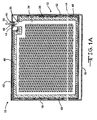
- FIG. 1 an electrochemical cell 10 of either a primary or secondary, rechargeable chemistry is shown.
- the cell 10 is comprised of a conductive casing 12 having first and second opposed major face walls 14 and 16 joined to a surrounding side wall 18.
- the face walls 14, 16 and surrounding side wall 18 form an open ended container that receives an electrode assembly 20, as will be described hereinafter.
- the open ended container housing the electrode assembly is then closed by a lid 42.
- the casing and lid may be comprised of materials such as stainless steel, mild steel, nickel-plated mild steel, titanium, tantalum or aluminum, but not limited thereto, so long as the metallic material is compatible for use with the other cell components.
- the casing lid 42 is typically provided with a first opening to accommodate a glass-to-metal seal/terminal pin feedthrough and a second opening for electrolyte filling.
- the electrode assembly or electrode stack 20 comprises a cathode 22 and an anode 24 housed within the casing 12.
- the cathode 22 is comprised of opposed plates 26 of cathode active material sandwiching a cathode current collector 34.
- Suitable cathode active materials include fluorinated carbon, silver vanadium oxide, copper silver vanadium oxide, Ag 2 O, Ag 2 O 2 , CuF 2 , Ag 2 CrO 4 , MnO 2 , V 2 O 5 , MnO 2 , TiS 2 , Cu 2 S, FeS, FeS 2 , copper oxide, copper vanadium oxide, and mixtures thereof.
- Suitable cathode current collector materials are selected from the group consisting of stainless steel, titanium, tantalum, platinum, gold, aluminum, cobalt nickel alloys, nickel-containing alloys, highly alloyed ferritic stainless steel containing molybdenum and chromium, and nickel-, chromium- and molybdenum-containing alloys.
- the anode 24 is comprised of a plate 28 of anode active material contacting one side of an anode current collector 30.
- the other, bare side of the anode current collector 30 resides adjacent to the casing major face wall 14. That's because only anode material directly facing the cathode participates in cell discharge.
- lithium and its alloys and intermetallic compounds for example, Li-Si, Li-Al, Li-B and Li-Si-B alloys, are preferred for the anode active material.
- the anode is of a carbonaceous material, for example graphite, that is capable of intercalating and deintercalating lithium ions.
- the anode is a thin metal sheet or foil of lithium metal or graphite, pressed or rolled on a metallic anode current collector selected from titanium, titanium alloy, nickel, copper, tungsten or tantalum.
- the anode current collector 30 includes a grounding tab 32 that is joined to the major face wall 14 of the casing 12.
- the cathode current collector 34 also includes a tab 36 that is joined to a terminal pin 38.
- the positive terminal pin 38 is typically of molybdenum.
- An insulative seal 40 surrounds the terminal pin 38 where it passes through the first opening in the lid 42, sealing the terminal pin 38 and isolating it from electrical contact with the casing 12.
- Seal 40 is preferably a glass-to-metal seal comprised of a ferrule 44 joined to the lid 42, and a bead 46 of fused glass bonded within the annulus between the ferrule 44 and the terminal pin 38.
- the ferrule 44 can be made of titanium although molybdenum, aluminum, nickel alloy and stainless steel are also suitable.
- the glass is of a corrosion resistant type having up to about 50% by weight silicon such as CABAL 12, TA 23, FUSITE 425 or FUSITE 435.
- the cell 10 shown in FIG. 1 is of a case-negative design, it is to be understood that the present invention is also applicable to cells of a case-positive design.
- Cell 10 is further comprised of a first separator enveloping at least one of the cathode 22 and the anode 24.
- the separator 48 envelopes the cathode plates 26, thereby insulating them from direct physical contact with the anode plate 28 and the negative polarity casing 12.
- the cell 10 may further include a second separator 50 enclosing the anode plate 28.
- the separators 48, 50 are of an electrically insulative material that is chemically unreactive with the anode and cathode active materials and both chemically unreactive with and insoluble in the electrolyte.
- the separator material has a degree of porosity sufficient to allow flow there through of the electrolyte during the electrochemical reaction of the cell.
- Illustrative separator materials include fabrics woven from fluoropolymeric fibers including polyvinylidine fluoride, polyethylenetetrafluoroethylene, and polyethylenechlorotrifluoroethylene used either alone or laminated with a fluoropolymeric microporous film, non-woven glass, polypropylene, polyethylene, glass fiber materials, ceramics, polytetrafluoroethylene membrane commercially available under the designation ZITEX (Chemplast Inc.), polypropylene membrane commercially available under the designation CELGARD (Celanese Plastic Company, Inc.) and a membrane commercially available under the designation DEXIGLAS (C. H. Dexter, Div., Dexter Corp.).
- fluoropolymeric fibers including polyvinylidine fluoride, polyethylenetetrafluoroethylene, and polyethylenechlorotrifluoroethylene used either alone or laminated with a fluoropolymeric microporous film, non-woven glass, polypropylene, polyethylene, glass fiber materials
- the cell 10 is thereafter filled with the electrolyte solution and hermetically sealed such as by close-welding a stainless steel ball over the second opening in the lid 42 serving as a fill-hole.
- the electrolyte serves as a medium for migration of ions between the anode 24 and the cathode 22 during the electrochemical reactions of the cell.
- electrochemical reaction at the electrodes involves conversion of ions in atomic or molecular forms which migrate from the anode 24 to the cathode 22.
- a suitable electrolyte has an inorganic, ionically conductive salt dissolved in a nonaqueous solvent, and more preferably, the electrolyte includes an ionizable lithium salt dissolved in a mixture of aprotic organic solvents comprising a low viscosity solvent and a high permittivity solvent.
- the inorganic, ionically conductive salt serves as the vehicle for migration of the anode ions to intercalate or react with the cathode active materials.
- Suitable lithium salts include LiPF 6 , LiBF 4 , LiA 5 F 6 , LiSbF 6 , LiClO 4 , LiO 2 , LiAlCl 4 , LiGaCl 4 , LiC(SO 2 CF 3 ) 3 , LiN(SO 2 CF 3 ) 2 , LiSCN, LiO 3 SCF 3 , LiC 6 F 5 SO 3 , LiO 2 CCF 3 , LiSO 6 F, LiB(C 6 H 5 ) 4 , LiCF 3 SO 3 , and mixtures thereof.
- Low viscosity solvents useful with the present invention include esters, linear and cyclic ethers and dialkyl carbonates such as tetrahydrofuran (THF), methyl acetate (MA), diglyme, trigylme, tetragylme, dimethyl carbonate (DMC), 1,2-dimethoxyethane (DME), 1,2-diethoxyethane (DEE), 1-ethoxy,2-methoxyethane (EME), ethyl methyl carbonate (EMC), methyl propyl carbonate, ethyl propyl carbonate, diethyl carbonate (DEC), dipropyl carbonate, and mixtures thereof, and high permittivity solvents include cyclic carbonates, cyclic esters and cyclic amides such as propylene carbonate (PC), ethylene carbonate (EC), butylene carbonate, acetonitrile, dimethyl sulfoxide, dimethyl formamide, dimethyl acetamide, ⁇ -val
- a stack holder 52 surrounds the electrode assembly 20.
- the stack holder 52 is formed as a bag that encloses or envelopes the electrode assembly 20 to maintain proper face-to-face electrochemical alignment between the anode and cathode plates.
- the stack holder 52 covers the outwardly facing side walls of the electrode assembly as well as the opposed ends adjacent to the casing bottom wall 18 and the lid 42.
- the stack holder may alternatively be formed as a band 54 disposed in an encircling relationship with a portion of the electrode assembly 20.
- the term "encircling” is meant to indicate that the stack holder is disposed around a portion of the perimeter of the electrode assembly 20 in an orientation such that it holds the two or more electrode plates in a constrictive, face-to-face alignment as the cell is discharged, as indicated by arrows 56 and 58 shown in FIGs. 1, 1A, 2 to 2B and 3 .
- the function of the stack holder is to maintain proper face-to-face electrochemical alignment between the anode and cathode plates.
- FIG. 2 illustrates the electrode assembly 20 comprising the cathode 22 and anode 24 being aligned in a face-to-face relationship suitable for acceptable electrochemical discharge.
- the electrode assembly 20 has a total height H 1 determined by measuring the cathode 22 and anode 24 from adjacent to the bottom wall 18 of the casing to adjacent the lid 42.
- the stack holder 54 encircles the circumference of the electrode assembly 20 and has a height H 2 that is at least 5% of H 1 to a maximum of 100% of H 1 .
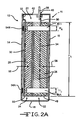
- FIG. 2A illustrates another embodiment of cell 11 where stack holder 54 has been replaced by stack holders 54A and 54B.
- Stack holder 54A has a height H 3 and encircles the circumference of the electrode assembly 20 adjacent to the casing bottom wall 18 while stack holder 54B has a height H 4 and encircles the circumference of the electrode assembly adjacent to the lid 42.
- the respective heights H 3 and H 4 of the stack holders 54A and 54B can be less than the height of H 2 of stack holder 54 shown in FIG. 2 as long as their cumulative heights H 3 + H 4 are at least 5% of the height H 1 of the electrode assembly.
- Stack holders 54A and 54B can have the same or different heights.
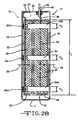
- FIG. 2B illustrates still another embodiment of cell 11 where stack holders 54 is supplemented with additional stack holders 54A and 54B.
- the stack holder 54A encircles the circumference of the electrode assembly adjacent to the bottom wall 18 of the casing while stack holder 54B encircles the circumference of the electrode assembly adjacent to the lid 42.
- the cumulative heights H 2 , H 3 and H 4 of the respective stack holders 54, 54A and 54B are preferably at least 5% of the height H 1 of the electrode assembly.
- the stack holders 52, 54, 54A and 54B may be made of the same materials used for the separators 48 and 50.
- the holder material is an elastic material capable of accommodating an initial expansion of the cathode that may occur at the early stage of cell discharge, and subsequent shrinkage of the electrode stack 20 during later stages of cell discharge.
- the term elastic is defined as a material that is capable of quickly recovering its original size and shape after a deformation force is removed.
- Suitable materials that are also useful for the stack holders 52, 54, 54A and 54B are the same materials that are used for separators 48, 50 and include fabrics woven from fluoropolymeric fibers including polyvinylidine fluoride, polyethylenetetrafluoroethylene, and polyethylenechlorotrifluoroethylene used either alone or laminated with a fluoropolymeric microporous film, non-woven glass, polypropylene, polyethylene, glass fiber materials, ceramics, polytetrafluoroethylene membrane commercially available under the designation ZITEX (Chemplast Inc.), polypropylene membrane commercially available under the designation CELGARD (Celanese Plastic Company, Inc.) and a membrane commercially available under the designation DEXIGLAS (C. H. Dexter, Div., Dexter Corp.). These materials can be provided in a bi-layer or tri-layer construction. An example is a tri-layer polymeric material of polypropylene/polyethylene/polyethylene (PP/PE/PE).
- the stack holder material may be wrapped around the electrode assembly and held under tension in a fixture to provide constrictive forces against the electrode plates 26 and 28.
- the stack holder material may be heat sealed in a manner similar to that used to fabricate individual electrode plate separators 48 and 50.
- the stack holders may also be made from non-porous materials that are not typically used to construct cell separators. Examples are polyimide tape and polypropylene tape. The difference between these tapes and the previously mentioned separator materials is that the former are non-porous and contain adhesives.
- the term "porous" refers to a material that has sufficient permeability to permit an acceptable degree of ion flow there through to support electrochemical discharge.
- a non-porous material may have some permeability, but not to a degree sufficient to permit ion flow to sustain an electrochemical discharge.
- either or both of the anode and cathode may be comprised of a plurality of plates of their respective electrode active materials. Each of the respective plates of electrode active material may be enveloped in its own separator, with the entire electrode assembly being further encircled by an elastic stack holder.
- FIG. 3 One exemplary cell comprised of multiple electrode plates is shown in FIG. 3 .
- Cell 13 is built in a case-negative design having a cathode 22 comprised of a cathode plate 26 disposed at an intermediate location between an anode 24 comprised of a first anode plate 28A contacting one side of an anode current collector 30A and a second anode plate 28B contacting one side of a second anode current collector 30B.
- the anode plates 28A, 28B face the central cathode plates 26 because only anode active material directly opposite cathode active material participates in electrochemical discharge.
- the stack holder 62 applies constrictive forces indicated by arrows 56 and 58 against electrode plates 26, 28A and 28B, thereby maintaining proper face-to-face electrochemical alignment between the plates during cell discharge. It will be apparent that cell 13 may be comprised of additional plates of anode and cathode active material compressed or constricted into face-to-face alignment by the stack holder 62.
- Electrode plate used herein is meant to indicate any structure of electrode active material that is alignable in a substantially face-to-face orientation or alignment with one or more adjacent portions of an opposite polarity electrode active material.
- Fig. 4 is a cross-sectional view of a freshly built electrochemical cell 15 that has not yet been discharged.
- the cell is comprised of single anode and cathode plates forming the electrode assembly.
- the electrodes are held in proper face-to-face electrochemical alignment with each other by joining their respective elastic separators together.
- cell 15 is similar in construction to the cell 10 of FIGs. 1 and 1A , except the stack holder that encircles the electrode assembly 20 has been removed. Instead, constrictive forces between the face-to-face opposite polarity electrodes are provided along the perimeter of the separators 48 and 50 where they contact each other. Electrode plates 26 and 28 are held in close contact with each other by joining their respective separators 48 and 50 to each other.
- separators 48, 50 are made of an elastic material, that portion of each separator lying against a major face wall of the anode and cathode tends to pull or constrict that electrode toward the other. This is possible because the separators are provided in a stretched state in comparison to a relaxed, non-deformed condition. Separators 48 and 50 may be joined intermittently along portions of their respective perimeters that contact each other, or along the entire perimeter of contact.
- separators 48 and 50 are joined to each other by a heat seal 60.
- heat seal 60 is depicted as being relatively thick compared to respective electrode plates 26 and 28. It is to be understood that the respective separators 48 and 50 for electrodes 26 and 28 are in closer contact with each other than is shown in FIG. 4 , and this contact relationship is maintained throughout the cell discharge. Regardless whether the stack holder is an envelope as shown in FIGs. 1 and 1A , at least one band-type structure as shown in FIGS.
- the opposite polarity electrodes must be close enough to each other to ensure that electrolyte wets the entire interface between them by capillary action. This must persist through the discharge life of the cell and is the primary purpose of the stack holder.
- an electrochemical cell is provided with a stack holder that surrounds the electrode assembly or stack thereof.
- the stack holder maintains the desired face-to-face electrical alignment between the opposite polarity electrode plates as the cell is discharged.
- An aspect of the invention provides a method for providing an electrochemical cell, comprising the steps:
- the method may include providing the stack holder as a bag enveloping the electrode assembly distinct from the separator.
- the method may include providing the stack holder as at least one band-type stack holder encircling a perimeter of the electrode assembly.
- the method may include providing the band-type stack holder encircling the electrode assembly having a height ranging from about 5% to 100% of a height of the electrode assembly.
- the method may include providing at least two band-type stack holders encircling the electrode assembly.
- the method may include providing one of the band-type stack holders encircling the electrode assembly adjacent to a bottom of the casing and the other encircling the electrode assembly adjacent to the lid.
- the method may include providing the at least two band-type stack holders encircling the electrode assembly having a cumulative height ranging from about 5% to 100% of a height of the electrode assembly.
- the method may include providing the at least two band-type stack holders encircling the electrode assembly having the same or different heights.
- the method may include providing the stack holder of an elastic material.
- the method may include selecting the stack holder from the group consisting of polyvinylidine fluoride, polyethylenetetrafluoroethylene, polyethylenechlorotrifluoroethylene, polytetrafluoroethylene, polypropylene, polyethylene, polyimide, glass fiber, ceramic fiber, and laminates thereof.
- the method may include providing the stack holder of either a porous or non-porous material.
Landscapes
- Engineering & Computer Science (AREA)
- Manufacturing & Machinery (AREA)
- Chemical & Material Sciences (AREA)
- Chemical Kinetics & Catalysis (AREA)
- Electrochemistry (AREA)
- General Chemical & Material Sciences (AREA)
- Secondary Cells (AREA)
- Cell Separators (AREA)
- Primary Cells (AREA)
- Connection Of Batteries Or Terminals (AREA)
Applications Claiming Priority (1)
| Application Number | Priority Date | Filing Date | Title |
|---|---|---|---|
| US97449607P | 2007-09-24 | 2007-09-24 |
Publications (3)
| Publication Number | Publication Date |
|---|---|
| EP2040322A2 true EP2040322A2 (de) | 2009-03-25 |
| EP2040322A3 EP2040322A3 (de) | 2009-06-10 |
| EP2040322B1 EP2040322B1 (de) | 2011-11-02 |
Family
ID=40032805
Family Applications (1)
| Application Number | Title | Priority Date | Filing Date |
|---|---|---|---|
| EP08165043A Not-in-force EP2040322B1 (de) | 2007-09-24 | 2008-09-24 | Elektrochemische Zelle mit fest umschlossener Elektrodenanordnung |
Country Status (2)
| Country | Link |
|---|---|
| US (1) | US20090081552A1 (de) |
| EP (1) | EP2040322B1 (de) |
Cited By (1)
| Publication number | Priority date | Publication date | Assignee | Title |
|---|---|---|---|---|
| FR3109026A1 (fr) * | 2020-04-07 | 2021-10-08 | Saft | Elément électrochimique pour batterie et batterie correspondante |
Families Citing this family (13)
| Publication number | Priority date | Publication date | Assignee | Title |
|---|---|---|---|---|
| CA2661469A1 (en) * | 2008-04-11 | 2009-10-11 | Andre Foucault | Leg rehabilitation apparatus |
| US8580439B1 (en) * | 2008-09-22 | 2013-11-12 | Greatbatch Ltd. | Insulator component design for maintaining electrode assembly compression in prismatic medical cells |
| US8405956B2 (en) * | 2009-06-01 | 2013-03-26 | Avx Corporation | High voltage electrolytic capacitors |
| US8605411B2 (en) | 2010-09-16 | 2013-12-10 | Avx Corporation | Abrasive blasted conductive polymer cathode for use in a wet electrolytic capacitor |
| US8514547B2 (en) | 2010-11-01 | 2013-08-20 | Avx Corporation | Volumetrically efficient wet electrolytic capacitor |
| US8259435B2 (en) | 2010-11-01 | 2012-09-04 | Avx Corporation | Hermetically sealed wet electrolytic capacitor |
| US9899655B2 (en) * | 2012-09-14 | 2018-02-20 | Greatbatch Ltd. | Electrochemical current collector screen designs utilizing ultrasonic welding |
| GB2512486B (en) | 2013-03-15 | 2018-07-18 | Avx Corp | Wet electrolytic capacitor |
| GB2512481B (en) | 2013-03-15 | 2018-05-30 | Avx Corp | Wet electrolytic capacitor for use at high temperatures |
| CN116706239A (zh) | 2016-12-02 | 2023-09-05 | 株式会社半导体能源研究所 | 蓄电装置及电子设备 |
| US20200358067A1 (en) * | 2019-05-06 | 2020-11-12 | Battelle Memorial Institute | Batteries and Battery Manufacture Methods |
| EP3893322A4 (de) | 2019-10-29 | 2022-01-26 | Lg Energy Solution, Ltd. | Sekundärbatterie |
| DE102020112801A1 (de) * | 2020-05-12 | 2021-11-18 | Bayerische Motoren Werke Aktiengesellschaft | Verfahren zur Detektion von Feinschlüssen, Teststand und Fertigungslinie |
Citations (12)
| Publication number | Priority date | Publication date | Assignee | Title |
|---|---|---|---|---|
| US5580676A (en) | 1993-08-17 | 1996-12-03 | Sony Corporation | Rectangular battery |
| JPH09161759A (ja) | 1995-12-05 | 1997-06-20 | Nissan Motor Co Ltd | セパレータ |
| JPH1064506A (ja) | 1996-08-19 | 1998-03-06 | Shin Kobe Electric Mach Co Ltd | 角形電池 |
| JPH10172565A (ja) | 1996-12-11 | 1998-06-26 | Mitsubishi Cable Ind Ltd | シート状リチウム二次電池 |
| EP0924779A1 (de) | 1997-12-19 | 1999-06-23 | Sony Corporation | Sekundärbatterie mit nichtwässrigem Elektrolyten |
| US6383234B1 (en) | 1999-04-09 | 2002-05-07 | Samsung Sdi Co., Ltd. | Method of manufacturing a prismatic lithium secondary battery |
| US20030113618A1 (en) | 2001-12-18 | 2003-06-19 | Ntk Powerdex, Inc. | Li-ion and/or Li-ion polymer battery with edge protectors |
| US20030232243A1 (en) | 2002-06-12 | 2003-12-18 | Ji-Jun Hong | Method for treating electrode tabs of crude cell for lithium secondary battery, and crude cell and lithium secondary battery according to the method |
| US20050058888A1 (en) | 2003-09-12 | 2005-03-17 | Aamodt Paul B. | Lithium-limited anode subassembly |
| US20060093902A1 (en) | 2004-09-24 | 2006-05-04 | Lee Jin U | Lithium secondary battery and method for manufacturing the same |
| US20060099496A1 (en) | 2004-10-29 | 2006-05-11 | Aamodt Paul B | Separator container |
| EP1717879A1 (de) | 2005-04-26 | 2006-11-02 | Samsung SDI Co., Ltd. | Batterie |
Family Cites Families (8)
| Publication number | Priority date | Publication date | Assignee | Title |
|---|---|---|---|---|
| US4086401A (en) * | 1975-12-17 | 1978-04-25 | Aktiebolaget Tudor | Electric storage battery separator |
| FR2754393A1 (fr) * | 1996-10-03 | 1998-04-10 | Accumulateurs Fixes | Dispositif d'introduction et de maintien d'un faisceau d'electrodes dans un conteneur de generateur electrochimique |
| US6180281B1 (en) * | 1997-12-12 | 2001-01-30 | Johnson Research & Development Company, Inc. | Composite separator and electrode |
| EP0935305B1 (de) * | 1998-02-06 | 2011-07-27 | Hoppecke Batterie Systeme GmbH | Elektrodenanordnung für Nickel-Cadmium-Akkumulatoren und Verfahren zu ihrer Herstellung |
| US6376095B1 (en) * | 1998-06-11 | 2002-04-23 | The Dow Chemical Company | Elastic films made from alpha-olefin/vinyl aromatic and/or aliphatic or cycloaliphatic vinyl or vinylidene interpolymers |
| US6727017B1 (en) * | 2001-04-06 | 2004-04-27 | Changs Ascending Enterprise Co., Ltd. | Methods of fabricating binding layers for a Li-ion polymer battery |
| JP4652942B2 (ja) * | 2005-10-05 | 2011-03-16 | セイコーインスツル株式会社 | 携帯時計 |
| JP4920957B2 (ja) * | 2005-11-21 | 2012-04-18 | Necエナジーデバイス株式会社 | 積層型リチウムイオンポリマー電池 |
-
2008
- 2008-09-23 US US12/235,686 patent/US20090081552A1/en not_active Abandoned
- 2008-09-24 EP EP08165043A patent/EP2040322B1/de not_active Not-in-force
Patent Citations (12)
| Publication number | Priority date | Publication date | Assignee | Title |
|---|---|---|---|---|
| US5580676A (en) | 1993-08-17 | 1996-12-03 | Sony Corporation | Rectangular battery |
| JPH09161759A (ja) | 1995-12-05 | 1997-06-20 | Nissan Motor Co Ltd | セパレータ |
| JPH1064506A (ja) | 1996-08-19 | 1998-03-06 | Shin Kobe Electric Mach Co Ltd | 角形電池 |
| JPH10172565A (ja) | 1996-12-11 | 1998-06-26 | Mitsubishi Cable Ind Ltd | シート状リチウム二次電池 |
| EP0924779A1 (de) | 1997-12-19 | 1999-06-23 | Sony Corporation | Sekundärbatterie mit nichtwässrigem Elektrolyten |
| US6383234B1 (en) | 1999-04-09 | 2002-05-07 | Samsung Sdi Co., Ltd. | Method of manufacturing a prismatic lithium secondary battery |
| US20030113618A1 (en) | 2001-12-18 | 2003-06-19 | Ntk Powerdex, Inc. | Li-ion and/or Li-ion polymer battery with edge protectors |
| US20030232243A1 (en) | 2002-06-12 | 2003-12-18 | Ji-Jun Hong | Method for treating electrode tabs of crude cell for lithium secondary battery, and crude cell and lithium secondary battery according to the method |
| US20050058888A1 (en) | 2003-09-12 | 2005-03-17 | Aamodt Paul B. | Lithium-limited anode subassembly |
| US20060093902A1 (en) | 2004-09-24 | 2006-05-04 | Lee Jin U | Lithium secondary battery and method for manufacturing the same |
| US20060099496A1 (en) | 2004-10-29 | 2006-05-11 | Aamodt Paul B | Separator container |
| EP1717879A1 (de) | 2005-04-26 | 2006-11-02 | Samsung SDI Co., Ltd. | Batterie |
Cited By (2)
| Publication number | Priority date | Publication date | Assignee | Title |
|---|---|---|---|---|
| FR3109026A1 (fr) * | 2020-04-07 | 2021-10-08 | Saft | Elément électrochimique pour batterie et batterie correspondante |
| WO2021204842A1 (fr) * | 2020-04-07 | 2021-10-14 | Saft | Elément électrochimique pour batterie et batterie correspondante |
Also Published As
| Publication number | Publication date |
|---|---|
| EP2040322A3 (de) | 2009-06-10 |
| EP2040322B1 (de) | 2011-11-02 |
| US20090081552A1 (en) | 2009-03-26 |
Similar Documents
| Publication | Publication Date | Title |
|---|---|---|
| EP2040322B1 (de) | Elektrochemische Zelle mit fest umschlossener Elektrodenanordnung | |
| US8580439B1 (en) | Insulator component design for maintaining electrode assembly compression in prismatic medical cells | |
| US8153293B2 (en) | Sandwich cathode electrochemical cell with wound electrode assembly | |
| US6737191B2 (en) | Double current collector negative electrode design for alkali metal ion electrochemical cells | |
| AU728179B2 (en) | Electrochemical cell having multiplate and jellyroll electrodes with differing discharge rate regions | |
| US5716728A (en) | Alkali metal electrochemical cell with improved energy density | |
| US6641953B2 (en) | Secondary cell with high rate pulse capability | |
| US6727022B2 (en) | Powder process for double current collector screen cathode preparation | |
| US6541140B1 (en) | Electrochemical lithium ion secondary cell having multiplate electrodes with differing discharge rate regions | |
| JP2000348768A (ja) | 再充電可能な電気化学電池における非水性電解液のための硝酸エステル添加剤 | |
| EP2802026B1 (de) | Innenisolierungsdesign mit porösem Material für eine elektrochemische Zelle | |
| US7022146B2 (en) | Method for providing a hermetically sealed coin cell | |
| US10038220B2 (en) | Nonaqueous electrolyte for lithium battery safety | |
| EP3958391A1 (de) | Anschlussstift für glas-metall-dichtung für eine elektrochemische zelle | |
| EP1318555B1 (de) | Positive Elektrodenanordnung mit doppeltem Stromkollektor für elektrochemische Alkalimetallionen-Zellen | |
| US6623884B1 (en) | Electrochemical lithium ion secondary cell having multiplate and jellyroll electrodes with differing discharge rate regions | |
| EP0989624A1 (de) | Lithiumsekundärbatterie mit niedrigem magnetischen Suszeptibilitätmaterial | |
| US7108942B1 (en) | Efficient electrode assembly design for cells with alkali metal anodes | |
| US6801016B2 (en) | Matching cells for a battery pack | |
| US7273674B1 (en) | Primary electrochemical cell having scalloped electrodes | |
| US9325029B1 (en) | Lithium battery having irregularly shaped casing | |
| EP1324418A1 (de) | Wiederaufladbare Batterie mit hoher Energiedichte für die Anwendung in medizinischen Geräten | |
| EP1914823A1 (de) | Hybridkathodenentwurf für eine elektrochemische Zelle |
Legal Events
| Date | Code | Title | Description |
|---|---|---|---|
| PUAI | Public reference made under article 153(3) epc to a published international application that has entered the european phase |
Free format text: ORIGINAL CODE: 0009012 |
|
| AK | Designated contracting states |
Kind code of ref document: A2 Designated state(s): AT BE BG CH CY CZ DE DK EE ES FI FR GB GR HR HU IE IS IT LI LT LU LV MC MT NL NO PL PT RO SE SI SK TR |
|
| AX | Request for extension of the european patent |
Extension state: AL BA MK RS |
|
| PUAL | Search report despatched |
Free format text: ORIGINAL CODE: 0009013 |
|
| AK | Designated contracting states |
Kind code of ref document: A3 Designated state(s): AT BE BG CH CY CZ DE DK EE ES FI FR GB GR HR HU IE IS IT LI LT LU LV MC MT NL NO PL PT RO SE SI SK TR |
|
| AX | Request for extension of the european patent |
Extension state: AL BA MK RS |
|
| 17P | Request for examination filed |
Effective date: 20091127 |
|
| 17Q | First examination report despatched |
Effective date: 20091230 |
|
| AKX | Designation fees paid |
Designated state(s): DE FR IT SE |
|
| REG | Reference to a national code |
Ref country code: DE Ref legal event code: R079 Ref document number: 602008011035 Country of ref document: DE Free format text: PREVIOUS MAIN CLASS: H01M0006160000 Ipc: H01M0010052000 |
|
| GRAP | Despatch of communication of intention to grant a patent |
Free format text: ORIGINAL CODE: EPIDOSNIGR1 |
|
| RIC1 | Information provided on ipc code assigned before grant |
Ipc: H01M 10/058 20100101ALI20110218BHEP Ipc: H01M 10/052 20100101AFI20110218BHEP |
|
| GRAS | Grant fee paid |
Free format text: ORIGINAL CODE: EPIDOSNIGR3 |
|
| GRAA | (expected) grant |
Free format text: ORIGINAL CODE: 0009210 |
|
| AK | Designated contracting states |
Kind code of ref document: B1 Designated state(s): DE FR IT SE |
|
| REG | Reference to a national code |
Ref country code: DE Ref legal event code: R096 Ref document number: 602008011035 Country of ref document: DE Effective date: 20120105 |
|
| PG25 | Lapsed in a contracting state [announced via postgrant information from national office to epo] |
Ref country code: SE Free format text: LAPSE BECAUSE OF FAILURE TO SUBMIT A TRANSLATION OF THE DESCRIPTION OR TO PAY THE FEE WITHIN THE PRESCRIBED TIME-LIMIT Effective date: 20111102 |
|
| PG25 | Lapsed in a contracting state [announced via postgrant information from national office to epo] |
Ref country code: IT Free format text: LAPSE BECAUSE OF FAILURE TO SUBMIT A TRANSLATION OF THE DESCRIPTION OR TO PAY THE FEE WITHIN THE PRESCRIBED TIME-LIMIT Effective date: 20111102 |
|
| PLBE | No opposition filed within time limit |
Free format text: ORIGINAL CODE: 0009261 |
|
| STAA | Information on the status of an ep patent application or granted ep patent |
Free format text: STATUS: NO OPPOSITION FILED WITHIN TIME LIMIT |
|
| 26N | No opposition filed |
Effective date: 20120803 |
|
| REG | Reference to a national code |
Ref country code: DE Ref legal event code: R097 Ref document number: 602008011035 Country of ref document: DE Effective date: 20120803 |
|
| REG | Reference to a national code |
Ref country code: FR Ref legal event code: ST Effective date: 20130531 |
|
| PG25 | Lapsed in a contracting state [announced via postgrant information from national office to epo] |
Ref country code: FR Free format text: LAPSE BECAUSE OF NON-PAYMENT OF DUE FEES Effective date: 20121001 |
|
| PGFP | Annual fee paid to national office [announced via postgrant information from national office to epo] |
Ref country code: DE Payment date: 20130918 Year of fee payment: 6 |
|
| REG | Reference to a national code |
Ref country code: DE Ref legal event code: R119 Ref document number: 602008011035 Country of ref document: DE |
|
| PG25 | Lapsed in a contracting state [announced via postgrant information from national office to epo] |
Ref country code: DE Free format text: LAPSE BECAUSE OF NON-PAYMENT OF DUE FEES Effective date: 20150401 |