EP2042083A2 - Type de détecteur de type à collier pour des informations électrocardiographiques et de température - Google Patents
Type de détecteur de type à collier pour des informations électrocardiographiques et de température Download PDFInfo
- Publication number
- EP2042083A2 EP2042083A2 EP08009012A EP08009012A EP2042083A2 EP 2042083 A2 EP2042083 A2 EP 2042083A2 EP 08009012 A EP08009012 A EP 08009012A EP 08009012 A EP08009012 A EP 08009012A EP 2042083 A2 EP2042083 A2 EP 2042083A2
- Authority
- EP
- European Patent Office
- Prior art keywords
- electrocardiographic
- signal
- detector according
- detector
- electrode
- Prior art date
- Legal status (The legal status is an assumption and is not a legal conclusion. Google has not performed a legal analysis and makes no representation as to the accuracy of the status listed.)
- Withdrawn
Links
Images


Classifications
-
- A—HUMAN NECESSITIES
- A61—MEDICAL OR VETERINARY SCIENCE; HYGIENE
- A61B—DIAGNOSIS; SURGERY; IDENTIFICATION
- A61B5/00—Measuring for diagnostic purposes; Identification of persons
- A61B5/02—Detecting, measuring or recording for evaluating the cardiovascular system, e.g. pulse, heart rate, blood pressure or blood flow
- A61B5/0205—Simultaneously evaluating both cardiovascular conditions and different types of body conditions, e.g. heart and respiratory condition
- A61B5/02055—Simultaneously evaluating both cardiovascular condition and temperature
-
- A—HUMAN NECESSITIES
- A61—MEDICAL OR VETERINARY SCIENCE; HYGIENE
- A61B—DIAGNOSIS; SURGERY; IDENTIFICATION
- A61B5/00—Measuring for diagnostic purposes; Identification of persons
- A61B5/24—Detecting, measuring or recording bioelectric or biomagnetic signals of the body or parts thereof
- A61B5/25—Bioelectric electrodes therefor
- A61B5/279—Bioelectric electrodes therefor specially adapted for particular uses
- A61B5/28—Bioelectric electrodes therefor specially adapted for particular uses for electrocardiography [ECG]
- A61B5/282—Holders for multiple electrodes
-
- A—HUMAN NECESSITIES
- A61—MEDICAL OR VETERINARY SCIENCE; HYGIENE
- A61B—DIAGNOSIS; SURGERY; IDENTIFICATION
- A61B5/00—Measuring for diagnostic purposes; Identification of persons
- A61B5/41—Detecting, measuring or recording for evaluating the immune or lymphatic systems
- A61B5/411—Detecting or monitoring allergy or intolerance reactions to an allergenic agent or substance
-
- A—HUMAN NECESSITIES
- A61—MEDICAL OR VETERINARY SCIENCE; HYGIENE
- A61B—DIAGNOSIS; SURGERY; IDENTIFICATION
- A61B5/00—Measuring for diagnostic purposes; Identification of persons
- A61B5/68—Arrangements of detecting, measuring or recording means, e.g. sensors, in relation to patient
- A61B5/6801—Arrangements of detecting, measuring or recording means, e.g. sensors, in relation to patient specially adapted to be attached to or worn on the body surface
- A61B5/6813—Specially adapted to be attached to a specific body part
- A61B5/6822—Neck
-
- A—HUMAN NECESSITIES
- A61—MEDICAL OR VETERINARY SCIENCE; HYGIENE
- A61B—DIAGNOSIS; SURGERY; IDENTIFICATION
- A61B5/00—Measuring for diagnostic purposes; Identification of persons
- A61B5/0002—Remote monitoring of patients using telemetry, e.g. transmission of vital signals via a communication network
- A61B5/0015—Remote monitoring of patients using telemetry, e.g. transmission of vital signals via a communication network characterised by features of the telemetry system
- A61B5/0022—Monitoring a patient using a global network, e.g. telephone networks, internet
Definitions
- a physiological signal recording system having no lead wire, easy to operate, monitor and detection at any time and accurate analysis can be achieved.
- the system can be used on the evaluation of sleeping quality for normal person and patients having diseases and applicable for diagnosis of long term patients having sleep obstacle.
- the system can be used on efficiency valuation of long term sleeping pills and other pharmaceuticals with respect to sleeping and side effect on self-neurological function, and health care with respect to sleep and the alteration of self neurological function, and other alternative of various health product, on the valuation on old age body, and sleeping problem of newborn babies.
- heart catch also called cardiac catheterization
- a method shown blood vessels of the heart and the inside of the heart as it pumps needs to put a catheter into artery then guided into the heart. It increases the accuracy for diagnosis and also increases the risk in the course of a surgery and the patient should endure the pain.
- non-invasive method is much safer as compared to an invasive method. This is due to the indirect detection method which cannot obtain accurate signal for medical use.
- Heart rate variability (HRV) analysis ( Anonymous 1996, Circulation 93: 1043-1065 . ) represents a good example for non-invasive diagnosis, which detects the skin surface voltage variability and processes those signals to estimate of the function of the sympathetic and parasympathetic autonomic nervous systems in patients.
- HRV heart rate variability
- This technique has been successfully applied on analysis of cardiovascular fluctuations during pentobarbital anesthesia ( Yang et al. 1996, American Journal of Physiology 270:H575-H582 .), brain death determining ( Kuo et al.
- the non-invasive diagnosis technique mainly consists two parts, the first one is a detector and the other one is a signal processing unit.
- the detector is the most important part in this field for the reason that, without a suitable detector, no accurate signal could be obtained and the further, signal procession is useless, or if the detector is difficult to apply on a patient, and the patient feels uncomfortable to use the invasive one.
- it is important to develop a non-invasive diagnosis technique for which a detector is accurate, comfortable to be applied on a patient and is user friendly.
- ECG electrocardiography
- a non-invasive detector become a daily-use necklace on wearing a subject and such detector is designed to express an article with beautiful outlook together with a user can use the detector under quiet condition or can fix the detector for a duration, such detector can enhance the practicability of non-invasive technology and can be worn a long time to achieve long term care.
- the present invention provides an non-adhering electrocardiographic and temperature signal detector comprising: (a) an electrocardiographic detecting working electrode, an electrocardiographic reference electrode and a temperature sensor connected together by a conduction chain; (b) a signal processing unit for processing those signals obtained from said electrode or sensor, (c) a wireless transceiver for sending and receiving processed signal of electrocardiographic to the receiver at a far end unit or receiving data from the far end unit; and (d) a power supply supplying power to the operation of the detector.
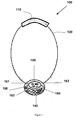
- Figure 1 shows an embodiment of necklace type of electrocardiographic and temperature signal detector of the present invention, wherein the electrocardiographic reference electrode is an independent conductive chain.
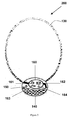
- Figure 2 shows an embodiment of necklace type of electrocardiographic and temperature signal detector of the present invention, wherein the electrocardiographic reference electrode and the conductive chain are formed as one unit.
- Figure 3 is a schematic view showing the detector being worn by user.
- Figure 4 is a schematic view showing the circuit design of the detector of the present invention.
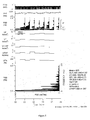
- FIG. 5 illustrates heart beat changes information by spectrum analysis of electrocardiographic signal detected by the detector of the present invention.
- the present invention relates to an necklace type of non-adhering electrocardiographic and temperature signal detector comprising: (a) an electrocardiographic detecting working electrode, an electrocardiographic reference electrode and a temperature sensor connected together by a conduction chain; (b) a signal processing unit for processing those signals obtained from said electrode or sensor, (c) a wireless transceiver for sending and receiving processed signal of electrocardiographic to the receiver at a far end unit or receiving data from the far end unit; and (d) a power supply supplying power to the operation of the detector.
- the electrocardiographic electrode and the electrocardiographic reference electrode are constructed into a two-electrode system.
- the electrocardiographic electrode detects surface voltage of a user's skin and electrocardiographic signal is compared with the surface voltage of the reference electrode at fixed potential. The detection can be obtained by direct contact with the skin or indirect sensing of the skin.
- the function of the reference electrode is used as a reference for amplified electrocardiographic signals.
- the chain used in this invention contains a conductive wire and is connected with a pendant, and the conductive chain and the pendant can be of various shapes.
- the electrocardiographic working electrode and the electrocardiographic reference electrode of this invention are placed separately on the conductive chain and on a pendant connected to the chain, wherein the electrode placed on the chain part is the chain per se or is a conductive plate on the chain.
- the electrode placed on the pendant is a conductive outer shell of said pendant or is placed at the interior of the conductive or non-conductive pendant.
- the conductive outer shell is made by metal or by plastic having processed on the surface thereof. For instance by electroplating or coating with conductive paint, graphite or carbon fiber or other conductor.
- the method of detecting by the detector is thermal resistance effect, thermistor, thermocouple, or any non-invasive electric-thermometer.
- the present signal processing unit of this invention comprises the detector wherein the signal processing unit comprising: (a) a signal amplifier; for amplify the electronic signal of the obtained electrocardiographic or temperature, (b) an electronic filter for screening the distorted signal detected; and (c) an analog-to-digital converter (ADC) to convert the analog signal to digital signal.
- the signal processing unit comprising: (a) a signal amplifier; for amplify the electronic signal of the obtained electrocardiographic or temperature, (b) an electronic filter for screening the distorted signal detected; and (c) an analog-to-digital converter (ADC) to convert the analog signal to digital signal.
- ADC analog-to-digital converter
- the wireless transceiver of this invention transmits signals through radio wave interface or infrared interface, wherein the radio wave interface is wireless, WLAN, INTEREST RATE, Bluetooth, RFID, GSM, PHS, CDMA or any other radio wave interface that can be used for electronic signal transmission.
- the radio wave interface is wireless, WLAN, INTEREST RATE, Bluetooth, RFID, GSM, PHS, CDMA or any other radio wave interface that can be used for electronic signal transmission.
- the power supply is a storage battery. Further the power supply is batteries.
- the signal processing unit of the present invention, wireless transceiver and the power supply are altogether or separately provided in one or more than one pendant.
- the detector further comprises a data storage unit for storing electronic physiological signal after being processed by the signal processing unit.
- the data storage unit is Random Access Memory (RAM) or any device for storing electrical signal.
- the size of the detector of the present invention likes a common necklace.
- the detector adopts non-adhering design to facilitate long-term wearing and to mitigate uncomfortable feeling when eletrocardiographic signal. Meanwhile, the detector could be designed as an article with beautiful and elegant outlook to increase the acceptability of a customer.
- the detector of the present invention is always worn on neck.
- the detector could be applied to other position such as limbs.
- FIG. 1 there is shown one embodiment of present invention, which is a non-adhering stuck necklace-type detector 100 having an electrocardiographic working electrode 140, a temperature sensor 150, a computing center 160 (contains signal processing unit 161, data storage unit 163, and wireless transceiver 164), a battery 162, and a reference electrode 110, wherein the former four components are placed within a pendant and the last component is a metal plate placed on a chain connecting the sensor 150.
- Figure 2 is another preferred embodiment of this invention which is slightly modification as compared to Figure 1 with respect to the reference electrode 130.
- the reference electrode 130 in Figure 2 is integrated into the chain.
- the working electrode 140 is an induction coil placed within the pedant.
- this detector 300 is worn on user's neck and the pendant hangs in front of chest. To perform a measurement, the user is asked to keep at a steady posture and the detector is in contact with the skin of the user for a few seconds. Then the electrocardiographic signal is obtained from detecting the chest surface the voltage of the surface of the chest by the working electrode 140, and the temperature information will be collected by the temperature sensor 150.
- an amplification device (a R.O.C. patent of the same inventor, patent No. 149299 , application date 1998/01/15) is used to amplify electrocardiographic signal detected by the working electrode and to obtain a useful wave pattern of the signal-to-noise ratio.
- the present invention has another function on body temperature measurement.
- the detection principle is the same as any commercial electric thermometer that detects a voltage change, a resistance change or a current change on the inner circuit of the sensor caused by heat transmission, and converts this information into electric signals
- FIG. 4 shows a diagram of the circuit design 400 of the present invention.
- the electrocardiographic signals obtained from the working electrode 140 first passes through an input filter 421 to enhance signal-to-noise ratio. Then, the signals are amplified by an amplifier 422 which uses the reference electrode 110 as a standard, and then the signals pass through an outpour filter 423 in order to facilitate the sampling.
- the body temperature signals also pass through a filter/amplify unit 424 to be filtered and amplified.
- ADC analog-to-digital converter
- micro arithmetic logic unit 432 a micro arithmetic logic unit 432
- modulator/demodulator 441 a modulator/demodulator 441 to further transmit the signals to a far-end computer through the wireless transceiver 164.
- the wireless transceiver 164 also can receive the feedback signal sent from the far-end receiver.
- a power supply 162 is used to supply power to this signal processing unit 410.
- IrDA Infrared Data Association
- IR port infrared port
- the computer program for HRV analysis was described in our previous publication ( Kuo et al. 1999, American Journal of Physiology 277: H2233-H2239 . ).
- QRS identification procedure the computer first detected all peaks of the digitized ECG signals using a spike detection algorithm similar to general QRS detection algorithms. Parameters such as amplitude and duration of all spikes were measured so that their means and standard deviations (SD) could be calculated as standard QRS templates.
- SD standard deviations
- Each QRS complex was then identified, and each ventricular premature complex or noise was rejected according to its likelihood in standard QRS templates.
- the R point of each valid QRS complex was defined as the time point of each heart beat, and the interval between two R points (R-R interval) was estimated as the interval between current and latter R points.
- R-R interval rejection procedure a temporary mean and SD of all R-R intervals were first calculated for standard reference. Each R-R interval was then validated: if the standard score of an R-R value exceeded 3, it was considered erroneous or nonstationary and was rejected. The average percentile of R-R rejection according to this procedure was 1.2%. The validated R-R values were subsequently resampled and interpolated at the rate of 7.11 Hz to accomplish the continuity in time domain.
- Frequency-domain analysis was performed using the nonparametric method of fast Fourier transform (FFT).
- FFT fast Fourier transform
- the direct current component was deleted, and a Hamming window was used to attenuate the leakage effect.
- the algorithm estimated the power spectral density on the basis of FFT.
- the resulting power spectrum was corrected for attenuation resulting from the sampling and the Hamming window.
- the power (TP) spectrum was subsequently quantified into various frequency-domain measurements as defined in Table 1.
- LF was normalized by the percentage of total power except for VLF (total power VLF) to detect sympathetic influence on HRV (LF%).
- HF HF
- the necklace-type non-adhering detector for electrocardiographic and temperature information measurement being representative of preferred embodiments, are exemplary, and are not intended as limitations on the scope of the invention. Modifications therein and other uses will occur to those skilled in the art. These modifications are encompassed within the spirit of the invention and are defined by the scope of the claims.
Landscapes
- Health & Medical Sciences (AREA)
- Life Sciences & Earth Sciences (AREA)
- Molecular Biology (AREA)
- Surgery (AREA)
- Biophysics (AREA)
- Pathology (AREA)
- Engineering & Computer Science (AREA)
- Biomedical Technology (AREA)
- Heart & Thoracic Surgery (AREA)
- Medical Informatics (AREA)
- Cardiology (AREA)
- Physics & Mathematics (AREA)
- Animal Behavior & Ethology (AREA)
- General Health & Medical Sciences (AREA)
- Public Health (AREA)
- Veterinary Medicine (AREA)
- Physiology (AREA)
- Pulmonology (AREA)
- Immunology (AREA)
- Vascular Medicine (AREA)
- Measuring And Recording Apparatus For Diagnosis (AREA)
- Measurement And Recording Of Electrical Phenomena And Electrical Characteristics Of The Living Body (AREA)
Applications Claiming Priority (1)
| Application Number | Priority Date | Filing Date | Title |
|---|---|---|---|
| TW096117164A TWI337536B (en) | 2007-05-15 | 2007-05-15 | Necklace type of detector for electrocardiographic and temperature information |
Publications (2)
| Publication Number | Publication Date |
|---|---|
| EP2042083A2 true EP2042083A2 (fr) | 2009-04-01 |
| EP2042083A3 EP2042083A3 (fr) | 2009-04-08 |
Family
ID=40028208
Family Applications (1)
| Application Number | Title | Priority Date | Filing Date |
|---|---|---|---|
| EP08009012A Withdrawn EP2042083A3 (fr) | 2007-05-15 | 2008-05-15 | Type de détecteur de type à collier pour des informations électrocardiographiques et de température |
Country Status (4)
| Country | Link |
|---|---|
| US (1) | US20080287768A1 (fr) |
| EP (1) | EP2042083A3 (fr) |
| JP (1) | JP2008284364A (fr) |
| TW (1) | TWI337536B (fr) |
Cited By (2)
| Publication number | Priority date | Publication date | Assignee | Title |
|---|---|---|---|---|
| WO2018097343A1 (fr) * | 2016-11-22 | 2018-05-31 | 주식회사 지인프로테크 | Capteur de sécurité de type collier |
| WO2021248742A1 (fr) * | 2020-06-08 | 2021-12-16 | 云南兆讯科技有限责任公司 | Bracelet de détection de température à double fréquence passive |
Families Citing this family (19)
| Publication number | Priority date | Publication date | Assignee | Title |
|---|---|---|---|---|
| US20130184517A1 (en) * | 2011-07-07 | 2013-07-18 | Ronda Collier | System and Method for Measuring and Controlling Stress |
| JP5979477B2 (ja) * | 2012-03-13 | 2016-08-24 | カシオ計算機株式会社 | 人体情報収集装置 |
| US9183738B1 (en) | 2012-04-19 | 2015-11-10 | iDevices, LLC | Wireless thermometer and method of use thereof |
| US20140114142A1 (en) * | 2012-10-19 | 2014-04-24 | Emanuel Shaoulian | Intelligent patient monitor pendant |
| US20140213881A1 (en) * | 2013-01-29 | 2014-07-31 | Perminova Inc. | Magnetically connected electrode for measuring physiological signals |
| US20140213880A1 (en) * | 2013-01-29 | 2014-07-31 | Perminova Inc. | Magnetically connected electrode for measuring physiological signals |
| US11141072B2 (en) | 2013-02-20 | 2021-10-12 | Baxter International Inc. | Necklace-shaped physiological monitor |
| US9211073B2 (en) * | 2013-02-20 | 2015-12-15 | Tosense, Inc. | Necklace-shaped physiological monitor |
| US20140235979A1 (en) * | 2013-02-20 | 2014-08-21 | Perminova Inc. | Necklace-shaped physiological monitor |
| TWI612984B (zh) * | 2013-05-30 | 2018-02-01 | 李後傑 | 一種對人體皮膚注入高中低週波之一訊號以量度皮膚對該訊號的阻抗之系統 |
| JP6354115B2 (ja) * | 2013-07-28 | 2018-07-11 | 株式会社大木工藝 | ネックレス |
| WO2015048502A1 (fr) * | 2013-09-27 | 2015-04-02 | Aegle, Llc | Moniteur physiologique et procédés pour le placer et le porter |
| US20150119765A1 (en) * | 2013-10-28 | 2015-04-30 | Jonathan Daniel Driscoll | Multi-Mode Massage Device Using Biofeedback |
| US9924902B2 (en) | 2014-09-11 | 2018-03-27 | Tosense, Inc. | Neck-worn physiological monitor |
| US11123020B2 (en) * | 2015-12-18 | 2021-09-21 | Baxter International Inc. | Neck-worn physiological monitor |
| IT201700078552A1 (it) * | 2017-07-13 | 2019-01-13 | D Heart S R L | Elettrocardiografo portatile |
| US20200029835A1 (en) * | 2018-07-24 | 2020-01-30 | Tosense, Inc. | Physiological sensor resembling a neck-worn collar |
| TWI784186B (zh) * | 2019-07-25 | 2022-11-21 | 倚天酷碁股份有限公司 | 穿戴式電子裝置與穿戴式電子裝置的組裝方法 |
| US11497427B2 (en) * | 2020-03-12 | 2022-11-15 | Biosense Webster (Israel) Ltd. | Adjusting annotation points in real time |
Family Cites Families (16)
| Publication number | Priority date | Publication date | Assignee | Title |
|---|---|---|---|---|
| US3972320A (en) * | 1974-08-12 | 1976-08-03 | Gabor Ujhelyi Kalman | Patient monitoring system |
| US4182315A (en) * | 1977-07-21 | 1980-01-08 | Diamond George A | Apparatus and method for detection of body tissue movement |
| FR2554704B1 (fr) * | 1983-11-10 | 1987-04-24 | Ascher Gilles | Appareil portatif de surveillance de l'activite cardiaque |
| EP0198905A1 (fr) * | 1984-10-30 | 1986-10-29 | THOMIS, Wendl | Collier de controle des battements du coeur |
| US4662378A (en) * | 1984-10-30 | 1987-05-05 | Wendl Thomis | Device for monitoring body signals |
| JPH09299343A (ja) * | 1996-05-17 | 1997-11-25 | Fukuda Denshi Co Ltd | 心電図情報収集装置及び心電図情報処理方法 |
| US6102856A (en) * | 1997-02-12 | 2000-08-15 | Groff; Clarence P | Wearable vital sign monitoring system |
| US6063036A (en) * | 1998-02-19 | 2000-05-16 | Li; Pao-Lang | Portable alarm apparatus for sudden heart attack patient |
| US7257438B2 (en) * | 2002-07-23 | 2007-08-14 | Datascope Investment Corp. | Patient-worn medical monitoring device |
| JP2003325466A (ja) * | 2002-05-14 | 2003-11-18 | Omron Corp | 心拍数計測装置 |
| JP3970759B2 (ja) * | 2002-12-11 | 2007-09-05 | 中部日本電気ソフトウェア株式会社 | 生体固有情報を用いた表示システム及び表示方法 |
| FR2858758B1 (fr) * | 2003-08-14 | 2006-04-07 | Tam Telesante Sarl | Systeme de surveillance medicale au moyen d'un vetement |
| KR20040072553A (ko) * | 2004-07-26 | 2004-08-18 | 이동화 | 심전도 측정 목걸이와 휴대용 심전도 측정 시스템 |
| KR100738074B1 (ko) * | 2005-07-16 | 2007-07-10 | 삼성전자주식회사 | 건강관리장치 및 방법 |
| KR100724133B1 (ko) * | 2005-10-11 | 2007-06-04 | 삼성전자주식회사 | 원격 모니터링을 위한 소형 액세서리 |
| US9198621B2 (en) * | 2007-06-18 | 2015-12-01 | University of Pittsburgh—of the Commonwealth System of Higher Education | Method, apparatus and system for food intake and physical activity assessment |
-
2007
- 2007-05-15 TW TW096117164A patent/TWI337536B/zh not_active IP Right Cessation
- 2007-08-01 US US11/832,157 patent/US20080287768A1/en not_active Abandoned
-
2008
- 2008-05-15 EP EP08009012A patent/EP2042083A3/fr not_active Withdrawn
- 2008-05-15 JP JP2008128576A patent/JP2008284364A/ja active Pending
Non-Patent Citations (8)
| Title |
|---|
| ANONYMOUS, CIRCULATION, vol. 93, 1996, pages 1043 - 1065 |
| CIRCULATION, vol. 93, 1996, pages 1043 - 1065 |
| EUROPEAN HEART JOURNAL, vol. 17, 1996, pages 354 - 381 |
| KUO ET AL., AMERICAN JOURNAL OF PHYSIOLOGY, vol. 273, 1997, pages H1291 - H1298 |
| KUO ET AL., AMERICAN JOURNAL OF PHYSIOLOGY, vol. 277, 1999, pages H2233 - H2239 |
| YANG ET AL., AMERICAN JOURNAL OF PHYSIOLOGY, vol. 270, 1996, pages H575 - H582 |
| YANG ET AL., AMERICAN JOURNAL OF PHYSIOLOGY-HEART AND CIRCULATORY PHYSIOLOGY, vol. 278, 2000, pages H1269 - 1273 |
| YIEN ET AL., CRITICAL CARE MEDICINE, vol. 25, 1997, pages 258 - 266 |
Cited By (2)
| Publication number | Priority date | Publication date | Assignee | Title |
|---|---|---|---|---|
| WO2018097343A1 (fr) * | 2016-11-22 | 2018-05-31 | 주식회사 지인프로테크 | Capteur de sécurité de type collier |
| WO2021248742A1 (fr) * | 2020-06-08 | 2021-12-16 | 云南兆讯科技有限责任公司 | Bracelet de détection de température à double fréquence passive |
Also Published As
| Publication number | Publication date |
|---|---|
| EP2042083A3 (fr) | 2009-04-08 |
| US20080287768A1 (en) | 2008-11-20 |
| JP2008284364A (ja) | 2008-11-27 |
| TW200843695A (en) | 2008-11-16 |
| TWI337536B (en) | 2011-02-21 |
Similar Documents
| Publication | Publication Date | Title |
|---|---|---|
| EP2042083A2 (fr) | Type de détecteur de type à collier pour des informations électrocardiographiques et de température | |
| US12588822B2 (en) | Remote physiological monitor | |
| US12446783B2 (en) | Monitoring device for monitoring of vital signs | |
| KR102912870B1 (ko) | 패치 기반의 생리학적 센서 | |
| US20170215754A1 (en) | Methods and apparatus for enhanced fiducial point determination and non-invasive hemodynamic parameter determination | |
| US20220249055A1 (en) | Non-invasive, real-time, beat-to-beat, ambulatory blood pressure monitoring | |
| CN103445767B (zh) | 传感监测交互控制全自动自主神经功能检测仪 | |
| US20110137189A1 (en) | Physiological signal sensing system without time and place contraint and its method | |
| US20050143668A1 (en) | Automatic diagnosing method for autonomic nervous system and device thereof | |
| KR101645212B1 (ko) | 일상생활 중 심부 체온 일주기 리듬 추정 방법 | |
| CN101653359A (zh) | 项链型心电及温度信息检测器 | |
| Szmajda et al. | Three methods for determining respiratory waves from ECG (Part I) | |
| Estrada et al. | Evaluating respiratory muscle activity using a wireless sensor platform | |
| KR102113403B1 (ko) | 동시 동작 분석이 가능한 심전도 모니터링 시스템 | |
| US20160045122A1 (en) | Device and method for recording physiological signal | |
| EP3833248B1 (fr) | Procédé et équipement électronique biomédical pour surveiller l'état de patient après un accident vasculaire cérébral | |
| CN210408404U (zh) | 动态血压计 | |
| Anisimov et al. | Comparison of heart rate derived from ECG and pulse wave signals during controlled breathing test for biofeedback systems | |
| CN111887829A (zh) | 人体健康信息检测评估系统及其运行方法 | |
| Chetelat et al. | Continuous multi-parameter health monitoring system | |
| KR101526144B1 (ko) | 휴대용 자율신경계 반응 모니터링 장치 | |
| Roberto | Automatic heartbeat monitoring system | |
| KR101956819B1 (ko) | 생체정보 통합 센싱을 위한 플랫폼 시스템 | |
| EP3241494A1 (fr) | Dispositif de détection ou de surveillance de paramètres bioélectriques | |
| Mainsah et al. | Design of a Dual Heart Rate Variability Monitor |
Legal Events
| Date | Code | Title | Description |
|---|---|---|---|
| PUAI | Public reference made under article 153(3) epc to a published international application that has entered the european phase |
Free format text: ORIGINAL CODE: 0009012 |
|
| PUAL | Search report despatched |
Free format text: ORIGINAL CODE: 0009013 |
|
| AK | Designated contracting states |
Kind code of ref document: A2 Designated state(s): AT BE BG CH CY CZ DE DK EE ES FI FR GB GR HR HU IE IS IT LI LT LU LV MC MT NL NO PL PT RO SE SI SK TR |
|
| AX | Request for extension of the european patent |
Extension state: AL BA MK RS |
|
| AK | Designated contracting states |
Kind code of ref document: A3 Designated state(s): AT BE BG CH CY CZ DE DK EE ES FI FR GB GR HR HU IE IS IT LI LT LU LV MC MT NL NO PL PT RO SE SI SK TR |
|
| AX | Request for extension of the european patent |
Extension state: AL BA MK RS |
|
| 17P | Request for examination filed |
Effective date: 20090929 |
|
| AKX | Designation fees paid |
Designated state(s): AT BE BG CH CY CZ DE DK EE ES FI FR GB GR HR HU IE IS IT LI LT LU LV MC MT NL NO PL PT RO SE SI SK TR |
|
| 17Q | First examination report despatched |
Effective date: 20091130 |
|
| STAA | Information on the status of an ep patent application or granted ep patent |
Free format text: STATUS: THE APPLICATION IS DEEMED TO BE WITHDRAWN |
|
| 18D | Application deemed to be withdrawn |
Effective date: 20100413 |