EP2042268A2 - Meule - Google Patents
Meule Download PDFInfo
- Publication number
- EP2042268A2 EP2042268A2 EP08160490A EP08160490A EP2042268A2 EP 2042268 A2 EP2042268 A2 EP 2042268A2 EP 08160490 A EP08160490 A EP 08160490A EP 08160490 A EP08160490 A EP 08160490A EP 2042268 A2 EP2042268 A2 EP 2042268A2
- Authority
- EP
- European Patent Office
- Prior art keywords
- grinding wheel
- aggregates
- superabrasive grains
- grinding
- adjoining
- Prior art date
- Legal status (The legal status is an assumption and is not a legal conclusion. Google has not performed a legal analysis and makes no representation as to the accuracy of the status listed.)
- Granted
Links
- 238000000227 grinding Methods 0.000 title claims abstract description 117
- 239000002245 particle Substances 0.000 claims abstract description 62
- 239000000463 material Substances 0.000 claims abstract description 25
- 239000000919 ceramic Substances 0.000 claims abstract description 9
- 229910052582 BN Inorganic materials 0.000 claims abstract description 5
- PZNSFCLAULLKQX-UHFFFAOYSA-N Boron nitride Chemical compound N#B PZNSFCLAULLKQX-UHFFFAOYSA-N 0.000 claims abstract description 5
- 229910003460 diamond Inorganic materials 0.000 claims abstract description 5
- 239000010432 diamond Substances 0.000 claims abstract description 5
- TWNQGVIAIRXVLR-UHFFFAOYSA-N oxo(oxoalumanyloxy)alumane Chemical compound O=[Al]O[Al]=O TWNQGVIAIRXVLR-UHFFFAOYSA-N 0.000 description 30
- 239000006061 abrasive grain Substances 0.000 description 15
- 238000000034 method Methods 0.000 description 8
- 238000002156 mixing Methods 0.000 description 4
- 239000011148 porous material Substances 0.000 description 4
- 238000005516 engineering process Methods 0.000 description 3
- 229920002430 Fibre-reinforced plastic Polymers 0.000 description 2
- 239000000853 adhesive Substances 0.000 description 2
- 230000001070 adhesive effect Effects 0.000 description 2
- PNEYBMLMFCGWSK-UHFFFAOYSA-N aluminium oxide Inorganic materials [O-2].[O-2].[O-2].[Al+3].[Al+3] PNEYBMLMFCGWSK-UHFFFAOYSA-N 0.000 description 2
- 239000002826 coolant Substances 0.000 description 2
- 230000003247 decreasing effect Effects 0.000 description 2
- 239000011151 fibre-reinforced plastic Substances 0.000 description 2
- 210000004940 nucleus Anatomy 0.000 description 2
- 238000010008 shearing Methods 0.000 description 2
- 230000035882 stress Effects 0.000 description 2
- 229910000831 Steel Inorganic materials 0.000 description 1
- RTAQQCXQSZGOHL-UHFFFAOYSA-N Titanium Chemical compound [Ti] RTAQQCXQSZGOHL-UHFFFAOYSA-N 0.000 description 1
- WGLPBDUCMAPZCE-UHFFFAOYSA-N Trioxochromium Chemical compound O=[Cr](=O)=O WGLPBDUCMAPZCE-UHFFFAOYSA-N 0.000 description 1
- 238000005299 abrasion Methods 0.000 description 1
- 229910052782 aluminium Inorganic materials 0.000 description 1
- XAGFODPZIPBFFR-UHFFFAOYSA-N aluminium Chemical compound [Al] XAGFODPZIPBFFR-UHFFFAOYSA-N 0.000 description 1
- 229910000423 chromium oxide Inorganic materials 0.000 description 1
- 239000002131 composite material Substances 0.000 description 1
- 238000010276 construction Methods 0.000 description 1
- 230000008602 contraction Effects 0.000 description 1
- 238000001816 cooling Methods 0.000 description 1
- KZHJGOXRZJKJNY-UHFFFAOYSA-N dioxosilane;oxo(oxoalumanyloxy)alumane Chemical compound O=[Si]=O.O=[Si]=O.O=[Al]O[Al]=O.O=[Al]O[Al]=O.O=[Al]O[Al]=O KZHJGOXRZJKJNY-UHFFFAOYSA-N 0.000 description 1
- 239000003822 epoxy resin Substances 0.000 description 1
- 239000000945 filler Substances 0.000 description 1
- 238000010348 incorporation Methods 0.000 description 1
- 238000004519 manufacturing process Methods 0.000 description 1
- 239000007769 metal material Substances 0.000 description 1
- 239000000203 mixture Substances 0.000 description 1
- 238000012986 modification Methods 0.000 description 1
- 230000004048 modification Effects 0.000 description 1
- 229910052863 mullite Inorganic materials 0.000 description 1
- 229920000647 polyepoxide Polymers 0.000 description 1
- HBMJWWWQQXIZIP-UHFFFAOYSA-N silicon carbide Chemical compound [Si+]#[C-] HBMJWWWQQXIZIP-UHFFFAOYSA-N 0.000 description 1
- 229910010271 silicon carbide Inorganic materials 0.000 description 1
- 238000005245 sintering Methods 0.000 description 1
- 239000010959 steel Substances 0.000 description 1
- 238000006467 substitution reaction Methods 0.000 description 1
- 230000008646 thermal stress Effects 0.000 description 1
- 239000010936 titanium Substances 0.000 description 1
- 229910052719 titanium Inorganic materials 0.000 description 1
Images


Classifications
-
- B—PERFORMING OPERATIONS; TRANSPORTING
- B24—GRINDING; POLISHING
- B24D—TOOLS FOR GRINDING, BUFFING OR SHARPENING
- B24D3/00—Physical features of abrasive bodies, or sheets, e.g. abrasive surfaces of special nature; Abrasive bodies or sheets characterised by their constituents
- B24D3/02—Physical features of abrasive bodies, or sheets, e.g. abrasive surfaces of special nature; Abrasive bodies or sheets characterised by their constituents the constituent being used as bonding agent
- B24D3/04—Physical features of abrasive bodies, or sheets, e.g. abrasive surfaces of special nature; Abrasive bodies or sheets characterised by their constituents the constituent being used as bonding agent and being essentially inorganic
- B24D3/14—Physical features of abrasive bodies, or sheets, e.g. abrasive surfaces of special nature; Abrasive bodies or sheets characterised by their constituents the constituent being used as bonding agent and being essentially inorganic ceramic, i.e. vitrified bondings
- B24D3/18—Physical features of abrasive bodies, or sheets, e.g. abrasive surfaces of special nature; Abrasive bodies or sheets characterised by their constituents the constituent being used as bonding agent and being essentially inorganic ceramic, i.e. vitrified bondings for porous or cellular structure
Definitions
- the present invention relates to a grinding wheel employing porous ceramics particles as aggregates.
- vitrified bond In grinding wheels employing vitrified bond for example, it has been known to add aggregates consisting of alumina abrasive grains or silicon carbide abrasive grains to the bonding material in order to enhance the strength by preventing cracks which would otherwise be caused due to excessive contraction after a burning process, and in order to lower the grinding resistance by lengthening the grain-to-grain interval (i.e., by lowering the concentration of abrasive grains).
- the vitrified bond is melted in the burning process to form bond bridges between abrasive grains.
- the superabrasive grains and the aggregates are blended at a volume ratio in the range of 90 : 10 to 10 : 90.
- the technology described in the last mentioned Japanese patent is effective in lowering the grinding resistance.
- the bonding material 116 is lowered in strength as a result that numerous small-diameter aggregates 114 having cavities (pores) are contained in each bond bridge 113 which holds adjoining abrasive grains 112. This causes the bond bridges 113 to be fractured by the grinding load, so that the abrasive grains 112 are liable to easily fall off to shorten the service life of the grinding wheel.
- an improved grinding wheel comprising a grinding wheel layer in which superabrasive grains selected from cubic boron nitride particles and diamond particles are contained together with aggregates in a bonding material.
- the aggregates are made of porous ceramics particles and have an average particle size which is in a range of 70% to 150% relative to the average particle size of the superabrasive grains, and bridges made of the bonding material are formed between the aggregates adjoining to one another or between the aggregates and the superabrasive grains adjoining to the aggregates.
- the average particle size of the aggregates contained in the bonding material is in a range of 70% to 150% relative to the average particle size of the superabrasive grains, and the aggregates are similar in particle size to the superabrasive grains. Because the particle size of the aggregates are relatively large, the aggregates which are inside the grinding wheel layer not to contact a workpiece being ground can stand in all against a large grinding load. Further, unlike the second prior art, it does not occur that many number of small, porous aggregates come to be contained in the bond bridges formed between adjoining superabrasive grains and hence, cause the bond bridges to be fragile and fractured.
- the relatively large aggregates become nucleuses to effectively form the bond bridges between mutually adjoining aggregates and between aggregates and superabrasive grains adjoining thereto, so that the grinding wheel can be strengthened in structure. This advantageously results in preventing the superabrasive grains from falling off easily, so that the service life of the grinding wheel can be lengthened.
- those aggregates which reside at the same position (i.e., the front line) as those abrasive grains facing a truing tool or a workpiece are crushed upon contact with the truing tool or the workpiece due to fragility attributed to the porousness and are retracted from the cutting edges of those abrasive grains at the front line.
- the crushed porous aggregates at the front line not only form chip pockets which serve to receive and discharge cutting chips, but also facilitate coolant to reach a grinding point as well as to spread in the grinding wheel layer, so that the grinding efficiency can also be enhanced.
- Figure 1 is a general side view of the grinding wheel
- Figure 2 is an enlarged fragmentary sectional view showing the structure of the grinding wheel at a portion (i.e., the front row or line ) adjacent to a grinding surface.
- the grinding wheel 2 is composed of a disc-like core member 4 and an annular or ring-shape grinding wheel layer 6 which is secured to the circumferential surface of the core member 4 with a suitable adhesive or by sintering.
- the core member 4 is made of a metal material such as steel, aluminum, titanium or the like, a FRP (fiber-reinforced plastic) material, a ceramics material (e.g., a conventional grinding wheel).
- the grinding wheel layer 6 is formed by fixing a grinding wheel layer ring formed to a ring-shape on the circumferential surface of the core member 4 or by arranging a plurality of segmented grinding chips on the circumferential surface of the core member 4 in a circular array.
- a center hole 8 is formed to pass through the core member 4 and is adapted to fit on a centering boss which protrudes from a spindle end of a wheel spindle (not shown) rotatably carried on a wheel head referred to later.
- the core member 4 has a plurality of bolt-through holes 10 formed around the center hole 8 (preferably, equiangular intervals on a bolt circle), and the bolt-through holes 10 allow fastening bolts (not shown) to pass therethrough and to be screwed into screw holes opening on the spindle end of the wheel spindle.
- the grinding wheel 2 can be secured to the wheel spindle by inserting the fastening bolts into the bolt-through holes 10 and by screwing the fastening bolts into the screwed holes.
- the wheel head and a work table are slidably guided in respective directions orthogonal to each other (e.g., X and Z-axis directions).
- the wheel spindle driven by an electric motor (not shown) is carried to be rotatable about an axis which extends in parallel with the axis of a workpiece (a cylindrical part) W ground with the grinding wheel 2.
- the work table mounts a work head and a foot stock (both not shown) thereon, which rotatably support the workpiece W about the axis parallel to the moving direction of the work table.
- the structure of the grinding wheel layer 6 is shown in an exaggerated scale, in which superabrasive grains 12 consisting of, e.g., CBN (cubic boron nitride) and aluminum oxide particles 14 as aggregates consisting of porous ceramics particles are bonded with vitrified bond.
- the vitrified bond 16 forms bridges 20 between adjoining superabrasive grains 12, adjoining aluminum oxide particles 14 and between each superabrasive grain and one or more aluminum oxide particles 14 adjoining thereto thereby to bond them and forms a plurality of pores 18 between the bridges 20.
- the aluminum oxide particles 14 there can be used those having the porosity in a range of 10% to 80%.
- the aluminum oxide particles 14 can be effectively crushed during a grinding operation and can retain the strength required for the structure of the grinding wheel layer 6.
- the average grain size of the CBN superabrasive grains 12 is, for example, 115 micrometers (#170), while the average grain size of the aluminum oxide particles 14 is, for example, 100 micrometers (#200). In this case, the average grain size of the aluminum oxide particles 14 is about 87% of the average grain size of the superabrasive grains 12.
- the grain size of the aggregates relative to the grain size of the superabrasive grains 12 to the range of 70% to 150% in this way, it has been experimentally grasped that the aluminum oxide particles 14 as aggregates can maintain the strength required for the structure of the grinding wheel layer 6. It is presumable that a primary reason for being capable of maintaining such strength is that the porous aggregates (aluminum oxide particles 14) do not cause the bridges made of the bonding material (vitrified bond 16) to be frangible.
- diamond abrasive grains may be used in substitution for CBN abrasive grains.
- the grinding wheel layer 6 is manufactured using CBN abrasive grains.
- CBN superabrasive grains 12 aluminum oxide particles (aggregates) 14 and vitrified bond 16 are mixed at a predetermined mixing ratio.
- the quantity of the aluminum oxide particles 14 used there is less than 50 volume percents of the entire grinding wheel layer 6.
- the aforementioned mixing ratio is determined taking the followings into consideration.
- the mixture is filled in a mold which defines therein a space corresponding to the ring-shape grinding wheel layer 6, and is press-formed. Then, the press-formed ring-shape grinding wheel layer 6 is pulled out from the mold and is then burned at around 1,000°C which is the burning temperature for vitrified bond 16, whereby the ring-shape grinding wheel layer 6 is manufactured. Subsequently, the burned grinding wheel layer 6 is fixed at its internal surface to the circumferential surface of the core member 4 with an adhesive to constitute the grinding wheel 2. The vitrified bond 6 is melted during the burning process to form bridging portions (bridges) 20 and pores 18 between adjoining superabrasive grains 12.
- the vitrified bond 16 forming the bridging portions 20 between the adjoining superabrasive grains 12, because the diameter or size of the aluminum oxide particles 14 as aggregates is similar to that of the superabrasive grains 12.
- the aluminum oxide particles 14 become nucleuses of a mesh formed by the vitrified bond 16 and effectively serve to form the bridging portions 20 between adjoining aluminum oxide particles 14 or between superabrasive grains 12 and aluminum oxide particles 14 adjoining thereto. Therefore, as a result of suppressing the falling-off of the superabrasive grains 12, it can be realized not only to strengthen the structure of the grinding wheel 2, but also to lengthen the service life of the grinding wheel 2.
- the existence rate in the grinding wheel layer 6 of the porous aluminum oxide particles 14 having the fragile nature is decreased thereby to increase the strength of the grinding wheel 2.
- the grinding wheel 2 is secured to the wheel spindle of the aforementioned wheel head, and the wheel spindle is driven by the electric motor to rotate the grinding wheel 2. Further, a workpiece W rotatably supported between the work head and the foot stock (both not shown) is rotated about its own axis by driving another motor connected to the work spindle of the work head. Then, a grinding operation is carried out by advancing the wheel head toward the workpiece W in a direction which is, for example, perpendicular to the axis of the workpiece W.
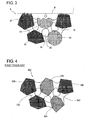
- the aluminum oxide particles 14 and the superabrasive grains 12 at the front line to define the circumferential surface (i.e., grinding surface) of the grinding wheel 2 have their front or forward cutting edges at approximately the same height as illustrated in Figure 2 . Because the aluminum oxide particles 14 are porous and fragile, the front cutting edges of the aluminum oxide particles 14 are crushed upon contact with the surface of the workpiece W during the grinding process and are retracted from the front edges of the superabrasive grains 12 at the front line which edges act as cutting edges facing the workpiece W, as shown in Figure 3 .
- the grinding resistance can be lowered, and the occurrence of grinding burns can be suppressed or prevented though such grinding burns would otherwise be caused if the aluminum oxide particles 14 continued to contact the workpiece W.
- the porous aluminum oxide particles 14 at the front line not only form chip pockets which serve to receive and discharge cutting chips, but also facilitate coolant to reach a grinding point, at which the grinding wheel 2 contacts the workpiece W, as well as to spread in the grinding wheel layer 6, so that the grinding efficiency can be enhanced.
- the present embodiment uses aluminum oxide particles as porous ceramics particles constituting aggregates.
- the present invention is not limited to the use of aluminum oxide particles.
- the present embodiment uses vitrified bond as bonding material.
- the present invention is not limited to the use vitrified bond.
- it is possible to use a resinoid bond in an epoxy resin group capable of forming the bond bridges.
- a grinding wheel comprising a disc-like core member and a ring-shape grinding wheel layer wherein superabrasive grains selected from cubic boron nitride particles and diamond particles are contained together with aggregates in a bonding material, the aggregates are made of porous ceramics particles and have an average particle size which is in a range of 70% to 150% relative to the average particle size of the superabrasive grains, and bridges made of the bonding material are formed between the aggregates adjoining to one another or between the aggregates and the superabrasive grains adjoining to the aggregates.
Landscapes
- Chemical & Material Sciences (AREA)
- Engineering & Computer Science (AREA)
- Ceramic Engineering (AREA)
- Inorganic Chemistry (AREA)
- Mechanical Engineering (AREA)
- Polishing Bodies And Polishing Tools (AREA)
Applications Claiming Priority (1)
| Application Number | Priority Date | Filing Date | Title |
|---|---|---|---|
| JP2007255651A JP5398132B2 (ja) | 2007-09-28 | 2007-09-28 | 研削砥石 |
Publications (3)
| Publication Number | Publication Date |
|---|---|
| EP2042268A2 true EP2042268A2 (fr) | 2009-04-01 |
| EP2042268A3 EP2042268A3 (fr) | 2011-06-29 |
| EP2042268B1 EP2042268B1 (fr) | 2012-05-02 |
Family
ID=39967816
Family Applications (1)
| Application Number | Title | Priority Date | Filing Date |
|---|---|---|---|
| EP08160490A Ceased EP2042268B1 (fr) | 2007-09-28 | 2008-07-16 | Meule |
Country Status (4)
| Country | Link |
|---|---|
| US (1) | US20090088056A1 (fr) |
| EP (1) | EP2042268B1 (fr) |
| JP (1) | JP5398132B2 (fr) |
| CN (1) | CN101396808B (fr) |
Families Citing this family (10)
| Publication number | Priority date | Publication date | Assignee | Title |
|---|---|---|---|---|
| JP5369654B2 (ja) | 2008-12-04 | 2013-12-18 | 株式会社ジェイテクト | ビトリファイドボンド砥石 |
| JP5963586B2 (ja) * | 2012-07-13 | 2016-08-03 | 豊田バンモップス株式会社 | ビトリファイドボンド砥石 |
| JP6459555B2 (ja) * | 2015-01-27 | 2019-01-30 | 株式会社ジェイテクト | 砥石、及びその製造方法 |
| JP6524783B2 (ja) | 2015-04-27 | 2019-06-05 | 株式会社ジェイテクト | 砥石の製造方法 |
| CN104802099B (zh) * | 2015-05-04 | 2017-07-21 | 华侨大学 | 一种具有大容屑腔的磨块、其制备方法及应用 |
| CN106493831A (zh) * | 2016-10-14 | 2017-03-15 | 常州亚环环保科技有限公司 | 一种耐磨陶瓷磨砂轮的制备方法 |
| JP2018109232A (ja) * | 2016-12-28 | 2018-07-12 | Dowaエレクトロニクス株式会社 | 接合材及びそれを用いた接合方法 |
| SG11202002342PA (en) | 2017-10-11 | 2020-04-29 | Almt Corp | Vitrified bond super-abrasive grinding wheel |
| CN112812743A (zh) * | 2019-11-15 | 2021-05-18 | 圣戈班磨料磨具有限公司 | 磨料制品及其形成方法 |
| JP7531293B2 (ja) * | 2020-03-19 | 2024-08-09 | 株式会社東京精密 | トリミング用ブレードおよびウェーハの製造方法 |
Citations (3)
| Publication number | Priority date | Publication date | Assignee | Title |
|---|---|---|---|---|
| JPH0138628B2 (fr) | 1981-11-13 | 1989-08-15 | Noritake Co Ltd | |
| JPH0716879B2 (ja) | 1986-06-18 | 1995-03-01 | 豊田工機株式会社 | 研削工具 |
| JP2007255651A (ja) | 2006-03-24 | 2007-10-04 | Ntn Corp | 動圧軸受装置 |
Family Cites Families (8)
| Publication number | Priority date | Publication date | Assignee | Title |
|---|---|---|---|---|
| JPH0716881B2 (ja) * | 1988-06-16 | 1995-03-01 | 株式会社ノリタケカンパニーリミテド | ビトリファイド超砥粒砥石 |
| JP2765167B2 (ja) * | 1990-03-13 | 1998-06-11 | 三菱マテリアル株式会社 | 多孔質レジンボンド砥石およびその製造方法 |
| JPH1119875A (ja) * | 1997-06-30 | 1999-01-26 | Toyoda Mach Works Ltd | ビトリファイド砥石 |
| DE60141700D1 (de) * | 2000-10-16 | 2010-05-12 | 3M Innovative Properties Co | Atteilchen |
| US6679758B2 (en) * | 2002-04-11 | 2004-01-20 | Saint-Gobain Abrasives Technology Company | Porous abrasive articles with agglomerated abrasives |
| JP2004017263A (ja) * | 2002-06-20 | 2004-01-22 | Toshiba Ceramics Co Ltd | 多孔質研削砥石 |
| EP1634678A4 (fr) * | 2003-05-30 | 2007-05-30 | Bosch Corp | Meule vitrifiee et procede de fabrication associe |
| JP2005342836A (ja) * | 2004-06-03 | 2005-12-15 | Asahi Diamond Industrial Co Ltd | 超砥粒工具及びその製造方法 |
-
2007
- 2007-09-28 JP JP2007255651A patent/JP5398132B2/ja active Active
-
2008
- 2008-07-14 US US12/172,466 patent/US20090088056A1/en not_active Abandoned
- 2008-07-16 EP EP08160490A patent/EP2042268B1/fr not_active Ceased
- 2008-08-20 CN CN2008102108195A patent/CN101396808B/zh not_active Expired - Fee Related
Patent Citations (3)
| Publication number | Priority date | Publication date | Assignee | Title |
|---|---|---|---|---|
| JPH0138628B2 (fr) | 1981-11-13 | 1989-08-15 | Noritake Co Ltd | |
| JPH0716879B2 (ja) | 1986-06-18 | 1995-03-01 | 豊田工機株式会社 | 研削工具 |
| JP2007255651A (ja) | 2006-03-24 | 2007-10-04 | Ntn Corp | 動圧軸受装置 |
Also Published As
| Publication number | Publication date |
|---|---|
| CN101396808A (zh) | 2009-04-01 |
| US20090088056A1 (en) | 2009-04-02 |
| JP5398132B2 (ja) | 2014-01-29 |
| EP2042268B1 (fr) | 2012-05-02 |
| CN101396808B (zh) | 2012-08-22 |
| JP2009083036A (ja) | 2009-04-23 |
| EP2042268A3 (fr) | 2011-06-29 |
Similar Documents
| Publication | Publication Date | Title |
|---|---|---|
| EP2042268B1 (fr) | Meule | |
| EP1066134B9 (fr) | Outils abrasifs | |
| US6093092A (en) | Abrasive tools | |
| CN1128042C (zh) | 高速砂轮 | |
| EP0945221B1 (fr) | Procédé pour meuler des composants de précision | |
| US9168637B2 (en) | Vitrified super-abrasive-grain grindstone | |
| EP2699387B1 (fr) | Roue de meulage liée à la résine | |
| CN1238717A (zh) | 锯齿状研磨工具 | |
| US20060137256A1 (en) | Vitrified grinding stone and method of manufacturing the same | |
| US20140013673A1 (en) | Vitrified bonded grinding stone | |
| EP3117959A1 (fr) | Roue de meulage et procédé de fabrication de celle-ci | |
| KR100458463B1 (ko) | 다이아몬드 공구용 세그먼트 및 다이아몬드 공구 | |
| JP2005246569A (ja) | 鏡面研削用レジノイド砥石 | |
| KR100765457B1 (ko) | 내경 연삭용 비트리 휠 | |
| JP4167009B2 (ja) | 砥石 | |
| JP2008213102A (ja) | ろう付け研削砥石 | |
| KR20240140490A (ko) | 균일하게 배열된 다이아몬드 지립을 구비한 로터리 드레서 | |
| HK1034221B (en) | Abrasive tools | |
| MXPA00009489A (en) | Abrasive tools |
Legal Events
| Date | Code | Title | Description |
|---|---|---|---|
| PUAI | Public reference made under article 153(3) epc to a published international application that has entered the european phase |
Free format text: ORIGINAL CODE: 0009012 |
|
| AK | Designated contracting states |
Kind code of ref document: A2 Designated state(s): AT BE BG CH CY CZ DE DK EE ES FI FR GB GR HR HU IE IS IT LI LT LU LV MC MT NL NO PL PT RO SE SI SK TR |
|
| AX | Request for extension of the european patent |
Extension state: AL BA MK RS |
|
| PUAL | Search report despatched |
Free format text: ORIGINAL CODE: 0009013 |
|
| AK | Designated contracting states |
Kind code of ref document: A3 Designated state(s): AT BE BG CH CY CZ DE DK EE ES FI FR GB GR HR HU IE IS IT LI LT LU LV MC MT NL NO PL PT RO SE SI SK TR |
|
| AX | Request for extension of the european patent |
Extension state: AL BA MK RS |
|
| 17P | Request for examination filed |
Effective date: 20110928 |
|
| GRAP | Despatch of communication of intention to grant a patent |
Free format text: ORIGINAL CODE: EPIDOSNIGR1 |
|
| AKX | Designation fees paid |
Designated state(s): DE |
|
| GRAS | Grant fee paid |
Free format text: ORIGINAL CODE: EPIDOSNIGR3 |
|
| GRAA | (expected) grant |
Free format text: ORIGINAL CODE: 0009210 |
|
| AK | Designated contracting states |
Kind code of ref document: B1 Designated state(s): DE |
|
| REG | Reference to a national code |
Ref country code: DE Ref legal event code: R096 Ref document number: 602008015319 Country of ref document: DE Effective date: 20120712 |
|
| PLBE | No opposition filed within time limit |
Free format text: ORIGINAL CODE: 0009261 |
|
| STAA | Information on the status of an ep patent application or granted ep patent |
Free format text: STATUS: NO OPPOSITION FILED WITHIN TIME LIMIT |
|
| 26N | No opposition filed |
Effective date: 20130205 |
|
| REG | Reference to a national code |
Ref country code: DE Ref legal event code: R097 Ref document number: 602008015319 Country of ref document: DE Effective date: 20130205 |
|
| PGFP | Annual fee paid to national office [announced via postgrant information from national office to epo] |
Ref country code: DE Payment date: 20140730 Year of fee payment: 7 |
|
| REG | Reference to a national code |
Ref country code: DE Ref legal event code: R119 Ref document number: 602008015319 Country of ref document: DE |
|
| PG25 | Lapsed in a contracting state [announced via postgrant information from national office to epo] |
Ref country code: DE Free format text: LAPSE BECAUSE OF NON-PAYMENT OF DUE FEES Effective date: 20160202 |