EP2042429A2 - Kraftmessender Gabeleinsatz - Google Patents
Kraftmessender Gabeleinsatz Download PDFInfo
- Publication number
- EP2042429A2 EP2042429A2 EP08014708A EP08014708A EP2042429A2 EP 2042429 A2 EP2042429 A2 EP 2042429A2 EP 08014708 A EP08014708 A EP 08014708A EP 08014708 A EP08014708 A EP 08014708A EP 2042429 A2 EP2042429 A2 EP 2042429A2
- Authority
- EP
- European Patent Office
- Prior art keywords
- clevis
- insert
- strain
- sensing element
- bore
- Prior art date
- Legal status (The legal status is an assumption and is not a legal conclusion. Google has not performed a legal analysis and makes no representation as to the accuracy of the status listed.)
- Withdrawn
Links
Images

Classifications
-
- B—PERFORMING OPERATIONS; TRANSPORTING
- B64—AIRCRAFT; AVIATION; COSMONAUTICS
- B64D—EQUIPMENT FOR FITTING IN OR TO AIRCRAFT; FLIGHT SUITS; PARACHUTES; ARRANGEMENT OR MOUNTING OF POWER PLANTS OR PROPULSION TRANSMISSIONS IN AIRCRAFT
- B64D29/00—Power-plant nacelles, fairings or cowlings
- B64D29/06—Attaching of nacelles, fairings or cowlings
-
- E—FIXED CONSTRUCTIONS
- E05—LOCKS; KEYS; WINDOW OR DOOR FITTINGS; SAFES
- E05B—LOCKS; ACCESSORIES THEREFOR; HANDCUFFS
- E05B15/00—Other details of locks; Parts for engagement by bolts of fastening devices
- E05B15/02—Striking-plates; Keepers; Bolt staples; Escutcheons
- E05B15/0205—Striking-plates, keepers, staples
-
- E—FIXED CONSTRUCTIONS
- E05—LOCKS; KEYS; WINDOW OR DOOR FITTINGS; SAFES
- E05B—LOCKS; ACCESSORIES THEREFOR; HANDCUFFS
- E05B17/00—Accessories in connection with locks
- E05B17/22—Means for operating or controlling lock or fastening device accessories, i.e. other than the fastening members, e.g. switches, indicators
-
- E—FIXED CONSTRUCTIONS
- E05—LOCKS; KEYS; WINDOW OR DOOR FITTINGS; SAFES
- E05C—BOLTS OR FASTENING DEVICES FOR WINGS, SPECIALLY FOR DOORS OR WINDOWS
- E05C19/00—Other devices specially designed for securing wings, e.g. with suction cups
- E05C19/10—Hook fastenings; Fastenings in which a link engages a fixed hook-like member
- E05C19/12—Hook fastenings; Fastenings in which a link engages a fixed hook-like member pivotally mounted around an axis
- E05C19/14—Hook fastenings; Fastenings in which a link engages a fixed hook-like member pivotally mounted around an axis with toggle action
- E05C19/145—Hook fastenings; Fastenings in which a link engages a fixed hook-like member pivotally mounted around an axis with toggle action flush
Definitions
- the present invention relates to a clevis insert for sensing force within a bore. Particularly, the present invention is directed to a force sensing clevis insert for detecting status of a latch on an aircraft.
- a variety of devices and methods are known in the art for detecting whether an aircraft latch is in a secured state. Of such devices, many are directed to determining whether an aircraft latch for securing an engine cowl is in a secured state.
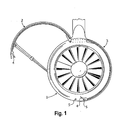
- Fig. 1 shows an aircraft engine 1 with one engine cowl 2 open and one engine cowl 3 closed.
- Cowls 2 and 3 can be hinged open by releasing a latch 4 from a stationary pin 5. Opening the cowls allows the engines to be serviced and maintained. However, failure to resecure the cowls after opening them can lead to malfunction of the cowls during take-off or flight. In some circumstances, the cowls can be blown off from the aircraft completely. Fortunately, the loss of an engine cowl is not generally a serious threat to an aircraft. It is nonetheless advantageous to reduce the number of cowl incidents. Typically, the onus is on ground personnel to verify that all engine cowls are secured before an aircraft pulls away from its gate. It is believed that the prevailing cause of engine cowl incidents is failure of ground crew to securely latch engine cowls prior to departure.
- U.S. Patent No. 6,334,588 to Porte describes a system for securing fan cowls in which a maintenance crew can visually detect an unsecured fan cowl because edges of unsecured fan cowls protrude enough to allow for visual detection.
- Another visual technique for detecting unsecured cowls is described in U.S. Patent No. 5,518,206 to Arnold et al. , which describes an apparatus that extends a flag visible to ground crew when an engine cowl is unsecured.
- the invention includes a sensor having a clevis insert for reception within a first bore of a clevis.
- the clevis insert is configured to accommodate a latch pin.
- a strain sensing element is operatively associated with the clevis insert for detecting mechanical strain imparted to the clevis insert when a force acts on the clevis insert through the pin.
- the clevis insert can be generally annular, "c” or “u” shaped, or any suitable shape, without departing from the spirit and scope of the invention. It is envisioned that the clevis insert can define a recess configured to receive the strain sensing element and adapted to concentrate mechanical strain on the strain sensing element.
- the clevis insert can include a first alignment feature proximate a periphery of the clevis insert, the first alignment feature being configured and adapted to cooperate with a corresponding second alignment feature within the first bore of the clevis to align the clevis insert.
- the first and second alignment features can be configured and adapted to align the strain sensing element along a load path defined by a force load when the force acts on the clevis insert.
- the second alignment feature within the bore can include a notch defined in a periphery of the bore.
- the second alignment feature can be generally cylindrical in shape. It is also envisioned that the clevis insert can be mounted on an engine cowl door.
- the recess defined by the clevis insert can be configured and adapted so that when a force acts on the clevis insert, the force compresses a portion of the clevis insert proximate the strain sensing element.
- the sensor can further include an electrical circuit electrically coupled to the strain sensing element to facilitate measurement of strain.
- the strain sensing element can be a surface acoustic wave (“SAW”) strain sensor configured and adapted to be excited by energy at a first radio frequency and to wirelessly transmit a second radio frequency indicative of strain experienced by the clevis insert.
- the sensor can further include an RF transceiver configured and adapted to transmit the first radio frequency to the SAW strain sensor, to receive the second radio frequency from the SAW strain sensor, and to transmit status information indicating the status of the latch.
- the clevis insert can also include an outwardly extending flange to prevent the clevis insert from passing through the first bore.
- the clevis insert can further include a passage defined therein. The passage can extend from the recess of the clevis insert to an area proximate the peripheral surface of the clevis insert. The passage can extend from the recess to an edge of the clevis insert.
- the passage can be configured and adapted to accommodate an antenna, wire, optic fiber, or other suitable communications means extending from the strain sensing element.
- the subject invention is also directed to a latch assembly including a clevis portion with a wall having a first bore extending therethrough.
- the latch assembly further includes an annular insert accommodated within the first bore of the wall of the clevis portion and having an aperture extending therethrough.
- a keeper pin extends through the aperture in the annular insert.
- a strain sensing element is mounted adjacent the aperture of the annular insert for detecting mechanical strain imparted to the annular insert when a force acts on the annular insert through the keeper pin.
- the clevis can have a second wall having a second bore, and the keeper pin can be configured and adapted to extend through the aperture in the annular insert and the second bore in the clevis. It is envisioned that the clevis portion can be mounted on an engine cowl door.
- the latch assembly can further include an RF transceiver configured and adapted to transmit the first radio frequency to the SAW strain sensor, to receive the second radio frequency from the SAW strain sensor, and to transmit status information indicating the status of the latch.
- the invention also includes a sensor for measuring a force load on a pin within a bore.
- the sensor includes an insert configured and adapted to be inserted at least partially into the bore.
- the insert defines a passage at least partially therethrough.
- the passage is configured to receive the pin.
- the sensor also includes a strain sensing element operably coupled to the insert.
- the strain sensing element is configured and adapted to detect mechanical strain on the insert when the force load acts on the insert.
- the strain sensing element is configured and adapted to detect a mechanical strain on the insert when the force load compresses the insert.
- the strain sensing element can be, for example, a SAW strain sensor configured and adapted to be excited by energy at a first radio frequency.
- the SAW strain sensing element can be configured and adapted to wirelessly transmit a second radio frequency indicative of strain experienced by the insert.
- the subject invention also includes a sensor for detecting a force acting on a keeper pin disposed in first and second bores of a clevis.
- the sensor includes a clevis insert configured and adapted to fit between the first bore of a clevis and the keeper pin.
- a strain sensing element is operably coupled to the clevis insert. The strain sensing element is configured and adapted to detect a mechanical strain on the clevis insert when the force acts on the clevis insert.
- the senor can further include an electrical circuit coupled electrically to the strain sensing element to facilitate measurement of strain.
- the circuit can be a Wheatstone bridge circuit, among others.
- the strain sensing element can be, for example, a SAW strain sensor configured and adapted to be excited by energy at a first radio frequency and to wirelessly transmit a second radio frequency indicative of strain experienced by the clevis insert.
- the sensor can further comprise an RF transceiver configured and adapted to transmit the first radio frequency to the SAW strain sensor, to receive the second radio frequency from the SAW strain sensor, and to transmit status information indicating the status of the latch.
- the subject invention is also directed to a clevis insert having a body configured and adapted to be inserted at least partially into a bore in a latch.
- the insert defines a passage at least partially therethrough.
- the passage is configured to receive a pin of the latch.
- a recess is defined in the insert body.
- the recess is configured and adapted to receive a strain sensing element.
- the subject invention is also directed to a kit for retrofitting a latch of an engine cowl of an aircraft to facilitate sensing when the latch is secured.
- the kit includes a clevis insert configured and adapted to be inserted at least partially into a bore of the latch.
- the insert defines a passage at least partially therethrough, the passage being configured and adapted to receive a pin of the latch.
- the kit further includes a strain sensing element configured and adapted to be operatively coupled to the clevis insert.
- the strain sensing element is configured and adapted to detect mechanical strain on the insert when a force load acts on the insert indicative of the engine cowl being securely latched.
- the kit further includes an alignment pin configured and adapted to be attached inside the bore of the latch to align the clevis insert with the bore.
- An alignment feature can be defined in a peripheral surface of the clevis insert. The alignment feature can be configured and adapted to cooperate with the alignment pin within the bore to align the clevis insert such that the strain sensing element is located along a path defined by a force load when the force load acts on the clevis insert, indicative of the latch and engine cowl being secured.
- invention also includes a method for retrofitting a latch assembly including the step of providing a clevis insert with a clevis insert body dimensioned for reception within a bore in a wall of a clevis.
- the clevis insert body has an aperture therein for receiving a latch pin.
- the clevis insert also includes a strain sensing element provided on the clevis insert body adjacent the aperture for detecting mechanical strain imparted to the clevis insert when a force acts thereon through the pin.
- the method also includes the step of enlarging an existing bore formed in a wall of the clevis.
- the method further includes positioning the clevis insert within the bore in the wall of the clevis. It is envisioned that the clevis can be mounted on an engine cowl door.
- the subject invention further includes a method for modifying an aircraft latch to facilitate sensing whether or not the latch is secured.
- the method includes providing a clevis insert, inserting the clevis insert into the first bore, and inserting the pin through the pin bore and a second bore of the clevis.
- the clevis insert is dimensioned to fit within the first bore of the clevis of the latch.
- the clevis insert includes a strain sensing element operably coupled thereto, and a pin bore parallel with the first bore when the clevis insert is inserted in the first bore.
- the pin bore is configured and adapted to receive the pin of the latch.
- the method for modifying an aircraft latch can further include the step of enlarging the first bore of the clevis to receive the clevis insert therein.
- the method can also include forming a first alignment feature in the first bore, and providing a second alignment feature on the clevis insert.
- the second alignment feature is configured to cooperate with the first alignment feature of the first bore to align the strain sensing element in the first bore.
- the second alignment feature can be configured and adapted to align the strain sensing element along a load path defined by an operational force load within the latch when the latch is secured.
- the clevis insert can include an outwardly extending flange and can be inserted until the flange contacts the clevis.
- the subject invention is also directed to a method for determining if a latch for securing an engine cowl on an aircraft is secured.
- the latch according to the method includes at least one clevis and one pin.
- the method includes providing a strain sensing element operably coupled to a clevis insert, the clevis insert being disposed between the clevis and the pin.
- the method also includes transmitting a first signal when the strain sensing element senses a force load acting on the pin of the latch, the first signal being indicative of the engine cowl being secured.
- the method further includes transmitting a second signal when the strain sensing element senses relaxation of the force load acting on the pin of the latch. The second signal is indicative of the engine cowl being unsecured.
- a sensor for detecting a force acting on a pin disposed in the first and second bores of a clevis including a clevis insert configured and adapted to fit between the first bore of the clevis and the pin.
- a strain sensing element is operably coupled to the clevis insert. The strain sensing element is configured and adapted to detect a mechanical strain on the clevis insert when the force acts on the clevis insert.
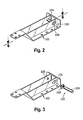
- a partial view of an exemplary embodiment of the sensor in accordance with the invention is shown in Fig. 2 and is designated generally by reference character 100.
- Other embodiments of a sensor in accordance with the invention, or aspects thereof, are provided in Figs. 3-7 , as will be described.
- a clevis 102 is provided having a pair of bores 106 for holding a latch pin 104.
- Clevis 102 and pin 104 are typical components of latches, including mechanical over-center latch devices, or other latch configurations commonly used in latching aircraft components, such as engine cowls (as shown in Fig. 1 ).
- Latches typically lock a keeper onto a pin to secure the latch in a closed position.
- over-center latches for example, the latch components must be moved through a high-stress position to be opened or closed. When closed, such latches are still stressed to some extent, albeit at a lower stress than the peak stress experienced during opening and closing the latch. This stressed state helps maintain the latch securely closed. Due to the various states of stress the latch undergoes depending on whether it is open, closed, or somewhere in between, sensing the state of stress on components within the latch can be useful in determining whether or not the latch is secured.
- Pin 104 can be the pin onto which the keeper locks. However, other pins in a latch can also be suitable for use with the invention, such as pins on which the keeper pivots. Those skilled in the art will appreciate that any pin through which a force is concentrated when the latch is closed, and through which the force is relaxed when the latch is open, can be used without departing from the spirit and scope of the invention.
- sensor 100 is provided with a clevis insert 108 configured and adapted to fit between pin 104 and one of the bores 106 of the clevis 102.
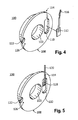
- Pin 104 fits through pin bore 103 (shown in Fig. 4 ) defined in insert 108.
- Pin 104 is also inserted through both bores 106 of clevis 102.
- pin 104 is supported at one end by a bore 106 of clevis 102, and at the other end by insert 108, as shown in Fig. 2 . While only one insert 108 is depicted, a second insert 108 could also be used in the other side of clevis 102, thus supporting each end of pin 104 with an insert 108 according to the invention.
- insert 108 is shown and described having a generally annular or circular shape, it is possible to employ other shapes of insert.
- insert 108 could be generally "c" or “u” shaped without departing from the spirit and scope of the invention.
- the bore 106 of insert 108 extends completely therethrough, it is also possible to use an insert with a bore that extends only partially therethrough, which would resemble an end cap for pin 104 that could hold pin 104 in clevis 102.
- the periphery of insert 108 has an outwardly extending flange 126, as shown in Figs. 4-5 .
- Flange 126 is optional. However it is advantageous, since it serves to prevent insert 108 from passing completely through bore 106 during assembly or operation.
- a strain sensing element is provided. As indicated in Fig. 4 , strain sensing element 112 is operably coupled to the clevis insert. A recess 110 is defined in an exterior face of clevis insert 108. The recess is dimensioned to accommodate strain sensing element 112, as indicated by the connecting line shown in Fig. 4 .
- Strain sensing element 112 is a traditional strain gauge of the electrical resistive type. Leads 116 can be connected to electrical circuitry, including a Wheatstone Bridge, to provide measurements of strain on strain gauge 112. Properly mounted in recess 110, strain gauge 112 can provide measurements of the mechanical strains on clevis insert 108 caused by forces acting on pin 104 during operation of the latch. A passage 114 accommodates lead 116 passing from recess 110 to the periphery of clevis insert 108.
- a strain sensor in the form of a surface acoustic wave (“SAW”) chip 118 is shown mounted to recess 110 within clevis insert 108.
- An antenna 120 extends from SAW chip 118 through passage 114. It is possible that if antenna 120 does not extend beyond the edge of insert 108, passage 114 need not extend all the way to the edge of clevis insert 108.
- Antenna 120 enhances the ability of SAW chip 118 to send and receive RF signals, as described in detail below.
- antenna 120 can be of any suitable shape and may be defined within the external perimeter of clevis insert 108. For example, antenna 108 can curve about the periphery of clevis insert 108. Moreover, a portion or all of antenna 120 can protrude outwardly from the face of clevis insert 108, as desired.
- SAW technology is known in the art for detecting mechanical stress/strain on a chip, such as in load sensors and pressure sensors (see e.g., U.S. Patent No. 4,265,124 to Lim et al. , U.S. Patent No. 6,144,332 to Reindl et al. , and U.S. Patent No. 4,632,813 to Naito , each of which is incorporated by reference herein in its entirety).
- SAW chip 118 is advantageous because of its wireless nature. A nearby transceiver can excite SAW chip 118 with RF energy at a first frequency and SAW chip 118 will then react by sending out RF energy at a second frequency.
- the second frequency sent by SAW chip 118 will vary depending on the state of strain in SAW chip 118.
- a nearby RF detector can be used to determine the strain on clevis insert 108 based on the RF frequency received from SAW chip 118, when excited. Since SAW chip 118 is wireless, assembly of sensor 100 is significantly simplified over using wired sensors. Moreover, if sensor 100 uses a SAW chip 118 and needs to be replaced, it can be changed out directly without dealing with wires, connectors, etc.
- strain sensing element can be used without departing from the spirit and scope of the invention.
- Strain sensing crystals such as piezoelectric sensors, optical strain sensors, or any other suitable strain sensor can be used. Regardless of what type of strain sensing element is employed, the invention can be used to determine whether a latch is secured based on the strain information provided by the strain sensing element.
- This information provided by sensor 100 can be in the form of an on/off signal, such as a signal when the latch is secured, and lack of a signal when the latch is open.
- the information can also be provided as one signal if the latch is open, and a different signal if the latch is secured. In this manner, a signal is provided in both latch states, so that it can also be ascertained that sensor 100 is functional at all times regardless of what state the latch is in.
- the information provided by sensor 100 can be used in a variety of ways.
- the information can be displayed on a console for ground crews to verify the latch is secured.
- a console could be provided inside an aircraft for the flight crew, and especially in the cockpit for the pilots to ascertain the state of the latch. It is also possible that such a console could be located elsewhere, such as in an air terminal, control tower, or any other suitable location.
- Sensor 100 could also be used to provide data to flight control systems. For example, it is possible to configure an aircraft to disable certain flight systems in order to ground an aircraft if the latch is not secure.
- the information from sensor 100 can be conveyed to such consoles or flight systems in any suitable manner. It is contemplated that the information can be conveyed through wires or wirelessly by any suitable means known in the art.
- recess 110 is an optional feature. Those skilled in the art will appreciate how to practice the invention with a strain sensing element 112/118 mounted to clevis insert 108 without any recess. However, recess 110 provides certain advantages. For example, recess 110 can enhance the overall robustness of sensor 100 by providing protective seclusion to delicate strain sensing elements 112/118. This robustness can be further enhanced by filling recess 110 with a protective material, such as resin, epoxy, or the like, after strain sensing element 112/118 is mounted. It is also possible to protect strain sensing element 112/118 (including lead 116 or antenna 120) by covering the entire face of sensor 108 with a layer of protective material after mounting sensing element 112/118 in place.
- a protective material such as resin, epoxy, or the like
- Figs. 6 and 7 a further advantage of recess 110 can be seen.
- the large arrow in Fig. 6 indicates the direction of a typical force acting on pin 104 in clevis 102 when the latch is secured.
- the circled area of Fig. 6 is enlarged in Fig. 7 , which shows the details of the cross section of clevis insert 108. Since clevis insert 108 has a reduced cross-sectional width "W" adjacent to recess 110, mechanical strain on clevis insert 108 will be particularly concentrated in recess 110, where strain sensing element 112/118 is mounted. Thus locating strain sensing element 112/118 within recess 110 increases the sensitivity of sensor 100 to forces acting on pin 104.
- an alignment feature is provided on the clevis insert.
- clevis insert 108 is provided with a first alignment feature 122 defined in the periphery.
- First alignment feature is depicted as a lunate cut-out which is configured to mate with second alignment feature 124 in bore 106, as depicted in Fig. 7 .
- Alignment feature 124 is depicted as a generally cylindrical protrusion extending inward from the periphery of bore 106.
- a protrusion of any suitable cross sectional shape may be used, as long as registration is provided between clevis insert 108 and bore 106.
- Alignment features 122 and 124 cause clevis insert 108 to have a particular orientation within bore 106. As shown in Fig. 7 , alignment features 122 and 124 serve to orient insert 108 so that recess 110 and strain sensing element 112/118 lie directly in the load path defined by the force acting on pin 104 when the latch is secured (indicated by the large arrow). While those skilled in the art will appreciate that alignment features are optional in accordance with the invention, they are advantageous in assuring that sensing elements 112/118 experience strong strain readings. In this orientation, the indicated force will act to compress recess 110.
- the recess could also be oriented differently, for example 180° from where it is shown, in which case the indicated force could act to place recess 110 at least partially in tension, without departing from the spirit and scope of the invention.
- clevis insert 108 could be placed out of alignment initially, or could be gradually worked to revolve out of alignment through repeated latchings and unlatchings or mechanical vibrations. While it is still possible to sense strains on clevis insert 108 when out of alignment, stronger and more consistent detection of strain is possible when keeping insert 108 properly aligned.
- second alignment feature 124 it is possible for second alignment feature 124 to be formed integrally with clevis 102. It is also possible for second alignment feature 124 to be a separate piece from bore 106 altogether.
- bore 106 could have a lunate notch similar to feature 122 of insert 108, and the second alignment feature could be a pin configured to be inserted into an opening defined by the notch in bore 106 and feature 122 of insert 108.
- Those skilled in the art will readily appreciate numerous other suitable alignment feature configurations, all of which can be practiced in accordance with the invention without limitation to the specific examples above.
- a method for determining if a latch for securing an engine cowl on an aircraft is secured.
- the method includes providing a strain sensing element operably coupled to a clevis insert.
- the clevis insert is disposed between the clevis and the pin of the latch.
- the method further includes transmitting a first signal when the strain sensing element senses a force load acting on the pin of the latch.
- the first signal is indicative of the engine cowl being secured.
- the method also includes transmitting a second signal when the strain sensing element senses relaxation of the force load acting on the pin of the latch.
- the second signal is indicative of the engine cowl being unsecured.
- a strain sensing element e.g., 112/118
- a clevis insert e.g., 108
- the clevis insert is located between the clevis (e.g., 102) and the pin (e.g., 104) of a latch.
- the step of transmitting a first signal is indicative of the engine cowl being secured when the strain sensing element senses a force load acting on the pin of the latch.
- the signal can be transmitted through wire cables, or wirelessly as discussed above.
- the signal can be transmitted to a console to inform a person of the state of the latch, as described above with reference to sensor 100.
- the second signal is transmitted when the strain sensing element senses a relaxation of the force load acting on the pin of the latch.
- the first and second signals can be produced by a strain gauge, SAW chip, or any other suitable strain sensing element, as described above.
- a method for modifying an aircraft latch to facilitate sensing whether or not the latch is secured.
- the method includes providing a clevis insert dimensioned to fit within a first bore of a clevis of the latch.
- the clevis insert has a strain sensing element operably coupled thereto and a pin bore parallel with the first bore when the clevis insert is inserted in the first bore.
- the pin bore is configured and adapted to receive a pin of the latch.
- the method further includes inserting the clevis insert into the first bore and inserting the pin through the pin bore and a second bore of the clevis.
- the method can be used to retrofit traditional latches to include a sensor (e.g., 100) in accordance with the invention.
- a clevis insert e.g., 108 including a strain sensing element (e.g., 112/118) mounted thereon is provided.
- the clevis insert is dimensioned to be inserted into a bore (e.g., 106) in the clevis of the latch, and to accommodate the pin (e.g., 104) of the latch through a pin bore (e.g., 103) to support the pin in the clevis when the insert and pin are inserted into the first bore of the clevis.
- the bore may be enlarged in order to accommodate the clevis insert.
- the bore is already sized to accommodate a spacer of comparable size to the clevis insert, it may not be necessary to enlarge the bore. Rather the existing spacer could simply be replaced with the clevis insert according to the invention.
- the clevis insert can include an outwardly extending flange (e.g., 126) so that during insertion of the insert, the flange can engage the clevis and thereby prevent the clevis insert from passing clear through the bore.
- first alignment feature e.g., 124
- second alignment feature is configured to cooperate with the first alignment feature to align the strain sensing element in the first bore, as described above with reference to sensor 100.
- the alignment features it is advantageous for the alignment features to align the strain sensing element along a load path defined by an operational force load within the latch when the latch is secured, after the retrofit is complete.
- Other components can be installed, if necessary, near the latch.
- Such components can include, for example, an RF transceiver for emitting and sensing RF energy in conjunction with a SAW chip in the clevis insert, or circuitry for a strain gauge in the clevis insert, as described above.
- RF transceiver for emitting and sensing RF energy in conjunction with a SAW chip in the clevis insert
- circuitry for a strain gauge in the clevis insert as described above.
- a kit for retrofitting a latch of an engine cowl of an aircraft to facilitate sensing when the latch is secured.
- the kit includes a clevis insert configured and adapted to be inserted at least partially into a bore of the latch.
- the insert defines a passage at least partially therethrough.
- the passage is configured to receive a pin of the latch.
- the kit also includes a strain sensing element configured and adapted to be operatively coupled to the clevis insert.
- the strain sensing element is configured and adapted to detect mechanical strain on the insert when a force load acts on the insert indicative of the engine cowl being securely latched.
- the kit includes a clevis insert (e.g., 108) configured to fit in between a pin and a clevis of a latch.
- a clevis insert e.g., 108
- use of the clevis insert according to the kit of the invention may require enlarging one of the bores of the clevis insert, depending on the relative sizes of the pin, bore, and clevis insert.
- a strain sensing element e.g., 112/118
- the strain sensing element of the kit is the same as described above, and can be provided already mounted to the clevis insert, or separate therefrom.
- an alignment pin with the kit.
- the alignment pin is configured and adapted to be inserted between the bore and the clevis insert to align the insert, as described above.
- the clevis insert can be supplied in the kit already having an alignment feature on the periphery thereof for use in conjunction with the alignment pin or other alignment features formed in the bore of the clevis.
- the alignment pin and/or alignment features are used to align the strain sensing element along a load path, as described above.
- the force sensing clevis insert can be used as a load cell in any pin and bore joint as a means of measuring force, stress, or strain on the bore and pin.
- the sensor can be used in various locations throughout an aircraft to sense the closing of latches.
- the senor of the invention could be used to sense if an aircraft door latch is closed, without departing from the spirit and scope of the invention.
Landscapes
- Engineering & Computer Science (AREA)
- Aviation & Aerospace Engineering (AREA)
- Force Measurement Appropriate To Specific Purposes (AREA)
- Body Structure For Vehicles (AREA)
Applications Claiming Priority (1)
| Application Number | Priority Date | Filing Date | Title |
|---|---|---|---|
| US11/903,964 US7661321B2 (en) | 2007-09-25 | 2007-09-25 | Force sensing clevis insert |
Publications (2)
| Publication Number | Publication Date |
|---|---|
| EP2042429A2 true EP2042429A2 (de) | 2009-04-01 |
| EP2042429A3 EP2042429A3 (de) | 2012-06-20 |
Family
ID=40070686
Family Applications (1)
| Application Number | Title | Priority Date | Filing Date |
|---|---|---|---|
| EP08014708A Withdrawn EP2042429A3 (de) | 2007-09-25 | 2008-08-19 | Kraftmessender Gabeleinsatz |
Country Status (4)
| Country | Link |
|---|---|
| US (1) | US7661321B2 (de) |
| EP (1) | EP2042429A3 (de) |
| JP (1) | JP2009078803A (de) |
| CN (1) | CN101402397A (de) |
Cited By (3)
| Publication number | Priority date | Publication date | Assignee | Title |
|---|---|---|---|---|
| WO2009088961A1 (en) | 2008-01-07 | 2009-07-16 | Rohr, Inc. | A method and component for determining load on a latch assembly |
| EP3333082A1 (de) * | 2016-12-12 | 2018-06-13 | Ge Avio S.r.l. | Schubmessvorrichtung für ein antriebssystem |
| WO2023275474A1 (fr) | 2021-07-02 | 2023-01-05 | Safran Nacelles | Systeme de verrouillage pour nacelle d'aeronef |
Families Citing this family (5)
| Publication number | Priority date | Publication date | Assignee | Title |
|---|---|---|---|---|
| EP3000734B1 (de) * | 2014-09-29 | 2018-03-14 | Airbus Defence and Space, S.A. | Ausrichtungs- und Sicherheitsvorrichtung für die Hauben von Flugzeugtriebwerksgondeln |
| US10093436B2 (en) * | 2016-06-23 | 2018-10-09 | General Electric Company | Wireless aircraft engine communication system |
| DE102018115812B4 (de) * | 2018-06-29 | 2021-05-27 | Vanguard Ag | Halterung zur lösbaren Aufnahme eines Sensors und eine Sensoranordnung, die eine Halterung und einen wiederverwendbaren Sensor umfasst und ein Reference Patch mit einer Halterung |
| US11686634B2 (en) * | 2020-06-26 | 2023-06-27 | Simmonds Precision Products, Inc. | Pylon engine mount health monitoring system |
| WO2026136878A1 (en) * | 2024-12-20 | 2026-06-25 | Milwaukee Electric Tool Corporation | Electrohydraulic tool |
Citations (7)
| Publication number | Priority date | Publication date | Assignee | Title |
|---|---|---|---|---|
| US4265124A (en) | 1979-06-04 | 1981-05-05 | Rockwell International Corporation | Remote acoustic wave sensors |
| US4632813A (en) | 1984-04-18 | 1986-12-30 | Enichem Agricolutra | Process for the production of water soluble ammonium phosphates |
| US5518206A (en) | 1992-05-22 | 1996-05-21 | Short Brothers Plc | Closure default indicator |
| US6144332A (en) | 1992-01-03 | 2000-11-07 | Siemensn Aktiengesellschaft | Passive surface wave sensor which can be wirelessly interrogated |
| US6334588B1 (en) | 1997-12-16 | 2002-01-01 | Aerispatiale Societe Nationale Industrielle | Aircraft propulsion unit fan cowls equipped with maintaining and positioning safety elements |
| US20040012212A1 (en) | 2002-05-03 | 2004-01-22 | Pratt John D. | Latch mechanism |
| US20060038410A1 (en) | 2003-09-17 | 2006-02-23 | Pratt John D | Motor driven latch |
Family Cites Families (49)
| Publication number | Priority date | Publication date | Assignee | Title |
|---|---|---|---|---|
| US3365689A (en) * | 1966-04-26 | 1968-01-23 | Kutsay Ali Umit | Strain gage apparatus |
| US3600023A (en) * | 1970-02-09 | 1971-08-17 | Rohr Corp | Locking system |
| US3695096A (en) * | 1970-04-20 | 1972-10-03 | Ali Umit Kutsay | Strain detecting load cell |
| GB1459027A (en) * | 1974-04-26 | 1976-12-22 | Strainstall Ltd | Mooring device |
| US4094003A (en) * | 1976-03-29 | 1978-06-06 | Canadian Patents And Development Limited | Sonic magnetic domain sensor |
| US4078186A (en) * | 1976-10-21 | 1978-03-07 | The United States Of America As Represented By The Secretary Of The Navy | Magnetically tuned, surface acoustic wave device |
| DE2807734A1 (de) * | 1977-02-28 | 1978-08-31 | Philips Nv | Kraftmesser |
| US4318557A (en) * | 1979-10-09 | 1982-03-09 | Hartwell Corporation | Latching mechanism |
| US4259548A (en) * | 1979-11-14 | 1981-03-31 | Gte Products Corporation | Apparatus for monitoring and signalling system |
| US4421349A (en) * | 1981-12-28 | 1983-12-20 | The Boeing Company | Cowling latch |
| US4613099A (en) * | 1982-02-05 | 1986-09-23 | The Boeing Company | Latch signal and cowling structure |
| JPS60133320A (ja) * | 1983-12-22 | 1985-07-16 | Ishida Scales Mfg Co Ltd | 荷重検出器 |
| US4679750A (en) * | 1984-06-20 | 1987-07-14 | The Boeing Company | Latch system |
| US4709210A (en) * | 1985-05-02 | 1987-11-24 | Pond Robert J | Magnetoacoustic proximity sensor |
| US4828299A (en) * | 1987-03-31 | 1989-05-09 | Hartwell Corporation | Latch |
| US4858475A (en) * | 1987-05-26 | 1989-08-22 | Revere Corporation Of America | Apparatus and method for measuring strain |
| US5152559A (en) * | 1989-12-04 | 1992-10-06 | The Hartwell Corporation | Latching mechanism |
| US5013091A (en) * | 1989-12-22 | 1991-05-07 | Consolidation Coal Company | Method of indirect measurement of cowl position on a longwall shearer |
| US5213286A (en) * | 1990-10-10 | 1993-05-25 | General Electric Company | Door for aircraft nacelle |
| GB2267122B (en) | 1992-05-22 | 1995-06-14 | Short Brothers Plc | Closure default indicator |
| US5620212A (en) * | 1995-08-28 | 1997-04-15 | Hartwell Corporation | Low profile hook latch assembly |
| US5808201A (en) * | 1996-09-09 | 1998-09-15 | Sonicforce, L.L.C. | Acoustic strain gauge |
| US6144288A (en) * | 1997-03-28 | 2000-11-07 | Eaton Corporation | Remote wireless switch sensing circuit using RF transceiver in combination with a SAW chirp processor |
| US5984241A (en) * | 1997-09-08 | 1999-11-16 | Mpc Products Corporation | Bi-directional, dual acting, electric safety lock |
| US5959388A (en) * | 1997-10-27 | 1999-09-28 | Lucent Technologies Inc. | Magnetically tunable surface acoustic wave devices |
| US5984382A (en) * | 1998-03-13 | 1999-11-16 | Hartwell Corporation | Extended reach latch |
| US6189832B1 (en) * | 1998-04-03 | 2001-02-20 | Hartwell Corporation | Permanently connected remote latch mechanism |
| US6042156A (en) * | 1998-08-11 | 2000-03-28 | Hartwell Corporation | Overcenter double jaw latch mechanism |
| US6046657A (en) * | 1998-08-21 | 2000-04-04 | Lucent Technologies Inc. | Magnetostrictive surface acoustic wave device and microelectronic circuit including same |
| JP2000121742A (ja) * | 1998-10-14 | 2000-04-28 | Mitsubishi Electric Corp | 掘削管体音響伝送用送信機およびこの送信機による掘削管体音響伝送方法 |
| CA2274572C (en) | 1999-06-07 | 2006-10-03 | Strategic Vista International Inc. | Security alarm system |
| US6279971B1 (en) * | 1999-10-05 | 2001-08-28 | Hartwell Corporation | Latch with sensor |
| US6325428B1 (en) * | 1999-11-10 | 2001-12-04 | Hartwell Corporation | Latch assembly including sensor |
| US6362543B1 (en) * | 1999-12-17 | 2002-03-26 | Agere Systems Optoelectronics Guardian Corp. | Magnetostrictive surface acoustic wave devices with transducers tuned for optimal magnetic anisotropy |
| US6571638B2 (en) * | 2000-06-30 | 2003-06-03 | Sawtek, Inc. | Surface-acoustic-wave pressure sensor and associated methods |
| US6382690B1 (en) * | 2000-09-27 | 2002-05-07 | Hartwell Corporation | Keeper mechanism |
| JP2002172962A (ja) * | 2000-12-07 | 2002-06-18 | Imasen Electric Ind Co Ltd | 乗員体重の検出装置 |
| JP2004527168A (ja) * | 2001-03-19 | 2004-09-02 | ニューランズ テクノロジー リミテッド | 磁歪アクチュエータ |
| JP4790175B2 (ja) * | 2001-03-30 | 2011-10-12 | 能美防災株式会社 | 消火栓装置 |
| GB0120571D0 (en) * | 2001-08-23 | 2001-10-17 | Transense Technologies Plc | Interrogation of passive sensors |
| US6933932B2 (en) * | 2002-09-17 | 2005-08-23 | Texzec, Inc. | Acoustic wave sensor with EMAT drive |
| US6517027B1 (en) * | 2001-12-03 | 2003-02-11 | Pratt & Whitney Canada Corp. | Flexible/fixed support for engine cowl |
| US7181174B2 (en) * | 2003-08-21 | 2007-02-20 | The Chamberlain Group, Inc. | Wireless transmit-only apparatus and method |
| US7066501B2 (en) * | 2004-09-22 | 2006-06-27 | Avibank Mfg., Inc. | Aircraft latch |
| US7100452B2 (en) * | 2004-12-15 | 2006-09-05 | Honeywell International Inc. | Surface acoustic wave multiple sense element |
| US7165455B2 (en) * | 2004-12-18 | 2007-01-23 | Honeywell International Inc. | Surface acoustic wave sensor methods and systems |
| JP2006258733A (ja) * | 2005-03-18 | 2006-09-28 | Toyo Tire & Rubber Co Ltd | センサ取付構造及びタイヤ状態の検出装置 |
| FR2886400B1 (fr) * | 2005-05-25 | 2007-09-07 | Messier Bugatti Sa | Cellule de mesure d'effort et axe de liaison equipe d'une telle cellule |
| US7392710B1 (en) * | 2007-01-09 | 2008-07-01 | King Fahd University Of Petroleum And Minerals | Flow meter probe with force sensors |
-
2007
- 2007-09-25 US US11/903,964 patent/US7661321B2/en not_active Expired - Fee Related
-
2008
- 2008-08-19 EP EP08014708A patent/EP2042429A3/de not_active Withdrawn
- 2008-09-19 JP JP2008240232A patent/JP2009078803A/ja not_active Ceased
- 2008-09-25 CN CNA2008101613835A patent/CN101402397A/zh active Pending
Patent Citations (7)
| Publication number | Priority date | Publication date | Assignee | Title |
|---|---|---|---|---|
| US4265124A (en) | 1979-06-04 | 1981-05-05 | Rockwell International Corporation | Remote acoustic wave sensors |
| US4632813A (en) | 1984-04-18 | 1986-12-30 | Enichem Agricolutra | Process for the production of water soluble ammonium phosphates |
| US6144332A (en) | 1992-01-03 | 2000-11-07 | Siemensn Aktiengesellschaft | Passive surface wave sensor which can be wirelessly interrogated |
| US5518206A (en) | 1992-05-22 | 1996-05-21 | Short Brothers Plc | Closure default indicator |
| US6334588B1 (en) | 1997-12-16 | 2002-01-01 | Aerispatiale Societe Nationale Industrielle | Aircraft propulsion unit fan cowls equipped with maintaining and positioning safety elements |
| US20040012212A1 (en) | 2002-05-03 | 2004-01-22 | Pratt John D. | Latch mechanism |
| US20060038410A1 (en) | 2003-09-17 | 2006-02-23 | Pratt John D | Motor driven latch |
Cited By (7)
| Publication number | Priority date | Publication date | Assignee | Title |
|---|---|---|---|---|
| WO2009088961A1 (en) | 2008-01-07 | 2009-07-16 | Rohr, Inc. | A method and component for determining load on a latch assembly |
| EP2229322A4 (de) * | 2008-01-07 | 2013-04-24 | Rohr Inc | Verfahren und komponente zur bestimmung der last auf einer verriegelungsbaugruppe |
| EP3333082A1 (de) * | 2016-12-12 | 2018-06-13 | Ge Avio S.r.l. | Schubmessvorrichtung für ein antriebssystem |
| WO2018108834A1 (en) * | 2016-12-12 | 2018-06-21 | Ge Avio S.R.L. | Thrust measuring device for a propulsion system |
| WO2023275474A1 (fr) | 2021-07-02 | 2023-01-05 | Safran Nacelles | Systeme de verrouillage pour nacelle d'aeronef |
| FR3124815A1 (fr) * | 2021-07-02 | 2023-01-06 | Safran Nacelles | Systeme de verrouillage pour nacelle d’aeronef |
| US12630298B2 (en) | 2021-07-02 | 2026-05-19 | Safran Nacelles | Locking system for an aircraft nacelle |
Also Published As
| Publication number | Publication date |
|---|---|
| US7661321B2 (en) | 2010-02-16 |
| JP2009078803A (ja) | 2009-04-16 |
| US20090078846A1 (en) | 2009-03-26 |
| CN101402397A (zh) | 2009-04-08 |
| EP2042429A3 (de) | 2012-06-20 |
Similar Documents
| Publication | Publication Date | Title |
|---|---|---|
| US7661321B2 (en) | Force sensing clevis insert | |
| CN102419185B (zh) | 用于检测销上的负载的电容传感器 | |
| US7843363B2 (en) | Mechanical latch locking detection sensors | |
| JP5478509B2 (ja) | ラッチ・アセンブリにかかる荷重を測定する方法および部品 | |
| CN105258742B (zh) | 具有锁定机构的超声波耗量测量仪 | |
| EP1663675B1 (de) | Drahtloses reifendruck- und/oder raddrehzahl-erfassungssystem für luftfahrzeug | |
| US9175989B2 (en) | Accident sensor | |
| JP2011503601A (ja) | 構成部品監視装置 | |
| US6446510B1 (en) | Force transducer assembly | |
| WO2010119298A1 (en) | Rotor blade | |
| WO2017091784A1 (en) | Apparatus and methods for direct sensing of rotational dynamics of a rotating shaft | |
| US20140053649A1 (en) | Monitoring unit and method for detecting structural defects which can occur in an aircraft nacelle during use | |
| US20080284595A1 (en) | Window or Door Handle | |
| CN101400527B (zh) | 压电触发装置 | |
| JP2019512087A (ja) | シールボルトおよびシールボルトの取付け方法 | |
| KR102590859B1 (ko) | 압력센서 | |
| JP2004069694A (ja) | 環状の装置用のタグハウジングおよび組立方法 | |
| EP4085975A1 (de) | Glaskörpervorrichtung | |
| US12630298B2 (en) | Locking system for an aircraft nacelle | |
| JPS62234758A (ja) | 自動車運行用磁界センサの支持装置 | |
| US9568494B2 (en) | Device and method for checking a probe for measuring the pressure of a flow | |
| US5369996A (en) | Physical magnitude measurement sensor | |
| Seaver et al. | Underwater blast loading of a composite twisted rudder with FBGs | |
| WO2021209321A1 (de) | Vakuumvorrichtung | |
| EP2586707A1 (de) | Sicherheitsverriegelung für die Klappe einer Flugzeugtriebwerksgondel |
Legal Events
| Date | Code | Title | Description |
|---|---|---|---|
| PUAI | Public reference made under article 153(3) epc to a published international application that has entered the european phase |
Free format text: ORIGINAL CODE: 0009012 |
|
| AK | Designated contracting states |
Kind code of ref document: A2 Designated state(s): AT BE BG CH CY CZ DE DK EE ES FI FR GB GR HR HU IE IS IT LI LT LU LV MC MT NL NO PL PT RO SE SI SK TR |
|
| AX | Request for extension of the european patent |
Extension state: AL BA MK RS |
|
| PUAL | Search report despatched |
Free format text: ORIGINAL CODE: 0009013 |
|
| AK | Designated contracting states |
Kind code of ref document: A3 Designated state(s): AT BE BG CH CY CZ DE DK EE ES FI FR GB GR HR HU IE IS IT LI LT LU LV MC MT NL NO PL PT RO SE SI SK TR |
|
| AX | Request for extension of the european patent |
Extension state: AL BA MK RS |
|
| RIC1 | Information provided on ipc code assigned before grant |
Ipc: E05C 19/14 20060101ALI20120516BHEP Ipc: B64D 29/06 20060101AFI20120516BHEP |
|
| 17P | Request for examination filed |
Effective date: 20120810 |
|
| AKX | Designation fees paid |
Designated state(s): AT BE BG CH CY CZ DE DK EE ES FI FR GB GR HR HU IE IS IT LI LT LU LV MC MT NL NO PL PT RO SE SI SK TR |
|
| STAA | Information on the status of an ep patent application or granted ep patent |
Free format text: STATUS: THE APPLICATION IS DEEMED TO BE WITHDRAWN |
|
| 18D | Application deemed to be withdrawn |
Effective date: 20150303 |