EP2042836B1 - Verfahren und System zur Routenplanung für einen Athleten - Google Patents
Verfahren und System zur Routenplanung für einen Athleten Download PDFInfo
- Publication number
- EP2042836B1 EP2042836B1 EP07117276A EP07117276A EP2042836B1 EP 2042836 B1 EP2042836 B1 EP 2042836B1 EP 07117276 A EP07117276 A EP 07117276A EP 07117276 A EP07117276 A EP 07117276A EP 2042836 B1 EP2042836 B1 EP 2042836B1
- Authority
- EP
- European Patent Office
- Prior art keywords
- route
- athlete
- anyone
- processing unit
- section
- Prior art date
- Legal status (The legal status is an assumption and is not a legal conclusion. Google has not performed a legal analysis and makes no representation as to the accuracy of the status listed.)
- Active
Links
Images

Classifications
-
- G—PHYSICS
- G01—MEASURING; TESTING
- G01C—MEASURING DISTANCES, LEVELS OR BEARINGS; SURVEYING; NAVIGATION; GYROSCOPIC INSTRUMENTS; PHOTOGRAMMETRY OR VIDEOGRAMMETRY
- G01C21/00—Navigation; Navigational instruments not provided for in groups G01C1/00 - G01C19/00
- G01C21/26—Navigation; Navigational instruments not provided for in groups G01C1/00 - G01C19/00 specially adapted for navigation in a road network
- G01C21/34—Route searching; Route guidance
- G01C21/3407—Route searching; Route guidance specially adapted for specific applications
- G01C21/343—Calculating itineraries
Definitions
- the present invention relates to a method and system for planning a route for an athlete.
- Navigation systems for vehicles are widely known. These navigation systems calculate a route for a vehicle from a start point to an endpoint and output the route on a map on a display. For pedestrians different criteria have to be considered when calculating a map.
- US 2001/0025222A1 a method and a system for providing walking instructions is described. In this document a walking route is calculated in combination with information about driving to or close to the desired destination.
- the navigation program uses data in a geographic database to assess the suitability of the roads around the desired destination for pedestrian travel.
- the suggested method and system may be suitable for a driver who needs directions from a parking spot to his final destination, the method and system can not address the needs of an athlete who wished to exercise.
- WO 01 / 42809 A1 a system for automatic monitoring real-time athletic performance of a user is described.
- the monitoring is performed by GPS.
- opportunities of monitoring an athlete and his performance during his training or exercise are disclosed.
- the monitoring may be beneficially used by an athlete preparing for a race with a particular elevation profile.
- This athlete may benefit from a digital elevation model database to engineer a local training route having a similar elevation profile to that of the race.
- One disadvantage of this method is that the individual needs of an athlete, in particular a training scheme cannot be addressed.
- JP 2006079183 A a practice support device and program for athletes are described.
- the training results of a person on a running course are measured. These results are stored as user data and are sorted for each section of the running course. This data is then compared to results in an athletic contest. From this comparison a practice running course similar to the contest course is extracted. The differences between the results on the practice course and the contest course are calculated and the difference results are presented to the user. Also with this approach a training scheme which may be independent from an athletic contest cannot be addressed when determining a route for the athlete.
- a typical training session for a runner normally consists of warming up, walking, jogging, running at maximum speed, walking and stretching.
- Each of these types of training requires specific types of a route. For example when running at maximum speed it would be very inconvenient to cross a busy road or to have to wait for a traffic light.
- many athletes have little time for their training sessions, so they want to plan these sessions as efficiently as possible. In the ideal situation, the session would end at exactly the same spot as it was started, so no time would be lost at walking back home or to the car after finishing the training session.
- this problem is solved by a method for planning a route for an athlete, wherein a processing unit determines a route.
- the method is characterized in that the determination of the route comprises the step of calculating the length of individual sections of the route, that the sum of the individual sections is the length of the determined route, that each section is defined by an exercise to be performed by the athlete in this section and that at least part of the determined route is matched by the processing unit against map data.
- the inventive approach By determining a route and subsequently matching it against map data, the needs of the athlete and different requirements for different parts of the route can be observed. Rather than calculating a route according to map data as is done in the prior art solutions, the inventive approach first determines the route and then selects the locations or paths to be used in the route. The thus planned route will provide the athlete with a route suited for the intended exercise.
- the route which is ultimately output to the athlete will be referred to as the planned route.
- the planned route will be the result of the determination of a route and the subsequent matching of the determined route with map data.
- the determination of the route comprises the step of calculating the length of individual sections of the route.
- Each section is defined by an exercise to be performed by the athlete in this section.
- the length of the section can thus be calculated by using the average speed of the athlete and the intended time of the exercise.
- the sum of all individual sections will provide the length of the entire route.
- the determination of the route comprises the step of assigning at least one criterion to at least one section of the route.
- the criterion may be the mentioned type of exercise and duration of the exercise. These criteria are used to calculate the length of the individual sections.
- criteria relating to the conditions of the path or the location of the path may be used. These criteria will hereinafter also be referred to as condition related information and may for example comprise topological, street, location and/or traffic information. These criteria can be dependent on the exercise to be performed or can be preferences of the athlete.
- the matching of the determined route comprises the comparison of condition related data of the map data with at least one criterion assigned to the determined route, in particular with condition related information.
- the condition related information assigned to the calculated route or route sections is assigned based on the exercise to be performed or based on the preferences of the athlete.
- other criterion such as position information may be used as a criterion to be compared to the map data.
- the position information may for example be the intended start point for the route and the intended finish point.
- the processing unit accesses a database with personal entries of the athlete for obtaining personal values for calculating the length of the individual sections of the route.
- the personal values may be stored in a personal profile of the athlete.
- the personal values may comprise the average speed of the athlete for a specific exercise.
- an exercise scheme where different exercises and the respective duration of each exercise as well as the sequence of the exercises are defined, may be stored in the database.
- the processing unit may furthermore access a database with personal entries of the athlete for obtaining personal settings for assigning at least one criterion to at least one section of the route.
- These personal entries which will also be referred to as preferences, may be stored in the same database as the personal values relating to speed and exercise schemes.
- the personal preferences may comprise preferred start and finish points for routes, preferred areas and/or areas which should be avoided.
- other preferences such as preferred road surface for specific exercises, e.g. pavement or soil, may be included in the personal entries.
- the processing unit includes external input for calculating the length of the route and/or for assigning at least one criterion to at least one section of the route.
- the external input may be provided by the athlete before starting the route planning and may for example be the start and end point of the route.
- the method according to the present invention is preferably also carried out when the athlete is using the route.
- the route during the exercise of the athlete changes that occur during the exercise can be accounted for. For example, if the athlete does not reach his average speed during one of the exercises, the subsequent route may be recalculated and the route plan may be adapted.
- the external input will be provided during the exercise of the athlete.
- the input may be generated by a monitoring system which monitors the speed and/or location of the athlete.
- the processing unit receives information for determining the route from a training or coaching system.
- training or coaching systems which may also be virtual coaching systems, may process data such as previously achieved speeds of the athlete or current conditions of the athlete, such as his current speed.
- the athlete By connecting such a coaching system to the inventive route planer, the athlete will be able to use data stored in the coaching system for the route planning and does not have to reenter information for the route planning.
- the at least one criterion for determining the route is preferably derived from the exercise type for at least one section of the route.
- the association of the criterion to the exercise type may be laid down in a database or may be provided by a training or coaching system.
- the criterion may be for example the condition of the road to be used for the exercise, such as the slope of the road, the traffic conditions of the road and so on.
- the route is preferably determined based on route definitions and training definitions.
- Route definitions may include the start point, the endpoint of the intended route, condition related information of the route, such as steepness, pavement, traffic conditions, as well as preferred and excluded areas.
- the training definitions may include the exercise type, the duration of the exercise and the sequence of the exercises.
- the training definitions are preferably defined in an exercise scheme.
- the present invention relates to a system for planning a route for an athlete.
- the system is characterized in that it comprises a processing unit having a determining unit for determining a route by calculating the length of individual sections of the route, wherein the sum of the individual sections is the length of the determined route, wherein each section is defined by an exercise to be performed by the athlete in this section and a matching unit for matching at least part of the determined route against map data.
- the system may further comprise access to a database for condition related information and/or to a database for personal profiles.
- the access may be provided by respective interfaces to the databases.
- the database or databases may be included within the system.
- the processing unit preferably has an input interface for input from a user and/or from a training or coaching system.
- the input interface may be connected to an input device such as a keyboard. If the system is located in a central location, e.g. on the Internet, the input interface may be provided by the access to the system from a PC or other terminal.
- the matching unit preferably comprises a comparison unit for comparing criteria of the determined route with condition related map data. By comparing the criteria with the condition related map data the most suitable paths can be selected for the determined route.
- the system is preferably at least partially implemented in a portable device, in particular a mobile phone. At least the output device of the inventive system should be included in the portable device. Thereby the athlete can be provided with information on the planned route during his exercise.
- the further units of the inventive system in particular, the processing unit may be realized at a remote unit, such as a network server. In this case the connection to a coaching system which is preferably also implemented centrally, e.g. on a web server can easily be realized.
- the system may be realized as hardware and/or software units.
- the system is preferably laid out to perform the inventive method.
- the system 1 shown in Figure 1 comprises a processing unit 10 having a determination unit 11 and a matching unit 12.
- the determination unit 11 has access to a database 13, where personal profiles are stored.
- the matching unit 12 has access to a database 14 for map data.
- An external coaching system 15 is shown, which is connected to the database 13 for personal profiles and to the determination unit 11.
- the database 13 for personal profiles and the determination unit 11 are also connected to an input device 17 which is schematically depicted as a keyboard.
- the matching unit 12 is connected to an output device 16, which may be a display or a loud speaker.
- the database 13 for personal profiles information specific to the individual athlete are stored. In particular, information about exercises which the athlete performs and the average speed of the athlete for this exercise are stored.
- condition related information such as the road type to be used for the specific exercise, the road surface as well as traffic information such as the traffic density of the street to be used, the presence of traffic lights and necessity of street crossings can be stored in the profile of the athlete.
- the road type may comprise indications such as pedestrian roads, roads for pedestrians and cyclists and sidewalks.
- the road surface may be defined as solid or soft.
- the indicated exercises i.e. stretching, walking, low speed running, moderate speed running and top speed running are only examples.
- the profile may in addition or alternatively comprise exercises like stretching, biking, swimming and so on.
- the personal profile of the athlete stored in database 13 may comprise an exercise scheme or a scheme for a training session.
- This scheme can be set up by the athlete or a coach via the input device 17.
- the scheme can be set up by a coaching system 15, which is also referred to as a virtual coaching system.
- the scheme may be provided to the determination unit 11 directly, i.e. does not have to be stored in the database 13 for personal profiles.
- the exercise or training scheme includes the types of exercise for a specific session in chronological order and the time intervals of each type of exercise.
- the schedule of a specific training session can be indicated in a module.
- This module is coupled with the processing unit 10 and can thereby specify the route requirements of each part of the training session.
- the determination unit 11 may calculate the distance that will be covered in that particular session, i.e. calculate the length of the section of the route.
- Table 2 shows an example of such a calculation. Table 2 time interval (minutes) speed (km/h) covered distance (km) Start point Work Warming up walking 5 5 0,4 low speed 10 8 1,3 stretching 5 0 0,0 Endurance moderate speed 30 10 5,0 Interval moderate speed 5 10 0,8 top speed 2 12 0,4 moderate speed 5 10 0,8 top speed 2 12 0,4 moderate speed 5 10 0,8 top speed 2 12 0,4 moderate speed 5 10 0,8 top speed 2 12 0,4 moderate speed 5 10 0,8 top speed 2 12 0,4 Cooling down moderate speed 10 10 1,7 low speed 10 8 1,3 walking 5 5 0,4 stretching 5 0 0,0 End point Home
- the system can now determine the route for the athlete.
- the thus determined route can be matched at the matching unit 12, where information from the database 14 is available.
- the ideal route is selected based on matches of the criteria of the determined route such as road surface and road type with map data.
- the database 14 for map data does not only include information on geographical locations and roads but also on condition related facts such as road surface, traffic density and so on.
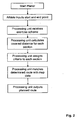
- FIG 2 one embodiment of the inventive method is shown.
- An athlete starts the route planner, i.e. initiates the method.
- the athlete inputs the intended start and end point of the route.
- the user may want to exercise on his way home from work.
- the start point would be the location of the work place and the end point would be the location of his home.
- the processing unit will receive or obtain the intended exercise scheme, where the exercises which are to be preformed, their duration and the sequence are defined. This scheme will be obtained or received from the database 13 or the coaching system 15. Based on this information, the length of each section of the route, i.e. the distance covered during one exercise will be calculated.
- the criteria to be fulfilled for the respective exercise will be assigned to the respective sections.
- a section where the athlete intends to walk, will be assigned the criterion of the road type having to be for pedestrians only.
- the information about the length of each section together with the criteria that have to be fulfilled will be transmitted to the matching unit 12.
- this information will be compared against data derived from the database 14.
- a suitable path will be selected.
- the matching unit 12 can select the appropriate path.
- the thus planned route can be output to the athlete via the output device 16, which may be a display.
- the steps indicated in Figure 2 may also be performed in a different order and may partially be omitted.
- the input of the start point and end point may be performed after the assigning of the criteria to the calculated route.
- the route planer could calculate a route to make sure that the specific route requirements, for example slope, presence of crossings, paved/unpaved surface, presence of vehicles, etc. are met for each of the training session's intervals. Also, the route planer could make sure that the training session ends at exactly the same spot as where it started, or at any spot indicated by the user, e.g. when the user runs home after work. A user could indicate which regions should be avoided when calculating routes. For example, regions could be avoided due to exhaust fumes, unsafe neighborhood or because of different reasons.
- the ideal route is selected on a route planer including information that is also included in the exercise profile, e.g. surface, traffic density, number and location of traffic lights, number of crossings, etc.
- This route is flexible and is adjusted if necessary during the training session.
- the user or athlete can set the start point and the end point to enable efficient planning of the training sessions. Also, neighborhoods or areas that a user wants to avoid, for example because of safety, bad road surface, etc. can be set.
- the user is provided with the ideal route for a specific training session and each training session is planned as effectively as possible.
Landscapes
- Engineering & Computer Science (AREA)
- Radar, Positioning & Navigation (AREA)
- Remote Sensing (AREA)
- Automation & Control Theory (AREA)
- Physics & Mathematics (AREA)
- General Physics & Mathematics (AREA)
- Navigation (AREA)
- Management, Administration, Business Operations System, And Electronic Commerce (AREA)
- Instructional Devices (AREA)
- Traffic Control Systems (AREA)
- Feedback Control In General (AREA)
Claims (16)
- Verfahren zum Planen einer Route für einen Athleten, wobei eine Verarbeitungseinheit (10) eine Route festlegt, dadurch gekennzeichnet, dass die Festlegung der Route den Schritt der Berechnung der Länge einzelner Abschnitte der Route umfasst, dass die Summe der einzelnen Abschnitte die Länge der festgelegten Route ist, dass jeder Abschnitt durch eine Übung definiert ist, die durch den Athleten in diesem Abschnitt durchzuführen ist und dass zumindest ein Teil der bestimmten Route von der Verarbeitungseinheit gegen Kartendaten abgeglichen wird.
- Verfahren nach Anspruch 1, dadurch gekennzeichnet, dass das Festlegen der Route den Schritt der Zuordnung von mindestens einem Kriterium zu mindestens einem Abschnitt der Route umfasst.
- Verfahren nach einem der Ansprüche 1 oder 2, dadurch gekennzeichnet, dass der Abgleich der festgelegten Route den Vergleich von bedingungsbezogenen Daten der Kartendaten mit zumindest einem Kriterium, das der festgelegten Route zugeordnet ist, umfasst.
- Verfahren nach einem der Ansprüche 1 bis 3, dadurch gekennzeichnet, dass die Verarbeitungseinheit (10) auf eine Datenbank (13) mit persönlichen Einträgen des Athleten zugreift, um persönliche Werte zur Berechnung der Länge der individuellen Abschnitte der Route zu erhalten.
- Verfahren nach einem der Ansprüche 1 bis 4, dadurch gekennzeichnet, dass die Verarbeitungseinheit (10) auf eine Datenbank (13) mit persönlichen Einträgen des Athleten zugreift, um persönliche Einstellungen für die Zuordnung mindestens eines Kriteriums zu mindestens einem Abschnitte der Route zu erhalten.
- Verfahren nach einem der Ansprüche 1 bis 5, dadurch gekennzeichnet, dass die Verarbeitungseinheit (10) externe Eingaben für die Berechnung der Länge der Route und/oder für die Zuordnung mindestens eines Kriteriums zu mindestens einem Abschnitt der Route einschließt.
- Verfahren nach einem der Ansprüche 1 bis 6, dadurch gekennzeichnet, dass die Verarbeitungseinheit (10) Informationen für die Festlegung der Route von einem Trainings- oder Coaching-System erhält.
- Verfahren nach einem der Ansprüche 2 bis 7, dadurch gekennzeichnet, dass zumindest ein Kriterium zur Festlegung der Route von dem Übungstyp für zumindest einen Abschnitt der Route abgeleitet wird.
- Verfahren nach einem der Ansprüche 1 bis 8, dadurch gekennzeichnet, dass die Route basierend auf Routendefinitionen und Trainingsdefinitionen festgelegt wird.
- Verfahren nach einem der Ansprüche 1 bis 9, dadurch gekennzeichnet, dass das Verfahren durchgeführt wird, wenn der Athlet die geplante Route benutzt.
- System zur Planung einer Route für einen Athleten, dadurch gekennzeichnet, dass das System eine Verarbeitungseinheit (10), die eine Festlegungseinheit (11) aufweist, die für die Festlegung einer Route durch Berechnung der Länge einzelner Abschnitte der Route ausgelegt ist, wobei die Summe der einzelnen Abschnitte die Länge der festgelegten Route ist, wobei jeder Abschnitt durch eine Übung, die durch den Athleten in diesem Abschnitt ausgeführt werden soll, definiert ist und eine Abgleicheinheit (12) umfasst, die für den Abgleich zumindest eines Teils der festgelegten Route gegen Kartendaten ausgelegt ist.
- System nach Anspruch 11, dadurch gekennzeichnet, dass die Verarbeitungseinheit (10) ausgelegt ist, um auf eine Datenbank, in der persönliche Profile gespeichert sind, zuzugreifen.
- System nach einem der Ansprüche 11 oder 12, dadurch gekennzeichnet, dass die Verarbeitungseinheit (10) eine Eingabeschnittstelle für Eingaben von einem Nutzer und/oder von einem Trainings- oder Coaching-System (15) aufweist.
- System nach einem der Ansprüche 11 bis 13, dadurch gekennzeichnet, dass die Abgleicheinheit (12) eine Vergleichseinheit umfasst, die ausgelegt ist, um Kriterien der festgelegten Route mit bedingungsbezogenen Kartendaten zu vergleichen.
- System nach einem der Ansprüche 11 bis 14, dadurch gekennzeichnet, dass das System (1) zumindest teilweise in einem tragbaren Gerät, insbesondere in einem Mobiltelefon, implementiert ist.
- System nach einem der Ansprüche 11 bis 15, dadurch gekennzeichnet, dass das System ausgelegt ist um das Verfahren nach einem der Ansprüche 1 bis 10 auszuführen.
Priority Applications (6)
| Application Number | Priority Date | Filing Date | Title |
|---|---|---|---|
| ES07117276T ES2362375T3 (es) | 2007-09-26 | 2007-09-26 | Método y sistema para planificar el itinerario de un atleta. |
| ES11155214T ES2395084T3 (es) | 2007-09-26 | 2007-09-26 | Método y sistema para planificar el itinerario de un atleta |
| DE602007012884T DE602007012884D1 (de) | 2007-09-26 | 2007-09-26 | Verfahren und System zur Routenplanung für einen Athleten |
| EP07117276A EP2042836B1 (de) | 2007-09-26 | 2007-09-26 | Verfahren und System zur Routenplanung für einen Athleten |
| AT07117276T ATE500488T1 (de) | 2007-09-26 | 2007-09-26 | Verfahren und system zur routenplanung für einen athleten |
| EP11155214A EP2317283B1 (de) | 2007-09-26 | 2007-09-26 | Verfahren und System zur Routenplanung für einen Athleten |
Applications Claiming Priority (1)
| Application Number | Priority Date | Filing Date | Title |
|---|---|---|---|
| EP07117276A EP2042836B1 (de) | 2007-09-26 | 2007-09-26 | Verfahren und System zur Routenplanung für einen Athleten |
Related Child Applications (1)
| Application Number | Title | Priority Date | Filing Date |
|---|---|---|---|
| EP11155214A Division EP2317283B1 (de) | 2007-09-26 | 2007-09-26 | Verfahren und System zur Routenplanung für einen Athleten |
Publications (2)
| Publication Number | Publication Date |
|---|---|
| EP2042836A1 EP2042836A1 (de) | 2009-04-01 |
| EP2042836B1 true EP2042836B1 (de) | 2011-03-02 |
Family
ID=38984422
Family Applications (2)
| Application Number | Title | Priority Date | Filing Date |
|---|---|---|---|
| EP07117276A Active EP2042836B1 (de) | 2007-09-26 | 2007-09-26 | Verfahren und System zur Routenplanung für einen Athleten |
| EP11155214A Active EP2317283B1 (de) | 2007-09-26 | 2007-09-26 | Verfahren und System zur Routenplanung für einen Athleten |
Family Applications After (1)
| Application Number | Title | Priority Date | Filing Date |
|---|---|---|---|
| EP11155214A Active EP2317283B1 (de) | 2007-09-26 | 2007-09-26 | Verfahren und System zur Routenplanung für einen Athleten |
Country Status (4)
| Country | Link |
|---|---|
| EP (2) | EP2042836B1 (de) |
| AT (1) | ATE500488T1 (de) |
| DE (1) | DE602007012884D1 (de) |
| ES (2) | ES2362375T3 (de) |
Families Citing this family (5)
| Publication number | Priority date | Publication date | Assignee | Title |
|---|---|---|---|---|
| US20100305852A1 (en) * | 2009-05-27 | 2010-12-02 | Nicola Louise Eger | Device and method for automatic route generation of a specified distance |
| JP2012177871A (ja) * | 2011-02-28 | 2012-09-13 | Pioneer Electronic Corp | 情報提示装置、情報提示方法、情報提示プログラムおよび情報提示プログラムを格納した記録媒体 |
| EP2780667B1 (de) | 2011-11-18 | 2018-04-25 | TomTom North America Inc. | Verfahren und vorrichtung zur erzeugung von kostendaten zur erzeugung einer route auf einer elektronischen karte |
| US9217647B2 (en) | 2013-05-14 | 2015-12-22 | Google Inc. | Guidebook transit routing |
| CN111260143A (zh) * | 2020-01-20 | 2020-06-09 | 北京建筑大学 | 路线的确定方法及装置、存储介质、终端 |
Family Cites Families (5)
| Publication number | Priority date | Publication date | Assignee | Title |
|---|---|---|---|---|
| US6208934B1 (en) | 1999-01-19 | 2001-03-27 | Navigation Technologies Corp. | Method and system for providing walking instructions with route guidance in a navigation program |
| WO2001042809A2 (en) * | 1999-12-07 | 2001-06-14 | Esport Incorporated | Gps athletic performance monitor methods and apparatus thereof |
| US7480512B2 (en) * | 2004-01-16 | 2009-01-20 | Bones In Motion, Inc. | Wireless device, program products and methods of using a wireless device to deliver services |
| JP2006079183A (ja) * | 2004-09-07 | 2006-03-23 | Hitachi Software Eng Co Ltd | 競技者練習支援装置およびプログラム |
| US7706973B2 (en) * | 2006-01-03 | 2010-04-27 | Navitrail Llc | Computer-aided route selection |
-
2007
- 2007-09-26 EP EP07117276A patent/EP2042836B1/de active Active
- 2007-09-26 EP EP11155214A patent/EP2317283B1/de active Active
- 2007-09-26 DE DE602007012884T patent/DE602007012884D1/de active Active
- 2007-09-26 ES ES07117276T patent/ES2362375T3/es active Active
- 2007-09-26 AT AT07117276T patent/ATE500488T1/de not_active IP Right Cessation
- 2007-09-26 ES ES11155214T patent/ES2395084T3/es active Active
Also Published As
| Publication number | Publication date |
|---|---|
| ATE500488T1 (de) | 2011-03-15 |
| ES2362375T3 (es) | 2011-07-04 |
| EP2042836A1 (de) | 2009-04-01 |
| ES2395084T3 (es) | 2013-02-08 |
| EP2317283B1 (de) | 2012-09-05 |
| EP2317283A1 (de) | 2011-05-04 |
| DE602007012884D1 (de) | 2011-04-14 |
Similar Documents
| Publication | Publication Date | Title |
|---|---|---|
| US6424910B1 (en) | Method and system for providing related navigation features for two or more end users | |
| EP2317283B1 (de) | Verfahren und System zur Routenplanung für einen Athleten | |
| US7359796B2 (en) | Methods and systems for reporting automotive traffic conditions in response to user-specific requests | |
| US11294372B2 (en) | Driving mode decision support | |
| EP1374200B1 (de) | Verfahren zur optimaliserung von verkerhrsinformationsinhalt | |
| US6208934B1 (en) | Method and system for providing walking instructions with route guidance in a navigation program | |
| US7439878B2 (en) | Apparatus and method for processing and displaying traffic information in an automotive navigation system | |
| US20110153193A1 (en) | Navigation systems and methods for users having different physical classifications | |
| JP5588473B2 (ja) | サーバ、経路探索システム、情報処理方法およびコンピュータプログラム | |
| US11536580B2 (en) | System and method for providing a travel route | |
| CN1441260A (zh) | 用于导航服务的单一或多重路径地图匹配装置及其方法 | |
| CN101483806A (zh) | 面向视障人群的户外导盲服务系统及方法 | |
| CN107331183A (zh) | 基于共享安全的智能交通服务方法和系统 | |
| CN1695043A (zh) | 道路信息提供服务器、道路信息提供系统、道路信息提供方法、路线搜索服务器、路线搜索系统以及路线搜索方法 | |
| US20110016146A1 (en) | Method for supporting the formation of car pools | |
| CN110954120B (zh) | 实时路况导航方法以及系统 | |
| CN110766195A (zh) | 一种基于游客需求的景区内部旅游路径规划方法 | |
| CN115127569A (zh) | 一种个性化联运导航方法和系统 | |
| CN103364003B (zh) | 区域导航方法、导航终端 | |
| CN112184371A (zh) | 一种乘客推荐上车点的计算和引导方法、系统及存储介质 | |
| JP2011043516A (ja) | ナビゲーションシステム、経路算出方法及びナビゲーション用プログラム | |
| JPH0961185A (ja) | 移動計画監視装置 | |
| JP3899946B2 (ja) | 経路設定方法、ナビゲーション装置、並びにそれらのコンピュータ・プログラム | |
| CN118410117B (zh) | 下车点推荐方法、装置、电子设备和计算机可读存储介质 | |
| CN109682387A (zh) | 一种确定导航位置点的方法和装置 |
Legal Events
| Date | Code | Title | Description |
|---|---|---|---|
| PUAI | Public reference made under article 153(3) epc to a published international application that has entered the european phase |
Free format text: ORIGINAL CODE: 0009012 |
|
| AK | Designated contracting states |
Kind code of ref document: A1 Designated state(s): AT BE BG CH CY CZ DE DK EE ES FI FR GB GR HU IE IS IT LI LT LU LV MC MT NL PL PT RO SE SI SK TR |
|
| AX | Request for extension of the european patent |
Extension state: AL BA HR MK RS |
|
| 17P | Request for examination filed |
Effective date: 20090518 |
|
| 17Q | First examination report despatched |
Effective date: 20090702 |
|
| AKX | Designation fees paid |
Designated state(s): AT BE BG CH CY CZ DE DK EE ES FI FR GB GR HU IE IS IT LI LT LU LV MC MT NL PL PT RO SE SI SK TR |
|
| GRAP | Despatch of communication of intention to grant a patent |
Free format text: ORIGINAL CODE: EPIDOSNIGR1 |
|
| GRAS | Grant fee paid |
Free format text: ORIGINAL CODE: EPIDOSNIGR3 |
|
| GRAA | (expected) grant |
Free format text: ORIGINAL CODE: 0009210 |
|
| AK | Designated contracting states |
Kind code of ref document: B1 Designated state(s): AT BE BG CH CY CZ DE DK EE ES FI FR GB GR HU IE IS IT LI LT LU LV MC MT NL PL PT RO SE SI SK TR |
|
| REG | Reference to a national code |
Ref country code: GB Ref legal event code: FG4D |
|
| REG | Reference to a national code |
Ref country code: CH Ref legal event code: EP |
|
| REG | Reference to a national code |
Ref country code: IE Ref legal event code: FG4D |
|
| REF | Corresponds to: |
Ref document number: 602007012884 Country of ref document: DE Date of ref document: 20110414 Kind code of ref document: P |
|
| REG | Reference to a national code |
Ref country code: DE Ref legal event code: R096 Ref document number: 602007012884 Country of ref document: DE Effective date: 20110414 |
|
| REG | Reference to a national code |
Ref country code: ES Ref legal event code: FG2A Ref document number: 2362375 Country of ref document: ES Kind code of ref document: T3 Effective date: 20110704 |
|
| REG | Reference to a national code |
Ref country code: NL Ref legal event code: VDEP Effective date: 20110302 |
|
| PG25 | Lapsed in a contracting state [announced via postgrant information from national office to epo] |
Ref country code: LT Free format text: LAPSE BECAUSE OF FAILURE TO SUBMIT A TRANSLATION OF THE DESCRIPTION OR TO PAY THE FEE WITHIN THE PRESCRIBED TIME-LIMIT Effective date: 20110302 Ref country code: GR Free format text: LAPSE BECAUSE OF FAILURE TO SUBMIT A TRANSLATION OF THE DESCRIPTION OR TO PAY THE FEE WITHIN THE PRESCRIBED TIME-LIMIT Effective date: 20110603 Ref country code: LV Free format text: LAPSE BECAUSE OF FAILURE TO SUBMIT A TRANSLATION OF THE DESCRIPTION OR TO PAY THE FEE WITHIN THE PRESCRIBED TIME-LIMIT Effective date: 20110302 Ref country code: SE Free format text: LAPSE BECAUSE OF FAILURE TO SUBMIT A TRANSLATION OF THE DESCRIPTION OR TO PAY THE FEE WITHIN THE PRESCRIBED TIME-LIMIT Effective date: 20110302 |
|
| LTIE | Lt: invalidation of european patent or patent extension |
Effective date: 20110302 |
|
| PG25 | Lapsed in a contracting state [announced via postgrant information from national office to epo] |
Ref country code: NL Free format text: LAPSE BECAUSE OF FAILURE TO SUBMIT A TRANSLATION OF THE DESCRIPTION OR TO PAY THE FEE WITHIN THE PRESCRIBED TIME-LIMIT Effective date: 20110302 Ref country code: AT Free format text: LAPSE BECAUSE OF FAILURE TO SUBMIT A TRANSLATION OF THE DESCRIPTION OR TO PAY THE FEE WITHIN THE PRESCRIBED TIME-LIMIT Effective date: 20110302 Ref country code: CY Free format text: LAPSE BECAUSE OF FAILURE TO SUBMIT A TRANSLATION OF THE DESCRIPTION OR TO PAY THE FEE WITHIN THE PRESCRIBED TIME-LIMIT Effective date: 20110302 Ref country code: FI Free format text: LAPSE BECAUSE OF FAILURE TO SUBMIT A TRANSLATION OF THE DESCRIPTION OR TO PAY THE FEE WITHIN THE PRESCRIBED TIME-LIMIT Effective date: 20110302 Ref country code: SI Free format text: LAPSE BECAUSE OF FAILURE TO SUBMIT A TRANSLATION OF THE DESCRIPTION OR TO PAY THE FEE WITHIN THE PRESCRIBED TIME-LIMIT Effective date: 20110302 Ref country code: BG Free format text: LAPSE BECAUSE OF FAILURE TO SUBMIT A TRANSLATION OF THE DESCRIPTION OR TO PAY THE FEE WITHIN THE PRESCRIBED TIME-LIMIT Effective date: 20110602 |
|
| PG25 | Lapsed in a contracting state [announced via postgrant information from national office to epo] |
Ref country code: BE Free format text: LAPSE BECAUSE OF FAILURE TO SUBMIT A TRANSLATION OF THE DESCRIPTION OR TO PAY THE FEE WITHIN THE PRESCRIBED TIME-LIMIT Effective date: 20110302 |
|
| PG25 | Lapsed in a contracting state [announced via postgrant information from national office to epo] |
Ref country code: PT Free format text: LAPSE BECAUSE OF FAILURE TO SUBMIT A TRANSLATION OF THE DESCRIPTION OR TO PAY THE FEE WITHIN THE PRESCRIBED TIME-LIMIT Effective date: 20110704 Ref country code: EE Free format text: LAPSE BECAUSE OF FAILURE TO SUBMIT A TRANSLATION OF THE DESCRIPTION OR TO PAY THE FEE WITHIN THE PRESCRIBED TIME-LIMIT Effective date: 20110302 |
|
| PG25 | Lapsed in a contracting state [announced via postgrant information from national office to epo] |
Ref country code: CZ Free format text: LAPSE BECAUSE OF FAILURE TO SUBMIT A TRANSLATION OF THE DESCRIPTION OR TO PAY THE FEE WITHIN THE PRESCRIBED TIME-LIMIT Effective date: 20110302 Ref country code: RO Free format text: LAPSE BECAUSE OF FAILURE TO SUBMIT A TRANSLATION OF THE DESCRIPTION OR TO PAY THE FEE WITHIN THE PRESCRIBED TIME-LIMIT Effective date: 20110302 Ref country code: SK Free format text: LAPSE BECAUSE OF FAILURE TO SUBMIT A TRANSLATION OF THE DESCRIPTION OR TO PAY THE FEE WITHIN THE PRESCRIBED TIME-LIMIT Effective date: 20110302 Ref country code: IS Free format text: LAPSE BECAUSE OF FAILURE TO SUBMIT A TRANSLATION OF THE DESCRIPTION OR TO PAY THE FEE WITHIN THE PRESCRIBED TIME-LIMIT Effective date: 20110702 |
|
| PLBE | No opposition filed within time limit |
Free format text: ORIGINAL CODE: 0009261 |
|
| STAA | Information on the status of an ep patent application or granted ep patent |
Free format text: STATUS: NO OPPOSITION FILED WITHIN TIME LIMIT |
|
| 26N | No opposition filed |
Effective date: 20111205 |
|
| PG25 | Lapsed in a contracting state [announced via postgrant information from national office to epo] |
Ref country code: PL Free format text: LAPSE BECAUSE OF FAILURE TO SUBMIT A TRANSLATION OF THE DESCRIPTION OR TO PAY THE FEE WITHIN THE PRESCRIBED TIME-LIMIT Effective date: 20110302 Ref country code: DK Free format text: LAPSE BECAUSE OF FAILURE TO SUBMIT A TRANSLATION OF THE DESCRIPTION OR TO PAY THE FEE WITHIN THE PRESCRIBED TIME-LIMIT Effective date: 20110302 |
|
| REG | Reference to a national code |
Ref country code: DE Ref legal event code: R097 Ref document number: 602007012884 Country of ref document: DE Effective date: 20111205 |
|
| PG25 | Lapsed in a contracting state [announced via postgrant information from national office to epo] |
Ref country code: MC Free format text: LAPSE BECAUSE OF NON-PAYMENT OF DUE FEES Effective date: 20110930 |
|
| REG | Reference to a national code |
Ref country code: CH Ref legal event code: PL |
|
| REG | Reference to a national code |
Ref country code: IE Ref legal event code: MM4A |
|
| PG25 | Lapsed in a contracting state [announced via postgrant information from national office to epo] |
Ref country code: CH Free format text: LAPSE BECAUSE OF NON-PAYMENT OF DUE FEES Effective date: 20110930 Ref country code: LI Free format text: LAPSE BECAUSE OF NON-PAYMENT OF DUE FEES Effective date: 20110930 Ref country code: IE Free format text: LAPSE BECAUSE OF NON-PAYMENT OF DUE FEES Effective date: 20110926 |
|
| PG25 | Lapsed in a contracting state [announced via postgrant information from national office to epo] |
Ref country code: MT Free format text: LAPSE BECAUSE OF FAILURE TO SUBMIT A TRANSLATION OF THE DESCRIPTION OR TO PAY THE FEE WITHIN THE PRESCRIBED TIME-LIMIT Effective date: 20110302 |
|
| PG25 | Lapsed in a contracting state [announced via postgrant information from national office to epo] |
Ref country code: LU Free format text: LAPSE BECAUSE OF NON-PAYMENT OF DUE FEES Effective date: 20110926 |
|
| PG25 | Lapsed in a contracting state [announced via postgrant information from national office to epo] |
Ref country code: TR Free format text: LAPSE BECAUSE OF FAILURE TO SUBMIT A TRANSLATION OF THE DESCRIPTION OR TO PAY THE FEE WITHIN THE PRESCRIBED TIME-LIMIT Effective date: 20110302 |
|
| PG25 | Lapsed in a contracting state [announced via postgrant information from national office to epo] |
Ref country code: HU Free format text: LAPSE BECAUSE OF FAILURE TO SUBMIT A TRANSLATION OF THE DESCRIPTION OR TO PAY THE FEE WITHIN THE PRESCRIBED TIME-LIMIT Effective date: 20110302 |
|
| PGFP | Annual fee paid to national office [announced via postgrant information from national office to epo] |
Ref country code: ES Payment date: 20150928 Year of fee payment: 9 |
|
| PGFP | Annual fee paid to national office [announced via postgrant information from national office to epo] |
Ref country code: IT Payment date: 20150924 Year of fee payment: 9 |
|
| REG | Reference to a national code |
Ref country code: FR Ref legal event code: PLFP Year of fee payment: 10 |
|
| PG25 | Lapsed in a contracting state [announced via postgrant information from national office to epo] |
Ref country code: IT Free format text: LAPSE BECAUSE OF NON-PAYMENT OF DUE FEES Effective date: 20160926 |
|
| REG | Reference to a national code |
Ref country code: FR Ref legal event code: PLFP Year of fee payment: 11 |
|
| PG25 | Lapsed in a contracting state [announced via postgrant information from national office to epo] |
Ref country code: ES Free format text: LAPSE BECAUSE OF NON-PAYMENT OF DUE FEES Effective date: 20160927 |
|
| REG | Reference to a national code |
Ref country code: FR Ref legal event code: PLFP Year of fee payment: 12 |
|
| REG | Reference to a national code |
Ref country code: ES Ref legal event code: FD2A Effective date: 20181126 |
|
| REG | Reference to a national code |
Ref country code: DE Ref legal event code: R082 Ref document number: 602007012884 Country of ref document: DE Representative=s name: MUELLER, THOMAS, DIPL.-ING., DE |
|
| PGFP | Annual fee paid to national office [announced via postgrant information from national office to epo] |
Ref country code: DE Payment date: 20240918 Year of fee payment: 18 |
|
| PGFP | Annual fee paid to national office [announced via postgrant information from national office to epo] |
Ref country code: GB Payment date: 20240919 Year of fee payment: 18 |
|
| PGFP | Annual fee paid to national office [announced via postgrant information from national office to epo] |
Ref country code: FR Payment date: 20240925 Year of fee payment: 18 |