EP2043018A1 - Procédé et dispositif de contrôle d'accès aux données dans un système de gestion de flux - Google Patents
Procédé et dispositif de contrôle d'accès aux données dans un système de gestion de flux Download PDFInfo
- Publication number
- EP2043018A1 EP2043018A1 EP07405288A EP07405288A EP2043018A1 EP 2043018 A1 EP2043018 A1 EP 2043018A1 EP 07405288 A EP07405288 A EP 07405288A EP 07405288 A EP07405288 A EP 07405288A EP 2043018 A1 EP2043018 A1 EP 2043018A1
- Authority
- EP
- European Patent Office
- Prior art keywords
- data
- privileges
- status
- user
- data set
- Prior art date
- Legal status (The legal status is an assumption and is not a legal conclusion. Google has not performed a legal analysis and makes no representation as to the accuracy of the status listed.)
- Ceased
Links
Images


Classifications
-
- G—PHYSICS
- G06—COMPUTING OR CALCULATING; COUNTING
- G06F—ELECTRIC DIGITAL DATA PROCESSING
- G06F21/00—Security arrangements for protecting computers, components thereof, programs or data against unauthorised activity
- G06F21/60—Protecting data
- G06F21/604—Tools and structures for managing or administering access control systems
-
- G—PHYSICS
- G06—COMPUTING OR CALCULATING; COUNTING
- G06F—ELECTRIC DIGITAL DATA PROCESSING
- G06F21/00—Security arrangements for protecting computers, components thereof, programs or data against unauthorised activity
- G06F21/60—Protecting data
- G06F21/62—Protecting access to data via a platform, e.g. using keys or access control rules
- G06F21/6218—Protecting access to data via a platform, e.g. using keys or access control rules to a system of files or objects, e.g. local or distributed file system or database
-
- G—PHYSICS
- G06—COMPUTING OR CALCULATING; COUNTING
- G06F—ELECTRIC DIGITAL DATA PROCESSING
- G06F2221/00—Indexing scheme relating to security arrangements for protecting computers, components thereof, programs or data against unauthorised activity
- G06F2221/21—Indexing scheme relating to G06F21/00 and subgroups addressing additional information or applications relating to security arrangements for protecting computers, components thereof, programs or data against unauthorised activity
- G06F2221/2141—Access rights, e.g. capability lists, access control lists, access tables, access matrices
Definitions
- the invention relates to the field of data processing, and in particular to the control of workflows and access rights involving data sets being processed by different users. It relates to a method and a data processing system for controlling data access as described in the preamble of the corresponding independent claims.
- Computer based data handling systems may define workflows which involve multiple entities and multiple persons acting on the same set of data. At a particular stage in the workflow, certain data items of the data set may be modified by certain persons, and at a later stage, certain other data items may be modified by again other persons. Access to the complete data set or to subsets of the data set may be controlled by e.g. access control lists (ACLs).
- ACLs access control lists
- current implementations are cumbersome and error prone.
- a privilege is simply one of a predetermined set of constants, preferably given meaningful names or labels.
- privileges may be "system”, “staff”, “decisionmaker”, “external user”, “requestor”, etc.
- Different sets of privileges "sharing a privilege” means that the sets have at least one privilege in common, i.e. the intersection of the sets is not empty.
- a user may be associated with his privileges either directly, e.g., by a software representation of a "user privilege - user” relation, or indirectly, by means of an intermediate software entity, called a role.
- Each user is related to one or more roles, and each role is related to zero or one or more privileges.
- a user has, in this manner, one or more privileges assigned to it, either directly or indirectly.
- a data item is a container for the basic data units that are handled by the system, with access and modification of the data item as a whole being enabled or disabled.
- a data item may represent e.g. a number, or a date or a text string etc., each optionally conforming to specific formatting rules.
- the data item, data set, status, privileges, rules etc. all are stored in computer readable (machine readable) form and are processed by software running on a computer or data processing system.
- the set of conventions and the rule for action define a framework which allows to specify "who may when change what" in a very compact manner. This specification conversely has low or no redundancy.
- the workflow is an implicit result of this specification: since the system is able to determine when a particular user has the right to change a particular data set, it can automatically make the data set visible and accessible to the user according to the status of the data set, in particular when it becomes relevant to the user. Physical storage requirements for defining the workflow and the access rights are correspondingly low. Whether a particular data item or data set is changeable can be determined from the context (user and status) of the data set in a computationally efficient manner by generic rules, i.e. a program implementing such rules.
- the workflow processing and access control can be generated automatically from the information in the basic framework.
- forms for entering and modifying data are generated dynamically, based on the information of the data sets, data items, statuses and privileges.
- properties of the forms which properties reflect the permission to change data items and statuses, are generated dynamically, depending on the current status and user.
- the privileges are described by zero, one or more privileges. If no privilege is defined, the action cannot be performed.
- an action-privilege pair in an action-privileges pair, the action is one of "modification of a data item" or "change the Status of the data set to a Next Status".
- an action-privilege pair associates the modification of one or more data items with certain privileges, or the modification of a status with certain privileges.
- a single action-privileges pair is configured to control the modification of all the data items of a data set being in the status to which the action-privileges pair belongs.
- the action is "modification of any data item of the data set being in the status”
- the privileges shall be called “mutability privileges”.
- one or more separate action-privileges pairs are configured to control the transition to separate Next Statuses.
- each data item is associated with one or more privileges. This allows to control the mutability of each data item according to the context it is in, i.e. the data set and the status of the data set.
- each data item is defined and controlled according to the following conventions and rule:
- a data item may be associated with more than one privilege, and a user may be associated with exactly one privilege.
- the right to change a particular data item is thus determined by the data item itself, the status of the data set comprising the data item is in, and the privileges of the user.
- the privileges of the user in turn are either directly or indirectly (via a role) associated with the identity of the user.
- status changes are defined and controlled in the following manner:
- the system comprises validation rules for verifying whether the values of data items are legal and consistent.
- Validations rules preferably are defined on different levels, e.g. verifying whether the value of a data item ...
- the system for controlling a workflow and for accessing its data comprises a data processing unit configured to implement the steps of the corresponding method.
- the system is configured by implementing the above-described data structures and associated processing rules and methods in an object oriented (OO) framework, i.e. using OO methodology:
- OO object oriented
- Actual data is represented by software objects that are instances of classes, with class definitions specifying the general relations between the objects. For example,
- a computer program product for controlling a workflow and for accessing its data according to the invention is loadable into an internal memory of a digital computer, and comprises computer program code means to make, when said computer program code means is loaded in the computer, the computer execute the method according to the invention.
- the computer program product comprises a computer readable medium, having the computer program code means recorded thereon.
- Figure 1 schematically shows a class diagram which describes object classes used in a preferred embodiment of the invention.
- the diagram follows the commonly known UML (unified modelling language) standard; the individual classes shall be explained in more detail below.
- UML unified modelling language
- the term “idl” expresses that method parameters are expressable in some interface description language.
- a DataObject represents a collection of related data items.
- a DataObject instance represents the data fields of a request form.
- the data fields may comprise information entered by a requesting person (name, address, request specific information, ...) and information entered by a person processing the request (comments, internal data assigned to the request, ).
- An exemplary hierarchy of DataObject classes comprises "mortgage request”, which is a subclass of "long term loan request” which is a subclass of "credit request” which is a subclass of "general request”. Recall that according to the OO paradigm a member of a subclass or child class inherits the properties of its parent class.
- a DataObject is "warrant request”, which is a subclass of "derivative request” which is a subclass of "request”.
- a DataItem instance contains a single chunk of data, which from the point of view of access control is regarded as an atomic entity.
- the class of the DataItem instance provides meta-information describing the instance.
- An exemplary hierarchy of DataItem classes comprises "Price” which is a subclass of "RealNumber” which is a subclass of "Number” which is a subclass of "General”.
- Price which is a subclass of "RealNumber” which is a subclass of "Number” which is a subclass of "General”.
- the DataItem instances used are preferably stored in a dictionary or catalogue of DataItems.
- a DataItem instance is associated with a DataDescriptor instance, for example, when the DataItem instance is instantiated.
- a DataDescriptor class represents additional properties of a DataItem class.
- a DataItem instance represents an address string, or a monetary value, a status code, a calendar date, a request identification number, etc.
- the name of the DataDescriptor instance associated with a particular DataItem instance is identified by an immutable string which gives the name of the DataItem, such as "Requestor Address”, “Date of submission”, “Current request status”, etc...
- the Privilege attribute has to be identical to a Privilege attribute of another entity, in order to allow that other entity to modify the instance of the DataItem.
- the other entity is a user, or from the point of view of the computer system, someone who logs in as a particular user and therewith assumes a particular user identity.
- the Storage attribute preferably defines whether
- a validation rule is automatically executed in order to verify the validity of the values of DataItems.
- Validation rules preferably operate on different levels, these levels comprising
- a Status is associated with a DataObject.
- the Status describes how the DataObject may be modified, and to which (other) Statuses the DataObject may be moved.
- each Status class allows for a Status instance to have zero, one or more Mutability Privileges, and one or more Next Status, each Next Status being associated with one or more Status Change Privileges. If a Status has no Mutability Privileges, no data items at all can be modified in this Status.
- All the Status instances associated with a particular DataObject together define the states and state transitions for that DataObject, preferably represented by Status Transition instances.
- Each DataObject preferably is associated with an initial Status; when an instance of the DataObject is created, the instance is given the initial Status.
- the Workflow class is a collection of Status instances. Each DataObject is associated with one Workflow instance. Hence, the Workflow defines the valid sequences of Statuses a DataObject can go through.
- a Workflow also provides hooks to intercept a DataObject's Status change. Such a hook can be used, e.g., to perform bookkeeping functions.
- Manager instance per application instance. It embeds the mechanisms described so far in the surrounding computer system. For example, the Manager performs the communication with the physical data storage and with up-and down-stream systems. It also performs any functions which concern more than one DataObject.
- classes so far have been described mainly in terms of object attributes, the classes also comprise the usual methods for accessing their attributes, that is, methods for modifying attributes, for querying objects about their attributes, for returning names and values of attributes etc....
- a particular implementation of a software system according to the invention is defined by specific classes established according to the above-described abstract class structure.
- the software is accessed or used by persons or machine-based entities that have functions (within their organisation) such as "requestor”, “formalities check”, “product assessment”, and “responsible for acceptance”. For the sake of simplicity, we shall henceforth only refer to persons, it is however understood that a computer can take on similar functions.
- Privileges use the same labels as the Privileges of the DataDescriptors, the Mutability Privileges and the Status Change Privileges.
- a Privilege associated with a current user shall also be called a "User Privilege".
- the association of user privileges to users may either be done directly, that is, by maintaining a computer readable representation of a "n..1" " relationship between users and user privileges.
- the association is represented indirectly, that is, the representation is based on intermediate software objects called roles, wherein each user is associated with one or more roles, and each role is associated with zero, one or more privileges.
- a first one is associated with the User Privilege "requestor", and a second another one with the user Privileges "requestor” and “submit”.
- a first one is associated with the User Privilege "staff”, and a second one with the User Privileges "staff” and "decide”.
- a further Privilege "system” represents the software system itself.
- the DataObject is defined e.g. by a
- the WarrantRequest class is a subclass of
- the DerivativeRequestclass is a subclass of
- Exemplary ValidationRules are defined e.g. to check the validity of an ISIN by means of a parity character included in the ISIN (level 1 test).
- Exemplary Status classes are:
- an instance of the DataObject "warrant request class” is created by the system.
- the system retrieves the DataItems from the warrant request class, including those DataItems inherited from its parent classes ("derivative request", "request"), and creates corresponding instances for storing the item data.
- the DataObject is put in the Status "draft”. This is done automatically by having predefined the initial Status for each DataObject.
- the system then dynamically generates an entry form for modifying the instances of the DataItems.
- an entry form for modifying the instances of the DataItems.
- the first user working for the requestor will see all the DataItems of the warrant request class.
- the identifier may not be changed by the user, since its Privilege is "system”.
- the ISIN may be changed by the user, since the Privilege of the ISIN and the current status and the current user is "requestor”.
- the mutability of the other DataItems follows in a similar fashion.
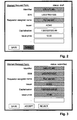
- FIG. 2 An exemplary representation of an entry form represented to a requestor is shown in Figure 2 . Fields that cannot be changed, and buttons that cannot be operated, are hatched. In an actual implementation, their state is preferably indicated by colour coding, shading, or by not drawing them at all.
- the first user is only offered a "Save” button, since the only Next Status defined in Status "draft” would require the Status Change Privilege "submit", which the first user does not have. For this reason, the "Submit” button is hatched (as in Figure 2 ), to indicate that it is inactive, or not displayed at all.
- the "Save” button may be generated automatically by the system, either as a default for each form, or by associating it with a "status change” in which the Next Status is identical to the present Status. This allows for an elegant implementation of the save feature by having the underlying Manager automatically performing a save operation for every status change, including such a dummy change.
- a corresponding "identical" Next Status entry can e.g. be included in each Status class definition or inherited from a Status parent class. As a result, it is not necessary to provide for a separate "Save” function and a corresponding control button.
- the second user working for the requestor will, when presented with the same form, be allowed to make the same changes, since he also has the privilege "requestor". In addition, he will also be presented with a "Submit” button for triggering the change to Next Status "submitted", since the second user also has the privilege "submit”.
- the fields that are modifiable by the first and second user at the stock exchange, and the control buttons they are presented with are determined automatically according to the status and the user privileges. If they could view the request while it is still in the "draft” Status, they would not be allowed to modify any fields, since the "draft” Status limits the mutability to users with privilege "requestor".
- FIG. 3 An exemplary representation of an entry form represented to a stock exchange staff member is shown in Figure 3 . A number of fields that were entered by the requestor cannot be changed anymore.
- the fields showing the DataItems are visually coded, e.g, by colouring or shading the field text and/or background, in order to represent the state of the field or DataItem.
- the field state can be
- a Validation Status of the complete form, or in other words, the DataObject is determined in the following manner:
- status changes are enabled only if the Validation Status of the DataObject is "valid". In this manner, a user must bring all fields that he has control over into a valid state.
- the procedure for implementing the Validation Status is independent of the actual application. On the other hand, the actual behaviour of the procedure is defmed by the definition of the ValidationRules and the Privileges.
- the validity and mutability of a field, and the Validation Status of the DataObject are preferably indicated visually in the form representing the fields of the DataObjects.
- a particular user is presented with a list of requests, i.e. DataObject instances, that he may modify.
- This list is generated dynamically by checking each existing request whether it comprises at least one field that is mutable by the user, or at least one Status Change that can be triggered by the user. If this is the case, the request is one that the user may modify.
- the list, or a separate list may also comprise a list of requests that the user modified at some earlier point in time, even if the user is currently not allowed to modify it. This allows the user to check the progress of the request through further states, which may bring it into a state in which the user is again allowed to modify it.
- the list of modifiable requests is of course represented visually to the user, with each request being selectable by an appropriate selection means such as a control button, menu entry, drop down list entry etc.
- the information item may be e.g. an identifier generated by the system, or a combination of the requestor's name and/or ISIN and/or request date etc.
- the form representing the request i.e. its DataObject instance
- Each entry in the list can be selected by pressing an "EDIT" button, which causes the corresponding entry form to be displayed.
- FIG. 5 shows a flow diagram of the method according to the invention. The individual steps shown are:
- the first four steps are initialization steps that are performed when setting up the system for operation, the last step is executed repeatedly during operation of the system; for a plurality of different users accessing and optionally modifying the data represented by the data set.
Landscapes
- Engineering & Computer Science (AREA)
- Theoretical Computer Science (AREA)
- Computer Security & Cryptography (AREA)
- Bioethics (AREA)
- General Health & Medical Sciences (AREA)
- Computer Hardware Design (AREA)
- Health & Medical Sciences (AREA)
- Software Systems (AREA)
- Physics & Mathematics (AREA)
- General Engineering & Computer Science (AREA)
- General Physics & Mathematics (AREA)
- Automation & Control Theory (AREA)
- Databases & Information Systems (AREA)
- Storage Device Security (AREA)
Priority Applications (1)
| Application Number | Priority Date | Filing Date | Title |
|---|---|---|---|
| EP07405288A EP2043018A1 (fr) | 2007-09-26 | 2007-09-26 | Procédé et dispositif de contrôle d'accès aux données dans un système de gestion de flux |
Applications Claiming Priority (1)
| Application Number | Priority Date | Filing Date | Title |
|---|---|---|---|
| EP07405288A EP2043018A1 (fr) | 2007-09-26 | 2007-09-26 | Procédé et dispositif de contrôle d'accès aux données dans un système de gestion de flux |
Publications (1)
| Publication Number | Publication Date |
|---|---|
| EP2043018A1 true EP2043018A1 (fr) | 2009-04-01 |
Family
ID=38947711
Family Applications (1)
| Application Number | Title | Priority Date | Filing Date |
|---|---|---|---|
| EP07405288A Ceased EP2043018A1 (fr) | 2007-09-26 | 2007-09-26 | Procédé et dispositif de contrôle d'accès aux données dans un système de gestion de flux |
Country Status (1)
| Country | Link |
|---|---|
| EP (1) | EP2043018A1 (fr) |
Cited By (3)
| Publication number | Priority date | Publication date | Assignee | Title |
|---|---|---|---|---|
| CN104424320A (zh) * | 2013-09-06 | 2015-03-18 | 镇江精英软件科技有限公司 | 一种通过序列号安全访问数据接口的方法 |
| JP2020528173A (ja) * | 2017-07-01 | 2020-09-17 | 成都牽牛草信息技術有限公司Chengdu Qianniucao Information Technology Co., Ltd. | フォーム関連情報の承認方法 |
| CN115936537A (zh) * | 2023-01-12 | 2023-04-07 | 中国核工业二三建设有限公司 | 一种基于三维模型设计的质量控制方法 |
Citations (5)
| Publication number | Priority date | Publication date | Assignee | Title |
|---|---|---|---|---|
| WO1997042584A1 (fr) * | 1996-05-03 | 1997-11-13 | Webmate Technologies, Inc. | Systeme et procedes de developpement et de repartition d'applications clients-serveurs |
| US6236996B1 (en) * | 1997-10-31 | 2001-05-22 | Sun Microsystems, Inc. | System and method for restricting database access to managed object information using a permissions table that specifies access rights to the managed objects |
| US20020138322A1 (en) | 2001-03-23 | 2002-09-26 | Katsuyuki Umezawa | Secure workflow system and method for the same |
| US20050043982A1 (en) * | 2003-08-22 | 2005-02-24 | Nguyen Vinh Dinh | Contextual workflow modeling |
| US20050071275A1 (en) | 2003-09-30 | 2005-03-31 | Pss Systems, Inc | Method and apparatus for transitioning between states of security policies used to secure electronic documents |
-
2007
- 2007-09-26 EP EP07405288A patent/EP2043018A1/fr not_active Ceased
Patent Citations (5)
| Publication number | Priority date | Publication date | Assignee | Title |
|---|---|---|---|---|
| WO1997042584A1 (fr) * | 1996-05-03 | 1997-11-13 | Webmate Technologies, Inc. | Systeme et procedes de developpement et de repartition d'applications clients-serveurs |
| US6236996B1 (en) * | 1997-10-31 | 2001-05-22 | Sun Microsystems, Inc. | System and method for restricting database access to managed object information using a permissions table that specifies access rights to the managed objects |
| US20020138322A1 (en) | 2001-03-23 | 2002-09-26 | Katsuyuki Umezawa | Secure workflow system and method for the same |
| US20050043982A1 (en) * | 2003-08-22 | 2005-02-24 | Nguyen Vinh Dinh | Contextual workflow modeling |
| US20050071275A1 (en) | 2003-09-30 | 2005-03-31 | Pss Systems, Inc | Method and apparatus for transitioning between states of security policies used to secure electronic documents |
Non-Patent Citations (2)
| Title |
|---|
| DENG P S ET AL INSTITUTE OF ELECTRICAL AND ELECTRONICS ENGINEERS: "A DYNAMIC ACCESS CONTROL MODEL FOR OBJECT-ORIENTED SYSTEM", PROCEEDINGS OF THE INTERNATIONAL CARNAHAN CONFERENCE ON SECURITY TECHNOLOGY. TAIPEI, OCT. 13 - 15, 1993, NEW YORK, IEEE, US, 13 October 1993 (1993-10-13), pages 159 - 163, XP000452692, ISBN: 0-7803-1480-8 * |
| SANDHU R S ET AL: "ACCESS CONTROL: PRINCIPLES AND PRACTICE", IEEE COMMUNICATIONS MAGAZINE, IEEE SERVICE CENTER,NEW YORK, NY, US, vol. 32, no. 9, 1 September 1994 (1994-09-01), pages 40 - 48, XP000476554, ISSN: 0163-6804 * |
Cited By (3)
| Publication number | Priority date | Publication date | Assignee | Title |
|---|---|---|---|---|
| CN104424320A (zh) * | 2013-09-06 | 2015-03-18 | 镇江精英软件科技有限公司 | 一种通过序列号安全访问数据接口的方法 |
| JP2020528173A (ja) * | 2017-07-01 | 2020-09-17 | 成都牽牛草信息技術有限公司Chengdu Qianniucao Information Technology Co., Ltd. | フォーム関連情報の承認方法 |
| CN115936537A (zh) * | 2023-01-12 | 2023-04-07 | 中国核工业二三建设有限公司 | 一种基于三维模型设计的质量控制方法 |
Similar Documents
| Publication | Publication Date | Title |
|---|---|---|
| US11741411B2 (en) | System and method for software development including column-based process editor | |
| US7600182B2 (en) | Electronic data capture and verification | |
| US10740069B2 (en) | Compositional entity modeling systems and methods | |
| US9298759B2 (en) | Smart containers | |
| US6658622B1 (en) | Self-diagnosing and self-correcting data entry components with dependency behavior | |
| US8954471B2 (en) | Method and system for providing process-based access control for a collaboration service in enterprise business software | |
| US6990480B1 (en) | Information manager method and system | |
| US6070152A (en) | Framework for business applications providing financial integration | |
| US20030090514A1 (en) | Business process user interface generation system and method | |
| US6341359B1 (en) | Self-diagnosing and self correcting data entry components | |
| US20110016448A1 (en) | System and method for rapid development of software applications | |
| CN101246355A (zh) | 控制与监测药品制造工序和/或配制工序的方法及设备 | |
| US20070083456A1 (en) | Algorithmic trading | |
| EP2043018A1 (fr) | Procédé et dispositif de contrôle d'accès aux données dans un système de gestion de flux | |
| US8073717B2 (en) | Systems for digital management of underwriting insurance contracts | |
| US8073716B2 (en) | Methods for digital management of underwriting insurance contracts | |
| EP0897149A1 (fr) | Structure pour l'intégration financielle des applications commerciales | |
| HK1130918A (en) | Method and apparatus for controlling data access in a workflow system | |
| US20060271913A1 (en) | Method and system for providing a field configurable guide | |
| EP4617914A1 (fr) | Procédé, appareil et produit de programme informatique pour une vérification automatisée de vérification de conformité et de vérification de vérification de conformité de document |
Legal Events
| Date | Code | Title | Description |
|---|---|---|---|
| PUAI | Public reference made under article 153(3) epc to a published international application that has entered the european phase |
Free format text: ORIGINAL CODE: 0009012 |
|
| AK | Designated contracting states |
Kind code of ref document: A1 Designated state(s): AT BE BG CH CY CZ DE DK EE ES FI FR GB GR HU IE IS IT LI LT LU LV MC MT NL PL PT RO SE SI SK TR |
|
| AX | Request for extension of the european patent |
Extension state: AL BA HR MK RS |
|
| RAP1 | Party data changed (applicant data changed or rights of an application transferred) |
Owner name: SIX SWISS EXCHANGE AG |
|
| 17P | Request for examination filed |
Effective date: 20090923 |
|
| 17Q | First examination report despatched |
Effective date: 20091022 |
|
| AKX | Designation fees paid |
Designated state(s): AT BE BG CH CY CZ DE DK EE ES FI FR GB GR HU IE IS IT LI LT LU LV MC MT NL PL PT RO SE SI SK TR |
|
| REG | Reference to a national code |
Ref country code: HK Ref legal event code: DE Ref document number: 1130918 Country of ref document: HK |
|
| STAA | Information on the status of an ep patent application or granted ep patent |
Free format text: STATUS: THE APPLICATION HAS BEEN REFUSED |
|
| 18R | Application refused |
Effective date: 20121227 |
|
| REG | Reference to a national code |
Ref country code: HK Ref legal event code: WD Ref document number: 1130918 Country of ref document: HK |