EP2043024A2 - Fingerkontakterkennungsvorrichtung, Fingerkontakterkennungsverfahren und Fingerabdrucklesevorrichtung und Fingerabdruckleseverfahren - Google Patents
Fingerkontakterkennungsvorrichtung, Fingerkontakterkennungsverfahren und Fingerabdrucklesevorrichtung und Fingerabdruckleseverfahren Download PDFInfo
- Publication number
- EP2043024A2 EP2043024A2 EP08165136A EP08165136A EP2043024A2 EP 2043024 A2 EP2043024 A2 EP 2043024A2 EP 08165136 A EP08165136 A EP 08165136A EP 08165136 A EP08165136 A EP 08165136A EP 2043024 A2 EP2043024 A2 EP 2043024A2
- Authority
- EP
- European Patent Office
- Prior art keywords
- finger
- fingerprint
- pixel data
- finger contact
- contact detecting
- Prior art date
- Legal status (The legal status is an assumption and is not a legal conclusion. Google has not performed a legal analysis and makes no representation as to the accuracy of the status listed.)
- Withdrawn
Links
Images




Classifications
-
- G—PHYSICS
- G06—COMPUTING OR CALCULATING; COUNTING
- G06V—IMAGE OR VIDEO RECOGNITION OR UNDERSTANDING
- G06V40/00—Recognition of biometric, human-related or animal-related patterns in image or video data
- G06V40/10—Human or animal bodies, e.g. vehicle occupants or pedestrians; Body parts, e.g. hands
- G06V40/12—Fingerprints or palmprints
- G06V40/1335—Combining adjacent partial images (e.g. slices) to create a composite input or reference pattern; Tracking a sweeping finger movement
Definitions
- This invention relates to a finger contact detecting apparatus and a finger contact detecting method, a fingerprint reading apparatus, and a fingerprint reading method.
- a fingerprint reading apparatus including a line sensor with pixels arranged on a line is known. While a finger is swept on the line sensor, light is irradiated onto the finger with a LED (Light Emitting Diode) or the like, and the reflected light from the finger is detected with the line sensor to obtain a line image of the finger. A fingerprint image is then formed (composed) using the line image.
- a LED Light Emitting Diode
- Such a fingerprint reading apparatus obtains a subtraction (difference) between the maximum values of a fingerprint image data measured under LED light radiation and no LED light radiation, and determines whether the finger is separated from the line sensor based on a difference between the subtraction result and a predetermined value.
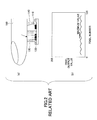
- FIG. 1 and FIG. 2 are drawings to describe a finger contact determination method of a conventional fingerprint reading apparatus.
- FIG. 1(a) is a side view of a conventional fingerprint reading apparatus measuring a fingerprint image with light radiation from a LED 110.
- a finger 150 sweeps from the left side to the right side (indicated by an arrow) on a line sensor 120 provided in a frame 140.
- the LED 110 radiates light on the finger 150, and the line sensor 120 receives the reflected light through an image guide 130.
- FIG. 1(b) indicates an output signal of the line sensor 120 in a state of FIG. 1(a).
- FIG. 1(b) indicates that the output of the line sensor 120 is varied according to a surface ridge pattern of a fingerprint, and the outputs of pixels indicate a wavelike signal.
- image data obtained with the line sensor 120 is collected for one frame by one frame at a predetermined periodic cycle while the finger 150 is swept on the line sensor 120. In this case, the maximum value of the pixel outputs is close to 255 in the range of 0 to 255.
- FIG. 2(a) shows a side view of a conventional fingerprint reading apparatus measuring a fingerprint image with no light radiation from a LED 110.
- the LED 110 is turned off, there in no reflected (or scattered) light incident on the line sensor 120, and the line sensor 120 receives no light.
- FIG. 2 (b) indicates an output signal of the line sensor 120 in a state of FIG. 2(a) .
- the output signal of the line sensor 120 indicates that output values of the entire pixels are small showing dark image data for all over. Thus the maximum value of the pixel outputs also indicates a small value.
- a detecting apparatus having a detecting unit that detects whether a body to be detected contacts a detection part based on a relationship obtained by comparing a detected signal level and a predetermined base level, is known (for example, a patent document Japanese Patent Application Publication No. 2005-202694 ).
- one aspect of this invention is to provide a finger contact detecting apparatus, a finger contact detecting method, and a fingerprint reading apparatus using the finger contact detecting method, and a fingerprint reading method using the fingerprint reading apparatus which enable to reliable (accurate) detection of whether a finger is separated from the fingerprint sensor.
- a finger contact detecting apparatus which detects a finger being swept on a fingerprint sensor of the finger contact detecting apparatus including, a pixel data averaging unit calculating an average value of pixel data collected by the fingerprint sensor; a deviation adding unit calculating, based on the pixel data average value and respective pixel data of predetermined pixels obtained by the fingerprint sensor, addition (summation) of deviations of the respective pixel data of the predetermined pixels; and a finger contact detecting unit determining whether the finger is separated from the fingerprint sensor based on the addition of deviations and a predetermined threshold value.
- finger contact detection can be reliably performed, and a fingerprint image can be obtained at the time when the finger separates from the detecting unit.
- a finger contact detecting method includes the steps of (a) collecting pixel data of a fingerprint sensor while a finger is being swept on the fingerprint sensor; (b) calculating an average value of the pixel data collected by the fingerprint sensor; (c) calculating addition of deviations based on the average value and respective pixel data of predetermined pixels obtained by the fingerprint sensor; and (d) determining whether a finger is separated from the fingerprint sensor based on the obtained addition of deviations at step (c) and a predetermined threshold value.
- a fingerprint reading apparatus includes: the finger contact detecting apparatus claimed in claim 1; the fingerprint sensor; and an image composing memory that records fingerprint image data collected by the fingerprint sensor and composes a fingerprint image.
- a computer-readable recording medium having instructions executable by a computer to execute a fingerprint reading method including the steps of collecting fingerprint image data while a finger is being swept on a fingerprint sensor; and performing the finger contact detecting method of claim 5, wherein when the finger is detected as being separated from the fingerprint sensor after executing the step of performing the finger contact detecting method, the step of collecting fingerprint image data is finished.
- an accurate detection of finger contact can be performed.
- FIG. 3 is a drawing showing a concept of a constitution of a finger contact detecting apparatus 100 and a fingerprint reading apparatus 200 applying this embodiment.
- the finger contact detecting apparatus 100 includes a pixel data-averaging unit 50 (or an averaging unit 50), a deviation adding unit 60, and a finger contact detecting unit 70.
- a fingerprint reading apparatus 200 may include a fingerprint sensor 20, an image composing memory 90, a light-emitting unit 10, an image guide 30, a frame 40, and an operation control unit 80 according to necessity.
- the light-emitting unit 10 radiates output light to a finger 150.
- a ridge pattern of a surface of the fingerprint needs to be read by radiating the output light (of the light-emitting unit 10) to the finger 150 and receiving reflected (or scattered) light from the finger.
- the output light (or light) needs to be generated to radiate the light to the fingerprint surface of the finger 150.
- the light-emitting unit 10 generates light for radiation and radiates the light on the finger 150.
- any kind of light may be used as the light-emitting unit, for example, a LED (light emitting diode) may be applied.
- a LED light emitting diode
- an infrared LED may be applied.
- the light-emitting unit 10 may be turned off.
- the fingerprint sensor 20 is an imaging unit which receives the light from the finger to collect a fingerprint image.
- the fingerprint sensor 20 is constituted by an imaging element having plural pixels 21 formed by arranged photoelectric conversion elements.
- An arrangement of the pixels 21 may be configured in a two-dimensional plane with a predetermined shape, and for example, a line sensor having plural pixels 21 arranged in a line may be applied.
- the line sensor collects, at one time, only line image data constituting part of a fingerprint. However, the line sensor collects the line image data as the finger 150 is swept and the entire fingerprint image can be formed by composing the image data. Further, for a case where the fingerprint sensor 20 is a line sensor, plural line sensors may be included in the finger print sensor 20 instead of one line sensor. Also, any type of photoelectric conversion elements may be applied for the pixels 21, and for example, photodiodes may be applied.
- the image guide 30 is a waveguide to guide light (incident light) from the finger 150 onto the fingerprint sensor 20.
- the image guide 30 is provided to efficiently guide the light from the finger 150 onto the fingerprint sensor 20 when necessary.
- optical fibers may be applied to the image guide 30.
- the frame 40 is a frame unit for mounting the light-emitting unit 10, the fingerprint sensor 20, and the image guide 30.
- the frame 20 is strong enough to support the finger 150 when the finger 150 is placed on the frame 20, any type of frame (structure) may be used.
- the frame 20 may be formed as part of the frame unit of the mobile phone.
- the averaging unit 50 calculates average values of image data collected by the pixels 21 constituting the fingerprint sensor 20. As pixel data is indicated by an absolute number in response to brightness at the pixel, the averaging unit 50 can calculate an average value of the collected output pixel data. Accordingly, an average value of the whole brightness for a fingerprint image collected by the fingerprint sensor 20 can be known and also an average value can be determined for background light in the surrounding environment. For example, when the fingerprint sensor 20 is a one-dimensional line sensor formed by using 126 pixels arranged in a line, the average value for 126 pixels is calculated. Also, when the fingerprint sensor 20 is formed by four rows of the one-dimensional line sensors arranged in two dimensions, the average value is calculated for 512 pixels of data.
- an arithmetic average for the entire pixels 21 of the fingerprint sensor 20 is preferred.
- an arithmetic process for the calculation is large, another way where the number of pixels to be calculated for averaging is reduced or a similar way may be applied when necessary. This issue will be described later.
- the deviation adding unit 60 calculates, for respective pixel data of predetermined pixels selected from the pixels 21 of the fingerprint sensor 20, a summation (addition) of a deviation that is obtained from an averaged pixel data calculated with the averaging unit and the pixel data of the predetermined pixels. In short, the deviation adding unit 60 calculates, for respective selected pixel data of the predetermined pixels, the absolute value of the difference between each pixel data and the average pixel data or the square root of a squared value of the difference between each pixel data and the average pixel data, and then the obtained values are added.
- the predetermined pixels to be calculated by the deviation-adding unit 60 for the addition of the deviations may be selected from arbitrary pixels of the fingerprint sensor 20.
- the predetermined pixels may be selected from arbitrary positions in the fingerprint sensor 20. However, the arrangement of pixels uniformly distributed over the fingerprint sensor 20 is preferred for the predetermined pixels to reflect pixel data of the whole regions of the fingerprint sensor 20.
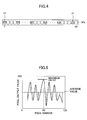
- FIG. 4 is an example of selection of predetermined pixels 22 for the pixels 21 arranged in a line sensor 20a applied as the fingerprint sensor 20.
- the fingerprint sensor 20a is a line sensor having 126 (one hundred twenty-six) of the pixels 21 laterally arranged in a line. Also, when each pixel is numbered from the left to the right being 0 (zero) through 125 (one hundred twenty-five), the 0th, the 4th,... 4nth (n indicates 0 and positive integers),..., the 120th, and the 124th of 22 pixels are selected as the predetermined pixels 22.
- the line sensor 20a which includes 126 pixels of the pixel 21 being laterally arranged in a line
- 32 of 126 pixels of the line sensor 20a are determined as the predetermined pixels, and each of the predetermined pixels is almost uniformly arranged in the line sensor 20a having three pixels apart.
- a number of predetermined pixels 22 having a large difference increases when the finger 150 exists on the line sensor 20a because of a peak and valley roughness pattern of a fingerprint.
- a number of predetermined pixels 22 having a small difference increase because a ridge pattern of the fingerprint does not exist. Based on the differences described above, the existence of the finger 150 on the line sensor 20a can be determined.
- any kind of sensors may be applied instead of the line sensor 20a having 126 pixels, and such a sensor can determine the pixels 22 to be calculated as the predetermined pixels 22 for adding deviations over ranges which the deviation adding unit 60 can process. For such determined pixels 22 at plural positions, pixel data and the average pixel data of the fingerprint sensor 20 are calculated, and based on the calculation results, determining whether the finger 150 is on the fingerprint sensor 20 is possible.
- adding of deviations calculated with the deviation adding unit 60 may be an addition (summation) of absolute deviations, which differences between each image data of the predetermined pixels 22 and the average image data are obtained respectively and the absolute values of the differences are added.
- the adding of deviations may also be addition of square deviations, which differences between each image data of the predetermined pixels 22 and the average image data are obtained respectively and each difference is squared, and then all the squared values are added. The difference between the two methods is only in the arithmetic procedure, but from a point of view where using addition (summation) of deviations between the pixel data of the predetermined pixels 22 and the average image data, there is no difference.
- the finger contact detecting unit 70 performs an arithmetic process to judge whether the finger 150 is separated from the fingerprint sensor 20 based on the addition of deviations obtained by the deviation adding unit 60.
- the finger contact detecting unit 70 may include a predetermined threshold value to judge the finger contact in a memory. Further, by comparing between a summation of deviations and the predetermined threshold value, the finger contact detecting unit 70 determines that the finger 150 is separated from the fingerprint sensor 20 when the summation of deviations is smaller than the predetermined threshold value.
- the determination that the finger 150 is separated may be made when the summation of deviations of the predetermined pixels 22 indicating a summation less than the predetermined threshold value has continued for more than a predetermined number of lines.
- the pixel data of the predetermined pixels 22 are part of sampling data of the finger sensor 20, and the predetermined pixels 22 may possibly correspond to part of a fingerprint including a large flat area for a certain moment, so that accidentally the summation of deviations can be smaller than the predetermined threshold value.
- the finger contact is determined as a separation of a finger when a condition that the summation of deviations for pixel data of the predetermined pixels 22 is less than the predetermined threshold value has continued for a predetermined number of lines.
- the constitution elements of the finger contact detecting unit 100, the averaging unit 50 (or the pixel data averaging unit 50), the deviation adding unit 60, and the finger contact detecting unit 70 are all units performing operation of processes, and they may be constituted by a microcomputer operable by software, a specific electronic circuit, or an arithmetic operation unit such as an ASIC (Application Specific Integrated Circuit) device or the like.
- ASIC Application Specific Integrated Circuit
- the operation control unit 80 is an arithmetic operation unit that manages the whole operation of the fingerprint reading apparatus 200. For example, once the finger contact detecting unit 70 determines that finger separation has occurred, based on the result, the operation control unit 80 performs a process for finishing the operation of the fingerprint sensor 20 detecting a fingerprint. Also, the operation control unit 80 may perform a determining operation that determines whether fingerprint image data obtained by the fingerprint sensor 20 should be recorded as frame data, or performs determining process whether the light-emitting unit 10 should be turned on, or the like.
- the image composing memory 90 records pixel data of a fingerprint image collected by the fingerprint sensor 20 as frame data.
- the fingerprint image collected with the fingerprint sensor 20 is recorded in the image composing memory 90, and eventually the whole image of a fingerprint is composed.
- that memory may be applied as the image composing memory 90 according to necessity.
- the averaging process may be performed by directly using image data collected with the fingerprint sensor 20 or based on pixel data recorded in the image composing memory 90.
- the fingerprint sensor 20 corresponds to the line sensor 20a having 126 pixels shown in FIG. 4 .
- FIG. 5 indicates output values of pixel data collected with the fingerprint sensor 20 in a case where the finger 150 entirely covers the fingerprint sensor 20, corresponding to the state in FIG. 3 .
- the horizontal axis indicates pixel numbers of the line sensor 20a
- the vertical line indicates output values of pixel data.
- the pixel number includes 0-125, indicating that the 63rd pixel is approximately located in a middle of the sensor.
- the predetermined pixels 22 to obtain a summation of deviations are uniformly arranged to locate with seven pixels apart each other from the 63rd pixel toward fewer numbers (to the left) and larger numbers (to the right). This configuration is assumed in the following description.
- the output values of the pixel data range between 0-255.
- the pixel data of a fingerprint image collected with the line sensor 20a show larger values and smaller values corresponding to peaks and valleys of a fingerprint.
- the average value is located approximately in a middle of the range of the peak values and the valley values in the pixel data. Therefore, differences between each pixel data of the fifteen pixels of the predetermined pixels 22 and the average pixel data, as indicated with vertical lines in FIG. 5 , include large values.
- the summation of deviations obtained by the deviation adding unit 60 also indicates a large number, and the value of the summation of deviations is larger than a predetermined threshold value established by the finger contact detecting unit 70 (part of comparison and determination is not shown).
- FIG. 6 indicates that the finger 150 is swept toward the right side from the position shown in FIG. 6 , showing that the line sensor 20a collects a fingerprint image at part of a fingertip of the finger 150.
- the finger 150 is put on the line sensor 20a entirely covered with the finger 150.
- the fingertip of the finger 150 is thinner than other parts of the finger 150, a small influence on background light occurs.
- FIG. 7 shows pixel data output values when the part of the fingertip of the finger 150 is placed on the line sensor 20a, showing the state of FIG. 6 .
- the whole pixel data indicate that the brightness slightly increase because of the background (disturbance or interfering) light caused by surrounding light, the whole output data values are higher than those of FIG. 5 .
- the average pixel data obtained with the pixel data averaging unit (or averaging unit) 50 shows a higher value than that of FIG. 5 .
- the differences between the fifteen pixels of the predetermined pixels 22 and the average pixel data still show large values, although they are slightly smaller than those of FIG. 5 as indicated with vertical lines in FIG. 7 . Accordingly, the summation of deviations obtained with the deviation adding unit 60 shows a reasonably large value which is larger than the predetermined threshold value established with the finger contact detecting unit 70.
- FIG. 8 shows a state where the finger 150 is further swept toward the right side from the state of FIG. 6 and the finger 150 is not placed on the line sensor 20a.
- the background light comes onto the line sensor 20a from the surroundings, and the line sensor 20a receives (detects) the background light instead of the incident light from the finger 150.
- FIG. 9 indicates pixel data output values, where the finger 150 is not on the line sensor 20a and the finger 150 is separated from the line sensor 20a, indicating the state of FIG. 8 .
- the pixel data output values are approximately constant for the pixels 0-125.
- the pixel data output values depend on the intensity of the background (interference) light, so that the entire pixel data are large values when the background light intensity is relatively strong.
- the average pixel data obtained with the pixel data averaging unit 50 are also a high value.
- the fifteen pixels of the predetermined pixels 22 on the line sensor 20a indicate approximately close values to the average value.
- the differences between each pixel datum and the average pixel data become small as indicated with each length of vertical lines of FIG. 9 , and become smaller than those of the states of FIG. 5 and FIG. 7 .
- the summation of deviations calculated with the deviation adding unit 60 becomes a small value, and the value is smaller than the predetermined threshold value established by the finger contact detecting unit 70.
- the predetermined threshold value has been established to be 500
- a value of the summation of deviations becomes definitely smaller than that value (500).
- a number of lines of the whole fingerprint image data correspond to be approximately 4000 (lines)
- approximately 5% of 4000 lines 255 lines may be determined as the predetermined number of lines.
- the determination (judgment) that the finger 150 is separated from the line sensor 20a may be made, and this method improves the correctness of the finger contact detecting and provides a highly reliable finger contact detecting apparatus 100 and a high reliable fingerprint reading apparatus 200.
- FIG. 10 is a drawing indicating pixel data collected with the line sensor 20a shown in FIG. 4 through FIG. 9 .
- the line sensor 20a is a fingerprint sensor 20 that includes 126 pixels of the pixels 21 arranged in a line having pixel numbers from 0 to 125, and the pixel data are formed by 126 of fingerprint image data.
- an average value of pixel data calculated with the averaging unit 50 is preferably obtained by using 126 of all pixel data for each line.
- averaging pixel data may be a simple method. For example, in FIG. 10 , only two pixels 62nd and 63rd in 0-125 pixels located at a middle of the pixels 21 may be used to calculate the average value of the pixel data of a line.
- the equations (1) and (2) indicate that two pixel data of 62nd and 63rd pixels at the middle collected by the line sensor 20a are used to obtain weighted averages for vertical line and the weighted averages are used as average values of lines.
- the equation (1) indicates that an average pixel data of 16th line is obtained from 15th line data.
- the value of Ai is divided by 2 to calculate an arithmetic average, so that an averaged one-pixel data value Mi is obtained.
- the ith line's average pixel data value Mi can be obtained.
- the number of pixels to be calculated may be reduced, or a pixel data average value per each line may be obtained using weighted average values in a vertical direction to the line.
- average pixel data values of the line sensor 20a are obtained by using the two middle pixel data.
- another method of averaging for reduced number of pixels in one line or the like may be applied to average pixel data values.
- the summation of deviations S may be obtained by calculating squared addition of deviations S 2 , and then obtaining its square root S to detect the finger contact using equation (4), instead of the absolute summation of deviations S, if this arithmetic process for obtaining the square root is simpler.
- S ⁇ ( M - Pk ⁇ ) 2
- the predetermined threshold value to be used for judging finger contact performed with the finger contact detecting unit 70 is carried out by taking consideration of the pixel number of the pixels 22 predetermined by the deviation adding unit 60. In short, when the number of predetermined pixels to be used for calculating the summation (addition) of deviations is large, the predetermined threshold value becomes a large number according to the result of the addition. For example, when 32 pixels of the pixel 21 as the predetermined pixels 22 are selected, the corresponding predetermined threshold value may be set to be approximately 1000. Such values may be set for considering state according to the specification of the fingerprint sensor 20.
- a number of lines used to determine the finger contact detection may be set by a proper number that allows to collect the entire picture image of a fingerprint or that is suitable for the object of the use. For example, as described above, when 4000 lines are used to form the entire fingerprint image and approximately 5% of the number, e.g., 255 lines are established (used) for the finger contact detection, then the determination of finger contact (separating from the line sensor) may be made for a state where the summation of deviations S being less than the predetermined threshold value has continued for 255 lines. In this manner, by considering the number of lines for taking the entire fingerprint image or the sweeping speed of a finger, a proper number may be preset as the predetermined threshold value for the detecting of finger contact (separation).
- the number of the lines counted may be initialized and the determination process may be started again, so that a more correct determination of finger contact can be performed.
- FIG. 11 shows a process flow of the finger contact detecting method and the fingerprint reading method.
- the fingerprint sensor may not be by a line sensor.
- Another type of sensor may be used.
- one line of the two-dimensional sensor may be used for detecting of the finger contact (separation), so that data processing can be simplified.
- pixel data for one line are used for the detecting of the finger contact is described for an example.
- the two-dimensional sensor includes a line sensor for the detecting of the finger contact (separation).
- Judging whether pixel data of one line are collected may be carried out when the operation control unit 80 determines whether one frame data for one line have been collected, or when the image composing memory 90 determines whether new pixel data of one line have been collected.
- the process advances to step 110, and if judged as not being performed, step 100 is repeated again.
- the averaging unit 50 calculates an average value of the one line pixel data.
- an arithmetical average may be applied for the whole pixel data of the line of the fingerprint sensor 20, but when the data processing load is heavy, the calculation may carry out for reduced number of pixels. Also another arithmetic technique may be applied.
- the deviation adding unit 60 performs addition of each difference obtained between averaged pixel data and respective pixel data of the predetermined pixels, that is, the summation of deviations S is obtained. Based on the result, it can be determined whether a ridge pattern of a fingerprint exists on the fingerprint sensor 20. Further, the calculation step of the summation of deviations S may be carried out by applying equation (3), or equation (4), which calculates a square root of the square of the summation of deviations S.
- the process judges whether the summation of deviations S being performed at step 120 is completed for a predetermined number of pixels. For example, when 32 pixels are chosen from the predetermined pixels 22 for calculating S, and if calculating S has been performed for only 25 pixels, the process returns to step 120 and repeats calculating the summation of deviation S. Also, if the summation of deviation S has completed for the entire predetermined pixels, the process advances to step 140.
- the finger contact detecting unit 70 determines whether the summation of deviations S obtained through step 120 and step 130 is less than the predetermined threshold value.
- the summation of deviations S is greater than the predetermined threshold value, indicating that the output data values of pixels have a wide range between the maximum value and the minimum value and thus a lot of pixel data having differences between each pixel data value and an average value of pixel data exist.
- the process determines that the possibility of having a finger on the line sensor 20, showing a roughness pattern, is high. In this case, the process returns to step 100 and performs judging whether one line pixel data are collected and repeats the same step described above.
- the finger contact detecting unit 70 determines whether a state where the summation (addition) of deviations S at step 140 is less than the predetermined threshold value has continued for a predetermined number of lines. Thereby, the mistaken detection of finger contact can be reduced and reliable determination whether the finger 150 is separated from the fingerprint sensor 20 becomes possible. For a case where the summation of deviations S is less than the predetermined threshold value has continued for more than the predetermined number of lines, the process returns to step 100 and the process starts from the beginning of the process flow and repeats the same steps.
- the process determines that the finger 150 is separated from the fingerprint sensor 20 (determination of finger separation).
- the process of the finger contact detecting apparatus 100 and the finger contact detecting method is finished with the above step, but for the case of the fingerprint reading apparatus 200 or the fingerprint reading method, the process advances to step 170.
- the operation control unit 80 performs a termination process of fingerprint image reading (collection) by using the fingerprint sensor 20.
- a termination process of fingerprint image reading selection
- the operation control unit 80 performs a termination process of fingerprint image reading (collection) by using the fingerprint sensor 20.
- step 150 is not a required step, so the process step 150 may be performed for more certain detecting of finger contact when necessary.
- the detecting of finger contact can be performed and the mistaken detection can be reduced even under radiation of background light. As a result, a case where part of a fingerprint image at the fingertip is lost can be avoided.
- the finger contact detecting unit 100, the finger contact detecting method, the fingerprint reading apparatus 200 using the method, and the fingerprint reading method related to the present embodiments may be applicable for a pointing device, and such pointing device can collect the information of the finger 150 which is moving even under radiation from background light.
Landscapes
- Engineering & Computer Science (AREA)
- Human Computer Interaction (AREA)
- Physics & Mathematics (AREA)
- General Physics & Mathematics (AREA)
- Multimedia (AREA)
- Theoretical Computer Science (AREA)
- Image Input (AREA)
- Measurement Of The Respiration, Hearing Ability, Form, And Blood Characteristics Of Living Organisms (AREA)
- Collating Specific Patterns (AREA)
Applications Claiming Priority (1)
| Application Number | Priority Date | Filing Date | Title |
|---|---|---|---|
| JP2007250475A JP4466707B2 (ja) | 2007-09-27 | 2007-09-27 | 指離れ検出装置、指離れ検出方法及びこれを用いた指紋読取装置、指紋読取方法 |
Publications (1)
| Publication Number | Publication Date |
|---|---|
| EP2043024A2 true EP2043024A2 (de) | 2009-04-01 |
Family
ID=40177984
Family Applications (1)
| Application Number | Title | Priority Date | Filing Date |
|---|---|---|---|
| EP08165136A Withdrawn EP2043024A2 (de) | 2007-09-27 | 2008-09-25 | Fingerkontakterkennungsvorrichtung, Fingerkontakterkennungsverfahren und Fingerabdrucklesevorrichtung und Fingerabdruckleseverfahren |
Country Status (4)
| Country | Link |
|---|---|
| US (1) | US8131027B2 (de) |
| EP (1) | EP2043024A2 (de) |
| JP (1) | JP4466707B2 (de) |
| CN (1) | CN101398887B (de) |
Cited By (1)
| Publication number | Priority date | Publication date | Assignee | Title |
|---|---|---|---|---|
| CN103679666A (zh) * | 2012-09-18 | 2014-03-26 | 成都方程式电子有限公司 | 改善传感器图像质量的架构 |
Families Citing this family (15)
| Publication number | Priority date | Publication date | Assignee | Title |
|---|---|---|---|---|
| JP5598104B2 (ja) * | 2010-06-10 | 2014-10-01 | ソニー株式会社 | 情報処理装置、情報処理方法及びコンピュータプログラム |
| US9836637B2 (en) * | 2014-01-15 | 2017-12-05 | Google Llc | Finger print state integration with non-application processor functions for power savings in an electronic device |
| FR3027730B1 (fr) * | 2014-10-22 | 2017-12-22 | New Imaging Tech | Dispositif d'acquisition d'empreintes digitales |
| US10268862B2 (en) | 2015-04-16 | 2019-04-23 | Huawei Technologies Co., Ltd. | Fingerprint collection method, fingerprint collector, and terminal |
| US10049257B2 (en) | 2015-07-09 | 2018-08-14 | Gingy Technology Inc. | Fingerprint identification module |
| US9818017B2 (en) * | 2015-07-09 | 2017-11-14 | Gingy Technology Inc. | Fingerprint identification module |
| KR20170019581A (ko) | 2015-08-12 | 2017-02-22 | 삼성전자주식회사 | 지문 감지 센서, 이를 포함하는 전자 장치 및 지문 감지 센서의 동작 방법 |
| KR20170019588A (ko) | 2015-08-12 | 2017-02-22 | 삼성전자주식회사 | 지문 감지 센서 및 이를 포함하는 전자 장치 |
| CN105303175B (zh) * | 2015-10-19 | 2017-10-20 | 广东欧珀移动通信有限公司 | 一种指纹的识别方法、装置以及移动终端 |
| TWI591545B (zh) * | 2016-06-30 | 2017-07-11 | 指紋影像偵測裝置及其方法 | |
| CN108304760B (zh) * | 2017-01-11 | 2021-10-29 | 神盾股份有限公司 | 检测手指上手和离手之方法和电子装置 |
| CN111033516B (zh) * | 2017-09-07 | 2023-09-08 | 指纹卡安娜卡敦知识产权有限公司 | 用于确定手指覆盖指纹传感器的传感器区的方法和指纹感测系统 |
| TWI679583B (zh) * | 2017-10-20 | 2019-12-11 | 映智科技股份有限公司 | 提高影像品質的指紋偵測裝置及其方法 |
| CN110490122A (zh) | 2018-10-11 | 2019-11-22 | 神盾股份有限公司 | 显示元件的指纹感测区域与指纹感测模组的对齐方法 |
| CN114903431B (zh) * | 2021-02-10 | 2026-03-24 | 海信视像科技股份有限公司 | 电子设备以及健康检测方法 |
Citations (1)
| Publication number | Priority date | Publication date | Assignee | Title |
|---|---|---|---|---|
| JP2005202694A (ja) | 2004-01-15 | 2005-07-28 | Mitsumi Electric Co Ltd | 検出装置 |
Family Cites Families (6)
| Publication number | Priority date | Publication date | Assignee | Title |
|---|---|---|---|---|
| DE69324513T2 (de) | 1992-02-11 | 1999-10-21 | Eastman Kodak Co., Rochester | System zur Bildherstellung und zugeordnetes Verfahren zur Minimierung von Konturen für ein quantisiertes Digitalfarbbild |
| US6483932B1 (en) | 1999-08-19 | 2002-11-19 | Cross Match Technologies, Inc. | Method and apparatus for rolled fingerprint capture |
| US20030115475A1 (en) * | 2001-07-12 | 2003-06-19 | Russo Anthony P. | Biometrically enhanced digital certificates and system and method for making and using |
| US20080267465A1 (en) * | 2004-04-30 | 2008-10-30 | Kabushiki Kaisha Dds | Operating Input Device and Operating Input Program |
| WO2006001070A1 (ja) * | 2004-06-25 | 2006-01-05 | Matsushita Electric Industrial Co., Ltd. | タッチパネルディスプレイを用いたコマンド入力装置 |
| JP4407511B2 (ja) | 2004-12-28 | 2010-02-03 | ミツミ電機株式会社 | スイープ型指紋読取装置の画像読取方法及びスイープ型指紋読取装置 |
-
2007
- 2007-09-27 JP JP2007250475A patent/JP4466707B2/ja not_active Expired - Fee Related
-
2008
- 2008-06-30 CN CN2008101272421A patent/CN101398887B/zh not_active Expired - Fee Related
- 2008-09-22 US US12/234,750 patent/US8131027B2/en not_active Expired - Fee Related
- 2008-09-25 EP EP08165136A patent/EP2043024A2/de not_active Withdrawn
Patent Citations (1)
| Publication number | Priority date | Publication date | Assignee | Title |
|---|---|---|---|---|
| JP2005202694A (ja) | 2004-01-15 | 2005-07-28 | Mitsumi Electric Co Ltd | 検出装置 |
Cited By (2)
| Publication number | Priority date | Publication date | Assignee | Title |
|---|---|---|---|---|
| CN103679666A (zh) * | 2012-09-18 | 2014-03-26 | 成都方程式电子有限公司 | 改善传感器图像质量的架构 |
| CN103679666B (zh) * | 2012-09-18 | 2016-05-11 | 成都方程式电子有限公司 | 改善传感器图像质量的系统 |
Also Published As
| Publication number | Publication date |
|---|---|
| JP4466707B2 (ja) | 2010-05-26 |
| US8131027B2 (en) | 2012-03-06 |
| CN101398887B (zh) | 2012-03-21 |
| JP2009080714A (ja) | 2009-04-16 |
| CN101398887A (zh) | 2009-04-01 |
| US20090087044A1 (en) | 2009-04-02 |
Similar Documents
| Publication | Publication Date | Title |
|---|---|---|
| US8131027B2 (en) | Finger contact detecting apparatus, finger contact detecting method, fingerprint reading apparatus and computer-readable recording medium | |
| KR100791188B1 (ko) | 광에 의해 화면에서 정보를 입력하는 기능을 구비한 표시장치 | |
| US10203402B2 (en) | Method of error correction for 3D imaging device | |
| EP1271933B1 (de) | Detektion und Korrektur von schlechten Pixeln in einer Bildaufnahmevorrichtung | |
| JP5930166B2 (ja) | 偽指判別装置 | |
| US6249591B1 (en) | Method and apparatus for control of robotic grip or for activating contrast-based navigation | |
| JP4731608B2 (ja) | 掃引型撮像装置を用いた生体情報検出 | |
| US9741193B2 (en) | Paper currency number recognition apparatus and recognition method | |
| EP2902803B1 (de) | Näherungssensor und verfahren zur näherungsdetektion mittels eines ereignisbasierten sichtsensors | |
| JP2004506993A (ja) | 指紋スキャナ自動キャプチャシステムおよび方法 | |
| JPH08506193A (ja) | ペンの視覚的検出のための拡散支援による位置標定用装置および方法 | |
| CN114018160A (zh) | 一种极耳成像装置和极耳尺寸检测方法 | |
| EP3723034A1 (de) | Vorrichtung und verfahren zur bestimmung eines falschen fingers | |
| WO1998040762A1 (en) | Image-directed active range finding system | |
| JP4466706B2 (ja) | 画像読取装置及び画像読取方法 | |
| CN105160289A (zh) | 一种人脸识别方法及终端 | |
| CN113792587A (zh) | 一种获取及识别图像的方法、装置、存储介质及电子设备 | |
| EP0493105A2 (de) | Verfahren und Gerät zur Datenverarbeitung | |
| JP2803313B2 (ja) | 指紋照合装置 | |
| US9229578B2 (en) | Image sensor and optical touch system including the same | |
| JP2001092916A (ja) | 反射光学素子の認識装置および記憶媒体の認識装置 | |
| EP0837301B1 (de) | Positionsbestimmungselement und Abstandssensor | |
| US9547083B2 (en) | Determining whether a target object was present during a scanning operation | |
| JP4447464B2 (ja) | 皮膚紋様の画像中の関心のある領域の決定方法 | |
| CN111982475B (zh) | 扩散片的检测装置和控制与处理方法 |
Legal Events
| Date | Code | Title | Description |
|---|---|---|---|
| PUAI | Public reference made under article 153(3) epc to a published international application that has entered the european phase |
Free format text: ORIGINAL CODE: 0009012 |
|
| AK | Designated contracting states |
Kind code of ref document: A2 Designated state(s): AT BE BG CH CY CZ DE DK EE ES FI FR GB GR HR HU IE IS IT LI LT LU LV MC MT NL NO PL PT RO SE SI SK TR |
|
| AX | Request for extension of the european patent |
Extension state: AL BA MK RS |
|
| 17P | Request for examination filed |
Effective date: 20090602 |
|
| STAA | Information on the status of an ep patent application or granted ep patent |
Free format text: STATUS: THE APPLICATION HAS BEEN WITHDRAWN |
|
| 18W | Application withdrawn |
Effective date: 20110620 |