EP2043268A1 - Optimierter CABAC Decoder - Google Patents
Optimierter CABAC Decoder Download PDFInfo
- Publication number
- EP2043268A1 EP2043268A1 EP08006313A EP08006313A EP2043268A1 EP 2043268 A1 EP2043268 A1 EP 2043268A1 EP 08006313 A EP08006313 A EP 08006313A EP 08006313 A EP08006313 A EP 08006313A EP 2043268 A1 EP2043268 A1 EP 2043268A1
- Authority
- EP
- European Patent Office
- Prior art keywords
- range
- offset
- register
- decoding
- block
- Prior art date
- Legal status (The legal status is an assumption and is not a legal conclusion. Google has not performed a legal analysis and makes no representation as to the accuracy of the status listed.)
- Withdrawn
Links
- 238000000034 method Methods 0.000 claims abstract description 106
- 238000012545 processing Methods 0.000 claims abstract description 19
- 238000004891 communication Methods 0.000 claims description 7
- 230000006854 communication Effects 0.000 claims description 7
- 238000004590 computer program Methods 0.000 claims description 7
- 230000001413 cellular effect Effects 0.000 claims description 3
- 230000003044 adaptive effect Effects 0.000 abstract description 5
- 230000008569 process Effects 0.000 description 93
- 230000014509 gene expression Effects 0.000 description 14
- 230000006870 function Effects 0.000 description 9
- 238000010586 diagram Methods 0.000 description 8
- 235000019800 disodium phosphate Nutrition 0.000 description 5
- 238000010606 normalization Methods 0.000 description 4
- 208000037170 Delayed Emergence from Anesthesia Diseases 0.000 description 2
- 101000574648 Homo sapiens Retinoid-inducible serine carboxypeptidase Proteins 0.000 description 2
- 102100025483 Retinoid-inducible serine carboxypeptidase Human genes 0.000 description 2
- 230000008859 change Effects 0.000 description 2
- 238000013461 design Methods 0.000 description 2
- 238000005516 engineering process Methods 0.000 description 2
- 239000000284 extract Substances 0.000 description 2
- 239000000835 fiber Substances 0.000 description 2
- 230000003287 optical effect Effects 0.000 description 2
- 238000013139 quantization Methods 0.000 description 2
- 238000012546 transfer Methods 0.000 description 2
- 238000003491 array Methods 0.000 description 1
- 230000007175 bidirectional communication Effects 0.000 description 1
- 230000005540 biological transmission Effects 0.000 description 1
- 239000011159 matrix material Substances 0.000 description 1
- 238000010295 mobile communication Methods 0.000 description 1
- 238000012986 modification Methods 0.000 description 1
- 230000004048 modification Effects 0.000 description 1
- 238000005457 optimization Methods 0.000 description 1
- 238000005192 partition Methods 0.000 description 1
- 238000004088 simulation Methods 0.000 description 1
- 230000007704 transition Effects 0.000 description 1
Images







Classifications
-
- H—ELECTRICITY
- H03—ELECTRONIC CIRCUITRY
- H03M—CODING; DECODING; CODE CONVERSION IN GENERAL
- H03M7/00—Conversion of a code where information is represented by a given sequence or number of digits to a code where the same, similar or subset of information is represented by a different sequence or number of digits
- H03M7/30—Compression; Expansion; Suppression of unnecessary data, e.g. redundancy reduction
- H03M7/40—Conversion to or from variable length codes, e.g. Shannon-Fano code, Huffman code, Morse code
- H03M7/4006—Conversion to or from arithmetic code
-
- H—ELECTRICITY
- H04—ELECTRIC COMMUNICATION TECHNIQUE
- H04N—PICTORIAL COMMUNICATION, e.g. TELEVISION
- H04N19/00—Methods or arrangements for coding, decoding, compressing or decompressing digital video signals
- H04N19/44—Decoders specially adapted therefor, e.g. video decoders which are asymmetric with respect to the encoder
-
- H—ELECTRICITY
- H04—ELECTRIC COMMUNICATION TECHNIQUE
- H04N—PICTORIAL COMMUNICATION, e.g. TELEVISION
- H04N19/00—Methods or arrangements for coding, decoding, compressing or decompressing digital video signals
- H04N19/60—Methods or arrangements for coding, decoding, compressing or decompressing digital video signals using transform coding
- H04N19/61—Methods or arrangements for coding, decoding, compressing or decompressing digital video signals using transform coding in combination with predictive coding
-
- H—ELECTRICITY
- H04—ELECTRIC COMMUNICATION TECHNIQUE
- H04N—PICTORIAL COMMUNICATION, e.g. TELEVISION
- H04N19/00—Methods or arrangements for coding, decoding, compressing or decompressing digital video signals
- H04N19/90—Methods or arrangements for coding, decoding, compressing or decompressing digital video signals using coding techniques not provided for in groups H04N19/10-H04N19/85, e.g. fractals
- H04N19/91—Entropy coding, e.g. variable length coding [VLC] or arithmetic coding
Definitions
- the present disclosure relates generally to the field of video decoding and, more specifically, to techniques for optimizing the Context-based Adaptive Binary Arithmetic Coding (CABAC) for the H.264 video decoding.
- CABAC Context-based Adaptive Binary Arithmetic Coding
- CABAC Context-based Adaptive Binary Arithmetic Coding
- the basic idea of the binary arithmetic coding process is recursive interval division.
- the arithmetic decoding engine core keeps two registers.
- the first register is a range register with 9-bits.
- the second register is an offset register which is 9-bits in a regular mode and 10-bits in a bypass mode.
- the range register keeps track of the width of the current interval.
- the offset is from the bit-stream and points to the current location within the range.
- CABAC Context-based Adaptive Binary Arithmetic Coding
- a device comprising a processing circuit operative to implement a set of instructions to decode multiple bins simultaneously and renormalize an offset register and a range register, after the multiple bins are decoded is provided.
- the device also includes a memory coupled to the processing circuit.
- an integrated circuit comprising a processing circuit operative to implement a set of instructions to decode multiple bins simultaneously and renormalize an offset register and a range register, after the multiple bins are decoded.
- the integrated circuit also includes a memory coupled to the processing circuit.
- a computer program product including a computer readable medium having instructions for causing a computer to: decode multiple bins simultaneously.
- the computer program product also includes instructions to renormalize for multi-bit aligning an offset register and a range register, after the multiple bins are decoded.
- FIG. 1 shows a general block diagram of a wireless device.
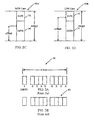
- FIG. 2A shows an exemplary H.264 standard range register.
- FIG. 2B shows an exemplary H.264 standard offset register.
- FIG. 2C shows an exemplary H.264 standard MPS case.
- FIG. 2D shows an exemplary H.264 standard LPS case.
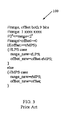
- FIG. 3 shows a sample (psuedocode) instruction set of a H.264 standard arithmetic decoding process for one bin.
- FIG. 4 shows a flowchart of a H.264 standard renormalization process.
- FIG. 5 shows a flowchart of a H.264 standard normal decoding mode process.
- FIG. 6 shows a flowchart of a H.264 standard bypass decoding mode process.
- FIG. 7 shows a flowchart of a H.264 standard terminate decoding process.
- FIGS. 8A and 8B show a modified range register and an offset register.
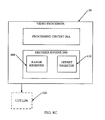
- FIGS. 8C shows a block diagram of a video processor using the modified range register and an offset register of FIGS. 8A and 8B .
- FIG. 9 shows a flowchart of a normal decoding mode process.
- FIG. 10A shows a flowchart of a first renormalization process.
- FIG. 10B shows a flowchart of a second renormalization process.
- FIG. 10C shows a flowchart of a third renormalization process.
- FIG. 11 shows a flowchart of a bypass decoding mode process.
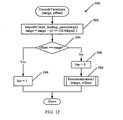
- FIG. 12 shows a flowchart of a terminate decoding process.
- FIG. 13A shows a sample (psuedocode) instruction set for a prefix EG code decoding process.
- FIG. 13B shows a range and offset relationship diagram the prefix EG code decoding process of FIG. 13A .
- FIG. 14A shows a sample (psuedocode) instruction set for a suffix EG code decoding process.
- FIG. 14B shows a range and offset relationship diagram the suffix EG code decoding process of FIG. 14A .
- FIG. 15A shows a flowchart of a prefix EGK code decoding process.
- FIG. 15B shows a flowchart of a suffix EGK code decoding process.
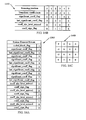
- FIG. 16A, 16B and 16C shows a CABAC residual block syntax arrangement.
- the techniques described herein may be used for wireless communications, computing, personal electronics, etc. An exemplary use of the techniques for wireless communication is described below.
- FIG. 1 shows a block diagram of a configuration of a wireless device 10 in a wireless communication system.
- the wireless device 10 may be a cellular or camera phone, a terminal, a handset, a personal digital assistant (PDA), or some other device.
- the wireless communication system may be a Code Division Multiple Access (CDMA) system, a Global System for Mobile Communications (GSM) system, or some other system.
- CDMA Code Division Multiple Access
- GSM Global System for Mobile Communications
- a handset may be a cellular phone, wireless device, wireless communications device, a video game console, a wirelessly-equipped personal digital assistant (PDA), a laptop computer, or a video-enabled device.
- CDMA Code Division Multiple Access
- GSM Global System for Mobile Communications
- the wireless device 10 is capable of providing bi-directional communications via a receive path and a transmit path.
- signals transmitted by base stations are received by an antenna 12 and provided to a receiver (RCVR) 14.
- the receiver 14 conditions and digitizes the received signal and provides samples to a digital section 20 for further processing.
- a transmitter (TMTR) 16 receives data to be transmitted from the digital section 20, processes and conditions the data, and generates a modulated signal, which is transmitted via the antenna 12 to the base stations.
- the digital section 20 includes various processing, interface and memory units such as, for example, a modem processor 22, a video processor 24, a controller/processor 26, a display processor 28, an ARM/DSP 32, a graphics processing unit (GPU) 34, an internal memory 36, and an external bus interface (EBI) 38.
- the modem processor 22 performs processing for data transmission and reception (e.g., encoding, modulation, demodulation, and decoding).
- the video processor 24 performs processing on video content (e.g., still images, moving videos, and moving texts) for video applications such as camcorder, video playback, and video conferencing.
- the controller/processor 26 may direct the operation of various processing and interface units within digital section 20.
- the display processor 28 performs processing to facilitate the display of videos, graphics, and texts on a display unit 30.
- the ARM/DSP 32 may perform various types of processing for the wireless device 10.
- the graphics processing unit 34 performs graphics processing.
- the techniques described herein may be used for any of the processors in the digital section 20, e.g., the video processor 24.
- the internal memory 36 stores data and/or instructions for various units within the digital section 20.
- the EBI 38 facilitates the transfer of data between the digital section 20 (e.g., internal memory 36) and a main memory 40 along a bus or data line DL.
- the digital section 20 may be implemented with one or more DSPs, microprocessors, RISCs, etc.
- the digital section 20 may also be fabricated on one or more application specific integrated circuits (ASICs) or some other type of integrated circuits (ICs).
- ASICs application specific integrated circuits
- ICs integrated circuits
- the techniques described herein may be implemented in various hardware units.
- the techniques may be implemented in ASICs, DSPs, RISCs, ARMs, digital signal processing devices (DSPDs), programmable logic devices (PLDs), field programmable gate arrays (FPGAs), processors, controllers, micro-controllers, microprocessors, and other electronic units.
- DSPDs digital signal processing devices
- PLDs programmable logic devices
- FPGAs field programmable gate arrays
- processors controllers, micro-controllers, microprocessors, and other electronic units.
- FIG. 2A shows an exemplary H.264 standard range register 50 and FIG. 2B shows an exemplary H.264 standard offset register 60.
- the basic idea of the binary arithmetic coding process is recursive interval division.
- the arithmetic decoding engine core keeps two registers.
- the first register is a range register 50 with 9-bits.
- the second register is an offset register 60 which is 9-bits in a regular mode and 10-bits in a bypass mode.
- FIG. 2C shows an exemplary H.264 standard most probability symbol (MPS) case generally denoted by reference numeral 50A
- FIG. 2D shows an exemplary H.264 standard least probability symbol (LPS) case generally denoted by reference numeral 50B
- the range register keeps track of the width of the current interval. The offset is from the bit-stream and a point to the current location within the range.
- the range is divided into two subintervals rLPS 52 and rMPS 54 depending on the context to decode a specific bin.
- the subinterval rLPS 52 and rMPS 54 where the offset falls, decides whether the bin is a MPS or a LPS bin.
- the bin is a LPS bin. Otherwise, the bin is a MPS bin.
- the range and offset are updated.
- the term pMPS is the probability. The probability should within 0 to 1.
- the term rMPS is the range*pMPS. The summation of the probabilities of MPS and LPS should be equal to 1.
- flowchart blocks are performed in the depicted order or these blocks or portions thereof may be performed contemporaneously, in parallel, or in a different order.
- FIG. 3 a sample (psuedocode) instruction set of a H.264 standard arithmetic decoding process 100 for one bin.
- the instruction set indicates that both the range register 50 and offset register 60 are 9 bits.
- the range register 50 configuration is also indicated.
- the bin is a MPS case. Then the range is updated to a new range (range_new) set equal to the subinterval rMPS and the new offset (offset_new) is set equal to offset.
- FIG. 4 shows a flowchart of a H.264 standard renormalization process 150.
- the standard renormalization process 150 ensures that the most significant bit (MSB) of the 9-bit range register 50 is always 1, as represented in FIG. 2A .
- the standard renormalization process 150 begins with block 152 where a decision is made whether the range is ⁇ 0X100.
- the value of the range is compared with 256 (or 0x100) If the determination is "No,” the process 150 ends. However, if the determination at block 152 is "Yes,” then block 152 is followed by block 154.
- the offset is also set to offset (bitwise OR) read_bits (1).
- offset (bitwise OR) read_bits (1) represents the value of the RANGE/OFFSET registers shifted left by one bit. After the shift, the least significant(right most) bit is 0.
- the expression read_bits (1) reads one bit from the bitstream and this one bit is added to the least significant(right most) bit of offset register 60.
- Block 154 loops back to block 152 described above. The loop of blocks 152 and 154 are repeated until the determination at block 152 is "No," which completes the renormalization process 150.
- FIG. 5 shows a flowchart of a H.264 standard normal decoding mode process 200.
- a 64x4 look up table LUT
- the range is approximated by equal-partitions of the 9-bit range register 50 into four cells.
- the pLPS is approximated by 64 quantized values indexed by a 6-bit context state.
- ctxIdx is an input to the process 200, represents the index to the context state and provides state information
- range >> 6 represents a right shift by 6 bits or a division by 2 6
- the result of (range>>6)&3 extracts bits 7-6 (the 2 bits after the MSB) in the range register 50 used to address the LUT.
- the expression ctxIdx->state can take a value from 0 to 63 which is used in the 64x4 LUT to get the rLPS.
- a range is 0b1 xx yy yyyy
- the range will be within 0x100 to 0x1FE, and (range>>6)&3 is used to get "xx" of the range.
- the expression & is a bitwise AND function.
- MPS range rLPS
- offset offset - rMPS
- !cctxIdx->valMPS denotes an expression where ctxIdx->valMPS can take a value 0 or 1, and "! means bit flip.
- ctxIdx is the input parameter to the function, and it provides the state and valMPS information.
- valMPS represents the bin output in the MPS case.
- Block 206 is followed by block 208 where a determination is made whether ctxIdx->state is equal to 0. If the determination at bock 208 is "Yes,” then block 208 is followed by block 210 where ctxIdx->valMPS is assigned to equal !ctxIdx->valMPS. Block 210 is followed by block 212. Additionally, if the determination at block 208 is "No,” then block 208 is also followed by block 212. At block 212, ctxIdx->state is assigned to equal TransIndexLPS(ctxIDx->state). After each bin is decoded, the state/valMPS associated with each ctxIdx needs to be updated. The terms TransIndexLPS/ TransIndexMPS are just 2 LUTs defined in the H.264 standard to calculate the state transition.
- Block 214 is followed by block 216 where ctxIdx->state is assigned to equal TransIndexLPS(ctxIDx->state). Both blocks 212 and 216 proceed to block 218 where the renormalization process 150 takes place. Block 218 ends the process 200.
- FIG. 6 shows a general flowchart of a H.264 standard bypass decoding mode process 250.
- the offset is shifted left by 1 bit and 1 bit is read from the bit stream.
- the new offset is compared with the range to determine whether the bin is 1 or 0.
- Block 254 is followed by block 258 where the bin is set equal to zero (0).
- Blocks 256 and 258 end the process 250. It should be noted that the term bin is also the same as bit.
- FIG. 7 shows a flowchart of a H.264 standard terminate decoding process 300.
- the range register 50 ( FIG. 2A ) is set to 0x1FE, 9 bits are read from the bitstream to set the initial offset register 60.
- the 9 bits are used to represent both the range and offset. Therefore, there are a great number of bit wise operations in the CABAC core processes.
- the offset is always left shifted by 1 and 1 bit is read from the bitstream. This requires very frequent renormalization and reading of bits from the bit-stream both of which are very computationally costly.
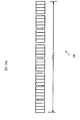
- FIGS. 8A and 8B show a modified range register 400 and an offset register 410 of an exemplary configuration.
- the range register 400 and the offset register 410 maybe 32 or 64 bits.
- the disclosure describes the implementation of a 32 bit range register 400 and offset register 410.
- the range register 400 is comprised of a plurality of parts.
- the 32 bits are divided into a leading zeros part 402, an effective 9-bits part 404, and a trailing zeros part 406.
- the bitpos (bit position) is indicated by the number of leading zeros bits in the leading zeros part 402 and is calculated using a Count_leading_zeros instruction.
- the bitpos in the 32 bit implementation is 11 bits.
- the number of bits in at least one part of the range register 400 may be varied.
- the two bits after the first bit 1 from the most significant bit (MSB) is extracted from the range register 400 and used to look up the rLPS.
- the looked up value is left shifted by (23 - bitpos) to align with the effective 9-bits part 404 in the range register 400.
- the remaining algorithm is almost the same except a more efficient renormalization is used.
- range is less than 0x100
- both range and offset are left shifted by 24 bits (3 bytes)
- 3 extra bytes are read from the bitstream and appended to the offset register 410. Therefore, all the bit-stream access is byte-based.
- This exemplary configuration is an example for illustrative purposes. Moreover instead of 32 bits more or less bits can be used.
- any number of multiple bits in lieu of the byte arrangements described herein may be used in a renormalization process without iterative loops.
- FIG. 8C shows a block diagram of a video processor 24 having a processor circuit 24A and a decoder engine 24B.
- the decoder engine 24B has the range and offset registers 400 and 410.
- the video processor 24 communicates with a Look-Up-Table (LUT) 420 for the rLPS.
- LUT Look-Up-Table
- the box 420 is shown in a dotted line to denote that it may be in the video processor 24 or external to the video processor 24.
- the video processor 24 carries out the processes set forth below.
- FIG. 9 shows a flowchart of a normal decoding mode process 450.
- the normal decoding mode process 450 is similar to the normal decoding mode process 200 ( FIG. 5 ). The primary differences include blocks 452 and 460.
- bitpos is set equal to count_leading_zeros (range).
- ctxIdx is an input to the process 450, represents the index to the context state and provides state information; and the result of range>>(29-bitpos))&3 extracts the 2 bits after the leading 1.
- the expression ⁇ (23-bitpos) is to used to align with the range.
- the expression ctxIdx->state can take a value from 0 to 63 which is used in the 64x4 LUT to get the rLPS.
- blocks 204, 206, 208, 210, 212, 214 and 216 correspond to the same numbered blocks in FIG. 5 . Hence, no further discussion is necessary. However, the renormalization block of 212 in FIG. 5 is substituted with the renormalization1 process 500 of FIG. 10A .
- FIG. 10A shows a flowchart of a first renormalization (renormalization1) process 500.
- the first renormalization process 500 begins with block 502 where a decision is made whether the range is ⁇ 0X100. If the determination is "No,” the process 500 ends. However, if the determination at block 502 is "Yes,” then block 502 is followed by block 504.
- the offset is also set to offset (bitwise OR) read_bytes (3).
- the first renormalization (renormalization1) process 500 performs a multi-bit alignment of a register at the same time without an iterative loop operation.
- the multi-bit alignment of the range register 400 and 410 occurs in intervals of bytes.
- FIG. 10B shows a flowchart of a second renormalization (renormalization2) process 600.
- the second renormalization process 600 begins with block 602 where a decision is made whether the range is ⁇ 0X200. If the determination is "No,” the process 600 ends. However, if the determination at block 602 is "Yes,” then block 602 is followed by block 604.
- the offset offset ⁇ 16.
- the offset is also set to offset (bitwise OR) read_bytes (2).
- the offset is shifted left by 16 bits, the right most 16 bits of the offset register 410 are all 0. Then, 2 bytes (16 bits) are read from the bit stream, and this is added to the offset register 410.
- FIG. 10C shows a flowchart of a third renormalization (renormalization3) process 700.
- the third renormalization process 700 begins with block 702 where a decision is made whether the range is ⁇ 0X1000000. If the determination is "No,” the process 700 ends. However, if the determination at block 702 is "Yes,” then block 702 is followed by block 704.
- the offset is also set to offset (bitwise OR) read_bytes (1).
- the offset is shifted left by 8 bits, the right most 8 bits of offset register 410 are all 0. Then, 1 byte (8 bits) are read from the bit stream, and this is added to the offset register 410.
- FIG. 11 shows a flowchart of a bypass decoding mode process 800.
- the range is right shifted by 1 and compared with the offset register 410.
- Block 802 is followed by block 804 where the range is set equal to range >>1.
- FIG. 12 shows a flowchart of a terminate decoding process 900.
- steps 304, 306 and 308 correspond to the same numbered blocks in FIG. 7 . Hence no further discussion is necessary.
- normalization takes place.
- the first normalization process 500 of FIG. 10A is used at block 910 where block 910 follows block 308. Both blocks 306 and 910 end the terminate decoding process 900.
- the bypass decoding mode process 800 applies to two cases, either to sign or exponential Golomb binarization (EG) code.
- EG exponential Golomb binarization
- the EG code only appears as a suffix of the bin strings of an absolute motion vector difference (abs_mvd) or abs_coeff_level_minus1. And only those bins with an abs_mvd>8 or an abs_coeff_level_minus1 > 13 contain a suffix of the EG code.
- Table 1 identifies a bin string with a prefix and suffix for abs_coeff_level_minus 1.
- Table 2 identifies a bin string with a prefix and suffix for abs_mvd.
- the term coeff_level_minusl is from the transform coefficient levels and abs represents the absolute value.
- Table 3 summaries the EG code prefix and suffix.
- the term "one shot” means decoding all the bits of a codeword at the same time instead of decoding one by one.
- the exemplary configuration can speed up the EG code decoding.
- Table 1 abs_coeff_level abs_coeff _level - 1
- Bin string Prefix TU code Suffix: EG0 code 0 0 1 1 0 2 1 1 0 3 1 1 1 0 4 1 1 1 1 0 5 ... ...
- the EG code contains a prefix and, in most cases, a suffix.
- the prefix is unary coded.
- the number of bins in the suffix is determined by the prefix.
- Table 3 summarize the prefix and suffix of a EG0 code and a EG3 code. Theoretically, the prefix/suffix part can be decoded as in FIGS. 13A and 14A .
- FIG. 13A shows a sample instruction set for a prefix EG code decoding process 1000.
- FIG. 13B shows a range and offset relationship diagram the prefix EG code decoding process of FIG. 13A .
- FIG. 14A shows a sample instruction set for a suffix EG code decoding process 1010.
- FIG. 14B shows a range and offset relationship diagram for the suffix EG code decoding process of FIG. 14A.
- FIG. 14A shows a sample instruction set for a suffix EG code decoding process 1010.
- the sample instruction set for process 1010 evaluates whether the offset is less than a set of threshold T1, T2, T3, T4, T5, T6 and T7 where T1 is equal to 1/8 of the range; T2 is 2/8 of the range; T3 is 3/8 of the range; T4 is 4/8 of the range; T5 is 5/8 of the range; T6 is 6/8 of the range; and T7 is 7/8 of the range. If the offset is less than T1, the bits 000 are returned.
- offset offset - T1
- the bits 001 are returned. If the offset is less than T3, offset subtracted and set to T2 and the bits 010 are returned. If the offset is less than T4, offset subtracted and set to T3 and the bits 011 are returned. If the offset is less than T5, offset subtracted and set to T4 and the bits 100 are returned. If the offset is less than T6, offset subtracted and set to T5 and the bits 101 are returned. If the offset is less than T7, offset subtracted and set to T6 and the bits 110 are returned. Else offset is offset subtracted and set to T7 and the bits 111 are returned. After any of the returns, range is right shifted by 3.
- FIG. 15A shows a flowchart of a prefix EGK code decoding process 1100.
- FIG. 15B shows a flowchart of a suffix EGK code decoding process 1200.
- Block 1110 ends the process 1100.
- block 1106 if the determination is "No," block 1106 proceeds to block 1110.
- the term k is the input to the DecodeEGKPrefix and DecodeEGKSuffix function. As the input to DecodeEGKPrefix function, it should be 0 for EG0 and 3 for EG3 code.
- the input to DecodeEGKSuffix function is the value k come out of the DecodeEGKPrefix function.
- the suffix EGK code decoding process 1200 begins with block 1202 where the third renormalization process 700 takes place. Block 1202 is followed by block 1204 where suffix is set to 0. Block 1204 is followed by block 1206 where a determination is made whether k is greater than 0. If the determination is "No," the process 1200 ends.
- Block 1206 is followed by block 1208 where range is right shifted by 1 and k is decremented by 1.
- Tables 4-5 show the MIPS and cycles/function_call comparison between the standard and the new optimized core. These numbers are obtained on the Kayak sequence on DSP simulator, with level 3 compiler optimizations and with default data and instruction cache size.
- Table 4 MIPS Comparison between Standard and New Core Bit Rate QP Decode Decision Decode Bypass Decode EGK Overall MIPS Mbps Original Optimized Original Optimized Original Optimized Original Optimized 6.40 20 179.64 117.41 20.71 10.80 10.05 3.83 541.01 451.10 2.55 28 72.44 17.90 6.87 3.58 5.40 2.07 256.36 220.18 1.53 32 44.38 29.80 3.80 1.98 3.46 1.33 172.33 150.87 0.91 36 27.01 18.66 2.15 1.12 2.34 0.90 117.67 105.29 0.55 40 16.95 12.03 1.23 0.64 1.44 0.55 84.00 76.78
- Table 5 Cycles/Function Call Comparison between Standard and New Core Bit Rate QP Decode Decision Decode Bypass Decode EGK
- Tables 4 and 5 shows a comparison of the bit rate, the quantization step size QP to the decode decision processes 200 and 450 of FIGS. 5 and 9 .
- Tables 4 and 5 also shows a comparison for the decode bypass processes 250 and 800 of FIGS. 6 and 11 and the decode process of the EGK code.
- Table 4 also shows the results of the MIPS.
- the threshold to do the first, second and third renormalization processes 500, 600 and 700, shown in FIGS. 10A, 10B and 10C can be changed to 0x100000000 so a common renormalization routine is applied. This will change the frequency of reading bytes from the bitstream. It can also change the renormalization check frequency. For example, the renormalization check at the beginning of FIG. 15B at block 1202 can be omitted.
- the first renormalization process 500 performed at block 460 can be moved to the beginning of the normal decoding mode process 450. If a 32 bit range register is used and the renormalization threshold is 0x10000, after decoding the first symbol, the smallest possible range register is 0x600. A range register of 0x600 is still > 0x100 and can decode the next symbol without renormalization. Hence, with more than a 9 bit range/offset register, it enables decoding multiple bins without re-normalization. Since the original re-normalization is bit-based therefore it is very costly. Thus, the arrangement of the range register 400 can simplify the hardware architecture to decode 2 consecutive normal mode symbols.
- FIG. 16A, 16B and 16C shows a CABAC residual block syntax arrangement.
- the significant_coeff_flag and last_significant_coeff_flag are decoded in pairs. If the significant_coeff_flag is 0, this indicate the coefficient is a zero coefficient and there is no last_significant_coeff_flag. If the significant_coeff_flag is 1, this indicates the coefficient is a non-zero coefficient and the next symbol to decode is last_significant_coeff_flag. Therefore, the value of the pair can take either 0 or 10 or 11. Since the pair needs to be decoded for each residual coefficients of the 4x4 block, the potential speedup/saving is quite significant.
- the terms significant_coeff_flag and last_significant_coeff_flag are defined in the H.264 standard.
- the matrix or block 1400 in FIG. 16C is an exemplary illustration of a data set.
- the values in the Table 1350 in FIG. 16B are derived from the data set of FIG. 16C .
- the syntax element stream 1300 is derived from the Table of 1350.
- the renormalization check can be skipped.
- the functions described may be implemented in hardware, software, firmware, or any combination thereof. If implemented in software, the functions may be stored on or transmitted over as one or more instructions or code on a computer-readable medium.
- Computer-readable media includes both computer storage media and communication media including any medium that facilitates transfer of a computer program from one place to another.
- a storage media may be any available media that can be accessed by a computer.
- such computer-readable media can comprise RAM, ROM, EEPROM, CD-ROM or other optical disk storage, magnetic disk storage or other magnetic storage devices, or any other medium that can be used to carry or store desired program code in the form of instructions or data structures and that can be accessed by a computer.
- any connection is properly termed a computer-readable medium.
- the software is transmitted from a website, server, or other remote source using a coaxial cable, fiber optic cable, twisted pair, digital subscriber line (DSL), or wireless technologies such as infrared, radio, and microwave
- the coaxial cable, fiber optic cable, twisted pair, DSL, or wireless technologies such as infrared, radio, and microwave are included in the definition of medium.
- Disk and disc includes compact disc (CD), laser disc, optical disc, digital versatile disc (DVD), floppy disk and blu-ray disc where disks usually reproduce data magnetically, while discs reproduce data optically with lasers. Combinations of the above should also be included within the scope of computer-readable media.
Landscapes
- Engineering & Computer Science (AREA)
- Multimedia (AREA)
- Signal Processing (AREA)
- Theoretical Computer Science (AREA)
- Compression Or Coding Systems Of Tv Signals (AREA)
- Compression, Expansion, Code Conversion, And Decoders (AREA)
- Error Detection And Correction (AREA)
Applications Claiming Priority (1)
| Application Number | Priority Date | Filing Date | Title |
|---|---|---|---|
| US11/862,942 US8782379B2 (en) | 2007-09-27 | 2007-09-27 | H.264 video decoder CABAC core optimization techniques |
Publications (1)
| Publication Number | Publication Date |
|---|---|
| EP2043268A1 true EP2043268A1 (de) | 2009-04-01 |
Family
ID=39967218
Family Applications (1)
| Application Number | Title | Priority Date | Filing Date |
|---|---|---|---|
| EP08006313A Withdrawn EP2043268A1 (de) | 2007-09-27 | 2008-03-31 | Optimierter CABAC Decoder |
Country Status (7)
| Country | Link |
|---|---|
| US (1) | US8782379B2 (de) |
| EP (1) | EP2043268A1 (de) |
| JP (1) | JP5006451B2 (de) |
| KR (1) | KR101136212B1 (de) |
| CN (1) | CN101809871B (de) |
| TW (1) | TW200931818A (de) |
| WO (1) | WO2009042813A1 (de) |
Cited By (1)
| Publication number | Priority date | Publication date | Assignee | Title |
|---|---|---|---|---|
| CN103597829A (zh) * | 2011-06-28 | 2014-02-19 | 日本电气株式会社 | 对视频量化参数编码的方法和对视频量化参数解码的方法 |
Families Citing this family (38)
| Publication number | Priority date | Publication date | Assignee | Title |
|---|---|---|---|---|
| JP2008289125A (ja) * | 2007-04-20 | 2008-11-27 | Panasonic Corp | 算術復号化装置及びその方法 |
| US20110125987A1 (en) * | 2009-11-20 | 2011-05-26 | Qualcomm Incorporated | Dedicated Arithmetic Decoding Instruction |
| US7961122B1 (en) * | 2010-02-03 | 2011-06-14 | Himax Media Solutions, Inc. | Multi-bin CABAC bypass bin decoder |
| TWI458268B (zh) * | 2010-03-16 | 2014-10-21 | Himax Media Solutions Inc | 並聯的五旁路位元全文自適應二進制算術編碼解碼器 |
| WO2012067412A2 (ko) * | 2010-11-15 | 2012-05-24 | 한국전자통신연구원 | 병렬 엔트로피 부호화/복호화 방법 및 장치 |
| US9008170B2 (en) * | 2011-05-10 | 2015-04-14 | Qualcomm Incorporated | Offset type and coefficients signaling method for sample adaptive offset |
| US10123053B2 (en) * | 2011-05-23 | 2018-11-06 | Texas Instruments Incorporated | Acceleration of bypass binary symbol processing in video coding |
| US11245902B2 (en) | 2011-06-30 | 2022-02-08 | Sony Corporation | Binarization of DQP using separate absolute value and sign (SAVS) in CABAC |
| US9112526B2 (en) * | 2011-06-15 | 2015-08-18 | Sony Corporation | Binarization of DQP using separate absolute value and sign (SAVS) in CABAC |
| JP5362129B2 (ja) * | 2011-06-24 | 2013-12-11 | パナソニック株式会社 | 画像符号化方法および画像符号化装置 |
| HUE050522T2 (hu) | 2011-06-28 | 2020-12-28 | Samsung Electronics Co Ltd | Video kódolási és dekódolási eljárás felhasználva aritmetikai kódolást az utolsó szignifikáns együttható kétdimenziós jelzésével |
| US20130083856A1 (en) * | 2011-06-29 | 2013-04-04 | Qualcomm Incorporated | Contexts for coefficient level coding in video compression |
| CN106101727B (zh) * | 2011-08-04 | 2019-10-08 | 寰发股份有限公司 | 基于上下文自适应二进制算术编码的方法及装置 |
| CN107197250B (zh) * | 2011-10-28 | 2019-09-03 | 三星电子株式会社 | 用于视频的帧内预测的方法和设备 |
| US20130114667A1 (en) * | 2011-11-08 | 2013-05-09 | Sony Corporation | Binarisation of last position for higher throughput |
| CN103220509B (zh) * | 2012-01-21 | 2017-12-15 | 中兴通讯股份有限公司 | 自适应控制算术编码bin数量的方法、编码器和解码器 |
| EP2810371B1 (de) * | 2012-01-30 | 2017-12-20 | Fraunhofer Gesellschaft zur Förderung der angewandten Forschung e.V. | Binäres arithmetisches codierungsschema |
| US9681133B2 (en) * | 2012-03-29 | 2017-06-13 | Intel Corporation | Two bins per clock CABAC decoding |
| WO2013175736A1 (ja) * | 2012-05-25 | 2013-11-28 | パナソニック株式会社 | 動画像符号化方法、動画像符号化装置、動画像復号方法、動画像復号装置、および、動画像符号化復号装置 |
| ES2936333T3 (es) | 2012-05-25 | 2023-03-16 | Sun Patent Trust | Procedimiento de codificación de imágenes de vídeo, procedimiento de decodificación de imágenes de vídeo, dispositivo de codificación de imágenes de vídeo, dispositivo de decodificación de imágenes de vídeo y dispositivo de codificación-decodificación de imágenes de vídeo |
| RU2679984C2 (ru) * | 2012-05-25 | 2019-02-14 | Вилос Медиа Интернэшнл Лимитед | Способ кодирования изображений, устройство кодирования изображений, способ декодирования изображений, устройство декодирования изображений и устройство кодирования и декодирования изображений |
| KR102060617B1 (ko) | 2012-06-04 | 2019-12-30 | 선 페이턴트 트러스트 | 동화상 부호화 방법, 동화상 부호화 장치, 동화상 복호 방법, 및, 동화상 복호 장치 |
| MX342497B (es) * | 2012-06-29 | 2016-10-03 | Sony Corp | Dispositivo de codificacion y metodo de codificacion. |
| US20150215633A1 (en) * | 2012-08-22 | 2015-07-30 | Nec Corporation | Image-data binary arithmetic decoding device and image decoding device |
| TWI517681B (zh) * | 2013-06-19 | 2016-01-11 | 晨星半導體股份有限公司 | 應用於數位音視頻編解碼技術標準系統之解碼方法及解碼裝置 |
| US9445132B2 (en) * | 2013-09-09 | 2016-09-13 | Qualcomm Incorporated | Two level last significant coefficient (LSC) position coding |
| CN104980749B (zh) * | 2014-04-11 | 2018-04-24 | 扬智科技股份有限公司 | 算术编码的解码装置及方法 |
| US9455743B2 (en) * | 2014-05-27 | 2016-09-27 | Qualcomm Incorporated | Dedicated arithmetic encoding instruction |
| US9425822B2 (en) * | 2014-08-05 | 2016-08-23 | Broadcom Corporation | Simplified range and context update for multimedia context-adaptive binary arithmetic coding design |
| US10313683B2 (en) | 2014-08-30 | 2019-06-04 | Apple Inc. | Video encoder with context switching |
| TWI610559B (zh) * | 2016-10-27 | 2018-01-01 | 中華電信股份有限公司 | 最佳化視訊轉碼的方法與裝置 |
| US10757412B2 (en) * | 2017-01-03 | 2020-08-25 | Avago Technologies International Sales Pte. Limited | Architecture flexible binary arithmetic coding system |
| JP6707045B2 (ja) | 2017-03-15 | 2020-06-10 | Nttエレクトロニクス株式会社 | 二値算術復号器および二値算術復号装置 |
| DE112018005899T5 (de) | 2017-12-18 | 2020-08-13 | Arris Enterprises Llc | System und Verfahren zum Konstruieren einer Ebene für planare Prädiktion |
| CN112514381A (zh) * | 2019-06-25 | 2021-03-16 | Oppo广东移动通信有限公司 | 图像编解码方法、编码器、解码器以及存储介质 |
| CN113032274B (zh) * | 2021-04-07 | 2021-09-10 | 北京电信易通信息技术股份有限公司 | 一种针对h.265的cabac连续图像验证的方法 |
| JP7582576B2 (ja) * | 2021-04-26 | 2024-11-13 | ホアウェイ・テクノロジーズ・カンパニー・リミテッド | 算術エンコーディング及びデコーディングにおける末尾ビットの操作 |
| WO2024091925A1 (en) * | 2022-10-25 | 2024-05-02 | Google Llc | Improved entropy bypass coding |
Family Cites Families (5)
| Publication number | Priority date | Publication date | Assignee | Title |
|---|---|---|---|---|
| US7769088B2 (en) * | 2003-05-28 | 2010-08-03 | Broadcom Corporation | Context adaptive binary arithmetic code decoding engine |
| US7688895B2 (en) * | 2003-07-22 | 2010-03-30 | Lsi Corporation | Method and/or circuit for binary arithmetic decoding decisions before termination |
| KR100648258B1 (ko) | 2004-08-02 | 2006-11-23 | 삼성전자주식회사 | 고속의 디코딩을 수행하는 파이프라인 구조의 내용 기반적응적 이진 산술 디코더 |
| CN100466739C (zh) | 2005-10-12 | 2009-03-04 | 华为技术有限公司 | Cabac解码系统及方法 |
| US7983343B2 (en) | 2006-01-12 | 2011-07-19 | Lsi Corporation | Context adaptive binary arithmetic decoding for high definition video |
-
2007
- 2007-09-27 US US11/862,942 patent/US8782379B2/en not_active Expired - Fee Related
-
2008
- 2008-03-31 EP EP08006313A patent/EP2043268A1/de not_active Withdrawn
- 2008-09-25 KR KR1020107009207A patent/KR101136212B1/ko not_active Expired - Fee Related
- 2008-09-25 WO PCT/US2008/077754 patent/WO2009042813A1/en not_active Ceased
- 2008-09-25 JP JP2010527155A patent/JP5006451B2/ja not_active Expired - Fee Related
- 2008-09-25 CN CN200880109052.5A patent/CN101809871B/zh not_active Expired - Fee Related
- 2008-09-26 TW TW097137397A patent/TW200931818A/zh unknown
Non-Patent Citations (4)
| Title |
|---|
| CHUNG-HYO KIM ET AL: "High speed decoding of context-based adaptive binary arithmetic codes using most probable symbol prediction", 2006 IEEE INTERNATIONAL SYMPOSIUM ON CIRCUITS AND SYSTEMS (IEEE CAT. NO. 06CH37717C) IEEE PISCATAWAY, NJ, USA, 2006, pages 1707 - 1710, XP002511881, ISBN: 0-7803-9389-9 * |
| MARPE DETLEV ET AL: "Fast renormalization for H.264/MPEG4-AVC arithmetic coding", 2006 14TH EUROPEAN SIGNAL PROCESSING CONFERENCE, IEEE, 4 September 2006 (2006-09-04), pages 1 - 5, XP032753767, ISSN: 2219-5491, [retrieved on 20150327] * |
| PENG ZHANG ET AL: "High-Performance CABAC Engine for H.264/AVC High Definition Real-Time Decoding", CONSUMER ELECTRONICS, 2007. ICCE 2007. DIGEST OF TECHNICAL PAPERS. INT ERNATIONAL CONFERENCE ON, IEEE, PI, 1 January 2007 (2007-01-01), pages 1 - 2, XP031071403, ISBN: 978-1-4244-0762-0 * |
| XU MEI-HUA ET AL: "Optimizing Design and FPGA Implementation for CABAC Decoder", HIGH DENSITY PACKAGING AND MICROSYSTEM INTEGRATION, 2007 INTERNATIONAL SYMPOSIUM ON, IEEE, PI, 1 June 2007 (2007-06-01), pages 1 - 5, XP031123001, ISBN: 978-1-4244-1252-5 * |
Cited By (4)
| Publication number | Priority date | Publication date | Assignee | Title |
|---|---|---|---|---|
| CN103597829A (zh) * | 2011-06-28 | 2014-02-19 | 日本电气株式会社 | 对视频量化参数编码的方法和对视频量化参数解码的方法 |
| CN103597829B (zh) * | 2011-06-28 | 2017-03-22 | 日本电气株式会社 | 对视频量化参数编码的方法和对视频量化参数解码的方法 |
| CN107071452A (zh) * | 2011-06-28 | 2017-08-18 | 日本电气株式会社 | 对视频量化参数解码的方法 |
| CN107071452B (zh) * | 2011-06-28 | 2019-03-05 | 日本电气株式会社 | 对视频量化参数解码的方法 |
Also Published As
| Publication number | Publication date |
|---|---|
| JP5006451B2 (ja) | 2012-08-22 |
| KR101136212B1 (ko) | 2012-04-17 |
| US8782379B2 (en) | 2014-07-15 |
| KR20100075560A (ko) | 2010-07-02 |
| WO2009042813A1 (en) | 2009-04-02 |
| CN101809871B (zh) | 2014-10-29 |
| CN101809871A (zh) | 2010-08-18 |
| US20090089549A1 (en) | 2009-04-02 |
| TW200931818A (en) | 2009-07-16 |
| JP2011501896A (ja) | 2011-01-13 |
Similar Documents
| Publication | Publication Date | Title |
|---|---|---|
| US8782379B2 (en) | H.264 video decoder CABAC core optimization techniques | |
| US7839311B2 (en) | Architecture for multi-stage decoding of a CABAC bitstream | |
| JP4886755B2 (ja) | コンテキスト適応バイナリ算術符号化と復号化のシステム及び方法 | |
| CN107801025B (zh) | 解码器、编码器、解码和编码视频的方法 | |
| US7982641B1 (en) | Context-based adaptive binary arithmetic coding engine | |
| US20040056787A1 (en) | Method and apparatus for arithmetic coding and termination | |
| DK3079261T3 (en) | METHOD AND APPARATUS FOR ARITHMETIC DECODATION | |
| KR100604364B1 (ko) | 정보신호의 연산 인코딩 및 디코딩 | |
| US7365660B2 (en) | Method and device for decoding syntax element in CABAC decoder | |
| KR100487411B1 (ko) | 가변 길이 디코더 | |
| CN120769057A (zh) | 解码装置和方法、电子设备 | |
| KR20020014957A (ko) | 가변길이 디코더 | |
| KR20020020886A (ko) | 산술적으로 인코딩된 정보신호의 산술 디코딩 |
Legal Events
| Date | Code | Title | Description |
|---|---|---|---|
| PUAI | Public reference made under article 153(3) epc to a published international application that has entered the european phase |
Free format text: ORIGINAL CODE: 0009012 |
|
| AK | Designated contracting states |
Kind code of ref document: A1 Designated state(s): AT BE BG CH CY CZ DE DK EE ES FI FR GB GR HR HU IE IS IT LI LT LU LV MC MT NL NO PL PT RO SE SI SK TR |
|
| AX | Request for extension of the european patent |
Extension state: AL BA MK RS |
|
| 17P | Request for examination filed |
Effective date: 20090806 |
|
| 17Q | First examination report despatched |
Effective date: 20090903 |
|
| AKX | Designation fees paid |
Designated state(s): AT BE BG CH CY CZ DE DK EE ES FI FR GB GR HR HU IE IS IT LI LT LU LV MC MT NL NO PL PT RO SE SI SK TR |
|
| STAA | Information on the status of an ep patent application or granted ep patent |
Free format text: STATUS: THE APPLICATION IS DEEMED TO BE WITHDRAWN |
|
| 18D | Application deemed to be withdrawn |
Effective date: 20191001 |