EP2043323A1 - Dispositif de communication pour synchroniser le flux recu avec un flux envoyé vers un autre dispositif - Google Patents
Dispositif de communication pour synchroniser le flux recu avec un flux envoyé vers un autre dispositif Download PDFInfo
- Publication number
- EP2043323A1 EP2043323A1 EP07301409A EP07301409A EP2043323A1 EP 2043323 A1 EP2043323 A1 EP 2043323A1 EP 07301409 A EP07301409 A EP 07301409A EP 07301409 A EP07301409 A EP 07301409A EP 2043323 A1 EP2043323 A1 EP 2043323A1
- Authority
- EP
- European Patent Office
- Prior art keywords
- stream
- multimedia content
- rendering
- audio
- time stamp
- Prior art date
- Legal status (The legal status is an assumption and is not a legal conclusion. Google has not performed a legal analysis and makes no representation as to the accuracy of the status listed.)
- Withdrawn
Links
- 238000009877 rendering Methods 0.000 claims abstract description 36
- 230000001360 synchronised effect Effects 0.000 abstract description 6
- 230000004048 modification Effects 0.000 description 7
- 238000012986 modification Methods 0.000 description 7
- 238000010586 diagram Methods 0.000 description 6
- 230000005540 biological transmission Effects 0.000 description 3
- 230000001413 cellular effect Effects 0.000 description 3
- 239000000872 buffer Substances 0.000 description 2
- 230000007423 decrease Effects 0.000 description 2
- 230000003247 decreasing effect Effects 0.000 description 2
- 239000000284 extract Substances 0.000 description 2
- 230000007246 mechanism Effects 0.000 description 2
- 230000006978 adaptation Effects 0.000 description 1
- 230000003139 buffering effect Effects 0.000 description 1
- 230000001934 delay Effects 0.000 description 1
- 230000006870 function Effects 0.000 description 1
- 230000002452 interceptive effect Effects 0.000 description 1
- 230000000670 limiting effect Effects 0.000 description 1
- 238000000034 method Methods 0.000 description 1
- 238000010025 steaming Methods 0.000 description 1
Images


Classifications
-
- H—ELECTRICITY
- H04—ELECTRIC COMMUNICATION TECHNIQUE
- H04L—TRANSMISSION OF DIGITAL INFORMATION, e.g. TELEGRAPHIC COMMUNICATION
- H04L65/00—Network arrangements, protocols or services for supporting real-time applications in data packet communication
- H04L65/60—Network streaming of media packets
- H04L65/61—Network streaming of media packets for supporting one-way streaming services, e.g. Internet radio
- H04L65/611—Network streaming of media packets for supporting one-way streaming services, e.g. Internet radio for multicast or broadcast
-
- H—ELECTRICITY
- H04—ELECTRIC COMMUNICATION TECHNIQUE
- H04L—TRANSMISSION OF DIGITAL INFORMATION, e.g. TELEGRAPHIC COMMUNICATION
- H04L65/00—Network arrangements, protocols or services for supporting real-time applications in data packet communication
- H04L65/60—Network streaming of media packets
- H04L65/75—Media network packet handling
- H04L65/764—Media network packet handling at the destination
Definitions
- the present invention relates generally to digital television and in particular to a method for synchronizing multiple streams at multiple receivers.
- the receiver is usually a standard TV device, connected to the receiving device, called a Set-Top Box or STB.
- the receiver device is a mobile terminal such as a mobile phone or a Personal Digital Assistant.
- a MPEG-2 stream In a MPEG-2 stream, several components, e.g. audio, video, are synchronized between each other in order to be rendered at the proper time. This is called inter-component synchronization.
- a common example is the lip synchronization, noted lip-sync, which provides the audio at the exact same time as the lips of the person move on the corresponding video.
- Such synchronization is typically achieved thanks to specific time stamps.
- the Presentation Time Stamp, or PTS ensures such synchronization.
- the PTS of the audio sample indicates its presentation time, in reference to the internal clock (which is set thanks to the PCR also contained in the MPEG-2 stream); in the same way, the PTS of the video sample indicates its presentation time, also in reference to the same internal clock.
- a first audio-video stream may be sent through the broadband network to the STB, and a second audio-video stream identical to the first audio-video stream may be sent through the mobile network to a mobile terminal.
- Such multimedia components which are rendered on different devices, cannot be synchronized with the inter-component synchronization mechanism because the devices don't know each other component PTS. So an end user cannot use at the same time the mobile terminal to listen to the audio corresponding to the first video displayed through the STB.
- Another example is a device receiving a first audio-video stream from a first delivery network, and a second audio-video stream from a second delivery network, both streams having different timestamps. In this case, there is no means for the receiving device to synchronize components from those both streams.
- the present invention attempts to remedy at least some of the concerns connected with synchronizing two streams received by one or more devices from several different distribution networks.
- the present invention concerns a device comprising communicating means for receiving in push mode a first multimedia content, the first multimedia content being a first component of a stream comprising a second component, the first multimedia content comprising a presentation time stamp adapted to indicate the rendering time of the first multimedia content, tuning means for shifting the presentation time stamp value, the shifting being intended to synchronize the rendering to the rendering of a second multimedia content of the stream rendered at a second device and outputting means for rendering the first multimedia content according to the presentation time stamp.
- the device enables synchronization of the stream it receives with a stream displayed at another device. Synchronization is performed through tuning means. This is a user interface that permits a user to synchronize the stream based on the rendering of a second stream.
- the stream is received in a push mode, wherein the transmission of information originates from a server.
- the information is broadcasted to the receiver.
- An audio stream rendered on a first device is synchronized to a video stream rendered on a second device.
- a first audio-video stream is received through a broadband network at a STB.
- a second audio stream corresponding to the first video stream is received through the mobile network at a mobile terminal. This second audio stream is for example an audio language different from the first audio.
- the presentation time stamp is appended to the packets of the first components of the stream. It is adapted to indicate the rendering time of the first multimedia content.
- the receiver extracts the presentation time stamp and renders the first multimedia content at the value of the presentation time stamp.
- this permits a service provider to provide a video on a screen and multiple audios, corresponding to multiple language of the video, on an audio receiver.
- the device is any kind of device that comprises communicating means for receiving a stream, the stream being an audio, a video or any interactive content.
- the device may be, but is not limited to, a Set-Top Box, a cellular device, a DVB-H receiver, a Wi-Fi station.
- the shifting moves forward or moves down the presentation time stamp value.
- the stream is an MPEG-2 stream
- the first multimedia content is an audio component of the MPEG-2 stream.
- the stream is an MPEG-2 stream
- the first multimedia content is a video component of the MPEG-2 stream.
- the rendering speed is based on an internal clock and in that said tuning means modifies the clock speed.
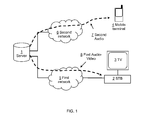
- Figure 1 is a block diagram of a system compliant with the embodiment.
- a second audio stream 7 is transmitted through a second network 6 to a mobile terminal 4.
- the second audio stream corresponds to the first video stream. It allows a user to watch the first video stream on the TV 3 and to listen to the corresponding second audio stream with another audio language on the mobile terminal.
- the first and the second streams are broadcasted the respectively the STB and the mobile terminal. They are sent in a push mode.
- the second audio stream is distributed through a DVB-H network, and the mobile terminal is a DVB-H receiver.
- the STB may be located in a public hot spot, which comprises displays for presenting the video.
- a public hot spot which comprises displays for presenting the video.
- the end user listens on the mobile terminal to an audio corresponding to the video displayed.
- Different users in the hot spot watch the same video, listening to different audio streams under different languages corresponding to that video.
- the second audio stream might be distributed through any network that can transport an audio stream to a mobile terminal, such as a cellular network, a Wi-Fi network.
- a mobile terminal such as a cellular network, a Wi-Fi network.
- the mobile terminal might be a device such as a cellular terminal, a Wi-Fi receiver, a DVB-T terminal.
- the STB and the mobile terminal receive streams coming from the same Video server.
- the streams hold components of the same TV program. Those two devices do not exchange any message, and they cannot know how the other renders the same TV program. Of course they could also receive the streams from different servers.
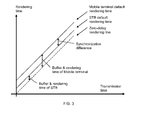
- the rendering of the streams on the TV and on the mobile terminal are not necessarily synchronized. Rendering delay is dependant on various parameters such as the transmission networks, or the local buffers in each of the receiving devices as illustrated on figure 3 .
- a mobile terminal is represented in figure 2 . It comprises a communicating module 1.1 for receiving the audio stream.
- the receiving module extracts the Presentation Time Stamp, or PTS, from the stream.
- the mobile terminal comprises a tuning module 1.5.
- the tuning module is a cursor that comprises two positions. A first position is adapted to move forward the rendering time. A second position is adapted to move down the rendering time. If the end user wants to play the second audio stream sooner, it sets the cursor towards the second position to reach the suitable delay. If he wants to play the audio stream later, he sets the cursor towards the first position.
- the tuning module may be any kind of user interface that comprises two such positions for providing the delaying function.
- the synchronizing module 1.6 is adapted to modify the value of the PTS. From the input received from the tuning module, the synchronizing module reduces or increases the value of the PTS by a value ⁇ . This permits to play the stream sooner or later than the time indicated in the PTS extracted from the stream.
- the modified PTS is sent to the presenting module 1.3.
- the stream is decoded by a decoding module not represented in the figure, and sent to the storing module 1.2.
- the presenting module indicates to the storing module 1.2 when to play the stream, in accordance with the PTS value. Then the stream is played at the outputting module 1.4.
- the mobile terminal also comprises processing means, not represented.
- the outputting module may also be adapted to send the stream to another device that plays renders the stream. As indicated in figure 4 , the rendering time of the second stream is then modified; after moving down the delay is increased and after moving forward the delay is reduced.
- tuning module may be locked. When locked the tuning module can not be set to the first or the second position.
- the STB may also comprise a tuning module and a synchronizing module. This allows modifying the rendering time of the first audio-video stream. This makes sense when the tuning module of the mobile terminal does not allow enough delaying of the rendering time of the second audio. This may happen because the transmission and the buffering time are different between the STB and the mobile terminal, and the mobile terminal does not receive the second audio early enough. The mobile terminal cannot move forward the audio enough to synchronize to the first video.
- the tuning module of the STB allows then to move down the rendering of the audio-video stream to give the mobile terminal more time to receive the audio streams.
- the STB according to the embodiment is represented in figure 2 .
- the outputting module 1.4 sends the stream to a TV that renders the steam.
- the synchronizing module is also adapted to modify the value of the internal clock of the device. It increases or decreases the value of the running speed of the clock.
- the receiving device plays the stream based on the internal clock. This permits to accelerate or slow down the rendering of the stream. This permits to tune the rendering speed to the same rendering speed as the other device. The increase or decrease is performed pace by pace.
- the clock modification is launched as follow.
- the synchronizing module detects that the tuning module has been successively activated several time to adapt the rendering. Further to modifying the PTS value, the synchronizing module also modifies the clock speed. If the PTS value is increased, the clock speed is also increased. If the PTS value is decreased, the clock value is also decreased.
- the synchronizing module detects that several PTS modifications are not sufficient, and then launches a clock speed modification. After several iterations the clock speed is matched to the clock speed of the other device.
- the clock speed at the receiver is compliant to the MPEG-2 standards. It is set to 27MHz.
- the pace is 100Hz.
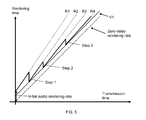
- the audio rendering rate R1 is higher than the video rendering rate V1.
- the synchronizing module reduces the clock speed by one pace, here by 100Hz, and then reduces the audio rendering rate R2, step 1. This adaptation may require the modification of the clock speed by a plurality of paces, step 2, step 3. And the audio rendering rate takes several values R3, R4 before it matches the video rate.
- the embodiments deal with synchronization of an audio stream with a video stream. More generally the tuning module of the embodiment is also applicable to synchronization of any stream type to any other stream to which it is not synchronized. The embodiments are also applicable to rendering of content stored in each device, where two devices store the same audio-video content and play this content. It is also applicable to a combination of devices receiving steaming content and devices playing stored content.
Landscapes
- Engineering & Computer Science (AREA)
- Multimedia (AREA)
- Computer Networks & Wireless Communication (AREA)
- Signal Processing (AREA)
- Two-Way Televisions, Distribution Of Moving Picture Or The Like (AREA)
- Circuits Of Receivers In General (AREA)
Priority Applications (7)
| Application Number | Priority Date | Filing Date | Title |
|---|---|---|---|
| EP07301409A EP2043323A1 (fr) | 2007-09-28 | 2007-09-28 | Dispositif de communication pour synchroniser le flux recu avec un flux envoyé vers un autre dispositif |
| CN2008801083150A CN101809965B (zh) | 2007-09-28 | 2008-09-23 | 将接收的流与发送至另外装置的流同步的通信技术 |
| JP2010526270A JP5679815B2 (ja) | 2007-09-28 | 2008-09-23 | 他の装置に送信された受信ストリームを同期可能な通信技術 |
| EP08804625.5A EP2193645B1 (fr) | 2007-09-28 | 2008-09-23 | Technique de communication capable de synchroniser le flux reçu avec celui envoyé à un autre dispositif |
| KR1020107006542A KR101484607B1 (ko) | 2007-09-28 | 2008-09-23 | 수신된 스트림과 다른 디바이스에 보낸 스트림을 동기화할 수 있는 통신 기법 |
| US12/733,876 US20110191816A1 (en) | 2007-09-28 | 2008-09-23 | Communication technique able to synchronise the received stream with that sent to another device |
| PCT/EP2008/062712 WO2009040356A1 (fr) | 2007-09-28 | 2008-09-23 | Technique de communication capable de synchroniser le flux reçu avec celui envoyé à un autre dispositif |
Applications Claiming Priority (1)
| Application Number | Priority Date | Filing Date | Title |
|---|---|---|---|
| EP07301409A EP2043323A1 (fr) | 2007-09-28 | 2007-09-28 | Dispositif de communication pour synchroniser le flux recu avec un flux envoyé vers un autre dispositif |
Publications (1)
| Publication Number | Publication Date |
|---|---|
| EP2043323A1 true EP2043323A1 (fr) | 2009-04-01 |
Family
ID=39172074
Family Applications (2)
| Application Number | Title | Priority Date | Filing Date |
|---|---|---|---|
| EP07301409A Withdrawn EP2043323A1 (fr) | 2007-09-28 | 2007-09-28 | Dispositif de communication pour synchroniser le flux recu avec un flux envoyé vers un autre dispositif |
| EP08804625.5A Active EP2193645B1 (fr) | 2007-09-28 | 2008-09-23 | Technique de communication capable de synchroniser le flux reçu avec celui envoyé à un autre dispositif |
Family Applications After (1)
| Application Number | Title | Priority Date | Filing Date |
|---|---|---|---|
| EP08804625.5A Active EP2193645B1 (fr) | 2007-09-28 | 2008-09-23 | Technique de communication capable de synchroniser le flux reçu avec celui envoyé à un autre dispositif |
Country Status (6)
| Country | Link |
|---|---|
| US (1) | US20110191816A1 (fr) |
| EP (2) | EP2043323A1 (fr) |
| JP (1) | JP5679815B2 (fr) |
| KR (1) | KR101484607B1 (fr) |
| CN (1) | CN101809965B (fr) |
| WO (1) | WO2009040356A1 (fr) |
Cited By (6)
| Publication number | Priority date | Publication date | Assignee | Title |
|---|---|---|---|---|
| WO2012038506A1 (fr) * | 2010-09-22 | 2012-03-29 | Thomson Licensing | Procédé de traitement de flux multimédias et dispositifs correspondants |
| US20130110900A1 (en) * | 2011-10-28 | 2013-05-02 | Comcast Cable Communications, Llc | System and method for controlling and consuming content |
| US8583555B1 (en) * | 2007-07-31 | 2013-11-12 | Quirio Holdings, Inc. | Synchronizing multiple playback device timing utilizing DRM encoding |
| US8739204B1 (en) | 2008-02-25 | 2014-05-27 | Qurio Holdings, Inc. | Dynamic load based ad insertion |
| WO2015116162A1 (fr) * | 2014-01-31 | 2015-08-06 | Thomson Licensing | Procédé et appareil de synchronisation de lectures sur deux dispositifs électroniques |
| US9538237B2 (en) | 2012-05-17 | 2017-01-03 | Huawei Technologies Co., Ltd. | Multi-screen interaction method and system |
Families Citing this family (11)
| Publication number | Priority date | Publication date | Assignee | Title |
|---|---|---|---|---|
| EP2257040A1 (fr) | 2009-05-29 | 2010-12-01 | Thomson Licensing | Procédé et appareil pour diffuser un contenu multimédia |
| US10187509B2 (en) * | 2010-09-14 | 2019-01-22 | At&T Intellectual Property I, L.P. | Enhanced video sharing |
| EP2704449A1 (fr) | 2012-08-30 | 2014-03-05 | Thomson Licensing | Commande de temps de rendu |
| CN103297824A (zh) * | 2013-05-29 | 2013-09-11 | 华为技术有限公司 | 视频处理方法、电视棒、控制终端和系统 |
| WO2015052908A1 (fr) * | 2013-10-11 | 2015-04-16 | パナソニック インテレクチュアル プロパティ コーポレーション オブ アメリカ | Procédé de transmission, procédé de réception, dispositif de transmission et dispositif de réception |
| US9210204B2 (en) * | 2013-10-31 | 2015-12-08 | At&T Intellectual Property I, Lp | Synchronizing media presentation at multiple devices |
| CN103905881B (zh) * | 2014-03-13 | 2018-07-31 | 北京奇艺世纪科技有限公司 | 一种视频数据和音频数据同步播放的方法、装置和设备 |
| CN103905879B (zh) * | 2014-03-13 | 2018-07-06 | 北京奇艺世纪科技有限公司 | 一种视频数据和音频数据同步播放的方法、装置和设备 |
| KR102126257B1 (ko) * | 2015-02-13 | 2020-06-24 | 에스케이텔레콤 주식회사 | 멀티뷰 스트리밍 서비스 지원 방법 및 이를 지원하는 장치 |
| SE541208C2 (en) * | 2016-07-04 | 2019-04-30 | Znipe Esports AB | Methods and nodes for synchronized streaming of a first and a second data stream |
| US11025858B2 (en) * | 2019-08-08 | 2021-06-01 | Netflix, Inc. | Frame rate conversion |
Citations (3)
| Publication number | Priority date | Publication date | Assignee | Title |
|---|---|---|---|---|
| EP1694033A1 (fr) * | 2005-02-16 | 2006-08-23 | France Telecom | Procédé de synchronisation d'un service vocal et d'une présentation visuelle et serveurs vocal et de diffusion associés |
| WO2007023378A2 (fr) * | 2005-08-26 | 2007-03-01 | Nokia Corporation | Procede permettant de signaler a une dispositif de ne pas effectuer de synchronisation ou d'introduire un retard de synchronisation sur des flux multimedia |
| WO2007096853A1 (fr) * | 2006-02-21 | 2007-08-30 | Markport Limited | Communication audio et vidéo |
Family Cites Families (17)
| Publication number | Priority date | Publication date | Assignee | Title |
|---|---|---|---|---|
| US6630963B1 (en) * | 2001-01-23 | 2003-10-07 | Digeo, Inc. | Synchronizing a video program from a television broadcast with a secondary audio program |
| US20030066094A1 (en) * | 2001-09-29 | 2003-04-03 | Koninklijke Philips Electronics N.V. | Robust method for recovering a program time base in MPEG-2 transport streams and achieving audio/video sychronization |
| US7676142B1 (en) * | 2002-06-07 | 2010-03-09 | Corel Inc. | Systems and methods for multimedia time stretching |
| EP1629672B1 (fr) * | 2003-06-05 | 2015-11-11 | NDS Limited | Systeme de transmission d'informations, entre une emission en continu et des dispositifs et des supports exterieurs |
| US7421656B2 (en) * | 2004-01-05 | 2008-09-02 | Microsoft Corporation | Systems and methods for interacting with a user interface of a media player |
| EP1553784A1 (fr) * | 2004-01-06 | 2005-07-13 | Deutsche Thomson-Brandt Gmbh | Méthode et appareil permettant une présentation synchronisée d'audio et de vidéo |
| US20070110074A1 (en) * | 2004-06-04 | 2007-05-17 | Bob Bradley | System and Method for Synchronizing Media Presentation at Multiple Recipients |
| JPWO2006064689A1 (ja) * | 2004-12-16 | 2008-06-12 | 松下電器産業株式会社 | 無線通信システム |
| JP2006186454A (ja) * | 2004-12-27 | 2006-07-13 | Hitachi Ltd | 放送受信装置、携帯型放送受信装置 |
| JP2007074037A (ja) * | 2005-09-02 | 2007-03-22 | Sony Corp | 情報再生装置、および情報再生方法、並びにコンピュータ・プログラム |
| JP4375313B2 (ja) | 2005-09-16 | 2009-12-02 | セイコーエプソン株式会社 | 画像音声出力システム、画像音声データ出力装置、音声処理プログラム、及び記録媒体 |
| US7643513B2 (en) * | 2005-11-30 | 2010-01-05 | Broadcom Corporation | Method and system for audio and video transport |
| JP2007201983A (ja) | 2006-01-30 | 2007-08-09 | Renesas Technology Corp | 放送局同期方法、及び制御装置 |
| US9591376B2 (en) * | 2006-09-06 | 2017-03-07 | Broadcom Corporation | Method and system for synchronizing signals in a communication system |
| US7953118B2 (en) * | 2006-12-08 | 2011-05-31 | Microsoft Corporation | Synchronizing media streams across multiple devices |
| US8272008B2 (en) * | 2007-02-28 | 2012-09-18 | At&T Intellectual Property I, L.P. | Methods, systems, and products for retrieving audio signals |
| US7724780B2 (en) * | 2007-04-19 | 2010-05-25 | Cisco Technology, Ink. | Synchronization of one or more source RTP streams at multiple receiver destinations |
-
2007
- 2007-09-28 EP EP07301409A patent/EP2043323A1/fr not_active Withdrawn
-
2008
- 2008-09-23 CN CN2008801083150A patent/CN101809965B/zh active Active
- 2008-09-23 JP JP2010526270A patent/JP5679815B2/ja active Active
- 2008-09-23 KR KR1020107006542A patent/KR101484607B1/ko active Active
- 2008-09-23 EP EP08804625.5A patent/EP2193645B1/fr active Active
- 2008-09-23 WO PCT/EP2008/062712 patent/WO2009040356A1/fr not_active Ceased
- 2008-09-23 US US12/733,876 patent/US20110191816A1/en not_active Abandoned
Patent Citations (3)
| Publication number | Priority date | Publication date | Assignee | Title |
|---|---|---|---|---|
| EP1694033A1 (fr) * | 2005-02-16 | 2006-08-23 | France Telecom | Procédé de synchronisation d'un service vocal et d'une présentation visuelle et serveurs vocal et de diffusion associés |
| WO2007023378A2 (fr) * | 2005-08-26 | 2007-03-01 | Nokia Corporation | Procede permettant de signaler a une dispositif de ne pas effectuer de synchronisation ou d'introduire un retard de synchronisation sur des flux multimedia |
| WO2007096853A1 (fr) * | 2006-02-21 | 2007-08-30 | Markport Limited | Communication audio et vidéo |
Non-Patent Citations (1)
| Title |
|---|
| MARY MIKHAIL ET AL: "An Online System for Synchronized Processing of Video and Audio Signals", ELECTRICAL AND COMPUTER ENGINEERING, CANADIAN CONFERENCE ON, IEEE, PI, May 2006 (2006-05-01), pages 2065 - 2068, XP031004838, ISBN: 1-4244-0038-4 * |
Cited By (10)
| Publication number | Priority date | Publication date | Assignee | Title |
|---|---|---|---|---|
| US8583555B1 (en) * | 2007-07-31 | 2013-11-12 | Quirio Holdings, Inc. | Synchronizing multiple playback device timing utilizing DRM encoding |
| US8739204B1 (en) | 2008-02-25 | 2014-05-27 | Qurio Holdings, Inc. | Dynamic load based ad insertion |
| US9549212B2 (en) | 2008-02-25 | 2017-01-17 | Qurio Holdings, Inc. | Dynamic load based ad insertion |
| WO2012038506A1 (fr) * | 2010-09-22 | 2012-03-29 | Thomson Licensing | Procédé de traitement de flux multimédias et dispositifs correspondants |
| US9609179B2 (en) | 2010-09-22 | 2017-03-28 | Thomson Licensing | Methods for processing multimedia flows and corresponding devices |
| US20130110900A1 (en) * | 2011-10-28 | 2013-05-02 | Comcast Cable Communications, Llc | System and method for controlling and consuming content |
| US9538237B2 (en) | 2012-05-17 | 2017-01-03 | Huawei Technologies Co., Ltd. | Multi-screen interaction method and system |
| US9973812B2 (en) | 2012-05-17 | 2018-05-15 | Huawei Technologies Co., Ltd. | Multi-screen interaction method and system |
| WO2015116162A1 (fr) * | 2014-01-31 | 2015-08-06 | Thomson Licensing | Procédé et appareil de synchronisation de lectures sur deux dispositifs électroniques |
| US10250927B2 (en) | 2014-01-31 | 2019-04-02 | Interdigital Ce Patent Holdings | Method and apparatus for synchronizing playbacks at two electronic devices |
Also Published As
| Publication number | Publication date |
|---|---|
| CN101809965B (zh) | 2013-12-18 |
| JP5679815B2 (ja) | 2015-03-04 |
| WO2009040356A1 (fr) | 2009-04-02 |
| KR101484607B1 (ko) | 2015-01-20 |
| EP2193645B1 (fr) | 2016-11-30 |
| CN101809965A (zh) | 2010-08-18 |
| US20110191816A1 (en) | 2011-08-04 |
| JP2010541354A (ja) | 2010-12-24 |
| KR20100058599A (ko) | 2010-06-03 |
| EP2193645A1 (fr) | 2010-06-09 |
Similar Documents
| Publication | Publication Date | Title |
|---|---|---|
| EP2193645B1 (fr) | Technique de communication capable de synchroniser le flux reçu avec celui envoyé à un autre dispositif | |
| JP6317872B2 (ja) | 異なるネットワークを介して受信したコンテンツのレンダリングを同期するデコーダ及びそれにおける方法 | |
| US20220167033A1 (en) | Reception method, transmission method, reception device, and transmission device | |
| US9414111B2 (en) | Caption data delivery apparatus and methods | |
| US20170006331A1 (en) | Synchronized rendering of split multimedia content on network clients | |
| US20140118616A1 (en) | Systems and Methods of Video Delivery to a Multilingual Audience | |
| Boronat et al. | HbbTV-compliant platform for hybrid media delivery and synchronization on single-and multi-device scenarios | |
| CN107197394B (zh) | 一种视频播放中音频切换的方法 | |
| EP2545708B1 (fr) | Procédé et système permettant d'inhiber un retard de synchronisation audio-vidéo | |
| CN106470352A (zh) | 直播频道播放方法、装置及系统 | |
| EP2891323B1 (fr) | Commande de temps de rendu | |
| CN101904153B (zh) | 用于ip广播网络中的服务分解的方法和设备 | |
| Concolato et al. | Synchronized delivery of multimedia content over uncoordinated broadcast broadband networks | |
| CN102413335A (zh) | 一种手动调节节目音画同步的装置及方法 | |
| EP2479984A1 (fr) | Dispositif et procédé pour synchroniser un contenu provenant de sources différentes | |
| Matsumura et al. | Personalization of broadcast programs using synchronized internet content | |
| Yuste et al. | Effective synchronisation of hybrid broadcast and broadband TV | |
| AU2015204359B2 (en) | Decoder and method at the decoder for synchronizing the rendering of contents received through different networks | |
| Leroux et al. | Efficient management of synchronised interactive services through the design of MCDP middleware | |
| HK1173291A (en) | Decoder and method at the decoder for synchronizing the rendering of contents received through different networks | |
| HK1212128B (en) | Rendering time control |
Legal Events
| Date | Code | Title | Description |
|---|---|---|---|
| PUAI | Public reference made under article 153(3) epc to a published international application that has entered the european phase |
Free format text: ORIGINAL CODE: 0009012 |
|
| AK | Designated contracting states |
Kind code of ref document: A1 Designated state(s): AT BE BG CH CY CZ DE DK EE ES FI FR GB GR HU IE IS IT LI LT LU LV MC MT NL PL PT RO SE SI SK TR |
|
| AX | Request for extension of the european patent |
Extension state: AL BA HR MK RS |
|
| AKX | Designation fees paid | ||
| REG | Reference to a national code |
Ref country code: DE Ref legal event code: 8566 |
|
| RAP1 | Party data changed (applicant data changed or rights of an application transferred) |
Owner name: THOMSON LICENSING |
|
| STAA | Information on the status of an ep patent application or granted ep patent |
Free format text: STATUS: THE APPLICATION IS DEEMED TO BE WITHDRAWN |
|
| 18D | Application deemed to be withdrawn |
Effective date: 20091002 |