EP2043351A1 - Procédé, système et logiciel pour le balayage d'une image - Google Patents
Procédé, système et logiciel pour le balayage d'une image Download PDFInfo
- Publication number
- EP2043351A1 EP2043351A1 EP07117373A EP07117373A EP2043351A1 EP 2043351 A1 EP2043351 A1 EP 2043351A1 EP 07117373 A EP07117373 A EP 07117373A EP 07117373 A EP07117373 A EP 07117373A EP 2043351 A1 EP2043351 A1 EP 2043351A1
- Authority
- EP
- European Patent Office
- Prior art keywords
- pixel
- exposure level
- image
- printed
- value
- Prior art date
- Legal status (The legal status is an assumption and is not a legal conclusion. Google has not performed a legal analysis and makes no representation as to the accuracy of the status listed.)
- Withdrawn
Links
- 238000012216 screening Methods 0.000 title claims abstract description 48
- 238000000034 method Methods 0.000 title claims abstract description 33
- 239000011159 matrix material Substances 0.000 claims abstract description 42
- 238000004590 computer program Methods 0.000 claims description 7
- 230000000717 retained effect Effects 0.000 claims description 3
- 239000000969 carrier Substances 0.000 description 2
- 230000001419 dependent effect Effects 0.000 description 2
- 238000004891 communication Methods 0.000 description 1
Images


Classifications
-
- H—ELECTRICITY
- H04—ELECTRIC COMMUNICATION TECHNIQUE
- H04N—PICTORIAL COMMUNICATION, e.g. TELEVISION
- H04N1/00—Scanning, transmission or reproduction of documents or the like, e.g. facsimile transmission; Details thereof
- H04N1/40—Picture signal circuits
- H04N1/40087—Multi-toning, i.e. converting a continuous-tone signal for reproduction with more than two discrete brightnesses or optical densities, e.g. dots of grey and black inks on white paper
Definitions
- a continuous tone range may extend from 0 to 1000, with 0 representing white and 1000 representing black.
- a continuous tone grey image for example grey 300, can be achieved via a printer printing a specific arrangement of individual pixels within a block of pixels in which it is required to provide the grey 300 continuous tone image. Within the block of pixels, some will be printed (e.g. they will be black) and some will not be printed (e.g. they will be white). To make up a larger region of a continuous tone image, these blocks of pixels are generally replicated next to each other.
- the tone of the final image is determined by the printed pixel density - i.e. the greater the number of printed pixels relative to non-printed pixels, then the greater the darkness of the final image.
- an image screening system 10 is able to screen an image before the image is printed using a variable exposure level printer which is capable of printing at a plurality of exposure levels. Therefore the system 10 is able to provide instructions to the variable exposure level printer in order to print the image in a desired form.
- the printer is separate to the system 10.
- the system 10 comprises a plurality of exposure level screening matrices 12, 14. In this embodiment there is a first exposure level screening matrix 12 and a second exposure level screening matrix 14. In other embodiments there may be three, four, five, six, seven, eight, nine, ten or any other suitable multiple number of exposure screening level matrices.
- the exposure level screening matrices 12, 14 are arranged to screen pixels of the image and each matrix is associated with a different printing exposure level. Each matrix 12, 14 include a set 120, 140 of threshold values for screening corresponding set of pixels in the image.
- the first exposure level screening matrix 12 includes a first set 120 of threshold values and the second exposure level screening matrix 14 includes a second set 140 of threshold values.
- Each pixel of the image to be printed has an associated continuous tone (CT) value as previously mentioned. If an entire image or region of an image is desired to be printed at a particular CT value then each pixel within the image or region of the image will have the same associated desired CT value.
- the system 10 further comprises a comparator 16 arranged to determine an exposure level at which the pixels should be printed or whether or not the pixels should be printed at all. The comparator 16 achieves this by comparing the CT value of each pixel with its corresponding threshold value from either one, 12, 14 or both 12 and 14, of the matrices.
- an image screening method 20 for screening an image, comprising pixels, prior to printing the image using a variable exposure level printer which is capable of printing at a plurality of exposure levels comprises providing 22 the plurality of exposure level screening matrices 12, 14.
- Each pixel of the image to be printed has an associated CT value.
- the method 20 further comprises determining 24 the exposure level at which the pixel should be printed or determining that the pixel should not be printed at all. This determining 24 is achieved by comparing the CT value of each pixel with it corresponding threshold value from one or more of the matrices 12, 14.
- the matrices 12, 14 are stored on memory 26 which is in communication with a processor 28 which has the comparator 16 located thereon.
- the comparator 16 is able to interrogate the matrices 12, 14.
- the memory 26 and the processor 28 of this embodiment are provided on a single computer module which is part of the printer 30.
- the printer 30 is the variable exposure level printer which is capable of printing a plurality of exposure levels.
- the printer 30 includes a printing module 32 which takes instructions from the determinations made by the comparator 16 relating to the exposure level at which the pixel should be printed or whether the pixel should be printed at all.
- the printing module 32 comprises the variable exposure level laser.
- the matrices 12, 14 have a size of 10 by 10 pixels. Two matrices are provided since the variable exposure level laser printer to which they are required to provide instructions comprises two exposure levels, a full exposure level and an intermediate exposure level.
- the first matrix 12 is a partial exposure level screening matrix and the second matrix is a full exposure level screening matrix.
- the first matrix comprises a first set of 100 (10 by 10) threshold values.
- the second matrix 14 comprises a second set 140 of 100 threshold values. In this embodiment the threshold values provided in the second set 140 are greater than (or equal to, when zero) the corresponding values provided in the first set 120. In other embodiments there may be different relationships, or no relationship, between the threshold values of the first 120 and second 140 sets.
- a matrix dictionary in the form of a key table 40 is provided.
- the key table 40 comprises twenty reference numerals which correspond to different continuous tone values.
- the reference numerals in the first 120 and second 140 sets of threshold values correspond to the continuous tone values provided by the corresponding reference numerals in the key table 40.
- a key table may not be provided and the sets of threshold values in the matrices include the continuous tone values themselves. The provision of the key table provides a clear and compact matrix structure in this embodiment.
- each matrix 12, 14 represent threshold values which are used to compare against the continuous tone value of an image to be printed (e.g. a continuous tone image) and from this is can be determined, for each pixel, whether or not that particular pixel should be printed in order to provide the desired image.
- a continuous tone image to be printed is represented by a number from 0.000 (white) to 1.000 (black). Therefore the shade of the continuous image that is required is represented by a number between 0 and 1, e.g. grey 0.270 or grey 0.310 etc.
- the key table 40 comprises twenty reference numerals corresponding to twenty different continuous tone threshold values.
- the continuous tone value of the image to be printed is compared with the threshold value within the relevant exposure level matrix for that pixel. For example, when considering a block of 10 by 10 pixels within an image to be printed, in order to determine whether any of those pixels should be printed at a full laser exposure, the desired continuous tone value of the final image (e.g. 0.370) is compared to the threshold value within the second matrix 14, pixel by pixel. For example, for the final pixel in the matrix (the bottom right pixel 42), the threshold value is compared with the desired CT value.
- the CT value (0.370) is less than the threshold value, 12 (which according to the key value 40 translates to 0.600). Therefore this pixel is not printed at full laser exposure. If the desired CT value is instead, for example, 0.800, then the same pixel would be printed at a full laser exposure since the desired CT value (0.800) would be greater than the relevant threshold value (0.600).
- an image screening method 50 which comprises providing 52 a plurality of exposure level screening matrices, comparing 54 the CT value of each pixel with its corresponding threshold value from the matrices in sequence, from the highest exposure level matrix to the lowest exposure level matrix.
- the block would initially be compared with the second (full) exposure level matrix 14, before being compared with the first (partial) exposure level matrix 12.
- the method 50 comprises stopping 56 further comparisons with threshold values from other matrices, for a pixel whose printing level has already been determined successfully at a particular exposure level. For example, referring to Figure 4 , for a particular pixel if it is determined that that pixel should be printed at a full laser exposure level after comparison with its relevant threshold value in the second matrix 14, then no comparison should be made for that pixel with its corresponding threshold value in the first exposure level matrix. This is because in this embodiment, once it is determined that a particular pixel should be printed at a full exposure level then it will not also need to be printed at the intermediate exposure level.
- the stopping feature 56 can increase the efficiency of the method 50 since unnecessary comparisons can be avoided. In other embodiments this may not be the case and further comparisons may be necessary.
- the comparison with the second exposure level matrix would determine that the pixel should not be printed at the full exposure laser level.
- a subsequent comparison with the relevant threshold value of the partial laser exposure matrix 12 would determine that the pixel should be printed at a partial laser exposure level. This is because in this embodiment, the comparison determines that a pixel should be printed at a particular laser exposure level if the desired CT value is greater or equal to the threshold value. In other embodiments there may be a requirement for the desired CT value to be greater than the threshold value. In yet further embodiments, the value logic may be inverted so that the desired CT value needs to be less than, or less than or equal to, the relevant threshold value in order for that pixel to be printed.
- an image screening method 60 comprises providing a plurality of exposure level screening matrices as described above.
- the method 60 comprises comparing the CT value of each pixel with its corresponding threshold value from the matrices in sequence from the lowest exposure level matrix to the highest exposure level matrix.
- a comparison determines that a particular pixel should be printed at more than one exposure level, then the determination to print at the highest of the more than one exposure levels is retained and any other determination to print the particular pixel at any lower exposure level is discarded.
- the method 60 therefore comprises retaining 66 the determination to print at the highest determined exposure level.
- the desired CT value is first compared with the corresponding threshold value from the first partial laser exposure matrix 12 and then the second full laser exposure matrix 14. If the first comparison shows that the pixel should be printed at the intermediate exposure level, the second comparison is made and if that second comparison determines that the pixel should be printed at the full exposure level, then the first determination is discarded and the second (higher exposure level) determination is retained. The pixel will eventually be printed at the highest exposure level. If the desired CT value is not greater than the threshold value in any of the exposure level screen matrices then the pixel is not printed.
- variable exposure level printer comprises a variable exposure laser and different exposure levels are obtained by varying the laser exposure time.
- different exposure levels are obtained by varying laser intensity or laser power and in yet further embodiments the different levels are obtained by a combination of these or other suitable features.
- the desired CT values are provided in a range from 0 to 256 or 0 to 1000 instead of 0 to 1. It will apparent to the skilled person that any other suitable range can be used and this can be reflected in the key table, if there is one in that particular embodiment.
- the relationship between the reference numerals of the key table and the CT values may be linear or non-linear - it is not linear in the key table 40 of Figure 4 .
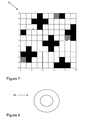
- FIG. 7 an example of printed output 70 resulting from a desired CT level of grey 0.270 processed through the matrices 12, 14 using either of the methods 50, 60 of Figures 5 and 6 is shown. An ordered screen with an angle of 26.6° is obtained. It will be appreciated that the printed output 70 can be tiled in a standard manner to obtain a larger region of grey 0.270.
- a computer program product having software thereon, which when run on a processor is arranged to carry out an image screening method according to this invention, e.g. the method of Figures 2 , 5 or 6 , or as claimed.
- Figure 8 shows such a computer program product in the form of a CD data carrier 80. It will be clear that other data carriers, such as other digital data carriers may also be used.
- the software may be used to update the processor of an existing computer, which may be part of an existing printer.
Landscapes
- Physics & Mathematics (AREA)
- Discrete Mathematics (AREA)
- General Physics & Mathematics (AREA)
- Engineering & Computer Science (AREA)
- Multimedia (AREA)
- Signal Processing (AREA)
- Facsimile Image Signal Circuits (AREA)
- Color, Gradation (AREA)
Priority Applications (1)
| Application Number | Priority Date | Filing Date | Title |
|---|---|---|---|
| EP07117373A EP2043351A1 (fr) | 2007-09-27 | 2007-09-27 | Procédé, système et logiciel pour le balayage d'une image |
Applications Claiming Priority (1)
| Application Number | Priority Date | Filing Date | Title |
|---|---|---|---|
| EP07117373A EP2043351A1 (fr) | 2007-09-27 | 2007-09-27 | Procédé, système et logiciel pour le balayage d'une image |
Publications (1)
| Publication Number | Publication Date |
|---|---|
| EP2043351A1 true EP2043351A1 (fr) | 2009-04-01 |
Family
ID=38983464
Family Applications (1)
| Application Number | Title | Priority Date | Filing Date |
|---|---|---|---|
| EP07117373A Withdrawn EP2043351A1 (fr) | 2007-09-27 | 2007-09-27 | Procédé, système et logiciel pour le balayage d'une image |
Country Status (1)
| Country | Link |
|---|---|
| EP (1) | EP2043351A1 (fr) |
Citations (4)
| Publication number | Priority date | Publication date | Assignee | Title |
|---|---|---|---|---|
| EP0578110A2 (fr) * | 1992-06-29 | 1994-01-12 | Eastman Kodak Company | Appareil pour la génération d'images en demi-teintes à plusieurs niveaux |
| EP0741486A1 (fr) * | 1995-05-05 | 1996-11-06 | Agfa-Gevaert N.V. | Obtention de demi-teintes à plusieurs niveaux et sans moiré pour images en couleurs |
| US5729663A (en) * | 1995-12-07 | 1998-03-17 | Xerox Corporation | Method and apparatus for gray screening |
| US20030053100A1 (en) * | 2000-05-08 | 2003-03-20 | Heinrich Wadle | Multistage screening with screens of any desired screen resolutions and screen angles |
-
2007
- 2007-09-27 EP EP07117373A patent/EP2043351A1/fr not_active Withdrawn
Patent Citations (4)
| Publication number | Priority date | Publication date | Assignee | Title |
|---|---|---|---|---|
| EP0578110A2 (fr) * | 1992-06-29 | 1994-01-12 | Eastman Kodak Company | Appareil pour la génération d'images en demi-teintes à plusieurs niveaux |
| EP0741486A1 (fr) * | 1995-05-05 | 1996-11-06 | Agfa-Gevaert N.V. | Obtention de demi-teintes à plusieurs niveaux et sans moiré pour images en couleurs |
| US5729663A (en) * | 1995-12-07 | 1998-03-17 | Xerox Corporation | Method and apparatus for gray screening |
| US20030053100A1 (en) * | 2000-05-08 | 2003-03-20 | Heinrich Wadle | Multistage screening with screens of any desired screen resolutions and screen angles |
Similar Documents
| Publication | Publication Date | Title |
|---|---|---|
| CN112598585B (zh) | 彩色图像处理方法、装置、电子墨水屏及存储介质 | |
| US8134573B2 (en) | Encoding CMYK data for display using indexed RGB | |
| EP1976261B1 (fr) | Dispositif de traitement de l'image | |
| US6944341B2 (en) | Loose gray-scale template matching for image processing of anti-aliased lines | |
| EP2166744B1 (fr) | Système de génération de masques binaires et pilotes d'imprimante et procédés d'impression utilisant de tels masques | |
| EP1453006A1 (fr) | Image numérique transformée en couleurs avec une distinction des couleurs améliorée pour daltoniens | |
| US20030011612A1 (en) | Method for representing a digital color image using a set of palette colors based on detected important colors | |
| US8098405B2 (en) | Laser print apparatus with dual halftones | |
| CN100352259C (zh) | 图像处理设备、图像处理方法及其程序产品 | |
| US12265864B2 (en) | Information code, information code generation device, information code readout device, program, and information code utilization system | |
| CN110458851A (zh) | 红外图像处理方法、装置、计算机设备和存储介质 | |
| US20080240561A1 (en) | Image processing apparatus | |
| EP2043351A1 (fr) | Procédé, système et logiciel pour le balayage d'une image | |
| CN114119778B (zh) | 用户界面的深色模式生成方法、电子设备及存储介质 | |
| JP2011112681A (ja) | 透過型多色印刷物、透過型多色印刷物作成方法、及び、画像形成装置 | |
| Luo et al. | Novel color palettization scheme for preserving important colors | |
| US7944585B2 (en) | Color information encoding in monochrome printing | |
| CN100541341C (zh) | 具有色粉爆发补偿的激光打印装置 | |
| US20030184773A1 (en) | Context-based adaptive image processing | |
| US20060077406A1 (en) | Fast low-memory paper color suppression algorithm | |
| CN112150345A (zh) | 图像处理方法及装置、视频处理方法和发送卡 | |
| US20030058461A1 (en) | Pixel based image rendering system | |
| EP1453008A1 (fr) | Image numérique transformée en couleurs avec une distinction des couleurs améliorée pour daltoniens | |
| US7236267B2 (en) | Method for merging rendering intents, hints, or tags | |
| EP1944960B1 (fr) | Procédé d'intégration d'informations, procédé et appareil d'obtention d'informations |
Legal Events
| Date | Code | Title | Description |
|---|---|---|---|
| PUAI | Public reference made under article 153(3) epc to a published international application that has entered the european phase |
Free format text: ORIGINAL CODE: 0009012 |
|
| AK | Designated contracting states |
Kind code of ref document: A1 Designated state(s): AT BE BG CH CY CZ DE DK EE ES FI FR GB GR HU IE IS IT LI LT LU LV MC MT NL PL PT RO SE SI SK TR |
|
| AX | Request for extension of the european patent |
Extension state: AL BA HR MK RS |
|
| AKX | Designation fees paid | ||
| REG | Reference to a national code |
Ref country code: DE Ref legal event code: 8566 |
|
| STAA | Information on the status of an ep patent application or granted ep patent |
Free format text: STATUS: THE APPLICATION IS DEEMED TO BE WITHDRAWN |
|
| 18D | Application deemed to be withdrawn |
Effective date: 20091002 |