EP2043424B1 - Anordnung zur unterbringung von schweinen - Google Patents
Anordnung zur unterbringung von schweinen Download PDFInfo
- Publication number
- EP2043424B1 EP2043424B1 EP07768923A EP07768923A EP2043424B1 EP 2043424 B1 EP2043424 B1 EP 2043424B1 EP 07768923 A EP07768923 A EP 07768923A EP 07768923 A EP07768923 A EP 07768923A EP 2043424 B1 EP2043424 B1 EP 2043424B1
- Authority
- EP
- European Patent Office
- Prior art keywords
- feeding
- cubicles
- pigs
- cubicle
- pig
- Prior art date
- Legal status (The legal status is an assumption and is not a legal conclusion. Google has not performed a legal analysis and makes no representation as to the accuracy of the status listed.)
- Not-in-force
Links
- 241000282887 Suidae Species 0.000 title claims abstract description 36
- 238000009434 installation Methods 0.000 claims abstract description 9
- 239000012141 concentrate Substances 0.000 claims abstract description 5
- 241001465754 Metazoa Species 0.000 description 4
- 238000010586 diagram Methods 0.000 description 3
- 230000001404 mediated effect Effects 0.000 description 2
- 238000000034 method Methods 0.000 description 2
- 238000012986 modification Methods 0.000 description 2
- 230000004048 modification Effects 0.000 description 2
- 208000027418 Wounds and injury Diseases 0.000 description 1
- 235000013365 dairy product Nutrition 0.000 description 1
- 230000006378 damage Effects 0.000 description 1
- 229940079593 drug Drugs 0.000 description 1
- 239000003814 drug Substances 0.000 description 1
- 235000013305 food Nutrition 0.000 description 1
- 244000144980 herd Species 0.000 description 1
- 208000014674 injury Diseases 0.000 description 1
- 230000003287 optical effect Effects 0.000 description 1
- 239000010902 straw Substances 0.000 description 1
Images


Classifications
-
- A—HUMAN NECESSITIES
- A01—AGRICULTURE; FORESTRY; ANIMAL HUSBANDRY; HUNTING; TRAPPING; FISHING
- A01K—ANIMAL HUSBANDRY; AVICULTURE; APICULTURE; PISCICULTURE; FISHING; REARING OR BREEDING ANIMALS, NOT OTHERWISE PROVIDED FOR; NEW BREEDS OF ANIMALS
- A01K1/00—Housing animals; Equipment therefor
- A01K1/02—Pigsties; Dog-kennels; Rabbit-hutches or the like
- A01K1/0209—Feeding pens for pigs or cattle
Definitions
- the invention relates to a housing arrangement for group housing of pigs, comprising a living area for pigs provided with identification means and at least one feeding installation for feed provided with an identification system for pigs.
- the known housing arrangement comprises at least one feeding installation which can be approached freely by the pigs.
- the feeding installation comprises a feeding trough, which is provided with a transceiver of an RFID system (Radio Frequency Identification system).
- the transceiver is arranged for recognizing responders carried by the pigs, in which, for each pig, a unique identification code is stored.
- the transceiver is further connected with a central processor, in which data with respect to the individual pigs are stored. In addition to the identification code of a pig, these data also comprise inter alia data about the feed supply to the pig, the health condition of the pig and the like.
- the identification code of the pig is recognized by the identification system.
- the central processor determines on the basis of the data associated with the detected identification code whether the respective pig has a right to feed and, if so, to what amount. If the pig has a right to feed, the central processor controls a feed metering device of the feeding installation, which drops the desired amount of feed into the feeding trough.
- the pig When the pig has finished the feed and notices that the feeding trough is no longer filled, it leaves the feeding trough, so that then the feeding trough is free for another pig.
- a problem that occurs with the known pig housing is that, for instance, a dominant pig, which has no right to feed, tries to chase away a pig which is eating. This can lead to fights and injury of pigs, while then, in addition, it is no longer guaranteed that all pigs get the right amount of (concentrate) feed. Further, it is difficult in the known housing to locate individual pigs and separate them, if desired, for an individual treatment, such as for instance the administration of medicines.
- the invention contemplates providing an improved housing arrangement for group housing of pigs, where the above-mentioned problems do not occur or occur to a lesser degree. More generally, the invention contemplates providing a housing arrangement with which pigs can be kept in an efficient, safe and well controllable manner, and can also be individually located and fed.
- a housing arrangement for group housing of pigs of the above-mentioned type is, according to the invention, defined in the charactering portion of claim 1.
- DE 201 03 954 U1 describes a housing arrangement for group housing of pigs, which comprises a number of feeding cubicles.
- the feeding cubicles are of the walk-through type and are located in a waiting area separated from a living area.
- the waiting area has one or more access doors, which are operated by an optical recognition device for pigs.
- an optical recognition device for pigs When a pig arrives at the access door to the waiting area and is found, after recognition, to have a right to feed, the access door is opened, provided that at least one of the feeding cubicles in the waiting area is free. The pig can then enter the waiting area.
- the feeding cubicles themselves also have lockable access doors and one of those access doors of the feeding cubicles is also automatically opened after opening of the access doors of the waiting area.
- the pig can then enter that feeding cubicle and can eat there.
- the pig can leave the feeding cubicle at the end opposite the access door and reach the living area again through a bypass corridor.
- a housing arrangement with feeding cubicles provided with an RFID system is not described in DE 201 03 954 .
- a feeder cage for pigs is known.
- This known feeder cage has a feeding trough, which can be released or made inaccessible depending on the identity of a pig detected by an identification device.
- this known feeder cage is of the walk-through type with an entrance door and an exit door positioned opposite the entrance door. A housing arrangement with feeding cubicles is not described in EP 0 610 171 A2 .
- WO 01/93667 discloses a method for automatically error notifying a user of a dairy farm, wherein a herd of milking animals are allowed to move freely in an area intended therefore and to visit a single milking station or a single feeding station.
- Said stations comprise an animal identification system and a database of the animals.
- the milking station and the feeding station are each provided with an entrance gate and an exit gate and thus are of the walk-through type. As there is only a single feeding station the animals may not lie down to rest in such a station.
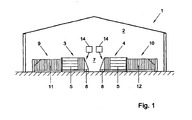
- FIG. 1 schematically shows, in cross section, an example of a pig housing for group housing.
- a barn building 1 has an interior space 2 arranged for group housing of pigs, such as for instance sows.
- the number of feeding cubicles is preferably at least equal to the number of pigs.
- the feeding cubicles have an entrance on the side facing away from the interspace 7, which also forms the exit.
- the rows of feeding cubicles are arranged opposite one another with some interspace 7.
- the feeding installation comprises a feeding trough 8 located in the interspace in front of each cubicle and a number of feed metering devices 14 individually controllable per cubicle, which are schematically shown.
- the cubicles in the example described below are of the self-catching type known per se. Such cubicles close automatically when a pig enters the cubicle, if at least the locking device of the cubicle has been cocked first.
- the invention is also usable with feeding cubicles which are not of the self-catching type.
- the cubicles are preferably provided with an optionally remotely lockable entrance gate in order to separate a pig if desired and/or to be able to prevent pushing away by another pig.
- each pig will eat in peace and quiet without being chased away by another pig.
- the feeding cubicles can be unlocked centrally. However, it is also possible to unlock the cubicles individually, or to leave them locked for a longer period.
- various methods are available. This may, for instance, be done electrically wirelessly or through cables and/or by means of manual operation.
- Each cubicle is automatically individually identifiable by software and/or hardware and is provided with an RFID transceiver of an RFID system for recognizing the identification code of a pig present in the cubicle.
- the pigs can be provided with identification means in the form of RFID responders in which an identification code unique to each pig is stored.
- the responders may be one of the known types of responders, for instance ear responders, collar responders, implanted chips or the like.
- Fig. 2 schematically shows a series of self-catching cubicles 20-25, one of which is drawn larger than the others.
- the cubicles are each provided with an RFID transceiver 26.
- the cubicles are further provided with connections 27 for electrically locking/unlocking the cubicles and with control connections 28 for controlling one or more feed metering devices.
- all cubicles are connected with a central processor 30 comprising a database 30a in which data of the individual sows, such as for instance the health condition of the sows, the amount of concentrate to be supplied, etc., are stored.
- the identification code of the pig is recognized by the RFID system.
- the identification code is, together with a hardware-mediated or software-mediated identification of the cubicle in which the pig is present, transmitted to the processor 30.
- a cubicle may, for instance, be provided with a number.
- the processor transmits a control signal through the control connection 28 of the respective cubicle to the feed metering device of the cubicle in which the pig is present. In this manner, each sow can be fed individually.
- the cubicles may be provided with one or more indicators 31, for instance a lamp or a red LED or the like.
- the indicator is excited as soon as a pig of which it is indicated in the database that it requires special attention is detected in a particular cubicle.
- a display with input facility per cubicle or series of cubicles which display displays the individual sow data of the sows present in those cubicles, as a replacement of the sow card.
- Fig. 2 schematically shows, by way of example, such a display 32 with cubicle 20.
- each cubicle or a group of cubicles with an individual processor, which has its own database and/or is coupled with a central database.
- FIG. 3 shows, in a block diagram, a number of feeding cubicles V1... Vn.
- the feeding cubicles shown are, in this example, each provided with a local processor PV1...PVn.
- the local processors are connected with a central processor 30, which has a central database 30a.
- the local processors can contain a local database DB1...DBn.
- the local processors are provided with a control connection 28 for controlling one or more feed metering devices 28a, and with a connection 27 for controlling a locking and/or unlocking device 27a.
- the local processors are further connected with an RFID transceiver 26.
- Fig. 3 further shows indication devices 31, which are also connected with the local processors, and a display 32, which is connected with local processors PV1...PVn of the group of feeding cubicles V1...Vn.
- feed metering devices it is noted that it is possible that the use of multiple types of feed is desirable. In that case, for instance, a first feed metering device for a first type of feed, a second metering device for a second type of feed, etc. could be used. In addition, it is possible to use common feed metering devices for adjacent feeding cubicles. This could, for instance, be a feed metering device moving along two or more feeding cubicles, which successively provides the feeding troughs of the respective feeding cubicles with feed by successive control of the associated connections 28.
- the invention is also usable with a housing arrangement with feeding cubicles which are provided with an access gate, which normally remains open, but which can be closed if desired via a remote control or locally manually.
- the RFID system may be arranged such that a pig is only recognized at the feeding trough. However, it is also possible to arrange the RFID system such that a pig is already recognized upon entering a feeding cubicle, optionally in combination with a further recognition at the feeding trough.
Landscapes
- Life Sciences & Earth Sciences (AREA)
- Environmental Sciences (AREA)
- Zoology (AREA)
- Animal Husbandry (AREA)
- Biodiversity & Conservation Biology (AREA)
- Feeding And Watering For Cattle Raising And Animal Husbandry (AREA)
- Ultra Sonic Daignosis Equipment (AREA)
Claims (10)
- Unterbringungsanordnung für eine Gruppenunterbringung von Schweinen mit einem Lebensbereich für die Schweine und mindestens einer Fütterungseinrichtung für Konzentrat, welche mit einem RFID-Identifizierungssystem für Schweine versehen ist, gekennzeichnet durch eine Anzahl einzeln und automatisch identifizierbarer Fütterungsboxen (5, 20-25) für Schweine, die sich in dem Lebensbereich befinden, wobei die Boxen einen Eingang aufweisen, welcher ebenfalls der Ausgang ist, und sowohl zentral gleichzeitig, als auch einzeln entriegelbar sind, und wobei die Boxen jeweils mit einem eigenen Sendeempfänger (26) eines RFID-Systems versehen sind, um ein in einer Fütterungsbox anwesendes Schwein zu identifizieren, wobei die mindestens eine Fütterungseinrichtung einen Futtertrog (8) für jede Fütterungsbox und eine Anzahl von mit den Boxen zusammenwirkenden Dosiervorrichtungen (14) aufweist, welche für jede Box einzeln steuerbar sind.
- Unterbringungsanordnung nach Anspruch 1, dadurch gekennzeichnet, dass die Fütterungsboxen (5, 20-25) vom Selbstfang-Typ sind.
- lJnterbringungsanordnung nach Anspruch 1 oder 2, dadurch gekennzeichnet, dass das RFID-System mindestens eine Datenbank aufweist, welche Daten der einzelnen Schweine enthält und mit mindestens einem Prozessor gekoppelt ist, der auf der Basis dieser Daten feststellen kann, in welcher Box (5, 20-25) ein Schwein anwesend ist, das besonderer Aufmerksamkeit und/oder Pflege bedarf.
- Unterbringungsanordnung nach einem der vorhergehenden Ansprüche, dadurch gekennzeichnet, dass jede Fütterungsbox (5, 20-25) mit mindestens einer Anzeige versehen ist, welche anzeigt, ob ein in der Fütterungsbox anwesendes Schwein besonderer Aufmerksamkeit oder Pflege bedarf.
- Unterbringungsanordnung nach Anspruch 3 oder 4, dadurch gekennzeichnet, dass der mindestens eine Prozessor ausgebildet ist, um die einzeln steuerbaren Futterdosiervorrichtungen der einzelnen Fütterungsboxen (5, 20-25) auf der Basis der in der mindestens einen Datenbank gespeicherten Daten der in den Fütterungsboxen anwesenden Schweine zu steuern.
- Unterbringungsanordnung nach einem der Ansprüche 1-5, dadurch gekennzeichnet, dass jede Fütterungsbox (5, 20-25) mit Einrichtungen zum Verhindern einer zentralen Entriegelung versehen ist.
- Unterbringungsanordnung nach einem der vorhergehenden Ansprüche, gekennzeichnet durch eine Anzahl von Displays, die pro Fütterungsbox (5, 20-25) oder pro Reihe von Fütterungsboxen verwendet werden, um Daten von in den Fütterungsboxen anwesenden Schweinen anzuzeigen.
- Schweinestall mit einer Unterbringungsanordnung nach einem der vorhergehenden Ansprüche.
- Schweinestall nach Anspruch 6, mit mindestens einer Reihe (3, 4) von Fütterungsboxen (5) und einem Freilaufbereich (9, 10) für die Schweine, der sich auf der Eingangsseite der Fütterungsboxen befindet.
- Fütterungsbox zur Verwendung in einer Unterbringungsanordnung nach einem der Ansprüche 1-7 oder in einem Schweinstall nach Anspruch 8 oder 9, mit einem Sendeempfänger (26) eines RFID-Systems.
Applications Claiming Priority (2)
| Application Number | Priority Date | Filing Date | Title |
|---|---|---|---|
| NL1032147A NL1032147C2 (nl) | 2006-07-11 | 2006-07-11 | Stalinrichting voor varkens. |
| PCT/NL2007/050341 WO2008007957A1 (en) | 2006-07-11 | 2007-07-10 | Housing arrangement for pigs |
Publications (2)
| Publication Number | Publication Date |
|---|---|
| EP2043424A1 EP2043424A1 (de) | 2009-04-08 |
| EP2043424B1 true EP2043424B1 (de) | 2009-12-09 |
Family
ID=37734267
Family Applications (1)
| Application Number | Title | Priority Date | Filing Date |
|---|---|---|---|
| EP07768923A Not-in-force EP2043424B1 (de) | 2006-07-11 | 2007-07-10 | Anordnung zur unterbringung von schweinen |
Country Status (5)
| Country | Link |
|---|---|
| EP (1) | EP2043424B1 (de) |
| AT (1) | ATE451011T1 (de) |
| DE (1) | DE602007003734D1 (de) |
| NL (1) | NL1032147C2 (de) |
| WO (1) | WO2008007957A1 (de) |
Families Citing this family (3)
| Publication number | Priority date | Publication date | Assignee | Title |
|---|---|---|---|---|
| US8556807B2 (en) | 2006-12-21 | 2013-10-15 | Intuitive Surgical Operations, Inc. | Hermetically sealed distal sensor endoscope |
| GB0716333D0 (en) | 2007-08-22 | 2007-10-03 | White Spark Holdings Ltd | Method and apparatus for the automatic grading of condition of livestock |
| DE102010007569B4 (de) | 2010-02-10 | 2014-04-30 | Autoliv Development Ab | Sicherheitsanordnung |
Family Cites Families (6)
| Publication number | Priority date | Publication date | Assignee | Title |
|---|---|---|---|---|
| DE3701864A1 (de) * | 1987-01-23 | 1988-08-04 | Buschhoff Th Ag | Einrichtung zur abruffuetterung von schweinen |
| AU4581393A (en) * | 1992-07-29 | 1994-03-03 | Francis John McGorry | Apparatus for feeding animals |
| AT401706B (de) * | 1993-02-02 | 1996-11-25 | Vogl Gerhard | Fütterungsanlage für schweine |
| SE0002082D0 (sv) * | 2000-06-05 | 2000-06-05 | Delaval Holding Ab | Notification method and system |
| DE20103954U1 (de) * | 2001-03-07 | 2001-06-07 | Hubert Weßjohann GmbH & Co. KG, 49692 Cappeln | Vorrichtung zur Fütterung von Tieren |
| AT6930U1 (de) * | 2003-08-04 | 2004-06-25 | Walter Steinhuber | Verriegelung für kastenstand |
-
2006
- 2006-07-11 NL NL1032147A patent/NL1032147C2/nl not_active IP Right Cessation
-
2007
- 2007-07-10 DE DE602007003734T patent/DE602007003734D1/de active Active
- 2007-07-10 EP EP07768923A patent/EP2043424B1/de not_active Not-in-force
- 2007-07-10 AT AT07768923T patent/ATE451011T1/de active
- 2007-07-10 WO PCT/NL2007/050341 patent/WO2008007957A1/en not_active Ceased
Also Published As
| Publication number | Publication date |
|---|---|
| ATE451011T1 (de) | 2009-12-15 |
| NL1032147C2 (nl) | 2008-01-14 |
| EP2043424A1 (de) | 2009-04-08 |
| DE602007003734D1 (de) | 2010-01-21 |
| WO2008007957A1 (en) | 2008-01-17 |
Similar Documents
| Publication | Publication Date | Title |
|---|---|---|
| EP0512096B1 (de) | Verfahren und vorrichtung zur tierfütterung | |
| US6516744B1 (en) | Arrangement and method for housing lactating animals | |
| US20080017118A1 (en) | Device and Method for Automatic Milking of Animals | |
| EP1589810B1 (de) | Anordnung zur unterbringung von melktieren | |
| US20100206245A1 (en) | Animal control system | |
| US8132538B1 (en) | System and method for gestation of sows in large pen gestation facilities | |
| US20220061260A1 (en) | System and method for directing livestock animal | |
| EP2043424B1 (de) | Anordnung zur unterbringung von schweinen | |
| Stefanowska et al. | The behaviour of dairy cows in an automatic milking system where selection for milking takes place in the milking stalls | |
| PL197281B1 (pl) | System i sposób hodowli zwierząt | |
| EP0622019B1 (de) | Gerät zum automatischen Melken von Tieren | |
| ES2236848T3 (es) | Procedimiento para la automatizacion de la explotacion agropecuaria de ganado lechero. | |
| EP1541017B1 (de) | Einrichtung und Verfahren zur Verwaltung einer Herde von frei herumlaufenden Tieren | |
| EP1078570A1 (de) | Liegeverhinderungsvorrichtung für Tiere | |
| NL1012873C2 (nl) | Ligbeperkingsinrichting voor dieren. | |
| DE19608398A1 (de) | Stallsystem zur Gruppenhaltung von Tieren, insbesondere Pferden |
Legal Events
| Date | Code | Title | Description |
|---|---|---|---|
| PUAI | Public reference made under article 153(3) epc to a published international application that has entered the european phase |
Free format text: ORIGINAL CODE: 0009012 |
|
| 17P | Request for examination filed |
Effective date: 20090209 |
|
| AK | Designated contracting states |
Kind code of ref document: A1 Designated state(s): AT BE BG CH CY CZ DE DK EE ES FI FR GB GR HU IE IS IT LI LT LU LV MC MT NL PL PT RO SE SI SK TR |
|
| AX | Request for extension of the european patent |
Extension state: AL BA HR MK RS |
|
| GRAP | Despatch of communication of intention to grant a patent |
Free format text: ORIGINAL CODE: EPIDOSNIGR1 |
|
| RBV | Designated contracting states (corrected) |
Designated state(s): AT DE NL |
|
| GRAS | Grant fee paid |
Free format text: ORIGINAL CODE: EPIDOSNIGR3 |
|
| GRAA | (expected) grant |
Free format text: ORIGINAL CODE: 0009210 |
|
| AK | Designated contracting states |
Kind code of ref document: B1 Designated state(s): AT DE NL |
|
| REF | Corresponds to: |
Ref document number: 602007003734 Country of ref document: DE Date of ref document: 20100121 Kind code of ref document: P |
|
| REG | Reference to a national code |
Ref country code: NL Ref legal event code: T3 |
|
| PLBE | No opposition filed within time limit |
Free format text: ORIGINAL CODE: 0009261 |
|
| STAA | Information on the status of an ep patent application or granted ep patent |
Free format text: STATUS: NO OPPOSITION FILED WITHIN TIME LIMIT |
|
| 26N | No opposition filed |
Effective date: 20100910 |
|
| REG | Reference to a national code |
Ref country code: DE Ref legal event code: R082 Ref document number: 602007003734 Country of ref document: DE Representative=s name: VEREENIGDE OCTROOIBUREAUX V.O., DE |
|
| PGFP | Annual fee paid to national office [announced via postgrant information from national office to epo] |
Ref country code: NL Payment date: 20210622 Year of fee payment: 15 |
|
| PGFP | Annual fee paid to national office [announced via postgrant information from national office to epo] |
Ref country code: AT Payment date: 20210722 Year of fee payment: 15 |
|
| PGFP | Annual fee paid to national office [announced via postgrant information from national office to epo] |
Ref country code: DE Payment date: 20210721 Year of fee payment: 15 |
|
| REG | Reference to a national code |
Ref country code: DE Ref legal event code: R119 Ref document number: 602007003734 Country of ref document: DE |
|
| REG | Reference to a national code |
Ref country code: NL Ref legal event code: MM Effective date: 20220801 |
|
| REG | Reference to a national code |
Ref country code: AT Ref legal event code: MM01 Ref document number: 451011 Country of ref document: AT Kind code of ref document: T Effective date: 20220710 |
|
| PG25 | Lapsed in a contracting state [announced via postgrant information from national office to epo] |
Ref country code: AT Free format text: LAPSE BECAUSE OF NON-PAYMENT OF DUE FEES Effective date: 20220710 |
|
| PG25 | Lapsed in a contracting state [announced via postgrant information from national office to epo] |
Ref country code: DE Free format text: LAPSE BECAUSE OF NON-PAYMENT OF DUE FEES Effective date: 20230201 |
|
| PG25 | Lapsed in a contracting state [announced via postgrant information from national office to epo] |
Ref country code: NL Free format text: LAPSE BECAUSE OF NON-PAYMENT OF DUE FEES Effective date: 20220801 |