EP2044845A1 - Verfahren zur Aufarbeitung von Melasse - Google Patents
Verfahren zur Aufarbeitung von Melasse Download PDFInfo
- Publication number
- EP2044845A1 EP2044845A1 EP07019471A EP07019471A EP2044845A1 EP 2044845 A1 EP2044845 A1 EP 2044845A1 EP 07019471 A EP07019471 A EP 07019471A EP 07019471 A EP07019471 A EP 07019471A EP 2044845 A1 EP2044845 A1 EP 2044845A1
- Authority
- EP
- European Patent Office
- Prior art keywords
- component
- molasses
- separation
- process according
- depleted
- Prior art date
- Legal status (The legal status is an assumption and is not a legal conclusion. Google has not performed a legal analysis and makes no representation as to the accuracy of the status listed.)
- Granted
Links
Images

Classifications
-
- C—CHEMISTRY; METALLURGY
- C13—SUGAR INDUSTRY
- C13B—PRODUCTION OF SUCROSE; APPARATUS SPECIALLY ADAPTED THEREFOR
- C13B20/00—Purification of sugar juices
- C13B20/18—Purification of sugar juices by electrical means
-
- A—HUMAN NECESSITIES
- A23—FOODS OR FOODSTUFFS; TREATMENT THEREOF, NOT COVERED BY OTHER CLASSES
- A23C—DAIRY PRODUCTS, e.g. MILK, BUTTER OR CHEESE; MILK OR CHEESE SUBSTITUTES; PREPARATION THEREOF
- A23C21/00—Whey; Whey preparations
- A23C21/02—Whey; Whey preparations containing, or treated with, microorganisms or enzymes
-
- A—HUMAN NECESSITIES
- A23—FOODS OR FOODSTUFFS; TREATMENT THEREOF, NOT COVERED BY OTHER CLASSES
- A23C—DAIRY PRODUCTS, e.g. MILK, BUTTER OR CHEESE; MILK OR CHEESE SUBSTITUTES; PREPARATION THEREOF
- A23C9/00—Milk preparations; Milk powder or milk powder preparations
- A23C9/14—Milk preparations; Milk powder or milk powder preparations in which the chemical composition of the milk is modified by non-chemical treatment
- A23C9/144—Milk preparations; Milk powder or milk powder preparations in which the chemical composition of the milk is modified by non-chemical treatment by electrical means, e.g. electrodialysis
-
- A—HUMAN NECESSITIES
- A23—FOODS OR FOODSTUFFS; TREATMENT THEREOF, NOT COVERED BY OTHER CLASSES
- A23L—FOODS, FOODSTUFFS OR NON-ALCOHOLIC BEVERAGES, NOT OTHERWISE PROVIDED FOR; PREPARATION OR TREATMENT THEREOF
- A23L29/00—Foods or foodstuffs containing additives; Preparation or treatment thereof
- A23L29/30—Foods or foodstuffs containing additives; Preparation or treatment thereof containing carbohydrate syrups; containing sugars; containing sugar alcohols, e.g. xylitol; containing starch hydrolysates, e.g. dextrin
-
- A—HUMAN NECESSITIES
- A23—FOODS OR FOODSTUFFS; TREATMENT THEREOF, NOT COVERED BY OTHER CLASSES
- A23L—FOODS, FOODSTUFFS OR NON-ALCOHOLIC BEVERAGES, NOT OTHERWISE PROVIDED FOR; PREPARATION OR TREATMENT THEREOF
- A23L33/00—Modifying nutritive qualities of foods; Dietetic products; Preparation or treatment thereof
- A23L33/10—Modifying nutritive qualities of foods; Dietetic products; Preparation or treatment thereof using additives
- A23L33/16—Inorganic salts, minerals or trace elements
-
- C—CHEMISTRY; METALLURGY
- C12—BIOCHEMISTRY; BEER; SPIRITS; WINE; VINEGAR; MICROBIOLOGY; ENZYMOLOGY; MUTATION OR GENETIC ENGINEERING
- C12P—FERMENTATION OR ENZYME-USING PROCESSES TO SYNTHESISE A DESIRED CHEMICAL COMPOUND OR COMPOSITION OR TO SEPARATE OPTICAL ISOMERS FROM A RACEMIC MIXTURE
- C12P7/00—Preparation of oxygen-containing organic compounds
- C12P7/02—Preparation of oxygen-containing organic compounds containing a hydroxy group
- C12P7/04—Preparation of oxygen-containing organic compounds containing a hydroxy group acyclic
- C12P7/06—Ethanol, i.e. non-beverage
-
- C—CHEMISTRY; METALLURGY
- C13—SUGAR INDUSTRY
- C13B—PRODUCTION OF SUCROSE; APPARATUS SPECIALLY ADAPTED THEREFOR
- C13B20/00—Purification of sugar juices
- C13B20/16—Purification of sugar juices by physical means, e.g. osmosis or filtration
-
- Y—GENERAL TAGGING OF NEW TECHNOLOGICAL DEVELOPMENTS; GENERAL TAGGING OF CROSS-SECTIONAL TECHNOLOGIES SPANNING OVER SEVERAL SECTIONS OF THE IPC; TECHNICAL SUBJECTS COVERED BY FORMER USPC CROSS-REFERENCE ART COLLECTIONS [XRACs] AND DIGESTS
- Y02—TECHNOLOGIES OR APPLICATIONS FOR MITIGATION OR ADAPTATION AGAINST CLIMATE CHANGE
- Y02E—REDUCTION OF GREENHOUSE GAS [GHG] EMISSIONS, RELATED TO ENERGY GENERATION, TRANSMISSION OR DISTRIBUTION
- Y02E50/00—Technologies for the production of fuel of non-fossil origin
- Y02E50/10—Biofuels, e.g. bio-diesel
Definitions
- the invention relates to a process for the processing of molasses.
- the latter is particularly the case in the processing of whey, in which the whey is first separated by a membrane process in a protein-enriched retentate and a lektose-enriched permeate. Lactose is separated from the latter after evaporation and crystallization by mechanical separation processes, the molasses remaining as un-valued component and having to be disposed of.
- the invention has for its object to provide a method for processing molasses, can be obtained by the valuable ingredients of the molasses.
- the molasses fed to the process from whey processing has a dry matter content of, for example, 18 to 35%.
- the reduced mineral content of the mineral-depleted component isolated by the separation of minerals is advantageous for their subsequent crystallization.
- the electrodialysis or chromatography are suitable, with which it is possible to separate 50 to 80%, in particular 60 to 65%, of the minerals in the molasses.
- the mineral-depleted component isolated by electrodialysis / chromatography has a dry matter content of 20%.
- the dry matter for example, the ash content is 8 to 9%, and the content of glucose and lactic acid is 2 to 5%.
- the dry matter content is increased, for example to 60 to 70%.
- the crystallization of the thus concentrated component is preferably carried out in a crystallization tank over a period of, for example, 25 to 35 hours.
- the suspension including the precipitated crystalline phase, can then be treated either according to the patent application 06 012 916.0-2114 - "Process for the production of permeate powder" - or according to the following process sequence:
- the suspension including the crystalline phase, is freed of all undesired ingredients in a multistage, preferably a two- to four-stage, decanting and washing line.
- the content of glucose and lactic acid, which are unfavorable for drying, in the dry matter is, for example, less than 1%, preferably less than 0.2%.
- this depleted component can be effectively subjected to a drying process whose end product is a lactose powder.
- liquid phase separated from the crystalline phase of the crystallization process and / or the component containing the separated glucose and lactic acid and / or the component containing the separated minerals are further processed to ethanol.
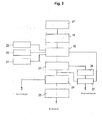
- Fig. 1 symbolizes a block 1 the input-side supply of molasses to the overall process, this molasses is obtained at the end of a lactose process, the whey first removed a protein-enriched retentate and separated from the remaining lactose-rich permeate by evaporation and crystallization lactose.
- the molasses fed at 1 which may have a dry matter content of about 25%, is standardized by dilution to a dry matter content of 10% or less. Suitable diluents for this reduction of the dry matter content are vapors and / or a permeate from reverse osmosis, which are obtained in downstream process stages to be explained.
- the pH of the thus standardized molasses can be adjusted to a pH value between 2 and 6 by addition of auxiliaries, for example hydrochloric acid, and of the possibly adjusted molasses in a stage 3 following stage 2 by electrodialysis a substantial proportion of the in the standardized molasses contained minerals, for example 60 to 65%, to be separated. It is recommended that electrodialysis be preceded by mechanical clarification, preferably a separator or microfiltration, to retain particles that would adversely affect the function of electrodialysis.
- auxiliaries for example hydrochloric acid
- the unwanted for drying levels of minerals, proteins, glucose and lactic acid are largely separated.
- the depleted component from the decanter 8 the content of undesirable ingredients, for example, less than 1%, preferably in total less than 0.5% is dried in a decanter 8 downstream drying stage 9, whereby the end product is a lactose powder, which in a silo 10 stored and can be bagged at an exit 11 of the silo 10.
- the processes are to be designed so that, depending on the market, permeate powder or the higher-order lactose powder can be produced.
- the mixture obtained in the washing mixture stage 7 can be completely or partially dried to a pH value of 6 or higher in a spray dryer 12, whereby a permeate powder is formed, which is stored in a silo 13 and bagged at an outlet 14 of the silo 13 can be.
- the vapors formed in the evaporator stages 4 and 7a are recycled to the dilution stage 2, the electrodialysis stage 3 and the decanter stages 6 and 8. As a result, the running in the stages 1 to 8 process can be operated without additional fresh water.
- the component remaining in the electrodialysis stage 3 in the recovery of the mineral-depleted component is concentrated in a stage 15 by reverse osmosis and the concentrated retentate is fed to an ethanol recovery process.
- Stage 15 permeate is recycled to the dilution stage 2, the electrodialysis stage 3 and the decanter stages 6 and 8 for balance of the total process.
- the portion of the liquid phase which is not consumed for the washing-mixing stage 7 is fed from the decanter 6 to the ethanol extraction process.
- This proportion is 70 to 90%, in particular 85%, and in particular leads amorphous lactose and galactose from the running in stages 1 to 8 process.
- the total flow produced in the block 17, which may be a tank, is supplied to a heater 18 in which it is heated to, for example, 85 ° for germination.
- a fermentation tank 19 connected downstream of the heater 18 yeast is added from a culture tank 20 and the fermentation is carried out at a fermentation temperature in the range from 25 to 35 ° C. It is preferable to use yeasts of the genus Kluyveromyces.
- the setting of a suitable pH, for example from 4 to 6, is carried out by supplying liquor or acid from a feed tank 21.
- the CO 2 produced during the fermentation can be collected in a CO 2 liquefaction plant 22.
- the fermented substrate is separated in a separator 23 into a yeast concentrate and a yeast-free fermentate.
- raw alcohol is produced in a step 24 by distillation, rectification.
- This alcohol with up to 96% is dewatered in a downstream dehydration stage 25, for example, to a purity of at least 99.8%, whereby commercially viable ethanol is obtained.
- the yeast concentrate separated in the separator 23 is mixed with water in a washing device 26 and then concentrated in a second separator 27.
- the clear phase separated in the separator 27 is admixed with the fermentation product flowing into the stage 24 from the separator 23 in order to recover residual alcohols contained therein.
- the yeast concentrate separated in the jet separator 27 is recirculated up to 50% into the fermentation tank 19.
- the non-recycled yeast concentrate is called Feed yeast removed.
- the vinasse obtained in the distillation / rectification step 24 is removed and can be concentrated by evaporation to 20 to 30% dry matter for further use.
- Fig. 1 are exemplified annual quantities for a process control on an industrial scale. Thereafter, starting from an annual supply of 29,986 t of molasses, 6,000 t of lactose powder, alternatively 9,000 t of permeate powder and 9,300 m 3 of ethanol are obtained annually.
Landscapes
- Chemical & Material Sciences (AREA)
- Life Sciences & Earth Sciences (AREA)
- Engineering & Computer Science (AREA)
- Organic Chemistry (AREA)
- Health & Medical Sciences (AREA)
- Food Science & Technology (AREA)
- Polymers & Plastics (AREA)
- Biochemistry (AREA)
- Zoology (AREA)
- Wood Science & Technology (AREA)
- Microbiology (AREA)
- Nutrition Science (AREA)
- Mycology (AREA)
- Bioinformatics & Cheminformatics (AREA)
- Biotechnology (AREA)
- Chemical Kinetics & Catalysis (AREA)
- General Chemical & Material Sciences (AREA)
- Inorganic Chemistry (AREA)
- Molecular Biology (AREA)
- Water Supply & Treatment (AREA)
- General Engineering & Computer Science (AREA)
- General Health & Medical Sciences (AREA)
- Genetics & Genomics (AREA)
- Coloring Foods And Improving Nutritive Qualities (AREA)
- Separation Using Semi-Permeable Membranes (AREA)
- Preparation Of Compounds By Using Micro-Organisms (AREA)
Abstract
Description
- Die Erfindung bezieht sich auf ein Verfahren zur Aufarbeitung von Melasse. Letztere fällt insbesondere bei der Aufarbeitung von Molke an, bei der die Molke zunächst durch ein Membranverfahren in eine proteinangereicherte Retentatkomponente und eine läktoseangereicherte Permeatkomponente getrennt wird. Aus letzterer wird nach Eindampfen und Kristallisieren durch mechanische Trennverfahren Laktose abgetrennt, wobei die Melasse als unverwertete Komponente zurückbleibt und entsorgt werden muß.
- Der Erfindung liegt die Aufgabe zugrunde, ein Verfahren zur Aufarbeitung von Melasse zu schaffen, durch das wertvolle Inhaltsstoffe der Melasse gewonnen werden können.
- Erfindungsgemäß wird diese Aufgabe durch ein Verfahren gelöst, das die folgenden Verfahrensschritte aufweist:
- Isolieren einer mineralisch abgereicherten Komponente durch Abtrennen von Mineralien aus der Melasse,
- Aufkonzentrieren der mineralisch abgereicherten Komponente durch Wasserentzug
- Kristallisieren der aufkonzentrierten Komponente
- Abtrennen der durch das Kristallisieren ausgefällten kristallinen Phase von der flüssigen Phase
- Waschen der abgetrennten kristallinen Phase mit einer Waschflüssigkeit.
- Die dem Verfahren aus der Molkeverarbeitung zugeführte Melasse weist einen Trockenmassegehalt von beispielsweise 18 bis 35 % auf. Der verringerte Mineralgehalt der durch das Abtrennen von Mineralien isolierten, mineralisch abgereicherten Komponente ist für deren nachfolgende Kristallisation vorteilhaft.
- Für die Mineralabtrennung im technischen Maßstab eignen sich die Elektrodialyse oder die Chromatographie, mit der es gelingt, 50 bis 80 %, insbesondere 60 bis 65 %, der in der Melasse befindlichen Mineralien abzutrennen. Für diese Verfahren ist es dabei vorteilhaft, den Trockenmassegehalt der dem Verfahren zugeführten Melasse auf z. B. 10 % einzustellen. Dies kann dadurch geschehen, daß der dem Verfahren zugeführten Melasse Brüden zugesetzt werden, die in nachfolgenden Verfahrensschritten entstehen. Dadurch kann die Wasserbilanz des Gesamtprozesses ausgeglichen werden, so daß kein zusätzliches Frischwasser zugeführt werden muß.
- Die durch die Elektrodialyse/Chromatographie isolierte, mineralisch abgereicherte Komponente weist beispielsweise einen Trockenmassegehalt von 20 % auf. In der Trockenmasse beträgt der Aschegehalt beispielsweise 8 bis 9 % sowie der Gehalt an Glucose und Milchsäure 2 bis 5 %.
- Durch das Aufkonzentrieren der mineralisch abgereicherten Komponente, das insbesondere durch Eindampfen erfolgt, wird der Trockenmassegehalt erhöht, beispielsweise auf 60 bis 70 %.
- Das Kristallisieren der solchermaßen aufkonzentrierten Komponente erfolgt vorzugsweise in einem Kristallisationstank über eine Zeitdauer von beispielsweise 25 bis 35 Stunden.
- Die Suspension, einschließlich der ausgefällten kristallinen Phase, kann dann entweder entsprechend der Patentanmeldung 06 012 916.0-2114 - "Verfahren zur Herstellung von Permeatpulver" - behandelt werden oder entsprechend folgendem Prozeßablauf:
- Die Suspension einschließlich der kristallinen Phase wird in einer mehrstufigen, vorzugsweise einer zwei- bis vierstufigen, Dekantier- und Waschstraße von allen unerwünschten Inhaltsstoffen befreit. In der solchermaßen abgereicherten Komponente beträgt der Gehalt an Glucose und Milchsäure, die für eine Trocknung ungünstig sind, in der Trockenmasse beispielsweise weniger als 1 %, vorzugsweise weniger als 0,2 %. Somit kann diese abgereicherte Komponente wirkungsvoll einem Trocknungsvorgang unterzogen werden, dessen Endprodukt ein Laktosepulver ist.
- Mit besonderem Vorteil wird die von der kristallinen Phase getrennte flüssige Phase des Kristallisationsprozesses und/oder die die abgetrennte Glucose und Milchsäure enthaltende Komponente und/oder die die abgetrennten Mineralien enthaltende Komponente zu Ethanol weiterverarbeitet. Dies ist Gegenstand der abhängigen Ansprüche 22 bis 30.
- In der folgenden Beschreibung wird ein Ausführungsbeispiel der Erfindung anhand der Zeichnung näher erläutert. Hierin zeigen:
- Fig. 1
- ein Ablaufschema eines Gesamtprozesses, und
- Fig. 2
- Einzelheiten eines der Ethanolherstellung dienenden Zweiges des Gesamtprozesses von
Fig. 1 . - In dem Ablaufschema von
Fig. 1 symbolisiert ein Block 1 die eingangsseitige Zuführung von Melasse zum Gesamtprozeß, wobei diese Melasse am Ende eines Laktoseprozesses anfällt, bei dem Molke zuerst eine proteinangereicherte Retentatkomponente entzogen und von der verbleibenden laktosereichen Permeatkomponente durch Eindampfen und Kristallisieren Laktose abgetrennt wird. In einer im Verfahrensablauf folgenden Stufe 2 wird die bei 1 zugeführte Melasse, die einen Trockenmassegehalt von etwa 25 % aufweisen kann, durch Verdünnen auf einen Trockenmassegehalt von 10 % oder kleiner standardisiert. Als Verdünnungsmittel für diese Reduzierung des Trockenmassegehaltes dienen Brüden und/oder ein Permeat aus reverser Osmose, die in noch zu erläuternden nachgeschalteten Prozeßstufen anfallen. - Der pH-Wert der solchermaßen standardisierten Melasse kann durch Zugabe von Hilfsstoffen, beispielsweise Salzsäure, auf einen pH-Wert zwischen 2 und 6 eingestellt und von der ggf. eingestellten Melasse in einer auf die Stufe 2 folgenden Stufe 3 durch Elektrodialyse ein wesentlicher Anteil der in der standardisierten Melasse enthaltenen Mineralien, beispielsweise 60 bis 65 %, abgetrennt werden. Es ist geraten, der Elektrodialyse eine mechanische Klärung, vorzugsweise einen Separator oder eine Mikrofiltration, vorzuschalten, um Partikel zurückzuhalten, die die Funktion der Elektrodialyse negativ beeinflussen würden. Die nach der Elektrodialyse verbleibende, mineralisch abgereicherte Komponente, deren Trockenmassegehalt beispielsweise etwa 20 % beträgt, wird in einer auf die Elektrodialysestufe 3 folgenden Eindampferstufe 4 auf eine Konzentration von beispielsweise 65 % Trockenmasse eingedampft und anschließend in einem Kristallisationstank 5 über beispielsweise 25 bis 35 Stunden kristallisiert.
- In der dem Kristallisationstank 5 nachgeschalteten mehrstufigen Dekantier- und Waschstraße (Stufen 6, 7 und 8 ) werden die für die Trocknung unerwünschten Gehalte an Mineralien, Proteinen, Glucose und Milchsäure weitestgehend abgetrennt. Die abgereicherte Komponente aus dem Dekanter 8, deren Gehalt an unerwünschten Inhaltsstoffen beispielsweise kleiner als 1 %, vorzugsweise in Summe kleiner als 0,5 % ist, wird in einer dem Dekanter 8 nachgeschalteten Trocknungsstufe 9 getrocknet, wodurch als Endprodukt ein Laktosepulver entsteht, das in einem Silo 10 zwischengelagert und an einem Ausgang 11 des Silos 10 abgesackt werden kann.
- Vorzugsweise sind die Prozesse so zu gestalten, daß in Abhängigkeit vom Markt Permeatpulver oder das höherwertige Laktosepulver hergestellt werden kann. Hierzu kann das in der Waschmischstufe 7 erhaltene Gemisch ganz oder teilweise nach einer pH-Wert-Einstellung auf 6 oder höher in einem Sprühtrockner 12 getrocknet werden, wodurch ein Permeatpulver entsteht, das in einem Silo 13 zwischengelagert und an einem Ausgang 14 des Silos 13 abgesackt werden kann.
- Die in den Eindampferstufen 4 und 7a entstehenden Brüden werden zu der Verdünnungsstufe 2, der Elektrodialysestufe 3 sowie den Dekanterstufen 6 und 8 zurückgeführt. Dadurch kann der in den Stufen 1 bis 8 ablaufende Prozeß ohne zusätzliche Frischwasserzufuhr betrieben werden.
- Die in der Elektrodialysestufe 3 bei der Gewinnung der mineralisch abgereicherten Komponente verbleibende Komponente wird in einer Stufe 15 durch reverse Osmose aufkonzentriert und das aufkonzentrierte Retentat einem Ethanolgewinnungsprozeß zugeführt. Das Permeat der Stufe 15 wird für einen Bilanzausgleich des Gesamtprozesses zu der Verdünnungsstufe 2, der Elektrodialysestufe 3 und den Dekanterstufen 6 und 8 zurückgeführt.
- Dem Ethanolgewinnungsprozeß wird ferner der nicht für die Wasch-Mischstufe 7 verbrauchte Anteil der flüssigen Phase aus dem Dekanter 6 zugeführt. Dieser Anteil beträgt 70 bis 90 %, insbesondere 85 %, und führt insbesondere amorphe Laktose und Galaktose aus dem in den Stufen 1 bis 8 ablaufenden Prozeß.
- Weiterhin wird dem Ethanolgewinnungsprozeß die in dem Dekanter 8 abgetrennte flüssige Phase zugeführt. Die Zusammenfassung der drei Teilströme aus der Elektrodialysestufe 3, der Dekanterstufe 6 und der Dekanterstufe 8 zu einem für die Ethanolgewinnung verwendeten Gesamtstrom ist in
Fig. 1 durch die Blöcke 16 und 17 veranschaulicht. - Gemäß
Fig. 2 wird der in dem Block 17, bei dem es sich um einen Tank handeln kann, anfallende Gesamtstrom einem Erhitzer 18 zugeführt, in dem eine Erhitzung auf beispielsweise 85° zur Keimabtötung stattfindet. In einem dem Erhitzer 18 nachgeschalteten Fermentationstank 19 wird aus einem Kulturtank 20 Hefe zugesetzt und die Fermentation bei einer Fermentationstemperatur im Bereich vom 25 bis 35° C durchgeführt. Es werden vorzugsweise Hefen der Gattung Kluyveromyces verwendet. Die Einstellung eines geeigneten pH-Wertes, beispielsweise von 4 bis 6, erfolgt durch Zufuhr von Lauge oder Säure aus einem Vorlagebehälter 21. Das bei der Fermentation entstehende CO2 kann in einer CO2-Verflüssigungsanlage 22 aufgefangen werden. - Nach abgeschlossener Fermentierung wird das fermentierte Substrat in einem Separator 23 in ein Hefenkonzentrat und ein hefefreies Fermentat getrennt. Aus letzterem wird in einer Stufe 24 Rohalkohol durch Destillieren, Rektifizieren erzeugt. Dieser Alkohol mit bis zu 96 % wird in einer nachgeschalteten Dehydrationsstufe 25 beispielsweise bis auf eine Reinheit von mindestens 99,8 % entwässert, wodurch handelsfähiges Ethanol erhalten wird.
- Das in dem Separator 23 abgetrennte Hefenkonzentrat wird in einer Wascheinrichtung 26 mit Wasser versetzt und anschließend in einem zweiten Separator 27 aufkonzentriert. Die in dem Separator 27 abgetrennte Klarphase wird dem der Stufe 24 zulaufenden Fermentat aus dem Separator 23 beigemischt, um enthaltene Restalkohole zurückzugewinnen. Das in dem Düsenseparator 27 abgetrennte Hefenkonzentrat wird bis zu 50 % in den Fermentationstank 19 zurückgeführt. Das nicht zurückgeführte Hefenkonzentrat wird als Futterhefe entnommen. Die beim Destillieren/Rektifizieren in der Stufe 24 anfallende Schlempe wird entnommen und kann zur weiteren Verwendung durch Eindampfen auf 20 bis 30 % Trockenmasse aufkonzentriert werden.
- In
Fig. 1 sind beispielhaft Jahresmengen für eine Prozeßführung im industriellen Maßstab angegeben. Danach werden ausgehend von einer jährlichen Zuführung von 29.986 t Melasse jährlich 6.000 t Laktosepulver, alternativ 9.000 t Permeatpulver und 9.300 m3 Ethanol gewonnen.
Claims (31)
- Verfahren zur Aufarbeitung von Melasse mit den Verfahrensschritten:Isolieren einer mineralisch abgereicherten Komponente durch Abtrennen von Mineralien aus der Melasse,Aufkonzentrieren der mineralisch abgereicherten Komponente durch WasserentzugKristallisieren der aufkonzentrierten KomponenteAbtrennen der durch das Kristallisieren ausgefällten kristallinen Phase von der flüssigen PhaseWaschen der abgetrennten kristallinen Phase mit einer Waschflüssigkeit.
- Verfahren nach Anspruch 1, dadurch gekennzeichnet, daß das Abtrennen von Mineralien aus der Melasse durch Elektrodialyse erfolgt.
- Verfahren nach Anspruch 1, dadurch gekennzeichnet, daß das Abtrennen von Mineralien aus der Melasse durch Chromatographie erfolgt.
- Verfahren nach einem der Ansprüche 1 bis 3, dadurch gekennzeichnet, daß das Aufkonzentrieren der mineralisch abgereicherten Komponente durch Eindampfen erfolgt.
- Verfahren nach einem der Ansprüche 1 bis 4, dadurch gekennzeichnet, daß das Kristallisieren in einem Kristallisationstank erfolgt.
- Verfahren nach einem der Ansprüche 1 bis 5, dadurch gekennzeichnet, daß das Abtrennen der kristallinen Phase in einem Dekanter erfolgt.
- Verfahren nach einem der Ansprüche 1 bis 6, dadurch gekennzeichnet, daß die Mischflüssigkeit aus der flüssigen Phase des Kristallisationsprozesses entnommen wird.
- Verfahren nach Anspruch 7, dadurch gekennzeichnet, daß die entnommene flüssige Phase zur Bildung der Mischflüssigkeit aufkonzentriert wird.
- Verfahren nach Anspruch 8, dadurch gekennzeichnet, daß das Aufkonzentrieren der entnommenen flüssigen Phase durch Eindampfen erfolgt.
- Verfahren nach einem der Ansprüche 1 bis 9, dadurch gekennzeichnet, daß die dem Verfahren zugeführte Melasse einen Trockenmassegehalt zwischen 18 und 35 % aufweist.
- Verfahren nach einem der Ansprüche 1 bis 10, dadurch gekennzeichnet, daß der Trockenmassegehalt der dem Verfahren zugeführten Melasse auf 10 % oder weniger eingestellt wird.
- Verfahren nach Anspruch 10, dadurch gekennzeichnet, daß die Einstellung des Trockenmassegehalts durch Zugabe von in mindestens einem Eindampfschritt des Verfahrens entstehenden Brüden erfolgt.
- Verfahren nach einem der Ansprüche 1 bis 12, dadurch gekennzeichnet, daß die aufkonzentrierte Komponente einen Trockenmassegehalt zwischen 60 und 70 % aufweist.
- Verfahren nach einem der Ansprüche 1 bis 13, dadurch gekennzeichnet, daß durch die Abtrennung zwischen 60 und 65 % der in der zugeführten Melasse enthaltenen Mineralien abgetrennt werden.
- Verfahren nach einem der Ansprüche 1 bis 14, dadurch gekennzeichnet, daß das Kristallisieren über eine Zeitdauer von 25 bis 35 Stunden ausgeführt wird.
- Verfahren nach einem der Ansprüche 1 bis 15, dadurch gekennzeichnet, daß für das Isolieren der mineralisch abgereicherten Komponente der pH-Wert auf kleiner 6,0 eingestellt wird.
- Verfahren nach einem der Ansprüche 1 bis 16, dadurch gekennzeichnet, daß aus der gewaschenen kristallinen Phase durch Abtrennen eine an Glucose und Milchsäure abgereicherte Komponente gewonnen wird.
- Verfahren nach Anspruch 17, dadurch gekennzeichnet, daß das Abtrennen in einem Dekanter erfolgt.
- Verfahren nach Anspruch 17 oder 18, dadurch gekennzeichnet, daß die an Glucose und Milchsäure abgereicherte Komponente getrocknet wird.
- Verfahren nach einem der Ansprüche 1 bis 16, dadurch gekennzeichnet, daß die gewaschene kristalline Phase sprühgetrocknet wird.
- Verfahren nach Anspruch 20, dadurch gekennzeichnet, daß der pH-Wert der gewaschenen kristallinen Phase auf 6 oder höher eingestellt wird.
- Verfahren nach einem der Ansprüche 1 bis 21, dadurch gekennzeichnet, daß eine von mindestens einem Teil der flüssigen Phase des Kristallisationsprozesses gebildete Komponente zu Ethanol weiterverarbeitet wird.
- Verfahren nach einem der Ansprüche 17 bis 22, dadurch gekennzeichnet, daß die nach Abtrennung der an Glucose und Milchsäure abgereicherten Komponente verbleibende Komponente zu Ethanol weiterverarbeitet wird.
- Verfahren nach einem der Ansprüche 1 bis 23, dadurch gekennzeichnet, daß die nach Isolieren der mineralisch abgereicherten Komponente verbleibende Komponente zu Ethanol weiterverarbeitet wird.
- Verfahren nach einem der Ansprüche 22 bis 24, dadurch gekennzeichnet, daß die zu Ethanol zu verarbeitende Komponente durch Zusatz von Hefe fermentiert, eine durch die Fermentierung gebildete alkoholische Komponente von der Hefe mechanisch abgetrennt und von der abgetrennten alkoholischen Komponente ein Alkoholanteil thermisch abgetrennt wird.
- Verfahren nach Anspruch 25, dadurch gekennzeichnet, daß die mechanische Abtrennung durch einen Separator erfolgt.
- Verfahren nach Anspruch 25 oder 26, dadurch gekennzeichnet, daß die thermische Abtrennung des Alkoholanteils durch Destillieren erfolgt.
- Verfahren nach einem der Ansprüche 25 bis 27, dadurch gekennzeichnet, daß die thermische Abtrennung des Alkoholanteils durch Rektifizieren erfolgt.
- Verfahren nach einem der Ansprüche 25 bis 28, dadurch gekennzeichnet, daß die Hefe die Gattung Kluyveromyces enthält.
- Verfahren nach einem der Ansprüche 25 bis 29, dadurch gekennzeichnet, daß ein Teil der mechanisch abgetrennten Hefe zur Fermentierung zurückgeführt wird.
- Verfahren nach einem der Ansprüche 1 bis 30, dadurch gekennzeichnet, daß die dem Verfahren zugeführte Melasse aus einem Molkeaufarbeitungsverfahren entnommen wird, bei dem der Molke zuerst Eiweiß durch ein Membrantrennverfahren und anschließend Laktose durch ein Kristallisationsverfahren entzogen wird, dessen Mutterlauge die Melasse liefert.
Priority Applications (5)
| Application Number | Priority Date | Filing Date | Title |
|---|---|---|---|
| EP13005082.6A EP2705757A1 (de) | 2007-10-04 | 2007-10-04 | Verfahren zur Aufarbeitung von Melasse aus Molke |
| ES07019471.7T ES2527874T3 (es) | 2007-10-04 | 2007-10-04 | Procedimiento para la regeneración de melazas |
| PL07019471T PL2044845T3 (pl) | 2007-10-04 | 2007-10-04 | Sposób przetwarzania melasy |
| DK07019471.7T DK2044845T3 (da) | 2007-10-04 | 2007-10-04 | Fremgangsmåde til bearbejdning af melasse |
| EP07019471.7A EP2044845B1 (de) | 2007-10-04 | 2007-10-04 | Verfahren zur Aufarbeitung von Melasse |
Applications Claiming Priority (1)
| Application Number | Priority Date | Filing Date | Title |
|---|---|---|---|
| EP07019471.7A EP2044845B1 (de) | 2007-10-04 | 2007-10-04 | Verfahren zur Aufarbeitung von Melasse |
Related Child Applications (2)
| Application Number | Title | Priority Date | Filing Date |
|---|---|---|---|
| EP13005082.6A Division EP2705757A1 (de) | 2007-10-04 | 2007-10-04 | Verfahren zur Aufarbeitung von Melasse aus Molke |
| EP13005082.6A Division-Into EP2705757A1 (de) | 2007-10-04 | 2007-10-04 | Verfahren zur Aufarbeitung von Melasse aus Molke |
Publications (2)
| Publication Number | Publication Date |
|---|---|
| EP2044845A1 true EP2044845A1 (de) | 2009-04-08 |
| EP2044845B1 EP2044845B1 (de) | 2015-01-14 |
Family
ID=39203150
Family Applications (2)
| Application Number | Title | Priority Date | Filing Date |
|---|---|---|---|
| EP07019471.7A Active EP2044845B1 (de) | 2007-10-04 | 2007-10-04 | Verfahren zur Aufarbeitung von Melasse |
| EP13005082.6A Withdrawn EP2705757A1 (de) | 2007-10-04 | 2007-10-04 | Verfahren zur Aufarbeitung von Melasse aus Molke |
Family Applications After (1)
| Application Number | Title | Priority Date | Filing Date |
|---|---|---|---|
| EP13005082.6A Withdrawn EP2705757A1 (de) | 2007-10-04 | 2007-10-04 | Verfahren zur Aufarbeitung von Melasse aus Molke |
Country Status (4)
| Country | Link |
|---|---|
| EP (2) | EP2044845B1 (de) |
| DK (1) | DK2044845T3 (de) |
| ES (1) | ES2527874T3 (de) |
| PL (1) | PL2044845T3 (de) |
Citations (2)
| Publication number | Priority date | Publication date | Assignee | Title |
|---|---|---|---|---|
| US2584158A (en) | 1950-01-10 | 1952-02-05 | Wyeth Corp | Recovery of lactose from mother liquor |
| GB1575089A (en) * | 1976-11-22 | 1980-09-17 | Patent Technology | Process for the treatment of whey and whey permeate and products resulting therefrom |
Family Cites Families (4)
| Publication number | Priority date | Publication date | Assignee | Title |
|---|---|---|---|---|
| NL7011786A (de) * | 1969-09-24 | 1971-03-26 | ||
| FR2391653A1 (fr) * | 1977-05-23 | 1978-12-22 | Nestle Sa Soc Ass Tech Prod | Procede de traitement du lactoserum |
| US4227981A (en) * | 1979-08-31 | 1980-10-14 | Borden, Inc. | Electrodialysis of acid whey |
| DE502006004865D1 (de) * | 2006-06-23 | 2009-10-29 | Mueller Alois Molkerei | Verfahren zur Herstellung von Laktose aus Molke |
-
2007
- 2007-10-04 EP EP07019471.7A patent/EP2044845B1/de active Active
- 2007-10-04 PL PL07019471T patent/PL2044845T3/pl unknown
- 2007-10-04 ES ES07019471.7T patent/ES2527874T3/es active Active
- 2007-10-04 EP EP13005082.6A patent/EP2705757A1/de not_active Withdrawn
- 2007-10-04 DK DK07019471.7T patent/DK2044845T3/da active
Patent Citations (2)
| Publication number | Priority date | Publication date | Assignee | Title |
|---|---|---|---|---|
| US2584158A (en) | 1950-01-10 | 1952-02-05 | Wyeth Corp | Recovery of lactose from mother liquor |
| GB1575089A (en) * | 1976-11-22 | 1980-09-17 | Patent Technology | Process for the treatment of whey and whey permeate and products resulting therefrom |
Non-Patent Citations (1)
| Title |
|---|
| CARIC MARIJANA: "Concentrated and dried dairy products , Lactose", CONCENTRATED AND DRIED DAIRY PRODUCTS, VCH PUBLISHERS, NEW YORK, NY, US, 1991, pages 227 - 234, XP002410105 * |
Also Published As
| Publication number | Publication date |
|---|---|
| EP2705757A1 (de) | 2014-03-12 |
| DK2044845T3 (da) | 2015-03-02 |
| PL2044845T3 (pl) | 2015-06-30 |
| ES2527874T3 (es) | 2015-02-02 |
| EP2044845B1 (de) | 2015-01-14 |
Similar Documents
| Publication | Publication Date | Title |
|---|---|---|
| DE69029293T2 (de) | Kontinuierliches Verfahren zur Rückgewinnung von Betain | |
| DE3853921T2 (de) | Verfahren zur produktion von ethanol, glycerin und bernsteinsäure. | |
| DE60213343T2 (de) | Verfahren zur gleichzeitigen Herstellung von Xylitol und Ethanol | |
| DE69821951T2 (de) | Bernsteinsäure herstellung und reinigung | |
| DE10327954C5 (de) | Verbesserte Verfahren zur Herstellung von Ethanol und Methan aus Getreide | |
| DE69526788T2 (de) | Verfahren zur fraktionierung von schlempe | |
| DE102015216815A1 (de) | Verfahren und Anlage zur Gewinnung einer in einem Fermentationsprozess hergestellten Carbonsäure | |
| DE69523051T2 (de) | Methode zur klärung von schlempen | |
| WO2008009733A2 (de) | Verbesserte verfahren zur herstellung von ethanol, gluten und kleie aus getreide | |
| EP3138814B1 (de) | Verfahren zur gewinnung von anorganischen kaliumsalzen aus einer anaeroben und/oder aeroben behandlung zumindest teilweise zugänglichen substraten | |
| DE69716497T2 (de) | Verfahren zur Rückgewinnung von Wertstoffen aus Gärungsschlempe | |
| EP3105356A1 (de) | Verfahren und anlage zur erzeugung eines laktose-kristallisats | |
| EP1113861B1 (de) | Verfahren zur gewinnung von festen stoffen aus lösungen | |
| EP2044845B1 (de) | Verfahren zur Aufarbeitung von Melasse | |
| DE102011080611A1 (de) | Abtrennung flüchtiger Verbindungen aus Fermentationsbrühen | |
| EP1918381B1 (de) | Verfahren zur Herstellung von Ethanol aus Molke | |
| EP2617727A1 (de) | Verfahren zur Ausbeuteverbesserung bei der Gewinnung von im Wesentlichen mineralstofffreier Lactose aus Molke | |
| EP1869984B2 (de) | Verfahren zur Herstellung von Laktose aus Molke | |
| WO2009065504A1 (de) | Darstellung von alkoholen aus biomasse unter einsatz von in situ destillation | |
| DD296956A5 (de) | Kontinuierliches verfahren zur aufarbeitung einer schlempe aus der alkoholischen gaerung und/oder der alkoholdestillation biologischer materialien | |
| DE102007033988A1 (de) | Verbesserte Verfahren zur Herstellung von Ethanol, Gluten und Kleie aus Getreide | |
| HUE025320T2 (en) | A method for crystallizing a water soluble compound | |
| US8425626B2 (en) | Method for processing molasses | |
| DE3822992C1 (en) | Process and device for the production of ethanol from starch-containing raw materials | |
| DE102009000815A1 (de) | Verfahren zur Abtrennung flüchtiger Verbindungen |
Legal Events
| Date | Code | Title | Description |
|---|---|---|---|
| PUAI | Public reference made under article 153(3) epc to a published international application that has entered the european phase |
Free format text: ORIGINAL CODE: 0009012 |
|
| AK | Designated contracting states |
Kind code of ref document: A1 Designated state(s): AT BE BG CH CY CZ DE DK EE ES FI FR GB GR HU IE IS IT LI LT LU LV MC MT NL PL PT RO SE SI SK TR |
|
| AX | Request for extension of the european patent |
Extension state: AL BA HR MK RS |
|
| 17P | Request for examination filed |
Effective date: 20090910 |
|
| AKX | Designation fees paid |
Designated state(s): AT BE BG CH CY CZ DE DK EE ES FI FR GB GR HU IE IS IT LI LT LU LV MC MT NL PL PT RO SE SI SK TR |
|
| 17Q | First examination report despatched |
Effective date: 20111017 |
|
| REG | Reference to a national code |
Ref country code: DE Ref legal event code: R079 Ref document number: 502007013682 Country of ref document: DE Free format text: PREVIOUS MAIN CLASS: A23C0021020000 Ipc: C12P0007060000 |
|
| RIC1 | Information provided on ipc code assigned before grant |
Ipc: C13B 20/18 20110101ALI20140904BHEP Ipc: A23L 1/304 20060101ALI20140904BHEP Ipc: C12P 7/06 20060101AFI20140904BHEP Ipc: A23C 9/144 20060101ALI20140904BHEP Ipc: A23L 1/09 20060101ALI20140904BHEP Ipc: A23C 21/02 20060101ALI20140904BHEP |
|
| GRAP | Despatch of communication of intention to grant a patent |
Free format text: ORIGINAL CODE: EPIDOSNIGR1 |
|
| INTG | Intention to grant announced |
Effective date: 20141103 |
|
| GRAS | Grant fee paid |
Free format text: ORIGINAL CODE: EPIDOSNIGR3 |
|
| GRAA | (expected) grant |
Free format text: ORIGINAL CODE: 0009210 |
|
| AK | Designated contracting states |
Kind code of ref document: B1 Designated state(s): AT BE BG CH CY CZ DE DK EE ES FI FR GB GR HU IE IS IT LI LT LU LV MC MT NL PL PT RO SE SI SK TR |
|
| REG | Reference to a national code |
Ref country code: GB Ref legal event code: FG4D Free format text: NOT ENGLISH |
|
| REG | Reference to a national code |
Ref country code: CH Ref legal event code: EP |
|
| REG | Reference to a national code |
Ref country code: ES Ref legal event code: FG2A Ref document number: 2527874 Country of ref document: ES Kind code of ref document: T3 Effective date: 20150202 |
|
| REG | Reference to a national code |
Ref country code: IE Ref legal event code: FG4D Free format text: LANGUAGE OF EP DOCUMENT: GERMAN |
|
| REG | Reference to a national code |
Ref country code: CH Ref legal event code: NV Representative=s name: WERNER FENNER PATENTANWALT, CH |
|
| REG | Reference to a national code |
Ref country code: AT Ref legal event code: REF Ref document number: 707089 Country of ref document: AT Kind code of ref document: T Effective date: 20150215 |
|
| REG | Reference to a national code |
Ref country code: DK Ref legal event code: T3 Effective date: 20150225 |
|
| REG | Reference to a national code |
Ref country code: DE Ref legal event code: R096 Ref document number: 502007013682 Country of ref document: DE Effective date: 20150305 |
|
| REG | Reference to a national code |
Ref country code: NL Ref legal event code: T3 |
|
| REG | Reference to a national code |
Ref country code: SE Ref legal event code: TRGR |
|
| REG | Reference to a national code |
Ref country code: LT Ref legal event code: MG4D |
|
| REG | Reference to a national code |
Ref country code: PL Ref legal event code: T3 |
|
| PG25 | Lapsed in a contracting state [announced via postgrant information from national office to epo] |
Ref country code: LT Free format text: LAPSE BECAUSE OF FAILURE TO SUBMIT A TRANSLATION OF THE DESCRIPTION OR TO PAY THE FEE WITHIN THE PRESCRIBED TIME-LIMIT Effective date: 20150114 Ref country code: BG Free format text: LAPSE BECAUSE OF FAILURE TO SUBMIT A TRANSLATION OF THE DESCRIPTION OR TO PAY THE FEE WITHIN THE PRESCRIBED TIME-LIMIT Effective date: 20150414 |
|
| PG25 | Lapsed in a contracting state [announced via postgrant information from national office to epo] |
Ref country code: IS Free format text: LAPSE BECAUSE OF FAILURE TO SUBMIT A TRANSLATION OF THE DESCRIPTION OR TO PAY THE FEE WITHIN THE PRESCRIBED TIME-LIMIT Effective date: 20150514 Ref country code: LV Free format text: LAPSE BECAUSE OF FAILURE TO SUBMIT A TRANSLATION OF THE DESCRIPTION OR TO PAY THE FEE WITHIN THE PRESCRIBED TIME-LIMIT Effective date: 20150114 Ref country code: GR Free format text: LAPSE BECAUSE OF FAILURE TO SUBMIT A TRANSLATION OF THE DESCRIPTION OR TO PAY THE FEE WITHIN THE PRESCRIBED TIME-LIMIT Effective date: 20150415 |
|
| REG | Reference to a national code |
Ref country code: FR Ref legal event code: PLFP Year of fee payment: 9 |
|
| REG | Reference to a national code |
Ref country code: DE Ref legal event code: R097 Ref document number: 502007013682 Country of ref document: DE |
|
| PG25 | Lapsed in a contracting state [announced via postgrant information from national office to epo] |
Ref country code: RO Free format text: LAPSE BECAUSE OF FAILURE TO SUBMIT A TRANSLATION OF THE DESCRIPTION OR TO PAY THE FEE WITHIN THE PRESCRIBED TIME-LIMIT Effective date: 20150114 Ref country code: EE Free format text: LAPSE BECAUSE OF FAILURE TO SUBMIT A TRANSLATION OF THE DESCRIPTION OR TO PAY THE FEE WITHIN THE PRESCRIBED TIME-LIMIT Effective date: 20150114 Ref country code: SK Free format text: LAPSE BECAUSE OF FAILURE TO SUBMIT A TRANSLATION OF THE DESCRIPTION OR TO PAY THE FEE WITHIN THE PRESCRIBED TIME-LIMIT Effective date: 20150114 Ref country code: CZ Free format text: LAPSE BECAUSE OF FAILURE TO SUBMIT A TRANSLATION OF THE DESCRIPTION OR TO PAY THE FEE WITHIN THE PRESCRIBED TIME-LIMIT Effective date: 20150114 |
|
| PGFP | Annual fee paid to national office [announced via postgrant information from national office to epo] |
Ref country code: ES Payment date: 20150925 Year of fee payment: 9 |
|
| PLBE | No opposition filed within time limit |
Free format text: ORIGINAL CODE: 0009261 |
|
| STAA | Information on the status of an ep patent application or granted ep patent |
Free format text: STATUS: NO OPPOSITION FILED WITHIN TIME LIMIT |
|
| PGFP | Annual fee paid to national office [announced via postgrant information from national office to epo] |
Ref country code: PL Payment date: 20150922 Year of fee payment: 9 |
|
| 26N | No opposition filed |
Effective date: 20151015 |
|
| PGFP | Annual fee paid to national office [announced via postgrant information from national office to epo] |
Ref country code: IT Payment date: 20151020 Year of fee payment: 9 |
|
| PG25 | Lapsed in a contracting state [announced via postgrant information from national office to epo] |
Ref country code: SI Free format text: LAPSE BECAUSE OF FAILURE TO SUBMIT A TRANSLATION OF THE DESCRIPTION OR TO PAY THE FEE WITHIN THE PRESCRIBED TIME-LIMIT Effective date: 20150114 |
|
| PGFP | Annual fee paid to national office [announced via postgrant information from national office to epo] |
Ref country code: AT Payment date: 20151029 Year of fee payment: 9 |
|
| PG25 | Lapsed in a contracting state [announced via postgrant information from national office to epo] |
Ref country code: LU Free format text: LAPSE BECAUSE OF FAILURE TO SUBMIT A TRANSLATION OF THE DESCRIPTION OR TO PAY THE FEE WITHIN THE PRESCRIBED TIME-LIMIT Effective date: 20151004 |
|
| PG25 | Lapsed in a contracting state [announced via postgrant information from national office to epo] |
Ref country code: MC Free format text: LAPSE BECAUSE OF FAILURE TO SUBMIT A TRANSLATION OF THE DESCRIPTION OR TO PAY THE FEE WITHIN THE PRESCRIBED TIME-LIMIT Effective date: 20150114 |
|
| REG | Reference to a national code |
Ref country code: FR Ref legal event code: PLFP Year of fee payment: 10 |
|
| PG25 | Lapsed in a contracting state [announced via postgrant information from national office to epo] |
Ref country code: HU Free format text: LAPSE BECAUSE OF FAILURE TO SUBMIT A TRANSLATION OF THE DESCRIPTION OR TO PAY THE FEE WITHIN THE PRESCRIBED TIME-LIMIT; INVALID AB INITIO Effective date: 20071004 |
|
| REG | Reference to a national code |
Ref country code: AT Ref legal event code: MM01 Ref document number: 707089 Country of ref document: AT Kind code of ref document: T Effective date: 20161004 |
|
| PG25 | Lapsed in a contracting state [announced via postgrant information from national office to epo] |
Ref country code: CY Free format text: LAPSE BECAUSE OF FAILURE TO SUBMIT A TRANSLATION OF THE DESCRIPTION OR TO PAY THE FEE WITHIN THE PRESCRIBED TIME-LIMIT Effective date: 20150114 |
|
| PG25 | Lapsed in a contracting state [announced via postgrant information from national office to epo] |
Ref country code: BE Free format text: LAPSE BECAUSE OF NON-PAYMENT OF DUE FEES Effective date: 20151031 |
|
| PG25 | Lapsed in a contracting state [announced via postgrant information from national office to epo] |
Ref country code: TR Free format text: LAPSE BECAUSE OF FAILURE TO SUBMIT A TRANSLATION OF THE DESCRIPTION OR TO PAY THE FEE WITHIN THE PRESCRIBED TIME-LIMIT Effective date: 20150114 Ref country code: MT Free format text: LAPSE BECAUSE OF FAILURE TO SUBMIT A TRANSLATION OF THE DESCRIPTION OR TO PAY THE FEE WITHIN THE PRESCRIBED TIME-LIMIT Effective date: 20150114 Ref country code: AT Free format text: LAPSE BECAUSE OF NON-PAYMENT OF DUE FEES Effective date: 20161004 |
|
| REG | Reference to a national code |
Ref country code: DE Ref legal event code: R082 Ref document number: 502007013682 Country of ref document: DE Representative=s name: BOEHMERT & BOEHMERT ANWALTSPARTNERSCHAFT MBB -, DE Ref country code: FR Ref legal event code: PLFP Year of fee payment: 11 |
|
| PG25 | Lapsed in a contracting state [announced via postgrant information from national office to epo] |
Ref country code: IT Free format text: LAPSE BECAUSE OF NON-PAYMENT OF DUE FEES Effective date: 20161004 |
|
| PGFP | Annual fee paid to national office [announced via postgrant information from national office to epo] |
Ref country code: GB Payment date: 20171024 Year of fee payment: 11 Ref country code: SE Payment date: 20171024 Year of fee payment: 11 Ref country code: CH Payment date: 20171023 Year of fee payment: 11 |
|
| PG25 | Lapsed in a contracting state [announced via postgrant information from national office to epo] |
Ref country code: PL Free format text: LAPSE BECAUSE OF NON-PAYMENT OF DUE FEES Effective date: 20161004 |
|
| PG25 | Lapsed in a contracting state [announced via postgrant information from national office to epo] |
Ref country code: ES Free format text: LAPSE BECAUSE OF NON-PAYMENT OF DUE FEES Effective date: 20161005 |
|
| REG | Reference to a national code |
Ref country code: ES Ref legal event code: FD2A Effective date: 20180626 |
|
| PG25 | Lapsed in a contracting state [announced via postgrant information from national office to epo] |
Ref country code: PT Free format text: LAPSE BECAUSE OF FAILURE TO SUBMIT A TRANSLATION OF THE DESCRIPTION OR TO PAY THE FEE WITHIN THE PRESCRIBED TIME-LIMIT Effective date: 20150114 |
|
| REG | Reference to a national code |
Ref country code: FR Ref legal event code: PLFP Year of fee payment: 12 |
|
| REG | Reference to a national code |
Ref country code: SE Ref legal event code: EUG |
|
| REG | Reference to a national code |
Ref country code: CH Ref legal event code: PL |
|
| GBPC | Gb: european patent ceased through non-payment of renewal fee |
Effective date: 20181004 |
|
| PG25 | Lapsed in a contracting state [announced via postgrant information from national office to epo] |
Ref country code: SE Free format text: LAPSE BECAUSE OF NON-PAYMENT OF DUE FEES Effective date: 20181005 |
|
| PG25 | Lapsed in a contracting state [announced via postgrant information from national office to epo] |
Ref country code: CH Free format text: LAPSE BECAUSE OF NON-PAYMENT OF DUE FEES Effective date: 20181031 Ref country code: LI Free format text: LAPSE BECAUSE OF NON-PAYMENT OF DUE FEES Effective date: 20181031 |
|
| PG25 | Lapsed in a contracting state [announced via postgrant information from national office to epo] |
Ref country code: GB Free format text: LAPSE BECAUSE OF NON-PAYMENT OF DUE FEES Effective date: 20181004 |
|
| REG | Reference to a national code |
Ref country code: DE Ref legal event code: R082 Ref document number: 502007013682 Country of ref document: DE Representative=s name: BOEHMERT & BOEHMERT ANWALTSPARTNERSCHAFT MBB -, DE Ref country code: DE Ref legal event code: R081 Ref document number: 502007013682 Country of ref document: DE Owner name: SACHSENMILCH LEPPERSDORF GMBH, DE Free format text: FORMER OWNER: MOLKEREI ALOIS MUELLER GMBH & CO. KG, 86850 FISCHACH, DE |
|
| REG | Reference to a national code |
Ref country code: FI Ref legal event code: PCE Owner name: SACHSENMILCH LEPPERSDORF GMBH |
|
| REG | Reference to a national code |
Ref country code: NL Ref legal event code: PD Owner name: SACHSENMILCH LEPPERSDORF GMBH; DE Free format text: DETAILS ASSIGNMENT: CHANGE OF OWNER(S), ASSIGNMENT; FORMER OWNER NAME: MOLKEREI ALOIS MUELLER GMBH & CO. KG Effective date: 20200810 |
|
| P01 | Opt-out of the competence of the unified patent court (upc) registered |
Effective date: 20230525 |
|
| PGFP | Annual fee paid to national office [announced via postgrant information from national office to epo] |
Ref country code: FI Payment date: 20231023 Year of fee payment: 17 |
|
| PG25 | Lapsed in a contracting state [announced via postgrant information from national office to epo] |
Ref country code: FI Free format text: LAPSE BECAUSE OF NON-PAYMENT OF DUE FEES Effective date: 20241004 |
|
| PGFP | Annual fee paid to national office [announced via postgrant information from national office to epo] |
Ref country code: NL Payment date: 20251023 Year of fee payment: 19 |
|
| PGFP | Annual fee paid to national office [announced via postgrant information from national office to epo] |
Ref country code: DE Payment date: 20251020 Year of fee payment: 19 |
|
| PGFP | Annual fee paid to national office [announced via postgrant information from national office to epo] |
Ref country code: DK Payment date: 20251023 Year of fee payment: 19 |
|
| PGFP | Annual fee paid to national office [announced via postgrant information from national office to epo] |
Ref country code: FR Payment date: 20251029 Year of fee payment: 19 |
|
| PGFP | Annual fee paid to national office [announced via postgrant information from national office to epo] |
Ref country code: IE Payment date: 20251021 Year of fee payment: 19 |