EP2045699A2 - Appareil et procédé de détermination de geste - Google Patents
Appareil et procédé de détermination de geste Download PDFInfo
- Publication number
- EP2045699A2 EP2045699A2 EP08016628A EP08016628A EP2045699A2 EP 2045699 A2 EP2045699 A2 EP 2045699A2 EP 08016628 A EP08016628 A EP 08016628A EP 08016628 A EP08016628 A EP 08016628A EP 2045699 A2 EP2045699 A2 EP 2045699A2
- Authority
- EP
- European Patent Office
- Prior art keywords
- input
- gesture
- gestures
- locus
- repeat
- Prior art date
- Legal status (The legal status is an assumption and is not a legal conclusion. Google has not performed a legal analysis and makes no representation as to the accuracy of the status listed.)
- Withdrawn
Links
Images


Classifications
-
- G—PHYSICS
- G06—COMPUTING OR CALCULATING; COUNTING
- G06F—ELECTRIC DIGITAL DATA PROCESSING
- G06F3/00—Input arrangements for transferring data to be processed into a form capable of being handled by the computer; Output arrangements for transferring data from processing unit to output unit, e.g. interface arrangements
- G06F3/01—Input arrangements or combined input and output arrangements for interaction between user and computer
- G06F3/048—Interaction techniques based on graphical user interfaces [GUI]
- G06F3/0487—Interaction techniques based on graphical user interfaces [GUI] using specific features provided by the input device, e.g. functions controlled by the rotation of a mouse with dual sensing arrangements, or of the nature of the input device, e.g. tap gestures based on pressure sensed by a digitiser
- G06F3/0488—Interaction techniques based on graphical user interfaces [GUI] using specific features provided by the input device, e.g. functions controlled by the rotation of a mouse with dual sensing arrangements, or of the nature of the input device, e.g. tap gestures based on pressure sensed by a digitiser using a touch-screen or digitiser, e.g. input of commands through traced gestures
- G06F3/04886—Interaction techniques based on graphical user interfaces [GUI] using specific features provided by the input device, e.g. functions controlled by the rotation of a mouse with dual sensing arrangements, or of the nature of the input device, e.g. tap gestures based on pressure sensed by a digitiser using a touch-screen or digitiser, e.g. input of commands through traced gestures by partitioning the display area of the touch-screen or the surface of the digitising tablet into independently controllable areas, e.g. virtual keyboards or menus
-
- G—PHYSICS
- G06—COMPUTING OR CALCULATING; COUNTING
- G06F—ELECTRIC DIGITAL DATA PROCESSING
- G06F3/00—Input arrangements for transferring data to be processed into a form capable of being handled by the computer; Output arrangements for transferring data from processing unit to output unit, e.g. interface arrangements
- G06F3/01—Input arrangements or combined input and output arrangements for interaction between user and computer
- G06F3/017—Gesture based interaction, e.g. based on a set of recognized hand gestures
-
- G—PHYSICS
- G06—COMPUTING OR CALCULATING; COUNTING
- G06F—ELECTRIC DIGITAL DATA PROCESSING
- G06F3/00—Input arrangements for transferring data to be processed into a form capable of being handled by the computer; Output arrangements for transferring data from processing unit to output unit, e.g. interface arrangements
- G06F3/01—Input arrangements or combined input and output arrangements for interaction between user and computer
- G06F3/048—Interaction techniques based on graphical user interfaces [GUI]
- G06F3/0487—Interaction techniques based on graphical user interfaces [GUI] using specific features provided by the input device, e.g. functions controlled by the rotation of a mouse with dual sensing arrangements, or of the nature of the input device, e.g. tap gestures based on pressure sensed by a digitiser
- G06F3/0488—Interaction techniques based on graphical user interfaces [GUI] using specific features provided by the input device, e.g. functions controlled by the rotation of a mouse with dual sensing arrangements, or of the nature of the input device, e.g. tap gestures based on pressure sensed by a digitiser using a touch-screen or digitiser, e.g. input of commands through traced gestures
-
- G—PHYSICS
- G06—COMPUTING OR CALCULATING; COUNTING
- G06F—ELECTRIC DIGITAL DATA PROCESSING
- G06F3/00—Input arrangements for transferring data to be processed into a form capable of being handled by the computer; Output arrangements for transferring data from processing unit to output unit, e.g. interface arrangements
- G06F3/01—Input arrangements or combined input and output arrangements for interaction between user and computer
- G06F3/048—Interaction techniques based on graphical user interfaces [GUI]
- G06F3/0487—Interaction techniques based on graphical user interfaces [GUI] using specific features provided by the input device, e.g. functions controlled by the rotation of a mouse with dual sensing arrangements, or of the nature of the input device, e.g. tap gestures based on pressure sensed by a digitiser
- G06F3/0488—Interaction techniques based on graphical user interfaces [GUI] using specific features provided by the input device, e.g. functions controlled by the rotation of a mouse with dual sensing arrangements, or of the nature of the input device, e.g. tap gestures based on pressure sensed by a digitiser using a touch-screen or digitiser, e.g. input of commands through traced gestures
- G06F3/04883—Interaction techniques based on graphical user interfaces [GUI] using specific features provided by the input device, e.g. functions controlled by the rotation of a mouse with dual sensing arrangements, or of the nature of the input device, e.g. tap gestures based on pressure sensed by a digitiser using a touch-screen or digitiser, e.g. input of commands through traced gestures for inputting data by handwriting, e.g. gesture or text
Definitions
- the present invention relates to a gesture determination apparatus for determining a gesture based on the locus thereof.
- An electronic device such as a computer or portable phone operated by a finger or a pen has a gesture determination function of receiving a stroke (e.g., handwriting) representing the locus of a gesture by a finger or a pen and determining a corresponding gesture based on information such as shape, direction, and size of the input stroke.
- the gesture determination function allows the electronic device to input a command such as pointer movement, cursor movement, character deletion, or insertion of a space or a line return in accordance with the type of the determined gesture. Normally, these commands are continuously repeatedly input.
- the conventional gesture determination apparatus is inconvenient for continuous input.
- JP-A 2002-203208 (KOKAI)
- gesture determination is necessary for each stroke.
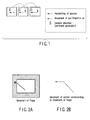
- a user must repeatedly input gestures of the same shape many times, as shown in FIG. 1 .
- a circular gesture disclosed in JP-A H9-230993 allows a user to continuously input commands an infinite number of times. However, since only two command types (i.e., clockwise and counterclockwise commands) are used, the circular gesture is unsuitable for inputting commands of three types or more.
- the present invention has been made in consideration of the above-described problems, and has as its object to allow a user to easily repeatedly input the same gesture without limiting the shape of a stroke representing the locus of a gesture or the repetitive number.
- a gesture determination apparatus includes a storage unit to store, for each gesture of a plurality of gestures, a feature of a locus necessary for determining the gesture and identification information of the gesture;
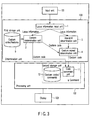
- FIG. 3 shows a portable information terminal apparatus such as a PDA or a tablet PC operated by a finger or a pen.
- the portable information terminal apparatus shown in FIG. 3 roughly includes a determination unit 100, an input unit 101 such as a tablet or a touch panel having, for example, a position coordinate detection plane (e.g., tablet plane) for detecting time-series coordinate data representing the locus of a gesture by a pen or a finger, a processing unit 102 which receives the identification information (gesture code) of the gesture determined by the determination unit 100 and executes a command corresponding to the gesture code, and a display 103.
- a position coordinate detection plane e.g., tablet plane
- the determination unit 100 includes a locus information input unit 1, a gesture determination unit 2, a standstill determination unit 3, a gesture repeat determination unit 4, and a first storage unit 5.
- the input unit 101 detects coordinate data in time sequence (i.e., time-series coordinate data representing the locus (stroke or handwriting) of a gesture input by a user using a pen or a finger) and inputs the data to the locus information input unit 1 of the determination unit 100.
- coordinate data in time sequence i.e., time-series coordinate data representing the locus (stroke or handwriting) of a gesture input by a user using a pen or a finger
- the input unit 101 detects, for example, a point coordinate representing the handwriting of a pen or a finger on the tablet at a predetermined time interval and inputs the point coordinate to the locus information input unit 1 of the determination unit 100.
- Coordinate data representing a handwriting can be expressed as time-series data given by
- Pi is a writing point on the coordinate input plane of the input unit 101
- X[i] and Y[i] are the X- and Y-coordinates of Pi.
- the locus i.e., the handwriting (stroke) of a gesture
- stroke is represented by strokes at a predetermined interval.
- Each point coordinate represents the position of a pen point or a fingertip at each time.
- the positive direction of Y-coordinates is set downward, and the positive direction of X-coordinates is set rightward.
- the input unit 101 detects the coordinates of writing points representing the locus of a gesture by a pen point or a fingertip and inputs them to the locus information input unit 1 at a predetermined time interval (step S101).
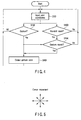
- the gesture determination unit 2 determines, based on features such as the direction, length, and shape of the input locus (input stroke) formed from the input writing point and previously input writing points, whether the input stroke indicates a gesture (step S102). Upon determining that the input stroke indicates a gesture, the gesture determination unit 2 outputs identification information representing the type of the gesture (i.e., a gesture code) to the processing unit 102 (step S105). The determination result of the gesture determination unit 2 is also output to the gesture repeat determination unit 4 at the time interval of writing point coordinate input. Even when the gesture determination unit 2 determines that the input stroke does not indicate a gesture, information representing the gesture can be output to the gesture repeat determination unit 4.
- identification information representing the type of the gesture i.e., a gesture code
- the first storage unit 5 stores, for each of a plurality of different gestures,' features of an input stroke (e.g., the conditions of the direction, length, and shape of an input stroke) necessary for determining the gesture, and identification information (gesture code) of the gesture.
- features of an input stroke e.g., the conditions of the direction, length, and shape of an input stroke
- identification information gesture code
- the gesture determination unit 2 Every time a writing point is input, the gesture determination unit 2 compares the direction, length, and shape of the input stroke formed from the input writing point and previously input writing points with the features of each gesture stored in the first storage unit 5, thereby checking whether the input stroke satisfies the features of any one of the gestures. When the input stroke satisfies the features of any one of the gestures stored in the first storage unit 5, the gesture determination unit 2 determines that the input stroke indicates the gesture and outputs the code of the gesture.
- the standstill determination unit 3 Every time the coordinates of a writing point are input at a predetermined time interval, the standstill determination unit 3 also determines whether the input stroke is in a standstill state at the input time (step S103).
- the standstill state indicates a state in which an input writing point is standing still within a predetermined distance for a predetermined time (T) or more.
- the gesture repeat determination unit 4 determines, based on the determination result of the standstill determination unit 3 and that of the gesture determination unit 2, whether repeat of the gesture determined by the gesture determination unit 2 before the current time is instructed. More specifically, when the input stroke is in the standstill state, and the gesture determination unit 2 has already determined the gesture before the input time, the gesture repeat determination unit 4 determines to repeat the last one of the plurality of gestures determined by the gesture determination unit 2 before the input time (step S104).
- step S104 the process advances to step S105 to output, to the processing unit 102, the identification information (gesture code) of the last one of the plurality of gestures determined by the gesture determination unit 2 before the input time.
- steps S101 to S105 is executed every time the coordinates of a writing point are input to the locus information input unit 1.
- FIG. 5 shows the loci (strokes) of eight gestures corresponding to the cursor moving operations in the eight directions. Each of the cursor moving operations in the eight directions is assigned to a gesture for drawing a locus in a required cursor moving direction.
- a time i is expressed as the number of a writing point detected at a predetermined time interval after the touch of the pen point or fingertip on the position coordinate detection plane of the input unit 101 is detected until the pen point or fingertip is moved off.
- step S5 The process advances to step S5 to obtain differences Dx and Dy of the X- and Y-coordinates of the input stroke from the starting point (X 0 ,Y 0 ) to the input writing point Pi(X[i],Y[i]).
- Dx X i - X 0
- Dy Y i - Y 0
- step S6 If Dx and Dy satisfy the features of any one of the gestures stored in the first storage unit 5, and the input stroke is determined as a gesture, the identification information of the gesture is output to the processing unit 102 and the gesture repeat determination unit 4 as the gesture determination result at the time i. Then, the process advances to step S8.
- the input stroke is not determined as a gesture at the time i, and the process advances to step S7.
- the gesture determination result representing that the input stroke is not determined as a gesture at the time i may be output to the gesture repeat determination unit 4.
- step S6 Since the current time i is "1", and the input stroke is not determined as a gesture, the process advances from step S6 to step S7.
- the process advances to step S3.
- step S3, the time i is "2".
- step S5 The process advances to step S5 to obtain the differences Dx and Dy of the X- and Y-coordinates of the input stroke from the starting point (X 0 ,Y 0 ) to the writing point P2.
- step S6 If the input stroke is not determined as a gesture based on Dx and Dy, the process advances to step S7. Then, steps S2 to S6 are repeated.
- a writing point Pk(X[k],Y[k]) is input (steps S1 and S2).
- step S6 it is checked whether Dx and Dy satisfy the features of any one of the gestures stored in the first storage unit 5.
- the first storage unit 5 stores, in advance, the features such as the direction and length of an input stroke (the conditions of an input stroke) necessary for determining the gesture in correspondence with each of the following gestures.
- H is a predetermined threshold value for gesture determination. The gesture is given by
- step S6 Dx and Dy of the input stroke from the starting point (X 0 ,Y 0 ) to the writing point Pk are compared with the conditions corresponding to the respective gestures stored in the first storage unit 5, and a gesture whose conditions are satisfied by Dx and Dy of the input stroke are searched for.
- the input stroke is determined as the gesture.
- the identification information of the gesture is output to the processing unit 102 and the gesture repeat determination unit 4 as the gesture determination result at time k. Then, the process advances to step S8.
- Dx and Dy of the input stroke satisfy the conditions of a plurality of gestures, one of the plurality of gestures, whose conditions have the highest satisfaction level for Dx and Dy of the input stroke, is selected and obtained as the determination result. For example, in the above conditions, a gesture whose left-hand side has the maximum value is selected.
- steps S2 to S8 is repeated every time the writing point Pi is input at a predetermined time interval until the pen point or fingertip moves off the input plane to finish the input of one stroke.
- step S1 When the pen point or fingertip has moved off the input plane to finish the input of one stroke, the touch of the pen point or fingertip on the input plane of the input unit 101 is detected again, and the input of other stroke starts, the process starts from step S1.
- the gesture repeat determination process (steps S103, S104, and S105 in FIG. 4 ) executed by the standstill determination unit 3 and the gesture repeat determination unit 4 will be described next with reference to FIG. 7 .
- the standstill determination unit 3 determines whether the handwriting is in the standstill state at the input time. More specifically, when the writing point Pi is input via the locus information input unit 1 at the time i (step S11), the standstill determination unit 3 determines whether the handwriting is in the standstill state at the input time i (step S12).
- the standstill determination unit 3 determines that the handwriting is in the standstill state at the time i under a condition that
- the coordinates of the writing point are within a predetermined distance from a time i-T to the time i. That is,
- the standstill determination unit 3 determines that the handwriting is in the standstill state at the time i.
- Sx and Sy are x- and y-direction threshold values for determining the standstill state
- T is a predetermined time for determining the standstill state (i.e., a standstill time).
- step S12 determines in step S12 that the handwriting is in the standstill state at the time i. If the standstill determination unit 3 determines in step S12 that the handwriting is in the standstill state at the time i, the process advances to step S13. Otherwise (if the above condition is not satisfied), the process returns to step S11 to execute the process of the next writing point.
- step S13 the gesture repeat determination unit 4 determines, using the standstill determination result of the standstill determination unit 3 and the gesture determination result of the gesture determination unit 2, whether repeat of the gesture is instructed at the time i (i.e., whether to repeat the gesture).
- Gesture repeat indicates regarding an input stroke as the same gesture as that determined immediately before and outputting the gesture code of the gesture.
- the gesture repeat determination unit 4 determines to execute gesture repeat by repeating the last one of the plurality of gestures determined by the gesture determination unit 2 before the time i. That is to say, the gesture repeat determination unit 4 determines the repeat of the gesture which is determined immediately before the standstill state is determined by the standstill determination unit 3.
- step S13 determines in step S13 to execute gesture repeat at the time i
- the process advances to step S14 to output, to the processing unit 102, the identification information (gesture code) of the last one of the plurality of gestures determined by the gesture determination unit 2 before the time i.
- a gesture repeat determination area may be provided on the position coordinate detection plane (handwriting input area) such as the tablet plane of the locus information input unit 1, as shown in FIG. 9 .
- the gesture repeat determination area is provided at the peripheral portion (hatched portion in FIG. 9 ) of the position coordinate detection plane.
- the gesture repeat determination area may be provided at the center of the position coordinate detection plane, at the peripheral portions of the left and right sides, at the peripheral portion of the upper side, or at the peripheral portion of the lower side.
- the gesture repeat determination area can be provided at any part of the position coordinate detection plane.
- the gesture repeat determination area determines gesture repeat at the time i, in addition to the above-described gesture repeat determination conditions (i.e., (gesture repeat determination condition 1) and (gesture repeat determination condition 2), the third gesture repeat determination condition that the coordinates of all writing points input from the time i-T to the time i, or some of them (e.g., writing points input at the time i) are within the gesture repeat determination area is necessary. More specifically, the following (gesture repeat determination condition 3) is added.
- a writing point stands still in a small area for a predetermined time (standstill time T) or more not only for gesture repeat but also due to simple hesitation in writing.
- the gesture repeat determination unit can accurately determine whether the standstill state has occurred for gesture repeat or due to simple hesitation in writing.
- a code conversion unit 11 of the processing unit 102 converts the gesture code output from the gesture determination unit 2 or the gesture repeat determination unit 4 of the determination unit 100 into a command corresponding to the gesture code.
- a second storage unit 12 of the processing unit 102 stores gesture codes and the corresponding commands to be related to each other as shown in FIG. 10 .
- the code conversion unit 11 searches the second storage unit 12 for a command corresponding to the gesture code output from the determination unit 100 and outputs the obtained command in the processing unit 102.
- the processing unit 102 displays a process result based on the command on the display 103. As a result, when the determination unit 100 outputs a gesture code indicating, for example, "up gesture", the cursor displayed on the display 103 moves up on the screen.
- gesture repeat If an upper left gesture is continuously determined, and then, gesture repeat is determined, the cursor displayed on the display 103 moves toward the upper left corner on the screen continuously during that time.
- the determination unit 100 may include the code conversion unit 11 and the second storage unit 12 so that the code conversion unit 11 converts the gesture code output from the gesture determination unit 2 or the gesture repeat determination unit 4 into a command and outputs the command to the processing unit 102.
- the gesture determination unit 2 compares the feature amount of the input locus (input stroke) formed from the input point coordinates and previously input point coordinates with the features of each gesture locus stored in the first storage unit 5. When the feature amount of the input locus satisfies the features of any one locus of the plurality of gestures stored in the first storage unit 5, the gesture is determined as a gesture corresponding to the input locus, and the identification information of the gesture is output.
- the standstill determination unit 3 determines whether a standstill state has occurred, in which a plurality of point coordinates including the input point coordinates and those which are input from the time of the point coordinate input to a predetermined time are standing still within a predetermined distance.
- the gesture repeat determination unit 4 determines to repeat the gesture (gesture repeat) and outputs the identification information of the gesture.
- the gesture can be determined at a plurality of stages halfway in the stroke. It is therefore possible to input (identical or a plurality of different) gestures a plurality of number of times continuously during the writing of one stroke. Hence, identical or a plurality of different commands can be input continuously. Additionally, when the writing point is made to stand still at one point for a predetermined time (standstill time T), a command corresponding to the gesture determined immediately before can be input repeatedly many times (during the time when the writing point is standing still).
- a gesture repeat function of allowing a user to easily continuously repeatedly instruct an operation (command) such as cursor movement or one character deletion which is often performed continuously.
- the features of the locus of each gesture stored in the first storage means include the conditions of the direction, length, and the like of an input stroke necessary for determining a gesture.
- the present invention is not limited to this, and an input stroke pattern may be used.
- the shape of a stroke is not limited, and a gesture can be determined from a stroke independently of the shape thereof.
- a gesture can be determined even at a plurality of stages during a stroke.
- a gesture can be recognized independently of the shape thereof if point coordinates representing the locus can be acquired at a predetermined time interval.
- the writing point is made to stand still at one point for a predetermined time (standstill time T).
- standstill time T a predetermined time
- the method of the present invention (the functions of the units of the determination unit 100) described in the embodiment of the present invention can be stored in a computer readable medium such as a magnetic disk (e.g., flexible disk or hard disk), an optical disk (e.g., CD-ROM or DVD), or a semiconductor memory and distributed as a program to be executed by a computer.
- a computer readable medium such as a magnetic disk (e.g., flexible disk or hard disk), an optical disk (e.g., CD-ROM or DVD), or a semiconductor memory and distributed as a program to be executed by a computer.
Landscapes
- Engineering & Computer Science (AREA)
- General Engineering & Computer Science (AREA)
- Theoretical Computer Science (AREA)
- Human Computer Interaction (AREA)
- Physics & Mathematics (AREA)
- General Physics & Mathematics (AREA)
- User Interface Of Digital Computer (AREA)
- Image Analysis (AREA)
- Position Input By Displaying (AREA)
Applications Claiming Priority (1)
| Application Number | Priority Date | Filing Date | Title |
|---|---|---|---|
| JP2007261273A JP2009093291A (ja) | 2007-10-04 | 2007-10-04 | ジェスチャー判定装置及び方法 |
Publications (2)
| Publication Number | Publication Date |
|---|---|
| EP2045699A2 true EP2045699A2 (fr) | 2009-04-08 |
| EP2045699A3 EP2045699A3 (fr) | 2012-05-30 |
Family
ID=40260438
Family Applications (1)
| Application Number | Title | Priority Date | Filing Date |
|---|---|---|---|
| EP08016628A Withdrawn EP2045699A3 (fr) | 2007-10-04 | 2008-09-22 | Appareil et procédé de détermination de geste |
Country Status (4)
| Country | Link |
|---|---|
| US (1) | US20090090567A1 (fr) |
| EP (1) | EP2045699A3 (fr) |
| JP (1) | JP2009093291A (fr) |
| CN (1) | CN101408814A (fr) |
Cited By (3)
| Publication number | Priority date | Publication date | Assignee | Title |
|---|---|---|---|---|
| EP2590054A1 (fr) * | 2011-11-07 | 2013-05-08 | Samsung Electronics Co., Ltd. | Appareil électronique et procédé pour commander l'appareil électronique à l'aide de la reconnaissance et de la reconnaissance de mouvement |
| WO2013152782A1 (fr) * | 2012-04-12 | 2013-10-17 | Siemens Enterprise Communications Gmbh & Co. Kg | Procédé pour influencer la représentation d'une information image affichée sur un dispositif d'affichage d'un appareil de technologie de l'information |
| US9513711B2 (en) | 2011-01-06 | 2016-12-06 | Samsung Electronics Co., Ltd. | Electronic device controlled by a motion and controlling method thereof using different motions to activate voice versus motion recognition |
Families Citing this family (29)
| Publication number | Priority date | Publication date | Assignee | Title |
|---|---|---|---|---|
| US8302033B2 (en) * | 2007-06-22 | 2012-10-30 | Apple Inc. | Touch screen device, method, and graphical user interface for providing maps, directions, and location-based information |
| US8327272B2 (en) | 2008-01-06 | 2012-12-04 | Apple Inc. | Portable multifunction device, method, and graphical user interface for viewing and managing electronic calendars |
| KR101496844B1 (ko) * | 2008-07-28 | 2015-02-27 | 삼성디스플레이 주식회사 | 터치 스크린 표시 장치 및 그 구동 방법 |
| US9501694B2 (en) * | 2008-11-24 | 2016-11-22 | Qualcomm Incorporated | Pictorial methods for application selection and activation |
| KR20100114572A (ko) * | 2009-04-16 | 2010-10-26 | 삼성전자주식회사 | 터치스크린을 구비한 단말기의 컨텐츠 표시 방법 및 장치 |
| KR101094636B1 (ko) | 2009-05-21 | 2011-12-20 | 팅크웨어(주) | 제스처 기반 사용자 인터페이스 시스템 및 그 방법 |
| US8681106B2 (en) | 2009-06-07 | 2014-03-25 | Apple Inc. | Devices, methods, and graphical user interfaces for accessibility using a touch-sensitive surface |
| US20110019105A1 (en) * | 2009-07-27 | 2011-01-27 | Echostar Technologies L.L.C. | Verification of symbols received through a touchpad of a remote control device in an electronic system to allow access to system functions |
| KR20110021062A (ko) * | 2009-08-25 | 2011-03-04 | 삼성전자주식회사 | 컴퓨터시스템 및 그 제어방법 |
| JP5209795B2 (ja) * | 2009-09-09 | 2013-06-12 | シャープ株式会社 | ジェスチャー判定装置およびその方法 |
| US8862576B2 (en) | 2010-01-06 | 2014-10-14 | Apple Inc. | Device, method, and graphical user interface for mapping directions between search results |
| KR101114750B1 (ko) * | 2010-01-29 | 2012-03-05 | 주식회사 팬택 | 다차원 영상을 이용한 사용자 인터페이스 장치 |
| US8554280B2 (en) | 2010-03-23 | 2013-10-08 | Ebay Inc. | Free-form entries during payment processes |
| CN101853133B (zh) * | 2010-05-31 | 2013-03-20 | 中兴通讯股份有限公司 | 一种自动识别手势的方法及移动终端 |
| US8707195B2 (en) | 2010-06-07 | 2014-04-22 | Apple Inc. | Devices, methods, and graphical user interfaces for accessibility via a touch-sensitive surface |
| US8751971B2 (en) | 2011-06-05 | 2014-06-10 | Apple Inc. | Devices, methods, and graphical user interfaces for providing accessibility using a touch-sensitive surface |
| JP5701714B2 (ja) * | 2011-08-05 | 2015-04-15 | 株式会社東芝 | ジェスチャ認識装置、ジェスチャ認識方法およびジェスチャ認識プログラム |
| US8881269B2 (en) | 2012-03-31 | 2014-11-04 | Apple Inc. | Device, method, and graphical user interface for integrating recognition of handwriting gestures with a screen reader |
| JP5565886B2 (ja) * | 2012-08-17 | 2014-08-06 | Necシステムテクノロジー株式会社 | 入力装置、入力方法、及びプログラム |
| US20140118281A1 (en) | 2012-10-26 | 2014-05-01 | Cirque Corporation | DETERMINING WHAT INPUT TO ACCEPT BY A TOUCH SENSOR AFTER INTENTIONAL AND ACCIDENTAL LIFT-OFF and SLIDE-OFF WHEN GESTURING OR PERFORMING A FUNCTION |
| TW201443762A (zh) * | 2013-05-06 | 2014-11-16 | You-He Zhang | 多點觸控裝置的操作方法 |
| WO2015001622A1 (fr) * | 2013-07-02 | 2015-01-08 | 富士通株式会社 | Dispositif d'entrée, procédé de commande d'entrée et programme de commande d'entrée |
| CN103488296B (zh) * | 2013-09-25 | 2016-11-23 | 华为软件技术有限公司 | 体感交互手势控制方法及装置 |
| US20150169217A1 (en) * | 2013-12-16 | 2015-06-18 | Cirque Corporation | Configuring touchpad behavior through gestures |
| CN105342299B (zh) * | 2015-12-10 | 2017-06-09 | 成都小爱未来智慧科技有限公司 | 智能水杯的触控电路 |
| DK201670580A1 (en) | 2016-06-12 | 2018-01-02 | Apple Inc | Wrist-based tactile time feedback for non-sighted users |
| US10996761B2 (en) | 2019-06-01 | 2021-05-04 | Apple Inc. | User interfaces for non-visual output of time |
| CN110716648B (zh) * | 2019-10-22 | 2021-08-24 | 上海商汤智能科技有限公司 | 手势控制方法和装置 |
| EP4154096A1 (fr) | 2020-05-18 | 2023-03-29 | Apple Inc. | Interfaces utilisateur permettant de visualiser et d'affiner l'emplacement actuel d'un dispositif électronique |
Citations (3)
| Publication number | Priority date | Publication date | Assignee | Title |
|---|---|---|---|---|
| JPH09230993A (ja) | 1996-02-20 | 1997-09-05 | Sharp Corp | ジョグダイアルの模擬入力装置 |
| JP2002203208A (ja) | 2000-10-31 | 2002-07-19 | Toshiba Corp | オンライン文字認識装置及び方法並びにコンピュータ読み取り可能な記憶媒体及びオンライン文字認識プログラム |
| JP2004094964A (ja) | 1996-03-28 | 2004-03-25 | Synaptics Inc | カーソル移動方法 |
Family Cites Families (11)
| Publication number | Priority date | Publication date | Assignee | Title |
|---|---|---|---|---|
| JPS61235932A (ja) * | 1985-04-12 | 1986-10-21 | Ricoh Co Ltd | 情報処理装置 |
| US5327161A (en) * | 1989-08-09 | 1994-07-05 | Microtouch Systems, Inc. | System and method for emulating a mouse input device with a touchpad input device |
| JP3607440B2 (ja) * | 1996-12-03 | 2005-01-05 | 日本電気株式会社 | ジェスチャー認識方法 |
| KR100595926B1 (ko) * | 1998-01-26 | 2006-07-05 | 웨인 웨스터만 | 수동 입력 통합 방법 및 장치 |
| US9292111B2 (en) * | 1998-01-26 | 2016-03-22 | Apple Inc. | Gesturing with a multipoint sensing device |
| US20020015064A1 (en) * | 2000-08-07 | 2002-02-07 | Robotham John S. | Gesture-based user interface to multi-level and multi-modal sets of bit-maps |
| JP4261145B2 (ja) * | 2001-09-19 | 2009-04-30 | 株式会社リコー | 情報処理装置、情報処理装置の制御方法、その方法をコンピュータに実行させるためのプログラム |
| US7256773B2 (en) * | 2003-06-09 | 2007-08-14 | Microsoft Corporation | Detection of a dwell gesture by examining parameters associated with pen motion |
| US20060007174A1 (en) * | 2004-07-06 | 2006-01-12 | Chung-Yi Shen | Touch control method for a drag gesture and control module thereof |
| JP4658544B2 (ja) * | 2004-09-03 | 2011-03-23 | 任天堂株式会社 | ゲームプログラム、ゲーム装置、および入力装置 |
| JP4394062B2 (ja) * | 2005-10-28 | 2010-01-06 | アルプス電気株式会社 | パッド型入力装置 |
-
2007
- 2007-10-04 JP JP2007261273A patent/JP2009093291A/ja active Pending
-
2008
- 2008-09-18 US US12/233,433 patent/US20090090567A1/en not_active Abandoned
- 2008-09-22 EP EP08016628A patent/EP2045699A3/fr not_active Withdrawn
- 2008-10-06 CN CNA2008101786001A patent/CN101408814A/zh active Pending
Patent Citations (3)
| Publication number | Priority date | Publication date | Assignee | Title |
|---|---|---|---|---|
| JPH09230993A (ja) | 1996-02-20 | 1997-09-05 | Sharp Corp | ジョグダイアルの模擬入力装置 |
| JP2004094964A (ja) | 1996-03-28 | 2004-03-25 | Synaptics Inc | カーソル移動方法 |
| JP2002203208A (ja) | 2000-10-31 | 2002-07-19 | Toshiba Corp | オンライン文字認識装置及び方法並びにコンピュータ読み取り可能な記憶媒体及びオンライン文字認識プログラム |
Cited By (6)
| Publication number | Priority date | Publication date | Assignee | Title |
|---|---|---|---|---|
| US9513711B2 (en) | 2011-01-06 | 2016-12-06 | Samsung Electronics Co., Ltd. | Electronic device controlled by a motion and controlling method thereof using different motions to activate voice versus motion recognition |
| EP2590054A1 (fr) * | 2011-11-07 | 2013-05-08 | Samsung Electronics Co., Ltd. | Appareil électronique et procédé pour commander l'appareil électronique à l'aide de la reconnaissance et de la reconnaissance de mouvement |
| WO2013152782A1 (fr) * | 2012-04-12 | 2013-10-17 | Siemens Enterprise Communications Gmbh & Co. Kg | Procédé pour influencer la représentation d'une information image affichée sur un dispositif d'affichage d'un appareil de technologie de l'information |
| KR20140017497A (ko) * | 2012-04-12 | 2014-02-11 | 유니파이 게엠베하 운트 코. 카게 | 정보 기술 장비 피스의 디스플레이 디바이스 상에 디스플레이된 이미지 정보의 프리젠테이션에 영향을 미치기 위한 방법 |
| CN103765363A (zh) * | 2012-04-12 | 2014-04-30 | 统一有限责任两合公司 | 影响在信息技术设备的显示装置上显示的带有图像的信息的表示的方法 |
| CN103765363B (zh) * | 2012-04-12 | 2016-12-28 | 统一有限责任两合公司 | 影响带有图像的信息的表示的方法和设备 |
Also Published As
| Publication number | Publication date |
|---|---|
| JP2009093291A (ja) | 2009-04-30 |
| EP2045699A3 (fr) | 2012-05-30 |
| CN101408814A (zh) | 2009-04-15 |
| US20090090567A1 (en) | 2009-04-09 |
Similar Documents
| Publication | Publication Date | Title |
|---|---|---|
| EP2045699A2 (fr) | Appareil et procédé de détermination de geste | |
| US8600163B2 (en) | Handwriting determination apparatus and method and program | |
| KR100856203B1 (ko) | 지문 인식 센서를 이용한 사용자 입력 장치 및 방법 | |
| US8791900B2 (en) | Computing device notes | |
| US9069386B2 (en) | Gesture recognition device, method, program, and computer-readable medium upon which program is stored | |
| US7409090B2 (en) | Handwritten character input device and handwritten character input processing method | |
| JP6902234B2 (ja) | 文字列に文字を挿入するための方法および対応するデジタルデバイス | |
| JP5604279B2 (ja) | ジェスチャー認識装置、方法、プログラム、および該プログラムを格納したコンピュータ可読媒体 | |
| US7932895B2 (en) | Control of an electronic device using a gesture as an input | |
| US9329775B2 (en) | Figure drawing apparatus, figure drawing method and recording medium on which figure drawing programs are recorded | |
| EP3796145A1 (fr) | Procédé et dispositif correspondant pour sélectionner des objets graphiques | |
| US10416868B2 (en) | Method and system for character insertion in a character string | |
| WO2012086133A1 (fr) | Dispositif à panneau tactile | |
| KR101348763B1 (ko) | 손동작에 의한 인터페이스 조작 장치 및 방법, 그리고 컴퓨터로 읽을 수 있는 기록매체 | |
| US20100245266A1 (en) | Handwriting processing apparatus, computer program product, and method | |
| CN113031817B (zh) | 一种多点触控的手势识别方法及防误触方法 | |
| JP5480357B1 (ja) | 電子機器および方法 | |
| KR101436091B1 (ko) | 포인터의 연속 궤적에 의한 버튼 선택 장치 및 방법 | |
| JP5735126B2 (ja) | システムおよび筆跡検索方法 | |
| JPH06266494A (ja) | ペン入力方式の情報処理方法及び同装置 | |
| KR101984560B1 (ko) | 사용자 동작 반응형 디지털 지우개 및 이의 작동 방법 | |
| JP2994176B2 (ja) | 罫線入力装置 | |
| KR101784257B1 (ko) | 터치 기반 단말장치의 문서 편집 방법 및 그 장치 | |
| JP2000148322A (ja) | 文字入力方法及び装置並びに記憶媒体 |
Legal Events
| Date | Code | Title | Description |
|---|---|---|---|
| PUAI | Public reference made under article 153(3) epc to a published international application that has entered the european phase |
Free format text: ORIGINAL CODE: 0009012 |
|
| 17P | Request for examination filed |
Effective date: 20080922 |
|
| AK | Designated contracting states |
Kind code of ref document: A2 Designated state(s): AT BE BG CH CY CZ DE DK EE ES FI FR GB GR HR HU IE IS IT LI LT LU LV MC MT NL NO PL PT RO SE SI SK TR |
|
| AX | Request for extension of the european patent |
Extension state: AL BA MK RS |
|
| PUAL | Search report despatched |
Free format text: ORIGINAL CODE: 0009013 |
|
| AK | Designated contracting states |
Kind code of ref document: A3 Designated state(s): AT BE BG CH CY CZ DE DK EE ES FI FR GB GR HR HU IE IS IT LI LT LU LV MC MT NL NO PL PT RO SE SI SK TR |
|
| AX | Request for extension of the european patent |
Extension state: AL BA MK RS |
|
| RIC1 | Information provided on ipc code assigned before grant |
Ipc: G06F 3/048 20060101AFI20120426BHEP Ipc: G06F 3/01 20060101ALI20120426BHEP |
|
| AKX | Designation fees paid |
Designated state(s): DE FR GB |
|
| STAA | Information on the status of an ep patent application or granted ep patent |
Free format text: STATUS: THE APPLICATION IS DEEMED TO BE WITHDRAWN |
|
| 18D | Application deemed to be withdrawn |
Effective date: 20121201 |