EP2046046A1 - Verfahren zur Kodierung und Rekonstruktion von Bilddaten und Vorrichtungen zur Anwendung dieser Verfahren - Google Patents
Verfahren zur Kodierung und Rekonstruktion von Bilddaten und Vorrichtungen zur Anwendung dieser Verfahren Download PDFInfo
- Publication number
- EP2046046A1 EP2046046A1 EP07301424A EP07301424A EP2046046A1 EP 2046046 A1 EP2046046 A1 EP 2046046A1 EP 07301424 A EP07301424 A EP 07301424A EP 07301424 A EP07301424 A EP 07301424A EP 2046046 A1 EP2046046 A1 EP 2046046A1
- Authority
- EP
- European Patent Office
- Prior art keywords
- data
- block
- image data
- sampling
- image
- Prior art date
- Legal status (The legal status is an assumption and is not a legal conclusion. Google has not performed a legal analysis and makes no representation as to the accuracy of the status listed.)
- Withdrawn
Links
- 238000000034 method Methods 0.000 title claims abstract description 74
- 238000005070 sampling Methods 0.000 claims abstract description 90
- 230000001131 transforming effect Effects 0.000 claims abstract description 23
- 230000000875 corresponding effect Effects 0.000 description 24
- 238000005259 measurement Methods 0.000 description 9
- 238000013139 quantization Methods 0.000 description 9
- 239000013598 vector Substances 0.000 description 8
- 238000005457 optimization Methods 0.000 description 7
- 230000005540 biological transmission Effects 0.000 description 4
- 239000011159 matrix material Substances 0.000 description 4
- 238000011084 recovery Methods 0.000 description 3
- 230000002123 temporal effect Effects 0.000 description 3
- 230000003044 adaptive effect Effects 0.000 description 1
- 230000002596 correlated effect Effects 0.000 description 1
- 230000000694 effects Effects 0.000 description 1
- 230000000153 supplemental effect Effects 0.000 description 1
Images


Classifications
-
- H—ELECTRICITY
- H04—ELECTRIC COMMUNICATION TECHNIQUE
- H04N—PICTORIAL COMMUNICATION, e.g. TELEVISION
- H04N19/00—Methods or arrangements for coding, decoding, compressing or decompressing digital video signals
- H04N19/50—Methods or arrangements for coding, decoding, compressing or decompressing digital video signals using predictive coding
- H04N19/59—Methods or arrangements for coding, decoding, compressing or decompressing digital video signals using predictive coding involving spatial sub-sampling or interpolation, e.g. alteration of picture size or resolution
-
- H—ELECTRICITY
- H04—ELECTRIC COMMUNICATION TECHNIQUE
- H04N—PICTORIAL COMMUNICATION, e.g. TELEVISION
- H04N19/00—Methods or arrangements for coding, decoding, compressing or decompressing digital video signals
- H04N19/30—Methods or arrangements for coding, decoding, compressing or decompressing digital video signals using hierarchical techniques, e.g. scalability
- H04N19/39—Methods or arrangements for coding, decoding, compressing or decompressing digital video signals using hierarchical techniques, e.g. scalability involving multiple description coding [MDC], i.e. with separate layers being structured as independently decodable descriptions of input picture data
-
- H—ELECTRICITY
- H04—ELECTRIC COMMUNICATION TECHNIQUE
- H04N—PICTORIAL COMMUNICATION, e.g. TELEVISION
- H04N19/00—Methods or arrangements for coding, decoding, compressing or decompressing digital video signals
- H04N19/48—Methods or arrangements for coding, decoding, compressing or decompressing digital video signals using compressed domain processing techniques other than decoding, e.g. modification of transform coefficients, variable length coding [VLC] data or run-length data
-
- H—ELECTRICITY
- H04—ELECTRIC COMMUNICATION TECHNIQUE
- H04N—PICTORIAL COMMUNICATION, e.g. TELEVISION
- H04N19/00—Methods or arrangements for coding, decoding, compressing or decompressing digital video signals
- H04N19/60—Methods or arrangements for coding, decoding, compressing or decompressing digital video signals using transform coding
-
- H—ELECTRICITY
- H04—ELECTRIC COMMUNICATION TECHNIQUE
- H04N—PICTORIAL COMMUNICATION, e.g. TELEVISION
- H04N19/00—Methods or arrangements for coding, decoding, compressing or decompressing digital video signals
- H04N19/90—Methods or arrangements for coding, decoding, compressing or decompressing digital video signals using coding techniques not provided for in groups H04N19/10-H04N19/85, e.g. fractals
- H04N19/97—Matching pursuit coding
Definitions
- the invention belongs to video/image coding domain. Specifically, the present invention relates to a coding method and a coding device. It also relates to a method for reconstructing image data and a decoder implementing the reconstructing method.
- MDC Multiple description coding
- a typical multiple description (MD) encoder generates more than one descriptions of a video sequence, and each description is individually packetized and sent through either the same or separate physical channels.
- the decoder can reconstruct the signal in an acceptable quality without receiving all the descriptions. Normally, the more descriptions are received, the better quality can be provided.
- a first MDC encoding method consists in directly decomposing the original image/video sequence into two or more sub-image/sub-videos either in the spatial, temporal, or frequency domain. Each subset is then compressed separately and corresponds to a specific description.
- a second MDC method generates different description by exploiting its quantization process.
- the output of a quantizer is assigned two indexes, one for each description.
- the decoder estimates the reconstructed signal based on the received index(es).
- a third MDC method uses a correlated transform, which introduces a controlled amount of redundancy between two sets of coefficients.
- a correlated transform which introduces a controlled amount of redundancy between two sets of coefficients.
- the fourth MDC method applies unequal cross-packet forward error correction (FEC) to different parts of a scalable bitstream, instead of designing the source encoder to yield multiple descriptions directly.
- FEC forward error correction
- the invention concerns an encoding method that is an alternative to the above methods providing similar effects.
- the invention concerns a method for coding a block of N image data with N a positive integer comprising the step of :
- the sampling step and the quantizing step are interchanged.
- the transforming step is preceded by a step of computing a mean value of the N image data and a step of subtracting the mean value from each of the N image data.
- the transforming step applies on the N image data after the subtracting step and the mean value is encoded within each stream during the coding step.
- the invention further relates to a method of reconstructing a block of N image data arising in the form of p streams of binary data comprising the steps of:
- the method of reconstructing a block of N image data arising in the form of p streams of binary data comprising the steps of:
- the method of reconstructing a block of N image data arising in the form of p streams of binary data comprising the steps of:
- the method of N image data arising in the form of p streams of binary data comprising the steps of:
- the invention further relates to an encoder comprising:
- the invention further relates to a decoder comprising:
- the invention further relates to a binary stream representative of an image or a coded video sequence made of blocks of pixels encoded according to the method of the invention comprising at least one binary data indicating for a block, a group of blocks, an image or a group of images the sampling pattern used to encode the block, the group of blocks, the image or the group of images respectively.
- the compressed sensing method which is also named as compressive sampling, can capture and represent compressible signals at a rate significantly below the Nyquist rate. It employs non-adaptive linear projections that preserve the structure of the signal. The signal is then reconstructed from these projections using an optimization process.
- x and s are N ⁇ 1 column vectors
- ⁇ [ ⁇ 1
- x and s are equivalent representations of the signal, with x in the time or space domain and s in the ⁇ domain.
- the signal x is K -sparse, if it is a linear combination of only K basis vectors, i.e.
- Equation (1) only K of the s i coefficients in equation (1) are nonzero and ( N-K ) are zero.
- the signal x is compressible if the representation (1) has just a few large coefficients and many small coefficients; i.e. if K ⁇ N .
- ⁇ is the transform
- s is in the frequency domain.
- the K largest coefficients are kept while the ( N-K ) smallest coefficients are discarded.
- ⁇ s ⁇ 1 ⁇
- . If some error is permitted, then the following constrained optimization problem has to be solved instead of those of equation (3): s ⁇ arg min ⁇ ⁇ s ⁇ 1 such that ⁇ ⁇ S - y ⁇ ⁇ ⁇ If the signal is a 2D image of size nxn, then the sparsed signal s can also be the gradient.
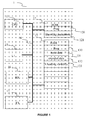
- Figure 1 represents an exemplary architecture of an encoder 1 according to the invention.
- Encoder 1 comprises the following elements that are linked together by a data and address bus 14:
- the word « register » used in the specification can correspond to area of small capacity (some bits) or to very large area (e.g. a whole program or large amount of received or decoded data).
- ROM 12 comprises:
- Algorithm of the encoding method according to the invention are stored in the ROM 12.
- the CPU 11 When switched on, the CPU 11 uploads the program 120 in the RAM and executes the corresponding instructions.
- RAM 13 comprises:
- the digital part of the encoder 1 is implemented in pure hardware configuration (e.g. in one or several FPGA, ASIC or VLSI with corresponding memory) or in a configuration using both VLSI and DSP.
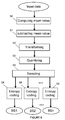
- Figure 2 discloses an encoding method according to a first embodiment of the invention.
- the represented boxes are purely functional entities, which do not necessarily correspond to physical separated entities. Namely, they could be developed in the form of software, or be implemented in one or several integrated circuits.
- the method may be embodied in a computer readable medium and executable by a computer. Therefore, according to the invention, s is the K -sparse data in the spatial domain or the data after temporal or spatial prediction.
- ⁇ is the normal DCT transform, and ⁇ is the additional sampling in the frequency domain.
- the input data are transformed in transformed data using for example the DCT transform or the integer transform in the H.264/AVC.
- the image is divided into non overlapping blocks of pixels.
- the input data can be the pixels' values (luminance, chrominance) of a block of image in the spatial domain, or the pixel values of the block after prediction.
- Such a prediction may occurs in the spatial domain and is named intra prediction or in the temporal domain and is called inter prediction.
- the transformed data are quantized using same or similar quantization method as the existing quantization method of H.264/AVC, H.263, or MPEG-2 (see for example section 7.4 of document ISO/IEC 13818-2:2000).
- the quantized data are sampled into q sets of M quantized data with q and M positive integers. Each set forms a description of the input data.
- predefined non overlapping sampling patterns are used. These sampling patterns are predefined such that the sampling step is random or pseudo-random. For example, if two sampling patterns are used, they may be defined as follows:
- each set of data is encoded separately in a stream of binary data (denoted BS 1 , BS 2 , ..., BSq respectively) using any of existing or future entropy coding methods to further remove the redundancy in the statistic domain.
- the encoding method of MPEG2 may be used (see for example section 7.2 of document ISO/IEC 13818-2:2000).
- Each stream may then be transmitted over a channel to a corresponding decoder implementing the decoding method according to the invention. All streams are sent either on the same physical channel or on separate channel.
- Figure 5 discloses an encoding method according to a second embodiment of the invention.
- step S2 is preceded by a step S0 of computing the mean value of the input data and a step S1 of subtracting the computed mean value from each of the input data.
- step S0 of computing the mean value of the input data
- step S1 of subtracting the computed mean value from each of the input data.
- block B is defined as follows: 0 0 32 - 32 0 0 0 0 0 0 0 0 0 0 0 0 0 0 0 0 0 0 0 0 0 0 0 0 0 0 0 0 0 0 0 0 0 0 0 0 0 0 0 0 0 0 0 0 0 0 0 0 0 0 0 0 0 0 0 0 0 0 0 0 0 0 0 0 0 0 0 0 0 0 0 0 0 -8 / -10 4 / 1 / / -2 -8 4 -7 / / / -1 / 7 / / 4 / 2 where the sign "/" means that the corresponding quantized data is not sampled, then
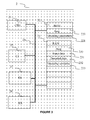
- Figure 3 represents an exemplary architecture of a decoder 2 according to the invention.
- the decoder 2 can be any decoder adapted to reconstruct data that are coded by the encoder 1.
- the decoder is adapted to take into account the specificities of the encoder 1 and especially the sampling step.
- Decoder 2 comprises the following elements that are linked together by a data and address bus 24:
- ROM 22 comprises:
- Algorithm of the decoding method according to the invention are stored in the ROM 22.
- the CPU 21 uploads the program 220 in the RAM and executes the corresponding instructions.
- RAM 23 comprises:
- the digital part of the decoder 2 is implemented in pure hardware configuration (e.g. in one or several FPGA, ASIC or VLSI with corresponding memory) or in a configuration using both VLSI and DSP.
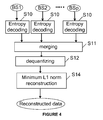
- Figure 4 discloses a decoding method according to a specific embodiment of the invention.
- the represented boxes are purely functional entities, which do not necessarily correspond to physical separated entities. Namely, they could be developed in the form of software, or be implemented in one or several integrated circuits.
- the method may be embodied in a computer readable medium and executable by a computer.
- the method takes as input p streams representing image data encoded according to one of the previous embodiments, where p is a positive integer that is inferior or equal to q. Indeed, it happens that some of the q streams generated by the encoder are lost totally or partially during their transmission.
- each of the p streams is decoded in M decoded data using the inverse process of step S8. Since p ⁇ q, then M*p ⁇ N.
- Each of the p sampling patterns used at step S6 by the encoding method to generate the p input streams are also determined on the basis of the at least one bit inserted, at step S8, by the encoder in each of the p streams.
- the p sets of M decoded data are possibly merged into a single block of n by n pixels taking into account the predefined sampling patterns determined at step S10. If p ⁇ q, then some of the decoded data in the block are missing. Such a merging is not explicitly required.
- step S14 N reconstructed data are obtained after the minimum I 1 norm reconstruction.
- step 14 consists in determining N image data, so that the sum of absolute values of said N image data is minimum and so that the N data after being processed according to the following steps equal to the P dequantized data obtained at step S12:
- the minimum I 1 norm reconstruction can use the linear programming (LP) or the second-order cone programming (SOCP), according to different optimization models.
- the LPs are solved using a generic path-following primal-dual method, and the SOCPs are solved with a generic log-barrier algorithm.
- Such an algorithm is described in the document from E. Candes, J. Romberg, and T. Tao, entitled “Robust uncertainty principles: Exact signal reconstruction from highly incomplete frequency information," and published in IEEE Trans. on Information Theory, vol.52, no.2, Feb. 2006 .
- Figure 6 discloses a decoding method according to another specific embodiment of the invention.
- the steps identical to those depicted on figure 4 are identified with the same numerical references and are not described further.
- one mean value is decoded from any of the p input streams.
- the same mean value is encoded within each of the q streams. Therefore, at steps S10, it is only necessary to decode the mean value once from one of the p input streams.
- the step S14 is followed by a step S15 of adding the decoded mean value to each reconstructed image data.
- An example of reconstruction of the input block B from the streams generated when encoding set n°1 and set n°2 with the encoding method of the invention (second embodiment). Let's suppose that only the first stream BS 1 is received. The binary data are then entropy decoded at step S10 into the following 8 decoded data: 0; -1; -8; -2; -8; 7; -10; 4.
- the data obtained at step 10 may be placed in the correct position within the block which is therefore the following: 0 / / / / -8 / -10 / -2 -8 4 -1 / 7 / In this case each missing data is replaced by a zero value.
- step S12 of inverse quantization the block is the following: 0 / / / / -16 / -20 / -4 -16 8 -2 / 14 /
- step S14 the reconstructed data are the following: 0 -1 32 -31 0 0 0 0 0 -1 -1 1 0 0 0 0 0
- the block is the following: 128 127 160 97 128 128 128 128 128 127 127 129 128 128 128 128 128 128 Even with a single stream instead of two streams the block is precisely reconstructed even if not perfectly.
- the reconstructed data are the following: 123 128 137 118 130 127 126 129 130 126 127 130 131 123 134 129 This block is quite different from the original input block. Indeed in this case many important high frequencies are lost.
- the step S6 of the encoding method is preceded by a step for determining the sampling patterns used at step S6.
- each sampling pattern is encoded at step S8 and is transmitted within the stream representing the data sampled according to it.
- the sampling patterns need not to be known at the decoder side and the bit(s) identifying the sampling pattern need not to be transmitted.
- Such sampling patterns may be encoded using SEI messages (Supplemental Enhancement Information) as those defined in H.264.
- the method of reconstruction is further adapted to reconstruct the sampling patterns encoded in each received stream.
- the reconstructed sampling patterns are then used to reconstruct the input data at the decoder side.
- the invention further relates to a binary stream comprising binary data making it possible to identify the sampling pattern used to generate it.
- the binary data may be encoded for each block, for each group of blocks (i.e. slice), for each picture or for each group of pictures.
- the binary stream further comprises binary data indicating the number of descriptions, i.e. the number q of streams, transmitted by the encoding method/encoder 1 according to the invention.
- Such an encoding method is particularly suitable for real-time applications such as live video broadcasting and video conferencing, for which low delay is required and retransmission is often not acceptable.
- MDC is also helpful for peer-to-peer (P2P) video application since MDC enables that different descriptions can be sent from different peers without preference.
Landscapes
- Engineering & Computer Science (AREA)
- Multimedia (AREA)
- Signal Processing (AREA)
- Compression Or Coding Systems Of Tv Signals (AREA)
Priority Applications (2)
| Application Number | Priority Date | Filing Date | Title |
|---|---|---|---|
| EP07301424A EP2046046A1 (de) | 2007-10-02 | 2007-10-02 | Verfahren zur Kodierung und Rekonstruktion von Bilddaten und Vorrichtungen zur Anwendung dieser Verfahren |
| PCT/EP2008/063164 WO2009043881A1 (en) | 2007-10-02 | 2008-10-01 | Methods of encoding and reconstructing image data and devices implementing said methods |
Applications Claiming Priority (1)
| Application Number | Priority Date | Filing Date | Title |
|---|---|---|---|
| EP07301424A EP2046046A1 (de) | 2007-10-02 | 2007-10-02 | Verfahren zur Kodierung und Rekonstruktion von Bilddaten und Vorrichtungen zur Anwendung dieser Verfahren |
Publications (1)
| Publication Number | Publication Date |
|---|---|
| EP2046046A1 true EP2046046A1 (de) | 2009-04-08 |
Family
ID=39810160
Family Applications (1)
| Application Number | Title | Priority Date | Filing Date |
|---|---|---|---|
| EP07301424A Withdrawn EP2046046A1 (de) | 2007-10-02 | 2007-10-02 | Verfahren zur Kodierung und Rekonstruktion von Bilddaten und Vorrichtungen zur Anwendung dieser Verfahren |
Country Status (2)
| Country | Link |
|---|---|
| EP (1) | EP2046046A1 (de) |
| WO (1) | WO2009043881A1 (de) |
Citations (5)
| Publication number | Priority date | Publication date | Assignee | Title |
|---|---|---|---|---|
| EP0584741A2 (de) * | 1992-08-21 | 1994-03-02 | Fuji Xerox Co., Ltd. | Vorrichtung zur Bildsignalkodierung |
| DE19944301A1 (de) * | 1999-09-15 | 2001-04-05 | Siemens Ag | Verfahren und Anordnung zur Bearbeitung bzw. inversen Bearbeitung zumindest eines Teils eines Bildes sowie Computerprogramm-Erzeugnisse und Computerlesbares Speichermedium |
| WO2004046879A2 (en) * | 2002-11-15 | 2004-06-03 | Qualcomm Incorporated | Apparatus and method for multiple description encoding |
| US20060038705A1 (en) * | 2004-07-20 | 2006-02-23 | Brady David J | Compressive sampling and signal inference |
| WO2006122146A2 (en) * | 2005-05-10 | 2006-11-16 | William Marsh Rice University | Method and apparatus for distributed compressed sensing |
-
2007
- 2007-10-02 EP EP07301424A patent/EP2046046A1/de not_active Withdrawn
-
2008
- 2008-10-01 WO PCT/EP2008/063164 patent/WO2009043881A1/en not_active Ceased
Patent Citations (5)
| Publication number | Priority date | Publication date | Assignee | Title |
|---|---|---|---|---|
| EP0584741A2 (de) * | 1992-08-21 | 1994-03-02 | Fuji Xerox Co., Ltd. | Vorrichtung zur Bildsignalkodierung |
| DE19944301A1 (de) * | 1999-09-15 | 2001-04-05 | Siemens Ag | Verfahren und Anordnung zur Bearbeitung bzw. inversen Bearbeitung zumindest eines Teils eines Bildes sowie Computerprogramm-Erzeugnisse und Computerlesbares Speichermedium |
| WO2004046879A2 (en) * | 2002-11-15 | 2004-06-03 | Qualcomm Incorporated | Apparatus and method for multiple description encoding |
| US20060038705A1 (en) * | 2004-07-20 | 2006-02-23 | Brady David J | Compressive sampling and signal inference |
| WO2006122146A2 (en) * | 2005-05-10 | 2006-11-16 | William Marsh Rice University | Method and apparatus for distributed compressed sensing |
Non-Patent Citations (8)
| Title |
|---|
| CANDÈS E J ET AL: "Robust uncertainty principles: exact signal reconstruction from highly incomplete frequency information", INTERNET CITATION, vol. 52, no. 2, February 2006 (2006-02-01), pages 489 - 509, XP002491493 * |
| COMAS D ET AL: "Rate-distortion optimization in a robust video transmission based on unbalanced multiple description coding", MULTIMEDIA SIGNAL PROCESSING, 2001 IEEE FOURTH WORKSHOP ON OCTOBER 3-5, 2001, PISCATAWAY, NJ, USA,IEEE, 3 October 2001 (2001-10-03), pages 581 - 586, XP010565835, ISBN: 978-0-7803-7025-8 * |
| EMMANUEL CANDÈS, JUSTIN ROMBERG, AND TERENCE TAO: "Stable signal recovery from incomplete and inaccurate measurements", COOMUNICATIONS ON PURE AND APPLIED MATHEMATICS, August 2006 (2006-08-01), XP002499280, Retrieved from the Internet <URL:http://users.ece.gatech.edu/~justin/Publications_files/StableRecovery.pdf> * |
| GALEN REEVES ET AL: "Differences Between Observation and Sampling Error in Sparse Signal Reconstruction", STATISTICAL SIGNAL PROCESSING, 2007. SSP '07. IEEE/SP 14TH WORKSH OP ON, IEEE, PI, 1 August 2007 (2007-08-01), pages 690 - 694, XP031134158, ISBN: 978-1-4244-1197-9 * |
| LIN S ET AL: "Multiple Description Coding for Video Delivery", PROCEEDINGS OF THE IEEE, IEEE. NEW YORK, US, vol. 93, no. 1, 1 January 2005 (2005-01-01), pages 57 - 70, XP011123853, ISSN: 0018-9219 * |
| MALEH R ET AL: "Sparse Gradient Image Reconstruction Done Faster", IMAGE PROCESSING, 2007. ICIP 2007. IEEE INTERNATIONAL CONFERENCE ON, IEEE, PI, 1 September 2007 (2007-09-01), pages II - 77, XP031157865, ISBN: 978-1-4244-1436-9 * |
| REIBMAN A ET AL: "Multiple description video using rate-distortion splitting", PROCEEDINGS 2001 INTERNATIONAL CONFERENCE ON IMAGE PROCESSING. ICIP 2001. THESSALONIKI, GREECE, OCT. 7 - 10, 2001; [INTERNATIONAL CONFERENCE ON IMAGE PROCESSING], NEW YORK, NY : IEEE, US, vol. 1, 7 October 2001 (2001-10-07), pages 978 - 981, XP010565025, ISBN: 978-0-7803-6725-8 * |
| T. PETRISOR, B. PESCQUET-POPESCU, J. RESQUET: "A Compressed Sensing Approach to Frame-Based Multiple Description Coding", ICASSP 2007, 15 April 2007 (2007-04-15) - 20 April 2007 (2007-04-20), XP002499661, Retrieved from the Internet <URL:http://ieeexplore.ieee.org/stamp/stamp.jsp?arnumber=4217507&isnumber=4217319> * |
Also Published As
| Publication number | Publication date |
|---|---|
| WO2009043881A1 (en) | 2009-04-09 |
Similar Documents
| Publication | Publication Date | Title |
|---|---|---|
| US8340192B2 (en) | Wyner-Ziv coding with multiple side information | |
| Chen et al. | Efficient and robust image coding and transmission based on scrambled block compressive sensing | |
| Liu et al. | Motion-aware decoding of compressed-sensed video | |
| CN103329522B (zh) | 用于使用字典编码视频的方法 | |
| BRPI0502092B1 (pt) | Method for decoding data encoded without predictive loss of an image or video, and video decoder or coded image " | |
| US8780971B1 (en) | System and method of encoding using selectable loop filters | |
| US8594189B1 (en) | Apparatus and method for coding video using consistent regions and resolution scaling | |
| US20130083852A1 (en) | Two-dimensional motion compensation filter operation and processing | |
| Chen et al. | Dictionary learning-based distributed compressive video sensing | |
| US20210235120A1 (en) | Transformations for signal enhancement coding | |
| US10356440B2 (en) | Scalable transform hardware architecture with improved transpose buffer | |
| US9071848B2 (en) | Sub-band video coding architecture for packet based transmission | |
| CN111182310A (zh) | 视频处理方法、装置、计算机可读介质及电子设备 | |
| KR20190033771A (ko) | 영상 인코딩 장치, 영상 디코딩 장치, 영상 인코딩 방법 및 영상 디코딩 방법 | |
| US10104389B2 (en) | Apparatus, method and non-transitory medium storing program for encoding moving picture | |
| EP2046045A1 (de) | Verfahren zur Kodierung und Rekonstruktion von Bilddaten und Vorrichtungen zur Anwendung dieser Verfahren | |
| KR20100089546A (ko) | 단계적인 영상 부호화, 복호화 방법 및 장치 | |
| Varodayan et al. | Adaptive distributed source coding | |
| EP2046046A1 (de) | Verfahren zur Kodierung und Rekonstruktion von Bilddaten und Vorrichtungen zur Anwendung dieser Verfahren | |
| Naidu et al. | A novel framework for JPEG image compression using baseline coding with parallel process | |
| Zhang et al. | A multiple description image/video coding method by compressed sensing theory | |
| US20150023410A1 (en) | Method for simultaneously coding quantized transform coefficients of subgroups of frame | |
| Zheng et al. | Block-modulating video compression: an ultralow complexity image compression encoder for resource-limited platforms | |
| Baig et al. | Quantization effects on compressed sensing video | |
| Baig et al. | Compressive Video Coding: A Review of the State-Of-The-Art |
Legal Events
| Date | Code | Title | Description |
|---|---|---|---|
| PUAI | Public reference made under article 153(3) epc to a published international application that has entered the european phase |
Free format text: ORIGINAL CODE: 0009012 |
|
| AK | Designated contracting states |
Kind code of ref document: A1 Designated state(s): AT BE BG CH CY CZ DE DK EE ES FI FR GB GR HU IE IS IT LI LT LU LV MC MT NL PL PT RO SE SI SK TR |
|
| AX | Request for extension of the european patent |
Extension state: AL BA HR MK RS |
|
| AKX | Designation fees paid | ||
| REG | Reference to a national code |
Ref country code: DE Ref legal event code: 8566 |
|
| RAP1 | Party data changed (applicant data changed or rights of an application transferred) |
Owner name: THOMSON LICENSING |
|
| STAA | Information on the status of an ep patent application or granted ep patent |
Free format text: STATUS: THE APPLICATION IS DEEMED TO BE WITHDRAWN |
|
| 18D | Application deemed to be withdrawn |
Effective date: 20091009 |