EP2046904B1 - Polyisocyanatzusammensetzung mit verbesserten stossicherungseigenschaften - Google Patents
Polyisocyanatzusammensetzung mit verbesserten stossicherungseigenschaften Download PDFInfo
- Publication number
- EP2046904B1 EP2046904B1 EP07731173.6A EP07731173A EP2046904B1 EP 2046904 B1 EP2046904 B1 EP 2046904B1 EP 07731173 A EP07731173 A EP 07731173A EP 2046904 B1 EP2046904 B1 EP 2046904B1
- Authority
- EP
- European Patent Office
- Prior art keywords
- functions
- polyisocyanate
- units
- isocyanate
- composition
- Prior art date
- Legal status (The legal status is an assumption and is not a legal conclusion. Google has not performed a legal analysis and makes no representation as to the accuracy of the status listed.)
- Not-in-force
Links
- 0 CN(C(N1*N(C(N(C)C(N2*N(C(N(C)C(N3C)=O)=O)C3=O)=O)=O)C2=O)=O)C1=O Chemical compound CN(C(N1*N(C(N(C)C(N2*N(C(N(C)C(N3C)=O)=O)C3=O)=O)=O)C2=O)=O)C1=O 0.000 description 2
Classifications
-
- C—CHEMISTRY; METALLURGY
- C08—ORGANIC MACROMOLECULAR COMPOUNDS; THEIR PREPARATION OR CHEMICAL WORKING-UP; COMPOSITIONS BASED THEREON
- C08G—MACROMOLECULAR COMPOUNDS OBTAINED OTHERWISE THAN BY REACTIONS ONLY INVOLVING UNSATURATED CARBON-TO-CARBON BONDS
- C08G18/00—Polymeric products of isocyanates or isothiocyanates
- C08G18/06—Polymeric products of isocyanates or isothiocyanates with compounds having active hydrogen
- C08G18/08—Processes
- C08G18/09—Processes comprising oligomerisation of isocyanates or isothiocyanates involving reaction of a part of the isocyanate or isothiocyanate groups with each other in the reaction mixture
- C08G18/092—Processes comprising oligomerisation of isocyanates or isothiocyanates involving reaction of a part of the isocyanate or isothiocyanate groups with each other in the reaction mixture oligomerisation to isocyanurate groups
-
- C—CHEMISTRY; METALLURGY
- C08—ORGANIC MACROMOLECULAR COMPOUNDS; THEIR PREPARATION OR CHEMICAL WORKING-UP; COMPOSITIONS BASED THEREON
- C08G—MACROMOLECULAR COMPOUNDS OBTAINED OTHERWISE THAN BY REACTIONS ONLY INVOLVING UNSATURATED CARBON-TO-CARBON BONDS
- C08G18/00—Polymeric products of isocyanates or isothiocyanates
- C08G18/06—Polymeric products of isocyanates or isothiocyanates with compounds having active hydrogen
- C08G18/08—Processes
- C08G18/09—Processes comprising oligomerisation of isocyanates or isothiocyanates involving reaction of a part of the isocyanate or isothiocyanate groups with each other in the reaction mixture
- C08G18/097—Processes comprising oligomerisation of isocyanates or isothiocyanates involving reaction of a part of the isocyanate or isothiocyanate groups with each other in the reaction mixture oligomerisation to urethdione groups
-
- C—CHEMISTRY; METALLURGY
- C08—ORGANIC MACROMOLECULAR COMPOUNDS; THEIR PREPARATION OR CHEMICAL WORKING-UP; COMPOSITIONS BASED THEREON
- C08G—MACROMOLECULAR COMPOUNDS OBTAINED OTHERWISE THAN BY REACTIONS ONLY INVOLVING UNSATURATED CARBON-TO-CARBON BONDS
- C08G18/00—Polymeric products of isocyanates or isothiocyanates
- C08G18/06—Polymeric products of isocyanates or isothiocyanates with compounds having active hydrogen
- C08G18/70—Polymeric products of isocyanates or isothiocyanates with compounds having active hydrogen characterised by the isocyanates or isothiocyanates used
- C08G18/72—Polyisocyanates or polyisothiocyanates
-
- C—CHEMISTRY; METALLURGY
- C08—ORGANIC MACROMOLECULAR COMPOUNDS; THEIR PREPARATION OR CHEMICAL WORKING-UP; COMPOSITIONS BASED THEREON
- C08G—MACROMOLECULAR COMPOUNDS OBTAINED OTHERWISE THAN BY REACTIONS ONLY INVOLVING UNSATURATED CARBON-TO-CARBON BONDS
- C08G18/00—Polymeric products of isocyanates or isothiocyanates
- C08G18/06—Polymeric products of isocyanates or isothiocyanates with compounds having active hydrogen
- C08G18/70—Polymeric products of isocyanates or isothiocyanates with compounds having active hydrogen characterised by the isocyanates or isothiocyanates used
- C08G18/72—Polyisocyanates or polyisothiocyanates
- C08G18/77—Polyisocyanates or polyisothiocyanates having heteroatoms in addition to the isocyanate or isothiocyanate nitrogen and oxygen or sulfur
- C08G18/78—Nitrogen
- C08G18/79—Nitrogen characterised by the polyisocyanates used, these having groups formed by oligomerisation of isocyanates or isothiocyanates
- C08G18/791—Nitrogen characterised by the polyisocyanates used, these having groups formed by oligomerisation of isocyanates or isothiocyanates containing isocyanurate groups
- C08G18/792—Nitrogen characterised by the polyisocyanates used, these having groups formed by oligomerisation of isocyanates or isothiocyanates containing isocyanurate groups formed by oligomerisation of aliphatic and/or cycloaliphatic isocyanates or isothiocyanates
-
- C—CHEMISTRY; METALLURGY
- C08—ORGANIC MACROMOLECULAR COMPOUNDS; THEIR PREPARATION OR CHEMICAL WORKING-UP; COMPOSITIONS BASED THEREON
- C08G—MACROMOLECULAR COMPOUNDS OBTAINED OTHERWISE THAN BY REACTIONS ONLY INVOLVING UNSATURATED CARBON-TO-CARBON BONDS
- C08G18/00—Polymeric products of isocyanates or isothiocyanates
- C08G18/06—Polymeric products of isocyanates or isothiocyanates with compounds having active hydrogen
- C08G18/70—Polymeric products of isocyanates or isothiocyanates with compounds having active hydrogen characterised by the isocyanates or isothiocyanates used
- C08G18/72—Polyisocyanates or polyisothiocyanates
- C08G18/77—Polyisocyanates or polyisothiocyanates having heteroatoms in addition to the isocyanate or isothiocyanate nitrogen and oxygen or sulfur
- C08G18/78—Nitrogen
- C08G18/79—Nitrogen characterised by the polyisocyanates used, these having groups formed by oligomerisation of isocyanates or isothiocyanates
- C08G18/798—Nitrogen characterised by the polyisocyanates used, these having groups formed by oligomerisation of isocyanates or isothiocyanates containing urethdione groups
-
- C—CHEMISTRY; METALLURGY
- C08—ORGANIC MACROMOLECULAR COMPOUNDS; THEIR PREPARATION OR CHEMICAL WORKING-UP; COMPOSITIONS BASED THEREON
- C08G—MACROMOLECULAR COMPOUNDS OBTAINED OTHERWISE THAN BY REACTIONS ONLY INVOLVING UNSATURATED CARBON-TO-CARBON BONDS
- C08G18/00—Polymeric products of isocyanates or isothiocyanates
- C08G18/06—Polymeric products of isocyanates or isothiocyanates with compounds having active hydrogen
- C08G18/70—Polymeric products of isocyanates or isothiocyanates with compounds having active hydrogen characterised by the isocyanates or isothiocyanates used
- C08G18/72—Polyisocyanates or polyisothiocyanates
- C08G18/80—Masked polyisocyanates
- C08G18/8061—Masked polyisocyanates masked with compounds having only one group containing active hydrogen
- C08G18/807—Masked polyisocyanates masked with compounds having only one group containing active hydrogen with nitrogen containing compounds
- C08G18/8077—Oximes
-
- C—CHEMISTRY; METALLURGY
- C08—ORGANIC MACROMOLECULAR COMPOUNDS; THEIR PREPARATION OR CHEMICAL WORKING-UP; COMPOSITIONS BASED THEREON
- C08L—COMPOSITIONS OF MACROMOLECULAR COMPOUNDS
- C08L61/00—Compositions of condensation polymers of aldehydes or ketones; Compositions of derivatives of such polymers
- C08L61/20—Condensation polymers of aldehydes or ketones with only compounds containing hydrogen attached to nitrogen
-
- C—CHEMISTRY; METALLURGY
- C08—ORGANIC MACROMOLECULAR COMPOUNDS; THEIR PREPARATION OR CHEMICAL WORKING-UP; COMPOSITIONS BASED THEREON
- C08L—COMPOSITIONS OF MACROMOLECULAR COMPOUNDS
- C08L75/00—Compositions of polyureas or polyurethanes; Compositions of derivatives of such polymers
- C08L75/04—Polyurethanes
-
- C—CHEMISTRY; METALLURGY
- C09—DYES; PAINTS; POLISHES; NATURAL RESINS; ADHESIVES; COMPOSITIONS NOT OTHERWISE PROVIDED FOR; APPLICATIONS OF MATERIALS NOT OTHERWISE PROVIDED FOR
- C09D—COATING COMPOSITIONS, e.g. PAINTS, VARNISHES OR LACQUERS; FILLING PASTES; CHEMICAL PAINT OR INK REMOVERS; INKS; CORRECTING FLUIDS; WOODSTAINS; PASTES OR SOLIDS FOR COLOURING OR PRINTING; USE OF MATERIALS THEREFOR
- C09D175/00—Coating compositions based on polyureas or polyurethanes; Coating compositions based on derivatives of such polymers
- C09D175/04—Polyurethanes
-
- Y—GENERAL TAGGING OF NEW TECHNOLOGICAL DEVELOPMENTS; GENERAL TAGGING OF CROSS-SECTIONAL TECHNOLOGIES SPANNING OVER SEVERAL SECTIONS OF THE IPC; TECHNICAL SUBJECTS COVERED BY FORMER USPC CROSS-REFERENCE ART COLLECTIONS [XRACs] AND DIGESTS
- Y10—TECHNICAL SUBJECTS COVERED BY FORMER USPC
- Y10T—TECHNICAL SUBJECTS COVERED BY FORMER US CLASSIFICATION
- Y10T428/00—Stock material or miscellaneous articles
- Y10T428/31504—Composite [nonstructural laminate]
-
- Y—GENERAL TAGGING OF NEW TECHNOLOGICAL DEVELOPMENTS; GENERAL TAGGING OF CROSS-SECTIONAL TECHNOLOGIES SPANNING OVER SEVERAL SECTIONS OF THE IPC; TECHNICAL SUBJECTS COVERED BY FORMER USPC CROSS-REFERENCE ART COLLECTIONS [XRACs] AND DIGESTS
- Y10—TECHNICAL SUBJECTS COVERED BY FORMER USPC
- Y10T—TECHNICAL SUBJECTS COVERED BY FORMER US CLASSIFICATION
- Y10T428/00—Stock material or miscellaneous articles
- Y10T428/31504—Composite [nonstructural laminate]
- Y10T428/31511—Of epoxy ether
-
- Y—GENERAL TAGGING OF NEW TECHNOLOGICAL DEVELOPMENTS; GENERAL TAGGING OF CROSS-SECTIONAL TECHNOLOGIES SPANNING OVER SEVERAL SECTIONS OF THE IPC; TECHNICAL SUBJECTS COVERED BY FORMER USPC CROSS-REFERENCE ART COLLECTIONS [XRACs] AND DIGESTS
- Y10—TECHNICAL SUBJECTS COVERED BY FORMER USPC
- Y10T—TECHNICAL SUBJECTS COVERED BY FORMER US CLASSIFICATION
- Y10T428/00—Stock material or miscellaneous articles
- Y10T428/31504—Composite [nonstructural laminate]
- Y10T428/31551—Of polyamidoester [polyurethane, polyisocyanate, polycarbamate, etc.]
-
- Y—GENERAL TAGGING OF NEW TECHNOLOGICAL DEVELOPMENTS; GENERAL TAGGING OF CROSS-SECTIONAL TECHNOLOGIES SPANNING OVER SEVERAL SECTIONS OF THE IPC; TECHNICAL SUBJECTS COVERED BY FORMER USPC CROSS-REFERENCE ART COLLECTIONS [XRACs] AND DIGESTS
- Y10—TECHNICAL SUBJECTS COVERED BY FORMER USPC
- Y10T—TECHNICAL SUBJECTS COVERED BY FORMER US CLASSIFICATION
- Y10T428/00—Stock material or miscellaneous articles
- Y10T428/31504—Composite [nonstructural laminate]
- Y10T428/31551—Of polyamidoester [polyurethane, polyisocyanate, polycarbamate, etc.]
- Y10T428/31554—Next to second layer of polyamidoester
Definitions
- the subject of the present invention is the use of polyisocyanate compositions for producing coatings, and in particular paints or varnishes, in particular for automobile bodywork parts.
- Coatings possessing improved properties are constantly being demanded, in particular having an increased drying speed, greater resistance to impacts and shocks and improved behavior against chemical attacks of all kinds, organic, microbial or and improved resistance to pressure washings, particularly for plastic substrates.
- One-component (1K) formulations based on blocked polyisocyanates are already known, for example for the OEM ("original manufacturing equipment” or “original equipment”), and for continuous or discontinuous web coating. (respectively “coil coating” and “can coating” in English).
- the blocked polyisocyanates generally give the substrates thus coated physicochemical properties quite acceptable, and most often meet the requirements in terms of appearance and performance for formulators, even if the means of application are different in the fields considered.
- Aqueous coating formulations based on polyisocyanates are also known. However, this type of aqueous formulation is only poorly suited to the technical coating means used today, particularly in the automotive field.
- the coatings obtained with these known aqueous formulations generally have either a characteristic of "hardness” acceptable and necessary for the use in question, or a characteristic of "elasticity", essential for good resistance to grit. Nevertheless, coating formulations that can combine "hardness” and “elasticity” are still lacking, particularly in the automotive and aeronautics fields, where efficient, durable and impact-resistant coatings, particularly of gravel type, are required, especially in the case of coatings comprising an aminoplast resin.
- a first object of the present invention is to provide a coating composition having improved hardness and elasticity properties over coating compositions known in the art.
- Another object of the present invention is to provide a coating composition having improved hardness and elasticity properties as an original coating.
- Another object of the invention is to provide a non-aqueous coating composition having improved hardness and elasticity properties as an original coating.
- the invention also aims to provide a non-aqueous coating composition having improved properties of hardness and elasticity, as a coating of original equipment, used in the automotive, aeronautical and railway.
- strong acid is meant an acid whose pK A in water is less than 4.
- strong acids are para -toluenesulfonic acid, phosphoric acids and their mono- or di-esters. .
- these strong acids are well known to those skilled in the art as catalyst systems for the crosslinking of melamines.
- the coating composition defined above also optionally comprises one or more pigments and / or additives facilitating the implementation of the formulation or the formation of the coatings. These are in particular chosen from rheology additives, spreading agents, surfactants and the like, and mixtures thereof.
- the coating obtained by using the composition defined above has a good appearance and has good mechanical properties and especially an improved resistance in terms of hardness, resistance to grit and good resistance to various chemical and / or biological attacks.
- the present invention also makes it possible to obtain a very good compromise between elasticity and hardness, a particularly sought-after compromise in the automotive or aeronautical field.
- composition is used as hardener of the "primary" layer of a coating ("primer").
- primary layer is meant, in the case of metal substrates and in particular of automotive parts, the layer applied directly to the cataphoresis layer which is crosslinked by heat treatment.
- the crosslinking is generally obtained by heat treatment of the coated substrate. Other treatments are possible, but the heat treatment is preferred.
- heat treatment is generally meant a passage, or a residence, of the coated substrate, in a furnace, at an elevated temperature, that is to say higher than 60 ° C, especially greater than 80 ° C, advantageously above 100 ° C for a time sufficient to allow crosslinking of the coating formulation.
- heating means such as heating guns allowing the heating of only a portion of the substrate, or heating by infra-red radiation.
- crosslinking temperature of less than 60 ° C. is conceivable, the duration of crosslinking then being longer. Conversely, crosslinking carried out at a temperature close to 300 ° C will take only a few tens of seconds, even a few seconds; this is called "flash" cooking.
- the crosslinking of the polyisocyanate composition according to the present invention is generally carried out at a temperature of between 60 ° C. and 300 ° C., preferably greater than 80 ° C. and less than 300 ° C. advantageously between 100 and 200 ° C for a period of between a few seconds and a few hours.
- wet-on-wet a layer of final varnish
- coating used herein includes one or more of the various aforementioned layers, generally at least three layers, at least one layer, preferably the primer layer, is a composition according to the invention.
- the present invention can not be limited to the use of the coating formulation to achieve a primer layer.
- the properties obtained concern the entire coating consisting of the different layers.
- the grit resistance properties are measured on the overall coating, mono- or multilayer.
- the use forming one of the objects of the present invention is particularly well suited in the field of industrial polyurethane-based original (OEM) paints for which the coatings obtained have, inter alia, improved hardness and resistance to grit.
- OEM industrial polyurethane-based original
- compositions envisaged in the invention make it possible to preserve, or even improve, this last property of resistance to grit, during retouching operations of the coating for lack of appearance.
- This retouching operation is characterized by a second application of the base and the varnish on the defective coating followed by crosslinking by a new baking. Generally, this retouching operation leads to a degradation of the anti-gravelling property of the final coating.
- the compositions used in the present invention make it possible in particular to overcome this problem.
- High gravel resistance means the property of the coatings to withstand multiple impacts caused by hard objects, including small objects that are more or less spherical, and with a high frequency , striking the surface of the coated substrate, at more or less significant speeds, making with said surface various angles, reproducing the impact conditions of a body of a vehicle with the chippings of the road surface.
- compositions used as coatings within the meaning of the present invention also make it possible to obtain resistors which are particularly suitable for various attacks of chemical origin, such as solvents for example, and / or of biological origin, such as animal waste, especially bird droppings.
- the desired properties for coatings especially of the paint type, in particular for bodywork parts, in particular automobile, include high hardness, good adhesion to the substrate, high resistance to chemical attack, good resistance to ultraviolet radiation, high gloss , good color retention, high impact resistance, and good adhesion properties, especially on plastic substrate.
- composition according to the invention allows the preparation of a coating in the aspect of a monocomponent formulation (1K), or a two-component formulation (2K) or multi-components.
- a monocomponent formulation (1K) or a two-component formulation (2K) or multi-components.
- Each of these formulations may be in non-aqueous form, of solvent (with solvent) or even hydro-organic (water + solvent) type of formulation.
- the polyisocyanate (s) of the composition when the formulation used is in monocomponent (1K) form, is (are) in at least partially or even totally masked form. .
- the polyisocyanate (s) may also be in at least partially or even completely masked form, although this is not a preferred aspect of the present invention. invention.
- surfactant compound (s) may further enhance the properties of impact resistance and to optimize the hardness / elasticity compromise, and in particular the resistance to gravel.
- the coatings obtained from compositions containing the known masked polyisocyanate hardeners which undergo the retouching operation become much more brittle, resulting in a significant loss of anti-gravel property and a reduction in the hardness-elasticity compromise. .
- polyisocyanate compositions in particular those based on hexamethylene diisocyanate (HDI), having a masked isocyanate function and containing at least one polyisocyanate containing a high content of uretidine-dione units, also called true dimer, are particularly useful as coating hardeners, particularly when they are in 1K formulation, for original equipment (OEM).
- HDI hexamethylene diisocyanate
- OEM original equipment
- compositions quite unexpectedly improve the properties of hardness, chemical resistance and impact resistance, in particular the resistance to grinding, and this, even for paint compositions containing aminoplast resins, in particular the 1K paint compositions containing aminoplast resins.
- composition furthermore optionally comprises one or more pigments and / or additives facilitating the implementation of the formulation or the formation of the coatings, in particular chosen from rheology additives, spreading agents, surfactants and the like, and mixtures thereof.
- Said composition is capable of being crosslinked by heat treatment, for example baking, at high temperature, preferably above 100 ° C. and below 300 ° C., for a sufficient time (from a few seconds to a few hours depending on the temperature). the temperature selected) to obtain, after the so-called touch-up operations, a coating of good appearance having good mechanical properties and, in particular, an improved resistance to hardness, good chemical resistance and in particular a retention of the property of resistance to gravelling.
- the amount of reaction catalyst (s) present in the composition of the present invention is usually between 0% and 0.5% by weight relative to the total weight of the composition without solvent (% on dry).
- the polyisocyanate (s) defined in (a) above has (before), before optional masking, an average isocyanate functionality of at least 2 and at most 10, preferably greater than 2. , 5 and at most equal to 8 advantageously between 2.8 and 6.5.
- the various components of the oligomeric fractions are identified by infrared structural analysis, their distributions and their functionalities are given and quantified using the characteristic bands of the polyisocyanate compounds, namely the bands of isocyanate functions, the alkyl bands, the CO bands of the isocyanurate as well as the iminotrimer, and those of the uretidinedione.
- the oligomeric weight distribution corresponding to each exemplified synthesis is thus obtained.
- a similar analysis can also be performed using the Nuclear Magnetic Resonance (NMR) technique.
- each oligomer and oligomeric moiety corresponds a measured functionality (by NCO content), which in the case of pure oligomers can be compared with the theoretical functionality (thus the HDI dimer has a functionality of 2).
- the functionality is obtained by multiplying the weight percentage of each oligomer of the composition by its own functionality, and then we sum the functionalities provided by each oligomer. The total represents the average functionality of the oligomeric composition.
- the final compositions are separated on a set of gel permeation columns sold by Polymer Laboratories under the brand name PL Gel mixed type E.
- the NCO titre is measured, in the usual way, according to the AFNOR NF T 52-132 standard of September 1988 (sometimes referred to as "dibutylamine method").
- true dimer is meant the product of cyclodimerization of two molecules of isocyanate monomer (s), identical or different, each having from 2 to 5 isocyanate functions, said cyclodimerization being schematized as follows: in which A and A ', which may be identical or different, each represents a linear, branched or cyclic divalent radical containing from 1 to 20 carbon atoms, preferably from 2 to 12 carbon atoms, advantageously from 2 to 8 carbon atoms, , for example 6 carbon atoms and further optionally comprising 1, 2 or 3 isocyanate functional groups.
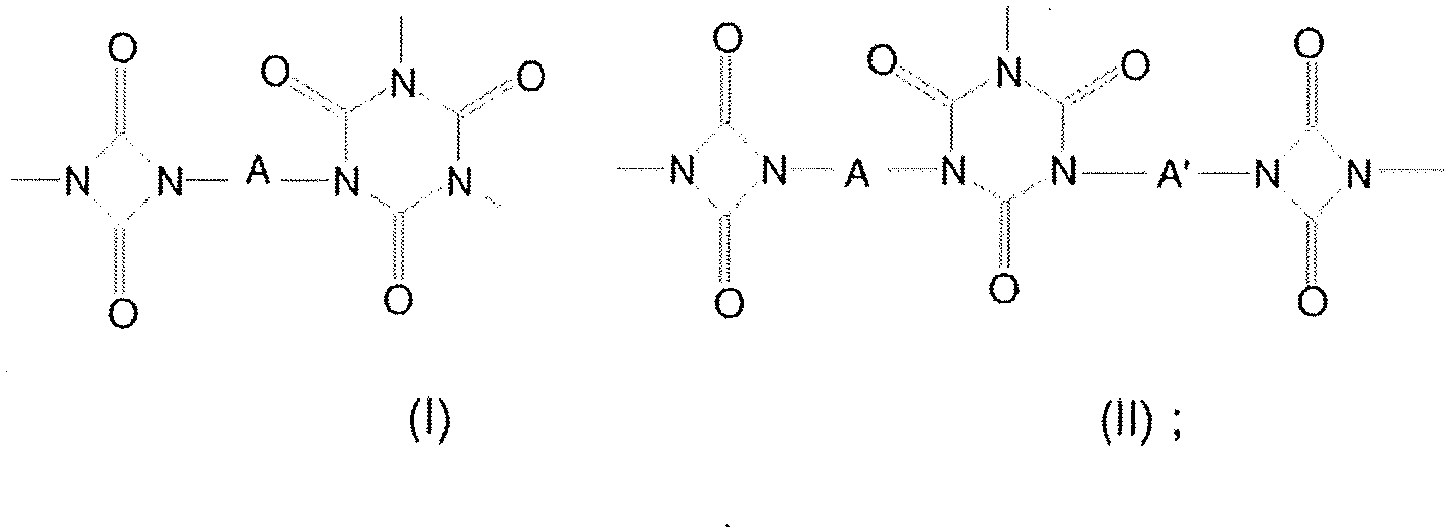
- the dimeric units are advantageously connected to one or more isocyanurate units, in particular in the form of chains represented by the following formulas (I) to (V) and their mixtures: and in which A and A ', which are identical or different, represent the residues of a monomeric isocyanate compound after removal of two isocyanate functional groups, and preferably A and A' each represent a linear, branched or cyclic bivalent radical containing from 1 to 20 carbon atoms, carbon, preferably from 2 to 12 carbon atoms, preferably from 2 to 8 carbon atoms, for example 6 carbon atoms and further optionally comprising 1, 2 or 3 isocyanate functional groups.
- polyisocyanate compositions of the invention those containing dimeric units linked to isocyanurate units by hydrocarbon chains, preferably alkyl chains, preferably constituting sequences "isocyanurate - dimer-isocyanurate unit" (formula (V) above) are particularly useful for the retouching operations defined above, but also to improve the sanding or the posability of the coatings .
- the dimeric units may be linked to one or more iminotrimeric units, according to one or more of the sequences (I) to (V) defined above, in which one or more of the isocyanurate units are replaced by iminotrimeric units.
- high content of dimeric units is meant a quantity by weight of dimer unit of between 0.25% and 25%, preferably between 0.5% and 20% relative to the total weight of the polyisocyanate (s). ).
- the polyisocyanate (s) used in the composition of the present invention contains at least one iminotrimeric unit.
- the iminotrimeric cyclotrimer can be represented by the following formula: isocyanate functions (NCO) at the end of chains that can be incorporated in dimeric or trimeric cycles, in the case of heavier oligomers.
- NCO isocyanate functions
- the isocyanate functions present in the composition according to the invention are preferably at least partially, or even completely masked.
- the ratios indicated above are not modified.
- the masking of the isocyanate functions by the masking agents in no way modifies the ratio (iminotrimeric units / trimer units).
- composition according to the invention may further comprise pigments as well as additives which facilitate the implementation of the formulation or the formation of the coatings, namely additives of rheology, spreading and the like.
- composition of the present invention may further comprise a "surfactant", i.e., a compound having the property of rendering hydrophobic and hydrophilic compounds miscible with one another, without in any way signifying a compound capable of forming any suspension or any emulsion.
- a surfactant i.e., a compound having the property of rendering hydrophobic and hydrophilic compounds miscible with one another, without in any way signifying a compound capable of forming any suspension or any emulsion.
- the coating composition according to the invention when it is in 1K form (monocomponent), is a solution, as opposed to emulsion, dispersion, latex or other, and more specifically a mixture homogeneous of at least the compounds defined above under a), b) and c), with possibly d).
- composition may also comprise a surfactant or a mixture of surfactants in an amount generally of between 0% and 30% by weight, preferably between 1% and 20% by weight, more preferably between 2% and 15% by weight.
- composition of the invention comprises a surfactant or a mixture of surfactants
- an anionic surfactant or a nonionic surfactant optionally comprising a polyethylene glycol and / or propylene glycol chain of at least 1, advantageously at least 5, preferably at least 7, ethylenyloxyl and / or propylenyloxyl units.
- the surfactant is chosen so that it has no or little function reactive with the (s) polyisocyanate (s).
- the surfactant is present in the solvent composition in essentially free form (as opposed to a form bonded through a chemical bond with the polyisocyanate (s).
- essentially free form it is meant that less than 50%, preferably less than 20%, preferably less than 10% by weight of the surfactant is in bound form.
- solution compositions in which the surfactant is fully covalently bonded to (poly) isocyanates are also within the scope of the present invention.
- the surfactant is an anionic agent having at least one functional group chosen from aryl (s) and / or alkyl (s) sulfates or phosphates, and aryl or alkyl phosphonates. , phosphinates and sulfonates. It is understood that the solution composition of the present invention may comprise a mixture of at least two surfactants.
- the polyisocyanate (s) included in the composition according to the present invention consists (s) of any isocyanate and / or polyisocyanate, alone or in admixture with one or more other isocyanates and / or polyisocyanates.
- the preferred polyisocyanates which form part of the composition of the present invention and whose isocyanate functional groups are advantageously at least partly or completely blocked by masking agents, are chosen from the products of homo- or hetero-condensation of alkylenediediols. isocyanate, and in particular those described in the applications for patents FR 2 822 828 and FR 2,837,820 .
- polyisocyanates may optionally comprise one or more functions of the "biuret” and / or “trimeric” type, and for example and without limitation, any type of function, urea, urethane, allophanate, ester, amide, acylurea or isocyanurate. , oxadiazinetrione, immino-dimer, immino-trimer (imminotriazinedione), immino-oxadiazinedione (also called asymmetric trimer), diazetidinedione (also called dimer), and mixtures thereof.
- the monomeric diisocyanates used to prepare the polyisocyanates defined above are generally chosen from diisocyanates of aliphatic and / or cycloaliphatic and / or, more rarely, aromatic character.
- the homo-condensation products are the products resulting from the condensation of one of the di-isocyanate monomers, listed above, with itself.
- the hetero-condensation products are the products resulting from the condensation of two or more of the monomers listed above, with each other and / or optionally with one or more compounds with a mobile hydrogen, such as for example an alcohol, a diol and other analogous compounds.
- Tolonate ® polyisocyanates marketed by Rhodia under the name “Tolonate ® ", including “Tolonate ® HDT”, which gives, after masking with methyl ethyl ketoxime (MEKO), "Tolonate ® D2” .
- MEKO methyl ethyl ketoxime
- the polyisocyanates included in the composition of the present invention may also be polyisocyanate derivatives derived from aromatic isocyanates used alone or mixed with aliphatic compounds.
- the viscosity of the non-masked polyisocyanate compounds useful in the invention is situated in a very broad viscosity range because of the structure of the polyisocyanate compounds that can be used.
- the viscosity is generally greater than 10 mPa ⁇ s at 25 ° C. 100% dry extract, preferably greater than 100 mPa ⁇ s, at 25 ° C and 100% solids.
- the viscosity of products from Rhodia such as Tolonate ® HDT LV2 which has a viscosity of about 600 mPa • s ⁇ 150 mPa • s at 25 ° C and that contains a dimeric unit content of the order of 5% by weight
- the Tolonate ® HDT HR with a viscosity of about 20,000 mPa • s, at 25 ° C at 100% solids, or 2,000 mPa • s at 25 ° C. to 90% of dry extract in n-butyl acetate and which contains a dimeric pattern content of the order of 3% by weight.
- Some polyisocyanate compounds are solids with 100% solids content. This is for example the case of the isocyanurate trimer of the IPDI or the dimer of the IPDI.
- the viscosities of some of these compounds can be given in organic solution; and Tolonate ® IDT 70 S (isocyanurate trimer of IPDI) has a viscosity of about 1700 mPa • s ⁇ 600 mPa • s at 25 ° C for a 70% formulation of solids in Solvesso ® 100, Tolonate ® IDT 70 B (IPDI trimer isocyanurate) has a viscosity of about 600 mPa • s ⁇ 300 mPa • s at 25 ° C for a formulation with 70% solids in l n-butyl acetate.
- homo-condensation and / or hetero-condensation products are preferred from an aliphatic diisocyanate monomer, in particular non-cyclic, preferably the HDI.
- the polyisocyanates present in the composition according to the invention may be in partially or completely masked form, that is to say that the isocyanate functions are not free, but masked with a masking agent or a mixture of masking agents, as defined below.
- Particularly preferred is the use of partially or totally masked polyisocyanate compositions, more preferably completely masked, especially for the preparation of a single-component coating formulation (1K formulation).
- masked polyisocyanate means a polyisocyanate for which at least 50%, preferably 80%, advantageously 90% and even more preferably all the isocyanate functions are masked.
- the masking agent or the masking agent mixture which temporarily or permanently protects the isocyanate functional groups are compounds which have at least one function carrying a labile hydrogen, generally a function carrying a labile hydrogen, preferably a single function carrying a labile hydrogen and which are reactive towards the isocyanate function.
- a labile hydrogen may be associated a pKa value that corresponds to either the ionization of an acid [including hydrogen functions -ols (in this description is understood by "-ol (s) Phenols and alcohols), or the associated acid of a base (usually nitrogen).
- said pKa (or one of them if it is possible to define more than one) of the function carrying one or more labile hydrogens is at least 4, advantageously 5. preferably 6 and is at most equal to 14, advantageously 13, preferably 12, and more preferably 10.
- lactams whose pKa is greater than these values and which constitute possible masking agents, although that not preferred for the invention.
- a masking agent is said to be temporary when the isocyanate function is temporarily protected by the masking agent and does not react under the storage conditions of the system formulated with the hydroxyl functions of the mobile hydrogen compound, in particular the polyol, but is then released during the thermal crosslinking reaction.
- the released isocyanate function then reacts with the mobile or reactive hydrogen functions of the polyol to give a urethane linkage and lead to the polyurethane network which forms part of the coating.
- the temporary masking agent is either removed as a volatile organic compound with most of the formulation solvents, remains in the film, or reacts with the aminoplast resin when the formulation contains it.
- hydroxylamine derivatives such as hydroxysuccinimide and oximes such as methylethylketoxime, hydrazine derivatives such as pyrazoles.
- triazole derivatives imidazole derivatives, phenol derivatives or the like, derivatives of amides such as imides and lactams, such as caprolactam, hindered amines such as di-isopropylamine and N-isopropyl-N benzylamine, as well as malonates or ketoesters and hydroxamates.
- These compounds may optionally contain substituents, in particular alkyl or alkyl chains.
- the masking agent (s) useful for the protection reaction of the isocyanate functional groups can be water-soluble, partially water-soluble or non-soluble in water.
- Preferred temporary masking agents are methyl ethyl ketoxime, also called MEKO, 3,5-dimethylpyrazole, also called DMP, 2- or 4-alkylimidazoles, dialkyl malonates, cyclic ⁇ -keto esters, hindered amines, caprolactam and triazoles, possibly substituted.
- the present invention is not limited to only temporary masking agents, but may also involve so-called final masking agents. These are characterized by the fact that the isocyanate functions are protected by the masking agent and do not react with the hydroxyl functions of the mobile hydrogen compound, in particular the polyol, under the storage conditions of the formulated system, or during the thermal crosslinking reaction.
- the isocyanate functions are therefore not restored at the time of the crosslinking reaction by baking and remain masked, said masked functions then being able to react under the crosslinking conditions with the methylole (-N-CH 2 -OH) or alkoxyalkyl ( -N-CH 2 -O-alkyl) aminoplast resins, such as those defined above, in the presence of an acid catalyst, preferably sulfonic, or a latent precursor of this catalyst which may be a tertiary amine salt of a sulphonic acid.
- an acid catalyst preferably sulfonic, or a latent precursor of this catalyst which may be a tertiary amine salt of a sulphonic acid.
- the masking agent (s) used to definitively protect the isocyanate functional groups are, in general, hydroxyl or sulfhydryl functional compounds, preferably monofunctional, such as hydroxy (cyclo) alkanes, for example methanol, butanols, cyclohexanol, 2-ethylhexanol or compounds with carboxylic acid functions, such as propionic acid, pivalic acid, benzoic acid, and others. These compounds may optionally carry one or more substituents.
- “definitive” masking agents may also be isocyanate functions masked by compounds comprising at least one crosslinkable function capable of polymerizing by UV radiation.
- “Definitive” masking agents include hydroxyalkyl acrylates or methacrylates.
- dual or polyfunctional masking agents comprising functions capable of giving temporary and / or permanent masked isocyanate functions.
- this is not preferred because the masked polyisocyanate compounds rapidly exhibit high viscosities, especially since the functionality in isocyanate functions (NCO) is higher.
- the reactive (or mobile) hydrogen compounds which react with the polyisocyanate (s) during the heat treatment preferably have at least two mobile hydrogen atoms, up to about twenty mobile hydrogen atoms per unit charge. molecule.
- These mobile hydrogen compounds are generally polymers containing two or more hydroxyl functions (alcohol or phenol) and / or thiol functions and / or primary or secondary amine functional groups and / or containing precursor functions such as, for example, epoxy or carbonate functions which , by reaction with a suitable nucleophile (an amine or water for example), release the hydroxyl functions.
- the compounds are chosen from polyols which can be used alone or as a mixture.
- the polyols used in the formulations of the invention are advantageously chosen from acrylic polymers or polyesters or polyurethanes or polyethers.
- polyester polyols or urethane polyesters For reasons of elasticity of the coatings and particularly for the so-called “primary” layer, it is preferred to use polyester polyols or urethane polyesters.
- a mixture of two polyester resins or urethane polyesters is used, one characterized by a "hard” character and the other by a “soft” or “soft” character.
- the hard or soft nature of the polyesters is conferred by the nature of the monomers used during their synthesis.
- a "hard” polyester will be obtained by choosing acid monomers or aromatic alcohols and / or cyclo-aliphatic and / or highly branched.
- acid monomers or aromatic alcohols and / or cyclo-aliphatic and / or highly branched As examples of this type of monomer, mention may be made of phthalic anhydride, or cyclohexanediol or 2,2,4-trimethylpentanediol.
- a "soft" polyester is obtained by choosing linear aliphatic monomers with little branching, such as adipic acid or 1,4-butanediol or 1,6-hexanediol, or with heteroatoms in their structure, such as diols. or poly-ethylene glycols. The latter are however not sought in so far as these compounds have a weakness when they are stable to ultraviolet radiation.
- polyester polyols are industrial and their synthesis is widely described and known to those skilled in the art. It will not be described in this document. For more details, refer to the following works: "Polymer Materials, Structures, Properties and Applications” by Gottfried W. Ehrenstein and Fabienne Montagne published in 2000 at Hermès Science ; "Handbook of Polyurethanes” by Michael Szycher, published in 1999 by CRC Press ; “Resins for Coatings, Chemistry, Properties and Applications” by D. Stoye and W. Freitag, published by Hanser in 1996 , as well as the collection of Eurocoat 1997 (pp 505-515) ) on page 507. You can also consult the commercial catalogs of the companies distributing polyols including the book titled Akzo Nobel Resins Specialty Resins, creating the solution together, published February 2001 .
- the average functionality in hydroxyl groups of the polymer polyols is at least 2, generally between 3 and 20. In general, for the intended application, too high a functionality would lead to compounds that are too "hard” and it is preferred to use polyester polyols of relatively low functionality less than 15, preferably less than 10, or even less than 8.
- the number-average molecular weight of the polyester polyols used in the composition of the invention is generally between 500 and 10,000, preferably between 600 and 4,000.
- polystyrene foams which imparts a higher hardness to the coating.
- These polyols can be “hard” or “flexible” depending on whether monomers having respectively an aromatic and / or cycloaliphatic and / or highly branched for this "hard” property and monomers having predominantly an aliphatic character for the property are used. "Soft”.
- the number average molecular weight for acrylic polyols is generally between 300 and 50,000, preferably between 500 and 25,000, preferably between 1,000 and 15,000.
- the hydroxyl function titer is generally between 10 and 750 mg of KOH per gram of polymer, preferably between 15 and 500 mg of KOH per gram of polymer.
- acrylic polyols As an example of acrylic polyols, reference may be made to the article of Eurocoat 97 cited above, on page 515, which gives the characteristics of some acrylic polyols, these examples having no limiting character.
- Hyperbranched polyols which are generally characterized by higher functionality than linear polyols can also be used, but these products are not preferred because of the high viscosity of these products.
- Structured or block polyols can also be used if a property compartmentalization effect is sought. However, these products, usually more expensive, are only used to bring a particular property. These compounds are, for example, a rheology agent or a pigment dispersion aid.
- the isocyanate functional groups / mobile hydrogen functions ratio is between 1.5 and 0.5, preferably between 1.2 and 0.8.
- the ratio isocyanate functions / hydroxyl functions is between 1.5 and 0.5, preferably between 1.2 and 0.8.
- composition according to the present invention also comprises an aminoplastic type resin or aminoplast type melamine formalin and / or urea formaldehyde and / or benzoguanamine formalin.
- aminoplastic type resin or aminoplast type melamine formalin and / or urea formaldehyde and / or benzoguanamine formalin are known and details of their syntheses are proposed in the works cited above, especially in the book by Stoye and Freitag on page 102, chapter 6.2.
- the presence of one or more aminoplast resins in the coating composition according to the present invention is particularly advantageous for the formation of the base coat (or “base coat”), and is not generally necessary for the formation of the finishing layer (or “top coat”), although this is not excluded from the scope of the invention.
- compositions according to the present invention also serve as a basis for the formulations used for Can and Coil Coating.
- compositions according to the invention give the substrates to which they are applied remarkable properties of hardness and resistance to grinding, in particular when they are applied as hardener of a primary layer to a metal substrate.
- a metal substrate for example aluminum and in particular stainless steel, or on a plastic substrate.
- Another advantage of the coating compositions according to the invention lies in the fact that the substrates have the remarkable properties described above, without however observing a degradation of the other properties.
- the coatings obtained in this way retain, in particular, resistance to chemical and / or biological attack and, in particular, are particularly resistant to animal dung, in particular bird droppings.
- An improvement of the desired properties can be further achieved by adding a surfactant additive to the masked isocyanate functional polyisocyanate formulation.
- the invention further relates to the process for preparing a multi-layer coating as defined above comprising at least one polyisocyanate composition described above having improved hardness and grittiness resistance properties.
- the process comprises the steps of mixing the various components of the coating according to conventional techniques known in the art, and can for example be carried out by means of traditional mixers, such as mixers, grinding mixers, depending on the viscosity of the various components and the type of desired coating. It should be understood, however, that the mixtures can be made just before the application of the coating, or else in the form of a ready-to-use formulation (one-component formulation or 1K formulation), or else in the form of pre-mixes that will be mixed together just before use.
- premixes separated from only two or three of the components of the coating formulation may be advantageous to make premixes separated from only two or three of the components of the coating formulation, and then to mix two or three premixes (2K or 3K formulations) just before use.
- type 1K formulations ie ready-to-use formulations containing all of the aforementioned components of the coating formulation, are preferred.
- the polyisocyanates are advantageously polyisocyanates whose isocyanate functions are at least partially or completely masked.
- surfactant or a mixture of surfactants is present in the polyisocyanate composition
- said surfactant or said mixture is preferably introduced into the polyisocyanate composition before, during or after the reaction of the polyisocyanate composition. masking of the isocyanate function by the masking agent.
- the surfactant or surfactant mixture can also be incorporated directly into the coating composition or provided by one of the other components of the coating composition, namely with the polyol, the aminoplast resin, with the or the pigments, if it is a paint, or with the additives or with any other component of the final polyurethane composition.
- the present invention also relates to the substrates coated with the composition defined above.
- the substrate may be of any type, and is generally a metal substrate, for example aluminum or steel, in particular stainless steel.
- the substrate may also be a plastic material substrate, that is to say a thermoplastic or thermosetting polymer material, optionally comprising fillers, for example reinforcing fillers, such as, for example, glass fibers, carbon fibers, and others.
- the coated substrate can be folded, formed and stamped if necessary.
- the thus coated substrate has excellent grit resistance, and excellent resistance to washing under pressure, or even high pressure, especially in the case of plastic substrates.
- the main raw materials are commercial industrial compounds, with the exception of surfactant-additive masked polyisocyanate compositions which are prepared separately.
- Nuclear Magnetic Resonance spectrometry of carbon 13 ( 13 C NMR, AMX 300 spectrometer equipped with a 13 C 10 mm qnp probe) is used in a deuterated chloroform medium and in the presence of iron acetylacetonate (FeAcAc) to quantify the specific patterns. polyisocyanate compositions.
- Table 1 gives the distribution of the dimeric, trimeric and iminotrimeric units contained in the polyisocyanates before masking, examples 1 and 2 (determined by 13 C NMR), as well as the calculation of the various ratios of the different patterns.
- Table 1 ⁇ / b>: ⁇ b> Pattern Distribution and Ratios - ⁇ / b> ⁇ /u> Number of functions Characteristic reasons (determined by 13 C NMR) Tolonate ® HDT HR 90 B Tolonate ® HDT LV2 Tolonate ® HDT Trimer Cycle 100 100 100 Dimer Cycle 4.6 24.7 8.7 Iminotrimère 3.5 4.0 2.8 NCO function 224 351 287 Ratio of patterns NCO / dimeric patterns 48% 14% 33 NCO / trimeric patterns 2.24% 3.51% 2.87 NCO / iminotrimeric patterns 64% 88% 102.5 Iminotrimer / trimer 3.5% 4% 2.8
- the masking of the isocyanate functions by the masking agents does not disturb the ratio iminotrimeric units / trimeric units. After masking, the ratio of free NCO + masked NCO functions / iminotrimer units is identical to the NCO ratio / iminotrimeric units.
- Example 1 Synthesis of blocked polyisocyanate curing formulation (hardener 1 with Tolonate ® HDT HR 90 B)
- the viscosity of the product thus masked is 6650 mPa ⁇ s at 25 ° C.
- the potential NCO titer is 10.33% (the potential titer expresses the number of moles of NCO functions that can be restored by heating to about 150 ° C).
- the average functionality of isocyanate functional groups of the polyisocyanate precursor Tolonate ® HDT HR 90 B is of the order of 4.5, giving an average functionality of isocyanate functions masked in the order of 4.5, the masking operation n resulting in no changes to the average functionality.
- the degree of linkage between dimer units (uretidine-diones) and isocyanurates is high and is characterized by a high ratio of "dimer-patterned carbonyls" to "trimeric-carbonyls" in heavy polyisocyanates (greater than trimer), as measured by Infra-Red technology coupled with polymer gel permeation chromatography (see patent applications FR 2 822 828 and FR 2,837,820 ). This ratio is of the order of 3.5.
- the amount of dimeric units contained in the heavies represents about 40% of the total dimeric units of the starting polyisocyanate before masking.
- Example 2 The procedure is as in Example 1 except that the commercial polyisocyanate Tolonate ® HDT LV2 is used as starting polyisocyanate.
- the formulations are prepared as shown in Table 2 below. The characteristics of the formulations are presented in the following Table 3. ⁇ u> - ⁇ b> Table 2 ⁇ / b>: ⁇ b> Antigravel OEM Primer Formulations ⁇ / b> - ⁇ / u> Components of the basic formulation Quantity (g) Function Provider Part 1 Vialkyd ® AN 927/7 0X 22.45 Hard polyester resin UCB Surface Specialties Kronos ® 2310 13.55 Pigment (TiO2) Kronos White fixed micro 18.50 Charge Sachtleben Chemie Special Black SP 4 0.05 Black Pigment Degussa Aerosil ® R 972 0.30 Rheology additive (calcined silica) Degussa Ircogel ® 905 0.20 Rheology additive (calcium based) The Lubrizol Corp.
- Part 1 The whole of the components of Part 1 which are milled to the ball mill are added to a reactor until the fineness 9 is obtained at the North gauge. We then complete by adding the components of Part 2 and mix all the components. The formulation is then applied to the selected support.
- the manufacture of the coating is done under standard conditions of the preparation of an automobile original coating (OEM) and the application of the formulations is made with the pneumatic gun.
- OEM automobile original coating
- the application conditions are described below.
- the spray formulation is applied to the spray gun.
- rapid evaporation Flash
- the thickness of the primer is 30 to 35 microns.
- a commercial PSA aluminum gray PSA solvent base PE / MEL / CAB), reference PPG
- the application thickness is about 15 ⁇ m. Flash evaporation is then carried out at room temperature for 10 minutes and then "wet on wet” is applied a standard automotive varnish referenced Varnish (ACRY / MEL / Crosslinker) HTR 3000 PPG for PSA. The application thickness is about 40 ⁇ m.
- the mixture is baked at 140 ° C. for 30 minutes.
- the coating is then left at room temperature for one day and then the properties of the coating are measured.
- Example 3 corresponds to the formulation using the polyisocyanate hardener of Example 1
- Example 4 corresponds to the formulation using the polyisocyanate hardener of Example 2.
- Example 5 and Comparative Example : Application of Coatings for Can Coating
- Quantity Function Provider Polymac ® 320-1308 103.5 polyol Eastman Chemical Aerosil ® 200 0.5 Rheology Officer Degussa Modaflow ® 2100 0.9 Spreader DOW Titanium oxide 78.8 Pigment Kronos Hardener Polyisocyanate to be tested 10.8 Masked polyisocyanate Rhodia Rhodiasolv ® RPDE 11.3 Solvent Rhodia Solvesso ® 150 40.3 Solvent ExxonMobil Chemical
- Example 5 corresponds to the formulation targeted by the invention using the polyisocyanate hardener of Example 1.
- the comparative example corresponds to the formulation using a composition which uses as Tolonate ® D2 polyisocyanate hardener resulting from the masking of the Tolonate ® HDT by MEKO (see Table 1, right column).
- the coating obtained from the formulation using the blocked polyisocyanate derived from Tolonate ® HDT HR 90 B of average functionality of isocyanate functions masked in the order of 4.5 has a Persoz hardness and much higher chemical resistance that the coating obtained from the hardener Tolonate ® D2, of average functionality isocyanate functions masked of the order of 3.6, for identical baking conditions.
- the formulations of the invention thus allow a productivity gain or a gain in temperature.
Landscapes
- Chemical & Material Sciences (AREA)
- Organic Chemistry (AREA)
- Health & Medical Sciences (AREA)
- Chemical Kinetics & Catalysis (AREA)
- Medicinal Chemistry (AREA)
- Polymers & Plastics (AREA)
- Life Sciences & Earth Sciences (AREA)
- Engineering & Computer Science (AREA)
- Materials Engineering (AREA)
- Wood Science & Technology (AREA)
- Polyurethanes Or Polyureas (AREA)
- Paints Or Removers (AREA)
Claims (21)
- Verwendung einer Zusammensetzung, umfassend:a) mindestens ein Polyisocyanat, aufweisend mindestens ein Dimermotiv und mindestens ein Polyisocyanat, identisch oder unterschiedlich vom vorangehenden, aufweisend mindestens ein Imintriazindionmotiv, wobei das/die Polyisocyanat/e, das eine und/oder das andere, vorzugsweise die zwei folgenden Merkmale aufweisen: - das molare Verhältnis (Isocyanatfunktionen/Imintriazindionmotive) vor der Maskierung ist kleiner als 100, vorzugsweise kleiner als 90, und/oder das molare Verhältnis (Imintriazindionmotive/Trimermotive) ist größer als 3,b) mindestens eine Verbindung, die mindestens eine Funktion mit mobilem Wasserstoff trägt, ausgewählt aus den primären oder sekundären Hydroxyl-, Phenol-, primären und/oder sekundären Amin-, Carboxylfunktionen und SH-Funktion, undc) mindestens ein aminoplastisches Harz (Harz "Aminoplast") vom Typ Melaminaldehyd, insbesondere Melaminformaldehyd und/oder Harnstoffaldehyd, insbesondere Harnstoffformaldehyd, oder Benzoguanamin und/oder deren Alkoxyalkylederivate,für die Ausbildung einer Beschichtung durch Vernetzung durch thermische Bearbeitung.
- Verwendung nach Anspruch 1, wobei die Zusammensetzung ferner umfasst:d) mindestens einen Katalysator der Reaktion der Verbindung a) mit der Verbindung c) und/oder mindestens eine Verbindung vom Typ starke Säure oder eine latente Form der starken Säure als Katalysator der Reaktion der Melamin- und/oder Harnstoffverbindungen oder ihrer Derivate mit den echten Urethan- oder Carbamatfunktionen.
- Verwendung einer Zusammensetzung nach einem der vorangehenden Ansprüche, wobei die Zusammensetzung als Härter der Primärschicht einer Beschichtung wirkt.
- Verwendung einer Zusammensetzung nach einem der vorangehenden Ansprüche für die Ausbildung einer Beschichtung für Erstausrüstung.
- Verwendung nach einem der Ansprüche 1 bis 3 für Retouchemaßnahmen.
- Verwendung nach einem der vorangehenden Ansprüche, wobei die Polyisocyanatzusammensetzung die Herstellung einer Beschichtung unter dem Aspekt einer Monokomponentenformulierung (1K) oder auch einer Bikomponentenformulierung (2K) oder auch Multikomponentenformulierung erlaubt.
- Zusammensetzung, umfassend:a) mindestens ein Polyisocyanat, aufweisend mindestens ein Dimermotiv und mindestens ein Polyisocyanat, identisch oder unterschiedlich vom vorangehenden, aufweisend mindestens ein Imintriazindionmotiv, wobei das/die Polyisocyanat/e, das eine und/oder das andere, vorzugsweise die zwei folgenden Merkmale aufweisen:- das molare Verhältnis (Isocyanatfunktionen/Imintriazindionmotive) vor der Maskierung ist kleiner als 100, vorzugsweise kleiner als 90, und/oder- das molare Verhältnis (Imintriazindionmotive/Trimermotive) ist größer als 3,b) mindestens eine Verbindung, die mindestens eine Funktion mit mobilem Wasserstoff trägt, ausgewählt aus den primären oder sekundären Hydroxyl-, Phenol-, primären und/oder sekundären Amin-, Carboxylfunktionen und SH-Funktion, undc) mindestens ein aminoplastisches Harz (Harz "Aminoplast") vom Typ Melaminaldehyd, insbesondere Melaminformaldehyd und/oder Harnstoffaldehyd, insbesondere Harnstoffformaldehyd, oder Benzoguanamin und/oder deren Alkoxyalkylederivate.
- Zusammensetzung nach Anspruch 7, umfassend ferner:d) mindestens einen Katalysator der Reaktion der Verbindung a) mit der Verbindung c) und/oder mindestens eine Verbindung vom Typ starke Säure oder eine latente Form der starken Säure als Katalysator der Reaktion der Melamin- und/oder Harnstoffverbindungen oder ihrer Derivate mit den echten Urethan- oder Carbamatfunktionen.
- Zusammensetzung nach einem der Ansprüche 7 oder 8, umfassend:- mindestens ein Polyisocyanat, enthaltend eine gewichtsmäßige Menge an Dimermotiven zwischen 0,25 % und 25 %, vorzugsweise zwischen 0,5 % und 20 %, inklusive in Bezug zur Gesamtmasse des/der Polyisocyanats/e, wobei die Dimermotive mit einem oder mehreren Isocyanuratmotiven durch Kohlenwasserstoffketten, vorzugsweise Alkylketten, verbunden sind,- mindestens ein Polyisocyanat, identisch oder unterschiedlich vom vorangehenden, aufweisend mindestens ein Imintriazindionmotiv,- eventuell mindestens ein Polyisocyanat, identisch oder unterschiedlich von den vorangehenden, enthaltend ein echtes Dimer,- mindestens eine Verbindung, die mindestens eine Funktion mit mobilem Wasserstoff trägt, wie Hydroxylfunktionen und/oder primäre und/oder sekundäre Aminfunktionen und/oder SH-Funktionen,- mindestens ein organisches Lösungsmittel,- mindestens ein Aminoplastharz vom Typ Melamin/Formaldehyd und/oder Harnstoff/Formaldehyd oder Benzoguanamin und/oder deren Alkoxyalkylderivate und- eventuell mindestens einen Katalysator der Polyurethanreaktion und/oder mindestens einen Katalysator starke Säure der Reaktion der Melamin- und/oder Harnstoffverbindungen oder ihrer Derivate mit den echten Urethan- oder Carbamatfunktionen.
- Zusammensetzung nach einem der Ansprüche 7 bis 9, wobei die Dimermotive mit einem oder mehreren Isocyanuratmotiven in Form von Verkettungen verbunden sind, die von den folgenden Formeln (I) bis (V) und deren Gemischen dargestellt sind:


- Zusammensetzung nach einem der Ansprüche 7 bis 10, umfassend:- 5 bis 20 Gew.-% mindestens eines Polyisocyanats im Verhältnis zum Gesamtgewicht der Zusammensetzung ohne Lösungsmittel (% zu trocken),- 15 bis 25 Gew.-% mindestens eines Aminoplastharzes im Verhältnis zum Gesamtgewicht der Zusammensetzung ohne Lösungsmittel (% zu trocken),- 55 bis 80 Gew.-% mindestens einer Verbindung, die mindestens eine Funktion mit mobilem Wasserstoff trägt, ausgewählt aus den primären oder sekundären Hydroxyl-, Phenol-, primären und/oder sekundären Amin-, Carboxylfunktionen und SH-Funktion, im Verhältnis zum Gesamtgewicht der Zusammensetzung ohne Lösungsmittel (% zu trocken), und- 35 bis 55 Gew.-%, in vorteilhafter Weise zirka 45 Gew.-%, mindestens eines organischen Lösungsmittels im Verhältnis zum Gesamtgewicht der Zusammensetzung.
- Zusammensetzung nach einem der Ansprüche 7 bis 11, wobei das/die Polyisocyanat/e aus den Produkten der Homo- oder Heterokondensation von Alcoylenediisocyanat ausgewählt ist/sind, umfassend vor allem Produkte des Typs "Biuret" und des Typs "Trimere", ja sogar "Präpolymere" mit Isocyanatfunktion, aufweisend vor allem Harnstoff-, Urethan-, Allophanat-, Ester-, Amid-, Acylharnstoff-, Isocyanurat-, Oxadiazintrion-, Imminodimer-, Imminotrimer- (Imminotriazadion), Imminooxadiazindion- (auch als asymmetrisches Trimer bezeichet), Diazetidindionfunktionen (auch als Dimer bezeichnet) und aus den Gemischen, davon enthaltend.
- Zusammensetzung nach einem der Ansprüche 7 bis 12, wobei das/die Polyisocyanat/e temporär und/oder definitiv maskiert ist/sind, vorzugsweise von einem Maskierungsmittel oder einem Maskierungsmittelgemisch, aufweisend mindestens eine Funktion, die einen labilen Wasserstoff trägt.
- Zusammensetzung nach Anspruch 13, wobei das Maskierungsmittel oder das Maskierungsmittelgemisch aus den Derivaten von Hydroxylamin, den Oximen, den Derivaten von Hydrazin, den Derivaten der Triazole, den Derivaten der Imidazole, den Derivaten der Phenole oder ähnlichem, den Derivaten der Amide, Imide und Lactame, den gehinderten Aminen sowie den Malonaten oder Cetoestern und den Hydroxamaten und ihren Gemischen für die temporären Maskierungsmittel und aus den Verbindungen mit Hydroxyl- oder Sulfhydrylfunktionen, vorzugsweise monofunktionalen, dem Cyclohexanol und den Verbindungen mit Carboxylsäurefunktionen und ihren Gemischen für die definitiven Maskierungsmittel ausgewählt ist.
- Zusammensetzung nach einem der Ansprüche 7 bis 14, wobei die Verbindung mit reaktivem (oder mobilem) Wasserstoff, die mit dem/den Polyisocyanat/en während der thermischen Behandlung reagiert, ein Poylmer ist, enthaltend zwei oder mehrere Hydroxylfunktionen (Alkohol oder Phenol) und/oder Thiolfunktionen und/oder primäre oder sekundäre Aminfunktionen und/oder enthaltend Vorläuferfunktionen vom Typ Epoxy oder Carbonate, die durch Reaktion mit einem adäquaten Nukleophil die Hydroxylfunktionen freisetzen.
- Zusammensetzung nach Anspruch 15, wobei die Verbindung mit reaktivem (oder mobilem) Wasserstoff ein Polyol ist, ausgewählt aus den Acrylpolymeren oder Polyestern oder Polyurethanen.
- Zusammensetzung nach einem der Ansprüche 7 bis 16, wobei das Harz vom Typ Aminoplastisch oder Aminoplast ein Harz vom Typ Melaminformol und/oder Harnstoffformol und/oder Benzoguanaminformol ist.
- Zusammensetzung nach einem der Ansprüche 7 bis 17, einhaltend eine der folgenden Bedingungen:• ein Gewichtsverhältnis temporär/e und/oder definitiv/e maskiertes/e Polyisocyanat/e in Bezug zu der Gesamtheit der Harze [Verbindung(en) mit mobilem Wasserstoff, maskiertes/e Aminoplast- und Polyisocyanatharz/e] zwischen 5 und 80 Gew.-% inklusive, vorzugsweise zwischen 10 und 60 % inklusive und in vorteilhafter Weise zwischen 15 % und 40 % inklusive,• eine gewichtsmäßige Menge an Dimermotiven in dem/den Vorläuferpolyisocyanat/en zwischen 0,25 und 25 % inklusive, vorzugsweise zwischen 0,5 % und 20 % inklusive, und• ein molares Verhältnis [(maskierte und freie Isocyanatfunktionen)/Imintrimermotive) ist kleiner als 100, vorzugsweise kleiner als 90, und/oder- ein molares Verhältnis (Imintrimermotive/Trimermotive) größer als 3, und• eine mittlere Funktionalität an Isocyanatfunktionen des (oder der) Vorläuferpolyisocyanats/e (vor Maskierung der Isocyanatfunktionen) im Allgemeinen von mindestens gleich 2 und höchstens gleich 10, vorzugsweise größer als 2,5 und höchsten gleich 8, in vorteilhafter Weise zwischen 2,8 und 6,5 inklusive.
- Verfahren zur Herstellung einer Zusammensetzung nach einem der Ansprüche 7 bis 18, umfassend die Mischschritte der diversen Bestandteile der Zusammensetzung, wobei das Mischen unmittelbar vor dem Auftragen der Beschichtung oder auch in Form einer gebrauchsfertigen Formulierung (Einkomponentenformulierung oder auch 1k-Formulierung) oder auch in Form von Vorgemischen durchgeführt wird, die unmittelbar vor dem Gebrauch miteinander vermischt werden.
- Beschichtung, umfassend eine, zwei, drei oder mehr Schichten, wovon mindestens eine Schicht, vorzugsweise die Primärschicht, eine Zusammensetzung nach einem der Ansprüche 7 bis 18 ist.
- Substrat, beschichtet mit mindestens einer Polyisocyanatzusammensetzung nach einem der Ansprüche 7 bis 18.
Priority Applications (1)
| Application Number | Priority Date | Filing Date | Title |
|---|---|---|---|
| SI200731996T SI2046904T1 (en) | 2006-03-24 | 2007-03-22 | A polyisocyanate composition with improved countermeasures |
Applications Claiming Priority (2)
| Application Number | Priority Date | Filing Date | Title |
|---|---|---|---|
| FR0602577A FR2898905B1 (fr) | 2006-03-24 | 2006-03-24 | Composition polyisocyanate a proprietes anti-chocs ameliorees |
| PCT/FR2007/000484 WO2007122309A1 (fr) | 2006-03-24 | 2007-03-22 | Composition polyisocyanate a proprietes anti-chocs améliorées |
Publications (2)
| Publication Number | Publication Date |
|---|---|
| EP2046904A1 EP2046904A1 (de) | 2009-04-15 |
| EP2046904B1 true EP2046904B1 (de) | 2017-09-27 |
Family
ID=37401013
Family Applications (1)
| Application Number | Title | Priority Date | Filing Date |
|---|---|---|---|
| EP07731173.6A Not-in-force EP2046904B1 (de) | 2006-03-24 | 2007-03-22 | Polyisocyanatzusammensetzung mit verbesserten stossicherungseigenschaften |
Country Status (8)
| Country | Link |
|---|---|
| US (1) | US8318310B2 (de) |
| EP (1) | EP2046904B1 (de) |
| KR (1) | KR101428603B1 (de) |
| CN (1) | CN101454414B (de) |
| ES (1) | ES2649735T3 (de) |
| FR (1) | FR2898905B1 (de) |
| SI (1) | SI2046904T1 (de) |
| WO (1) | WO2007122309A1 (de) |
Families Citing this family (6)
| Publication number | Priority date | Publication date | Assignee | Title |
|---|---|---|---|---|
| PT2214701T (pt) * | 2007-11-01 | 2016-11-02 | Univ Guelph | Composições e métodos de potenciar respostas imunes a eimeria |
| DE102010041243A1 (de) * | 2010-09-23 | 2012-03-29 | Evonik Degussa Gmbh | Prepregs auf der Basis lagerstabiler reaktiven oder hochreaktiven Polyurethanzusammensetzung |
| KR101923369B1 (ko) * | 2011-08-19 | 2018-11-29 | 호야 가부시키가이샤 | 우레탄계 광학 부재 및 그 제조방법 |
| KR20160081370A (ko) * | 2014-12-31 | 2016-07-08 | 현대자동차주식회사 | 고탄성 중도 도료 조성물 |
| CN110511656B (zh) * | 2019-09-12 | 2021-07-02 | 中国科学院长春应用化学研究所 | 一种喷涂成型的双组分聚脲表皮及其制备方法 |
| JP7546259B2 (ja) * | 2021-02-26 | 2024-09-06 | 東特塗料株式会社 | 絶縁層形成用樹脂ワニス |
Citations (2)
| Publication number | Priority date | Publication date | Assignee | Title |
|---|---|---|---|---|
| EP0798299A1 (de) * | 1996-03-26 | 1997-10-01 | Bayer Ag | Isocyanattrimerisate und Isocyanattrimerisatmischungen, deren Herstellung und Verwendung |
| EP1340483A1 (de) * | 2002-02-27 | 2003-09-03 | Ivoclar Vivadent AG | (Meth)acrylatsubstuierte Iminooxadiazindion-Derivate und deren Verwendung zur Herstellung von Dentalwerkstoffen |
Family Cites Families (14)
| Publication number | Priority date | Publication date | Assignee | Title |
|---|---|---|---|---|
| GB974900A (en) * | 1962-05-30 | 1964-11-11 | Ici Ltd | Isocyanurates and polymeric materials therefrom |
| US4427822A (en) * | 1982-02-15 | 1984-01-24 | Hitachi Chemical Co., Ltd. | Process for producing particulate polymer having imide groups |
| FR2699182B1 (fr) | 1992-12-15 | 1995-07-13 | Rhone Poulenc Chimie | Monomere presentant au moins une fonction isocyanate et une insuturation son procede de synthese et (co)polymeres en decoulant. |
| GB9602957D0 (en) * | 1996-02-17 | 1996-04-10 | Ici Plc | Coating compositions |
| US5877254A (en) * | 1996-07-22 | 1999-03-02 | Film Specialties, Inc. | Scratch-resistant anti-fog coating composition incorporating isocyanate-reactive surfactants |
| WO1998034973A1 (en) * | 1997-02-11 | 1998-08-13 | Huntsman Ici Chemicals Llc | Isocyanate compositions for low density polyurethane foam |
| ES2189151T3 (es) * | 1997-02-28 | 2003-07-01 | Rhodia Chimie Sa | Isocianatos modificados con miras a proporcionarles una propiedad tensioactiva, composicion que los contiene, revestimiento resultante. |
| KR100367324B1 (ko) * | 1997-08-12 | 2003-01-09 | 로디아 쉬미 | 저점도 (폴리)이소시아네이트 조성물의 제조방법 |
| DE19930555C1 (de) * | 1999-07-02 | 2001-01-18 | Basf Coatings Ag | Wäßriger Beschichtungsstoff, insbesondere wäßriger Füller oder Steinschlagschutzgrund |
| CN1109727C (zh) * | 1999-11-09 | 2003-05-28 | 复旦大学 | 一种单罐装高性能聚氨酯涂料及其制备方法 |
| EP1106636A1 (de) * | 1999-12-08 | 2001-06-13 | Bayer Corporation | Zwei-Komponenten-Beschichtungszusammensetzung mit verbesserter Kratzbeständigkeit |
| US6607646B2 (en) * | 2001-09-12 | 2003-08-19 | E. I. Du Pont De Nemours And Company | Cathodic electrocoating compositions containing hydroxyl-carbonate blocked polyisocyanate crosslinking agent |
| US6632873B2 (en) * | 2001-11-19 | 2003-10-14 | Ashland, Inc. | Two-part polyurethane adhesives for structural finger joints and method therefor |
| EP1732965B1 (de) * | 2003-07-14 | 2014-02-26 | Vencorex US, Inc. | Verbesserte farbstabilität von isocyanaten |
-
2006
- 2006-03-24 FR FR0602577A patent/FR2898905B1/fr not_active Expired - Fee Related
-
2007
- 2007-03-22 CN CN200780018687XA patent/CN101454414B/zh not_active Expired - Fee Related
- 2007-03-22 ES ES07731173.6T patent/ES2649735T3/es active Active
- 2007-03-22 KR KR1020087025918A patent/KR101428603B1/ko not_active Expired - Fee Related
- 2007-03-22 WO PCT/FR2007/000484 patent/WO2007122309A1/fr not_active Ceased
- 2007-03-22 US US12/294,093 patent/US8318310B2/en not_active Expired - Fee Related
- 2007-03-22 SI SI200731996T patent/SI2046904T1/en unknown
- 2007-03-22 EP EP07731173.6A patent/EP2046904B1/de not_active Not-in-force
Patent Citations (2)
| Publication number | Priority date | Publication date | Assignee | Title |
|---|---|---|---|---|
| EP0798299A1 (de) * | 1996-03-26 | 1997-10-01 | Bayer Ag | Isocyanattrimerisate und Isocyanattrimerisatmischungen, deren Herstellung und Verwendung |
| EP1340483A1 (de) * | 2002-02-27 | 2003-09-03 | Ivoclar Vivadent AG | (Meth)acrylatsubstuierte Iminooxadiazindion-Derivate und deren Verwendung zur Herstellung von Dentalwerkstoffen |
Also Published As
| Publication number | Publication date |
|---|---|
| FR2898905B1 (fr) | 2008-05-09 |
| CN101454414B (zh) | 2012-08-29 |
| US8318310B2 (en) | 2012-11-27 |
| ES2649735T3 (es) | 2018-01-15 |
| KR101428603B1 (ko) | 2014-08-12 |
| SI2046904T1 (en) | 2018-02-28 |
| WO2007122309A1 (fr) | 2007-11-01 |
| CN101454414A (zh) | 2009-06-10 |
| US20090104452A1 (en) | 2009-04-23 |
| EP2046904A1 (de) | 2009-04-15 |
| FR2898905A1 (fr) | 2007-09-28 |
| KR20090040402A (ko) | 2009-04-24 |
Similar Documents
| Publication | Publication Date | Title |
|---|---|---|
| CN104395368B (zh) | 具有高抗刮擦性的涂敷剂 | |
| EP2064258B1 (de) | Verwendung von polyisocyanat-zusammensetzungen für hochglanzbeschichtungen | |
| EP2212362B1 (de) | Neuartige wasserdispersible polyisocyanat-zusammensetzungen | |
| EP2212368B1 (de) | Neuartige hydrophile polyisocyanatzusammensetzungen auf basis von phosphatestern | |
| WO2009079536A1 (en) | Thermal curable polyester powder coating composition | |
| FR2747388A1 (fr) | Composition de polyisocyanate protege et composition de resine thermodurcissable en une piece comportant cette composition | |
| FR2879616A1 (fr) | Composition polyisacyanate a proprietes anti-chocs ameliorees | |
| EP2046904A1 (de) | Polyisocyanatzusammensetzung mit verbesserten stossicherungseigenschaften | |
| WO2008125419A1 (fr) | Composition a base de (poly)isocyanate modifie et d'un solvant de type acetal ou cetone aliphatique, et utilisation de cette composition pour la fabrication de revetements | |
| EP1999173B1 (de) | Gemisch auf der basis von polyisocyanat und einem acetallösungsmittel, wässrige emulsion aus diesem gemisch und verwendung dieser emulsion zur herstellung von beschichtungen und haftmitteln | |
| RU2278138C2 (ru) | Грунтовочная композиция, содержащая ароматический полиуретановый полиол, способ нанесения покрытия, способ отделки автомобиля | |
| WO2009156683A1 (fr) | Nouveaux melanges de compositions de polyisocyanates | |
| FR2893940A1 (fr) | Compose a fonctionnalite isocyanate, sa preparation et son utilisation dans un procede de preparation d'un revetement | |
| EP0915924B1 (de) | Zusammensetzung für die herstellung einer matten oder seidigen beschichtung, verwendung dieser zusammensetzung sowie daraus hergestellte beschichtung | |
| CA2299172C (fr) | Composition utile pour l'obtention de revetement mat ou satine, utilisation de cette composition et revetement ainsi obtenu | |
| RU2425065C2 (ru) | Меламиновые полиолы и покрытия из них | |
| JP3263935B2 (ja) | 特定のポリイソシアネート硬化剤を用いたポリウレタン塗料 | |
| EP1627004A2 (de) | Auf isocyanat basierende zusammensetzungen, verfahren zu deren verwendung, deren verwendung bei der herstellung von direkthaftenden beschichtungen und so erhaltene beschichtungen | |
| CA2673209A1 (en) | Thermal curable powder coating composition | |
| EP2896639A1 (de) | Beschichtete metallisierte Oberflächen |
Legal Events
| Date | Code | Title | Description |
|---|---|---|---|
| PUAI | Public reference made under article 153(3) epc to a published international application that has entered the european phase |
Free format text: ORIGINAL CODE: 0009012 |
|
| 17P | Request for examination filed |
Effective date: 20080919 |
|
| AK | Designated contracting states |
Kind code of ref document: A1 Designated state(s): AT BE BG CH CY CZ DE DK EE ES FI FR GB GR HU IE IS IT LI LT LU LV MC MT NL PL PT RO SE SI SK TR |
|
| AX | Request for extension of the european patent |
Extension state: AL BA HR MK RS |
|
| RAP1 | Party data changed (applicant data changed or rights of an application transferred) |
Owner name: PERSTORP FRANCE |
|
| 17Q | First examination report despatched |
Effective date: 20100706 |
|
| DAX | Request for extension of the european patent (deleted) | ||
| RAP1 | Party data changed (applicant data changed or rights of an application transferred) |
Owner name: VENCOREX FRANCE |
|
| GRAP | Despatch of communication of intention to grant a patent |
Free format text: ORIGINAL CODE: EPIDOSNIGR1 |
|
| INTG | Intention to grant announced |
Effective date: 20170428 |
|
| GRAS | Grant fee paid |
Free format text: ORIGINAL CODE: EPIDOSNIGR3 |
|
| GRAA | (expected) grant |
Free format text: ORIGINAL CODE: 0009210 |
|
| AK | Designated contracting states |
Kind code of ref document: B1 Designated state(s): AT BE BG CH CY CZ DE DK EE ES FI FR GB GR HU IE IS IT LI LT LU LV MC MT NL PL PT RO SE SI SK TR |
|
| REG | Reference to a national code |
Ref country code: GB Ref legal event code: FG4D Free format text: NOT ENGLISH |
|
| REG | Reference to a national code |
Ref country code: CH Ref legal event code: EP |
|
| REG | Reference to a national code |
Ref country code: AT Ref legal event code: REF Ref document number: 931935 Country of ref document: AT Kind code of ref document: T Effective date: 20171015 |
|
| REG | Reference to a national code |
Ref country code: IE Ref legal event code: FG4D Free format text: LANGUAGE OF EP DOCUMENT: FRENCH |
|
| REG | Reference to a national code |
Ref country code: DE Ref legal event code: R096 Ref document number: 602007052485 Country of ref document: DE |
|
| REG | Reference to a national code |
Ref country code: ES Ref legal event code: FG2A Ref document number: 2649735 Country of ref document: ES Kind code of ref document: T3 Effective date: 20180115 |
|
| PG25 | Lapsed in a contracting state [announced via postgrant information from national office to epo] |
Ref country code: LT Free format text: LAPSE BECAUSE OF FAILURE TO SUBMIT A TRANSLATION OF THE DESCRIPTION OR TO PAY THE FEE WITHIN THE PRESCRIBED TIME-LIMIT Effective date: 20170927 Ref country code: SE Free format text: LAPSE BECAUSE OF FAILURE TO SUBMIT A TRANSLATION OF THE DESCRIPTION OR TO PAY THE FEE WITHIN THE PRESCRIBED TIME-LIMIT Effective date: 20170927 Ref country code: FI Free format text: LAPSE BECAUSE OF FAILURE TO SUBMIT A TRANSLATION OF THE DESCRIPTION OR TO PAY THE FEE WITHIN THE PRESCRIBED TIME-LIMIT Effective date: 20170927 |
|
| REG | Reference to a national code |
Ref country code: NL Ref legal event code: MP Effective date: 20170927 |
|
| REG | Reference to a national code |
Ref country code: LT Ref legal event code: MG4D |
|
| REG | Reference to a national code |
Ref country code: AT Ref legal event code: MK05 Ref document number: 931935 Country of ref document: AT Kind code of ref document: T Effective date: 20170927 |
|
| PG25 | Lapsed in a contracting state [announced via postgrant information from national office to epo] |
Ref country code: GR Free format text: LAPSE BECAUSE OF FAILURE TO SUBMIT A TRANSLATION OF THE DESCRIPTION OR TO PAY THE FEE WITHIN THE PRESCRIBED TIME-LIMIT Effective date: 20171228 Ref country code: BG Free format text: LAPSE BECAUSE OF FAILURE TO SUBMIT A TRANSLATION OF THE DESCRIPTION OR TO PAY THE FEE WITHIN THE PRESCRIBED TIME-LIMIT Effective date: 20171227 Ref country code: LV Free format text: LAPSE BECAUSE OF FAILURE TO SUBMIT A TRANSLATION OF THE DESCRIPTION OR TO PAY THE FEE WITHIN THE PRESCRIBED TIME-LIMIT Effective date: 20170927 |
|
| PG25 | Lapsed in a contracting state [announced via postgrant information from national office to epo] |
Ref country code: NL Free format text: LAPSE BECAUSE OF FAILURE TO SUBMIT A TRANSLATION OF THE DESCRIPTION OR TO PAY THE FEE WITHIN THE PRESCRIBED TIME-LIMIT Effective date: 20170927 |
|
| REG | Reference to a national code |
Ref country code: FR Ref legal event code: PLFP Year of fee payment: 12 |
|
| PG25 | Lapsed in a contracting state [announced via postgrant information from national office to epo] |
Ref country code: CZ Free format text: LAPSE BECAUSE OF FAILURE TO SUBMIT A TRANSLATION OF THE DESCRIPTION OR TO PAY THE FEE WITHIN THE PRESCRIBED TIME-LIMIT Effective date: 20170927 Ref country code: RO Free format text: LAPSE BECAUSE OF FAILURE TO SUBMIT A TRANSLATION OF THE DESCRIPTION OR TO PAY THE FEE WITHIN THE PRESCRIBED TIME-LIMIT Effective date: 20170927 |
|
| PG25 | Lapsed in a contracting state [announced via postgrant information from national office to epo] |
Ref country code: SK Free format text: LAPSE BECAUSE OF FAILURE TO SUBMIT A TRANSLATION OF THE DESCRIPTION OR TO PAY THE FEE WITHIN THE PRESCRIBED TIME-LIMIT Effective date: 20170927 Ref country code: EE Free format text: LAPSE BECAUSE OF FAILURE TO SUBMIT A TRANSLATION OF THE DESCRIPTION OR TO PAY THE FEE WITHIN THE PRESCRIBED TIME-LIMIT Effective date: 20170927 Ref country code: IS Free format text: LAPSE BECAUSE OF FAILURE TO SUBMIT A TRANSLATION OF THE DESCRIPTION OR TO PAY THE FEE WITHIN THE PRESCRIBED TIME-LIMIT Effective date: 20180127 Ref country code: AT Free format text: LAPSE BECAUSE OF FAILURE TO SUBMIT A TRANSLATION OF THE DESCRIPTION OR TO PAY THE FEE WITHIN THE PRESCRIBED TIME-LIMIT Effective date: 20170927 |
|
| REG | Reference to a national code |
Ref country code: DE Ref legal event code: R097 Ref document number: 602007052485 Country of ref document: DE |
|
| PG25 | Lapsed in a contracting state [announced via postgrant information from national office to epo] |
Ref country code: DK Free format text: LAPSE BECAUSE OF FAILURE TO SUBMIT A TRANSLATION OF THE DESCRIPTION OR TO PAY THE FEE WITHIN THE PRESCRIBED TIME-LIMIT Effective date: 20170927 |
|
| PLBE | No opposition filed within time limit |
Free format text: ORIGINAL CODE: 0009261 |
|
| STAA | Information on the status of an ep patent application or granted ep patent |
Free format text: STATUS: NO OPPOSITION FILED WITHIN TIME LIMIT |
|
| PG25 | Lapsed in a contracting state [announced via postgrant information from national office to epo] |
Ref country code: PL Free format text: LAPSE BECAUSE OF FAILURE TO SUBMIT A TRANSLATION OF THE DESCRIPTION OR TO PAY THE FEE WITHIN THE PRESCRIBED TIME-LIMIT Effective date: 20170927 |
|
| 26N | No opposition filed |
Effective date: 20180628 |
|
| PG25 | Lapsed in a contracting state [announced via postgrant information from national office to epo] |
Ref country code: MT Free format text: LAPSE BECAUSE OF FAILURE TO SUBMIT A TRANSLATION OF THE DESCRIPTION OR TO PAY THE FEE WITHIN THE PRESCRIBED TIME-LIMIT Effective date: 20170927 |
|
| REG | Reference to a national code |
Ref country code: CH Ref legal event code: PL |
|
| PG25 | Lapsed in a contracting state [announced via postgrant information from national office to epo] |
Ref country code: MC Free format text: LAPSE BECAUSE OF FAILURE TO SUBMIT A TRANSLATION OF THE DESCRIPTION OR TO PAY THE FEE WITHIN THE PRESCRIBED TIME-LIMIT Effective date: 20170927 |
|
| REG | Reference to a national code |
Ref country code: BE Ref legal event code: MM Effective date: 20180331 |
|
| REG | Reference to a national code |
Ref country code: IE Ref legal event code: MM4A |
|
| PG25 | Lapsed in a contracting state [announced via postgrant information from national office to epo] |
Ref country code: LU Free format text: LAPSE BECAUSE OF NON-PAYMENT OF DUE FEES Effective date: 20180322 |
|
| PG25 | Lapsed in a contracting state [announced via postgrant information from national office to epo] |
Ref country code: IE Free format text: LAPSE BECAUSE OF NON-PAYMENT OF DUE FEES Effective date: 20180322 |
|
| PG25 | Lapsed in a contracting state [announced via postgrant information from national office to epo] |
Ref country code: LI Free format text: LAPSE BECAUSE OF NON-PAYMENT OF DUE FEES Effective date: 20180331 Ref country code: CH Free format text: LAPSE BECAUSE OF NON-PAYMENT OF DUE FEES Effective date: 20180331 Ref country code: BE Free format text: LAPSE BECAUSE OF NON-PAYMENT OF DUE FEES Effective date: 20180331 |
|
| PG25 | Lapsed in a contracting state [announced via postgrant information from national office to epo] |
Ref country code: TR Free format text: LAPSE BECAUSE OF FAILURE TO SUBMIT A TRANSLATION OF THE DESCRIPTION OR TO PAY THE FEE WITHIN THE PRESCRIBED TIME-LIMIT Effective date: 20170927 |
|
| PG25 | Lapsed in a contracting state [announced via postgrant information from national office to epo] |
Ref country code: HU Free format text: LAPSE BECAUSE OF FAILURE TO SUBMIT A TRANSLATION OF THE DESCRIPTION OR TO PAY THE FEE WITHIN THE PRESCRIBED TIME-LIMIT; INVALID AB INITIO Effective date: 20070322 Ref country code: PT Free format text: LAPSE BECAUSE OF FAILURE TO SUBMIT A TRANSLATION OF THE DESCRIPTION OR TO PAY THE FEE WITHIN THE PRESCRIBED TIME-LIMIT Effective date: 20170927 |
|
| PG25 | Lapsed in a contracting state [announced via postgrant information from national office to epo] |
Ref country code: CY Free format text: LAPSE BECAUSE OF FAILURE TO SUBMIT A TRANSLATION OF THE DESCRIPTION OR TO PAY THE FEE WITHIN THE PRESCRIBED TIME-LIMIT Effective date: 20170927 |
|
| PGFP | Annual fee paid to national office [announced via postgrant information from national office to epo] |
Ref country code: FR Payment date: 20230322 Year of fee payment: 17 |
|
| PGFP | Annual fee paid to national office [announced via postgrant information from national office to epo] |
Ref country code: SI Payment date: 20230309 Year of fee payment: 17 Ref country code: GB Payment date: 20230321 Year of fee payment: 17 Ref country code: DE Payment date: 20220620 Year of fee payment: 17 |
|
| PGFP | Annual fee paid to national office [announced via postgrant information from national office to epo] |
Ref country code: IT Payment date: 20230328 Year of fee payment: 17 Ref country code: ES Payment date: 20230527 Year of fee payment: 17 |
|
| REG | Reference to a national code |
Ref country code: DE Ref legal event code: R119 Ref document number: 602007052485 Country of ref document: DE |
|
| GBPC | Gb: european patent ceased through non-payment of renewal fee |
Effective date: 20240322 |
|
| PG25 | Lapsed in a contracting state [announced via postgrant information from national office to epo] |
Ref country code: DE Free format text: LAPSE BECAUSE OF NON-PAYMENT OF DUE FEES Effective date: 20241001 |
|
| PG25 | Lapsed in a contracting state [announced via postgrant information from national office to epo] |
Ref country code: GB Free format text: LAPSE BECAUSE OF NON-PAYMENT OF DUE FEES Effective date: 20240322 |
|
| PG25 | Lapsed in a contracting state [announced via postgrant information from national office to epo] |
Ref country code: FR Free format text: LAPSE BECAUSE OF NON-PAYMENT OF DUE FEES Effective date: 20240331 |
|
| PG25 | Lapsed in a contracting state [announced via postgrant information from national office to epo] |
Ref country code: GB Free format text: LAPSE BECAUSE OF NON-PAYMENT OF DUE FEES Effective date: 20240322 Ref country code: FR Free format text: LAPSE BECAUSE OF NON-PAYMENT OF DUE FEES Effective date: 20240331 Ref country code: DE Free format text: LAPSE BECAUSE OF NON-PAYMENT OF DUE FEES Effective date: 20241001 |
|
| PG25 | Lapsed in a contracting state [announced via postgrant information from national office to epo] |
Ref country code: IT Free format text: LAPSE BECAUSE OF NON-PAYMENT OF DUE FEES Effective date: 20240322 |
|
| REG | Reference to a national code |
Ref country code: ES Ref legal event code: FD2A Effective date: 20250506 |
|
| PG25 | Lapsed in a contracting state [announced via postgrant information from national office to epo] |
Ref country code: ES Free format text: LAPSE BECAUSE OF NON-PAYMENT OF DUE FEES Effective date: 20240323 |
|
| REG | Reference to a national code |
Ref country code: SI Ref legal event code: KO00 Effective date: 20240323 |