EP2047005B1 - Keramik und cermet mit der zweiten phase zur verbesserung der zähigkeit mittels phasentrennung aus kompletter feststofflösungsphase und herstellungsverfahren dafür - Google Patents
Keramik und cermet mit der zweiten phase zur verbesserung der zähigkeit mittels phasentrennung aus kompletter feststofflösungsphase und herstellungsverfahren dafür Download PDFInfo
- Publication number
- EP2047005B1 EP2047005B1 EP07747032.6A EP07747032A EP2047005B1 EP 2047005 B1 EP2047005 B1 EP 2047005B1 EP 07747032 A EP07747032 A EP 07747032A EP 2047005 B1 EP2047005 B1 EP 2047005B1
- Authority
- EP
- European Patent Office
- Prior art keywords
- phase
- solution
- complete solid
- sintering
- powder
- Prior art date
- Legal status (The legal status is an assumption and is not a legal conclusion. Google has not performed a legal analysis and makes no representation as to the accuracy of the status listed.)
- Active
Links
Images

Classifications
-
- C—CHEMISTRY; METALLURGY
- C22—METALLURGY; FERROUS OR NON-FERROUS ALLOYS; TREATMENT OF ALLOYS OR NON-FERROUS METALS
- C22C—ALLOYS
- C22C29/00—Alloys based on carbides, oxides, nitrides, borides, or silicides, e.g. cermets, or other metal compounds, e.g. oxynitrides, sulfides
- C22C29/02—Alloys based on carbides, oxides, nitrides, borides, or silicides, e.g. cermets, or other metal compounds, e.g. oxynitrides, sulfides based on carbides or carbonitrides
- C22C29/06—Alloys based on carbides, oxides, nitrides, borides, or silicides, e.g. cermets, or other metal compounds, e.g. oxynitrides, sulfides based on carbides or carbonitrides based on carbides, but not containing other metal compounds
- C22C29/10—Alloys based on carbides, oxides, nitrides, borides, or silicides, e.g. cermets, or other metal compounds, e.g. oxynitrides, sulfides based on carbides or carbonitrides based on carbides, but not containing other metal compounds based on titanium carbide
-
- C—CHEMISTRY; METALLURGY
- C22—METALLURGY; FERROUS OR NON-FERROUS ALLOYS; TREATMENT OF ALLOYS OR NON-FERROUS METALS
- C22C—ALLOYS
- C22C29/00—Alloys based on carbides, oxides, nitrides, borides, or silicides, e.g. cermets, or other metal compounds, e.g. oxynitrides, sulfides
- C22C29/02—Alloys based on carbides, oxides, nitrides, borides, or silicides, e.g. cermets, or other metal compounds, e.g. oxynitrides, sulfides based on carbides or carbonitrides
-
- C—CHEMISTRY; METALLURGY
- C01—INORGANIC CHEMISTRY
- C01B—NON-METALLIC ELEMENTS; COMPOUNDS THEREOF; METALLOIDS OR COMPOUNDS THEREOF NOT COVERED BY SUBCLASS C01C
- C01B21/00—Nitrogen; Compounds thereof
- C01B21/06—Binary compounds of nitrogen with metals, with silicon, or with boron, or with carbon, i.e. nitrides; Compounds of nitrogen with more than one metal, silicon or boron
- C01B21/0605—Binary compounds of nitrogen with carbon
-
- C—CHEMISTRY; METALLURGY
- C04—CEMENTS; CONCRETE; ARTIFICIAL STONE; CERAMICS; REFRACTORIES
- C04B—LIME, MAGNESIA; SLAG; CEMENTS; COMPOSITIONS THEREOF, e.g. MORTARS, CONCRETE OR LIKE BUILDING MATERIALS; ARTIFICIAL STONE; CERAMICS; REFRACTORIES; TREATMENT OF NATURAL STONE
- C04B35/00—Shaped ceramic products characterised by their composition; Ceramics compositions; Processing powders of inorganic compounds preparatory to the manufacturing of ceramic products
- C04B35/515—Shaped ceramic products characterised by their composition; Ceramics compositions; Processing powders of inorganic compounds preparatory to the manufacturing of ceramic products based on non-oxide ceramics
- C04B35/56—Shaped ceramic products characterised by their composition; Ceramics compositions; Processing powders of inorganic compounds preparatory to the manufacturing of ceramic products based on non-oxide ceramics based on carbides or oxycarbides
- C04B35/5607—Shaped ceramic products characterised by their composition; Ceramics compositions; Processing powders of inorganic compounds preparatory to the manufacturing of ceramic products based on non-oxide ceramics based on carbides or oxycarbides based on refractory metal carbides
- C04B35/5611—Shaped ceramic products characterised by their composition; Ceramics compositions; Processing powders of inorganic compounds preparatory to the manufacturing of ceramic products based on non-oxide ceramics based on carbides or oxycarbides based on refractory metal carbides based on titanium carbides
-
- C—CHEMISTRY; METALLURGY
- C04—CEMENTS; CONCRETE; ARTIFICIAL STONE; CERAMICS; REFRACTORIES
- C04B—LIME, MAGNESIA; SLAG; CEMENTS; COMPOSITIONS THEREOF, e.g. MORTARS, CONCRETE OR LIKE BUILDING MATERIALS; ARTIFICIAL STONE; CERAMICS; REFRACTORIES; TREATMENT OF NATURAL STONE
- C04B35/00—Shaped ceramic products characterised by their composition; Ceramics compositions; Processing powders of inorganic compounds preparatory to the manufacturing of ceramic products
- C04B35/515—Shaped ceramic products characterised by their composition; Ceramics compositions; Processing powders of inorganic compounds preparatory to the manufacturing of ceramic products based on non-oxide ceramics
- C04B35/56—Shaped ceramic products characterised by their composition; Ceramics compositions; Processing powders of inorganic compounds preparatory to the manufacturing of ceramic products based on non-oxide ceramics based on carbides or oxycarbides
- C04B35/5607—Shaped ceramic products characterised by their composition; Ceramics compositions; Processing powders of inorganic compounds preparatory to the manufacturing of ceramic products based on non-oxide ceramics based on carbides or oxycarbides based on refractory metal carbides
- C04B35/5626—Shaped ceramic products characterised by their composition; Ceramics compositions; Processing powders of inorganic compounds preparatory to the manufacturing of ceramic products based on non-oxide ceramics based on carbides or oxycarbides based on refractory metal carbides based on tungsten carbides
-
- C—CHEMISTRY; METALLURGY
- C04—CEMENTS; CONCRETE; ARTIFICIAL STONE; CERAMICS; REFRACTORIES
- C04B—LIME, MAGNESIA; SLAG; CEMENTS; COMPOSITIONS THEREOF, e.g. MORTARS, CONCRETE OR LIKE BUILDING MATERIALS; ARTIFICIAL STONE; CERAMICS; REFRACTORIES; TREATMENT OF NATURAL STONE
- C04B35/00—Shaped ceramic products characterised by their composition; Ceramics compositions; Processing powders of inorganic compounds preparatory to the manufacturing of ceramic products
- C04B35/515—Shaped ceramic products characterised by their composition; Ceramics compositions; Processing powders of inorganic compounds preparatory to the manufacturing of ceramic products based on non-oxide ceramics
- C04B35/58—Shaped ceramic products characterised by their composition; Ceramics compositions; Processing powders of inorganic compounds preparatory to the manufacturing of ceramic products based on non-oxide ceramics based on borides, nitrides, i.e. nitrides, oxynitrides, carbonitrides or oxycarbonitrides or silicides
-
- C—CHEMISTRY; METALLURGY
- C04—CEMENTS; CONCRETE; ARTIFICIAL STONE; CERAMICS; REFRACTORIES
- C04B—LIME, MAGNESIA; SLAG; CEMENTS; COMPOSITIONS THEREOF, e.g. MORTARS, CONCRETE OR LIKE BUILDING MATERIALS; ARTIFICIAL STONE; CERAMICS; REFRACTORIES; TREATMENT OF NATURAL STONE
- C04B35/00—Shaped ceramic products characterised by their composition; Ceramics compositions; Processing powders of inorganic compounds preparatory to the manufacturing of ceramic products
- C04B35/515—Shaped ceramic products characterised by their composition; Ceramics compositions; Processing powders of inorganic compounds preparatory to the manufacturing of ceramic products based on non-oxide ceramics
- C04B35/58—Shaped ceramic products characterised by their composition; Ceramics compositions; Processing powders of inorganic compounds preparatory to the manufacturing of ceramic products based on non-oxide ceramics based on borides, nitrides, i.e. nitrides, oxynitrides, carbonitrides or oxycarbonitrides or silicides
- C04B35/58007—Shaped ceramic products characterised by their composition; Ceramics compositions; Processing powders of inorganic compounds preparatory to the manufacturing of ceramic products based on non-oxide ceramics based on borides, nitrides, i.e. nitrides, oxynitrides, carbonitrides or oxycarbonitrides or silicides based on refractory metal nitrides
-
- C—CHEMISTRY; METALLURGY
- C04—CEMENTS; CONCRETE; ARTIFICIAL STONE; CERAMICS; REFRACTORIES
- C04B—LIME, MAGNESIA; SLAG; CEMENTS; COMPOSITIONS THEREOF, e.g. MORTARS, CONCRETE OR LIKE BUILDING MATERIALS; ARTIFICIAL STONE; CERAMICS; REFRACTORIES; TREATMENT OF NATURAL STONE
- C04B35/00—Shaped ceramic products characterised by their composition; Ceramics compositions; Processing powders of inorganic compounds preparatory to the manufacturing of ceramic products
- C04B35/515—Shaped ceramic products characterised by their composition; Ceramics compositions; Processing powders of inorganic compounds preparatory to the manufacturing of ceramic products based on non-oxide ceramics
- C04B35/58—Shaped ceramic products characterised by their composition; Ceramics compositions; Processing powders of inorganic compounds preparatory to the manufacturing of ceramic products based on non-oxide ceramics based on borides, nitrides, i.e. nitrides, oxynitrides, carbonitrides or oxycarbonitrides or silicides
- C04B35/58007—Shaped ceramic products characterised by their composition; Ceramics compositions; Processing powders of inorganic compounds preparatory to the manufacturing of ceramic products based on non-oxide ceramics based on borides, nitrides, i.e. nitrides, oxynitrides, carbonitrides or oxycarbonitrides or silicides based on refractory metal nitrides
- C04B35/58014—Shaped ceramic products characterised by their composition; Ceramics compositions; Processing powders of inorganic compounds preparatory to the manufacturing of ceramic products based on non-oxide ceramics based on borides, nitrides, i.e. nitrides, oxynitrides, carbonitrides or oxycarbonitrides or silicides based on refractory metal nitrides based on titanium nitrides, e.g. TiAlON
- C04B35/58021—Shaped ceramic products characterised by their composition; Ceramics compositions; Processing powders of inorganic compounds preparatory to the manufacturing of ceramic products based on non-oxide ceramics based on borides, nitrides, i.e. nitrides, oxynitrides, carbonitrides or oxycarbonitrides or silicides based on refractory metal nitrides based on titanium nitrides, e.g. TiAlON based on titanium carbonitrides
-
- C—CHEMISTRY; METALLURGY
- C04—CEMENTS; CONCRETE; ARTIFICIAL STONE; CERAMICS; REFRACTORIES
- C04B—LIME, MAGNESIA; SLAG; CEMENTS; COMPOSITIONS THEREOF, e.g. MORTARS, CONCRETE OR LIKE BUILDING MATERIALS; ARTIFICIAL STONE; CERAMICS; REFRACTORIES; TREATMENT OF NATURAL STONE
- C04B35/00—Shaped ceramic products characterised by their composition; Ceramics compositions; Processing powders of inorganic compounds preparatory to the manufacturing of ceramic products
- C04B35/622—Forming processes; Processing powders of inorganic compounds preparatory to the manufacturing of ceramic products
- C04B35/626—Preparing or treating the powders individually or as batches ; preparing or treating macroscopic reinforcing agents for ceramic products, e.g. fibres; mechanical aspects section B
- C04B35/62605—Treating the starting powders individually or as mixtures
- C04B35/62645—Thermal treatment of powders or mixtures thereof other than sintering
- C04B35/6265—Thermal treatment of powders or mixtures thereof other than sintering involving reduction or oxidation
-
- C—CHEMISTRY; METALLURGY
- C04—CEMENTS; CONCRETE; ARTIFICIAL STONE; CERAMICS; REFRACTORIES
- C04B—LIME, MAGNESIA; SLAG; CEMENTS; COMPOSITIONS THEREOF, e.g. MORTARS, CONCRETE OR LIKE BUILDING MATERIALS; ARTIFICIAL STONE; CERAMICS; REFRACTORIES; TREATMENT OF NATURAL STONE
- C04B35/00—Shaped ceramic products characterised by their composition; Ceramics compositions; Processing powders of inorganic compounds preparatory to the manufacturing of ceramic products
- C04B35/622—Forming processes; Processing powders of inorganic compounds preparatory to the manufacturing of ceramic products
- C04B35/64—Burning or sintering processes
- C04B35/645—Pressure sintering
-
- C—CHEMISTRY; METALLURGY
- C04—CEMENTS; CONCRETE; ARTIFICIAL STONE; CERAMICS; REFRACTORIES
- C04B—LIME, MAGNESIA; SLAG; CEMENTS; COMPOSITIONS THEREOF, e.g. MORTARS, CONCRETE OR LIKE BUILDING MATERIALS; ARTIFICIAL STONE; CERAMICS; REFRACTORIES; TREATMENT OF NATURAL STONE
- C04B35/00—Shaped ceramic products characterised by their composition; Ceramics compositions; Processing powders of inorganic compounds preparatory to the manufacturing of ceramic products
- C04B35/622—Forming processes; Processing powders of inorganic compounds preparatory to the manufacturing of ceramic products
- C04B35/64—Burning or sintering processes
- C04B35/645—Pressure sintering
- C04B35/6455—Hot isostatic pressing
-
- B—PERFORMING OPERATIONS; TRANSPORTING
- B22—CASTING; POWDER METALLURGY
- B22F—WORKING METALLIC POWDER; MANUFACTURE OF ARTICLES FROM METALLIC POWDER; MAKING METALLIC POWDER; APPARATUS OR DEVICES SPECIALLY ADAPTED FOR METALLIC POWDER
- B22F5/00—Manufacture of workpieces or articles from metallic powder characterised by the special shape of the product
- B22F2005/001—Cutting tools, earth boring or grinding tool other than table ware
-
- B—PERFORMING OPERATIONS; TRANSPORTING
- B22—CASTING; POWDER METALLURGY
- B22F—WORKING METALLIC POWDER; MANUFACTURE OF ARTICLES FROM METALLIC POWDER; MAKING METALLIC POWDER; APPARATUS OR DEVICES SPECIALLY ADAPTED FOR METALLIC POWDER
- B22F2998/00—Supplementary information concerning processes or compositions relating to powder metallurgy
-
- B—PERFORMING OPERATIONS; TRANSPORTING
- B22—CASTING; POWDER METALLURGY
- B22F—WORKING METALLIC POWDER; MANUFACTURE OF ARTICLES FROM METALLIC POWDER; MAKING METALLIC POWDER; APPARATUS OR DEVICES SPECIALLY ADAPTED FOR METALLIC POWDER
- B22F2998/00—Supplementary information concerning processes or compositions relating to powder metallurgy
- B22F2998/10—Processes characterised by the sequence of their steps
-
- B—PERFORMING OPERATIONS; TRANSPORTING
- B22—CASTING; POWDER METALLURGY
- B22F—WORKING METALLIC POWDER; MANUFACTURE OF ARTICLES FROM METALLIC POWDER; MAKING METALLIC POWDER; APPARATUS OR DEVICES SPECIALLY ADAPTED FOR METALLIC POWDER
- B22F2999/00—Aspects linked to processes or compositions used in powder metallurgy
-
- B—PERFORMING OPERATIONS; TRANSPORTING
- B82—NANOTECHNOLOGY
- B82Y—SPECIFIC USES OR APPLICATIONS OF NANOSTRUCTURES; MEASUREMENT OR ANALYSIS OF NANOSTRUCTURES; MANUFACTURE OR TREATMENT OF NANOSTRUCTURES
- B82Y40/00—Manufacture or treatment of nanostructures
-
- C—CHEMISTRY; METALLURGY
- C01—INORGANIC CHEMISTRY
- C01P—INDEXING SCHEME RELATING TO STRUCTURAL AND PHYSICAL ASPECTS OF SOLID INORGANIC COMPOUNDS
- C01P2004/00—Particle morphology
- C01P2004/01—Particle morphology depicted by an image
- C01P2004/03—Particle morphology depicted by an image obtained by SEM
-
- C—CHEMISTRY; METALLURGY
- C04—CEMENTS; CONCRETE; ARTIFICIAL STONE; CERAMICS; REFRACTORIES
- C04B—LIME, MAGNESIA; SLAG; CEMENTS; COMPOSITIONS THEREOF, e.g. MORTARS, CONCRETE OR LIKE BUILDING MATERIALS; ARTIFICIAL STONE; CERAMICS; REFRACTORIES; TREATMENT OF NATURAL STONE
- C04B2235/00—Aspects relating to ceramic starting mixtures or sintered ceramic products
- C04B2235/02—Composition of constituents of the starting material or of secondary phases of the final product
- C04B2235/30—Constituents and secondary phases not being of a fibrous nature
- C04B2235/32—Metal oxides, mixed metal oxides, or oxide-forming salts thereof, e.g. carbonates, nitrates, (oxy)hydroxides, chlorides
- C04B2235/3231—Refractory metal oxides, their mixed metal oxides, or oxide-forming salts thereof
- C04B2235/3232—Titanium oxides or titanates, e.g. rutile or anatase
-
- C—CHEMISTRY; METALLURGY
- C04—CEMENTS; CONCRETE; ARTIFICIAL STONE; CERAMICS; REFRACTORIES
- C04B—LIME, MAGNESIA; SLAG; CEMENTS; COMPOSITIONS THEREOF, e.g. MORTARS, CONCRETE OR LIKE BUILDING MATERIALS; ARTIFICIAL STONE; CERAMICS; REFRACTORIES; TREATMENT OF NATURAL STONE
- C04B2235/00—Aspects relating to ceramic starting mixtures or sintered ceramic products
- C04B2235/02—Composition of constituents of the starting material or of secondary phases of the final product
- C04B2235/30—Constituents and secondary phases not being of a fibrous nature
- C04B2235/32—Metal oxides, mixed metal oxides, or oxide-forming salts thereof, e.g. carbonates, nitrates, (oxy)hydroxides, chlorides
- C04B2235/3231—Refractory metal oxides, their mixed metal oxides, or oxide-forming salts thereof
- C04B2235/3256—Molybdenum oxides, molybdates or oxide forming salts thereof, e.g. cadmium molybdate
-
- C—CHEMISTRY; METALLURGY
- C04—CEMENTS; CONCRETE; ARTIFICIAL STONE; CERAMICS; REFRACTORIES
- C04B—LIME, MAGNESIA; SLAG; CEMENTS; COMPOSITIONS THEREOF, e.g. MORTARS, CONCRETE OR LIKE BUILDING MATERIALS; ARTIFICIAL STONE; CERAMICS; REFRACTORIES; TREATMENT OF NATURAL STONE
- C04B2235/00—Aspects relating to ceramic starting mixtures or sintered ceramic products
- C04B2235/02—Composition of constituents of the starting material or of secondary phases of the final product
- C04B2235/30—Constituents and secondary phases not being of a fibrous nature
- C04B2235/32—Metal oxides, mixed metal oxides, or oxide-forming salts thereof, e.g. carbonates, nitrates, (oxy)hydroxides, chlorides
- C04B2235/3231—Refractory metal oxides, their mixed metal oxides, or oxide-forming salts thereof
- C04B2235/3258—Tungsten oxides, tungstates, or oxide-forming salts thereof
-
- C—CHEMISTRY; METALLURGY
- C04—CEMENTS; CONCRETE; ARTIFICIAL STONE; CERAMICS; REFRACTORIES
- C04B—LIME, MAGNESIA; SLAG; CEMENTS; COMPOSITIONS THEREOF, e.g. MORTARS, CONCRETE OR LIKE BUILDING MATERIALS; ARTIFICIAL STONE; CERAMICS; REFRACTORIES; TREATMENT OF NATURAL STONE
- C04B2235/00—Aspects relating to ceramic starting mixtures or sintered ceramic products
- C04B2235/02—Composition of constituents of the starting material or of secondary phases of the final product
- C04B2235/30—Constituents and secondary phases not being of a fibrous nature
- C04B2235/38—Non-oxide ceramic constituents or additives
- C04B2235/3817—Carbides
- C04B2235/3839—Refractory metal carbides
-
- C—CHEMISTRY; METALLURGY
- C04—CEMENTS; CONCRETE; ARTIFICIAL STONE; CERAMICS; REFRACTORIES
- C04B—LIME, MAGNESIA; SLAG; CEMENTS; COMPOSITIONS THEREOF, e.g. MORTARS, CONCRETE OR LIKE BUILDING MATERIALS; ARTIFICIAL STONE; CERAMICS; REFRACTORIES; TREATMENT OF NATURAL STONE
- C04B2235/00—Aspects relating to ceramic starting mixtures or sintered ceramic products
- C04B2235/02—Composition of constituents of the starting material or of secondary phases of the final product
- C04B2235/30—Constituents and secondary phases not being of a fibrous nature
- C04B2235/38—Non-oxide ceramic constituents or additives
- C04B2235/3817—Carbides
- C04B2235/3839—Refractory metal carbides
- C04B2235/3843—Titanium carbides
-
- C—CHEMISTRY; METALLURGY
- C04—CEMENTS; CONCRETE; ARTIFICIAL STONE; CERAMICS; REFRACTORIES
- C04B—LIME, MAGNESIA; SLAG; CEMENTS; COMPOSITIONS THEREOF, e.g. MORTARS, CONCRETE OR LIKE BUILDING MATERIALS; ARTIFICIAL STONE; CERAMICS; REFRACTORIES; TREATMENT OF NATURAL STONE
- C04B2235/00—Aspects relating to ceramic starting mixtures or sintered ceramic products
- C04B2235/02—Composition of constituents of the starting material or of secondary phases of the final product
- C04B2235/30—Constituents and secondary phases not being of a fibrous nature
- C04B2235/38—Non-oxide ceramic constituents or additives
- C04B2235/3817—Carbides
- C04B2235/3839—Refractory metal carbides
- C04B2235/3847—Tungsten carbides
-
- C—CHEMISTRY; METALLURGY
- C04—CEMENTS; CONCRETE; ARTIFICIAL STONE; CERAMICS; REFRACTORIES
- C04B—LIME, MAGNESIA; SLAG; CEMENTS; COMPOSITIONS THEREOF, e.g. MORTARS, CONCRETE OR LIKE BUILDING MATERIALS; ARTIFICIAL STONE; CERAMICS; REFRACTORIES; TREATMENT OF NATURAL STONE
- C04B2235/00—Aspects relating to ceramic starting mixtures or sintered ceramic products
- C04B2235/02—Composition of constituents of the starting material or of secondary phases of the final product
- C04B2235/30—Constituents and secondary phases not being of a fibrous nature
- C04B2235/38—Non-oxide ceramic constituents or additives
- C04B2235/3852—Nitrides, e.g. oxynitrides, carbonitrides, oxycarbonitrides, lithium nitride, magnesium nitride
- C04B2235/3856—Carbonitrides, e.g. titanium carbonitride, zirconium carbonitride
-
- C—CHEMISTRY; METALLURGY
- C04—CEMENTS; CONCRETE; ARTIFICIAL STONE; CERAMICS; REFRACTORIES
- C04B—LIME, MAGNESIA; SLAG; CEMENTS; COMPOSITIONS THEREOF, e.g. MORTARS, CONCRETE OR LIKE BUILDING MATERIALS; ARTIFICIAL STONE; CERAMICS; REFRACTORIES; TREATMENT OF NATURAL STONE
- C04B2235/00—Aspects relating to ceramic starting mixtures or sintered ceramic products
- C04B2235/02—Composition of constituents of the starting material or of secondary phases of the final product
- C04B2235/30—Constituents and secondary phases not being of a fibrous nature
- C04B2235/38—Non-oxide ceramic constituents or additives
- C04B2235/3852—Nitrides, e.g. oxynitrides, carbonitrides, oxycarbonitrides, lithium nitride, magnesium nitride
- C04B2235/3886—Refractory metal nitrides, e.g. vanadium nitride, tungsten nitride
-
- C—CHEMISTRY; METALLURGY
- C04—CEMENTS; CONCRETE; ARTIFICIAL STONE; CERAMICS; REFRACTORIES
- C04B—LIME, MAGNESIA; SLAG; CEMENTS; COMPOSITIONS THEREOF, e.g. MORTARS, CONCRETE OR LIKE BUILDING MATERIALS; ARTIFICIAL STONE; CERAMICS; REFRACTORIES; TREATMENT OF NATURAL STONE
- C04B2235/00—Aspects relating to ceramic starting mixtures or sintered ceramic products
- C04B2235/02—Composition of constituents of the starting material or of secondary phases of the final product
- C04B2235/30—Constituents and secondary phases not being of a fibrous nature
- C04B2235/42—Non metallic elements added as constituents or additives, e.g. sulfur, phosphor, selenium or tellurium
- C04B2235/422—Carbon
-
- C—CHEMISTRY; METALLURGY
- C04—CEMENTS; CONCRETE; ARTIFICIAL STONE; CERAMICS; REFRACTORIES
- C04B—LIME, MAGNESIA; SLAG; CEMENTS; COMPOSITIONS THEREOF, e.g. MORTARS, CONCRETE OR LIKE BUILDING MATERIALS; ARTIFICIAL STONE; CERAMICS; REFRACTORIES; TREATMENT OF NATURAL STONE
- C04B2235/00—Aspects relating to ceramic starting mixtures or sintered ceramic products
- C04B2235/02—Composition of constituents of the starting material or of secondary phases of the final product
- C04B2235/30—Constituents and secondary phases not being of a fibrous nature
- C04B2235/46—Gases other than oxygen used as reactant, e.g. nitrogen used to make a nitride phase
-
- C—CHEMISTRY; METALLURGY
- C04—CEMENTS; CONCRETE; ARTIFICIAL STONE; CERAMICS; REFRACTORIES
- C04B—LIME, MAGNESIA; SLAG; CEMENTS; COMPOSITIONS THEREOF, e.g. MORTARS, CONCRETE OR LIKE BUILDING MATERIALS; ARTIFICIAL STONE; CERAMICS; REFRACTORIES; TREATMENT OF NATURAL STONE
- C04B2235/00—Aspects relating to ceramic starting mixtures or sintered ceramic products
- C04B2235/65—Aspects relating to heat treatments of ceramic bodies such as green ceramics or pre-sintered ceramics, e.g. burning, sintering or melting processes
- C04B2235/656—Aspects relating to heat treatments of ceramic bodies such as green ceramics or pre-sintered ceramics, e.g. burning, sintering or melting processes characterised by specific heating conditions during heat treatment
-
- C—CHEMISTRY; METALLURGY
- C04—CEMENTS; CONCRETE; ARTIFICIAL STONE; CERAMICS; REFRACTORIES
- C04B—LIME, MAGNESIA; SLAG; CEMENTS; COMPOSITIONS THEREOF, e.g. MORTARS, CONCRETE OR LIKE BUILDING MATERIALS; ARTIFICIAL STONE; CERAMICS; REFRACTORIES; TREATMENT OF NATURAL STONE
- C04B2235/00—Aspects relating to ceramic starting mixtures or sintered ceramic products
- C04B2235/65—Aspects relating to heat treatments of ceramic bodies such as green ceramics or pre-sintered ceramics, e.g. burning, sintering or melting processes
- C04B2235/656—Aspects relating to heat treatments of ceramic bodies such as green ceramics or pre-sintered ceramics, e.g. burning, sintering or melting processes characterised by specific heating conditions during heat treatment
- C04B2235/6562—Heating rate
-
- C—CHEMISTRY; METALLURGY
- C04—CEMENTS; CONCRETE; ARTIFICIAL STONE; CERAMICS; REFRACTORIES
- C04B—LIME, MAGNESIA; SLAG; CEMENTS; COMPOSITIONS THEREOF, e.g. MORTARS, CONCRETE OR LIKE BUILDING MATERIALS; ARTIFICIAL STONE; CERAMICS; REFRACTORIES; TREATMENT OF NATURAL STONE
- C04B2235/00—Aspects relating to ceramic starting mixtures or sintered ceramic products
- C04B2235/65—Aspects relating to heat treatments of ceramic bodies such as green ceramics or pre-sintered ceramics, e.g. burning, sintering or melting processes
- C04B2235/658—Atmosphere during thermal treatment
-
- C—CHEMISTRY; METALLURGY
- C04—CEMENTS; CONCRETE; ARTIFICIAL STONE; CERAMICS; REFRACTORIES
- C04B—LIME, MAGNESIA; SLAG; CEMENTS; COMPOSITIONS THEREOF, e.g. MORTARS, CONCRETE OR LIKE BUILDING MATERIALS; ARTIFICIAL STONE; CERAMICS; REFRACTORIES; TREATMENT OF NATURAL STONE
- C04B2235/00—Aspects relating to ceramic starting mixtures or sintered ceramic products
- C04B2235/65—Aspects relating to heat treatments of ceramic bodies such as green ceramics or pre-sintered ceramics, e.g. burning, sintering or melting processes
- C04B2235/658—Atmosphere during thermal treatment
- C04B2235/6581—Total pressure below 1 atmosphere, e.g. vacuum
-
- C—CHEMISTRY; METALLURGY
- C04—CEMENTS; CONCRETE; ARTIFICIAL STONE; CERAMICS; REFRACTORIES
- C04B—LIME, MAGNESIA; SLAG; CEMENTS; COMPOSITIONS THEREOF, e.g. MORTARS, CONCRETE OR LIKE BUILDING MATERIALS; ARTIFICIAL STONE; CERAMICS; REFRACTORIES; TREATMENT OF NATURAL STONE
- C04B2235/00—Aspects relating to ceramic starting mixtures or sintered ceramic products
- C04B2235/70—Aspects relating to sintered or melt-casted ceramic products
- C04B2235/74—Physical characteristics
- C04B2235/78—Grain sizes and shapes, product microstructures, e.g. acicular grains, equiaxed grains, platelet-structures
- C04B2235/786—Micrometer sized grains, i.e. from 1 to 100 micron
-
- C—CHEMISTRY; METALLURGY
- C04—CEMENTS; CONCRETE; ARTIFICIAL STONE; CERAMICS; REFRACTORIES
- C04B—LIME, MAGNESIA; SLAG; CEMENTS; COMPOSITIONS THEREOF, e.g. MORTARS, CONCRETE OR LIKE BUILDING MATERIALS; ARTIFICIAL STONE; CERAMICS; REFRACTORIES; TREATMENT OF NATURAL STONE
- C04B2235/00—Aspects relating to ceramic starting mixtures or sintered ceramic products
- C04B2235/70—Aspects relating to sintered or melt-casted ceramic products
- C04B2235/74—Physical characteristics
- C04B2235/78—Grain sizes and shapes, product microstructures, e.g. acicular grains, equiaxed grains, platelet-structures
- C04B2235/788—Aspect ratio of the grains
-
- C—CHEMISTRY; METALLURGY
- C04—CEMENTS; CONCRETE; ARTIFICIAL STONE; CERAMICS; REFRACTORIES
- C04B—LIME, MAGNESIA; SLAG; CEMENTS; COMPOSITIONS THEREOF, e.g. MORTARS, CONCRETE OR LIKE BUILDING MATERIALS; ARTIFICIAL STONE; CERAMICS; REFRACTORIES; TREATMENT OF NATURAL STONE
- C04B2235/00—Aspects relating to ceramic starting mixtures or sintered ceramic products
- C04B2235/70—Aspects relating to sintered or melt-casted ceramic products
- C04B2235/80—Phases present in the sintered or melt-cast ceramic products other than the main phase
-
- C—CHEMISTRY; METALLURGY
- C04—CEMENTS; CONCRETE; ARTIFICIAL STONE; CERAMICS; REFRACTORIES
- C04B—LIME, MAGNESIA; SLAG; CEMENTS; COMPOSITIONS THEREOF, e.g. MORTARS, CONCRETE OR LIKE BUILDING MATERIALS; ARTIFICIAL STONE; CERAMICS; REFRACTORIES; TREATMENT OF NATURAL STONE
- C04B2235/00—Aspects relating to ceramic starting mixtures or sintered ceramic products
- C04B2235/70—Aspects relating to sintered or melt-casted ceramic products
- C04B2235/96—Properties of ceramic products, e.g. mechanical properties such as strength, toughness, wear resistance
Definitions
- the present invention relates to a ceramic and a cermet each having a second phase for improving toughness via phase separation from a complete solid-solution phase and a method of preparing them, and particularly, to a ceramic and a cermet each having a second phase for improving toughness via phase separation from a complete solid-solution phase, in which the ceramic and the cermet are suitable for use as high-speed cutting tool materials and die materials in the fields of the machine industry, including the manufacture of machines, the automobile manufacturing industry, etc., and in which the mechanical properties thereof are superior overall, and in particular, the toughness thereof is very good, and to a method of preparing them.
- WC based hard alloys For cutting tools or wear-resistant tools mainly used in the metal cutting process, required by machine industries, useful are WC based hard alloys, various TiC or Ti(CN) based cermet alloys, other ceramics, or high-speed steels.
- a cermet is a sintered body of ceramic-metal composite powder containing, for example, (Ti, W) C, (Ti, W) (CN), TiC, or Ti (CN) and a binder metal, such as Ni, Co, or Fe, as main components, and, as an additive, carbide, nitride, or carbonitride of Group IVa, Va, and VIa metals in the periodic table.
- a cermet is prepared by mixing TiC, Ti(CN), or WC with hard ceramic powder, including Mo 2 C, NbC, or TaC, and metal powder of Co, Ni, Fe, in a matrix phase, for binding the ceramic powder, and sintering the mixture in a vacuum or in a nitrogen atmosphere.
- TiC has very high Vicker's hardness of 3,200 kg/mm 2 , a considerably high melting point of 3,423 to 3,523 K, and relatively high oxidation resistance until 973 K, and furthermore, has superior properties, including wear resistance, corrosion resistance, electromagnetic radiation properties, and light-collecting properties.
- TiC has been mainly used as a high-speed cutting tool material, instead of conventional WC-Co alloys.
- a binder metal such as Ni is used as a liquid metal upon sintering.
- a wetting angle becomes greater than WC-Co combinations, undesirably causing rapid grain growth of TiC, leading to decreased toughness.
- Ti(CN) which is a more stable thermodynamic phase, was realized through the addition of TiC with TiN. Further, because Ti(CN) has a finer structure than TiC, toughness may be improved to some degree, and as well, chemical stability and mechanical impact resistance may be increased.
- a general microstructure of a sintered TiC or Ti(CN) based cermet is observed as a core/rim structure, in which the hard phase of the core/rim structure is enclosed with a binder phase such as Ni or Co.
- the core is undissolved TiC or Ti(CN) in the liquefied metal binder (Ni, Co) during sintering, the structure of which has high hardness.
- the rim around the core is a solid-solution (which is represented by (Ti,M1,M2...) (CN)) between the core component, TiC or Ti(CN), and the additive carbide, and is a structure having high toughness, rather than high hardness.
- the cermet is advantageous because toughness problems, which are drawbacks of TiC-Ni or Ti(CN)-Ni based simple cermet, are alleviated, thanks to the formation of the rim structure.
- the cermet having the core/rim structure still has a problem in that the toughness is inferior to WC-Co based hard alloys, and thus has not yet completely substituted for WC-Co.
- the present inventors have developed solid-solution powder and cermet for substantially achieving a complete solution-solution phase ⁇ Korean Unexamined Patent Publication No. 2005-0081553 >, and the toughness may be greatly improved according thereto.
- US-A1-2005/0047950 discloses the preparation of ultra-fine carbide grains by milling a mixture of Ti, transition metal, Ni (or Co) and carbon powders.
- a cermet that is able to greatly improve toughness even in the case where the complete solid-solution phase is formed as above or a partial solid-solution phase is additionally formed in addition to the complete solid-solution phase and that also has other good properties including, high strength, along with a preparation method thereof, has not yet been developed.
- an aspect of the present invention is to provide a ceramic and a cermet each having a second phase for improving toughness via phase separation from a complete solid-solution phase, in which the ceramic and the cermet may have a second phase phase-separated from the complete solid-solution phase, thereby making it easy to greatly improve toughness and exhibiting other good properties including high strength, consequently enabling the manufacture of high-strength and high-toughness cutting tools, instead of conventional WC-Co hard materials, and to provide a method of preparing the ceramic and the cermet.
- a ceramic including a sintered body of solid-solution powder including composite solid-solution carbide, composite solid-solution carbonitride or a mixture thereof, of two or more metals selected, including titanium and a Group VIa metal, from among. Group IVa, va, and VIa metals in the periodic table, wherein a complete solid-solution phase and a second phase for improving toughness phase-separated from the complete solid-solution phase are present in the microstructure of the sintered body.
- the amount of carbide, carbonitride or mixture thereof of the selected Group VIa metal may be 30-50 mole% based on the total amount of the composite carbide, composite carbonitride or mixture thereof.
- the selected Group VIa metal may be W or Mo.
- the amount of carbide, carbonitride or mixture thereof of the metal may be 0.1-20 mole% based on the total amount of the composite carbide, composite carbonitride or mixture thereof.
- a partial solid-solution phase which is additionally mixed with the complete solid-solution phase, may be further present, in addition to the complete solid-solution phase and the second phase for improving toughness phase-separated from the complete solid-solution phase.
- partial solid-solution phase means a phase responsible for strengthening toughness and hardness of the cermet by considerably increasing the rim portion in a conventional microstructure composed of a core and a rim resulting from sintering of a mixture of carbide such as TiC, TaC, WC or carbonitride and complete solid-solution powder.
- a cermet including a sintered body including composite solid-solution carbide, composite solid-solution carbonitride or a mixture thereof, of two or more metals selected, including titanium and a Group VIa metal, from among Group IVa, Va, and VIa metals in the periodic table, and at least one metal selected from the group consisting of nickel, cobalt, and iron, wherein a complete solid-solution phase and a second phase for improving toughness phase-separated from the complete solid-solution phase are present in the microstructure of the sintered body.
- the amount of carbide, carbonitride or mixture thereof of the selected Group VIa metal may be 30 ⁇ 50 mole% based on the total amount of the composite carbide, composite carbonitride or mixture thereof.
- the selected Group VIa metal may be W or Mo.
- the amount of carbide, carbonitride or mixture thereof of the metal may be 0.1 ⁇ 20 mole% based on the total amount of the composite carbide, composite carbonitride or mixture thereof.
- a partial solid-solution phase which is additionally mixed with the complete solid-solution phase may be further present, in addition to the complete solid-solution phase and the second phase for improving toughness phase-separated from the complete solid-solution phase.
- the above aspect of the present invention is achieved by a method of preparing a ceramic, including providing complete solid-solution phase powder including composite solid-solution carbide, composite solid-solution carbonitride or a mixture thereof, of two or more metals selected, including titanium and a Group VIa metal, from among Group IVa, Va, and VIa metals in the periodic table, and sintering the provided powder, wherein a second phase for improving toughness is obtained via phase separation from the complete solid-solution phase powder through sintering.
- the providing the complete solid-solution phase powder may include mixing or mixing and grinding oxide of the two or more metals and carbon powder and subjecting the powder to reducing and carburizing or to reducing, carburizing, and nitriding.
- the amount of carbide, carbonitride or mixture thereof of the selected Group VIa metal may be 30 ⁇ 50 mole% based on the total amount of the composite carbide, composite carbonitride or mixture thereof.
- the selected Group VIa metal may be W or Mo.
- the amount of carbide, carbonitride or mixture thereof of the metal may be 0.1 ⁇ 20 mole% based on the total amount of the composite carbide, composite carbonitride or mixture thereof.
- the method of preparing the ceramic may further include mixing the powder with hard phase TiC or Ti (CN) powder before sintering.
- the sintering the powder may be conducted in a nitrogen or nitrogen-containing mixture gas atmosphere.
- the sintering may be conducted through heating in a furnace in a nitrogen or nitrogen-containing mixture gas atmosphere at a pressure of 0.1 ⁇ 100 torr.
- the sintering may be conducted through heating at a heating rate of 1 ⁇ 30 K per min and then sintering at 1600 ⁇ 1900 K.
- hot pressing hot isostatic pressing (HIP), or GPS may be applied.
- HIP hot isostatic pressing
- the shape and the size of the second phase may be changed by adjusting the type of the binder, the amount of the binder, the amount of carbide, carbonitride or mixture thereof of the selected Group VIa metal, the amount of injected nitrogen, the nitrogen-injecting time, the sintering time, the heating rate, or the sintering temperature.
- the above aspect of the present invention is achieved through a method of preparing a cermet, including mixing or mixing and grinding at least one metal selected from the group consisting of nickel, cobalt, and iron, oxide of two or more metals selected, including titanium and a Group VIa metal, from among Group IVa, Va, and VIa metals in the periodic table, and carbon powder at a predetermined composition ratio, thus providing nano-sized crystallite powder (S1-2); subjecting the powder to reducing and carburizing or to reducing, carburizing, and nitriding (S2); and sintering the prepared powder (S3), wherein a second phase for improving toughness is obtained via phase separation from the complete solid-solution phase powder upon sintering.
- a method of preparing a cermet including mixing or mixing and grinding at least one metal selected from the group consisting of nickel, cobalt, and iron, oxide of two or more metals selected, including titanium and a Group VIa metal, from among Group IVa, Va, and VIa metals in the periodic table
- the amount of carbide, carbonitride or mixture thereof of the selected Group VIa metal may be 30 ⁇ 50 mol% based on the total amount of the composite carbide, composite carbonitride or mixture thereof.
- the selected Group VIa metal may be W or Mo.
- the amount of carbide, carbonitride or mixture thereof of the metal may be 0.1 ⁇ 20 mole% based on the total amount of the composite carbide, composite carbonitride or mixture thereof.
- the method of preparing the cermet may further include, before the sintering, mixing the powder with hard phase TiC or Ti(CN) powder (S4).
- the sintering the powder may be conducted in a nitrogen or nitrogen-containing mixture gas atmosphere.
- the sintering may be conducted through heating in a furnace in a nitrogen or nitrogen-containing mixture gas atmosphere at a pressure of 0.1 ⁇ 100 torr.
- the sintering may be conducted through heating at a heating rate of 1 ⁇ 30 K per min and then sintering at 1600 ⁇ 1900 K.
- hot pressing hot isostatic pressing (HIP), or GPS may be applied.
- HIP hot isostatic pressing
- the shape and the size of the second phase may be changed by adjusting the type of the binder, the amount of the binder, the amount of carbide, carbonitride or mixture thereof of the selected Group VIa metal, the amount of injected nitrogen, the nitrogen-injecting time, the sintering time, the heating rate, or the sintering temperature.
- the second phase such as a whisker phase
- the second phase is allowed to be present in the microstructure of the sintered body via phase separation from the complete solid-solution phase to thus facilitate a further improvement in toughness.
- the present invention is intended to improve toughness by forming the second phase from the complete solid-solution phase through separation even in the case where the complete solid-solution phase is additionally mixed with a partial solid-solution phase.
- solid-solution powder having a complete solid-solution phase for kthe preparation of a ceramic, or cermet powder including the solid-solution powder and a binder metal is prepared.
- the amount of carbide, carbonitride or mixture thereof of a Group VIa metal in the periodic table, including tungsten carbide (WC), may be set to 30 ⁇ 50 mole%, from the point of view of easily forming the second phase as seen below. In particular, in the case where the amount exceeds 50 mole% and is 55 mole% or more, it is difficult to control the microstructure attributable to the formation of a coarse second phase.
- oxide having a nano size or a micron size of two or more metals, selected, including titanium and a Group VIa metal, from among Group IVa, Va, and VIa metals in the periodic table is mixed with carbon powder, and the mixture is ground, finally providing nanocrystallite powder (i.e., a process of adjusting the crystallite size to a nano size is conducted) (S1-1).
- the mixture of oxide and carbon powder (in the case of a cermet, metal powder or oxide thereof, as mentioned below) is ground to yield nano-sized crystallites using high-energy ball milling.
- powder having nano-sized crystallites may be easily provided even through only ball milling.
- the mixture thereof with carbon powder may be used without grinding, but may be further ground, if required.
- the mixing ratio may be appropriately determined depending on the predetermined composition of the powder. For instance, all of the metals that are solutes in the solid-solution powder according to the present invention may be formed into a complete solid-solution phase within a range of solid solubility thereof.
- cermet powder a binder metal having a nano size or a micron size or oxide thereof is mixed together, and grinding is conducted depending on need, thus obtaining nano-sized crystallite powder.
- the powder thus obtained is reduced and carburized, or reduced, carburized, and nitrided, that is, the carburizing is conducted, nitrogen is injected into a vacuum furnace, and reduced and carburized powder is nitrided in a nitrogen atmosphere, thereby forming carbide, carbonitride or mixture thereof.
- thermal treatment is preferably conducted at 1273 to 1773 K (1000 to 1500°C), and more preferably 1273 to 1573 K (1000 to 1300°C) for 3 hours or less in a vacuum or in a hydrogen atmosphere, ultimately generating economic benefits and maximizing the formation of a complete solid-solution phase.
- the amount of oxygen is regarded as very important. Typically, when the amount of oxygen is increased, it is easy to form pores, and thus it is necessary to assure a minimum amount of oxygen and appropriate amounts of carbon and nitrogen in conformity therewith.
- the amount of nitrogen may be determined depending on the process temperature, partial pressure of nitrogen upon the synthesis of powder, and the amount of carbon added to the powder, and as a stable composition, C/N (molar ratio) may be 3/7, 5/5, and 7/3.
- C/N molar ratio
- the separation of the second phase may be more easily realized upon sintering.
- the solid-solution powder or cermet powder having the complete solid-solution phase having a crystallite size adjusted to the nano scale while containing carbide, carbonitride or a mixture thereof of a periodic table Group VIa metal, which is thermodynamically incompatible with nitrogen is obtained, it is subjected to phase separation at the same time of conducting sintering through vacuum sintering or atmosphere sintering, thereby attaining the second phase, such as a whisker phase, along with the complete solid-solution phase, in the microstructure of the sintered body.
- the whisker phase may have various shapes, including an angular shape or a circular shape due to changes in surface energy when a liquid phase, that is, a binder phase, is increased.
- Such second phases are uniformly distributed in the microstructure of the ceramic or cermet, greatly improving toughness.
- the sintering is conducted not under general vacuum sintering conditions but under conditions including a nitrogen atmosphere, that is,' nitrogen or nitrogen-containing mixture gas and a high temperature, thereby facilitating the deposition of carbide, carbonitride or a mixture thereof of a Group VIa metal in the periodic table, such as tungsten carbide (WC) or molybdenum carbide (Mo 2 C), into the second phase, including a whisker phase or an angular or circular phase modified therefrom during the sintering. That is, the formation of the second phase may be very easily realized using the nitrogen atmosphere upon the sintering.
- a nitrogen atmosphere that is,' nitrogen or nitrogen-containing mixture gas and a high temperature
- the sintering is conducted through heating in a furnace in an atmosphere composed of nitrogen or nitrogen-containing mixture gas at a pressure of 0.1 ⁇ 100 torr.
- the heating is performed at a heating rate of 1 ⁇ 30 K per min to reach the sintering temperature. It is preferred that the sintering temperature be maintained at 1600 ⁇ 1900 K.
- a sintering procedure is conducted by heating from 1473 K, sintering at 1783 K for about 1 hour, and then cooling to 1473 K.
- the heating rate is set to 2.7 K/min.
- nitrogen is injected to 5 torr or 40 torr.
- the heating range may become relatively decreased, for example heating from 1623 K to 1783 K.
- Hot pressing may be conducted at 1100 ⁇ 1400°C for a relatively short time period of 5 ⁇ 60 min in a vacuum, N 2 or Ar atmosphere.
- the pressure may be appropriately applied in the range of 10 ⁇ 50 MPa.
- HIP may be conducted at 1000 ⁇ 1400°C lower than hot pressing for 5 ⁇ 60 min in an N 2 or Ar atmosphere. As such, the pressure may be applied in the range of 10 ⁇ 150 MPa.
- a uniform microstructure composed not of a core/rim structure but of a complete solid-solution phase may be realized, and the second phase may be directly obtained from the complete solid-solution phase.
- carbide such as WC or Mo 2 C
- a ceramic or a cermet containing the second phase such as a fine whisker phase, may be provided.
- the solid-solution powder or cermet powder may be additionally mixed with hard carbide or carbonitride, such as TiC or Ti(CN), before the sintering, so that a partial solid-solution phase including a hard phase may be further present, in addition to the already-present complete solid-solution phase.
- hard carbide or carbonitride such as TiC or Ti(CN)
- the solid-solution powder or cermet powder including the complete solid-solution phase and further including the partial solid-solution phase is sintered.
- toughness may be improved even in the coexistence of the complete solid-solution phase and the partial solid-solution phase.
- a whisker having a length of 5 ⁇ m or more and an aspect ratio of 1:10 or more may be provided.
- the size of the whisker may be variously regulated, that is, the amount of carbide, carbonitride or mixture of a Group VIa metal in the periodic table, the nitrogen injecting conditions, including the amount of nitrogen injected and the nitrogen-injecting time, and the sintering conditions, including the sintering time, the heating rate, and the sintering temperature, may be adjusted, such that the size of the whisker may be regulated, and the whisker may be prepared to have either a submicron size (more than 100 nm, less than 1 ⁇ m) or a micron size (ones of ⁇ m).
- the second phase may be formed to have various shapes, including circular shapes, in addition to the whisker shape. That is, the amount of the binder, such as Ni, Co, or Fe, the amount of carbide, carbonitride or mixture thereof of a Group VIa metal in the periodic table, the nitrogen injecting conditions, including the amount of nitrogen injected and the nitrogen-injecting time, and the sintering conditions, including the sintering time, the heating rate, and the sintering temperature, may be adjusted, and thereby the shape of the second phase may be regulated, and the second phase may be prepared to have either a submicron size (more than 100 nm, less than 1 ⁇ m) or a micron size (ones of ⁇ m).
- the binder such as Ni, Co, or Fe
- a ceramic or a cermet may have the second phase formed via phase separation from a complete solid-solution phase, thereby making it easy to greatly improve toughness and realizing other good properties, including high strength, and thus may substitute for WC-Co hard materials, consequently enabling the manufacture of high-strength and high-toughness cutting tools.
- desired compositions for solid-solution powder and cermet powder were determined, and TiO 2 and WO 3 oxides, as a 50 nm sized agglomerate, were prepared in respective amounts suitable therefor.
- the desired composition for solid-solution powder or cermet powder is as follows.
- the ceramic composition of said (i) ⁇ (iv) was (Ti,W)C-Me or (Ti,W) (CN)-Me containing Ni, Co, Cr, Fe, or mixtures thereof, represented by Me, as metals introduced into a jar and a ball for milling, in which the amount of Me was found to be about 3.5 ⁇ 5.0 wt% through SEM, TEM, and EDS after sintering.
- the above prepared oxide was mixed with carbon powder, and the mixture was ground, and then the ground powder was thermally treated at 1473 K for 1 hour in a vacuum to thus be subjected to reducing and carburizing, or to reducing, carburizing, and nitriding.
- FIG. 1 illustrates the results of analysis of XRD of (Ti,W)C solid-solution powder [carbide having compositions of (i) ⁇ (iv)] prepared in an embodiment of the present invention.
- FIG. 1 shows that TiO 2 , WO 3 , and C having a micron size were mixed and ground to thus form amorphous or nanocrystallite oxide
- FIG. 2 shows that complete solid-solution powders having various (Ti 1-x W x )C compositions were prepared from the mixture of TiO 2 , WO 3 , and C.
- the peak of the mixture of Ni, Co, Cr, and Fe, introduced during the milling, were not shown due to the small amount ( ⁇ 5 wt%) thereof.
- the formed solid-solution phase was monolithic, that is, a complete solid-solution phase.
- WC was seen to be present in a form mixed with the monolithic solid-solution phase. This was considered to be due to an excess of WC, that was not a solute in the target composition of (Ti 0.5 W 0.5 )C.
- all metals that are solutes in the solid-solution powder may be formed into a complete solid-solution phase within a range of solid solubility thereof.
- the solute amount thereof may be 15 wt% (4.5 mole%), 30 wt%
- the powder prepared through the above preparation process was sintered [1783 K (1510°C), 1 hour] in a vacuum of 10 -2 Torr.
- the powder thus prepared was sintered in a nitrogen atmosphere at a pressure of 5 ⁇ 40 torr, in which nitrogen was injected in the entire temperature range from the heating temperature [1473 K (1200°C)], through the sintering temperature [1783 K (1510°C), 1 hour], to the cooling temperature [1473 K (1200°C)], or alternatively, the sintering was conducted at a different heating temperature [1623 K (1350°C) or by introducing nitrogen only in part of the temperature range. A description thereof will be given below.
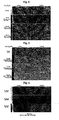
- FIGS. 3 to 5 are photographs illustrating the microstructures of the sintered ceramic samples.
- nitrogen is injected only in the range from the heating temperature [1623 K (1350°C)] to the sintering temperature [1783 K (1510°C), 1 hour]
- nitrogen is injected in the entire temperature range from the heating temperature [1473 K (1200°C)], through
- FIG. 5 illustrates the cases where carbonitride (Ti 0.5 W 0.5 )(CN) is subjected to sintering at 1783 K (1510°C) for 1 hour in a vacuum, where sintering is conducted by injecting nitrogen at 5 torr or 1 torr during the sintering [1783 K (1510°C), 1 hour and 1723 K (1450°C), 1 hour] and cooling, and where sintering is conducted by injecting nitrogen in the entire temperature range from the heating temperature [1473 K (1200°C)], through the sintering temperature [1783 K (1510°C), 1 hour], to the cooling temperature [1473 K (1200°C)].
- the (Ti,W)C or (Ti,W)(CN) solid-solution powder could be seen to have a complete solid-solution phase structure without a core/rim structure, and also to have a microstructure in which the second phase, such as whiskers having a size of 10 ⁇ m, was uniformly distributed along with the complete solid-solution phase on the surface or interior thereof.
- the second phase such as whiskers having a size of 10 ⁇ m
- Table 1 below shows the properties of respective ceramics, in particular, toughness and hardness, in which the value of the properties is an average value of five measurements.
- the hardness (H V ) and toughness (K IC ) of ceramics are measured using a Vicker's hardness meter under a load of 20 kg. The other materials are measured under a load of 10 ⁇ 30 kg.
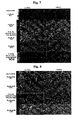
- FIGS. 6 to 8 are photographs illustrating the microstructures of the sintered cermet samples according to an embodiment of the present invention.
- FIG. 6 illustrates the microstructures of surfaces and interiors of the sintered bodies obtained by sintering some compositions [(Ti,W)C-20 wt% Ni; amount of WC is 30 mole%, 40 mole%, 50 mole%] of said (v) in a nitrogen atmosphere at a pressure of 40 torr.
- the sintering was conducted while nitrogen was injected in the entire temperature range from the heating temperature [1473 K (1200°C)], through the sintering temperature [1783 K (1510°C), 1 hour], to the cooling temperature [1473 K (1200°C)].
- FIG. 7 illustrates the sintered (Ti 1-x ,M x )C-Me type cermet powders containing 2.5 ⁇ 5.0 wt% of various binders (Co, Fe, FeCoNi).
- various binders Co, Fe, FeCoNi.
- vacuum sintering was conducted, or during the sintering and cooling, nitrogen of 5 torr was injected, and for (Ti 0.6 ,W 0.4 )C-5FeCoNi, nitrogen was injected in the entire temperature range.
- FIG. 8 illustrates the sintered (Ti 1-x , W x )(CN)-Co type cermet powders containing 2.5 ⁇ 5.0 wt% of binder (Co).
- binder Co
- the shape and amount of the second phase can be seen to vary depending on the type of binder, whether the atmosphere is present or not, and the nitrogen-injecting period. As the amount of the CO binder was greater, the circular second phase was formed. Moreover, in the same nitrogen atmosphere, the whisker second phase was more easily deposited from the (Ti 0.5 , W 0.5 ) (CN)-2.5Co cermet of FIG. 3c than from the (Ti 0.5 , W 0.5 )C-2.5Co cermet of FIG. 3b .
- the present invention may be applied to tool materials, such as cermets. Further, the present invention may be applied to ceramics having various structures requiring high hardness and high toughness.
Landscapes
- Chemical & Material Sciences (AREA)
- Engineering & Computer Science (AREA)
- Ceramic Engineering (AREA)
- Organic Chemistry (AREA)
- Manufacturing & Machinery (AREA)
- Materials Engineering (AREA)
- Structural Engineering (AREA)
- Inorganic Chemistry (AREA)
- Mechanical Engineering (AREA)
- Metallurgy (AREA)
- Physics & Mathematics (AREA)
- Thermal Sciences (AREA)
- Cutting Tools, Boring Holders, And Turrets (AREA)
- Powder Metallurgy (AREA)
Claims (14)
- Keramik, umfassend: einen Sinterkörper, enthaltend Vollfestlösungscarbid, Vollfestlösungscarbonitrid oder eine Mischung davon von zwei oder mehr Metallen, die einschließlich Titan und einem Metall der Gruppe VIa aus Metallen der Gruppe IVa, Va und VIa des Periodensystems ausgewählt sind, wobei in der Mikrostruktur des Sinterkörpers die Vollfestlösungsphase und eine zweite Phase zur Verbesserung der Zähigkeit, die von der Vollfestlösungsphase phasensepariert ist, vorliegen.
- Keramik nach Anspruch 1, wobei die Menge des gewählten Metalls der Gruppe VIa 30-50 Mol-%, bezogen auf die Gesamtmenge aller Metallelemente des Vollfestlöungscarbids oder -carbonitrids, beträgt.
- Keramik nach Anspruch 1, wobei in der Mikrostruktur des Sinterkörpers neben der Vollfestlösungsphase und der zweiten Phase zur Verbesserung der Zähigkeit, die von der Vollfestlösungsphase phasensepariert ist, ferner eine Teilfestlösungsphase, die zusätzlich mit der Vollfestlösungsphase gemischt ist, vorliegt.
- Cermet, umfassend: einen Sinterkörper, enthaltend Vollfestlöungscarbid, Vollfestlösungscarbonitrid oder eine Mischung davon von zwei oder mehr Metallen, die einschließlich Titan und einem Metall der Gruppe VIa aus Metallen der Gruppe IVa, Va und VIa des Periodensystems ausgewählt sind, und mindestens ein Metall aus der Gruppe bestehend aus Nickel, Cobalt und Eisen, wobei in der Mikrostruktur des Sinterkörpers die Vollfestlösungsphase und eine zweite Phase zur Verbesserung der Zähigkeit, die von der Vollfestlösungsphase phasensepariert ist, vorliegen.
- Cermet nach Anspruch 4, wobei die Menge des gewählten Metalls der Gruppe VIa 30-50 Mol-%, bezogen auf die Gesamtmenge aller Metallelemente des Vollfestlöungscarbids oder -carbonitrids, beträgt.
- Cermet nach Anspruch 4, wobei in der Mikrostruktur des Sinterkörpers neben der Vollfestlösungsphase und der zweiten Phase zur Verbesserung der Zähigkeit, die von der Vollfestlösungsphase phasensepariert ist, ferner eine Teilfestlösungsphase, die zusätzlich mit der Vollfestlösungsphase gemischt ist, vorliegt.
- Verfahren zur Herstellung der Keramik nach Anspruch 1, bei dem man Vollfestlösungsphasenpulver, enthaltend Vollfestlöungscarbid, Vollfestlösungscarbonitrid oder eine Mischung davon von zwei oder mehr Metallen, die einschließlich Titan und einem Metall der Gruppe VIa aus Metallen der Gruppe IVa, Va und VIa des Periodensystems ausgewählt sind, bereitstellt und das bereitgestellte Pulver sintert, wobei man durch Phasenseparation von dem Vollfestlösungsphasenpulver durch das Sintern eine zweite Phase zur Verbesserung der Zähigkeit erhält, wobei das Sintern des Pulvers in einer Gasatmosphäre von Stickstoff oder einer Stickstoff enthaltenden Mischung durchgeführt wird.
- Verfahren nach Anspruch 7, bei dem die Menge des gewählten Metalls der Gruppe VIa 30-50 Mol-%, bezogen auf die Gesamtmenge aller Metallelemente des Vollfestlöungscarbids oder -carbonitrids, beträgt.
- Verfahren nach Anspruch 7, bei dem man ferner das Pulver vor dem Sintern mit TiC- oder Ti(CN)-Hartphasenpulver mischt.
- Verfahren nach Anspruch 7, bei man man beim Sintern oder nach dem Sintern Heißpressen, isostatisches Heißpressen (HIP) oder GPS anwendet.
- Verfahren zur Herstellung des Cermets nach Anspruch 4, bei dem man mindestens ein Metall aus der Gruppe bestehend aus Nickel, Cobalt und Eisen, Oxid von zwei oder mehr Metallen, die einschließlich Titan und einem Metall der Gruppe VIa aus Metallen der Gruppe IVa, Va und VIa des Periodensystems ausgewählt sind, und Kohlepulver in einem vorbestimmten Zusammensetzungsverhältnis mischt oder mischt und mahlt, wodurch ein nanoskaliges Kristallitpulver bereitgestellt wird;
das Pulver reduziert und karburiert oder reduziert, karburiert und nitriert und das hergestellte Pulver sintert, wobei man durch Phasenseparation von dem Vollfestlösungsphasenpulver durch das Sintern eine zweite Phase zur Verbesserung der Zähigkeit erhält, wobei das Sintern des Pulvers in einer Gasatmosphäre von Stickstoff oder einer Stickstoff enthaltenden Mischung durchgeführt wird. - Verfahren nach Anspruch 11, bei dem die Menge des gewählten Metalls der Gruppe VIa 30-50 Mol-%, bezogen auf die Gesamtmenge aller Metallelemente des Vollfestlöungscarbids oder -carbonitrids, beträgt.
- Verfahren nach Anspruch 11, bei dem man ferner das Pulver vor dem Sintern mit TiC- oder Ti(CN)-Hartphasenpulver mischt.
- Verfahren nach Anspruch 11, bei man man beim Sintern oder nach dem Sintern Heißpressen, isostatisches Heißpressen (HIP) oder GPS anwendet.
Applications Claiming Priority (2)
| Application Number | Priority Date | Filing Date | Title |
|---|---|---|---|
| KR1020060055957A KR100796649B1 (ko) | 2006-06-21 | 2006-06-21 | 인성을 향상시키는 2차 상이 완전 고용상으로부터 상분리에의하여 형성된 세라믹과 서멧트 및 각각의 제조 방법 |
| PCT/KR2007/002998 WO2007148921A1 (en) | 2006-06-21 | 2007-06-20 | Ceramic and cermet having the second phase to improve toughness via phase separation from complete solid-solution phase and the method for preparing them |
Publications (3)
| Publication Number | Publication Date |
|---|---|
| EP2047005A1 EP2047005A1 (de) | 2009-04-15 |
| EP2047005A4 EP2047005A4 (de) | 2010-09-22 |
| EP2047005B1 true EP2047005B1 (de) | 2013-08-14 |
Family
ID=38833620
Family Applications (1)
| Application Number | Title | Priority Date | Filing Date |
|---|---|---|---|
| EP07747032.6A Active EP2047005B1 (de) | 2006-06-21 | 2007-06-20 | Keramik und cermet mit der zweiten phase zur verbesserung der zähigkeit mittels phasentrennung aus kompletter feststofflösungsphase und herstellungsverfahren dafür |
Country Status (4)
| Country | Link |
|---|---|
| US (1) | US8679220B2 (de) |
| EP (1) | EP2047005B1 (de) |
| KR (1) | KR100796649B1 (de) |
| WO (1) | WO2007148921A1 (de) |
Families Citing this family (5)
| Publication number | Priority date | Publication date | Assignee | Title |
|---|---|---|---|---|
| EP2049452A4 (de) * | 2006-08-08 | 2012-02-15 | Seoul Nat Univ Ind Foundation | Mischpulver mit mischkristallpulver und sinterkörper mit dem mischpulver, cermet-mischpulver mit mischkristallpulver und cermet mit dem cermet-mischpulver sowie herstellungsverfahren dafür |
| US10308558B2 (en) * | 2013-05-31 | 2019-06-04 | Sandvik Intellectual Property Ab | Process of manufacturing cemented carbide and a product obtained thereof |
| KR20200050558A (ko) | 2018-11-02 | 2020-05-12 | 서울대학교산학협력단 | 인성이 향상된 서멧트 및 그의 제조방법 |
| KR102320583B1 (ko) * | 2018-11-02 | 2021-11-02 | 서울대학교산학협력단 | 인성이 향상된 서멧트 및 그의 제조방법 |
| CN113999013A (zh) * | 2021-11-03 | 2022-02-01 | 哈尔滨理工大学 | 一种反应热压烧结法低温制备碳氮化物-硅化物固溶体复相陶瓷的方法 |
Citations (1)
| Publication number | Priority date | Publication date | Assignee | Title |
|---|---|---|---|---|
| US2942971A (en) * | 1955-02-03 | 1960-06-28 | Firth Sterling Inc | Process of making cemented carbide products |
Family Cites Families (15)
| Publication number | Priority date | Publication date | Assignee | Title |
|---|---|---|---|---|
| US566636A (en) * | 1896-08-25 | Angle-cock | ||
| JPS5129520B2 (de) * | 1971-09-09 | 1976-08-26 | ||
| JPS5819736B2 (ja) * | 1975-10-14 | 1983-04-19 | 日本特殊陶業株式会社 | 切削工義用焼結合金 |
| JP2580168B2 (ja) * | 1987-05-27 | 1997-02-12 | 東芝タンガロイ株式会社 | 窒素含有炭化タングステン基焼結合金 |
| US5380688A (en) * | 1993-08-09 | 1995-01-10 | The Dow Chemical Company | Method for making submicrometer carbides, submicrometer solid solution carbides, and the material resulting therefrom |
| KR0140409B1 (ko) * | 1994-09-29 | 1998-06-01 | 김은영 | 질화티탄 소결체의 제조 방법 |
| US5666636A (en) | 1995-09-23 | 1997-09-09 | Korea Institute Of Science And Technology | Process for preparing sintered titanium nitride cermets |
| JPH10502A (ja) * | 1996-06-11 | 1998-01-06 | Mitsubishi Materials Corp | すぐれた耐摩耗性を有する炭窒化物系サーメット製切削工具 |
| US5746803A (en) * | 1996-06-04 | 1998-05-05 | The Dow Chemical Company | Metallic-carbide group VIII metal powder and preparation methods thereof |
| JPH10242221A (ja) * | 1997-02-27 | 1998-09-11 | Mitsubishi Materials Corp | Icチップのリード材ボンディング用圧接工具 |
| US5756410A (en) * | 1997-02-27 | 1998-05-26 | The Dow Chemical Company | Method for making submicrometer transition metal carbonitrides |
| KR100528046B1 (ko) * | 2003-08-26 | 2005-11-15 | 한국과학기술연구원 | 균일한 고용체 입자구조를 갖는 초미세 결정립 서메트제조 방법 |
| SE527348C2 (sv) * | 2003-10-23 | 2006-02-14 | Sandvik Intellectual Property | Sätt att tillverka en hårdmetall |
| KR100626224B1 (ko) * | 2004-02-14 | 2006-09-20 | 재단법인서울대학교산학협력재단 | 고용체 분말, 그 제조 방법, 상기 고용체 분말을 포함하는서멧트용 분말, 그 제조 방법 및 상기 서멧트용 분말을이용한 서멧트 |
| KR100663666B1 (ko) * | 2005-04-22 | 2007-01-02 | 한국야금 주식회사 | 고인성 탄질화 티탄기 서멧트 및 이의 제조 방법 |
-
2006
- 2006-06-21 KR KR1020060055957A patent/KR100796649B1/ko not_active Expired - Fee Related
-
2007
- 2007-06-20 US US12/305,723 patent/US8679220B2/en active Active
- 2007-06-20 WO PCT/KR2007/002998 patent/WO2007148921A1/en not_active Ceased
- 2007-06-20 EP EP07747032.6A patent/EP2047005B1/de active Active
Patent Citations (1)
| Publication number | Priority date | Publication date | Assignee | Title |
|---|---|---|---|---|
| US2942971A (en) * | 1955-02-03 | 1960-06-28 | Firth Sterling Inc | Process of making cemented carbide products |
Also Published As
| Publication number | Publication date |
|---|---|
| WO2007148921A1 (en) | 2007-12-27 |
| KR100796649B1 (ko) | 2008-01-22 |
| EP2047005A1 (de) | 2009-04-15 |
| US20100273637A1 (en) | 2010-10-28 |
| KR20070121197A (ko) | 2007-12-27 |
| EP2047005A4 (de) | 2010-09-22 |
| US8679220B2 (en) | 2014-03-25 |
Similar Documents
| Publication | Publication Date | Title |
|---|---|---|
| KR100792190B1 (ko) | 유심구조가 없는 고용체 분말, 그 제조 방법, 상기 고용체분말을 포함하는 서멧트용 분말, 그 제조 방법, 상기고용체 분말 및 서멧트용 분말을 이용한 유심구조가 없는세라믹스 소결체 및 서멧트 | |
| KR101235201B1 (ko) | 고강도 초경합금 및 그 제조방법 | |
| KR101229124B1 (ko) | 고용체 탄화물 및 탄질화물 분말의 고온 제조 방법 | |
| KR100626224B1 (ko) | 고용체 분말, 그 제조 방법, 상기 고용체 분말을 포함하는서멧트용 분말, 그 제조 방법 및 상기 서멧트용 분말을이용한 서멧트 | |
| US20100273638A1 (en) | Solid-solution carbide/carbonitride powder and method for preparing thereof | |
| KR20170042617A (ko) | 경질 재료, 소결체, 소결체를 이용한 공구, 경질 재료의 제조 방법 및 소결체의 제조 방법 | |
| KR101113489B1 (ko) | 고용체 탄화물 및 탄질화물 분말 제조방법 | |
| EP2047005B1 (de) | Keramik und cermet mit der zweiten phase zur verbesserung der zähigkeit mittels phasentrennung aus kompletter feststofflösungsphase und herstellungsverfahren dafür | |
| KR101186456B1 (ko) | 금속 복합분말, 소결체 및 이의 제조 방법 | |
| JP3949181B2 (ja) | 硬質合金を結合材とするダイヤモンド燒結体及びその製造方法 | |
| KR20120086457A (ko) | 완전 고용체 초경 분말, 판상 탄화물을 보유한 초경 소결체, 코팅초경 및 이들의 제조 방법 | |
| EP0480636B1 (de) | Verschleissfeste Materialien hoher Härte | |
| US8303681B2 (en) | Mixed powder and sintered body, mixed cermet powder and cermet, and fabrication methods thereof | |
| KR100755882B1 (ko) | 새로운 Ti계 고용체 절삭 공구 소재 | |
| KR100904234B1 (ko) | 인성이 향상된 세라믹스, 그 제조방법, 인성이 향상된서멧트, 그 제조방법 | |
| JP3481702B2 (ja) | 硬質合金を結合材とする立方晶窒化硼素燒結体及びその製造方法 | |
| EP0689525B1 (de) | Komplexes mehrphasiges reaktionsgesintertes hartes und verschleissfestes material | |
| JP3092887B2 (ja) | 表面調質焼結合金及びその製造方法 | |
| KR20110043258A (ko) | 탄화물계 내마모 복합소재 | |
| KR20140036781A (ko) | 고용체 탄화물 및 탄질화물 나노분말을 사용한 고성능 마이크로 드릴 | |
| JPS61183437A (ja) | 高強度焼結合金及びその製造方法 | |
| KR20170057593A (ko) | 열간 등방압 저압 소결에 의한 입방정 질화붕소-초경합금 복합 소결체 |
Legal Events
| Date | Code | Title | Description |
|---|---|---|---|
| PUAI | Public reference made under article 153(3) epc to a published international application that has entered the european phase |
Free format text: ORIGINAL CODE: 0009012 |
|
| 17P | Request for examination filed |
Effective date: 20090121 |
|
| AK | Designated contracting states |
Kind code of ref document: A1 Designated state(s): AT BE BG CH CY CZ DE DK EE ES FI FR GB GR HU IE IS IT LI LT LU LV MC MT NL PL PT RO SE SI SK TR |
|
| AX | Request for extension of the european patent |
Extension state: AL BA HR MK RS |
|
| DAX | Request for extension of the european patent (deleted) | ||
| RBV | Designated contracting states (corrected) |
Designated state(s): AT DE FR GB SE |
|
| A4 | Supplementary search report drawn up and despatched |
Effective date: 20100825 |
|
| RIC1 | Information provided on ipc code assigned before grant |
Ipc: C22C 29/10 20060101AFI20080306BHEP Ipc: C04B 35/58 20060101ALI20100819BHEP Ipc: C04B 35/56 20060101ALI20100819BHEP |
|
| 17Q | First examination report despatched |
Effective date: 20110714 |
|
| GRAJ | Information related to disapproval of communication of intention to grant by the applicant or resumption of examination proceedings by the epo deleted |
Free format text: ORIGINAL CODE: EPIDOSDIGR1 |
|
| GRAP | Despatch of communication of intention to grant a patent |
Free format text: ORIGINAL CODE: EPIDOSNIGR1 |
|
| GRAS | Grant fee paid |
Free format text: ORIGINAL CODE: EPIDOSNIGR3 |
|
| GRAA | (expected) grant |
Free format text: ORIGINAL CODE: 0009210 |
|
| AK | Designated contracting states |
Kind code of ref document: B1 Designated state(s): AT DE FR GB SE |
|
| REG | Reference to a national code |
Ref country code: GB Ref legal event code: FG4D |
|
| REG | Reference to a national code |
Ref country code: AT Ref legal event code: REF Ref document number: 626932 Country of ref document: AT Kind code of ref document: T Effective date: 20130815 |
|
| REG | Reference to a national code |
Ref country code: DE Ref legal event code: R096 Ref document number: 602007032246 Country of ref document: DE Effective date: 20131010 |
|
| REG | Reference to a national code |
Ref country code: SE Ref legal event code: TRGR |
|
| REG | Reference to a national code |
Ref country code: AT Ref legal event code: MK05 Ref document number: 626932 Country of ref document: AT Kind code of ref document: T Effective date: 20130814 |
|
| PG25 | Lapsed in a contracting state [announced via postgrant information from national office to epo] |
Ref country code: AT Free format text: LAPSE BECAUSE OF FAILURE TO SUBMIT A TRANSLATION OF THE DESCRIPTION OR TO PAY THE FEE WITHIN THE PRESCRIBED TIME-LIMIT Effective date: 20130814 |
|
| PLBE | No opposition filed within time limit |
Free format text: ORIGINAL CODE: 0009261 |
|
| STAA | Information on the status of an ep patent application or granted ep patent |
Free format text: STATUS: NO OPPOSITION FILED WITHIN TIME LIMIT |
|
| 26N | No opposition filed |
Effective date: 20140515 |
|
| REG | Reference to a national code |
Ref country code: DE Ref legal event code: R097 Ref document number: 602007032246 Country of ref document: DE Effective date: 20140515 |
|
| GBPC | Gb: european patent ceased through non-payment of renewal fee |
Effective date: 20140620 |
|
| REG | Reference to a national code |
Ref country code: FR Ref legal event code: ST Effective date: 20150227 |
|
| PG25 | Lapsed in a contracting state [announced via postgrant information from national office to epo] |
Ref country code: GB Free format text: LAPSE BECAUSE OF NON-PAYMENT OF DUE FEES Effective date: 20140620 Ref country code: FR Free format text: LAPSE BECAUSE OF NON-PAYMENT OF DUE FEES Effective date: 20140630 |
|
| PGFP | Annual fee paid to national office [announced via postgrant information from national office to epo] |
Ref country code: DE Payment date: 20250520 Year of fee payment: 19 |
|
| PGFP | Annual fee paid to national office [announced via postgrant information from national office to epo] |
Ref country code: SE Payment date: 20250523 Year of fee payment: 19 |