EP2047455B1 - Vorrichtung zur herstellung von signalen, die töne eines tasten- und saiteninstruments darstellen - Google Patents
Vorrichtung zur herstellung von signalen, die töne eines tasten- und saiteninstruments darstellen Download PDFInfo
- Publication number
- EP2047455B1 EP2047455B1 EP07823284A EP07823284A EP2047455B1 EP 2047455 B1 EP2047455 B1 EP 2047455B1 EP 07823284 A EP07823284 A EP 07823284A EP 07823284 A EP07823284 A EP 07823284A EP 2047455 B1 EP2047455 B1 EP 2047455B1
- Authority
- EP
- European Patent Office
- Prior art keywords
- note
- representative
- parameter
- sounds
- module
- Prior art date
- Legal status (The legal status is an assumption and is not a legal conclusion. Google has not performed a legal analysis and makes no representation as to the accuracy of the status listed.)
- Ceased
Links
Images


Classifications
-
- G—PHYSICS
- G10—MUSICAL INSTRUMENTS; ACOUSTICS
- G10H—ELECTROPHONIC MUSICAL INSTRUMENTS; INSTRUMENTS IN WHICH THE TONES ARE GENERATED BY ELECTROMECHANICAL MEANS OR ELECTRONIC GENERATORS, OR IN WHICH THE TONES ARE SYNTHESISED FROM A DATA STORE
- G10H7/00—Instruments in which the tones are synthesised from a data store, e.g. computer organs
- G10H7/08—Instruments in which the tones are synthesised from a data store, e.g. computer organs by calculating functions or polynomial approximations to evaluate amplitudes at successive sample points of a tone waveform
- G10H7/10—Instruments in which the tones are synthesised from a data store, e.g. computer organs by calculating functions or polynomial approximations to evaluate amplitudes at successive sample points of a tone waveform using coefficients or parameters stored in a memory, e.g. Fourier coefficients
-
- G—PHYSICS
- G10—MUSICAL INSTRUMENTS; ACOUSTICS
- G10H—ELECTROPHONIC MUSICAL INSTRUMENTS; INSTRUMENTS IN WHICH THE TONES ARE GENERATED BY ELECTROMECHANICAL MEANS OR ELECTRONIC GENERATORS, OR IN WHICH THE TONES ARE SYNTHESISED FROM A DATA STORE
- G10H1/00—Details of electrophonic musical instruments
- G10H1/02—Means for controlling the tone frequencies, e.g. attack or decay; Means for producing special musical effects, e.g. vibratos or glissandos
- G10H1/06—Circuits for establishing the harmonic content of tones, or other arrangements for changing the tone colour
- G10H1/16—Circuits for establishing the harmonic content of tones, or other arrangements for changing the tone colour by non-linear elements
-
- G—PHYSICS
- G10—MUSICAL INSTRUMENTS; ACOUSTICS
- G10H—ELECTROPHONIC MUSICAL INSTRUMENTS; INSTRUMENTS IN WHICH THE TONES ARE GENERATED BY ELECTROMECHANICAL MEANS OR ELECTRONIC GENERATORS, OR IN WHICH THE TONES ARE SYNTHESISED FROM A DATA STORE
- G10H5/00—Instruments in which the tones are generated by means of electronic generators
- G10H5/007—Real-time simulation of G10B, G10C, G10D-type instruments using recursive or non-linear techniques, e.g. waveguide networks, recursive algorithms
-
- G—PHYSICS
- G10—MUSICAL INSTRUMENTS; ACOUSTICS
- G10H—ELECTROPHONIC MUSICAL INSTRUMENTS; INSTRUMENTS IN WHICH THE TONES ARE GENERATED BY ELECTROMECHANICAL MEANS OR ELECTRONIC GENERATORS, OR IN WHICH THE TONES ARE SYNTHESISED FROM A DATA STORE
- G10H2250/00—Aspects of algorithms or signal processing methods without intrinsic musical character, yet specifically adapted for or used in electrophonic musical processing
- G10H2250/315—Sound category-dependent sound synthesis processes [Gensound] for musical use; Sound category-specific synthesis-controlling parameters or control means therefor
- G10H2250/441—Gensound string, i.e. generating the sound of a string instrument, controlling specific features of said sound
- G10H2250/451—Plucked or struck string instrument sound synthesis, controlling specific features of said sound
Definitions
- the invention relates to a device for digitally producing signals representative of sounds having a sound simulating that of a keyboard and string instrument connected to a soundboard of the instrument, these sounds each corresponding to a note of the instrument.
- waveguide synthesis methods known as waveguide synthesis methods, according to which a resonator of the musical instrument (a piano string for example) is represented by means of a delay loop comprising linear signal processing members (in particular filters) whose transfer function is determined according to the properties (resonance and attenuation) of the resonator.
- a waveform is introduced as an excitation in the delay loop.
- the shape of the excitation waves and the design parameters of the delay loop filters are obtained either by manual adjustment, by trial and error, of each filter for each instrument configuration to be simulated (which is long complex, provides unreliable results, and does not allow quick and easy configuration changes), either from a recorded signal recorded on a traditional acoustic piano (the simulation is then very imperfect, a real piano n 'not being a network of waveguides). Therefore, the scope of these waveguide methods is strictly limited to the imperfect, unrealistic imitation of the sound of a single instrument corresponding to the manual adjustments of the filters, or from which the recording is taken. of the recorded signal.
- the invention aims to propose a device for real-time digital simulation of sounds of a keyboard and string instrument connected to a soundboard such as a piano, with which the user (c. that is, the player) can easily and quickly choose and change the sound of the sounds produced.
- the invention aims at enabling the user to define, according to intuitive criteria, any instrument sound, the device producing, for each of the sounds thus defined, sounds whose timbre bears the distinctive character of this sound. .
- the invention aims at providing such a device enabling a user to quickly and easily define any sound corresponding to any instrument that can be both a real instrument known traditional invoice, an instrument whose physical characteristics are determined directly by the user, or even a totally virtual instrument unrealizable in reality, and able to reproduce such a sound.
- the invention also aims to enable the user to define, particularly intuitively, new instrument timbres, including timbres corresponding to instruments whose invoice would be impracticable in practice because of mechanical constraints in this area, including constraints related to the physical properties of materials, constraints related to known invoice techniques, economic constraints ...
- the invention aims to provide a device for simulating a wide range of instruments, allowing a user to act directly, simply and quickly on the physical parameters of the instrument to simulate likely in fact to influence the timbre.
- the invention also aims to provide the player with a playing comfort equivalent to that of traditional acoustic pianos, or at least approximating such comfort of play.
- the invention aims to provide a solution providing a delay of little or no noticeable response between each action of the instrumentalist and the corresponding sound effect.
- the invention aims to provide a solution compatible with the computing power and memory space presented by known computers currently marketed at a price accessible to the general public.
- the invention aims to produce sounds in real time on a personal computer available commercially at a low price respecting the rhythm of a fast musical score.
- the invention aims to provide a solution providing high quality and high acoustic performance while presenting an economic cost.
- a device further comprises means for input by a user of at least one physical parameter, said presynthesis module being adapted to produce the coefficients stamp from the physical parameters entered.
- said presynthesis module being adapted to produce the coefficients stamp from the physical parameters entered.
- the said measurable physical properties correspond to measurable properties that do not make it possible to evaluate the acoustic behavior or the sound provided without solving equations; in particular, it is not a question of the characteristics of a sound provided by a real keyboard and string instrument to be simulated, nor of the acoustic behavior of a real keyboard and string instrument to be simulated. On the contrary, they are measurable physical properties on which the instrument factor and / or the instrument tuner could physically intervene in the case of a real keyboard and string instrument.
- the physical parameters of soundboard and string (s) condition the physical characteristics of the keyboard and string instrument to be simulated, and are independent of the simulation device (the values of these physical parameters being predetermined, or determined or modified by an input by the user, constituting input values of the presynthesis module, and not modified by a subsequent digital processing), each of these physical parameters can be modified independently of the others to obtain a corresponding modification sounds produced.
- the invention thus makes it possible to define, particularly intuitively, different sounds of keyboard and string instruments and to produce realistic sounds corresponding to these different sounds.
- the inventor has been able to implement devices according to the invention adapted to be able to reproduce with a high degree of fidelity the characteristic sound of any real mechanical instrument with keyboard and strings. of traditional invoice.
- no prior known device for producing sounds in real time can obtain such a result by proceeding from physical parameters of soundboard and string parameters (s).
- the invention allows the user to enter values of said physical parameters which do not necessarily correspond to those of a real instrument, and which can extend to extreme values not actually encountered (for example, dimensions that are excessively important, or otherwise weak, of the soundboard), or even fanciful values not technically feasible in practice (quadratic term equal to zero, several strings for low frequencies, dimensions of the soundboard normally incompatible with the tensile strength of the ropes ).
- the invention thus makes it possible to explore sounds of virtual instruments at infinity.
- the inventor has determined that it is practically possible, for the operation of the presynthesis module, to use a mechanical modeling of the keyboard and string instrument to be simulated describing each string, the soundboard and the coupling of all strings and the soundboard of the keyboard and string instrument.
- a device according to the invention may comprise a modest memory capacity compared to known devices using prerecorded sounds of keyboard and string instruments, including piano .
- the above-mentioned mechanical modeling used for the presynthesis module of a device according to the invention can be used for any keyboard and string instrument, such as the piano, the pantaleon, the harpsichord, the clavichord, the pianoforte, etc.
- the above-mentioned prejudice is particularly aimed at mechanical piano models. Indeed, the sound of the piano is particularly rich and difficult to reproduce accurately.
- This mechanical modeling makes it possible, in a device according to the invention, to calculate sets of values of distinct stamp coefficients, notably in the form of a table, in association with sets of corresponding values for the different physical parameters that the user can edit.
- An initial configuration of the presynthesis module is thus carried out, so that the determination of the timbre coefficients at each modification of a physical parameter by the user can be carried out by the presynthesis module directly by interpolation from pre-recorded values for these timbre coefficients.
- the (the) parameter (s) of chord (s) is (are) distinct (s) parameter (s) soundboard.
- the device comprises means for inputting at least one soundboard parameter.
- the device comprises means for capturing at least one string parameter (s).
- At least one string parameter is representative of a tuning difference between at least two coupled strings corresponding to the note.
- the inventor was able to obtain realistic piano sounds by taking into account the mutual influence of the strings of a set of coupled strings corresponding to the piano note.
- At least one soundboard parameter is representative of at least one property of the material of the soundboard.
- a soundboard parameter can be a weighting factor of the Hooke tensor values of the soundboard or a dimension of the soundboard.
- the physical parameters comprise, for a plurality of frequencies, at least one soundboard parameter representative of the impedance of the soundboard of the keyboard and string instrument for each of these frequencies.
- the physical parameters may comprise a soundboard parameter representative of the impedance of the soundboard for each frequency of a plurality of frequencies each of which corresponds to at least a partial portion of the note.
- the device comprises manual input means.
- the presynthesis module is adapted to determine from values entered of said physical parameters, the values of a plurality of modal elements comprising, in addition to said timbre coefficients, modal shift parameters representative of the modes. own the coupled system of the soundboard and strings.
- the presynthesis module is adapted to determine the values of the modal elements from a constellation of previously memorized points each associating a set of values of the physical parameters that can be entered by a user with a game. of modal elements.
- the values of the modal elements of each point are determined beforehand according to a mechanical model of the instrument which takes into account the coupling of the strings and the soundboard.
- said mechanical modeling takes into account tuning differences between the unison strings of the notes.
- the presynthesis module is adapted to determine excitation parameters representative of the initial amplitude a n ( p ) and of the phase shift ⁇ n ( p ) of each partial n of the notes p.
- the presynthesis module is adapted to perform at least one presynthesis process in the background, that is to say, not in real time.
- the timbre coefficients are determined by the presynthesis module by a process that is not a real-time process and therefore does not affect the efficiency and performance of the real-time sound generation module.
- each trigger signal is formed of a message relating to the actions of an instrumentalist on the keys of a keyboard-in particular a MIDI- message.
- These Trigger messages can be any other format than the standard MIDI.
- the production module realizes in real time the synthesis of a signal representative of a piano sound as a function of the values of the timbre coefficients and the excitation parameters corresponding to a note p to produce and a striking intensity of this note p, as determined by a received trigger signal.
- a device comprises a computer system incorporating a software for synthesizing sounds simulating the sound of a keyboard instrument, strings and soundboard, this sound synthesis software forming each presynthesis module and each module of real-time production of sounds, and having a human-machine interface adapted to allow a user to form trigger signals and to present said means for capturing at least one physical parameter.
- the instrument to be simulated being a piano
- a device according to the invention comprises at least one electronic keyboard with mechanical piano keys.
- this keypad can be simulated by the virtual human-machine interface of the computer system.
- said input means comprise means adapted to allow the user to modify, before use by the production module in real time, at least one timbre coefficient f n , d n and / or at least one excitation parameter a n , ⁇ n determined by the presynthesis module.
- the user can modify one and / or the other of these coefficients or parameters according to simple laws.
- the invention extends to a recording medium - in particular of the removable type (CD-ROM, DVD, USB key, external electronic hard disk, etc.) - adapted to be read in a reader of a computing device, and comprising a registered computer program adapted to be loaded into RAM memory of said computing device when said recording medium is loaded into said reader, characterized in what this computer program is adapted so that, when loaded in RAM of this computing device, the latter constitutes a device for producing digitally representative signals of sounds according to the invention.
- a recording medium in particular of the removable type (CD-ROM, DVD, USB key, external electronic hard disk, etc.) - adapted to be read in a reader of a computing device, and comprising a registered computer program adapted to be loaded into RAM memory of said computing device when said recording medium is loaded into said reader, characterized in what this computer program is adapted so that, when loaded in RAM of this computing device, the latter constitutes a device for producing digitally representative signals of sounds according to the invention.
- the invention also relates to a device and a recording medium characterized in combination by all or some of the features mentioned above or below.
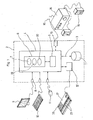
- a software for synthesizing piano sounds is recorded in the form of one or more files in a mass memory 1 of a computer system such as a microcomputer 2. type personal computer, says PC.
- the mass memory is adapted to be able to transmit, through a bus 3 of data, the executable data corresponding to these backup files to a processing unit 4 comprising at least one processor 5 and an associated RAM 6.
- Such transmission of data to the processing unit 4 can be carried out in a traditional manner by calling on system functions of an operating system 7 loaded into RAM and executing by means of the processing unit 4. of the microcomputer 2.
- the operating system 7 includes software drivers adapted to allow the use of peripherals which is equipped with the microcomputer 2. These devices include a graphic card 8 and its monitor 9 associated, an alphanumeric keyboard, a mouse 11, a MIDI interface 12, the mass memory 1 and a 13 audio card.
- This microcomputer 2 further comprises ports and data input / output controllers, buses and interfaces for communication between the aforementioned peripherals and the processing unit 4.
- the device further comprises an audio amplifier 14 to which is connected the audio card 13 of the microcomputer 2 via a cable 15 for transmitting an audio signal.
- This amplifier is itself connected to at least one speaker 16 to which it transmits an amplified audio signal to translate this signal in the form of audible sounds.
- the device further comprises a keyboard, said MIDI keyboard 17, having a port, said MIDI OUT interface, for connection to the transmission of messages, so-called MIDI messages, compliant the so-called Digital Musical Instrument Interface (MIDI).
- MIDI messages are representative of events, detected by the keyboard 17, produced as a result of the user's actions on keys 23 or by means of buttons 33 of the MIDI keyboard 17.
- MIDI messages called MIDI musical performance messages, related to the playing of the instrumentalist (triggering of a note, speed of depression of the corresponding key, release of a note, actuation of a pedal etc.). ) are detected in particular actions of the instrumentalist on keys 23 of the keyboard.
- the MIDI OUT interface is connected by means of a suitable cable, called MIDI cable, to an input port, called MIDI IN, of the MIDI interface of the microcomputer.
- MIDI cable a suitable cable
- MIDI IN an input port
- the piano sound synthesis software is adapted to interpret any received musical performance MIDI message and produce audio signals in a digital format.
- the generated signals are transmitted to the audio card, the amplifier and at least one associated speaker (or headset) for real-time production of audible piano sounds.
- the MIDI musical performance messages generated and transmitted by the MIDI keyboard to the processing unit form trigger signals relating to the playing of an instrumentalist and which make it possible, thanks to the device according to the invention, to produce audio signals representative of sounds corresponding to this game.
- these musical performance messages representative of a game of an instrumentalist can be in any other format than the MIDI standard.
- the trigger signals must be representative of at least the main frequency of a note and its duration and, preferably, also its intensity (or velocity).
- the audio signals are each obtained by performing the sum of so-called partial, sinusoidal exponentially damped signals and a percussion signal.
- Each of the partials (identified by the index n ) is defined by two coefficients: the frequency, called frequency f n , and the damping coefficient, said coefficient d n which form the timbre coefficients according to the invention.
- each note p of the piano to be simulated is associated, in the software for synthesizing piano sounds, with a set of timbre coefficients defining a plurality of partials.
- Each note p can correspond to a string or several strings, called strings of unison. It should be noted that for a note p with K unison strings (K being an integer greater than or equal to 1), there exist K partial n for each harmonic of the note p. As an example, for a note whose fundamental is 440 Hz and which has 3 strings, there are 3 modes corresponding to 3 partials whose frequencies are close to 440 Hz, 3 modes corresponding to 3 partials whose frequencies are close to 880 Hz, etc.
- the harmonic term must be interpreted as designating the mode of vibration of the system formed by the coupling of the soundboard and strings of the corresponding note p.
- this term designates modes of vibration whose frequency is not necessarily an integral multiple of that of the fundamental mode.
- the magnitude s may be a vector quantity, each component corresponding to an audio output channel.
- the quantities a n , ⁇ n and b n are also vectorial.
- Each component of s is associated with the corresponding component of a n , ⁇ n and b n .
- the resonator corresponds to the coefficients d n ( p ) and f n (p) and the exciter corresponds to the coefficients a n ( p ) and ⁇ n ( p ).
- the resonator is the operator associated with the model, its eigenvalues determining d n ( p ) and f n ( p ).
- the exciter is the second member of the system associated mechanics, the coefficients of the solution of this system in the base of eigen modes determining a n (p) and ⁇ n (p).
- the piano sound synthesis software is adapted to determine the values of the timbre coefficients for all the notes of the piano according to physical parameters representative of measurable physical measurable properties of the instrument, having an influence on the timbre of the sounds produced. by a corresponding real instrument, but not allowing to evaluate the acoustic behavior or the sound provided without resolution of equations.
- the physical parameters advantageously comprise parameters of the soundboard, and in particular parameters, called impedance parameters, each representative of the impedance Z np that the piano soundboard presents for a partial n of a piano note p.
- the physical parameters advantageously comprise string parameters (s), and in particular parameters, called tuning parameters, each representative of a tuning gap ⁇ p between a plurality of coupled piano strings corresponding to the note p.
- the device according to the invention is adapted to allow input, by the user (that is to say by the instrumentist) of the physical parameters, so that it results in a modification of the values d n ( p ) and f n (p) (denoted d np and f np in the figures 7 and 8 ) timbre coefficients and, consequently, a change in the timbre of the sounds produced.
- the modification of the timbre of the sounds produced must correspond to the modification of the physical parameters entered by the user.
- the software for synthesizing piano sounds comprises a module, said presynthesis module 19, capable of determining the values to be assigned to the timbre coefficients as a function of the physical parameters according to a function, called the interpolation function.
- the interpolation function makes it possible to determine the values of a plurality of modal elements, from values entered of the physical parameters.
- the modal elements comprise the timbre coefficients and modal displacements, representative of the eigen modes, called u np modes, of the coupled system of the soundboard and strings. Each of these modes u np corresponding to a partial n of the note p.
- This interpolation function is built prior to the realization of the device according to the invention of this example by means of a computer from a constellation of points each associating a set of values Z np , ⁇ p , physical parameters with a set of values, f np , d np , u np modal elements. To do this, said computer generates numerical coefficients defining this interpolation function.
- the interpolation function it is possible to use multi-variable polynomial functions, radial basic functions, etc.
- the construction of the constellation of points is based on techniques known in themselves such as hypercubes. space filling (space filling) or the sparse grid technique.
- a linear regression function can also be considered.
- the successive derivatives of the modal elements with respect to said physical parameters are calculated for the construction of a Taylor polynomial or a multivariate Padé approximant.
- the constellation of points is then replaced by a constellation of derivation directions.
- the values of the modal elements of each point are determined, prior to the execution of the approximation method, according to a mechanical model of the piano, based on the physical parameters of the latter, and in particular the values entered by the user.
- This mechanical modeling is implemented according to a numerical analysis method.
- the numerical analysis method may be executed by a computer (not shown in the figures).
- a finite element method can be used to model the soundboard and the strings of a piano in order to determine the dynamic behavior of the system formed by the soundboard and strings of the piano. in order to determine its complex resonant frequencies ( f np + id np / 2 ⁇ ) as well as the so-called eigen modes u np of the coupled system of the soundboard and strings.
- the publication PH. GUILLAUME Nonlinear eigenproblems, SIAM J. Matrix Anal. Appl. Vol 20 No 3 (1999), 575-595 , describes a method for calculating complex eigenvalues of a nonlinear eigenvalue system, which can be used in the present invention.
- Matrixes of mass, rigidity and damping necessary for the implementation of the finite element method are established according to a piano model to simulate.
- these matrices are determined as a function of parameter values, called piano modeling parameters, of this piano model to be simulated.
- each note p corresponds to one or more unison strings on which a hammer corresponding to this note is struck.
- some bass notes of the piano to simulate may include one or two strings of unison while the other notes may include three strings of unison.
- the piano modeling parameters of the first exemplary implementation of the invention comprise at least one soundboard modeling parameter.
- a weighting factor of the values of the Hooke tensor of the soundboard can constitute a modeling parameter of the soundboard.
- the matrices of mass, stiffness and damping are established according to the dimensions and the structure of the strings and the soundboard, as well as the Hooke tensor of these elements of the piano as determined by the model of the piano to simulate and the values of the piano modeling parameters.
- the finite element method is implemented to determine, for each note p of the piano to simulate, an impedance value Z np of the soundboard for each partial n of the note p. These Z np soundboard impedance values are representative of the physical properties of the soundboard.
- the piano model of the first embodiment of the invention is a model close to reality.
- each string of the piano can be modeled as an elastic beam.
- the inventor has found that the use of such a model makes it possible to translate the effect of inharmonicity occurring due to the considerable rigidity of the string in bending, as well as the quadratic effect due to the interaction with the easel. This last sound effect is all the more noticeable as the vibration amplitude of the string is important, so that the notes are played strongly.
- each rope is considered to be embedded at the attachment point and the nut.
- This attachment point and the nut can be considered as totally immobile so that the position of the rope at the nut and the position of the rope at the point of attachment form, in the model of the first example, boundary conditions of the rope.
- each string is considered to be rigidly connected with the bridge of the soundboard through trestle points in accordance with the rules of the art in the matter of piano bill.
- this modeling takes into account the coupling of the strings of the piano and the soundboard.
- This coupling is provided in the traditional pianos at the level of the bridge because of forcing the position of each string in this place.
- the model makes it possible to take into account the mutual influence of the piano strings, in particular the sympathetic resonance phenomenon between the notes and the mutual influence of the unison strings of the same note.
- the inventor has found that taking into account, in the modeling, this coupling of the strings and the soundboard as well as tuning differences between the unison strings of the notes makes it possible to obtain a device producing realistic piano sounds.
- a hull model can be used to represent by finite elements the soundboard, including the saddle and the bridge of this soundboard.
- a tier 1 laminar model may further be used to account for the orientation of the soundboard fiber with reinforcements in the orthogonal direction.
- the soundboard can also be modeled by an isotropic material with an addition of reinforcements in the direction of the fiber and in the orthogonal direction. Finally, one can use a three-dimensional model, called 3D model, isotropic or not.
- the finite element method is implemented several times by varying, after each analysis step (iteration), the value of at least one piano modeling parameter so as to modify the physical properties of the piano.
- the matrices of the finite element method are redefined accordingly after each of the analysis steps.
- a plurality of representative points of different mechanical piano configurations as defined by Z np , ⁇ p , physical parameters
- corresponding acoustic behavior as defined by f np , d np , timbre coefficients obtained from the values Z np , ⁇ p , physical parameters
- the finite element method is repeated a large number of times. It is a question of providing a number of distinct points making it possible to define the interpolation function with sufficient precision so that it makes it possible to obtain, from a set of values Z np , ⁇ p , physical parameters. , which correspond to the values that can be entered by the user, values f np , d np , u np modal elements representative of the mechanical configuration corresponding to these values of the physical parameters.
- the set of these associated values is determined by prior calculations and its values and their correspondences are used by an interpolation process of the presynthesis module.
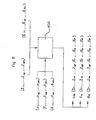
- the process defined by the figure 7 is executed on a high power computer that is not represented. These calculations are carried out beforehand and not in real time, their results are recorded in a mass memory accessible to the sound production module, so that this sound production module can generate sounds of stringed instruments and sound. keyboard in real time.
- the interpolation function can be determined using a kriegage technique, neural networks, a vector support machine, called SVM, a radial mass function, called RBF, or any interpolation adapted.
- GUILLAUME Optimal Shape Design
- the multivariate Padé method can be used as an approximation method (cf. PH. GUILLAUME, Nested Multivariate Padé Approximants, Journal of Computational and Applied Mathematics, 82 (1997), 149-158 - PH. GUILLAUME, A. HUARD, V. ROBIN, Generalized Multivariate Padé Approximants, J. Approx. Theory, Vol. 95, No. 2 (1998), 203-214 - PH. GUILLAUME, Convergence of the Nested Multivariate Padé Approximants, J. Approx. Theory, Vol. 94, No. 3 (1998), 455-466 - PH. GUILLAUME, A. HUARD, Multivariate Padé approximation, Journal of Computational and Applied Mathematics 121 (2000), 197-219 ).
- the points from which the approximation method is implemented can be determined by any method other than the finite element method.
- any method for determining the dynamic behavior, the u np modes and the complex resonant frequencies can be used.
- the points can be determined using spectral methods or using the finite difference principle.
- equivalent circuits, trellises of beams or equivalent bars, an analytical or spectral calculation can be used.
- an input of physical parameters can be carried out by the user by any means.
- such a capture can be carried out directly by the user from human machine interface devices which is equipped with the microcomputer, in particular the screen 9 and the mouse.
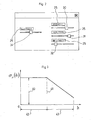
- the software for synthesizing piano sounds of the first example of implementation of the invention can define a graphical interface displayed on the monitor 9 during the execution of the software for synthesizing piano sounds.
- This interface comprises a plurality of graphic elements representing buttons 30, 31, 32, 34, mounted on slides, identified for the attention of the user by textual elements.
- the software for synthesizing piano sounds includes backup files defining, for each note p of the piano, default values for tuning parameters.
- the position of a button 34 of the graphical interface of the first exemplary implementation of the invention makes it possible to determine the value of a weighting factor.
- the software for synthesizing piano sounds is adapted to multiply this weighting factor with each of the default values of the tuning parameters.
- the values resulting from this multiplication correspond to values ⁇ p entering the tuning parameters in order to determine the values u np , dnp , fnp , of the modal elements by means of the interpolation function.
- the input of the impedance values Z np of the mechanical parameters is carried out for each note p according to a function, called the weighting function.
- This weighting function defines a weighting factor for each impedance value of a plurality of default impedance values each corresponding to a partial n of this note p.
- the position of the buttons 30, 31, 32 of the graphical interface of the first exemplary implementation of the invention allows the user to modify the weighting functions so that the impedance values obtained by weighting, according to these functions, default impedance values correspond to values Z np seizures impedance parameters.
- These entered Z np values are used to determine the u np , d np , f np values of the modal elements by means of the interpolation function.
- the default impedance values can be read by the piano sound synthesis software in backup files. These default impedance values can be the values Z npj determined during an analysis number j by the finite element method.
- the piano sound synthesis software of the first example may include backup files defining, for each note p of the piano, default values of parameters of the corresponding weighting function. Each weighting function defines a value of the weighting factor ⁇ p ( h ) for each harmonic of the note p as a function of the rank h harmonic. The weighting factor ⁇ p ( h ) thus defined for each harmonic is used to weight the modules of the default impedance values of the K partials of the note p corresponding to this harmonic.
- Each weighting function can be a continuous affine function composed of two parts.
- the figure 3 illustrates such a function having the weighting factor ⁇ p (h) on the ordinate and the rank h of harmonics on the abscissa.
- a first constant portion 42 defines a constant weighting factor for low order harmonics.
- a second part 43 defines a decreasing weighting factor with the rank h of high order harmonics.
- Each weighting function can be defined using three weighting function parameters.
- a first parameter said weighting constant 40, determines the value of the weighting factor for the low order harmonics.
- a second parameter called clipping index 41, determines the rank from which the weighting function becomes decreasing. This index corresponds to the maximum rank of low order harmonics.
- a third parameter called quality factor, determines the slope of the second part 43 of the affine function.
- buttons 30, 31, 32 of the graphical interface form means for entering the parameters of the weighting functions of all the notes.
- the position of each button relative to its slideway may be representative of a weighting factor to be applied to the default values of the weighting function parameters.
- each of the three buttons 30, 31, 32 makes it possible to modify, in a uniform manner or not, the parameters of the weighting functions of all the notes of the piano: the first button 30 makes it possible to modify the constants 40 of weighting of these functions the second button 31 makes it possible to modify the clipping indices 41 of these functions and the third button 32 makes it possible to modify the quality factors of these functions.
- buttons 30, 31, 32 and 34 of the graphical interface as well as the peripherals allowing their manipulation form means for entering physical parameters according to the invention.
- the software for synthesizing piano sounds thus enables the user to make changes to the physical properties of the piano that affect, in a uniform manner or not, a plurality of piano notes by acting on a reduced number of input means, such as the buttons 30, 31, 32 and 34 of the graphical interface.
- each weighting function is defined by a larger number of weighting function parameters in order to allow the user to more precisely define the physical properties of the soundboard according to the ranks of the harmonics of each note.
- the weighting functions of the notes of the piano can be determined by any other means of control than the buttons 30, 31, 32.
- the graphical interface may comprise a graphical representation of each weighting function under the shape of a continuous curve extending in a plane having an abscissa corresponding to the rank h of harmonics and an ordinate corresponding to the weighting factor ⁇ p ( h ).
- this curve may be of cubic spline type and the graphic interface may comprise graphic elements, called handles, each corresponding to a control point of the cubic spline.
- MIDI keyboard control means may be employed to generate MIDI messages corresponding to changes to the physical parameters, the piano sound synthesis software then being adapted to interpret such MIDI messages and perform a corresponding input of the physical parameters.
- nothing prevents automatically performing a sequence of modifications of the physical properties by means for example of a MIDI sequencer software (not shown), running within the microcomputer 2 and adapted to transmit to the software of synthesis of piano sounds from corresponding MIDI messages previously saved in a backup file. It should be noted that nothing also prevents the transmission, by means of such a MIDI sequencer software, of a sequence of musical performance MIDI messages previously recorded in a backup file.
- the MIDI musical performance messages thus transmitted form trigger signals according to the invention.
- the software for synthesizing piano sounds can be programmed to create, following its loading in memory, processes executing within the processing unit 4 with other processes, notably system processes, according to a scheduling of which the management is provided by the operating system 7.
- the presynthesis module 19 executes a first process, referred to as the presynthesis process, which is adapted to supply the values f np , d np , timbre coefficients corresponding to values ⁇ p , Z np , of seized physical parameters.
- This presynthesis process does not run in real time, but rather as a background task.
- the figure 5 represents an algorithmic scheme according to which the presynthesis process executes. Following its creation by the module 19 of presynthesis of the software of synthesis of piano sounds, the process of presynthesis is programmed to perform an initialization step 101 in which this process reads the backup files the default values of the tuning parameters, the default impedance values and the default values of the parameters of the weighting functions.
- a step 103 subsequent to step 101 the presynthesis process determines, as previously described, the values f np , d np , u np , of the modal elements from the values ⁇ p , Z np , seizures of the physical parameters. , then record these values f np , d np , u np , for the attention of the real-time sound production process.
- this data can be recorded in a data transfer file accessible to the real-time production process of the sounds so as to allow a recovery of these data by the latter process.
- the interpolation function makes it possible to determine, with a low computation load, the values f np , d np , u np , modal elements corresponding to the set of values of the physical parameters.
- step 103 the presynthesis process processes, for each note p of the piano, a plurality of signals, called excitatory signals E pl ( t ), each representative of the excitation of the strings of the note p according to a I strike intensity of this note.
- excitatory signals E pl ( t ) each representative of the excitation of the strings of the note p according to a I strike intensity of this note.
- these excitatory signals can be measured directly on a traditional piano by using an automatic mechanical device and adjustable depression of the notes of the piano, these excitatory signals being recorded in backup files. It should be noted in this regard that these excitatory signals are never used in a device according to the invention as an audio signal.
- the presynthesis process determines the parameter values, called excitation parameters, representative of the initial amplitude a n ( p ) and of the phase shift ⁇ n ( p ) of each partial n notes p.
- excitation parameters representative of the initial amplitude a n ( p ) and of the phase shift ⁇ n ( p ) of each partial n notes p.
- the process of presynthesis deals with each exciter signal E p1 (t) according to the eigen modes u np of the corresponding note p, in accordance with the modal method.
- u x t Re ⁇ ⁇ not ⁇ not exp 2 ⁇ i ⁇ ⁇ f not + i ⁇ d not ⁇ t
- ⁇ n are provided by formulas (1), (2) and (3) of the modal analysis mentioned above.
- the excitation parameters can be obtained in any other way, for example from a physical model representative of the rope-hammer interaction.
- step 104 subsequent to step 103, the presynthesis process is held pending receipt of a signal according to which at least one physical parameter has been inputted.
- a signal can be transmitted to the presynthesis module following any movement of one of the buttons 30, 31, 32, 34 of the graphic interface.
- the presynthesis process executes step 103 and the subsequent steps again.
- the presynthesis module determines new values of timbre coefficients and excitation parameters at each modification of a physical parameter, as determined by a user input using the means of input (mouse, keyboard, graphical interface ...) or by a software program transmitting corresponding signals (MIDI sequencer for example) to a software module (not shown) for producing piano sounds, adapted to interpret the signals and perform an input corresponding physical parameters.
- a software program transmitting corresponding signals (MIDI sequencer for example) to a software module (not shown) for producing piano sounds, adapted to interpret the signals and perform an input corresponding physical parameters.
- the presynthesis module is adapted to transmit an interruption to the production module of sounds to indicate that new values of timbre coefficients and excitation parameters are available.
- the presynthesis process preferably runs continuously until the piano tone synthesis software signals it to finish.
- the piano sound synthesis software further comprises a module 20 for real-time digital production of audio signals representative of the sounds.
- This real-time sound production module 20 creates, in RAM, at least one real-time sound production process as mentioned above, adapted to be able to read the values of the timbre coefficients and the excitation parameters produced by the process of presynthesis and produce digital audio signals based on the trigger signals (representative of the game of an instrumentalist) received.
- This process of producing sounds in real time generates the audio signals, by additive synthesis according to formulas (1), (2) and (3) mentioned above, that is to say by cumulating the partials from timbre coefficients and trigger signals.
- This real-time calculation is very simple and only requires very little computing power.
- the figure 6 represents an algorithmic scheme according to which the real time process of sound production is executed.
- the real-time sound production process retrieves the values of timbre coefficients and excitation parameters. recorded to his attention by the process of presynthesis.
- the real-time sound production process can be adapted to wait to receive a signal transmitted by the presynthesis process indicating that such data are actually available.
- step 202 subsequent to step 201, the real-time sound production process is placed in the waiting state of receipt of a trigger signal.
- step 203 the real-time sound production process performs, in accordance with the above-described formula, the synthesis of a signal s (p, t) representative of a piano sound in function. values of the timbre coefficients and excitation parameters corresponding to a score p to be produced and a striking intensity of this note p as determined by a received trigger signal.
- the real-time sound production process is adapted to select the values of the excitation parameters corresponding to a striking intensity I closest to that determined by the received trigger signal.
- a percussive sound b (p, t) is added to the sum of the partials.
- the same pre-recorded sound can be combined with each of the summed signals corresponding to the produced notes.
- a plurality of percussion noises b (p, t) are recorded for different notes p.
- step 203 the real-time sound production process executes step 202 again.
- the real-time sound production process preferably runs continuously until the piano sound synthesis software signals it to end.
- ⁇ real-time sound production processes can be created for concurrent execution of these processes on the same processor or parallel execution of these processes on multiple processors.
- a real time sound production process can be created for each piano note so as to allow the simultaneous production of several audio signals each corresponding to a piano note p. These audio signals may be summed, for example by means of a hardware mixing module of the sound card, to produce the audio signal transmitted to the amplifier.
- the computer system can be implemented in the form of a dedicated system, specially configured to run a software for synthesizing piano sounds such as that of the first example implementation of the invention.
- a system can be realized by means of a microcomputer equipped with a flanged operating system so as to be able to execute only the software for synthesizing piano sounds.
- a system can be configured to allow possible updates and the transfer of backup files.
- the device according to the invention can be realized in the form of an electronic keyboard ( figure 4 ) mechanical piano keys comprising a module (not shown) for digital processing, similar to the central unit of the first example of implementation.
- This module can be adapted to execute an embedded software similar to the software of the first example of implementation of the invention.
- this keyboard may include buttons 130, 131, 132 for controlling weighting function parameters similar to those of the software of the first exemplary implementation.
- this keyboard may include a knob 134 for controlling the tuning gap between the unison strings of the piano notes.
- the device according to the invention can be implemented in a so-called silent system for playing on the keyboard of an acoustic piano without disturbing those around.
- a system may include a mechanism for stopping acoustic piano hammers before any impact on the strings and sensors arranged at the keyboard.
- a housing forming a device according to the invention is adapted to produce piano sounds according to trigger signals generated by the sensors. These piano sounds can be amplified and transmitted to a headphone plugged into the case.
- Input means of such a device may be provided in a form similar to those of the second example of implementation of the invention.
- the devices given by way of example make it possible to perform manual input of the physical parameters by means of the keyboard, the mouse, etc. None prevents the use of a device according to the invention adapted to enable a user to perform such an operation. entered by any other suitable means, for example by means of a voice recognition system.
- the physical parameters according to the invention may correspond to any other measurable physical property of the soundboard or piano strings having an influence on the timbre of the sounds produced by a piano.
- the soundboard parameters can be representative of physical properties of the soundboard corresponding to instrument bill choices. These physical parameters include, in particular, parameters representative of the structure, the behavior under constraints, the vibratory behavior, the dimension, the materials, the arrangement of the soundboard as well as the parts that constitute it.
- the size of the soundboard in the sense of thickness, length or width may be a soundboard parameter according to the invention.
- a multiplicative factor of a dimension of the soundboard can constitute such a physical parameter.
- parameters representative of the shape of certain parts of the soundboard can constitute soundboard parameters according to the invention.
- a multiplicative factor of the radii of curvature of the outline of the soundboard seen from the front can constitute such a physical parameter.
- a weighting factor of the values of the Hooke tensor matrix may constitute a soundboard parameter according to the invention.
- soundboard parameters can be representative of physical properties of the soundboard that are not related to billing choices.
- a soundboard parameter may be representative of a soundboard moisture level.
- a parameter representative of the tension of a piano string can be used for each string of the piano. It should be noted that such parameters constitute, in the case of notes to which are associated several strings of the piano, strings parameters representative of tuning gaps between these strings of unisons notes of a piano.
- string parameters (s) representative of the temperament of the piano may constitute string parameters according to the invention.
- the string parameters can be representative of the choice of invoice of the instrument.
- parameters representative of the number of strings for each note, parameters representative of the position of each string relative to the soundboard, etc. may constitute string parameters according to the invention.
- a device according to the invention can be used by piano factors as a simulation tool of acoustic pianos for their design, to have a representation of the sound likely to be produced before the construction of the instrument.
- the gripping means of the device according to the invention may be specially adapted for such use.
- the device may include a large amount of input means for accurately determining a large amount of physical properties of the piano entering the piano factor design choices.
- the device may comprise several input means for accurately determining the dimensions of the ropes and the various parts of the soundboard.
- the device may include a plurality of input means for accurately determining the properties of the material composing each piece of the soundboard and the strings.
- the device may further comprise input means corresponding to other parameters, such as the voltage of each string ...
- the input means comprise means adapted to allow the user to modify, before use by the production module in real time, the minus a timbre coefficient f n , d n and / or at least one excitation parameter a n , ⁇ n determined by the presynthesis module.
- a modification cursor for each timbre coefficient and for each excitation parameter.
- it can be provided a cursor for modifying each harmonic (for all notes), or a graphical representation of the harmonic curve of each note that can be adjusted by the user ...
- the input means of a device according to the invention can be specifically adapted for use of the device as a teaching tool in the context of courses taught to train piano tuners as well as in music schools.
- the aforementioned examples of implementation of the invention can be transposed to keyboard and string instruments other than the piano, for example the pantaleon, the harpsichord, the clavichord, the pianoforte ....
- the finite element modeling of the above-mentioned first example can be modified accordingly.
- the exciter signals of this example can be further measured on the corresponding keyboard instrument.
- the invention extends to a recording medium - in particular of the removable type (CD-ROM, DVD, USB key, external electronic hard disk, etc.) - adapted to be read in a reader of a computing device, and comprising a registered computer program adapted to be loaded into the RAM of said computing device when said recording medium is loaded into said reader, which computer program is adapted so that when loaded into RAM of that device computer, the latter is a device for producing digitally representative signals of sounds according to the invention.
- the recording medium contains the software for synthesizing piano sounds as described above.
- Said computer device may be a computer associated or not with an electronic keyboard as mentioned above.
Landscapes
- Physics & Mathematics (AREA)
- Engineering & Computer Science (AREA)
- Acoustics & Sound (AREA)
- Multimedia (AREA)
- Nonlinear Science (AREA)
- Mathematical Physics (AREA)
- Algebra (AREA)
- General Physics & Mathematics (AREA)
- Mathematical Analysis (AREA)
- Mathematical Optimization (AREA)
- Pure & Applied Mathematics (AREA)
- General Engineering & Computer Science (AREA)
- Electrophonic Musical Instruments (AREA)
- Input From Keyboards Or The Like (AREA)
Claims (24)
- Vorrichtung für die Erzeugung auf digitalem Weg von Signalen, die repräsentativ für Töne sind, die einen Klang haben, der denjenigen eines Instruments mit Tastatur und Saiten simuliert, die mit einem Resonanzboden des Instruments verbunden sind, wobei diese Töne jeweils einer Note des Instruments entsprechen, und die die folgenden Teile umfasst:- zumindest ein Modul für die Erzeugung in Echtzeit von Tönen auf digitalem Weg, das geeignet ist, ausgehend von zumindest einem Auslösesignal, das mit dem Spiel eines Instrumentenspielers verbunden ist, zumindest ein Signal zu erzeugen, das repräsentativ für einen Ton ist, und durch Benutzung von Koeffizienten, die für zumindest einen physischen Parameter repräsentativ sind, den sogenannten Saitenparameter, der charakteristisch für mindestens eine Saite des zu simulierenden Instruments und repräsentativ für eine messbare physische Eigenschaft von Saite(n) ist, die einen Einfluss auf die Klangfarbe der vom Instrument erzeugten Töne haben, dadurch gekennzeichnet, dass- sie zumindest ein Vorsynthese-Modul umfasst, das geeignet ist, Klangfarben-Koeffizienten zu erzeugen, die für die Dämpfung jedes exponentiell gedämpften Teilsinus repräsentativ sind, die einen Ton zusammensetzen und Klangfarben-Koeffizienten, die für die Frequenz jedes Teilsinus repräsentativ sind, und dies ausgehend von physikalischen Parametern, die umfassen:• zumindest einen physikalischen Parameter, den sogenannten Resonanzboden-Parameter, der charakteristisch für einen Resonanzboden des zu simulierenden Instruments und repräsentativ für eine messbare physikalische Eigenschaft dieses Resonanzbodens ist, die einen Einfluss auf die Klangfarbe der vom Instrument erzeugten Töne hat,• zumindest den besagten Saitenparameter,- zumindest das besagte Modul für die Erzeugung in Echtzeit von Tönen auf digitalem Weg, das geeignet ist, zumindest das Signal zu erzeugen, das repräsentativ für den Ton ist, der zumindest aus der besagten Mehrzahl der Teile zusammengesetzt ist, und dies nach den Klangfarben-Koeffizienten, die vom / von den Vorsynthese-Modul(en) erzeugt werden, und ausgehend von zumindest einem Auslösesignal, das mit dem Spiel eines Instrumentenspielers verbunden ist.
- Vorrichtung nach Anspruch 1, dadurch gekennzeichnet, dass sie Mittel (30, 31, 32, 34, 9, 10, 11, 33, 134, 131, 130, 132) für die Eingabe durch einen Benutzer von zumindest einem physikalischen Parameter umfasst, wobei das besagte Vorsynthese-Modul geeignet ist, die Klangfarben-Koeffizienten ausgehend von den eingegebenen physikalischen Parametern zu erzeugen.
- Vorrichtung nach einem beliebigen der vorstehenden Ansprüche 1 oder 2, dadurch gekennzeichnet, dass der / die Saitenparameter getrennt vom / von den Resonanzboden-Parameter(n) ist/sind.
- Vorrichtung nach einem beliebigen der vorstehenden Ansprüche 1 bis 3, dadurch gekennzeichnet, dass die Vorrichtung Mittel (30, 31, 32, 9, 10, 11, 33, 130, 131, 132) für die Eingabe von zumindest einem Resonanzboden-Parameter umfasst.
- Vorrichtung nach einem beliebigen der vorstehenden Ansprüche 1 bis 4, dadurch gekennzeichnet, dass die Vorrichtung Mittel (34, 9, 10, 11, 33, 134) für die Eingabe von zumindest einem Saitenparameter umfasst.
- Vorrichtung nach einem beliebigen der vorstehenden Ansprüche 1 bis 5, dadurch gekennzeichnet, dass zumindest ein Saitenparameter repräsentativ für eine Stimmabweichung zwischen zumindest zwei gekoppelten der Note entsprechenden Saiten ist.
- Vorrichtung nach einem beliebigen der vorstehenden Ansprüche 1 bis 6, dadurch gekennzeichnet, dass zumindest ein Resonanzboden-Parameter repräsentativ für zumindest eine Eigenschaft des Werkstoffs des Resonanzbodens ist.
- Vorrichtung nach einem beliebigen der vorstehenden Ansprüche 1 bis 7, dadurch gekennzeichnet, dass die physikalischen Parameter bei einer Mehrzahl von Frequenzen zumindest einen Resonanzboden-Parameter umfassen, der repräsentativ für die Impedanz des Resonanzbodens des Instruments mit Tastatur und Saiten für jede dieser Frequenzen ist.
- Vorrichtung nach einem beliebigen der vorstehenden Ansprüche 1 bis 8, dadurch gekennzeichnet, dass die physikalischen Parameter für jede Note zumindest einen Resonanzboden-Parameter umfassen, der repräsentativ für die Impedanz des Resonanzbodens für jede Frequenz einer Mehrzahl von der besagten Note zugeordneten Frequenzen ist.
- Vorrichtung nach einem beliebigen der vorstehenden Ansprüche 1 bis 9, dadurch gekennzeichnet, dass die Klangfarben-Koeffizienten zumindest repräsentativ für die Dämpfung und die Frequenz jedes Teilsinus sind.
- Vorrichtung nach einem beliebigen der vorstehenden Ansprüche 1 bis 10, dadurch gekennzeichnet, dass sie Mittel (10, 11, 30 bis 32, 130, 131, 132, 134) für die manuelle Eingabe umfasst.
- Vorrichtung nach einem beliebigen der vorstehenden Ansprüche 1 bis 11, dadurch gekennzeichnet, dass das Vorsynthese-Modul geeignet ist, ausgehend von eingegebenen Werten der besagten physikalischen Parameter die Werte einer Mehrzahl modaler Elemente zu bestimmen, die außer den besagten Klangfarben-Koeffizienten auch Parameter modaler Verschiebungen umfassen, die repräsentativ für die Eigenmodi des gekoppelten Systems des Resonanzbodens und der Saiten sind.
- Vorrichtung nach Anspruch 12, dadurch gekennzeichnet, dass das Vorsynthese-Modul geeignet ist, ausgehend von einer Konstellation vorher gespeicherter Punkte die Werte der modalen Elemente zu bestimmen, wobei jedes einen Satz Werte der physikalischen Parameter verbindet, die von einem Benutzer mit einem Wertesatz von modalen Elementen eingegeben werden können.
- Vorrichtung nach Anspruch 13, dadurch gekennzeichnet, dass die Werte der modalen Elemente jedes Punkts vorher nach einer mechanischen Modellierung des Instruments bestimmt werden, bei der der Koppelung der Saiten und des Resonanzbodens Rechnung getragen wird.
- Vorrichtung nach Anspruch 14, dadurch gekennzeichnet, dass bei der besagten mechanischen Modellierung Stimmabweichungen zwischen den Saiten vom Einklang der Noten berücksichtigt werden.
- Vorrichtung nach einem beliebigen der vorstehenden Ansprüche 1 bis 15, dadurch gekennzeichnet, dass das Vorsynthese-Modul geeignet ist, Erregungsparameter zu bestimmen, die repräsentativ für die Initialamplitude an (p) und die Phasenverschiebung θ n(p) jedes Teilsinus n der Noten sind.
- Vorrichtung nach einem beliebigen der vorstehenden Ansprüche 1 bis 16, dadurch gekennzeichnet, dass das Vorsynthese-Modul geeignet ist, zumindest einen Vorsynthese-Prozess als Hintergrundaufgabe durchzuführen.
- Vorrichtung nach einem beliebigen der vorstehenden Ansprüche 1 bis 17, dadurch gekennzeichnet, dass jedes Auslösesignal aus einer Meldung gebildet wird, die sich auf Einwirkungen eines Instrumentenspielers auf die Tasten einer Tastatur bezieht - insbesondere eine MIDI Meldung.
- Vorrichtung nach einem beliebigen der vorstehenden Ansprüche 1 bis 18, dadurch gekennzeichnet, dass das Erzeugungsmodul in Echtzeit die Synthese eines Signals realisiert, das repräsentativ für einen Ton eines Klaviers ist, und dies nach den Werten der Klangfarben-Koeffizienten und der Erregungsparameter, die einer zu erzeugenden Note p entsprechen und einer Anschlagstärke dieser Note p, wie sie von einem empfangenen Auslösesignal bestimmt werden.
- Vorrichtung nach einem beliebigen der vorstehenden Ansprüche 1 bis 19, dadurch gekennzeichnet, dass das Erzeugungsmodul geeignet ist, ein Audiosignal nach folgender Formel (1) zu erzeugen:

wobei:- t die Zeit darstellt,- p ein Auslösesignal ist, das die Note p identifiziert und zumindest die Höhe dieser Note p und eventuell die Geschwindigkeit und/oder die Dauer der Note p umfasst,- s(p,t) das erzeugte Audiosignal darstellt,- dn (p) den Dämpfungskoeffizienten eines der Note p entsprechenden Teilsinus n darstellt,- fn(p) die Frequenz jedes der Note p entsprechenden Teilsinus n darstellt,- an (p) die Ausgangsamplitude des Teilsinus n der Note p direkt nach dem Auftreffen des Hammers auf die Saiten der Note darstellt,- θ n(p) die Phasenverschiebung des Teilsinus n der Note p darstellt,- b(p,t) den schlagenden Anteil des Tons und jede andere Komponente des Tons darstellt, die nicht (oder schlecht) durch eine Zerlegung in eine Sinussumme modellierbar ist. - Vorrichtung nach Anspruch 2 und einem beliebigen der vorstehenden Ansprüche 1 bis 20, dadurch gekennzeichnet, dass sie ein Informatiksystem mit einer installierten Software für die Tonsynthese umfasst, das die Klangfülle eines Instruments mit Tasten, Saiten und Resonanzboden simuliert, wobei diese Tonsynthese-Software jedes Vorsynthese-Modul und jedes Modul für die Erzeugung von Tönen in Echtzeit bildet und eine Mensch-Maschine-Schnittstelle aufweist, die dazu geeignet ist, dass ein Benutzer Auslösesignale bilden kann, und dass die besagten Eingabemittel von zumindest einem physikalischen Parameter aufgewiesen werden.
- Vorrichtung nach Anspruch 21, dadurch gekennzeichnet, dass das zu simulierende Instrument mit Tastatur und mit Saiten ein Klavier ist, und dadurch, dass es zumindest eine elektronische Tastatur mit mechanischen Klaviertasten umfasst.
- Vorrichtung nach einem beliebigen der vorstehenden Ansprüche 1 bis 22, dadurch gekennzeichnet, dass die besagten Eingabemittel geeignete Mittel umfassen, damit der Benutzer vor seiner Benutzung durch das Modul zur Erzeugung in Echtzeit zumindest einen Klangfarben-Koeffizienten fn , dn , und/oder zumindest einen Erregungsparameter an , θ n ändern kann, der vom Vorsynthese-Modul bestimmt wurde.
- Aufzeichnungsträger - insbesondere von der herausnehmbaren Art (CD-ROM, DVD, USB-Speicherstick, elektronische externe Festplatte, ...) - dafür geeignet, dass er in einem Laufwerk einer Informatikvorrichtung gelesen werden kann, und der ein aufgezeichnetes Computer-Programm umfasst, das in den Lebendspeicher der besagten Informatikvorrichtung geladen werden kann, wenn dieser Aufzeichnungsträger in das besagte Laufwerk eingelegt wird, dadurch gekennzeichnet, dass dieses Computer-Programm dazu geeignet ist, dass es, wenn es in den Lebendspeicher dieser Informatikvorrichtung geladen wird, letztere eine Vorrichtung zur Erzeugung auf digitalem Weg von Signalen bildet, die repräsentativ für Töne gemäß einem der Ansprüche 1 bis 23 sind.
Applications Claiming Priority (2)
| Application Number | Priority Date | Filing Date | Title |
|---|---|---|---|
| FR0606937A FR2904462B1 (fr) | 2006-07-28 | 2006-07-28 | Dispositif de production de signaux representatifs de sons d'un instrument a clavier et a cordes. |
| PCT/FR2007/001199 WO2008012412A2 (fr) | 2006-07-28 | 2007-07-13 | Dispositif de production de signaux representatifs de sons d'un instrument à clavier et à cordes |
Publications (2)
| Publication Number | Publication Date |
|---|---|
| EP2047455A2 EP2047455A2 (de) | 2009-04-15 |
| EP2047455B1 true EP2047455B1 (de) | 2011-09-07 |
Family
ID=37696103
Family Applications (1)
| Application Number | Title | Priority Date | Filing Date |
|---|---|---|---|
| EP07823284A Ceased EP2047455B1 (de) | 2006-07-28 | 2007-07-13 | Vorrichtung zur herstellung von signalen, die töne eines tasten- und saiteninstruments darstellen |
Country Status (8)
| Country | Link |
|---|---|
| US (1) | US7915515B2 (de) |
| EP (1) | EP2047455B1 (de) |
| JP (1) | JP5261385B2 (de) |
| CN (1) | CN101473368B (de) |
| AT (1) | ATE523873T1 (de) |
| CA (1) | CA2651981A1 (de) |
| FR (1) | FR2904462B1 (de) |
| WO (1) | WO2008012412A2 (de) |
Cited By (1)
| Publication number | Priority date | Publication date | Assignee | Title |
|---|---|---|---|---|
| WO2015185841A2 (fr) | 2014-06-02 | 2015-12-10 | Adele H. | Piano numerique pliant |
Families Citing this family (23)
| Publication number | Priority date | Publication date | Assignee | Title |
|---|---|---|---|---|
| JP5614108B2 (ja) * | 2009-06-03 | 2014-10-29 | ヤマハ株式会社 | 楽音信号合成方法、プログラムおよび楽音信号合成装置 |
| JP5614109B2 (ja) * | 2009-06-03 | 2014-10-29 | ヤマハ株式会社 | 楽音信号合成方法、プログラムおよび楽音信号合成装置 |
| JP5728832B2 (ja) * | 2009-06-03 | 2015-06-03 | ヤマハ株式会社 | 楽音信号合成方法、プログラムおよび楽音信号合成装置 |
| US8115092B2 (en) | 2009-06-03 | 2012-02-14 | Yamaha Corporation | Method for synthesizing tone signal and tone signal generating system |
| JP5605192B2 (ja) | 2010-12-02 | 2014-10-15 | ヤマハ株式会社 | 楽音信号合成方法、プログラムおよび楽音信号合成装置 |
| ITAN20120023A1 (it) | 2012-03-13 | 2013-09-14 | Viscount Internat S P A | Sistema per riprodurre il suono di uno strumento a corde. |
| CN103632657B (zh) * | 2013-12-04 | 2016-05-11 | 李宋 | 一种一指弹交响乐系统 |
| USD766325S1 (en) * | 2014-09-02 | 2016-09-13 | Samsung Electronics Co., Ltd. | Display screen or portion thereof with graphical user interface |
| US10068558B2 (en) * | 2014-12-11 | 2018-09-04 | Uberchord Ug (Haftungsbeschränkt) I.G. | Method and installation for processing a sequence of signals for polyphonic note recognition |
| CN104575471B (zh) * | 2015-01-21 | 2017-10-17 | 李宋 | 可联网弹奏的电子交响乐器 |
| CN107195289B (zh) * | 2016-05-28 | 2018-06-22 | 浙江大学 | 一种可编辑的多级音色合成系统及方法 |
| JP6801443B2 (ja) * | 2016-12-26 | 2020-12-16 | カシオ計算機株式会社 | 楽音生成装置および方法、電子楽器 |
| JP6540681B2 (ja) * | 2016-12-26 | 2019-07-10 | カシオ計算機株式会社 | 楽音生成装置および方法、電子楽器 |
| JP6819309B2 (ja) * | 2017-01-18 | 2021-01-27 | ヤマハ株式会社 | 共鳴信号生成装置、電子音楽装置、共鳴信号生成方法及びプログラム |
| CN108031077B (zh) * | 2017-12-01 | 2020-02-21 | 刘思春 | 一种电脑健身器 |
| IL259059A (en) * | 2018-04-30 | 2018-06-28 | Arcana Instr Ltd | A musical instrument with a joystick with variable voltage and a variable range of motion and a method of using it |
| CN109935222B (zh) * | 2018-11-23 | 2021-05-04 | 咪咕文化科技有限公司 | 一种构建和弦转换向量的方法、装置及计算机可读存储介质 |
| CN110010110B (zh) * | 2019-04-02 | 2022-11-22 | 深圳市魔耳乐器有限公司 | 一种模拟音箱音色的方法 |
| CN110827788B (zh) * | 2019-12-02 | 2023-04-18 | 北京博声音元科技有限公司 | 一种音乐演奏的模拟方法及装置 |
| JP7230870B2 (ja) * | 2020-03-17 | 2023-03-01 | カシオ計算機株式会社 | 電子楽器、電子鍵盤楽器、楽音発生方法およびプログラム |
| CN111540339A (zh) * | 2020-04-22 | 2020-08-14 | 广州商学院 | 一种环绕声虚拟交互乐器软件系统 |
| CN112017673A (zh) * | 2020-09-07 | 2020-12-01 | 江苏小梦科技有限公司 | 一种以互联网软件设计为基础的调频立体声编码器 |
| CN120412506A (zh) * | 2025-05-14 | 2025-08-01 | 扬州金韵乐器御工坊有限公司 | 基于人工智能的数码古琴音色优化方法及系统 |
Family Cites Families (9)
| Publication number | Priority date | Publication date | Assignee | Title |
|---|---|---|---|---|
| US4387622A (en) * | 1981-07-20 | 1983-06-14 | Kawai Musical Instrument Mfg. Co., Ltd. | Musical tone generator with independent time varying harmonics |
| JP2861358B2 (ja) * | 1990-10-18 | 1999-02-24 | ヤマハ株式会社 | 楽音合成装置 |
| JPH1063270A (ja) * | 1996-08-13 | 1998-03-06 | Yamaha Corp | 楽音合成装置 |
| JPH10247084A (ja) * | 1997-03-05 | 1998-09-14 | Kawai Musical Instr Mfg Co Ltd | 音源装置 |
| JP3116894B2 (ja) * | 1998-03-27 | 2000-12-11 | ヤマハ株式会社 | 電子楽器 |
| DE19917434C1 (de) * | 1999-04-19 | 2000-09-28 | Rudolf Rabenstein | Vorrichtung zur Signalberechnung und -erzeugung, insbesondere zur digitalen Klangsynthese |
| US6647359B1 (en) * | 1999-07-16 | 2003-11-11 | Interval Research Corporation | System and method for synthesizing music by scanning real or simulated vibrating object |
| KR100694395B1 (ko) * | 2004-03-02 | 2007-03-12 | 엘지전자 주식회사 | 웨이브 테이블 기반의 미디 합성 방법 |
| CN100437748C (zh) * | 2004-11-24 | 2008-11-26 | 王逸驰 | 合成器中的多维矢量合成技术 |
-
2006
- 2006-07-28 FR FR0606937A patent/FR2904462B1/fr not_active Expired - Fee Related
-
2007
- 2007-07-13 EP EP07823284A patent/EP2047455B1/de not_active Ceased
- 2007-07-13 AT AT07823284T patent/ATE523873T1/de not_active IP Right Cessation
- 2007-07-13 JP JP2009521288A patent/JP5261385B2/ja not_active Expired - Fee Related
- 2007-07-13 WO PCT/FR2007/001199 patent/WO2008012412A2/fr not_active Ceased
- 2007-07-13 US US12/303,419 patent/US7915515B2/en active Active
- 2007-07-13 CA CA002651981A patent/CA2651981A1/fr not_active Abandoned
- 2007-07-13 CN CN2007800227032A patent/CN101473368B/zh not_active Expired - Fee Related
Cited By (1)
| Publication number | Priority date | Publication date | Assignee | Title |
|---|---|---|---|---|
| WO2015185841A2 (fr) | 2014-06-02 | 2015-12-10 | Adele H. | Piano numerique pliant |
Also Published As
| Publication number | Publication date |
|---|---|
| US20090241757A1 (en) | 2009-10-01 |
| WO2008012412A2 (fr) | 2008-01-31 |
| FR2904462A1 (fr) | 2008-02-01 |
| EP2047455A2 (de) | 2009-04-15 |
| FR2904462B1 (fr) | 2010-10-29 |
| JP5261385B2 (ja) | 2013-08-14 |
| CN101473368A (zh) | 2009-07-01 |
| ATE523873T1 (de) | 2011-09-15 |
| WO2008012412A8 (fr) | 2008-05-02 |
| WO2008012412A3 (fr) | 2008-03-13 |
| US7915515B2 (en) | 2011-03-29 |
| JP2009544995A (ja) | 2009-12-17 |
| CN101473368B (zh) | 2013-08-07 |
| CA2651981A1 (fr) | 2008-01-31 |
Similar Documents
| Publication | Publication Date | Title |
|---|---|---|
| EP2047455A2 (de) | Vorrichtung zur herstellung von signalen, die tastentöne darstellen und saiteninstrument | |
| EP2737475B1 (de) | System und verfahren zur herstellung einer harmonischeren musikbegleitung | |
| US9466279B2 (en) | Synthetic simulation of a media recording | |
| JP5088030B2 (ja) | 演奏音の類似度を評価する方法、装置およびプログラム | |
| CN115004294B (zh) | 编曲生成方法、编曲生成装置以及计算机程序产品 | |
| US20090254206A1 (en) | System and method for composing individualized music | |
| WO2023181570A1 (ja) | 情報処理方法、情報処理システムおよびプログラム | |
| Simionato et al. | Physics-informed differentiable method for piano modeling | |
| Simionato et al. | Sines, transient, noise neural modeling of piano notes | |
| EP0802520B1 (de) | Verfahren zum Simulieren von Resonanzeffekten bei einem elektronischen Musikinstrument | |
| Petiot et al. | Contribution of machine learning and physics-based sound simulations for the optimization of brass instruments | |
| Renault | Neural audio synthesis of realistic piano performances | |
| Rauhala et al. | A parametric piano synthesizer | |
| Zhang et al. | A Review of String Instrument Synthesis Methods for Use in Interactive Systems | |
| Jekal et al. | Software Development and Application for Sound Wave Analysis | |
| Angra | Effect of plucking dynamics and tonewood on electric guitar tone | |
| Youvan | HoTT Music: Exploring the Harmonic Structure of Sound Through Homotopy Type Theory | |
| Perez et al. | Score level timbre transformations of violin sounds | |
| BAGHERI ZIDEH SARAEI | The sound simulation of ancient musical instruments: state of the art and challenges | |
| Zhang | A Hybrid Architecture Combining Physical Modeling and Neural Networks for Piano Sound Synthesis | |
| FR2958068A1 (fr) | Procede et dispositif de synthese d'un signal audio selon un phrase melodique imparti sur un organe vibrant | |
| Debut et al. | 3D Modeling Techniques for the Characterization and Sound Synthesis of Timbila Bars | |
| JP2023143837A (ja) | 楽音信号合成方法、楽音信号合成装置およびプログラム | |
| Migneco et al. | Techniques for Modeling Expression in Plucked-Guitar Tones | |
| WO2016039465A1 (ja) | 音響解析装置 |
Legal Events
| Date | Code | Title | Description |
|---|---|---|---|
| PUAI | Public reference made under article 153(3) epc to a published international application that has entered the european phase |
Free format text: ORIGINAL CODE: 0009012 |
|
| 17P | Request for examination filed |
Effective date: 20081212 |
|
| AK | Designated contracting states |
Kind code of ref document: A2 Designated state(s): AT BE BG CH CY CZ DE DK EE ES FI FR GB GR HU IE IS IT LI LT LU LV MC MT NL PL PT RO SE SI SK TR |
|
| AX | Request for extension of the european patent |
Extension state: AL BA HR MK RS |
|
| 17Q | First examination report despatched |
Effective date: 20090812 |
|
| DAX | Request for extension of the european patent (deleted) | ||
| GRAP | Despatch of communication of intention to grant a patent |
Free format text: ORIGINAL CODE: EPIDOSNIGR1 |
|
| GRAS | Grant fee paid |
Free format text: ORIGINAL CODE: EPIDOSNIGR3 |
|
| GRAA | (expected) grant |
Free format text: ORIGINAL CODE: 0009210 |
|
| REG | Reference to a national code |
Ref country code: GB Ref legal event code: FG4D Free format text: NOT ENGLISH |
|
| REG | Reference to a national code |
Ref country code: CH Ref legal event code: EP |
|
| REG | Reference to a national code |
Ref country code: IE Ref legal event code: FG4D Free format text: LANGUAGE OF EP DOCUMENT: FRENCH |
|
| REG | Reference to a national code |
Ref country code: DE Ref legal event code: R096 Ref document number: 602007017055 Country of ref document: DE Effective date: 20111103 |
|
| REG | Reference to a national code |
Ref country code: NL Ref legal event code: VDEP Effective date: 20110907 |
|
| PG25 | Lapsed in a contracting state [announced via postgrant information from national office to epo] |
Ref country code: SE Free format text: LAPSE BECAUSE OF FAILURE TO SUBMIT A TRANSLATION OF THE DESCRIPTION OR TO PAY THE FEE WITHIN THE PRESCRIBED TIME-LIMIT Effective date: 20110907 Ref country code: LT Free format text: LAPSE BECAUSE OF FAILURE TO SUBMIT A TRANSLATION OF THE DESCRIPTION OR TO PAY THE FEE WITHIN THE PRESCRIBED TIME-LIMIT Effective date: 20110907 Ref country code: FI Free format text: LAPSE BECAUSE OF FAILURE TO SUBMIT A TRANSLATION OF THE DESCRIPTION OR TO PAY THE FEE WITHIN THE PRESCRIBED TIME-LIMIT Effective date: 20110907 |
|
| LTIE | Lt: invalidation of european patent or patent extension |
Effective date: 20110907 |
|
| PG25 | Lapsed in a contracting state [announced via postgrant information from national office to epo] |
Ref country code: CY Free format text: LAPSE BECAUSE OF FAILURE TO SUBMIT A TRANSLATION OF THE DESCRIPTION OR TO PAY THE FEE WITHIN THE PRESCRIBED TIME-LIMIT Effective date: 20110907 Ref country code: LV Free format text: LAPSE BECAUSE OF FAILURE TO SUBMIT A TRANSLATION OF THE DESCRIPTION OR TO PAY THE FEE WITHIN THE PRESCRIBED TIME-LIMIT Effective date: 20110907 Ref country code: SI Free format text: LAPSE BECAUSE OF FAILURE TO SUBMIT A TRANSLATION OF THE DESCRIPTION OR TO PAY THE FEE WITHIN THE PRESCRIBED TIME-LIMIT Effective date: 20110907 Ref country code: GR Free format text: LAPSE BECAUSE OF FAILURE TO SUBMIT A TRANSLATION OF THE DESCRIPTION OR TO PAY THE FEE WITHIN THE PRESCRIBED TIME-LIMIT Effective date: 20111208 Ref country code: AT Free format text: LAPSE BECAUSE OF FAILURE TO SUBMIT A TRANSLATION OF THE DESCRIPTION OR TO PAY THE FEE WITHIN THE PRESCRIBED TIME-LIMIT Effective date: 20110907 |
|
| REG | Reference to a national code |
Ref country code: AT Ref legal event code: MK05 Ref document number: 523873 Country of ref document: AT Kind code of ref document: T Effective date: 20110907 |
|
| REG | Reference to a national code |
Ref country code: IE Ref legal event code: FD4D |
|
| PG25 | Lapsed in a contracting state [announced via postgrant information from national office to epo] |
Ref country code: SK Free format text: LAPSE BECAUSE OF FAILURE TO SUBMIT A TRANSLATION OF THE DESCRIPTION OR TO PAY THE FEE WITHIN THE PRESCRIBED TIME-LIMIT Effective date: 20110907 Ref country code: CZ Free format text: LAPSE BECAUSE OF FAILURE TO SUBMIT A TRANSLATION OF THE DESCRIPTION OR TO PAY THE FEE WITHIN THE PRESCRIBED TIME-LIMIT Effective date: 20110907 Ref country code: IE Free format text: LAPSE BECAUSE OF FAILURE TO SUBMIT A TRANSLATION OF THE DESCRIPTION OR TO PAY THE FEE WITHIN THE PRESCRIBED TIME-LIMIT Effective date: 20110907 Ref country code: IS Free format text: LAPSE BECAUSE OF FAILURE TO SUBMIT A TRANSLATION OF THE DESCRIPTION OR TO PAY THE FEE WITHIN THE PRESCRIBED TIME-LIMIT Effective date: 20120107 |
|
| PG25 | Lapsed in a contracting state [announced via postgrant information from national office to epo] |
Ref country code: RO Free format text: LAPSE BECAUSE OF FAILURE TO SUBMIT A TRANSLATION OF THE DESCRIPTION OR TO PAY THE FEE WITHIN THE PRESCRIBED TIME-LIMIT Effective date: 20110907 Ref country code: NL Free format text: LAPSE BECAUSE OF FAILURE TO SUBMIT A TRANSLATION OF THE DESCRIPTION OR TO PAY THE FEE WITHIN THE PRESCRIBED TIME-LIMIT Effective date: 20110907 Ref country code: PL Free format text: LAPSE BECAUSE OF FAILURE TO SUBMIT A TRANSLATION OF THE DESCRIPTION OR TO PAY THE FEE WITHIN THE PRESCRIBED TIME-LIMIT Effective date: 20110907 Ref country code: EE Free format text: LAPSE BECAUSE OF FAILURE TO SUBMIT A TRANSLATION OF THE DESCRIPTION OR TO PAY THE FEE WITHIN THE PRESCRIBED TIME-LIMIT Effective date: 20110907 Ref country code: PT Free format text: LAPSE BECAUSE OF FAILURE TO SUBMIT A TRANSLATION OF THE DESCRIPTION OR TO PAY THE FEE WITHIN THE PRESCRIBED TIME-LIMIT Effective date: 20120109 Ref country code: IT Free format text: LAPSE BECAUSE OF FAILURE TO SUBMIT A TRANSLATION OF THE DESCRIPTION OR TO PAY THE FEE WITHIN THE PRESCRIBED TIME-LIMIT Effective date: 20110907 |
|
| PLBE | No opposition filed within time limit |
Free format text: ORIGINAL CODE: 0009261 |
|
| STAA | Information on the status of an ep patent application or granted ep patent |
Free format text: STATUS: NO OPPOSITION FILED WITHIN TIME LIMIT |
|
| PG25 | Lapsed in a contracting state [announced via postgrant information from national office to epo] |
Ref country code: DK Free format text: LAPSE BECAUSE OF FAILURE TO SUBMIT A TRANSLATION OF THE DESCRIPTION OR TO PAY THE FEE WITHIN THE PRESCRIBED TIME-LIMIT Effective date: 20110907 |
|
| 26N | No opposition filed |
Effective date: 20120611 |
|
| REG | Reference to a national code |
Ref country code: DE Ref legal event code: R097 Ref document number: 602007017055 Country of ref document: DE Effective date: 20120611 |
|
| BERE | Be: lapsed |
Owner name: MODARTT Effective date: 20120731 |
|
| PG25 | Lapsed in a contracting state [announced via postgrant information from national office to epo] |
Ref country code: MC Free format text: LAPSE BECAUSE OF NON-PAYMENT OF DUE FEES Effective date: 20120731 |
|
| REG | Reference to a national code |
Ref country code: CH Ref legal event code: PL |
|
| PG25 | Lapsed in a contracting state [announced via postgrant information from national office to epo] |
Ref country code: CH Free format text: LAPSE BECAUSE OF NON-PAYMENT OF DUE FEES Effective date: 20120731 Ref country code: LI Free format text: LAPSE BECAUSE OF NON-PAYMENT OF DUE FEES Effective date: 20120731 Ref country code: ES Free format text: LAPSE BECAUSE OF FAILURE TO SUBMIT A TRANSLATION OF THE DESCRIPTION OR TO PAY THE FEE WITHIN THE PRESCRIBED TIME-LIMIT Effective date: 20111218 |
|
| PG25 | Lapsed in a contracting state [announced via postgrant information from national office to epo] |
Ref country code: BE Free format text: LAPSE BECAUSE OF NON-PAYMENT OF DUE FEES Effective date: 20120731 |
|
| PG25 | Lapsed in a contracting state [announced via postgrant information from national office to epo] |
Ref country code: BG Free format text: LAPSE BECAUSE OF FAILURE TO SUBMIT A TRANSLATION OF THE DESCRIPTION OR TO PAY THE FEE WITHIN THE PRESCRIBED TIME-LIMIT Effective date: 20111207 |
|
| PG25 | Lapsed in a contracting state [announced via postgrant information from national office to epo] |
Ref country code: MT Free format text: LAPSE BECAUSE OF FAILURE TO SUBMIT A TRANSLATION OF THE DESCRIPTION OR TO PAY THE FEE WITHIN THE PRESCRIBED TIME-LIMIT Effective date: 20110907 |
|
| PG25 | Lapsed in a contracting state [announced via postgrant information from national office to epo] |
Ref country code: TR Free format text: LAPSE BECAUSE OF FAILURE TO SUBMIT A TRANSLATION OF THE DESCRIPTION OR TO PAY THE FEE WITHIN THE PRESCRIBED TIME-LIMIT Effective date: 20110907 |
|
| PG25 | Lapsed in a contracting state [announced via postgrant information from national office to epo] |
Ref country code: LU Free format text: LAPSE BECAUSE OF NON-PAYMENT OF DUE FEES Effective date: 20120713 |
|
| PG25 | Lapsed in a contracting state [announced via postgrant information from national office to epo] |
Ref country code: HU Free format text: LAPSE BECAUSE OF FAILURE TO SUBMIT A TRANSLATION OF THE DESCRIPTION OR TO PAY THE FEE WITHIN THE PRESCRIBED TIME-LIMIT Effective date: 20070713 |
|
| REG | Reference to a national code |
Ref country code: FR Ref legal event code: PLFP Year of fee payment: 10 |
|
| REG | Reference to a national code |
Ref country code: FR Ref legal event code: PLFP Year of fee payment: 11 |
|
| REG | Reference to a national code |
Ref country code: FR Ref legal event code: PLFP Year of fee payment: 12 |
|
| PGFP | Annual fee paid to national office [announced via postgrant information from national office to epo] |
Ref country code: GB Payment date: 20220721 Year of fee payment: 16 Ref country code: DE Payment date: 20220720 Year of fee payment: 16 |
|
| PGFP | Annual fee paid to national office [announced via postgrant information from national office to epo] |
Ref country code: FR Payment date: 20220720 Year of fee payment: 16 |
|
| REG | Reference to a national code |
Ref country code: DE Ref legal event code: R119 Ref document number: 602007017055 Country of ref document: DE |
|
| GBPC | Gb: european patent ceased through non-payment of renewal fee |
Effective date: 20230713 |
|
| PG25 | Lapsed in a contracting state [announced via postgrant information from national office to epo] |
Ref country code: DE Free format text: LAPSE BECAUSE OF NON-PAYMENT OF DUE FEES Effective date: 20240201 Ref country code: GB Free format text: LAPSE BECAUSE OF NON-PAYMENT OF DUE FEES Effective date: 20230713 |
|
| PG25 | Lapsed in a contracting state [announced via postgrant information from national office to epo] |
Ref country code: FR Free format text: LAPSE BECAUSE OF NON-PAYMENT OF DUE FEES Effective date: 20230731 |