EP2047745A1 - Futterkorb - Google Patents
Futterkorb Download PDFInfo
- Publication number
- EP2047745A1 EP2047745A1 EP08009243A EP08009243A EP2047745A1 EP 2047745 A1 EP2047745 A1 EP 2047745A1 EP 08009243 A EP08009243 A EP 08009243A EP 08009243 A EP08009243 A EP 08009243A EP 2047745 A1 EP2047745 A1 EP 2047745A1
- Authority
- EP
- European Patent Office
- Prior art keywords
- swimfeeder
- fixing pin
- weight
- hole
- fixing
- Prior art date
- Legal status (The legal status is an assumption and is not a legal conclusion. Google has not performed a legal analysis and makes no representation as to the accuracy of the status listed.)
- Withdrawn
Links
Images


Classifications
-
- A—HUMAN NECESSITIES
- A01—AGRICULTURE; FORESTRY; ANIMAL HUSBANDRY; HUNTING; TRAPPING; FISHING
- A01K—ANIMAL HUSBANDRY; AVICULTURE; APICULTURE; PISCICULTURE; FISHING; REARING OR BREEDING ANIMALS, NOT OTHERWISE PROVIDED FOR; NEW BREEDS OF ANIMALS
- A01K97/00—Accessories for angling
- A01K97/02—Devices for laying ground-bait, e.g. chum dispensers, e.g. also for throwing ground-bait
Definitions
- the present invention relates to the field of swimfeeders.
- a swimfeeder is a device used in fresh water angling that is attached to a fishing line near to the hook and which holds bait for attracting fish to the hook.
- the swimfeeder is adapted to be cast and to sit on the river bed.
- a variety of types of bait may be used with the swimfeeder, including particulate bait such as maggots, seeds etc, and ground bait.
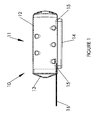
- a known oval block swimfeeder is shown in Figure 1 from a side view.
- the swimfeeder 10 comprises an elongate body 11 having a main portion 12 open at one end and a cap portion 13 which serves to close off the open end.
- the body 11 is weighted at its base by a base weight 14 made from lead.
- the base weight 14 is formed with integral legs 15 and is attached to the main portion 12 of the body 11 by inserting the legs 15 into apertures in the base and bending the legs 15 over to the position shown in Figure 1 (when the cap portion 13 is removed) to prevent the withdrawal of the legs 15 from the apertures and thereby secure the base weight 14 to the underside of the body 11.
- the swimfeeder 10 is attached to a fishing line by an eye (not visible from the Figure 1 view) formed in a connection tab 16.
- Lead is generally known to be a difficult material to work with in bulk consignments due to its high density and softness which tends to lead to bruising during transport. These difficulties become especially apparent when the lead weights having integral legs 15 are manufactured. Because the legs 15 stand proud from the base weight 14 they are particularly prone, during transport, to damage or being bent from the straight condition necessary for assembly. In practice, it has been found that upon delivery to the assembly point, it is necessary to manually straighten many of the legs which is obviously disadvantageous from a manufacturing standpoint.
- the present invention may provide a method of assembling a swimfeeder, comprising:
- the present invention provides a robust manufacturing process and eliminates the need for the frequent corrective intervention required in the above-described prior art process.
- the present invention is particularly useful when the weight comprises a dense, soft metal.
- the weight preferably comprises lead.
- the hole comprises a tapered or step-tapered through-hole having a narrow section and a wide section, wherein the fixing pin is inserted from the narrow section side of the weight, and energy is applied to the portion of the fixing pin in the wide section side of the through-hole.
- the energy is applied by heat-staking or ultrasonic welding.
- the swimfeeder body is oriented such that just prior to melting the distal end of the fixing pin, the fixing pin projects vertically upwards.
- the distal end of the fixing pin re-solidifies with a thickened distal end portion which prevents the withdrawal of the pin from the hole.
- the method is performed on a swimfeeder body having a plurality of fixing pins and a weight having a corresponding number of holes.
- the fixing method according to the present invention is particularly useful for fixing base weights to swimfeeder bodies in which the base weights also serve as part of the bottom of the swimfeeder, as per the swimfeeder shown in Figures 2-9 , or in which the base weights serve as the whole bottom of the swimfeeder, as per the swimfeeder shown in Figure 1 .
- the present invention may provide a swimfeeder body comprising at least one fixing pin suitable for use in the above method.
- the present invention may provide a weight for a swimfeeder comprising at least one hole suitable for use in the above method.
- the present invention may provide a swimfeeder comprising a body, defining a chamber for bait, and a fixing pin; and a weight comprising a hole within which the fixing pin is inserted, the weight being fixed to the body by a thickened distal portion of the fixing pin, formed post-insertion by melting of the material of the fixing pin, preventing withdrawal from the hole.
- a swimfeeder for fresh water angling in accordance with a preferred embodiment is generally designated 20.
- the swimfeeder 20 comprises a body 22 made from plastics material.
- the body 22 is elongate and has a first end 26 and a second end 28.
- the body 22 consists of a hollow main portion 24 have an opening at one end and a cap portion 30 which closes off the opening with an interference fit at the second end 28 of the body 22.
- the swimfeeder 20 further comprises a connection tab 31 comprising a nylon tab part fitted within a silicone sleeve.
- the connection tab 31 includes an eye 31a at one end by which the swimfeeder 20 is attached to a fishing line.
- connection tab 31 extends from an anchoring point within the main portion 24, as is described later, through a recess in the cap portion 30.
- the recessing of the sleeve avoids using a butt joint which would provide a possible site for a line trap.
- the nylon tab itself is flexible enough to allow the cap portion 30 to be dislodged from the main portion 24 to allow easy filling of the swimfeeder 20 with bait, but strong enough to support the whole weight of the swimfeeder and withstand the casting forces.
- the main portion 24 is generally 'D'-shaped in cross-section with the wall corresponding to the curved portion of the 'D' being designated 32.
- a base structure 34 corresponds generally to the straight portion of the 'D'.
- the base structure 34 comprises a pair of arms 36, 38 disposed on opposite sides of the body 22, each having a lowermost surface 36a, 38a, and a side wall 36b, 38b.
- the arms 36, 38 extend in a generally longitudinal direction along the main portion 24 with the side walls gently tapering away from one another from the cap portion 30 towards, but terminating before, the first end 26. Just before the arms 36, 38 terminate, the side walls 36b, 38b are more strongly tapered.
- the lowermost surfaces 36a, 36b are generally flat and have a pattern of small surface pimples 39 to promote grip on the river bed.
- the base structure 34 further comprises holding surfaces in the form of flanges 40, 42, 44, 46 disposed between, and upwardly recessed relative to, the lowermost surfaces 36a, 38a.
- the flange 40 is disposed at the first end 26 body 22 and the flange 46 is disposed at the other end of the main portion 24.
- the flanges 42, 44 run longitudinally along the main portion 24 so as to connect the flanges 40, 46 and define therebetween an aperture 47.
- the flanges mark the upper boundary between the base structure 34 and a region or chamber 50 for bait located above the flanges.
- the flanges 42, 44, 46 are horizontal and generally at the same height above the bottom surfaces 36a, 38b, whereas the flange 40 slopes upwardly beyond the height of the flanges 42, 44, 46 as it approaches the first end 26.
- the body 22 further comprises a plurality of bait evacuation holes 25 through which bait in the bait chamber 50 can egress.
- the holes are provided on both the main portion 24 and the cap portion 30, but those on the cap portion 30 are larger. They can be larger as there is no risk of spillage of bait from those holes in while preparing to cast as the cap portion 30 is always uppermost.
- the body 22 further comprises a plurality of rigid, integrally-formed, fixing pins 48a, 48b, 50 projecting downwardly from the holding surfaces.
- the fixing pins 48a, 48b project from the first end flange 40 at positions equally and oppositely offset from a central longitudinal axis of the body 22.
- the fixing pin 50 projects from the second end flange 46 at a position on a central longitudinal axis of the body 22.
- the attachment tab 30 is anchored to the fixing pin 50.
- the swimfeeder 20 further comprises a base weight 70 made from lead.
- the base weight 70 is shaped generally in the form of a slab having a first, upper major face 72 and a second, lower major face 74.
- the face 74 is generally flat and includes an array of small surface pimples 80 to promote grip on the river bed.
- the major faces 72, 74 are shaped such that the weight 70 is elongate with a first wide end 76 having a minor end face which is curved in a direction across the slab.
- the weight 70 tapers inwardly from the first wide end 76 to a second narrow end 78 having a minor end face which is straight in a direction across the slab.
- the upper face 72 is provided with a number of surface features which facilitate co-operation with the main portion 24, that is a slightly elevated central plateau 72a which matches the shape of the aperture 48 and, in the vicinity of the first end 76, a thickened or upwardly bulging portion 72b which matches the lower surface contour of the flange 46.
- the weight 70 further comprises holes 84a, 84b near the first wide end 76 and a hole 86 near the second end 78.
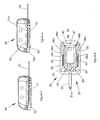
- the dimensions of the base weight 70 are matched to those of the cavity/recess defined by the internal surfaces of the base structure 34, namely the flanges 40, 42, 44, 46 and the side walls 36b, 38b, such that when the fixing pins 48a, 48b, 50 are fully inserted into the holes 84a, 84b, 86 from the direction of the upper face 72, the weight is loaded within the base structure 34 and abuts against the flanges 40, 42, 44, 46 as can be seen in Figure 6 .
- the dimensional matching between the base weight 70 and internal surfaces of the base structure 34 results in the lower face 74 of the base weight being flush with the lowermost surfaces 36a, 36b of the base structure, whereby together they form a composite flat bottom for the swimfeeder 20.
- the first wide end 76 of the base weight 70 is shaped such that it fits in with the profile of the neighbouring first end 26 of the body 22 in both the horizontal and vertical directions so as to provide the swimfeeder 20 as a whole with a curved continuous profile at that end.
- the central plateau 72a of the upper face 72 sits flush with an upper surface of the flange 40 to form a generally flat floor to the bait chamber 50.
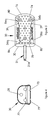
- Figure 9(a) shows a cross-sectional view through the hole 86 through which the fixing pin 50 has been inserted.
- the hole 86 is step-tapered and comprises a narrow section, defined by a wall 87, having cross-sectional dimensions similar to that of the pin 50 adjacent to the first major face 72, and a wide section, defined by a wall 88, having cross-sectional dimensions larger than those of the pin 50 adjacent to the second major face 74.
- the fixing pin 50 is long and when fully inserted into the hole 86 from the side of the first major face 72 projects beyond the second major face 74.
- the swimfeeder 20 is inverted from its normal orientation such that the fixing pin 50 is pointing upwardly as shown in Figure 9(a) . Then, the fixing pin 50 is heat staked or ultrasonically welded causing the fixing pin 50 to melt and so collapse downwardly under gravity, filling the wide section of the hole 86, as illustrated in Figure 9(b) , and thereby acquiring a mushroom-shaped/thickened distal end portion. On cooling and re-solidifying in this new shape, it becomes impossible for the material which made up the fixing pin 50 to be withdrawn back through the hole 86 and so fixing is achieved.
- the fixing pin material may become bonded to the wall 88 defining the wide section of the hole 86.
- the base weight 70 can be permanently fixed to the main body 24, and because this technique requires only a shaped slab of lead and does require that the slab have any vulnerable deformable formations, there is a reasonable expectation that, with careful handling, those slabs can be transported to the assembly point and used without further reparative processing.
- the holes 84a, 84b, 86 are kept small, for example, to accommodate 3mm diameter pins.
- the base weight 70 in the base structure 34 ensures that the swimfeeder 20 comes to rest on the river bed with its composite flat bottom surface, comprising the lowermost surfaces 36a, 36b of the main portion 24 and the lower major face 74 of the base weight 70, in contact with the river bed.
- the shape of the base weight 70 is such that its centre of mass is significantly closer its first end 76 than its second end 78. It will be recalled from the preceding description that the biasing of the centre of mass towards the first end 76 stems from both the lateral tapering of the side walls and the thickened portion 72a local to the first end 76.
- the base weight 70 is much heavier than the body 22, and hence the centre of mass of the swimfeeder 20 as a whole is mainly determined by the shape of the base weight 70.
- the base weight 70 is much heavier than the body 22, and hence the centre of mass of the swimfeeder 20 as a whole is mainly determined by the shape of the base weight 70.
- the biasing of the centre of mass towards the upstream end also has a benefit during casting.
- the upstream end is the leading end (since it is opposite the end with the connection tab 31) and having the mass biased towards the leading end assists with the stability of the swimfeeder 20 during flight and hence facilitates more accurate casting and casting to a greater distance.
- the swimfeeder 20 In situ on the river bed, the swimfeeder 20 is able to hold bottom well for a variety of design reasons.
- the elimination of any differential between the lower face of the base weight 70 and the lowermost surfaces 36a, 36b of the main portion 24 ensures that not only has the possibility for the line to become trapped been eliminated, but so has the source of any unwanted uplift.
- the upstream end of the swimfeeder 20 presents a curved, continuous and hence streamlined face to the current, it presents less resistance to the current and is, thus, less prone to being disturbed especially in a strong current.
- the streamlining effect is also enhanced by the fact that recessing the base weight enables a more squat (i.e.
- the swimfeeder 20 is found to retrieve very smoothly. Failure to retrieve in a smooth manner, for example, if the swimfeeder 20 excessively oscillates or varies in the resistance to the water that it offers can result in the non-uniform laying of the line onto the reel spool of the fishing rod, which will have a negative impact on the subsequent casting accuracy.
- the factors governing the smoothness of the retrieve of the swimfeeder 20 are not known with certainty but the absence of abrupt edges made possible by the recessing of the base 70 and the distinctive, experimentally selected, cross-sectional profile of the body 27, as best seen in Figure 4 , are thought to be contributing factors.
- the overall squatness of the swimfeeder 20, as previously discussed, may be a further factor.
- FIG. 7 An alternative embodiment of the invention is shown in Figure 7 .
- the Figure 7 embodiment differs from that in Figure 6 in that the base weight 70 has been replaced by a lighter lead base weight 70'.
- the base weight 70' is lighter as it has been hollowed out in a central region of the upper face 72 (in the region corresponding to where the plateau 72a exists in the base weight 70) to effect the reduction in mass.
- the recess is labelled 71 in Figure 7 . Other than in that respect, the impact on the performance of the design is minimal.
- base weights modified in this way allows the manufacturer to make swimfeeders weighted to a meaningful different range of masses using the same body 22 to meet the needs of the angler, while being advantageous to the manufacturer in terms of tooling costs, avoid tooling changes during the manufacture of the body 22 and not escalating component stock diversity.
- typical weights may be 1oz (28g) or 1.5 oz (43g).
- typical weights may be 1.5oz (43g) or 2oz (57g).
- typical weights may be 2oz (57g) or 2.5oz (71g).
Landscapes
- Life Sciences & Earth Sciences (AREA)
- Environmental Sciences (AREA)
- Animal Husbandry (AREA)
- Biodiversity & Conservation Biology (AREA)
Applications Claiming Priority (1)
| Application Number | Priority Date | Filing Date | Title |
|---|---|---|---|
| GB0719914A GB2448005B (en) | 2007-10-12 | 2007-10-12 | Swimfeeder |
Publications (1)
| Publication Number | Publication Date |
|---|---|
| EP2047745A1 true EP2047745A1 (de) | 2009-04-15 |
Family
ID=38788026
Family Applications (1)
| Application Number | Title | Priority Date | Filing Date |
|---|---|---|---|
| EP08009243A Withdrawn EP2047745A1 (de) | 2007-10-12 | 2008-05-20 | Futterkorb |
Country Status (2)
| Country | Link |
|---|---|
| EP (1) | EP2047745A1 (de) |
| GB (1) | GB2448005B (de) |
Cited By (1)
| Publication number | Priority date | Publication date | Assignee | Title |
|---|---|---|---|---|
| LU103278B1 (de) | 2024-04-18 | 2025-10-20 | Karsten Jaszkowiak | Lockmittelaufnahmeadapter |
Citations (4)
| Publication number | Priority date | Publication date | Assignee | Title |
|---|---|---|---|---|
| US2979853A (en) * | 1959-07-01 | 1961-04-18 | Erickson George Erving | Chum pot |
| GB2092873A (en) | 1981-02-18 | 1982-08-25 | Drennan Peter John | Bait dispenser |
| GB2200022A (en) | 1984-11-07 | 1988-07-27 | Peter John Drennan | Fishing tackle |
| GB2309146A (en) * | 1996-01-17 | 1997-07-23 | Drennan Int | Fishing bait dispenser |
Family Cites Families (3)
| Publication number | Priority date | Publication date | Assignee | Title |
|---|---|---|---|---|
| SU483969A1 (ru) * | 1973-11-14 | 1975-09-15 | Кормушка дл прикормки рыб при их ловле | |
| GB2208992B (en) * | 1987-08-26 | 1991-09-25 | Varitech Tools Limited | Swim feeder |
| GB2433404A (en) * | 2005-12-22 | 2007-06-27 | Drennan Int Ltd | Swimfeeder |
-
2007
- 2007-10-12 GB GB0719914A patent/GB2448005B/en not_active Expired - Fee Related
-
2008
- 2008-05-20 EP EP08009243A patent/EP2047745A1/de not_active Withdrawn
Patent Citations (4)
| Publication number | Priority date | Publication date | Assignee | Title |
|---|---|---|---|---|
| US2979853A (en) * | 1959-07-01 | 1961-04-18 | Erickson George Erving | Chum pot |
| GB2092873A (en) | 1981-02-18 | 1982-08-25 | Drennan Peter John | Bait dispenser |
| GB2200022A (en) | 1984-11-07 | 1988-07-27 | Peter John Drennan | Fishing tackle |
| GB2309146A (en) * | 1996-01-17 | 1997-07-23 | Drennan Int | Fishing bait dispenser |
Cited By (1)
| Publication number | Priority date | Publication date | Assignee | Title |
|---|---|---|---|---|
| LU103278B1 (de) | 2024-04-18 | 2025-10-20 | Karsten Jaszkowiak | Lockmittelaufnahmeadapter |
Also Published As
| Publication number | Publication date |
|---|---|
| GB2448005B (en) | 2009-08-26 |
| GB0719914D0 (en) | 2007-11-21 |
| GB2448005A (en) | 2008-10-01 |
Similar Documents
| Publication | Publication Date | Title |
|---|---|---|
| US4907364A (en) | Weedless, multi-depth sinking and top water fish lures | |
| EP3534702B1 (de) | Angelköder | |
| US4837966A (en) | Cam action fishing sinker device | |
| EP2047745A1 (de) | Futterkorb | |
| US20170099822A1 (en) | Bladed fishing lure with depth determining mass | |
| EP2047746B1 (de) | Futterkorb | |
| US9814221B2 (en) | Combination sinker and bait stabilizer | |
| EP2047747B1 (de) | Futterkorb | |
| US9301511B1 (en) | Fishing rig with floatation device | |
| KR102620407B1 (ko) | 낚시용 리그 | |
| US20020078619A1 (en) | Tube Lure | |
| US20110056113A1 (en) | Vibrating fishing lure | |
| US6655073B2 (en) | Adjustable bobber system | |
| EP1920653B1 (de) | Futterkorb | |
| EP1880608B1 (de) | Vorrichtung zum Ausbringen von Ködern in Wasser | |
| US8347548B1 (en) | Counterbalanced fishing hook | |
| US20230247975A1 (en) | Adjustable fishing tip-up stand | |
| GB2432768A (en) | Fishing feeder | |
| GB2295074A (en) | Fishing marker | |
| US20060260181A1 (en) | Fishing weight | |
| JP3140557U (ja) | 根掛かり防止用のルアー用錘 | |
| JP2023001015A (ja) | 釣用ウキ | |
| JP6991280B2 (ja) | 釣竿及びこれに採用される石突 | |
| JP2018501823A (ja) | 複合パドルおよび連結用キール | |
| CN218747943U (zh) | 一种医疗导管生产裁断装置 |
Legal Events
| Date | Code | Title | Description |
|---|---|---|---|
| PUAI | Public reference made under article 153(3) epc to a published international application that has entered the european phase |
Free format text: ORIGINAL CODE: 0009012 |
|
| 17P | Request for examination filed |
Effective date: 20080520 |
|
| AK | Designated contracting states |
Kind code of ref document: A1 Designated state(s): AT BE BG CH CY CZ DE DK EE ES FI FR GB GR HR HU IE IS IT LI LT LU LV MC MT NL NO PL PT RO SE SI SK TR |
|
| AX | Request for extension of the european patent |
Extension state: AL BA MK RS |
|
| STAA | Information on the status of an ep patent application or granted ep patent |
Free format text: STATUS: THE APPLICATION HAS BEEN WITHDRAWN |
|
| 18W | Application withdrawn |
Effective date: 20090508 |