EP2047907A2 - Auf Partikelfilter getragener Katalysator - Google Patents
Auf Partikelfilter getragener Katalysator Download PDFInfo
- Publication number
- EP2047907A2 EP2047907A2 EP08104892A EP08104892A EP2047907A2 EP 2047907 A2 EP2047907 A2 EP 2047907A2 EP 08104892 A EP08104892 A EP 08104892A EP 08104892 A EP08104892 A EP 08104892A EP 2047907 A2 EP2047907 A2 EP 2047907A2
- Authority
- EP
- European Patent Office
- Prior art keywords
- mixed oxide
- based mixed
- oxide particles
- zrnd
- catalyst
- Prior art date
- Legal status (The legal status is an assumption and is not a legal conclusion. Google has not performed a legal analysis and makes no representation as to the accuracy of the status listed.)
- Granted
Links
Images


Classifications
-
- B—PERFORMING OPERATIONS; TRANSPORTING
- B01—PHYSICAL OR CHEMICAL PROCESSES OR APPARATUS IN GENERAL
- B01J—CHEMICAL OR PHYSICAL PROCESSES, e.g. CATALYSIS OR COLLOID CHEMISTRY; THEIR RELEVANT APPARATUS
- B01J23/00—Catalysts comprising metals or metal oxides or hydroxides, not provided for in group B01J21/00
- B01J23/002—Mixed oxides other than spinels, e.g. perovskite
-
- B—PERFORMING OPERATIONS; TRANSPORTING
- B01—PHYSICAL OR CHEMICAL PROCESSES OR APPARATUS IN GENERAL
- B01D—SEPARATION
- B01D53/00—Separation of gases or vapours; Recovering vapours of volatile solvents from gases; Chemical or biological purification of waste gases, e.g. engine exhaust gases, smoke, fumes, flue gases, aerosols
- B01D53/34—Chemical or biological purification of waste gases
- B01D53/92—Chemical or biological purification of waste gases of engine exhaust gases
- B01D53/94—Chemical or biological purification of waste gases of engine exhaust gases by catalytic processes
- B01D53/944—Simultaneously removing carbon monoxide, hydrocarbons or carbon making use of oxidation catalysts
-
- B—PERFORMING OPERATIONS; TRANSPORTING
- B01—PHYSICAL OR CHEMICAL PROCESSES OR APPARATUS IN GENERAL
- B01J—CHEMICAL OR PHYSICAL PROCESSES, e.g. CATALYSIS OR COLLOID CHEMISTRY; THEIR RELEVANT APPARATUS
- B01J23/00—Catalysts comprising metals or metal oxides or hydroxides, not provided for in group B01J21/00
- B01J23/10—Catalysts comprising metals or metal oxides or hydroxides, not provided for in group B01J21/00 of rare earths
-
- B—PERFORMING OPERATIONS; TRANSPORTING
- B01—PHYSICAL OR CHEMICAL PROCESSES OR APPARATUS IN GENERAL
- B01J—CHEMICAL OR PHYSICAL PROCESSES, e.g. CATALYSIS OR COLLOID CHEMISTRY; THEIR RELEVANT APPARATUS
- B01J23/00—Catalysts comprising metals or metal oxides or hydroxides, not provided for in group B01J21/00
- B01J23/38—Catalysts comprising metals or metal oxides or hydroxides, not provided for in group B01J21/00 of noble metals
- B01J23/54—Catalysts comprising metals or metal oxides or hydroxides, not provided for in group B01J21/00 of noble metals combined with metals, oxides or hydroxides provided for in groups B01J23/02 - B01J23/36
- B01J23/56—Platinum group metals
- B01J23/63—Platinum group metals with rare earths or actinides
-
- B—PERFORMING OPERATIONS; TRANSPORTING
- B01—PHYSICAL OR CHEMICAL PROCESSES OR APPARATUS IN GENERAL
- B01J—CHEMICAL OR PHYSICAL PROCESSES, e.g. CATALYSIS OR COLLOID CHEMISTRY; THEIR RELEVANT APPARATUS
- B01J35/00—Catalysts, in general, characterised by their form or physical properties
- B01J35/50—Catalysts, in general, characterised by their form or physical properties characterised by their shape or configuration
- B01J35/56—Foraminous structures having flow-through passages or channels, e.g. grids or three-dimensional [3D] monoliths
-
- B—PERFORMING OPERATIONS; TRANSPORTING
- B01—PHYSICAL OR CHEMICAL PROCESSES OR APPARATUS IN GENERAL
- B01J—CHEMICAL OR PHYSICAL PROCESSES, e.g. CATALYSIS OR COLLOID CHEMISTRY; THEIR RELEVANT APPARATUS
- B01J37/00—Processes, in general, for preparing catalysts; Processes, in general, for activation of catalysts
- B01J37/02—Impregnation, coating or precipitation
- B01J37/024—Multiple impregnation or coating
- B01J37/0248—Coatings comprising impregnated particles
-
- B—PERFORMING OPERATIONS; TRANSPORTING
- B01—PHYSICAL OR CHEMICAL PROCESSES OR APPARATUS IN GENERAL
- B01D—SEPARATION
- B01D2255/00—Catalysts
- B01D2255/10—Noble metals or compounds thereof
- B01D2255/102—Platinum group metals
- B01D2255/1021—Platinum
-
- B—PERFORMING OPERATIONS; TRANSPORTING
- B01—PHYSICAL OR CHEMICAL PROCESSES OR APPARATUS IN GENERAL
- B01D—SEPARATION
- B01D2255/00—Catalysts
- B01D2255/10—Noble metals or compounds thereof
- B01D2255/102—Platinum group metals
- B01D2255/1023—Palladium
-
- B—PERFORMING OPERATIONS; TRANSPORTING
- B01—PHYSICAL OR CHEMICAL PROCESSES OR APPARATUS IN GENERAL
- B01D—SEPARATION
- B01D2255/00—Catalysts
- B01D2255/20—Metals or compounds thereof
- B01D2255/206—Rare earth metals
-
- B—PERFORMING OPERATIONS; TRANSPORTING
- B01—PHYSICAL OR CHEMICAL PROCESSES OR APPARATUS IN GENERAL
- B01D—SEPARATION
- B01D2255/00—Catalysts
- B01D2255/20—Metals or compounds thereof
- B01D2255/207—Transition metals
- B01D2255/20715—Zirconium
-
- B—PERFORMING OPERATIONS; TRANSPORTING
- B01—PHYSICAL OR CHEMICAL PROCESSES OR APPARATUS IN GENERAL
- B01D—SEPARATION
- B01D2255/00—Catalysts
- B01D2255/20—Metals or compounds thereof
- B01D2255/209—Other metals
- B01D2255/2092—Aluminium
-
- B—PERFORMING OPERATIONS; TRANSPORTING
- B01—PHYSICAL OR CHEMICAL PROCESSES OR APPARATUS IN GENERAL
- B01D—SEPARATION
- B01D2258/00—Sources of waste gases
- B01D2258/01—Engine exhaust gases
- B01D2258/012—Diesel engines and lean burn gasoline engines
-
- B—PERFORMING OPERATIONS; TRANSPORTING
- B01—PHYSICAL OR CHEMICAL PROCESSES OR APPARATUS IN GENERAL
- B01D—SEPARATION
- B01D2258/00—Sources of waste gases
- B01D2258/01—Engine exhaust gases
- B01D2258/014—Stoichiometric gasoline engines
-
- B—PERFORMING OPERATIONS; TRANSPORTING
- B01—PHYSICAL OR CHEMICAL PROCESSES OR APPARATUS IN GENERAL
- B01D—SEPARATION
- B01D53/00—Separation of gases or vapours; Recovering vapours of volatile solvents from gases; Chemical or biological purification of waste gases, e.g. engine exhaust gases, smoke, fumes, flue gases, aerosols
- B01D53/34—Chemical or biological purification of waste gases
- B01D53/92—Chemical or biological purification of waste gases of engine exhaust gases
- B01D53/94—Chemical or biological purification of waste gases of engine exhaust gases by catalytic processes
- B01D53/9459—Removing one or more of nitrogen oxides, carbon monoxide, or hydrocarbons by multiple successive catalytic functions; systems with more than one different function, e.g. zone coated catalysts
- B01D53/9477—Removing one or more of nitrogen oxides, carbon monoxide, or hydrocarbons by multiple successive catalytic functions; systems with more than one different function, e.g. zone coated catalysts with catalysts positioned on separate bricks, e.g. exhaust systems
-
- B—PERFORMING OPERATIONS; TRANSPORTING
- B01—PHYSICAL OR CHEMICAL PROCESSES OR APPARATUS IN GENERAL
- B01J—CHEMICAL OR PHYSICAL PROCESSES, e.g. CATALYSIS OR COLLOID CHEMISTRY; THEIR RELEVANT APPARATUS
- B01J2523/00—Constitutive chemical elements of heterogeneous catalysts
-
- B—PERFORMING OPERATIONS; TRANSPORTING
- B01—PHYSICAL OR CHEMICAL PROCESSES OR APPARATUS IN GENERAL
- B01J—CHEMICAL OR PHYSICAL PROCESSES, e.g. CATALYSIS OR COLLOID CHEMISTRY; THEIR RELEVANT APPARATUS
- B01J2523/00—Constitutive chemical elements of heterogeneous catalysts
- B01J2523/30—Constitutive chemical elements of heterogeneous catalysts of Group III (IIIA or IIIB) of the Periodic Table
- B01J2523/37—Lanthanides
- B01J2523/3712—Cerium
-
- B—PERFORMING OPERATIONS; TRANSPORTING
- B01—PHYSICAL OR CHEMICAL PROCESSES OR APPARATUS IN GENERAL
- B01J—CHEMICAL OR PHYSICAL PROCESSES, e.g. CATALYSIS OR COLLOID CHEMISTRY; THEIR RELEVANT APPARATUS
- B01J2523/00—Constitutive chemical elements of heterogeneous catalysts
- B01J2523/30—Constitutive chemical elements of heterogeneous catalysts of Group III (IIIA or IIIB) of the Periodic Table
- B01J2523/37—Lanthanides
- B01J2523/3718—Praseodymium
-
- B—PERFORMING OPERATIONS; TRANSPORTING
- B01—PHYSICAL OR CHEMICAL PROCESSES OR APPARATUS IN GENERAL
- B01J—CHEMICAL OR PHYSICAL PROCESSES, e.g. CATALYSIS OR COLLOID CHEMISTRY; THEIR RELEVANT APPARATUS
- B01J2523/00—Constitutive chemical elements of heterogeneous catalysts
- B01J2523/30—Constitutive chemical elements of heterogeneous catalysts of Group III (IIIA or IIIB) of the Periodic Table
- B01J2523/37—Lanthanides
- B01J2523/3725—Neodymium
-
- B—PERFORMING OPERATIONS; TRANSPORTING
- B01—PHYSICAL OR CHEMICAL PROCESSES OR APPARATUS IN GENERAL
- B01J—CHEMICAL OR PHYSICAL PROCESSES, e.g. CATALYSIS OR COLLOID CHEMISTRY; THEIR RELEVANT APPARATUS
- B01J2523/00—Constitutive chemical elements of heterogeneous catalysts
- B01J2523/40—Constitutive chemical elements of heterogeneous catalysts of Group IV (IVA or IVB) of the Periodic Table
- B01J2523/48—Zirconium
-
- B—PERFORMING OPERATIONS; TRANSPORTING
- B01—PHYSICAL OR CHEMICAL PROCESSES OR APPARATUS IN GENERAL
- B01J—CHEMICAL OR PHYSICAL PROCESSES, e.g. CATALYSIS OR COLLOID CHEMISTRY; THEIR RELEVANT APPARATUS
- B01J35/00—Catalysts, in general, characterised by their form or physical properties
- B01J35/19—Catalysts containing parts with different compositions
Definitions
- This invention relates to catalyst-supported particulate filters.
- Exhaust gases from diesel engines using fuels containing diesel oil as a main component and exhaust gases from gasoline engines using fuels containing gasoline as a main component to burn them under fuel-lean conditions are known to contain particulates (suspended particulate matters containing carbon particles).
- a filter for trapping particulates in exhaust gas is disposed in an exhaust gas passage of such an engine.
- the amount of particulates deposited on the filter becomes large, this causes deterioration of engine power and fuel efficiency. Therefore, in this case, it is necessary to burn the deposited particulates as appropriate to remove them from the filter.
- a catalyst layer containing catalytic metal-carried alumina is formed on the walls of exhaust gas channels in the body of such a filter.
- Catalytic metal-carried alumina is effective in burning particulates but there have been recently developed catalyst materials for filters capable of more efficiently burning particulates.
- the catalyst material is a material in which a catalytic metal, such as platinum (Pt), is carried on a mixed oxide (composite oxide) containing cerium (Ce), zirconium (Zr) and a rare earth metal R selected from among praseodymium (Pr), neodymium (Nd) and lanthanum (La).
- a catalytic metal such as platinum (Pt)
- Pt platinum
- a mixed oxide composite oxide
- Ce cerium
- Zr zirconium
- R rare earth metal
- the content of R in the mixed oxide is preferably 2% to 11 % by mole, both inclusive. Since such a mixed oxide contains Ce, it has oxygen storage/release capacity so that oxygen released from the mixed oxide contributes to ignition and burning of particulates.
- the catalyst material is a material in which a catalytic metal is carried on mixed oxide ZrRO particles containing Zr and a rare earth metal R selected from among ytterbium (Yb), Nd and scandium (Sc) and having an R content of up to 18% by mole and mixed oxide CeMO particles containing Ce and a rare earth metal M selected from among samarium (Sm) and gadolinium (Gd).
- the ZrRO particles have oxygen ion conductivity to thereby release active oxygen but their oxygen release mechanism is different from that of CeZr-based mixed oxides as disclosed in Published Japanese Patent Application No. 2006-326573 .
- CeZr-based mixed oxides have high oxygen storage capacity and release active oxygen by the valence change of Ce ions.
- the ZrRO particles have oxygen ion conductivity, i.e., so-called oxygen pumping function, and transport, when having both of high-oxygen concentration sites and low-oxygen concentration sites on the particle surfaces, oxygen ions from high-oxygen concentration sites to low-oxygen concentration sites and then release them as active oxygen.
- the catalyst material is a material in which a catalytic precious metal is carried on ZrRO having oxygen ion conductivity as stated above and alumina.
- Engine exhaust gas after-treatment systems are required not only to efficiently trap and burn off particulates but also to convert hydrocarbons (HC) and carbon monoxide (CO) in exhaust gas. But, what is particularly required is to enhance its exhaust gas conversion performance when the exhaust gas is at low temperatures. Therefore, generally, a catalyst is disposed in an exhaust gas passage upstream of the position at which a particulate filter is placed, and used to oxidize HC and CO or oxidize NO in exhaust gas into NO 2 .
- an object of the present invention is to give a catalyst disposed together with a particulate filter not only the function of promoting the burning of particulates but also the function of converting exhaust gas at low temperatures and thereby reduce the burden of the catalyst even if the catalyst is disposed upstream of the particulate filter.
- a catalyst for a particulate filter is essentially composed of a combination of activated alumina, a CeZr-based mixed oxide and a ZrNd-based mixed oxide in an appropriate ratio.
- an aspect of the present invention is directed to a catalyst-supported particulate filter in which a catalyst is supported on walls of exhaust gas channels of a filter body capable of trapping particulates exhausted from an engine.
- the catalyst contains a mixture of activated alumina particles carrying a catalytic metal, CeZr-based mixed oxide particles containing Ce and Zr and ZrNd-based mixed oxide particles containing Zr, Nd and a rare earth metal M other than Ce and Nd, the proportion of the total amount of the CeZr-based mixed oxide particles and the ZrNd-based mixed oxide particles in the total amount of the activated alumina particles and the CeZr-based mixed oxide particles and the ZrNd-based mixed oxide particles is 10% to 60% by mass, both inclusive, and the mass ratio of the amount of the CeZr-based mixed oxide particles to the amount of the ZrNd-based mixed oxide particles (the CeZr-based mixed oxide/ZrNd-based mixed oxide mass ratio) is 20/80 to 80/20, both
- the CeZr-based mixed oxide particles have oxygen storage/release capacity and release active oxygen by the valence change of Ce ions even in an oxygen-rich gas atmosphere.
- oxygen storage components when oxygen storage components are used in a three-way catalyst repeating oxygen-rich conditions (fuel-lean conditions) and oxygen-lean conditions (fuel-rich conditions), they store oxygen under fuel-lean conditions and release oxygen under fuel-rich conditions.
- oxygen storage components perform oxygen exchange reactions in which even under fuel-lean conditions they release active oxygen from inside the oxide while taking oxygen into inside the oxide (see Published Japanese Patent Application No. 2007-190460 filed in Japan by the Applicant).
- the ZrNd-based mixed particles have oxygen ion conductivity to transport oxygen ions from high-oxygen concentration sites to low-oxygen concentration sites and then release them as active oxygen.
- the activated alumina particles carrying a catalytic metal are effective in burning particulates and act to oxidize HC and CO and oxidize NO into NO 2 .
- active oxygen released from the ZrNd-based mixed oxide particles is effectively used for the burning of particulates and the CeZr-based mixed oxide particles having a different oxygen release mechanism aid in burning the particulates.
- the active oxygen release capacity of the ZrNd-based mixed oxide particles and CeZr-based mixed oxide particles effectively aids the catalytic metal carried on the activated alumina particles to oxidize HC and CO in exhaust gas and oxidize NO into NO 2 , heat produced by oxidation reaction of these exhaust gas components promotes the burning of the particulates, and produced NO 2 serves as an oxidizing agent for efficiently burning the particulates.
- the catalyst contains the activated alumina particles carrying a catalytic metal, the CeZr-based mixed oxide particles and the ZrNd-based mixed oxide particles in a mixed state, the following effects for the burning of particulates can be obtained.
- activated alumina particles are porous and, therefore, have large specific surface areas. Since in the above aspect of the invention activated alumina particles are interposed between CeZr-based mixed oxide particles and ZrNd-based mixed oxide particles, a large number of voids exist inside the catalyst. This improves the flowability of exhaust gas inside the catalyst to facilitate the release of active oxygen from the CeZr-based mixed oxide particles and the ZrNd-based mixed oxide particles.
- particulates are more likely to burn.
- the large specific surface areas of the activated alumina particles coupled with the above-stated good releasability of active oxygen, promote the reaction of NO ⁇ NO 2 , which more easily causes the burning of particulates due to the action of NO 2 as an oxidizing agent.
- the three kinds of catalyst components i.e., the activated alumina particles carrying a catalytic metal, the CeZr-based mixed oxide particles and the ZrNd-based mixed oxide particles, are simply mixed, but that the proportion of the total amount of the CeZr-based mixed oxide particles and the ZrNd-based mixed oxide particles in the total amount of the above three kinds of catalyst components is 10% to 60% by mass both inclusive and the CeZr-based mixed oxide/ZrNd-based mixed oxide mass ratio is 20/80 to 80/20 both inclusive.
- the proportion of the total amount of the CeZr-based mixed oxide particles and the ZrNd-based mixed oxide particles in the total amount of the above three kinds of catalyst components is 20% to 50% by mass, both inclusive, and the CeZr-based mixed oxide/ZrNd-based mixed oxide mass ratio is 40/60 to 60/40, both inclusive.
- Examples of the rare earth metal M contained in the ZrNd-based mixed oxide particles include La, Pr, Sm, Gd and Y. What is preferable in enhancing the particulate burning property is the use of at least one selected from the group consisting of La, Pr and Y What is particularly preferable is the use of Pr as the rare earth metal M.
- the oxide of the rare earth metal M in the ZrNd-based mixed oxide particles is designated by MO
- the proportion of the total amount of Nd 2 O 3 and MO in the total amount of ZrO 2 , Nd 2 O 3 and MO is 18% to 30% by mole, both inclusive.
- the CeZr-based mixed oxide particles contain Nd in addition to Ce and Zr.
- reference numeral 1 denotes a particulate filter (hereinafter, referred to simply as a "filter") disposed in an exhaust gas passage 11 of an engine.
- An oxidation catalyst (not shown) can be disposed in the exhaust gas passage 11 upstream of the filter 1 in the flow direction of exhaust gas.
- Such an oxidation catalyst is obtained by carrying a catalytic metal, such as platinum (Pt) or palladium (Pd), on a support material such as activated alumina.
- HC and CO in the exhaust gas are oxidized by the oxidation catalyst and heat of the oxidation combustion increases the temperature of exhaust gas flowing into the filter 1.
- NO in the exhaust gas is oxidized into NO 2 by the oxidation catalyst and produced NO 2 is then supplied as an oxidizing agent for burning particulates to the filter 1.
- the filter 1 has a honeycomb structure in which a large number of exhaust gas channels 2 and 3 run in parallel with each other.
- the filter 1 has a structure in which a plurality of exhaust gas inflow channels 2 and a plurality of exhaust gas outflow channels 3 are alternately arranged vertically and horizontally.
- Each exhaust gas inflow channel 2 is closed at the downstream end by a plug 4, while each exhaust gas outflow channel 3 is closed at the upstream end by a plug 4.
- the adjacent exhaust gas inflow and outflow channels 2 and 3 are separated from each other by a thin partition wall 5.
- the hatched parts denote the plugs 4 at the upstream ends of the exhaust gas outflow channels 3.
- the body of the filter 1, inclusive of the partition walls 5, is formed of cordierite or an inorganic porous material, such as SiC, Si 3 N 4 or sialon.
- the exhaust gas flowing into each exhaust gas inflow channel 2 flows out through the surrounding partition walls 5 into the adjacent exhaust gas outflow channels 3, as shown in the arrows in Figure 3 .
- each partition wall 5 has micro pores (exhaust gas channels) 6 communicating the exhaust gas inflow channel 2 with the adjacent exhaust gas outflow channel 3 so that the exhaust gas flows through the micro pores 6. Particulates are trapped and deposited mainly on the wall surfaces of the exhaust gas inflow channels 2 and the micro pores 6.
- a catalyst layer 7 is coated on the walls of all the exhaust gas channels (i.e., exhaust gas inflow channels 2, exhaust gas outflow channels 3 and micro pores 6) in the body of the filter 1. However, it is not necessarily required to form the catalyst layer on the walls of the exhaust gas outflow channels 3.
- the catalyst layer 7 contains activated alumina particles carrying a catalytic metal, CeZr-based mixed oxide particles containing Ce and Zr and ZrNd-based mixed oxide particles containing Zr, Nd and a rare earth metal M other than Ce and Nd.
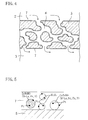
- FIG. 5 schematically shows an example of the catalyst layer 7.
- This example of the catalyst layer 7 contains three kinds of catalyst components in a mixed state.
- One of the three catalyst components is a catalyst component obtained by carrying Pt as a catalytic metal on activated alumina (Al 2 O 3 ) particles.
- Another of the three catalyst components is a catalyst component obtained by carrying Pt as a catalytic metal on CeZr-based mixed oxide particles (CeZrRO) containing Ce and Zr in major proportions and a rare earth metal R (La, Nd, Pr or yttrium (Y)) other than Ce.
- CeZr-based mixed oxide particles CeZr-based mixed oxide particles
- the remaining one of the three catalyst components is a catalyst component obtained by carrying Pt as a catalytic metal on ZrNd-based mixed oxide particles (ZrNdMO) containing Zr and Nd in major proportions and a rare earth metal M (La, Pr or Y) other than Ce and Nd. All of the activated alumina particles, the ZrNd-based mixed oxide particles and CeZr-based mixed oxide particles are secondary particles formed by cohesion of primary particles.
- ZrNdMO ZrNd-based mixed oxide particles
- CeZr-based mixed oxide particles are secondary particles formed by cohesion of primary particles.
- the three kinds of oxide powders were mixed at various mixing ratios (see Tables 1 and 2), and each oxide powder mixture thus obtained was mixed with a solution of diamminedinitro platinum nitrate and ion-exchanged water, then evaporated to dryness, then well dried and then calcined at 500°C in the atmospheric environment for two hours, thereby obtaining catalyst materials having different mixed oxide mixing ratios.
- Each catalyst material was mixed with a binder and ion-exchanged water into a slurry.
- the slurry was coated on a support for a filter made of silicon carbide (SiC) having a volume of 25 mL, a cell wall thickness of 16 mil (406.4x10 -3 mm) and 178 cells per square inch (645.16 mm 2 ), then dried and then calcined by keeping it at 500°C for two hours in the atmospheric environment, thereby obtaining each sample (catalyst-supported particulate filter).
- SiC silicon carbide
- the total amount of the three kinds of mixed oxide powders carried per L of filter was 20 g/L, and the amount of Pt carried per L of filter was 2.0 g/L.
- Each sample was heat aged by keeping it at 800°C for 24 hours in the atmospheric environment and then subjected to evaluation tests on its carbon burning property and exhaust gas conversion performance.
- the sample was attached to a fixed-bed, simulated gas flow reactor.
- simulated exhaust gas (composed of 10% O 2 , 300ppm NO, 10% H 2 O and N 2 ) was allowed to flow through the sample at a space velocity of 80000/h and, concurrently, the gas temperature at the catalyst sample entrance was increased at a rate of 15°C/min.
- the carbon burning rate at the time when the gas temperature reaches 590°C was measured.
- the carbon burning rate was calculated based on the amounts of CO and CO 2 produced by carbon burning and according to the following equation.
- Carbon burning rate g / h gas flow rate L / h x CO and CO 2 concentration ppm / 1 x 10 6 / 22.4 x 12
- Each sample was attached to a fixed-bed, simulated gas flow reactor.
- simulated exhaust gas (composed of 200ppmC HC, 400ppm CO, 100ppm NO, 10% O 2 , 4.5% CO 2 , 10% H 2 O and N 2 ) was allowed to flow through the sample at a space velocity of 50000/h and, concurrently, the gas temperature at the catalyst sample entrance was increased at a rate of 30°C/min. Then, the gas temperature at the catalyst sample entrance when the conversion efficiency of each of HC and CO reaches 50% (light-off temperature) was measured.
- Table 1 shows carbon burning rates of the samples using ZrNdPr mixed oxide powder having a proportion of (Nd 2 O 3 +Pr 6 O 11 ) of 30% by mole and Table 2 shows light-off temperatures of the same samples.
- Table 3 shows carbon burning rates of the samples using ZrNdPr mixed oxide powder having a proportion of (Nd 2 O 3 +Pr 6 O 11 ) of 18% by mole and Table 4 shows light-off temperatures of the same samples.
- the carbon burning rate was relatively high within the zone enclosed by the medium thick line frame (in which the proportion of the total amount of both the mixed oxide particles was 10 to 60 % by mass, both inclusive, and the mass ratio between both the mixed oxide particles was 20/80 to 80/20, both inclusive) and a preferable range of carbon burning rates is within the zone enclosed by the thicker line frame (in which the proportion of the total amount of both the mixed oxide particles was 20 to 50 % by mass, both inclusive, and the mass ratio between both the mixed oxide particles was 40/60 to 60/40, both inclusive).
- the mixing ratio of the three kinds of mixed oxides is preferably set within the zone enclosed by the medium thick line frame and more preferably set within the zone enclosed by the thicker line frame.
- the mixing ratio of the three kinds of mixed oxides is preferably set within the zone enclosed by the medium thick line frame and more preferably set within the zone enclosed by the thicker line frame.
- each of the obtained catalyst materials was coated, like the previously-stated evaluation tests, on a support (filter body) for a filter made of SiC, then dried and calcined, thereby obtaining a sample.
- the amount of each ZrNd-based mixed oxide powder carried per L of filter was 50 g/L, and the amount of Pt carried per L of filter was 0.5 g/L.
- each sample was heat aged by keeping it at 800°C for 24 hours in the atmospheric environment and then measured in terms of carbon burning rate at 590°C under the same conditions as in the previous-stated evaluation test and amount of CO produced. The measurement results are shown in Table 5.
- Nd is an essential ingredient.
- the carbon burning rate did not increase with increasing amount of Nd. Therefore, it can be said to be preferable that Nd is used in combination with La, Pr or Y
- the proportion of the total amount of Nd 2 O 3 and MO increased, with minor exceptions.
- the proportion of the above total amount is high, it is preferable that the proportion is not more than 30% by mole in order to restrain the increase in the amount of CO produced.
- the proportion of the above total amount reached 18% by mole or more, the carbon burning rate generally became high. Therefore, it can be said to be preferable that the proportion of the above total amount is not less than 18% by mole in enhancing the particulate burning property. Particularly, from the comparison among Samples 6, 8, 13, 15 and 23, it can be said to be preferable to attain a proportion of the above total amount of 18% by mole or more while raising the proportion of Nd 2 O 3 or Pr 6 O 11 .
- the ZrNdPr mixed oxide of Sample 17 is a ZrNdPr mixed oxide used for the samples of Tables 1 and 2 and the ZrNdPr mixed oxide of Sample 15 is a ZrNdPr mixed oxide used for the samples of Tables 3 and 4.
- Comparison in carbon burning rate between Tables 1 and 3 and comparison in light-off temperature between Tables 2 and 4 show that Tables 1 and 2 exhibited better results. This is consistent with the results of carbon burning rates of Samples 17 and 15 in Table 5. It can be said from this that if the other ZrNdM mixed oxides in Table 5 are used for samples for the previously-stated evaluation tests, they also will exhibit such carbon burning property and exhaust gas conversion performance as shown in Tables 1 to 4.
- CeZrRO powdered CeZr-based mixed oxides
- R rare earth metals
- each of the obtained catalyst materials was coated, like the previously-stated evaluation tests, on a support for a filter made of SiC (a filter body having a volume of 25 mL, a cell wall thickness of 12 mil (304.8x10 -3 mm) and 300 cells per square inch (645.16 mm 2 ), then dried and calcined, thereby obtaining a sample.
- the amount of each CeZr-based mixed oxide powder carried per L of filter was 50 g/L, and the amount of Pt carried per L of filter was 0.5 g/L.
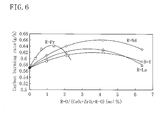
- each sample was heat aged by keeping it at 800°C for 24 hours in the atmospheric environment and then measured in terms of carbon burning rate at 590°C under the same conditions as in the previous-stated evaluation test. The measurement results are shown in Figure 6 .
- the abscissa of Figure 6 represents the proportion (% by mole) of rare earth metal oxide R-O in each CeZr-based mixed oxide.
- Figure 6 shows that when the rare earth metal R was Pr, relatively high carbon burning rates were reached at small proportions of the rare earth metal oxide R-O of 2% by mole or less and that when the rare earth metal R was Nd, La or Y, relatively high carbon burning rates were reached at proportions of the rare earth metal oxide R-O of not more than 6% by mole or not more than 7% by mole. Furthermore, it can be said that, among the four kinds of rare earth metals, the use ofNd is most advantageous in enhancing the carbon burning property.
Landscapes
- Chemical & Material Sciences (AREA)
- Engineering & Computer Science (AREA)
- Materials Engineering (AREA)
- Chemical Kinetics & Catalysis (AREA)
- Organic Chemistry (AREA)
- Oil, Petroleum & Natural Gas (AREA)
- Analytical Chemistry (AREA)
- General Chemical & Material Sciences (AREA)
- Environmental & Geological Engineering (AREA)
- Biomedical Technology (AREA)
- Health & Medical Sciences (AREA)
- Combustion & Propulsion (AREA)
- Catalysts (AREA)
- Exhaust Gas Treatment By Means Of Catalyst (AREA)
- Processes For Solid Components From Exhaust (AREA)
- Filtering Materials (AREA)
- Exhaust Gas After Treatment (AREA)
Applications Claiming Priority (1)
| Application Number | Priority Date | Filing Date | Title |
|---|---|---|---|
| JP2007206363A JP4849034B2 (ja) | 2007-08-08 | 2007-08-08 | 触媒付パティキュレートフィルタ |
Publications (3)
| Publication Number | Publication Date |
|---|---|
| EP2047907A2 true EP2047907A2 (de) | 2009-04-15 |
| EP2047907A3 EP2047907A3 (de) | 2009-07-15 |
| EP2047907B1 EP2047907B1 (de) | 2013-06-19 |
Family
ID=40084148
Family Applications (1)
| Application Number | Title | Priority Date | Filing Date |
|---|---|---|---|
| EP08104892.8A Ceased EP2047907B1 (de) | 2007-08-08 | 2008-07-28 | Auf Partikelfilter getragener Katalysator |
Country Status (4)
| Country | Link |
|---|---|
| US (1) | US8052936B2 (de) |
| EP (1) | EP2047907B1 (de) |
| JP (1) | JP4849034B2 (de) |
| CN (1) | CN101363349B (de) |
Families Citing this family (15)
| Publication number | Priority date | Publication date | Assignee | Title |
|---|---|---|---|---|
| WO2009134686A1 (en) | 2008-04-27 | 2009-11-05 | Loma Vista Medical, Inc. | Biological navigation device |
| JP4753209B2 (ja) * | 2007-12-06 | 2011-08-24 | 本田技研工業株式会社 | 排ガス浄化用酸化触媒装置 |
| CN104353457B (zh) * | 2008-09-02 | 2017-05-24 | 日产自动车株式会社 | 废气净化用催化剂及其制造方法 |
| JP5531567B2 (ja) * | 2009-11-10 | 2014-06-25 | マツダ株式会社 | 排気ガス浄化用触媒 |
| JP5742625B2 (ja) | 2011-09-22 | 2015-07-01 | マツダ株式会社 | 触媒付パティキュレートフィルタ |
| JP5880160B2 (ja) * | 2012-03-09 | 2016-03-08 | マツダ株式会社 | 触媒付パティキュレートフィルタ |
| DE102012207960B3 (de) * | 2012-05-11 | 2013-08-08 | Eberspächer Exhaust Technology GmbH & Co. KG | Partikelfilter |
| EP2873817A4 (de) * | 2012-06-28 | 2016-05-25 | Mitsui Mining & Smelting Co | Dieselpartikelfilter und abgasreinigungsvorrichtung |
| US9708946B2 (en) | 2013-05-22 | 2017-07-18 | Mitsui Mining & Smelting Co., Ltd. | Diesel particulate filter and exhaust gas purification device |
| JP6194699B2 (ja) * | 2013-08-29 | 2017-09-13 | マツダ株式会社 | 触媒付パティキュレートフィルタの製造方法 |
| JP2015047517A (ja) * | 2013-08-29 | 2015-03-16 | マツダ株式会社 | 排気ガス浄化用触媒及びその製造方法 |
| US9855547B2 (en) * | 2015-10-05 | 2018-01-02 | GM Global Technology Operations LLC | Low-temperature oxidation catalysts |
| WO2019161775A1 (en) * | 2018-02-26 | 2019-08-29 | Basf Corporation | Catalyst for gasoline engine exhaust gas aftertreatment |
| GB2581330B (en) * | 2019-02-04 | 2023-01-11 | Jaguar Land Rover Ltd | Catalytic materials for passive soot oxidation and methods of their manufacture |
| CN116608033B (zh) * | 2023-06-20 | 2025-12-30 | 中国第一汽车股份有限公司 | 汽油车颗粒捕集器催化剂的处理方法和装置 |
Citations (4)
| Publication number | Priority date | Publication date | Assignee | Title |
|---|---|---|---|---|
| JP2006326573A (ja) | 2005-04-27 | 2006-12-07 | Mazda Motor Corp | ディーゼルパティキュレートフィルタ |
| JP2007054713A (ja) | 2005-08-23 | 2007-03-08 | Mazda Motor Corp | ディーゼルパティキュレートフィルタ |
| JP2007083224A (ja) | 2005-08-23 | 2007-04-05 | Mazda Motor Corp | ディーゼルパティキュレートフィルタ |
| JP2007190460A (ja) | 2006-01-17 | 2007-08-02 | Mazda Motor Corp | パティキュレート燃焼触媒材の評価方法及び装置 |
Family Cites Families (39)
| Publication number | Priority date | Publication date | Assignee | Title |
|---|---|---|---|---|
| ATE190241T1 (de) * | 1991-11-26 | 2000-03-15 | Engelhard Corp | Ceroxid-aluminiumoxid enthaltender oxidationskatalysator und verfahren zur anwendung. |
| CA2124439A1 (en) * | 1991-11-26 | 1993-06-10 | Kenneth E. Voss | Oxidation catalyst and method of use |
| US6248684B1 (en) * | 1992-11-19 | 2001-06-19 | Englehard Corporation | Zeolite-containing oxidation catalyst and method of use |
| US5580535A (en) * | 1994-07-07 | 1996-12-03 | Engelhard Corporation | System and method for abatement of food cooking fumes |
| US5898014A (en) * | 1996-09-27 | 1999-04-27 | Engelhard Corporation | Catalyst composition containing oxygen storage components |
| EP1196234B1 (de) * | 1999-07-02 | 2007-04-18 | Engelhard Corporation | Katalysatorsystem zum behandeln von abgasen aus dieselmotoren und verfahren |
| WO2002026379A1 (en) * | 2000-09-29 | 2002-04-04 | Omg Ag & Co. Kg | Catalytic soot filter and use thereof in treatment of lean exhaust gases |
| US6912847B2 (en) * | 2001-12-21 | 2005-07-05 | Engelhard Corporation | Diesel engine system comprising a soot filter and low temperature NOx trap |
| US7740817B2 (en) * | 2002-02-15 | 2010-06-22 | Ict Co., Ltd. | Catalyst for purifying exhaust emission from internal combustion engine, method for preparation thereof and method for purifying exhaust emission from internal combustion engine |
| US20030186805A1 (en) * | 2002-03-28 | 2003-10-02 | Vanderspurt Thomas Henry | Ceria-based mixed-metal oxide structure, including method of making and use |
| JP3528839B2 (ja) * | 2002-05-15 | 2004-05-24 | トヨタ自動車株式会社 | パティキュレート酸化材及び酸化触媒 |
| US7229597B2 (en) * | 2003-08-05 | 2007-06-12 | Basfd Catalysts Llc | Catalyzed SCR filter and emission treatment system |
| US7490464B2 (en) * | 2003-11-04 | 2009-02-17 | Basf Catalysts Llc | Emissions treatment system with NSR and SCR catalysts |
| US20050113249A1 (en) | 2003-11-24 | 2005-05-26 | Robin Ziebarth | Catalyst for a diesel particulate filter |
| US7875250B2 (en) * | 2003-12-11 | 2011-01-25 | Umicore Ag & Co. Kg | Exhaust treatment device, and methods of making the same |
| JP4513384B2 (ja) * | 2004-03-31 | 2010-07-28 | 日産自動車株式会社 | 高耐熱性排ガス浄化用触媒及びその製造方法 |
| US7722829B2 (en) * | 2004-09-14 | 2010-05-25 | Basf Catalysts Llc | Pressure-balanced, catalyzed soot filter |
| JP4977467B2 (ja) * | 2004-09-16 | 2012-07-18 | 第一稀元素化学工業株式会社 | セリウム−ジルコニウム系複合酸化物、その製造方法、それを用いた酸素吸蔵放出材料、排気ガス浄化触媒、及び排気ガス浄化方法 |
| US8975204B2 (en) | 2004-10-28 | 2015-03-10 | Cataler Corporation | Exhaust-gas-purifying catalyst |
| CN1917957B (zh) * | 2004-12-20 | 2014-07-30 | 田中贵金属工业株式会社 | 柴油机排气处理用的燃烧催化剂以及柴油机排气的处理方法 |
| US7618919B2 (en) * | 2005-01-28 | 2009-11-17 | Kabushiki Kaisha Toyota Chuo Kenkyusho | Catalyst support and method of producing the same |
| JP4633509B2 (ja) * | 2005-03-24 | 2011-02-16 | マツダ株式会社 | 排気ガス浄化用触媒 |
| JP4618795B2 (ja) | 2005-07-15 | 2011-01-26 | 独立行政法人産業技術総合研究所 | リハビリ装置 |
| EP1919613B1 (de) * | 2005-08-05 | 2009-10-07 | Basf Catalysts Llc | Dieselabgasartikel und katalysatorzusammensetzungen dafür |
| JP4687330B2 (ja) | 2005-08-23 | 2011-05-25 | マツダ株式会社 | ディーゼルパティキュレートフィルタ |
| JP4622753B2 (ja) | 2005-09-05 | 2011-02-02 | マツダ株式会社 | 触媒付きディーゼルパティキュレートフィルタ |
| JP4714568B2 (ja) * | 2005-11-22 | 2011-06-29 | マツダ株式会社 | 排気ガス浄化用触媒及びその製造方法 |
| US7625836B2 (en) * | 2005-12-13 | 2009-12-01 | Cataler Corporation | Heat-resistant oxide |
| US7506504B2 (en) * | 2005-12-21 | 2009-03-24 | Basf Catalysts Llc | DOC and particulate control system for diesel engines |
| JP4851190B2 (ja) * | 2006-01-13 | 2012-01-11 | 戸田工業株式会社 | 排気ガス浄化用触媒 |
| JP2007209913A (ja) * | 2006-02-10 | 2007-08-23 | Mazda Motor Corp | 触媒材およびその製造方法並びにディーゼルパティキュレートフィルタ |
| JP4835193B2 (ja) * | 2006-02-20 | 2011-12-14 | マツダ株式会社 | ディーゼルパティキュレートフィルタ |
| JP4826337B2 (ja) | 2006-05-23 | 2011-11-30 | マツダ株式会社 | 排気ガス浄化用触媒及び排気ガス浄化方法 |
| US7749472B2 (en) * | 2006-08-14 | 2010-07-06 | Basf Corporation | Phosgard, a new way to improve poison resistance in three-way catalyst applications |
| JP2008121438A (ja) | 2006-11-08 | 2008-05-29 | Mazda Motor Corp | 触媒担持型パティキュレートフィルタ |
| JP4849035B2 (ja) | 2007-08-08 | 2011-12-28 | マツダ株式会社 | 触媒付パティキュレートフィルタ |
| US7871452B2 (en) * | 2007-10-01 | 2011-01-18 | Mazda Motor Corporation | Particulate filter |
| EP2055365B1 (de) | 2007-10-10 | 2018-02-28 | Mazda Motor Corporation | Katalysatorgestützter Partikelfilter |
| US8187548B2 (en) | 2007-10-30 | 2012-05-29 | Mazda Motor Corporation | Catalyst-supported particulate filter |
-
2007
- 2007-08-08 JP JP2007206363A patent/JP4849034B2/ja not_active Expired - Fee Related
-
2008
- 2008-07-09 US US12/169,753 patent/US8052936B2/en not_active Expired - Fee Related
- 2008-07-15 CN CN2008101338768A patent/CN101363349B/zh not_active Expired - Fee Related
- 2008-07-28 EP EP08104892.8A patent/EP2047907B1/de not_active Ceased
Patent Citations (4)
| Publication number | Priority date | Publication date | Assignee | Title |
|---|---|---|---|---|
| JP2006326573A (ja) | 2005-04-27 | 2006-12-07 | Mazda Motor Corp | ディーゼルパティキュレートフィルタ |
| JP2007054713A (ja) | 2005-08-23 | 2007-03-08 | Mazda Motor Corp | ディーゼルパティキュレートフィルタ |
| JP2007083224A (ja) | 2005-08-23 | 2007-04-05 | Mazda Motor Corp | ディーゼルパティキュレートフィルタ |
| JP2007190460A (ja) | 2006-01-17 | 2007-08-02 | Mazda Motor Corp | パティキュレート燃焼触媒材の評価方法及び装置 |
Also Published As
| Publication number | Publication date |
|---|---|
| JP4849034B2 (ja) | 2011-12-28 |
| US20090041637A1 (en) | 2009-02-12 |
| EP2047907B1 (de) | 2013-06-19 |
| US8052936B2 (en) | 2011-11-08 |
| CN101363349A (zh) | 2009-02-11 |
| CN101363349B (zh) | 2012-07-18 |
| JP2009039632A (ja) | 2009-02-26 |
| EP2047907A3 (de) | 2009-07-15 |
Similar Documents
| Publication | Publication Date | Title |
|---|---|---|
| EP2047907B1 (de) | Auf Partikelfilter getragener Katalysator | |
| EP2055366B1 (de) | Katalysatorgestützter Partikelfilter | |
| EP1967263B1 (de) | Katalytisches Material und Katalysator zur Reinigung von Abgaskomponenten | |
| EP2044999B1 (de) | Partikelfilter | |
| EP1820561B1 (de) | Dieselpartikelfilter enthaltend eine katalytische Beschichtung | |
| EP2055365B1 (de) | Katalysatorgestützter Partikelfilter | |
| EP2022554B1 (de) | Katalysatortragender Partikelfilter | |
| JP4985299B2 (ja) | 排ガス成分浄化用触媒材及び同触媒材付パティキュレートフィルタ | |
| JP5023969B2 (ja) | 排ガス成分浄化用触媒材及び同触媒材付パティキュレートフィルタ | |
| JP4978581B2 (ja) | パティキュレートフィルタ | |
| JP5023968B2 (ja) | 排ガス成分浄化用触媒材及び同触媒材付パティキュレートフィルタ | |
| CN113329817B (zh) | 废气净化用催化剂 | |
| JP5942550B2 (ja) | 粒子状物質燃焼触媒及びその製造方法 | |
| JP4858394B2 (ja) | 排ガス成分浄化用触媒材及び同触媒材付パティキュレートフィルタ | |
| EP1759763B1 (de) | Abgaskatalysator und mit Katalysator beladener Dieselpartikelfilter | |
| JP2009090235A (ja) | 排ガス成分浄化用触媒材及び同触媒材付パティキュレートフィルタ | |
| JP6288113B2 (ja) | パティキュレートフィルタ |
Legal Events
| Date | Code | Title | Description |
|---|---|---|---|
| PUAI | Public reference made under article 153(3) epc to a published international application that has entered the european phase |
Free format text: ORIGINAL CODE: 0009012 |
|
| AK | Designated contracting states |
Kind code of ref document: A2 Designated state(s): AT BE BG CH CY CZ DE DK EE ES FI FR GB GR HR HU IE IS IT LI LT LU LV MC MT NL NO PL PT RO SE SI SK TR |
|
| AX | Request for extension of the european patent |
Extension state: AL BA MK RS |
|
| PUAL | Search report despatched |
Free format text: ORIGINAL CODE: 0009013 |
|
| AK | Designated contracting states |
Kind code of ref document: A3 Designated state(s): AT BE BG CH CY CZ DE DK EE ES FI FR GB GR HR HU IE IS IT LI LT LU LV MC MT NL NO PL PT RO SE SI SK TR |
|
| AX | Request for extension of the european patent |
Extension state: AL BA MK RS |
|
| 17P | Request for examination filed |
Effective date: 20090929 |
|
| 17Q | First examination report despatched |
Effective date: 20091023 |
|
| AKX | Designation fees paid |
Designated state(s): DE |
|
| GRAP | Despatch of communication of intention to grant a patent |
Free format text: ORIGINAL CODE: EPIDOSNIGR1 |
|
| GRAS | Grant fee paid |
Free format text: ORIGINAL CODE: EPIDOSNIGR3 |
|
| GRAA | (expected) grant |
Free format text: ORIGINAL CODE: 0009210 |
|
| AK | Designated contracting states |
Kind code of ref document: B1 Designated state(s): DE |
|
| REG | Reference to a national code |
Ref country code: DE Ref legal event code: R096 Ref document number: 602008025382 Country of ref document: DE Effective date: 20130814 |
|
| REG | Reference to a national code |
Ref country code: DE Ref legal event code: R097 Ref document number: 602008025382 Country of ref document: DE |
|
| PLBE | No opposition filed within time limit |
Free format text: ORIGINAL CODE: 0009261 |
|
| STAA | Information on the status of an ep patent application or granted ep patent |
Free format text: STATUS: NO OPPOSITION FILED WITHIN TIME LIMIT |
|
| 26N | No opposition filed |
Effective date: 20140320 |
|
| REG | Reference to a national code |
Ref country code: DE Ref legal event code: R084 Ref document number: 602008025382 Country of ref document: DE Effective date: 20140410 |
|
| REG | Reference to a national code |
Ref country code: DE Ref legal event code: R097 Ref document number: 602008025382 Country of ref document: DE Effective date: 20140320 |
|
| PGFP | Annual fee paid to national office [announced via postgrant information from national office to epo] |
Ref country code: DE Payment date: 20190716 Year of fee payment: 12 |
|
| REG | Reference to a national code |
Ref country code: DE Ref legal event code: R119 Ref document number: 602008025382 Country of ref document: DE |
|
| PG25 | Lapsed in a contracting state [announced via postgrant information from national office to epo] |
Ref country code: DE Free format text: LAPSE BECAUSE OF NON-PAYMENT OF DUE FEES Effective date: 20210202 |