EP2048006B1 - Pneumatique et son procédé de fabrication - Google Patents
Pneumatique et son procédé de fabrication Download PDFInfo
- Publication number
- EP2048006B1 EP2048006B1 EP07791956.1A EP07791956A EP2048006B1 EP 2048006 B1 EP2048006 B1 EP 2048006B1 EP 07791956 A EP07791956 A EP 07791956A EP 2048006 B1 EP2048006 B1 EP 2048006B1
- Authority
- EP
- European Patent Office
- Prior art keywords
- rubber
- tread member
- racing
- tires
- racing tires
- Prior art date
- Legal status (The legal status is an assumption and is not a legal conclusion. Google has not performed a legal analysis and makes no representation as to the accuracy of the status listed.)
- Ceased
Links
- 238000004519 manufacturing process Methods 0.000 title claims description 8
- 238000010894 electron beam technology Methods 0.000 claims description 13
- 230000001678 irradiating effect Effects 0.000 claims description 6
- 230000000052 comparative effect Effects 0.000 description 146
- 229920001971 elastomer Polymers 0.000 description 83
- 238000004073 vulcanization Methods 0.000 description 48
- 238000000034 method Methods 0.000 description 23
- 239000002344 surface layer Substances 0.000 description 18
- 238000011156 evaluation Methods 0.000 description 14
- 239000010410 layer Substances 0.000 description 8
- 238000010835 comparative analysis Methods 0.000 description 6
- 230000000694 effects Effects 0.000 description 5
- 229920001875 Ebonite Polymers 0.000 description 4
- NINIDFKCEFEMDL-UHFFFAOYSA-N Sulfur Chemical compound [S] NINIDFKCEFEMDL-UHFFFAOYSA-N 0.000 description 3
- 239000006229 carbon black Substances 0.000 description 3
- 239000003795 chemical substances by application Substances 0.000 description 3
- 230000007423 decrease Effects 0.000 description 3
- 239000010734 process oil Substances 0.000 description 3
- 239000012763 reinforcing filler Substances 0.000 description 3
- 239000011593 sulfur Substances 0.000 description 3
- 229910052717 sulfur Inorganic materials 0.000 description 3
- VTYYLEPIZMXCLO-UHFFFAOYSA-L Calcium carbonate Chemical compound [Ca+2].[O-]C([O-])=O VTYYLEPIZMXCLO-UHFFFAOYSA-L 0.000 description 2
- VYPSYNLAJGMNEJ-UHFFFAOYSA-N Silicium dioxide Chemical compound O=[Si]=O VYPSYNLAJGMNEJ-UHFFFAOYSA-N 0.000 description 2
- 235000021355 Stearic acid Nutrition 0.000 description 2
- PPBRXRYQALVLMV-UHFFFAOYSA-N Styrene Chemical compound C=CC1=CC=CC=C1 PPBRXRYQALVLMV-UHFFFAOYSA-N 0.000 description 2
- XLOMVQKBTHCTTD-UHFFFAOYSA-N Zinc monoxide Chemical compound [Zn]=O XLOMVQKBTHCTTD-UHFFFAOYSA-N 0.000 description 2
- 239000003963 antioxidant agent Substances 0.000 description 2
- 230000003078 antioxidant effect Effects 0.000 description 2
- 238000003780 insertion Methods 0.000 description 2
- 230000037431 insertion Effects 0.000 description 2
- 230000000873 masking effect Effects 0.000 description 2
- 238000002156 mixing Methods 0.000 description 2
- QIQXTHQIDYTFRH-UHFFFAOYSA-N octadecanoic acid Chemical compound CCCCCCCCCCCCCCCCCC(O)=O QIQXTHQIDYTFRH-UHFFFAOYSA-N 0.000 description 2
- OQCDKBAXFALNLD-UHFFFAOYSA-N octadecanoic acid Natural products CCCCCCCC(C)CCCCCCCCC(O)=O OQCDKBAXFALNLD-UHFFFAOYSA-N 0.000 description 2
- 238000013040 rubber vulcanization Methods 0.000 description 2
- 239000008117 stearic acid Substances 0.000 description 2
- QAZLUNIWYYOJPC-UHFFFAOYSA-M sulfenamide Chemical compound [Cl-].COC1=C(C)C=[N+]2C3=NC4=CC=C(OC)C=C4N3SCC2=C1C QAZLUNIWYYOJPC-UHFFFAOYSA-M 0.000 description 2
- 239000011787 zinc oxide Substances 0.000 description 2
- 235000014692 zinc oxide Nutrition 0.000 description 2
- YXIWHUQXZSMYRE-UHFFFAOYSA-N 1,3-benzothiazole-2-thiol Chemical compound C1=CC=C2SC(S)=NC2=C1 YXIWHUQXZSMYRE-UHFFFAOYSA-N 0.000 description 1
- OWRCNXZUPFZXOS-UHFFFAOYSA-N 1,3-diphenylguanidine Chemical compound C=1C=CC=CC=1NC(=N)NC1=CC=CC=C1 OWRCNXZUPFZXOS-UHFFFAOYSA-N 0.000 description 1
- 239000006237 Intermediate SAF Substances 0.000 description 1
- 241000872198 Serjania polyphylla Species 0.000 description 1
- 239000006087 Silane Coupling Agent Substances 0.000 description 1
- UCKMPCXJQFINFW-UHFFFAOYSA-N Sulphide Chemical compound [S-2] UCKMPCXJQFINFW-UHFFFAOYSA-N 0.000 description 1
- FZWLAAWBMGSTSO-UHFFFAOYSA-N Thiazole Chemical compound C1=CSC=N1 FZWLAAWBMGSTSO-UHFFFAOYSA-N 0.000 description 1
- GWEVSGVZZGPLCZ-UHFFFAOYSA-N Titan oxide Chemical compound O=[Ti]=O GWEVSGVZZGPLCZ-UHFFFAOYSA-N 0.000 description 1
- 230000001133 acceleration Effects 0.000 description 1
- 239000010692 aromatic oil Substances 0.000 description 1
- 125000003118 aryl group Chemical group 0.000 description 1
- 230000015572 biosynthetic process Effects 0.000 description 1
- 229910000019 calcium carbonate Inorganic materials 0.000 description 1
- 238000013329 compounding Methods 0.000 description 1
- 239000003431 cross linking reagent Substances 0.000 description 1
- 230000006866 deterioration Effects 0.000 description 1
- AFZSMODLJJCVPP-UHFFFAOYSA-N dibenzothiazol-2-yl disulfide Chemical compound C1=CC=C2SC(SSC=3SC4=CC=CC=C4N=3)=NC2=C1 AFZSMODLJJCVPP-UHFFFAOYSA-N 0.000 description 1
- 229920003244 diene elastomer Polymers 0.000 description 1
- HKOUMIFWHSIIBQ-UHFFFAOYSA-N dioctylcarbamothioylsulfanyl n,n-dioctylcarbamodithioate Chemical compound CCCCCCCCN(CCCCCCCC)C(=S)SSC(=S)N(CCCCCCCC)CCCCCCCC HKOUMIFWHSIIBQ-UHFFFAOYSA-N 0.000 description 1
- HLGRRZFWTBVGMM-UHFFFAOYSA-L disodium;sulfate;dihydrate Chemical compound O.O.[Na+].[Na+].[O-]S([O-])(=O)=O HLGRRZFWTBVGMM-UHFFFAOYSA-L 0.000 description 1
- 238000010438 heat treatment Methods 0.000 description 1
- 230000002093 peripheral effect Effects 0.000 description 1
- 229920005989 resin Polymers 0.000 description 1
- 239000011347 resin Substances 0.000 description 1
- 239000000377 silicon dioxide Substances 0.000 description 1
- 239000000126 substance Substances 0.000 description 1
- OGIDPMRJRNCKJF-UHFFFAOYSA-N titanium oxide Inorganic materials [Ti]=O OGIDPMRJRNCKJF-UHFFFAOYSA-N 0.000 description 1
- 125000000391 vinyl group Chemical group [H]C([*])=C([H])[H] 0.000 description 1
- 229920002554 vinyl polymer Polymers 0.000 description 1
- 238000004804 winding Methods 0.000 description 1
Images

Classifications
-
- B—PERFORMING OPERATIONS; TRANSPORTING
- B60—VEHICLES IN GENERAL
- B60C—VEHICLE TYRES; TYRE INFLATION; TYRE CHANGING; CONNECTING VALVES TO INFLATABLE ELASTIC BODIES IN GENERAL; DEVICES OR ARRANGEMENTS RELATED TO TYRES
- B60C11/00—Tyre tread bands; Tread patterns; Anti-skid inserts
- B60C11/03—Tread patterns
- B60C11/0306—Patterns comprising block rows or discontinuous ribs
-
- B—PERFORMING OPERATIONS; TRANSPORTING
- B29—WORKING OF PLASTICS; WORKING OF SUBSTANCES IN A PLASTIC STATE IN GENERAL
- B29D—PRODUCING PARTICULAR ARTICLES FROM PLASTICS OR FROM SUBSTANCES IN A PLASTIC STATE
- B29D30/00—Producing pneumatic or solid tyres or parts thereof
- B29D30/06—Pneumatic tyres or parts thereof (e.g. produced by casting, moulding, compression moulding, injection moulding, centrifugal casting)
- B29D30/0601—Vulcanising tyres; Vulcanising presses for tyres
-
- B—PERFORMING OPERATIONS; TRANSPORTING
- B60—VEHICLES IN GENERAL
- B60C—VEHICLE TYRES; TYRE INFLATION; TYRE CHANGING; CONNECTING VALVES TO INFLATABLE ELASTIC BODIES IN GENERAL; DEVICES OR ARRANGEMENTS RELATED TO TYRES
- B60C11/00—Tyre tread bands; Tread patterns; Anti-skid inserts
- B60C11/0041—Tyre tread bands; Tread patterns; Anti-skid inserts comprising different tread rubber layers
- B60C11/005—Tyre tread bands; Tread patterns; Anti-skid inserts comprising different tread rubber layers with cap and base layers
-
- B—PERFORMING OPERATIONS; TRANSPORTING
- B60—VEHICLES IN GENERAL
- B60C—VEHICLE TYRES; TYRE INFLATION; TYRE CHANGING; CONNECTING VALVES TO INFLATABLE ELASTIC BODIES IN GENERAL; DEVICES OR ARRANGEMENTS RELATED TO TYRES
- B60C11/00—Tyre tread bands; Tread patterns; Anti-skid inserts
- B60C11/03—Tread patterns
- B60C11/13—Tread patterns characterised by the groove cross-section, e.g. for buttressing or preventing stone-trapping
- B60C11/1307—Tread patterns characterised by the groove cross-section, e.g. for buttressing or preventing stone-trapping with special features of the groove walls
- B60C11/1346—Tread patterns characterised by the groove cross-section, e.g. for buttressing or preventing stone-trapping with special features of the groove walls covered by a rubber different from the tread rubber
-
- B—PERFORMING OPERATIONS; TRANSPORTING
- B29—WORKING OF PLASTICS; WORKING OF SUBSTANCES IN A PLASTIC STATE IN GENERAL
- B29D—PRODUCING PARTICULAR ARTICLES FROM PLASTICS OR FROM SUBSTANCES IN A PLASTIC STATE
- B29D30/00—Producing pneumatic or solid tyres or parts thereof
- B29D30/06—Pneumatic tyres or parts thereof (e.g. produced by casting, moulding, compression moulding, injection moulding, centrifugal casting)
- B29D30/0601—Vulcanising tyres; Vulcanising presses for tyres
- B29D30/0662—Accessories, details or auxiliary operations
- B29D2030/0675—Controlling the vulcanization processes
- B29D2030/0677—Controlling temperature differences
-
- B—PERFORMING OPERATIONS; TRANSPORTING
- B60—VEHICLES IN GENERAL
- B60C—VEHICLE TYRES; TYRE INFLATION; TYRE CHANGING; CONNECTING VALVES TO INFLATABLE ELASTIC BODIES IN GENERAL; DEVICES OR ARRANGEMENTS RELATED TO TYRES
- B60C11/00—Tyre tread bands; Tread patterns; Anti-skid inserts
- B60C11/0008—Tyre tread bands; Tread patterns; Anti-skid inserts characterised by the tread rubber
- B60C2011/0016—Physical properties or dimensions
- B60C2011/0025—Modulus or tan delta
Definitions
- the present invention relates to: a pneumatic tire that is suitable to be used as a tire for passenger vehicles, a studless tire, a racing tire, a tire for buses and trucks, an off-road tire, a tire for two-wheeled vehicles, or the like; and a manufacturing method thereof.
- a tread member is formed to have a two-layer structure including an outer surface layer and an inner surface layer having different properties.
- a technique for reducing the amount of uneven wear of tires at the early stage of wear and also improving grip performance of the tires at the time of driving on an icy/snowy road has been proposed (see Patent Document 1).
- a tread member is formed to have a two-layer structure in which the degree of hardness of an outer surface layer is higher than that of an inner layer.
- a technique for improving grip performance of tires at the early stage of driving has been proposed (see Patent Document 2).
- a tread member is formed so that the ratio of the stress of a rubber composition forming an inner surface layer at 300% elongation to the stress of a rubber composition forming an outer surface layer would be 70% or less, that is, the tread member is formed to have a two-layer structure in which the outer surface layer is softer than the inner surface layer.
- the outer surface layer of the tread member is formed of a member having a low degree of hardness
- the outer surface layer and the inner surface layer result in having different rigidities. Therefore, this increases the occurrence of another type of uneven wear in which only hard rubber remains selectively, at the last stage of driving.
- the outer surface layer of the tread member is formed of a member having a high degree of hardness, an uneven wear resistance at the early stage of driving is improved while the grip performance of the tire sometimes decreases significantly.
- An object of the present invention is to provide: a pneumatic tire with excellent productivity that is capable of reducing uneven wear likely to occur at the early stage of wear while maintaining grip performance; and a manufacturing method thereof.
- Such a pneumatic tire can be manufactured with high productivity, since the tread member does not need to be formed with a two-layer structure.
- 300% modulus at 100°C corresponds to a stress of a member that occurs when 300% strain is caused in the member under an atmosphere at a temperature of 100°C.
- Strain amount to be caused in a member is not limited to 300%, but can be appropriately selected within 100 to 300%.
- the 300% modulus at 100°C in the range of 1 mm in the axial direction from the surface of the tread member is set to be less than 1.10 times larger than the 300% modulus at 100°C in the range of 0.5 mm to 1.5 mm in the axial direction from the bottom part of the tread member, the uneven wear of tread member cannot be reduced sufficiently.
- the 300% modulus at 100°C in the range of 1 mm in the axial direction from the surface of the tread member is set to be more than 2.0 times larger than the 300% modulus at 100°C in the range of 0.5 mm to 1.5 mm in the axial direction from the bottom part of the tread member, the grip performance of the surface of the tread member decreases considerably.
- Methods of setting the 300% modulus at 100°C in the range of 1 mm in the axial direction from the surface of the tread member to be between 1.10 times and 2.0 times larger than the 300% modulus at 100°C in the range of 0.5 mm to 1.5 mm inclusive in the axial direction from the bottom part of the tread member in embodiments of the invention are, for example: (1) selectively irradiating a surface region to be cured, with an electron beam; and (2) attaching a masking sheet onto a surface region not to be cured, and thereafter irradiating the entire surface region with an electron beam, and the like.
- irradiation of an electron beam is after vulcanization.
- the modulus of elasticity of the tread member continuously changes in the axial direction. Accordingly, hard rubber remains on the wall surface, and effects of reducing uneven wear can thereby be maintained, even when the surface of the tread member is worn.
- the groove wall part of the block part is also cured. Accordingly, hard rubber remains on the side wall part of the block part, and effects of reducing uneven wear can thereby be maintained, even when the surface of the tread member is worn.
- irradiation of only the side wall part of the block with an electron beam is employed to reduce uneven wear, only the side wall part of the block is made hard from the early stage. Accordingly, deterioration of the grip performance at the early stage does not occur, and effects of reducing uneven wear can also be maintained
- the 300% modulus at 100°C in the range of 1 mm in the axial direction from the surface of the tread member may be set to continuously change toward the bottom part direction. Further, the 300% modulus at 100°C in the range of 0.5 mm to 1.5 mm in the axial. direction from the bottom part of the tread member is desirably set to be within the range of 1.0 MPa to 12 MPa.
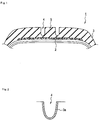
- a pneumatic tire 1 of the embodiment of the present invention includes, as main components; a radial carcass (not illustrated); a belt 2 having high rigidity and disposed to cover a crown part of the radial carcass; and a tread member 3 formed of a rubber composition and disposed around the entire outer peripheral surface of the belt 2.
- An outer surface of the tread member 3 is formed to be in the shape of an arc-shaped crown, and serves as an outer skin, to have contact with road surface, of the pneumatic tire 1.
- a tread pattern is formed by sectioning a block part 5 by rib grooves 4 extending in a circumferential direction.
- the rubber composition used to form the tread member 3 desirably contains at least one kind or more of diene rubber component 90% or more.
- a compounding agent such as a reinforcing filler, a process oil, an antioxidant, a vulcanization accelerator, a silane coupling agent, a vulcanization acceleration assistant such as stearic acid or zinc white, a vulcanizing agent such as sulfur, or the like which is generally used in the rubber industry can be mixed into the rubber component appropriately.
- the reinforcing filler is desired to be 20 to 150 parts by weight of HAF, ISAF or SAF carbon black with respect to 100 parts by weight of the rubber component used as a raw material_
- the process oil can be, for example, paraffinic, naphthenic or aromatic process oil.
- the vulcanization accelerator can be, for example, used: a thiuraxn type such as tetraoctylthiuram disulfide or tetrabenzylthiuram disulphide, a thiazole type such as mercaptobenzothiazol or dibenzothiazyl disulfide, a sulfenamide type such as N-cyclohexy1-2-dibensothiazyl sulfenamide, N,Nt-dicydohexylbenzothiazy1 - 2 - sulfenamide or N'-t-buty1 - 2 - benzothiazyl sulfenamide, or a diphenylguanidine type.
- a thiuraxn type such as tetraoctylthiuram disulfide or tetrabenzylthiuram disulphide
- a thiazole type such as mercaptobenzothiazol or dibenz
- a blending quantity of the vulcanization accelerator is preferably 0.1 to 5 parts by weight with respect to 100 parts by weight of the rubber component. Moreover, a blending quantity of a vulcanizing agent is preferably 0.5 to 5.0 parts by weight with respect to 100 parts by weight of the rubber component.
- a 300% modulus at 100°C in the range of 1 mm in an axial direction from a surface region 3a of the rib groove 4 shown in Fig. 2 is set to be between 1.10 times and 2.0 times inclusive larger than a 300% modulus at 100°C in the range of 0.5 mm to 1.5 mm in the axial direction from a bottom part of the tread member 3.
- a 300% modulus at 100°C corresponds to a stress that occurs when 300% strain is caused in a sample obtained by slicing off an approximately 1 mm piece from the pneumatic tire 1 in the circumferential direction under an atmosphere at a temperature of 100°C.
- the 300% modulus at 100°C in the range of 1 mm in the axial direction from the surface of the tread member 3 is set to be less than 1.10 times larger than the 300% modulus at 100°C in the range of 0.5 mm to 1.5 mm in the axial direction from the bottom part of the tread member 3, uneven wear cannot be reduced sufficiently.
- the 300% modulus at 100°C in the range of 1 mm in the axial direction from the surface of the tread member 3 is set to be more than 2.0 times larger than the 300% modulus at 100°C in the range of 0.5 mm to 1.5 mm in the axial direction from the bottom part of the tread member 3, the grip performance of the surface of the tread member 3 decreases considerably.
- Methods of setting the 300% modulus at 100°C in the range of 1 mm in the axial direction from the surface of the tread member 3 to be between 1.10 times and 2.0 times larger than the 300% modulus at 100°C in the range of 0.5 mm to 1.5 mm inclusive in the axial direction from the bottom part of the tread member 3 are, for example: (1) setting the vulcanizing temperature in the range of 1 mm in the axial direction from the surface of the tread member to be higher than that in the range of 0.5 mm to 1.5 mm in the axial direction from the bottom part of the tread member; (2) heating only the range of 1 mm in the axial direction from the surface of the tread member by a high-temperature warmer or the like after vulcanization; (3) using a manufacturing method of forming the tread member by winding a ribbon-shaped rubber around, and thus adjusting the amounts of the vulcanization accelerator and sulfur contained in the rubber; (4) selectively irradiating a surface region to be cured, with an electron beam; and (5) attaching a
- the surface layer of the rib groove 4 corresponds to the surface region 3a that is a part of a surface layer, or the entire surface layer, of the tread member 3 excluding the part coming directly in contact with the road surface.
- the surface layer of the rib groove 4 is desirably the surface region 3a shown in Fig. 3(a) , preferably the surface region 3a shown in any one of Figs. 3(b) to (e) , and more preferably the surface region 3a shown in Figs. 3(b) or (d) .
- the surface layer of the rib groove 4 may be the surface region 3a shown in any one of Figs. 3(g) to (i).
- Figures 3(d) and 3(i) show irradiation profiles according to embodiments of the invention.
- Figures 3(a) - 3(c), 3(e) to 3(h) and 3(j) do not show profiles according to embodiments of the invention.
- Example 1 which is not according to the invention, a rubber A serving as a tread member described in Table 1 below is prepared, and vulcanization is performed under a vulcanization condition y (tread surface-side average vulcanizing temperature 161°C and tread bottom-surface-side average vulcanizing temperature 151°C) shown in Table 4 below.
- a vulcanization condition y tilt surface-side average vulcanizing temperature 161°C and tread bottom-surface-side average vulcanizing temperature 151°C
- 300% moduli at 100°C in the range of 1 mm in an axial direction from a surface of a tread member, in the range of 1 mm in the middle part, and in the range of 0.5 mm to 1.5 mm in the axial direction from a bottom part are adjusted respectively to 111, 106 and 102, as shown in Tables 2 and 3 below.
- a racing tire (size: 225/40R18) of Example 1 is manufactured.
- the above given values of 300% moduli at 100°C are relative values when the 300% modulus at 100°C of the rubber A described in Table 1 is expressed as 100.
- the middle part here is a part in the middle between the tread surface and the tread bottom part
- Example 2 which is not according to the present invention, the same process is performed as in Example 1 except for the following respects: vulcanization is performed under a vulcanization condition 5 (tread surface-side average vulcanizing temperature 161°C and tread bottom-surface-side average vulcanizing temperature 146°C) shown in Table 4 below; and, thereby, 300% moduli at 100°C in the range of 1 mm in an axial direction from a surface of a tread member, in the range of 1 mm in the middle part, and in the range of 0.5 mm to 1.5 mm in the axial direction from a bottom part are adjusted respectively to 130, 116 and 104, as shown in Tables 2 and 3 below. Thereby, a racing tire of Example 2 is manufactured.
- the above given values of 300% moduli at 100°C are relative values when the 300% modulus at 100°C of the rubber A described in Table 1 is expressed as 100.
- Example 3 which is not according to the present invention, the same process is performed as in Example 1 except for the following respects: vulcanization is performed under a vulcanization condition c (tread surface-side average vulcanizing temperature 171°C and tread bottom-surface-side average vulcanizing temperature 146°C) shown in Table 4 below; and, thereby, 300% moduli at 100°C in the range of 1 mm in an axial direction from a surface of a tread member, in the range of 1 mm in the middle part, and in the range of 0.5 mm to 1.5 mm in the axial direction from a bottom part are adjusted respectively to 150, 131 and 107, as shown in Tables 2 and 3 below. Thereby, a racing tire of Example 3 is manufactured.
- the above given values of 300% moduli at 100°C are relative values when the 300% modulus at 100°C of the rubber A described in Table 1 is expressed as 100.
- Comparative Example 1 the same process is performed as in Example 1 except for the following respects: the vulcanization is performed under a vulcanization condition a (tread surface-side average vulcanizing temperature 151°C and tread bottom-surface-side average vulcanizing temperature 151°C) shown in Table 4 below; and, thereby, 300% moduli at 100°C in the range of 1 mm in an axial direction from a surface of a tread member, in the range of 1 mm in the middle part, and in the range of 0.5 mm to L5 mm in the axial direction from a bottom part are all adjusted to the same value (100), as shown in Tables 2 and 3 below. Thereby, a racing tire of Comparative Example 1 is manufactured.
- a vulcanization condition a (tread surface-side average vulcanizing temperature 151°C and tread bottom-surface-side average vulcanizing temperature 151°C) shown in Table 4 below; and, thereby, 300% moduli at 100°C in the range of 1 mm
- Comparative Example 2 As a tread member, a rubber having a two-layer structure in which a part in the range of 1 mm in an axial direction from a surface is formed of a rubber B described in Table 1 while the remaining part is formed of the rubber A is prepared, and vulcanization is performed under the vulcanization condition a shown in Table 4. Thereby, 300% moduli at 100°C in the range of 1 mm in an axial direction from a surface of a tread member, in the range of 1 mm in the middle part, and in the range of 0.5 mm to 1.5 mm in the axial direction from a bottom part are adjusted respectively to 109, 101 and 100, as shown in Tables 2 and 3 below. By using this tread member, a racing tire of Comparative Example 2 is manufactured.
- the above given values of 300% moduli at 100°C are relative values when the 300% modulus at 100°C of the rubber A described in Table 1 is expressed as 100.
- Comparative Example 3 As a tread member, a rubber having a two-layer structure in which a part in the range of 1 mm in an axial direction from a surface is formed of a rubber C described in Table 1 while the remaining part is formed of the rubber A is prepared, and vulcanization is performed under the vulcanization condition a shown in Table 4. Thereby, 300% moduli at 100°C in the range of 1 mm in an axial direction from a surface of a tread member, in the range of 1 mm in the middle part, and in the range of 0.5 mm to 1.5 mm in the axial direction from a bottom part are adjusted respectively to 120, 100 and 100, as shown in Tables 2 and 3 below. By using this tread member, a racing tire of Comparative Example 3 is manufactured.
- the above given values of 300% moduli at 100°C are relative values when the 300% modulus at 100°C of the rubber A described in Table 1 is expressed as 100.
- Comparative Example 4 the same process is performed as in Example 1 except for the following respects: vulcanization is performed under a vulcanization condition 8 (tread surface-side average vulcanizing temperature 156°C and tread bottom - surface-side average vulcanizing temperature 151°C) shown in Table 4 below; and, thereby, 300% moduli at 100°C in the range of 1 mm in an axial direction from a surface of a tread member, in the range of 1 mm in the middle part, and in the range of 0.5 mm to 1.5 mm in the axial direction from a bottom part are adjusted respectively to 106, 103 and 101, as shown in Tables 2 and 3 below. Thereby, a racing tire of Comparative Example 4 is manufactured.
- a vulcanization condition 8 tilt surface-side average vulcanizing temperature 156°C and tread bottom - surface-side average vulcanizing temperature 151°C
- Comparative Example 5 the same process is performed as in Example 1 except for the following respects: vulcanization is performed under a vulcanization condition (tread surface-side average vulcanizing temperature 181°C and tread bottom-surface-side average vulcanizing temperature 146°C) shown in Table 4 below; and, thereby, 300% moduli at 100°C in the range of 1 mm in an axial direction from a surface of a tread member, in the range of 1 mm in the middle part, and in the range of 0.5 mm to 1.5 mm in the axial direction from a bottom part are adjusted respectively to 220, 170 and 115, as shown in Tables 2 and 3 below. Thereby, a racing tire of Comparative Example 4-5 is manufactured.
- a vulcanization condition such as shown in Example 1 except for the following respects: vulcanization is performed under a vulcanization condition (tread surface-side average vulcanizing temperature 181°C and tread bottom-surface-side average vulcanizing temperature 146°C) shown
- the grip performance of the new racing tires of Example 1 is equal to those of the new racing tires of Comparative Examples 1 and 4, while being higher than those of the new racing tires of Comparative Examples 2, 3 and 5.
- the uneven wear resistance of the new racing tires of Example 1 is equal to that of the new racing tires of Comparative Example 5, while being higher than those of the new racing tires of Comparative Examples 1 to 4.
- the grip performance of the used racing tires of Example 1 is equal to those of the used racing tires of Comparative Examples 1 to 4, while being higher than that of the used racing tires of Comparative Example 5. Moreover, the uneven wear resistance of the used racing tires of Example 1 is lower than that of the used racing tires of Comparative Example 5, while being higher than those of the used racing tires of Comparative Examples 1 to 4.
- the grip performance of the new racing tires of Example 2 is lower than those of the new racing tires of Comparative Examples 1 and 4, while being higher than those of the new racing tires of Comparative Examples 2, 3 and 5. Moreover, the uneven wear resistance of the new racing tires of Example 2 is equal to that of the new racing tires of Comparative Example 5, while being higher than those of the new racing tires of Comparative Examples 1 to 4_
- the grip performance of the used racing tires of Example 2 is equal to those of the used racing tires of Comparative Examples 1 to 4, while being higher than that of the used racing tires of Comparative Example 5.
- the uneven wear resistance of the used racing tires of Example 2 is equal to that of the used racing tires of Comparative Example 5, while being higher than those of the used racing tires of Comparative Examples 1 to 4.
- the grip performance of the new racing tires of Example 3 is equal to or lower than those of the new racing tires of Comparative Examples 1, 2 and 4, while being higher than those of the new racing tires of Comparative Examples 3 and 5.
- the uneven wear resistance of the new racing tires of Example 3 is equal to that of the new racing tires of Comparative Example 5, while being higher than those of the new racing tires of Comparative Examples 1 to 4.
- the grip performance of the used racing tires of Example 3 is lower than those of the used racing tires of Comparative Examples 1 to 4, while being higher than that of the used racing tires of Comparative Example 5. Moreover, the uneven wear resistance of the used racing tires of Example 3 is equal to that of the used racing tires of Comparative Example 5, while being higher than those of the used racing tires of Comparative Examples 1 to 4.
- a pneumatic tire with excellent productivity that is capable of reducing uneven wear likely to occur at the early stage of wear while maintaining grip performance can be manufactured by setting the 300% modulus at 100°C in the range of 1 mm in the axial direction from the surface of the tread member to be 1.10 times and 2M times inclusive larger than the 300% modulus at 100°C in the range of 0.5 mm to 1.5 mm in the axial direction from the bottom part of the tread member.
- the modulus of elasticity of the tread member continuously changes in the axial direction, hard rubber remains on the wall surface, and effects of reducing uneven wear can thereby be maintained, even when the surface of the tread member is worn.
- Example 11 which is according to the present invention, a side wall part of each rib groove of a tread member whose 300% modulus at 100°C is 100 (rubber A described in Table 1) is irradiated with an electron beam by using an apparatus from Nissin-High voltage Co., Ltd. Thereby, the 300% modulus at 100°C of the side wall part of each rib groove is adjusted to be 110.
- a racing tire size: 225/40 R18
- Example 12 which is according to the present invention, the same process is performed as in Example 11 except that 300% modulus at 100°C of a side wall part of each rib groove is adjusted to be 150; thereby, a racing tire of Example 12 is manufactured.
- Example 13 the same process is performed as in Example 11 except that 300% modulus at 100°C of a side wall part of each rib groove is adjusted to be 200; thereby, a racing tire of Example 13 is manufactured.
- Comparative Example 11 a racing tire of comparative Example 11 is manufactured by using a tread member whose 300% modulus at 100°C is 100 (rubber A described in Table 1).
- Comparative Example 12 the same process is performed as in Example 11 except that 300% modulus at 100°C of a side wall part of each rib groove is adjusted to be 105; thereby, a racing tire of Comparative Example 12 is manufactured.
- Comparative Example 13 a racing tire of comparative Example 13 is manufactured by using a tread member whose 300% modulus at 100°C is 200 (rubber D described in Table 1).
- Comparative Example 14 the same process is performed as in Example 11 except that 300% modulus at 100°C of a side wall part of each rib groove is adjusted to be 400; thereby, a racing tire of Comparative Example 14 is manufactured.
- the grip performance of the new racing tires of Example 11 is equal to those of the new racing tires of Comparative Examples 11 and 12, while being higher than those of the new racing tires of Comparative Examples 13 and 14.
- the uneven wear resistance of the new racing tires of Example 11 is lower than those of the new racing tires of Comparative Examples 13 and 14, while being higher than those of the new racing tires of Comparative Examples 11 and 12.
- the grip performance of the used racing tires of Example 11 is equal to those of the used racing tires of Comparative Examples 11 and 12, while being higher than those of the used racing tires of Comparative Examples 13 and 14. Moreover, the uneven wear resistance of the used racing tires of Example 11 is lower than those of the used racing tires of Comparative Examples 13 and 14, while being higher than those of the used racing tires of Comparative Examples 11 and 12.
- the grip performance of the new racing tires of Example 12 is equal to those of the new racing tires of Comparative Examples 11 and 12, while being higher than those of the new racing tires of Comparative Examples 13 and 14. Moreover, the uneven wear resistance of the new racing tires of Example 12 is lower than those of the new racing tires of Comparative Examples 13 and 14, while being higher than those of the new racing tires of Comparative Examples 11 and 12.
- the grip performance of the used racing tires of Example 12 is equal to those of the used racing tires of Comparative Examples 11 and 12, while being higher than those of the used racing tires of Comparative Examples 13 and 14. Moreover, the uneven wear resistance of the used racing tires of Example 12 is lower than those of the used racing tires of Comparative Examples 13 and 14, while being higher than those of the used racing tires of Comparative Examples 11 and 12.
- the grip performance of the new racing tires of Example 13 is equal to those of the new racing tires of Comparative Examples 11 and 12, while being higher than those of the new racing tires of Comparative Examples 13 and 14.
- the uneven wear resistance of the new racing tires of Example 13 is equal to those of the new racing tires of Comparative Examples 13 and 14, while being higher than those of the new racing tires of Comparative Examples 11 and 12.
- the grip performance of the used racing tires of Example 13 is equal to those of the used racing tires of Comparative Examples 11 and 12, while being higher than those of the used racing tires of Comparative Examples 13 and 14.
- the uneven wear resistance of the used racing tires of Example 13 is equal to those of the used racing tires of Comparative Examples 13 and 14, while being higher than those of the used racing tires of Comparative Examples 11 and 12.
- a pneumatic tire with excellent productivity that is capable of reducing uneven wear likely to occur at the early stage of wear while maintaining grip performance can be manufactured by setting the 300% modulus at 100°C in the range of 1 mm in the axial direction from the surface of the tread member to be between 1.10 times and 2.0 times inclusive larger than the 300% modulus at 100°C in the range of 0.5 mm to 1.5 mm in the axial direction from the bottom part of the tread member.
- the side wall part of the block is irradiated with an electron beam to reduce uneven wear, reduction of the grip performance at the early stage does not occur, and effects of reducing uneven wear can also be maintained, since only the side wall part of the block is made hard from the early stage.
- Example 14 which is not according to the present invention, the entire surface of a tread member whose 300% modulus at 100°C is 100 (rubber A described in Table 1) is irradiated with an electron beam by using the apparatus from Nissin-High voltage Co., Ltd. Thereby, 300% modulus at 100°C of the entire surface of the tread member is adjusted to be 110_ By using this tread member, a racing tire of Example 14 is manufactured.
- Example 15 which is not according to the present invention, the same process is performed as in Example 14 except that 300% modulus at 100°C of the entire surface of a tread member is adjusted to be 150; thereby, a racing tire of Example 15 is manufactured.
- Example 16 which is not according to the present invention, the same process is performed as in Example 14 except that 300% modulus at 100°C of the entire surface of a tread member is adjusted to be 200; thereby, a racing tire of Example 16 is manufactured.
- Comparative Example 15 a racing tire of comparative Example 15 is manufactured by using a tread member whose 300% modulus at 100°C is 100 (rubber A described in Table 1).
- Comparative Example 16 the same process is performed as in Example 14 except that 300% modulus at 100°C of the entire surface of a tread member is adjusted to be 105; thereby, a racing tire of Comparative Example 16 is manufactured.
- Comparative Example 17 the same process is performed as in Example 14 except that 300% modulus at 100°C of the entire surface of a tread member is adjusted to be 250; thereby, a racing tire of Comparative Example 17 is manufactured.
- Comparative Example 18 the same process is performed as in Example 14 except that 300% modulus at 100°C of the entire surface of a tread member is adjusted to be 400; thereby, a racing tire of Comparative Example 18 is manufactured.
- the grip performance of the new racing tires of Example 14 is equal to those of the new racing tires of Comparative Examples 15 and 16, while being higher than those of the new racing tires of Comparative Examples 17 and 18.
- the uneven wear resistance of the new racing tires of Example 14 is equal to or lower than those of the new racing tires of Comparative Examples 16 to 18, while being higher than that of the new racing tires of Comparative Example 15.
- the grip performance of the used racing tires of Example 14 is equal to those of the used racing tires of Comparative Examples 15 to 18. Moreover, the uneven wear resistance of the used racing tires of Example 14 is lower than those of the used racing tires of Comparative Examples 17 and 18, while being higher than those of the used racing tires of Comparative Examples 15 and 16.
- the grip performance of the new racing tires of Example 15 is lower than those of the new racing tires of Comparative Examples 15 and 16, while being higher than those of the new racing tires of Comparative Examples 17 and 18. Moreover, the uneven wear resistance of the new racing tires of Example 15 is lower than those of the new racing tires of Comparative Examples 17 and 18, while being higher than those of the new racing tires of Comparative Examples 15 and 16.
- the grip performance of the used racing tires of Example 15 is equal to those of the used racing tires of Comparative Examples 15 to 18. Moreover, the uneven wear resistance of the used racing tires of Example 15 is lower than those of the used racing tires of Comparative Examples 17 and 18, while being higher than those of the used racing tires of Comparative Examples 15 and 16.
- the grip performance of the new racing tires of Example 16 is lower than those of the new racing tires of Comparative Examples 15 and 16, while being higher than those of the new racing tires of Comparative Examples 17 and 18. Moreover, the uneven wear resistance of the new racing tires of Example 16 is equal to those of the new racing tires of Comparative Examples 17 and 18, while being higher than those of the new racing tires of Comparative Examples 15 and 16.
- the grip performance of the used racing tires of Example 16 is equal to those of the used racing tires of Comparative Examples 15 to 18. Moreover, the uneven wear resistance of the used racing tires of Example 16 is equal to those of the used racing tires of Comparative Examples 17 and 18, while being higher than those of the used racing tires of Comparative Examples 15 and 16_
- a pneumatic tire with excellent productivity that is capable of reducing uneven wear likely to occur at the early stage of wear while maintaining grip performance can be manufactured by setting the 300% modulus at 100°C in the range of 1 mm in the axial direction from the surface of the tread member to be between 1.10 times and 2.0 times inclusive larger than the 300% modulus at 100°C in the range of 0.5 mm to 1.5 mm in the axial direction from the bottom part of the tread member.
- the present invention can be applied to tires such as tires for passenger vehicles, studless tires, racing tires, tires for buses and trucks, off-road tires, or tires for motorcycles.
Landscapes
- Engineering & Computer Science (AREA)
- Mechanical Engineering (AREA)
- Tires In General (AREA)
- Heating, Cooling, Or Curing Plastics Or The Like In General (AREA)
Claims (2)
- Procédé de fabrication d'un bandage pneumatique englobant un élément de bande de roulement (3) comprenant des rainures à nervures, et un élément de ceinture (2), comprenant les étapes ci-dessous :une étape A consistant à positionner l'élément de bande de roulement autour de la surface périphérique de l'élément de ceinture, et à vulcaniser l'élément de ceinture et l'élément de bande de roulement ; et caractérisé par :une étape B, consistant à irradier sélectivement un faisceau électronique, uniquement sur une région de surface d'une partie de paroi latérale de chaque rainure à nervures de l'élément de bande de roulement vulcanisé ;l'étape B comprenant l'irradiation par le faisceau électronique de sorte qu'un module de 300% à 100°C d'une zone entre une surface de l'élément de bande de roulement, et 1 mm inclusif à partir de la surface de l'élément de bande de roulement, dans une épaisseur de l'élément de bande de roulement, représente 1,10 fois ou plus et 2,0 fois ou moins qu'un module de 300% à 100°C d'une zone, entre 0,5 mm inclusif à partir d'une surface inférieure de l'élément de bande de roulement, et 1,5 mm inclusif à partir de la surface inférieure de l'élément de bande de roulement, dans l'épaisseur de l'élément de bande de roulement.
- Procédé de fabrication d'un bandage pneumatique selon la revendication 1, dans lequel :au cours de l'étape A, les rainures à nervures sont formées sur la surface de l'élément de bande de roulement lors de la vulcanisation de l'élément de ceinture et de l'élément de bande de roulement.
Applications Claiming Priority (3)
| Application Number | Priority Date | Filing Date | Title |
|---|---|---|---|
| JP2006211814 | 2006-08-03 | ||
| JP2006221500 | 2006-08-15 | ||
| PCT/JP2007/065283 WO2008016145A1 (fr) | 2006-08-03 | 2007-08-03 | pneumatique et son procédé de fabrication |
Publications (3)
| Publication Number | Publication Date |
|---|---|
| EP2048006A1 EP2048006A1 (fr) | 2009-04-15 |
| EP2048006A4 EP2048006A4 (fr) | 2010-07-28 |
| EP2048006B1 true EP2048006B1 (fr) | 2016-03-30 |
Family
ID=38997318
Family Applications (1)
| Application Number | Title | Priority Date | Filing Date |
|---|---|---|---|
| EP07791956.1A Ceased EP2048006B1 (fr) | 2006-08-03 | 2007-08-03 | Pneumatique et son procédé de fabrication |
Country Status (4)
| Country | Link |
|---|---|
| US (1) | US8480829B2 (fr) |
| EP (1) | EP2048006B1 (fr) |
| JP (1) | JP5052516B2 (fr) |
| WO (1) | WO2008016145A1 (fr) |
Families Citing this family (11)
| Publication number | Priority date | Publication date | Assignee | Title |
|---|---|---|---|---|
| JP4834008B2 (ja) * | 2008-02-01 | 2011-12-07 | 東洋ゴム工業株式会社 | 空気入りタイヤ |
| US9022084B2 (en) | 2010-11-10 | 2015-05-05 | The Goodyear Tire & Rubber Company | Passenger tire having low rolling resistance with improved wet traction and treadwear |
| RU2569147C1 (ru) * | 2011-12-16 | 2015-11-20 | Компани Женераль Дез Этаблиссман Мишлен | Протектор для пневматической шины |
| JP6206731B2 (ja) * | 2012-09-07 | 2017-10-04 | コンパニー ゼネラール デ エタブリッスマン ミシュラン | 空気入りタイヤ用トレッド及びこのトレッドを有する空気入りタイヤ |
| KR20150048255A (ko) * | 2013-10-23 | 2015-05-07 | 한국타이어 주식회사 | 타이어의 트레드 블록 구조 |
| JP2017052330A (ja) * | 2015-09-07 | 2017-03-16 | 株式会社ブリヂストン | 空気入りタイヤ |
| FR3040910B1 (fr) * | 2015-09-14 | 2017-09-15 | Michelin & Cie | Pneumatique avec une bande de roulement comportant un renforcement circonferentiel |
| JP6627466B2 (ja) * | 2015-12-04 | 2020-01-08 | 住友ゴム工業株式会社 | タイヤ用ゴム組成物および空気入りタイヤ |
| JP6809099B2 (ja) * | 2016-09-30 | 2021-01-06 | 横浜ゴム株式会社 | 空気入りタイヤ |
| JP2019104428A (ja) * | 2017-12-13 | 2019-06-27 | 株式会社ブリヂストン | タイヤ |
| JP2023147115A (ja) * | 2022-03-29 | 2023-10-12 | 横浜ゴム株式会社 | タイヤ |
Family Cites Families (23)
| Publication number | Priority date | Publication date | Assignee | Title |
|---|---|---|---|---|
| US3959053A (en) * | 1974-08-05 | 1976-05-25 | The Goodyear Tire & Rubber Company | Surface treatment of tires to reduce flash |
| US4139405A (en) * | 1975-10-30 | 1979-02-13 | Mildred Kelley Seiberling | Selective electron irradiation precuring of treads in tire making processes |
| JPS5380602A (en) * | 1976-12-27 | 1978-07-17 | Bridgestone Corp | Pneumatic tire with superior irregular wear resistance |
| US4230649A (en) * | 1978-06-12 | 1980-10-28 | The Firestone Tire & Rubber Company | Apparatus and method for continuous tread production |
| JPH062441B2 (ja) | 1984-11-15 | 1994-01-12 | 株式会社ブリヂストン | 空気入りタイヤ |
| JPH01153305A (ja) | 1987-12-07 | 1989-06-15 | Sumitomo Rubber Ind Ltd | ラジアルタイヤ |
| JP3091264B2 (ja) * | 1991-07-22 | 2000-09-25 | 株式会社ブリヂストン | 空気入りタイヤの製造方法 |
| DE4335150C2 (de) * | 1993-10-15 | 1996-10-17 | Continental Ag | Profilverstärkende Zusatzschicht für die Laufstreifen von Luftreifen und Verfahren zu ihrer Aufbringung |
| JPH07117411A (ja) | 1993-10-28 | 1995-05-09 | Yokohama Rubber Co Ltd:The | スタッドレスタイヤ |
| US5686505A (en) * | 1994-12-07 | 1997-11-11 | Bridgestone Corporation | Process and apparatus for surface treatment of unvulcanized rubber sheet |
| JPH09155884A (ja) * | 1995-12-12 | 1997-06-17 | Bridgestone Corp | 空気入りタイヤの製造方法及びタイヤ |
| JPH11165320A (ja) * | 1997-12-03 | 1999-06-22 | Bridgestone Corp | タイヤ加硫装置 |
| JP3045492B2 (ja) * | 1998-08-03 | 2000-05-29 | 住友ゴム工業株式会社 | タイヤの加硫方法及び加硫装置 |
| JP2001233020A (ja) * | 2000-02-24 | 2001-08-28 | Ohtsu Tire & Rubber Co Ltd :The | 乗用車用タイヤおよびその製造方法 |
| JP4477757B2 (ja) * | 2000-08-18 | 2010-06-09 | 住友ゴム工業株式会社 | 自動二輪車用タイヤ |
| JP2002079808A (ja) | 2000-09-07 | 2002-03-19 | Sumitomo Rubber Ind Ltd | 空気入りタイヤ |
| US6583210B2 (en) * | 2001-02-01 | 2003-06-24 | The Goodyear Tire & Rubber Company | Tire having tread with co-extruded non-black colored overlay |
| JP2003211917A (ja) * | 2002-01-18 | 2003-07-30 | Bridgestone Corp | 二輪車用空気入りタイヤ |
| JP4685792B2 (ja) * | 2003-10-30 | 2011-05-18 | ソシエテ ド テクノロジー ミシュラン | 特異な混合物で覆われたトレッドパターン要素を有するトレッド |
| ES2305585T3 (es) | 2003-12-30 | 2008-11-01 | Pirelli Tyre S.P.A. | Neumatico para vehiculos. |
| JP4350622B2 (ja) * | 2004-09-07 | 2009-10-21 | 住友ゴム工業株式会社 | 空気入りタイヤ |
| BRPI0520581B1 (pt) * | 2005-10-27 | 2017-03-28 | Pirelli | método e aparelho para vulcanizar pneus pneumáticos |
| JP5038637B2 (ja) * | 2006-02-23 | 2012-10-03 | 東洋ゴム工業株式会社 | 空気入りタイヤ |
-
2007
- 2007-08-03 EP EP07791956.1A patent/EP2048006B1/fr not_active Ceased
- 2007-08-03 US US12/376,261 patent/US8480829B2/en not_active Expired - Fee Related
- 2007-08-03 WO PCT/JP2007/065283 patent/WO2008016145A1/fr not_active Ceased
- 2007-08-03 JP JP2008527807A patent/JP5052516B2/ja not_active Expired - Fee Related
Also Published As
| Publication number | Publication date |
|---|---|
| US8480829B2 (en) | 2013-07-09 |
| JPWO2008016145A1 (ja) | 2009-12-24 |
| US20090308514A1 (en) | 2009-12-17 |
| JP5052516B2 (ja) | 2012-10-17 |
| EP2048006A1 (fr) | 2009-04-15 |
| WO2008016145A1 (fr) | 2008-02-07 |
| EP2048006A4 (fr) | 2010-07-28 |
Similar Documents
| Publication | Publication Date | Title |
|---|---|---|
| EP2048006B1 (fr) | Pneumatique et son procédé de fabrication | |
| JP4997038B2 (ja) | 更生タイヤ用トレッド及び更生タイヤ | |
| EP1632364B1 (fr) | Bandage pneumatique de vehicule deux-roues | |
| EP2940071B1 (fr) | Composition de caoutchouc pour pneumatiques pour véhicules de construction | |
| JP5768901B2 (ja) | 空気入りタイヤ | |
| EP3260305B1 (fr) | Pneumatique | |
| EP2993062A1 (fr) | Pneumatique radial pour voiture automobile | |
| JP6897206B2 (ja) | 重荷重用空気入りタイヤ | |
| CN103415403A (zh) | 充气车辆轮胎 | |
| EP3656814A1 (fr) | Pneumatique | |
| EP2019123B1 (fr) | Composition de gomme pour bourrage sur tringle et pneu ainsi obtenu | |
| JP2001316527A (ja) | ゴム組成物及びそれを用いた空気入りタイヤ | |
| JP2006249361A (ja) | トレッド用ゴム組成物及びタイヤ | |
| JP5199033B2 (ja) | 空気入りタイヤ | |
| JP2000154203A (ja) | ゴム組成物及びそれを用いた空気入りタイヤ | |
| JP2004161139A (ja) | 空気入りタイヤ | |
| JP4487527B2 (ja) | タイヤ用ゴム組成物及びそれを用いた空気入りタイヤ | |
| JP2009173048A (ja) | トレッド及びそれを用いたタイヤ | |
| JP4010894B2 (ja) | 空気入りタイヤ | |
| JP5095297B2 (ja) | スタッドレスタイヤおよびスタッドレスタイヤの製造方法 | |
| JP4081182B2 (ja) | ビード部補強用ゴム組成物 | |
| JP2008013609A (ja) | 重荷重用タイヤのベーストレッド用ゴム組成物 | |
| JP2004243820A (ja) | 更生タイヤ | |
| EP2679410A1 (fr) | Pneumatique | |
| JP2005200598A (ja) | 空気入りタイヤのベルト用コードを被覆するための未加硫ゴム組成物及び空気入りタイヤ用ベルトプライ |
Legal Events
| Date | Code | Title | Description |
|---|---|---|---|
| PUAI | Public reference made under article 153(3) epc to a published international application that has entered the european phase |
Free format text: ORIGINAL CODE: 0009012 |
|
| 17P | Request for examination filed |
Effective date: 20090209 |
|
| AK | Designated contracting states |
Kind code of ref document: A1 Designated state(s): AT BE BG CH CY CZ DE DK EE ES FI FR GB GR HU IE IS IT LI LT LU LV MC MT NL PL PT RO SE SI SK TR |
|
| AX | Request for extension of the european patent |
Extension state: AL BA HR MK RS |
|
| DAX | Request for extension of the european patent (deleted) | ||
| RBV | Designated contracting states (corrected) |
Designated state(s): DE FR GB IT |
|
| A4 | Supplementary search report drawn up and despatched |
Effective date: 20100624 |
|
| 17Q | First examination report despatched |
Effective date: 20111128 |
|
| GRAP | Despatch of communication of intention to grant a patent |
Free format text: ORIGINAL CODE: EPIDOSNIGR1 |
|
| INTG | Intention to grant announced |
Effective date: 20151006 |
|
| GRAS | Grant fee paid |
Free format text: ORIGINAL CODE: EPIDOSNIGR3 |
|
| GRAA | (expected) grant |
Free format text: ORIGINAL CODE: 0009210 |
|
| AK | Designated contracting states |
Kind code of ref document: B1 Designated state(s): DE FR GB IT |
|
| REG | Reference to a national code |
Ref country code: GB Ref legal event code: FG4D |
|
| REG | Reference to a national code |
Ref country code: DE Ref legal event code: R096 Ref document number: 602007045554 Country of ref document: DE |
|
| REG | Reference to a national code |
Ref country code: FR Ref legal event code: PLFP Year of fee payment: 10 |
|
| REG | Reference to a national code |
Ref country code: DE Ref legal event code: R097 Ref document number: 602007045554 Country of ref document: DE |
|
| PLBE | No opposition filed within time limit |
Free format text: ORIGINAL CODE: 0009261 |
|
| STAA | Information on the status of an ep patent application or granted ep patent |
Free format text: STATUS: NO OPPOSITION FILED WITHIN TIME LIMIT |
|
| 26N | No opposition filed |
Effective date: 20170103 |
|
| GBPC | Gb: european patent ceased through non-payment of renewal fee |
Effective date: 20160803 |
|
| PG25 | Lapsed in a contracting state [announced via postgrant information from national office to epo] |
Ref country code: GB Free format text: LAPSE BECAUSE OF NON-PAYMENT OF DUE FEES Effective date: 20160803 |
|
| REG | Reference to a national code |
Ref country code: FR Ref legal event code: PLFP Year of fee payment: 11 |
|
| REG | Reference to a national code |
Ref country code: FR Ref legal event code: PLFP Year of fee payment: 12 |
|
| PGFP | Annual fee paid to national office [announced via postgrant information from national office to epo] |
Ref country code: IT Payment date: 20190829 Year of fee payment: 13 Ref country code: DE Payment date: 20190822 Year of fee payment: 13 |
|
| PGFP | Annual fee paid to national office [announced via postgrant information from national office to epo] |
Ref country code: FR Payment date: 20200821 Year of fee payment: 14 |
|
| REG | Reference to a national code |
Ref country code: DE Ref legal event code: R119 Ref document number: 602007045554 Country of ref document: DE |
|
| PG25 | Lapsed in a contracting state [announced via postgrant information from national office to epo] |
Ref country code: DE Free format text: LAPSE BECAUSE OF NON-PAYMENT OF DUE FEES Effective date: 20210302 Ref country code: IT Free format text: LAPSE BECAUSE OF NON-PAYMENT OF DUE FEES Effective date: 20200803 |
|
| PG25 | Lapsed in a contracting state [announced via postgrant information from national office to epo] |
Ref country code: FR Free format text: LAPSE BECAUSE OF NON-PAYMENT OF DUE FEES Effective date: 20210831 |