EP2048384B1 - Ensemble de montage doté d'un anneau élastique - Google Patents
Ensemble de montage doté d'un anneau élastique Download PDFInfo
- Publication number
- EP2048384B1 EP2048384B1 EP08017894.0A EP08017894A EP2048384B1 EP 2048384 B1 EP2048384 B1 EP 2048384B1 EP 08017894 A EP08017894 A EP 08017894A EP 2048384 B1 EP2048384 B1 EP 2048384B1
- Authority
- EP
- European Patent Office
- Prior art keywords
- ring
- sleeve
- screw
- diameter
- annular
- Prior art date
- Legal status (The legal status is an assumption and is not a legal conclusion. Google has not performed a legal analysis and makes no representation as to the accuracy of the status listed.)
- Not-in-force
Links
- 230000004323 axial length Effects 0.000 claims description 28
- 230000037431 insertion Effects 0.000 claims 1
- 238000003780 insertion Methods 0.000 claims 1
- 238000007789 sealing Methods 0.000 claims 1
- 239000011324 bead Substances 0.000 description 11
- 238000000034 method Methods 0.000 description 10
- 238000004519 manufacturing process Methods 0.000 description 7
- 238000005096 rolling process Methods 0.000 description 5
- 230000006835 compression Effects 0.000 description 3
- 238000007906 compression Methods 0.000 description 3
- 238000006073 displacement reaction Methods 0.000 description 3
- 241000209035 Ilex Species 0.000 description 2
- 238000013461 design Methods 0.000 description 2
- 238000011161 development Methods 0.000 description 2
- 230000018109 developmental process Effects 0.000 description 2
- 230000005489 elastic deformation Effects 0.000 description 2
- 239000013536 elastomeric material Substances 0.000 description 2
- 238000010079 rubber tapping Methods 0.000 description 2
- 238000013459 approach Methods 0.000 description 1
- 238000005452 bending Methods 0.000 description 1
- 230000001143 conditioned effect Effects 0.000 description 1
- 230000000694 effects Effects 0.000 description 1
- 230000008030 elimination Effects 0.000 description 1
- 238000003379 elimination reaction Methods 0.000 description 1
- 238000005304 joining Methods 0.000 description 1
- 238000003754 machining Methods 0.000 description 1
- 238000012423 maintenance Methods 0.000 description 1
- 239000002184 metal Substances 0.000 description 1
- 230000035515 penetration Effects 0.000 description 1
- 238000004513 sizing Methods 0.000 description 1
- 239000007779 soft material Substances 0.000 description 1
- 238000003860 storage Methods 0.000 description 1
- 238000005728 strengthening Methods 0.000 description 1
- 230000003313 weakening effect Effects 0.000 description 1
Images


Classifications
-
- F—MECHANICAL ENGINEERING; LIGHTING; HEATING; WEAPONS; BLASTING
- F16—ENGINEERING ELEMENTS AND UNITS; GENERAL MEASURES FOR PRODUCING AND MAINTAINING EFFECTIVE FUNCTIONING OF MACHINES OR INSTALLATIONS; THERMAL INSULATION IN GENERAL
- F16B—DEVICES FOR FASTENING OR SECURING CONSTRUCTIONAL ELEMENTS OR MACHINE PARTS TOGETHER, e.g. NAILS, BOLTS, CIRCLIPS, CLAMPS, CLIPS OR WEDGES; JOINTS OR JOINTING
- F16B35/00—Screw-bolts; Stay-bolts; Screw-threaded studs; Screws; Set screws
- F16B35/04—Screw-bolts; Stay-bolts; Screw-threaded studs; Screws; Set screws with specially-shaped head or shaft in order to fix the bolt on or in an object
- F16B35/041—Specially-shaped shafts
-
- F—MECHANICAL ENGINEERING; LIGHTING; HEATING; WEAPONS; BLASTING
- F16—ENGINEERING ELEMENTS AND UNITS; GENERAL MEASURES FOR PRODUCING AND MAINTAINING EFFECTIVE FUNCTIONING OF MACHINES OR INSTALLATIONS; THERMAL INSULATION IN GENERAL
- F16B—DEVICES FOR FASTENING OR SECURING CONSTRUCTIONAL ELEMENTS OR MACHINE PARTS TOGETHER, e.g. NAILS, BOLTS, CIRCLIPS, CLAMPS, CLIPS OR WEDGES; JOINTS OR JOINTING
- F16B33/00—Features common to bolt and nut
- F16B33/004—Sealing; Insulation
-
- F—MECHANICAL ENGINEERING; LIGHTING; HEATING; WEAPONS; BLASTING
- F16—ENGINEERING ELEMENTS AND UNITS; GENERAL MEASURES FOR PRODUCING AND MAINTAINING EFFECTIVE FUNCTIONING OF MACHINES OR INSTALLATIONS; THERMAL INSULATION IN GENERAL
- F16B—DEVICES FOR FASTENING OR SECURING CONSTRUCTIONAL ELEMENTS OR MACHINE PARTS TOGETHER, e.g. NAILS, BOLTS, CIRCLIPS, CLAMPS, CLIPS OR WEDGES; JOINTS OR JOINTING
- F16B41/00—Measures against loss of bolts, nuts, or pins; Measures against unauthorised operation of bolts, nuts or pins
- F16B41/002—Measures against loss of bolts, nuts or pins
Definitions
- the invention relates to a mounting arrangement comprising a sleeve insertable into a mounting part, an elastic ring and a head and a shaft having screw, which is insertable with its shaft until the bearing surface of the head in the sleeve, wherein the shank of the screw with at least one thread and is provided with at least one annular groove into which the ring is insertable, and wherein the outer diameter of the ring inserted into the annular groove both exceeds the shank diameter of the screw and the head diameter of the screw below, wherein the sleeve has a ring zone whose Sleeve inner diameter at the boundary to the annular zone both exceeds the outer diameter of the ring inserted into the annular groove, and exceeds the shaft diameter.
- the screw / sleeve combination provides from the perspective of the manufacturer of the mounting part a supplier part there.
- the sleeve with inserted screw is pressed into a receiving bore of the mounting part, so that the screw is held captive in the mounting part.
- the manufacturer of the mounting part thus does not need to initiate measures for the production of the captive, he must provide only a cylindrical receiving bore for the sleeve.
- the screws are not only captive in mounting hardware, but also take a defined position to these. So it is often necessary that the thread of the screw in the preassembled state - so when the mounting hardware is positioned on the joint - does not stand on the parting line between the mounting part and joint. If the mounting part has to be transported parallel to the parting line in the direction of the joint, for example, due to restricted space, a protruding from the mounting part could Threads scratch the surface of the joining part or collide with protrusions of the joining part and thus block the automated assembly process.
- a key element of this mounting arrangement is an elastic ring, which is clamped radially in the preassembled state with the sleeve.
- the jammed condition FIGS. 4 , 9 and 11 of the cited document
- the clamping of the ring is carried out either by a radial expansion due to a diameter widening of the screw or by a radial constriction by means of a constriction on the sleeve.
- the disadvantage of the DE 20 2006 007 952 known mounting arrangement is that its tolerance compensation in the angular orientation of the longitudinal axis of the screw is depleted relative to the longitudinal axis of the sleeve. In some assembly situations, a tolerance compensation is required, which allows a parallel offset of the screw and sleeve axis. One parallel displacement of the screw and sleeve is in principle not possible in the known solution in the preassembled state.
- the screw has a radially widened head and a shaft provided with a fixing section, which passes through the passage opening and is held captive therein.
- An inventive feature of the shaft is a radially projecting and an axial distance to the head having ring.
- This ring is a separate, axially fixed member arranged on the shaft and elastically deformable so that it is movable when the screw with an axial force directed to the fixing portion of the sleeve over, even in the preassembly position, the shaft of the screw held captive in the through hole is.
- the advantage of the DE 10 2007 008 372 is that the stop element is positively secured radially within the sleeve. This allows a good radial positioning with regard to the assembly process.
- the flexible design of the ring extends the frame of the tolerance interval for assembly.
- the present invention seeks to provide a mounting arrangement which excludes an axial mobility of the screw relative to the sleeve in the preassembled state, the one Tolerance compensation in the sense of an angular deviation between the screw and sleeve axis permits, which also allows a tolerance compensation in the sense of a parallel offset of the longitudinal axis of the screw relative to the longitudinal axis and in which the ring plays a connection-strengthening function both in the pre-assembled and in the assembled state.
- a mounting arrangement of the type mentioned are additionally provided within the sleeve at least two axially limited on both sides annular zones symmetrically whose diameter exceeds the outer diameter of the ring inserted into the annular groove.
- a erfindungskenn conferencede embodiment of the sleeve provides to provide symmetrical within these two annular zones.
- the symmetrical arrangement of two annular zones simplifies the feeding of the empty sleeve into the mounting part, since the sleeve is always correctly positioned. This excludes that the sleeve is turned upside down in the mounting part.
- the ring is in the preassembled state within the annular groove of the sleeve. Since this has a larger diameter than the outer diameter of the ring inserted into the annular groove, this is not radially pinched with the sleeve, which is why a parallel offset of the screw axis to the sleeve axis is allowed within the tolerance compensation.
- the annular zones are bounded on both sides in the axial direction, namely the fact that the sleeve inner diameter falls below the outer diameter of the ring inserted into the annular groove at the boundary to the annular zones.
- the parallel offset between the screw and sleeve axis corresponds to half the difference between the sleeve inner diameter and shaft diameter.
- Another advantage of the mounting arrangement according to the invention over the known mounting arrangement consists in its simplified production. Since the ring is within the annular groove throughout the assembly process, no special conical sections or diameter extensions of the screw are required. This simplifies their production and their mechanical stability, since changes in the cross section of screws are generally associated with a mechanical weakening.
- the sleeve can either be designed so that the annular zones are designed as a recess in the inner wall of the sleeve, or that they are bounded on both sides by projections on the inner wall of the sleeve in the axial direction.
- the first shape variant with a groove forming the ring zones is particularly suitable for machining the sleeve.
- the latter consists only of a cylindrical pipe section, in which the ring zones are pierced. If the sleeve is to be made by forming, the shape variant with the projections on the inner wall of the sleeve offers. This makes it possible to form the sleeve from a sheet metal section, were previously impressed in the projections. In this embodiment, the projections then form an integral part of the sleeve, which increases their stability.
- a particularly preferred development of the second design variant with the annular zones bounded on both sides by projections is to provide within the sleeve a running zone which extends over the entire axial length of the sleeve, with the exception of the extension regions of the annular zones and the projections, wherein the running zone diameter corresponds to the outer diameter of the sleeve exceeds in the annular groove inserted ring.
- the inner wall of the sleeve is formed by a Aneinaderreihung two or more annular zones and the running zone, wherein the zones are delimited from each other by the projections.
- the running zone does not necessarily have to be connected, it can also be interrupted by one or more internal ring zones.
- the running zone diameter also does not have to be constant over the entire length of the running zone. It is only important that the diameter of the running zone always exceeds the outer diameter of the ring inserted into the annular groove, so that the screw is freely movable within the running zone.
- the ring is not clamped here with the sleeve so that it is not damaged when tightening the screw, and therefore does not lose its function even after disassembly of the mounting unit. So it is possible to "button" the screw in the pre-assembled state first in the ring zone captive. During final assembly, the screw is tightened so that the ring leaves the ring zone and enters the running zone. In it he remains unscathed over the entire tightening process.
- the head diameter of the screw - measured at its bearing surface - dimensioned so that it exceeds the outer diameter of the sleeve. This ensures that the sleeve is held in a form-fitting manner in the mounting part by the screw head. This is particularly necessary if the connection between the mounting part and sleeve is realized only via a press fit, the load capacity significantly below that of Screw connection is. If the screw head rested only on the sleeve, the holding force of the connection would otherwise be limited by the strength of the press fit.
- a corresponding diameter expansion could be provided on the sleeve, which causes a positive connection in the axial direction between the sleeve and mounting part.
- this would complicate the production of the sleeve.
- the sleeve of the mounting arrangement when used in a mounting part made of a soft material such as plastic, if the length of the sleeve corresponds to the strength of the mounting part between the bearing surface and the joining part.
- the sleeve extends from the head support surface to the parting line between the mounting part and joining part. This prevents excessive introduction of clamping force into the soft mounting part: the sleeve absorbs the forces and introduces them directly into the joining part; An overload of the mounting part in case of incorrect tightening of the screw is thereby excluded.
- the invention achieves parallel tolerance compensation by avoiding radial compression of screw and sleeve via the elastic ring. Nevertheless, it may be advisable in some assembly situations, while still precluding a radial compression, but to allow a gentle axial compression of the ring with the sleeve. This is achieved constructively in that the axial length of the annular zones is dimensioned so that it falls below the axial length of the ring. The shorter axial length of the annular zones relative to the axial length of the ring results in the screw being held very accurately axially positioned. The axially acting elastic forces force the screw into the center of the ring zone.
- the axial length of the annular zone should be chosen so that the axial length of the ring exceeds. Since a ring zone reduced relative to the ring basically permits axial mobility of the screw, the ring zone should not be chosen too long. In practice, a value of four-thirds of the axial length of the ring has been found to be adequate.
- the axially elongated annular zone causes no elastic forces acting on the screw from the ring.
- This Torsionswinkelausmaschine is advantageous when applying the screwing to the screw head, since the screw can align immediately with respect to the force application points of the screwing. As a result, the screwing can be accelerated. In addition, it is ensured that the tool grips the head correctly in the tool approach.
- the diameter of the annular zones should preferably correspond to eleven tenths of the outer diameter of the ring inserted into the annular groove. This is a good compromise between mobility in the context of tolerance compensation and positioning accuracy found.
- the ring is always within the annular groove.
- the groove base diameter of the annular groove is chosen so that it exceeds the inner diameter of the unmounted, stress-free ring.
- the ring inserted into the annular groove is elastically expanded under tension and sits tightly at the intended location.
- the ring is preferably an O-ring (O-ring) made of an elastomeric material.
- O-rings are inexpensive and highly available standard components, which - alienated in the context of the invention - take over the function of the ring excellent.
- a suitable method for producing a screw for the present mounting arrangement is that first a threaded blank shank and head is made, then two annular grooves are rolled into the cylindrical blank, so that between the annular grooves an annular bead is pushed out, and finally at least on the side facing away from the screw head of the Ringnutwulstes a thread is rolled into the cylindrical shaft.
- thread rolling jaws which have a corresponding recess in the region of the annular bead in order not to damage the annular bead by the thread rolling.
- FIG. 1 shows a first embodiment of the mounting arrangement according to the invention in an exploded view.
- the mounting arrangement comprises at least three parts, namely a screw 1, a ring 2 and a sleeve 3.
- the intended use may also require accessories such as washers.
- the screw 1 comprises, like each screw, a head 4 and a shaft 5, the shaft 5 being provided with a thread 6 at the end.
- the diameter of the thread 6 corresponds to the shaft diameter D S of the screw in the illustrated embodiment.
- the shank diameter D S is significantly smaller than the head diameter D K measured on the support surface 7 of the head.
- an annular groove 8 in the shank of the screw whose groove base diameter D N is once again smaller than the shaft diameter.
- the distance of the center of the annular groove 8 to the bearing surface 7 of the head 4 is denoted below by A K.
- annular groove 8 In the direction of the head 4, the annular groove 8 is bounded by an annular bead 9.
- the diameter of the annular bead 9 corresponds approximately to the shaft diameter D S.
- another annular groove 10 and another thread 11 connects. Ring groove 10 and thread 11, however, have no function for the operation of the mounting arrangement and are rather conditioned by the production.
- screw 1 is namely prepared as described above, so only rolling the two annular grooves 8, 10 to form the annular bead 9 and then rolling the thread 6, which is located on the side facing away from the head 4 of the annular bead 9. The useless thread 11 may arise for production-technical reasons simultaneously with the user thread 6.
- the ring 2 is a standard O-ring (so-called "O-ring") made of an elastomeric material.
- the inner diameter D RI of the stress free, unmounted ring 2 is smaller than the groove diameter D N of the annular groove 8.
- D N 9/8 D RI.
- the axial length L R of the ring corresponds to the axial length L N of the annular groove 8, so the axial dimension between the head-side threaded outlet of the thread 6 and the annular bead 9. Since it is a toroidal O-ring at the ring 2, the dimension L R corresponds the cross-sectional diameter of the O-ring. Due to the selected dimensions of the ring 2, this can be pushed under expansion over the thread 6 and inserted into the annular groove 8. Since the groove base diameter D N exceeds the inner diameter D RI of the unmounted ring 2, the ring 2 sets elastically expanded under tension in the annular groove 8. Thread 6 and annular bead 9 flank it on both sides, so that it remains firmly in this position.
- the sleeve 3 is a rotary part.
- the outside is purely cylindrical and keeps the outside diameter D H.
- the outer diameter D H of the sleeve 3 is smaller than the head diameter D K of the head 4.
- the inner wall of the sleeve is cylindrical apart from frontal depressions with a sleeve inner diameter D I.
- the sleeve 3 has on its inner wall two recesses 12, each forming an annular zone.
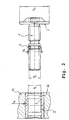
- FIG. 2 shows that in FIG. 1 illustrated embodiment of the mounting arrangement immediately before reaching the pre-assembled state.
- the sleeve 3 was inserted into a mounting part 13 and keeps it in a press fit.
- the bore in the mounting part 13 is thus to be adapted accordingly to the outer diameter D H of the sleeve.
- the ring 2 was inserted into the annular groove 8 of the screw 1.
- the ring 2 is radially elastic there expanded, its outer diameter in this state is denoted by D R in the following.
- the sleeve inner diameter D I immediately at the boundary to the recess 12 is smaller than the outer diameter D R of the ring 2, but larger than the shaft diameter D S.
- the screw 1 is radially movable in the preassembled state, since the ring zone leaves the ring according to space.
- the longitudinal axes of sleeve 3 and screw 1 can move parallel to each other in the preassembled state when ring 2, ring groove 8 and groove 12 are at a height.
- an angular offset is also permissible to a certain extent.
- FIG. 2 A peculiarity of in FIG. 2
- the constellation shown also consists in that the screw can rotate freely in the mounting position, since the ring 2 is not on the wall of the groove 12 rubs. Through this Torsionstoleranzaus GmbH the screwdriver tool can be better positioned in the head 4. When this is done, the screw is tightened, so that the annular groove 8 is located at the level of the left recess 12 as soon as the support surface 7 rests on the sleeve 3 and mounting member 13. At this moment, the screw can turn again without the ring 2 in the sleeve 3 grinds. At the beginning of the state of tension, the ring is thus not deformed or crushed, so that it remains intact.
- the screw can be easily solved at a later time again and pulled out of the sleeve.
- the screw connection formed with the mounting arrangement can consequently be easily dismantled.
- a particular advantage is then that the fitter can position this after loosening the screw 1 in the right puncture, so that the screw is not lost in the workshop.
- FIG. 3 shows a further embodiment of the mounting arrangement according to the invention.
- this screw 1 comprises a head 4 with a protruding bearing surface 7 whose diameter is D K.
- the shaft 5 is provided with a thread 6, to which an annular groove 8 connects.
- an elastic ring 2 is inserted in the annular groove 8.
- the ring 2 is radially expanded in the annular groove 8, its outer diameter D R exceeds the shaft diameter D S of the screw.
- sleeve was in FIG. 3 and 4 shown sleeve 3 produced by a forming process. For this purpose, four projections 14 were first embossed in a rectangular sheet, then the sheet was shaped round, so that it forms a cylindrical sleeve 3.
- the projections 14 on the inside of the sleeve each define an annular zone 15 with an inner diameter D Z where D Z > D R.
- the projections 14 reduce the sleeve inner diameter D I at the boundaries of the annular zone 15, it is D S ⁇ D I ⁇ D R.
- the axial length L Z of the annular zone 15 bounded by the projections 14 is in this embodiment but smaller than the axial length L R of the ring 2.
- a running zone 15 * Between the two annular zones 15 extends to the inner wall of the sleeve 3, a running zone 15 *.
- the here running barrel diameter D L corresponds to the inner diameter D Z of the ring zones 15. This is a special case, D L can also be unlike D Z , as long as D L > D R applies.
- the running zone diameter D L need not be constant over the entire length of the running zone.
- the ring 2 is unloaded, so that the screw 1 runs freely in the sleeve 3 and the ring 2 remains undamaged
- the outer diameter D H of the sleeve 3 is again smaller than the head diameter D K.
- the distance A H from the center of the annular zone 15 to the opposite end of the sleeve in turn corresponds to the mean distance A K of the annular groove 8 to the bearing surface 7 of the head 4th
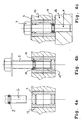
- FIGS. 4a to 4c show steps of mounting the in FIG. 3 shown embodiment.
- the sleeve 3 is inserted into a corresponding through hole of a mounting part 13.
- the outer diameter D H of the sleeve 3 and the diameter of the receiving bore in the mounting part 13 are coordinated so that the sleeve 3 holds with a press fit in the mounting part 13.
- the axial length of the sleeve 3 corresponds to the thickness of the mounting part 13.
- an overload of the mounting member 13 is prevented when the screw 4 is tightened too much.
- the screw 1 is inserted into the sleeve, so that the ring 2 is received in the upper ring zone 15; see. FIG. 4b , In this position, the mounting arrangement has reached its pre-assembled state.
- the line contact causes a very dimensionally accurate positioning of the screw relative to the sleeve in the preassembled state.
- Their axial mobility is almost zero, minimal axial deflections are accompanied by elastic deformation of the ring, so that it centers the screw elastically in the annular zone.
- An angular deflection of the screw relative to the sleeve is possible only against elastic biasing force of the ring, so that here also a centering effect occurs, which holds the screw coaxial with the sleeve.
- a radial offset of the sleeve is also possible up to the stop of the shaft 5 on the projections 14, but here only against spring action of the ring.
- this embodiment achieved with the shortened ring zone a very dimensionally accurate erection of the screw in the sleeve and a tolerance compensation only against elastic force of the ring. No tolerance compensation allows this embodiment with respect to a rotation of the screw in the sleeve, here the frictional forces act on the line contact of the projections 14 against.
- a running zone 15 * is provided between the inner projections 14, ie a section of the sleeve whose inner diameter D L is always greater than the outer diameter D R of the ring seated in the annular groove 8.
- the ring 2 thus finds enough space on its way through the running zone 15 * and does not roll on the inner wall of the sleeve. Damage to the ring 2 can therefore be ruled out.
- the intact ring could also be used again later in loosening the screw to button the screw in the upper ring zone in the disassembled state.
- Two differently selected ring zones - one longer, the other shorter than the ring - may be advantageous to this extent.
- Disadvantage of this variant is a special positioning need of the sleeve 3 relative to the mounting part 13, since a sleeve with two different lengths ring zones can be installed upside down.
- the running zone 15 * can be extended so that it extends from the inner projection 14 adjacent to the upper annular groove 15 to the joining part-side end of the sleeve 3.
Landscapes
- Engineering & Computer Science (AREA)
- General Engineering & Computer Science (AREA)
- Mechanical Engineering (AREA)
- Snaps, Bayonet Connections, Set Pins, And Snap Rings (AREA)
- Bolts, Nuts, And Washers (AREA)
- Clamps And Clips (AREA)
Claims (15)
- Agencement de montage comprenant une douille (3) pouvant être insérée dans une partie de montage (13), une bague élastique (2) et une vis (1) présentant une tête (4) et une tige (5), qui peut être introduite avec sa tige (5) jusqu'à ce que la surface d'appui (7) de la tête (4) repose dans la douille (3), étant entendu que la tige (5) de la vis (1) est munie d'au moins un filetage (6) et d'au moins une rainure annulaire (8) dans laquelle la bague (2) peut être insérée, et étant entendu que le diamètre extérieur (DR) de la bague (2) insérée dans la rainure annulaire (8) est à la fois plus grand que le diamètre de la tige (DS) de la vis (1) et plus petit que le diamètre de la tête (DK) de la vis (1), étant entendu que la douille (3) présente une zone annulaire (12, 15) dont le diamètre intérieur de la douille (DI) à la limite de la zone annulaire (12, 15) est à la fois plus petit que le diamètre extérieur (DR) de la bague (2) insérée dans la rainure annulaire (8) et plus grand que le diamètre de la tige (DS), caractérisé en ce qu'il est prévu à l'intérieur de la douille (3) au moins deux zones annulaires (12, 15) délimitées des deux côtés dans la direction axiale, en position symétrique, dont le diamètre (DZ) est plus grand que le diamètre extérieur (DR) de la bague (2) insérée dans la rainure annulaire (8).
- Agencement de montage selon la revendication 1, caractérisé en ce que la distance axiale (AH) du centre d'une zone annulaire respective (12, 15) par rapport à l'extrémité distante de la douille (3) correspond à la distance axiale (AK) du centre de la rainure annulaire (8) par rapport à la surface d'appui (7) de la tête (4).
- Agencement de montage selon la revendication 1 et 2, caractérisé en ce que les zones annulaires sont réalisées comme collet (12) dans la paroi intérieure de la douille (3).
- Agencement de montage selon la revendication 1 et 2, caractérisé en ce que les zones annulaires (15) sont délimitées des deux côtés, dans la direction axiale, par des saillies (14) sur la paroi intérieure de la douille (3).
- Agencement de montage selon la revendication 4, caractérisé en ce que les saillies (14) font partie intégrante de la douille (3).
- Agencement de montage selon la revendication 4 ou 5, caractérisé en ce qu'il est prévu à l'intérieur de la douille (3) une zone de course (15*), qui s'étend sur toute la longueur axiale de la douille (3) à l'exception des surfaces d'extension des zones annulaires (15) et des saillies (14), étant entendu que le diamètre de la zone de course (DL) est plus grand que le diamètre extérieur (DR) de la bague (2) insérée dans la rainure annulaire (8).
- Agencement de montage selon l'une des revendications 1 à 6, caractérisé en ce que le diamètre de la tête (DK) de la vis (1) est plus grand que le diamètre extérieur (DH) de la douille.
- Agencement de montage selon l'une des revendications 1 à 7, caractérisé en ce que lors de son insertion dans la partie de montage, la longueur axiale de la douille (3) correspond à l'épaisseur de la partie de montage (13) entre la surface d'appui (7) et la partie d'assemblage (16) adjointe à l'agencement de montage.
- Agencement de montage selon l'une des revendications 1 à 8, caractérisé en ce que la longueur axiale (LZ) des zones annulaires (15) est plus petite que la longueur axiale (LR) de la bague (2).
- Agencement de montage selon l'une des revendications 1 à 8, caractérisé en ce que la longueur axiale (LZ) des zones annulaires (12) est plus grande que la longueur axiale (LR) de la bague (2).
- Agencement de montage selon la revendication 10, caractérisé en ce que la longueur axiale (LZ) des zones annulaires (12) correspond à quatre tiers de la longueur axiale (LR) de la bague (2).
- Agencement de montage selon l'une des revendications 1 à 11, caractérisé en ce que le diamètre (DZ) des zones annulaires (12, 15) correspond à onze dixièmes du diamètre extérieur (DR) de la bague (2) insérée dans la rainure annulaire (8).
- Agencement de montage selon l'une des revendications 1 à 12, caractérisé en ce que le diamètre du fond de la rainure (DN) de la rainure annulaire (8) est plus grand que le diamètre intérieur (DRI) de la bague (2) sans tension non montée, de sorte que la bague (2) insérée dans la rainure annulaire (8) est élargie constamment de façon élastique sous l'effet de la tension.
- Agencement de montage selon la revendication 13, caractérisé en ce que le diamètre du fond de la rainure (DN) de la rainure annulaire (8) correspond à neuf huitièmes du diamètre intérieur (DRI) de la bague (2) sans tension non montée.
- Agencement de montage selon l'une des revendications 1 à 14, caractérisé en ce que la bague (2) est une bague d'étanchéité circulaire.
Applications Claiming Priority (1)
| Application Number | Priority Date | Filing Date | Title |
|---|---|---|---|
| DE200720014325 DE202007014325U1 (de) | 2007-10-12 | 2007-10-12 | Montageanordnung mit elastischem Ring |
Publications (3)
| Publication Number | Publication Date |
|---|---|
| EP2048384A2 EP2048384A2 (fr) | 2009-04-15 |
| EP2048384A3 EP2048384A3 (fr) | 2011-03-23 |
| EP2048384B1 true EP2048384B1 (fr) | 2013-12-18 |
Family
ID=38859943
Family Applications (1)
| Application Number | Title | Priority Date | Filing Date |
|---|---|---|---|
| EP08017894.0A Not-in-force EP2048384B1 (fr) | 2007-10-12 | 2008-10-13 | Ensemble de montage doté d'un anneau élastique |
Country Status (2)
| Country | Link |
|---|---|
| EP (1) | EP2048384B1 (fr) |
| DE (1) | DE202007014325U1 (fr) |
Families Citing this family (7)
| Publication number | Priority date | Publication date | Assignee | Title |
|---|---|---|---|---|
| EP2169685B1 (fr) * | 2008-09-26 | 2012-02-22 | Areva NP | Dispositif de connexion pour connecter un tube guide à une buse en partie inférieure dans un assemblage de combustible nucléaire |
| JP2012127481A (ja) * | 2010-12-17 | 2012-07-05 | Nitto Seiko Co Ltd | 脱落防止ねじ |
| FR2972892B1 (fr) * | 2011-03-18 | 2013-03-29 | Seifel | Boitier assemble |
| DE102012203520A1 (de) | 2012-03-06 | 2013-09-12 | Mahle International Gmbh | Befestigungsanordnung |
| DE102014118513A1 (de) * | 2014-12-12 | 2016-06-16 | Eaton Electrical Ip Gmbh & Co. Kg | Schraube, insbesondere für Gehäuse |
| DE102016205155A1 (de) * | 2016-03-29 | 2017-10-05 | Audi Ag | Verbindungsanordnung |
| CN109845030B (zh) * | 2016-08-15 | 2022-01-25 | 赫思曼汽车通讯有限公司 | 通过十字旋转件卡固车辆的顶罩天线 |
Family Cites Families (5)
| Publication number | Priority date | Publication date | Assignee | Title |
|---|---|---|---|---|
| JPS5628354Y2 (fr) * | 1976-11-27 | 1981-07-06 | ||
| DE4131779A1 (de) * | 1991-09-24 | 1993-03-25 | Siemens Ag | Schraubbefestigung fuer abdeckungen oder frontplatten von geraeten oder systemen |
| DE29623736U1 (de) * | 1995-12-23 | 1999-07-22 | Richard Bergner Gmbh & Co, 91126 Schwabach | Montageeinheit aus einem Montageteil und einem insbesondere als Schraube ausgebildeten Fixierteil |
| DE202007019095U1 (de) | 2006-02-16 | 2010-08-12 | Richard Bergner Verbindungstechnik Gmbh & Co. Kg | Montageeinheit und Befestigereinheit |
| DE202006007952U1 (de) | 2006-05-18 | 2006-08-03 | Knipping Verbindungstechnik Gmbh | Montageanordnung mit wanderndem Ring |
-
2007
- 2007-10-12 DE DE200720014325 patent/DE202007014325U1/de not_active Expired - Lifetime
-
2008
- 2008-10-13 EP EP08017894.0A patent/EP2048384B1/fr not_active Not-in-force
Also Published As
| Publication number | Publication date |
|---|---|
| EP2048384A2 (fr) | 2009-04-15 |
| EP2048384A3 (fr) | 2011-03-23 |
| DE202007014325U1 (de) | 2007-12-27 |
Similar Documents
| Publication | Publication Date | Title |
|---|---|---|
| DE69417441T2 (de) | Vorrichtung zum herstellen von verbindungen | |
| DE2008035C3 (fr) | ||
| DE602005000797T2 (de) | Element zum Befestigen von Zubehörteilen an Metallfenstern und Metalltüren | |
| EP2048384B1 (fr) | Ensemble de montage doté d'un anneau élastique | |
| EP1696138B1 (fr) | Dispositif de compensation de tolérance | |
| DE102006034463B3 (de) | Vorrichtung zum Befestigen eines Anbauteiles und eines Trägerteiles in einem Abstand voneinander | |
| EP1869334B1 (fr) | Palier lisse, systeme de palier lisse et montage d'un systeme de palier lisse | |
| EP1918596B1 (fr) | Rivet aveugle et son utilisation | |
| EP1853408B1 (fr) | Dispositif et procede pour etablir un assemblage par vis entre un premier element constitutif et au moins un autre element constitutif | |
| EP2130722B1 (fr) | Elément d'équilibrage de tolérance | |
| EP3597943A1 (fr) | Procédé de raccordement des composants ainsi que module | |
| CH682688A5 (de) | Schaftanordnung mit wenigstens einem Kugel- oder Rollenlager. | |
| EP0627568A1 (fr) | Elément de connection et de centrage par insertion à force, en particulier boulon de roue | |
| DE3027947C2 (de) | Anordnung zur Befestigung eines ersten Teils an einem zweiten Teil mittels eines Bolzens | |
| EP2018484A1 (fr) | Système de vis et rivet aveugle, ensemble de liaison à vis et rivet aveugle, et procédé pour relier deux composants avec le système de vis et rivet aveugle | |
| EP3569880A1 (fr) | Agencement flottant imperdable d'un élément de raccordement sur un composant | |
| EP2627915B1 (fr) | Dispositif d'ancrage destiné à fixer une pièce sur un élément de support | |
| DE3322861A1 (de) | Querkraefte aufnehmende schraubenverbindung, insbesondere zum zusammenspannen des geteilten kurbelgehaeuses eines motors | |
| WO2005017372A1 (fr) | Dispositif comportant deux profiles creux assembles par une vis et outil correspondant | |
| EP3144546A1 (fr) | Dispositif de liaison, système de liaison et procédé de fabrication d'un dispositif de liaison | |
| DE2730475A1 (de) | Einstellantrieb fuer feinmechanische geraete, insbesondere thermostate | |
| WO2001081777A1 (fr) | Unite de montage constituee d"un composant et d"au moins une vis taraudeuse | |
| AT400977B (de) | Anordnung zum befestigen von rohren | |
| DE10291501T5 (de) | Lager für ein mechanisches Wälzübertragungselement | |
| DE102019100396A1 (de) | Befestigungsvorrichtung zum Befestigen eines Griffträgers an einem Kraftfahrzeugkarosserieblech |
Legal Events
| Date | Code | Title | Description |
|---|---|---|---|
| PUAI | Public reference made under article 153(3) epc to a published international application that has entered the european phase |
Free format text: ORIGINAL CODE: 0009012 |
|
| AK | Designated contracting states |
Kind code of ref document: A2 Designated state(s): AT BE BG CH CY CZ DE DK EE ES FI FR GB GR HR HU IE IS IT LI LT LU LV MC MT NL NO PL PT RO SE SI SK TR |
|
| AX | Request for extension of the european patent |
Extension state: AL BA MK RS |
|
| PUAL | Search report despatched |
Free format text: ORIGINAL CODE: 0009013 |
|
| AK | Designated contracting states |
Kind code of ref document: A3 Designated state(s): AT BE BG CH CY CZ DE DK EE ES FI FR GB GR HR HU IE IS IT LI LT LU LV MC MT NL NO PL PT RO SE SI SK TR |
|
| AX | Request for extension of the european patent |
Extension state: AL BA MK RS |
|
| AKX | Designation fees paid |
Designated state(s): AT BE BG CH CY CZ DE DK EE ES FI FR GB GR HR HU IE IS IT LI LT LU LV MC MT NL NO PL PT RO SE SI SK TR |
|
| 17P | Request for examination filed |
Effective date: 20120103 |
|
| GRAP | Despatch of communication of intention to grant a patent |
Free format text: ORIGINAL CODE: EPIDOSNIGR1 |
|
| INTG | Intention to grant announced |
Effective date: 20130604 |
|
| RIN1 | Information on inventor provided before grant (corrected) |
Inventor name: SCHOMAKER, CHRISTIAN Inventor name: HOFMANN, FRANK |
|
| GRAS | Grant fee paid |
Free format text: ORIGINAL CODE: EPIDOSNIGR3 |
|
| GRAA | (expected) grant |
Free format text: ORIGINAL CODE: 0009210 |
|
| AK | Designated contracting states |
Kind code of ref document: B1 Designated state(s): AT BE BG CH CY CZ DE DK EE ES FI FR GB GR HR HU IE IS IT LI LT LU LV MC MT NL NO PL PT RO SE SI SK TR |
|
| REG | Reference to a national code |
Ref country code: GB Ref legal event code: FG4D Free format text: NOT ENGLISH |
|
| REG | Reference to a national code |
Ref country code: CH Ref legal event code: EP |
|
| REG | Reference to a national code |
Ref country code: AT Ref legal event code: REF Ref document number: 645778 Country of ref document: AT Kind code of ref document: T Effective date: 20140115 |
|
| REG | Reference to a national code |
Ref country code: IE Ref legal event code: FG4D Free format text: LANGUAGE OF EP DOCUMENT: GERMAN |
|
| REG | Reference to a national code |
Ref country code: DE Ref legal event code: R096 Ref document number: 502008011084 Country of ref document: DE Effective date: 20140213 |
|
| REG | Reference to a national code |
Ref country code: NL Ref legal event code: VDEP Effective date: 20131218 |
|
| PG25 | Lapsed in a contracting state [announced via postgrant information from national office to epo] |
Ref country code: SE Free format text: LAPSE BECAUSE OF FAILURE TO SUBMIT A TRANSLATION OF THE DESCRIPTION OR TO PAY THE FEE WITHIN THE PRESCRIBED TIME-LIMIT Effective date: 20131218 Ref country code: LT Free format text: LAPSE BECAUSE OF FAILURE TO SUBMIT A TRANSLATION OF THE DESCRIPTION OR TO PAY THE FEE WITHIN THE PRESCRIBED TIME-LIMIT Effective date: 20131218 Ref country code: NO Free format text: LAPSE BECAUSE OF FAILURE TO SUBMIT A TRANSLATION OF THE DESCRIPTION OR TO PAY THE FEE WITHIN THE PRESCRIBED TIME-LIMIT Effective date: 20140318 Ref country code: HR Free format text: LAPSE BECAUSE OF FAILURE TO SUBMIT A TRANSLATION OF THE DESCRIPTION OR TO PAY THE FEE WITHIN THE PRESCRIBED TIME-LIMIT Effective date: 20131218 Ref country code: FI Free format text: LAPSE BECAUSE OF FAILURE TO SUBMIT A TRANSLATION OF THE DESCRIPTION OR TO PAY THE FEE WITHIN THE PRESCRIBED TIME-LIMIT Effective date: 20131218 |
|
| REG | Reference to a national code |
Ref country code: LT Ref legal event code: MG4D |
|
| PG25 | Lapsed in a contracting state [announced via postgrant information from national office to epo] |
Ref country code: LV Free format text: LAPSE BECAUSE OF FAILURE TO SUBMIT A TRANSLATION OF THE DESCRIPTION OR TO PAY THE FEE WITHIN THE PRESCRIBED TIME-LIMIT Effective date: 20131218 |
|
| PG25 | Lapsed in a contracting state [announced via postgrant information from national office to epo] |
Ref country code: EE Free format text: LAPSE BECAUSE OF FAILURE TO SUBMIT A TRANSLATION OF THE DESCRIPTION OR TO PAY THE FEE WITHIN THE PRESCRIBED TIME-LIMIT Effective date: 20131218 Ref country code: IS Free format text: LAPSE BECAUSE OF FAILURE TO SUBMIT A TRANSLATION OF THE DESCRIPTION OR TO PAY THE FEE WITHIN THE PRESCRIBED TIME-LIMIT Effective date: 20140418 |
|
| PG25 | Lapsed in a contracting state [announced via postgrant information from national office to epo] |
Ref country code: PL Free format text: LAPSE BECAUSE OF FAILURE TO SUBMIT A TRANSLATION OF THE DESCRIPTION OR TO PAY THE FEE WITHIN THE PRESCRIBED TIME-LIMIT Effective date: 20131218 Ref country code: CY Free format text: LAPSE BECAUSE OF FAILURE TO SUBMIT A TRANSLATION OF THE DESCRIPTION OR TO PAY THE FEE WITHIN THE PRESCRIBED TIME-LIMIT Effective date: 20131218 Ref country code: ES Free format text: LAPSE BECAUSE OF FAILURE TO SUBMIT A TRANSLATION OF THE DESCRIPTION OR TO PAY THE FEE WITHIN THE PRESCRIBED TIME-LIMIT Effective date: 20131218 Ref country code: SK Free format text: LAPSE BECAUSE OF FAILURE TO SUBMIT A TRANSLATION OF THE DESCRIPTION OR TO PAY THE FEE WITHIN THE PRESCRIBED TIME-LIMIT Effective date: 20131218 Ref country code: RO Free format text: LAPSE BECAUSE OF FAILURE TO SUBMIT A TRANSLATION OF THE DESCRIPTION OR TO PAY THE FEE WITHIN THE PRESCRIBED TIME-LIMIT Effective date: 20131218 Ref country code: CZ Free format text: LAPSE BECAUSE OF FAILURE TO SUBMIT A TRANSLATION OF THE DESCRIPTION OR TO PAY THE FEE WITHIN THE PRESCRIBED TIME-LIMIT Effective date: 20131218 Ref country code: NL Free format text: LAPSE BECAUSE OF FAILURE TO SUBMIT A TRANSLATION OF THE DESCRIPTION OR TO PAY THE FEE WITHIN THE PRESCRIBED TIME-LIMIT Effective date: 20131218 Ref country code: PT Free format text: LAPSE BECAUSE OF FAILURE TO SUBMIT A TRANSLATION OF THE DESCRIPTION OR TO PAY THE FEE WITHIN THE PRESCRIBED TIME-LIMIT Effective date: 20140418 |
|
| REG | Reference to a national code |
Ref country code: DE Ref legal event code: R097 Ref document number: 502008011084 Country of ref document: DE |
|
| PLBE | No opposition filed within time limit |
Free format text: ORIGINAL CODE: 0009261 |
|
| STAA | Information on the status of an ep patent application or granted ep patent |
Free format text: STATUS: NO OPPOSITION FILED WITHIN TIME LIMIT |
|
| PG25 | Lapsed in a contracting state [announced via postgrant information from national office to epo] |
Ref country code: DK Free format text: LAPSE BECAUSE OF FAILURE TO SUBMIT A TRANSLATION OF THE DESCRIPTION OR TO PAY THE FEE WITHIN THE PRESCRIBED TIME-LIMIT Effective date: 20131218 |
|
| 26N | No opposition filed |
Effective date: 20140919 |
|
| REG | Reference to a national code |
Ref country code: DE Ref legal event code: R097 Ref document number: 502008011084 Country of ref document: DE Effective date: 20140919 |
|
| PG25 | Lapsed in a contracting state [announced via postgrant information from national office to epo] |
Ref country code: MC Free format text: LAPSE BECAUSE OF FAILURE TO SUBMIT A TRANSLATION OF THE DESCRIPTION OR TO PAY THE FEE WITHIN THE PRESCRIBED TIME-LIMIT Effective date: 20131218 Ref country code: SI Free format text: LAPSE BECAUSE OF FAILURE TO SUBMIT A TRANSLATION OF THE DESCRIPTION OR TO PAY THE FEE WITHIN THE PRESCRIBED TIME-LIMIT Effective date: 20131218 Ref country code: LU Free format text: LAPSE BECAUSE OF FAILURE TO SUBMIT A TRANSLATION OF THE DESCRIPTION OR TO PAY THE FEE WITHIN THE PRESCRIBED TIME-LIMIT Effective date: 20141013 |
|
| REG | Reference to a national code |
Ref country code: CH Ref legal event code: PL |
|
| PG25 | Lapsed in a contracting state [announced via postgrant information from national office to epo] |
Ref country code: BE Free format text: LAPSE BECAUSE OF NON-PAYMENT OF DUE FEES Effective date: 20141031 |
|
| REG | Reference to a national code |
Ref country code: IE Ref legal event code: MM4A |
|
| PG25 | Lapsed in a contracting state [announced via postgrant information from national office to epo] |
Ref country code: CH Free format text: LAPSE BECAUSE OF NON-PAYMENT OF DUE FEES Effective date: 20141031 Ref country code: LI Free format text: LAPSE BECAUSE OF NON-PAYMENT OF DUE FEES Effective date: 20141031 |
|
| PG25 | Lapsed in a contracting state [announced via postgrant information from national office to epo] |
Ref country code: IE Free format text: LAPSE BECAUSE OF NON-PAYMENT OF DUE FEES Effective date: 20141013 |
|
| REG | Reference to a national code |
Ref country code: AT Ref legal event code: MM01 Ref document number: 645778 Country of ref document: AT Kind code of ref document: T Effective date: 20141013 |
|
| REG | Reference to a national code |
Ref country code: FR Ref legal event code: PLFP Year of fee payment: 8 |
|
| PG25 | Lapsed in a contracting state [announced via postgrant information from national office to epo] |
Ref country code: AT Free format text: LAPSE BECAUSE OF NON-PAYMENT OF DUE FEES Effective date: 20141013 |
|
| PG25 | Lapsed in a contracting state [announced via postgrant information from national office to epo] |
Ref country code: BG Free format text: LAPSE BECAUSE OF FAILURE TO SUBMIT A TRANSLATION OF THE DESCRIPTION OR TO PAY THE FEE WITHIN THE PRESCRIBED TIME-LIMIT Effective date: 20131218 |
|
| PG25 | Lapsed in a contracting state [announced via postgrant information from national office to epo] |
Ref country code: GR Free format text: LAPSE BECAUSE OF FAILURE TO SUBMIT A TRANSLATION OF THE DESCRIPTION OR TO PAY THE FEE WITHIN THE PRESCRIBED TIME-LIMIT Effective date: 20140319 Ref country code: IT Free format text: LAPSE BECAUSE OF FAILURE TO SUBMIT A TRANSLATION OF THE DESCRIPTION OR TO PAY THE FEE WITHIN THE PRESCRIBED TIME-LIMIT Effective date: 20131218 |
|
| PG25 | Lapsed in a contracting state [announced via postgrant information from national office to epo] |
Ref country code: TR Free format text: LAPSE BECAUSE OF FAILURE TO SUBMIT A TRANSLATION OF THE DESCRIPTION OR TO PAY THE FEE WITHIN THE PRESCRIBED TIME-LIMIT Effective date: 20131218 Ref country code: HU Free format text: LAPSE BECAUSE OF FAILURE TO SUBMIT A TRANSLATION OF THE DESCRIPTION OR TO PAY THE FEE WITHIN THE PRESCRIBED TIME-LIMIT; INVALID AB INITIO Effective date: 20081013 Ref country code: MT Free format text: LAPSE BECAUSE OF FAILURE TO SUBMIT A TRANSLATION OF THE DESCRIPTION OR TO PAY THE FEE WITHIN THE PRESCRIBED TIME-LIMIT Effective date: 20131218 |
|
| REG | Reference to a national code |
Ref country code: FR Ref legal event code: PLFP Year of fee payment: 9 |
|
| REG | Reference to a national code |
Ref country code: FR Ref legal event code: PLFP Year of fee payment: 10 |
|
| REG | Reference to a national code |
Ref country code: FR Ref legal event code: PLFP Year of fee payment: 11 |
|
| PGFP | Annual fee paid to national office [announced via postgrant information from national office to epo] |
Ref country code: GB Payment date: 20181019 Year of fee payment: 11 Ref country code: FR Payment date: 20181022 Year of fee payment: 11 |
|
| GBPC | Gb: european patent ceased through non-payment of renewal fee |
Effective date: 20191013 |
|
| PG25 | Lapsed in a contracting state [announced via postgrant information from national office to epo] |
Ref country code: GB Free format text: LAPSE BECAUSE OF NON-PAYMENT OF DUE FEES Effective date: 20191013 Ref country code: FR Free format text: LAPSE BECAUSE OF NON-PAYMENT OF DUE FEES Effective date: 20191031 |
|
| REG | Reference to a national code |
Ref country code: DE Ref legal event code: R084 Ref document number: 502008011084 Country of ref document: DE |
|
| PGFP | Annual fee paid to national office [announced via postgrant information from national office to epo] |
Ref country code: DE Payment date: 20221019 Year of fee payment: 15 |
|
| REG | Reference to a national code |
Ref country code: DE Ref legal event code: R119 Ref document number: 502008011084 Country of ref document: DE |
|
| PG25 | Lapsed in a contracting state [announced via postgrant information from national office to epo] |
Ref country code: DE Free format text: LAPSE BECAUSE OF NON-PAYMENT OF DUE FEES Effective date: 20240501 |