EP2048907A1 - Verfahren zur Bestimmung des Hysteresebereichs, Übergabeauslöseverfahren und mobile Station zur Durchführung dieses Verfahrens - Google Patents
Verfahren zur Bestimmung des Hysteresebereichs, Übergabeauslöseverfahren und mobile Station zur Durchführung dieses Verfahrens Download PDFInfo
- Publication number
- EP2048907A1 EP2048907A1 EP08158997A EP08158997A EP2048907A1 EP 2048907 A1 EP2048907 A1 EP 2048907A1 EP 08158997 A EP08158997 A EP 08158997A EP 08158997 A EP08158997 A EP 08158997A EP 2048907 A1 EP2048907 A1 EP 2048907A1
- Authority
- EP
- European Patent Office
- Prior art keywords
- cell
- handover
- serving cell
- hysteresis range
- determining
- Prior art date
- Legal status (The legal status is an assumption and is not a legal conclusion. Google has not performed a legal analysis and makes no representation as to the accuracy of the status listed.)
- Granted
Links
Images
Classifications
-
- H—ELECTRICITY
- H04—ELECTRIC COMMUNICATION TECHNIQUE
- H04W—WIRELESS COMMUNICATION NETWORKS
- H04W36/00—Hand-off or reselection arrangements
- H04W36/0005—Control or signalling for completing the hand-off
- H04W36/0083—Determination of parameters used for hand-off, e.g. generation or modification of neighbour cell lists
- H04W36/00837—Determination of triggering parameters for hand-off
-
- H—ELECTRICITY
- H04—ELECTRIC COMMUNICATION TECHNIQUE
- H04W—WIRELESS COMMUNICATION NETWORKS
- H04W36/00—Hand-off or reselection arrangements
- H04W36/0005—Control or signalling for completing the hand-off
- H04W36/0055—Transmission or use of information for re-establishing the radio link
- H04W36/0061—Transmission or use of information for re-establishing the radio link of neighbour cell information
-
- H—ELECTRICITY
- H04—ELECTRIC COMMUNICATION TECHNIQUE
- H04W—WIRELESS COMMUNICATION NETWORKS
- H04W36/00—Hand-off or reselection arrangements
- H04W36/24—Reselection being triggered by specific parameters
- H04W36/30—Reselection being triggered by specific parameters by measured or perceived connection quality data
- H04W36/302—Reselection being triggered by specific parameters by measured or perceived connection quality data due to low signal strength
-
- H—ELECTRICITY
- H04—ELECTRIC COMMUNICATION TECHNIQUE
- H04W—WIRELESS COMMUNICATION NETWORKS
- H04W36/00—Hand-off or reselection arrangements
- H04W36/34—Reselection control
- H04W36/36—Reselection control by user or terminal equipment
Definitions
- the present invention relates to a method of determining a hysteresis range, a handover triggering method, and a mobile station for performing the method.
- the present invention is supported by the IT R&D program of MIC/IITA [2005-S-404-23, Research and development on 3G long-term evolution access system].
- a basic purpose of handover is to always connect a mobile station with a base station, which provides the best signal quality, in order to provide a service without intermittence to a moving user. Therefore, there have been various handover methods that connect a mobile station with a base station providing the best signal quality,
- a mobile station performs handover to a cell, which provides the best signal intensity, without additional criteria.
- This method causes a problem that unnecessary handover occurs while the mobile station moves along a path, Particularly, if handover is performed whenever a pattern where signal intensity is suddenly increased or decreased may occur in an irregular wireless environment, a ping-pong effect where the performance of a system deteriorates may occur.
- the signal intensity of a serving cell is compared with the signal intensities of adjacent cells by a fixed hysteresis range FH and a timer value, and handover is performed when the signal intensities of the adjacent cells are significantly higher than the signal intensity of the serving cell. That is, when detecting the signal intensity RSS Neigh of an adjacent cell, which has the highest signal intensity level, from an adjacent cell in a coverage region as represented by the following Equation 1, the mobile station confirms whether the signal intensity RSS Neigh is higher than the sum of the signal intensity RSS serv detected from the serving cell and the fixed hysteresis range FH. If the signal intensity RSS Neigh is higher than the sum of the signal intensity RSS serv detected from the serving cell and the fixed hysteresis range FH, handover is performed.
- Equation 1 represents a handover reporting event formula corresponding to the fixed hysteresis application handover.
- the fixed hysteresis application handover method has an advantage of reducing potential unnecessary handover, which is performed using a value lower than the hysteresis range on the signal quality, to some extent.
- the signal intensity RSS serv of the signal received from the serving cell is sufficiently high or the signal intensities of the adjacent cells are significantly high (when Rss serv ⁇ RSS Neigh - FH is still available), unnecessary handover is performed.
- the signal intensity of the serving cell is very low or the signal intensities of the adjacent cells do not meet the handover reporting event formula (RSS serv ⁇ RSS Neigh - FH)
- handover triggering is not quickly performed. For this reason, there is a problem in that the probability of handover failure is increased.
- variable hysteresis application handover method is a method that reduces the probability of handover by increasing a hysteresis range when the signal intensity of a serving cell is high, and increases the probability of handover by decreasing the hysteresis range when the signal intensity is low.
- the method uses a variable hysteresis range depending on the signal intensity of the serving cell.
- a handover reporting event formula corresponding to the variable hysteresis application handover may be represented by the following Equation 2.
- RSS serv ⁇ RSS Neigh - VH VH RSS serv - ⁇
- a variable hysteresis range VH is represented by the difference between the signal intensity RSS serv of the current serving cell and the fixed handover expectation value ⁇ . Accordingly, if the signal intensity RSS serv of the serving cell is increased, the variable hysteresis range VH is also increased. If the signal intensity RSS serv of the serving cell is decreased, the variable hysteresis range VH is decreased.
- the probability of handover with respect to the signal intensity given in the serving cell depends on the selection of the handover expectation value ⁇ . Further, when the signal intensity of the serving cell is low or the signal intensities of the adjacent cells are low, the variable hysteresis range is significantly decreased. For this reason, there is a drawback in that unnecessary handover occurs.
- the present invention has been made in an effort to provide a method of determining a hysteresis range of a mobile station having advantages of preventing the occurrence of unnecessary handover, and a handover triggering method therefore.
- An exemplary embodiment of the present invention provides a method of determining a hysteresis range of a mobile station for performing handover triggering.
- the method includes obtaining signal intensities of signals that are received from a serving cell and adjacent cells during a collection period, deducing a slope of linearized signal intensity of each of the serving cell and the adjacent cells by using the signal intensities, and determining hysteresis ranges corresponding to the adjacent cells by using the slope.
- Another embodiment of the present invention provides a handover triggering method of a mobile station.
- the handover triggering method includes obtaining signal intensities of signals that are received from a plurality of cells including a serving cell and at least one adjacent cell during a collection period, deducing a slope of linearized signal intensity of each of the plurality of cells by using the signal intensities, determining at least one hysteresis range corresponding to the at least one adjacent cell by using the difference between the slope corresponding to the at least one adjacent cell and the slope corresponding to the serving cell, determining whether the handover triggering is to be performed or not by using the hysteresis range, and transmitting a message, which includes information about a target cell to be an object of handover, to the serving cell when the handover triggering is determined.
- yet another embodiment of the present invention provides a mobile station.
- the mobile station include a signal collecting unit obtaining signal intensities of signals that are received from a plurality of cells including a serving cell and at least one adjacent cell during a collection period, a signal intensity pattern analyzing unit deducing approximately linearized signal intensities of the plurality of cells and the slopes of the approximately linearized signal intensities by using the signal intensities obtained during the collection period, and a handover triggering determining unit that determines at least one hysteresis range corresponding to the at least one adjacent cell by using the slopes, selects a target cell by using the at least one hysteresis range, and determines whether the handover triggering is to be performed or not.
- the mobile station when determining the hysteresis ranges by using the slopes of the linearized signal intensities of the adjacent cells, the mobile station is apt to perform handover to a cell of which signal quality is most rapidly increased among the adjacent cells. Therefore, it is possible to obtain an advantage of reducing unnecessary handover.
- a mobile station may represent a terminal, a mobile terminal (MT), a subscriber station (SS), a portable subscriber station (PSS), user equipment (UE), an access terminal (AT), and the like. Further, the mobile station may have the entire or partial function of the terminal, the mobile terminal, the subscriber station, the portable subscriber station, the user equipment, the access terminal, and the like.
- a base station may represent an access point (AP), a radio access station (RAS), a node B, an eNB (evolved Node-B), a base transceiver station (BTS), a mobile multihop relay (MMR)-BS, and the like. Further, the base station may have the entire or partial function of the access point, the radio access station, the node B, the eNB, the base transceiver station, the MMR-BS, and the like.
- AP access point
- RAS radio access station
- a node B an eNB (evolved Node-B)
- BTS base transceiver station
- MMR mobile multihop relay
- a method of determining a hysteresis range according to an exemplary embodiment of the present invention, a handover triggering method using the method, and a mobile station for performing the method will be described in detail below with reference to drawings.
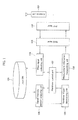
- FIG. 1 is a diagram showing the configuration of a mobile station according to an exemplary embodiment of the present invention.
- a mobile station includes an antenna unit 101, a physical (PHY) layer 102, a media access control (MAC) layer 103, a pilot signal collecting unit 104, a local database (DB) 105, a signal intensity pattern analyzing unit 106, a handover control unit 107, a handover trigger determining unit 108, and a measurement information transmitting unit 109.
- PHY physical
- MAC media access control
- DB local database
- the pilot signal collecting unit 104 receives the signal through the PHY layer 102 and the MAC layer 103, Then, the pilot signal collecting unit 104 measures the signal intensity of the received signal. Further, the signal intensity of the received signal measured until the operation of a timer is terminated is stored in the local DB 105. In this case, the signal intensity of the received signal means the signal intensity of a pilot signal included in the received signals.
- a timer value counted by the timer is as a value corresponding to a collection period where the signal intensities of the received signals used to analyze signal intensity patterns are collected, and the timer value uses a value that is set by the handover control unit 107 using a measurement control message received from a serving cell or a predetermined value that is predetermined at the time of designing a system.
- the signal intensity pattern analyzing unit 106 deduces approximately linearized signal intensities of a serving cell and adjacent cells by using the signals intensities of the signals collected during a timer value, and slopes of the signal intensities using the linearized signal intensities.
- the approximately linearized signal intensities are deduced using a least-squares method. Since the least-squares method is well known and can be easily performed by those skilled in the art, a detailed description thereof will be omitted.
- the handover trigger determining unit 108 determines hysteresis ranges by using the slopes deduced by the signal intensity pattern analyzing unit 106. Further, the handover trigger determining unit 108 determines an optimum target cell by applying the determined hysteresis ranges to a handover reporting event formula, and judges whether the handover triggering of the target cell is to be performed or not. In this case, the handover trigger determining unit 108 uses a method of determining a relative hysteresis range in order to determine the hysteresis ranges, and the method of determining a relative hysteresis range will be described in detail below.
- the measurement information transmitting unit 109 adds the information about the target cell to a measurement information message that requests to perform the handover, and then transmits the measurement information message to the MAC layer 103.
- the measurement information message is transmitted to the serving cell through the PHY layer 102 and the antenna unit 101, and the handover to the target cell is requested.
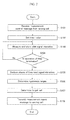
- FIG. 2 is a flowchart illustrating a handover triggering method according to an exemplary embodiment of the present invention.
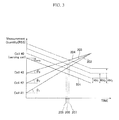
- FIG. 3 is a view showing an example of a method of determining a relative hysteresis range according to an exemplary embodiment of the present invention, and shows slopes of linearized signal intensities of a serving cell (cell #0) and adjacent cells (celt #1 to cell #3) and hysteresis ranges deduced using the slops.
- the mobile station when receiving a measurement control message from the serving cell (S101), the mobile station sets a timer value of timer corresponding to a collection period where patterns of approximately linearized signal intensities are searched (S102).
- the mobile station may set a timer value by using parameters included in the measurement control message, or use a fixed timer value. Meanwhile, if the mobile station uses a fixed timer value, step S102 may be omitted.
- the mobile station measures signal intensities by using pilot signals included in the signals received until the operation of the timer is terminated. Then, the mobile station stores the measured signals intensities in the local DB 105 (S103).
- the mobile station deduces slopes of the approximately linearized signal intensities corresponding to the serving cell and the adjacent cells on the basis of the signal intensities collected during the collection period by using a least-squares method (S105). Further, the mobile station determines hysteresis ranges corresponding to the respective adjacent cells on the basis of the slopes of the respective adjacent cells (S106).
- the mobile station determines a hysteresis range RH n corresponding to each of the adjacent cells by using the method of determining a relative hysteresis range, and the method of determining a relative hysteresis range may be represented by the following Equation 3.
- RH n H Max - H Min ⁇ 1 - tanh ⁇ n - ⁇ Serv / w 2 + H Min
- H Max indicates the maximum value of a hysteresis range
- H Min indicates the minimum value of a hysteresis range
- ⁇ serv indicates the slope (an angle represented by radians) of the approximately linearized signal intensity corresponding to the serving cell
- ⁇ n indicates the slope (an angle represented by radians) of the approximately linearized signal intensity corresponding to n-th adjacent cell
- w indicates a weight value parameter used to determine an influence of a difference between the slopes of the adjacent cell and the serving cell on a hysteresis range, and may have a value of 1 or more.
- a relative hysteresis range RH n is determined in the range between H Max and H Min , and is calculated by applying a hyperbolic tangent to the difference ( ⁇ n - ⁇ Serv ) between the slopes of the signal intensities of the adjacent cell and the serving cell. Accordingly, a hysteresis range applied to each of the adjacent cells is determined from the difference ( ⁇ n - ⁇ Serv ) between the slopes of the signal intensities of the adjacent cell and the serving cell.
- a hysteresis range which corresponds to an adjacent cell having a large difference ( ⁇ n - ⁇ Serv ) between the slopes of the signal intensities of the adjacent cell and the serving cell, that is, an adjacent cell of which signal intensity is significantly increased, which is an adjacent cell of which signal quality is expected to be most quickly improved, is set to be relatively small.
- the difference between the slope ⁇ 1 of the signal intensity 202 of the cell #1 and the slope ⁇ Serv of the signal intensity 201 of the serving cell (cell #0) is larger than the difference between the slope ⁇ 2 of the signals intensity 203 of the cell #2 and the slope ⁇ 3 of the signal intensity 204 of the cell #3 and the slope ⁇ Serv of the linearized signal intensity of the serving cell (cell #0) ( ⁇ 1 - ⁇ Serv > ⁇ 2 - ⁇ Serv > ⁇ 3 - ⁇ Serv ).
- a hysteresis range RH 1 corresponding to the cell #1 is calculated to be smaller than hysteresis ranges RH 2 and RH 3 corresponding to the cell #2 and the cell #3 (RH 1 > RH 2 > RH 3 ).
- the weight value w is an important parameter that is used to determine a fluctuation band of the hysteresis range RH n corresponding to the difference ( ⁇ n - ⁇ Serv ) between the slopes of the adjacent cell and the serving cell. For example, if the weight value w is 1, the signal intensity slope( ⁇ n ) of the n-th adjacent cell is - ⁇ 2 and the signal intensity slope ⁇ Serv of the serving cell is ⁇ 2 the difference ( ⁇ n - ⁇ Serv ) there between is ⁇ . Therefore, the relative hysteresis range RH n becomes H Max .
- the relative hysteresis range RH n becomes H Min .
- the weight value w is larger than 1
- the signal intensity slope ⁇ n of the n-th adjacent cell is - ⁇ 2
- the signal intensity slope ⁇ Serv of the serving cell is ⁇ 2
- the relative hysteresis range RH n is smaller than H Max . If the slope ⁇ n of the n-th adjacent cell is ⁇ 2 and the slope ⁇ Serv of the serving cell is - ⁇ 2 the relative hysteresis range RH n is larger than H Min .
- the weight value w used to determine the relative hysteresis range is set corresponding to an actual wireless environment so as to represent an optimum value of the relative hysteresis range RH n corresponding to the difference ( ⁇ n - ⁇ Serv ) between the slopes of the signal intensities of the adjacent cell and the serving cell.
- the mobile station determines an optimum target cell by applying the determined hysteresis ranges to the handover reporting event formula, and judges whether the handover triggering of the target cell is to be performed or not (S107). Further, when the handover triggering is determined, the mobile station transmits a measurement report message including information about the target cell to the serving cell in order to request handover, thereby performing handover triggering (S108).
- the mobile station uses a handover reporting event formula in order to determine handover triggering, and the handover reporting event formula may be represented by the following Equation 4.
- RSS Serv indicates the current signal intensity of the serving cell
- RSS n indicates the current signal intensity of the n-th adjacent cell
- RH n indicates a hysteresis range corresponding to the n-th adjacent cell, and may be deduced by the method of determining a relative hysteresis range as in Equation 3.
- the mobile station when the current signal intensity RSS n of the n-th adjacent cell is higher than the current signal intensity RSS Serv of the serving cell by the relative hysteresis range RH n or more, handover triggering is performed. Accordingly, the mobile station is apt to determine a cell having a small hysteresis range as a target cell. That is, the mobile station is apt to perform handover to a cell of which signal quality is expected to be most quickly improved.
- handover triggering caused by the handover reporting event formula occurs at a point of 205 in the case of the cell #1, at a point of 206 in the case of the cell #2, and at a point of 207 in the case of the cell #3.
- the mobile station is apt to perform handover to the cell #1 of which slope of the signal intensity is most rapidly increased.
- the mobile station When the hysteresis ranges are determined using the slopes of the linearized signal intensities of the adjacent cells as described above, the mobile station is apt to perform handover to a cell of which signal quality is most rapidly increased among the adjacent cells. Therefore, the probability that the mobile station performs handover to the other cell is decreased. As a result, it is possible to obtain an advantage of reducing unnecessary handover.
- the above-mentioned exemplary embodiments of the present invention are not only embodied by a method and apparatus.
- the above-mentioned exemplary embodiments may be embodied by a program performing functions that correspond to the configuration of the exemplary embodiments of the present invention, or a recording medium on which the program is recorded.
- These embodiments can be easily devised from the description of the above-mentioned exemplary embodiments by those skilled in the art to which the present invention pertains.
- An embodiment of the present invention may be summarized as providing a mobile station that deduces a slope of a linearized signal intensity corresponding to each of a serving cell and adjacent cells by using signal intensities collected during a predetermined period, and determines a hysteresis range corresponding to each of the adjacent cells by using the deduced slopes of the signal intensities. Further, the mobile station determines whether handover triggering is to be performed or not by applying the determined hysteresis range to a handover reporting event formula, and thus determines a target cell.
Landscapes
- Engineering & Computer Science (AREA)
- Computer Networks & Wireless Communication (AREA)
- Signal Processing (AREA)
- Mobile Radio Communication Systems (AREA)
- Radar Systems Or Details Thereof (AREA)
Applications Claiming Priority (1)
| Application Number | Priority Date | Filing Date | Title |
|---|---|---|---|
| KR1020070103012A KR100922003B1 (ko) | 2007-10-12 | 2007-10-12 | 히스테리시스 범위 결정 방법 및 핸드오버 트리거링 방법,그리고 이를 수행하는 이동국 |
Publications (2)
| Publication Number | Publication Date |
|---|---|
| EP2048907A1 true EP2048907A1 (de) | 2009-04-15 |
| EP2048907B1 EP2048907B1 (de) | 2010-06-30 |
Family
ID=40280686
Family Applications (1)
| Application Number | Title | Priority Date | Filing Date |
|---|---|---|---|
| EP08158997A Not-in-force EP2048907B1 (de) | 2007-10-12 | 2008-06-25 | Verfahren zur Bestimmung des Hysteresebereichs, Übergabeauslöseverfahren und mobile Station zur Durchführung dieses Verfahrens |
Country Status (4)
| Country | Link |
|---|---|
| EP (1) | EP2048907B1 (de) |
| KR (1) | KR100922003B1 (de) |
| AT (1) | ATE472914T1 (de) |
| DE (1) | DE602008001645D1 (de) |
Cited By (3)
| Publication number | Priority date | Publication date | Assignee | Title |
|---|---|---|---|---|
| EP2453699A1 (de) * | 2010-11-15 | 2012-05-16 | ST-Ericsson SA | Verbessertes Übergabeverfahren |
| US9119126B2 (en) | 2010-09-28 | 2015-08-25 | Kt Corporation | Method for determining handover in wireless communication system and base station therefor |
| EP4221327A4 (de) * | 2020-10-16 | 2024-04-03 | Guangdong Oppo Mobile Telecommunications Corp., Ltd. | Zellsuchverfahren und -vorrichtung, chip, mobiles endgerät und speichermedium |
Citations (4)
| Publication number | Priority date | Publication date | Assignee | Title |
|---|---|---|---|---|
| DE19510256A1 (de) * | 1994-03-21 | 1995-09-28 | Motorola Ltd | Verfahren zur Ermittlung einer Übergabe in einer multizellularen Umgebung |
| WO1999034633A1 (en) * | 1997-12-24 | 1999-07-08 | Telefonaktiebolaget Lm Ericsson (Publ) | Adaptive handoff hysteresis in wireless telecommunication networks |
| EP1091612A1 (de) * | 1999-10-04 | 2001-04-11 | Motorola, Inc. | Methode zur Reduzierung von Weiterreichungen in einem Mobilfunksystem |
| US20040267928A1 (en) * | 2003-06-25 | 2004-12-30 | Paul Petrus | Adaptive determination of hysteresis for facilitating base station selection, including handover, in a wireless communication system |
Family Cites Families (2)
| Publication number | Priority date | Publication date | Assignee | Title |
|---|---|---|---|---|
| US5995836A (en) | 1997-12-24 | 1999-11-30 | Telefonaktiebolaget Lm Ericsson | Method and system for variable handoff hysteresis in a radiocommunication system |
| US6954643B2 (en) | 2003-06-25 | 2005-10-11 | Arraycomm Llc | Criteria for base station selection, including handover, in a wireless communication system |
-
2007
- 2007-10-12 KR KR1020070103012A patent/KR100922003B1/ko active Active
-
2008
- 2008-06-25 DE DE602008001645T patent/DE602008001645D1/de active Active
- 2008-06-25 AT AT08158997T patent/ATE472914T1/de not_active IP Right Cessation
- 2008-06-25 EP EP08158997A patent/EP2048907B1/de not_active Not-in-force
Patent Citations (4)
| Publication number | Priority date | Publication date | Assignee | Title |
|---|---|---|---|---|
| DE19510256A1 (de) * | 1994-03-21 | 1995-09-28 | Motorola Ltd | Verfahren zur Ermittlung einer Übergabe in einer multizellularen Umgebung |
| WO1999034633A1 (en) * | 1997-12-24 | 1999-07-08 | Telefonaktiebolaget Lm Ericsson (Publ) | Adaptive handoff hysteresis in wireless telecommunication networks |
| EP1091612A1 (de) * | 1999-10-04 | 2001-04-11 | Motorola, Inc. | Methode zur Reduzierung von Weiterreichungen in einem Mobilfunksystem |
| US20040267928A1 (en) * | 2003-06-25 | 2004-12-30 | Paul Petrus | Adaptive determination of hysteresis for facilitating base station selection, including handover, in a wireless communication system |
Non-Patent Citations (1)
| Title |
|---|
| WON-IK KIM ET AL: "Ping-Pong Avoidance Algorithm for Vertical Handover in Wireless Overlay Networks", VEHICULAR TECHNOLOGY CONFERENCE, 2007. VTC-2007 FALL. 2007 IEEE 66TH, IEEE, PI, 1 September 2007 (2007-09-01), pages 1509 - 1512, XP031147659, ISBN: 978-1-4244-0263-2 * |
Cited By (5)
| Publication number | Priority date | Publication date | Assignee | Title |
|---|---|---|---|---|
| US9119126B2 (en) | 2010-09-28 | 2015-08-25 | Kt Corporation | Method for determining handover in wireless communication system and base station therefor |
| EP2453699A1 (de) * | 2010-11-15 | 2012-05-16 | ST-Ericsson SA | Verbessertes Übergabeverfahren |
| WO2012065959A1 (en) * | 2010-11-15 | 2012-05-24 | St-Ericsson Sa | Enhanced handover procedure |
| US9161282B2 (en) | 2010-11-15 | 2015-10-13 | St-Ericsson Sa | Enhanced handover procedure |
| EP4221327A4 (de) * | 2020-10-16 | 2024-04-03 | Guangdong Oppo Mobile Telecommunications Corp., Ltd. | Zellsuchverfahren und -vorrichtung, chip, mobiles endgerät und speichermedium |
Also Published As
| Publication number | Publication date |
|---|---|
| KR100922003B1 (ko) | 2009-10-14 |
| ATE472914T1 (de) | 2010-07-15 |
| DE602008001645D1 (de) | 2010-08-12 |
| KR20090037609A (ko) | 2009-04-16 |
| EP2048907B1 (de) | 2010-06-30 |
Similar Documents
| Publication | Publication Date | Title |
|---|---|---|
| US7136638B2 (en) | Method and system for analyzing a network environment and network parameters | |
| US8326303B2 (en) | Method of determining wireless hand off parameters | |
| US10454551B2 (en) | Communication method and apparatus for configuring measurement parameters using beamforming | |
| EP0946076B1 (de) | Verfahren und Vorrichtung zum Interfrequenzweiterreichen in einem drahtlosen Kommunikationssystem | |
| CN103974275B (zh) | 无线通信系统中的装置和方法 | |
| US9439125B2 (en) | Location-based, event triggered inter-radio access technology handovers from a CDMA macrocell to a WCDMA femtocell | |
| US20100124927A1 (en) | Periodic reporting for inter-radio access technology location-based handovers from a gsm macrocell to a wcdma femtocell | |
| US8750856B2 (en) | Distributed sleeping cell detection | |
| JP2005522156A (ja) | 隣接セルリストを最適にするための方法およびシステム | |
| EP2981137B1 (de) | Verfahren zur schätzung eines abdeckungsgebiets für verteiltes antennensystem (das) oder ein repeatersystem | |
| US20130336148A1 (en) | User equipment and measurement method | |
| US20190182798A1 (en) | Telecommunications apparatus and methods for determining location of terminal device using beam sweeping | |
| KR20140003516A (ko) | 시간 및 전력 기반 무선 위치 추적 시스템 | |
| US20170257787A1 (en) | Received Signal Strength Based Interferer Classification of Cellular Network Cells | |
| EP4079083A1 (de) | Verfahren und gerät in zusammenhang mit richtungsbasiertem hören-vor-sprechen | |
| TWI325731B (en) | Method and system for automated determination of inter-system border thresholds | |
| CN101247621B (zh) | 用于测量3a事件的TD-SCDMA信号评估方法及3a事件测量报告方法 | |
| CN110636540A (zh) | 一种网络上行干扰预评估方法及装置 | |
| US7167681B2 (en) | Antenna adjustment method, system and network element | |
| EP2048907A1 (de) | Verfahren zur Bestimmung des Hysteresebereichs, Übergabeauslöseverfahren und mobile Station zur Durchführung dieses Verfahrens | |
| EP1733567B1 (de) | System, einheit und verfahren zur frequenzneuplanung | |
| US6859642B2 (en) | Calibration of signal strength measurements in a cellular communications system | |
| EP2640112B1 (de) | Mobilkommunikationsverfahren, mobilstation und funkbasisstation | |
| US20120165025A1 (en) | Method of managing handover in a cellular wireless system | |
| EP2200375A2 (de) | Verfahren und Vorrichtung zur Erkennung des Zugriffsystems in einer drahtlosen/mobilen Systemumgebung mit Mehrfachzugriff |
Legal Events
| Date | Code | Title | Description |
|---|---|---|---|
| PUAI | Public reference made under article 153(3) epc to a published international application that has entered the european phase |
Free format text: ORIGINAL CODE: 0009012 |
|
| AK | Designated contracting states |
Kind code of ref document: A1 Designated state(s): AT BE BG CH CY CZ DE DK EE ES FI FR GB GR HR HU IE IS IT LI LT LU LV MC MT NL NO PL PT RO SE SI SK TR |
|
| AX | Request for extension of the european patent |
Extension state: AL BA MK RS |
|
| 17P | Request for examination filed |
Effective date: 20091015 |
|
| AKX | Designation fees paid |
Designated state(s): AT BE BG CH CY CZ DE DK EE ES FI FR GB GR HR HU IE IS IT LI LT LU LV MC MT NL NO PL PT RO SE SI SK TR |
|
| GRAP | Despatch of communication of intention to grant a patent |
Free format text: ORIGINAL CODE: EPIDOSNIGR1 |
|
| GRAS | Grant fee paid |
Free format text: ORIGINAL CODE: EPIDOSNIGR3 |
|
| GRAA | (expected) grant |
Free format text: ORIGINAL CODE: 0009210 |
|
| AK | Designated contracting states |
Kind code of ref document: B1 Designated state(s): AT BE BG CH CY CZ DE DK EE ES FI FR GB GR HR HU IE IS IT LI LT LU LV MC MT NL NO PL PT RO SE SI SK TR |
|
| REG | Reference to a national code |
Ref country code: CH Ref legal event code: EP Ref country code: GB Ref legal event code: FG4D |
|
| REG | Reference to a national code |
Ref country code: IE Ref legal event code: FG4D |
|
| REF | Corresponds to: |
Ref document number: 602008001645 Country of ref document: DE Date of ref document: 20100812 Kind code of ref document: P |
|
| REG | Reference to a national code |
Ref country code: NL Ref legal event code: VDEP Effective date: 20100630 |
|
| PG25 | Lapsed in a contracting state [announced via postgrant information from national office to epo] |
Ref country code: LT Free format text: LAPSE BECAUSE OF FAILURE TO SUBMIT A TRANSLATION OF THE DESCRIPTION OR TO PAY THE FEE WITHIN THE PRESCRIBED TIME-LIMIT Effective date: 20100630 Ref country code: NO Free format text: LAPSE BECAUSE OF FAILURE TO SUBMIT A TRANSLATION OF THE DESCRIPTION OR TO PAY THE FEE WITHIN THE PRESCRIBED TIME-LIMIT Effective date: 20100930 Ref country code: SE Free format text: LAPSE BECAUSE OF FAILURE TO SUBMIT A TRANSLATION OF THE DESCRIPTION OR TO PAY THE FEE WITHIN THE PRESCRIBED TIME-LIMIT Effective date: 20100630 |
|
| LTIE | Lt: invalidation of european patent or patent extension |
Effective date: 20100630 |
|
| PG25 | Lapsed in a contracting state [announced via postgrant information from national office to epo] |
Ref country code: SI Free format text: LAPSE BECAUSE OF FAILURE TO SUBMIT A TRANSLATION OF THE DESCRIPTION OR TO PAY THE FEE WITHIN THE PRESCRIBED TIME-LIMIT Effective date: 20100630 Ref country code: AT Free format text: LAPSE BECAUSE OF FAILURE TO SUBMIT A TRANSLATION OF THE DESCRIPTION OR TO PAY THE FEE WITHIN THE PRESCRIBED TIME-LIMIT Effective date: 20100630 Ref country code: FI Free format text: LAPSE BECAUSE OF FAILURE TO SUBMIT A TRANSLATION OF THE DESCRIPTION OR TO PAY THE FEE WITHIN THE PRESCRIBED TIME-LIMIT Effective date: 20100630 Ref country code: HR Free format text: LAPSE BECAUSE OF FAILURE TO SUBMIT A TRANSLATION OF THE DESCRIPTION OR TO PAY THE FEE WITHIN THE PRESCRIBED TIME-LIMIT Effective date: 20100630 Ref country code: LV Free format text: LAPSE BECAUSE OF FAILURE TO SUBMIT A TRANSLATION OF THE DESCRIPTION OR TO PAY THE FEE WITHIN THE PRESCRIBED TIME-LIMIT Effective date: 20100630 |
|
| PG25 | Lapsed in a contracting state [announced via postgrant information from national office to epo] |
Ref country code: PL Free format text: LAPSE BECAUSE OF FAILURE TO SUBMIT A TRANSLATION OF THE DESCRIPTION OR TO PAY THE FEE WITHIN THE PRESCRIBED TIME-LIMIT Effective date: 20100630 |
|
| PG25 | Lapsed in a contracting state [announced via postgrant information from national office to epo] |
Ref country code: NL Free format text: LAPSE BECAUSE OF FAILURE TO SUBMIT A TRANSLATION OF THE DESCRIPTION OR TO PAY THE FEE WITHIN THE PRESCRIBED TIME-LIMIT Effective date: 20100630 Ref country code: EE Free format text: LAPSE BECAUSE OF FAILURE TO SUBMIT A TRANSLATION OF THE DESCRIPTION OR TO PAY THE FEE WITHIN THE PRESCRIBED TIME-LIMIT Effective date: 20100630 |
|
| PG25 | Lapsed in a contracting state [announced via postgrant information from national office to epo] |
Ref country code: SK Free format text: LAPSE BECAUSE OF FAILURE TO SUBMIT A TRANSLATION OF THE DESCRIPTION OR TO PAY THE FEE WITHIN THE PRESCRIBED TIME-LIMIT Effective date: 20100630 Ref country code: IS Free format text: LAPSE BECAUSE OF FAILURE TO SUBMIT A TRANSLATION OF THE DESCRIPTION OR TO PAY THE FEE WITHIN THE PRESCRIBED TIME-LIMIT Effective date: 20101030 Ref country code: CZ Free format text: LAPSE BECAUSE OF FAILURE TO SUBMIT A TRANSLATION OF THE DESCRIPTION OR TO PAY THE FEE WITHIN THE PRESCRIBED TIME-LIMIT Effective date: 20100630 Ref country code: CY Free format text: LAPSE BECAUSE OF FAILURE TO SUBMIT A TRANSLATION OF THE DESCRIPTION OR TO PAY THE FEE WITHIN THE PRESCRIBED TIME-LIMIT Effective date: 20100630 Ref country code: RO Free format text: LAPSE BECAUSE OF FAILURE TO SUBMIT A TRANSLATION OF THE DESCRIPTION OR TO PAY THE FEE WITHIN THE PRESCRIBED TIME-LIMIT Effective date: 20100630 Ref country code: BE Free format text: LAPSE BECAUSE OF FAILURE TO SUBMIT A TRANSLATION OF THE DESCRIPTION OR TO PAY THE FEE WITHIN THE PRESCRIBED TIME-LIMIT Effective date: 20100630 |
|
| PG25 | Lapsed in a contracting state [announced via postgrant information from national office to epo] |
Ref country code: IT Free format text: LAPSE BECAUSE OF FAILURE TO SUBMIT A TRANSLATION OF THE DESCRIPTION OR TO PAY THE FEE WITHIN THE PRESCRIBED TIME-LIMIT Effective date: 20100630 |
|
| PG25 | Lapsed in a contracting state [announced via postgrant information from national office to epo] |
Ref country code: DK Free format text: LAPSE BECAUSE OF FAILURE TO SUBMIT A TRANSLATION OF THE DESCRIPTION OR TO PAY THE FEE WITHIN THE PRESCRIBED TIME-LIMIT Effective date: 20100630 |
|
| PLBE | No opposition filed within time limit |
Free format text: ORIGINAL CODE: 0009261 |
|
| STAA | Information on the status of an ep patent application or granted ep patent |
Free format text: STATUS: NO OPPOSITION FILED WITHIN TIME LIMIT |
|
| PG25 | Lapsed in a contracting state [announced via postgrant information from national office to epo] |
Ref country code: GR Free format text: LAPSE BECAUSE OF FAILURE TO SUBMIT A TRANSLATION OF THE DESCRIPTION OR TO PAY THE FEE WITHIN THE PRESCRIBED TIME-LIMIT Effective date: 20101001 |
|
| 26N | No opposition filed |
Effective date: 20110331 |
|
| PG25 | Lapsed in a contracting state [announced via postgrant information from national office to epo] |
Ref country code: ES Free format text: LAPSE BECAUSE OF FAILURE TO SUBMIT A TRANSLATION OF THE DESCRIPTION OR TO PAY THE FEE WITHIN THE PRESCRIBED TIME-LIMIT Effective date: 20101011 |
|
| REG | Reference to a national code |
Ref country code: DE Ref legal event code: R097 Ref document number: 602008001645 Country of ref document: DE Effective date: 20110330 |
|
| PG25 | Lapsed in a contracting state [announced via postgrant information from national office to epo] |
Ref country code: MT Free format text: LAPSE BECAUSE OF FAILURE TO SUBMIT A TRANSLATION OF THE DESCRIPTION OR TO PAY THE FEE WITHIN THE PRESCRIBED TIME-LIMIT Effective date: 20100630 |
|
| REG | Reference to a national code |
Ref country code: IE Ref legal event code: MM4A |
|
| PG25 | Lapsed in a contracting state [announced via postgrant information from national office to epo] |
Ref country code: IE Free format text: LAPSE BECAUSE OF NON-PAYMENT OF DUE FEES Effective date: 20110625 |
|
| REG | Reference to a national code |
Ref country code: CH Ref legal event code: PL |
|
| REG | Reference to a national code |
Ref country code: CH Ref legal event code: PL |
|
| PG25 | Lapsed in a contracting state [announced via postgrant information from national office to epo] |
Ref country code: LI Free format text: LAPSE BECAUSE OF NON-PAYMENT OF DUE FEES Effective date: 20120630 Ref country code: MC Free format text: LAPSE BECAUSE OF NON-PAYMENT OF DUE FEES Effective date: 20110630 Ref country code: CH Free format text: LAPSE BECAUSE OF NON-PAYMENT OF DUE FEES Effective date: 20120630 |
|
| PG25 | Lapsed in a contracting state [announced via postgrant information from national office to epo] |
Ref country code: LU Free format text: LAPSE BECAUSE OF NON-PAYMENT OF DUE FEES Effective date: 20110625 |
|
| PG25 | Lapsed in a contracting state [announced via postgrant information from national office to epo] |
Ref country code: TR Free format text: LAPSE BECAUSE OF FAILURE TO SUBMIT A TRANSLATION OF THE DESCRIPTION OR TO PAY THE FEE WITHIN THE PRESCRIBED TIME-LIMIT Effective date: 20100630 Ref country code: BG Free format text: LAPSE BECAUSE OF FAILURE TO SUBMIT A TRANSLATION OF THE DESCRIPTION OR TO PAY THE FEE WITHIN THE PRESCRIBED TIME-LIMIT Effective date: 20100930 |
|
| PG25 | Lapsed in a contracting state [announced via postgrant information from national office to epo] |
Ref country code: HU Free format text: LAPSE BECAUSE OF FAILURE TO SUBMIT A TRANSLATION OF THE DESCRIPTION OR TO PAY THE FEE WITHIN THE PRESCRIBED TIME-LIMIT Effective date: 20100630 |
|
| PG25 | Lapsed in a contracting state [announced via postgrant information from national office to epo] |
Ref country code: PT Free format text: LAPSE BECAUSE OF FAILURE TO SUBMIT A TRANSLATION OF THE DESCRIPTION OR TO PAY THE FEE WITHIN THE PRESCRIBED TIME-LIMIT Effective date: 20100630 |
|
| PGFP | Annual fee paid to national office [announced via postgrant information from national office to epo] |
Ref country code: GB Payment date: 20140522 Year of fee payment: 7 |
|
| PGFP | Annual fee paid to national office [announced via postgrant information from national office to epo] |
Ref country code: DE Payment date: 20140523 Year of fee payment: 7 |
|
| PGFP | Annual fee paid to national office [announced via postgrant information from national office to epo] |
Ref country code: FR Payment date: 20140522 Year of fee payment: 7 |
|
| REG | Reference to a national code |
Ref country code: DE Ref legal event code: R119 Ref document number: 602008001645 Country of ref document: DE |
|
| GBPC | Gb: european patent ceased through non-payment of renewal fee |
Effective date: 20150625 |
|
| REG | Reference to a national code |
Ref country code: FR Ref legal event code: ST Effective date: 20160229 |
|
| PG25 | Lapsed in a contracting state [announced via postgrant information from national office to epo] |
Ref country code: GB Free format text: LAPSE BECAUSE OF NON-PAYMENT OF DUE FEES Effective date: 20150625 Ref country code: DE Free format text: LAPSE BECAUSE OF NON-PAYMENT OF DUE FEES Effective date: 20160101 |
|
| PG25 | Lapsed in a contracting state [announced via postgrant information from national office to epo] |
Ref country code: FR Free format text: LAPSE BECAUSE OF NON-PAYMENT OF DUE FEES Effective date: 20150630 |