EP2051068A2 - Appareil de contrôle de l'humidité pour capteurs électrochimiques - Google Patents
Appareil de contrôle de l'humidité pour capteurs électrochimiques Download PDFInfo
- Publication number
- EP2051068A2 EP2051068A2 EP08166531A EP08166531A EP2051068A2 EP 2051068 A2 EP2051068 A2 EP 2051068A2 EP 08166531 A EP08166531 A EP 08166531A EP 08166531 A EP08166531 A EP 08166531A EP 2051068 A2 EP2051068 A2 EP 2051068A2
- Authority
- EP
- European Patent Office
- Prior art keywords
- sensor
- water
- interior region
- region
- side wall
- Prior art date
- Legal status (The legal status is an assumption and is not a legal conclusion. Google has not performed a legal analysis and makes no representation as to the accuracy of the status listed.)
- Withdrawn
Links
- 238000000034 method Methods 0.000 claims abstract description 15
- XLYOFNOQVPJJNP-UHFFFAOYSA-N water Substances O XLYOFNOQVPJJNP-UHFFFAOYSA-N 0.000 claims abstract description 14
- 230000036571 hydration Effects 0.000 claims abstract description 9
- 238000006703 hydration reaction Methods 0.000 claims abstract description 9
- 239000012528 membrane Substances 0.000 claims description 8
- 230000002093 peripheral effect Effects 0.000 claims description 3
- 238000010438 heat treatment Methods 0.000 claims 3
- 230000008878 coupling Effects 0.000 claims 1
- 238000010168 coupling process Methods 0.000 claims 1
- 238000005859 coupling reaction Methods 0.000 claims 1
- 239000008236 heating water Substances 0.000 claims 1
- 238000007789 sealing Methods 0.000 claims 1
- 239000003792 electrolyte Substances 0.000 description 13
- 230000007613 environmental effect Effects 0.000 description 6
- 230000000887 hydrating effect Effects 0.000 description 6
- 239000012266 salt solution Substances 0.000 description 6
- 239000000463 material Substances 0.000 description 5
- 230000004048 modification Effects 0.000 description 4
- 238000012986 modification Methods 0.000 description 4
- 239000000243 solution Substances 0.000 description 4
- 238000005259 measurement Methods 0.000 description 3
- 239000004698 Polyethylene Substances 0.000 description 2
- 230000015556 catabolic process Effects 0.000 description 2
- 238000006731 degradation reaction Methods 0.000 description 2
- 230000018044 dehydration Effects 0.000 description 2
- 238000006297 dehydration reaction Methods 0.000 description 2
- 238000010586 diagram Methods 0.000 description 2
- 239000000203 mixture Substances 0.000 description 2
- -1 polyethylene Polymers 0.000 description 2
- 229920000573 polyethylene Polymers 0.000 description 2
- 229920000642 polymer Polymers 0.000 description 2
- 239000004810 polytetrafluoroethylene Substances 0.000 description 2
- 229920001343 polytetrafluoroethylene Polymers 0.000 description 2
- 230000036755 cellular response Effects 0.000 description 1
- 229920001971 elastomer Polymers 0.000 description 1
- 239000008151 electrolyte solution Substances 0.000 description 1
- 230000000246 remedial effect Effects 0.000 description 1
- 229920006395 saturated elastomer Polymers 0.000 description 1
- 239000007787 solid Substances 0.000 description 1
- 230000003068 static effect Effects 0.000 description 1
Images
Classifications
-
- G—PHYSICS
- G01—MEASURING; TESTING
- G01N—INVESTIGATING OR ANALYSING MATERIALS BY DETERMINING THEIR CHEMICAL OR PHYSICAL PROPERTIES
- G01N27/00—Investigating or analysing materials by the use of electric, electrochemical, or magnetic means
- G01N27/26—Investigating or analysing materials by the use of electric, electrochemical, or magnetic means by investigating electrochemical variables; by using electrolysis or electrophoresis
- G01N27/403—Cells and electrode assemblies
- G01N27/406—Cells and probes with solid electrolytes
-
- G—PHYSICS
- G01—MEASURING; TESTING
- G01N—INVESTIGATING OR ANALYSING MATERIALS BY DETERMINING THEIR CHEMICAL OR PHYSICAL PROPERTIES
- G01N33/00—Investigating or analysing materials by specific methods not covered by groups G01N1/00 - G01N31/00
- G01N33/0004—Gaseous mixtures, e.g. polluted air
- G01N33/0009—General constructional details of gas analysers, e.g. portable test equipment
- G01N33/0011—Sample conditioning
-
- G—PHYSICS
- G01—MEASURING; TESTING
- G01N—INVESTIGATING OR ANALYSING MATERIALS BY DETERMINING THEIR CHEMICAL OR PHYSICAL PROPERTIES
- G01N27/00—Investigating or analysing materials by the use of electric, electrochemical, or magnetic means
- G01N27/26—Investigating or analysing materials by the use of electric, electrochemical, or magnetic means by investigating electrochemical variables; by using electrolysis or electrophoresis
- G01N27/403—Cells and electrode assemblies
- G01N27/406—Cells and probes with solid electrolytes
- G01N27/4067—Means for heating or controlling the temperature of the solid electrolyte
Definitions
- the invention pertains to electrochemical gas sensors. More particularly, the invention pertains to devices and methods to adjust levels of hydration in such sensors subsequent to exposure to an ambient environment.
- Electrochemical gas sensors of the type that are commonly used in portable and fixed instrumentation are frequently employed in diverse and sometimes extreme operating environments. Most sensors would be expected to function continuously at temperatures between -20 degrees C to 40 degrees C and 15% to 85% ambient humidity, and intermittently at even more extreme conditions.
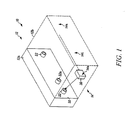
- Fig. 1 is a block diagram of a system in accordance with the invention.
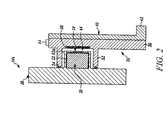
- Fig. 2 is an enlarged diagram illustrating additional aspects of the invention.
- Applicant has recognized that there is a need to be able to modify hydration of electrochemical-type sensors. Modification can take place, in accordance with the invention via various exemplary processes.
- An assumption as to the environmental history of usage a sensor can be made and that sensor can be exposed to a controlled RH environment that is deemed appropriate for the respective history.
- a measurement can be made of one or more parameters which indicate the state of humidity of the sensor, and the sensor can then be exposed to an appropriate RH environment. Multiple measurements could of course be made during the course of exposure to the environment.
- information can be collected during operation of the sensor to subsequently determine the appropriate remedial RH environment.
- electrochemical gas sensors can be hydrated or dehydrated after use to adjust the sensor's electrolyte concentration to a predetermined range. This process can be conveniently carried out when the respective sensor, or associated detector is receiving routine service or battery charging. In this regard, those of skill will understand that either the entire detector or the sensor element alone could be exposed to a hydrating/dehydrating environment.
- Electrolyte adjustment can be implemented by exposing the sensor to water vapor, to moving streams of mixed wet or dry air, exposing the sensor to solid dryers or any other way which provides the desired hydration or dehydration.
- Effective electrolyte adjustment can include adjusting the electrolyte to its allowable operable range.
- Those of skill in the art will recognize that it is not necessary to readjust the respective sensor to its original, out the factory door condition, in view of that fact that electrolytes for such sensors are usually chosen partly on the basis that they continue to function adequately across as wide a range as possible.
- an open loop hydrating/dehydrating methodology could be developed which could be applied to a plurality of cells which have been exposed to the common environment.
- an electrochemical gas sensor component within a gas detector is hydrated, or dehydrated, through modification of the local humidity external to the sensor, while the detector, or, instrument is not in use.
- hydration, or dehydration could take place while the batteries of the detector are being re-charged.
- the present method would replenish or extract an equivalent amount of water vapor to that lost/gained by the sensor during a period of operation, thereby significantly reducing or eliminating environmental effects on sensor performance.
- the detector can be placed in a sealed chamber in which the local humidity is modified/controlled in a fixed or dynamic fashion so as to restore the electrolyte concentration within the sensor to the manufacturer's intended composition.
- the relative humidity, RH of the modified instrument environment may be static and set at an appropriate level to compensate for the working conditions of the instrument/cell, or the modified RH environment may be dynamic and capable of being changed or controlled to an optimum level.
- the optimum level may be determined by measurement of a physical characteristic of the cell that varies with degree of hydration of the electrolyte. For example, pH of the electrolyte could be measured as an indicator of hydration.
- a shroud/jacket can provide an interface with a detector's front panel to provide a seal against the external environment.
- the seal can be maintained with respect to the detector, or sensor element, using a variety of different types of seals such as O-rings, a gasket material, or a molded rubber insert.
- the jacket can contain a salt solution, water or other hydrating solution, whose temperature is/can be controlled via a heater element.
- the jacket can also include a vapor permeable membrane through which moisture vapor can pass into an air space enclosed between the instrument sensor and the shroud. Suitable materials for the membrane material include micro-porous polymers such as PTFE or polyethylene.
- the shroud containing the solution could include an aperture to enable replenishment of lost water.
- various embodiments include:
- the shroud can contain a salt solution with an RH between 5 and 95% RH that is non-temperature controlled.
- the imposed RH would be in the range 40 to 60% to match that of the original electrolyte solution within the cell.
- the RH of the shroud could be chosen and adjusted to compensate for the local working environment. For example. If the cells have been operating in a dry warm environment then a shroud might be chosen to provide a high RH environment to compensate for higher than average loss of water vapor from the cell and vice versa.
- the applied RH% may be controlled by varying the temperature of the salt solution via a heater element.
- the temperature and applied humidity might be specifically controlled and adjusted to an optimum level by measuring a characteristic of the cell that varies with degree of electrolyte hydration. Examples include electrolyte pH, cell capacitance, impedance, or noise. Alternately, cell response to an applied current or voltage pulse can be sensed.
- the local RH environment of the instrument/cell could be modified remotely, provided the instrument is in an enclosed chamber.
- other suitable methods might be to blend two air streams of differing humidity to a single flow of a specific humidity.
- FIG. 1 illustrates an apparatus 10 which embodies the invention.
- a hydrating housing 12 can partially, via section 12a, or fully, as illustrated by expansion section 12b (in phantom), provide a hydrating/dehydrating environment for a plurality of electrochemical gas detectors 14, having members 14a, 14b....14n. Electrolyte adjustment can take place while a battery of the respective detector, such as detector 14i is being recharged.
- detector 14i is illustrated positioned adjacent to section 12a to be hydrated.
- Detector 14i includes, for example, a sensor component 20 having a cylindrically extending portion 22 with an environmental access aperture 24.
- An electrochemical sensing element 26 is carried within the portion 22 exposed to the environment via aperture 24.
- the detector 14i will also include other conventional elements which need not be illustrated here.
- Apparatus 12a includes a housing section 30 with a cylindrical, hollow, protruding member, or jacket, 32.
- Member 32 has an interior peripheral surface 32a, and also carries a seal 34, for example an O ring or other type of seal such as a gasket or molded insert.
- the jacket 32 contains, for example, a salt solution 36 whose temperature is/can be controlled via a heater element 40.
- the heater element 40 can be energized from an exterior source via a connector 42. It will be understood that other solutions could be used to carry out a hydrating or dehydrating process.
- the apparatus 12a also contains a vapor permeable membrane 38 through which moisture vapor can pass into an air space 44 sandwiched between the sensor element 26 and the jacket 32.
- Suitable materials for the membrane's material include micro-porous polymers such as PTFE or polyethylene.
- the apparatus 12a containing the salt solution 36 has an aperture 44 usable to replace lost water.
- detector 14i can be removed from apparatus 12a and placed back into service. On removal, the sensor element 26 should exhibit improved operational characteristics.
Landscapes
- Chemical & Material Sciences (AREA)
- Health & Medical Sciences (AREA)
- Life Sciences & Earth Sciences (AREA)
- General Physics & Mathematics (AREA)
- Pathology (AREA)
- Immunology (AREA)
- Physics & Mathematics (AREA)
- Analytical Chemistry (AREA)
- Biochemistry (AREA)
- General Health & Medical Sciences (AREA)
- Engineering & Computer Science (AREA)
- Chemical Kinetics & Catalysis (AREA)
- Molecular Biology (AREA)
- Electrochemistry (AREA)
- Medicinal Chemistry (AREA)
- Food Science & Technology (AREA)
- Combustion & Propulsion (AREA)
- Investigating Or Analyzing Materials By The Use Of Fluid Adsorption Or Reactions (AREA)
- Investigating Or Analyzing Materials By The Use Of Electric Means (AREA)
- Hybrid Cells (AREA)
- Electrolytic Production Of Non-Metals, Compounds, Apparatuses Therefor (AREA)
Applications Claiming Priority (1)
| Application Number | Priority Date | Filing Date | Title |
|---|---|---|---|
| US11/872,392 US8741120B2 (en) | 2007-10-15 | 2007-10-15 | Humidity control apparatus for electrochemical sensors |
Publications (2)
| Publication Number | Publication Date |
|---|---|
| EP2051068A2 true EP2051068A2 (fr) | 2009-04-22 |
| EP2051068A3 EP2051068A3 (fr) | 2010-01-13 |
Family
ID=40229974
Family Applications (1)
| Application Number | Title | Priority Date | Filing Date |
|---|---|---|---|
| EP08166531A Withdrawn EP2051068A3 (fr) | 2007-10-15 | 2008-10-14 | Appareil de contrôle de l'humidité pour capteurs électrochimiques |
Country Status (3)
| Country | Link |
|---|---|
| US (1) | US8741120B2 (fr) |
| EP (1) | EP2051068A3 (fr) |
| CA (1) | CA2640255A1 (fr) |
Cited By (1)
| Publication number | Priority date | Publication date | Assignee | Title |
|---|---|---|---|---|
| EP3006077A4 (fr) * | 2013-05-29 | 2017-05-24 | Hisamitsu Pharmaceutical Co., Inc. | Système de fabrication de préparation de micro-aiguille, et procédé de conditionnement d'air |
Families Citing this family (3)
| Publication number | Priority date | Publication date | Assignee | Title |
|---|---|---|---|---|
| SG11201706202VA (en) | 2015-02-02 | 2017-08-30 | Carrier Corp | Refrigerant analyzer and a method of using the same |
| EP3371569B1 (fr) * | 2015-11-06 | 2021-01-20 | 3M Innovative Properties Company | Capteur de gaz avec chambre d'échantillonnage pouvant être scellée |
| JP7325006B2 (ja) * | 2018-03-30 | 2023-08-14 | パナソニックIpマネジメント株式会社 | ガス成分計測装置 |
Family Cites Families (10)
| Publication number | Priority date | Publication date | Assignee | Title |
|---|---|---|---|---|
| GB1296156A (fr) | 1970-07-21 | 1972-11-15 | ||
| JPS5345242A (en) | 1976-10-05 | 1978-04-22 | Mitsubishi Electric Corp | Humidity controller |
| US4265714A (en) * | 1980-03-24 | 1981-05-05 | General Electric Company | Gas sensing and measuring device and process using catalytic graphite sensing electrode |
| US4635467A (en) * | 1985-05-22 | 1987-01-13 | American Hospital Supply Corporation | Calibration cell for the calibration of gaseous or non-gaseous fluid constituent sensors |
| JPH0517650Y2 (fr) * | 1986-01-31 | 1993-05-12 | ||
| US4921642A (en) * | 1987-12-03 | 1990-05-01 | Puritan-Bennett Corporation | Humidifier module for use in a gas humidification assembly |
| FI82147C (fi) * | 1988-10-27 | 1991-01-10 | Vaisala Oy | Kontrollanordning foer fuktmaetare foer faeltbruk. |
| FI99164C (fi) * | 1994-04-15 | 1997-10-10 | Vaisala Oy | Menetelmä kastepisteen tai kaasupitoisuuden mittaamiseksi sekä laitteisto jäätymisen ennakoimista varten |
| JP2005214685A (ja) | 2004-01-28 | 2005-08-11 | Nec Kansai Ltd | ガス漏洩検出装置 |
| EP1894074A4 (fr) * | 2005-06-13 | 2010-05-19 | Sigma Systems Corp | Procedes et appareil permettant d'optimiser l'humidite de l'environnement |
-
2007
- 2007-10-15 US US11/872,392 patent/US8741120B2/en not_active Expired - Fee Related
-
2008
- 2008-10-02 CA CA002640255A patent/CA2640255A1/fr not_active Abandoned
- 2008-10-14 EP EP08166531A patent/EP2051068A3/fr not_active Withdrawn
Non-Patent Citations (1)
| Title |
|---|
| None |
Cited By (2)
| Publication number | Priority date | Publication date | Assignee | Title |
|---|---|---|---|---|
| EP3006077A4 (fr) * | 2013-05-29 | 2017-05-24 | Hisamitsu Pharmaceutical Co., Inc. | Système de fabrication de préparation de micro-aiguille, et procédé de conditionnement d'air |
| US11130148B2 (en) | 2013-05-29 | 2021-09-28 | Hisamitsu Pharmaceutical Co., Inc. | System for manufacturing microneedle preparation, and air-conditioning method |
Also Published As
| Publication number | Publication date |
|---|---|
| EP2051068A3 (fr) | 2010-01-13 |
| CA2640255A1 (fr) | 2009-04-15 |
| US20090095640A1 (en) | 2009-04-16 |
| US8741120B2 (en) | 2014-06-03 |
Similar Documents
| Publication | Publication Date | Title |
|---|---|---|
| EP2327981B1 (fr) | Surveillance de capteurs de gaz électrochimiques | |
| US8741120B2 (en) | Humidity control apparatus for electrochemical sensors | |
| EP3183566B1 (fr) | Appareil et procédé d'auto-compensation automatisée destinés à fournir des capteurs électrochimiques | |
| US20080047325A1 (en) | Measurement of moisture vapor transfer rate | |
| JP3462854B2 (ja) | 水蒸気移動制御装置を備えた閉鎖空間の気密検査方法及び気密検査装置 | |
| JPWO1999066300A1 (ja) | 水蒸気移動制御装置を備えた閉鎖空間の気密検査方法及び気密検査装置 | |
| US20200300710A1 (en) | Systems and methods for logging data in harsh environments | |
| WO2012157349A1 (fr) | Dispositif de détection d'une concentration d'eau | |
| US7854159B2 (en) | Sensor and methods for measuring of concentrations of components in a liquid | |
| CN107250785A (zh) | 制冷剂分析仪及其使用方法 | |
| CN109959692A (zh) | 用于电化学测量的测量探针 | |
| JP5464694B2 (ja) | 容量式湿度センサー | |
| KR102301888B1 (ko) | 히터 전류의 변화를 이용한 가스센서 모듈의 온도 보정방법 | |
| JP4122271B2 (ja) | 調湿セルおよび高感度ガスセンサ | |
| US20120186664A1 (en) | Water Uptake Measurement System | |
| CN111744336A (zh) | 一种可重复使用的进气干燥过滤系统 | |
| KR20200063999A (ko) | 액츄에이터를 갖는 주변 센서 | |
| CN106442215A (zh) | 用于确定液体的密度的方法 | |
| CN213336520U (zh) | 一种透气式防水温度传感器 | |
| US11397164B2 (en) | Ion concentration measurement device | |
| JP7348096B2 (ja) | ガス濃度測定装置 | |
| JPS6011160A (ja) | 水分分析計 | |
| JP2005214685A (ja) | ガス漏洩検出装置 | |
| CN85106179A (zh) | 测量材料的水蒸汽透过性 | |
| JPH09274009A (ja) | 酸素濃度計並びに前記酸素濃度計に使用する酸素濃度センサ |
Legal Events
| Date | Code | Title | Description |
|---|---|---|---|
| PUAI | Public reference made under article 153(3) epc to a published international application that has entered the european phase |
Free format text: ORIGINAL CODE: 0009012 |
|
| AK | Designated contracting states |
Kind code of ref document: A2 Designated state(s): AT BE BG CH CY CZ DE DK EE ES FI FR GB GR HR HU IE IS IT LI LT LU LV MC MT NL NO PL PT RO SE SI SK TR |
|
| AX | Request for extension of the european patent |
Extension state: AL BA MK RS |
|
| RAP1 | Party data changed (applicant data changed or rights of an application transferred) |
Owner name: LIFE SAFETY DISTRIBUTION AG |
|
| PUAL | Search report despatched |
Free format text: ORIGINAL CODE: 0009013 |
|
| AK | Designated contracting states |
Kind code of ref document: A3 Designated state(s): AT BE BG CH CY CZ DE DK EE ES FI FR GB GR HR HU IE IS IT LI LT LU LV MC MT NL NO PL PT RO SE SI SK TR |
|
| AX | Request for extension of the european patent |
Extension state: AL BA MK RS |
|
| RIC1 | Information provided on ipc code assigned before grant |
Ipc: G01N 33/00 20060101ALI20091208BHEP Ipc: G01N 27/28 20060101AFI20090120BHEP |
|
| 17P | Request for examination filed |
Effective date: 20100702 |
|
| 17Q | First examination report despatched |
Effective date: 20100730 |
|
| AKX | Designation fees paid |
Designated state(s): DE GB |
|
| STAA | Information on the status of an ep patent application or granted ep patent |
Free format text: STATUS: THE APPLICATION IS DEEMED TO BE WITHDRAWN |
|
| 18D | Application deemed to be withdrawn |
Effective date: 20170503 |