EP2051438A1 - Procédé et dispositif pour gérer des groupes de multidiffusion - Google Patents
Procédé et dispositif pour gérer des groupes de multidiffusion Download PDFInfo
- Publication number
- EP2051438A1 EP2051438A1 EP09152343A EP09152343A EP2051438A1 EP 2051438 A1 EP2051438 A1 EP 2051438A1 EP 09152343 A EP09152343 A EP 09152343A EP 09152343 A EP09152343 A EP 09152343A EP 2051438 A1 EP2051438 A1 EP 2051438A1
- Authority
- EP
- European Patent Office
- Prior art keywords
- request
- group
- host
- router
- network
- Prior art date
- Legal status (The legal status is an assumption and is not a legal conclusion. Google has not performed a legal analysis and makes no representation as to the accuracy of the status listed.)
- Withdrawn
Links
Images

Classifications
-
- H—ELECTRICITY
- H04—ELECTRIC COMMUNICATION TECHNIQUE
- H04L—TRANSMISSION OF DIGITAL INFORMATION, e.g. TELEGRAPHIC COMMUNICATION
- H04L12/00—Data switching networks
- H04L12/02—Details
- H04L12/16—Arrangements for providing special services to substations
- H04L12/18—Arrangements for providing special services to substations for broadcast or conference, e.g. multicast
- H04L12/185—Arrangements for providing special services to substations for broadcast or conference, e.g. multicast with management of multicast group membership
-
- H—ELECTRICITY
- H04—ELECTRIC COMMUNICATION TECHNIQUE
- H04L—TRANSMISSION OF DIGITAL INFORMATION, e.g. TELEGRAPHIC COMMUNICATION
- H04L41/00—Arrangements for maintenance, administration or management of data switching networks, e.g. of packet switching networks
- H04L41/02—Standardisation; Integration
- H04L41/0213—Standardised network management protocols, e.g. simple network management protocol [SNMP]
-
- H—ELECTRICITY
- H04—ELECTRIC COMMUNICATION TECHNIQUE
- H04L—TRANSMISSION OF DIGITAL INFORMATION, e.g. TELEGRAPHIC COMMUNICATION
- H04L69/00—Network arrangements, protocols or services independent of the application payload and not provided for in the other groups of this subclass
- H04L69/08—Protocols for interworking; Protocol conversion
Definitions
- the invention relates generally to data communications, in particular to a system and method for interfacing between routers and hosts running internet group management protocols.
- Digital media services provide subscribers with access to downloadable video information, such as television programs, movies, audio programs and text-based information streams.
- subscribers selectively access such services via a connection to a communication network.
- the services are provided from one or more information sources.
- Routers in the network are coupled to both the sources and the subscribers; the routers provide linking interfaces to enable the sources to transmit their services to the intended subscribers in the network.
- IGMP Internet Group Management Protocol
- IP Internet Protocol
- IETF Internet Engineering Task Force
- IGMP version 2 is designed to be interoperable with Protocol Independent Multicast - Sparse Mode (PIM-SM) multicasting.
- IGMP, version 3 adds the capability for Protocol Independent Multicast - Single Source Multicast (PIM-SSM) multicasting.
- PIM-SSM provides simplified processing in both the data plane and the control plane over PIM-SM.
- some mapping constructs of IGMP v3 are not compatible with IGMP v2. This is problematic when a legacy host, which recognizes only IGMP version 2 protocol commands, is connected to a network which utilizes PIM-SSM.
- a method of generating a request in a protocol from another request formed in another protocol is provided.
- the request is related to a membership change to a group and the group is related a service provided by a host in a communication network.
- the method comprises receiving the request, identifying a target group from the request, identifying an associated host to the target group and generating in another protocol, another request containing a reference to the target group and the associated host.
- the request identifies the group and does not uniquely identify the associated host.
- the service in the method may relate to a multicast transmission in the network.
- the method may have the host identified by accessing data relating all hosts to all of their groups which are configured in the network.
- the method may have the data being accessible by each router in the network.
- an instance of the data may be stored locally at each router.
- each instance of the data may be updated by a network manager computer associated with the network.
- the another protocol may follow IGMP version 2 constructs and the request may follow IGMP version 3 constructs.
- the method may have the another request generated at a requesting host in the network, which is received at a router connected to the requesting host.
- the method may update a forwarding table associated with the group to reflect the request.
- a system for managing and converting a request in a protocol from another request formed in another protocol is provided.
- the request relates to changing a membership to a group and the group relates to a service provided by a host in a communication network.
- the system comprises a module for receiving the another request, data relating all hosts to all of their groups which are configured in the network, an identification module for identifying an associated host to the target group utilizing the data and a generation module for selectively generating the request containing a reference to the target group and the associated host.
- the another request identifies the group and does not uniquely identify the associated host.
- the system may have the data accessible by each router in the network.
- the system may store an instance of the data locally at each router; each instance of the data may be updated by a network manager computer associated with the network; the another protocol may follow IGMP version 2 constructs; and request may follow IGMP version 3 constructs.
- the system further may comprise an evaluation module and a blocking module.
- the evaluation module evaluates access rights of the another request to the target group by utilizing membership information associated with the host and the target group; the blocking module selectively blocks the generation module from generating the request if the another request has access rights which are not acceptable.
- a method of evaluating and converting a request received in a protocol comprises receiving the request, identifying a target group from the request, identifying an associated host to the target group, evaluating access rights of the request to the target group by utilizing membership information associated with the host and the target group, blocking the request if the request does not have acceptable access rights to the target group and generating another request containing a reference to the target group and the associated host if the access rights are acceptable.
- the request identifies the group and does not uniquely identify the associated host.
- the method may have the request relating to a multicast transmission in the network; the another protocol may follow IGMP version 2 constructs; and the request may follow IGMP version 3 constructs.
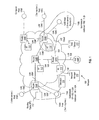
- network 100 is shown. Aspects of network 100 are shown to illustrate prior art systems and an embodiment of the invention.
- network 100 enables network elements to be connected through cloud 102 to other network elements.
- network cloud comprises a series of routers 104 connected by communication links 108.
- cloud 102 comprises routers 104A, 104B, 104C, 104D and 104E.
- routers 104A, 104B, 104C, 104D and 104E When data traffic is sent from a source device to a destination device in through network cloud 102, a communication path through various routers 104 must be defined.
- the architecture of network 102 is preferably IP. Accordingly, address constructs for data traffic and path generation constructs follow IP constructs. As such, when establishing a path, it is extended from the source device to the destination device in segments by sequentially finding a router which can send the data traffic to an adjacent router which is in a segment of a communication path towards the destination device. Each router has a routing table 112 providing a map of the topology of network cloud 102 to assist each router in identifying a next segment for a routing path for received data traffic.
- Network manager 110 is connected to cloud 102 and is responsible for maintaining and updating routing tables 112 of each router 104.
- Network manager 110 is connected to each router 104 in cloud 102 via a communication link 108.
- Hosts 106 are computing devices and each host has an IP address. Each host 106 is connected to a router 104 which provides the point of connection for host 106 to network 100. For example, hosts 106A and 106D are connected to network 100 via router 104A; hosts 106B and 106C are connected to network 100 via router 104B; host 106E is connected to router 104E and host 106F is connected to router 104C. Connections are made via communication links 108. In other embodiments, the communication link between the hosts and their connecting router may be a broadband communication link such as an assymetric digital subscriber line, Ethernet connection, local multipoint data service (LMDS), or an asynchronous transfer mode (ATM) passive optical network (APON).
- LMDS local multipoint data service
- ATM asynchronous transfer mode passive optical network
- Some hosts may be used as storage sites for services (for example hosts 106B and 106D); a host may be a computer (host 106E and 106F) or set-top box (hosts 106A and 106C).
- a set-top box is used to request services from other hosts, such as multicast group transmissions.
- a set top box issues one or more requests to the router which connects it to network 100 to receive a multicast transmission corresponding to programming information selected by the user.
- the set top box relays information concerning the channel change to the connecting router.
- the set top box indicates to the connecting router that the previously viewed channel is no longer required and that a new multicast data stream corresponding to the channel to which the user has selected is required.
- a personal computer may be configured as a host to request multicast groups in a similar manner as a set top box.
- Each of the hosts may be active or inactive at various points in time, and each of the hosts may request one or more multicast groups when active.
- network 100 is used to provide, in part, access to digital video distribution services.
- a user of television 114 access network 100 to request downloads of specific video programs offered by the services from remote hosts 106.
- the user has a set-top box 106A connected to his display device (e.g. his television) and network 100; the set-top box 106A is a host and generates and transmits network requests for video programs initiated by the user.
- the set-top box 106A When the user wishes to download a video program, he accesses a menu (typically displayed on television 114) and selects the desired video program from the menu.
- the set-top box 106A then issues a request to network 100 to receive the video program.
- the request sent by the set-top box 106A is received by router 104A, as the point of connection to network 100; in turn, router 104A must forward the request towards the source of the video program to network 100.
- the host which provides the video program is host 106B.
- hosts 106B and 106D utilize IP multicasting protocols to have network 100 distribute their programs to requesting set-top boxes or computers. Multicasting provides the benefit of conserving bandwidth usage in network 100. With multicasting, a host can send one copy of the multicasted data once to its server rather than repeatedly sending the same data to its router, then having its router send the data to each subscribing service.
- An IP multicast session is defined by sending a packet to a reserved multicast IP address, which in IPv4, comprise addresses in the Class D range, encompassing addresses from 224.0.0.0 to 239.255.255.255. Accordingly, by examining the source and destination IP addresses from the IP header of a packet, a router can determine over which links 108 the packet is to be multicasted.
- a multicast address identifies a particular transmission session rather than a specific physical destination host. This ensures that a host is able to join an ongoing multicast session.
- each router maintains a multicast forwarding table (MFT) of hosts associated with each video program.
- MFT multicast forwarding table
- Each entry in the table has two components: the first component provides information on the multicasted program, including its Group's IP address and the source host of the program; the second component is a list of outgoing links (108) associated with the program.
- Table A is a representative multicast forwarding table for router 104B in network 100.
- Source S host 106D (10.2.3.4) Link 108E to Router 104E
- Group G NBC (239.0.0.9)
- Source S host 106B (10.1.2.3) Link 108A to Set-top box 106C
- Group G HBO (239.0.0.5)
- the MFT may be included as a part of routing table 112. The MFT needs to be updated as multicast destinations are added and dropped from a group. In multicast routing, routers communicate with each other to exchange information about multicast group membership information to neighboring routers.
- a host 106A uses IGMPv3 to generate a JR (S, G) to router 104A, where S is the IP address of host 106B and G is the group IP address of ABC.
- Router 104A does a lookup in the unicast routing table on address S to determine that the reverse path towards the source egresses out link 108A towards router 104D.
- STB router 104A will generate a join request command which has the syntax: JR (S, G).
- the behaviour of router 104D is similar to 104A and outside the scope of the behaviour being described.
- the resulting Multicast Forwarding Table at Router 104B is shown in Table B with the change highlighted.
- Source S host 106D (10.2.3.4) Link 108E to Router 104E
- Group G NBC (239.0.0.9)
- Source S host 106B (10.1.2.3) Link 108A to Set-top box 106C
- Group G HBO (239.0.0.5)
- an embodiment provides another system incorporating IGMPv2 with PIM-SSM network is provided.
- the present invention provides a system and method for processing multicast group subscriptions for a multicast distribution group.
- a router When a router has received a request to join a multicast group, but has not been provided the identity of the source of the group, the router responsively obtains information from a group source table to identify the source for the group. Next, the router creates a request to join the distribution group and sends the request with the source information to the router associated with the group.
- Fig. 1 the following example illustrates operating aspects of the embodiment.
- legacy set-top boxes such as set-top box 106A
- the embodiment provides an interface mechanism allowing legacy systems to use IGMPv2 protocols to interface with a network which uses PIM-SSM.
- IGMPv2 JR *, G
- STB router 104A which then generates a corresponding PIM-SSM JR (S, G) request.
- a JR (*, G) request is received by STB router 104A, it needs to identify a source S for the group G.
- the join request JR (S, G) is sent towards the source host 106 according to standard PIM-SSM procedures.
- PIM-SSM operation is based on a unidirectional tree whose root is the Source and whose leaves are the receivers.
- a Source Specific Multicast (SSM) defines a "channel" identified by an (S, G) pair, from source S for SSM destination address G.
- the tree which models the group is called source-specific tree, or shortest-path tree (SPT).
- Network 100 has receiver/host 106A on subnetwork 116A (addressed as 190.1.1/24).
- Receiver 106A may send an IGMPv2 or IGMPv3 message to implement this notification to router 104A which, in the example, is the designated router in subnetwork 116A.
- Router 104A tracks groups which are being accessed by receivers 106 in its subnetwork 116A in a tree information base (TIB).
- TIB tree information base
- router 104A When router 104A receives the IGMP message from receiver 106A, router 104A creates an (S1, G1) entry in its TIB and then places the Ethernet interface E0 in its outgoing interface list which is a list of interfaces that have joined the group.
- router 104A Since router 104A had to create a new (S1, G1) state, router 104A must send a Join Request (S1, G1) command to the upstream router 104 towards source S1. Router 104A consults a multicast topology table to decide where to send the message. In the example, router 104A send a Join Request (S1,G1) message to router 104D. In this manner, the Join Request (S1,G1) message travels hop-by-hop towards S1 for the group G1 and, in each router 104 it passes through, a (S1,G1) state is instantiated. Eventually the Join Request (S1,G1) message either reaches S1, or reaches a router 104 that already has the (S1,G1) Join state.
- S1,G1 Join Request
- receivers 104 can request to leave a group. If all receivers 104 in subnetwork 202 leave a group, router 104, as the designated router, sends a Prune (S1,G1) message towards source S1 for multicast group G1.
- Prune S1,G1
- all of the source and group information is stored at each router 104.
- Management of the source and group information is performed by network manager 110 is a computer in network 100.
- the source and group information is preferably organized in a table.
- Network manager 110 maintains the contents of the table and ensures that information in the table is distributed to all routers 104 in network 100.
- network manager 110 may use any known method to distribute the table over the links 108.
- Table C is an exemplary table of the source and group information for a network. Any changes (additions and subtractions) to Table C need to be distributed to all routers 106. For example, if a new channel (e.g. FOX) starts transmitting from a video server, Table C needs to be modified to include the group and source address of the new channel by a network management operator and then the updated table needs to be distributed to each of the routers.
- a new channel e.g. FOX
- Table C needs to be modified to include the group and source address of the new channel by a network management operator and then the updated table needs to be distributed to each of the routers.
- Table C Channel (Group G) Source Host S ABC (239.0.0.1) Host 106B (10.1.2.3) HBO (239.0.0.5) Host 106B (10.1.2.3) NBC (239.0.0.9) Host 106D (10.2.3.4) CBS (239.0.0.12) Host 106D (10.2.3.4)
- the embodiment uses the source and group information to generate a JR (S, G) PIM-SSM command from a JR (*, G) IGMPv2 command as follows, using router 104A as a representative communication device to perform the generation.
- Router 104A has internal hardware and software modules to generate the command. In particular aspects of the modules are implemented in a state machine.
- router 104A receives the IGMPv2 JR (*, G) message from host 106A. Router 104A needs to determine addressing information of the host of the program. To do this, router 104A accesses a source and group information table. As the STB router knows the identity of group G, the correlating source S can be identified from the source and group information table. With the source S information, STB router 104A builds a PIM-SSM join request placing the source address as determined from Table B as the "S" IP address in the PIM-SSM JR (S, G). The PIM-SSM is sent on a link as determined by a lookup of address S in the unicast routing table. This will be link 108 towards router 104D.
- unique multicast addresses are provided to each group within the multicast groups in order to allow IGMP v1/v2 join requests.
- source and group information is used in conjunction with the "Reverse Path Forwarding" (RPF) lookup as defined in the PIM-SM and PIM-SSM standards.
- RPF Reverse Path Forwarding
- the reception of a (*, G) join results in a special RPF check based on a special router in the network named the Rendezvous Point (RP).
- this step may not be performed by the embodiment, as it is not needed.
- the source address (S) information is used to perform an RPF lookup to determine the outgoing interface used to reach address S.
- the outgoing interface to reach address S (10.1.2.3) is link 108A, which is the link leading towards router 104D.
- the embodiment configures the datapath such that received (S, G) packets on link 108A are sent out towards host 106A.
- the embodiment then sends a PIM-SSM Join Request (S, G) on link 108A towards router 104D.
- Router 104D receives the PIM-SSM Join Request (S, G) and passes the request to its state machine which performs another RPF lookup on the source address S 1.
- the state machine determines that the outgoing interface to reach address S is link 108B leading towards router 104B.
- the embodiment configures the datapath such that received (S, G) packets on link 108B are sent out towards link 108A.
- the embodiment sends a PIM-SSM Join Request (S, G) on link 108B towards router 104B.
- Router 104B receives the request and passes the request to its state machine which performs a third RPF lookup on the source address S. This determines that the outgoing interface to reach address S is link 108C towards host 106B.
- the embodiment configures the datapath such that received (S, G) packets on link 108C are sent out towards link 108B.
- Now (S, G) traffic from host 106B traverses network 100 and reaches host 106A.
- disconnect requests For a disconnect request, a similar protocol is followed.
- the disconnect requests must follow the same multicast tree topology as they were for the join requests.
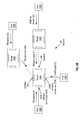
- Router 104A has line cards 202A, 202B and 202C providing interface points to external devices, such as other routers 104 and hosts 106.
- line card 202A provides (i) a connection via communication link 108F to host 106A; and (ii) a connection via communication link 108A to router 104D.
- Line card 202B provides a connection via link 108D to host 106D.
- line card 202C is shown as having an additional connection via link 108G to an additional host 106G and an additional connection via link 108H to an additional host 106H.
- Router 104A also has control module 204 which provides processing of the forwarding information.
- External devices join the group managed by router 104A in the following order: host 106B, router 104D, host 106G, and host 106H.
- host 106D transmits IP packets to group address G1.
- host 106D joins the group
- host 106D sends an IGMP join message to join group G1.
- line card 202B detects join message and provides it line card 202A. It will be appreciated that other routers may be provided for the embodiment which do not use line cards.
- FIG. 1 another embodiment provides for selectively enabled multicast to secure a network against denial of service attacks involving multicast traffic.
- Another device besides the video server, would be able to send multicast traffic with a different source address but the same group address (S', G).
- group (*, G) implying the desire to connect to the (S, G) traffic from the video server
- this feature restricts the traffic received by the set-top box to the (S, G) traffic.
- the (S', G) or any other (*, G) traffic is not sent to the set-top box.
- the ABC channel is carried on group address 239.0.0.1 which is carried by source host 106B using source address 10.1.2.3 is the authorized carrier of multicast traffic on group address 239.0.0.1.
- Another host 106D in the network is improperly or maliciously transmitting on group address 239.0.0.1.
- the host 106D must do this with its source address 10.2.3.4.
- the traffic is terminated and not forwarded by Router 104A as there are no subscribers to this improper channel. No other host can attempt to join this improper channel as on each router the group address 239.0.0.1 is mapped to the source address 10.1.2.3. There will be no requests generated for group address 239.0.0.1 with the source address 10.2.3.4.
- an embodiment also provides a transmission security feature which blocks unauthorized multicast transmissions.
- This security feature utilizes the conversion process of converting IGMPv2 join requests (*, G) to IGMPv3 join requests (S, G) to evaluate and exclude unknown malicious sources from transmitting on a given multi-cast group.
- the multicast source addresses can be configured through CLI. This feature may be used to prevent denial of service (DOS) attacks on a network source which supports multicast traffic.
- DOS denial of service
- router 104 has line cards 202 which provide connection points between it and each connected host 106 and router 104.
- an interface 204 is provided, which may be selectively activated or deactivated by its router 104, depending on configuration constructs. In alternative embodiments, an interface 204 may be remotely controlled. When an interface 204 is deactivated, no data traffic received through its interface 204 will be forwarded by the router 104 to any other point in the network. Such data traffic may simply be discarded by the router 104.
Landscapes
- Engineering & Computer Science (AREA)
- Computer Networks & Wireless Communication (AREA)
- Signal Processing (AREA)
- Computer Security & Cryptography (AREA)
- Data Exchanges In Wide-Area Networks (AREA)
Applications Claiming Priority (2)
| Application Number | Priority Date | Filing Date | Title |
|---|---|---|---|
| US10/323,633 US7233987B2 (en) | 2002-12-20 | 2002-12-20 | System and method for converting requests between different multicast protocols in a communication network |
| EP03300265A EP1432172B1 (fr) | 2002-12-20 | 2003-12-12 | Procédé et système pour conversion de requêtes IGMP |
Related Parent Applications (1)
| Application Number | Title | Priority Date | Filing Date |
|---|---|---|---|
| EP03300265A Division EP1432172B1 (fr) | 2002-12-20 | 2003-12-12 | Procédé et système pour conversion de requêtes IGMP |
Publications (1)
| Publication Number | Publication Date |
|---|---|
| EP2051438A1 true EP2051438A1 (fr) | 2009-04-22 |
Family
ID=32393042
Family Applications (2)
| Application Number | Title | Priority Date | Filing Date |
|---|---|---|---|
| EP09152343A Withdrawn EP2051438A1 (fr) | 2002-12-20 | 2003-12-12 | Procédé et dispositif pour gérer des groupes de multidiffusion |
| EP03300265A Expired - Lifetime EP1432172B1 (fr) | 2002-12-20 | 2003-12-12 | Procédé et système pour conversion de requêtes IGMP |
Family Applications After (1)
| Application Number | Title | Priority Date | Filing Date |
|---|---|---|---|
| EP03300265A Expired - Lifetime EP1432172B1 (fr) | 2002-12-20 | 2003-12-12 | Procédé et système pour conversion de requêtes IGMP |
Country Status (5)
| Country | Link |
|---|---|
| US (2) | US7233987B2 (fr) |
| EP (2) | EP2051438A1 (fr) |
| JP (1) | JP2004208302A (fr) |
| CN (1) | CN100435515C (fr) |
| DE (1) | DE60334062D1 (fr) |
Families Citing this family (67)
| Publication number | Priority date | Publication date | Assignee | Title |
|---|---|---|---|---|
| US7936752B2 (en) * | 2002-07-31 | 2011-05-03 | Cisco Technology, Inc. | Source specific multicast group to source mapping |
| US7769873B1 (en) | 2002-10-25 | 2010-08-03 | Juniper Networks, Inc. | Dynamically inserting filters into forwarding paths of a network device |
| US8078758B1 (en) | 2003-06-05 | 2011-12-13 | Juniper Networks, Inc. | Automatic configuration of source address filters within a network device |
| US20050002398A1 (en) * | 2003-07-01 | 2005-01-06 | Alcatel | IGMP on NT architecture |
| US20050063409A1 (en) * | 2003-09-18 | 2005-03-24 | Nokia Corporation | Method and apparatus for managing multicast delivery to mobile devices involving a plurality of different networks |
| US7716363B1 (en) * | 2004-02-10 | 2010-05-11 | Cisco Technology, Inc. | Method and apparatus of providing zero configuration single source multicasting reporting |
| US7418003B1 (en) * | 2004-02-12 | 2008-08-26 | Cisco Systems, Inc. | PIM sparse mode to source specific multicast conversion |
| US8099516B1 (en) * | 2004-02-23 | 2012-01-17 | Avaya Inc. | Protocol independent multicast designated router enhancements for supporting internet group management protocol in a multi-access network |
| US9065669B2 (en) * | 2004-08-24 | 2015-06-23 | Avaya Inc. | Method and apparatus for authorizing multicast forwarding states |
| US7519010B1 (en) | 2004-08-30 | 2009-04-14 | Juniper Networks, Inc. | Inter-autonomous system (AS) multicast virtual private networks |
| WO2006053027A2 (fr) * | 2004-11-09 | 2006-05-18 | Nexthop Technologies, Inc. | Systemes et procedes de routage multidiffusion sur des reseaux a commutation par paquets |
| US20060159091A1 (en) * | 2005-01-19 | 2006-07-20 | Arjen Boers | Active multicast information protocol |
| US20060182049A1 (en) * | 2005-01-31 | 2006-08-17 | Alcatel | IP multicasting with improved redundancy |
| US7602702B1 (en) | 2005-02-10 | 2009-10-13 | Juniper Networks, Inc | Fast reroute of traffic associated with a point to multi-point network tunnel |
| US7724739B2 (en) * | 2005-03-18 | 2010-05-25 | Cisco Technology, Inc. | Source specific multicast layer 2 networking device and method |
| US9166807B2 (en) * | 2005-07-28 | 2015-10-20 | Juniper Networks, Inc. | Transmission of layer two (L2) multicast traffic over multi-protocol label switching networks |
| US7990965B1 (en) | 2005-07-28 | 2011-08-02 | Juniper Networks, Inc. | Transmission of layer two (L2) multicast traffic over multi-protocol label switching networks |
| EP1913743B1 (fr) | 2005-08-12 | 2016-07-13 | Samsung Electronics Co., Ltd. | Procede et systeme de gestion de groupe dans un systeme d'interfonctionnement d'un systeme imps et d'un systeme im simple |
| US7564803B1 (en) | 2005-08-29 | 2009-07-21 | Juniper Networks, Inc. | Point to multi-point label switched paths with label distribution protocol |
| US7596799B2 (en) * | 2005-11-18 | 2009-09-29 | At&T Intellectual Property I, L.P. | System and method of communicating video content |
| US7936702B2 (en) * | 2005-12-01 | 2011-05-03 | Cisco Technology, Inc. | Interdomain bi-directional protocol independent multicast |
| US8018964B2 (en) * | 2005-12-16 | 2011-09-13 | Cisco Technology, Inc. | Multicast operations using prioritized state information |
| US8626925B2 (en) * | 2005-12-16 | 2014-01-07 | Panasonic Corporation | Systems and methods for providing a selective multicast proxy on a computer network |
| US7839850B2 (en) * | 2006-01-30 | 2010-11-23 | Juniper Networks, Inc. | Forming equal cost multipath multicast distribution structures |
| US8270395B2 (en) * | 2006-01-30 | 2012-09-18 | Juniper Networks, Inc. | Forming multicast distribution structures using exchanged multicast optimization data |
| US8259612B2 (en) | 2006-06-09 | 2012-09-04 | Cisco Technologies, Inc. | Method of routing multicast traffic |
| US7839862B1 (en) | 2006-06-30 | 2010-11-23 | Juniper Networks, Inc. | Upstream label assignment for the label distribution protocol |
| US7787380B1 (en) | 2006-06-30 | 2010-08-31 | Juniper Networks, Inc. | Resource reservation protocol with traffic engineering point to multi-point label switched path hierarchy |
| US7742482B1 (en) | 2006-06-30 | 2010-06-22 | Juniper Networks, Inc. | Upstream label assignment for the resource reservation protocol with traffic engineering |
| US7826348B2 (en) * | 2007-04-26 | 2010-11-02 | Cisco Technology, Inc. | Multicast fast reroute |
| EP1993228B1 (fr) * | 2007-05-18 | 2012-05-23 | Huawei Technologies Co., Ltd. | Procédé d'envoi de messages, dispositif d'envoi de messages et système de transmission de messages |
| US20100046516A1 (en) * | 2007-06-26 | 2010-02-25 | Media Patents, S.L. | Methods and Devices for Managing Multicast Traffic |
| ES2381175T3 (es) * | 2007-06-26 | 2012-05-23 | Media Patents, S. L. | Dispositivo para gestionar grupos multidifusión |
| WO2009011621A1 (fr) | 2007-07-13 | 2009-01-22 | Telefonaktiebolaget L M Ericsson (Publ) | Procédé de réduction de la signalisation de commande dans des situations de transfert |
| US20090040957A1 (en) * | 2007-08-10 | 2009-02-12 | Thomas Anschutz | Prepositioning Data For Wireless Applications |
| JP5157351B2 (ja) * | 2007-09-28 | 2013-03-06 | 日本電気株式会社 | 動画配信システム、加入者回線終端装置、動画配信方法、動画配信プログラム、及び記憶媒体 |
| US8184630B2 (en) * | 2007-10-15 | 2012-05-22 | Media Patents, S.L. | Method for managing multicast traffic in a data network and network equipment using said method |
| US8064449B2 (en) * | 2007-10-15 | 2011-11-22 | Media Patents, S.L. | Methods and apparatus for managing multicast traffic |
| EP2215772A1 (fr) * | 2007-10-30 | 2010-08-11 | Media Patents, S. L. | Procédé pour gérer un trafic de multidiffusion entre des routeurs communiquant au moyen d'un protocole intégrant le protocole pim, et routeur et commutateur impliqués dans ledit procédé |
| WO2009095041A1 (fr) * | 2008-02-01 | 2009-08-06 | Soporte Multivendor S.L. | Procédé permettant la gestion de trafic de multidiffusion via un commutateur fonctionnant dans la couche 2 du modèle de référence osi, et routeur et commutateur mis en œuvre dans ledit procédé |
| US9031068B2 (en) * | 2008-02-01 | 2015-05-12 | Media Patents, S.L. | Methods and apparatus for managing multicast traffic through a switch |
| WO2009109684A1 (fr) * | 2008-03-05 | 2009-09-11 | Media Patents, S. L. | Procédé pour contrôler ou gérer des équipements connectés à un réseau de données |
| US7936780B1 (en) | 2008-03-12 | 2011-05-03 | Juniper Networks, Inc. | Hierarchical label distribution protocol for computer networks |
| ITMI20081811A1 (it) * | 2008-10-13 | 2010-04-14 | Franco Barbalato | Sistema e metodo per la gestione di informazioni provenienti da istituzioni o da enti aderenti da veicolarsi in tempo reale all'attenzione del pubblico attraverso sistemi elettronici posti esclusivamente presso istituti di credito |
| US7929557B2 (en) * | 2008-11-14 | 2011-04-19 | Juniper Networks, Inc. | Summarization and longest-prefix match within MPLS networks |
| US8077726B1 (en) | 2008-12-10 | 2011-12-13 | Juniper Networks, Inc. | Fast reroute for multiple label switched paths sharing a single interface |
| US8189584B2 (en) | 2009-07-27 | 2012-05-29 | Media Patents, S. L. | Multicast traffic management in a network interface |
| US20110149960A1 (en) * | 2009-12-17 | 2011-06-23 | Media Patents, S.L. | Method and apparatus for filtering multicast packets |
| US20110188499A1 (en) * | 2010-02-04 | 2011-08-04 | Cisco Technology, Inc. | Point-to-multipoint path implementation in a multicast virtual private network |
| US8422514B1 (en) | 2010-02-09 | 2013-04-16 | Juniper Networks, Inc. | Dynamic configuration of cross-domain pseudowires |
| US8310957B1 (en) | 2010-03-09 | 2012-11-13 | Juniper Networks, Inc. | Minimum-cost spanning trees of unicast tunnels for multicast distribution |
| US9559855B2 (en) | 2010-05-20 | 2017-01-31 | Cisco Technology, Inc. | System and method for providing multicast delivery in a network environment |
| US8799767B2 (en) | 2010-05-28 | 2014-08-05 | Welch Allyn, Inc. | Transformation of medical status data into executable programs |
| US9246838B1 (en) | 2011-05-27 | 2016-01-26 | Juniper Networks, Inc. | Label switched path setup using fast reroute bypass tunnel |
| CN102595248B (zh) * | 2012-01-18 | 2014-02-26 | 杭州华三通信技术有限公司 | 组播转发表项维护方法及协议无关组播路由器 |
| US9148343B2 (en) * | 2012-03-27 | 2015-09-29 | Juniper Networks, Inc. | Methods and apparatus for improving compatibility between network devices |
| US8837479B1 (en) | 2012-06-27 | 2014-09-16 | Juniper Networks, Inc. | Fast reroute between redundant multicast streams |
| US9363227B2 (en) | 2012-08-17 | 2016-06-07 | Cisco Technology, Inc. | Multicast source in group address mapping |
| US9049148B1 (en) | 2012-09-28 | 2015-06-02 | Juniper Networks, Inc. | Dynamic forwarding plane reconfiguration in a network device |
| US8953500B1 (en) | 2013-03-29 | 2015-02-10 | Juniper Networks, Inc. | Branch node-initiated point to multi-point label switched path signaling with centralized path computation |
| US9118809B2 (en) | 2013-10-11 | 2015-08-25 | Edifire LLC | Methods and systems for multi-factor authentication in secure media-based conferencing |
| US8929257B1 (en) * | 2013-10-11 | 2015-01-06 | Edifire LLC | Methods and systems for subconferences in secure media-based conferencing |
| US9118654B2 (en) | 2013-10-11 | 2015-08-25 | Edifire LLC | Methods and systems for compliance monitoring in secure media-based conferencing |
| US9806895B1 (en) | 2015-02-27 | 2017-10-31 | Juniper Networks, Inc. | Fast reroute of redundant multicast streams |
| US10243841B2 (en) | 2016-06-06 | 2019-03-26 | Cisco Technology, Inc. | Multicast fast reroute at access devices with controller implemented multicast control plane |
| US10264040B2 (en) | 2016-08-03 | 2019-04-16 | Big Switch Networks, Inc. | Systems and methods to manage multicast traffic |
| US10805164B2 (en) | 2018-12-14 | 2020-10-13 | At&T Intellectual Property I, L.P. | Controlling parallel data processing for service function chains |
Citations (1)
| Publication number | Priority date | Publication date | Assignee | Title |
|---|---|---|---|---|
| EP1424806A1 (fr) * | 2002-11-26 | 2004-06-02 | Hitachi, Ltd. | Routeur de multidiffusion avec fonction de traduction des protocoles conformément à Any-Source-Multicast et Source-Specific-Multicast |
Family Cites Families (16)
| Publication number | Priority date | Publication date | Assignee | Title |
|---|---|---|---|---|
| US5729532A (en) * | 1995-05-26 | 1998-03-17 | Lucent Technologies Inc. | Selective participation in a multimedia communication conference call |
| US5963720A (en) * | 1996-08-13 | 1999-10-05 | Advanced Micro Devices, Inc. | Method and system for expediting transfer of data over a network using an additional field |
| US6331983B1 (en) * | 1997-05-06 | 2001-12-18 | Enterasys Networks, Inc. | Multicast switching |
| US6035405A (en) * | 1997-12-22 | 2000-03-07 | Nortel Networks Corporation | Secure virtual LANs |
| DE69943228D1 (de) * | 1998-07-14 | 2011-04-07 | Sony Corp | Datenempfangsvorrichtung |
| JP3519616B2 (ja) * | 1998-10-21 | 2004-04-19 | 株式会社日立製作所 | 中継装置 |
| US6850987B1 (en) * | 1999-06-01 | 2005-02-01 | Fastforward Networks, Inc. | System for multipoint infrastructure transport in a computer network |
| EP1094675A1 (fr) * | 1999-10-21 | 2001-04-25 | Hyundai Electronics Industries Co., Ltd. | Procédé de transmission d un message de commande de resources radio dans un système de communication mobile asynchrone |
| JP4347497B2 (ja) * | 2000-04-03 | 2009-10-21 | 株式会社日立製作所 | 通信制御装置及びパケット変換方法 |
| US6831917B1 (en) * | 2000-05-10 | 2004-12-14 | Cisco Technology, Inc. | Network address translation for multicast virtual sourcing |
| US6963573B1 (en) * | 2000-09-13 | 2005-11-08 | Nortel Networks Limited | System, device, and method for receiver access control in a multicast communication system |
| US6847638B1 (en) * | 2000-10-16 | 2005-01-25 | Cisco Technology, Inc. | Multicast system for forwarding desired multicast packets in a computer network |
| US6947434B2 (en) * | 2000-11-16 | 2005-09-20 | Telefonaktiebolaget Lm Ericsson (Publ) | Subgroup multicasting in a communications network |
| US7339903B2 (en) * | 2001-06-14 | 2008-03-04 | Qualcomm Incorporated | Enabling foreign network multicasting for a roaming mobile node, in a foreign network, using a persistent address |
| CN1192574C (zh) * | 2002-01-30 | 2005-03-09 | 华为技术有限公司 | 受控组播的系统及其实现方法 |
| US7936752B2 (en) * | 2002-07-31 | 2011-05-03 | Cisco Technology, Inc. | Source specific multicast group to source mapping |
-
2002
- 2002-12-20 US US10/323,633 patent/US7233987B2/en not_active Expired - Lifetime
-
2003
- 2003-12-12 EP EP09152343A patent/EP2051438A1/fr not_active Withdrawn
- 2003-12-12 EP EP03300265A patent/EP1432172B1/fr not_active Expired - Lifetime
- 2003-12-12 DE DE60334062T patent/DE60334062D1/de not_active Expired - Lifetime
- 2003-12-17 JP JP2003419296A patent/JP2004208302A/ja active Pending
- 2003-12-19 CN CNB2003101246937A patent/CN100435515C/zh not_active Expired - Fee Related
-
2007
- 2007-01-26 US US11/698,082 patent/US7519662B2/en not_active Expired - Lifetime
Patent Citations (2)
| Publication number | Priority date | Publication date | Assignee | Title |
|---|---|---|---|---|
| EP1424806A1 (fr) * | 2002-11-26 | 2004-06-02 | Hitachi, Ltd. | Routeur de multidiffusion avec fonction de traduction des protocoles conformément à Any-Source-Multicast et Source-Specific-Multicast |
| EP1587243A1 (fr) * | 2002-11-26 | 2005-10-19 | Hitachi Ltd. | Routeur de multidiffusion avec fonction de detection de noeuds conformément à Any-Source-Multicast dans une groupe conformément à Source-Specific-Multicast |
Non-Patent Citations (1)
| Title |
|---|
| "Interdomain Multicast Solutions Using SSM", INTERNET CITATION, 22 March 2001 (2001-03-22), pages 1 - 28, XP002254330, Retrieved from the Internet <URL:www.cisco.com/univercd/cc/td/doc/cisintwk/intsolns/mcst_p1/mcst_p2.pdf> [retrieved on 20061018] * |
Also Published As
| Publication number | Publication date |
|---|---|
| US7233987B2 (en) | 2007-06-19 |
| CN1523824A (zh) | 2004-08-25 |
| US20040122890A1 (en) | 2004-06-24 |
| CN100435515C (zh) | 2008-11-19 |
| US20070124454A1 (en) | 2007-05-31 |
| EP1432172A3 (fr) | 2007-03-07 |
| EP1432172B1 (fr) | 2010-09-08 |
| DE60334062D1 (de) | 2010-10-21 |
| US7519662B2 (en) | 2009-04-14 |
| EP1432172A2 (fr) | 2004-06-23 |
| JP2004208302A (ja) | 2004-07-22 |
Similar Documents
| Publication | Publication Date | Title |
|---|---|---|
| EP1432172B1 (fr) | Procédé et système pour conversion de requêtes IGMP | |
| US8611348B2 (en) | Source specific multicast group to source mapping | |
| JP4165196B2 (ja) | パケット中継装置 | |
| US7801068B2 (en) | Selectively receiving data in a multicast environment | |
| CA2315210C (fr) | Procede et dispositif de reception de diffusions multiples d'animations video numeriques integrales, de donnees et de voix interactives, via un circuit de lignes d'abonnes numeriques | |
| US20090161674A1 (en) | Method and tool for IP multicast network address translation (MNAT) | |
| US8683049B2 (en) | Methods for obtaining terminal multicasts status | |
| US9191688B2 (en) | Television delivery system | |
| JP5548696B2 (ja) | マルチキャストサービス品質モジュールおよび方法 | |
| CN100574266C (zh) | 数据包传送装置 | |
| CN118590470B (zh) | 一种云平台的非侵入式组播转发方法及系统 | |
| US8584170B2 (en) | System and method of internet group management for multicast push in passive access networks | |
| US20100135298A1 (en) | Method and system for providing source specific multicast service on ethernet network | |
| Metz et al. | A look at native IPv6 multicast | |
| JP4530039B2 (ja) | パケット中継装置 | |
| JP2008048449A (ja) | パケット中継装置 |
Legal Events
| Date | Code | Title | Description |
|---|---|---|---|
| PUAI | Public reference made under article 153(3) epc to a published international application that has entered the european phase |
Free format text: ORIGINAL CODE: 0009012 |
|
| AC | Divisional application: reference to earlier application |
Ref document number: 1432172 Country of ref document: EP Kind code of ref document: P |
|
| AK | Designated contracting states |
Kind code of ref document: A1 Designated state(s): AT DE ES FR GB IT |
|
| 17P | Request for examination filed |
Effective date: 20091022 |
|
| 17Q | First examination report despatched |
Effective date: 20091203 |
|
| AKX | Designation fees paid |
Designated state(s): DE ES FR GB IT |
|
| STAA | Information on the status of an ep patent application or granted ep patent |
Free format text: STATUS: THE APPLICATION IS DEEMED TO BE WITHDRAWN |
|
| 18D | Application deemed to be withdrawn |
Effective date: 20100414 |