EP2052009B1 - Method of preparing polycarbonate - Google Patents
Method of preparing polycarbonate Download PDFInfo
- Publication number
- EP2052009B1 EP2052009B1 EP07798265A EP07798265A EP2052009B1 EP 2052009 B1 EP2052009 B1 EP 2052009B1 EP 07798265 A EP07798265 A EP 07798265A EP 07798265 A EP07798265 A EP 07798265A EP 2052009 B1 EP2052009 B1 EP 2052009B1
- Authority
- EP
- European Patent Office
- Prior art keywords
- carbonate
- polycarbonate
- end groups
- chainstopper
- bis
- Prior art date
- Legal status (The legal status is an assumption and is not a legal conclusion. Google has not performed a legal analysis and makes no representation as to the accuracy of the status listed.)
- Active
Links
Images


Classifications
-
- C—CHEMISTRY; METALLURGY
- C08—ORGANIC MACROMOLECULAR COMPOUNDS; THEIR PREPARATION OR CHEMICAL WORKING-UP; COMPOSITIONS BASED THEREON
- C08G—MACROMOLECULAR COMPOUNDS OBTAINED OTHERWISE THAN BY REACTIONS ONLY INVOLVING UNSATURATED CARBON-TO-CARBON BONDS
- C08G64/00—Macromolecular compounds obtained by reactions forming a carbonic ester link in the main chain of the macromolecule
- C08G64/04—Aromatic polycarbonates
- C08G64/06—Aromatic polycarbonates not containing aliphatic unsaturation
- C08G64/14—Aromatic polycarbonates not containing aliphatic unsaturation containing a chain-terminating or -crosslinking agent
-
- C—CHEMISTRY; METALLURGY
- C08—ORGANIC MACROMOLECULAR COMPOUNDS; THEIR PREPARATION OR CHEMICAL WORKING-UP; COMPOSITIONS BASED THEREON
- C08G—MACROMOLECULAR COMPOUNDS OBTAINED OTHERWISE THAN BY REACTIONS ONLY INVOLVING UNSATURATED CARBON-TO-CARBON BONDS
- C08G64/00—Macromolecular compounds obtained by reactions forming a carbonic ester link in the main chain of the macromolecule
- C08G64/20—General preparatory processes
- C08G64/30—General preparatory processes using carbonates
- C08G64/307—General preparatory processes using carbonates and phenols
Definitions
- the present invention relates to a method of preparing polycarbonate.
- Polycarbonates are generally produced through one of two types of processes: an interfacial process or a melt transesterification process.
- dihydroxy compounds such as biphenol A arc reacted with a carbonic acid diester.
- the carbonic acid diester may be a diaryl carbonate such as diphenyl carbonate.
- US 4,323,668 describes a polycarbonate transesterification process comprising reacting (ortho-alkoxycarbonylarylcarbonates and a dihydric phenol under transesterification reaction conditions.
- US Patent No. 4,323,668 makes uses of bis-methylsalicylcarbonate (BMSC) as the diaryl carbonate.
- BMSC bis-methylsalicylcarbonate
- Use of activated diaryl carbonates is also described in US, 6,420,512 , US 6,506,871 , US 6,548,623 , US 6,790,929 , US 6,518,391 , US 2003/0139529 , and US 2003/0149223 . When these activated carbonates are used, internal residues and end-caps derived from the activated diaryl carbonate are incorporated into the final polymer. See, US patent Publication No. 20030050427 and 20030149223 .
- WO 2004/060962 discloses polycarbonates containing low or undetectable levels of Fries rearrangement products and comprising repeat units derived from one or more of resorcinol, hydroquinone, methylhydroquinone, bisphenol A, and 4,4'-biphenol prepared by the melt reaction of one or more of the aforementioned dihydroxy aromatic compounds with an ester-substituted diaryl carbonate such as bis-methyl salicyl carbonate.
- WO 03/010220 discloses that extrusion of a mixture of an ester-substituted diaryl carbonate, a dihydroxy aromatic compound, and a transesterification catalyst affords polycarbonate having a weight average molecular weight of greater than 20,000 daltons.
- the extruder is equipped with one or more vacuum vents to remove by-product ester-substituted phenol
- a precursor polycarbonate having ester-substituted phenoxy endgroups when subjected to extrusion affords a polycarbonate having a significantly increased molecular weight relative to the precursor polycarbonate.
- the reaction to form a higher molecular weight polycarbonate may be catalyzed by residual transesterification catalyst present in the precursor polycarbonate, or by a combination of any residual catalyst and an additional catalyst such as tetrabutylphosphonium acetate (TBPA) introduced in the extrusion step.
- TBPA tetrabutylphosphonium acetate
- polycarbonates incorporating terminal carbonate groups derived from ester-substituted activated carbonates for example terminal methyl salicyl carbonate (TMSC) derived from the use of BMSC as the activated carbonate in a transesterification process
- TMSC terminal methyl salicyl carbonate
- the present application provides a method for reducing the number of activated carbonate end group formed during the melt transesterification formation of polycarbonate, without sacrificing the benefits of using an activated diaryl carbonate, and without requiring a separate reaction or additional additives.
- polycarbonate is prepared by reacting a dihydroxy reaction component comprising a dihydroxy compound with carbonate reaction component comprising an activated diaryl carbonate in the presence of an esterification catalyst to produce a polycarbonate, wherein the carbonate reaction component and the dihydroxy reaction component are reacted in the presence of a monofunctional chainstopper, said chainstopper being present in an amount effective to yield a polycarbonate in which from 35 to 65% of the total number of end groups are derived from the monofunctional chainstopper and further wherein an activated diaryl carbonate is a carbonate that is more reactive than diphenyl carbonate toward transesterification reactions.
- the chainstopper reagent is a monhydroxychainstopper such as phenolic chainstopper of the formula where each substituent Ris independently selected from the group consisting of alkyl, aryl, alkaryl having from 1 to 30 carbon units, and hydrogen; and x is an integer between 1 and 5; but the substituent R is not an ester or other strongly activating or electron-with drawing substituent.
- the monofunctional chainstopper is a mono-acid (such as etaric acid), a mono-ester (such as the phenyl ester of stearic acid) or a mono-activated, asymmetric carbonate.
- this is achieved by using a molar ratio of carbonate reaction component to the total of dihydroxy reaction component plus 1 ⁇ 2 the chainstopping reagent that is less than 1 when expressed to at least three decimal places, for example 0.996 or less.
- the ratio is between 0.962 and 0.996, for example between 0.968 and 0.996. In another specific embodiment, the ratio is between 0.971 and 0,994.
- This ratio distinguishes the product formed using the method of the present invention from that formed when excess activated diaryl carbonate is used.
- the reaction goes to completion in the latter case, no appreciable amount of free, non-salicylate OH end groups derived from the dihydroxy compound remains.
- the term "Fries product” or “Fries rearrangement product” is defined as a structural unit of the product polycarbonate which upon hydrolysis of the product polycarbonate affords a carboxy-substituted dihydroxy aromatic compound bearing a carboxy group adjacent to one or both of the hydroxy groups of said carboxy-substituted dihydroxy aromatic compound.
- the Fries product includes those structural features of the polycarbonate which afford 2-carboxy bisphenol A species upon complete hydrolysis of the product polycarbonate.
- activated carbonates include bis(o-methoxycarbonylphenyl)carbonate, bis(o-chlorophenyl)carbonate, bis(o-nitrophenyl)carbonate, bis(o-acetylphenyl)carbonate, bis(o-phenylketonephenyl)carbonate, bis(o-formylphenyl)carbonate, and bis(o-cyanophenyl)carbonate.
- unsymmetrical combinations of these structures, where the substitution number and type on A and A' are different, are also possible to employ in the current invention.
- One method for determining whether a certain diarylcarbonate is activated or is not activated is to carry out a model transesterification reaction between the certain diarylcarbonate with a phenol such as para-cumyl phenol.
- a phenol such as para-cumyl phenol.
- This phenol is preferred because it possesses only one reactive site, possesses a low volatility and possesses a similar reactivity to bisphenol-A.
- the model transesterification reaction was carried out at temperatures above the melting points of the certain diarylcarbonate and para-cumyl phenol and in the presence of a transesterification catalyst, which is usually an aqueous solution of sodium hydroxide or sodium phenoxide.
- Non-limiting examples of suitable organic ammonium compounds are tetramethyl ammonium hydroxide, tetrabutyl ammonium hydroxide, tetramethyl ammonium acetate, tetramethyl ammonium formate and tetrabutyl ammonium acetate. Tetramethyl ammonium hydroxide is often preferred.
- the diacid employed may have structure: HOOC-R 20 -COOH wherein R 20 is a C 4 -C 30 aromatic radical, a C, -C 40 aliphatic radical, or a C 5 -C 30 cycloaliphatic radical, Specific examples of diacids of this formula include terephthalic acid; isophthalic acid; 1,4-cyclohexanediacrboxylic acid; hexanedioic acid; octanedioic acid; decanedioic acid; dodecanedioic acid; tetradecanedioic acid; hexadecanedioic acid; octadecanedioic acid; cis 9-octenedioic acid; alpha-nonyldecanedioic acid; alpha-octylundecanedioic acid; and hydrogenated dimer acid. Ester of these acids, for example lower alkyl
- Preferred diacids and diesters for use in the present invention include:
- Non-limiting examples of aliphatic chainstoppers include C1 to C36 linear or branched aliphatic alcohols, acids or esters such as methanol, ethanol, propanol, lauric acid, myristic acid, palmitic acid, stearic acid, arachidic acid, behenic acid, lignoceric acid, eicosanoic acid, and the alkyl or aryl esters of these acids such as methyl salicyl stearate or phenyl stearate.
- acids or esters such as methanol, ethanol, propanol, lauric acid, myristic acid, palmitic acid, stearic acid, arachidic acid, behenic acid, lignoceric acid, eicosanoic acid, and the alkyl or aryl esters of these acids such as methyl salicyl stearate or phenyl stearate.
- Non-limiting examples of aromatic chainstoppers are phenolic chainstopper of the formula where each substituent R is independently selected from the group consisting of alkyl, aryl, and alkaryl having from 1 to 30 carbon unites, and hydrogen; and x is an integer between 1 and 5; but the substituent R is not an ester or other strongly activating or electron-withdrawing substituent.
- aromatic chainstoppers are include phenol, para-cumyl phenol, benzoic acid, alkyl or aryl esters of benzoic acid and alkyl or aryl-substituted benzoic acids; and alkyl or aryl substituted phenols such as tert-butyl phenol, octylphenol, nonylphenol.
- Fig. 2 shows the normal reaction in the production of polycarbonate using a dihydroxy compound and BMSC as the ester-substituted diaryl carbonate.
- the -OH (or O - ) end group on a monomer or polycarbonate oligomer or polymer chain (PC-OH) reacts with BMSC to form a monomer, oligomer or polycarbonate terminated with a terminal methyl salicyl carbonate (TMSC) and methyl salicylate (MS).
- TMSC terminal methyl salicyl carbonate
- MS methyl salicylate
- the PC-TMSC molecule in turn reacts with the -OH (or O - ) end group of another monomer or a growing oligomer or polymer chain to form polycarbonate PC and another molecule of methyl salicylate.
- the other end group of the PC in this reaction is not specified and thus it can also be a site for additional chain extension.
- the reaction shown in Fig. 2 is not a chain-growth terminating event, unless the unspecified ends of the PC-OH are capped.
- the present application provides methods for making polycarbonates that decreases the number of chains terminated with alkyl salicyl carbonates. This results in a reduction in both the content of internal salicyl carbonate groups and their ester linkages and in the amount of terminal alkyl salicylate carbonate (TASC) end groups in the final product.
- TASC terminal alkyl salicylate carbonate
- TMSC terminal methyl salicyl carbonate
- the method of the present invention provides a method for making polycarbonate comprising reacting a dihydroxy reaction component with a carbonate reaction component in the presence of an esterification catalyst to produce a polycarbonate, wherein
- the method of the invention can also be used to make poly(carbonate-co-esters) through the inclusion of diesters or diacids.
- diesters or diacids One skilled in the art will recognize that the presence of these additional components needs to be taken into account when calculating the stoichiometric ratio of diaryl carbonate to dihydroxy compound.
- diester will generally substitute for one mole of diaryl carbonate in the ratio calculation
- diacid will generally substitute for one mole of dihydroxy compound.
- substitution may not be exactly 1 to 1, and it may depend slightly on such factors as the degree of monomer purity and volatility of the monomer (e.g.
- the dihydroxy compounds or polycarbonate oligomers are reacted with the ester-substituted diaryl carbonate.
- the melt process generally involves a base-catalyzed condensation polymerization of, for example, diphenyl carbonate and a dihydroxy compound such as Bisphenol A.
- the reaction is conducted at high enough temperatures for the starting monomers and product to remain molten, while the reactor pressure is staged in order to effectively remove phenol, the by-product of the polycondensation reaction.
- Most current melt technology programs employ a two component catalyst system.
- the first component is a tetralkylammonium hydroxide (TMAH) co-catalyst which is used to initiate oligomer formation in the melt.
- TMAH tetralkylammonium hydroxide
- the oligomeric polycarbonate may be partially crystallized by one of several methods, such as exposure of powdered or pelletized oligomer to hot solvent vapors, or dissolution of the amorphous oligomer in a solvent such as methylene chloride and thereafter adding a solvent such as methanol or ethyl acetate to precipitate crystalline oligomeric polycarbonate.
- solvent vapor or liquid solvent crystallization methods result in partially crystalline oligomeric polycarbonates having a percent crystallinity between about 20 and about 40 percent as measured by differential scanning calorimetry.
- the polymerization can utilize any known catalyst, including without limitation those in the list set forth above.
- the catalyst is a two part catalyst system such as tetramethylammonium hydroxide (TMAH)/sodium hydroxide.
- TMAH tetramethylammonium hydroxide
- the levels of the alpha catalyst typically sodium is suitably used at a concentration of 1 to 40 mEq/mol of total dihydroxy compound, for example between 2 and 20 mEq/mol, or between 4 and 10 mEq/mol.
- the method is carried out at a "reverse ratio" with respect to conventional stoichiometry.
- the dihydroxy reaction component is present in a molar excess relative to the carbonate reaction component.
- the molar ratio of ester-substituted diaryl carbonate to dihydroxy compound is less than 1, when considered to an accuracy of three decimal places.
- the molar ratio is suitably 0.996 or less.
- the ratio is between 0.962 and 0.996, for example between 0.968 and 0.996.
- the ratio is between 0.971 and 0.994.
- the molar ratio of ester-substituted diaryl carbonate to dihydroxy compound has conventionally been close to, but always slightly greater than 1.
- the numerical difference in the ratios of the present invention are not great as compared to these early examples, the use of the reverse ratio of less than 1 results in a significant decrease in the amount of TMSC in the product polymer and thus achieves the goal of the present invention.
- a polycarbonate when the reverse ratio conditions described above are employed, a polycarbonate may be prepared having less than 0.5 mole % of terminal alkyl carbonate end groups, less than 1000 ppm of Fries rearrangement products, and free salicylate in the range of from 1 to 500 ppm, said polycarbonate containing free non-salicylate OH groups and carbonate end groups of the formula wherein X is one or more electron-withdrawing groups in the ortho or para positions, and wherein the free non-salicylate OH groups and carbonate end groups are present in a ratio of at least 0.1, for example great than 0.2, 0.3, or 0.4, and wherein the polycarbonate comprises end groups that are residues of a monofunctional chainstopper, and wherein the carbonate end groups and the end groups that are residues of the chainstopper are present at a combined total level of between 40 and 66 mol % of the total end groups.
- end groups refers to the terminal groups on the ends of chains of the polycarbonate.
- the mol % of an end-group or type of end-group is expressed as a mole percentage of the total amount of dihydroxy compound incorporated in the polymer.
- end groups may be analyzed by either spectroscopic means or by total hydrolysis of a polymer followed by analysis of the various constituent units.
- Spectroscopic methods include vibrational spectroscopy such as infrared or Raman spectroscopy and nuclear magnetic resonance (NMR) spectroscopy.
- vibrational spectroscopy such as infrared or Raman spectroscopy and nuclear magnetic resonance (NMR) spectroscopy.
- NMR nuclear magnetic resonance
- high-resolution solution NMR spectra can generally be obtained. Because high polymer solution viscosities may shorten relaxation times and thus broaden line widths, one skilled in the art will understand that various standard methods may be applied to obtain high-resolution NMR spectra, for example, the polymer solution may be diluted or the measurement temperature increased, or a higher magnetic field strength may be applied.
- the choice of solvent is important. Preferred solvents will be magnetically isotropic and will be inert and therefore not interact strongly with the polymer (e.g. no hydrogen-bonding interactions between the solvent and the polymer and no degradation of the polymer by the solvent). In addition preferred solvents will not contain functional groups that blank out regions of the NMR spectrum.
- both 1 H-NMR and 13 C-NMR may be employed, but 1 H-NMR is preferred because of its greater sensitivity and ease of use for quantitative analysis.
- 1 H-NMR is preferred because of its greater sensitivity and ease of use for quantitative analysis.
- the content of a particular end group on a mole percent basis may be determined by measuring the integrated area of the resonance for a particular end group type relative to that of the carbon of the carbonate group in the polymer backbone.
- One skilled in the art will understand that one would measure the amount of the end group relative to take the sum of the carbonate and incorporated diacid units in the case of poly(carbonate-co-ester)s.
- One skilled in the art will also appreciate that a small correction may need to be made in order to correct for the small difference in number of carbonate and incorporated dihydroxy monomer units in the polycarbonate due to the molar stoichiometry of the monomers and the resulting end group effects.
- the NMR method will not always readily distinguish between functional groups in the polymer versus those in some residual species.
- residual analyses may be conducted and then a correction to the NMR data can be made.
- the polymer may be purified, for example, by precipitation to remove any residual species prior to NMR analysis.
- the molecular weight measurements of the materials prepared in the examples have been carried out by means of Gel Permeation Chromatography (GPC).
- GPC Gel Permeation Chromatography
- a 12-point calibration line covering the entire molecular weight range of was constructed using polystyrene standards with a narrow molecular weight distribution (polydispersity (PD) of less than 1.01). All polycarbonate samples were measured against the calibration curve and molecular weights were expressed relative to the measured polystyrene molecular weights.
- the analysis of other polycarbonate homopolymers and copolymers may necessitate the use of variations in or other polymer concentrations, polystyrene molecular weight standards, solvent systems, dissolution methods, eluents/mobile phases, stationary phases (composition, crosslinking, porosity, surface functionalization), detector systems (such as those based on refractive index or UV or infrared absorption) and instrumental parameters (flow rate, temperature, and pressure).
- the mobile phase should be a good solvent for the polymer, not interfere with the detector response of the polymer, and should wet the surface of the stationary phase (column packing) well.
- the GPC method may not be universally applicable for the determination of polymer molecular weights or to determine whether one has obtained a "polycarbonate polymer” as used here.
- some polymers may be insoluble due to very high molecular weights, their composition, crystallinity or branching. In such cases, it is possible by melt flow rate or melt viscosity measurements to determine whether one has obtained a "polycarbonate polymer" as used here.
- Melt mass-flow rate (MFR) and melt volume-flow rate (MVR) of polycarbonates arc measures of the extrusion rate of a polycarbonate melt through a die with a specified length and diameter under set conditions of temperature and loads. Such measurements are typically made according to ISO 1133. These melt flow rate techniques are based on the principle that flow increases with decreasing polymer viscosity for a given temperature and load test condition. A higher MVR value indicates a lower viscosity under an applied stress (load or weight in kg) and generally decreases as the molecular weight of a particular type of polymer increases.
- the test temperature is usually set at or slightly above the melting region of the material being characterized.
- Melt viscosity is a measurement of the rheological characteristics of thermoplastics at temperatures and shear conditions common to processing equipment. Melt viscosities are typically determined by pressing a melt through a die while measuring the pressure drop over the complete or part of this die, and such measurements are typically conducted according to ISO 11443. Zero shear rate viscosities may be determined by measuring the melt viscosity of a polymer at various shear rates and then extrapolating the data to a shear rate of zero. Melt viscosities generally increase as the molecular weight of a particular type of polymer increases. It is important to avoid degradation of the polymer in the melt flow rate or melt viscosity measurement.
- Polymerizations were carried out in the reactor system shown schematically in Figure 5 .
- the oligomerization vessel A is charged at ambient temperature and pressure with solid dihydroxy compound monomers, bisphenol A (HP), and optionally also hydroquinone, and methyl hydroquinone (terpolymer, TP); liquid BMSC.
- the mol % of monomers in the terpolymers was 33% BPA, 34 % hydroquinone, and 33 % methyl hydroquinone.
- Para-cumyl phenol (PCP) chainstopper was added in amount to yield approximately 30, 50 or 70 mol% of PCP end groups at the targeted PC molecular weight of 30,000 g/mol.
- the molar amount of additional BMSC employed was 0.5 times the molar amount of chainstopper.
- the catalysts tetramethyl ammonium hydroxide and sodium hydroxide were next added as an aqueous solution.
- the tetramethyl ammonium hydroxide at a concentration of 25 ⁇ Eq/mol diol and the sodium hydroxide at a concentration of 4 ⁇ Eq/mol BPA in the case of homopolymer and 2 ⁇ Eq/mol BPA in the case of terpolymer.
- the oligomerization reactor was sealed shut.
- the system was deoxygenated by briefly evacuating the oligomerization reactor and then introducing nitrogen. This process was repeated three times. After a period of at least approximately 4 hours, an additional amount of sodium hydroxide was added to the molten oligomers at a concentration of 6 ⁇ Eq/mol dihydroxy compound in the case of the terpolymer production runs.
- the molten oligomer was then fed to a ZSK-25 extruder C by means of pump B and feedline 1 ( Fig. 5 ).
- the ZSK-25 extruder is a 25 mm diameter, twin screw, co-rotating intermeshing extruder having a length to diameter ratio (LOD) of about 59.
- LOD length to diameter ratio
- the oligomer was fed to the extruder at a rate of about 12 to 14 kg/h, and the screw speed was about 300 rpm.
- the barrels of the extruder are set at 300 C, the die head at 310 C
- the Z-SK 25 extruder is equipped with a high and low vacuum system to remove the methyl salicylate formed as a byproduct in the polycondensation reaction.
- the polycarbonate pellets were dried before molding.
- the homopolymer (HP) pellets were dried for 2 hours at 120° C, and the terpolymer (TP) pellets were dried for 3 hours at 105°C.
- an Engel 45T, and mold, an insert mold yielding a plaque of 60x60x2.5mm were used.
- the molding conditions were selected such that the melt was exposed to a relatively high temperature in combination with a longer residence time in the barrel compared to regular molding. Details of these molding conditions for both the polymers are given in Table 1.
- STD refers to standard reaction conditions, while ABU are abusive reaction conditions intended to induce lower quality polymers.
- the molecular weight properties of the polymers were determined by gel permeation chromatographic (GPC) analysis, using polycarbonate molecular weight standards to construct a broad standard calibration curve against which polymer molecular weights were determined.
- the terpolymer (TP) values were corrected based on their lower average repeat unit mass versus that of BPA homopolymers.
- the ratio of total non-salicyl free OH/total carbonate end groups can be used to determine whether a polycarbonate prepared using an activated carbonate monomer, such as BMSC, monomer has been prepared using a normal or reverse ratio.
- a polycarbonate prepared using an activated carbonate and a normal ratio will have only a very low content of non-salicyl free OH end groups relative to carbonate end groups.
- a polycarbonate prepared using a reverse ratio (excess diol monomer) will have a significant content of non-salicyl free OH end groups (end groups resulting from excess diols), even if an optional chain stopper is used.
- a normal ratio polycarbonate prepared from BMSC will have a ratio of total non-salicyl free OH end groups/total carbonate end groups that is quite low, for example, less than 0.1; whereas a corresponding reverse ratio polycarbonate at full conversion will have a ratio that is greater than 0.1.
- This ratio of total non-salicyl free OH end groups/total carbonate end groups can be calculated in the following manner and as illustrated in Table 2.
- the salicyl OH end group may be located adjacent to a BPA or other diol unit.
- the non-salicyl free OH end group results simply from the presence of a uncapped or non-chainstopped diol unit such as BPA or any other diol monomer at a chain end, such as in Fig 1A or Fig 1H . Therefore the total non-salicyl free OH end groups is the molar sum of all of the free OH end groups resulting from having a diol unit such as BPA ( Fig. 1A ) or another diol monomer ( Fig. 1H ) located at a chain end. This sum is given in column 9 of Table 2 (Total of all Non-Salicyl Free OH End Groups).
- the BPA homopolymer In the case of the BPA homopolymer, it is simply the sum of the BPA chain end units (WEI to CE3), and it is the sum of the BPA, hydroquinone, and methyl hydroquinone units in the case of the terpolymer (WE2 to CE5).
- One type of carbonate end groups may be a residue of an activated carbonate end group located at a chain end, such as in Figs. 1B to 1D .
- T-MSC the sum of the T-MSC end groups ( Fig. 1D ) is given in column 4 (T-MSC).
- a second type of carbonate end group results from the use of added chainstopping phenols such as PCP.
- PCP carbonate the content of this second carbonate end group type is given in column 7 (PCP carbonate).
- a third type of carbonate end group results from the incorporation as end group of the alcoholic byproduct (e.g. methanol) resulting from hydrolysis reactions of the ester functionality of the activated carbonate (e.g. BMSC) or the activated carbonate end group (e.g.
- the ratio of total non-salicyl free OH end groups/total carbonate end groups can then simply be calculated by dividing the content of the total non-salicyl free OH end groups (column 9 of Table 2: Total of all Non-Salicyl Free OH End Groups) by the content of the total carbonate end groups (column 11 in Table 2: Total of all Carbonate End Groups). As can be seen in the last column of Table 2, all of these polycarbonates were prepared using a normal ratio. Thus the ratio of total non-salicyl free OH end groups/total carbonate end groups is less than 0.1 and is actually quite close to 0 in all of these examples. Table 2.
- the color of molded 2.5mm thick plaques was measured in the transmission mode using a Gretag-MacBelh 7000A spectrometer according to the CIE laboratory standard. A D65 light source was used with a 10) observation angle. The color parameters 1, a, and b of the molded plaques are given in Table 3. Table 3.
- the residual levels in the polymer samples were analysed by means of an HPLC analytical method.
- the solvent used was methylene chloride (CHCl 3 ) in the case of the homopolymers or a 4:1 mixture of CHCl 3 with 1,1,1,3.3,3-hexafluoroisopropanol (HFIP) in the case of the terpolymers.
- the homopolymer (HP) solution was shaken for at least one hour.
- the terpolymer (TP) was first treated in an ultrasonic bath for 15min followed by shaking for 2hrs. In both cases methanol was added to precipitate the polymer and the resulting solution was filtered through a 0.2 micron filter and injected on to HPLC.
- Table 4 The results are summarized in Table 4.
- MS methyl salicylate
- the mole ratio of BMSC to (dihdroxy compound + 1 ⁇ 2 monohydroxy compound) is maintained at a level less than 1 when expressed to three decimal places, for example 0.996 or less.
- the ratio is between 0.962 and 0.996, for example 0.968 to 0.996.
- the ratio is between 0.971 and 0.994.
- the use of the PCP as a chain stopper generally results in reduced TMSC end caps compared to no chain stopper.
- BMSC is used in the ratio of less than 1 relative to the amount of dihydroxy compound and 1 ⁇ 2 the PCP results in reduced levels of TMSC end groups.
- the free OH end groups in Table 6 refer to non-salicylate OH end groups such as those resulting from the incorporation of a dihydroxy compound monomer unit (e.g. BPA, hydroquinone or methyl hydroquinone) at a chain end.
Landscapes
- Chemical & Material Sciences (AREA)
- Health & Medical Sciences (AREA)
- Chemical Kinetics & Catalysis (AREA)
- Medicinal Chemistry (AREA)
- Polymers & Plastics (AREA)
- Organic Chemistry (AREA)
- Polyesters Or Polycarbonates (AREA)
Description
- The present invention relates to a method of preparing polycarbonate.
- Polycarbonates are generally produced through one of two types of processes: an interfacial process or a melt transesterification process. In the melt transesterification process, dihydroxy compounds such as biphenol A arc reacted with a carbonic acid diester. For many purposes, the carbonic acid diester may be a diaryl carbonate such as diphenyl carbonate.
- It is also known to use the melt transesterification process with activated diaryl carbonates. For example,
US 4,323,668 describes a polycarbonate transesterification process comprising reacting (ortho-alkoxycarbonylarylcarbonates and a dihydric phenol under transesterification reaction conditions. In the specific examples,US Patent No. 4,323,668 makes uses of bis-methylsalicylcarbonate (BMSC) as the diaryl carbonate. Use of activated diaryl carbonates is also described inUS, 6,420,512 ,US 6,506,871 ,US 6,548,623 ,US 6,790,929 ,US 6,518,391 ,US 2003/0139529 , andUS 2003/0149223 . When these activated carbonates are used, internal residues and end-caps derived from the activated diaryl carbonate are incorporated into the final polymer. See,US patent Publication No. 20030050427 and20030149223 . -
WO 2004/060962 discloses polycarbonates containing low or undetectable levels of Fries rearrangement products and comprising repeat units derived from one or more of resorcinol, hydroquinone, methylhydroquinone, bisphenol A, and 4,4'-biphenol prepared by the melt reaction of one or more of the aforementioned dihydroxy aromatic compounds with an ester-substituted diaryl carbonate such as bis-methyl salicyl carbonate. -
WO 03/010220
The extruder is equipped with one or more vacuum vents to remove by-product ester-substituted phenol Similarly, a precursor polycarbonate having ester-substituted phenoxy endgroups, when subjected to extrusion affords a polycarbonate having a significantly increased molecular weight relative to the precursor polycarbonate. The reaction to form a higher molecular weight polycarbonate may be catalyzed by residual transesterification catalyst present in the precursor polycarbonate, or by a combination of any residual catalyst and an additional catalyst such as tetrabutylphosphonium acetate (TBPA) introduced in the extrusion step. - Applicants have now found that polycarbonates incorporating terminal carbonate groups derived from ester-substituted activated carbonates, for example terminal methyl salicyl carbonate (TMSC) derived from the use of BMSC as the activated carbonate in a transesterification process, have unfavorable properties with respect to color, hydrolytic stability and thermal stability, particularly when the polycarbonate containing such end groups is molded. The present application provides a method for reducing the number of activated carbonate end group formed during the melt transesterification formation of polycarbonate, without sacrificing the benefits of using an activated diaryl carbonate, and without requiring a separate reaction or additional additives.
- In accordance with the method of the present invention, polycarbonate is prepared by reacting a dihydroxy reaction component comprising a dihydroxy compound with carbonate reaction component comprising an activated diaryl carbonate in the presence of an esterification catalyst to produce a polycarbonate, wherein the carbonate reaction component and the dihydroxy reaction component are reacted in the presence of a monofunctional chainstopper, said chainstopper being present in an amount effective to yield a polycarbonate in which from 35 to 65% of the total number of end groups are derived from the monofunctional chainstopper and further wherein an activated diaryl carbonate is a carbonate that is more reactive than diphenyl carbonate toward transesterification reactions.
- Further embodiments of the method of the invention are defined by the appended claims 2-12.
- In some embodiments of the invention, the chainstopper reagent is a monhydroxychainstopper such as phenolic chainstopper of the formula

- The chainstopper may be added at any point in the reaction, for example to the initial monomer mix, or during oligomerization or polymerization stages. To obtain the reduction in activated carbonate-derived end groups and internal ester linkages noted above, the reaction conditions of time and temperature, and the amount of the chainstopper used are selected to yield a polymer having end groups derived from the monofunctional chainstopper in amounts of from 35 to 65 mol % of the total end groups. In further preferred embodiments, the ending polymer has end groups derived from the activated diaryl carbonate and from the chainstopping reagent at a combined total level of between 40 and 66% of the total end groups.
- In an embodiment of the method of the invention, this is achieved by using a molar ratio of carbonate reaction component to the total of dihydroxy reaction component plus ½ the chainstopping reagent that is less than 1 when expressed to at least three decimal places, for example 0.996 or less. In specific embodiments, the ratio is between 0.962 and 0.996, for example between 0.968 and 0.996. In another specific embodiment, the ratio is between 0.971 and 0,994.
- Polycarbonates made in accordance with the methods of the invention have desirable properties not generally found in polycarbonates made according to other previously known methods, and are structurally different from such polycarbonates. The polycarbonates made in accordance with an embodiment of this invention are structurally similar to polycarbonates made using the method of concurrently filed
US Patent Application Serial No. 11/427,861 . - Thus, the polycarbonates made in accordance with an embodiment of the invention have both low levels of terminal ester-substituted carbonate end groups, for example less than 0.5 mole %, a non-salicylate OH to carbonate end group ratio of at least 0.1, and low levels of Fries rearrangement products, for example less than 1000 ppm. Further, the resulting polycarbonates contain low levels of residual free salicylates, for example less than 500 ppm. As a result, the resulting polycarbonate composition is suited to molding applications, because it retains transparency without discoloring when subjected to elevated molding temperatures. In addition, however, the polycarbonates of the present invention also include terminal residues derived from the chainstopper employed in making them.
- In another aspect, the present invention is directed to a polycarbonate having less than 0.5 mole % of terminal alkyl carbonate end groups, less that 1000 ppm of Fries rearrangement products, and free salicylate in the range of from 1 to 500 ppm, said polycarbonate containing free non-salicylate OH groups and carbonate end groups of the formula

- In a preferred embodiment, in such polycarbonate the carbonate end groups comprise ends groups of the formula

- A further aspect of the present invention regards a molded article molded from the polycarbonate according to the invention.
-
-
Fig, 1A-I shows various types of end groups that can form when polycarbonate (PC) is formed used bisphenol A and an activated carbonate. -
Fig. 1J shows the structure of an internal ester linkage which can form when an ester-substituted diaryl carbonate BMSC is used in a reaction with bisphenol-A. -
Fig. 2 shows the normal desired reaction in the production of polycarbonate using a dihydroxy compound and BMSC as the ester-substituted diaryl carbonate. -
Figs. 3A-B show side reactions through which by-products such those depicted inFigs. 1B-F can occur during the process ofFig. 2 . -
Fig. 4 shows the reaction of polymers with TMSC end groups can react to form polymers with greater molecular weight. -
Fig. 5 shows an apparatus used in preparing the examples of the invention and comparative examples. - As used in the specification and claims of this application, the following definitions, should be applied:
- "end groups" refer to the terminal group on the ends of chains in the polycarbonate.
Figs. 1A - 1F shows examples of some of the types of different end groups that can form when polycarbonate (PC) is formed used bisphenol A and an activated ester-substituted diaryl carbonyl such as BMSC.Fig. 1A shows a portion of a BPA polycarbonate, with an internal carbonate linkage and a free OH end group. PC represents the balance of the polycarbonate chain.Fig. 1B shows a generalized structure of an activated carbonate end group in which X is one or more electron-withdrawing substituents at the ortho and para positions.Fig. 1C shows the structure of salicyl carbonate end group, where R is an alkyl (for example methyl, ethyl, propyl, butyl or pentyl), phenyl or benzyl group.Fig. 1D shows a methyl salicyl carbonate end group (T-MSC).Fig. 1E shows a salicyl-OH end group.Fig. 1F shows a non-activated carbonate end groups in which R is defined as inFig 1C . For example, such end groups may be formed from the transesterification reaction to incorporate the alcoholic byproduct (e.g. methanol) formed from the hydrolysis or transterification reaction of the salicyl ester of an activated carbonate (e.g. BMSC or T-MSC).Fig. 1G shows a non-activated end group that can result from the use of chain stoppers such as para-cumyl phenol (PCP). Y is independently hydrogen, alkyl, aryl or aralkyl, and n is an integer between I and 5, inclusive.Fig. 1H shows a further form of non-salicylate OH end group. InFig. 1H , R is optionally substituted linear or branched alkyl, phenyl, aryl or aralkyl.Fig. 1I shows an ether end group, for example, as may be formed by a SN2 reaction of a free OH of a phenolic end group like BPA (Fig. 1 A) and the methyl ester functional group on methyl salicylate, BMSC, or terminal methyl salicylate (T-MSC). Such a reaction results from the nucleophilic attack of a phenolic anion on the methyl ester to expel an acidic carboxylic acid leaving group. - In the specification and claims of this application, the mol% of an end-group or type of end-group is expressed as a mole percentage of the dihydroxy compound incorporated in the polymer. There are several ways of measuring this which are discussed below.
- "Non-salicylate OH to carbonate end group ratio" as used herein refers to the mol% ratio of OH end groups of the type shown in
Fig. 1A or1H to carbonate-derived end groups (activated and non-activated) of the types shown in any ofFigs 1B to 1D , andFigs. 1F to 1H . In accordance with the reverse ratio embodiments of the invention, the ratio is at least 0.01, for example at least 0.2, 0.3, or 0.4. This ratio distinguishes the product formed using the method of the present invention from that formed when excess activated diaryl carbonate is used. When the reaction goes to completion in the latter case, no appreciable amount of free, non-salicylate OH end groups derived from the dihydroxy compound remains. - This ratio distinguishes the product formed using the method of the present invention from that formed when excess activated diaryl carbonate is used. When the reaction goes to completion in the latter case, no appreciable amount of free, non-salicylate OH end groups derived from the dihydroxy compound remains.
- As used herein the term "Fries product" or "Fries rearrangement product" is defined as a structural unit of the product polycarbonate which upon hydrolysis of the product polycarbonate affords a carboxy-substituted dihydroxy aromatic compound bearing a carboxy group adjacent to one or both of the hydroxy groups of said carboxy-substituted dihydroxy aromatic compound. For example, in bisphenol A polycarbonate prepared by a melt reaction method in which Fries reaction occurs, the Fries product includes those structural features of the polycarbonate which afford 2-carboxy bisphenol A species upon complete hydrolysis of the product polycarbonate.
- One method to characterize Fries rearrangement products is by means of proton NMR. The Fries structures characterized in this analysis include:
- Linear Fries:

- Acid Fries:
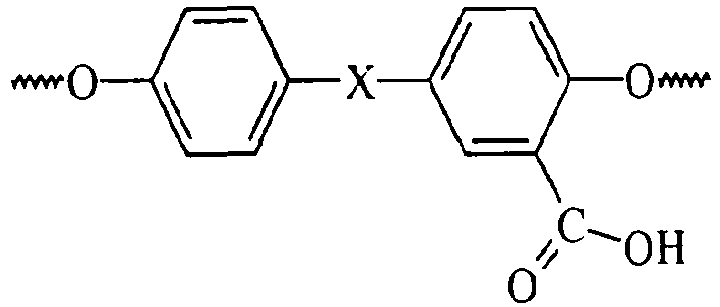
- Branched Fries:


- The terms "Fries reaction" and "Fries rearrangement" are used interchangeably herein.
- "internal-ester carbonate linkage" or "IEL" refers to a linkage derived from an ester-substituted diaryl carbonate that is formed internally in place of the normal carbonate linkage.
Fig. 1H shows the structure of an internal ester linkage, andFigs 3A and3B show reactions to form such internal ester linkages. - "polycarbonate" refers to an oligomer or polymer comprising residues of a dihydroxy compound joined by carbonate linkages. In certain embodiments of the invention, the polycarbonate comprises residues of an aromatic dihydroxy compound and has a number average molecular weight, Mn measured relative to polystyrene (PS) standards of between 10,000 g/mol and 160,000 g/mol. In specific embodiments, the Mn measured relative to PS is between 13,000 g/mol and 160,000 g/mol, for example between 15,000 g/mol and 160,000 g/mol. In another embodiment, the Mn (PS) is between 15,000 g/mol and 102,000 g/mol. The term "polycarbonate" encompasses poly(carbonate-co-ester) oligomers and polymers.
- "dihydroxy reaction component" refers to one component of the reaction mixture used in the method of the invention to make polycarbonate. The dihydroxy reaction component comprises one or more dihydroxy compounds. In addition, when the product polycarbonate is a poly(carbonate-co-ester), diacids incorporated in the reaction mixture are part of the dihydroxy reaction component for determining the molar ratio of the reactants.
- "carbonate reaction component" refers to a second component of the reaction mixture used in the method of the invention to make polycarbonate. The carbonate reaction component comprises one or more activated diaryl carbonates. In addition, when the product polycarbonate is a poly(carbonate-co-ester), diesters incorporated in the reaction mixture are part of the carbonate reaction component for determining the molar ratio of the reactants.
- As used herein, the molar ratio of carbonate reaction component to dihydroxy reaction component refers to the molar ratio based on the amounts of these components as added. As noted below, there are various factors that can cause a specific reaction to depart from the theoretical, including impurities, reduced activity of monomers used in making poly(carbonate-coesters), and these incidental variations are not taken into account in determining the molar ratio.
- In the following discussion of the methods and compositions of the invention, the following materials may be employed:
- The dihdroxy compound used in the method of the invention may be an aromatic or an aliphatic dihydroxy compound. In certain embodiments, an aromatic dihydroxy compound is preferred.
- Aliphatic dihydroxy compounds that are suitably used in the present invention include without limitation butane-1,4-diol, 2,2-dimethylpropane-1,3-diol, hexane-1,6-diol, diethylene glycol, triethylene glycol, tetraethylene glycol, octaethylene glycol, dipropylene glycol, N,N-methyldiethanolamine, cyclohexane-1,3-diol, cyclohexane-1,4-diol, 1,4-dimethylolcyclohexane, p-xylene glycol, 2,2-bis(4-hydroxycyclohexyl)propane, and ethoxylated or propoxylated products of dihydric alcohols or phenols such as bis-hydroxyethyl-bisphenol A, bis-hydroxyethyl-tetrachlorobisphenol A and bis-hydroxyethyl-tetrachlorohydroquinone. Other aliphatic dihydroxy compounds include 3,9-bis(2-hydroxyethyl)-2,4,8,10-tetraoxaspiro[5.5]undecane, 3,9-bis(2-hydroxy-1,1-dimethylethyl)-2,4,8,10-tetraoxaspiro[5.5]undecane, 3,9-bis(2-hydroxy-1,1-diethylethyl)-2,4,8,10-tetraoxaspiro[5,5]-undecane, and 3,9-bis(2-hydroxy-1,1-dipropylethyl)-2,4,8,10-tetraoxaspiro[5.5]undecane.
- Aromatic dihydroxy compounds that can be used in the present invention are suitably selected from the group consisting of bisphenols having structure,


- Suitable bisphenols are illustrated by 2,2-bis(4-hydroxyphenyl)propane (bisphenol A); 2,2-bis(3-chloro-4-hydroxyphenyl)propane; 2,2-bis(3-bromo-4-hydroxyphenyl)propane; 2,2-bis(4-hydroxy-3-methy(phenyl)propane; 2,2-bis(4-hydroxy-3-isopropylphenyl)propane; 2,2-bis(3-t-butyl-4-hydroxyphenyl)propane; 2,2-bis(3-phenyl-4-hydroxyphenyl)propane; 2,2-bis(3,5-dichloro-4-hydroxyphenyl)-propane; 2,2-bis(3,5-dibromo-4-hydroxyphenyl)propane; 2,2-bis(3,5-dimethyl-4-hydroxyphenyl)propane; 2,2-bis(3-chloro-4-hydroxy-5-methylphenyl)propane; 2,2-bis(3-bromo-4-hydroxy-5-methylphenyl)propane; 2,2-bis(3-chloro-4-hydroxy-5-isopropylphenyl)propane; 2,2-bis(3-bromo-4-hydroxy-5-isopropylphenyl)propane; 2,2-bis(3-t-butyl-5-chloro-4-hydroxyphenyl)propane; 2,2-bis(3-bromo-5-t-butyl-4-hydroxyphenyl)propane; 2,2-bis(3-chloro-5-phenyl-4-hydroxyphenyl)propane; 2,2-bis(3-bromo-5-phenyl-4-hydroxyphenyl)propane; 2,2-bis(3,5-disopropyl-4-hydroxyphenyl)propane: 2,2-bis(3,5-di-t-butyl-4-hydroxyphenyl)propane; 2,2-bis(3,5-diphenyl-4-hydroxyphenyl)propane; 2,2-bis(4-hydroxy-2,3,5,6-tetrachlorophenyl)propane; 2,2-bis(4-hydroxy-2,3,5,6-tetrabromophenyl)propane; 2,2-bis(4-hydroxy-2,3,5,6-tetramethylphenyl)propane; 2,2-bis(2,6-dichloro-3,5-dimethyl-4-hydroxyphenyl)propane; 2,2-bis(2,6-dibromo-3,5-dimethyl-4-hydroxyphenyl)propane; 1,1-bis(4-hydroxyphenyl)cyclohexane; 1,1-bis(3-chloro-4-hydroxyphenyl)cyclohexane; 1,1-bis(3-bromo-4-hydroxyphenyl)cyclohexane; 1,1-bis(4-hydroxy-3-methylphenyl)cyclohexane; 1,1-bis(4-hydroxy-3-isopropylphenyl)cyclohexane; 1,1-bis(3-t-butyl-4-hydroxyphenyl)cyclohexane; 1,1-bis(3-phenyl-4-hydroxyphenyl)cyclohexane; 1,1-bis(3,5-dichloro-4-hydroxyphenyl)cyclohexane; 1,1-bis(3,5-dibromo-4-hydroxyphenyl)cyclohexane; 1,1-bis(3,5-dimethyl-4-hydroxyphenyl)cyclohexane; 1,1-bis(3-chloro-4-hydroxy-5-methylphenyl)cyclohexane; 1,1-bis(3-bromo-4-hydroxy-5-methylphenyl)cyclohexane; 1,1-bis(3-chloro-4-hydroxy-5-isopropylphenyl)cyclohexane; 1,1-bis(3-bromo-4-hydroxy-5-isopropylphenyl)cyclohexane; 1,1-bis(3-t-butyl-5-chloro-4-hydroxyphenyl)cyclohexane; 1,1-bis(3-bromo-5-t-butyl-4-hydroxyphenyl)cyclohexane; 1,1-bis(3-chloro-5-phenyl-4-hydroxyphenyl)cyclohexane; 1,1-bis(3-bromo-5-phenyl-4-hydroxyphenyl)cyclohexane; 1,1-bis(3,5-disopropyl-4-hydroxyphenyl)cyclohexane; 1,1-bis(3,5-di-t-butyl-4-hydroxyphenyl)cyclohexane; 1,1-bis(3,5-diphenyl-4-hydroxyphenyl)cyclohexane; 1,1-bis(4-hydroxy-2,3,5,6-tetrachlorophenyl)cyclohexane; 1,1-bis(4-hydroxy-2,3,5,6-tetrabromophenyl)cyclohexane; 1,1-bis(4-hydroxy-2,3,5,6-tetramethylphenyl)cyclohexane; 1,1-bis(2,6-dichloro-3,5-dimethyl-4-hydroxyphenyl)cyclohexane; 1,1-bis(2,6-dibromo-3,5-dimethyl-4-hydroxyphenyl)cyclohexane; 1,1-bis(4-hydroxyphenyl)-3,3,5-trimethylcyclohexane; 1,1-bis(3-chloro-4-hydroxyphenl)-3,3,5-trimethylcyclohexane; 1,1-bis(3-bromo-4-hydroxyphenyl)-3,3,5-trimethylcyclohexane; 1,1-bis(4-hydroxy-3-methylphenyl)-3,3,5-trimethylcyclohexane; 1,1-bis(4-hydroxy-3-isopropylphenyl)-3,3,5-trimethylcyclohexane; 1,1-bis(3-t-butyl-4-hydroxyphenyl)-3,3,5-trimethylcyclohexane; 1,1-bis(3-phenyl-4-hydroxyphenyl)-3,3,5-trimethylcyclohexane; 1,1-bis(3,5-dichloro-4-hydroxyphenyl)-3,3,5-trimethylcyclohexane; 1,1-bis(3,5-dibromo-4-hydroxyphenyl)-3,3,5-trimethylcyclohexane; 1,1-bis(3,5-dimethyl-4-hydroxyphenyl)-3,3,5-trimethylcyclohexane; 1,1-bis(3-chloro-4-hydroxy-5-methylphenyl)-3,3,5-trimethylcyclohexane; 1,1-bis(3-bromo-4-hydroxy-5-methylphenyl)-3,3,5-trimethylcyclohexane; 1,1-bis(3-chloro-4-hydroxy-5-isopropylphenyl)-3,3,5-trimethylcyclohexane; 1,1-bis(3-bromo-4-hydroxy-5-isopropylphenyl)-3,3,5-trimethylcyclohexane; 1,1-bis(3-1-butyl-5-chloro-4-hydroxyphenyl)-3,3,5-trimethylcyclohexane; 1,1-bis(3-bromo-5-t-butyl-4-hydroxyphenyl)-3,3,5-trimethylcyclohexane; bis(3-chloro-5-phenyl-4-hydroxyphenyl)-3,3,5-trimethylcyclohexane; 1,1-bis(3-bromo-5-phenyl-4-hydroxyphenyl)-3,3,5-trimethylcyclohexane; 1.1-bis(3,5-disopropyl-4-hydroxypphenyl)-3,3,5-trimethylcyclohexane; 1,1-bis(3,5-di-t-butyl-4-hydroxyphenyl)-3,3,5-trimethylcyclohexane; 1,1-bis(3,5-diphenyl-4-hydroxyphenyl)-3,3,5-trimethylcyclohexane; 1,1-bis(4-hydroxy-2,3,5,6-tetrachlorophenyl)-3,3,5-trimethylcyclohexane; 1,1-bis(4-hydroxy-2,3,5,6-tetrabromophenyl)-3,3,5-trimethylcyclohexane; 1,1-bis(4-hydroxy-2,3,5,6-tetramethylphenyl)-3,3,5-trimethylcyclohexane; 1,1-bis(2,6-dichloro-3,5-dimethyl-4-hydroxyphenyl)-3,3,5-trimethylcyclohexane; 1,1-bis(2,6-dibromo-3,5-dimethyl-4-hydroxyphenyl)-3,3,5-trimethylcyclohexane; 4,4'dihydroxy-1,1-biphenyl; 4,4'-dihydroxy-3,3'-dimethyl-1,1-biphenyl; 4,4'-dihydroxy-3,3'-dioctyl-1,1-biphenyl; 4,4'-dihydroxydiphenylether; 4,4'-dihydroxydiphenylthioether; 1,3-bis(2-(4-hydroxyphenyl)-2-propyl)benzene; 1,3-bis(2-(4-hydroxy-3-methylphenyl)-2-propyl)benzene; 1,4-bis(2-(4-hydroxyphenyl)-2-propyl)benzene and 1,4-bis(2-(4-hydroxy-3-methylphenyl)-2-propyl)benzene.
- Suitable dihydroxy benzenes are illustrated by hydroquinone, resorcinol, methylhydroquinone, butylhydroquinone, phenylhydroquinone, 4-phenylresorcinol and 4-methylresorcinol.
- Suitable dihydroxy naphthalenes are illustrated by 2,6-dihydroxy naphthalene; 2,6-dihydroxy-3-methyl naphthalene; and 2,6-dihydroxy-3-phenyl naphthalene. Other suitable dihydroxy naphthalenes IV are illustrated by 1,4-dihydroxy naphthalene; 1,4-dihydroxy-2-methyl naphthalene; 1,4-dihydroxy-2-phenyl naphthalene and 1,3-dihydroxy naphthalene.
- The relative amounts of monomers are selected based on the desired composition of the oligomers. If other comonomers are used, they can be introduced to the melt reaction system as part of the same feed, in a separate feed, or both.
- The polycarbonate formed from these monomers may be a homopolymer, a random copolymer, or a random block copolymer To form random block copolymers, preformed oligomer or polymer blocks with appropriate end groups (diols, diacids, diesters, etc) are used as co-reactants in the polymerization process. '
- Preferred dihydroxy compounds and combinations of dihydroxy compounds for use in the present invention include BPA, hydroquinone, and sulfones such as 4,4'-biphenyl sulfone.
- As used herein the term "activated carbonate" is defined as a diarylcarbonate which is more reactive than diphenyl carbonate toward transesterification reactions. Such activated carbonates are of the general formula:


- Non-limiting examples of activating groups Q and Q' are: alkoxycarbonyl groups, halogens, nitro groups, amide groups, sulfone groups, sulfoxide groups, imine groups, or cyano groups with structures indicated below:

— Q
Q = Halogen or NO2
- Specific and non-limiting examples of activated carbonates include bis(o-methoxycarbonylphenyl)carbonate, bis(o-chlorophenyl)carbonate, bis(o-nitrophenyl)carbonate, bis(o-acetylphenyl)carbonate, bis(o-phenylketonephenyl)carbonate, bis(o-formylphenyl)carbonate, and bis(o-cyanophenyl)carbonate. Unsymmetrical combinations of these structures, where the substitution number and type on A and A' are different, are also possible to employ in the current invention. A preferred structure for an activated carbonate is an ester-substituted diarylcarbonate having the structure:

- Examples of preferred ester-substituted diarylcarbonates include but are not limited to bis(methy)salicyl)carbonate (CAS Registry No. 82091-12-1), bis(ethyl salicyl)carbonate, bis(propyl salicyl) carbonate, bis(butylsalicyl) carbonate, bis(benzyl salicyl)carbonate, bis(methyl 4-chlorosalicyl)carbonate and the like. Typically bis(methylsalicyl)carbonate is preferred for use in melt polycarbonate synthesis due to its preparation from less expensive raw materials, lower molecular weight and higher vapor pressure.
- One method for determining whether a certain diarylcarbonate is activated or is not activated is to carry out a model transesterification reaction between the certain diarylcarbonate with a phenol such as para-cumyl phenol. This phenol is preferred because it possesses only one reactive site, possesses a low volatility and possesses a similar reactivity to bisphenol-A. The model transesterification reaction was carried out at temperatures above the melting points of the certain diarylcarbonate and para-cumyl phenol and in the presence of a transesterification catalyst, which is usually an aqueous solution of sodium hydroxide or sodium phenoxide. Preferred concentrations of the transesterification catalyst are about 0.001 mole % based on the number of moles of the phenol or diarylcarbonate. And a preferred reaction temperature is 200 C. But the choice of conditions and catalyst concentration can be adjusted depending on the reactivity of the reactants and melting points of the reactants to provide a convenient reaction rate. The only limitation to reaction temperature is that the temperature must be below the degradation temperature of the reactants. Sealed tubes can be used if the reaction temperatures cause the reactants to volatilize and effect the reactant molar balance. The determination of the equilibrium concentration of reactants is accomplished through reaction sampling during the course of the reaction and then analysis of the reaction mixture using a well-know detection method to those skilled in the art such as HPLC (high pressure liquid chromatography). Particular care needs to be taken so that reaction does not continue after the sample has been removed from the reaction vessel. This is accomplished by cooling down the sample in an ice bath and by employing a reaction quenching acid such as acetic acid in the water phase of the HPLC solvent system. It may also be desirable to introduce a reaction quenching acid directly into the reaction sample in addition to cooling the reaction mixture. A preferred concentration for the acetic acid in the water phase of the HPLC solvent system is 0.05 % (v/v). The equilibrium constant can be determined from the concentration of the reactants and product when equilibrium is reached. Equilibrium is assumed to have been reached when the concentration of components in the reaction mixture reach a point of little or no change on sampling of the reaction mixture. The equilibrium constant can be determined from the concentration of the reactants and products at equilibrium by methods well known to those skilled in the art. A diarylcarbonate which possesses an equilibrium constant of greater than 1 is considered to possess a more favorable equilibrium than diphenylcarbonate and is an activated carbonate, whereas a diarylcarbonate which possesses an equilibrium constant of 1 or less is considered to possess the same or a less favorable equilibrium than diphenylcarbonate and is considered not to be activated. It is generally preferred to employ an activated carbonate with very high reactivity compared to diphenylcarbonate when conducting transesterification reactions. Preferred are activated carbonates with an equilibrium constant greater than at least 10 times that of diarylcarbonate.
- Some non-limiting examples of non-activating groups which, when present in an ortho position relative to the carbonate group, would not be expected to result in activated carbonates are alkyl and cycolalkyl. Some specific and non-limiting examples of non-activated carbonates are bis(o-methylphenyl)carbonate, bis(p-cumylphenyl)carbonate, and bis(p-(1,1,3,3-tetramethyl)butylphenyl)carbonate. Unsymmetrical combinations of these structures are also expected to result in non-activated carbonates.
- Unsymmetrical diarylcarbonates wherein one aryl group is activated and one aryl is unactivated or de-activated would also be useful in this invention if the activating group renders the diaryl carbonate still more reactive than diphenyl carbonate. It should be noted that such unsymmetrical diaryl carbonates may function essentially as monofunctional chainstoppers on the time scales associated with the short reaction profiles often used of benefit in polymerizations based on activated carbonates.
- A preferred ester-substituted diaryl carbonate is BMSC. Other preferred ester-substituted diaryl carbonates include bis-ethyl salicyl carbonate, bis-propyl salicyl carbonate, bisphenyl salicyl carbonate and bis-benzyl salicyl carbonate.
- The method of the invention also comprises the step of introducing a catalyst to the melt reaction system to initiate a polymerization reaction. The catalyst may be introduced continuously, or may be introduced batchwise and may occur before, during or after the introduction of the dihydroxy composition or the activated carbonate to the melt react system.
- The catalyst used in the method of the present invention is a base, and preferably comprises at least one source of alkaline earth ions or alkali metal ions, and/or at least one quaternary ammonium compound, a quaternary phosphonium compound or a mixture thereof. The source of alkaline earth ions or alkali metal ions being used in an amount such that the amount of alkaline earth or alkali metal ions present in the reaction mixture is in a range between about 10-5 and about 10-8 moles alkaline earth or alkali metal ion per mole of dihydroxy compound employed.
- The quaternary ammonium compound is selected from the group of organic ammonium compounds having the structure

- Non-limiting examples of suitable organic ammonium compounds are tetramethyl ammonium hydroxide, tetrabutyl ammonium hydroxide, tetramethyl ammonium acetate, tetramethyl ammonium formate and tetrabutyl ammonium acetate. Tetramethyl ammonium hydroxide is often preferred.
- The quaternary phosphonium compound is selected from the group of organic phosphonium compounds having the structure:

- Where X- is a polyvalent anion such as carbonate or sulfate it is understood that the positive and negative charges in the above structures are properly balanced. For example, where R20 - R23 in structure VI are each methyl groups and X- is carbonate, it is understood that X-represents ½ (CO3 -2).
- Suitable sources of alkaline earth ions include alkaline earth hydroxides such as magnesium hydroxide and calcium hydroxide. Suitable sources of alkali metal ions include the alkali metal hydroxides illustrated by lithium hydroxide, sodium hydroxide and potassium hydroxide. Other sources of alkaline earth and alkali metal ions include salts of carboxylic acids, such as sodium acetate and derivatives of ethylene diamine tetraacetic acid (EDTA) such as EDTA tetrasodium salt, and EDTA magnesium disodium salt. Sodium hydroxide is often preferred.
- In order to achieve the formation of polycarbonate using the method of the present invention an effective amount of catalyst must be employed. The amount of catalyst employed is typically based upon the total number of moles of the total dihydroxy compounds employed in the polymerization reaction. When referring to the ratio of catalyst, for example phosphonium salt VII, to all dihydroxy compounds employed in the polymerization reaction, it is convenient to refer to moles of phosphonium salt per mole of the first and second dihydroxy compounds combined, meaning the number of moles of phosphonium salt divided by the sum of the moles of each individual dihydroxy compound present in the reaction mixture. The amount of organic ammonium or phosphonium salts employed typically will be in a range between about 1 x 10⁻² and about 1 x 10⁻⁵, preferably between about 1 x 10⁻³ and about 1 x 10⁻⁴ moles per mole of the dihydroxy compounds combined. The inorganic metal hydroxide catalyst typically will be used in an amount corresponding to between about 1 x 10⁻⁴ and about 1 x 10⁻⁸, preferably 1 x 10⁻⁴ and about I x 10-7 mole of metal hydroxide per mole of the dihydroxy compounds combined.
- If the method of the invention is used to make a poly(carbonate-co-ester), a diacid or diester is also included in the transesterification reaction. Specific examples of diacids and diesters that can be used in the method of the invention include without limitation: aromatic diacids such as 2,6-nathalene dicarboxylic acid, aliphatic diacids such as succinic acid, or a cycloaliphatic diacid such as 1,7-cyclododecanedioic acid. The diacid employed may have structure:
HOOC-R20-COOH
wherein R20 is a C4 -C30 aromatic radical, a C, -C40 aliphatic radical, or a C5-C30 cycloaliphatic radical, Specific examples of diacids of this formula include terephthalic acid; isophthalic acid; 1,4-cyclohexanediacrboxylic acid; hexanedioic acid; octanedioic acid; decanedioic acid; dodecanedioic acid; tetradecanedioic acid; hexadecanedioic acid; octadecanedioic acid; cis 9-octenedioic acid; alpha-nonyldecanedioic acid; alpha-octylundecanedioic acid; and hydrogenated dimer acid. Ester of these acids, for example lower alkyl esters such as methyl or ethyl esters may also be used. - Preferred diacids and diesters for use in the present invention include:
- terephthalic acid or esters thereof and isophthalic acid or esters thereof.
- Chainstoppers useful in the present invention are monofunctional compounds that react in place of the dihydroxy compound to terminate a growing chain. In general, chainstoppers may be aliphatic or aromatic monohydroxy compounds that meet the following criteria (1) they are stable at the reaction conditions for polycarbonate formation; (2) they do not contain reactive groups other than the hydroxy substituent that will provide sites for further reaction, including the formation of additional bonds, cross-linkages or the like under the reaction conditions for polycarbonate formation, and (3) they do not contribute any undesired color to the product polycarbonate as formed or after weathering or aging. The monofunctional chainstopper may also be a mono-acid or a mono-ester that reacts to terminate a growing chain. In other embodiments, the monofunctional chainstopper is an asymmetric carbonate, in which one substituent is activated to provide greater reactivity.
- Non-limiting examples of aliphatic chainstoppers include C1 to C36 linear or branched aliphatic alcohols, acids or esters such as methanol, ethanol, propanol, lauric acid, myristic acid, palmitic acid, stearic acid, arachidic acid, behenic acid, lignoceric acid, eicosanoic acid, and the alkyl or aryl esters of these acids such as methyl salicyl stearate or phenyl stearate.
- Non-limiting examples of aromatic chainstoppers are phenolic chainstopper of the formula

-
Fig. 2 shows the normal reaction in the production of polycarbonate using a dihydroxy compound and BMSC as the ester-substituted diaryl carbonate. In the first step, the -OH (or O-) end group on a monomer or polycarbonate oligomer or polymer chain (PC-OH) reacts with BMSC to form a monomer, oligomer or polycarbonate terminated with a terminal methyl salicyl carbonate (TMSC) and methyl salicylate (MS). The PC-TMSC molecule in turn reacts with the -OH (or O-) end group of another monomer or a growing oligomer or polymer chain to form polycarbonate PC and another molecule of methyl salicylate. Note that the other end group of the PC in this reaction is not specified and thus it can also be a site for additional chain extension. Thus, the reaction shown inFig. 2 is not a chain-growth terminating event, unless the unspecified ends of the PC-OH are capped. -
Figs 3A andB show side reactions through which by- products can occur during the process ofFig. 2 . InFig 3A , the by-product MS reacts with a terminal -OH or O- to yield a polymer with a salicylate end group (Sal-OH) and methanol. InFig. 3B , the product of the reaction fromFig. 3A reacts with BMSC to form a TMSC group with an internal salicylate residue (ISC-TMSC). Sal-OH can also react with the intermediate TMSC product ofFig. 2 to form polycarbonate with internal salicylate structures (ISC). - In addition to the reaction shown in
Fig. 2 , TMSC can also react with another TMSC to form longer chains and methyl salicylate shown inFig. 4 . This reaction occurs particularly under hydrolyzing conditions, such as when a polycarbonate it molded at elevated temperature, and results in changes in properties and release of volatiles. Such changes are generally undesirable. While not intending to be bound by any particular mechanism, this is believed to be a result of the hydrolytic degradation of the ester bond of the internal salicyl carbonate group (ISC) and consequent chain scission and molecular weight reduction. - The present application provides methods for making polycarbonates that decreases the number of chains terminated with alkyl salicyl carbonates. This results in a reduction in both the content of internal salicyl carbonate groups and their ester linkages and in the amount of terminal alkyl salicylate carbonate (TASC) end groups in the final product. Prior to Applicants efforts as described herein, it was not appreciated that internal salicyl cabronate and its ester linkages or TASC end groups were detrimental. In fact,
US Patents Nos. 5,696,222 ,6,252,036 and6,303,734 disclose the intentional creation of terminal methyl salicyl carbonate (TMSC) end-groups to take advantage of the greater reactivity of BMSC, for example, as compared to diphenyl carbonate (DPC). - The method of the present invention provides a method for making polycarbonate comprising reacting a dihydroxy reaction component with a carbonate reaction component in the presence of an esterification catalyst to produce a polycarbonate, wherein
- (a) the carbonate reaction component comprises an ester-substituted diaryl carbonate, and
- (b) a monohydroxy chainstopper is added in an amount effective to yield a polycarbonate in which from 35 to 65% of the total number of end groups are derived from the monohydroxy chainstopper. This effective amount depends on the reaction conditions, including
- The amount of monohydroxy compound to be added for a given set of reaction conditions may be determined empirically by running the reaction at various starting levels of monohydroxy chainstopper and determining the mol% of end groups derived from the monohydroxy chainstopper in the product. This determination is described below. In general, suitable starting amounts of monohydroxy chainstopper to achieve this end result are amounts of from 0.1 to 4 mole % relative to the total diol content of the monomer formulation for making the polymer, in one embodiment between 1 and 3 mole %, and in another embodiment between 1.2 and 2.8 mole %. The optimum level of chainstopper will depend somewhat on the desired molecular weight of the polymer, the properties of the chainstopper, and the process conditions. The number of end groups per unit mass of polymer inherently decreases as the number average molecular weight of the polymer increases. As a result the number of chains available to be chainstopped decreases as the molecular weight of the polymer increases. Therefore one will typically add lesser amounts of chainstopper relative to the total diol content for polymers having higher targeted molecular weights. In addition, it may be necessary to add more chainstopper, for example, if a lower molecular weight chainstopper is used and it is partially lost due to devolatization under the vacuum conditions of the process or if the chainstopper has limited reactivity under reaction conditions typically used with activated carbonates, for example, in the case of monofunctional acids or alkyl esters. As discussed in other sections of this description, some chainstopped end groups are inherently produced in this production method due to side reactions such as alcoholysis. The amount of such inherent chainstopped end groups will generally increase with residence time and temperature and catalyst loading. In practice, one can do a "blank" production run in the absence of any chainstopper, then measure the amount of available end groups to be chain-stopped (the salicyl carbonate end groups) under these process conditions, and then carry out subsequent production runs under these same process conditions in which one adds the chainstopper in a molar amount that is about 40 to about 60 % of the salicyl carbonate end group content of the polymer produced in the "blank" production run.
- In a preferred embodiment of the invention, the product polymer has end groups derived from the activated diaryl carbonate and from the chainstopping reagent at a combined total level of between 40 and 66% of the total end groups.
- In an embodiment of the method of the invention, the desired level of endcapping is achieved by using a molar ratio of activated diaryl carbonate to the total of dihydroxy compound plus ½ the chainstopping reagent that is less than 1 when expressed to at least three decimal places, for example 0.996 or less. In specific embodiments, the ratio is between 0.962 and 0.996, for example between 0.968 and 0.996. In another specific embodiment, the ratio is between 0.971 and 0.994.
- The method of the invention can also be used to make poly(carbonate-co-esters) through the inclusion of diesters or diacids. One skilled in the art will recognize that the presence of these additional components needs to be taken into account when calculating the stoichiometric ratio of diaryl carbonate to dihydroxy compound. For example, one mole of diester will generally substitute for one mole of diaryl carbonate in the ratio calculation, whereas one mole of diacid will generally substitute for one mole of dihydroxy compound. As disccused in more detail in another section, one skilled in the art will understand that the substitution may not be exactly 1 to 1, and it may depend slightly on such factors as the degree of monomer purity and volatility of the monomer (e.g. is a monomer actual partially lost due to devolatization during the process). In addition, a non-activated diester may have so much slower reactivity than an activated carbonate that it might actually act to some extent as a chain stopper or even inert component under some process conditions.
- In addition, some small amount of non-activated carbonate or unsymmetrical diaryl carbonates having one activated aryl group may be substituted for the activated carbonate in the calculation of the stoichiometric ratio. However the reactivity of such carbonates will be slower than those of the activated carbonates. Therefore although they would not affect the stoichiometric ratio of the reaction and thus the end group type and molecular weight at full conversion, in practice their reduced reaction kinetics may actually cause them to act to some extent as chainstoppers or inert components in this process. The method of reaction may be performed using any known transesterification reaction protocol, including without limitation melt transesterification (also known as melt condensation) and solid state polymerization. The melt reaction may be done in a reactor train, an extruder or reactor/train combination and in a continuous, semi-continuous or batch process. The polymerization may conveniently be carried out in a two stage process, namely oligomerization followed by polymerization. It may be desirable to limit exposure of the reactants to high temperatures and long holding times in any monomer melt-up, monomer melt mixing or oligomerization stages. Further, it is advantageous during the polymerization to effectively devolatize residual materials such as MS. By way of example, melt transesterification processes are described in
US Patents Nos. 5,026,817 ,5,221,761 ,5,412,061 and6,569,985 ; and solid state polymerization processes are described inUS Patents Nos. 6,960,641 and6,518,391 . - In a melt process in accordance with the invention, the dihydroxy compounds or polycarbonate oligomers are reacted with the ester-substituted diaryl carbonate. The melt process generally involves a base-catalyzed condensation polymerization of, for example, diphenyl carbonate and a dihydroxy compound such as Bisphenol A. The reaction is conducted at high enough temperatures for the starting monomers and product to remain molten, while the reactor pressure is staged in order to effectively remove phenol, the by-product of the polycondensation reaction. Most current melt technology programs employ a two component catalyst system. The first component is a tetralkylammonium hydroxide (TMAH) co-catalyst which is used to initiate oligomer formation in the melt. The second catalyst is an alkali metal hydroxide (i.e., the "α-catalyst") which is the second part of the overall catalyst system. Due to its intrinsic thermal stability and low volatility, the alkali metal salt must be quenched at the end of the polymerization using this catalyst.
- In a solid state polymerization process, a precursor polycarbonate, typically a relatively low molecular weight oligomeric polycarbonate, is prepared by the melt reaction of a diaryl carbonate such as diphenyl carbonate with a dihydroxy compound such as bisphenol A. In the preparation of bisphenol A polycarbonate oligomers, a diaryl carbonate such as diphenyl carbonate is heated together with bisphenol A in the presence of a catalyst such as sodium hydroxide while removing phenol. Phenol is formed as a by-product of the transesterification reaction between phenolic groups of the growing polymer chains and diphenyl carbonate or phenyl carbonate polymer chain end-groups. In the oligomer preparation, either an excess of diaryl carbonate or an excess of dihydroxy compound may be employed. This oligomerization reaction is typically carried out under reduced pressure to facilitate the orderly removal of the phenol by-product. When the desired level of oligomerization has been achieved the reaction is terminated and the product oligomeric polycarbonate is isolated. The oligomeric polycarbonate so produced is amorphous and must be partially crystallized in order to be suitable for solid state polymerization.
- The oligomeric polycarbonate may be partially crystallized by one of several methods, such as exposure of powdered or pelletized oligomer to hot solvent vapors, or dissolution of the amorphous oligomer in a solvent such as methylene chloride and thereafter adding a solvent such as methanol or ethyl acetate to precipitate crystalline oligomeric polycarbonate. Typically, such solvent vapor or liquid solvent crystallization methods result in partially crystalline oligomeric polycarbonates having a percent crystallinity between about 20 and about 40 percent as measured by differential scanning calorimetry. A percent crystallinity in this range is usually sufficient for the oligomeric polycarbonate to undergo solid state polymerization without fusion of the pellets or powder being subjected to SSP. In addition to solvent induced crystallization, oligomeric bisphenol A polycarbonate has been crystallized by dissolving BMSC or other activated carbonate in molten amorphous polycarbonate oligomer followed by cooling the mixture to ambient temperature to afford partially crystalline polycarbonate as a mixture with BMSC or other activated carbonate. Finally, amorphous oligomeric polycarbonates have been crystallized by prolonged heating at a temperature below the melting point of the partially crystalline polycarbonate. However, such thermally induced crystallization is quite slow relative to the aforementioned crystallization methods. In the method of the invention, an understoichiometric amount of BMSC or other activated carbonate is used in preparing the polymer. Therefore either polycarbonate oligomer having free OH end groups are reacted with an understoichiometirc amount of BMSC or other activated carbonate in the SSP stage, or else polycarbonate oligomers having carbonate end groups are reacted with bisphenol A or another dihydroxy compound having OH end groups in the SSP stage.
- The partially crystalline oligomeric polycarbonate in a solid form such as a powder, particulate or pellet is then heated under solid state polymerization conditions at a temperature below the sticking temperature or melting point of the oligomeric polycarbonate, but above the glass transition temperature of the partially crystalline oligomeric polycarbonate, and the volatile by-products formed as chain growth occurs, phenol, diphenyl carbonate and the like, are removed. The polycondensation reaction which converts the low molecular weight oligomer to high polymer is effected in the solid state under these conditions.
- The polymerization can utilize any known catalyst, including without limitation those in the list set forth above. In certain embodiments, the catalyst is a two part catalyst system such as tetramethylammonium hydroxide (TMAH)/sodium hydroxide. In this case, the levels of the alpha catalyst (typically sodium) is suitably used at a concentration of 1 to 40 mEq/mol of total dihydroxy compound, for example between 2 and 20 mEq/mol, or between 4 and 10 mEq/mol.
- In one embodiment of the invention, the method is carried out at a "reverse ratio" with respect to conventional stoichiometry. Thus, in this embodiment of the invention, the dihydroxy reaction component is present in a molar excess relative to the carbonate reaction component. One skilled in the art will understand that the occurrence of any hydrolysis reactions, presence of impurities, monofunctional species such as chainstoppers, and other monomers such as diacids and diols will be taken into account in calculating this stoichiometric ratio. For example, as detailed in concurrently filed
US Patent Application Serial No. 11/427,861 , the molar ratio of ester-substituted diaryl carbonate to dihydroxy compound is less than 1, when considered to an accuracy of three decimal places. For example, the molar ratio is suitably 0.996 or less. In specific embodiments, the ratio is between 0.962 and 0.996, for example between 0.968 and 0.996. In another specific embodiment, the ratio is between 0.971 and 0.994. - In the art, the molar ratio of ester-substituted diaryl carbonate to dihydroxy compound has conventionally been close to, but always slightly greater than 1. Surprisingly, as demonstrated in the examples below, although the numerical difference in the ratios of the present invention are not great as compared to these early examples, the use of the reverse ratio of less than 1 results in a significant decrease in the amount of TMSC in the product polymer and thus achieves the goal of the present invention.
- In accordance with a preferred embodiment of the present invention, when the reverse ratio conditions described above are employed, a polycarbonate may be prepared having less than 0.5 mole % of terminal alkyl carbonate end groups, less than 1000 ppm of Fries rearrangement products, and free salicylate in the range of from 1 to 500 ppm, said polycarbonate containing free non-salicylate OH groups and carbonate end groups of the formula

- As noted above, the term "end groups" refers to the terminal groups on the ends of chains of the polycarbonate. The mol % of an end-group or type of end-group is expressed as a mole percentage of the total amount of dihydroxy compound incorporated in the polymer. There are several ways of measuring this quantity. For example, end groups may be analyzed by either spectroscopic means or by total hydrolysis of a polymer followed by analysis of the various constituent units. Spectroscopic methods include vibrational spectroscopy such as infrared or Raman spectroscopy and nuclear magnetic resonance (NMR) spectroscopy. Such methods and their application to the qualitative and quantitative analysis of polymers are described in more detail in Spectroscopy of Polymers by J. Koenig (ISBN 0-8412-1904-4) and Modem Polymer Spectroscopy by G. Zerbi (ISBN 3527296557).
- Of these methods, NMR spectroscopy is the preferred one because it allows an unambiguous structural assignment. It will be understood by one skilled in the art that the NMR resonances in an NMR spectrum may be assigned to specific structural features of a polymer by using one or more methods including: comparison of the observed chemical shifts with those observed for analogous low-molecular weight model compounds, calculation of chemical shifts by using derived additivity relationships (particularly for 13C NMR), synthesis of polymers with known specific structural or compositional features to establish the particular resonance-structure relationships, synthesis of polymers with selectively enriched 13C sites or having deuterium selectively substituted for protons, comparison of the intensities of structural sequences with those intensities predicted based on models of the polymerization kinetics and statistical distributions, various 1-dimensional (1-D) spectral-editing methods such as the selective-spin-decoupling used for the determination of the proton bonding of carbon atoms, and various two-dimensional (2-D) techniques for determining the coupling between nuclei and to reveal the chemical shifts of the nuclei. The chemical bonding between the various constituent atoms can often be inferred from the 1H and 13C chemical shifts and from the spin-spin coupling between nuclei. One skilled in the art will understand that each of these techniques has their limitations and that it is often necessary to use a combination of these techniques, as well as other physical and chemical methods as needed.
- If the polymer is soluble, high-resolution solution NMR spectra can generally be obtained. Because high polymer solution viscosities may shorten relaxation times and thus broaden line widths, one skilled in the art will understand that various standard methods may be applied to obtain high-resolution NMR spectra, for example, the polymer solution may be diluted or the measurement temperature increased, or a higher magnetic field strength may be applied. On skilled in the art will appreciate that the choice of solvent is important. Preferred solvents will be magnetically isotropic and will be inert and therefore not interact strongly with the polymer (e.g. no hydrogen-bonding interactions between the solvent and the polymer and no degradation of the polymer by the solvent). In addition preferred solvents will not contain functional groups that blank out regions of the NMR spectrum. Preferred solvents will include deuterated chloroform (CDCl3), and the deuterated form of tetrachloroethane. If necessary the deuterated form of other solvents such as dimethyl sulfoxide, benzene, pyridine, acetone, and dioxane may also be used if they do not interact strongly with the polymer or degrade it. In the case of 13C NMR spectra, additives such as Chromium (III) acetylacetonate (also known as chromium (III) pentanedionate or Cracac) may be used to reduce both the T1-relaxation times and the Nuclear Overhauser Effect (NOE).
- If the polymer is not soluble, various methods well-known in the art may be applied in order to obtain a high resolution, narrow linewidths, and enhanced sensitivity in solid-state NMR polymer spectra. For example, one skilled in the art will appreciate that the techniques of high-power decoupling (DD), magic angle spinning (MAS), and cross-polarization (CP) may be applied. One skilled in the art will appreciate that solution NMR methods will be greatly preferred for quantitative analysis whenever possible.
- These and all of the other various aspects in obtaining and interpreting NMR spectra of polymers are described in more detail in NMR Spectroscopy of Polymers, Edited by R.N. Ibbett (ISBN 075140005X), NMR Spectra of Polymers and Polymer Additives by A.J. Brandolini and D.D. Hills (ISBN 0824789709), NMR Spectroscopy of Polymers by K. Hatada and T. Kitayama (ISBN 3540402209), and Instrumental Analysis by G.D. Christian and J.E. O'Reilly (ISBN 0-205-08640-3).
- In the NMR analysis of end group type and content, both 1H-NMR and 13C-NMR may be employed, but 1H-NMR is preferred because of its greater sensitivity and ease of use for quantitative analysis. When the identity of all of the dihydroxy compound and the composition of the polymer are known and all of the dihydroxy compounds contain at least one proton that is distinct and distinguishable in the proton NMR spectrum from those of the other dihydroxy compounds as well as the various end groups, one may then readily use the integrated resonances of the various end group and dihydroxy units in the 1H-NMR in order to calculate the molar amount of each end group type present. For example, in the case of the BPA polycarbonate homopolymer, one may simply measure the integrated intensity of each end group type relative to that of the incorporated BPA unit. One skilled in the art will recognize the need for the use of either an internal standard for the quantitative analysis or the use of a chemometric software calibration program. In addition, one skilled in the art will understand that various standard corrections may need to be applied in this analysis, for example, correcting for any differences in the relative number of protons whose intensities have been integrated for each type of structural unit.
Functional Group Typical 1H-NMR assignment (ppm) total Terminal 8.03/8.05 (2J= 7Hz, doublet, 1 proton) Salicylate Methylester group at 3.85 ppm total Internal Salicylate 8.20/8.22 (2J= 7Hz, d, 1H) BPA - Salicyl-OH 10.48 (CDCl3, OH, s, 1H) endgroup 10.38 (TCE, OH, s, 1H) 8.03/8.05 (2J= 7 Hz, d, 1H) MeHQ - Salicyl- 10.33 (TCE, OH, d, 1H) OH endgroup 8.03/8.05 (2J= 7 Hz, d, 1H) HQ - Salicyl-OH 10.36 (CDCl3, OH, d, 1H) endgroup 10.31 (TCE, OH, d, 1H) 8.03/8.05 (2J= 7 Hz, d) RS - Salicyl-OH 10.33 (CDCle, OH, d, 1H) endgroup 8.03/8.05 (2J= 7 Hz, d, 1H) total Methyl Carbonate 3.87 (CH3O s, 3H) total Methyl Ether 3.76 (CH3O s, 3H) Residual BMSC 8.01/8.03 (2J= 7Hz, d) Residual MS 10.73 (OH, s) 7.80/7.82 (2J = 7 Hz, d) Linear Fries 8.00 (3J=3Hz,d) 10.42 (OH,s) Acid Fries 7.75 (3J=3Hz, d) Branched Fries 8.13 (3J=3Hz,d) PC-OH 6.63/6.65 (2J= 7Hz,d) - The invention will now be further described with references to the following non-limiting examples.
- The molecular weight measurements of the materials prepared in the examples have been carried out by means of Gel Permeation Chromatography (GPC). A 12-point calibration line covering the entire molecular weight range of was constructed using polystyrene standards with a narrow molecular weight distribution (polydispersity (PD) of less than 1.01). All polycarbonate samples were measured against the calibration curve and molecular weights were expressed relative to the measured polystyrene molecular weights. Polycarbonate BPA homopolymer oligomers and polymers were dissolved in chloroform solvent prior to measurement, and the terpolymer oligomers and polymers were dissolved instead in a mixed solvent (15/85 vol/vol) of hexafluoroisopropanol (HFIP) and chloroform. For both the homopolymer and terpolymer samples the mobile phase was a mixed solvent (5/95 vol/vol) of HFIP in chloroform. Because further changes in molecular weight may sometimes occur in solution depending on the nature of the polymer and the solvent, it is important to carry out the GPC analysis rapidly after a good solution of polycarbonate in a good solvent and strong eluent is obtained and before any degradation of the polycarbonate occurs. Therefore all of the terpolymer GPC measurements were carried out within two hours of preparing the terpolymer solutions. The temperature of the gel permeation columns was 35 °C.
- It will be appreciated by one skilled in the art that the analysis of other polycarbonate homopolymers and copolymers may necessitate the use of variations in or other polymer concentrations, polystyrene molecular weight standards, solvent systems, dissolution methods, eluents/mobile phases, stationary phases (composition, crosslinking, porosity, surface functionalization), detector systems (such as those based on refractive index or UV or infrared absorption) and instrumental parameters (flow rate, temperature, and pressure). For example, the mobile phase should be a good solvent for the polymer, not interfere with the detector response of the polymer, and should wet the surface of the stationary phase (column packing) well. Since the GPC method is quite sensitive to the hydrodynamic volume of the polymer chain, polymer-solvent interactions may have a significant influence on the retention times measured. In addition, for the measurement of some copolymers, it may be necessary to use multiple detector systems. Care must be taken to avoid reaction between the solute (polymer) and the stationary phase or any other adsorption phenomena. Such care may be especially important when two solvents are used, one to dissolve the polymer and the other as eluent. Changing over the solvent system in the chromatograph may also take long periods of time of 24 hours or more before the baseline stabilizes. Such aspects of the GPC measurement method are discussed in Size Exclusion Chromatography by S. Mori and H.G. Barth (ISBN 3-540-65635-9), Chapter 18 of Polymer Synthesis and Characterization by S.R. Sandler, W. Karo, J.-A. Bonesteel, and E.M. Pierce (ISBN 0-12-618240-X),
Chapter 3 of Introduction to Polymers by R.J. Young and P.A. Lovell (ISBN 0-412-30630-1 - It will be furthermore appreciated by one skilled in the art that the GPC method may not be universally applicable for the determination of polymer molecular weights or to determine whether one has obtained a "polycarbonate polymer" as used here. For example, some polymers may be insoluble due to very high molecular weights, their composition, crystallinity or branching. In such cases, it is possible by melt flow rate or melt viscosity measurements to determine whether one has obtained a "polycarbonate polymer" as used here.
- Melt mass-flow rate (MFR) and melt volume-flow rate (MVR) of polycarbonates arc measures of the extrusion rate of a polycarbonate melt through a die with a specified length and diameter under set conditions of temperature and loads. Such measurements are typically made according to ISO 1133. These melt flow rate techniques are based on the principle that flow increases with decreasing polymer viscosity for a given temperature and load test condition. A higher MVR value indicates a lower viscosity under an applied stress (load or weight in kg) and generally decreases as the molecular weight of a particular type of polymer increases. The test temperature is usually set at or slightly above the melting region of the material being characterized. Melt viscosity is a measurement of the rheological characteristics of thermoplastics at temperatures and shear conditions common to processing equipment. Melt viscosities are typically determined by pressing a melt through a die while measuring the pressure drop over the complete or part of this die, and such measurements are typically conducted according to ISO 11443. Zero shear rate viscosities may be determined by measuring the melt viscosity of a polymer at various shear rates and then extrapolating the data to a shear rate of zero. Melt viscosities generally increase as the molecular weight of a particular type of polymer increases. It is important to avoid degradation of the polymer in the melt flow rate or melt viscosity measurement. One skilled in the art will recognize that degradation of the polymer may be avoided by carefully drying the polymer prior to measurement to remove water and the careful selection of measurement parameters such as the measurement temperature and the use of an inert atmosphere, if needed. The importance of these various measurement parameters and their optimization in the melt flow rate and melt viscosity measurement methods are described in Rheology - Principles, Measurements and Applications by C.W. Macosko (ISBN 0-471-18575-2), Rheological Techniques by R.W. Whorlow (ISBN 0-13-775370-5), Flow Properties of Polymer Melts by J.A. Brydson, (ISBN 0-59-205458-6).
One skilled in the art may therefore determine if an insoluble sample is a "polycarbonate polymer" as used here by comparing the melt flow rate or melt viscosity at zero shear viscosity of the insoluble polymer with that of a polycarbonate BPA-based homopolymer having a molecular weight of at 10,000 g/mol when measured relative to polystyrene standards according to the GPC method. The insoluble sample is a "polycarbonate polymer," as used here, if it has a melt flow rate at least as low as that of the polycarbonates homopolymer or a melt viscosity at least as high as that of the polycarbonate homopolymer when measured under the same conditions (e.g. absolute temperature and mass). - Polymerizations were carried out in the reactor system shown schematically in
Figure 5 . In this system the oligomerization vessel A is charged at ambient temperature and pressure with solid dihydroxy compound monomers, bisphenol A (HP), and optionally also hydroquinone, and methyl hydroquinone (terpolymer, TP); liquid BMSC. The mol % of monomers in the terpolymers was 33% BPA, 34 % hydroquinone, and 33 % methyl hydroquinone. Para-cumyl phenol (PCP) chainstopper was added in amount to yield approximately 30, 50 or 70 mol% of PCP end groups at the targeted PC molecular weight of 30,000 g/mol. The molar amount of additional BMSC employed was 0.5 times the molar amount of chainstopper. The catalysts tetramethyl ammonium hydroxide and sodium hydroxide were next added as an aqueous solution. The tetramethyl ammonium hydroxide at a concentration of 25 µEq/mol diol and the sodium hydroxide at a concentration of 4 µEq/mol BPA in the case of homopolymer and 2µ Eq/mol BPA in the case of terpolymer. After this the oligomerization reactor was sealed shut. The system was deoxygenated by briefly evacuating the oligomerization reactor and then introducing nitrogen. This process was repeated three times. After a period of at least approximately 4 hours, an additional amount of sodium hydroxide was added to the molten oligomers at a concentration of 6 µEq/mol dihydroxy compound in the case of the terpolymer production runs. - The molten oligomer was then fed to a ZSK-25 extruder C by means of pump B and feedline 1 (
Fig. 5 ). The ZSK-25 extruder is a 25 mm diameter, twin screw, co-rotating intermeshing extruder having a length to diameter ratio (LOD) of about 59. The oligomer was fed to the extruder at a rate of about 12 to 14 kg/h, and the screw speed was about 300 rpm. The barrels of the extruder are set at 300 C, the die head at 310 C The Z-SK 25 extruder is equipped with a high and low vacuum system to remove the methyl salicylate formed as a byproduct in the polycondensation reaction. The low vacuum system consists ofline 2, condenser D, Vacuum pump F and MS holding tank H. The high vacuum system consists ofline 3, condenser E, Vacuum pump G and MS holding tank I. The two low vacuum vents are operated at a vacuum level of about 14 to 20 mbar, and the subsequent four high vacuum vents operated at a vacuum level of about 0.5 to 4 mbar. The extruder was operated under conditions of temperature, vacuum, residence time, and mixing intensity sufficient to promote polymerization. It should be noted that three production runs of the normal ratio homopolymer were made, the average values of these runs are reported whenever possible. - The polycarbonate pellets were dried before molding. The homopolymer (HP) pellets were dried for 2 hours at 120° C, and the terpolymer (TP) pellets were dried for 3 hours at 105°C. In all cases the same molding machine, an Engel 45T, and mold, an insert mold yielding a plaque of 60x60x2.5mm, were used. In order to emphasize the differences in color performance between the polycarbonates and to test them under realistic but harsher conditions the molding conditions were selected such that the melt was exposed to a relatively high temperature in combination with a longer residence time in the barrel compared to regular molding. Details of these molding conditions for both the polymers are given in Table 1.
Table 1 Machine Engel 45T Condition UOM STD ABU Temp. Hopper °C 40 40 Temp. zone 1°C 280 320 Temp. Zone 2°C 290 330 Temp. Zone 3°C 300 340 Temp. Nozzle °C 295 335 Temp. Mold °C 90 100 Holding time sec 10 10 Cooling time sec 20 128 Cycletime sec 36 144 Residence time sec 180 720 - STD refers to standard reaction conditions, while ABU are abusive reaction conditions intended to induce lower quality polymers.
- The molecular weight properties of the polymers were determined by gel permeation chromatographic (GPC) analysis, using polycarbonate molecular weight standards to construct a broad standard calibration curve against which polymer molecular weights were determined. The terpolymer (TP) values were corrected based on their lower average repeat unit mass versus that of BPA homopolymers.
- The levels of terminal methyl salicylate carbonate (TMSC), para-cumyl phenol (PCP), methyl carbonate and other end groups, as well as Fnes rearrangement products, were measured by means of proton NMR. Deuterated chloroform (CDCl3) was used as the solvent for the homopolymer samples, and deuterated tetrachloroethane (TCE) was used for the terpolymer samples. It should be noted that in all of the polymer examples prepared, the content of all of the Fries rearrangement products (e.g. linear, acid and branched Fries), when measured by proton NMR, were below the detection limit of 100 ppm. The other results are shown in Table 2.
- The ratio of total non-salicyl free OH/total carbonate end groups can be used to determine whether a polycarbonate prepared using an activated carbonate monomer, such as BMSC, monomer has been prepared using a normal or reverse ratio. At full conversion, a polycarbonate prepared using an activated carbonate and a normal ratio (excess carbonate monomer) will have only a very low content of non-salicyl free OH end groups relative to carbonate end groups. In contrast, a polycarbonate prepared using a reverse ratio (excess diol monomer) will have a significant content of non-salicyl free OH end groups (end groups resulting from excess diols), even if an optional chain stopper is used. Therefore a normal ratio polycarbonate prepared from BMSC will have a ratio of total non-salicyl free OH end groups/total carbonate end groups that is quite low, for example, less than 0.1; whereas a corresponding reverse ratio polycarbonate at full conversion will have a ratio that is greater than 0.1.
- This ratio of total non-salicyl free OH end groups/total carbonate end groups can be calculated in the following manner and as illustrated in Table 2. As discussed earlier, there are two types of free OH end groups. One is the byproduct salicyl OH end group resulting from the transesterification reaction of, for example, of the methyl ester of methyl salicylate with the free OH end group of a diol monomer to give the end group shown in Fig IE. The salicyl OH end group may be located adjacent to a BPA or other diol unit. In contrast, the non-salicyl free OH end group results simply from the presence of a uncapped or non-chainstopped diol unit such as BPA or any other diol monomer at a chain end, such as in
Fig 1A orFig 1H . Therefore the total non-salicyl free OH end groups is the molar sum of all of the free OH end groups resulting from having a diol unit such as BPA (Fig. 1A ) or another diol monomer (Fig. 1H ) located at a chain end. This sum is given in column 9 of Table 2 (Total of all Non-Salicyl Free OH End Groups). In the case of the BPA homopolymer, it is simply the sum of the BPA chain end units (WEI to CE3), and it is the sum of the BPA, hydroquinone, and methyl hydroquinone units in the case of the terpolymer (WE2 to CE5). - One type of carbonate end groups may be a residue of an activated carbonate end group located at a chain end, such as in
Figs. 1B to 1D . In Table 2 the sum of the T-MSC end groups (Fig. 1D ) is given in column 4 (T-MSC). A second type of carbonate end group results from the use of added chainstopping phenols such as PCP. In Table 2, the content of this second carbonate end group type is given in column 7 (PCP carbonate). A third type of carbonate end group results from the incorporation as end group of the alcoholic byproduct (e.g. methanol) resulting from hydrolysis reactions of the ester functionality of the activated carbonate (e.g. BMSC) or the activated carbonate end group (e.g. T-MSC). This liberated methanol can be incorporated as a chainstopping end group. In Table 2, the content of this third carbonate end group type is given in column 5 (MeCarb). Therefore the sum of these three end group types gives the total carbonate end group content of the polycarbonate. This sum of carbonate end groups is given in column 11 of Table 2 (Total of all Carbonate End Groups). The ratio of total non-salicyl free OH end groups/total carbonate end groups can then simply be calculated by dividing the content of the total non-salicyl free OH end groups (column 9 of Table 2: Total of all Non-Salicyl Free OH End Groups) by the content of the total carbonate end groups (column 11 in Table 2: Total of all Carbonate End Groups). As can be seen in the last column of Table 2, all of these polycarbonates were prepared using a normal ratio. Thus the ratio of total non-salicyl free OH end groups/total carbonate end groups is less than 0.1 and is actually quite close to 0 in all of these examples.Table 2. Characterization of Extruded Polymer Pellets Sample Polymer PCP % T-MSC (mol %) MeCarb (mol %) MeEther (mol%) PCP carbonate (mol %) Total of all Sal-OH (mol %) Total of all non-Salicyl Free CH End Groups (mol %) Total PCP + MeCarb (mol %) Total of All Carbonate Endgroups (mol %) PCP as % of Total Carbonate End Groups Total End Groups (mol % PCP as % of Total End Group MeCarb as % of Total End Groups PCP + MeCarb as % of Total End Groups Ratio Total Non-Salicyl Free OH/Total carbonate End Groups WE1 HP 50 0.5 0.56 0.13 1.96 0.03 0.13 2.52 3.02 64.9 3.31 59.2 16.92 76.13 0.04 OE1 HP 0 2.69 0.19 0.07 0 0.0 0.01 0.19 2.88 0.0 2.97 0.0 6.40 6.40 0.00 OE2 HP 30 1.86 0.24 0.06 1.19 0.01 0.01 1.43 3.29 36.2 3.37 35.3 7.12 42.43 0.00 OE3 HP 70 0.58 0.29 0 06 2.73 0.01 0.06 3.06 3.57 76.5 3.7 73.8 7.84 81.62 0.02 ME2 TP 50 0.67 0.47 0.12 1.98 0.03 0.06 2.45 3.12 63.5 3.33 59.5 14.11 73.57 0.02 CE4 TP 30 1.46 0.36 0.08 1.2 0.03 0.06 1.58 3.01 39.9 3.18 37.7 11.01 48.74 0.02 CE5 TP 70 0.9 0.33 0.08 2.75 0.03 0.03 0.06 3.99 68.9 4.16 66.1 7.93 74.04 0.06 - The color of molded 2.5mm thick plaques was measured in the transmission mode using a Gretag-MacBelh 7000A spectrometer according to the CIE laboratory standard. A D65 light source was used with a 10) observation angle. The
color parameters 1, a, and b of the molded plaques are given in Table 3.Table 3. Color Properties of Molded Polymers STD Color ABU Color Color Stability Example Polymer PCP STD L STD a STD b ABU L ABU a ABU b dL da db dE WE1 HP 50 95 5 -0.07 174 95 3 -0.27 2 40 -0 15 -0 19 0.66 0 71 CE 1HP 0 95 6 -0.18 1.62 95 2 -0 27 2.57 -0 34 -009 0 95 1 02 CE2 HP 30 95 5 -007 156 95 3 -0 36 2.68 -0 26 -0.29 1 13 1. 19 CE 3HP 70 95.2 -0.02 1.88 95 1 -0.20 2 76 -0.14 -0 17 0.88 0 91 WE 2TP 50 93.6 008 428 90 8 0 91 9 42 -278 0.83 514 5 90 CE 4TP 30 92.9 024 443 89 7 1.08 1026 -3 13 0.84 5 83 6 67 CE 5TP 70 92 5 0.52 5 11 89 2 1 40 11 61 -334 0.88 6 50 7 37 - The residual levels in the polymer samples were analysed by means of an HPLC analytical method. The solvent used was methylene chloride (CHCl3) in the case of the homopolymers or a 4:1 mixture of CHCl3 with 1,1,1,3.3,3-hexafluoroisopropanol (HFIP) in the case of the terpolymers. The homopolymer (HP) solution was shaken for at least one hour. The terpolymer (TP) was first treated in an ultrasonic bath for 15min followed by shaking for 2hrs. In both cases methanol was added to precipitate the polymer and the resulting solution was filtered through a 0.2 micron filter and injected on to HPLC. The results are summarized in Table 4.
Table 4 Residuals STD Residuals ABU Example Polymer PCP BPA MS BMSC PCP Total BPA MS BMSC PCP Total WE 1 HP 50 4 440 4 26 473 5 232 1 29 268 CE 1HP 0 37 4 1039 1848 0 2924 34.9 1302 1953 0 3290 CE 2HP 30 2 940 67 6 1015 3 744 38 6 791 CE 3HP 70 2 317 5 23 347 2 212 0 26 241 WE 2TP 50 < LOD 515 17 19 552 < LOD 369 6 26 401 CE 4TP 30 < LOD 700 64 11 775 < LOD 673 36 16 724 CE 5TP 70 < LOD 538 38 17 593 < LOD 456 12 29 498 - As can be seen from residuals after molding are lower than or comparable to the comparative examples. The major residual is methyl salicylate (MS), which is believed to come from release of the MS from the many terminal TMSC groups that occur in normal ratio samples.
- Experiments were carried out in accordance with Example 1, except that the amounts of activated diaryl carbonate relative to the combined amount of hydroxy groups from the dihydroxy compound and the monohydroxy chainstopper was varied, and the oligomerization temperature was varied as shown in Table 5. In the examples of the invention, the mole ratio of BMSC to (dihdroxy compound + ½ monohydroxy compound) is maintained at a level less than 1 when expressed to three decimal places, for example 0.996 or less. In specific embodiments, the ratio is between 0.962 and 0.996, for example 0.968 to 0.996. In another specific embodiment, the ratio is between 0.971 and 0.994.
Table5 Example Polymer PCP Monomer Formulation Ratio BMSC/(Di-OH + ½ mono-OH) Molar Ratio BMSC/Aromatic Diols Oligomerization T(°C) WE 4HP 50 0.996 1.006 150 CE 6HP 0 n/a 1.021 170 CE 7 HP 30 >1 1.020 170 WE 5HP 50 > 1 1.020 170 WE6 TP 50 0.998 1.008 170 CE9 TP 0 n/a 1.018 170 CE 10 TP 30 >1 1.020 170 WE 7 TP 50 > 1 1.020 170 Table 6 Example Polymer PCP Mw g/mol Carbonate End Groups free OH End Groups PCP/mol% T-MSC /mol % MeCarb /mol % Total Carbonate End Groups /mol% PC- OH/ppm HQ- OH/ppm MeHQ- OH/ppm Total free OH /ppm Total free OH /mol % Ratio Total Free OH / Total Carbonate WE 4 HP-Rev 50 29091 1.83 < 0.05 0.23 2.16 751 0 0 75 1 1.00 0.46 CE 6HP 0 30584 0 2.32 0.53 2.85 80 0 0 80 0.1 0.04 CE 7 HP 30 28590 1.19 1.87 0.23 3.29 7 0 0 7 0.01 0.00 WE 5 HP 50 30212 1.96 0.54 0.54 3.04 78 0 0 78 0.10 0.03 WE6 TP-Rev 50 26966 1.98 <0.05 0,34 2.32 174 280 243 697 1.00 0.43 CE 8 TP 0 36727 0 1.41 0.95 2.36 23 42 24 89 0.12 0.05 CE 9 TP 30 27124 1.198 1.46 0.35 3.01 <15 <20 <20 <55 <0.05 < 0.017 WE 7 TP 50 25344 1.98 0 67 0.47 3.12 < 15 < 20 < 20 < 55 < 0.05 <0.017 - As can be seen, the use of the PCP as a chain stopper generally results in reduced TMSC end caps compared to no chain stopper. However, even better results are achieved when BMSC is used in the ratio of less than 1 relative to the amount of dihydroxy compound and ½ the PCP results in reduced levels of TMSC end groups. It should be noted that the free OH end groups in Table 6 refer to non-salicylate OH end groups such as those resulting from the incorporation of a dihydroxy compound monomer unit (e.g. BPA, hydroquinone or methyl hydroquinone) at a chain end.
- The color properties were determined as described in Example 1 and are reported in Table 7. As can be seen, the selection of the defined ratio further improves the color properties relative to the use of monohydroxy chainstopper alone.
Table 7 Example Polymer PCP Molded Color L a b WE 4 HP-Rev 50 95.4 -0.1 2.0 CE6 HP 0 95.2 -0.3 2.6 CE7 HP 30 95.3 -0.4 2.7 WE5 HP 50 95.3 -0.3 2.4 WE6 TP-Rev 50 91.1 0.9 8.1 CE8 TP 0 90.2 1.6 9.9 CE9 TP 30 89.7 1.1 10.3 WE7 TP 50 90.8 0.9 9.4 - Residuals after molding were measured as in Example 1, and are reported in Table 8. The total residuals after molding in the working examples were far less than those in the comparative examples.
Table 8 Example Polymer PCP Residuals After Molding BPA MS BMSC PCP Total WE4 HP-Rev 50 33 8 7 82 130 CE6 HP 0 <4 925 134 <LOD 1059 CE7 HP 30 3 744 38 6 791 WE5 HP 50 5 232 1 29 268 WE6 TP-Rev 50 6 14 1 65 85 CE8 TP 30 <4 557 93 0 650 CE9 TP 30 <LOD 673 36 16 724 WE7 TP 50 < LOD 369 6 26 401 LOD = limit of detection - The level of internal salicyl carbonate linkages was determined and the result are summarized in Table 9. As shown, the number of IEL is lower in both the pellets and the molded samples in the compositions of the invention in which the ratio is as specified (
WE 4 and WE 6).Table 9 Example Polymer PCP IEL Pellets Molded WE 4 HP 50 0.15 0.16 CE 6HP 0 0.50 0.75 CE 7 HP 30 0.34 0.72 WE 5 HP 50 0.61 0.75 WE 6 TP 50 0.23 0.17 CE 8 TP 0 0.63 1.03 CE 9 TP 30 0.36 0.79 WE 7 TP 50 0.44 0.64
Claims (15)
- A method for preparing a polycarbonate comprising reacting a dihydroxy reaction component comprising a dihydroxy compound with carbonate reaction component comprising an activated diaryl carbonate in the presence of an esterification catalyst to produce a polycarbonate, wherein the carbonate reaction component and the dihydroxy reaction component are reacted in the presence of a monofunctional chainstopper, said chainstopper being present in an amount effective to yield a polycarbonate in which from 35 to 65% of the total number of end groups are derived from the monofunctional chainstopper and further wherein an activated diaryl carbonate is a carbonate that is more reactive than diphenyl carbonate toward transesterification reactions.
- The method of claim 1, wherein the polycarbonate prepared has end groups derived from the activated diaryl carbonate and from the chainstopper at a combined total level of between 40 and 66 mol % of the total end groups.
- The method of claim 1, wherein the carbonate reaction component is reacted in a molar ratio to the total of dihydroxy reaction component plus ½ the chainstopper that is less than 1 when expressed to at least three decimal places.
- The method of claim 3, wherein the ratio is between 0.996 or less.
- The method of claims 3 or 4, where wherein the ratio is between 0.962 and 0.996, inclusive.
- The method of any of claims 3 to 5, wherein the ratio is between 0.968 and 0.996, inclusive.
- The method of any of claims 3 to 6, wherein the ratio is between 0.971 and 0.994 inclusive,
- The method of claim 1, wherein the monofunctional chainstopper is selected from the group consisting of: a monohydroxy compound, a mono-acid or mono-ester.
- The method of claim 1, wherein the monofunctional chainstopper is a phenolic chainstopper of the formula:

- The method of claim 1, wherein the monofunctional chainstopper is para-cumyl phenol.
- The method of claim 1, wherein the polycarbonate is a poly(carbonate-co-ester) and the dihydroxy reaction component comprises a diacid compound,
- The method of claim 1, wherein the polycarbonate is a poly(carbonate-co-ester) and the carbonate reaction component comprises a diester compound.
- A polycarbonate having less than 0.5 mole % of terminal alkyl carbonate end groups, less than 1000 ppm of Fries rearrangement products, and free salicylate in the range of from 1 to 500 ppm, said polycarbonate containing free non-salicylate OH groups and carbonate end groups of the formula

- The polycarbonate of claim 13, wherein the carbonate end groups comprise ends groups of the formula

- A molded article molded from the polycarbonate of any of claims 13 to 14.
Applications Claiming Priority (2)
| Application Number | Priority Date | Filing Date | Title |
|---|---|---|---|
| US11/427,885 US7498400B2 (en) | 2006-06-30 | 2006-06-30 | Method of preparing polycarbonate |
| PCT/US2007/070671 WO2008005648A1 (en) | 2006-06-30 | 2007-06-08 | Method of preparing polycarbonate |
Publications (2)
| Publication Number | Publication Date |
|---|---|
| EP2052009A1 EP2052009A1 (en) | 2009-04-29 |
| EP2052009B1 true EP2052009B1 (en) | 2012-12-19 |
Family
ID=38562028
Family Applications (1)
| Application Number | Title | Priority Date | Filing Date |
|---|---|---|---|
| EP07798265A Active EP2052009B1 (en) | 2006-06-30 | 2007-06-08 | Method of preparing polycarbonate |
Country Status (5)
| Country | Link |
|---|---|
| US (1) | US7498400B2 (en) |
| EP (1) | EP2052009B1 (en) |
| CN (2) | CN101484498A (en) |
| TW (1) | TW200825120A (en) |
| WO (1) | WO2008005648A1 (en) |
Families Citing this family (19)
| Publication number | Priority date | Publication date | Assignee | Title |
|---|---|---|---|---|
| US7541420B2 (en) * | 2006-06-30 | 2009-06-02 | Sabic Innovative Plastics Ip B.V. | Method for making molded polycarbonate articles with improved color |
| US7482423B2 (en) * | 2006-06-30 | 2009-01-27 | Sabic Innovative Plastics Ip B.V. | Polycarbonates and method of preparing same |
| US7645851B2 (en) * | 2006-06-30 | 2010-01-12 | Sabic Innovative Plastics Ip B.V. | Polycarbonate with reduced color |
| US7629432B2 (en) * | 2006-10-23 | 2009-12-08 | Sabic Innovative Plastics Ip B.V. | Tert-butylhydroquinone polycarbonates |
| US7619053B2 (en) * | 2007-09-28 | 2009-11-17 | Sabic Innovative Plastics Ip B.V. | Monomer solution for producing polycarbonate |
| US7601794B2 (en) * | 2007-09-28 | 2009-10-13 | Sabic Innovative Plastics Ip B.V. | Monomer solution for producing polycarbonate |
| US7615605B2 (en) * | 2008-03-26 | 2009-11-10 | Sabic Innovative Plastics Ip B.V. | Monomer solution for producing polycarbonate |
| US7671165B2 (en) * | 2008-05-16 | 2010-03-02 | Sabic Innovative Plastics Ip B.V. | Method of forming polycarbonate |
| US7674872B2 (en) * | 2008-06-17 | 2010-03-09 | Sabic Innovative Plastics Ip B.V. | Method of producing high molecular weight polymer |
| US7547799B1 (en) | 2008-06-20 | 2009-06-16 | Sabic Innovative Plastics Ip B.V. | Method for producing phenolic compound |
| US7863404B2 (en) * | 2008-09-26 | 2011-01-04 | Sabic Innovative Plastics Ip B.V. | Method of making isosorbide polycarbonate |
| KR101101563B1 (en) * | 2008-12-30 | 2012-01-02 | 호남석유화학 주식회사 | Method for preparing polycarbonate in the form of fine spherical powder and method for preparing high molecular weight polycarbonate resin using the same |
| US8343608B2 (en) | 2010-08-31 | 2013-01-01 | General Electric Company | Use of appended dyes in optical data storage media |
| EP2650278A1 (en) * | 2012-04-11 | 2013-10-16 | Bayer MaterialScience AG | Method for manufacturing diaryl carbonates from dialkyl carbonates |
| KR102272484B1 (en) | 2014-11-19 | 2021-07-05 | 사빅 글로벌 테크놀러지스 비.브이. | A method of polymerizing end-capped polycarbonate and end-capped polycarbonates derived therefrom |
| TWI725094B (en) | 2015-12-22 | 2021-04-21 | 荷蘭商蜆殼國際研究所 | Method for producing polycarbonate |
| KR20180094927A (en) | 2015-12-22 | 2018-08-24 | 쉘 인터내셔날 리써취 마트샤피지 비.브이. | Method for producing polycarbonate |
| WO2020074982A1 (en) | 2018-10-11 | 2020-04-16 | Sabic Global Technologies B.V. | Polycarbonate |
| CN112912419A (en) * | 2018-10-11 | 2021-06-04 | Sabic环球技术有限责任公司 | Method for producing polycarbonate |
Family Cites Families (53)
| Publication number | Priority date | Publication date | Assignee | Title |
|---|---|---|---|---|
| US4323668A (en) | 1980-12-03 | 1982-04-06 | General Electric Company | (Ortho-alkoxycarbonyaryl)-carbonate transesterification |
| ES2107999T3 (en) | 1988-07-11 | 1997-12-16 | Gen Electric | PROCEDURE FOR PREPARING POLYCARBONATES. |
| SG73353A1 (en) | 1988-09-22 | 2000-06-20 | Ge Plastics Japan Ltd | Process for the production of polycarbonates |
| US5091591A (en) | 1990-11-13 | 1992-02-25 | General Electric Company | Process and composition |
| JPH059282A (en) | 1991-07-04 | 1993-01-19 | Idemitsu Kosan Co Ltd | Method for producing polycarbonate |
| US5221761A (en) | 1992-04-29 | 1993-06-22 | Instituto Guido Donegani | Melt transesterification process for the production of polycarbonates |
| US5525701A (en) | 1993-12-14 | 1996-06-11 | General Electric Company | Method for the manufacture of aromatic polycarbonate |
| US5412061A (en) | 1994-03-07 | 1995-05-02 | General Electric Company | Polycarbonate melt condensation synthesis using a tetraorganophosphonium carboxylate salt catalyst |
| JP3613355B2 (en) | 1995-09-19 | 2005-01-26 | 出光興産株式会社 | Polycarbonate and method for producing the same |
| EP0764673B1 (en) | 1995-09-19 | 1999-11-17 | Teijin Limited | Process for the production of polycarbonate |
| JPH10101787A (en) | 1996-09-30 | 1998-04-21 | Teijin Ltd | Polycarbonate and method for producing the same |
| JPH10101786A (en) | 1996-09-30 | 1998-04-21 | Teijin Ltd | Polycarbonate copolymer and method for producing the same |
| WO1998045246A1 (en) | 1997-04-04 | 1998-10-15 | Teijin Limited | Salicylic ester derivatives and process for producing the same |
| TW409131B (en) | 1997-04-18 | 2000-10-21 | Teijin Ltd | Process for producing polycarbonate resin |
| EP0982340A4 (en) | 1998-03-17 | 2001-09-26 | Teijin Ltd | Process for producing aromatic polycarbonate |
| WO1999050335A1 (en) | 1998-03-27 | 1999-10-07 | Teijin Limited | Stabilized aromatic polycarbonate |
| JPH11302228A (en) | 1998-04-20 | 1999-11-02 | Teijin Ltd | Salicylic acid ester derivative and method for producing the same |
| JP2000129112A (en) | 1998-10-28 | 2000-05-09 | Teijin Ltd | Stabilized polycarbonate resin composition and formed product |
| US6177536B1 (en) | 1999-02-22 | 2001-01-23 | General Electric Company | Method for quenching of catalyst in the production of low molecular weight polycarbonates |
| DE60005779T2 (en) | 1999-04-20 | 2004-08-05 | Teijin Ltd. | METHOD FOR PRODUCING POLYARYLATES |
| WO2002060855A2 (en) | 2000-12-28 | 2002-08-08 | General Electric Company | Process for the production of polycarbonate |
| US6653434B2 (en) | 2000-12-29 | 2003-11-25 | General Electric Company | Process for the production of polycarbonate |
| US6403754B1 (en) | 2001-01-29 | 2002-06-11 | General Electric Company | Optimization of polycarbonate preparation by transesterification |
| JP4739571B2 (en) | 2001-04-18 | 2011-08-03 | 帝人化成株式会社 | Stretched film |
| US6870025B2 (en) | 2001-07-24 | 2005-03-22 | General Electric Company | Method of polycarbonate preparation |
| US6506871B1 (en) | 2001-07-24 | 2003-01-14 | General Electric Company | Extrusion method for making polycarbonate |
| US6518391B1 (en) | 2001-07-24 | 2003-02-11 | General Electric Company | Method of polycarbonate preparation by solid state polymerization |
| US6420588B1 (en) | 2001-07-24 | 2002-07-16 | General Electric Company | Interfacial method of preparing ester-substituted diaryl carbonates |
| US6469192B1 (en) | 2001-07-24 | 2002-10-22 | General Electric Company | Solventless preparation of ester-substituted diaryl carbonates |
| US6548623B2 (en) | 2001-07-24 | 2003-04-15 | General Electric Company | Method of polycarbonate preparation |
| US6723823B2 (en) | 2001-07-24 | 2004-04-20 | General Electric Company | Method of polycarbonate preparation |
| US6420512B1 (en) | 2001-07-24 | 2002-07-16 | General Electric Company | Extrusion method for making polycarbonate |
| US6569985B2 (en) | 2001-08-08 | 2003-05-27 | General Electric Company | Method for making polycarbonate |
| US6399739B1 (en) | 2001-08-22 | 2002-06-04 | General Electric Company | Preparation of polycarbonate having a predetermined molecular weight and level of endcapping |
| US6525163B1 (en) | 2001-09-07 | 2003-02-25 | General Electric Company | Process for the production of polycarbonate |
| US6500914B1 (en) | 2001-10-10 | 2002-12-31 | General Electric Company | Method for end-capping polycarbonate resins and composition for use in same |
| US6706846B2 (en) | 2001-10-10 | 2004-03-16 | General Electric Company | Method for end-capping polycarbonate resins and composition for use in same |
| WO2003048230A1 (en) | 2001-10-10 | 2003-06-12 | General Electric Company | Method for end-capping polycarbonate resins and composition for use in same |
| US20030139529A1 (en) | 2001-11-02 | 2003-07-24 | General Electric Company | Method of making block copolymers by solid state polymerization |
| US6590068B2 (en) | 2001-11-14 | 2003-07-08 | General Electric Company | Reduction of reaction by-products in polycarbonate resins |
| US20030146223A1 (en) | 2002-02-04 | 2003-08-07 | Bill Loh | Tray with skirt |
| US6486294B1 (en) * | 2002-02-19 | 2002-11-26 | General Electric Company | Production of poly(carbonate-co-ester) copolymers |
| US6747119B2 (en) | 2002-03-28 | 2004-06-08 | General Electric Company | Method and system for preparing a polycarbonate, copolymerization reagent and polycarbonate |
| US6600004B1 (en) | 2002-04-10 | 2003-07-29 | General Electric Company | Method of preparing polyestercarbonates |
| US6734277B2 (en) | 2002-05-09 | 2004-05-11 | General Electric Company | Method of enhancing pit replication in optical disks |
| US6790929B2 (en) | 2002-06-12 | 2004-09-14 | General Electric Company | Method for making an aromatic polycarbonate |
| US6887969B2 (en) | 2002-10-04 | 2005-05-03 | General Electric Company | Method and apparatus to make high molecular weight melt polycarbonate |
| US6900283B2 (en) | 2002-11-04 | 2005-05-31 | General Electric Company | Method for making stable, homogeneous melt solutions |
| US7041775B2 (en) | 2004-04-20 | 2006-05-09 | General Electric Company | Method for preparing a polycarbonate oligomer mixture at low temperature for manufacturing polycarbonate |
| US7105626B2 (en) | 2004-09-10 | 2006-09-12 | General Electric Company | Method for incorporating alkyl ester endgroups to improve the release properties of melt polycarbonate |
| US7132498B2 (en) | 2004-09-27 | 2006-11-07 | General Electric Company | Process to make polycarbonate from bismethylsalicylcarbonate (BMSC) |
| US20060135662A1 (en) | 2004-12-22 | 2006-06-22 | General Electric Company | Polycarbonates with fluoroalkylene carbonate end groups |
| US7482423B2 (en) | 2006-06-30 | 2009-01-27 | Sabic Innovative Plastics Ip B.V. | Polycarbonates and method of preparing same |
-
2006
- 2006-06-30 US US11/427,885 patent/US7498400B2/en active Active
-
2007
- 2007-06-08 CN CNA2007800248895A patent/CN101484498A/en active Pending
- 2007-06-08 WO PCT/US2007/070671 patent/WO2008005648A1/en not_active Ceased
- 2007-06-08 CN CN201110385249.5A patent/CN102516518B/en active Active
- 2007-06-08 EP EP07798265A patent/EP2052009B1/en active Active
- 2007-06-22 TW TW096122567A patent/TW200825120A/en unknown
Also Published As
| Publication number | Publication date |
|---|---|
| US7498400B2 (en) | 2009-03-03 |
| WO2008005648A1 (en) | 2008-01-10 |
| CN102516518B (en) | 2014-12-31 |
| CN101484498A (en) | 2009-07-15 |
| TW200825120A (en) | 2008-06-16 |
| CN102516518A (en) | 2012-06-27 |
| EP2052009A1 (en) | 2009-04-29 |
| US20080004418A1 (en) | 2008-01-03 |
Similar Documents
| Publication | Publication Date | Title |
|---|---|---|
| EP2052009B1 (en) | Method of preparing polycarbonate | |
| US7482423B2 (en) | Polycarbonates and method of preparing same | |
| EP1427771B1 (en) | Method of polycarbonate preparation by solid state polymerization | |
| US6420512B1 (en) | Extrusion method for making polycarbonate | |
| US7115700B2 (en) | Method of polycarbonate preparation | |
| EP1414888B1 (en) | Extrusion method for making polycarbonate | |
| EP1577333B1 (en) | Method of polycarbonate preparation | |
| US7365149B2 (en) | Equipment cleaning in the manufacture of polycarbonates | |
| EP1436342B1 (en) | Method for end-capping polycarbonate resins | |
| US7629432B2 (en) | Tert-butylhydroquinone polycarbonates | |
| CN101568569B (en) | Tert-butylhydroquinone polycarbonates |
Legal Events
| Date | Code | Title | Description |
|---|---|---|---|
| PUAI | Public reference made under article 153(3) epc to a published international application that has entered the european phase |
Free format text: ORIGINAL CODE: 0009012 |
|
| 17P | Request for examination filed |
Effective date: 20090119 |
|
| AK | Designated contracting states |
Kind code of ref document: A1 Designated state(s): AT BE BG CH CY CZ DE DK EE ES FI FR GB GR HU IE IS IT LI LT LU LV MC MT NL PL PT RO SE SI SK TR |
|
| AX | Request for extension of the european patent |
Extension state: AL BA HR MK RS |
|
| 17Q | First examination report despatched |
Effective date: 20090821 |
|
| RAP1 | Party data changed (applicant data changed or rights of an application transferred) |
Owner name: SABIC INNOVATIVE PLASTICS IP B.V. |
|
| GRAP | Despatch of communication of intention to grant a patent |
Free format text: ORIGINAL CODE: EPIDOSNIGR1 |
|
| DAX | Request for extension of the european patent (deleted) | ||
| GRAS | Grant fee paid |
Free format text: ORIGINAL CODE: EPIDOSNIGR3 |
|
| GRAA | (expected) grant |
Free format text: ORIGINAL CODE: 0009210 |
|
| AK | Designated contracting states |
Kind code of ref document: B1 Designated state(s): AT BE BG CH CY CZ DE DK EE ES FI FR GB GR HU IE IS IT LI LT LU LV MC MT NL PL PT RO SE SI SK TR |
|
| REG | Reference to a national code |
Ref country code: GB Ref legal event code: FG4D |
|
| REG | Reference to a national code |
Ref country code: CH Ref legal event code: EP |
|
| REG | Reference to a national code |
Ref country code: AT Ref legal event code: REF Ref document number: 589410 Country of ref document: AT Kind code of ref document: T Effective date: 20130115 |
|
| REG | Reference to a national code |
Ref country code: DE Ref legal event code: R096 Ref document number: 602007027514 Country of ref document: DE Effective date: 20130228 |
|
| PG25 | Lapsed in a contracting state [announced via postgrant information from national office to epo] |
Ref country code: ES Free format text: LAPSE BECAUSE OF FAILURE TO SUBMIT A TRANSLATION OF THE DESCRIPTION OR TO PAY THE FEE WITHIN THE PRESCRIBED TIME-LIMIT Effective date: 20130330 Ref country code: LT Free format text: LAPSE BECAUSE OF FAILURE TO SUBMIT A TRANSLATION OF THE DESCRIPTION OR TO PAY THE FEE WITHIN THE PRESCRIBED TIME-LIMIT Effective date: 20121219 Ref country code: SE Free format text: LAPSE BECAUSE OF FAILURE TO SUBMIT A TRANSLATION OF THE DESCRIPTION OR TO PAY THE FEE WITHIN THE PRESCRIBED TIME-LIMIT Effective date: 20121219 Ref country code: FI Free format text: LAPSE BECAUSE OF FAILURE TO SUBMIT A TRANSLATION OF THE DESCRIPTION OR TO PAY THE FEE WITHIN THE PRESCRIBED TIME-LIMIT Effective date: 20121219 |
|
| REG | Reference to a national code |
Ref country code: NL Ref legal event code: VDEP Effective date: 20121219 Ref country code: AT Ref legal event code: MK05 Ref document number: 589410 Country of ref document: AT Kind code of ref document: T Effective date: 20121219 |
|
| REG | Reference to a national code |
Ref country code: LT Ref legal event code: MG4D |
|
| PG25 | Lapsed in a contracting state [announced via postgrant information from national office to epo] |
Ref country code: SI Free format text: LAPSE BECAUSE OF FAILURE TO SUBMIT A TRANSLATION OF THE DESCRIPTION OR TO PAY THE FEE WITHIN THE PRESCRIBED TIME-LIMIT Effective date: 20121219 Ref country code: GR Free format text: LAPSE BECAUSE OF FAILURE TO SUBMIT A TRANSLATION OF THE DESCRIPTION OR TO PAY THE FEE WITHIN THE PRESCRIBED TIME-LIMIT Effective date: 20130320 Ref country code: LV Free format text: LAPSE BECAUSE OF FAILURE TO SUBMIT A TRANSLATION OF THE DESCRIPTION OR TO PAY THE FEE WITHIN THE PRESCRIBED TIME-LIMIT Effective date: 20121219 |
|
| PG25 | Lapsed in a contracting state [announced via postgrant information from national office to epo] |
Ref country code: SK Free format text: LAPSE BECAUSE OF FAILURE TO SUBMIT A TRANSLATION OF THE DESCRIPTION OR TO PAY THE FEE WITHIN THE PRESCRIBED TIME-LIMIT Effective date: 20121219 Ref country code: EE Free format text: LAPSE BECAUSE OF FAILURE TO SUBMIT A TRANSLATION OF THE DESCRIPTION OR TO PAY THE FEE WITHIN THE PRESCRIBED TIME-LIMIT Effective date: 20121219 Ref country code: IS Free format text: LAPSE BECAUSE OF FAILURE TO SUBMIT A TRANSLATION OF THE DESCRIPTION OR TO PAY THE FEE WITHIN THE PRESCRIBED TIME-LIMIT Effective date: 20130419 Ref country code: BG Free format text: LAPSE BECAUSE OF FAILURE TO SUBMIT A TRANSLATION OF THE DESCRIPTION OR TO PAY THE FEE WITHIN THE PRESCRIBED TIME-LIMIT Effective date: 20130319 Ref country code: BE Free format text: LAPSE BECAUSE OF FAILURE TO SUBMIT A TRANSLATION OF THE DESCRIPTION OR TO PAY THE FEE WITHIN THE PRESCRIBED TIME-LIMIT Effective date: 20121219 Ref country code: CZ Free format text: LAPSE BECAUSE OF FAILURE TO SUBMIT A TRANSLATION OF THE DESCRIPTION OR TO PAY THE FEE WITHIN THE PRESCRIBED TIME-LIMIT Effective date: 20121219 Ref country code: AT Free format text: LAPSE BECAUSE OF FAILURE TO SUBMIT A TRANSLATION OF THE DESCRIPTION OR TO PAY THE FEE WITHIN THE PRESCRIBED TIME-LIMIT Effective date: 20121219 |
|
| PG25 | Lapsed in a contracting state [announced via postgrant information from national office to epo] |
Ref country code: PL Free format text: LAPSE BECAUSE OF FAILURE TO SUBMIT A TRANSLATION OF THE DESCRIPTION OR TO PAY THE FEE WITHIN THE PRESCRIBED TIME-LIMIT Effective date: 20121219 Ref country code: RO Free format text: LAPSE BECAUSE OF FAILURE TO SUBMIT A TRANSLATION OF THE DESCRIPTION OR TO PAY THE FEE WITHIN THE PRESCRIBED TIME-LIMIT Effective date: 20121219 Ref country code: PT Free format text: LAPSE BECAUSE OF FAILURE TO SUBMIT A TRANSLATION OF THE DESCRIPTION OR TO PAY THE FEE WITHIN THE PRESCRIBED TIME-LIMIT Effective date: 20130419 Ref country code: NL Free format text: LAPSE BECAUSE OF FAILURE TO SUBMIT A TRANSLATION OF THE DESCRIPTION OR TO PAY THE FEE WITHIN THE PRESCRIBED TIME-LIMIT Effective date: 20121219 |
|
| PLBE | No opposition filed within time limit |
Free format text: ORIGINAL CODE: 0009261 |
|
| STAA | Information on the status of an ep patent application or granted ep patent |
Free format text: STATUS: NO OPPOSITION FILED WITHIN TIME LIMIT |
|
| PG25 | Lapsed in a contracting state [announced via postgrant information from national office to epo] |
Ref country code: DK Free format text: LAPSE BECAUSE OF FAILURE TO SUBMIT A TRANSLATION OF THE DESCRIPTION OR TO PAY THE FEE WITHIN THE PRESCRIBED TIME-LIMIT Effective date: 20121219 |
|
| 26N | No opposition filed |
Effective date: 20130920 |
|
| PG25 | Lapsed in a contracting state [announced via postgrant information from national office to epo] |
Ref country code: CY Free format text: LAPSE BECAUSE OF FAILURE TO SUBMIT A TRANSLATION OF THE DESCRIPTION OR TO PAY THE FEE WITHIN THE PRESCRIBED TIME-LIMIT Effective date: 20121219 |
|
| PG25 | Lapsed in a contracting state [announced via postgrant information from national office to epo] |
Ref country code: IT Free format text: LAPSE BECAUSE OF FAILURE TO SUBMIT A TRANSLATION OF THE DESCRIPTION OR TO PAY THE FEE WITHIN THE PRESCRIBED TIME-LIMIT Effective date: 20121219 |
|
| REG | Reference to a national code |
Ref country code: DE Ref legal event code: R097 Ref document number: 602007027514 Country of ref document: DE Effective date: 20130920 |
|
| PG25 | Lapsed in a contracting state [announced via postgrant information from national office to epo] |
Ref country code: MC Free format text: LAPSE BECAUSE OF FAILURE TO SUBMIT A TRANSLATION OF THE DESCRIPTION OR TO PAY THE FEE WITHIN THE PRESCRIBED TIME-LIMIT Effective date: 20121219 |
|
| REG | Reference to a national code |
Ref country code: CH Ref legal event code: PL |
|
| REG | Reference to a national code |
Ref country code: IE Ref legal event code: MM4A |
|
| PG25 | Lapsed in a contracting state [announced via postgrant information from national office to epo] |
Ref country code: IE Free format text: LAPSE BECAUSE OF NON-PAYMENT OF DUE FEES Effective date: 20130608 Ref country code: CH Free format text: LAPSE BECAUSE OF NON-PAYMENT OF DUE FEES Effective date: 20130630 Ref country code: LI Free format text: LAPSE BECAUSE OF NON-PAYMENT OF DUE FEES Effective date: 20130630 |
|
| PGFP | Annual fee paid to national office [announced via postgrant information from national office to epo] |
Ref country code: GB Payment date: 20140604 Year of fee payment: 8 |
|
| PG25 | Lapsed in a contracting state [announced via postgrant information from national office to epo] |
Ref country code: MT Free format text: LAPSE BECAUSE OF FAILURE TO SUBMIT A TRANSLATION OF THE DESCRIPTION OR TO PAY THE FEE WITHIN THE PRESCRIBED TIME-LIMIT Effective date: 20121219 |
|
| REG | Reference to a national code |
Ref country code: FR Ref legal event code: PLFP Year of fee payment: 9 |
|
| PG25 | Lapsed in a contracting state [announced via postgrant information from national office to epo] |
Ref country code: TR Free format text: LAPSE BECAUSE OF FAILURE TO SUBMIT A TRANSLATION OF THE DESCRIPTION OR TO PAY THE FEE WITHIN THE PRESCRIBED TIME-LIMIT Effective date: 20121219 |
|
| PG25 | Lapsed in a contracting state [announced via postgrant information from national office to epo] |
Ref country code: LU Free format text: LAPSE BECAUSE OF NON-PAYMENT OF DUE FEES Effective date: 20130608 Ref country code: HU Free format text: LAPSE BECAUSE OF FAILURE TO SUBMIT A TRANSLATION OF THE DESCRIPTION OR TO PAY THE FEE WITHIN THE PRESCRIBED TIME-LIMIT; INVALID AB INITIO Effective date: 20070608 |
|
| GBPC | Gb: european patent ceased through non-payment of renewal fee |
Effective date: 20150608 |
|
| REG | Reference to a national code |
Ref country code: DE Ref legal event code: R081 Ref document number: 602007027514 Country of ref document: DE Owner name: SHPP GLOBAL TECHNOLOGIES B.V., NL Free format text: FORMER OWNER: SABIC INNOVATIVE PLASTICS IP B.V., BERGEN OP ZOOM, NL Ref country code: DE Ref legal event code: R081 Ref document number: 602007027514 Country of ref document: DE Owner name: SABIC GLOBAL TECHNOLOGIES B.V., NL Free format text: FORMER OWNER: SABIC INNOVATIVE PLASTICS IP B.V., BERGEN OP ZOOM, NL |
|
| REG | Reference to a national code |
Ref country code: FR Ref legal event code: CD Owner name: SABIC INNOVATIVE PLASTICS IP B.V., NL Effective date: 20160224 |
|
| PG25 | Lapsed in a contracting state [announced via postgrant information from national office to epo] |
Ref country code: GB Free format text: LAPSE BECAUSE OF NON-PAYMENT OF DUE FEES Effective date: 20150608 |
|
| REG | Reference to a national code |
Ref country code: FR Ref legal event code: PLFP Year of fee payment: 10 |
|
| REG | Reference to a national code |
Ref country code: FR Ref legal event code: PLFP Year of fee payment: 11 |
|
| REG | Reference to a national code |
Ref country code: FR Ref legal event code: PLFP Year of fee payment: 12 |
|
| PGFP | Annual fee paid to national office [announced via postgrant information from national office to epo] |
Ref country code: FR Payment date: 20190510 Year of fee payment: 13 |
|
| PG25 | Lapsed in a contracting state [announced via postgrant information from national office to epo] |
Ref country code: FR Free format text: LAPSE BECAUSE OF NON-PAYMENT OF DUE FEES Effective date: 20200630 |
|
| REG | Reference to a national code |
Ref country code: DE Ref legal event code: R082 Ref document number: 602007027514 Country of ref document: DE Representative=s name: FARAGO PATENTANWALTS- UND RECHTSANWALTSGESELLS, DE Ref country code: DE Ref legal event code: R081 Ref document number: 602007027514 Country of ref document: DE Owner name: SHPP GLOBAL TECHNOLOGIES B.V., NL Free format text: FORMER OWNER: SABIC GLOBAL TECHNOLOGIES B.V., AMSTERDAM, NL |
|
| REG | Reference to a national code |
Ref country code: DE Ref legal event code: R082 Ref document number: 602007027514 Country of ref document: DE Representative=s name: SCHIEBER - FARAGO PATENTANWAELTE, DE Ref country code: DE Ref legal event code: R082 Ref document number: 602007027514 Country of ref document: DE Representative=s name: FARAGO PATENTANWALTSGESELLSCHAFT MBH, DE |
|
| REG | Reference to a national code |
Ref country code: DE Ref legal event code: R082 Ref document number: 602007027514 Country of ref document: DE Representative=s name: SCHIEBER - FARAGO PATENTANWAELTE, DE |
|
| P01 | Opt-out of the competence of the unified patent court (upc) registered |
Effective date: 20230530 |
|
| PGFP | Annual fee paid to national office [announced via postgrant information from national office to epo] |
Ref country code: DE Payment date: 20250402 Year of fee payment: 19 |