EP2052952B1 - Vorrichtung zum Steuern des Kippens eines Fahrerhauses eines Lastkraftwagens - Google Patents
Vorrichtung zum Steuern des Kippens eines Fahrerhauses eines Lastkraftwagens Download PDFInfo
- Publication number
- EP2052952B1 EP2052952B1 EP08161150A EP08161150A EP2052952B1 EP 2052952 B1 EP2052952 B1 EP 2052952B1 EP 08161150 A EP08161150 A EP 08161150A EP 08161150 A EP08161150 A EP 08161150A EP 2052952 B1 EP2052952 B1 EP 2052952B1
- Authority
- EP
- European Patent Office
- Prior art keywords
- branch
- pulling
- chamber
- pushing
- valve
- Prior art date
- Legal status (The legal status is an assumption and is not a legal conclusion. Google has not performed a legal analysis and makes no representation as to the accuracy of the status listed.)
- Not-in-force
Links
- 230000003213 activating effect Effects 0.000 title claims abstract description 33
- 238000005086 pumping Methods 0.000 claims description 15
- 238000004891 communication Methods 0.000 claims description 9
- 230000001276 controlling effect Effects 0.000 claims description 8
- 230000001172 regenerating effect Effects 0.000 claims description 6
- 230000000694 effects Effects 0.000 claims description 5
- 230000004913 activation Effects 0.000 claims description 4
- 230000015572 biosynthetic process Effects 0.000 claims description 2
- 230000001105 regulatory effect Effects 0.000 claims description 2
- 238000007599 discharging Methods 0.000 claims 2
- 238000007789 sealing Methods 0.000 claims 1
- 230000005484 gravity Effects 0.000 description 11
- 238000010586 diagram Methods 0.000 description 7
- 230000009471 action Effects 0.000 description 4
- 239000012530 fluid Substances 0.000 description 2
- 238000012358 sourcing Methods 0.000 description 2
- 230000000903 blocking effect Effects 0.000 description 1
- 230000008878 coupling Effects 0.000 description 1
- 238000010168 coupling process Methods 0.000 description 1
- 238000005859 coupling reaction Methods 0.000 description 1
- 238000012423 maintenance Methods 0.000 description 1
- 238000012986 modification Methods 0.000 description 1
- 230000004048 modification Effects 0.000 description 1
- 230000007935 neutral effect Effects 0.000 description 1
- 238000009877 rendering Methods 0.000 description 1
- 230000008439 repair process Effects 0.000 description 1
- 230000000630 rising effect Effects 0.000 description 1
Images







Classifications
-
- B—PERFORMING OPERATIONS; TRANSPORTING
- B62—LAND VEHICLES FOR TRAVELLING OTHERWISE THAN ON RAILS
- B62D—MOTOR VEHICLES; TRAILERS
- B62D33/00—Superstructures for load-carrying vehicles
- B62D33/06—Drivers' cabs
- B62D33/063—Drivers' cabs movable from one position into at least one other position, e.g. tiltable, pivotable about a vertical axis, displaceable from one side of the vehicle to the other
- B62D33/067—Drivers' cabs movable from one position into at least one other position, e.g. tiltable, pivotable about a vertical axis, displaceable from one side of the vehicle to the other tiltable
-
- F—MECHANICAL ENGINEERING; LIGHTING; HEATING; WEAPONS; BLASTING
- F15—FLUID-PRESSURE ACTUATORS; HYDRAULICS OR PNEUMATICS IN GENERAL
- F15B—SYSTEMS ACTING BY MEANS OF FLUIDS IN GENERAL; FLUID-PRESSURE ACTUATORS, e.g. SERVOMOTORS; DETAILS OF FLUID-PRESSURE SYSTEMS, NOT OTHERWISE PROVIDED FOR
- F15B11/00—Servomotor systems without provision for follow-up action; Circuits therefor
- F15B11/08—Servomotor systems without provision for follow-up action; Circuits therefor with only one servomotor
-
- F—MECHANICAL ENGINEERING; LIGHTING; HEATING; WEAPONS; BLASTING
- F15—FLUID-PRESSURE ACTUATORS; HYDRAULICS OR PNEUMATICS IN GENERAL
- F15B—SYSTEMS ACTING BY MEANS OF FLUIDS IN GENERAL; FLUID-PRESSURE ACTUATORS, e.g. SERVOMOTORS; DETAILS OF FLUID-PRESSURE SYSTEMS, NOT OTHERWISE PROVIDED FOR
- F15B13/00—Details of servomotor systems ; Valves for servomotor systems
- F15B13/01—Locking-valves or other detent i.e. load-holding devices
-
- F—MECHANICAL ENGINEERING; LIGHTING; HEATING; WEAPONS; BLASTING
- F15—FLUID-PRESSURE ACTUATORS; HYDRAULICS OR PNEUMATICS IN GENERAL
- F15B—SYSTEMS ACTING BY MEANS OF FLUIDS IN GENERAL; FLUID-PRESSURE ACTUATORS, e.g. SERVOMOTORS; DETAILS OF FLUID-PRESSURE SYSTEMS, NOT OTHERWISE PROVIDED FOR
- F15B15/00—Fluid-actuated devices for displacing a member from one position to another; Gearing associated therewith
- F15B15/08—Characterised by the construction of the motor unit
- F15B15/14—Characterised by the construction of the motor unit of the straight-cylinder type
- F15B15/16—Characterised by the construction of the motor unit of the straight-cylinder type of the telescopic type
-
- F—MECHANICAL ENGINEERING; LIGHTING; HEATING; WEAPONS; BLASTING
- F15—FLUID-PRESSURE ACTUATORS; HYDRAULICS OR PNEUMATICS IN GENERAL
- F15B—SYSTEMS ACTING BY MEANS OF FLUIDS IN GENERAL; FLUID-PRESSURE ACTUATORS, e.g. SERVOMOTORS; DETAILS OF FLUID-PRESSURE SYSTEMS, NOT OTHERWISE PROVIDED FOR
- F15B2211/00—Circuits for servomotor systems
- F15B2211/30—Directional control
- F15B2211/305—Directional control characterised by the type of valves
- F15B2211/30505—Non-return valves, i.e. check valves
- F15B2211/3051—Cross-check valves
-
- F—MECHANICAL ENGINEERING; LIGHTING; HEATING; WEAPONS; BLASTING
- F15—FLUID-PRESSURE ACTUATORS; HYDRAULICS OR PNEUMATICS IN GENERAL
- F15B—SYSTEMS ACTING BY MEANS OF FLUIDS IN GENERAL; FLUID-PRESSURE ACTUATORS, e.g. SERVOMOTORS; DETAILS OF FLUID-PRESSURE SYSTEMS, NOT OTHERWISE PROVIDED FOR
- F15B2211/00—Circuits for servomotor systems
- F15B2211/30—Directional control
- F15B2211/32—Directional control characterised by the type of actuation
- F15B2211/321—Directional control characterised by the type of actuation mechanically
- F15B2211/324—Directional control characterised by the type of actuation mechanically manually, e.g. by using a lever or pedal
Definitions
- the invention relates to a device for activating a tiling of a driver's cabin of a lorry, such as defined in the preamble of claim 1 and known for example from JP 5719875 .
- drivers' cabins are connected to the frame of the vehicle such that they enable the cabin to be tilted from a normal driving position, in which the vehicle can be driven, to a tilted position in which the engine below the cabin is exposed, for example in order to carry out maintenance or repair work on the engine.
- the tilting of lorry cabins is at present done using a double-acting hydraulic cylinder, generally activated by a manual pump, which on being extended pushes the cabin, causing it to rotate about pivots or hinges in order to be raised with respect to the normal position, giving access to the engine compartment.
- the centre of gravity of the cabin is displaced from one side to the other of the vertical hinging plane so that during the first stage of tilting the hydraulic piston pushes the cabin, while once the vertical hinging plane is passed over, it is pulled by the weight of the cabin itself.
- the double action of the piston is due to the fact that both chambers of the piston are connected to a two-way valve which sets them in communication with the supply of pressurised oil and with the discharge.
- the chamber located on the piston side the pushing chamber, which during extension of the piston is connected to the pressurised oil supply, while the chamber located on the other side of the piston we shall call the pulling chamber.
- known systems include a block valve along the hydraulic circuit branch which opens from the pushing chamber, which will hereinafter be termed the pushing branch, which block valve is subject to the pressure in the pulling chamber in counter-position to the pressure of the activating oil.
- the internal element of a telescopic cylinder is a single-acting cylinder, which is not perfectly controllable during the re-entry stage.
- the weight of the cabin bearing down on the pushing chamber would tend to cause the more external element to exit and to pressurise the branch of the hydraulic circuit depending on the pulling chamber, which would pilot the block valve on the branch of the hydraulic circuit depending on the pushing chamber, opening it and keeping the pushing chamber empty and thus causing an uncontrolled descent of the whole internal element.
- the more internal element has retracted, the external one would start descending, but as soon as this happened the branch of the hydraulic circuit depending on the pulling chamber would depressurise because the pulling chamber would enter into a depression and would activate the block valve to close, as happens in traditional tilting circuits with a single-element cylinder.
- Document JP 57 198175 shows a device for activating a tilting of a driver's cabin of a lorry.
- the device comprises a hydraulic circuit suitable for alternatively feeding oil in pressure to a cylinder to a push chamber or to a pull chamber.
- the device is provided with a couple of block valves, one for the pull branch and the other for the push branch of the hydraulic circuit in order to prevent a sudden drop of the cabin.
- a further valve is provided that is able to put the push chamber in fluidic communication with the pull chamber in order to absorb vibrations of the cabin during normal operation of the lorry.
- the device of JP 57 198175 comprises a double-acting cylinder having single piston element.
- Document US 2 306 348 shows a device for activating a tilting of a driver's cabin of a lorry having a telescopic cylinder.
- Oil in pressure is fed to an internal conduit and subsequently to an internal piston element and then to an external element in order to rise the cabin into a tilted position.
- a four-way valve is acted upon in such a way that the oil in pressure enters into the telescopic cylinder through a system of tubes forcing the return of cylinder downwards up to the point in which the centre of gravity of cabin passes the vertical centre of the hinges.
- the cabin then proceeds downwards by its own weight until it reaches the lowered position.
- the aim of the present invention is to resolve the above-mentioned problems by realising a device which enables an optimisation of the dimensions of the tilting system of the driver's cabin of a lorry and which is safe and controllable to use.
- a further aim of the invention is to create a device for tilting the cabin of a lorry which is very reliable.
- a further aim of the invention is to attain the mentioned objectives with a simple, rational and relatively inexpensive solution.
- the aims are attained with a device for activating a tilting of a driver's cabin of a lorry, comprising the features defined in claim 1.
- the means for commanding the pushing or pulling movement of the telescopic cylinder comprise a mechanical pump associated to a distributor valve.
- the means for commanding the pushing or pulling movement of the telescopic cylinder comprise an electric pump.
- the means for controlling the position of at least one of the elements comprise a pulling branch block valve, which is able to prevent the external element of the telescopic cylinder from being pushed upwards by the pressure which is generated in the pushing chamber, due to the weight of the cabin during the descent of the internal element, since during the cabin return when the weight of the cabin bears down on the internal element, the block valve closes, isolating the pulling chamber.
- the means for controlling the position of the elements of the telescopic cylinder comprise a pulling branch discharge valve which can halt the descent of the internal element of the telescopic cylinder by effect of the weight of the cabin, since it can act on the piloting of the block valve of the pushing chamber and close it.
- the invention enables control of the stage of re-entry of the internal element, such that by interrupting pumping in any position of the cylinder elements the elements stay still.
- FIG. 1 For embodiments of the invention, include use of a shuttle valve for placing the pushing and pulling chambers in communication when the pushing branch is pressurised, in order to enable the tilting device to function regeneratively.
- the circuit also includes the closing of the bottom of the external element, such that the internal element is commanded by the pulling pressure, instead of the pushing pressure.
- the shuttle valve can be combined or not with a lost motion valve, which latter is connected to a lost motion conduit with the aim of enabling a free descent of the cylinder in the final stage of the cabin return, i.e. during the stage of hooking-up and in order to make the cylinder neutral while the lorry is being driven.
- the device for tilting the cabin of a lorry of the invention comprises a hydraulic cylinder 33, which activates the tilting of the cabin.
- the cylinder 33 is located between the cabin of the vehicle and the frame thereof, and is hinged to the frame, while the opposite telescopic end is hinged to the cabin and the cabin is also hinged to the frame of the vehicle in order to pass from a normal driving position to a tilted position and vice versa under the effect of the cylinder.
- the hydraulic cylinder 33 is a telescopic cylinder having two elements, an internal element 35 and an external element 34, both commanded by a hydraulic circuit which comprises a plurality of valves and on which a pump 1 sourcing from a tank 2 acts.
- the internal element 35 is a single-acting piston, associated to a non-commanded chamber 32, which can be placed in communication with the pushing chamber 30, through a passage of the piston or element (not represented).
- the external element 34 is a double-acting piston, provided with a pushing chamber 30 and a pulling chamber 31.
- the hydraulic circuit to which the telescopic cylinder 33 is connected comprises a branch which leads from the pushing chamber, which will hereinafter be termed the pushing branch 11, and a branch which leads from the pulling chamber, hereinafter the pulling branch 12, where a first blocking valve 13 is located on the pushing branch 11 for the pushing chamber 30, and a block valve 14 for the pulling chamber 33 and a load discharge valve 15 for the piloting branch 24 are located on the pulling branch 12.
- the hydraulic circuit further comprises a four-way two-position distributor valve 10 which commands the pushing or pulling movement of the telescopic cylinder.
- the distributor valve 10 is connected to a pump 1, either manual or electric, which has the function of supplying the oil, sourcing it from an underlying container 2, which the discharge conduit 3 deriving from the distributor valve 10 is also connected to.
- valves 13, 14 and 15 are constructionally similar, and each thereof comprises a body, respectively denoted by the numerical references 130, 140 and 150, which exhibits a valve seating, respectively 131, 141 and 151, on which a ball obturator acts, respectively 132, 142 and 152, which is normally kept in the closed position, i.e. against the valve seating thanks to a spring, denoted respectively by 133, 143 and 153.
- An actuator 134, 144, 154 acts on the ball obturator 132, 142, 152 through the valve seating and in contrast with the spring action, which actuator 134, 144, 154 comprises a piston 135, 145, 155 from which a stem 136, 146, 156 derives, a free end of which acts on the ball obturator.
- the piloting of the actuator is commanded by the pressure of the oil in the hydraulic circuit, as will be explained in detail herein below.
- the first block valve 13 is located on the pushing branch 11 and is connected to the circuit by an entry conduit 22 and an exit conduit 23 and via the exit conduit 23 it is connected to the pushing chamber 30.
- the valve 13 is also pilotable by the actuator 134 the activation of which is commanded through a piloting branch 24 located branching off from the pulling branch 12.
- the load valve 15 of the piloting branch 24 (and also the pulling branch 12) is connected to the hydraulic circuit by an entry conduit 19 and by an exit conduit 20 which opens into the pulling branch 12.
- the valve 15 is also pilotable by means of the actuator 154 the activating of which is commanded by a piloting branch 21, which is hydraulically connected to the pushing chamber 30.
- the block valve 14 is located on the pulling branch and is connected to the circuit by an entry conduit 25 and an exit conduit 26 which opens in the pulling chamber 31.
- the valve 14 is also pilotable via the actuator 144, the activating of which is commanded by means of a piloting branch 27, the piloting branch 27 being branched off from the pushing branch 11.
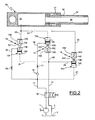
- FIG 2 the distributor valve 10 is shown in a position in which, following the activating of the pump 1, the oil in the hydraulic circuit pressurises the pushing branch 11 in the circuit and via the entry conduit 22 opens the valve 13, pressurising the pushing chamber 30 and thus activating the cylinder to bring the cabin from a driving position to a tilted position.
- the conduit 19 exhibits a check valve 18 which keeps the pushing branch and the pulling branch 12 separate during the raising of the cabin.
- conduit 22 and the conduit 19 respectively exhibit chokes 16 and 17 the function of which will be illustrated more fully herein below.
- Figure 2 illustrates the behaviour of the valves 13-15 during the stages in which, following the activation of the pump 1, the driver's cabin is brought from a normal driving position to a tilted position.
- the oil in the hydraulic circuit pressurises the pushing branch 11 of the hydraulic circuit, while by effect of the check valve 18, the conduit 19 is not crossed by oil.
- the valve 15 is open ( figure 2 ) inasmuch as the pressurised oil, via the conduit 21, activates the actuator 154 which opens the valve 15, but there is no passage of oil through the valve 15 because the conduit 19 is not crossed by oil.
- the pressurised oil through the entry conduit 22, opens the valve 13, pressurising the pushing chamber 30 and thus enabling activation of the telescopic cylinder in extension in order to raise the driver's cabin.
- the pressure of the oil in delivery also acts on the branch-off of the piloting branch 27 of the block valve 14, opening it so that the oil contained in the pulling chamber 31 flows out through the block valve 14 of the pulling chamber 31 and then discharges into the container 2 via the pulling branch 12.
- the weight of the cabin draws the piston elements creating a depression in the pushing chamber 30. This depression causes the closing of the valve 15 inasmuch as the oil in the branch 21 is recalled into the pushing chamber 30 and the force of the spring 153 pushes the ball obturator 152 against the respective valve seating 151.
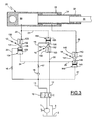
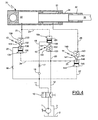
- the distributor valve 10 is activated to bring it into the position illustrated in figures 3 and 4 .
- the oil in the hydraulic circuit pressurises the pulling branch 12, and consequently the oil pressure, through the entry conduit 25, opens the block valve 14 of the pulling chamber 31, such that the oil puts the pulling chamber 31 under pressure, enabling the telescopic cylinder to start moving in order to bring the cabin into the driving position.
- the overpressure which forms in the pushing chamber 30 (also obtained thanks to choke 16, which prevents the direct unloading or too-rapid unloading) is sufficient to overcome the pressure in the pulling branch, and the discharge valve 15 opens and sets the pulling branch 12 in discharge, as illustrated in figure 4 .
- the chokes 16 and 17 can be united to make a single choke located on the branch 11.
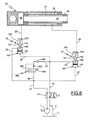
- FIG. 5 A similar circuit to the preceding one, which however works regeneratively, is illustrated in figure 5 , in which the components which correspond to those illustrated in figures 1 to 4 are denoted using the same numerical references.
- the difference in comparison with the circuit of figures 1-4 is the addition of a shuttle valve 36.
- the shuttle valve 36 comprises a valve body 360 provided with two valve seatings 361 and 362 to which respective oil-supplying conduits 37 and 26 are connected.
- An oil discharge conduit 38 is present between the two valve seatings, as is a mobile obturator 363 which displaces alternatingly between the two seatings.
- the pushing chamber 30 and the pulling chamber 31 are placed in communication by the shuttle valve 36, which is in the position shown in figure 5 , for which the system is in regenerative mode.
- the shuttle valve 36 switches, separating the two chambers and making the system function as in the previous case described with reference to figures 3-4 .
- FIGS. 6 and 7 illustrate further embodiments of the hydraulic circuit of the invention, where the components corresponding to those in figures 1-4 are denoted using the same numbers.
- the discharge valve of the pulling branch can be realised in two divided parts and associated to a variable-flow choke 40, as illustrated in figure 6 ; i.e. a normal check valve 39b and a flow block valve 39a.
- the check valve 39b serves to isolate the two branches, pushing and pulling, during the tilting stage, i.e. when the pulling branch 11 is pressurised.
- the valve 39a serves to place the branch 12 in discharge, and thus remove piloting pressure to the valve 13.
- the default position is open due to the force of a spring 391, as represented in figure 6 .
- valve 14 closes, the branch 12 is depressurised, the valve 39a returns into the default position, thanks to the action of the spring 391, putting the branch 12 into discharge and removing the piloting to the valve 13.
- the seal of the valve 39a (in the switched configuration) must not be perfect, nor lose too much, in order not to have a too-low performance of the pumped fluid.
- the valve 39a can be a ball located in a conduit, precise and with two seal seatings.
- a platelet instead of a ball, as it is easier to recreate a controlled loss of the coupling of two flat surfaces. Further, the plate can allow a greater fall of pressure when pumping begins more rapidly, thus improving the pumping performance.
- the check valve 39b can be integrated with a flow block valve 39a in a single valve.
- the system of figure 6 can be made to function in regenerative mode.
- Figure 7 shows a similar solution to that of the circuit of figure 6 , in which the two block valves 13 and 14 are integrated in a single valve 40.
- a fifth embodiment of the hydraulic circuit of the invention is now described with reference to figures 8-10 for the stages of tilting the driver's cabin and figures 11-14 for the return stage of the cabin.
- This fifth embodiment of the invention is an evolution of the realisation illustrated in figure 5 ; in this, apart from the shuttle valve 36 interposed between the pushing branch and the pulling branch of the circuit, there is also a branching 50 of the pushing branch which comprises a lost motion valve 51 from which a lost motion conduit 52 departs, terminating in a lost-motion hole 59.
- a further difference with respect to the embodiments of figures 1-7 is the fact that the bottom 56 of the external element is closed and a passage hole 53 has been made through the element, such that the internal element is commanded by the pulling pressure instead of by the pushing pressure, as the chamber 32a is thus located in communication with the chamber 31.
- the function of the lost motion valve is known and is that of enabling a free descent of the cylinder in the final stage of return of the cabin, i.e. the hooking stage to the frame, and rendering the cylinder free when the vehicle is moving.
- the lost motion valve 51 comprises a first and a second chamber 501, 502, an obturator 503 and a spring 504.
- a passage 54 provided with a choke 55 which connects a chamber 32b with the chamber 32a, which respectively function as a pulling chamber and a pushing chamber for the internal element 35.
- a first stage includes sending the oil through the pump 1 and the distributor valve 10 through the thrust branch 11 towards the pushing chamber 30.
- the circuit will not function regeneratively, but the oil can fill only the pushing chamber 30 which is isolated from the other chambers of the circuit: thus the pushing occurs over the whole pushing area.
- the hydraulic seal is still given by the pump 1; as the lost motion valve 51 remains open for the whole stage. This means that the position of the distributor valve 10 inverts and the cabin descends.
- the oil sent to the chamber 30 can pass through the lost motion conduit 52 and the shuttle valve 36 and can fill the chambers 31, 32a, 32b which are thus brought to the same pressure as the push chamber 30; in this case the circuit functions regeneratively and the external element 34 rises due to the thrust due to the area of the external element 34.
- the third stage includes the exit of the internal element 35.
- the pressure increases and from the more internal element 35 starts to exit, under the thrust of the stem area.
- the centre of gravity of the cabin is almost on the vertical of the tilting centre, so that even if a push is made on a much smaller area with respect to the initial area of the first stage, the pressure requested is however low and consequently the operator's exertion is fully acceptable.
- the fourth stage includes the braked forwards fall of the driver's cabin, up till when the internal element 35 reaches the end run 99 thereof.
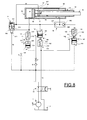
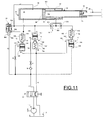
- the distributor valve 10 is switched as in figures 11-14 so that the pump 1 supplies the pulling branch during the first return stage ( figure 11 ), so that the chamber 30 is depressurised, not having to balance any load and being connected in discharge by the valve 13 each time the pulling branch is pressurised.
- the shuttle valve 36 is switched as in figure 11 .
- the weight of the cabin tends to keep the cylinder open because the centre of gravity of the cabin is beyond the vertical of the hinge plane thereof.
- the valve 15, which serves to put the piloting of the block valve 13 in discharge, is always closed. In this way the pressures required to overcome the weight of the cabin can be reached in the pulling branch, causing the external element 34 to return, while the internal element 35 during this stage is substantially in the extended position.
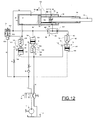
- the more internal element reaches closing endrun 100 so that the whole system begins to function as a single-element cylinder.
- the pressure in the pulling chambers falls (no longer having to balance any load) up until it falls below the value of the pressure in pushing chamber, when the shuttle valve 36 ball switches ( figure 13 ) and a regenerative functioning starts up; for each pumping, the oil in the pushing chamber goes in part into the pulling chamber (passing through the lost motion branch) and in part is discharged.
- the fourth and final stage of the return of the cabin ( figure 14 ) is the stage of free fall, in which the piston passes the lost motion hole 59, isolating the pushing and pulling chambers.
- the oil from the pushing chamber does not return into the pulling chamber, but is all discharged: the pressure in the pulling branch falls and the lost motion valve 51, which is no longer in equilibrium, switches and opens so that it can maintain the pushing chamber 30 in discharge up till the cabin is hooked to the frame.
Landscapes
- Engineering & Computer Science (AREA)
- Mechanical Engineering (AREA)
- Physics & Mathematics (AREA)
- Fluid Mechanics (AREA)
- General Engineering & Computer Science (AREA)
- Chemical & Material Sciences (AREA)
- Combustion & Propulsion (AREA)
- Transportation (AREA)
- Fluid-Pressure Circuits (AREA)
- Vehicle Body Suspensions (AREA)
- Body Structure For Vehicles (AREA)
- Forklifts And Lifting Vehicles (AREA)
Claims (19)
- Vorrichtung zum Steuern des Kippens eines Fahrerhauses eines Lastkraftwagens, einschließlich eines Hydraulikzylinders (33), der am Fahrerhaus und an einem Rahmen des Lastkraftwagens gelenkig befestigt ist und der das Steuern des Kippens des Fahrerhauses aus der Fahrstellung in die Kippstellung und umgekehrt bewirkt. Die Vorrichtung beinhaltet ferner eine hydraulische Ansteuerschaltung des Zylinders mit einer Schiebeschaltung und einer Ziehschaltung, wobei die hydraulische Ansteuerschaltung Mittel zum Veranlassen einer Schiebe- oder einer Ziehbewegung des Teleskopzylinders beinhaltet und mit wenigstens einem gesteuerten Sperrventil (13) ausgestattet ist, das einer Schiebekammer (30) des Zylinders zugeordnet ist, dadurch gekennzeichnet, dass der Hydraulikzylinder (33) ein Teleskopzylinder mit einem Zylindergehäuse ist, das die Schiebekammer (30) einschließt und mit wenigstens zwei Bewegungselementen (34, 35), einem externen Element (34) und einem internen Element (35), ausgestattet ist, wobei sich das interne Element (35) innerhalb des externen Elements (34) bewegt, und dass es Mittel zum Kontrollieren der Stellung der beiden Bewegungselemente (34, 35) des Teleskopzylinders (33) beinhaltet. Die Mittel zum Kontrollieren der Stellung des internen Elements (35) umfassen eine Ventilanordnung, die so angeordnet sind, dass sie auf die Steuerung des Sperrventils (13) der Schiebekammer (30) einwirkt, um die Schiebekammer (30) zu verschließen und damit das Gewicht des Fahrerhauses auszugleichen.
- Die Steuervorrichtung nach Patentanspruch 1, dadurch gekennzeichnet, dass die Mittel zum Veranlassen der Schiebe- und Ziehbewegung des Teleskopzylinders eine mechanische Pumpe beinhalten, die einem Verteilerventil (10) zugeordnet ist.
- Die Steuervorrichtung nach Patentanspruch 1, dadurch gekennzeichnet, dass die Mittel zum Veranlassen der Schiebe- und Ziehbewegung des Teleskopzylinders eine elektrische Pumpe beinhalten.
- Die Steuervorrichtung nach Patentanspruch 1, dadurch gekennzeichnet, dass die Mittel zum Kontrollieren der Stellung des externen Elements (34) wenigstens ein Sperrventil (14, 38) der Ziehschaltung beinhalten, welches das externe Element (34) des Teleskopzylinders daran hindern kann, durch einen Druck nach oben geschoben zu werden, der in der Schiebekammer (30) durch das Gewicht des Fahrerhauses beim Absenken des internen Elements (35) entsteht.
- Die Steuervorrichtung nach Patentanspruch 2, dadurch gekennzeichnet, dass das Sperrventil (14) der Ziehschaltung auf der Ziehschaltung angebracht ist und mit der hydraulischen Ansteuerschaltung durch eine Einlassleitung (25) und eine Auslassleitung (26) verbunden ist, die in die Ziehkammer (31) führt und sich über eine Steuerschaltung (27) steuern lässt, die von der Schiebeschaltung (11) abzweigt.
- Die Steuervorrichtung nach Patentanspruch 1, dadurch gekennzeichnet, dass die Mittel zum Kontrollieren der Stellung des internen Elements (35) ein Auslassventil (15, 37) der Ziehschaltung beinhalten, welches das Absenken des internen Elements (35) des Teleskopzylinders unter der Wirkung des Gewichtes des Fahrerhauses durch Einwirkung auf die Steuerung des Sperrventils (13) der Schiebekammer (30) zum Verschließen der Schiebekammer (30) unterbrechen kann.
- Die Steuervorrichtung nach Patentanspruch 4, dadurch gekennzeichnet, dass das Auslassventil (15) der Ziehschaltung mit der hydraulischen Ansteuerschaltung durch eine Einlassleitung (19) und eine Auslassleitung (20) verbunden ist, die zur Schiebeschaltung (31) führt und sich über eine Steuerschaltung (21) steuern lässt, die von der Auslassleitung des ersten Ventils (13) abzweigt.
- Die Steuervorrichtung nach Patentanspruch 5, dadurch gekennzeichnet, dass die Einlassleitung des Auslassventils (15) der Ziehschaltung ein Rückschlagventil (18) aufweist, das die Schiebeschaltung und die Ziehschaltung voneinander getrennt hält, um zu verhindern, dass bei Betätigung der Pumpe (1) zum Anheben des Fahrerhauses Druck zum Auslassventil (15) der Ziehschaltung gelangt.
- Die Steuervorrichtung nach Patentanspruch 5, dadurch gekennzeichnet, dass die Einlassleitung des Sperrventils (13) der Schiebekammer (30) eine Drossel (16) aufweist, die bei Unterbrechung des Pumpvorganges einen Druckwert in der Schiebekammer aufrecht erhält, der ausreicht, um das Ventil (15) steuern und die Ziehschaltung entladen zu können.
- Die Steuervorrichtung nach Patentanspruch 5, dadurch gekennzeichnet, dass die Einlassleitung des Auslassventils (15) der Ziehschaltung eine Drossel (17) aufweist, welche einen ausreichenden Druckaufbau in der Ziehschaltung (12) zur Steuerung des Sperrventils (13) der Schiebekammer durch das Öffnen des Sperrventils (13) ermöglicht, so dass die Ziehkammer (30) entladen und eine ausreichende Druckdifferenz in der Ansteuerschaltung zum Verschließen des Auslassventils (15) der Ziehschaltung geschaffen wird, damit der Pumpstrom voll auf die Ziehkammer (31) einwirken kann.
- Die Steuervorrichtung nach Patentanspruch 1, dadurch gekennzeichnet, dass die Schiebeleitung der hydraulischen Ansteuerschaltung eine Drossel aufweist.
- Die Steuervorrichtung nach Patentanspruch 1, dadurch gekennzeichnet, dass die Mittel zum Kontrollieren der Stellung des internen Elements (35) ein Auslassventil der Ziehschaltung beinhalten, das in zwei Teile (39a, 39b) unterteilt und einer verstellbaren Drossel (392) zugeordnet ist, wobei der erste Teil aus einem Rückschlagventil (39b) zum Isolieren der Schiebeschaltung und der Ziehschaltung der hydraulischen Ansteuerschaltung und der zweite Teil aus einem Drosselventil (39a) besteht, das einer Feder (391) zugeordnet ist, um die Ziehschaltung (12) zu entladen, wenn einer Steuerung des Sperrventils (13) der Schiebekammer vorgebeugt werden soll.
- Die Steuervorrichtung nach Patentanspruch 12, dadurch gekennzeichnet, dass die Belastung der Feder (391) und der verstellbaren Drossel (392) so geregelt sind, dass während des manuellen Pumpens eine ausreichende Druckdifferenz entsteht, um das Drosselventil (39a) zu verschließen und einen verbleibenden Teil des gepumpten Öls in die Schiebekammer (30) zu schicken.
- Die Steuervorrichtung nach Patentanspruch 12, dadurch gekennzeichnet, dass das Drosselventil (39a) durch eine Kugel oder eine Platte in einer Leitung mit zwei entgegen gesetzten Dichtsitzen realisiert werden kann.
- Die Steuervorrichtung nach Patentanspruch 1, dadurch gekennzeichnet, dass sie ein Wechselventil (36) beinhaltet, das die Schiebekammer (30) und die Ziehkammer (31) miteinander in Verbindung setzt, wenn die Schiebeschaltung unter Druck gesetzt wird, so dass die Vorrichtung nach dem Rückspeisungsprinzip arbeiten kann.
- Die Steuervorrichtung nach Patentanspruch 15, dadurch gekennzeichnet, dass sie ein Leerlaufventil (51) beinhaltet, das mit einer Leerlaufleitung (52) verbunden ist, um die Schiebekammer (30) und die Ziehkammer (31) miteinander in Verbindung zu setzen, wenn der Kolben den Bereich des freien Falls verlassen hat, so dass die Vorrichtung nach dem Rückspeisungsprinzip arbeiten kann.
- Die Steuervorrichtung nach Patentanspruch 15, dadurch gekennzeichnet, dass sie einen Durchgang (54) im Inneren des internen Elements (35) beinhaltet, der mit einer Drossel (55) ausgestattet ist und eine Kammer (32b) mit einer weiteren Kammer (32a) verbindet, die jeweils als Ziehkammer und Schiebekammer für das interne Element (35) dienen.
- Die Steuervorrichtung nach Patentanspruch 17, dadurch gekennzeichnet, dass die Kammer (32a) von der Schiebekammer (30) durch Verschluss eines Bodens (56) des externen Elements isoliert werden kann und mit der Ziehkammer (31) über ein Loch (53) in Verbindung steht.
- Die Steuervorrichtung nach den vorstehenden Patentansprüchen, dadurch gekennzeichnet, dass das Sperrventil (13) der Schiebekammer (30) und das Sperrventil (14) der Ziehkammer (31) baulich in ein einzelnes Ventil (40) integriert sind.
Applications Claiming Priority (1)
| Application Number | Priority Date | Filing Date | Title |
|---|---|---|---|
| IT000114A ITRE20070114A1 (it) | 2007-10-25 | 2007-10-25 | "dispositivo per azionare il ribaltamento di una cabina di guida di un autocarro" |
Publications (2)
| Publication Number | Publication Date |
|---|---|
| EP2052952A1 EP2052952A1 (de) | 2009-04-29 |
| EP2052952B1 true EP2052952B1 (de) | 2010-12-22 |
Family
ID=40297798
Family Applications (1)
| Application Number | Title | Priority Date | Filing Date |
|---|---|---|---|
| EP08161150A Not-in-force EP2052952B1 (de) | 2007-10-25 | 2008-07-25 | Vorrichtung zum Steuern des Kippens eines Fahrerhauses eines Lastkraftwagens |
Country Status (4)
| Country | Link |
|---|---|
| EP (1) | EP2052952B1 (de) |
| AT (1) | ATE492460T1 (de) |
| DE (1) | DE602008004048D1 (de) |
| IT (1) | ITRE20070114A1 (de) |
Families Citing this family (3)
| Publication number | Priority date | Publication date | Assignee | Title |
|---|---|---|---|---|
| CN102434529B (zh) * | 2011-12-06 | 2015-03-18 | 中联重科股份有限公司 | 液压缸伸缩控制回路以及工程机械设备 |
| AT519149B1 (de) | 2016-09-30 | 2018-11-15 | Avl List Gmbh | Längenverstellbares Pleuel mit Steuerungseinrichtung |
| CN112623052B (zh) * | 2019-10-08 | 2022-07-08 | 韩萍 | 卡车驾驶室举升系统悬浮和锁栓开锁操控拉索自动控制器 |
Family Cites Families (4)
| Publication number | Priority date | Publication date | Assignee | Title |
|---|---|---|---|---|
| US2306348A (en) | 1941-11-12 | 1942-12-22 | Shell Dev | Hydraulic lift for forward-tilting cabs |
| DE2210754B2 (de) * | 1972-03-06 | 1974-04-18 | Emil Weber Fabrik Fuer Oelhydraulik, 7129 Gueglingen | Hydraulische Kippvorrichtung für kippbare Fahrerhäuser von Lastkraftwagen |
| JPS57198175A (en) | 1981-05-30 | 1982-12-04 | Diesel Kiki Co Ltd | Hydraulic system for tilting a cab |
| US4446939A (en) * | 1982-02-02 | 1984-05-08 | Applied Power Inc. | Tiltcab truck with hydraulic lost motion |
-
2007
- 2007-10-25 IT IT000114A patent/ITRE20070114A1/it unknown
-
2008
- 2008-07-25 AT AT08161150T patent/ATE492460T1/de not_active IP Right Cessation
- 2008-07-25 DE DE602008004048T patent/DE602008004048D1/de active Active
- 2008-07-25 EP EP08161150A patent/EP2052952B1/de not_active Not-in-force
Also Published As
| Publication number | Publication date |
|---|---|
| ATE492460T1 (de) | 2011-01-15 |
| DE602008004048D1 (de) | 2011-02-03 |
| ITRE20070114A1 (it) | 2009-04-26 |
| EP2052952A1 (de) | 2009-04-29 |
Similar Documents
| Publication | Publication Date | Title |
|---|---|---|
| EP2740944B1 (de) | Elektrohydraulisches Stellantriebsystem zum Einziehen/Ausfahren eines Fahrwerks | |
| CN105174149B (zh) | 平衡的液压夹紧力控制装置 | |
| US9080310B2 (en) | Closed-loop hydraulic system having regeneration configuration | |
| RU2459043C2 (ru) | Гидроклапанное устройство | |
| US5760695A (en) | Apparatus for hydraulic actuation of a hinged cover | |
| JP2008285146A (ja) | ダンプトラック | |
| US6370874B1 (en) | Hydraulic control device for a mobile machine, especially for a wheel loader | |
| US8753034B2 (en) | Auxiliary pressure relief reservoir for crash barrier | |
| CN108136707B (zh) | 电液式驱动单元 | |
| JP6856065B2 (ja) | 油圧システム | |
| EP2052952B1 (de) | Vorrichtung zum Steuern des Kippens eines Fahrerhauses eines Lastkraftwagens | |
| CZ293252B6 (cs) | Zařízení na zpětné získávání energie | |
| CN106061792A (zh) | 自卸卡车的举升装置 | |
| EP2786959B1 (de) | Kavitationsschutzvorrichtung für einen Hydraulikzylinder | |
| CN111216879B (zh) | 用于操作飞行器着陆装置的液压回路 | |
| US20040074702A1 (en) | Hydraulic lift comprising a pressure accumulator and method for controlling and regulating one such lift | |
| KR20190025984A (ko) | 유압 액추에이터로부터 에너지를 회수하기 위한 시스템 | |
| US8360678B2 (en) | Crash barrier with over-pressure relief system | |
| US3434450A (en) | Mounting arrangement for hydraulic impact damping and power lift means for an outboard propulsion unit | |
| KR102762022B1 (ko) | 브레이크 해제 장치를 위한 유압 시스템, 이러한 유압 시스템을 구비한 브레이크 해제 장치 및 브레이크 시스템 | |
| EP1932797A1 (de) | Hebevorrichtung | |
| US8826799B2 (en) | Single effect hydraulic cylinder | |
| US12110985B2 (en) | Switching valve, electro-hydrostatic circuit, and aircraft | |
| CN212272673U (zh) | 一种驾驶室升降液压控制系统及挖掘机 | |
| EP1733996B1 (de) | Hydraulische Vorrichtung zum Heben und Senken eines an einer Arbeitsmaschine schwenkbaren Arms |
Legal Events
| Date | Code | Title | Description |
|---|---|---|---|
| PUAI | Public reference made under article 153(3) epc to a published international application that has entered the european phase |
Free format text: ORIGINAL CODE: 0009012 |
|
| AK | Designated contracting states |
Kind code of ref document: A1 Designated state(s): AT BE BG CH CY CZ DE DK EE ES FI FR GB GR HR HU IE IS IT LI LT LU LV MC MT NL NO PL PT RO SE SI SK TR |
|
| AX | Request for extension of the european patent |
Extension state: AL BA MK RS |
|
| 17P | Request for examination filed |
Effective date: 20091021 |
|
| 17Q | First examination report despatched |
Effective date: 20091125 |
|
| AKX | Designation fees paid |
Designated state(s): AT BE BG CH CY CZ DE DK EE ES FI FR GB GR HR HU IE IS IT LI LT LU LV MC MT NL NO PL PT RO SE SI SK TR |
|
| GRAP | Despatch of communication of intention to grant a patent |
Free format text: ORIGINAL CODE: EPIDOSNIGR1 |
|
| GRAS | Grant fee paid |
Free format text: ORIGINAL CODE: EPIDOSNIGR3 |
|
| GRAA | (expected) grant |
Free format text: ORIGINAL CODE: 0009210 |
|
| AK | Designated contracting states |
Kind code of ref document: B1 Designated state(s): AT BE BG CH CY CZ DE DK EE ES FI FR GB GR HR HU IE IS IT LI LT LU LV MC MT NL NO PL PT RO SE SI SK TR |
|
| REG | Reference to a national code |
Ref country code: GB Ref legal event code: FG4D |
|
| REG | Reference to a national code |
Ref country code: CH Ref legal event code: EP |
|
| REG | Reference to a national code |
Ref country code: IE Ref legal event code: FG4D |
|
| REF | Corresponds to: |
Ref document number: 602008004048 Country of ref document: DE Date of ref document: 20110203 Kind code of ref document: P |
|
| REG | Reference to a national code |
Ref country code: DE Ref legal event code: R096 Ref document number: 602008004048 Country of ref document: DE Effective date: 20110203 |
|
| REG | Reference to a national code |
Ref country code: NL Ref legal event code: VDEP Effective date: 20101222 |
|
| PG25 | Lapsed in a contracting state [announced via postgrant information from national office to epo] |
Ref country code: LT Free format text: LAPSE BECAUSE OF FAILURE TO SUBMIT A TRANSLATION OF THE DESCRIPTION OR TO PAY THE FEE WITHIN THE PRESCRIBED TIME-LIMIT Effective date: 20101222 |
|
| LTIE | Lt: invalidation of european patent or patent extension |
Effective date: 20101222 |
|
| PG25 | Lapsed in a contracting state [announced via postgrant information from national office to epo] |
Ref country code: SE Free format text: LAPSE BECAUSE OF FAILURE TO SUBMIT A TRANSLATION OF THE DESCRIPTION OR TO PAY THE FEE WITHIN THE PRESCRIBED TIME-LIMIT Effective date: 20101222 Ref country code: BG Free format text: LAPSE BECAUSE OF FAILURE TO SUBMIT A TRANSLATION OF THE DESCRIPTION OR TO PAY THE FEE WITHIN THE PRESCRIBED TIME-LIMIT Effective date: 20110322 Ref country code: AT Free format text: LAPSE BECAUSE OF FAILURE TO SUBMIT A TRANSLATION OF THE DESCRIPTION OR TO PAY THE FEE WITHIN THE PRESCRIBED TIME-LIMIT Effective date: 20101222 Ref country code: SI Free format text: LAPSE BECAUSE OF FAILURE TO SUBMIT A TRANSLATION OF THE DESCRIPTION OR TO PAY THE FEE WITHIN THE PRESCRIBED TIME-LIMIT Effective date: 20101222 Ref country code: CY Free format text: LAPSE BECAUSE OF FAILURE TO SUBMIT A TRANSLATION OF THE DESCRIPTION OR TO PAY THE FEE WITHIN THE PRESCRIBED TIME-LIMIT Effective date: 20101222 Ref country code: LV Free format text: LAPSE BECAUSE OF FAILURE TO SUBMIT A TRANSLATION OF THE DESCRIPTION OR TO PAY THE FEE WITHIN THE PRESCRIBED TIME-LIMIT Effective date: 20101222 Ref country code: FI Free format text: LAPSE BECAUSE OF FAILURE TO SUBMIT A TRANSLATION OF THE DESCRIPTION OR TO PAY THE FEE WITHIN THE PRESCRIBED TIME-LIMIT Effective date: 20101222 Ref country code: HR Free format text: LAPSE BECAUSE OF FAILURE TO SUBMIT A TRANSLATION OF THE DESCRIPTION OR TO PAY THE FEE WITHIN THE PRESCRIBED TIME-LIMIT Effective date: 20101222 |
|
| PG25 | Lapsed in a contracting state [announced via postgrant information from national office to epo] |
Ref country code: CZ Free format text: LAPSE BECAUSE OF FAILURE TO SUBMIT A TRANSLATION OF THE DESCRIPTION OR TO PAY THE FEE WITHIN THE PRESCRIBED TIME-LIMIT Effective date: 20101222 Ref country code: GR Free format text: LAPSE BECAUSE OF FAILURE TO SUBMIT A TRANSLATION OF THE DESCRIPTION OR TO PAY THE FEE WITHIN THE PRESCRIBED TIME-LIMIT Effective date: 20110323 Ref country code: EE Free format text: LAPSE BECAUSE OF FAILURE TO SUBMIT A TRANSLATION OF THE DESCRIPTION OR TO PAY THE FEE WITHIN THE PRESCRIBED TIME-LIMIT Effective date: 20101222 Ref country code: ES Free format text: LAPSE BECAUSE OF FAILURE TO SUBMIT A TRANSLATION OF THE DESCRIPTION OR TO PAY THE FEE WITHIN THE PRESCRIBED TIME-LIMIT Effective date: 20110402 Ref country code: PT Free format text: LAPSE BECAUSE OF FAILURE TO SUBMIT A TRANSLATION OF THE DESCRIPTION OR TO PAY THE FEE WITHIN THE PRESCRIBED TIME-LIMIT Effective date: 20110422 Ref country code: NO Free format text: LAPSE BECAUSE OF FAILURE TO SUBMIT A TRANSLATION OF THE DESCRIPTION OR TO PAY THE FEE WITHIN THE PRESCRIBED TIME-LIMIT Effective date: 20110322 Ref country code: BE Free format text: LAPSE BECAUSE OF FAILURE TO SUBMIT A TRANSLATION OF THE DESCRIPTION OR TO PAY THE FEE WITHIN THE PRESCRIBED TIME-LIMIT Effective date: 20101222 Ref country code: IS Free format text: LAPSE BECAUSE OF FAILURE TO SUBMIT A TRANSLATION OF THE DESCRIPTION OR TO PAY THE FEE WITHIN THE PRESCRIBED TIME-LIMIT Effective date: 20110422 |
|
| PG25 | Lapsed in a contracting state [announced via postgrant information from national office to epo] |
Ref country code: RO Free format text: LAPSE BECAUSE OF FAILURE TO SUBMIT A TRANSLATION OF THE DESCRIPTION OR TO PAY THE FEE WITHIN THE PRESCRIBED TIME-LIMIT Effective date: 20101222 Ref country code: NL Free format text: LAPSE BECAUSE OF FAILURE TO SUBMIT A TRANSLATION OF THE DESCRIPTION OR TO PAY THE FEE WITHIN THE PRESCRIBED TIME-LIMIT Effective date: 20101222 Ref country code: SK Free format text: LAPSE BECAUSE OF FAILURE TO SUBMIT A TRANSLATION OF THE DESCRIPTION OR TO PAY THE FEE WITHIN THE PRESCRIBED TIME-LIMIT Effective date: 20101222 Ref country code: PL Free format text: LAPSE BECAUSE OF FAILURE TO SUBMIT A TRANSLATION OF THE DESCRIPTION OR TO PAY THE FEE WITHIN THE PRESCRIBED TIME-LIMIT Effective date: 20101222 |
|
| PLBE | No opposition filed within time limit |
Free format text: ORIGINAL CODE: 0009261 |
|
| STAA | Information on the status of an ep patent application or granted ep patent |
Free format text: STATUS: NO OPPOSITION FILED WITHIN TIME LIMIT |
|
| PG25 | Lapsed in a contracting state [announced via postgrant information from national office to epo] |
Ref country code: DK Free format text: LAPSE BECAUSE OF FAILURE TO SUBMIT A TRANSLATION OF THE DESCRIPTION OR TO PAY THE FEE WITHIN THE PRESCRIBED TIME-LIMIT Effective date: 20101222 |
|
| 26N | No opposition filed |
Effective date: 20110923 |
|
| PG25 | Lapsed in a contracting state [announced via postgrant information from national office to epo] |
Ref country code: MT Free format text: LAPSE BECAUSE OF FAILURE TO SUBMIT A TRANSLATION OF THE DESCRIPTION OR TO PAY THE FEE WITHIN THE PRESCRIBED TIME-LIMIT Effective date: 20101222 |
|
| REG | Reference to a national code |
Ref country code: DE Ref legal event code: R097 Ref document number: 602008004048 Country of ref document: DE Effective date: 20110923 |
|
| PG25 | Lapsed in a contracting state [announced via postgrant information from national office to epo] |
Ref country code: MC Free format text: LAPSE BECAUSE OF NON-PAYMENT OF DUE FEES Effective date: 20110731 |
|
| REG | Reference to a national code |
Ref country code: FR Ref legal event code: ST Effective date: 20120330 |
|
| REG | Reference to a national code |
Ref country code: IE Ref legal event code: MM4A |
|
| PG25 | Lapsed in a contracting state [announced via postgrant information from national office to epo] |
Ref country code: FR Free format text: LAPSE BECAUSE OF NON-PAYMENT OF DUE FEES Effective date: 20110801 |
|
| PG25 | Lapsed in a contracting state [announced via postgrant information from national office to epo] |
Ref country code: IE Free format text: LAPSE BECAUSE OF NON-PAYMENT OF DUE FEES Effective date: 20110725 |
|
| REG | Reference to a national code |
Ref country code: CH Ref legal event code: PL |
|
| GBPC | Gb: european patent ceased through non-payment of renewal fee |
Effective date: 20120725 |
|
| PG25 | Lapsed in a contracting state [announced via postgrant information from national office to epo] |
Ref country code: CH Free format text: LAPSE BECAUSE OF NON-PAYMENT OF DUE FEES Effective date: 20120731 Ref country code: LI Free format text: LAPSE BECAUSE OF NON-PAYMENT OF DUE FEES Effective date: 20120731 Ref country code: GB Free format text: LAPSE BECAUSE OF NON-PAYMENT OF DUE FEES Effective date: 20120725 |
|
| PG25 | Lapsed in a contracting state [announced via postgrant information from national office to epo] |
Ref country code: LU Free format text: LAPSE BECAUSE OF NON-PAYMENT OF DUE FEES Effective date: 20110725 |
|
| PG25 | Lapsed in a contracting state [announced via postgrant information from national office to epo] |
Ref country code: TR Free format text: LAPSE BECAUSE OF FAILURE TO SUBMIT A TRANSLATION OF THE DESCRIPTION OR TO PAY THE FEE WITHIN THE PRESCRIBED TIME-LIMIT Effective date: 20101222 |
|
| PG25 | Lapsed in a contracting state [announced via postgrant information from national office to epo] |
Ref country code: HU Free format text: LAPSE BECAUSE OF FAILURE TO SUBMIT A TRANSLATION OF THE DESCRIPTION OR TO PAY THE FEE WITHIN THE PRESCRIBED TIME-LIMIT Effective date: 20101222 |
|
| REG | Reference to a national code |
Ref country code: DE Ref legal event code: R082 Ref document number: 602008004048 Country of ref document: DE Representative=s name: LORENZ & KOLLEGEN PATENTANWAELTE PARTNERSCHAFT, DE Ref country code: DE Ref legal event code: R081 Ref document number: 602008004048 Country of ref document: DE Owner name: OGNIBENE POWER S.P.A., IT Free format text: FORMER OWNER: OGNIBENE S.P.A., MANCASALE DI REGGIO EMILIA, IT |
|
| PGFP | Annual fee paid to national office [announced via postgrant information from national office to epo] |
Ref country code: BE Payment date: 20170620 Year of fee payment: 14 |
|
| PG25 | Lapsed in a contracting state [announced via postgrant information from national office to epo] |
Ref country code: IT Free format text: LAPSE BECAUSE OF NON-PAYMENT OF DUE FEES Effective date: 20180725 |
|
| PGFP | Annual fee paid to national office [announced via postgrant information from national office to epo] |
Ref country code: DE Payment date: 20200729 Year of fee payment: 13 |
|
| REG | Reference to a national code |
Ref country code: DE Ref legal event code: R119 Ref document number: 602008004048 Country of ref document: DE |
|
| PG25 | Lapsed in a contracting state [announced via postgrant information from national office to epo] |
Ref country code: DE Free format text: LAPSE BECAUSE OF NON-PAYMENT OF DUE FEES Effective date: 20220201 |