EP2053114A1 - Processus de réduction du contenu en oxygène de produits de départ riches en oxygène - Google Patents
Processus de réduction du contenu en oxygène de produits de départ riches en oxygène Download PDFInfo
- Publication number
- EP2053114A1 EP2053114A1 EP07118777A EP07118777A EP2053114A1 EP 2053114 A1 EP2053114 A1 EP 2053114A1 EP 07118777 A EP07118777 A EP 07118777A EP 07118777 A EP07118777 A EP 07118777A EP 2053114 A1 EP2053114 A1 EP 2053114A1
- Authority
- EP
- European Patent Office
- Prior art keywords
- oxygen
- feedstock
- coke
- inorganic material
- catalyst
- Prior art date
- Legal status (The legal status is an assumption and is not a legal conclusion. Google has not performed a legal analysis and makes no representation as to the accuracy of the status listed.)
- Withdrawn
Links
- 238000000034 method Methods 0.000 title claims abstract description 38
- 239000001301 oxygen Substances 0.000 title claims abstract description 29
- 229910052760 oxygen Inorganic materials 0.000 title claims abstract description 29
- QVGXLLKOCUKJST-UHFFFAOYSA-N atomic oxygen Chemical compound [O] QVGXLLKOCUKJST-UHFFFAOYSA-N 0.000 title claims abstract description 20
- 239000003054 catalyst Substances 0.000 claims abstract description 34
- 239000000571 coke Substances 0.000 claims abstract description 16
- UGFAIRIUMAVXCW-UHFFFAOYSA-N Carbon monoxide Chemical compound [O+]#[C-] UGFAIRIUMAVXCW-UHFFFAOYSA-N 0.000 claims abstract description 12
- 229910002091 carbon monoxide Inorganic materials 0.000 claims abstract description 8
- 239000002245 particle Substances 0.000 claims description 23
- 239000012530 fluid Substances 0.000 claims description 9
- 239000000203 mixture Substances 0.000 claims description 5
- 230000003197 catalytic effect Effects 0.000 claims description 4
- 239000002029 lignocellulosic biomass Substances 0.000 claims description 2
- 229910052751 metal Inorganic materials 0.000 claims description 2
- 239000002184 metal Substances 0.000 claims description 2
- 229910010272 inorganic material Inorganic materials 0.000 claims 7
- 239000011147 inorganic material Substances 0.000 claims 7
- VYPSYNLAJGMNEJ-UHFFFAOYSA-N Silicium dioxide Chemical compound O=[Si]=O VYPSYNLAJGMNEJ-UHFFFAOYSA-N 0.000 claims 3
- 241000282326 Felis catus Species 0.000 claims 1
- 239000004576 sand Substances 0.000 claims 1
- 239000000377 silicon dioxide Substances 0.000 claims 1
- 239000002028 Biomass Substances 0.000 abstract description 21
- 230000008929 regeneration Effects 0.000 abstract description 2
- 238000011069 regeneration method Methods 0.000 abstract description 2
- 239000000463 material Substances 0.000 description 17
- 239000001257 hydrogen Substances 0.000 description 11
- 229910052739 hydrogen Inorganic materials 0.000 description 11
- UFHFLCQGNIYNRP-UHFFFAOYSA-N Hydrogen Chemical compound [H][H] UFHFLCQGNIYNRP-UHFFFAOYSA-N 0.000 description 10
- 239000007789 gas Substances 0.000 description 10
- 239000007787 solid Substances 0.000 description 10
- 238000006243 chemical reaction Methods 0.000 description 9
- 238000005336 cracking Methods 0.000 description 6
- 239000000446 fuel Substances 0.000 description 6
- 239000000047 product Substances 0.000 description 5
- 239000012075 bio-oil Substances 0.000 description 4
- 239000003546 flue gas Substances 0.000 description 4
- 238000004231 fluid catalytic cracking Methods 0.000 description 4
- 239000007788 liquid Substances 0.000 description 4
- 238000002156 mixing Methods 0.000 description 4
- 238000006392 deoxygenation reaction Methods 0.000 description 3
- 239000000126 substance Substances 0.000 description 3
- XLYOFNOQVPJJNP-UHFFFAOYSA-N water Substances O XLYOFNOQVPJJNP-UHFFFAOYSA-N 0.000 description 3
- OKTJSMMVPCPJKN-UHFFFAOYSA-N Carbon Chemical compound [C] OKTJSMMVPCPJKN-UHFFFAOYSA-N 0.000 description 2
- CPLXHLVBOLITMK-UHFFFAOYSA-N Magnesium oxide Chemical compound [Mg]=O CPLXHLVBOLITMK-UHFFFAOYSA-N 0.000 description 2
- PNEYBMLMFCGWSK-UHFFFAOYSA-N aluminium oxide Inorganic materials [O-2].[O-2].[O-2].[Al+3].[Al+3] PNEYBMLMFCGWSK-UHFFFAOYSA-N 0.000 description 2
- 229910052799 carbon Inorganic materials 0.000 description 2
- 239000001913 cellulose Substances 0.000 description 2
- 229920002678 cellulose Polymers 0.000 description 2
- 238000010586 diagram Methods 0.000 description 2
- 239000002803 fossil fuel Substances 0.000 description 2
- 229930195733 hydrocarbon Natural products 0.000 description 2
- 150000002430 hydrocarbons Chemical class 0.000 description 2
- 241000609240 Ambelania acida Species 0.000 description 1
- 239000004215 Carbon black (E152) Substances 0.000 description 1
- 235000008733 Citrus aurantifolia Nutrition 0.000 description 1
- 241000196324 Embryophyta Species 0.000 description 1
- 235000011941 Tilia x europaea Nutrition 0.000 description 1
- 240000008042 Zea mays Species 0.000 description 1
- 235000005824 Zea mays ssp. parviglumis Nutrition 0.000 description 1
- 235000002017 Zea mays subsp mays Nutrition 0.000 description 1
- 239000002154 agricultural waste Substances 0.000 description 1
- 125000000129 anionic group Chemical group 0.000 description 1
- -1 bOc-d Chemical class 0.000 description 1
- 239000010905 bagasse Substances 0.000 description 1
- 239000011230 binding agent Substances 0.000 description 1
- 239000002551 biofuel Substances 0.000 description 1
- 239000006227 byproduct Substances 0.000 description 1
- 238000004523 catalytic cracking Methods 0.000 description 1
- 238000004517 catalytic hydrocracking Methods 0.000 description 1
- 238000007233 catalytic pyrolysis Methods 0.000 description 1
- 125000002091 cationic group Chemical group 0.000 description 1
- 238000002485 combustion reaction Methods 0.000 description 1
- 239000000470 constituent Substances 0.000 description 1
- 239000012084 conversion product Substances 0.000 description 1
- 235000005822 corn Nutrition 0.000 description 1
- 239000010779 crude oil Substances 0.000 description 1
- 230000002708 enhancing effect Effects 0.000 description 1
- 238000000227 grinding Methods 0.000 description 1
- 239000010903 husk Substances 0.000 description 1
- 150000002431 hydrogen Chemical class 0.000 description 1
- 150000004679 hydroxides Chemical class 0.000 description 1
- 125000002887 hydroxy group Chemical group [H]O* 0.000 description 1
- 238000004898 kneading Methods 0.000 description 1
- 239000004571 lime Substances 0.000 description 1
- 239000012263 liquid product Substances 0.000 description 1
- 239000000314 lubricant Substances 0.000 description 1
- 239000000395 magnesium oxide Substances 0.000 description 1
- 150000002697 manganese compounds Chemical class 0.000 description 1
- 238000010297 mechanical methods and process Methods 0.000 description 1
- 230000005226 mechanical processes and functions Effects 0.000 description 1
- 229910044991 metal oxide Inorganic materials 0.000 description 1
- 150000004706 metal oxides Chemical class 0.000 description 1
- 238000003801 milling Methods 0.000 description 1
- 239000003921 oil Substances 0.000 description 1
- 230000035515 penetration Effects 0.000 description 1
- JTJMJGYZQZDUJJ-UHFFFAOYSA-N phencyclidine Chemical class C1CCCCN1C1(C=2C=CC=CC=2)CCCCC1 JTJMJGYZQZDUJJ-UHFFFAOYSA-N 0.000 description 1
- 238000002203 pretreatment Methods 0.000 description 1
- 238000011027 product recovery Methods 0.000 description 1
- 238000000197 pyrolysis Methods 0.000 description 1
- 239000011541 reaction mixture Substances 0.000 description 1
- 229910021647 smectite Inorganic materials 0.000 description 1
- 239000010902 straw Substances 0.000 description 1
- 229910052723 transition metal Inorganic materials 0.000 description 1
- 150000003624 transition metals Chemical class 0.000 description 1
- 238000011144 upstream manufacturing Methods 0.000 description 1
- 239000002023 wood Substances 0.000 description 1
- 239000010457 zeolite Substances 0.000 description 1
Images

Classifications
-
- C—CHEMISTRY; METALLURGY
- C10—PETROLEUM, GAS OR COKE INDUSTRIES; TECHNICAL GASES CONTAINING CARBON MONOXIDE; FUELS; LUBRICANTS; PEAT
- C10G—CRACKING HYDROCARBON OILS; PRODUCTION OF LIQUID HYDROCARBON MIXTURES, e.g. BY DESTRUCTIVE HYDROGENATION, OLIGOMERISATION, POLYMERISATION; RECOVERY OF HYDROCARBON OILS FROM OIL-SHALE, OIL-SAND, OR GASES; REFINING MIXTURES MAINLY CONSISTING OF HYDROCARBONS; REFORMING OF NAPHTHA; MINERAL WAXES
- C10G1/00—Production of liquid hydrocarbon mixtures from oil-shale, oil-sand, or non-melting solid carbonaceous or similar materials, e.g. wood, coal
- C10G1/002—Production of liquid hydrocarbon mixtures from oil-shale, oil-sand, or non-melting solid carbonaceous or similar materials, e.g. wood, coal in combination with oil conversion- or refining processes
-
- C—CHEMISTRY; METALLURGY
- C10—PETROLEUM, GAS OR COKE INDUSTRIES; TECHNICAL GASES CONTAINING CARBON MONOXIDE; FUELS; LUBRICANTS; PEAT
- C10G—CRACKING HYDROCARBON OILS; PRODUCTION OF LIQUID HYDROCARBON MIXTURES, e.g. BY DESTRUCTIVE HYDROGENATION, OLIGOMERISATION, POLYMERISATION; RECOVERY OF HYDROCARBON OILS FROM OIL-SHALE, OIL-SAND, OR GASES; REFINING MIXTURES MAINLY CONSISTING OF HYDROCARBONS; REFORMING OF NAPHTHA; MINERAL WAXES
- C10G1/00—Production of liquid hydrocarbon mixtures from oil-shale, oil-sand, or non-melting solid carbonaceous or similar materials, e.g. wood, coal
- C10G1/08—Production of liquid hydrocarbon mixtures from oil-shale, oil-sand, or non-melting solid carbonaceous or similar materials, e.g. wood, coal with moving catalysts
-
- C—CHEMISTRY; METALLURGY
- C10—PETROLEUM, GAS OR COKE INDUSTRIES; TECHNICAL GASES CONTAINING CARBON MONOXIDE; FUELS; LUBRICANTS; PEAT
- C10G—CRACKING HYDROCARBON OILS; PRODUCTION OF LIQUID HYDROCARBON MIXTURES, e.g. BY DESTRUCTIVE HYDROGENATION, OLIGOMERISATION, POLYMERISATION; RECOVERY OF HYDROCARBON OILS FROM OIL-SHALE, OIL-SAND, OR GASES; REFINING MIXTURES MAINLY CONSISTING OF HYDROCARBONS; REFORMING OF NAPHTHA; MINERAL WAXES
- C10G11/00—Catalytic cracking, in the absence of hydrogen, of hydrocarbon oils
- C10G11/14—Catalytic cracking, in the absence of hydrogen, of hydrocarbon oils with preheated moving solid catalysts
- C10G11/18—Catalytic cracking, in the absence of hydrogen, of hydrocarbon oils with preheated moving solid catalysts according to the "fluidised-bed" technique
-
- C—CHEMISTRY; METALLURGY
- C10—PETROLEUM, GAS OR COKE INDUSTRIES; TECHNICAL GASES CONTAINING CARBON MONOXIDE; FUELS; LUBRICANTS; PEAT
- C10G—CRACKING HYDROCARBON OILS; PRODUCTION OF LIQUID HYDROCARBON MIXTURES, e.g. BY DESTRUCTIVE HYDROGENATION, OLIGOMERISATION, POLYMERISATION; RECOVERY OF HYDROCARBON OILS FROM OIL-SHALE, OIL-SAND, OR GASES; REFINING MIXTURES MAINLY CONSISTING OF HYDROCARBONS; REFORMING OF NAPHTHA; MINERAL WAXES
- C10G2300/00—Aspects relating to hydrocarbon processing covered by groups C10G1/00 - C10G99/00
- C10G2300/10—Feedstock materials
- C10G2300/1011—Biomass
-
- Y—GENERAL TAGGING OF NEW TECHNOLOGICAL DEVELOPMENTS; GENERAL TAGGING OF CROSS-SECTIONAL TECHNOLOGIES SPANNING OVER SEVERAL SECTIONS OF THE IPC; TECHNICAL SUBJECTS COVERED BY FORMER USPC CROSS-REFERENCE ART COLLECTIONS [XRACs] AND DIGESTS
- Y02—TECHNOLOGIES OR APPLICATIONS FOR MITIGATION OR ADAPTATION AGAINST CLIMATE CHANGE
- Y02P—CLIMATE CHANGE MITIGATION TECHNOLOGIES IN THE PRODUCTION OR PROCESSING OF GOODS
- Y02P30/00—Technologies relating to oil refining and petrochemical industry
- Y02P30/20—Technologies relating to oil refining and petrochemical industry using bio-feedstock
Definitions
- the invention relates generally to a process for reducing the oxygen content of high-oxygen feedstocks, and more particularly to the conversion of bio-ail components to hydrocarbon fuels.
- biomass materials are being looked at as a source for liquid fuels for internal combustion engines.
- Liquid fuels obtained from crude oil consist predominantly of hydrocarbons and aromatics. The constituents are almost exclusively carbon (C), and hydrogen (H), and little or no oxygen. Conversion products from biomass invariably comprise significant amounts of oxygen. Ligno-cellulosic biomass and bio-oils derived therefrom typically have an oxygen content of at least 20% by weight, and sometimes as high as 50% by weight. The energy content of these materials is accordingly much lower than that of fossil fuels.
- the present invention addresses these problems by providing a process for reducing the oxygen content of a high-oxygen feedstock, said process comprising the step of contacting the high-oxygen feedstock with carbon monoxide and/or coke at a temperature in the range of 100 to 300 °C.
- Another aspect of the invention comprises a method for carrying out the inventive process in standard refinery equipment.
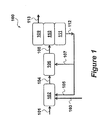
- FIG. 1 is a diagram of a reaction scheme for the catalytic pyrolysis and the catalytic cracking of a biomass material
- FIG. 2 is a diagram of in improved embodiment of the reaction scheme of figure 1
- Figure 1 is a diagrammatic depiction of one embodiment of the process 100 of the present invention.
- biomass material 101 is mixed with a particulate catalyst 105, and a fluidizing gas 103.
- the fluidizing gas 103 may be inert, or it may be a reducing gas, such as comprising hydrogen, carbon monoxide. Conveniently the gas could be flue gas from regenerator 111, which is rich in CO.
- the temperature of the catalyst particles 105 and the fluidizing gas 13 is such that the temperature in reactor 102 does not exceed 200 °C. It will be understood that biomass material 101 typically contains water, which will be driven off by fluidizing gas 103. The amount of water present in biomass material 101 is an important factor in determining the temperature in reactor 102, and must be taken into account when calculating the energy balance for reactor 102.
- the mixture 104 is transferred to fluid cracker 106.
- a second stream 107 of catalyst particles is introduced at this point.
- Catalyst stream 107 is hot, so as to maintain a cracking temperature in fluid cracker 20 of from 250 to 550 °C, preferably from 350 to 450 °C.
- the cracking reaction taking place in fluid cracker 106 reduces the oxygen content of the feedstock. If CO is present in the fluidizing gas, at least part of the oxygen reduction proceeds via the following reaction: C a H b O c + d CO ⁇ C a H b O c -d + d CO 2 (1)
- reaction mixture 108 is transferred to product/catalyst separator 110 (e.g., comprising cyclones and a stripper).
- Product is condensed in product recovery unit 109, producing product stream 113.
- the catalyst particles, which are covered with coke (a by-product of the fluid cracking reaction) are sent to regenerator 111.
- regenerator 111 an oxygen containing gas (e.g., air, or an oxygen/steam mixture) is admitted, to bum off the coke.
- the amount of oxygen and the temperature in regenerator 111 are controlled so as to maximize the amount of carbon monoxide in flue gas 103. This gas is piped to reactor 102.
- Regenerated catalyst particles 112 which are hot and, in this embodiment, virtually coke free (e.g., less than 0.2 % coke by weight of the catalyst) are recycled in part to reactor 102, and in part to fluid reactor 106.
- the split is controlled so as to obtain the desired temperatures in each of reactor 102 and fluid reactor 106.
- FIG. 2 is a diagrammatic representation of a second embodiment of the present invention. This embodiment differs from that of figure 1 in that the regeneration in regenerator 111 is controlled such that the regenerated catalyst particles (112a, 107a and 105a) retain at least 1 wt%, preferably about 2 wt % of coke.
- the feedstock reacts with carbon monoxide in the flue gas, as per equation (1), above.
- feedstock is deoxygenated by reaction with the coke deposit on the catalyst particles, as illustrated by equation (2): C a H b O c + eC ⁇ C a H b O c-2e + e CO 2 (2)
- coke is depicted as elemental carbon, although it may contain small amounts of hydrogen.
- 106, 110 and 111 can be the riser, the stripper and the regenerator of a conventional FCC unit.
- feed 101 Any high-oxygen feedstock may be used as feed 101.
- the feedstock may be liquid or solid.
- suitable liquid feedstocks include bio-oils and components of bio-oils.
- bio-oil refers to liquid product resulting from a chemical treatment of a solid biomass.
- the chemical treatment may be pyrolysis, cracking, hydrotreatment, and the like.
- solid feedstocks include solid biomass materials, in particular biomass materials containing cellulose and/or ligno-cellulose. Examples include wood particles, straw, corn husks, bagasse, and other forms of forestry or agricultural waste materials.
- Solid biomass materials may be fed directly into reactor 102 in the form of small particles.
- Fluidizing gas 103 carrying catalyst material 105 or 105a provides intimate mixing of the catalyst material and the solid biomass.
- catalyst material 105 or 105a is brought into intimate contact with solid biomass material in a pre-treatment step (not shown) prior to introduction into reactor 102.
- Solid biomass may be brought into intimate contact with catalyst particles by mechanical processes, such as grinding, milling kneading, and the like. Such processes are disclosed in more detail in our pending patent application PCT/EP2007/054377 , the disclosures of which are incorporated herein by reference. It will be appreciated that the presence of coke on the surface of the catalyst particles may act as a lubricant, thereby enhancing the penetration of the catalyst particle into the biomass particle.
- the catalyst particles used in this pre-mixing step may be much smaller than the catalyst sizes customary for use in FCC processes.
- the latter are in the mm range, whereas for this pre-mixing step the catalyst particles have an average particle size in the range of from 50 nanometers to 40 micrometers, preferably from 150 to 500 nanometers.
- These catalyst particles are recovered from the product stream as "fines", and recycled to the pre-mixing step.
- the process for deoxygenation of solid biomass may comprise two catalyst streams: a first catalyst stream comprising catalyst particles having an average particle size the range of from 50 nanometers to 40 micrometers, preferably from 150 to 500 nanometers, which is mixed with a solid biomass in a mixer positioned upstream of reactor 102, and which is recovered from the product stream in separator 109; and a second catalyst stream comprising catalyst particles suitable for fluidized beds (i.e., in the mm range), which is recovered from regenerator 111 (with or without a coke residue) and recycled into 102 and 106.
- the chemical composition of the two catalyst streams may be the same or different, with the understanding that, even if the same catalyst is used in both stream, the catalyst particles of the second stream will usually contain a binder.
- Suitable catalytic materials include clays, silicas, silica-aluminas, magnesia, magnesia-alumina, magnesia-silica-alumina, manganese compounds, lime, transition metal hydroxides, metal oxides, metal hydroxyl salts, zeolites, cationic layered materials, anionic clays, layered double hydroxides (LDHs), smectite clays, saponites, and mixtures thereof.
Landscapes
- Chemical & Material Sciences (AREA)
- Oil, Petroleum & Natural Gas (AREA)
- Engineering & Computer Science (AREA)
- Chemical Kinetics & Catalysis (AREA)
- General Chemical & Material Sciences (AREA)
- Organic Chemistry (AREA)
- Life Sciences & Earth Sciences (AREA)
- Wood Science & Technology (AREA)
- Production Of Liquid Hydrocarbon Mixture For Refining Petroleum (AREA)
- Catalysts (AREA)
Priority Applications (6)
| Application Number | Priority Date | Filing Date | Title |
|---|---|---|---|
| EP07118777A EP2053114A1 (fr) | 2007-10-18 | 2007-10-18 | Processus de réduction du contenu en oxygène de produits de départ riches en oxygène |
| EP08839814A EP2203541A2 (fr) | 2007-10-18 | 2008-10-16 | Processus de réduction du contenu en oxygène de produits de départ riches en oxygène |
| BRPI0817648 BRPI0817648A2 (pt) | 2007-10-18 | 2008-10-16 | Processo para reduzir o teor de oxigênio de matérias-primas com alto teor de oxigênio |
| CA2699326A CA2699326C (fr) | 2007-10-18 | 2008-10-16 | Procede pour reduire la teneur en oxygene des produits de depart a teneur elevee en oxygene |
| PCT/EP2008/064003 WO2009050249A2 (fr) | 2007-10-18 | 2008-10-16 | Procédé pour réduire la teneur en oxygène des produits de départ à teneur élevée en oxygène |
| US12/681,053 US8598393B2 (en) | 2007-10-18 | 2008-10-16 | Process for reducing the oxygen content of high-oxygen feedstocks |
Applications Claiming Priority (1)
| Application Number | Priority Date | Filing Date | Title |
|---|---|---|---|
| EP07118777A EP2053114A1 (fr) | 2007-10-18 | 2007-10-18 | Processus de réduction du contenu en oxygène de produits de départ riches en oxygène |
Publications (1)
| Publication Number | Publication Date |
|---|---|
| EP2053114A1 true EP2053114A1 (fr) | 2009-04-29 |
Family
ID=39359112
Family Applications (2)
| Application Number | Title | Priority Date | Filing Date |
|---|---|---|---|
| EP07118777A Withdrawn EP2053114A1 (fr) | 2007-10-18 | 2007-10-18 | Processus de réduction du contenu en oxygène de produits de départ riches en oxygène |
| EP08839814A Withdrawn EP2203541A2 (fr) | 2007-10-18 | 2008-10-16 | Processus de réduction du contenu en oxygène de produits de départ riches en oxygène |
Family Applications After (1)
| Application Number | Title | Priority Date | Filing Date |
|---|---|---|---|
| EP08839814A Withdrawn EP2203541A2 (fr) | 2007-10-18 | 2008-10-16 | Processus de réduction du contenu en oxygène de produits de départ riches en oxygène |
Country Status (5)
| Country | Link |
|---|---|
| US (1) | US8598393B2 (fr) |
| EP (2) | EP2053114A1 (fr) |
| BR (1) | BRPI0817648A2 (fr) |
| CA (1) | CA2699326C (fr) |
| WO (1) | WO2009050249A2 (fr) |
Cited By (7)
| Publication number | Priority date | Publication date | Assignee | Title |
|---|---|---|---|---|
| WO2012143573A1 (fr) * | 2011-04-21 | 2012-10-26 | Shell Internationale Research Maatschappij B.V. | Procédé de conversion d'une biomasse solide |
| WO2012143564A1 (fr) * | 2011-04-21 | 2012-10-26 | Shell Internationale Research Maatschappij B.V. | Procédé de conversion d'une biomasse solide |
| WO2012143572A1 (fr) * | 2011-04-21 | 2012-10-26 | Shell Internationale Research Maatschappij B.V. | Procédé de régénération d'un catalyseur de craquage catalytique enrobé de coke |
| WO2012143551A1 (fr) * | 2011-04-21 | 2012-10-26 | Shell Internationale Research Maatschappij B.V. | Procédé de transformation d'un matériau de biomasse solide |
| WO2012143550A1 (fr) * | 2011-04-21 | 2012-10-26 | Shell Internationale Research Maatschappij B.V. | Procédé de transformation d'un matériau de biomasse solide |
| WO2012143567A1 (fr) * | 2011-04-21 | 2012-10-26 | Shell Internationale Research Maatschappij B.V. | Procédé de conversion d'une biomasse solide |
| US9115314B2 (en) | 2012-04-23 | 2015-08-25 | Shell Oil Company | Process for converting a solid biomass material |
Families Citing this family (5)
| Publication number | Priority date | Publication date | Assignee | Title |
|---|---|---|---|---|
| EP2024435A1 (fr) * | 2006-05-05 | 2009-02-18 | BIOeCON International Holding N.V. | Matériau polymère d'origine photosynthétique comprenant un matériau inorganique particulaire |
| US9309469B2 (en) * | 2009-09-30 | 2016-04-12 | Johnson Matthey Process Technologies, Inc. | Apparatus and method for controlling or adding material to one or more units |
| BR112012020475A2 (pt) * | 2010-02-16 | 2016-05-17 | Kior Inc | coprocessamento de biomassa e material à base de polímero sintéticos em um processo de conversão de pirólise |
| WO2011159768A2 (fr) * | 2010-06-18 | 2011-12-22 | Viresco Energy | Huile biologique à faible oxygénation par pyrolyse en deux étapes |
| US9303213B2 (en) | 2012-07-19 | 2016-04-05 | Kior, Llc | Process for producing renewable biofuel from a pyrolyzed biomass containing bio-oil stream |
Citations (1)
| Publication number | Priority date | Publication date | Assignee | Title |
|---|---|---|---|---|
| US4304649A (en) * | 1980-08-25 | 1981-12-08 | The United States Of America As Represented By The Secretary Of Agriculture | Solubilization of lignocellulosic materials |
Family Cites Families (8)
| Publication number | Priority date | Publication date | Assignee | Title |
|---|---|---|---|---|
| US7119241B2 (en) * | 2002-09-27 | 2006-10-10 | Exxonmobile Chemical Patents Inc. | Process for handling catalyst from an oxygenate to olefin reaction |
| US7273960B2 (en) * | 2002-10-25 | 2007-09-25 | Exxonmobil Chemical Patents Inc | Fluid bed oxygenates to olefins reactor apparatus and process of controlling same |
| US7199278B2 (en) * | 2004-07-30 | 2007-04-03 | Exxonmobil Chemical Patents Inc. | Conversion of oxygenates to olefins |
| US20090026112A1 (en) * | 2006-02-09 | 2009-01-29 | Jan Lodewijk Maria Dierickx | Fluid catalytic cracking process |
| US7582792B2 (en) * | 2006-06-15 | 2009-09-01 | Eastman Chemical Company | Carbonylation process |
| EP1892280A1 (fr) * | 2006-08-16 | 2008-02-27 | BIOeCON International Holding N.V. | Craquage catalytique en lit fluidisé de composés oxygénés |
| US7829751B2 (en) * | 2006-10-27 | 2010-11-09 | Exxonmobil Chemical Patents, Inc. | Processes for converting oxygenates to olefins using aluminosilicate catalysts |
| US8022002B2 (en) * | 2009-03-24 | 2011-09-20 | Uop Llc | Integrated regeneration of non-noble metal catalysts |
-
2007
- 2007-10-18 EP EP07118777A patent/EP2053114A1/fr not_active Withdrawn
-
2008
- 2008-10-16 CA CA2699326A patent/CA2699326C/fr not_active Expired - Fee Related
- 2008-10-16 US US12/681,053 patent/US8598393B2/en not_active Expired - Fee Related
- 2008-10-16 BR BRPI0817648 patent/BRPI0817648A2/pt not_active Application Discontinuation
- 2008-10-16 WO PCT/EP2008/064003 patent/WO2009050249A2/fr not_active Ceased
- 2008-10-16 EP EP08839814A patent/EP2203541A2/fr not_active Withdrawn
Patent Citations (1)
| Publication number | Priority date | Publication date | Assignee | Title |
|---|---|---|---|---|
| US4304649A (en) * | 1980-08-25 | 1981-12-08 | The United States Of America As Represented By The Secretary Of Agriculture | Solubilization of lignocellulosic materials |
Non-Patent Citations (2)
| Title |
|---|
| J.D. ADJAYE, N.N. BAKHSHI: "Production of Hydrocarbons by Catalytic Upgrading of a Fast Pyrolysis bio-oil. Part I: Conversion over various catalysts", FUEL PROCESSING TECHNOLOGY, vol. 45, no. 1995, December 1995 (1995-12-01) - 4 April 1995 (1995-04-04), Amsterdam, pages 161 - 183, XP002480764 * |
| J.D. ADJAYE, N.N. BAKHSHI: "Production of Hydrocarbons by Catalytic Upgrading of a Fast Pyrolysis bio-oil. Part II: Comparative catalyst performance and reaction pathways", FUEL PROCESSING TECHNOLOGY, vol. 45, no. 3, December 1995 (1995-12-01) - 4 April 1995 (1995-04-04), Amsterdam, pages 185 - 202, XP002480765 * |
Cited By (15)
| Publication number | Priority date | Publication date | Assignee | Title |
|---|---|---|---|---|
| CN103597056A (zh) * | 2011-04-21 | 2014-02-19 | 国际壳牌研究有限公司 | 转化固体生物质材料的方法 |
| CN103597059A (zh) * | 2011-04-21 | 2014-02-19 | 国际壳牌研究有限公司 | 转化固体生物质材料的方法 |
| WO2012143572A1 (fr) * | 2011-04-21 | 2012-10-26 | Shell Internationale Research Maatschappij B.V. | Procédé de régénération d'un catalyseur de craquage catalytique enrobé de coke |
| WO2012143551A1 (fr) * | 2011-04-21 | 2012-10-26 | Shell Internationale Research Maatschappij B.V. | Procédé de transformation d'un matériau de biomasse solide |
| WO2012143550A1 (fr) * | 2011-04-21 | 2012-10-26 | Shell Internationale Research Maatschappij B.V. | Procédé de transformation d'un matériau de biomasse solide |
| WO2012143567A1 (fr) * | 2011-04-21 | 2012-10-26 | Shell Internationale Research Maatschappij B.V. | Procédé de conversion d'une biomasse solide |
| WO2012143564A1 (fr) * | 2011-04-21 | 2012-10-26 | Shell Internationale Research Maatschappij B.V. | Procédé de conversion d'une biomasse solide |
| US9248444B2 (en) | 2011-04-21 | 2016-02-02 | Shell Oil Company | Process for regenerating a coked catalytic cracking catalyst |
| WO2012143573A1 (fr) * | 2011-04-21 | 2012-10-26 | Shell Internationale Research Maatschappij B.V. | Procédé de conversion d'une biomasse solide |
| US8927794B2 (en) | 2011-04-21 | 2015-01-06 | Shell Oil Company | Process for regenerating a coked catalytic cracking catalyst |
| US8779225B2 (en) | 2011-04-21 | 2014-07-15 | Shell Oil Company | Conversion of a solid biomass material |
| CN103597059B (zh) * | 2011-04-21 | 2015-11-25 | 国际壳牌研究有限公司 | 转化固体生物质材料的方法 |
| US9217111B2 (en) | 2011-04-21 | 2015-12-22 | Shell Oil Company | Process for converting a solid biomass material |
| US9238779B2 (en) | 2011-04-21 | 2016-01-19 | Shell Oil Company | Process for converting a solid biomass material |
| US9115314B2 (en) | 2012-04-23 | 2015-08-25 | Shell Oil Company | Process for converting a solid biomass material |
Also Published As
| Publication number | Publication date |
|---|---|
| BRPI0817648A2 (pt) | 2015-03-31 |
| US8598393B2 (en) | 2013-12-03 |
| US20100280301A1 (en) | 2010-11-04 |
| WO2009050249A3 (fr) | 2009-07-09 |
| CA2699326A1 (fr) | 2009-04-23 |
| EP2203541A2 (fr) | 2010-07-07 |
| WO2009050249A2 (fr) | 2009-04-23 |
| CA2699326C (fr) | 2016-02-09 |
Similar Documents
| Publication | Publication Date | Title |
|---|---|---|
| US8598393B2 (en) | Process for reducing the oxygen content of high-oxygen feedstocks | |
| US8288600B2 (en) | Methods for co-processing of biomass and petroleum feed | |
| CN103261381B (zh) | 可再生生物燃料的生产 | |
| US9944837B2 (en) | Co-processing solid biomass in a conventional petroleum refining process unit | |
| US8003835B2 (en) | Biomass conversion process | |
| CN103582691B (zh) | 转化固体生物质材料的方法 | |
| CN103124781B (zh) | 可再生生物燃料的制备 | |
| CN102260529B (zh) | 一种加工劣质重油的组合方法 | |
| EP2105486A1 (fr) | Faible nombre d'acide bio brut total | |
| EP2107100A1 (fr) | Processus de craquage biocatalytique à plusieurs étages | |
| AU2009251444A1 (en) | Slurry hydroconversion of biorenewable feedstocks | |
| JP2018518550A (ja) | 水素化熱分解プロセスの制御のための共処理及びその生成物 | |
| JP2014515055A (ja) | 固体バイオマス材料を転化させる方法 | |
| US20240157347A1 (en) | Moving bed lignocellulosic biomass conversion with fluid bed catalyst regeneration | |
| JP2014511938A (ja) | 固体バイオマス材料を転化させる方法 | |
| US20150247095A1 (en) | Method of biomass conversion using a multifunctional catalyst system | |
| JP2014511936A (ja) | 固体バイオマス材料を転化させる方法 | |
| JP2014511935A (ja) | 固体バイオマス材料を転化させる方法 | |
| CN103965958B (zh) | 一种含酸石油的加工方法 | |
| EP3856874A1 (fr) | Co-traitement d'huile de liquéfaction hydrothermale et de co-charge pour produire des biocarburants | |
| EP3165588B1 (fr) | Procédé de production de gaz de synthèse par régénération d'un agent de craquage cokéfié | |
| US20150051427A1 (en) | Integrated process for the production of renewable drop-in fuels | |
| CN103059991B (zh) | 一种石油烃的高效催化转化方法 | |
| EP3165586A1 (fr) | Production d'un rendement élevé de gaz de synthèse par régénération d'agent de valorisation cokéfié | |
| CN103571519A (zh) | 一种重油的组合加工方法 |
Legal Events
| Date | Code | Title | Description |
|---|---|---|---|
| PUAI | Public reference made under article 153(3) epc to a published international application that has entered the european phase |
Free format text: ORIGINAL CODE: 0009012 |
|
| AK | Designated contracting states |
Kind code of ref document: A1 Designated state(s): AT BE BG CH CY CZ DE DK EE ES FI FR GB GR HU IE IS IT LI LT LU LV MC MT NL PL PT RO SE SI SK TR |
|
| AX | Request for extension of the european patent |
Extension state: AL BA HR MK RS |
|
| AKX | Designation fees paid | ||
| REG | Reference to a national code |
Ref country code: DE Ref legal event code: 8566 |
|
| STAA | Information on the status of an ep patent application or granted ep patent |
Free format text: STATUS: THE APPLICATION IS DEEMED TO BE WITHDRAWN |
|
| 18D | Application deemed to be withdrawn |
Effective date: 20091030 |