EP2053183A2 - Kit für den Zaunbau - Google Patents
Kit für den Zaunbau Download PDFInfo
- Publication number
- EP2053183A2 EP2053183A2 EP08166398A EP08166398A EP2053183A2 EP 2053183 A2 EP2053183 A2 EP 2053183A2 EP 08166398 A EP08166398 A EP 08166398A EP 08166398 A EP08166398 A EP 08166398A EP 2053183 A2 EP2053183 A2 EP 2053183A2
- Authority
- EP
- European Patent Office
- Prior art keywords
- kit
- aperture
- support
- fence
- fitting
- Prior art date
- Legal status (The legal status is an assumption and is not a legal conclusion. Google has not performed a legal analysis and makes no representation as to the accuracy of the status listed.)
- Withdrawn
Links
- 238000000034 method Methods 0.000 claims abstract description 23
- 238000010276 construction Methods 0.000 description 9
- 239000002184 metal Substances 0.000 description 7
- 229910052751 metal Inorganic materials 0.000 description 7
- 229910001018 Cast iron Inorganic materials 0.000 description 5
- 238000003466 welding Methods 0.000 description 5
- 229910000831 Steel Inorganic materials 0.000 description 3
- 239000010959 steel Substances 0.000 description 3
- 230000001419 dependent effect Effects 0.000 description 2
- 239000000463 material Substances 0.000 description 2
- 230000000135 prohibitive effect Effects 0.000 description 2
- 241001531957 Opsariichthys uncirostris Species 0.000 description 1
- 238000003780 insertion Methods 0.000 description 1
- 230000037431 insertion Effects 0.000 description 1
- 150000002739 metals Chemical class 0.000 description 1
- 230000003278 mimic effect Effects 0.000 description 1
- 238000012986 modification Methods 0.000 description 1
- 230000004048 modification Effects 0.000 description 1
- 239000004033 plastic Substances 0.000 description 1
- 229920003023 plastic Polymers 0.000 description 1
- 238000010079 rubber tapping Methods 0.000 description 1
- 238000000926 separation method Methods 0.000 description 1
- 230000003313 weakening effect Effects 0.000 description 1
Images



Classifications
-
- E—FIXED CONSTRUCTIONS
- E04—BUILDING
- E04H—BUILDINGS OR LIKE STRUCTURES FOR PARTICULAR PURPOSES; SWIMMING OR SPLASH BATHS OR POOLS; MASTS; FENCING; TENTS OR CANOPIES, IN GENERAL
- E04H17/00—Fencing, e.g. fences, enclosures, corrals
- E04H17/14—Fences constructed of rigid elements, e.g. with additional wire fillings or with posts
- E04H17/1413—Post-and-rail fences, e.g. without vertical cross-members
- E04H17/1417—Post-and-rail fences, e.g. without vertical cross-members with vertical cross-members
- E04H17/1426—Picket fences
- E04H17/1439—Picket fences with separate pickets going through the horizontal members
-
- E—FIXED CONSTRUCTIONS
- E04—BUILDING
- E04H—BUILDINGS OR LIKE STRUCTURES FOR PARTICULAR PURPOSES; SWIMMING OR SPLASH BATHS OR POOLS; MASTS; FENCING; TENTS OR CANOPIES, IN GENERAL
- E04H17/00—Fencing, e.g. fences, enclosures, corrals
- E04H17/14—Fences constructed of rigid elements, e.g. with additional wire fillings or with posts
- E04H17/1413—Post-and-rail fences, e.g. without vertical cross-members
- E04H17/1447—Details of connections between rails and posts
- E04H17/1448—Adjustable, angled or hinged connections
Definitions
- the present invention relates to gates and fencing which are constructed on-site in kit form and in particular, though not exclusively, to a fencing kit which can be constructed without the requirement to weld components for use in the DIY market.
- fence panel systems have been developed. In this arrangement the cross rails and stays are preassembled to form fence panels and brought to the site. Connection to the support posts can then be made by welding, bolting or screwing the panel against them. Unfortunately these systems are generally prohibitive to the diy enthusiast as the fence panels are large and heavy, difficult to connect to the posts and usually best left to a skilled tradesperson.
- GB 2 425 317 provides a kit for assembling a fence which can be transported in the back of a hatchback car and which can be assembled by the average homeowner.
- This kit comprises a plurality of elongate members which are assembled into a fence panel. The panel is then attached to support posts which are in place on site.
- the elongate panels interlock vertically with one another to form an unobstructed panel, the top and bottom edges of which slide into cross bar retainers.
- This arrangement requires the panel to be assembled and lifted into place. This can be awkward for a single constructor.
- the arrangement does not provide for the more desirable fence, this being of stays in the form of rods which have spaces between adjacent stays to allow viewing through the fence.
- WO2007/082338 describes a kit for constructing a fence having spaced apart rods.
- the cross rails are square sectioned steel tubing.
- a series of lugs are welded to the lower side of a top rail and the upper side of a lower rail at equidistant positions along the length of each rail respectively.
- Stays are push fitted into the lugs between the rails and then the panel is located between support posts. If decorative spires are required on the top of each stay extending beyond the upper side of the top rail, these are pre-welded to the top rail.
- extensions of the stays below the lower rail can also be pre-welded to the lower rail.
- the second option requires the ability to support the upper rail, which may be heavy with spires, while aligning all the stays. This is a tricky operation particularly if done alone and if the cross rails are of a significant length. Further if the stays are long they will tend to bend off alignment as they are only supported at their base until the cross rail is fitted.
- a kit of parts for constructing a fence comprising at least two support members, at least one cross rail, the cross rail including at least one aperture therethrough, fixing means to connect the rail to the support members; at least one stay dimensioned to slide through the aperture in the cross rail; and at least one unidirectional fitting adapted to connect to the cross rail at the aperture and allow the stay to pass through the aperture in a first direction but resist movement of the stay through the aperture in a second direction.
- At least one support member is a support post, the support post being adapted to be fixed to the ground.
- the support member includes a detachable base unit so that the base can initially be fixed to the ground and the support post then located thereon.
- at least one support member is a support bracket adapted to be locatable on a wall or other permanent structure.
- a user takes an easily transportable kit of parts home which can fit in the back of a standard car. They erect the support members either by erecting support posts by means such as cementing or bolting to the ground, or by fixing a support bracket to a wall. A combination of support post and support bracket may be used. With the supports in place, they can then fix the cross rails to the support members by bolts, screws or other fittings. Once positioned, the stays can be inserted through the apertures to provide a desired length for the extension and the spire. By using unidirectional or one-way fittings the stays are both supported in position and are resiliently fixed to prevent unwanted removal.
- the kit includes at least two cross rails each having a plurality of substantially equidistantly spaced apertures.
- the fixing means may include hinges so that the cross rails can move relative to a support member to thereby create a gate.
- the fixing means comprises an interlocking bracket.
- the bracket may comprise a key member which can be inserted into an aperture in the support post and rotated into position. Access to the key member can be covered to prevent unwanted removal.
- the stays may be rods with a circular cross-section.
- the stays may have a square cross-section.
- the apertures will have an outline which substantially matches the cross-section of the stays.
- the unidirectional fitting comprises a substantially tubular body, the body being dimensioned to fit snugly through the aperture.
- at least one protruding lip extends from an inner surface of the body.
- the lip may be formed by cutting a substantially u-shaped section in the body.
- the lip extends from the body in a downward direction, in use.
- the lips are equidistantly spaced around the body.
- the lips may be arranged longitudinally on the body.
- the body includes an overhang at an upper end.
- the overhang preferably extends radially outwards.
- the overhang may be dimensioned to be wider than the aperture so that, in use, the fitting can be inserted through the aperture until the overhang engages an upper surface of the cross rail and is supported thereupon.
- tabs may be formed in the body also.
- the tabs are smaller lips and are arranged opposite to the lips, to extend from the outer surface of the body in an upward direction.
- the tabs are located towards the overhang.
- one or more fittings may have a base.
- the base extends across a lower end of the fitting to prevent a stay being pushed out of the end of the fitting.
- Such fittings are used on a lower cross rail and their length is selected to provide a fixed extension for the stay from a lower rail.
- the stays may have an ornamental spire at an end thereof.
- the stays may mimic the finials found on decorative cast iron fencing.
- support post finials may also be provided. These may be detachable from the posts but include a locking mechanism to prevent unwanted removal.
- the kit is made of a metal. More preferably the kit is made in cast iron so that the gate resembles a traditional cast iron fence. Optionally the kit may be made of differing materials such as metals, woods or plastics.
- kit of parts may be provided in any selection of widths and heights which are easily transportable.
- a fence the fence being constructed from a kit of parts according to the first aspect.
- a method of constructing a fence using a kit of parts according to the first aspect including the steps of;
- the method may include the step of mounting a plurality of cross rails to the support members. Yet further the method may include the step of locating a plurality of stays through the one or more cross rails.
- the method may also include the step of locating fittings, including a base, through a lower cross rail and inserting a stay through the apertures until it engages the base of the fitting. Use of such fittings ensures that the stays are positioned level to each other and the cross rail.
- At least one cross rail may be fitted between the support members in step (a) to ensure the posts are located the correct distance apart.
- a plurality of support members are located to create a line of fencing, each section according to the first aspect.
- Step (a) may include the additional steps of:
- the method may include the step of inserting interlocking brackets between the support posts and the cross rails, and preventing access to the brackets by locating a stay adjacent to the bracket.
- the method may include the step of affixing a hinge between the cross rails and a support member. In this way a gate is created.
- FIG. 1 there is illustrated a fence, generally indicated by reference numeral 10, constructed from a kit of parts 12, according to an embodiment of the present invention.
- the kit of parts 12 comprises two members being support posts 14a,b; two cross rails 16a,b; four fixing means 18a-d; eight unidirectional fittings 20a-d,22a-d; and four stays 24a-d. This is an illustrative kit and it will be appreciated that the quantity of each of the parts will be dependent on the length and dimensions of the fence required.
- Each support post 14 is a square cross-section of steel, having at its base 26, a plate 28 for fixing the support post 14 to the ground. At an upper end 30, the post is finished with a decorative ball 32.
- the ball 32 or other decorative ornamentation is optional.
- each cross rail 16 is a flat steel bar 33 having recesses 34 at either end to allow adjustment in the fixing means, to be described hereinafter. An alternative arrangement would be just to use apertures on bar for the fixing means with the adjustment provided elsewhere.
- each cross rail 16a,b has four apertures 36a-d,38a-d, respectively which pass through the bar 33 from an upper surface 40 to a lower surface 42.
- the apertures 36,38 are spaced evenly along the length of the bar 33. In this embodiment the apertures 36,38 are circular.
- Fixing means 18 comprises a bracket 44 and a bolt, washer and nut set 46.
- the bracket 44 is attached to the support post 14. This attachment may be by welding or, alternatively, by a screw. If the bracket 44 is welded in place, the support post 14 will be supplied with the bracket in place. If a screw fitting is expected then the bracket will form a component part of the kit 12. This is as illustrated in the figure where the bracket 44 is a simple angle bracket having a slot 48 on a first plane 55 for fixing the bracket 44 to the support post 14, and an aperture 50 on a second plane for affixing the bracket 44 to a cross rail 16.
- the recess 34 lies over the aperture 50 and the bolt, nut and washer set 46 are tightened up to hold the cross rail 16 to the bracket 44.
- an aperture could be used in place of the recess 34 and a slot located on the bracket 44 to allow for adjustment.
- the shape of the bracket 44 is selected so that, once constructed, it has a low profile to give the impression that the cross rail 16 could be welded to the support post 14 as would occur in a traditional cast iron fence.
- brackets 44 are located on a support post 14 also provides three types of support posts. These are also illustrated in Figure 1 . If brackets 44 are located on a single face 58 of the support post 14, then an end post 52 is created. If brackets 44 are located on opposing faces 58,60 of a support post 14, then a link post 54 is created. Finally, if brackets are located on adjacent faces 58,62 of a support post 14 (illustrated in dashed lines on the Figure), then a corner post 56 is created. It will be apparent to those skilled in the art that if the bracket 44 is turned by 90 degrees and hinged, an appropriate cross rail 16 fitted thereto would provide a gate as the rails 16 could swing relative to the support post 14.
- the stays are metal rods 64 having a first end 66 which is shaped to fit through the apertures 36,38.
- the first end 66 is flat but in others it may be spiked, rounded or have any other profile which still allows insertion through the apertures 36,38.
- an ornamentation in the form of a finial 70 is an ornamentation in the form of a finial 70.
- the finial is a ball, to match the ball 32 on the support posts, however, it will be apparent that any finial design may be selected.
- the finial 70 may be of any size or shape as it is not required to slide through the apertures 36,38.
- the stays 24 could be inserted through the apertures and be allowed to either meet the ground, or hang by the finials at the apertures 36 in the top cross rail 16a, this is not desired by the inventor. Such arrangements would allow the stays to wobble, due to the tolerances required to ensure the stays 24 all fit the apertures 36,38.
- the fence 10 would then be unstable and noisy in windy conditions with the stays rattling in the apertures. Additionally, the stays could be easily removed making them too plausible for thieves.
- the invention therefore includes fittings 20,22 to positively hold the stays 24 in position both for aesthetics and for security.
- one of the fittings 20 may also be used on any other rail 16.
- Fitting 20 may be referred to as a through clip.
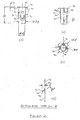
- Fitting 20 has a tubular metal body 72 which is substantially cylindrical to match the cross-section of the apertures 36,38 and the rod 64. It will be apparent that all three components can be designed with a different cross-sectional area if desired. However, the features of the fitting 20 will be carried across onto any other design. These features are an overhang 74; lip 76 and tab 78.
- the overhang 74 At an upper end 80 of the body 72 is arranged the overhang 74.
- the overhang is created by cutting vertical portions from the end 80 and folding the remaining sections outwards to form a splayed 'foot' when viewed from above (see Figure 2(c) ). This is a simple method of creating the overhang 74 but it could equally be cast as a complete circular extension.
- the important feature of the overhang is that it provides an outer diameter to the fitting 20 which is greater than the diameter of the aperture 36,38 through which it will pass. In this way, when fitted, the lower surface 82 of the overhang 74 will rest on the upper surface 40 of the rail 16, with the remainder of the body 72 hanging below the rail 16.
- each tab is an outwardly angled protrusion 86, with the free end 88 towards the overhang 74.
- Each protrusion 86 is formed by cutting an inverted 'U' shape through the body 72.
- the tabs 78 are spaced equidistantly around the circumference of the body 72 with the number selected to fit around the body 72 without weakening the structure.
- the free end 88 of the tab 78 is spaced from the overhang by a distance just greater than the thickness of the bar 33. In this way the free ends will sit just under the bar to catch the bar if the fitting 20 where to be attempted to be removed.
- the lips 76 Arranged below the tabs 78 are the lips 76. These are downwardly facing protrusions 90. They are larger than the tabs 78 and have a greater portion of cut-away material to make the 'U' shape, so that it is easier to push a lip 76 inwards. In this way, the lips 76 extend into the body 72 from the inner surface 92. There are three lips 76 equidistantly arranged around the body 72. The free ends 94 of the lips 76 may be serrated to provide additional grip and cut into the outer surface 96 of a stay 24. Thus the lips 76 are pushed out of the way as a stay 24 is inserted through the fitting 20 with only the free ends 94 scrapping against the outer surface 96 of the stay.
- Fitting 22 may be referred to as a retainer clip.
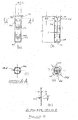
- Fitting 22 is identical to the through clip fitting 20 except that it has a longer body 98 terminating in a base 100 and an extra row of lips 102. In the embodiment shown there are four tabs 104 equally spaced below the overhang 106 as described with reference to Figure 2 .
- the retainer clip fitting 22 also includes opposing split sides 108 (one shown). The split side is a cut running the length of the body 98 and around a lower end 110 thereof. The split 108 assists in the escape of air when a stay 24 is inserted into the fitting 22. As a base 100 covers the entire lower end 110 of the body 98, a vacuum would be created if there was not an exhaust route as the stay 24 is inserted. While a split 108 is illustrated it will be apparent that any aperture to create an air release port through the arrangement would be appropriate. The pair of split sides 108 in this embodiment allows for easier construction of the fitting 22.
- the stay 24 can only be inserted through an aperture 38 in a cross rail 16 by a fixed distance. This distance is determined by the length of the fitting 22.
- retainer clip fittings 22 on a lower cross rail 16b, it ensures that the stays appear above the ground and identically horizontally arranged across the fence 10. If through clip fittings 20 are used on a lower rail 16b, it is intended that the base 26 of the stays 24 will rest upon the ground.
- a purchaser being typically a general DIY enthusiast will first determine the length of fence they wish to construct, it's desired height, design and number of corners which may be present. Once they have determined these they can purchase the component parts to form their chosen fence design. In this way, component parts will be stocked in a selection of lengths of support posts and stays, designs in terms of cross-sectional profiles and ornamentation. They will also select the types of cross rails and the number of apertures therein and the number of through or retainer clip fittings.
- Table 1 below provides a guide to the number of selected components for a set distance between supporting rails to meet current UK standards for fence construction.
- the user first determines the positions of the support posts 14. Naturally, end posts 52 will be used at either end of the fence 10, with corner posts 56 at appropriate points where the direction of the fence is required to turn 90 degrees.
- Link posts 54 make up the remainder of the support posts 14.
- a cross rail 16 can be inserted or fitted between neighbouring posts 14. The posts 14 are then secured to the ground. This may be by bolting, screwing, or cementing as is shown in Figure 4 .
- the base plate 28 helps to level the support posts 14.
- each cross rail 16 can be attached between the posts 14.
- the fixing bracket 44 can first be located to the support post 14 if required. This is done by placing a screw through the slot 48 in the bracket 44 with the face 55 of the bracket 44 held against the correct face 58,60,62 of the post 14. With the bracket 44 in place, the cross rails 16 are located upon the respective bracket 44. This is done by locating the recess 34 over the aperture 50 and then fixing the two together using the bolt, washer and nut set 46. Alternatively, the aperture may be in the bar 33 with a slot in the bracket 44.
- FIG. 5 illustrates a portion of a fence 10, constructed from a kit of parts 12, according to a further embodiment of the present invention. Like parts to those shown in earlier Figures have been given the same reference numeral to aid clarity.
- each support bracket 112 is an angle bracket having two perpendicular plates 116,118 with apertures therethrough.
- the back plate 116 is bolted to the wall 114 while the aperture on the top plate 118 is used to attach the cross rail 16 to the support member.
- the fixing means is by the bolt, washer, and nut set 46. While brackets 44 could be used as support members, it is preferred that heavier duty brackets and bolts are used for the support brackets 112 to provide a more secure fixing to the wall in order to support the weight of the fence 10 at one side.
- each support post 14a,b now comprises a base unit 210, being a hollow square cross-section of metal affixed to a base plate 212.
- the base plate 212 has corresponding fixtures to allow attachment of the plate to a surface such as the ground.
- Each side of the unit includes an elongate aperture 213.
- a square cross-sectional post 214 is arranged as a sliding fit over the base unit 210. Alternatively the post 214 could be located within the base 210. On one or more side of the post 214 are a row of generally rectangular apertures 216. Typically three sides will contain apertures 216 with the fourth being a plane finish free of apertures for aesthetic reasons.
- a finial insert 218 is arranged as a sliding fit within the post 214.
- the finial insert 218 also has elongate apertures 219 similar to those of the base unit 210.
- Brackets 44 cannot be welded into place as the heights may not match for locating cross rails 16 between adjacent posts 14. To overcome this, the brackets 44 are now separate from the post 14. Each bracket 44 still comprises a right angle bend with an aperture 50, but a locking arrangement 220 is now attached to the first plane 55.
- Locking arrangement 220 comprises a threaded nut 222 threadably engaged to the bracket 44.
- the nut 222 terminates with a head 224 at a first end and a rectangular plate 226 at a second end.
- the plate 226 is sized to fit through the apertures 216 in a first direction, but if rotated they are obstructed.
- the plate 226 is also sized to fit, in one direction, through the elongate slots 213, 219. When located in the aperture 216, the locking arrangement 220 can be rotated to leave only a head 224 exposed.
- the mounting of the brackets 44 is best described by considering the method of constructing a fence according to this embodiment.
- the purchaser will determine the length of fence they wish to construct, it's desired height, design and number of corners which may be present. They will then determine the number of respective kit parts they require. Table 1 illustrated typical numbers for some fence designs.
- the purchaser will also select the post lengths they require and for each post 214 they will require a base unit 210 and a finial insert 218 of their choosing. Additionally, for every cross rail 16 they require two brackets 44 for attachment of the rail 16 to the post 214.
- the locking arrangement 220 may be pre-fitted to the posts 214 at regular intervals in the apertures 216.
- each part is smaller and more lightweight than the corresponding parts from the first embodiment. This makes handling and transporting of the kit of parts 12 much easier.
- the user first determines the desired post length. They will either have purchased the correct post lengths or they could buy longer lengths and cut them to size. Similarly the cross rails 16 can also be bought at length or cut to size. The user then determines the position of the cross rails 16 on the posts 214. Unwanted locking arrangements 220 are removed by rotating the head 224 through 90 degrees to align the plate 226 with a slot 216 and pulling the arrangement 220 through the slot 216. The brackets 44 can then be screwed onto the locking arrangements 220, and fitted to the posts 214, by re-inserting the plate 226 through the slot 216 and tightening. Brackets 44 are placed at all locations where a rail 16 is to be supported.
- the base units 210 may have been secured to the ground where required, or preferably, they are left free to aid alignment. In this way the posts 214 are dropped on the base units 210 or into prepared holes or other desired positions. Cross rails 16 are placed on the brackets 44 and stays 64 inserted through the apertures 50, 36, 38 respectively. With the stays 64 in place, the posts 14 can be levelled and aligned.
- the base units 210 can also be secured by bolting the plate 212 or cementing the unit 210 to the ground or other surface. Alternatively the brackets 44 can be used to support posts against walls as described herein before.
- the stays 64 and rails 16 are removed.
- the holding sleeve 230 is fed onto or moved to an end of the top rail 16a.
- the rail 16a is placed on top of the bracket 44 and the sleeve 230 is slid over both to a position where apertures 232 in the sleeve align with the apertures 50, 36 on the bracket 44 and rail 16a respectively.
- a stay 64 is then dropped through the created aperture. The procedure is repeated with the other end of the rail 16a.
- Holding sleeves 230 are located on the bottom rail 16b, one space from the end. A retaining clip 20,22 is pushed through the end aperture 38 of the rail to keep the holding sleeve 230 in place. The remaining clips 20,22 are pushed into the apertures 38 along the rail 16b. A hammer may be used to tap the clips 20,22 into position. The rail 16b is then located on the brackets 44, pushing the clip 20,22 through the aperture 50. If small clips 20 are used, the holding sleeve 230 can be slid over the apertures. Stays 64 are then located through each of the clips 20,22 and a hammer is used to tap down each stay 64 to the required position and to grip the respective clip 20,22.
- the finial inserts 218 can then be located in the supports 214 to complete the fence 10. If pilfering of the inserts 218 is a concern, then the inserts can be put on before the cross rails 16 and held in place using the locking arrangement 220. When the stays 64 are located in position access to the locking arrangement 220 is prevented and thus the finial inserts 218 cannot be removed.
- Figures 7(a)-(d) illustrates some fence designs using the kit of parts of the present invention. It will be seen that many other designs could be constructed and these are merely a small selection. As illustrated in Figures 7(a),(c) and (d) any number of cross rails can be supported on the posts. Figure 7(d) also illustrates additional elements, in the form of rings, which can be located between the rails, upon the stays, to increase the possible designs available. The rings may also be held in place by the finials upon the stays.
- the principal advantage of the present invention is that it provides a kit of parts for the construction of a fence which requires no specialist skills and may be easily assembled by a DIY enthusiast.
- a further advantage of the present invention is that it provides a kit of parts for the construction of a fence which can resemble a cast iron fence but does not require any welding on-site.
- a yet further advantage of the present invention is that it provides a method of constructing a fence from a kit of parts which does not require an individual to lift or support more than one component part at a time, particularly not an entire fence panel.
- a yet further advantage of the present invention is that it provides a kit of parts for the construction of a fence which, when constructed, is not easily pilfered.
- runner channels may be formed on the face of the support posts with complimentary engaging fittings on the cross rails so that the rails may be secured to the posts in a non releasable manner.
- the cross rails need not be flat or level bars but may be of various shapes and orientations as long as they provide a line of apertures through which the stays may be fitted. It will also be apparent that a large number of designs of fences may be achieved from a kit according to the present invention.
Landscapes
- Engineering & Computer Science (AREA)
- Architecture (AREA)
- Civil Engineering (AREA)
- Structural Engineering (AREA)
- Fencing (AREA)
Applications Claiming Priority (2)
| Application Number | Priority Date | Filing Date | Title |
|---|---|---|---|
| GB0721091A GB0721091D0 (en) | 2007-10-26 | 2007-10-26 | Gate & fencing kit system |
| GB0810109A GB0810109D0 (en) | 2008-06-03 | 2008-06-03 | Gate & fencing kit system |
Publications (2)
| Publication Number | Publication Date |
|---|---|
| EP2053183A2 true EP2053183A2 (de) | 2009-04-29 |
| EP2053183A3 EP2053183A3 (de) | 2013-10-30 |
Family
ID=40282437
Family Applications (1)
| Application Number | Title | Priority Date | Filing Date |
|---|---|---|---|
| EP08166398.1A Withdrawn EP2053183A3 (de) | 2007-10-26 | 2008-10-10 | Kit für den Zaunbau |
Country Status (1)
| Country | Link |
|---|---|
| EP (1) | EP2053183A3 (de) |
Cited By (5)
| Publication number | Priority date | Publication date | Assignee | Title |
|---|---|---|---|---|
| EP2759655A4 (de) * | 2011-08-24 | 2015-12-02 | GIL Jesús PUNTER | Handlauf aus vorgefertigten rohren und teilen aus rostfreiem stahl |
| IT201600073524A1 (it) * | 2016-07-14 | 2018-01-14 | Massimo Celli | Struttura per realizzare recinzioni, inferriate, parapetti ed altri simili prodotti di carpenteria |
| CN112681876A (zh) * | 2021-01-02 | 2021-04-20 | 中铁宝桥集团有限公司 | 一种可拆卸式安全防护栏杆及安全防护方法 |
| CN115095276A (zh) * | 2022-07-16 | 2022-09-23 | 唐山中地工程勘察有限公司 | 一种岩土工程勘察用钻机 |
| CN116043750A (zh) * | 2023-01-10 | 2023-05-02 | 湖南金宝涟交通设施工程股份有限公司 | 一种高速护栏用支撑角度可调式立柱 |
Citations (2)
| Publication number | Priority date | Publication date | Assignee | Title |
|---|---|---|---|---|
| GB2425317A (en) | 2005-04-18 | 2006-10-25 | Corus Uk Ltd | A kit for assembling a fence |
| WO2007082338A1 (en) | 2006-01-17 | 2007-07-26 | Anna Heyes | A fence system |
Family Cites Families (4)
| Publication number | Priority date | Publication date | Assignee | Title |
|---|---|---|---|---|
| AU7655074A (en) * | 1973-12-17 | 1976-06-17 | Tubemakers Australia | Modular fence |
| US6863265B2 (en) * | 2003-06-04 | 2005-03-08 | Safeguards Technology, Inc. | Tamper resistant fence |
| FR2887009B1 (fr) * | 2005-06-13 | 2007-08-24 | Patrice Hureau | Grille montable sur mesure |
| US20070170410A1 (en) * | 2006-01-25 | 2007-07-26 | Gtech Precision Industries (Usa), Ltd. | System, method and Apparatus for Assembling a Picket Fence |
-
2008
- 2008-10-10 EP EP08166398.1A patent/EP2053183A3/de not_active Withdrawn
Patent Citations (2)
| Publication number | Priority date | Publication date | Assignee | Title |
|---|---|---|---|---|
| GB2425317A (en) | 2005-04-18 | 2006-10-25 | Corus Uk Ltd | A kit for assembling a fence |
| WO2007082338A1 (en) | 2006-01-17 | 2007-07-26 | Anna Heyes | A fence system |
Cited By (7)
| Publication number | Priority date | Publication date | Assignee | Title |
|---|---|---|---|---|
| EP2759655A4 (de) * | 2011-08-24 | 2015-12-02 | GIL Jesús PUNTER | Handlauf aus vorgefertigten rohren und teilen aus rostfreiem stahl |
| IT201600073524A1 (it) * | 2016-07-14 | 2018-01-14 | Massimo Celli | Struttura per realizzare recinzioni, inferriate, parapetti ed altri simili prodotti di carpenteria |
| WO2018011231A1 (en) | 2016-07-14 | 2018-01-18 | Celli Massimo | Structure for making fences, grates, guardrails and other similar carpentry products |
| CN112681876A (zh) * | 2021-01-02 | 2021-04-20 | 中铁宝桥集团有限公司 | 一种可拆卸式安全防护栏杆及安全防护方法 |
| CN115095276A (zh) * | 2022-07-16 | 2022-09-23 | 唐山中地工程勘察有限公司 | 一种岩土工程勘察用钻机 |
| CN115095276B (zh) * | 2022-07-16 | 2023-07-04 | 唐山中地工程勘察有限公司 | 一种岩土工程勘察用钻机 |
| CN116043750A (zh) * | 2023-01-10 | 2023-05-02 | 湖南金宝涟交通设施工程股份有限公司 | 一种高速护栏用支撑角度可调式立柱 |
Also Published As
| Publication number | Publication date |
|---|---|
| EP2053183A3 (de) | 2013-10-30 |
Similar Documents
| Publication | Publication Date | Title |
|---|---|---|
| US20070221903A1 (en) | Interlocking fence system and method | |
| US7347412B1 (en) | Modular fence | |
| US6648304B1 (en) | Modular fence | |
| US8899555B2 (en) | Adjustable picket fence | |
| US5581868A (en) | Method and apparatus for constructing a metal picket fence | |
| US20090026431A1 (en) | Picket and rail fence | |
| US9458667B2 (en) | Gate for composite railing | |
| US20090166598A1 (en) | Metal fence post and fence system | |
| US20080157049A1 (en) | Interlocking Fence System and Method | |
| EP2053183A2 (de) | Kit für den Zaunbau | |
| EP4107347B1 (de) | Zaun | |
| CN101605947A (zh) | 构件之间的套管型或套筒型接合件的支架 | |
| WO2001020105A1 (en) | Hoardings | |
| WO2024007047A1 (en) | Connection system | |
| US7222467B2 (en) | Screen with integral railing | |
| AU2004323735A1 (en) | Paling fences | |
| AU2005239724B2 (en) | Modular fence | |
| US20260092469A1 (en) | Stackable spacers for infill | |
| AU2010100852A4 (en) | Fencing system | |
| CN108495971A (zh) | 具有隐蔽型紧固件和降噪性能的栅栏 | |
| FR2900425A1 (fr) | Jeu d'elements pour la realisation d'une cloison mobile | |
| AU733808B3 (en) | Walling assembly and method | |
| AU2023302877A1 (en) | Connection system | |
| GB2581875A (en) | Fencing system, set of components for constructing a fence, and mounting Members(S) | |
| US20080164450A1 (en) | Vinyl over substrate rail construction |
Legal Events
| Date | Code | Title | Description |
|---|---|---|---|
| PUAI | Public reference made under article 153(3) epc to a published international application that has entered the european phase |
Free format text: ORIGINAL CODE: 0009012 |
|
| AK | Designated contracting states |
Kind code of ref document: A2 Designated state(s): AT BE BG CH CY CZ DE DK EE ES FI FR GB GR HR HU IE IS IT LI LT LU LV MC MT NL NO PL PT RO SE SI SK TR |
|
| AX | Request for extension of the european patent |
Extension state: AL BA MK RS |
|
| PUAL | Search report despatched |
Free format text: ORIGINAL CODE: 0009013 |
|
| AK | Designated contracting states |
Kind code of ref document: A3 Designated state(s): AT BE BG CH CY CZ DE DK EE ES FI FR GB GR HR HU IE IS IT LI LT LU LV MC MT NL NO PL PT RO SE SI SK TR |
|
| AX | Request for extension of the european patent |
Extension state: AL BA MK RS |
|
| RIC1 | Information provided on ipc code assigned before grant |
Ipc: E04H 17/14 20060101AFI20130926BHEP |
|
| AKY | No designation fees paid | ||
| REG | Reference to a national code |
Ref country code: DE Ref legal event code: R108 |
|
| REG | Reference to a national code |
Ref country code: DE Ref legal event code: R108 Effective date: 20140709 |
|
| STAA | Information on the status of an ep patent application or granted ep patent |
Free format text: STATUS: THE APPLICATION IS DEEMED TO BE WITHDRAWN |
|
| 18D | Application deemed to be withdrawn |
Effective date: 20140501 |