EP2053553A1 - Verfahren und Vorrichtung zum Austausch von Werten zwischen persönlichen tragbaren elektronischen Einheiten - Google Patents
Verfahren und Vorrichtung zum Austausch von Werten zwischen persönlichen tragbaren elektronischen Einheiten Download PDFInfo
- Publication number
- EP2053553A1 EP2053553A1 EP08290978A EP08290978A EP2053553A1 EP 2053553 A1 EP2053553 A1 EP 2053553A1 EP 08290978 A EP08290978 A EP 08290978A EP 08290978 A EP08290978 A EP 08290978A EP 2053553 A1 EP2053553 A1 EP 2053553A1
- Authority
- EP
- European Patent Office
- Prior art keywords
- transaction
- message
- debtor
- creditor
- portable electronic
- Prior art date
- Legal status (The legal status is an assumption and is not a legal conclusion. Google has not performed a legal analysis and makes no representation as to the accuracy of the status listed.)
- Granted
Links
Images

Classifications
-
- H—ELECTRICITY
- H04—ELECTRIC COMMUNICATION TECHNIQUE
- H04L—TRANSMISSION OF DIGITAL INFORMATION, e.g. TELEGRAPHIC COMMUNICATION
- H04L63/00—Network architectures or network communication protocols for network security
- H04L63/08—Network architectures or network communication protocols for network security for authentication of entities
- H04L63/083—Network architectures or network communication protocols for network security for authentication of entities using passwords
-
- G—PHYSICS
- G06—COMPUTING OR CALCULATING; COUNTING
- G06Q—INFORMATION AND COMMUNICATION TECHNOLOGY [ICT] SPECIALLY ADAPTED FOR ADMINISTRATIVE, COMMERCIAL, FINANCIAL, MANAGERIAL OR SUPERVISORY PURPOSES; SYSTEMS OR METHODS SPECIALLY ADAPTED FOR ADMINISTRATIVE, COMMERCIAL, FINANCIAL, MANAGERIAL OR SUPERVISORY PURPOSES, NOT OTHERWISE PROVIDED FOR
- G06Q20/00—Payment architectures, schemes or protocols
- G06Q20/22—Payment schemes or models
- G06Q20/223—Payment schemes or models based on the use of peer-to-peer networks
-
- G—PHYSICS
- G06—COMPUTING OR CALCULATING; COUNTING
- G06Q—INFORMATION AND COMMUNICATION TECHNOLOGY [ICT] SPECIALLY ADAPTED FOR ADMINISTRATIVE, COMMERCIAL, FINANCIAL, MANAGERIAL OR SUPERVISORY PURPOSES; SYSTEMS OR METHODS SPECIALLY ADAPTED FOR ADMINISTRATIVE, COMMERCIAL, FINANCIAL, MANAGERIAL OR SUPERVISORY PURPOSES, NOT OTHERWISE PROVIDED FOR
- G06Q20/00—Payment architectures, schemes or protocols
- G06Q20/30—Payment architectures, schemes or protocols characterised by the use of specific devices or networks
- G06Q20/32—Payment architectures, schemes or protocols characterised by the use of specific devices or networks using wireless devices
- G06Q20/327—Short range or proximity payments by means of M-devices
- G06Q20/3278—RFID or NFC payments by means of M-devices
-
- G—PHYSICS
- G06—COMPUTING OR CALCULATING; COUNTING
- G06Q—INFORMATION AND COMMUNICATION TECHNOLOGY [ICT] SPECIALLY ADAPTED FOR ADMINISTRATIVE, COMMERCIAL, FINANCIAL, MANAGERIAL OR SUPERVISORY PURPOSES; SYSTEMS OR METHODS SPECIALLY ADAPTED FOR ADMINISTRATIVE, COMMERCIAL, FINANCIAL, MANAGERIAL OR SUPERVISORY PURPOSES, NOT OTHERWISE PROVIDED FOR
- G06Q20/00—Payment architectures, schemes or protocols
- G06Q20/38—Payment protocols; Details thereof
- G06Q20/40—Authorisation, e.g. identification of payer or payee, verification of customer or shop credentials; Review and approval of payers, e.g. check credit lines or negative lists
-
- G—PHYSICS
- G06—COMPUTING OR CALCULATING; COUNTING
- G06Q—INFORMATION AND COMMUNICATION TECHNOLOGY [ICT] SPECIALLY ADAPTED FOR ADMINISTRATIVE, COMMERCIAL, FINANCIAL, MANAGERIAL OR SUPERVISORY PURPOSES; SYSTEMS OR METHODS SPECIALLY ADAPTED FOR ADMINISTRATIVE, COMMERCIAL, FINANCIAL, MANAGERIAL OR SUPERVISORY PURPOSES, NOT OTHERWISE PROVIDED FOR
- G06Q20/00—Payment architectures, schemes or protocols
- G06Q20/30—Payment architectures, schemes or protocols characterised by the use of specific devices or networks
- G06Q20/32—Payment architectures, schemes or protocols characterised by the use of specific devices or networks using wireless devices
- G06Q20/326—Payment applications installed on the mobile devices
Definitions
- the present invention relates to the exchange of amounts in values, for example monetary values, loyalty points, vouchers or subscriptions, and more particularly a method and a device for exchanging amounts in values between electronic entities.
- portable for example between mobile phones.
- payment through a communication network also known as online payment, allows a user, after ordering an item or service, to provide bank information, an amount and an authorization to a trusted third party so that it transmits a transaction request to the computer system of the bank concerned.
- a payment card is capable of storing a number representing a monetary amount.
- This card can be credited, or reloaded, using a suitable device. It is debited at each payment.
- This method of payment does not generally implement a mechanism for verifying the cardholder's consent by authenticating it, it is often an anonymous payment method, such as a cash payment.
- the creditor must have a device adapted to the reading of the card, by contact or without contact, to receive the money.
- the invention solves at least one of the problems discussed above.
- the method according to the invention thus makes it possible to simply carry out a transaction in a secure manner using a personal portable electronic entity such as a mobile phone, without having recourse to a specific device such as a payment terminal or to a particular environment.
- said at least one piece of data related to said value amount is received via said short range wireless communication means.
- the method according to the invention may thus allow a debtor to enter or validate the transaction amount on his personal portable electronic entity.
- the method further comprises a step of acquiring at least one datum enabling authentication of said debtor.
- the debtor can thus use, for example, a personal identification code to authenticate.
- Other data such as a fingerprint may also be used.
- the method further comprises a step of adding information relating to said debtor in said transaction message.
- the transaction message may thus include a reference to the debtor to allow a third party computer system to perform a debit transaction corresponding to the transaction.
- the method further comprises a step of adding additional information relating to creditor audit in said transaction message.
- the transaction message may thus include a reference to the creditor to allow a computer system of a third party to perform a credit transaction corresponding to the transaction.
- the method further comprises a step for adding at least one authentication information to said transaction message, said at least one authentication information allowing a recipient of said transaction message to authenticate at least a part of said message transaction. It is thus possible to authenticate said at least one datum, said debtor and / or said creditor.
- Said step for adding at least one authentication information may, for example, include a step for signing at least a portion of said transaction message.
- the method preferably further comprises a step of encrypting at least a portion of said transaction message to secure the transaction.
- the method comprises a step of establishing a secure communication channel between said short-range wireless communication means of said personal portable electronic entities in order to secure the transaction.
- the method is advantageously implemented in the personal portable electronic entity of said creditor.
- the method further comprises a step of approximating said personal portable electronic entities to secure the transaction.
- said transaction message is transmitted by a mobile communication network or by a data communication network, for example via a connection established between said personal portable electronic entity of said creditor and a computer system of a third party.
- the method according to the invention thus makes it possible to combine a local exchange of information and an exchange of information via, for example, a mobile or data network to simplify and secure a transaction.
- said transaction message is transmitted in a deferred manner.
- a transaction involving a computer system of a third party can be initiated in the absence of a connection to this computer system.
- the method further comprises a step of receiving a transaction confirmation message.
- the method preferably includes a step of storing said transaction confirmation message in order to maintain a transaction history.
- the method further comprises a step of retransmitting said transaction confirmation message via said short-range wireless communication means. It is thus possible to transmit the transaction confirmation message to the personal portable electronic entity of the debtor.
- the method further comprises a step of adding or subtracting said at least one datum to a previously stored number.
- the transaction can thus be carried out directly between personal portable electronic entities, without resorting to a computer system of a third party.
- the method further comprises a step for indicating the state of said transaction.
- the method according to the invention thus makes it possible, in particular, to determine whether the portable electronic entities of the debtor and the creditor must be close to one another.
- Said amount in value is for example a monetary value, a number of loyalty points, a voucher or a subscription, a number of gaming points, a number of telephone units or rights of restitution of digital recordings. .
- said personal portable electronic entity of said creditor is a mobile phone.
- said personal portable electronic entity of said debtor is a mobile phone or a microcircuit card. The method according to the invention is thus easy to implement and does not require any specific device such as a payment terminal or a particular environment.
- the invention also relates to a computer program comprising instructions adapted to the implementation of each of the steps of the method as described above.
- the invention enables a debtor to transmit an amount in securities to a creditor using a mobile phone and an electronic entity such as a mobile phone or a microcircuit card.
- These electronic devices are here provided with low-level wireless communication means range allowing, for example, a communication at a maximum distance of one meter, fifty centimeters or twenty centimeters.
- the mobile phone is also provided with means of communication for transferring a transaction request to a computer system, typically a server, a banking institution, a trusted third party or a person in charge of the management of transactions. values considered.
- a computer system typically a server, a banking institution, a trusted third party or a person in charge of the management of transactions. values considered.
- Such means of communication are for example means of telephone communications, including GSM (acronym for Global System for Mobile Communications in English terminology) or GPRS (acronym for General Packet Radio Service in English terminology).
- GSM Global System for Mobile Communications
- GPRS General Packet Radio Service
- these communication means make it possible to access a data communication network to which the computer system of the banking institution, the trusted third party or the person in charge of managing the values in question is connected, to transmit the request. transaction via the network.
- Such means of communication are, by way of illustration, compatible with at least one of the WiFi standards.
- Amounts in value are for example monetary values, loyalty points, vouchers or subscriptions, gaming points, telephone units or digital recording rights (audio or audio and video) .
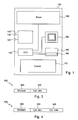
- the figure 1 represents a mobile phone 100 capable of implementing the invention.
- the mobile phone 100 comprises a mobile telephone module 110, advantageously connected to a loudspeaker 120 and to a microphone 130.
- the mobile phone 100 also comprises a central processing unit 140, also called CPU (acronym for Central Processing Unit in English terminology) and, preferably, a screen 150.
- CPU central processing unit
- the mobile phone 100 further comprises a short-range communication module 160, preferably a short-range wireless communication module.
- the module 160 is for example of the NFC type (acronym for Near Field Communication in English terminology).
- the module 160 can be directly implanted in the mobile phone 100, for example under integrated circuit and antenna form, or inserted in the mobile phone 100, for example, in the form of a microcircuit card comprising an integrated antenna.
- the mobile phone also includes an input device 170, such as a keyboard or equivalent device, for entering characters, amounts in values and / or commands.
- the input device 170 forms, in cooperation with the screen 150, a user interface.
- the input device 170 can also be integrated in the screen 150 in the form of a touch screen.
- the mobile phone 100 also comprises a memory module 180 adapted to store at least one application 190 for the exchange of amounts in values, using the module 160 of short-range wireless communication, with another portable electronic entity provided with a communication module compatible with it.
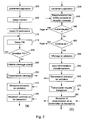
- the figure 2 illustrates a first example of an algorithm for implementing the invention in order to transfer an amount in values between two persons, a debtor and a creditor, one being provided with a mobile phone, for example that presented on the figure 1 and the other of a portable electronic entity that can also be a mobile phone. It is here considered that the debtor and the creditor each have a mobile phone such as the one presented on the figure 1 . The debtor and the creditor thus have mobile phones 100 and 100 ', respectively.
- the debtor is the person to whom the amount in value is withdrawn, for example the holder of an account that is debited, while the creditor is the person who receives the amount in value, for example the holder of an account who is credited.
- the figure 2a represents the algorithm implemented on the debtor's mobile phone while the figure 2b represents the algorithm implemented on the mobile phone of the creditor.
- These algorithms are preferably partially integrated in a secure module (authentication and addition of information allowing authentication) and partially in the same application, for example applications 190 and 190 ', which can be used for debit and credit operations. (user interface).
- the debtor must launch the application to transfer an amount in values (step 200).
- This application is for example the application 190 represented on the figure 1 .
- the user can then enter an amount in values (step 205) using the input device 170. This amount can be displayed on the screen 150 before it is validated.
- a creditor identifier (step 210), particularly if a secure communication channel has not been established between the debtor's and the creditor's portable electronic entities.
- the identifier of the creditor is preferably short, such as initials. It can be represented, for example, on six bytes. Again, the creditor ID can be displayed before it is validated. This identifier is, for example, given orally by the creditor.
- step 215 The user is then prompted to enter an indication allowing his authentication such as a personal identification number (step 215), also called PIN or PIN (acronym for Personal Identification Number in English terminology).
- PIN personal identification number
- PIN personal identification Number
- This code is preferably not displayed or is advantageously at least partially masked so that it is not viewable by a malicious person.
- a test is performed to authenticate the user (step 220).
- the PIN can be transmitted to an authentication module that can be implemented, for example, in the module 160 for short-range wireless communication.
- the authentication module compares the code entered by the user with a previously registered code. If the PIN entered by the user does not match the previously registered code, the user is prompted to enter the PIN again.
- the number of attempts to enter the PIN can be limited, for example to 3 tries. Alternatively, or in a complementary manner, a pause time can be introduced between each attempt, the break time increasing between each attempt.
- the authentication module sends an acknowledgment to the application 190 making it possible to transfer a amount in values which preferably displays an authentication indication on the screen 150 to prevent the transaction from being performed.
- a message is created (step 225).
- the message includes the amount in values entered by the user.
- the message also includes indications relating to the debtor identification and / or the account to be debited.
- the figure 3 illustrates an example of the information contained in such a message. This message can be created by the application 190.
- the message may also include an indication of the identity of the creditor, such as his initials.
- the transaction is preceded by a preliminary exchange of information, by the short-range wireless communication interface, between the two mobile phones in order to set up a secure communication channel. Therefore, it is not necessary here to insert an indication of the recipient in the message.
- This preliminary information exchange is also used for the transmission of one or more temporary cryptographic keys used to encrypt and decrypt the exchanged data.
- the communication established between the mobile phones is preferably secured using a security module comprising cryptographic means known to those skilled in the art, typically means for encrypting, decrypting, signing and verifying a signature and means for memorize one or more cryptographic keys.
- a security module comprising cryptographic means known to those skilled in the art, typically means for encrypting, decrypting, signing and verifying a signature and means for memorize one or more cryptographic keys.
- a secure communication channel is preferably established between the two mobile phones.
- the communication by the short-range wireless communication interface is then secured by the use of temporary keys, it is not always necessary to specifically encrypt the message using another key.
- the message is preferably encrypted and / or signed.
- the creditor indication may be encrypted and signed to allow the creditor to authenticate the message while the debtor's amount and account number information can be encrypted and signed to allow the server in charge of performing the transaction to authenticate the message to verify that it has been submitted by the debtor.
- two different keys can be used.
- a security module comprising cryptographic means for encrypting, decrypting, signing and verifying a signature can be implemented, for example, in the module 160 for short-range wireless communication.
- the security module preferably comprises a secure microcontroller, certified according to the common criteria or complies with the FIPS requirements (acronym for Federal Information Processing Standards ). This module is used to encrypt and decrypt all data passing through the secure communication channel or, more specifically, the message. The message is then transmitted to the short-range wireless communication module 160 for encryption.
- the encryption means are for example based on standard algorithms such as the algorithms DES (acronym for Data Encryption Standard in English terminology), AES (acronym for Advanced Encryption Standard in English terminology) and RSA (initials of the authors of this algorithm: Rivest, Shamir and Adleman), and a memorized key.
- the security module can also be implemented elsewhere, for example in a SIM card (acronym for Subscriber Identity Module in English terminology) inserted in the portable electronic entity or in the application 190.
- the encrypted message is then transmitted to the creditor (step 230) by the short-range wireless communication module 160.
- the relative minimum distance between mobile phones is determined by the range of the short-range wireless communication means. This step of bringing mobile phones closer together contributes to security of the system by limiting the risk that the information exchanged will be intercepted and used by a third party.
- the creditor when it has agreed with the debtor, launches the application, referenced 190 ', to transfer an amount in securities (step 235).
- the application 190 ' can be started automatically after receiving the message, when the received message has been identified as a transaction message.
- an authentication step (step 245) is implemented.
- This authentication step based, for example, on the use of a public key, is intended to control the origin of the message received.
- the authentication is preferably carried out by an implanted security module, for example, in the module 160 '.
- a test is performed to determine whether the user of the mobile phone 100 'is the recipient of the transfer (step 250), that is, to say if the user of this mobile phone is the creditor.
- the indications relating to the identity of the creditor contained in the received message are compared with the indications relating to the identity of the creditor previously stored in the mobile phone 100 ', for example in the security module which can be implemented in the module 160 'of short-range wireless communication.
- the received message is transferred to the application 190 '. If part of the message is confidential, only the non-confidential part is preferably transmitted to the application 190 'which is not necessarily secure. Some information contained in the message are then preferably displayed on the screen 150 'to allow the creditor to validate the transaction (step 255). The information displayed is, for example, the amount and indications relating to the debtor's identity.
- the user can use the input device 170 'to validate or not the transaction. If the user does not validate the transaction, the message is rejected. On the contrary, if the user validates the transaction, additional information is added to the received message (step 260). As illustrated on the figure 4 this additional information is for example data relating to the identity of the creditor and the account to be credited. This additional information, preferably encrypted in the message, can be added, on request of the application 190 ', by the security module. This request for adding the additional information is thus preferably transmitted, with a validation indication, to the module 160 'comprising, for example, the security module.
- the short-range wireless communication module 160 transmits (step 265), in turn, a validation indication to the short-range wireless communication module 160 of the debtor's mobile phone.
- the validation indication transmitted from the mobile phone of the creditor to that of the debtor advantageously includes the additional information added to the message.
- the validation indication received by the short-range wireless communication module 160 of the debtor's mobile telephone may be memorized by this module or in the memory module 180 (step 270).
- the validation indication may be displayed on the screen 150.
- a transaction request is then issued by the creditor's mobile phone to the computer system of the banking institution, the trusted third party or the person in charge of managing the securities in question (step 275). This request is transmitted here by the mobile phone network.
- the transaction request may contain information making it possible to authenticate the request, in particular authentication information added by the modules 160 and / or 160 'using cryptographic keys stored in these modules (these cryptographic keys are different from the keys used to secure communication between the two portable electronic entities).
- the transaction request is thus advantageously similar to the validation indication transmitted from the mobile phone of the creditor to that of the debtor, possibly encrypted with a different key, allowing authentication by a trusted third party.
- the transaction request may be issued by the mobile phone of the debtor taking into account the additional information received with the validation indication.
- the transaction request can also be transmitted by a data communication network such as the Internet.
- a transaction confirmation message is preferably sent to the mobile phones of the debtor and the creditor when the transaction has been made (steps 280 and 285) or, preferably, to the mobile phone of the sole issuer of the transaction request.
- the mobile phone of the issuer of the request for the transaction advantageously transmits to the other mobile phone the message of confirmation or rejection of the transaction.
- Transaction confirmations are stored in each mobile phone, preferably in non-volatile memory, for archival purposes.
- the transaction may be initiated by the creditor who transmits a message including the references of the account to be credited to the debtor, the latter sending a transaction validation message to the debtor, with any additional information concerning him.
- the short-range wireless communication module 160 may be in the form of a microcircuit card. This module is, for example, an electronic purse. Alternately, the short-range wireless communication module 160 may be integrated with the central processing unit 140 then forming a single integrated circuit. It may also be an integrated circuit comprising the antenna, or not, mounted in the body of the portable electronic entity. The antenna may be integrated in the circuit or other component of the portable electronic entity.
- connection to the computer system of the bank, the trusted third party or the person in charge of the management of the securities considered and the communication of the transaction request can be made during the transaction or can be deferred. in time. This communication is preferably secure.
- the transaction request received by the computer system of the bank, the trusted third party or the person in charge of managing the values considered is advantageously authenticated.
- the values are stored and updated directly in the mobile phones, it is not necessary to make a connection to a computer system of the bank, the trusted third party or the person in charge of managing the data.
- values considered For example, if the short-range wireless communication modules 160 and 160 'are electronic purses and the applications 190 and 190' have functions for decreasing and increasing the stored values, the establishment of a connection is not required.
- the values considered are of the fidelity point type, if they are stored directly in the mobile telephones and if the security modules, or alternatively the applications 190 and 190 ', have functions making it possible to decrease and increase the stored values, it is not necessary to establish a connection.
- the figure 3 illustrates an example of a message part that can be transmitted by the debtor's mobile phone to that of the creditor, during the transaction, before it is encrypted (steps 225 and 230 of the figure 2 ).
- the message 300 here comprises a first field 305 corresponding to the amount of the transaction and a second field 310 corresponding to the reference of the account to be debited or to a debtor identifier enabling find these references.
- the message 300 may also include a third field corresponding to the identifier of the creditor, for example his initials.
- the second field 310 is not necessary if the values are stored directly in the debtor's portable electronic entity, that is to say when the message 400 is not necessarily transmitted to a server of a third party to complete the transaction.
- the message 300 is preferably encrypted before being transmitted. Some message data such as signature and keys are not represented on the figure 3 .
- the figure 4 illustrates an example of a message part transmitted by the mobile phone from the creditor to that of the debtor when the creditor has validated the transaction (step 265 of the figure 2 ) or a part of a message transmitted to a computer system of a banking institution, a trusted third party or a person in charge of the management of the considered values, in the form of a transaction request.
- the message 400 includes the fields 305 and 310 described above, relating to the amount of the transaction and the account to be debited or the identification of the debtor.
- the message 400 furthermore comprises a field 405 corresponding to the reference of the account to be credited or to indications relating to the creditor making it possible to retrieve this reference.
- the second field 310 and / or the third field 405 are not necessary if the values are stored directly in the mobile phone of the debtor and / or the creditor, that is to say when the message 400 does not exist. is not necessarily forwarded to a server of a third party to complete the transaction.
- Some message data such as signature and keys are not represented on the figure 4 .
- the message 400 is preferably encrypted before being transmitted.
- the creditor can read the message 300 and add information about the account to be credited, the creditor can not modify the fields 305 and 310 regarding the amount of the transaction and the references of the account to be debited due to the security used.
- the figure 5 illustrates a second example of implementation of the invention to transfer an amount in values between a debtor and a creditor, one being provided with a mobile phone and the other with a portable electronic entity that can be a telephone mobile.
- the creditor has a mobile phone such as the one presented on the figure 1 and that the debtor has a simple microcircuit card comprising short-range wireless communication means and authentication means such as cryptographic authentication means.
- the figure 5a represents the algorithm implemented on the mobile phone of the creditor
- the figure 5b represents the algorithm implemented on the debtor's microcircuit card
- the figure 5c represents the algorithm implemented by the banking institution, the trusted third party or the person in charge of the management of the considered values.
- the creditor After initiating the value transfer application 190 (step 500), the creditor enters an amount in values (step 505), preferably using the input device 170.
- the amount can be displayed on the screen 150 .
- the debtor is then prompted to enter his PIN on the creditor's mobile phone (step 510).
- the confidential code is advantageously entered using the input device 170. It is preferably not displayed on the screen 150.
- An authentication request is then formed by the application 190, containing the confidential code and transmitted to the module 160 for short-range wireless communication.
- the module 160 transmits the authentication request to the debtor's microcircuit card.
- the creditor's mobile phone and the debtor's microcircuit card are brought together to allow data transmission between them, using the short-range wireless communication means.
- a secure communication channel is established between the mobile phone creditor and the debtor's microcircuit card using temporary encryption keys.
- temporary keys are stored, for example, in security modules that can be implemented in the short-range wireless communication modules.
- the authentication request can be encrypted before being transmitted to the debtor's microcircuit card.
- the debtor's microcircuit card After having received the authentication request (step 520), the debtor's microcircuit card authenticates the confidential code contained in the request by comparing it, for example, with a confidential code previously stored in the debtor's microcircuit card (step 525 ).
- the authentication request is rejected. If, on the contrary, the confidential code is validated, the debtor's microcircuit card created, in response to this request, an authentication message that is transmitted (step 530) to the mobile phone of the creditor, that is to say , here, at module 160.
- the authentication message preferably includes information enabling its authentication.
- the authentication message comprises first information enabling the authentication of this message by the creditor and second information enabling the authentication of this message by a third party, for example by a computer system of a banking institution.
- This information for authentication may be a signature.
- the authentication message is preferably at least partially encrypted.
- the authentication message advantageously comprises, preferably in encrypted form, references from the debtor enabling a computer system of a banking establishment, a trusted third party or a person in charge of managing the values in question, to debit an account.
- the module 160 After receiving the authentication message (step 535), the module 160 transmits the authentication message to the application 190.
- the application then forms a transaction request comprising the authentication message, the amount previously entered and references of the creditor such as his account number.
- the transaction request preferably includes information enabling authentication of the debtor, the amount of the transaction and / or the creditor.
- the transaction request may comprise a portion of the authentication message received from the debtor's portable electronic entity.
- the transaction request is preferably at least partially encrypted using cryptographic means.
- the transaction request is then transmitted (step 540) by the mobile phone creditor to a computer system of the bank, the trusted third party or the person in charge of the management of the considered values.
- the transaction request is here transmitted by the mobile network.
- the trusted third party or the person in charge of the management of the considered values When the transaction request is received (step 545) by a computer system of the banking establishment, the trusted third party or the person in charge of the management of the considered values, this one, or this one, authenticates the request transaction. If the transaction request is not authenticated, it is rejected. Similarly, if the transaction can not be carried out, for example if the debtor's account is not sufficiently credited, the transaction request is rejected. If the transaction request is not rejected, the amount in values is transferred (step 550) as a standard. A confirmation or rejection of the transaction message is then advantageously transmitted by the computer system of the bank, the trusted third party or the person in charge of the management of the securities considered (step 555) to the mobile phone of the creditor when the transaction was completed or rejected.
- step 560 Upon receipt of this confirmation or rejection (step 560), an indication is displayed on the screen 150 to indicate that the transaction has been performed or rejected. This confirmation can be retransmitted to the debtor's microcircuit card where it can be stored.
- the confirmation message can take the form of an SMS (acronym for Short Message Service in English terminology), the creditor's telephone number being transmitted with the transaction request or being memorized by a computer system of the banking establishment. , from the third of trust or the person in charge of the management of the values considered in relation to the references of the account to be credited.
- SMS Short Message Service
- the request and the transaction message can be transmitted by a data communication network, for example the Internet, which is connected to the mobile phone of the creditor and a computer system of the bank, the trusted third party or the person in charge of the management of the considered values.
- the credit mobile phone can be connected to this network according to, for example, one of the WiFi standards.
- agreement of the debtor can be validated by the entry of a confidential code and the comparison of the entered code with a previously memorized code, this agreement can be validated according to other techniques.
- the agreement of the debtor can be validated by biometric means such as a fingerprint comparison.
- biometric means such as a fingerprint comparison.
- the debtor's portable electronic entity must be provided with means for entering this information, for example a fingerprint reader.
- a transaction message is first transmitted by the creditor to the debtor.
- the mobile phone of the creditor and the portable electronic entity of the debtor each provided with means of short-range wireless communication, here each have a memory, preferably secured, for storing a balance in values of which the amount in values
- the transaction can be debited and credited.
- only the mobile phone of the creditor or the debtor's portable electronic entity has such a balance, the transaction being then partially executed by a computer system of a third party.
- the mobile phone creditor transmits to the debtor's portable electronic entity, via the short-range wireless communication means, a secure transaction message including the amount in transaction values.
- the message is secured according to a cryptographic key that can be used by a large number of portable electronic entity carriers.
- the debtor's mobile phone is not near the debtor's portable electronic entity, the debtor's mobile phone and the debtor's portable electronic entity shall be brought close to each other.
- the debtor's portable electronic entity has an activation button enabling the reception of transaction messages via the short-range wireless communication means.
- the debtor thus controls the receipt of transaction messages to avoid a flow without his knowledge.
- this activation button activates the short-range wireless communication means.
- the transaction message is authenticated by the debtor's portable electronic entity to verify that the creditor is authorized to issue such a transaction message.
- the debtor's portable electronic entity After authenticating the transaction message, the debtor's portable electronic entity debits the stored value balance of the transaction value amount. Then, the debtor's portable electronic entity transmits, via the short-range wireless communication means, a secure message to the credit mobile phone.
- the secure message preferably includes the amount in transaction values.
- the creditor's mobile phone Upon receipt of the secure message, the creditor's mobile phone authenticates this message. If the message is authenticated, the stored value balance is credited.
- the creditor's mobile phone or the debtor's portable electronic entity If the creditor's mobile phone or the debtor's portable electronic entity does not have memory to store a balance in value, it transmits a corresponding transaction request to a computer system of a third party to perform this operation.
- the electronic entity when an exchange of data between the portable electronic entities is implemented to proceed with the transaction, for example according to the last embodiment described, the electronic entity
- the creditor's mobile phone and / or that of the debtor have means to indicate to the user that a transaction is in progress and / or that it is completed.
- the debtor's portable electronic entity may be debited while the creditor's mobile phone will not be credited.
- the credit mobile phone emits a first sound when a transaction message is transmitted and emits a second sound signal, preferably different from the first, when a secure message is received.
- a visual transaction indication may be displayed on the screen of the portable electronic entity to indicate that the transaction is in progress or completed.
- the mobile phone of the creditor uses an internal status indicator.
- the credit mobile phone activates an internal status indicator when the transaction message is issued. This internal status flag is disabled upon receipt of the secure message corresponding to the transaction message.
- the transaction must be canceled from the debtor's portable electronic entity or the secure message must be reissued.
- the mobile phone creditor can send a transaction cancellation message or message reissue the secure message.
Landscapes
- Engineering & Computer Science (AREA)
- Business, Economics & Management (AREA)
- Accounting & Taxation (AREA)
- Theoretical Computer Science (AREA)
- Strategic Management (AREA)
- Physics & Mathematics (AREA)
- General Business, Economics & Management (AREA)
- General Physics & Mathematics (AREA)
- Computer Networks & Wireless Communication (AREA)
- Computer Security & Cryptography (AREA)
- Finance (AREA)
- Computer Hardware Design (AREA)
- Computing Systems (AREA)
- General Engineering & Computer Science (AREA)
- Signal Processing (AREA)
- Financial Or Insurance-Related Operations Such As Payment And Settlement (AREA)
- Mobile Radio Communication Systems (AREA)
- Telephone Function (AREA)
Applications Claiming Priority (1)
| Application Number | Priority Date | Filing Date | Title |
|---|---|---|---|
| FR0758477A FR2922670B1 (fr) | 2007-10-22 | 2007-10-22 | Procede et dispositif pour l'echange de valeurs entre entites electroniques portables personnelles |
Publications (2)
| Publication Number | Publication Date |
|---|---|
| EP2053553A1 true EP2053553A1 (de) | 2009-04-29 |
| EP2053553B1 EP2053553B1 (de) | 2022-03-30 |
Family
ID=39323038
Family Applications (1)
| Application Number | Title | Priority Date | Filing Date |
|---|---|---|---|
| EP08290978.9A Active EP2053553B1 (de) | 2007-10-22 | 2008-10-17 | Verfahren und Vorrichtung zum Austausch von Werten zwischen persönlichen tragbaren elektronischen Einheiten |
Country Status (4)
| Country | Link |
|---|---|
| US (1) | US8290870B2 (de) |
| EP (1) | EP2053553B1 (de) |
| ES (1) | ES2909968T3 (de) |
| FR (1) | FR2922670B1 (de) |
Cited By (1)
| Publication number | Priority date | Publication date | Assignee | Title |
|---|---|---|---|---|
| WO2014009646A1 (fr) * | 2012-07-13 | 2014-01-16 | Oberthur Technologies | Entite electronique securisee pour l'autorisation d'une transaction |
Families Citing this family (5)
| Publication number | Priority date | Publication date | Assignee | Title |
|---|---|---|---|---|
| EP2438563A4 (de) * | 2009-06-04 | 2013-05-01 | Mobile Messenger Global Inc | Verfahren und system zur bereitstellung eines echtzeitzugangs zu bestätigungen für mobile handelstransaktionen |
| US8855312B1 (en) * | 2012-06-29 | 2014-10-07 | Emc Corporation | Mobile trust broker |
| US10817593B1 (en) * | 2015-12-29 | 2020-10-27 | Wells Fargo Bank, N.A. | User information gathering and distribution system |
| US11432149B1 (en) | 2019-10-10 | 2022-08-30 | Wells Fargo Bank, N.A. | Self-sovereign identification via digital credentials for selected identity attributes |
| CN114037525A (zh) * | 2021-09-30 | 2022-02-11 | 中国人民银行数字货币研究所 | 基于数字货币的交易方法和装置 |
Citations (6)
| Publication number | Priority date | Publication date | Assignee | Title |
|---|---|---|---|---|
| WO2003023574A2 (en) | 2001-09-12 | 2003-03-20 | Worldcom, Inc. | Systems and methods for monetary transactions between wired and wireless devices |
| WO2005079038A1 (fr) * | 2004-01-14 | 2005-08-25 | France Telecom | Procede, terminal mobile, systeme et equipement pour la fourniture d’un service de proximite accessible par l’intermediaire d’un terminal mobile |
| DE102004046847A1 (de) | 2004-09-27 | 2006-04-13 | Giesecke & Devrient Gmbh | System, Verfahren und tragbarer Datenträger zur Erzeugung einer digitalen Signatur |
| US20070123215A1 (en) | 2005-10-03 | 2007-05-31 | Tiehong Wang | Method and system for improving client server transmission over fading channel with wireless location and authentication technology via electromagnetic radiation |
| WO2007076456A2 (en) * | 2005-12-28 | 2007-07-05 | Sandisk Corporation | Nested memory system with near field communications capability |
| WO2007119032A1 (fr) * | 2006-04-19 | 2007-10-25 | France Telecom | Procede de securisation de l'acces a un module de communication de proximite dans un terminal mobile |
Family Cites Families (8)
| Publication number | Priority date | Publication date | Assignee | Title |
|---|---|---|---|---|
| US7822688B2 (en) * | 2002-08-08 | 2010-10-26 | Fujitsu Limited | Wireless wallet |
| US7603316B1 (en) * | 2004-11-01 | 2009-10-13 | American Express Travel Related Services Company, Inc. | Message delivery delegate system and method |
| US7124937B2 (en) * | 2005-01-21 | 2006-10-24 | Visa U.S.A. Inc. | Wireless payment methods and systems |
| US7907896B2 (en) * | 2006-04-28 | 2011-03-15 | Motorola Mobility, Inc. | Mobile commerce method and device |
| US20080177668A1 (en) * | 2007-01-24 | 2008-07-24 | Bruno Delean | Computerized person-to-person payment system and method without use of currency |
| US8688570B2 (en) * | 2007-04-27 | 2014-04-01 | American Express Travel Related Services Company, Inc. | System and method for performing person-to-person funds transfers via wireless communications |
| US9342823B2 (en) * | 2007-06-18 | 2016-05-17 | Lemon, Inc. | Payment clearing network for electronic financial transactions and related personal financial transaction device |
| US20090070263A1 (en) * | 2007-09-12 | 2009-03-12 | Wachovia Corporation | Peer to peer fund transfer |
-
2007
- 2007-10-22 FR FR0758477A patent/FR2922670B1/fr active Active
-
2008
- 2008-10-17 ES ES08290978T patent/ES2909968T3/es active Active
- 2008-10-17 EP EP08290978.9A patent/EP2053553B1/de active Active
- 2008-10-22 US US12/255,860 patent/US8290870B2/en active Active
Patent Citations (6)
| Publication number | Priority date | Publication date | Assignee | Title |
|---|---|---|---|---|
| WO2003023574A2 (en) | 2001-09-12 | 2003-03-20 | Worldcom, Inc. | Systems and methods for monetary transactions between wired and wireless devices |
| WO2005079038A1 (fr) * | 2004-01-14 | 2005-08-25 | France Telecom | Procede, terminal mobile, systeme et equipement pour la fourniture d’un service de proximite accessible par l’intermediaire d’un terminal mobile |
| DE102004046847A1 (de) | 2004-09-27 | 2006-04-13 | Giesecke & Devrient Gmbh | System, Verfahren und tragbarer Datenträger zur Erzeugung einer digitalen Signatur |
| US20070123215A1 (en) | 2005-10-03 | 2007-05-31 | Tiehong Wang | Method and system for improving client server transmission over fading channel with wireless location and authentication technology via electromagnetic radiation |
| WO2007076456A2 (en) * | 2005-12-28 | 2007-07-05 | Sandisk Corporation | Nested memory system with near field communications capability |
| WO2007119032A1 (fr) * | 2006-04-19 | 2007-10-25 | France Telecom | Procede de securisation de l'acces a un module de communication de proximite dans un terminal mobile |
Cited By (3)
| Publication number | Priority date | Publication date | Assignee | Title |
|---|---|---|---|---|
| WO2014009646A1 (fr) * | 2012-07-13 | 2014-01-16 | Oberthur Technologies | Entite electronique securisee pour l'autorisation d'une transaction |
| FR2993382A1 (fr) * | 2012-07-13 | 2014-01-17 | Oberthur Technologies | Entite electronique securisee pour l'autorisation d'une transaction |
| RU2651245C2 (ru) * | 2012-07-13 | 2018-04-18 | Обертур Текнолоджи | Защищенный электронный блок для санкционирования транзакции |
Also Published As
| Publication number | Publication date |
|---|---|
| FR2922670A1 (fr) | 2009-04-24 |
| FR2922670B1 (fr) | 2021-04-09 |
| US8290870B2 (en) | 2012-10-16 |
| ES2909968T3 (es) | 2022-05-11 |
| US20090119214A1 (en) | 2009-05-07 |
| EP2053553B1 (de) | 2022-03-30 |
Similar Documents
| Publication | Publication Date | Title |
|---|---|---|
| EP2873045B1 (de) | Sichere elektronische entität zur autorisierung einer transaktion | |
| EP3221815B1 (de) | Verfahren zur sicherung von zahlungstransaktionstoken | |
| FR2821225A1 (fr) | Systeme de paiement electronique a distance | |
| WO2002065414A1 (fr) | Procede et systeme de telepaiement | |
| EP2308014A1 (de) | Architekturen und verfahren eines vertrauenswürdigen dienstmanagers (tsm) | |
| EP2053554A1 (de) | Tragbares elektronisches Gerät zum Datenaustausch und Verfahren zur Implementierung eines solchen Geräts | |
| WO2002082388A1 (fr) | Dispositif securise d'echange de donnees | |
| EP2053553B1 (de) | Verfahren und Vorrichtung zum Austausch von Werten zwischen persönlichen tragbaren elektronischen Einheiten | |
| EP2369780B1 (de) | Verfahren und system zur validierung einer transaktion, und entsprechendes transaktiosterminal und programm | |
| WO2009044371A1 (en) | System based on a sim card performing services with high security features and relative method | |
| EP2509025A1 (de) | Zugriffsverfahren auf eine geschützte Quelle einer gesicherten persönlichen Vorrichtung | |
| EP1724720B1 (de) | Zahlungsverfahren für den Frankierdienst in einer Maschine zur Verarbeitung von Post mit Direktzugriff | |
| EP2131318A1 (de) | Verfahren und Vorrichtung für elektronische Einheiten zum Austausch und zur Verwendung von Rechten | |
| CN103514669A (zh) | 货币交易系统及其方法 | |
| EP1076886B1 (de) | Verfahren zum durchführen einer gesicherten transaktion mittels einer chipkarte über ein telekommunikationsnetzwerk | |
| FR2812424A1 (fr) | Procede et systeme pour effectuer des transactions securisees de biens et de services au moyen d'un telephone mobile via un reseau de communication cellulaire | |
| WO2025125562A1 (fr) | Procédé d'authentification d'un individu pour la mise en œuvre d'une transaction sur un terminal marchand | |
| BE1016964A3 (fr) | Methode et systeme de paiements electroniques entre porte-monnaies electroniques. | |
| WO2025109113A1 (fr) | Procédés, dispositifs et système de transmission et d'acquisition d'une donnée | |
| Wafula Muliaro et al. | Enhancing Personal Identification Number (Pin) Mechanism To Provide Non-Repudiation Through Use Of Timestamps In Mobile Payment Systems. | |
| FR2913162A1 (fr) | Procede de verification d'un code identifiant un porteur, carte a puce et terminal respectivement prevus pour la mise en oeuvre dudit procede. | |
| FR2831361A1 (fr) | Jeton informatique | |
| FR3003977A1 (fr) | Procede de securisation de transactions entre terminaux mobiles |
Legal Events
| Date | Code | Title | Description |
|---|---|---|---|
| PUAI | Public reference made under article 153(3) epc to a published international application that has entered the european phase |
Free format text: ORIGINAL CODE: 0009012 |
|
| 17P | Request for examination filed |
Effective date: 20081107 |
|
| AK | Designated contracting states |
Kind code of ref document: A1 Designated state(s): AT BE BG CH CY CZ DE DK EE ES FI FR GB GR HR HU IE IS IT LI LT LU LV MC MT NL NO PL PT RO SE SI SK TR |
|
| AX | Request for extension of the european patent |
Extension state: AL BA MK RS |
|
| 17Q | First examination report despatched |
Effective date: 20090608 |
|
| AKX | Designation fees paid |
Designated state(s): AT BE BG CH CY CZ DE DK EE ES FI FR GB GR HR HU IE IS IT LI LT LU LV MC MT NL NO PL PT RO SE SI SK TR |
|
| APBK | Appeal reference recorded |
Free format text: ORIGINAL CODE: EPIDOSNREFNE |
|
| APBN | Date of receipt of notice of appeal recorded |
Free format text: ORIGINAL CODE: EPIDOSNNOA2E |
|
| APBR | Date of receipt of statement of grounds of appeal recorded |
Free format text: ORIGINAL CODE: EPIDOSNNOA3E |
|
| APBV | Interlocutory revision of appeal recorded |
Free format text: ORIGINAL CODE: EPIDOSNIRAPE |
|
| APBK | Appeal reference recorded |
Free format text: ORIGINAL CODE: EPIDOSNREFNE |
|
| APBN | Date of receipt of notice of appeal recorded |
Free format text: ORIGINAL CODE: EPIDOSNNOA2E |
|
| APBR | Date of receipt of statement of grounds of appeal recorded |
Free format text: ORIGINAL CODE: EPIDOSNNOA3E |
|
| APAF | Appeal reference modified |
Free format text: ORIGINAL CODE: EPIDOSCREFNE |
|
| RAP1 | Party data changed (applicant data changed or rights of an application transferred) |
Owner name: IDEMIA FRANCE |
|
| APBX | Invitation to file observations in appeal sent |
Free format text: ORIGINAL CODE: EPIDOSNOBA2E |
|
| APBZ | Receipt of observations in appeal recorded |
Free format text: ORIGINAL CODE: EPIDOSNOBA4E |
|
| RAP1 | Party data changed (applicant data changed or rights of an application transferred) |
Owner name: IDEMIA FRANCE |
|
| APBT | Appeal procedure closed |
Free format text: ORIGINAL CODE: EPIDOSNNOA9E |
|
| GRAP | Despatch of communication of intention to grant a patent |
Free format text: ORIGINAL CODE: EPIDOSNIGR1 |
|
| STAA | Information on the status of an ep patent application or granted ep patent |
Free format text: STATUS: GRANT OF PATENT IS INTENDED |
|
| INTG | Intention to grant announced |
Effective date: 20211112 |
|
| GRAS | Grant fee paid |
Free format text: ORIGINAL CODE: EPIDOSNIGR3 |
|
| GRAA | (expected) grant |
Free format text: ORIGINAL CODE: 0009210 |
|
| STAA | Information on the status of an ep patent application or granted ep patent |
Free format text: STATUS: THE PATENT HAS BEEN GRANTED |
|
| AK | Designated contracting states |
Kind code of ref document: B1 Designated state(s): AT BE BG CH CY CZ DE DK EE ES FI FR GB GR HR HU IE IS IT LI LT LU LV MC MT NL NO PL PT RO SE SI SK TR |
|
| REG | Reference to a national code |
Ref country code: GB Ref legal event code: FG4D Free format text: NOT ENGLISH |
|
| REG | Reference to a national code |
Ref country code: CH Ref legal event code: EP |
|
| REG | Reference to a national code |
Ref country code: AT Ref legal event code: REF Ref document number: 1479903 Country of ref document: AT Kind code of ref document: T Effective date: 20220415 |
|
| REG | Reference to a national code |
Ref country code: DE Ref legal event code: R096 Ref document number: 602008064448 Country of ref document: DE |
|
| REG | Reference to a national code |
Ref country code: IE Ref legal event code: FG4D Free format text: LANGUAGE OF EP DOCUMENT: FRENCH |
|
| REG | Reference to a national code |
Ref country code: ES Ref legal event code: FG2A Ref document number: 2909968 Country of ref document: ES Kind code of ref document: T3 Effective date: 20220511 |
|
| REG | Reference to a national code |
Ref country code: LT Ref legal event code: MG9D |
|
| PG25 | Lapsed in a contracting state [announced via postgrant information from national office to epo] |
Ref country code: SE Free format text: LAPSE BECAUSE OF FAILURE TO SUBMIT A TRANSLATION OF THE DESCRIPTION OR TO PAY THE FEE WITHIN THE PRESCRIBED TIME-LIMIT Effective date: 20220330 Ref country code: NO Free format text: LAPSE BECAUSE OF FAILURE TO SUBMIT A TRANSLATION OF THE DESCRIPTION OR TO PAY THE FEE WITHIN THE PRESCRIBED TIME-LIMIT Effective date: 20220630 Ref country code: LT Free format text: LAPSE BECAUSE OF FAILURE TO SUBMIT A TRANSLATION OF THE DESCRIPTION OR TO PAY THE FEE WITHIN THE PRESCRIBED TIME-LIMIT Effective date: 20220330 Ref country code: HR Free format text: LAPSE BECAUSE OF FAILURE TO SUBMIT A TRANSLATION OF THE DESCRIPTION OR TO PAY THE FEE WITHIN THE PRESCRIBED TIME-LIMIT Effective date: 20220330 Ref country code: BG Free format text: LAPSE BECAUSE OF FAILURE TO SUBMIT A TRANSLATION OF THE DESCRIPTION OR TO PAY THE FEE WITHIN THE PRESCRIBED TIME-LIMIT Effective date: 20220630 |
|
| REG | Reference to a national code |
Ref country code: NL Ref legal event code: MP Effective date: 20220330 |
|
| REG | Reference to a national code |
Ref country code: AT Ref legal event code: MK05 Ref document number: 1479903 Country of ref document: AT Kind code of ref document: T Effective date: 20220330 |
|
| PG25 | Lapsed in a contracting state [announced via postgrant information from national office to epo] |
Ref country code: LV Free format text: LAPSE BECAUSE OF FAILURE TO SUBMIT A TRANSLATION OF THE DESCRIPTION OR TO PAY THE FEE WITHIN THE PRESCRIBED TIME-LIMIT Effective date: 20220330 Ref country code: GR Free format text: LAPSE BECAUSE OF FAILURE TO SUBMIT A TRANSLATION OF THE DESCRIPTION OR TO PAY THE FEE WITHIN THE PRESCRIBED TIME-LIMIT Effective date: 20220701 Ref country code: FI Free format text: LAPSE BECAUSE OF FAILURE TO SUBMIT A TRANSLATION OF THE DESCRIPTION OR TO PAY THE FEE WITHIN THE PRESCRIBED TIME-LIMIT Effective date: 20220330 |
|
| PG25 | Lapsed in a contracting state [announced via postgrant information from national office to epo] |
Ref country code: NL Free format text: LAPSE BECAUSE OF FAILURE TO SUBMIT A TRANSLATION OF THE DESCRIPTION OR TO PAY THE FEE WITHIN THE PRESCRIBED TIME-LIMIT Effective date: 20220330 |
|
| PG25 | Lapsed in a contracting state [announced via postgrant information from national office to epo] |
Ref country code: RO Free format text: LAPSE BECAUSE OF FAILURE TO SUBMIT A TRANSLATION OF THE DESCRIPTION OR TO PAY THE FEE WITHIN THE PRESCRIBED TIME-LIMIT Effective date: 20220330 Ref country code: PT Free format text: LAPSE BECAUSE OF FAILURE TO SUBMIT A TRANSLATION OF THE DESCRIPTION OR TO PAY THE FEE WITHIN THE PRESCRIBED TIME-LIMIT Effective date: 20220801 Ref country code: EE Free format text: LAPSE BECAUSE OF FAILURE TO SUBMIT A TRANSLATION OF THE DESCRIPTION OR TO PAY THE FEE WITHIN THE PRESCRIBED TIME-LIMIT Effective date: 20220330 Ref country code: CZ Free format text: LAPSE BECAUSE OF FAILURE TO SUBMIT A TRANSLATION OF THE DESCRIPTION OR TO PAY THE FEE WITHIN THE PRESCRIBED TIME-LIMIT Effective date: 20220330 Ref country code: AT Free format text: LAPSE BECAUSE OF FAILURE TO SUBMIT A TRANSLATION OF THE DESCRIPTION OR TO PAY THE FEE WITHIN THE PRESCRIBED TIME-LIMIT Effective date: 20220330 |
|
| PG25 | Lapsed in a contracting state [announced via postgrant information from national office to epo] |
Ref country code: PL Free format text: LAPSE BECAUSE OF FAILURE TO SUBMIT A TRANSLATION OF THE DESCRIPTION OR TO PAY THE FEE WITHIN THE PRESCRIBED TIME-LIMIT Effective date: 20220330 Ref country code: IS Free format text: LAPSE BECAUSE OF FAILURE TO SUBMIT A TRANSLATION OF THE DESCRIPTION OR TO PAY THE FEE WITHIN THE PRESCRIBED TIME-LIMIT Effective date: 20220730 |
|
| REG | Reference to a national code |
Ref country code: DE Ref legal event code: R097 Ref document number: 602008064448 Country of ref document: DE |
|
| PG25 | Lapsed in a contracting state [announced via postgrant information from national office to epo] |
Ref country code: DK Free format text: LAPSE BECAUSE OF FAILURE TO SUBMIT A TRANSLATION OF THE DESCRIPTION OR TO PAY THE FEE WITHIN THE PRESCRIBED TIME-LIMIT Effective date: 20220330 |
|
| PLBE | No opposition filed within time limit |
Free format text: ORIGINAL CODE: 0009261 |
|
| STAA | Information on the status of an ep patent application or granted ep patent |
Free format text: STATUS: NO OPPOSITION FILED WITHIN TIME LIMIT |
|
| 26N | No opposition filed |
Effective date: 20230103 |
|
| PG25 | Lapsed in a contracting state [announced via postgrant information from national office to epo] |
Ref country code: SI Free format text: LAPSE BECAUSE OF FAILURE TO SUBMIT A TRANSLATION OF THE DESCRIPTION OR TO PAY THE FEE WITHIN THE PRESCRIBED TIME-LIMIT Effective date: 20220330 Ref country code: MC Free format text: LAPSE BECAUSE OF FAILURE TO SUBMIT A TRANSLATION OF THE DESCRIPTION OR TO PAY THE FEE WITHIN THE PRESCRIBED TIME-LIMIT Effective date: 20220330 |
|
| REG | Reference to a national code |
Ref country code: CH Ref legal event code: PL |
|
| P01 | Opt-out of the competence of the unified patent court (upc) registered |
Effective date: 20230428 |
|
| REG | Reference to a national code |
Ref country code: BE Ref legal event code: MM Effective date: 20221031 |
|
| PG25 | Lapsed in a contracting state [announced via postgrant information from national office to epo] |
Ref country code: LU Free format text: LAPSE BECAUSE OF NON-PAYMENT OF DUE FEES Effective date: 20221017 |
|
| PG25 | Lapsed in a contracting state [announced via postgrant information from national office to epo] |
Ref country code: LI Free format text: LAPSE BECAUSE OF NON-PAYMENT OF DUE FEES Effective date: 20221031 Ref country code: CH Free format text: LAPSE BECAUSE OF NON-PAYMENT OF DUE FEES Effective date: 20221031 |
|
| PG25 | Lapsed in a contracting state [announced via postgrant information from national office to epo] |
Ref country code: BE Free format text: LAPSE BECAUSE OF NON-PAYMENT OF DUE FEES Effective date: 20221031 |
|
| PG25 | Lapsed in a contracting state [announced via postgrant information from national office to epo] |
Ref country code: IE Free format text: LAPSE BECAUSE OF NON-PAYMENT OF DUE FEES Effective date: 20221017 |
|
| PG25 | Lapsed in a contracting state [announced via postgrant information from national office to epo] |
Ref country code: HU Free format text: LAPSE BECAUSE OF FAILURE TO SUBMIT A TRANSLATION OF THE DESCRIPTION OR TO PAY THE FEE WITHIN THE PRESCRIBED TIME-LIMIT; INVALID AB INITIO Effective date: 20081017 |
|
| PG25 | Lapsed in a contracting state [announced via postgrant information from national office to epo] |
Ref country code: CY Free format text: LAPSE BECAUSE OF FAILURE TO SUBMIT A TRANSLATION OF THE DESCRIPTION OR TO PAY THE FEE WITHIN THE PRESCRIBED TIME-LIMIT Effective date: 20220330 |
|
| PG25 | Lapsed in a contracting state [announced via postgrant information from national office to epo] |
Ref country code: SK Free format text: LAPSE BECAUSE OF FAILURE TO SUBMIT A TRANSLATION OF THE DESCRIPTION OR TO PAY THE FEE WITHIN THE PRESCRIBED TIME-LIMIT Effective date: 20220330 |
|
| PG25 | Lapsed in a contracting state [announced via postgrant information from national office to epo] |
Ref country code: TR Free format text: LAPSE BECAUSE OF FAILURE TO SUBMIT A TRANSLATION OF THE DESCRIPTION OR TO PAY THE FEE WITHIN THE PRESCRIBED TIME-LIMIT Effective date: 20220330 Ref country code: SK Free format text: LAPSE BECAUSE OF FAILURE TO SUBMIT A TRANSLATION OF THE DESCRIPTION OR TO PAY THE FEE WITHIN THE PRESCRIBED TIME-LIMIT Effective date: 20220330 |
|
| PG25 | Lapsed in a contracting state [announced via postgrant information from national office to epo] |
Ref country code: MT Free format text: LAPSE BECAUSE OF FAILURE TO SUBMIT A TRANSLATION OF THE DESCRIPTION OR TO PAY THE FEE WITHIN THE PRESCRIBED TIME-LIMIT Effective date: 20220330 |
|
| PGFP | Annual fee paid to national office [announced via postgrant information from national office to epo] |
Ref country code: IT Payment date: 20250923 Year of fee payment: 18 |
|
| PGFP | Annual fee paid to national office [announced via postgrant information from national office to epo] |
Ref country code: GB Payment date: 20250923 Year of fee payment: 18 |
|
| PGFP | Annual fee paid to national office [announced via postgrant information from national office to epo] |
Ref country code: FR Payment date: 20250924 Year of fee payment: 18 |
|
| PGFP | Annual fee paid to national office [announced via postgrant information from national office to epo] |
Ref country code: DE Payment date: 20250923 Year of fee payment: 18 |
|
| PGFP | Annual fee paid to national office [announced via postgrant information from national office to epo] |
Ref country code: ES Payment date: 20251103 Year of fee payment: 18 |