EP2053575A1 - Rauchmelder - Google Patents
Rauchmelder Download PDFInfo
- Publication number
- EP2053575A1 EP2053575A1 EP08167321A EP08167321A EP2053575A1 EP 2053575 A1 EP2053575 A1 EP 2053575A1 EP 08167321 A EP08167321 A EP 08167321A EP 08167321 A EP08167321 A EP 08167321A EP 2053575 A1 EP2053575 A1 EP 2053575A1
- Authority
- EP
- European Patent Office
- Prior art keywords
- housing
- detector
- particulate matter
- radiant energy
- frequency
- Prior art date
- Legal status (The legal status is an assumption and is not a legal conclusion. Google has not performed a legal analysis and makes no representation as to the accuracy of the status listed.)
- Withdrawn
Links
Images

Classifications
-
- G—PHYSICS
- G08—SIGNALLING
- G08B—SIGNALLING SYSTEMS, e.g. PERSONAL CALLING SYSTEMS; ORDER TELEGRAPHS; ALARM SYSTEMS
- G08B17/00—Fire alarms; Alarms responsive to explosion
- G08B17/10—Actuation by presence of smoke or gases, e.g. automatic alarm devices for analysing flowing fluid materials by the use of optical means
- G08B17/103—Actuation by presence of smoke or gases, e.g. automatic alarm devices for analysing flowing fluid materials by the use of optical means using a light emitting and receiving device
- G08B17/107—Actuation by presence of smoke or gases, e.g. automatic alarm devices for analysing flowing fluid materials by the use of optical means using a light emitting and receiving device for detecting light-scattering due to smoke
-
- G—PHYSICS
- G01—MEASURING; TESTING
- G01N—INVESTIGATING OR ANALYSING MATERIALS BY DETERMINING THEIR CHEMICAL OR PHYSICAL PROPERTIES
- G01N21/00—Investigating or analysing materials by the use of optical means, i.e. using sub-millimetre waves, infrared, visible or ultraviolet light
- G01N21/17—Systems in which incident light is modified in accordance with the properties of the material investigated
- G01N21/47—Scattering, i.e. diffuse reflection
- G01N21/49—Scattering, i.e. diffuse reflection within a body or fluid
- G01N21/53—Scattering, i.e. diffuse reflection within a body or fluid within a flowing fluid, e.g. smoke
- G01N21/532—Scattering, i.e. diffuse reflection within a body or fluid within a flowing fluid, e.g. smoke with measurement of scattering and transmission
-
- G—PHYSICS
- G08—SIGNALLING
- G08B—SIGNALLING SYSTEMS, e.g. PERSONAL CALLING SYSTEMS; ORDER TELEGRAPHS; ALARM SYSTEMS
- G08B17/00—Fire alarms; Alarms responsive to explosion
- G08B17/10—Actuation by presence of smoke or gases, e.g. automatic alarm devices for analysing flowing fluid materials by the use of optical means
- G08B17/103—Actuation by presence of smoke or gases, e.g. automatic alarm devices for analysing flowing fluid materials by the use of optical means using a light emitting and receiving device
-
- G—PHYSICS
- G01—MEASURING; TESTING
- G01N—INVESTIGATING OR ANALYSING MATERIALS BY DETERMINING THEIR CHEMICAL OR PHYSICAL PROPERTIES
- G01N21/00—Investigating or analysing materials by the use of optical means, i.e. using sub-millimetre waves, infrared, visible or ultraviolet light
- G01N21/17—Systems in which incident light is modified in accordance with the properties of the material investigated
- G01N21/47—Scattering, i.e. diffuse reflection
- G01N2021/4704—Angular selective
- G01N2021/4707—Forward scatter; Low angle scatter
-
- G—PHYSICS
- G01—MEASURING; TESTING
- G01N—INVESTIGATING OR ANALYSING MATERIALS BY DETERMINING THEIR CHEMICAL OR PHYSICAL PROPERTIES
- G01N21/00—Investigating or analysing materials by the use of optical means, i.e. using sub-millimetre waves, infrared, visible or ultraviolet light
- G01N21/17—Systems in which incident light is modified in accordance with the properties of the material investigated
- G01N21/47—Scattering, i.e. diffuse reflection
- G01N2021/4704—Angular selective
- G01N2021/4709—Backscatter
-
- G—PHYSICS
- G01—MEASURING; TESTING
- G01N—INVESTIGATING OR ANALYSING MATERIALS BY DETERMINING THEIR CHEMICAL OR PHYSICAL PROPERTIES
- G01N21/00—Investigating or analysing materials by the use of optical means, i.e. using sub-millimetre waves, infrared, visible or ultraviolet light
- G01N21/17—Systems in which incident light is modified in accordance with the properties of the material investigated
- G01N21/47—Scattering, i.e. diffuse reflection
- G01N2021/4792—Polarisation of scatter light
-
- G—PHYSICS
- G01—MEASURING; TESTING
- G01N—INVESTIGATING OR ANALYSING MATERIALS BY DETERMINING THEIR CHEMICAL OR PHYSICAL PROPERTIES
- G01N21/00—Investigating or analysing materials by the use of optical means, i.e. using sub-millimetre waves, infrared, visible or ultraviolet light
- G01N21/17—Systems in which incident light is modified in accordance with the properties of the material investigated
- G01N21/21—Polarisation-affecting properties
-
- G—PHYSICS
- G08—SIGNALLING
- G08B—SIGNALLING SYSTEMS, e.g. PERSONAL CALLING SYSTEMS; ORDER TELEGRAPHS; ALARM SYSTEMS
- G08B17/00—Fire alarms; Alarms responsive to explosion
- G08B17/10—Actuation by presence of smoke or gases, e.g. automatic alarm devices for analysing flowing fluid materials by the use of optical means
- G08B17/11—Actuation by presence of smoke or gases, e.g. automatic alarm devices for analysing flowing fluid materials by the use of optical means using an ionisation chamber for detecting smoke or gas
- G08B17/113—Constructional details
Definitions
- the invention pertains to photoelectric smoke detectors. More particularly, the invention pertains to such detectors which incorporate a multi-frequency light source and a light sensor to perform multiple angle, multiple wavelength scattering analysis.
- the emitter is energized, or pulsed, periodically. When smoke is present the receiver detects the increasing scattered light signal.
- a photocurrent to voltage circuit (transimpedance amplifier) is usually used to measure smoke presence and eventually determine alarm condition.
- the present invention provides a smoke detector in accordance with claim 1 hereto.
- the invention further provides a method of detecting air borne particulate matter, in accordance with claim 13 hereto. Examples of smoke detectors will now be described with reference to the accompanying drawings, in which:
- Fig. 1 is a block diagram of a first embodiment of the invention
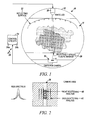
- Fig. 2 illustrates multi-scattering effects associated with the embodiment of Fig. 1 ;
- Fig. 3 is a block diagram of a second embodiment of the invention.
- Fig. 4 illustrates multi-scattering effects associated with the embodiment of Fig. 3 .
- Embodiments of the invention provide a more complete and powerful quantitative and qualitative analysis of suspended particles. As a result, more sensitive detection and improved nuisance immunity should be achievable,
- a broad band light source such as a white LED and preferably getting benefit of RGB data available from a low cost low resolution (VGA or lower) color CMOS camera extinction
- front scattering very small angles
- back scattering analysis of received signals over three different wavelengths spectrum can be achieved.
- Such information can be used in multi-frequency detection processing resulting in very early and robust - in terms of nuisance immunity- fire detection.
- one of the preferred provides an in-sight arrangement with a white led emitter and a multi-frequency sensor, such as those found in CMOS color cameras, functioning as a receiver. Between the emitters and receivers there are a few centimeters (approx 5 cm) called the detection volume- where smoke can enter.
- the emitters can exhibit a very narrow ( ⁇ 5°) beam by including a selected lens with or without mechanical flanges. Close to and in front of the sensor there is a partially opaque plastic member (like a vertical pillar), or an optical filter. When no smoke is present the beam hits the transparent pillar and the sensor (a low CMOS camera in the preferred embodiment) detects a dark picture with a small white dot in the center.
- the sensor will thereby detect the spectral response (RGB/HUE analysis) of several physical light-particle interaction phenomena: front scattering over a wide range of angles (5-45°), back scattering and absorption/extinction (reduction of light intensity of central spot).
- Polarization / scattering ellipsometry analysis could also be implemented by the analysis method.
- a final benefit of the approach would be achieving ultra-sensitive small particle detection: scattering at extremely narrow angles is at least a 2 orders of magnitude higher compared to current photoelectric smoke detectors arrangement (typical detection angle is approximately 45°). Moreover as the wavelength to particle diameter ratio dominates the scattering physic, blue light scattering from sub micron particles, such as those released from oxygen rich, free burning flames is much higher then scattering from IR radiation. Preferably, high nuisance immunity could be achieved through selected signal processing of all those different types of scattering phenomena.
- Another possible embodiment may provide an additional light guide for ambient light supervision.
- Such an input could be used for day/night sensitivity settings as well as flame detection in a multiple criteria algorithm.
- Electrowetting lenses already commercially available in various consumer products for example, mobile phones, can be used to adjust camera, or sensor, focus length to detect forward, or, back scattering as desirable.
- Fig. 1 illustrates a block diagram of a detector 10 which embodies the present invention.
- Detector 10 includes a housing 12 which defines an internal sensing region 14.
- the housing 12 includes at least one inflow port and at least one outflow port into the region 14 for air borne particulate matter indicated generally at S.
- the air borne particulate matter S could be indicative of smoke in a larger region adjacent to the detector 10.
- Detector 10 also includes a multi-frequency source of radiant energy 20.
- the source 20 could be implemented with a light emitting diode, LED, which emits white light along an axis A. Light from the source 20 is emitted as a heat radiating energy R into the region 14 and is scattered by air borne particulate matter S present therein.
- housing 10 can also carry optional reflecting surfaces 22.
- a selectively opaque optical window 28 which could be in the form of a parallelepiped, or, cylindrical plastic member is located on the central axis A of the radiant energy beam R relative to the source 20.
- an optical filter can be interposed between the source and a sensor as discussed below.
- a multi-frequency sensor 30, which could be implemented as a CMOS RGB camera element is carried by housing 10 on the axis A of the radiant energy beam R displaced from the window 28.
- the window, or filter, 28 is located between the source 20 and sensor element 30.
- Sensor 30 could be implemented as a multi-dimensional array or matrix.
- Control circuits 34 can be coupled to the source 20 for purposes of pulsing and intermittingly energizing same such that source 20 produces the radiant energy beam R.
- Control circuits 34 can be coupled to the sensor 30 and receive multi-frequency outputs there from.
- the multi-frequency outputs correspond to the red, green and blue frequencies.
- a detector 10 and sensor 30 can generate signals for control circuits 34 enabling the circuits 34 to carry out absorption/ forward scattering/backward scattering analysis of the received radiant energy beam R.
- the analysis indicates a level of particulate matter S in the region 14.
- Detectors, such as detector 10 are advantageously potentially highly sensitive, by taking advantage of narrow angle front scattering, and have high noise immunity.
- Reflecting surfaces 24 make it possible for the sensor 30 to receive back scattered radiant energy which can be analyzed.
- Fig. 2 illustrates representative radiant energy components incident on the array 30.
- Array 30 generates signals indicative of the components of radiant energy impinging thereon.
- the opaque window 28 limits incident radiant energy falling directly onto the sensor 30 to avoid saturation thereof.
- Forward scattering analysis 40 can be carried out in response to incident blue frequency components and respective edges incident on array 30.
- Back scattering analysis 42, of radiant energy from the reflective surfaces 22 incident on array 30 can be carried out at circuits 34.
- control circuits 34 could be implemented with a programmable processor 34a and associated executable software 34b. Control circuits 34 could be in communication with an environmental monitoring system, not shown, via a wired or wireless medium 38. Those of skill in the art will also understand that the control circuits 34 can carry out a variety of analysis methods for purposes of analyzing signals received from array 30.
- Fig. 3 illustrates an alternate embodiment, smoke detector 10-1. Structures associated with Identification numerals in Fig. 3 which are identical to those of Fig. 1 were previously discussed and no further discussion thereof is needed.
- detector 10-1 includes a polarization filter 50 located on the axis A of the radiant energy beam R emitted from the source 20.
- the polarized beam R-1 which traverses region 14 has been emitted from polarizing filter 50.
- a second polarizing filter 52 adjacent to the sensor or camera 30 could be implemented as a double orthogonal polarizing filter.
- Filter 52 as a vertical plane polarizing section 52a and a horizontal plane polarizing section 52b.
- the filter 52 is located generally displaced from sensor 30 in the same vicinity as the opaque plastic window 28 of the detector 10.
- Fig. 4 illustrates various types of signals receivable off of the array or camera 30 generated by incoming incident beam R-1 subsequent to having passed through polarization filter 52.
- Forward scattering data can be analyzed 40-1 off of signals from radiant energy incident on the array 30. Where reflectors such as reflectors 22 might be present, back scattered radiant energy incident on array 30 could be analyzed 42-1.
- control circuits 34-1 via processor 34a-1 and associated executable software 34b-1.
- data representative of the multi-frequency signals received from sensor 30 could be transmitted via wired or wireless medium 38 to a displaced regional monitoring unit.
Landscapes
- Physics & Mathematics (AREA)
- Chemical & Material Sciences (AREA)
- Analytical Chemistry (AREA)
- General Physics & Mathematics (AREA)
- Emergency Management (AREA)
- Business, Economics & Management (AREA)
- General Health & Medical Sciences (AREA)
- Biochemistry (AREA)
- Immunology (AREA)
- Pathology (AREA)
- Life Sciences & Earth Sciences (AREA)
- Health & Medical Sciences (AREA)
- Investigating Or Analysing Materials By Optical Means (AREA)
- Fire-Detection Mechanisms (AREA)
Applications Claiming Priority (1)
| Application Number | Priority Date | Filing Date | Title |
|---|---|---|---|
| US11/923,313 US8085157B2 (en) | 2007-10-24 | 2007-10-24 | Smoke detectors |
Publications (1)
| Publication Number | Publication Date |
|---|---|
| EP2053575A1 true EP2053575A1 (de) | 2009-04-29 |
Family
ID=40266113
Family Applications (1)
| Application Number | Title | Priority Date | Filing Date |
|---|---|---|---|
| EP08167321A Withdrawn EP2053575A1 (de) | 2007-10-24 | 2008-10-22 | Rauchmelder |
Country Status (2)
| Country | Link |
|---|---|
| US (1) | US8085157B2 (de) |
| EP (1) | EP2053575A1 (de) |
Cited By (2)
| Publication number | Priority date | Publication date | Assignee | Title |
|---|---|---|---|---|
| CN108205867A (zh) * | 2017-12-25 | 2018-06-26 | 中国科学技术大学 | 一种具备干扰粒子识别能力的早期火灾烟雾探测方法 |
| EP3614352A3 (de) * | 2018-08-21 | 2020-04-01 | Viavi Solutions Inc. | Auf einem multispektralsensor basierender alarmbedingungsdetektor |
Families Citing this family (13)
| Publication number | Priority date | Publication date | Assignee | Title |
|---|---|---|---|---|
| JP5647108B2 (ja) | 2008-06-10 | 2014-12-24 | エックストラリス・テクノロジーズ・リミテッド | 粒子検出システムおよび粒子検出器を用いた粒子検出方法 |
| WO2010124347A1 (en) | 2009-05-01 | 2010-11-04 | Xtralis Technologies Ltd | Improvements to particle detectors |
| US8289178B2 (en) * | 2010-01-18 | 2012-10-16 | Volution | Electro/optical smoke analyzer |
| CN103597525B (zh) * | 2011-08-29 | 2015-09-30 | 日本芬翁股份有限公司 | 光电式烟感测器 |
| JP5713862B2 (ja) * | 2011-09-29 | 2015-05-07 | 能美防災株式会社 | 光電式分離型煙感知器 |
| US8743366B2 (en) * | 2012-08-31 | 2014-06-03 | Fenwal Controls Of Japan, Ltd. | Light emission portion, photoelectric smoke sensor, and suction-type smoke sensing system |
| US9652958B2 (en) * | 2014-06-19 | 2017-05-16 | Carrier Corporation | Chamber-less smoke sensor |
| MX389745B (es) | 2016-06-15 | 2025-03-20 | Carrier Corp | Metodología de detección de humo. |
| WO2018027104A1 (en) | 2016-08-04 | 2018-02-08 | Carrier Corporation | Smoke detector |
| WO2018226567A1 (en) | 2017-06-09 | 2018-12-13 | Carrier Corporation | Chamberless smoke detector with indoor air quality detection and monitoring |
| CN111551474A (zh) * | 2020-05-31 | 2020-08-18 | 天津大学 | 港口扬尘颗粒物浓度空间分布实测方法 |
| CN115201091A (zh) * | 2021-04-12 | 2022-10-18 | 天地融科技股份有限公司 | 一种多光谱的烟雾颗粒检测方法和系统 |
| RU210429U1 (ru) * | 2022-01-31 | 2022-04-15 | Публичное акционерное общество "Татнефть" имени В.Д. Шашина | Датчик дымовой оптико-электронный для условий, осложненных наличием внутри помещения взвешенных частиц цемента |
Citations (6)
| Publication number | Priority date | Publication date | Assignee | Title |
|---|---|---|---|---|
| GB2259763A (en) * | 1991-09-20 | 1993-03-24 | Hochiki Co | A fire alarm system |
| GB2273769A (en) * | 1992-12-15 | 1994-06-29 | Stephen Henry Ellwood | Proportional light scattering sensor for particles |
| US5352901A (en) * | 1993-04-26 | 1994-10-04 | Cummins Electronics Company, Inc. | Forward and back scattering loss compensated smoke detector |
| GB2330410A (en) * | 1997-10-15 | 1999-04-21 | Kidde Fire Protection Ltd | Smoke detector which monitors forward scattered blue light |
| US20050173638A1 (en) * | 2002-05-27 | 2005-08-11 | Kidde Ip Holdings Limited | Smoke detector |
| US20070064980A1 (en) * | 2003-05-14 | 2007-03-22 | Vision Fire & Security Pty Ltd | Particle detector |
Family Cites Families (9)
| Publication number | Priority date | Publication date | Assignee | Title |
|---|---|---|---|---|
| US4742236A (en) * | 1985-04-27 | 1988-05-03 | Minolta Camera Kabushiki Kaisha | Flame detector for detecting phase difference in two different wavelengths of light |
| JP3127111B2 (ja) * | 1996-02-22 | 2001-01-22 | 株式会社日立製作所 | フロー式粒子画像解析方法および装置 |
| US5880466A (en) * | 1997-06-02 | 1999-03-09 | The Regents Of The University Of California | Gated charged-particle trap |
| US6784990B1 (en) * | 2003-04-04 | 2004-08-31 | Pacific Scientific Instruments Company | Particle detection system implemented with a mirrored optical system |
| US7233253B2 (en) * | 2003-09-12 | 2007-06-19 | Simplexgrinnell Lp | Multiwavelength smoke detector using white light LED |
| US20070242269A1 (en) * | 2004-03-06 | 2007-10-18 | Michael Trainer | Methods and apparatus for determining characteristics of particles |
| GB0411097D0 (en) * | 2004-05-19 | 2004-06-23 | Qinetiq Ltd | Laser radar device and method |
| EP1810259A1 (de) | 2004-10-29 | 2007-07-25 | Simplexgrinnell Lp | Mehrwellenlängen-rauchdetektor mit weisslicht-led |
| JP2007057360A (ja) * | 2005-08-24 | 2007-03-08 | Agilent Technol Inc | 粒子検出装置及びそれに使用される粒子検出方法 |
-
2007
- 2007-10-24 US US11/923,313 patent/US8085157B2/en active Active
-
2008
- 2008-10-22 EP EP08167321A patent/EP2053575A1/de not_active Withdrawn
Patent Citations (6)
| Publication number | Priority date | Publication date | Assignee | Title |
|---|---|---|---|---|
| GB2259763A (en) * | 1991-09-20 | 1993-03-24 | Hochiki Co | A fire alarm system |
| GB2273769A (en) * | 1992-12-15 | 1994-06-29 | Stephen Henry Ellwood | Proportional light scattering sensor for particles |
| US5352901A (en) * | 1993-04-26 | 1994-10-04 | Cummins Electronics Company, Inc. | Forward and back scattering loss compensated smoke detector |
| GB2330410A (en) * | 1997-10-15 | 1999-04-21 | Kidde Fire Protection Ltd | Smoke detector which monitors forward scattered blue light |
| US20050173638A1 (en) * | 2002-05-27 | 2005-08-11 | Kidde Ip Holdings Limited | Smoke detector |
| US20070064980A1 (en) * | 2003-05-14 | 2007-03-22 | Vision Fire & Security Pty Ltd | Particle detector |
Cited By (6)
| Publication number | Priority date | Publication date | Assignee | Title |
|---|---|---|---|---|
| CN108205867A (zh) * | 2017-12-25 | 2018-06-26 | 中国科学技术大学 | 一种具备干扰粒子识别能力的早期火灾烟雾探测方法 |
| CN108205867B (zh) * | 2017-12-25 | 2021-03-09 | 中国科学技术大学 | 一种具备干扰粒子识别能力的早期火灾烟雾探测方法 |
| EP3614352A3 (de) * | 2018-08-21 | 2020-04-01 | Viavi Solutions Inc. | Auf einem multispektralsensor basierender alarmbedingungsdetektor |
| US11137331B2 (en) | 2018-08-21 | 2021-10-05 | Viavi Solutions Inc. | Multispectral sensor based alert condition detector |
| US11604129B2 (en) | 2018-08-21 | 2023-03-14 | Viavi Solutions Inc. | Multispectral sensor based alert condition detector |
| US12216037B2 (en) | 2018-08-21 | 2025-02-04 | Viavi Solutions Inc. | Multispectral sensor based alert condition detector |
Also Published As
| Publication number | Publication date |
|---|---|
| US8085157B2 (en) | 2011-12-27 |
| US20090109043A1 (en) | 2009-04-30 |
Similar Documents
| Publication | Publication Date | Title |
|---|---|---|
| US8085157B2 (en) | Smoke detectors | |
| AU2017204851B2 (en) | Improvements to particle detectors | |
| US11195400B2 (en) | Smoke detector and method for detecting smoke | |
| US8232884B2 (en) | Carbon monoxide and smoke detectors having distinct alarm indications and a test button that indicates improper operation | |
| US9123222B2 (en) | Apparatus and method for detecting tampering with an infra-red motion sensor | |
| CA2840772C (en) | Device and method for detecting scattered light signals | |
| US4857895A (en) | Combined scatter and light obscuration smoke detector | |
| CN101515400A (zh) | 通过分析两个光学反向散射信号检测烟雾的装置和方法 | |
| CN113508288B (zh) | 具有波长选择偏振器的散射光烟雾探测器以及这种偏振器的合适用途 | |
| AU2006251047B9 (en) | A flame detector and a method | |
| JPH04205400A (ja) | 煙感知器 | |
| US20260038353A1 (en) | Smoke detector light source and sensor to emit and detect polarized light | |
| US6326608B1 (en) | Polarization-type laser detection system | |
| RU2682566C2 (ru) | Устройство обнаружения пылеотложения на печатных платах радиоэлектронной аппаратуры | |
| JPH08115479A (ja) | 光電式煙感知器 | |
| JPS5852520Y2 (ja) | 煙検出装置 | |
| WO2026029799A1 (en) | Smoke detector light source and sensor to emit and detect polarized light | |
| CN118470892A (zh) | 烟雾检测装置 | |
| JPH1123459A (ja) | 光電式煙感知器 |
Legal Events
| Date | Code | Title | Description |
|---|---|---|---|
| PUAI | Public reference made under article 153(3) epc to a published international application that has entered the european phase |
Free format text: ORIGINAL CODE: 0009012 |
|
| AK | Designated contracting states |
Kind code of ref document: A1 Designated state(s): AT BE BG CH CY CZ DE DK EE ES FI FR GB GR HR HU IE IS IT LI LT LU LV MC MT NL NO PL PT RO SE SI SK TR |
|
| AX | Request for extension of the european patent |
Extension state: AL BA MK RS |
|
| 17P | Request for examination filed |
Effective date: 20091016 |
|
| 17Q | First examination report despatched |
Effective date: 20091110 |
|
| AKX | Designation fees paid |
Designated state(s): DE ES FR GB IT |
|
| STAA | Information on the status of an ep patent application or granted ep patent |
Free format text: STATUS: THE APPLICATION IS DEEMED TO BE WITHDRAWN |
|
| 18D | Application deemed to be withdrawn |
Effective date: 20130503 |