EP2054875B1 - Codage amélioré et représentation de paramètres d'un codage d'objet à mélange abaisseur multi-canal - Google Patents
Codage amélioré et représentation de paramètres d'un codage d'objet à mélange abaisseur multi-canal Download PDFInfo
- Publication number
- EP2054875B1 EP2054875B1 EP07818759A EP07818759A EP2054875B1 EP 2054875 B1 EP2054875 B1 EP 2054875B1 EP 07818759 A EP07818759 A EP 07818759A EP 07818759 A EP07818759 A EP 07818759A EP 2054875 B1 EP2054875 B1 EP 2054875B1
- Authority
- EP
- European Patent Office
- Prior art keywords
- audio
- downmix
- matrix
- parameters
- synthesizer
- Prior art date
- Legal status (The legal status is an assumption and is not a legal conclusion. Google has not performed a legal analysis and makes no representation as to the accuracy of the status listed.)
- Active
Links
Images








Classifications
-
- G—PHYSICS
- G10—MUSICAL INSTRUMENTS; ACOUSTICS
- G10L—SPEECH ANALYSIS TECHNIQUES OR SPEECH SYNTHESIS; SPEECH RECOGNITION; SPEECH OR VOICE PROCESSING TECHNIQUES; SPEECH OR AUDIO CODING OR DECODING
- G10L19/00—Speech or audio signals analysis-synthesis techniques for redundancy reduction, e.g. in vocoders; Coding or decoding of speech or audio signals, using source filter models or psychoacoustic analysis
- G10L19/04—Speech or audio signals analysis-synthesis techniques for redundancy reduction, e.g. in vocoders; Coding or decoding of speech or audio signals, using source filter models or psychoacoustic analysis using predictive techniques
- G10L19/16—Vocoder architecture
- G10L19/18—Vocoders using multiple modes
- G10L19/20—Vocoders using multiple modes using sound class specific coding, hybrid encoders or object based coding
-
- G—PHYSICS
- G10—MUSICAL INSTRUMENTS; ACOUSTICS
- G10L—SPEECH ANALYSIS TECHNIQUES OR SPEECH SYNTHESIS; SPEECH RECOGNITION; SPEECH OR VOICE PROCESSING TECHNIQUES; SPEECH OR AUDIO CODING OR DECODING
- G10L19/00—Speech or audio signals analysis-synthesis techniques for redundancy reduction, e.g. in vocoders; Coding or decoding of speech or audio signals, using source filter models or psychoacoustic analysis
- G10L19/008—Multichannel audio signal coding or decoding using interchannel correlation to reduce redundancy, e.g. joint-stereo, intensity-coding or matrixing
-
- G—PHYSICS
- G10—MUSICAL INSTRUMENTS; ACOUSTICS
- G10L—SPEECH ANALYSIS TECHNIQUES OR SPEECH SYNTHESIS; SPEECH RECOGNITION; SPEECH OR VOICE PROCESSING TECHNIQUES; SPEECH OR AUDIO CODING OR DECODING
- G10L19/00—Speech or audio signals analysis-synthesis techniques for redundancy reduction, e.g. in vocoders; Coding or decoding of speech or audio signals, using source filter models or psychoacoustic analysis
- G10L19/04—Speech or audio signals analysis-synthesis techniques for redundancy reduction, e.g. in vocoders; Coding or decoding of speech or audio signals, using source filter models or psychoacoustic analysis using predictive techniques
- G10L19/16—Vocoder architecture
- G10L19/173—Transcoding, i.e. converting between two coded representations avoiding cascaded coding-decoding
-
- H—ELECTRICITY
- H04—ELECTRIC COMMUNICATION TECHNIQUE
- H04S—STEREOPHONIC SYSTEMS
- H04S3/00—Systems employing more than two channels, e.g. quadraphonic
- H04S3/008—Systems employing more than two channels, e.g. quadraphonic in which the audio signals are in digital form, i.e. employing more than two discrete digital channels
-
- H—ELECTRICITY
- H04—ELECTRIC COMMUNICATION TECHNIQUE
- H04S—STEREOPHONIC SYSTEMS
- H04S3/00—Systems employing more than two channels, e.g. quadraphonic
- H04S3/02—Systems employing more than two channels, e.g. quadraphonic of the matrix type, i.e. in which input signals are combined algebraically, e.g. after having been phase shifted with respect to each other
-
- H—ELECTRICITY
- H04—ELECTRIC COMMUNICATION TECHNIQUE
- H04S—STEREOPHONIC SYSTEMS
- H04S7/00—Indicating arrangements; Control arrangements, e.g. balance control
- H04S7/30—Control circuits for electronic adaptation of the sound field
-
- H—ELECTRICITY
- H04—ELECTRIC COMMUNICATION TECHNIQUE
- H04S—STEREOPHONIC SYSTEMS
- H04S2400/00—Details of stereophonic systems covered by H04S but not provided for in its groups
- H04S2400/03—Aspects of down-mixing multi-channel audio to configurations with lower numbers of playback channels, e.g. 7.1 -> 5.1
-
- H—ELECTRICITY
- H04—ELECTRIC COMMUNICATION TECHNIQUE
- H04S—STEREOPHONIC SYSTEMS
- H04S2400/00—Details of stereophonic systems covered by H04S but not provided for in its groups
- H04S2400/11—Positioning of individual sound objects, e.g. moving airplane, within a sound field
-
- H—ELECTRICITY
- H04—ELECTRIC COMMUNICATION TECHNIQUE
- H04S—STEREOPHONIC SYSTEMS
- H04S2420/00—Techniques used stereophonic systems covered by H04S but not provided for in its groups
- H04S2420/03—Application of parametric coding in stereophonic audio systems
-
- H—ELECTRICITY
- H04—ELECTRIC COMMUNICATION TECHNIQUE
- H04S—STEREOPHONIC SYSTEMS
- H04S5/00—Pseudo-stereo systems, e.g. in which additional channel signals are derived from monophonic signals by means of phase shifting, time delay or reverberation
Definitions
- the present invention relates to decoding of multiple objects from an encoded multi-object signal based on an available multichannel downmix and additional control data.
- a parametric multi-channel audio decoder (e.g. the MPEG Surround decoder defined in ISO/IEC 23003-1 [1], [2]), reconstructs M channels based on K transmitted channels, where M > K, by use of the additional control data.
- the control data consists of a parameterisation of the multi-channel signal based on IID (Inter channel Intensity Difference) and ICC (Inter Channel Coherence).
- IID Inter channel Intensity Difference
- ICC Inter Channel Coherence
- a much related coding system is the corresponding audio object coder [3], [4] where several audio objects are downmixed at the encoder and later on upmixed guided by control data.
- the process of upmixing can be also seen as a separation of the objects that are mixed in the downmix.
- the resulting upmixed signal can be rendered into one or more playback channels.
- [3,4] presents a method to synthesize audio channels from a downmix (preferred to as sum signal), statistical information about the source objects, and data that describes the desired output format.
- sum signal a downmix
- these downmix signals consist of different subsets of the objects, and the upmixing is performed for each downmix channel individually.
- WO 2006/048203 A1 discloses a method for improving performance of prediction based multi-channel reconstruction.
- an energy measure is used for compensating energy losses due to a predictive upmix.
- the energy measure can be applied in the encoder or the decoder.
- the decorrelated signal is added to output channels generated by an energy-loss introducing upmix procedure.
- an audio object coder of claim 1 an audio object coding method of claim 18, an audio synthesizer of claim 19, an audio synthesizing method of claim 47, an encoded audio object signal of claim 48 or a computer program of claim 50.
- a first aspect of the invention relates to an audio object coder as described in claim 1.
- a second aspect of the invention relates to an audio object coding method as described in claim 18.
- a third aspect of the invention relates to an audio synthesizer as described in claim 19.
- a fourth aspect of the invention relates to an audio synthesizing method as described in claim 47.
- a fifth aspect of the invention relates to an encoded audio object signal as described in claim 48.
- Preferred embodiments provide a coding scheme that combines the functionality of an object coding scheme with the rendering capabilities of a multi-channel decoder.
- the transmitted control data is related to the individual objects and allows therefore a manipulation in the reproduction in terms of spatial position and level.
- the control data is directly related to the so called scene description, giving information on the positioning of the objects.
- the scene description can be either controlled on the decoder side interactively by the listener or also on the encoder side by the producer.
- a transcoder stage as taught by the invention is used to convert the object related control data and downmix signal into control data and a downmix signal that is related to the reproduction system, as e.g. the MPEG Surround decoder.
- the objects can be arbitrarily distributed in the available downmix, channels at the encoder.
- the transcoder makes explicit use of the multichannel downmix information, providing a transcoded downmix signal and object related control data.
- the upmixing at the decoder is not done for all channels individually as proposed in [3], but all downmix channels are treated at the same time in one single upmixing process.
- the multichannel downmix information has to be part of the control data and is encoded by the object encoder.
- the distribution of the objects into the downmix channels can be done in an automatic way or it can be a design choice on the encoder side. In the latter case one can design the downmix to be suitable for playback by an existing multi-channel reproduction scheme (e.g., Stereo reproduction system), featuring a reproduction and omitting the transcoding and multi-channel decoding stage.
- an existing multi-channel reproduction scheme e.g., Stereo reproduction system
- the present invention does not suffer from this limitation as it supplies a method to jointly decode downmixes containing more than one channel downmix.
- the obtainable quality in the separation of objects increases by an increased number of downmix channels.
- the invention successfully bridges the gap between an object coding scheme with a single mono downmix channel and multi-channel coding scheme where each object is transmitted in a separate channel.
- the proposed scheme thus allows flexible scaling of quality for the separation of objects according to requirements of the application and the properties of the transmission system (such as the channel capacity).
- a system for transmitting and creating a plurality of individual audio objects using a multi-channel downmix and additional control data describing the objects comprising: a spatial audio object encoder for encoding a plurality of audio objects into a multichannel downmix, information about the multichannel downmix, and object parameters; or a spatial audio object decoder for decoding a multichannel downmix, information about the multichannel downmix, object parameters, and an object rendering matrix into a second multichannel audio signal suitable for audio reproduction.
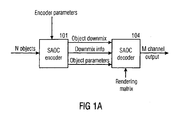
- Fig. la illustrates the operation of spatial audio object coding (SAOC), comprising an SAOC encoder 101 and an SAOC decoder 104.
- the spatial audio object encoder 101 encodes N objects into an object downmix consisting of K > 1 audio channels, according to encoder parameters.
- Information about the applied downmix weight matrix D is output by the SAOC encoder together with optional data concerning the power and correlation of the downmix.
- the matrix D is often, but not necessarily always, constant over time and frequency, and therefore represents a relatively low amount of information.
- the SAOC encoder extracts object parameters for each object as a function of both time and frequency at a resolution defined by perceptual considerations.
- the spatial audio object decoder 104 takes the object downmix channels, the downmix info, and the object parameters (as generated by the encoder) as input and generates an output with M audio channels for presentation to the user.
- the rendering of N objects into M audio channels makes use of a rendering matrix provided as user input to the SAOC decoder.
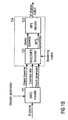
- Fig. 1b illustrates the operation of spatial audio object coding reusing an MPEG Surround decoder.
- An SAOC decoder 104 taught by the current invention can be realized as an SAOC to MPEG Surround transcoder 102 and an stereo downmix based MPEG Surround decoder 103.
- the task of the SAOC decoder is to perceptually recreate the target rendering of the original audio objects.
- the SAOC to MPEG Surround transcoder 102 takes as input the rendering matrix A, the object downmix, the downmix side information including the downmix weight matrix D , and the object side information, and generates a stereo downmix and MPEG Surround side information.
- a subsequent MPEG Surround decoder 103 fed with this data will produce an M channel audio output with the desired properties.
- An SAOC decoder taught by the current invention consists of an SAOC to MPEG Surround transcoder 102 and an stereo downmix based MPEG Surround decoder 103 .
- the task of the SAOC decoder is to perceptually recreate the target rendering of the original audio objects.
- the SAOC to MPEG Surround transcoder 102 takes as input the rendering matrix A , the object downmix, the downmix side information including the downmix weight matrix D , and the object side information, and generates a stereo downmix and MPEG Surround side information.
- a subsequent MPEG Surround decoder 103 fed with this data will produce an M channel audio output with the desired properties.
- Fig. 2 illustrates the operation of a spatial audio object (SAOC) encoder 101 taught by current invention.
- the N audio objects are fed both into a downmixer 201 and an audio object parameter extractor 202.
- the downmixer 201 mixes the objects into an object downmix consisting of K > 1 audio channels, according to the encoder parameters and also outputs downmix information.
- This information includes a description of the applied downmix weight matrix D and, optionally, if the subsequent audio object parameter extractor operates in prediction mode, parameters describing the power and correlation of the object downmix.
- the audio object parameter extractor 202 extracts object parameters according to the encoder parameters.
- the encoder control determines on a time and frequency varying basis which one of two encoder modes is applied, the energy based or the prediction based mode.
- the encoder parameters further contains information on a grouping of the N audio objects into P stereo objects and N-2P mono objects. Each mode will be further described by Figures 3 and 4 .
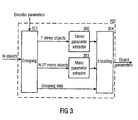
- Fig. 3 illustrates an audio object parameter extractor 202 operating in energy based mode.
- a grouping 301 into P stereo objects and N - 2 P mono objects is performed according to grouping information contained in the encoder parameters. For each considered time frequency interval the following operations are then performed.
- Two object powers and one normalized correlation are extracted for each of the P stereo objects by the stereo parameter extractor 302.
- One power parameter is extracted for each of the N - 2 P mono objects by the mono parameter extractor 303.
- the total set of N power parameters and P normalized correlation parameters is then encoded in 304 together with the grouping data to form the object parameters.
- the encoding can contain a normalization step with respect to the largest object power or with respect to the sum of extracted object powers.
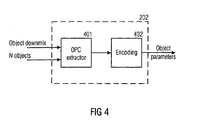
- Fig. 4 illustrates an audio object parameter extractor 202 operating in prediction based mode. For each considered time frequency interval the following operations are performed. For each of the N objects, a linear combination of the K object downmix channels is derived which matches the given object in a least squares sense. The K weights of this linear combination are called Object Prediction Coefficients (OPC) and they are computed by the OPC extractor 401. The total set of N • K OPC's are encoded in 402 to form the object parameters. The encoding can incorporate a reduction of total number of OPC's based on linear interdependencies. As taught by the present invention, this total number can be reduced to max ⁇ K •( N - K ),0 ⁇ if the downmix weight matrix D has full rank.
- OPC Object Prediction Coefficients
- Fig. 5 illustrates the structure of an SAOC to MPEG Surround transcoder 102 as taught by the current invention.
- the downmix side information and the object parameters are combined with the rendering matrix by the parameter calculator 502 to form MPEG Surround parameters of type CLD, CPC, and ICC, and a downmix converter matrix G of size 2 ⁇ K .
- the downmix converter 501 converts the object downmix into a stereo downmix by applying a matrix operation according to the G matrices.
- this matrix is the identity matrix and the object downmix is passed unaltered through as stereo downmix.
- This mode is illustrated in the drawing with the selector switch 503 in position A, whereas the normal operation mode has the switch in position B .
- An additional advantage of the transcoder is its usability as a stand alone application where the MPEG Surround parameters are ignored and the output of the downmix converter is used directly as a stereo rendering.
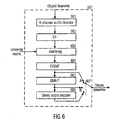
- Fig. 6 illustrates different operation modes of a downmix converter 501 as taught by the present invention.
- this bitstream is first decoded by the audio decoder 601 into K time domain audio signals. These signals are then all transformed to the frequency domain by an MPEG Surround hybrid QMF filter bank in the T/F unit 602.
- the time and frequency varying matrix operation defined by the converter matrix data is performed on the resulting hybrid QMF domain signals by the matrixing unit 603 which outputs a stereo signal in the hybrid QMF domain.
- the hybrid synthesis unit 604 converts the stereo hybrid QMF domain signal into a stereo QMF domain signal.
- the hybrid QMF domain is defined in order to obtain better frequency resolution towards lower frequencies by means of a subsequent filtering of the QMF subbands.
- this subsequent filtering is defined by banks of Nyquist filters
- the conversion from the hybrid to the standard QMF domain consists of simply summing groups of hybrid subband signals, see [ E. Schuijers, J. Breebart, and H. Purnhagen "Low complexity parametric stereo coding" Proc 116th AES convention Berlin ,Germany 2004 , Preprint 6073].
- This signal constitutes the first possible output format of the downmix converter as defined by the selector switch 607 in position A.
- Such a QMF domain signal can be fed directly into the corresponding QMF domain interface of an MPEG Surround decoder, and this is the most advantageous operation mode in terms of delay, complexity and quality.
- the next possibility is obtained by performing a QMF filter bank synthesis 605 in order to obtain a stereo time domain signal. With the selector switch 607 in position B the converter outputs a digital audio stereo signal that also can be fed into the time domain interface of a subsequent MPEG Surround decoder, or rendered directly in a stereo playback device.
- the third possibility with the selector switch 607 in position C is obtained by encoding the time domain stereo signal with a stereo audio encoder 606.
- the output format of the downmix converter is then a stereo audio bitstream which is compatible with a core decoder contained in the MPEG decoder.
- This third mode of operation is suitable for the case where the SAOC to MPEG Surround transcoder is separated by the MPEG decoder by a connection that imposes restrictions on bitrate, or in the case where the user desires to store a particular object rendering for future playback.
- Fig 7 illustrates the structure of an MPEG Surround decoder for a stereo downmix.
- the stereo downmix is converted to three intermediate channels by the Two-To-Three (TTT) box.
- TTT Two-To-Three
- OTT One-To-Two
- Fig. 8 illustrates a practical use case including an SAOC encoder.
- An audio mixer 802 outputs a stereo signal (L and R) which typically is composed by combining mixer input signals (here input channels 1-6) and optionally additional inputs from effect returns such as reverb etc.
- the mixer also outputs an individual channel (here channel 5) from the mixer. This could be done e.g. by means of commonly used mixer functionalities such as "direct outputs" or "auxiliary send” in order to output an individual channel post any insert processes (such as dynamic processing and EQ).
- the stereo signal (L and R) and the individual channel output (obj5) are input to the SAOC encoder 801, which is nothing but a special case of the SAOC encoder 101 in Fig. 1 .
- a signal block of L samples represents the signal in a time and frequency interval which is a part of the perceptually motivated tiling of the time-frequency plane which is applied for the description of signal properties.
- the downmix weight matrix D of size K ⁇ N where K > 1 determines the K channel downmix signal in the form of a matrix with K rows through the matrix multiplication X DS .
- the task of the SAOC decoder is to generate an approximation in the perceptual sense of the target rendering Y of the original audio objects, given the rendering matrix A ,the downmix X the downmix matrix D , and object parameters.
- the object parameters in the energy mode taught by the present invention carry information about the covariance of the original objects.
- this covariance is given in un-normalized form by the matrix product SS • where the star denotes the complex conjugate transpose matrix operation.
- energy mode object parameters furnish a positive semi-definite N ⁇ N matrix E such that, possibly up to a scale factor, S ⁇ S * ⁇ E .
- the ICC data can then be combined with the energies in order to form a matrix E with 2 P off diagonal entries.
- the transmitted energy and correlation data is S 1 , S 2 , S 3 and ⁇ 1.2 .
- the downmix left channel is 2 and the right channel is 2 .
- the OPC's for the single track aim at approximating s 3 ⁇ c 31 x 1 + c 32 x 2 and the equation (11) can in this case be solved to achieve 2 , 2 , 2 , and 2 .
- the transcoder has to output a stereo downmix ( l 0 , r 0 ) and parameters for the TTT and OTT boxes.
- K 2
- K 2
- both the object parameters and the MPS TTT parameters exist in both an energy mode and a prediction mode, all four combinations have to be considered.
- the energy mode is a suitable choice for instance in case the downmix audio coder is not of waveform coder in the considered frequency interval. It is understood that the MPEG Surround parameters derived in the following text have to be properly quantized and coded prior to their transmission.
- the object parameters can be in both energy or prediction mode, but the transcoder should preferably operate in prediction mode. If the downmix audio coder is not a waveform coder the in the considered frequency interval, the object encoder and the and the transcoder should both operate in energy mode.
- the fourth combination is of less relevance so the subsequent description will address the first three combinations only.
- the data available to the transcoder is described by the triplet of matrices ( D , E , A ).
- the MPEG Surround OTT parameters are obtained by performing energy and correlation estimates on a virtual rendering derived from the transmitted parameters and the 6 ⁇ N rendering matrix A .
- the MPEG surround decoder will be instructed to use some decorrelation between right front and right surround but no decorrelation between left front and left surround.
- the matrix C 3 contains the best weights for obtaining an approximation to the desired object rendering to the combined channels ( l,r,qc ) from the object downmix.
- This general type of matrix operation cannot be implemented by the MPEG surround decoder, which is tied to a limited space of TTT matrices through the use of only two parameters.
- the object of the inventive downmix converter is to pre-process the object downmix such that the combined effect of the pre-processing and the MPEG Surround TTT matrix is identical to the desired upmix described by C 3 .
- the available data is represented by the matrix triplet ( D , C , A ) where C is the N ⁇ 2 matrix holding the N pairs of OPC's. Due to the relative nature of prediction coefficients, it will further be necessary for the estimation of energy based MPEG Surround parameters to have access to an approximation to the 2 ⁇ 2 covariance matrix of the object downmix, X ⁇ X * ⁇ Z .
- This information is preferably transmitted from the object encoder as part of the downmix side information, but it could also be estimated at the transcoder from measurements performed on the received downmix, or indirectly derived from ( D , C ) by approximate object model considerations.
- OPC's arises in combination with MPEG Surround TIT parameters in prediction mode.
- the resulting matrix G is fed to the downmix converter and the TTT parameters ( ⁇ , ⁇ ) are transmitted to the MPEG Surround decoder.
- the object to stereo downmix converter 501 outputs an approximation to a stereo downmix of the 5.1 channel rendering of the audio objects.
- this downmix is interesting in its own right and a direct manipulation of the stereo rendering A 2 is attractive.
- the design of the downmix converter matrix is based on GDS ⁇ A 2 ⁇ S .
- Fig. 9 illustrates a preferred embodiment of an audio object coder in accordance with one aspect of the present invention.
- the audio object encoder 101 has already been generally described in connection with the preceding figures.
- the audio object coder for generating the encoded object signal uses the plurality of audio objects 90 which have been indicated in Fig. 9 as entering a downmixer 92 and an object parameter generator 94.
- the audio object encoder 101 includes the downmix information generator 96 for generating downmix information 97 indicating a distribution of the plurality of audio objects into at least two downmix channels indicated at 93 as leaving the downmixer 92.
- the object parameter generator is for generating object parameters 95 for the audio objects, wherein the object parameters are calculated such that the reconstruction of the audio object is possible using the object parameters and at least two downmix channels 93. Importantly, however, this reconstruction does not take place on the encoder side, but takes place on the decoder side. Nevertheless, the encoderside object parameter generator calculates the object parameters for the objects 95 so that this full reconstruction can be performed on the decoder side.
- the audio object encoder 101 includes an output interface 98 for generating the encoded audio object signal 99 using the downmix information 97 and the object parameters 95.
- the downmix channels 93 can also be used and encoded into the encoded audio object signal.
- the output interface 98 generates an encoded audio object signal 99 which does not include the downmix channels. This situation may arise when any downmix channels to be used on the decoder side are already at the decoder side, so that the downmix information and the object parameters for the audio objects are transmitted separately from the downmix channels.
- Such a situation is useful when the object downmix channels 93 can be purchased separately from the object parameters and the downmix information for a smaller amount of money, and the object parameters and the downmix information can be purchased for an additional amount of money in order to provide the user on the decoder side with an added value.
- the object parameters and the downmix information enable the user to form a flexible rendering of the audio objects at any intended audio reproduction setup, such as a stereo system, a multi-channel system or even a wave field synthesis system. While wave field synthesis systems are not yet very popular, multi-channel systems such as 5.1 systems or 7.1 systems are becoming increasingly popular on the consumer market.
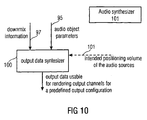
- Fig. 10 illustrates an audio synthesizer for generating output data.
- the audio synthesizer includes an output data synthesizer 100.
- the output data synthesizer receives, as an input, the downmix information 97 and audio object parameters 95 and, probably, intended audio source data such as a positioning of the audio sources or a user-specified volume of a specific source, which the source should have been when rendered as indicated at 101.
- the output data synthesizer 100 is for generating output data usable for creating a plurality of output channels of a predefined audio output configuration representing a plurality of audio objects. Particularly, the output data synthesizer 100 is operative to use the downmix information 97, and the audio object parameters 95. As discussed in connection with Fig. 11 later on, the output data can be data of a large variety of different useful applications, which include the specific rendering of output channels or which include just a reconstruction of the source signals or which include a transcoding of parameters into spatial rendering parameters for a spatial upmixer configuration without any specific rendering of output channels, but e.g. for storing or transmitting such spatial parameters.
- Fig. 14 The general application scenario of the present invention is summarized in Fig. 14 .
- an encoder side 140 which includes the audio object encoder 101 which receives, as an input, N audio objects.
- the output of the preferred audio object encoder comprises, in addition to the downmix information and the object parameters which are not shown in Fig. 14 , the K downmix channels.
- the number of downmix channels in accordance with the present invention is greater than or equal to two.
- the downmix channels are transmitted to a decoder side 142, which includes a spatial upmixer 143.
- the spatial upmixer 143 may include the inventive audio synthesizer, when the audio synthesizer is operated in a transcoder mode.
- the audio synthesizer 101 as illustrated in Fig. 10 works in a spatial upmixer mode, then the spatial upmixer 143 and the audio synthesizer are the same device in this embodiment.
- the spatial upmixer generates M output channels to be played via M speakers. These speakers are positioned at predefined spatial locations and together represent the predefined audio output configuration.
- An output channel of the predefined audio output configuration may be seen as a digital or analog speaker signal to be sent from an output of the spatial upmixer 143 to the input of a loudspeaker at a predefined position among the plurality of predefined positions of the predefined audio output configuration.
- the number of M output channels can be equal to two when stereo rendering is performed.
- the number of M output channels is larger than two.
- M is larger than K and may even be much larger than K, such as double the size or even more.
- Fig. 14 furthermore includes several matrix notations in order to illustrate the functionality of the inventive encoder side and the inventive decoder side.
- blocks of sampling values are processed. Therefore, as is indicated in equation (2), an audio object is represented as a line of L sampling values.
- the matrix S has N lines corresponding to the number of objects and L columns corresponding to the number of samples.
- the matrix E is calculated as indicated in equation (5) and has N columns and N lines.
- the matrix E includes the object parameters when the object parameters are given in the energy mode.
- the matrix E has, as indicated before in connection with equation (6) only main diagonal elements, wherein a main diagonal element gives the energy of an audio object. All off-diagonal elements represent, as indicated before, a correlation of two audio objects, which is specifically useful when some objects are two channels of the stereo signal.
- equation (2) is a time domain signal. Then a single energy value for the whole band of audio objects is generated.
- the audio objects are processed by a time/frequency converter which includes, for example, a type of a transform or a filter bank algorithm.
- equation (2) is valid for each subband so that one obtains a matrix E for each subband and, of course, each time frame.
- the downmix channel matrix X has K lines and L columns and is calculated as indicated in equation (3).
- the M output channels are calculated using the N objects by applying the so-called rendering matrix A to the N objects.
- the N objects can be regenerated on the decoder side using the downmix and the object parameters and the rendering can be applied to the reconstructed object signals directly.
- the downmix can be directly transformed to the output channels without an explicit calculation of the source signals.
- the rendering matrix A indicates the positioning of the individual sources with respect to the predefined audio output configuration. If one had six objects and six output channels, then one could place each object at each output channel and the rendering matrix would reflect this scheme. If, however, one would like to place all objects between two output speaker locations, then the rendering matrix A would look different and would reflect this different situation.
- the rendering matrix or, more generally stated, the intended positioning of the objects and also an intended relative volume of the audio sources can in general be calculated by an encoder and transmitted to the decoder as a so-called scene description.
- this scene description can be generated by the user herself/himself for generating the user-specific upmix for the user-specific audio output configuration.
- a transmission of the scene description is, therefore, not necessarily required, but the scene description can also be generated by the user in order to fulfill the wishes of the user.
- the user might, for example, like to place certain audio objects at places which are different from the places where these objects were when generating these objects.
- the audio objects are designed by themselves and do not have any "original" location with respect to the other objects. In this situation, the relative location of the audio sources is generated by the user at the first time.
- a downmixer 92 is illustrated.
- the downmixer is for downmixing the plurality of audio objects into the plurality of downmix channels, wherein the number of audio objects is larger than the number of downmix channels, and wherein the downmixer is coupled to the downmix information generator so that the distribution of the plurality of audio objects into the plurality of downmix channels is conducted as indicated in the downmix information.
- the downmix information generated by the downmix information generator 96 in Fig. 9 can be automatically created or manually adjusted. It is preferred to provide the downmix information with a resolution smaller than the resolution of the object parameters.
- the downmix information represents a downmix matrix having K lines and N columns.
- the value in a line of the downmix matrix has a certain value when the audio object corresponding to this value in the downmix matrix is in the downmix channel represented by the row of the downmix matrix.
- the values of more than one row of the downmix matrix have a certain value.
- Other values, however, are possible as well.
- audio objects can be input into one or more downmix channels with varying levels, and these levels can be indicated by weights in the downmix matrix which are different from one and which do not add up to 1.0 for a certain audio object.
- the encoded audio object signal may be for example a time-multiplex signal in a certain format.
- the encoded audio object signal can be any signal which allows the separation of the object parameters 95, the downmix information 97 and the downmix channels 93 on a decoder side.
- the output interface 98 can include encoders for the object parameters, the downmix information or the downmix channels. Encoders for the object parameters and the downmix information may be differential encoders and/or entropy encoders, and encoders for the downmix channels can be mono or stereo audio encoders such as MP3 encoders or AAC encoders. All these encoding operations result in a further data compression in order to further decrease the data rate required for the encoded audio object signal 99.
- the downmixer 92 is operative to include the stereo representation of background music into the at least two downmix channels and furthermore introduces the voice track into the at least two downmix channels in a predefined ratio.
- a first channel of the background music is within the first downmix channel and the second channel of the background music is within the second downmix channel. This results in an optimum replay of the stereo background music on a stereo rendering device. The user can, however, still modify the position of the voice track between the left stereo speaker and the right stereo speaker.
- the first and the second background music channels can be included in one downmix channel and the voice track can be included in the other downmix channel.
- a downmixer 92 is adapted to perform a sample by sample addition in the time domain. This addition uses samples from audio objects to be downmixed into a single downmix channel. When an audio object is to be introduced into a downmix channel with a certain percentage, a pre-weighting is to take place before the sample-wise summing process. Alternatively, the summing can also take place in the frequency domain, or a subband domain, i.e., in a domain subsequent to the time/frequency conversion. Thus, one could even perform the downmix in the filter bank domain when the time/frequency conversion is a filter bank or in the transform domain when the time/frequency conversion is a type of FFT, MDCT or any other transform.
- the object parameter generator 94 generates energy parameters and, additionally, correlation parameters between two objects when two audio objects together represent the stereo signal as becomes clear by the subsequent equation (6).
- the object parameters are prediction mode parameters.
- Fig. 15 illustrates algorithm steps or means of a calculating device for calculating these audio object prediction parameters. As has been discussed in connection with equations (7) to (12), some statistical information on the downmix channels in the matrix X and the audio objects in the matrix S has to be calculated. Particularly, block 150 illustrates the first step of calculating the real part of S ⁇ X* and the real part of X ⁇ X*.
- Fig. 7 illustrates several kinds of output data usable for creating a plurality of output channels of a predefined audio output configuration.
- Line 111 illustrates a situation in which the output data of the output data synthesizer 100 are reconstructed audio sources.
- the input data required by the output data synthesizer 100 for rendering the reconstructed audio sources include downmix information, the downmix channels and the audio object parameters.
- an output configuration and an intended positioning of the audio sources themselves in the spatial audio output configuration are not necessarily required.
- the output data synthesizer 100 would output reconstructed audio sources.
- the output data synthesizer 100 works as defined by equation (7).
- the output data synthesizer uses an inverse of the downmix matrix and the energy matrix for reconstructing the source signals.
- the output data synthesizer 100 operates as a transcoder as illustrated for example in block 102 in Fig. 1b .
- the output synthesizer is a type of a transcoder for generating spatial mixer parameters
- the downmix information, the audio object parameters, the output configuration and the intended positioning of the sources are required.
- the output configuration and the intended positioning are provided via the rendering matrix A.
- the downmix channels are not required for generating the spatial mixer parameters as will be discussed in more detail in connection with Fig. 12 .
- the spatial mixer parameters generated by the output data synthesizer 100 can then be used by a straight-forward spatial mixer such as an MPEG-surround mixer for upmixing the downmix channels.
- This embodiment does not necessarily need to modify the object downmix channels, but may provide a simple conversion matrix only having diagonal elements as discussed in equation (13).
- the output data synthesizer 100 would, therefore, output spatial mixer parameters and, preferably, the conversion matrix G as indicated in equation (13), which includes gains that can be used as arbitrary downmnix gain parameters (ADG) of the MPEG-surround decoder.
- ADG downmnix gain parameters
- the output data include spatial mixer parameters at a conversion matrix such as the conversion matrix illustrated in connection with equation (25).
- the output data synthesizer 100 does not necessarily have to perform the actual downmix conversion to convert the object downmix into a stereo downmix.
- a different mode of operation indicated by mode number 4 in line 114 in Fig. 11 illustrates the output data synthesizer 100 of Fig. 10 .
- the transcoder is operated as indicated by 102 in Fig. 1b and outputs not only spatial mixer parameters but additionally outputs a converted downmix. However, it is not necessary anymore to output the conversion matrix G in addition to the converted downmix. Outputting the converted downmix and the spatial mixer parameters is sufficient as indicated by Fig. 1b .
- Mode number 5 indicates another usage of the output data synthesizer 100 illustrated in Fig. 10 .
- the output data generated by the output data synthesizer do not include any spatial mixer parameters but only include a conversion matrix G as indicated by equation (35) for example or actually includes the output of the stereo signals themselves as indicated at 115.
- a stereo rendering is of interest and any spatial mixer parameters are not required.
- all available input information as indicated in Fig. 11 is required.
- Another output data synthesizer mode is indicated by mode number 6 at line 116.
- the output data synthesizer 100 generates a multi-channel output, and the output data synthesizer 100 would be similar to element 104 in Fig. 1b .
- the output data synthesizer 100 requires all available input information and outputs a multi-channel output signal having more than two output channels to be rendered by a corresponding number of speakers to be positioned at intended speaker positions in accordance with the predefined audio output configuration.
- Such a multi-channel output is a 5.1 output, a 7.1 output or only a 3.0 output having a left speaker, a center speaker and a right speaker.
- Fig. 11 illustrates one example for calculating several parameters from the Fig. 7 parameterization concept known from the MPEG-surround decoder.
- Fig. 7 illustrates an MPEG-surround decoder-side parameterization starting from the stereo downmix 70 having a left downmix channel l 0 and a right downmix channel r 0 .
- both downmix channels are input into a so-called Two-To-Three box 71.
- the Two-To-Three box is controlled by several input parameters 72.
- Box 71 generates three output channels 73a, 73b, 73c. Each output channel is input into a One-To-Two box.
- the intermediate signals indicated by 73a, 73b and 73c are not explicitly calculated by a certain embodiment, but are illustrated in Fig. 7 only for illustration purposes.
- boxes 74a, 74b receive some residual signals res l OTT , res 2 OTT which can be used for introducing a certain randomness into the output signals.
- box 71 is controlled either by prediction parameters CPC or energy parameters CLD TTT .
- prediction parameters CPC For the upmix from two channels to three channels, at least two prediction parameters CPC1, CPC2 or at least two energy parameters CLD 1 TTT and CLD 2 TTT are required.
- the correlation measure ICC TTT can be put into the box 71 which is, however, only an optional feature which is not used in one embodiment of the invention.
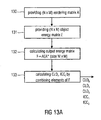
- Figs. 12 and 13 illustrate the necessary steps and/or means for calculating all parameters CPC/CLD TTT , CLD0, CLD1, ICCl, CLD2, ICC2 from the object parameters 95 of Fig. 9 , the downmix information 97 of Fig. 9 and the intended positioning of the audio sources, e.g. the scene description 101 as illustrated in Fig. 10 .
- These parameters are for the predefined audio output format of a 5.1 surround system.
- a rendering matrix A is provided.
- the rendering matrix indicates where the source of the plurality of sources is to be placed in the context of the predefined output configuration.
- Step 121 illustrates the derivation of the partial downmix matrix D 36 as indicated in equation (20). This matrix reflects the situation of a downmix from six output channels to three channels and has a size of 3xN. When one intends to generate more output channels than the 5.1 configuration, such as an 8-channel output configuration (7.1), then the matrix determined in block 121 would be a D 38 matrix.
- a reduced rendering matrix A 3 is generated by multiplying matrix D 36 and the full rendering matrix as defined in step 120.
- the downmix matrix D is introduced. This downmix matrix D can be retrieved from the encoded audio object signal when the matrix is fully included in this signal. Alternatively, the downmix matrix could be parameterized e.g. for the specific downmix information example and the downmix matrix G.
- the object energy matrix is provided in step 124.
- This object energy matrix is reflected by the object parameters for the N objects and can be extracted from the imported audio objects or reconstructed using a certain reconstruction rule.
- This reconstruction rule may include an entropy decoding etc.
- step 125 the "reduced" prediction matrix C 3 is defined.
- the values of this matrix can be calculated by solving the system of linear equations as indicated in step 125. Specifically, the elements of matrix C 3 can be calculated by multiplying the equation on both sides by an inverse of (DED*).
- step 126 the conversion matrix G is calculated.
- the conversion matrix G has a size of KxK and is generated as defined by equation (25).
- the specific matrix D TTT is to be provided as indicated by step 127.
- An example for this matrix is given in equation (24) and the definition can be derived from the corresponding equation for C TTT as defined in equation (22). Equation (22), therefore, defines what is to be done in step 128.
- Step 129 defines the equations for calculating matrix C TTT .
- the parameters ⁇ , ⁇ and ⁇ which are the CPC parameters, can be output.
- ⁇ is set to 1 so that the only remaining CPC parameters input into block 71 are ⁇ and ⁇ .
- the rendering matrix A is provided.
- the size of the rendering matrix A is N lines for the number of audio objects and M columns for the number of output channels.
- This rendering matrix includes the information from the scene vector, when a scene vector is used.
- the rendering matrix includes the information of placing an audio source in a certain position in an output setup.
- the rendering matrix is generated on the decoder side without any information from the encoder side. This allows a user to place the audio objects wherever the user likes without paying attention to a spatial relation of the audio objects in the encoder setup.
- the relative or absolute location of audio sources can be encoded on the encoder side and transmitted to the decoder as a kind of a scene vector. Then, on the decoder side, this information on locations of audio sources which is preferably independent of an intended audio rendering setup is processed to result in a rendering matrix which reflects the locations of the audio sources customized to the specific audio output configuration.
- step 131 the object energy matrix E which has already been discussed in connection with step 124 of Fig. 12 is provided.
- This matrix has the size of NxN and includes the audio object parameters.
- such an object energy matrix is provided for each subband and each block of time-domain samples or subband-domain samples.
- the output energy matrix F is calculated.
- F is the covariance matrix of the output channels. Since the output channels are, however, still unknown, the output energy matrix F is calculated using the rendering matrix and the energy matrix.
- These matrices are provided in steps 130 and 131 and are readily available on the decoder side. Then, the specific equations (15), (16), (17), (18) and (19) are applied to calculate the channel level difference parameters CLD 0 , CLD 1 , CLD 2 and the inter-channel coherence parameters ICC 1 and ICC 2 so that the parameters for the boxes 74a, 74b, 74c are available. Importantly, the spatial parameters are calculated by combining the specific elements of the output energy matrix F.
- step 133 all parameters for a spatial upmixer, such as the spatial upmixer as schematically illustrated in Fig. 7 , are available,
- the object parameters were given as energy parameters.
- the object parameters are given as prediction parameters, i.e. as an object prediction matrix C as indicated by item 124a in Fig. 12
- the calculation of the reduced prediction matrix C 3 is just a matrix multiplication as illustrated in block 125a and discussed in connection with equation (32).
- the matrix A 3 as used in block 125a is the same matrix A 3 as mentioned in block 122 of Fig. 12 .
- the object prediction matrix C is generated by an audio object encoder and transmitted to the decoder, then some additional calculations are required for generating the parameters for the boxes 74a, 74b, 74c. These additional steps are indicated in Fig. 13b .
- the object prediction matrix C is provided as indicated by 124a in Fig. 13b , which is the same as discussed in connection with block 124a of Fig. 12 .
- the covariance matrix of the object downmix Z is calculated using the transmitted downmix or is generated and transmitted as additional side information.
- the decoder does not necessarily have to perform any energy calculations which inherently introduce some delayed processing and increase the processing load on the decoder side.
- step 134 the object energy matrix E can be calculated as indicated by step 135 by using the prediction matrix C and the downmix covariance or "downmix energy" matrix Z.
- step 135 all steps discussed in connection with Fig. 13a can be performed, such as steps 132, 133, to generate all parameters for blocks 74a, 74b, 74c of Fig. 7 .
- Fig. 16 illustrates a further embodiment, in which only a stereo rendering is required.
- the stereo rendering is the output as provided by mode number 5 or line 115 of Fig. 11 .
- the output data synthesizer 100 of Fig. 10 is not interested in any spatial upmix parameters but is mainly interested in a specific conversion matrix G for converting the object downmix into a useful and, of course, readily influencable and readily controllable stereo downmix.
- an M-to-2 partial downmix matrix is calculated.
- the partial downmix matrix would be a downmix matrix from six to two channels, but other downmix matrices are available as well.
- the calculation of this partial downmix matrix can be, for example, derived from the partial downmix matrix D 36 as generated in step 121 and matrix D TTT as used in step 127 of Fig. 12 .
- a stereo rendering matrix A 2 is generated using the result of step 160 and the "big" rendering matrix A is illustrated in step 161.
- the rendering matrix A is the same matrix as has been discussed in connection with block 120 in Fig. 12 .
- the stereo rendering matrix may be parameterized by placement parameters ⁇ and ⁇ .
- ⁇ is set to 1 and ⁇ is set to 1 as well, then the equation (33) is obtained, which allows a variation of the voice volume in the example described in connection with equation (33).
- other parameters such as ⁇ and ⁇ are used, then the placement of the sources can be varied as well.
- the conversion matrix G is calculated by using equation (33).
- the matrix (DED*) can be calculated, inverted and the inverted matrix can be multiplied to the right-hand side of the equation in block 163.
- the conversion matrix G is there, and the object downmix X can be converted by multiplying the conversion matrix and the object downmix as indicated in block 164.
- the converted downmix X' can be stereo-rendered using two stereo speakers.
- certain values for ⁇ , ⁇ and ⁇ can be set for calculating the conversion matrix G.
- the conversion matrix G can be calculated using all these three parameters as variables so that the parameters can be set subsequent to step 163 as required by the user.
- Preferred embodiments solve the problem of transmitting a number of individual audio objects (using a multi-channel downmix and additional control data describing the objects) and rendering the objects to a given reproduction system (loudspeaker configuration).
- a technique on how to modify the object related control data into control data that is compatible to the reproduction system is introduced. It further proposes suitable encoding methods based on the MPEG Surround coding scheme.
- the inventive methods and signals can be implemented in hardware or in software.
- the implementation can be performed using a digital storage medium, in particular a disk or a CD having electronically readable control signals stored thereon, which can cooperate with a programmable computer system such that the inventive methods are performed.
- the present invention is, therefore, a computer program product with a program code stored on a machine-readable carrier, the program code being configured for performing at least one of the inventive methods, when the computer program products runs on a computer.
- the inventive methods are, therefore, a computer program having a program code for performing the inventive methods, when the computer program runs on a computer.
Landscapes
- Engineering & Computer Science (AREA)
- Physics & Mathematics (AREA)
- Signal Processing (AREA)
- Acoustics & Sound (AREA)
- Multimedia (AREA)
- Computational Linguistics (AREA)
- Health & Medical Sciences (AREA)
- Audiology, Speech & Language Pathology (AREA)
- Human Computer Interaction (AREA)
- Mathematical Physics (AREA)
- Mathematical Analysis (AREA)
- General Physics & Mathematics (AREA)
- Algebra (AREA)
- Mathematical Optimization (AREA)
- Pure & Applied Mathematics (AREA)
- Theoretical Computer Science (AREA)
- Stereophonic System (AREA)
- Compression, Expansion, Code Conversion, And Decoders (AREA)
- Medicines Containing Antibodies Or Antigens For Use As Internal Diagnostic Agents (AREA)
- Electron Tubes For Measurement (AREA)
- Investigating Or Analysing Biological Materials (AREA)
- Reduction Or Emphasis Of Bandwidth Of Signals (AREA)
- Signal Processing For Digital Recording And Reproducing (AREA)
- Telephone Function (AREA)
- Sorting Of Articles (AREA)
- Optical Measuring Cells (AREA)
Claims (50)
- Codeur d'objet audio (101) destiné à générer un signal d'objet audio codé (99) à l'aide d'une pluralité d'objets audio (90), dans lequel la pluralité d'objets audio comporte un objet stéréo représenté par deux objets audio présentant une certaine corrélation non zéro, comprenant:un générateur d'informations de mélange vers le bas (96) destiné à générer des informations de mélange vers le bas (97) indiquant une répartition de la pluralité d'objets audio sur au moins deux canaux de mélange vers le bas;un générateur de paramètres d'objet (94) destiné à générer les paramètres d'objet pour les objets audio (95), où les paramètres d'objet comprennent des approximations d'énergies d'objet de la pluralité d'objets audio et des données de corrélation pour l'objet stéréo; etune interface de sortie (98) destinée à générer le signal d'objet audio codé (99) à l'aide des informations de mélange vers le bas et des paramètres d'objet.
- Codeur d'objet audio selon la revendication 1, comprenant par ailleurs:un mélangeur vers le bas (92) destiné à mélanger vers le bas la pluralité d'objets audio, pour obtenir la pluralité de canaux de mélange vers le bas, où le nombre d'objets audio est supérieur au nombre de canaux de mélange vers le bas, et où le mélangeur vers le bas est couplé au générateur d'informations de mélange vers le bas, de sorte que la répartition de la pluralité d'objets audio sur la pluralité de canaux de mélange vers le bas soit effectuée tel qu'indiqué dans les informations de mélange vers le bas.
- Codeur d'objet audio selon la revendication 2, dans lequel l'interface de sortie (98) fonctionne pour générer le signal audio codé en utilisant en outré la pluralité de canaux de mélange vers le bas.
- Codeur d'objet audio selon la revendication 1, dans lequel le générateur de paramètres d'objet (94) est opérationnel pour générer les paramètres d'objet avec une première résolution dans le temps et de fréquence, et dans lequel le générateur d'informations de mélange vers le bas (96) est opérationnel pour générer les informations de mélange vers le bas avec une deuxième résolution dans le temps et de fréquence, la deuxième résolution dans le temps et de fréquence étant inférieure à la première résolution dans le temps et de fréquence.
- Codeur d'objet audio selon la revendication 1, dans lequel le générateur d'informations de mélange vers le bas (96) est opérationnel pour générer les informations de mélange vers le bas de sorte que les informations de mélange vers le bas soient égales pour toute la bande de fréquences des objets audio.
- Codeur d'objet audio selon la revendication 1, dans lequel le générateur d'informations de mélange vers le bas (96) est opérationnel pour générer les informations de mélange vers le bas de sorte que les informations de mélange vers le bas représentent une matrice de mélange vers le bas définie comme suit:

où S est la matrice et représente les objets audio et présente un nombre de rangées égal au nombre d'objets audio,
où D est la matrice de mélange vers le bas, et
où X est une matrice et représente la pluralité de canaux de mélange vers le bas et présente un nombre de rangées égal au nombre de canaux de mélange vers le bas. - Codeur d'objet audio selon la revendication 1, dans lequel le générateur d'informations de mélange vers le bas (96) est opérationnel pour calculer les informations de mélange vers le bas de sorte que les informations de mélange vers le bas indiquent
l'objet audio qui est totalement ou partiellement inclus dans un ou plusieurs de la pluralité de canaux de mélange vers le bas, et
lorsqu'un objet audio est inclus dans plus d'un canal de mélange vers le bas, une information sur une partie de l'objet audio inclus dans un canal de mélange vers le bas des plus d'un canal de mélange vers le bas. - Codeur d'objet audio selon la revendication 7, dans lequel l'information sur une partie est un facteur inférieur à 1 et supérieur à 0.
- Codeur d'objet audio selon la revendication 2, dans lequel le mélangeur vers le bas (92) est opérationnel pour inclure la représentation stéréo de musique de fond dans les au moins deux canaux de mélange vers le bas, et pour introduire une piste de parole dans les au moins deux canaux de mélange vers le bas selon un rapport prédéfini.
- Codeur d'objet audio selon la revendication 2, dans lequel le mélangeur vers le bas (92) est opérationnel pour effectuer une addition par échantillon de signaux à entrer dans un canal de mélange vers le bas comme indiqué par les informations de mélange vers le bas.
- Codeur d'objet audio selon la revendication 1, dans lequel l'interface de sortie (98) est opérationnelle pour effectuer une compression de données des informations de mélange vers le bas et des paramètres d'objet avant de générer le signal d'objet audio codé.
- Codeur d'objet audio selon la revendication 1, dans lequel le générateur d'informations de mélange vers le bas (96) est opérationnel pour générer une information de puissance et une information de corrélation indiquant une caractéristique de puissance et une caractéristique de corrélation des au moins deux canaux de mélange vers le bas.
- Codeur d'objet audio selon la revendication 1, dans lequel le générateur d'informations de mélange vers le bas génère une information de regroupement indiquant les deux objets audio formant l'objet stéréo.
- Codeur d'objet audio selon la revendication 1, dans lequel le générateur de paramètres d'objet (94) est opérationnel pour générer les paramètres de prédiction d'objet pour les objets audio, les paramètres de prédiction étant calculés de sorte que l'addition pondérée des canaux de mélange vers le bas pour un objet de source contrôlé par les paramètres de prédiction ou l'objet de source résulte en une approximation de l'objet de source.
- Codeur d'objet audio selon la revendication 14, dans lequel les paramètres de prédiction sont générés par bande de fréquences, et dans lequel les objets audio couvrent une pluralité de bandes de fréquences.
- Codeur d'objet audio selon la revendication 14, dans lequel le nombre d'objets audio est égal à N, le nombre de canaux de mélange vers le bas est égal à K, et le nombre de paramètres de prédiction d'objet calculés par le générateur de paramètres d'objet (94) est égal ou inférieur à N · K.
- Codeur d'objet audio selon la revendication 16, dans lequel le générateur de paramètres d'objet (94) est opérationnel pour calculer tout au plus K · (N-K) paramètres de prédiction d'objet.
- Procédé de codage d'objets audio pour générer un signal d'objet audio codé (99) à l'aide d'une pluralité d'objets audio (90), dans lequel la pluralité d'objets audio comporte un objet stéréo représenté par deux objets audio présentant une certaine corrélation non zéro, comprenant:générer (96) les informations de mélange vers le bas indiquant une répartition de la pluralité d'objets audio sur au moins deux canaux de mélange vers le bas;générer (94) les paramètres d'objet pour les objets audio (95), où les paramètres d'objet comprennent des approximations d'énergies d'objet de la pluralité d'objets audio et les données de corrélation pour l'objet stéréo; etgénérer (98) le signal d'objet audio codé à l'aide des informations de mélange vers le bas et des paramètres d'objet.
- Synthétiseur audio (101) destiné à générer des données de sortie à l'aide d'un signal d'objet audio codé, le signal d'objet audio codé comprenant les paramètres d'objet (95) pour une pluralité d'objets audio et les informations de mélange vers le bas (97), comprenant:un synthétiseur de données de sortie (100) destiné à générer les données de sortie pouvant être utilisées pour le rendu d'une pluralité de canaux de sortie d'une configuration de sortie audio prédéfinie représentant la pluralité d'objets audio, où la pluralité d'objets audio comporte un objet stéréo représenté par deux objets audio présentant une certaine corrélation non zéro, le synthétiseur de données de sortie étant opérationnel pour recevoir, comme entrée, les paramètres d'objet (95), où les paramètres d'objet (95) comprennent des approximations d'énergies d'objet de la pluralité d'objets audio et les données de corrélation pour l'objet stéréo et pour utiliser les informations de mélange vers le bas (97) indiquant une répartition de la pluralité d'objets audio sur au moins deux canaux de mélange vers le bas, et les paramètres d'objet (95) pour les objets audio.
- Synthétiseur audio selon la revendication 19, dans lequel le synthétiseur de données de sortie (100) est opérationnel pour transcoder les paramètres d'objet en paramètres spatiaux pour la configuration de sortie audio prédéfinie à l'aide, en outre, d'un positionnement prévu des objets audio dans la configuration de sortie audio.
- Synthétiseur audio selon la revendication 19, dans lequel le synthétiseur de données de sortie (100) est opérationnel pour convertir une pluralité de canaux de mélange vers le bas en mélange vers le bas stéréo pour la configuration de sortie audio prédéfinie à l'aide d'une matrice de conversion dérivée du positionnement prévu des objets audio.
- Synthétiseur audio selon la revendication 21, dans lequel le synthétiseur de données de sortie (100) est opérationnel pour déterminer la matrice de conversion à l'aide des informations de mélange vers le bas, où la matrice de conversion est calculée de sorte qu'au moins des parties des canaux de mélange vers le bas soient échangées lorsqu'un objet audio inclus dans un premier canal de mélange vers le bas représentant la première moitié d'un plan stéréo doit être reproduite dans la deuxième moitié du plan stéréo.
- Synthétiseur audio selon la revendication 20, comprenant par ailleurs un dispositif de rendu de canaux (104) destiné à rendre des canaux de sortie audio pour la configuration de sortie audio prédéfinie à l'aide des paramètres spatiaux et des au moins deux canaux de mélange vers le bas ou des canaux de mélange vers le bas convertis.
- Synthétiseur audio selon la revendication 19, dans lequel le synthétiseur de données de sortie (100) est opérationnel pour sortir les canaux de sortie de la configuration de sortie audio prédéfinie à l'aide, en outre, des au moins deux canaux de mélange vers le bas.
- Synthétiseur audio selon la revendication 19, dans lequel les paramètres spatiaux comportent le premier groupe de paramètres pour un mélange vers le haut de Deux-à-Trois et un deuxième groupe de paramètres d'énergie pour un mélange vers le haut de Trois-Deux-Six, et
dans lequel le synthétiseur de données de sortie (100) est opérationnel pour calculer les paramètres de prédiction pour la matrice de prédiction Deux-à-Trois à l'aide de la matrice de rendu déterminée par un positionnement prévu des objets audio, une matrice de mélange vers le bas partial décrivant le mélange vers le bas des canaux de sortie, pour obtenir trois canaux générés par un processus de mélange vers le haut Deux-à-Trois hypothétique, et la matrice de mélange vers le bas. - Synthétiseur audio selon la revendication 25, dans lequel le synthétiseur de données de sortie (100) est opérationnel pour calculer les poids de mélange vers le bas réels pour la matrice de mélange vers le bas partielle de sorte qu'une énergie d'une somme pondérée de deux canaux soit égale aux énergies des canaux dans un facteur de limite.
- Synthétiseur audio selon la revendication 26, dans lequel les poids de mélange vers le bas pour la matrice de mélange vers le bas partielle sont déterminés comme suit:

où wp est un poids de mélange vers le bas, p est une variable d'indice de nombre entier, fj.i est un élément d'une matrice d'énergie représentant une approximation d'une matrice de covariance des canaux de sortie de la configuration de sortie prédéfinie. - Synthétiseur audio selon la revendication 25, dans lequel le synthétiseur de données de sortie (100) est opérationnel pour calculer des coefficients séparés de la matrice de prédiction en résolvant un système d'équations linéaires.
- Synthétiseur audio selon la revendication 25, dans lequel le synthétiseur de données de sortie (100) est opérationnel pour résoudre le système d'équations linéaires sur base de:

où C3 est la matrice de prédiction Deux-à-Trois, D est la matrice de mélange vers le bas dérivée des informations de mélange vers le bas, E est une matrice d'énergie dérivée des objets de source audio, et A3 est la matrice de mélange vers le bas réduite, et où the "•" indique l'opération conjuguée complexe. - Synthétiseur audio selon la revendication 25, dans lequel les paramètres de prédiction pour le mélange vers le haut Deux-à-Trois sont dérivés d'une paramétrisation de la matrice de prédiction de sorte que la matrice de prédiction soit définie à l'aide d'uniquement deux paramètres, et
dans lequel le synthétiseur de données de sortie (100) est opérationnel pour prétraiter les au moins deux canaux de mélange vers le bas de sorte que l'effet du prétraitement et de la matrice de prédiction paramétrisée corresponde à une matrice de mélange vers le haut souhaitée. - Synthétiseur audio selon la revendication 30, dans lequel la paramétrisation de la matrice de prédiction est comme suit:

où l'indice TTT est la matrice de prédiction paramétrisée, et où α, β et
γ sont des facteurs. - Synthétiseur audio selon la revendication 19, dans lequel une matrice de conversion de mélange vers le bas G est calculée comme suit:

où C3 est une matrice de prédiction Deux-à-Trois, où DTTT et CTTT sont égaux à I, où I est une matrice d'identité deux-par-deux, et où CTTT est basé sur:
où α, β et γ sont des facteurs constants. - Synthétiseur audio selon la revendication 32, dans lequel les paramètres de prédiction pour le mélange vers le haut Deux-à-Trois sont déterminés comme α et β, où γ est réglé à 1.
- Synthétiseur audio selon la revendication 25, dans lequel le synthétiseur de données de sortie (100) est opérationnel pour calculer les paramètres d'énergie pour le mélange vers le haut Trois-Deux-Six à l'aide d'une matrice d'énergie F sur base de:

où A est la matrice de rendu, E est la matrice d'énergie dérivée des objets de source audio, Y est une matrice de canaux de sortie et "•" indique l'opération conjuguée complexe. - Synthétiseur audio selon la revendication 34, dans lequel le synthétiseur de données de sortie (100) est opérationnel pour calculer les paramètres d'énergie en combinant des éléments de la matrice d'énergie.
- Synthétiseur audio selon la revendication 35, dans lequel le synthétiseur de données de sortie (100) est opérationnel pour calculer les paramètres d'énergie sur base des équations suivantes:


où ϕ est une valeur absolue ϕ(z)=| z | ou un opérateur de valeur réelle ϕ(z)=Re{z},
où CLD0 est un premier paramètre d'énergie de différence de niveau de canal, où CLD1 est un deuxième paramètre d'énergie de différence de niveau de canal, où CLD2 est un troisième paramètre d'énergie de différence de niveau de canal, où ICC1 est un premier paramètre d'énergie de cohérence entre canaux, et ICC2 est un deuxième paramètre d'énergie de cohérence entre canaux, et où fij sont des éléments d'une matrice d'énergie F aux positions i, j dans cette matrice. - Synthétiseur audio selon la revendication 25, dans lequel le premier groupe de paramètres comporte les paramètres d'énergie, et dans lequel le synthétiseur de données de sortie (100) est opérationnel pour dériver les paramètres d'énergie en combinant les éléments de la matrice d'énergie F.
- Synthétiseur audio selon la revendication 37, dans lequel les paramètres d'énergie sont dérivés sur base de:


où

- Synthétiseur audio selon les revendications 37 ou 38, dans lequel le synthétiseur de données de sortie (100) est opérationnel pour calculer les facteurs de poids pour pondérer les canaux de mélange vers le bas, les facteurs de poids étant utilisés pour contrôler les facteurs de gain de mélange vers le bas arbitraires du décodeur spatial.
- Synthétiseur audio selon la revendication 39, dans lequel le synthétiseur de données de sortie (100) est opérationnel pour calculer les facteurs de poids sur base de:


où D est la matrice de mélange vers le bas, E est une matrice d'énergie dérivée des objets de source audio, où W est une matrice intermédiaire, où D26 est la matrice de mélange vers le bas partielle pour le mélange vers le bas de 6 à 2 canaux de la configuration de sortie prédéterminée, et où G est la matrice de conversion comportant les facteurs de gain de mélange vers le bas arbitraires du décodeur spatial. - Synthétiseur audio selon la revendication 25, dans lequel les paramètres d'objet sont des paramètres de prédiction d'objet, et dans lequel le synthétiseur de données de sortie est opérationnel pour précalculer une matrice d'énergie sur base des paramètres de prédiction d'objet, des informations de mélange vers le bas, et des informations d'énergie correspondant aux canaux de mélange vers le bas.
- Synthétiseur audio selon la revendication 41, dans lequel le synthétiseur de données de sortie (100) est opérationnel pour calculer la matrice d'énergie sur base de:

où E est la matrice d'énergie, C est la matrice de paramètres de prédiction, et Z est une matrice de covariance des au moins deux canaux de mélange vers le bas. - Synthétiseur audio selon la revendication 19, dans lequel le synthétiseur de données de sortie (100) est opérationnel pour générer deux canaux stéréo pour une configuration de sortie stéréo en calculant une matrice de rendu stéréo paramétrisée et une matrice de conversion fonction de la matrice de rendu stéréo paramétrisée.
- Synthétiseur audio selon la revendication 43, dans lequel le synthétiseur de données de sortie (100) est opérationnel pour calculer la matrice de conversion sur base de:

où G est la matrice de conversion, A2 est la matrice de rendu partielle, et C est la matrice de paramètres de prédiction. - Synthétiseur audio selon la revendication 43, dans lequel le synthétiseur de données de sortie (100) est opérationnel pour calculer la matrice de conversion sur base de:

où G est une matrice d'énergie dérivée de la source audio de pistes, D est une matrice de mélange vers le bas dérivée des informations de mélange vers le bas, A2 est une matrice de rendu réduite, et "•" indique l'opération conjuguée complexe. - Synthétiseur audio selon la revendication 43, dans lequel la matrice de rendu stéréo paramétrisée A2 est déterminée comme suit:

où µ, v, et K sont des paramètres de valeur réelle à régler selon la position et le volume d'un ou plusieurs objets audio de source. - Procédé de synthétisation audio pour générer des données de sortie à l'aide d'un signal d'objet audio codé, le signal d'objet audio codé comprenant les paramètres d'objet (95) pour une pluralité d'objets audio et des informations de mélange vers le bas (97), comprenant:recevoir les paramètres d'objet (95), où les paramètres d'objet (95) comprennent des approximations d'énergies d'objet de la pluralité d'objets audio et les données de corrélation pour un objet stéréo, etgénérer les données de sortie pouvant être utilisées pour créer une pluralité de canaux de sortie d'une configuration de sortie audio prédéfinie représentant la pluralité d'objets audio, où la pluralité d'objets audio inclut un objet stéréo représenté par deux objets audio présentant une certaine corrélation non zéro, à l'aide des informations de mélange vers le bas (97) indiquant une répartition de la pluralité d'objets audio sur au moins deux canaux de mélange vers le bas, et les paramètres d'objet (95) pour les objets audio.
- Signal d'objet audio codé comprenant une information de mélange vers le bas indiquant une répartition de la pluralité d'objets audio sur au moins deux canaux de mélange vers le bas, le signal d'objet audio codé comprenant par ailleurs les paramètres d'objet (95), où les paramètres d'objet (95) comprennent des approximations d'énergies d'objet d'une pluralité d'objets audio et les données de corrélation pour un objet stéréo, où la pluralité d'objets audio inclut un objet stéréo représenté par deux objets audio présentant une certaine corrélation non zéro, et où les paramètres d'objet (95) sont tels qu'une reconstruction des objets audio est possible à l'aide des paramètres d'objet et des au moins deux canaux de mélange vers le bas.
- Signal d'objet audio codé selon la revendication 49 mémorisé sur un support de mémoire lisible par un ordinateur.
- Programme d'ordinateur pour réaliser, lorsqu'il est exécuté sur un ordinateur, un procédé selon l'un quelconque des procédés des revendications 18 ou 47.
Priority Applications (3)
| Application Number | Priority Date | Filing Date | Title |
|---|---|---|---|
| EP11153938.3A EP2372701B1 (fr) | 2006-10-16 | 2007-10-05 | Codage amélioré et représentation de paramètre de codage d'objet à mélange abaisseur multicanaux |
| PL09004406T PL2068307T3 (pl) | 2006-10-16 | 2007-10-05 | Udoskonalony sposób kodowania i odtwarzania parametrów w wielokanałowym kodowaniu obiektów poddanych procesowi downmiksu |
| EP09004406A EP2068307B1 (fr) | 2006-10-16 | 2007-10-05 | Codage amélioré et représentation de paramètre de codage d'objet à mélange abaisseur multicanaux |
Applications Claiming Priority (2)
| Application Number | Priority Date | Filing Date | Title |
|---|---|---|---|
| US82964906P | 2006-10-16 | 2006-10-16 | |
| PCT/EP2007/008683 WO2008046531A1 (fr) | 2006-10-16 | 2007-10-05 | Codage amélioré et représentation de paramètres d'un codage d'objet à abaissement de fréquence multi-canal |
Related Child Applications (3)
| Application Number | Title | Priority Date | Filing Date |
|---|---|---|---|
| EP09004406A Division EP2068307B1 (fr) | 2006-10-16 | 2007-10-05 | Codage amélioré et représentation de paramètre de codage d'objet à mélange abaisseur multicanaux |
| EP09004406.6 Division-Into | 2009-03-26 | ||
| EP11153938.3 Division-Into | 2011-02-10 |
Publications (2)
| Publication Number | Publication Date |
|---|---|
| EP2054875A1 EP2054875A1 (fr) | 2009-05-06 |
| EP2054875B1 true EP2054875B1 (fr) | 2011-03-23 |
Family
ID=38810466
Family Applications (3)
| Application Number | Title | Priority Date | Filing Date |
|---|---|---|---|
| EP07818759A Active EP2054875B1 (fr) | 2006-10-16 | 2007-10-05 | Codage amélioré et représentation de paramètres d'un codage d'objet à mélange abaisseur multi-canal |
| EP09004406A Active EP2068307B1 (fr) | 2006-10-16 | 2007-10-05 | Codage amélioré et représentation de paramètre de codage d'objet à mélange abaisseur multicanaux |
| EP11153938.3A Active EP2372701B1 (fr) | 2006-10-16 | 2007-10-05 | Codage amélioré et représentation de paramètre de codage d'objet à mélange abaisseur multicanaux |
Family Applications After (2)
| Application Number | Title | Priority Date | Filing Date |
|---|---|---|---|
| EP09004406A Active EP2068307B1 (fr) | 2006-10-16 | 2007-10-05 | Codage amélioré et représentation de paramètre de codage d'objet à mélange abaisseur multicanaux |
| EP11153938.3A Active EP2372701B1 (fr) | 2006-10-16 | 2007-10-05 | Codage amélioré et représentation de paramètre de codage d'objet à mélange abaisseur multicanaux |
Country Status (21)
| Country | Link |
|---|---|
| US (2) | US9565509B2 (fr) |
| EP (3) | EP2054875B1 (fr) |
| JP (3) | JP5270557B2 (fr) |
| KR (2) | KR101012259B1 (fr) |
| CN (3) | CN103400583B (fr) |
| AT (2) | ATE503245T1 (fr) |
| AU (2) | AU2007312598B2 (fr) |
| BR (1) | BRPI0715559B1 (fr) |
| CA (3) | CA2874454C (fr) |
| DE (1) | DE602007013415D1 (fr) |
| ES (1) | ES2378734T3 (fr) |
| MX (1) | MX2009003570A (fr) |
| MY (1) | MY145497A (fr) |
| NO (1) | NO340450B1 (fr) |
| PL (1) | PL2068307T3 (fr) |
| PT (1) | PT2372701E (fr) |
| RU (1) | RU2430430C2 (fr) |
| SG (1) | SG175632A1 (fr) |
| TW (1) | TWI347590B (fr) |
| UA (1) | UA94117C2 (fr) |
| WO (1) | WO2008046531A1 (fr) |
Cited By (2)
| Publication number | Priority date | Publication date | Assignee | Title |
|---|---|---|---|---|
| RU2618383C2 (ru) * | 2011-11-01 | 2017-05-03 | Конинклейке Филипс Н.В. | Кодирование и декодирование аудиообъектов |
| US11869517B2 (en) | 2018-05-31 | 2024-01-09 | Huawei Technologies Co., Ltd. | Downmixed signal calculation method and apparatus |
Families Citing this family (143)
| Publication number | Priority date | Publication date | Assignee | Title |
|---|---|---|---|---|
| AU2006255662B2 (en) * | 2005-06-03 | 2012-08-23 | Dolby Laboratories Licensing Corporation | Apparatus and method for encoding audio signals with decoding instructions |
| US20090177479A1 (en) * | 2006-02-09 | 2009-07-09 | Lg Electronics Inc. | Method for Encoding and Decoding Object-Based Audio Signal and Apparatus Thereof |
| EP2575129A1 (fr) | 2006-09-29 | 2013-04-03 | Electronics and Telecommunications Research Institute | Appareil et procédé de codage et de décodage d'un signal audio à objets multiples ayant divers canaux |
| CN101529898B (zh) * | 2006-10-12 | 2014-09-17 | Lg电子株式会社 | 用于处理混合信号的装置及其方法 |
| ES2378734T3 (es) | 2006-10-16 | 2012-04-17 | Dolby International Ab | Codificación mejorada y representación de parámetros de codificación de objetos de mezcla descendente multicanal |
| AU2007312597B2 (en) | 2006-10-16 | 2011-04-14 | Dolby International Ab | Apparatus and method for multi -channel parameter transformation |
| US8571875B2 (en) | 2006-10-18 | 2013-10-29 | Samsung Electronics Co., Ltd. | Method, medium, and apparatus encoding and/or decoding multichannel audio signals |
| US20090210239A1 (en) * | 2006-11-24 | 2009-08-20 | Lg Electronics Inc. | Method for Encoding and Decoding Object-Based Audio Signal and Apparatus Thereof |
| CN101553867B (zh) | 2006-12-07 | 2013-04-17 | Lg电子株式会社 | 用于处理音频信号的方法和装置 |
| EP2595148A3 (fr) | 2006-12-27 | 2013-11-13 | Electronics and Telecommunications Research Institute | Dispositif de codage de signaux audio multi-objet |
| MX2008012986A (es) | 2007-02-14 | 2008-11-28 | Lg Electronics Inc | Metodos y aparatos para codificar y decodificar señales de audio basadas en objetos. |
| EP2093757A4 (fr) * | 2007-02-20 | 2012-02-22 | Panasonic Corp | Dispositif de décodage multiplex, procédé de décodage multiplex, programme et circuit intégré à semi-conducteur |
| KR20080082917A (ko) * | 2007-03-09 | 2008-09-12 | 엘지전자 주식회사 | 오디오 신호 처리 방법 및 이의 장치 |
| WO2008111773A1 (fr) | 2007-03-09 | 2008-09-18 | Lg Electronics Inc. | Procédé et appareil de traitement de signal audio |
| US20100106271A1 (en) | 2007-03-16 | 2010-04-29 | Lg Electronics Inc. | Method and an apparatus for processing an audio signal |
| EP3712888B1 (fr) * | 2007-03-30 | 2024-05-08 | Electronics and Telecommunications Research Institute | Appareil et procédé de codage et de décodage de signal audio à plusieurs objets avec de multiples canaux |
| CA2699004C (fr) | 2007-09-06 | 2014-02-11 | Lg Electronics Inc. | Procede et dispositif de decodage d'un signal audio |
| RU2452043C2 (ru) * | 2007-10-17 | 2012-05-27 | Фраунхофер-Гезелльшафт цур Фёрдерунг дер ангевандтен Форшунг Е.Ф. | Аудиокодирование с использованием понижающего микширования |
| WO2009068087A1 (fr) * | 2007-11-27 | 2009-06-04 | Nokia Corporation | Codage audio multicanal |
| WO2009075511A1 (fr) * | 2007-12-09 | 2009-06-18 | Lg Electronics Inc. | Procédé et appareil pour traiter un signal |
| WO2009086174A1 (fr) | 2007-12-21 | 2009-07-09 | Srs Labs, Inc. | Système pour ajuster la sonie perçue de signaux audio |
| WO2009116280A1 (fr) * | 2008-03-19 | 2009-09-24 | パナソニック株式会社 | Dispositif de codage de signal stéréo, dispositif de décodage de signal stéréo et procédés associés |
| KR101461685B1 (ko) * | 2008-03-31 | 2014-11-19 | 한국전자통신연구원 | 다객체 오디오 신호의 부가정보 비트스트림 생성 방법 및 장치 |
| RU2497204C2 (ru) | 2008-05-23 | 2013-10-27 | Конинклейке Филипс Электроникс Н.В. | Устройство параметрического стереофонического повышающего микширования, параметрический стереофонический декодер, устройство параметрического стереофонического понижающего микширования, параметрический стереофонический кодер |
| US8315396B2 (en) * | 2008-07-17 | 2012-11-20 | Fraunhofer-Gesellschaft Zur Foerderung Der Angewandten Forschung E.V. | Apparatus and method for generating audio output signals using object based metadata |
| WO2010013450A1 (fr) * | 2008-07-29 | 2010-02-04 | パナソニック株式会社 | Dispositif de codage de son, dispositif de décodage de son, dispositif de codage/décodage de son et système de conférence |
| EP2327072B1 (fr) | 2008-08-14 | 2013-03-20 | Dolby Laboratories Licensing Corporation | Transformation de format de signal audio |
| US8861739B2 (en) | 2008-11-10 | 2014-10-14 | Nokia Corporation | Apparatus and method for generating a multichannel signal |
| WO2010064877A2 (fr) | 2008-12-05 | 2010-06-10 | Lg Electronics Inc. | Procédé et appareil de traitement d'un signal audio |
| KR20100065121A (ko) * | 2008-12-05 | 2010-06-15 | 엘지전자 주식회사 | 오디오 신호 처리 방법 및 장치 |
| CN102292769B (zh) * | 2009-02-13 | 2012-12-19 | 华为技术有限公司 | 一种立体声编码方法和装置 |
| ES2415155T3 (es) | 2009-03-17 | 2013-07-24 | Dolby International Ab | Codificación estéreo avanzada basada en una combinación de codificación estéreo izquierda/derecha o central/lateral seleccionable de manera adaptativa y de codificación estéreo paramétrica |
| GB2470059A (en) * | 2009-05-08 | 2010-11-10 | Nokia Corp | Multi-channel audio processing using an inter-channel prediction model to form an inter-channel parameter |
| JP2011002574A (ja) * | 2009-06-17 | 2011-01-06 | Nippon Hoso Kyokai <Nhk> | 3次元音響符号化装置、3次元音響復号装置、符号化プログラム及び復号プログラム |
| KR101283783B1 (ko) * | 2009-06-23 | 2013-07-08 | 한국전자통신연구원 | 고품질 다채널 오디오 부호화 및 복호화 장치 |
| US20100324915A1 (en) * | 2009-06-23 | 2010-12-23 | Electronic And Telecommunications Research Institute | Encoding and decoding apparatuses for high quality multi-channel audio codec |
| US8538042B2 (en) | 2009-08-11 | 2013-09-17 | Dts Llc | System for increasing perceived loudness of speakers |
| JP5345024B2 (ja) * | 2009-08-28 | 2013-11-20 | 日本放送協会 | 3次元音響符号化装置、3次元音響復号装置、符号化プログラム及び復号プログラム |
| CN102714035B (zh) | 2009-10-16 | 2015-12-16 | 弗兰霍菲尔运输应用研究公司 | 用以提供一或多个经调整参数的装置及方法 |
| US9026236B2 (en) | 2009-10-21 | 2015-05-05 | Panasonic Intellectual Property Corporation Of America | Audio signal processing apparatus, audio coding apparatus, and audio decoding apparatus |
| KR20110049068A (ko) * | 2009-11-04 | 2011-05-12 | 삼성전자주식회사 | 멀티 채널 오디오 신호의 부호화/복호화 장치 및 방법 |
| PL2489038T3 (pl) * | 2009-11-20 | 2016-07-29 | Fraunhofer Ges Forschung | Urządzenie do dostarczania reprezentacji sygnału upmixu na bazie reprezentacji sygnału downmixu, urządzenie do dostarczania strumienia bitów reprezentującego wielokanałowy sygnał audio, sposoby, programy komputerowe i strumień bitów reprezentujący wielokanałowy sygnał audio z zastosowaniem parametru kombinacji liniowej |
| WO2011071928A2 (fr) * | 2009-12-07 | 2011-06-16 | Pixel Instruments Corporation | Détecteur de dialogue et correction |
| US20120277894A1 (en) * | 2009-12-11 | 2012-11-01 | Nsonix, Inc | Audio authoring apparatus and audio playback apparatus for an object-based audio service, and audio authoring method and audio playback method using same |
| WO2011083979A2 (fr) * | 2010-01-06 | 2011-07-14 | Lg Electronics Inc. | Appareil et son procédé pour traiter un signal audio |
| BR112012021369B1 (pt) * | 2010-02-24 | 2021-11-16 | Fraunhofer-Gesellschaft zur Förderung der angewandten Forschung e.V. | Aparelho para gerar um sinal downmix intensificado e método para gerar um sinal downmix intensificado |
| US10158958B2 (en) | 2010-03-23 | 2018-12-18 | Dolby Laboratories Licensing Corporation | Techniques for localized perceptual audio |
| CN116390017A (zh) | 2010-03-23 | 2023-07-04 | 杜比实验室特许公司 | 音频再现方法和声音再现系统 |
| JP5604933B2 (ja) * | 2010-03-30 | 2014-10-15 | 富士通株式会社 | ダウンミクス装置およびダウンミクス方法 |
| IL286761B (en) * | 2010-04-09 | 2022-09-01 | Dolby Int Ab | An uplink mixer is active in predictive or non-predictive mode |
| US9508356B2 (en) * | 2010-04-19 | 2016-11-29 | Panasonic Intellectual Property Corporation Of America | Encoding device, decoding device, encoding method and decoding method |
| KR20120038311A (ko) | 2010-10-13 | 2012-04-23 | 삼성전자주식회사 | 공간 파라미터 부호화 장치 및 방법,그리고 공간 파라미터 복호화 장치 및 방법 |
| US9055371B2 (en) | 2010-11-19 | 2015-06-09 | Nokia Technologies Oy | Controllable playback system offering hierarchical playback options |
| US9313599B2 (en) | 2010-11-19 | 2016-04-12 | Nokia Technologies Oy | Apparatus and method for multi-channel signal playback |
| US9456289B2 (en) | 2010-11-19 | 2016-09-27 | Nokia Technologies Oy | Converting multi-microphone captured signals to shifted signals useful for binaural signal processing and use thereof |
| KR20120071072A (ko) * | 2010-12-22 | 2012-07-02 | 한국전자통신연구원 | 객체 기반 오디오를 제공하는 방송 송신 장치 및 방법, 그리고 방송 재생 장치 및 방법 |
| BR112013026850B1 (pt) | 2011-04-20 | 2021-02-23 | Panasonic Intellectual Property Corporation Of America | Aparelhos de codificação e decodificação de áudio/fala e métodos decodificação e decodificação de áudio/fala |
| WO2013073810A1 (fr) * | 2011-11-14 | 2013-05-23 | 한국전자통신연구원 | Appareil d'encodage et appareil de décodage prenant en charge un signal audio multicanal pouvant être mis à l'échelle, et procédé pour des appareils effectuant ces encodage et décodage |
| KR20130093798A (ko) | 2012-01-02 | 2013-08-23 | 한국전자통신연구원 | 다채널 신호 부호화 및 복호화 장치 및 방법 |
| CN108810744A (zh) | 2012-04-05 | 2018-11-13 | 诺基亚技术有限公司 | 柔性的空间音频捕捉设备 |
| US9312829B2 (en) | 2012-04-12 | 2016-04-12 | Dts Llc | System for adjusting loudness of audio signals in real time |
| EP2862370B1 (fr) | 2012-06-19 | 2017-08-30 | Dolby Laboratories Licensing Corporation | Représentation et reproduction d'audio spatial utilisant des systèmes audio à la base de canaux |
| MX342150B (es) * | 2012-07-09 | 2016-09-15 | Koninklijke Philips Nv | Codificacion y decodificacion de señales de audio. |
| US9190065B2 (en) | 2012-07-15 | 2015-11-17 | Qualcomm Incorporated | Systems, methods, apparatus, and computer-readable media for three-dimensional audio coding using basis function coefficients |
| US9761229B2 (en) | 2012-07-20 | 2017-09-12 | Qualcomm Incorporated | Systems, methods, apparatus, and computer-readable media for audio object clustering |
| US9516446B2 (en) | 2012-07-20 | 2016-12-06 | Qualcomm Incorporated | Scalable downmix design for object-based surround codec with cluster analysis by synthesis |
| CN104541524B (zh) | 2012-07-31 | 2017-03-08 | 英迪股份有限公司 | 一种用于处理音频信号的方法和设备 |
| AU2013298462B2 (en) * | 2012-08-03 | 2016-10-20 | Fraunhofer-Gesellschaft Zur Foerderung Der Angewandten Forschung E. V. | Decoder and method for multi-instance spatial-audio-object-coding employing a parametric concept for multichannel downmix/upmix cases |
| US9489954B2 (en) * | 2012-08-07 | 2016-11-08 | Dolby Laboratories Licensing Corporation | Encoding and rendering of object based audio indicative of game audio content |
| CA2880412C (fr) * | 2012-08-10 | 2019-12-31 | Fraunhofer-Gesellschaft Zur Foerderung Der Angewandten Forschung E.V. | Appareil et methode d'adaptation de l'information audio dans le codage d'un objet audio spatial |
| KR20140027831A (ko) * | 2012-08-27 | 2014-03-07 | 삼성전자주식회사 | 오디오 신호 전송 장치 및 그의 오디오 신호 전송 방법, 그리고 오디오 신호 수신 장치 및 그의 오디오 소스 추출 방법 |
| EP2717265A1 (fr) | 2012-10-05 | 2014-04-09 | Fraunhofer-Gesellschaft zur Förderung der angewandten Forschung e.V. | Codeur, décodeur et procédés pour adaptation dynamique rétrocompatible de résolution dans le temps/fréquence pour le codage d'objet audio spatial |
| KR102037418B1 (ko) * | 2012-12-04 | 2019-10-28 | 삼성전자주식회사 | 오디오 제공 장치 및 오디오 제공 방법 |
| RU2660611C2 (ru) * | 2013-01-15 | 2018-07-06 | Конинклейке Филипс Н.В. | Стереофоническая обработка аудиосигналов |
| JP6179122B2 (ja) * | 2013-02-20 | 2017-08-16 | 富士通株式会社 | オーディオ符号化装置、オーディオ符号化方法、オーディオ符号化プログラム |
| JP6484605B2 (ja) | 2013-03-15 | 2019-03-13 | ディーティーエス・インコーポレイテッドDTS,Inc. | 複数のオーディオステムからの自動マルチチャネル音楽ミックス |
| EP2982139A4 (fr) | 2013-04-04 | 2016-11-23 | Nokia Technologies Oy | Appareil de traitement audiovisuel |
| EP2981956B1 (fr) | 2013-04-05 | 2022-11-30 | Dolby International AB | Système de traitement audio |
| WO2014165543A1 (fr) * | 2013-04-05 | 2014-10-09 | Dolby Laboratories Licensing Corporation | Appareil de compression-expansion et procédé pour réduire une distorsion de quantification à l'aide d'une extension spectrale avancée |
| WO2014175591A1 (fr) * | 2013-04-27 | 2014-10-30 | 인텔렉추얼디스커버리 주식회사 | Procédé de traitement de signal audio |
| EP2804176A1 (fr) | 2013-05-13 | 2014-11-19 | Fraunhofer-Gesellschaft zur Förderung der angewandten Forschung e.V. | Séparation d'un objet audio d'un signal de mélange utilisant des résolutions de temps/fréquence spécifiques à l'objet |
| US9706324B2 (en) | 2013-05-17 | 2017-07-11 | Nokia Technologies Oy | Spatial object oriented audio apparatus |
| EP2973551B1 (fr) | 2013-05-24 | 2017-05-03 | Dolby International AB | Reconstruction de scènes audio à partir d'un signal de mixage réducteur |
| RU2745832C2 (ru) * | 2013-05-24 | 2021-04-01 | Долби Интернешнл Аб | Эффективное кодирование звуковых сцен, содержащих звуковые объекты |
| SG11201509001YA (en) * | 2013-05-24 | 2015-12-30 | Dolby Int Ab | Audio encoder and decoder |
| BR112015029129B1 (pt) * | 2013-05-24 | 2022-05-31 | Dolby International Ab | Método para codificar objetos de áudio em um fluxo de dados, meio legível por computador, método em um decodificador para decodificar um fluxo de dados e decodificador para decodificar um fluxo de dados incluindo objetos de áudio codificados |
| MY178342A (en) | 2013-05-24 | 2020-10-08 | Dolby Int Ab | Coding of audio scenes |
| KR101761099B1 (ko) * | 2013-05-24 | 2017-07-25 | 돌비 인터네셔널 에이비 | 오디오 인코딩 및 디코딩 방법들, 대응하는 컴퓨터-판독 가능한 매체들 및 대응하는 오디오 인코더 및 디코더 |
| TWI615834B (zh) * | 2013-05-31 | 2018-02-21 | Sony Corp | 編碼裝置及方法、解碼裝置及方法、以及程式 |
| EP3503096B1 (fr) * | 2013-06-05 | 2021-08-04 | Dolby International AB | Appareil de décodage de signaux et audio procédé de décodage de signaux audio |
| CN104240711B (zh) | 2013-06-18 | 2019-10-11 | 杜比实验室特许公司 | 用于生成自适应音频内容的方法、系统和装置 |
| EP3017446B1 (fr) | 2013-07-05 | 2021-08-25 | Dolby International AB | Codage amélioré de champs acoustiques utilisant une génération paramétrée de composantes |
| EP3023984A4 (fr) * | 2013-07-15 | 2017-03-08 | Electronics and Telecommunications Research Institute | Codeur et procédé de codage pour signal multicanal, ainsi que décodeur et procédé de décodage pour signal multicanal. |
| EP2830334A1 (fr) | 2013-07-22 | 2015-01-28 | Fraunhofer-Gesellschaft zur Förderung der angewandten Forschung e.V. | Décodeur audio multicanal, codeur audio multicanal, procédés, programmes informatiques au moyen d'une représentation audio codée utilisant une décorrélation de rendu de signaux audio |
| EP2830045A1 (fr) * | 2013-07-22 | 2015-01-28 | Fraunhofer-Gesellschaft zur Förderung der angewandten Forschung e.V. | Concept de codage et décodage audio pour des canaux audio et des objets audio |
| WO2015011015A1 (fr) | 2013-07-22 | 2015-01-29 | Fraunhofer-Gesellschaft zur Förderung der angewandten Forschung e.V. | Décodeur audio multivoie, codeur audio multivoie, procédés, programme informatique et représentation audio codée utilisant une décorrélation de signaux audio rendus |
| EP2830063A1 (fr) | 2013-07-22 | 2015-01-28 | Fraunhofer-Gesellschaft zur Förderung der angewandten Forschung e.V. | Appareil, procédé et programme d'ordinateur permettant de décoder un signal audio codé |
| EP2830047A1 (fr) | 2013-07-22 | 2015-01-28 | Fraunhofer-Gesellschaft zur Förderung der angewandten Forschung e.V. | Appareil et procédé de codage de métadonnées d'objet à faible retard |
| EP2830046A1 (fr) | 2013-07-22 | 2015-01-28 | Fraunhofer-Gesellschaft zur Förderung der angewandten Forschung e.V. | Appareil et procédé permettant de décoder un signal audio codé pour obtenir des signaux de sortie modifiés |
| EP2830048A1 (fr) | 2013-07-22 | 2015-01-28 | Fraunhofer-Gesellschaft zur Förderung der angewandten Forschung e.V. | Appareil et procédé permettant de réaliser un mixage réducteur SAOC de contenu audio 3D |
| WO2015017235A1 (fr) * | 2013-07-31 | 2015-02-05 | Dolby Laboratories Licensing Corporation | Traitement d'objets audio spatialement diffus ou grands |
| EP3039675B1 (fr) * | 2013-08-28 | 2018-10-03 | Dolby Laboratories Licensing Corporation | Amélioration paramétrique de la parole |
| KR102243395B1 (ko) * | 2013-09-05 | 2021-04-22 | 한국전자통신연구원 | 오디오 부호화 장치 및 방법, 오디오 복호화 장치 및 방법, 오디오 재생 장치 |
| TWI634547B (zh) * | 2013-09-12 | 2018-09-01 | 瑞典商杜比國際公司 | 在包含至少四音訊聲道的多聲道音訊系統中之解碼方法、解碼裝置、編碼方法以及編碼裝置以及包含電腦可讀取的媒體之電腦程式產品 |
| WO2015036352A1 (fr) | 2013-09-12 | 2015-03-19 | Dolby International Ab | Codage de contenu audio multicanal |
| TWI557724B (zh) * | 2013-09-27 | 2016-11-11 | 杜比實驗室特許公司 | 用於將 n 聲道音頻節目編碼之方法、用於恢復 n 聲道音頻節目的 m 個聲道之方法、被配置成將 n 聲道音頻節目編碼之音頻編碼器及被配置成執行 n 聲道音頻節目的恢復之解碼器 |
| WO2015053109A1 (fr) * | 2013-10-09 | 2015-04-16 | ソニー株式会社 | Dispositif et procédé de codage, dispositif et procédé de décodage et programme |
| CN105659320B (zh) * | 2013-10-21 | 2019-07-12 | 杜比国际公司 | 音频编码器和解码器 |
| KR102244379B1 (ko) | 2013-10-21 | 2021-04-26 | 돌비 인터네셔널 에이비 | 오디오 신호들의 파라메트릭 재구성 |
| EP2866227A1 (fr) | 2013-10-22 | 2015-04-29 | Fraunhofer-Gesellschaft zur Förderung der angewandten Forschung e.V. | Procédé de décodage et de codage d'une matrice de mixage réducteur, procédé de présentation de contenu audio, codeur et décodeur pour une matrice de mixage réducteur, codeur audio et décodeur audio |
| EP2866475A1 (fr) | 2013-10-23 | 2015-04-29 | Thomson Licensing | Procédé et appareil pour décoder une représentation du champ acoustique audio pour lecture audio utilisant des configurations 2D |
| KR102107554B1 (ko) * | 2013-11-18 | 2020-05-07 | 인포뱅크 주식회사 | 네트워크를 이용한 멀티미디어 합성 방법 |
| EP2879131A1 (fr) * | 2013-11-27 | 2015-06-03 | Fraunhofer-Gesellschaft zur Förderung der angewandten Forschung e.V. | Décodeur, codeur et procédé pour estimation de sons informée des systèmes de codage audio à base d'objets |
| WO2015105748A1 (fr) | 2014-01-09 | 2015-07-16 | Dolby Laboratories Licensing Corporation | Métrique d'erreur spatiale de contenu audio |
| KR101904423B1 (ko) * | 2014-09-03 | 2018-11-28 | 삼성전자주식회사 | 오디오 신호를 학습하고 인식하는 방법 및 장치 |
| US9774974B2 (en) | 2014-09-24 | 2017-09-26 | Electronics And Telecommunications Research Institute | Audio metadata providing apparatus and method, and multichannel audio data playback apparatus and method to support dynamic format conversion |
| TWI587286B (zh) | 2014-10-31 | 2017-06-11 | 杜比國際公司 | 音頻訊號之解碼和編碼的方法及系統、電腦程式產品、與電腦可讀取媒體 |
| EP3067885A1 (fr) | 2015-03-09 | 2016-09-14 | Fraunhofer-Gesellschaft zur Förderung der angewandten Forschung e.V. | Appareil et procédé pour le codage ou le décodage d'un signal multicanal |
| US10356547B2 (en) * | 2015-07-16 | 2019-07-16 | Sony Corporation | Information processing apparatus, information processing method, and program |
| EP3342186B1 (fr) | 2015-08-25 | 2023-03-29 | Dolby International AB | Système de métadonnées et procédé pour transformations de présentation |
| US12125492B2 (en) | 2015-09-25 | 2024-10-22 | Voiceage Coproration | Method and system for decoding left and right channels of a stereo sound signal |
| EP3353784B1 (fr) | 2015-09-25 | 2025-03-05 | VoiceAge Corporation | Procédé et système de codage de canaux gauche et droit d'un signal sonore stéréo sélectionnant entre des modèles à deux et quatre sous-trames en fonction du budget de bits |
| US9961467B2 (en) * | 2015-10-08 | 2018-05-01 | Qualcomm Incorporated | Conversion from channel-based audio to HOA |
| UA125582C2 (uk) | 2015-11-17 | 2022-04-27 | Долбі Леборетеріз Лайсенсінг Корпорейшн | Система і спосіб спостереження за рухом голови для одержання параметричного бінаурального вихідного сигналу |
| MX384922B (es) * | 2015-11-17 | 2025-03-14 | Dolby Int Ab | Seguimiento de cabeza para sistema de salida binaural paramétrica y método. |
| KR102881405B1 (ko) | 2016-01-27 | 2025-11-06 | 돌비 레버러토리즈 라이쎈싱 코오포레이션 | 음향 환경 시뮬레이션 |
| US10158758B2 (en) | 2016-11-02 | 2018-12-18 | International Business Machines Corporation | System and method for monitoring and visualizing emotions in call center dialogs at call centers |
| US10135979B2 (en) * | 2016-11-02 | 2018-11-20 | International Business Machines Corporation | System and method for monitoring and visualizing emotions in call center dialogs by call center supervisors |
| CN106604199B (zh) * | 2016-12-23 | 2018-09-18 | 湖南国科微电子股份有限公司 | 一种数字音频信号的矩阵处理方法及装置 |
| GB201718341D0 (en) | 2017-11-06 | 2017-12-20 | Nokia Technologies Oy | Determination of targeted spatial audio parameters and associated spatial audio playback |
| US10650834B2 (en) | 2018-01-10 | 2020-05-12 | Savitech Corp. | Audio processing method and non-transitory computer readable medium |
| GB2572650A (en) | 2018-04-06 | 2019-10-09 | Nokia Technologies Oy | Spatial audio parameters and associated spatial audio playback |
| GB2574239A (en) | 2018-05-31 | 2019-12-04 | Nokia Technologies Oy | Signalling of spatial audio parameters |
| CN110970008A (zh) * | 2018-09-28 | 2020-04-07 | 广州灵派科技有限公司 | 一种嵌入式混音方法、装置、嵌入式设备及存储介质 |
| KR102837743B1 (ko) | 2018-11-13 | 2025-07-23 | 돌비 레버러토리즈 라이쎈싱 코오포레이션 | 오디오 신호 및 연관된 메타데이터에 의해 공간 오디오를 표현하는 것 |
| ES2974219T3 (es) * | 2018-11-13 | 2024-06-26 | Dolby Laboratories Licensing Corp | Procesamiento de audio en servicios de audio inversivos |
| CN114270437B (zh) * | 2019-06-14 | 2025-05-30 | 弗劳恩霍夫应用研究促进协会 | 参数编码与解码 |
| JP7286876B2 (ja) | 2019-09-23 | 2023-06-05 | ドルビー ラボラトリーズ ライセンシング コーポレイション | 変換パラメータによるオーディオ符号化/復号化 |
| KR102079691B1 (ko) * | 2019-11-11 | 2020-02-19 | 인포뱅크 주식회사 | 네트워크를 이용한 멀티미디어 합성 단말기 |
| AU2021286636A1 (en) * | 2020-06-11 | 2023-01-19 | Dolby Laboratories Licensing Corporation | Encoding of multi-channel audio signals comprising downmixing of a primary and two or more scaled non-primary input channels |
| WO2022245076A1 (fr) * | 2021-05-21 | 2022-11-24 | 삼성전자 주식회사 | Appareil et procédé de traitement de signal audio multicanal |
| CN114463584B (zh) * | 2022-01-29 | 2023-03-24 | 北京百度网讯科技有限公司 | 图像处理、模型训练方法、装置、设备、存储介质及程序 |
| CN114501297B (zh) * | 2022-04-02 | 2022-09-02 | 北京荣耀终端有限公司 | 一种音频处理方法以及电子设备 |
Family Cites Families (62)
| Publication number | Priority date | Publication date | Assignee | Title |
|---|---|---|---|---|
| DE69428939T2 (de) * | 1993-06-22 | 2002-04-04 | Deutsche Thomson-Brandt Gmbh | Verfahren zur Erhaltung einer Mehrkanaldekodiermatrix |
| CN1129263C (zh) | 1994-02-17 | 2003-11-26 | 摩托罗拉公司 | 分组编码信号的方法和装置 |
| US6128597A (en) * | 1996-05-03 | 2000-10-03 | Lsi Logic Corporation | Audio decoder with a reconfigurable downmixing/windowing pipeline and method therefor |
| US5912976A (en) | 1996-11-07 | 1999-06-15 | Srs Labs, Inc. | Multi-channel audio enhancement system for use in recording and playback and methods for providing same |
| JP2005093058A (ja) | 1997-11-28 | 2005-04-07 | Victor Co Of Japan Ltd | オーディオ信号のエンコード方法及びデコード方法 |
| JP3743671B2 (ja) | 1997-11-28 | 2006-02-08 | 日本ビクター株式会社 | オーディオディスク及びオーディオ再生装置 |
| US6016473A (en) | 1998-04-07 | 2000-01-18 | Dolby; Ray M. | Low bit-rate spatial coding method and system |
| US6788880B1 (en) | 1998-04-16 | 2004-09-07 | Victor Company Of Japan, Ltd | Recording medium having a first area for storing an audio title set and a second area for storing a still picture set and apparatus for processing the recorded information |
| US6122619A (en) * | 1998-06-17 | 2000-09-19 | Lsi Logic Corporation | Audio decoder with programmable downmixing of MPEG/AC-3 and method therefor |
| MY123651A (en) * | 1999-04-07 | 2006-05-31 | Dolby Laboratories Licensing Corp | Matrix improvements to lossless encoding and decoding |
| KR100392384B1 (ko) | 2001-01-13 | 2003-07-22 | 한국전자통신연구원 | 엠펙-2 데이터에 엠펙-4 데이터를 동기화시켜 전송하는장치 및 그 방법 |
| US7292901B2 (en) | 2002-06-24 | 2007-11-06 | Agere Systems Inc. | Hybrid multi-channel/cue coding/decoding of audio signals |
| JP2002369152A (ja) | 2001-06-06 | 2002-12-20 | Canon Inc | 画像処理装置、画像処理方法、画像処理プログラム及び画像処理プログラムが記憶されたコンピュータにより読み取り可能な記憶媒体 |
| ATE390245T1 (de) | 2001-09-14 | 2008-04-15 | Aleris Aluminum Koblenz Gmbh | Verfahren zur beschichtungsentfernung von schrottteilen mit metallischer beschichtung |
| AU2003209585A1 (en) * | 2002-04-05 | 2003-10-20 | Koninklijke Philips Electronics N.V. | Signal processing |
| JP3994788B2 (ja) | 2002-04-30 | 2007-10-24 | ソニー株式会社 | 伝達特性測定装置、伝達特性測定方法、及び伝達特性測定プログラム、並びに増幅装置 |
| AU2003244932A1 (en) | 2002-07-12 | 2004-02-02 | Koninklijke Philips Electronics N.V. | Audio coding |
| RU2325046C2 (ru) | 2002-07-16 | 2008-05-20 | Конинклейке Филипс Электроникс Н.В. | Аудиокодирование |
| JP2004193877A (ja) | 2002-12-10 | 2004-07-08 | Sony Corp | 音像定位信号処理装置および音像定位信号処理方法 |
| KR20040060718A (ko) * | 2002-12-28 | 2004-07-06 | 삼성전자주식회사 | 오디오 스트림 믹싱 방법, 그 장치 및 그 정보저장매체 |
| KR20050116828A (ko) | 2003-03-24 | 2005-12-13 | 코닌클리케 필립스 일렉트로닉스 엔.브이. | 다채널 신호를 나타내는 주 및 부 신호의 코딩 |
| US7447317B2 (en) | 2003-10-02 | 2008-11-04 | Fraunhofer-Gesellschaft Zur Foerderung Der Angewandten Forschung E.V | Compatible multi-channel coding/decoding by weighting the downmix channel |
| US7555009B2 (en) | 2003-11-14 | 2009-06-30 | Canon Kabushiki Kaisha | Data processing method and apparatus, and data distribution method and information processing apparatus |
| JP4378157B2 (ja) | 2003-11-14 | 2009-12-02 | キヤノン株式会社 | データ処理方法および装置 |
| US7805313B2 (en) | 2004-03-04 | 2010-09-28 | Agere Systems Inc. | Frequency-based coding of channels in parametric multi-channel coding systems |
| MXPA06011359A (es) * | 2004-04-05 | 2007-01-16 | Koninkl Philips Electronics Nv | Codificador de canales multiples. |
| ES2426917T3 (es) * | 2004-04-05 | 2013-10-25 | Koninklijke Philips N.V. | Aparato codificador, aparato decodificador, sus métodos y sistema de audio asociado |
| SE0400998D0 (sv) * | 2004-04-16 | 2004-04-16 | Cooding Technologies Sweden Ab | Method for representing multi-channel audio signals |
| US7391870B2 (en) | 2004-07-09 | 2008-06-24 | Fraunhofer-Gesellschaft Zur Foerderung Der Angewandten Forschung E V | Apparatus and method for generating a multi-channel output signal |
| TWI393121B (zh) * | 2004-08-25 | 2013-04-11 | 杜比實驗室特許公司 | 處理一組n個聲音信號之方法與裝置及與其相關聯之電腦程式 |
| JP4832305B2 (ja) * | 2004-08-31 | 2011-12-07 | パナソニック株式会社 | ステレオ信号生成装置およびステレオ信号生成方法 |
| JP2006101248A (ja) | 2004-09-30 | 2006-04-13 | Victor Co Of Japan Ltd | 音場補正装置 |
| SE0402652D0 (sv) * | 2004-11-02 | 2004-11-02 | Coding Tech Ab | Methods for improved performance of prediction based multi- channel reconstruction |
| US8340306B2 (en) * | 2004-11-30 | 2012-12-25 | Agere Systems Llc | Parametric coding of spatial audio with object-based side information |
| EP1691348A1 (fr) | 2005-02-14 | 2006-08-16 | Ecole Polytechnique Federale De Lausanne | Codage paramétrique combiné de sources audio |
| US7573912B2 (en) | 2005-02-22 | 2009-08-11 | Fraunhofer-Gesellschaft Zur Foerderung Der Angewandten Forschunng E.V. | Near-transparent or transparent multi-channel encoder/decoder scheme |
| EP1866912B1 (fr) * | 2005-03-30 | 2010-07-07 | Koninklijke Philips Electronics N.V. | Codage audio a canaux multiples |
| US7991610B2 (en) | 2005-04-13 | 2011-08-02 | Fraunhofer-Gesellschaft Zur Foerderung Der Angewandten Forschung E.V. | Adaptive grouping of parameters for enhanced coding efficiency |
| US7961890B2 (en) | 2005-04-15 | 2011-06-14 | Fraunhofer-Gesellschaft Zur Foerderung Der Angewandten Forschung, E.V. | Multi-channel hierarchical audio coding with compact side information |
| EP1913578B1 (fr) | 2005-06-30 | 2012-08-01 | LG Electronics Inc. | Procede et appareil permettant de decoder un signal audio |
| US20070055510A1 (en) * | 2005-07-19 | 2007-03-08 | Johannes Hilpert | Concept for bridging the gap between parametric multi-channel audio coding and matrixed-surround multi-channel coding |
| KR101162218B1 (ko) | 2005-07-29 | 2012-07-04 | 엘지전자 주식회사 | 인코딩된 오디오 신호 생성 및 처리 방법 |
| ATE453908T1 (de) * | 2005-08-30 | 2010-01-15 | Lg Electronics Inc | Vorrichtung und verfahren zur dekodierung eines audiosignals |
| KR100857105B1 (ko) | 2005-09-14 | 2008-09-05 | 엘지전자 주식회사 | 오디오 신호의 디코딩 방법 및 장치 |
| JP2009514008A (ja) * | 2005-10-26 | 2009-04-02 | エルジー エレクトロニクス インコーポレイティド | マルチチャンネルオーディオ信号の符号化及び復号化方法とその装置 |
| KR100888474B1 (ko) * | 2005-11-21 | 2009-03-12 | 삼성전자주식회사 | 멀티채널 오디오 신호의 부호화/복호화 장치 및 방법 |
| KR100644715B1 (ko) * | 2005-12-19 | 2006-11-10 | 삼성전자주식회사 | 능동적 오디오 매트릭스 디코딩 방법 및 장치 |
| KR100885700B1 (ko) | 2006-01-19 | 2009-02-26 | 엘지전자 주식회사 | 신호 디코딩 방법 및 장치 |
| CN103366747B (zh) | 2006-02-03 | 2017-05-17 | 韩国电子通信研究院 | 用于控制音频信号的渲染的设备和方法 |
| WO2007089129A1 (fr) | 2006-02-03 | 2007-08-09 | Electronics And Telecommunications Research Institute | Procédé et dispositif de visualisation de signaux audio multicanaux |
| US20090177479A1 (en) * | 2006-02-09 | 2009-07-09 | Lg Electronics Inc. | Method for Encoding and Decoding Object-Based Audio Signal and Apparatus Thereof |
| BRPI0708047A2 (pt) | 2006-02-09 | 2011-05-17 | Lg Eletronics Inc | método para codificar e decodificar sinal de áudio com base em objeto e equipamento para o mesmo |
| US8175280B2 (en) * | 2006-03-24 | 2012-05-08 | Dolby International Ab | Generation of spatial downmixes from parametric representations of multi channel signals |
| CN101411214B (zh) | 2006-03-28 | 2011-08-10 | 艾利森电话股份有限公司 | 用于多信道环绕声音的解码器的方法和装置 |
| US7965848B2 (en) | 2006-03-29 | 2011-06-21 | Dolby International Ab | Reduced number of channels decoding |
| EP1853092B1 (fr) | 2006-05-04 | 2011-10-05 | LG Electronics, Inc. | Amélioration de signaux audio stéréo par capacité de remixage |
| RU2407227C2 (ru) * | 2006-07-07 | 2010-12-20 | Фраунхофер-Гезелльшафт Цур Фердерунг Дер Ангевандтен Форшунг Е.Ф. | Концепция для объединения множества параметрически кодированных аудиоисточников |
| US20080235006A1 (en) | 2006-08-18 | 2008-09-25 | Lg Electronics, Inc. | Method and Apparatus for Decoding an Audio Signal |
| CA2645908C (fr) | 2006-09-29 | 2013-11-26 | Lg Electronics Inc. | Procedes et appareils destines a coder et a decoder des signaux audio bases sur l'objet |
| EP2575129A1 (fr) | 2006-09-29 | 2013-04-03 | Electronics and Telecommunications Research Institute | Appareil et procédé de codage et de décodage d'un signal audio à objets multiples ayant divers canaux |
| CN101529898B (zh) * | 2006-10-12 | 2014-09-17 | Lg电子株式会社 | 用于处理混合信号的装置及其方法 |
| ES2378734T3 (es) | 2006-10-16 | 2012-04-17 | Dolby International Ab | Codificación mejorada y representación de parámetros de codificación de objetos de mezcla descendente multicanal |
-
2007
- 2007-10-05 ES ES09004406T patent/ES2378734T3/es active Active
- 2007-10-05 DE DE602007013415T patent/DE602007013415D1/de active Active
- 2007-10-05 RU RU2009113055/09A patent/RU2430430C2/ru active
- 2007-10-05 CN CN201310285571.XA patent/CN103400583B/zh active Active
- 2007-10-05 EP EP07818759A patent/EP2054875B1/fr active Active
- 2007-10-05 SG SG2011075256A patent/SG175632A1/en unknown
- 2007-10-05 BR BRPI0715559-0A patent/BRPI0715559B1/pt active IP Right Grant
- 2007-10-05 US US12/445,701 patent/US9565509B2/en active Active
- 2007-10-05 UA UAA200903977A patent/UA94117C2/ru unknown
- 2007-10-05 PT PT111539383T patent/PT2372701E/pt unknown
- 2007-10-05 PL PL09004406T patent/PL2068307T3/pl unknown
- 2007-10-05 MX MX2009003570A patent/MX2009003570A/es active IP Right Grant
- 2007-10-05 AT AT07818759T patent/ATE503245T1/de not_active IP Right Cessation
- 2007-10-05 MY MYPI20091442A patent/MY145497A/en unknown
- 2007-10-05 WO PCT/EP2007/008683 patent/WO2008046531A1/fr not_active Ceased
- 2007-10-05 CN CN201210276103.1A patent/CN102892070B/zh active Active
- 2007-10-05 CA CA2874454A patent/CA2874454C/fr active Active
- 2007-10-05 AU AU2007312598A patent/AU2007312598B2/en active Active
- 2007-10-05 KR KR1020097007957A patent/KR101012259B1/ko active Active
- 2007-10-05 EP EP09004406A patent/EP2068307B1/fr active Active
- 2007-10-05 JP JP2009532703A patent/JP5270557B2/ja active Active
- 2007-10-05 CA CA2874451A patent/CA2874451C/fr active Active
- 2007-10-05 EP EP11153938.3A patent/EP2372701B1/fr active Active
- 2007-10-05 AT AT09004406T patent/ATE536612T1/de active
- 2007-10-05 CA CA2666640A patent/CA2666640C/fr active Active
- 2007-10-05 CN CN2007800383647A patent/CN101529501B/zh active Active
- 2007-10-05 KR KR1020107029462A patent/KR101103987B1/ko active Active
- 2007-10-11 TW TW096137940A patent/TWI347590B/zh active
-
2009
- 2009-05-14 NO NO20091901A patent/NO340450B1/no unknown
-
2011
- 2011-03-11 AU AU2011201106A patent/AU2011201106B2/en active Active
-
2012
- 2012-03-22 JP JP2012064886A patent/JP5297544B2/ja active Active
-
2013
- 2013-05-13 JP JP2013100865A patent/JP5592974B2/ja active Active
-
2016
- 2016-11-04 US US15/344,170 patent/US20170084285A1/en not_active Abandoned
Cited By (3)
| Publication number | Priority date | Publication date | Assignee | Title |
|---|---|---|---|---|
| RU2618383C2 (ru) * | 2011-11-01 | 2017-05-03 | Конинклейке Филипс Н.В. | Кодирование и декодирование аудиообъектов |
| US11869517B2 (en) | 2018-05-31 | 2024-01-09 | Huawei Technologies Co., Ltd. | Downmixed signal calculation method and apparatus |
| US12327567B2 (en) | 2018-05-31 | 2025-06-10 | Huawei Technologies Co., Ltd. | Downmixed signal calculation method and apparatus |
Also Published As
Similar Documents
| Publication | Publication Date | Title |
|---|---|---|
| EP2068307B1 (fr) | Codage amélioré et représentation de paramètre de codage d'objet à mélange abaisseur multicanaux | |
| EP2137725B1 (fr) | Dispositif et procédé pour synthétiser un signal de sortie | |
| RU2485605C2 (ru) | Усовершенствованный метод кодирования и параметрического представления кодирования многоканального объекта после понижающего микширования | |
| HK1126888B (en) | Enhanced coding and parameter representation of multichannel downmixed object coding | |
| HK1133116B (en) | Enhanced coding and parameter representation of multichannel downmixed object coding | |
| HK1162736B (en) | Enhanced coding and parameter representation of multichannel downmixed object coding | |
| HK1142712B (en) | Apparatus and method for synthesizing an output signal |
Legal Events
| Date | Code | Title | Description |
|---|---|---|---|
| PUAI | Public reference made under article 153(3) epc to a published international application that has entered the european phase |
Free format text: ORIGINAL CODE: 0009012 |
|
| 17P | Request for examination filed |
Effective date: 20080327 |
|
| AK | Designated contracting states |
Kind code of ref document: A1 Designated state(s): AT BE BG CH CY CZ DE DK EE ES FI FR GB GR HU IE IS IT LI LT LU LV MC MT NL PL PT RO SE SI SK TR |
|
| AX | Request for extension of the european patent |
Extension state: AL BA HR MK RS |
|
| DAX | Request for extension of the european patent (deleted) | ||
| RIN1 | Information on inventor provided before grant (corrected) |
Inventor name: VILLEMOES, LARS Inventor name: ENGDEGARD, JONAS Inventor name: PURNHAGEN, HEIKO Inventor name: RESCH, BARBARA |
|
| 17Q | First examination report despatched |
Effective date: 20090804 |
|
| REG | Reference to a national code |
Ref country code: HK Ref legal event code: DE Ref document number: 1126888 Country of ref document: HK |
|
| GRAP | Despatch of communication of intention to grant a patent |
Free format text: ORIGINAL CODE: EPIDOSNIGR1 |
|
| GRAS | Grant fee paid |
Free format text: ORIGINAL CODE: EPIDOSNIGR3 |
|
| GRAA | (expected) grant |
Free format text: ORIGINAL CODE: 0009210 |
|
| AK | Designated contracting states |
Kind code of ref document: B1 Designated state(s): AT BE BG CH CY CZ DE DK EE ES FI FR GB GR HU IE IS IT LI LT LU LV MC MT NL PL PT RO SE SI SK TR |
|
| REG | Reference to a national code |
Ref country code: GB Ref legal event code: FG4D |
|
| REG | Reference to a national code |
Ref country code: CH Ref legal event code: EP |
|
| REG | Reference to a national code |
Ref country code: IE Ref legal event code: FG4D |
|
| REG | Reference to a national code |
Ref country code: CH Ref legal event code: NV Representative=s name: BOVARD AG |
|
| REF | Corresponds to: |
Ref document number: 602007013415 Country of ref document: DE Date of ref document: 20110505 Kind code of ref document: P |
|
| REG | Reference to a national code |
Ref country code: DE Ref legal event code: R096 Ref document number: 602007013415 Country of ref document: DE Effective date: 20110505 |
|
| REG | Reference to a national code |
Ref country code: NL Ref legal event code: T3 |
|
| REG | Reference to a national code |
Ref country code: SE Ref legal event code: TRGR |
|
| PG25 | Lapsed in a contracting state [announced via postgrant information from national office to epo] |
Ref country code: LT Free format text: LAPSE BECAUSE OF FAILURE TO SUBMIT A TRANSLATION OF THE DESCRIPTION OR TO PAY THE FEE WITHIN THE PRESCRIBED TIME-LIMIT Effective date: 20110323 Ref country code: GR Free format text: LAPSE BECAUSE OF FAILURE TO SUBMIT A TRANSLATION OF THE DESCRIPTION OR TO PAY THE FEE WITHIN THE PRESCRIBED TIME-LIMIT Effective date: 20110624 Ref country code: LV Free format text: LAPSE BECAUSE OF FAILURE TO SUBMIT A TRANSLATION OF THE DESCRIPTION OR TO PAY THE FEE WITHIN THE PRESCRIBED TIME-LIMIT Effective date: 20110323 |
|
| LTIE | Lt: invalidation of european patent or patent extension |
Effective date: 20110323 |
|
| PG25 | Lapsed in a contracting state [announced via postgrant information from national office to epo] |
Ref country code: AT Free format text: LAPSE BECAUSE OF FAILURE TO SUBMIT A TRANSLATION OF THE DESCRIPTION OR TO PAY THE FEE WITHIN THE PRESCRIBED TIME-LIMIT Effective date: 20110323 Ref country code: FI Free format text: LAPSE BECAUSE OF FAILURE TO SUBMIT A TRANSLATION OF THE DESCRIPTION OR TO PAY THE FEE WITHIN THE PRESCRIBED TIME-LIMIT Effective date: 20110323 Ref country code: SI Free format text: LAPSE BECAUSE OF FAILURE TO SUBMIT A TRANSLATION OF THE DESCRIPTION OR TO PAY THE FEE WITHIN THE PRESCRIBED TIME-LIMIT Effective date: 20110323 Ref country code: CY Free format text: LAPSE BECAUSE OF FAILURE TO SUBMIT A TRANSLATION OF THE DESCRIPTION OR TO PAY THE FEE WITHIN THE PRESCRIBED TIME-LIMIT Effective date: 20110323 Ref country code: BG Free format text: LAPSE BECAUSE OF FAILURE TO SUBMIT A TRANSLATION OF THE DESCRIPTION OR TO PAY THE FEE WITHIN THE PRESCRIBED TIME-LIMIT Effective date: 20110623 |
|
| PG25 | Lapsed in a contracting state [announced via postgrant information from national office to epo] |
Ref country code: BE Free format text: LAPSE BECAUSE OF FAILURE TO SUBMIT A TRANSLATION OF THE DESCRIPTION OR TO PAY THE FEE WITHIN THE PRESCRIBED TIME-LIMIT Effective date: 20110323 |
|
| REG | Reference to a national code |
Ref country code: CH Ref legal event code: PFA Owner name: DOLBY INTERNATIONAL AB Free format text: DOLBY SWEDEN AB#GAEVLEGATAN 12A#113 30 STOCKHOLM (SE) -TRANSFER TO- DOLBY INTERNATIONAL AB#C/O APOLLO BUILDING, 3E HERIKERBERGWEG 1-35, 1101 CN#AMSTERDAM ZUID-OOST (NL) |
|
| PG25 | Lapsed in a contracting state [announced via postgrant information from national office to epo] |
Ref country code: EE Free format text: LAPSE BECAUSE OF FAILURE TO SUBMIT A TRANSLATION OF THE DESCRIPTION OR TO PAY THE FEE WITHIN THE PRESCRIBED TIME-LIMIT Effective date: 20110323 Ref country code: PT Free format text: LAPSE BECAUSE OF FAILURE TO SUBMIT A TRANSLATION OF THE DESCRIPTION OR TO PAY THE FEE WITHIN THE PRESCRIBED TIME-LIMIT Effective date: 20110725 |
|
| RAP2 | Party data changed (patent owner data changed or rights of a patent transferred) |
Owner name: DOLBY INTERNATIONAL AB |
|
| PG25 | Lapsed in a contracting state [announced via postgrant information from national office to epo] |
Ref country code: RO Free format text: LAPSE BECAUSE OF FAILURE TO SUBMIT A TRANSLATION OF THE DESCRIPTION OR TO PAY THE FEE WITHIN THE PRESCRIBED TIME-LIMIT Effective date: 20110323 Ref country code: IS Free format text: LAPSE BECAUSE OF FAILURE TO SUBMIT A TRANSLATION OF THE DESCRIPTION OR TO PAY THE FEE WITHIN THE PRESCRIBED TIME-LIMIT Effective date: 20110723 Ref country code: SK Free format text: LAPSE BECAUSE OF FAILURE TO SUBMIT A TRANSLATION OF THE DESCRIPTION OR TO PAY THE FEE WITHIN THE PRESCRIBED TIME-LIMIT Effective date: 20110323 Ref country code: CZ Free format text: LAPSE BECAUSE OF FAILURE TO SUBMIT A TRANSLATION OF THE DESCRIPTION OR TO PAY THE FEE WITHIN THE PRESCRIBED TIME-LIMIT Effective date: 20110323 Ref country code: ES Free format text: LAPSE BECAUSE OF FAILURE TO SUBMIT A TRANSLATION OF THE DESCRIPTION OR TO PAY THE FEE WITHIN THE PRESCRIBED TIME-LIMIT Effective date: 20110704 |
|
| REG | Reference to a national code |
Ref country code: HK Ref legal event code: GR Ref document number: 1126888 Country of ref document: HK |
|
| REG | Reference to a national code |
Ref country code: NL Ref legal event code: TD Effective date: 20111212 |
|
| PLBE | No opposition filed within time limit |
Free format text: ORIGINAL CODE: 0009261 |
|
| STAA | Information on the status of an ep patent application or granted ep patent |
Free format text: STATUS: NO OPPOSITION FILED WITHIN TIME LIMIT |
|
| 26N | No opposition filed |
Effective date: 20111227 |
|
| PG25 | Lapsed in a contracting state [announced via postgrant information from national office to epo] |
Ref country code: PL Free format text: LAPSE BECAUSE OF FAILURE TO SUBMIT A TRANSLATION OF THE DESCRIPTION OR TO PAY THE FEE WITHIN THE PRESCRIBED TIME-LIMIT Effective date: 20110323 Ref country code: DK Free format text: LAPSE BECAUSE OF FAILURE TO SUBMIT A TRANSLATION OF THE DESCRIPTION OR TO PAY THE FEE WITHIN THE PRESCRIBED TIME-LIMIT Effective date: 20110323 |
|
| REG | Reference to a national code |
Ref country code: DE Ref legal event code: R097 Ref document number: 602007013415 Country of ref document: DE Effective date: 20111227 |
|
| PG25 | Lapsed in a contracting state [announced via postgrant information from national office to epo] |
Ref country code: IT Free format text: LAPSE BECAUSE OF FAILURE TO SUBMIT A TRANSLATION OF THE DESCRIPTION OR TO PAY THE FEE WITHIN THE PRESCRIBED TIME-LIMIT Effective date: 20110323 Ref country code: MC Free format text: LAPSE BECAUSE OF NON-PAYMENT OF DUE FEES Effective date: 20111031 |
|
| REG | Reference to a national code |
Ref country code: IE Ref legal event code: MM4A |
|
| PG25 | Lapsed in a contracting state [announced via postgrant information from national office to epo] |
Ref country code: IE Free format text: LAPSE BECAUSE OF NON-PAYMENT OF DUE FEES Effective date: 20111005 |
|
| PG25 | Lapsed in a contracting state [announced via postgrant information from national office to epo] |
Ref country code: MT Free format text: LAPSE BECAUSE OF FAILURE TO SUBMIT A TRANSLATION OF THE DESCRIPTION OR TO PAY THE FEE WITHIN THE PRESCRIBED TIME-LIMIT Effective date: 20110323 |
|
| PG25 | Lapsed in a contracting state [announced via postgrant information from national office to epo] |
Ref country code: LU Free format text: LAPSE BECAUSE OF NON-PAYMENT OF DUE FEES Effective date: 20111005 |
|
| PG25 | Lapsed in a contracting state [announced via postgrant information from national office to epo] |
Ref country code: TR Free format text: LAPSE BECAUSE OF FAILURE TO SUBMIT A TRANSLATION OF THE DESCRIPTION OR TO PAY THE FEE WITHIN THE PRESCRIBED TIME-LIMIT Effective date: 20110323 |
|
| PG25 | Lapsed in a contracting state [announced via postgrant information from national office to epo] |
Ref country code: HU Free format text: LAPSE BECAUSE OF FAILURE TO SUBMIT A TRANSLATION OF THE DESCRIPTION OR TO PAY THE FEE WITHIN THE PRESCRIBED TIME-LIMIT Effective date: 20110323 |
|
| REG | Reference to a national code |
Ref country code: FR Ref legal event code: PLFP Year of fee payment: 9 |
|
| REG | Reference to a national code |
Ref country code: FR Ref legal event code: PLFP Year of fee payment: 10 |
|
| REG | Reference to a national code |
Ref country code: FR Ref legal event code: PLFP Year of fee payment: 11 |
|
| REG | Reference to a national code |
Ref country code: FR Ref legal event code: PLFP Year of fee payment: 12 |
|
| REG | Reference to a national code |
Ref country code: FR Ref legal event code: PLFP Year of fee payment: 16 |
|
| P01 | Opt-out of the competence of the unified patent court (upc) registered |
Effective date: 20230512 |
|
| PGFP | Annual fee paid to national office [announced via postgrant information from national office to epo] |
Ref country code: NL Payment date: 20250923 Year of fee payment: 19 |
|
| PGFP | Annual fee paid to national office [announced via postgrant information from national office to epo] |
Ref country code: GB Payment date: 20250923 Year of fee payment: 19 |
|
| PGFP | Annual fee paid to national office [announced via postgrant information from national office to epo] |
Ref country code: FR Payment date: 20250924 Year of fee payment: 19 |
|
| PGFP | Annual fee paid to national office [announced via postgrant information from national office to epo] |
Ref country code: SE Payment date: 20250923 Year of fee payment: 19 |
|
| REG | Reference to a national code |
Ref country code: CH Ref legal event code: U11 Free format text: ST27 STATUS EVENT CODE: U-0-0-U10-U11 (AS PROVIDED BY THE NATIONAL OFFICE) Effective date: 20251101 |
|
| PGFP | Annual fee paid to national office [announced via postgrant information from national office to epo] |
Ref country code: DE Payment date: 20250923 Year of fee payment: 19 |
|
| PGFP | Annual fee paid to national office [announced via postgrant information from national office to epo] |
Ref country code: CH Payment date: 20251101 Year of fee payment: 19 |