EP2055131B1 - Procédés et agencements pour signaliser des appels dans e-utran - Google Patents
Procédés et agencements pour signaliser des appels dans e-utran Download PDFInfo
- Publication number
- EP2055131B1 EP2055131B1 EP07801821A EP07801821A EP2055131B1 EP 2055131 B1 EP2055131 B1 EP 2055131B1 EP 07801821 A EP07801821 A EP 07801821A EP 07801821 A EP07801821 A EP 07801821A EP 2055131 B1 EP2055131 B1 EP 2055131B1
- Authority
- EP
- European Patent Office
- Prior art keywords
- user equipment
- paging
- network
- bandwidth
- positions
- Prior art date
- Legal status (The legal status is an assumption and is not a legal conclusion. Google has not performed a legal analysis and makes no representation as to the accuracy of the status listed.)
- Active
Links
Images

Classifications
-
- H—ELECTRICITY
- H04—ELECTRIC COMMUNICATION TECHNIQUE
- H04W—WIRELESS COMMUNICATION NETWORKS
- H04W68/00—User notification, e.g. alerting and paging, for incoming communication, change of service or the like
- H04W68/02—Arrangements for increasing efficiency of notification or paging channel
-
- H—ELECTRICITY
- H04—ELECTRIC COMMUNICATION TECHNIQUE
- H04W—WIRELESS COMMUNICATION NETWORKS
- H04W68/00—User notification, e.g. alerting and paging, for incoming communication, change of service or the like
- H04W68/005—Transmission of information for alerting of incoming communication
-
- H—ELECTRICITY
- H04—ELECTRIC COMMUNICATION TECHNIQUE
- H04W—WIRELESS COMMUNICATION NETWORKS
- H04W68/00—User notification, e.g. alerting and paging, for incoming communication, change of service or the like
- H04W68/02—Arrangements for increasing efficiency of notification or paging channel
- H04W68/025—Indirect paging
-
- H—ELECTRICITY
- H04—ELECTRIC COMMUNICATION TECHNIQUE
- H04W—WIRELESS COMMUNICATION NETWORKS
- H04W72/00—Local resource management
- H04W72/02—Selection of wireless resources by user or terminal
-
- H—ELECTRICITY
- H04—ELECTRIC COMMUNICATION TECHNIQUE
- H04W—WIRELESS COMMUNICATION NETWORKS
- H04W76/00—Connection management
- H04W76/20—Manipulation of established connections
- H04W76/28—Discontinuous transmission [DTX]; Discontinuous reception [DRX]
-
- H—ELECTRICITY
- H04—ELECTRIC COMMUNICATION TECHNIQUE
- H04W—WIRELESS COMMUNICATION NETWORKS
- H04W72/00—Local resource management
- H04W72/04—Wireless resource allocation
- H04W72/044—Wireless resource allocation based on the type of the allocated resource
- H04W72/0453—Resources in frequency domain, e.g. a carrier in FDMA
Definitions
- the present invention relates to methods and arrangements in a telecommunication system, in particular to methods and arrangements for paging transmissions in variable bandwidth scenarios.
- E-UTRAN Evolved UTRAN
- the reception bandwidth of user equipments is the same as the cell transmission bandwidth.
- the system may employ variable bandwidths.
- the minimum bandwidth that is applied by a user equipment can be smaller than the network bandwidth.
- a typical case in future releases of E-UTRAN would be a 20 MHz user equipment operating in a system comprising a 30 MHz or 40 MHz cell transmission bandwidth.
- One additional important aspect of E-UTRAN is the potentially very large number of active and idle mode users per cell. This is partly due to the possibly large bandwidth that can be applied (10 MHz and 20 MHz cases) and partly because of the packet-oriented design.
- the number of paging messages per cell is envisioned to be much larger compared to previous radio access networks, e.g. the UTRAN or GERAN system, and, as a consequence, paging in E-UTRAN may consume more resources than in other systems.
- E-UTRAN no radio resources are allocated to a user equipment in idle mode and, thus, there is no RRC connection maintained (see, e.g., the documents 3GPP TS25.304, "UE procedures in idle mode and procedures for cell reselection in connected mode" and 3GPP TS25.331, "Radio Resource Control Protocol Specifications" issued by the 3rd Generation Partnership Project). Therefore, the user equipment is informed about an incoming call by help of a paging indication. In case of an incoming call the network can page the user equipment, whereby the information relates to the call only at a well defined instance, i.e. once per DRX cycle. This implies that user equipments need to monitor the paging indication once per DRX cycle. As E-UTRAN fully employs packet switching technology, it requires efficient paging mechanisms since the packet arrival (i.e. incoming calls) is bursty.
- the paging is sent in the centre of the transmission bandwidth. This solution works well for user equipments having a bandwidth that is the same as the cell transmission bandwidth. However, in some E-UTRAN scenarios the bandwidth of the user equipment is smaller than the network bandwidth. For such scenarios a user equipment must retune its receiver each time it needs to listen to the paging. Further, current solutions also lead to less flexibility in terms of resource allocation from the network perspective.
- EP 1 515 575 A1 relates to an UMTS cellular communication network and a method for multiplexing paging indicating messages within the network.
- the method may further include the steps of receiving and applying selection probabilities for different possible paging positions within the network bandwidth that are broadcasted by the network in order to ensure for a cell an even distribution of user equipments in the frequency domain.
- a method in a network unit comprising the step of positioning a user equipment at a particular position in the frequency domain for receiving paging when the user equipment is in idle mode or any other low activity state.
- a user equipment and a network unit are provided for performing the methods of the first and second aspects, respectively, as outlined above.
- the present invention implies the advantage to ensure an equal distribution in the frequency domain of paging positions of user equipments within the cell transmission bandwidth.
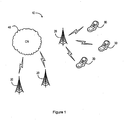
- FIG. 1 shows a cellular radio communication network 10.
- the network 10 comprises a plurality of network units 20, each of which transmits communications to a separate cell in the network 10.
- Network units 20 are also referred to as base stations in the following description.
- UEs user equipments
- CN core network
- the present invention relates to the scheduling of paging indications and paging messages to user equipments having a bandwidth that is smaller than the cell transmission bandwidth.
- the user equipment shall be positioned in the frequency domain at limited positions.
- the minimum UE bandwidth capability is 20 MHz and the maximum cell bandwidth in future will be larger than 20 MHz.
- a 20 MHz user equipment within a 40 MHz cell bandwidth shall be placed at a limited number of positions (e.g. two or three positions).
- the user equipment tunes its receiver to a specific position in the frequency domain within a cell.
- Figure 2 shows an example of 20 MHz UE with two different positions in the frequency domain: lower (left) 20 MHz or upper 20 MHz (right).
- both the paging indicator and the paging message are sent within the UE reception bandwidth without any duplication (the paging can be sent at any position in the frequency domain within the UE reception bandwidth). Since the user equipment is paged within its reception bandwidth it is prevented that the user equipment needs to re-tune its receiver.
- Figure 3 shows the transmission of paging in case of two UE positions.
- the user equipment would be allowed to receive the paging irrespective of its position and without the need for any re-tuning of its receiver.
- the network needs to be aware of the current paging position of the user equipment within the cell transmission bandwidth, which is larger than the UE bandwidth. In a first step the user equipment needs to be positioned at a certain paging position.
- a certain positioning rule is applied, e.g. a probabilistic or a hash-based rule.
- the groups of UE identities can be mapped onto paging positions.
- UE identities can be hashed onto paging groups (e.g. 32-bit UE_ID to 12 bit Paging Group ID) which are, in turn, deterministically distributed over the available paging positions.
- paging groups e.g. 32-bit UE_ID to 12 bit Paging Group ID
- the UE positioning can be performed either by a UE-based selection, i.e. the user equipment places itself independently at a certain position, or by a network-based selection.
- a UE-based selection i.e. the user equipment places itself independently at a certain position
- a network-based selection As the paging consumes a certain amount of resources it is beneficial to equally distribute the idle mode user equipments, i.e. those listening to the paging, within the different positions in the frequency domain.
- the network is fully aware of the radio resource situation and can therefore indicate in the system information (transmitted on the broadcast channel) the preferred paging positions where the user equipment shall tune itself.
- the type of information that is sent in the system information there are different possible ways to realize this mechanism, whereof the following discloses two non-limiting examples:
- the user equipment After having retrieved a paging position for the user equipment in the frequency band, it is necessary to report the paging positions.
- the user equipment (in idle mode) selects a suitable paging position, e.g. by using any of the methods described above. Subsequently, the user equipment then reports, depending on the used position selection method, its paging position to the network (except for hash based rules). This is necessary because the network needs to know the frequency position at which the user equipment currently is camped before the network can send the page.
- the user equipment can indicate its paging position, e.g., in a location management message (e.g. tracking area update, cell update etc). The message may simply consist of an identity of the paging position, e.g.
- the user equipment can move within the coverage area and, thus, may camp on to a new cell.
- the user equipment shall maintain the same paging position at least in the same tracking area.
- the network shall send a paging indicator as well as a paging message to the new paging position in the frequency domain at which the user equipment is tuned. This means that user equipments in a particular paging position may be assigned the same group identity in case this group identity is used to address paging related information.
- the network also has the liberty to direct the user equipment to change its paging position. This could be done by sending the request to the user equipment in a location management message, e.g. tracking area update confirm, cell update confirm etc.
- a location management message e.g. tracking area update confirm, cell update confirm etc.
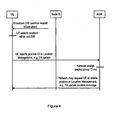
- the entire protocol operation is shown in figure 4 .
- the user equipment in idle mode or any low activity state receives a broadcast message from the Node B with UE position-related information.
- the user equipment selects, its paging position within the cell transmission bandwidth and reports the paging position-ID in, e.g., a location management message.
- the network assigns paging group ID and may request the user equipment to retune its paging position in a location management message .
- the main benefit of the pre-defined rules is that the Core Network, e.g. the access gateway in E-UTRAN, does not need to inform the base station where to page the user equipment. It is already sufficient to inform the base station about the identity of the user equipment. If the base station has been supplied with the particular "rule", the base station can calculate itself at which paging position in the frequency domain the user equipment is camped. The base station will then send the paging for that particular user equipment at that particular paging position.
- the Core Network e.g. the access gateway in E-UTRAN
- the applied "rule” should preferably not be hard-coded into the user equipment but rather be provided at the time when the user equipment attaches to the network. This allows to use the benefits of the usage of a network-controlled rule, e.g. to simplify an update of a hash function, which has turned out to have some bad properties. Secondly as stated earlier, this also provides a more flexible and efficient handling of the radio resources.
Landscapes
- Engineering & Computer Science (AREA)
- Computer Networks & Wireless Communication (AREA)
- Signal Processing (AREA)
- Mobile Radio Communication Systems (AREA)
- Exchange Systems With Centralized Control (AREA)
Claims (36)
- Procédé, destiné à être utilisé dans une unité d'équipement d'utilisateur (30), dans un réseau de radiocommunication cellulaire (10), ledit équipement d'utilisateur (30) fonctionnant avec une bande passante qui est inférieure à la bande passante de réseau, ledit procédé étant caractérisé par, alors que l'équipement d'utilisateur (30) est dans un mode non occupé ou dans n'importe quel autre état de faible activité, les étapes consistant à :sélectionner une position de radiomessagerie de l'équipement d'utilisateur (30) dans le domaine fréquentiel ;recevoir, du réseau (10), des informations de radiomessagerie ou un message dans une bande passante de réception de l'équipement d'utilisateur (30) ; etchanger, si cela est indiqué par le réseau (10), la position de radiomessagerie de l'équipement d'utilisateur (30) dans la bande passante de réseau, dans lequel ladite position de radiomessagerie indique où le réseau doit envoyer un indicateur de radiomessagerie.
- Procédé selon la revendication 1, dans lequel l'équipement d'utilisateur (30) détermine sa position de radiomessagerie dans le domaine fréquentiel dans la bande passante de réseau à l'aide d'une ou de plusieurs règles prédéfinies.
- Procédé selon la revendication 2, dans lequel l'équipement d'utilisateur (30) détermine sa position de radiomessagerie en fonction de probabilités prédéfinies pour chaque position.
- Procédé selon la revendication 2, dans lequel l'équipement d'utilisateur (30) détermine sa position de radiomessagerie selon une fonction de hachage appropriée.
- Procédé selon la revendication 4, dans lequel l'identité d'équipement d'utilisateur est hachée sur l'une d'une quantité disponible de positions de radiomessagerie dans le domaine fréquentiel.
- Procédé selon la revendication 4, dans lequel les identités d'équipement d'utilisateur sont hachées sur un groupe de radiomessagerie, lesquelles sont attribuées à leur tour à différentes positions de radiomessagerie.
- Procédé selon la revendication 1, dans lequel l'équipement d'utilisateur (30) détermine sa position de radiomessagerie dans le domaine fréquentiel dans la bande passante de réseau selon des informations de diffusion reçues.
- Procédé selon la revendication 7, dans lequel les informations de diffusion comprennent des probabilités d'accès avec lesquelles l'équipement d'utilisateur (30) peut sélectionner de manière aléatoire la position de radiomessagerie.
- Procédé selon la revendication 1, dans lequel l'équipement d'utilisateur (30) détermine sa position de radiomessagerie selon des positions bien définies.
- Procédé selon la revendication 8 ou 9, dans lequel l'équipement d'utilisateur (30) signale sa position de radiomessagerie au réseau (10) pendant une gestion d'emplacement après une sélection de cellule initiale.
- Procédé selon la revendication 8 ou 9, dans lequel l'équipement d'utilisateur (30) signale sa position de radiomessagerie au réseau (10) pendant une gestion d'emplacement après une nouvelle sélection de cellule.
- Procédé selon l'une quelconque des revendications ci-dessus, dans lequel le réseau (10) demande à l'équipement d'utilisateur (30) de changer sa position de radiomessagerie périodiquement.
- Procédé selon la revendication 12, dans lequel le réseau (10) demande à l'équipement d'utilisateur (30) de changer sa position de radiomessagerie périodiquement pendant une gestion d'emplacement.
- Procédé, dans une unité de réseau (20), pour attribuer différentes positions de radiomessagerie dans un domaine fréquentiel à différents équipements d'utilisateur (30) d'un réseau de radiocommunication cellulaire (10) comprenant un ou plusieurs équipements d'utilisateur (30) fonctionnant avec une bande passante qui est inférieure à la bande passante de réseau, caractérisé en ce que ledit procédé comprend les étapes consistant à :positionner un équipement d'utilisateur (30) à une position particulière dans le domaine fréquentiel pour recevoir une radiomessagerie dans un mode non occupé ou dans un autre état de faible activité,dans lequel lesdites positions de radiomessagerie indiquent où le réseau doit envoyer un indicateur de radiomessagerie.
- Procédé selon la revendication 14, comprenant en outre l'étape consistant à diffuser des probabilités de sélection pour répartir de manière aléatoire les équipements d'utilisateur (30) à différentes positions de radiomessagerie possibles dans la bande passante de réseau.
- Procédé selon la revendication 15, dans lequel une distribution uniforme desdits équipements d'utilisateur (30) est obtenue à différentes positions de radiomessagerie dans le domaine fréquentiel.
- Procédé selon la revendication 15, dans lequel les ressources radio sont utilisées de manière optimale à toutes les positions de radiomessagerie et des ressources radio suffisantes sont rendues disponibles à toutes les positions de radiomessagerie par une distribution uniforme dans le domaine fréquentiel des positions de radiomessagerie des équipements d'utilisateur (30) dans la bande passante de réseau.
- Procédé selon la revendication 14, dans lequel l'unité de réseau (20) réattribue périodiquement la position de l'équipement d'utilisateur (30) dans la bande passante de réseau.
- Procédé selon la revendication 18, dans lequel l'unité de réseau (20) réattribue périodiquement pendant une gestion d'emplacement la position de l'équipement d'utilisateur (30) dans la bande passante de réseau.
- Equipement d'utilisateur (30) destiné à être utilisé dans un réseau de radiocommunication cellulaire (10), ledit équipement d'utilisateur (30) fonctionnant avec une bande passante qui est inférieure à la bande passante de réseau, caractérisé en ce que ledit équipement d'utilisateur (30) est conçu pour :sélectionner une position de radiomessagerie de l'équipement d'utilisateur (30) dans le domaine fréquentiel ;recevoir, du réseau (10), des informations de radiomessagerie ou un message dans la bande passante de réception de l'équipement d'utilisateur (30) ; etchanger, si cela est indiqué par le réseau (10), la position de radiomessagerie de l'équipement d'utilisateur (30) dans la bande passante de réseau, dans lequel ladite position de radiomessagerie indique où le réseau doit envoyer un indicateur de radiomessagerie.
- Equipement d'utilisateur (30) selon la revendication 20, ledit équipement d'utilisateur (30) étant conçu pour déterminer sa position de radiomessagerie dans le domaine fréquentiel dans la bande passante de réseau à l'aide d'une ou de plusieurs règles prédéfinies.
- Equipement d'utilisateur (30) selon la revendication 21, dans lequel l'équipement d'utilisateur (30) est conçu pour déterminer sa position de radiomessagerie en fonction de probabilités prédéfinies pour chaque position.
- Equipement d'utilisateur (30) selon la revendication 21, dans lequel l'équipement d'utilisateur (30) est conçu pour déterminer sa position de radiomessagerie selon une fonction de hachage appropriée.
- Equipement d'utilisateur (30) selon la revendication 23, dans lequel l'identité d'équipement d'utilisateur est hachée sur l'une des positions de radiomessagerie disponibles dans le domaine fréquentiel.
- Equipement d'utilisateur (30) selon la revendication 23, dans lequel les identités d'équipement d'utilisateur sont hachées sur le groupe de radiomessagerie, lesquelles sont attribuées à leur tour à différentes positions de radiomessagerie.
- Equipement d'utilisateur (30) selon la revendication 20, dans lequel l'équipement d'utilisateur (30) est conçu pour déterminer sa position de radiomessagerie dans le domaine fréquentiel dans la bande passante de réseau selon des informations de diffusion reçues.
- Equipement d'utilisateur (30) selon la revendication 26, dans lequel les informations de diffusion comprennent des probabilités d'accès avec lesquelles l'équipement d'utilisateur (30) peut sélectionner de manière aléatoire la position de radiomessagerie.
- Equipement d'utilisateur (30) selon la revendication 20, dans lequel l'équipement d'utilisateur (30) est conçu pour déterminer sa position de radiomessagerie selon des positions bien définies.
- Equipement d'utilisateur (30) selon la revendication 27 ou 28, dans lequel l'équipement d'utilisateur (30) est conçu pour signaler sa position de radiomessagerie au réseau (10) pendant une gestion d'emplacement après une sélection de cellule initiale.
- Equipement d'utilisateur (30) selon la revendication 27 ou 28, dans lequel l'équipement d'utilisateur (30) est conçu pour signaler sa position de radiomessagerie au réseau (10) pendant une gestion d'emplacement après une nouvelle sélection de cellule.
- Unité de réseau (20), destinée à être utilisée dans un réseau de radiocommunication cellulaire (10) comprenant un ou plusieurs équipements d'utilisateur (30) fonctionnant avec une bande passante qui est inférieure à la bande passante de réseau, ladite unité de réseau (20) étant caractérisée en ce qu'elle est conçue pour positionner un équipement d'utilisateur (30) à une position particulière, parmi plusieurs positions de radiomessagerie différentes dans le domaine fréquentiel pour recevoir une radiomessagerie dans un mode non occupé ou un autre état de faible activité, et dans laquelle lesdites positions de radiomessagerie indiquent où le réseau doit envoyer un indicateur de radiomessagerie.
- Unité de réseau (20) selon la revendication 31, dans laquelle ladite unité de réseau (20) est en outre conçue pour diffuser des probabilités de sélection pour répartir de manière aléatoire les équipements d'utilisateur (30) à différentes positions de radiomessagerie possibles dans la bande passante de réseau.
- Unité de réseau (20) selon la revendication 32, dans laquelle une distribution uniforme desdits équipements d'utilisateur (30) est obtenue à différentes positions de radiomessagerie dans le domaine fréquentiel.
- Unité de réseau (20) selon la revendication 32, dans laquelle les ressources radio sont utilisées de manière optimale à toutes les positions de radiomessagerie et des ressources radio suffisantes sont rendues disponibles à toutes les positions de radiomessagerie, par une distribution uniforme dans le domaine fréquentiel des positions de radiomessagerie des équipements d'utilisateur (30) dans la bande passante de réseau.
- Unité de réseau (20) selon la revendication 31, dans laquelle l'unité de réseau (20) est conçue pour réattribuer périodiquement la position de l'équipement d'utilisateur (30) dans la bande passante de réseau.
- Unité de réseau (20) selon la revendication 35, dans laquelle l'unité de réseau (20) est conçue pour réattribuer périodiquement pendant une gestion d'emplacement la position de l'équipement d'utilisateur (30) dans la bande passante de réseau.
Priority Applications (2)
| Application Number | Priority Date | Filing Date | Title |
|---|---|---|---|
| EP11159991.6A EP2373103B1 (fr) | 2006-08-22 | 2007-08-22 | Procédé et arrangement de radiomessagerie dans E-UTRAN |
| PL07801821T PL2055131T3 (pl) | 2006-08-22 | 2007-08-22 | Sposoby i urządzenia do wywoływania w E-UTRAN |
Applications Claiming Priority (2)
| Application Number | Priority Date | Filing Date | Title |
|---|---|---|---|
| SE0601716 | 2006-08-22 | ||
| PCT/EP2007/007392 WO2008022782A1 (fr) | 2006-08-22 | 2007-08-22 | Procédé et agencement pour une radiomessagerie en e-utran |
Publications (2)
| Publication Number | Publication Date |
|---|---|
| EP2055131A1 EP2055131A1 (fr) | 2009-05-06 |
| EP2055131B1 true EP2055131B1 (fr) | 2011-03-30 |
Family
ID=38711781
Family Applications (2)
| Application Number | Title | Priority Date | Filing Date |
|---|---|---|---|
| EP07801821A Active EP2055131B1 (fr) | 2006-08-22 | 2007-08-22 | Procédés et agencements pour signaliser des appels dans e-utran |
| EP11159991.6A Active EP2373103B1 (fr) | 2006-08-22 | 2007-08-22 | Procédé et arrangement de radiomessagerie dans E-UTRAN |
Family Applications After (1)
| Application Number | Title | Priority Date | Filing Date |
|---|---|---|---|
| EP11159991.6A Active EP2373103B1 (fr) | 2006-08-22 | 2007-08-22 | Procédé et arrangement de radiomessagerie dans E-UTRAN |
Country Status (8)
| Country | Link |
|---|---|
| US (6) | US9002385B2 (fr) |
| EP (2) | EP2055131B1 (fr) |
| JP (1) | JP5185933B2 (fr) |
| AT (1) | ATE504183T1 (fr) |
| DE (1) | DE602007013572D1 (fr) |
| ES (1) | ES2361246T3 (fr) |
| PL (1) | PL2055131T3 (fr) |
| WO (1) | WO2008022782A1 (fr) |
Families Citing this family (15)
| Publication number | Priority date | Publication date | Assignee | Title |
|---|---|---|---|---|
| WO2007040201A1 (fr) | 2005-10-04 | 2007-04-12 | Sharp Kabushiki Kaisha | Dispositif de station mobile, dispositif de station de base, procede pour le mappage de bande de frequences utilisee par le dispositif de station mobile, dispositf de gestion de position, procede d'enregistrement de position de dispositif de station mobile; procede de radiomessagerie, programme de mise en oeuvre et sup |
| EP2055131B1 (fr) | 2006-08-22 | 2011-03-30 | Telefonaktiebolaget LM Ericsson (publ) | Procédés et agencements pour signaliser des appels dans e-utran |
| US20100034160A1 (en) * | 2008-08-08 | 2010-02-11 | Qualcomm Incorporated | Updating frequency priority lists in wireless communications |
| JP2010062651A (ja) * | 2008-09-01 | 2010-03-18 | Panasonic Corp | 無線送信装置及び無線受信装置 |
| US9042221B2 (en) * | 2010-04-28 | 2015-05-26 | Lg Electronics Inc. | Method of controlling congestion of MTC data in a mobile communication system |
| EP3242518B1 (fr) * | 2015-01-27 | 2021-10-27 | Huawei Technologies Co., Ltd. | Procédé et appareil pour transmettre des informations publiques |
| KR102813921B1 (ko) | 2015-11-04 | 2025-05-27 | 인터디지탈 패튼 홀딩스, 인크 | 감소된 대역폭 wtru들을 위한 페이징 절차의 방법 |
| US10536925B2 (en) | 2016-06-28 | 2020-01-14 | Telefonaktiebolaget Lm Ericsson (Publ) | Paging for massive MTC |
| US10959206B2 (en) * | 2017-01-09 | 2021-03-23 | Qualcomm Incorporated | Conveying paging group information through control channel transmissions |
| KR102484905B1 (ko) * | 2017-11-03 | 2023-01-06 | 광동 오포 모바일 텔레커뮤니케이션즈 코포레이션 리미티드 | 페이징 방법, 단말 장치 및 네트워크 장치 |
| CN111194562B (zh) * | 2017-11-14 | 2025-03-18 | Oppo广东移动通信有限公司 | 无线通信方法和设备 |
| AU2017440250B2 (en) | 2017-11-14 | 2022-10-06 | Guangdong Oppo Mobile Telecommunications Corp., Ltd. | Wireless communication method and device |
| US10841898B2 (en) * | 2018-07-18 | 2020-11-17 | Acer Incorporated | Method of receiving paging messages for UE and UE using the same |
| CN111436059B (zh) * | 2019-02-14 | 2022-12-27 | 维沃移动通信有限公司 | 终端测量的处理方法和终端 |
| CN116193499A (zh) * | 2021-11-29 | 2023-05-30 | 华为技术有限公司 | 通信方法及通信装置 |
Family Cites Families (22)
| Publication number | Priority date | Publication date | Assignee | Title |
|---|---|---|---|---|
| US7529548B2 (en) * | 2001-06-28 | 2009-05-05 | Intel Corporation | Method and system for adapting a wireless link to achieve a desired channel quality |
| US6731936B2 (en) * | 2001-08-20 | 2004-05-04 | Qualcomm Incorporated | Method and system for a handoff in a broadcast communication system |
| JP2003259448A (ja) * | 2002-02-28 | 2003-09-12 | Sony Corp | 無線通信方法、無線通信システム、無線基地局、無線通信端末、プログラム及び媒体 |
| US7313116B2 (en) * | 2002-05-13 | 2007-12-25 | Samsung Electronics Co., Ltd. | Method of performing inter-RAT measurement for a handover from NB-TDD to GSM |
| US7242687B2 (en) * | 2002-05-24 | 2007-07-10 | Intel Corporation | Method and system for distribution of session scheduling |
| US9125061B2 (en) * | 2002-06-07 | 2015-09-01 | Apple Inc. | Systems and methods for channel allocation for forward-link multi-user systems |
| US7013158B1 (en) * | 2002-11-25 | 2006-03-14 | Sprint Spectrum L.P. | Method and system for brokering frequencies to facilitate peer-to-peer communication |
| KR100548344B1 (ko) * | 2003-05-13 | 2006-02-02 | 엘지전자 주식회사 | 이동통신 시스템에서의 rrc연결방법 |
| EP1515575A1 (fr) * | 2003-09-15 | 2005-03-16 | Motorola, Inc. | Reseau, équipement d' utilisateur et méthode dans un système de communication cellulaire du 3ième géneration pour la transmission des messages signalisation d'appel |
| ES2305409T3 (es) * | 2003-11-10 | 2008-11-01 | Research In Motion Limited | Tratamiento (manejo o gestion) de mensajes relacionados con una celda diferente de la celda con la que un dispositivo de equipo de usuario esta comunicando en ese momento en un sistema de comunicaciones movilesuniversal. |
| KR101042163B1 (ko) * | 2004-07-30 | 2011-06-20 | 엘지전자 주식회사 | 이동통신 시스템에서의 페이징 주기 할당방법 |
| US20060148493A1 (en) * | 2004-12-30 | 2006-07-06 | Murali Narasimha | Paging for broadcast and multicast services |
| FR2883694B1 (fr) * | 2005-03-25 | 2007-07-20 | Evolium Sas Soc Par Actions Si | Procede pour le controle de mesures radio dans un systeme cellulaire de radiocommunications mobiles |
| WO2007040201A1 (fr) * | 2005-10-04 | 2007-04-12 | Sharp Kabushiki Kaisha | Dispositif de station mobile, dispositif de station de base, procede pour le mappage de bande de frequences utilisee par le dispositif de station mobile, dispositf de gestion de position, procede d'enregistrement de position de dispositif de station mobile; procede de radiomessagerie, programme de mise en oeuvre et sup |
| EP1949547B1 (fr) * | 2005-10-31 | 2019-08-07 | LG Electronics, Inc. | Procede de reception de donnees par un terminal de communications mobile |
| KR101203841B1 (ko) * | 2006-01-05 | 2012-11-21 | 엘지전자 주식회사 | 무선 통신 시스템에서의 페이징 메시지 전송 및 수신 방법 |
| KR101358469B1 (ko) * | 2006-02-07 | 2014-02-06 | 엘지전자 주식회사 | 무선 네트워크(network) 안에서 상향(uplink)및 하향(downlink) 대역폭(bandwidth)의선택 및 신호 방법 |
| US8102802B2 (en) * | 2006-05-08 | 2012-01-24 | Motorola Mobility, Inc. | Method and apparatus for providing downlink acknowledgments and transmit indicators in an orthogonal frequency division multiplexing communication system |
| JP4265620B2 (ja) * | 2006-05-26 | 2009-05-20 | 沖電気工業株式会社 | アクセス制御装置、無線装置、ネットワーク、アクセス制御方法及びアクセス制御プログラム |
| EP2055131B1 (fr) | 2006-08-22 | 2011-03-30 | Telefonaktiebolaget LM Ericsson (publ) | Procédés et agencements pour signaliser des appels dans e-utran |
| KR100933160B1 (ko) * | 2006-10-02 | 2009-12-21 | 삼성전자주식회사 | 무선통신 시스템에서의 페이징 정보의 송수신 방법 및 장치 |
| US9848340B2 (en) * | 2012-05-18 | 2017-12-19 | Telefonaktiebolaget Lm Ericsson (Publ) | Technique for performing cell measurement on at least two cells |
-
2007
- 2007-08-22 EP EP07801821A patent/EP2055131B1/fr active Active
- 2007-08-22 EP EP11159991.6A patent/EP2373103B1/fr active Active
- 2007-08-22 ES ES07801821T patent/ES2361246T3/es active Active
- 2007-08-22 DE DE602007013572T patent/DE602007013572D1/de active Active
- 2007-08-22 JP JP2009524959A patent/JP5185933B2/ja active Active
- 2007-08-22 US US12/304,640 patent/US9002385B2/en not_active Expired - Fee Related
- 2007-08-22 PL PL07801821T patent/PL2055131T3/pl unknown
- 2007-08-22 WO PCT/EP2007/007392 patent/WO2008022782A1/fr not_active Ceased
- 2007-08-22 AT AT07801821T patent/ATE504183T1/de not_active IP Right Cessation
-
2015
- 2015-02-27 US US14/633,942 patent/US9439170B2/en active Active
-
2016
- 2016-07-27 US US15/221,048 patent/US9736813B2/en active Active
-
2017
- 2017-07-06 US US15/643,228 patent/US10021671B2/en active Active
-
2018
- 2018-06-12 US US16/005,837 patent/US10420068B2/en active Active
-
2019
- 2019-07-29 US US16/525,017 patent/US10841900B2/en active Active
Also Published As
| Publication number | Publication date |
|---|---|
| US10021671B2 (en) | 2018-07-10 |
| EP2373103A1 (fr) | 2011-10-05 |
| US10420068B2 (en) | 2019-09-17 |
| US9439170B2 (en) | 2016-09-06 |
| EP2373103B1 (fr) | 2013-10-09 |
| ATE504183T1 (de) | 2011-04-15 |
| PL2055131T3 (pl) | 2011-08-31 |
| US20180295605A1 (en) | 2018-10-11 |
| JP2011503911A (ja) | 2011-01-27 |
| DE602007013572D1 (de) | 2011-05-12 |
| US20150173041A1 (en) | 2015-06-18 |
| JP5185933B2 (ja) | 2013-04-17 |
| US20160338007A1 (en) | 2016-11-17 |
| US20190349888A1 (en) | 2019-11-14 |
| EP2055131A1 (fr) | 2009-05-06 |
| US20100222083A1 (en) | 2010-09-02 |
| US20170311283A1 (en) | 2017-10-26 |
| US9736813B2 (en) | 2017-08-15 |
| WO2008022782A1 (fr) | 2008-02-28 |
| US9002385B2 (en) | 2015-04-07 |
| US10841900B2 (en) | 2020-11-17 |
| ES2361246T3 (es) | 2011-06-15 |
Similar Documents
| Publication | Publication Date | Title |
|---|---|---|
| US10841900B2 (en) | Method and arrangement in a telecommunication system | |
| US8396020B2 (en) | Point-to-multipoint service communication | |
| US9306993B2 (en) | Mobile communication system | |
| AU714610B2 (en) | Bandwidth allocation | |
| RU2420927C2 (ru) | Способ обработки информации поискового вызова в системе беспроводной подвижной связи | |
| KR101358469B1 (ko) | 무선 네트워크(network) 안에서 상향(uplink)및 하향(downlink) 대역폭(bandwidth)의선택 및 신호 방법 | |
| CN101669384A (zh) | Lte系统的mbms专用小区中的测量机制和有效寻呼以及广播方案实施的方法和设备 | |
| KR20080079961A (ko) | 광대역 무선 접속 시스템에서의 레인징 수행 방법 | |
| KR101208554B1 (ko) | 멀티 캐리어 시스템에서 e-mbs서비스를 지원하기 위한 방법 및 장치 | |
| US7876837B2 (en) | Method for reducing access noise in a spread spectrum communication system | |
| CN100508664C (zh) | 用于把有用信息作为业务传输给多个用户站的方法和无线通信系统 | |
| KR20110083489A (ko) | 멀티캐리어 시스템에서 e-mbs서비스를 위한 효율적인 캐리어 스위칭 동작을 수행하기 위한 방법 및 장치 | |
| GB2361390A (en) | Communications system | |
| CN101123742B (zh) | 一种无线通信系统中寻呼实现的方法、装置及系统 | |
| HK1140612A (en) | Method and apparatus of measurement mechanism and efficient paging and broadcasting scheme implementation in mbms dedicated cell of lte systems | |
| KR20110121516A (ko) | 다중반송파를 사용하는 무선통신 시스템에서 멀티캐스트 방송 서비스를 위한 방법 및 장치 |
Legal Events
| Date | Code | Title | Description |
|---|---|---|---|
| PUAI | Public reference made under article 153(3) epc to a published international application that has entered the european phase |
Free format text: ORIGINAL CODE: 0009012 |
|
| REG | Reference to a national code |
Ref country code: DE Ref legal event code: R079 Ref document number: 602007013572 Country of ref document: DE Free format text: PREVIOUS MAIN CLASS: H04Q0007380000 Ipc: H04W0004000000 |
|
| 17P | Request for examination filed |
Effective date: 20090127 |
|
| AK | Designated contracting states |
Kind code of ref document: A1 Designated state(s): AT BE BG CH CY CZ DE DK EE ES FI FR GB GR HU IE IS IT LI LT LU LV MC MT NL PL PT RO SE SI SK TR |
|
| AX | Request for extension of the european patent |
Extension state: AL BA HR MK RS |
|
| RIC1 | Information provided on ipc code assigned before grant |
Ipc: H04W 4/00 20090101AFI20090416BHEP |
|
| 17Q | First examination report despatched |
Effective date: 20090819 |
|
| GRAP | Despatch of communication of intention to grant a patent |
Free format text: ORIGINAL CODE: EPIDOSNIGR1 |
|
| RIC1 | Information provided on ipc code assigned before grant |
Ipc: H04W 68/02 20090101AFI20100923BHEP |
|
| RTI1 | Title (correction) |
Free format text: METHODS AND ARRANGEMENTS FOR PAGING IN E-UTRAN |
|
| DAX | Request for extension of the european patent (deleted) | ||
| GRAS | Grant fee paid |
Free format text: ORIGINAL CODE: EPIDOSNIGR3 |
|
| GRAA | (expected) grant |
Free format text: ORIGINAL CODE: 0009210 |
|
| AK | Designated contracting states |
Kind code of ref document: B1 Designated state(s): AT BE BG CH CY CZ DE DK EE ES FI FR GB GR HU IE IS IT LI LT LU LV MC MT NL PL PT RO SE SI SK TR |
|
| REG | Reference to a national code |
Ref country code: GB Ref legal event code: FG4D |
|
| REG | Reference to a national code |
Ref country code: CH Ref legal event code: EP |
|
| REG | Reference to a national code |
Ref country code: IE Ref legal event code: FG4D |
|
| REF | Corresponds to: |
Ref document number: 602007013572 Country of ref document: DE Date of ref document: 20110512 Kind code of ref document: P |
|
| REG | Reference to a national code |
Ref country code: DE Ref legal event code: R096 Ref document number: 602007013572 Country of ref document: DE Effective date: 20110512 |
|
| REG | Reference to a national code |
Ref country code: CH Ref legal event code: NV Representative=s name: SERVOPATENT GMBH |
|
| REG | Reference to a national code |
Ref country code: ES Ref legal event code: FG2A Ref document number: 2361246 Country of ref document: ES Kind code of ref document: T3 Effective date: 20110615 |
|
| REG | Reference to a national code |
Ref country code: RO Ref legal event code: EPE |
|
| REG | Reference to a national code |
Ref country code: NL Ref legal event code: T3 |
|
| REG | Reference to a national code |
Ref country code: SE Ref legal event code: TRGR |
|
| PG25 | Lapsed in a contracting state [announced via postgrant information from national office to epo] |
Ref country code: LT Free format text: LAPSE BECAUSE OF FAILURE TO SUBMIT A TRANSLATION OF THE DESCRIPTION OR TO PAY THE FEE WITHIN THE PRESCRIBED TIME-LIMIT Effective date: 20110330 Ref country code: LV Free format text: LAPSE BECAUSE OF FAILURE TO SUBMIT A TRANSLATION OF THE DESCRIPTION OR TO PAY THE FEE WITHIN THE PRESCRIBED TIME-LIMIT Effective date: 20110330 |
|
| LTIE | Lt: invalidation of european patent or patent extension |
Effective date: 20110330 |
|
| REG | Reference to a national code |
Ref country code: GR Ref legal event code: EP Ref document number: 20110401546 Country of ref document: GR Effective date: 20110714 |
|
| PG25 | Lapsed in a contracting state [announced via postgrant information from national office to epo] |
Ref country code: SI Free format text: LAPSE BECAUSE OF FAILURE TO SUBMIT A TRANSLATION OF THE DESCRIPTION OR TO PAY THE FEE WITHIN THE PRESCRIBED TIME-LIMIT Effective date: 20110330 Ref country code: FI Free format text: LAPSE BECAUSE OF FAILURE TO SUBMIT A TRANSLATION OF THE DESCRIPTION OR TO PAY THE FEE WITHIN THE PRESCRIBED TIME-LIMIT Effective date: 20110330 Ref country code: AT Free format text: LAPSE BECAUSE OF FAILURE TO SUBMIT A TRANSLATION OF THE DESCRIPTION OR TO PAY THE FEE WITHIN THE PRESCRIBED TIME-LIMIT Effective date: 20110330 Ref country code: CY Free format text: LAPSE BECAUSE OF FAILURE TO SUBMIT A TRANSLATION OF THE DESCRIPTION OR TO PAY THE FEE WITHIN THE PRESCRIBED TIME-LIMIT Effective date: 20110330 |
|
| REG | Reference to a national code |
Ref country code: PL Ref legal event code: T3 |
|
| PG25 | Lapsed in a contracting state [announced via postgrant information from national office to epo] |
Ref country code: BE Free format text: LAPSE BECAUSE OF FAILURE TO SUBMIT A TRANSLATION OF THE DESCRIPTION OR TO PAY THE FEE WITHIN THE PRESCRIBED TIME-LIMIT Effective date: 20110330 |
|
| PG25 | Lapsed in a contracting state [announced via postgrant information from national office to epo] |
Ref country code: PT Free format text: LAPSE BECAUSE OF FAILURE TO SUBMIT A TRANSLATION OF THE DESCRIPTION OR TO PAY THE FEE WITHIN THE PRESCRIBED TIME-LIMIT Effective date: 20110801 Ref country code: EE Free format text: LAPSE BECAUSE OF FAILURE TO SUBMIT A TRANSLATION OF THE DESCRIPTION OR TO PAY THE FEE WITHIN THE PRESCRIBED TIME-LIMIT Effective date: 20110330 |
|
| PG25 | Lapsed in a contracting state [announced via postgrant information from national office to epo] |
Ref country code: SK Free format text: LAPSE BECAUSE OF FAILURE TO SUBMIT A TRANSLATION OF THE DESCRIPTION OR TO PAY THE FEE WITHIN THE PRESCRIBED TIME-LIMIT Effective date: 20110330 Ref country code: IS Free format text: LAPSE BECAUSE OF FAILURE TO SUBMIT A TRANSLATION OF THE DESCRIPTION OR TO PAY THE FEE WITHIN THE PRESCRIBED TIME-LIMIT Effective date: 20110730 |
|
| PG25 | Lapsed in a contracting state [announced via postgrant information from national office to epo] |
Ref country code: MT Free format text: LAPSE BECAUSE OF FAILURE TO SUBMIT A TRANSLATION OF THE DESCRIPTION OR TO PAY THE FEE WITHIN THE PRESCRIBED TIME-LIMIT Effective date: 20110330 |
|
| PLBE | No opposition filed within time limit |
Free format text: ORIGINAL CODE: 0009261 |
|
| STAA | Information on the status of an ep patent application or granted ep patent |
Free format text: STATUS: NO OPPOSITION FILED WITHIN TIME LIMIT |
|
| PG25 | Lapsed in a contracting state [announced via postgrant information from national office to epo] |
Ref country code: DK Free format text: LAPSE BECAUSE OF FAILURE TO SUBMIT A TRANSLATION OF THE DESCRIPTION OR TO PAY THE FEE WITHIN THE PRESCRIBED TIME-LIMIT Effective date: 20110330 |
|
| 26N | No opposition filed |
Effective date: 20120102 |
|
| PG25 | Lapsed in a contracting state [announced via postgrant information from national office to epo] |
Ref country code: MC Free format text: LAPSE BECAUSE OF NON-PAYMENT OF DUE FEES Effective date: 20110831 |
|
| REG | Reference to a national code |
Ref country code: DE Ref legal event code: R097 Ref document number: 602007013572 Country of ref document: DE Effective date: 20120102 |
|
| REG | Reference to a national code |
Ref country code: IE Ref legal event code: MM4A |
|
| PG25 | Lapsed in a contracting state [announced via postgrant information from national office to epo] |
Ref country code: IE Free format text: LAPSE BECAUSE OF NON-PAYMENT OF DUE FEES Effective date: 20110822 |
|
| PG25 | Lapsed in a contracting state [announced via postgrant information from national office to epo] |
Ref country code: LU Free format text: LAPSE BECAUSE OF NON-PAYMENT OF DUE FEES Effective date: 20110822 |
|
| PG25 | Lapsed in a contracting state [announced via postgrant information from national office to epo] |
Ref country code: BG Free format text: LAPSE BECAUSE OF FAILURE TO SUBMIT A TRANSLATION OF THE DESCRIPTION OR TO PAY THE FEE WITHIN THE PRESCRIBED TIME-LIMIT Effective date: 20110630 |
|
| PG25 | Lapsed in a contracting state [announced via postgrant information from national office to epo] |
Ref country code: HU Free format text: LAPSE BECAUSE OF FAILURE TO SUBMIT A TRANSLATION OF THE DESCRIPTION OR TO PAY THE FEE WITHIN THE PRESCRIBED TIME-LIMIT Effective date: 20110330 |
|
| REG | Reference to a national code |
Ref country code: FR Ref legal event code: PLFP Year of fee payment: 9 |
|
| REG | Reference to a national code |
Ref country code: DE Ref legal event code: R082 Ref document number: 602007013572 Country of ref document: DE Representative=s name: MARKS & CLERK (LUXEMBOURG) LLP, LU Ref country code: DE Ref legal event code: R081 Ref document number: 602007013572 Country of ref document: DE Owner name: IDTP HOLDINGS, INC., WILMINGTON, US Free format text: FORMER OWNER: TELEFONAKTIEBOLAGET LM ERICSSON (PUBL), STOCKHOLM, SE Ref country code: DE Ref legal event code: R081 Ref document number: 602007013572 Country of ref document: DE Owner name: INTERDIGITAL PATENT HOLDINGS, INC., WILMINGTON, US Free format text: FORMER OWNER: TELEFONAKTIEBOLAGET LM ERICSSON (PUBL), STOCKHOLM, SE |
|
| REG | Reference to a national code |
Ref country code: FR Ref legal event code: TP Owner name: IDTP HOLDINGS, INC., US Effective date: 20160125 |
|
| REG | Reference to a national code |
Ref country code: NL Ref legal event code: PD Owner name: IDTP HOLDINGS, INC.; US Free format text: DETAILS ASSIGNMENT: VERANDERING VAN EIGENAAR(S), OVERDRACHT; FORMER OWNER NAME: TELEFONAKTIEBOLAGET LM ERICSSON (PUBL) Effective date: 20151030 |
|
| REG | Reference to a national code |
Ref country code: FR Ref legal event code: PLFP Year of fee payment: 10 |
|
| REG | Reference to a national code |
Ref country code: ES Ref legal event code: PC2A Owner name: IDTP HOLDINGS, INC. Effective date: 20160804 |
|
| PGFP | Annual fee paid to national office [announced via postgrant information from national office to epo] |
Ref country code: IT Payment date: 20160722 Year of fee payment: 10 |
|
| PGFP | Annual fee paid to national office [announced via postgrant information from national office to epo] |
Ref country code: SE Payment date: 20160726 Year of fee payment: 10 |
|
| PGFP | Annual fee paid to national office [announced via postgrant information from national office to epo] |
Ref country code: ES Payment date: 20160727 Year of fee payment: 10 |
|
| REG | Reference to a national code |
Ref country code: FR Ref legal event code: PLFP Year of fee payment: 11 |
|
| REG | Reference to a national code |
Ref country code: CH Ref legal event code: PUE Owner name: IDTP HOLDINGS, INC., US Free format text: FORMER OWNER: TELEFONAKTIEBOLAGET LM ERICSSON (PUBL), SE Ref country code: CH Ref legal event code: NV Representative=s name: MARKS AND CLERK (LUXEMBOURG) LLP, CH |
|
| PG25 | Lapsed in a contracting state [announced via postgrant information from national office to epo] |
Ref country code: SE Free format text: LAPSE BECAUSE OF NON-PAYMENT OF DUE FEES Effective date: 20170823 |
|
| REG | Reference to a national code |
Ref country code: FR Ref legal event code: PLFP Year of fee payment: 12 |
|
| PG25 | Lapsed in a contracting state [announced via postgrant information from national office to epo] |
Ref country code: IT Free format text: LAPSE BECAUSE OF NON-PAYMENT OF DUE FEES Effective date: 20170822 |
|
| REG | Reference to a national code |
Ref country code: ES Ref legal event code: FD2A Effective date: 20181029 |
|
| PG25 | Lapsed in a contracting state [announced via postgrant information from national office to epo] |
Ref country code: ES Free format text: LAPSE BECAUSE OF NON-PAYMENT OF DUE FEES Effective date: 20170823 |
|
| REG | Reference to a national code |
Ref country code: DE Ref legal event code: R081 Ref document number: 602007013572 Country of ref document: DE Owner name: INTERDIGITAL PATENT HOLDINGS, INC., WILMINGTON, US Free format text: FORMER OWNER: IDTP HOLDINGS, INC., WILMINGTON, DEL., US Ref country code: DE Ref legal event code: R082 Ref document number: 602007013572 Country of ref document: DE Representative=s name: FINK NUMRICH PATENTANWAELTE PARTMBB, DE |
|
| P01 | Opt-out of the competence of the unified patent court (upc) registered |
Effective date: 20230628 |
|
| REG | Reference to a national code |
Ref country code: GB Ref legal event code: 732E Free format text: REGISTERED BETWEEN 20231012 AND 20231018 |
|
| REG | Reference to a national code |
Ref country code: NL Ref legal event code: PD Owner name: INTERDIGITAL PATENT HOLDINGS, INC.; US Free format text: DETAILS ASSIGNMENT: CHANGE OF OWNER(S), ASSIGNMENT; FORMER OWNER NAME: TELEFONAKTIEBOLAGET LM ERICSSON (PUBL) Effective date: 20250303 |
|
| PGFP | Annual fee paid to national office [announced via postgrant information from national office to epo] |
Ref country code: NL Payment date: 20250825 Year of fee payment: 19 |
|
| PGFP | Annual fee paid to national office [announced via postgrant information from national office to epo] |
Ref country code: DE Payment date: 20250827 Year of fee payment: 19 |
|
| PGFP | Annual fee paid to national office [announced via postgrant information from national office to epo] |
Ref country code: GR Payment date: 20250820 Year of fee payment: 19 |
|
| PGFP | Annual fee paid to national office [announced via postgrant information from national office to epo] |
Ref country code: TR Payment date: 20250808 Year of fee payment: 19 Ref country code: PL Payment date: 20250812 Year of fee payment: 19 |
|
| PGFP | Annual fee paid to national office [announced via postgrant information from national office to epo] |
Ref country code: GB Payment date: 20250826 Year of fee payment: 19 |
|
| PGFP | Annual fee paid to national office [announced via postgrant information from national office to epo] |
Ref country code: FR Payment date: 20250825 Year of fee payment: 19 |
|
| PGFP | Annual fee paid to national office [announced via postgrant information from national office to epo] |
Ref country code: CH Payment date: 20250901 Year of fee payment: 19 |
|
| PGFP | Annual fee paid to national office [announced via postgrant information from national office to epo] |
Ref country code: CZ Payment date: 20250814 Year of fee payment: 19 |
|
| PGFP | Annual fee paid to national office [announced via postgrant information from national office to epo] |
Ref country code: RO Payment date: 20250821 Year of fee payment: 19 |