EP2055432A2 - Schraubenschlüssel - Google Patents
Schraubenschlüssel Download PDFInfo
- Publication number
- EP2055432A2 EP2055432A2 EP08167823A EP08167823A EP2055432A2 EP 2055432 A2 EP2055432 A2 EP 2055432A2 EP 08167823 A EP08167823 A EP 08167823A EP 08167823 A EP08167823 A EP 08167823A EP 2055432 A2 EP2055432 A2 EP 2055432A2
- Authority
- EP
- European Patent Office
- Prior art keywords
- fastener
- head portion
- wrench
- handle portion
- handle
- Prior art date
- Legal status (The legal status is an assumption and is not a legal conclusion. Google has not performed a legal analysis and makes no representation as to the accuracy of the status listed.)
- Withdrawn
Links
Images

Classifications
-
- B—PERFORMING OPERATIONS; TRANSPORTING
- B25—HAND TOOLS; PORTABLE POWER-DRIVEN TOOLS; MANIPULATORS
- B25B—TOOLS OR BENCH DEVICES NOT OTHERWISE PROVIDED FOR, FOR FASTENING, CONNECTING, DISENGAGING, OR HOLDING
- B25B13/00—Spanners; Wrenches
- B25B13/02—Spanners; Wrenches with rigid jaws
- B25B13/08—Spanners; Wrenches with rigid jaws of open jaw type
-
- B—PERFORMING OPERATIONS; TRANSPORTING
- B25—HAND TOOLS; PORTABLE POWER-DRIVEN TOOLS; MANIPULATORS
- B25B—TOOLS OR BENCH DEVICES NOT OTHERWISE PROVIDED FOR, FOR FASTENING, CONNECTING, DISENGAGING, OR HOLDING
- B25B13/00—Spanners; Wrenches
- B25B13/02—Spanners; Wrenches with rigid jaws
- B25B13/04—Spanners; Wrenches with rigid jaws of ring jaw type
-
- B—PERFORMING OPERATIONS; TRANSPORTING
- B25—HAND TOOLS; PORTABLE POWER-DRIVEN TOOLS; MANIPULATORS
- B25B—TOOLS OR BENCH DEVICES NOT OTHERWISE PROVIDED FOR, FOR FASTENING, CONNECTING, DISENGAGING, OR HOLDING
- B25B13/00—Spanners; Wrenches
- B25B13/48—Spanners; Wrenches for special purposes
- B25B13/481—Spanners; Wrenches for special purposes for operating in areas having limited access
-
- B—PERFORMING OPERATIONS; TRANSPORTING
- B25—HAND TOOLS; PORTABLE POWER-DRIVEN TOOLS; MANIPULATORS
- B25B—TOOLS OR BENCH DEVICES NOT OTHERWISE PROVIDED FOR, FOR FASTENING, CONNECTING, DISENGAGING, OR HOLDING
- B25B13/00—Spanners; Wrenches
- B25B13/56—Spanner sets
-
- B—PERFORMING OPERATIONS; TRANSPORTING
- B25—HAND TOOLS; PORTABLE POWER-DRIVEN TOOLS; MANIPULATORS
- B25G—HANDLES FOR HAND IMPLEMENTS
- B25G1/00—Handle constructions
- B25G1/08—Handle constructions with provision for storing tool elements
- B25G1/085—Handle constructions with provision for storing tool elements for screwdrivers, wrenches or spanners
Definitions
- the invention relates to wrenches (known in the United Kingdom as spanners).
- a wrench is a tool for applying torque to fasteners, such as nuts and bolts, for the purpose of tightening or slackening the fastener.
- wrenches are designed to be used on fasteners that have a polygonal drive receiving portion comprising a number of generally flat drive receiving surfaces.
- the head portion of an open ended wrench comprises an open-sided fastener receiving aperture having a pair of opposed fastener engaging surfaces that are spaced apart by a distance corresponding to the size of fastener they are designed to be used on.
- Ring wrenches have a generally circular head portion that defines a closed fastener receiving aperture. The internal surface defining the aperture is shaped to engage the type and size of fastener it is designed to be used on.
- a ring wrench is the better tool.
- An open ended wrench only has two torque applying surfaces and, particularly when high levels of torque are being applied, they can easily slip off of the fastener. This usually results in damage to the fastener. Specifically, the corners formed where adjacent drive receiving surfaces meet are rounded off making it more difficult for the wrench to successfully apply high levels of torque to the fastener. Ultimately, the damage can effectively round off the fastener drive receiving surfaces to the extent a conventional wrench can no longer successfully operate the fastener. This is a particular problem where the fastener is in place and the user of the wrench is trying to loosen it.
- Ring wrenches have the same number of fastener engaging surfaces as the fastener has drive receiving surfaces. With ring wrenches, because the fastener receiving aperture is closed there is no danger of the tool slipping off of the fastener and because the applied torque is distributed more evenly around the fastener, it is less likely high levels of applied torque will result in the corners of the fastener being rounded off. Unfortunately, there are many applications for which a ring wrench cannot be used. For example, where a nut is located on a pipe, it is not possible to fit a ring wrench over the pipe and so an open ended wrench has to be used.
- the nut that secures a brake pipe to brake unit on an automobile is one example of a fastener that has to be worked on with an open ended wrench. Because of their position on the vehicle, these nuts are exposed to all of the adverse weather and other environmental conditions to which a vehicle is exposed. They are also relatively small in size and so in the circumferential direction of the nut, the drive receiving surfaces are relatively short. The result is that relatively high levels of torque are needed to release them. Often when such levels of torque are applied, the wrench head portion slips off rounding off the corners of the nut. This problem is often exacerbated by the location of the nut, which is typically such that only one or two pairs of drive receiving surfaces are accessible. Once the corners of those drive receiving surfaces have been wrung off, it is not usually possible to loosen the nut with a conventional open ended wrench.
- the invention provides a wrench comprising a handle portion, a head portion releasably secured to the handle portion and a release device, the head portion having an inner surface that defines a fastener receiving aperture having a plurality of fastener engaging surfaces and a side entry to said fastener engaging aperture and being movable relative to the handle portion between a loading position in which the side entry is open to permit an elongate member attached to a fastener to be moved into said fastener receiving aperture to permit said fastener engaging surfaces to be moved into engagement with the fastener by relative movement of the head portion and fastener in a lengthways direction of the elongate member and an operating position in which said side entry is closed and the head portion is operable to close said fastener engaging surfaces around the fastener received in said fastener receiving aperture in response to a torque applied in a predetermined direction using said handle portion, and said release device bring arranged to at least assist in releasing the head portion from the handle portion to permit the head portion to be separated from the handle portion.
- the invention includes a wrench comprising:
- the invention also includes a method of operating a wrench for applying a torque to a fastener attached to an elongate member, the method comprising:
- the invention also includes a wrench comprising a handle portion and a head portion, the head portion being movably connected with said handle portion so as to be movable relative to the handle portion between a storage position in which it is at least partially received within said handle portion and use positions in which it projects from the handle portion, the head portion having an inner surface that defines a fastener receiving aperture having a plurality of fastener engaging surfaces and a side entry to said fastener engaging aperture through which an elongate member attached to a fastener can be inserted into said fastener receiving aperture to permit said fastener engaging surfaces to be moved into engagement with the fastener by a movement in a lengthways direction of the elongate member and being operable to close said fastener engaging surfaces around a fastener received in said fastener receiving aperture in response to a torque applied in a predetermined direction using said handle portion.
- the invention also includes a wrench comprising a handle portion and a head portion, the head portion having an outer side surface and an inner surface that defines a fastener receiving aperture that has a plurality of fastener engaging surfaces and being operable to close said fastener engaging surfaces around a fastener received in said fastener receiving aperture in response to a torque applied in a predetermined direction using said handle portion, said outer side surface having a plurality of concave portions, each of which is disposed generally opposite a said fastener engaging surface.
- the invention also includes a wrench comprising a handle portion and a head portion, the head portion having an inner surface that defines a fastener receiving aperture that has a plurality of fastener engaging surfaces and being operable to close said fastener engaging surfaces around a fastener received in said fastener receiving aperture in response to a torque applied in a predetermined direction using said handle portion, at least some of said fastener engaging surfaces being provided on a portion of said head portion that comprises a series of alternately oppositely facing generally C-shaped sections arranged end to end and forming an outer end of the head portion.
- the invention also includes a method of operating a wrench for applying a torque to a fastener attached to an elongate member, the method comprising:
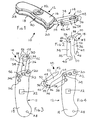
- a wrench 10 comprises a handle portion 12 and a removable head portion 14.
- the handle portion 12 comprises a pair of elongate plate members 16, 18.
- the plate members 16, 18 are secured to one another by rivets 20-28 that are arranged to maintain the plate members in parallel spaced apart relation such that there is a gap 30 defined between them.
- the plate members 16, 18 have a peripheral contour shaped to make the handle portion 12 easy to grip in the hand.
- at least one of the plate members 16, 18 is provided with a polygonal aperture 32 shaped and sized to engage a standard size fastener head.
- the plate members 16, 18 may be provided with respective different sized apertures 32 or only one of the plate members may be provided with an aperture 32. However, having the same size and shape of aperture in each plate member simplifies production.
- the head portion 14 is a generally U-shaped member comprising elongate leg portions 34, 36 interconnected at one end by an arcuate portion 38.
- the leg portion 34 is longer than the leg portion 36 and has a semi-circular recess 40 provided at its free end.
- the leg portion 36 has a notch 42 provided in the outer side 44 of its free end.
- the inner side of the arcuate portion 38 defines five fastener engaging surfaces 46. Adjacent ones of the fastener engaging surfaces 46 are interconnected by concave surface portions 48 such that they define a generally polygonal fastener receiving aperture 50 with the concave surface portions forming the corners of the aperture.
- the aperture 50 is shaped and sized to correspond to the fasteners the wrench is designed to be used on.
- the leg portions 34, 36 are spaced apart to define an elongate passage 52 that has an outer end 54 at the free ends of the leg portions and extends from the outer end to the aperture 50.
- the fastener engaging surfaces 46 are flat surfaces angled so as to be able to engage respective drive receiving flat surfaces of the size and shape of fastener the head portion 14 is intended to operate.
- the fastener engaging surfaces 46 and concave surface portions 48 are arranged such that the fastener engaging surfaces engage the leading ends of the respective fastener flats in the torque applying direction of the wrench (ie the anticlockwise direction as viewed in Figure 3 ) and the concave surface portions are located over the trailing end portion of the fastener flats at which the application of torque is not required.
- the outer side surface of the arcuate portion 38 has a number of concave portions 56 that are disposed generally opposite a respective fastener engaging surface 46. Specifically, there are concave portions 56 disposed generally opposite the three fastener engaging surfaces 46 at the end of the head portion 14. There are also concavities 58 in the outside surface of each of the leg portions 34, 36 behind (ie generally opposite) the fastener engaging surfaces 46 immediately adjacent the passage 52.
- the effect of the convex fastener engaging surfaces 46, concave surface portions 48, concave portions 56 and concavities 58 is to divide the part of the head portion 14 that defines the fastener receiving apertures 50 into a series of alternating oppositely facing generally C-shaped portions that provide a corrugated effect.
- the concave surface portions 48 define the corners of the polygonal fastener receiving aperture 50 and act in the manner of a curved spring hinge. It will be appreciated that the curvature of the concave surface portions 48 allows the hinge-like action and avoids the problem of stress concentration that would arise if sharp corners were used.
- the rivets 20, 22, 24, 26 are positioned and shaped such that they also serve as posts that in use of the wrench 10 are engaged by the head portion 14.
- the semi-circular recess 40 of the leg portion 34 engages the rivet 24, which serves as a mount on which the head portion 14 can pivot between the open and closed positions shown.
- the handle portion 12 is pivoted clockwise from the position shown in Figure 4 to close the wrench (the position shown in Figure 3 )
- the notch 42 in the end of the leg portion 36 engages the rivet 20.
- the rivet 22 is positioned between the rivets 20, 24 such that it provides an abutment that limits movement of the free end of the leg portion 36 towards the leg portion 34.
- the rivet 22 also assists in keeping the recess 40 engaged with the rivet 24.
- the head portion 14 of the wrench 10 is first moved to an open position such as those shown in Figures 4 and 5 . To put it in an open position, the head portion 14 is pivoted about the rivet 24 until the outer end 54 of the passage 52 is fully exposed. While it may not always be necessary to go so far, fitting the wrench 10 onto the nut 70 is most easily achieved if the head portion 14 is positioned such that its lengthways direction is disposed at approximately 90° or more to the lengthways direction of the handle portion 12.
- the head portion 14 With the outer end 54 of the passage 52 fully exposed, the head portion 14 is moved transversely to the brake pipe 72 such that the pipe passes through the passage towards the fastener receiving aperture 50. Once the brake pipe 72 is received in the fastener receiving aperture 50, the wrench is moved in a direction along the pipe that brings the head portion 14 onto the nut 70 with the fastener engaging surfaces 46 engaging the drive receiving surfaces 76 of the nut.
- the handle portion 12 is rotated towards the head portion 14 (in the anticlockwise direction as viewed in ( Figures 4 and 5 ) to close the wrench 10 and bring the rivet 20 into engagement with the notch 42. Where convenient, this closing process may take place before the wrench is moved along the pipe 72 to engage the nut 70.
- this closing process may take place before the wrench is moved along the pipe 72 to engage the nut 70.
- Continued rotation of the handle portion 12 in the anticlockwise direction presses the rivet 20 against the notch 42 to apply a moment to the free end of the leg portion 36 that pushes that end towards the leg portion 34 and in the process narrows the passage 52.
- This movement of the leg portion 36 causes the arcuate portion 38 to flex and stretch around the nut 70 until the fastener engaging surfaces 46 firmly grip the nut.
- continued anticlockwise rotation of the handle portion 12 causes a torque to be applied to the nut 70, which is turned anticlockwise and so released from the brake unit 74.
- the gripping force applied by the fastener engaging surfaces 46 will increase as the torque applied to the handle portion 12 increases and so in cases in which high levels of torque are needed to move a tight fastener, the gripping force will be increased and the wrench should not slip on the fastener.
- the concave outer side surface portions 56 of the head portion 14 improve the flexibility of the head portion making it better able to adjust its shape in response to the applied torque for gripping a fastener, even in cases in which due to damage to the fastener, the fastener's drive receiving surfaces are rounded off and undersize such as to be quite different to the design size.
- head portion 14 By making the head portion 14 releasable from the handle portion 12, it is possible to have just one handle portion for a range of sizes of head portion.
- the differences in the head portions may be the size and/or shape of the fastener receiving aperture and/or the length or angularity of the head portion. It will be appreciated that there is economic efficiency in having one handle portion that can accommodate multiple interchangeable head portions.
- the head portion may be configured to take advantage of the resilience of the material from which it is made such that the recess 40 receives the rivet 24 by snap-fitting.
- the head portion may be fitted to the handle portion via a circuitous path that makes it difficult for the head portion to be disengaged from the handle portion by accident regardless of the strength of the actual connection between the head portion and handle portion.
- the end region of the leg portion 34 that connects with the handle portion and the rivets 22, 24 could be configured such that the leg portion needs to be threaded into the connected position shown and will not readily be released. It will be understood that in general it will often be desirable for a detachable head portion to be quick-fit releasable by, for example, a push-fit and/or snap-fit connection.
- a release device may take the from of an abutment surface positioned to apply a force that helps to break the connection between the head portion and handle portion in similar fashion to the rivet 26 shown in Figure 3 . It will of course be understood that many other release devices, which may comprise more complex mechanisms, could be used.
- the head portion 14 could be secured to the handle portion 12 such that it can be permanently connected and for practical purposes not releasable.
- the rivet 28 is not needed and can be removed, if desired, to allow the head portion to be rotated anticlockwise (as viewed in Figures 3 to 6 ) such that it can be stored in the gap 30 between the plate members 16, 18 of the handle portion.
- the rivet 28 could be positioned to act as a detent that would hold the head portion 14 within the gap 30.
- a separate detent or other form of retention device could be used.
- the wrench is described in use operating a nut 70 on a brake pipe 72. It will be appreciated that this is not to be taken as limiting and that the wrench can be used to operate fasteners generally. In particular, while the wrench is particularly suited to use on fasteners incorporated in elongate structures, such as pipes, that would not be accessible to a conventional ring wrench, it will be appreciated that the wrench can be used on fasteners that could, for example, be accessed by a conventional open ended and/or ring wrench.
- the invention also provides a wrench comprising a handle portion, a head portion releasably secured to the handle portion and a release device, the head portion having an inner surface that defines a fastener receiving aperture having a plurality of fastener engaging surfaces and a side entry to said fastener engaging aperture and being movable relative to the handle portion between a loading position in which the side entry is open to permit an elongate member attached to a fastener to be moved into said fastener receiving aperture to permit said fastener engaging surfaces to be moved into engagement with the fastener by relative movement of the head portion and fastener in a lengthways direction of the elongate member and an operating position in which said side entry is closed and the head portion is operable to close said fastener engaging surfaces around the fastener received in said fastener receiving aperture in response to a torque applied in a predetermined direction using said handle portion, and said release device bring arranged to at least assist in releasing the head portion from the handle portion to permit the head portion to be separated from the handle portion.
- the release device mentioned in the last preceding paragraph may comprise an abutment surface provided on the handle portion and arranged to be engageable by the head portion in response to relative rotation of the head portion and handle portion for releasing the head portion from said handle portion.
- the wrench mentioned in either of the last two preceding paragraphs may comprise a plurality of head portions, each said head portion being releasably securable to said handle portion.
- the or each head portion mentioned in the last three preceding paragraphs may comprise an outer side surface having a plurality of concave portions that are each disposed generally opposite a said fastener engaging surface.
- Adjacent said fastener engaging surfaces mentioned in any of the last four preceding paragraphs may be connected by respective concave surface portions of said inner surface.
- the fastener engaging surfaces mentioned in any of the last five preceding paragraphs may be arranged for engaging a leading end portion of respective drive receiving surfaces of a fastener the head portion is configured to be used on with the concave surface portions disposed adjacent respective trailing end portions of said drive receiving surfaces.
- said head portion mentioned in any of the last six preceding paragraphs may be pivotable between said loading and operating positions, when in said loading position it extends transversely to said handle portion and when in said operating position it extends generally in line with said handle portion.
- the head portion mentioned in any of the last seven preceding paragraphs may comprise a first elongate portion, a second elongate portion and an arcuate portion connecting said elongate portions, said side entry being defined between said elongate portions.
- the head portion mentioned in the last preceding paragraph may be releasably securable to the handle portion by a connection between the handle portion and said first elongate portion and the handle portion may be arranged to apply said torque in a predetermined direction to a free end region of said second elongate portion.
- the handle portion of the wrench described in the ninth paragraph preceding this one may comprise two generally opposed elongate members disposed in spaced apart relation, a first pin member extending between said elongate members and a second pin member extending between said elongate members, said pin members being disposed at a first end region of the handle portion, said first pin member providing a pivot mount to which the head portion is releasably pivotally securable and the second pin member providing an abutment surface by which said torque applied in a predetermined direction is applied to the head portion.
- the wrench mentioned in the preceding paragraph may comprise a third pin member disposed generally intermediate said first and second pin members for limiting deformation of said head portion by said torque applied in a predetermined direction.
- the first end region mentioned in either of the last two preceding paragraphs may include a first end of the handle portion and the release device comprises a further pin member that is disposed further from said first end of the handle portion than said first pin member and is arranged to be engageable by the head portion by relative rotation of the head portion and handle portion for disconnecting the head portion from said first pin member.
- the fastener receiving aperture mentioned in any of the last twelve preceding paragraphs may have a plurality of corners and said head portion may be configured such that a spring hinge portion is defined by at least one of said corners.
- the head portion mentioned in any of the last thirteen preceding paragraphs may be releasably securable to the handle portion by a snap-fit connection.
- the head portion mentioned in any of the last thirteen preceding paragraphs may be push-fit releasably securable to said handle portion.
- the head portion mentioned in any of the last thirteen preceding paragraphs may be quick-fit releasably securable to said handle portion.
- the head portion mentioned in any of the last thirteen preceding paragraphs may be is releasably securable to the handle portion by a pivot connection.
- the invention also provides a wrench comprising:
- the invention also provides a method of operating a wrench for applying a torque to a fastener attached to an elongate member, the method comprising:
- the method mentioned in the last preceding paragraph may comprise releasably pivotally connecting said head portion to said handle portion when the fastener is received in the fastener receiving aperture.
- the elongate member mentioned in either of the last two preceding paragraphs may be a pipe and the fastener a nut that is rotatable relative to the pipe for securing said pipe of a threaded member.
- the pipe may be a brake pipe on an automobile.
- the invention also provides a wrench comprising a handle portion and a head portion, the head portion being movably connected with said handle portion so as to be movable relative to the handle portion between a storage position in which it is at least partially received within said handle portion and use positions in which it projects from the handle portion, the head portion having an inner surface that defines a fastener receiving aperture having a plurality of fastener engaging surfaces and a side entry to said fastener engaging aperture through which an elongate member attached to a fastener can be inserted into said fastener receiving aperture to permit said fastener engaging surfaces to be moved into engagement with the fastener by a movement in a lengthways direction of the elongate member and being operable to close said fastener engaging surfaces around a fastener received in said fastener receiving aperture in response to a torque applied in a predetermined direction using said handle portion.
- the head portion mentioned in the last preceding paragraph may comprise an outer side surface having a plurality of concave portions that are each disposed generally opposite a said fastener engaging surface.
- Adjacent said fastener engaging surfaces mentioned in either of the last two preceding paragraphs may be connected by respective concave surface portions of said inner surface.
- the fastener engaging surfaces mentioned in the last preceding paragraph may be arranged for engaging a leading end portion of respective drive receiving surfaces of a fastener the head portion is configured to be used on with the concave surface portions disposed adjacent respective trailing end portions of said drive receiving surfaces.
- the head portion mentioned in any of the last four preceding paragraphs may be pivotally connected to the handle portion so as to be pivotable to positions in which it extends transversely to said handle portion to permit entry to said side entry and a position generally in line with said handle portion in which entry to said side entry is blocked.
- the head portion mentioned in any of the last five preceding paragraphs may comprise a first elongate portion, a second elongate portion and an arcuate portion connecting said elongate portions, said side entry being defined between said elongate portions.
- connection between the head portion and handle portion may be with said first elongate portion and the handle portion may be arranged to apply said torque in a predetermined direction to a free end region of said second elongate portion.
- the movable connection mentioned the last preceding paragraph may a pivot connection and said handle portion comprises two generally opposed elongate members disposed in spaced apart relation, a first pin member extending between said elongate members and a second pin member extending between said elongate members, said pin members being disposed at a first end region of the handle portion, said first pin member providing a pivot mount to which the head portion is pivotally connected and the second pin member providing an abutment surface by which said torque applied in a predetermined direction is applied to the head portion.
- the wrench mentioned in the last preceding paragraph may comprise a third pin member disposed generally intermediate said first and second pin members for limiting deformation of said head portion by said torque applied in a predetermined direction.
- At least one said pin member mentioned in either of the last two preceding paragraphs comprises a fastener securing said elongate members together.
- the fastener receiving aperture mentioned in any of the last ten preceding paragraphs may have a plurality of corners and said head portion may be configured such that a spring hinge portion is defined at least one of said corners.
- the invention also includes a method of operating a wrench for applying a torque to a fastener attached to an elongate member, the method comprising:
- said handle portion when said elongate member is received in said fastener engaging aperture, said handle portion may be moved relative to said head portion to close said side entry.
Landscapes
- Engineering & Computer Science (AREA)
- Mechanical Engineering (AREA)
- Details Of Spanners, Wrenches, And Screw Drivers And Accessories (AREA)
Applications Claiming Priority (2)
| Application Number | Priority Date | Filing Date | Title |
|---|---|---|---|
| GBGB0721222.8A GB0721222D0 (en) | 2007-10-29 | 2007-10-29 | Wrench |
| GB0724571A GB2454269B (en) | 2007-10-29 | 2007-12-17 | Wrench |
Publications (2)
| Publication Number | Publication Date |
|---|---|
| EP2055432A2 true EP2055432A2 (de) | 2009-05-06 |
| EP2055432A3 EP2055432A3 (de) | 2009-09-16 |
Family
ID=38830153
Family Applications (1)
| Application Number | Title | Priority Date | Filing Date |
|---|---|---|---|
| EP08167823A Withdrawn EP2055432A3 (de) | 2007-10-29 | 2008-10-29 | Schraubenschlüssel |
Country Status (7)
| Country | Link |
|---|---|
| US (1) | US8117948B2 (de) |
| EP (1) | EP2055432A3 (de) |
| CN (1) | CN101422887A (de) |
| CA (1) | CA2641825C (de) |
| GB (4) | GB0721222D0 (de) |
| RU (1) | RU2008142848A (de) |
| TW (1) | TW200927392A (de) |
Cited By (1)
| Publication number | Priority date | Publication date | Assignee | Title |
|---|---|---|---|---|
| CN105538224A (zh) * | 2016-01-25 | 2016-05-04 | 禹伟 | 一种金属支撑管推棒 |
Citations (2)
| Publication number | Priority date | Publication date | Assignee | Title |
|---|---|---|---|---|
| USRE35424E (en) | 1993-07-08 | 1997-01-21 | Fiskars Inc. | Multipurpose bicycle tool kit |
| WO2003035327A1 (en) | 2001-10-26 | 2003-05-01 | Smart Tools Ltd. | Fold-away wrench |
Family Cites Families (39)
| Publication number | Priority date | Publication date | Assignee | Title |
|---|---|---|---|---|
| US553015A (en) * | 1896-01-14 | Elba pember | ||
| US131252A (en) * | 1872-09-10 | Improvement in pipe-wrenches | ||
| US1101022A (en) * | 1913-06-27 | 1914-06-23 | Howard R Adams | Wrench. |
| US1186807A (en) * | 1916-02-01 | 1916-06-13 | John L Litomy | Tool. |
| US1402373A (en) * | 1921-03-21 | 1922-01-03 | Charles G Palmer | Combination wrench |
| US1573409A (en) * | 1921-10-24 | 1926-02-16 | Theodore L Lynch | Tubing tongs and wrench |
| GB235434A (en) | 1924-09-11 | 1925-06-18 | Karl Ridel | Improvements in tongs for gripping pipes or other round articles |
| FR592653A (fr) | 1924-11-17 | 1925-08-06 | Clé à pédale | |
| DE599682C (de) | 1932-10-29 | 1934-07-07 | Carl Walter | Hebel mit einer einseitig an ihm angelenkten, schellenbandartigen Klemmklaue |
| US2435329A (en) * | 1944-12-09 | 1948-02-03 | Don M Stainbrook | Pipe wrench |
| US2655064A (en) * | 1951-11-29 | 1953-10-13 | Otis W Simon | Ratcheting wrench |
| US2766648A (en) * | 1955-10-26 | 1956-10-16 | Alois M Jazwieck | Friction actuated, ratchet type wrench |
| US2824476A (en) * | 1956-06-22 | 1958-02-25 | Leonard K Wilson | Friction drive, ratchet-type wrench |
| DE1603875A1 (de) | 1967-06-15 | 1971-09-16 | Heinrich Kunis | Schraubenschluessel |
| US3668950A (en) * | 1971-03-04 | 1972-06-13 | Virgil E Tyler | Slip joint nut wrench |
| US3780604A (en) * | 1971-07-01 | 1973-12-25 | G Wood | Split socket wrench and method of using same |
| DE2522696A1 (de) | 1975-05-22 | 1976-12-09 | Robert Walter | Spannringschluessel mit austauschbaren einsaetzen |
| US4130032A (en) * | 1977-08-29 | 1978-12-19 | The United States Of America As Represented By The Administrator Of The National Aeronautics And Space Administration | High-torque open-end wrench |
| DE2749857C3 (de) | 1977-11-08 | 1980-05-14 | Paul-Heinz Wagner Maschinenfabrikation, 5203 Much | Kraftschrauber mit einem Schlüsselkopf |
| US4269311A (en) * | 1979-10-30 | 1981-05-26 | Rich Jackson E | Portable hand carried kit for a set of wrenches and the like |
| US4593585A (en) * | 1981-11-20 | 1986-06-10 | Encor, Limited | Adjustable wrench |
| US4967612A (en) * | 1989-10-13 | 1990-11-06 | Russell Sparling | Flare nut wrench |
| US5201257A (en) * | 1992-01-13 | 1993-04-13 | Universal Tool & Stamping Co., Inc. | Folding lug wrench |
| US5557992A (en) * | 1992-04-07 | 1996-09-24 | Proprietary Technologies, Inc. | Multi-socket wrench containing dual socket wrench units |
| ATE249319T1 (de) * | 1995-05-26 | 2003-09-15 | Best Way Tools By Anderson Inc | Mehrzweckschraubenzieher mit einsätzen und mit verändlicher reichweite, klappmesser und auswechselbarem schraubendrehereinsatz |
| US6079301A (en) * | 1997-06-04 | 2000-06-27 | Media Group | Multi-wrench tool kit |
| DE19747536B4 (de) * | 1997-10-28 | 2004-06-03 | Gernot Hirse | Schraubenschlüssel in Gabelschlüsselform |
| DE29821725U1 (de) | 1997-12-08 | 1999-05-27 | Chiu, Ching-Hsiung, Changhua | Zusammenklappbares Multifunktionswerkzeug mit einem Werkzeugkörper zur Aufnahme mehrerer Steckschlüssel |
| US5983759A (en) * | 1998-04-13 | 1999-11-16 | Turner; Paul E. | Folding wrench cluster |
| GB9907059D0 (en) * | 1999-03-29 | 1999-05-19 | Buchanan Nigel A | Smart spanner |
| CA2328592C (en) * | 2000-01-12 | 2006-03-28 | Benjamin C. Rivera | Folding multipurpose tool including blade lock release mechanism |
| US6305254B1 (en) * | 2000-08-08 | 2001-10-23 | Chih-Ching Hsieh | Combination tool kit |
| US6988430B1 (en) * | 2002-01-16 | 2006-01-24 | Snap-On Incorporated | Wrench with flexible ring |
| US20040035260A1 (en) * | 2002-08-21 | 2004-02-26 | Adkison O. Gemare | Tool with engaging portion having axial opening and radial slot |
| CN1756625A (zh) | 2003-03-02 | 2006-04-05 | 丹尼斯·李·史迪瓦特 | 活动扳手 |
| US20050028649A1 (en) | 2003-08-06 | 2005-02-10 | Dan Settanni | Box wrench with hinged socket |
| US7424839B2 (en) * | 2006-07-31 | 2008-09-16 | Mu-Pei Chiang | Wrench |
| FR2908340A1 (fr) * | 2006-11-10 | 2008-05-16 | Renault Sas | Outil de serrage a cliquet. |
| US20080216611A1 (en) * | 2007-03-06 | 2008-09-11 | Eric Shawn Resnick | Removable thumb socket for loosening and tightening coaxial cable nut |
-
2007
- 2007-10-29 GB GBGB0721222.8A patent/GB0721222D0/en not_active Ceased
- 2007-12-17 GB GB0919475A patent/GB2464624B/en not_active Expired - Fee Related
- 2007-12-17 GB GB0724571A patent/GB2454269B/en not_active Expired - Fee Related
- 2007-12-17 GB GB0919462A patent/GB2464623B/en not_active Expired - Fee Related
-
2008
- 2008-10-24 CA CA2641825A patent/CA2641825C/en not_active Expired - Fee Related
- 2008-10-28 US US12/259,591 patent/US8117948B2/en not_active Expired - Fee Related
- 2008-10-29 CN CNA2008101785600A patent/CN101422887A/zh active Pending
- 2008-10-29 EP EP08167823A patent/EP2055432A3/de not_active Withdrawn
- 2008-10-29 TW TW097141531A patent/TW200927392A/zh unknown
- 2008-10-29 RU RU2008142848/02A patent/RU2008142848A/ru not_active Application Discontinuation
Patent Citations (2)
| Publication number | Priority date | Publication date | Assignee | Title |
|---|---|---|---|---|
| USRE35424E (en) | 1993-07-08 | 1997-01-21 | Fiskars Inc. | Multipurpose bicycle tool kit |
| WO2003035327A1 (en) | 2001-10-26 | 2003-05-01 | Smart Tools Ltd. | Fold-away wrench |
Cited By (1)
| Publication number | Priority date | Publication date | Assignee | Title |
|---|---|---|---|---|
| CN105538224A (zh) * | 2016-01-25 | 2016-05-04 | 禹伟 | 一种金属支撑管推棒 |
Also Published As
| Publication number | Publication date |
|---|---|
| US20090107302A1 (en) | 2009-04-30 |
| GB0724571D0 (en) | 2008-01-30 |
| CN101422887A (zh) | 2009-05-06 |
| RU2008142848A (ru) | 2010-05-10 |
| GB2464624A (en) | 2010-04-28 |
| GB2464623B (en) | 2011-05-04 |
| CA2641825C (en) | 2013-01-08 |
| GB0919462D0 (en) | 2009-12-23 |
| TW200927392A (en) | 2009-07-01 |
| GB2454269B (en) | 2010-10-27 |
| GB0919475D0 (en) | 2009-12-23 |
| CA2641825A1 (en) | 2009-04-29 |
| US8117948B2 (en) | 2012-02-21 |
| GB2454269A (en) | 2009-05-06 |
| GB2464623A (en) | 2010-04-28 |
| GB0721222D0 (en) | 2007-12-05 |
| EP2055432A3 (de) | 2009-09-16 |
| GB2464624B (en) | 2010-10-27 |
Similar Documents
| Publication | Publication Date | Title |
|---|---|---|
| US9056389B2 (en) | Line wrenches | |
| US7343837B1 (en) | Multi-plane flexible handle for ratchets and wrenches | |
| US8402627B2 (en) | Puller tool | |
| US9393676B2 (en) | Ratchet line wrench tool | |
| US20090178517A1 (en) | Nut driver system and method | |
| US20250018542A1 (en) | Tool having a central toolhead | |
| US4236266A (en) | Collapsible automotive tool | |
| US4114481A (en) | Oil filter wrench with ratchet drive | |
| US20060081095A1 (en) | Fold-away wrench set | |
| CN112912643A (zh) | 钩环组件 | |
| EP1539428B1 (de) | Schraubenschlüssel mit spaltring | |
| EP2055432A2 (de) | Schraubenschlüssel | |
| US5549022A (en) | Closed end box line wrench | |
| US10919130B2 (en) | Wrench | |
| WO2014169345A1 (en) | Position indicator for a threaded fixing member | |
| US12564921B2 (en) | Flip socket adapters | |
| US6745651B2 (en) | Manual device for applying a clamping pressure to the head of a nut | |
| US6666113B1 (en) | Valve wrench | |
| AU2010100897A4 (en) | Improved Shackle | |
| US10183382B2 (en) | Strap wrench | |
| US20070157772A1 (en) | Mechanical tool coupler | |
| US4750390A (en) | Hand wrenching tool for installation of torque limited fasteners | |
| CA2122222A1 (en) | T lever adapter for a ratchet wrench | |
| GB2031314A (en) | Strap wrench for gripping cylindrical articles | |
| JPH0646865U (ja) | レンチ |
Legal Events
| Date | Code | Title | Description |
|---|---|---|---|
| PUAI | Public reference made under article 153(3) epc to a published international application that has entered the european phase |
Free format text: ORIGINAL CODE: 0009012 |
|
| AK | Designated contracting states |
Kind code of ref document: A2 Designated state(s): AT BE BG CH CY CZ DE DK EE ES FI FR GB GR HR HU IE IS IT LI LT LU LV MC MT NL NO PL PT RO SE SI SK TR |
|
| AX | Request for extension of the european patent |
Extension state: AL BA MK RS |
|
| PUAL | Search report despatched |
Free format text: ORIGINAL CODE: 0009013 |
|
| AK | Designated contracting states |
Kind code of ref document: A3 Designated state(s): AT BE BG CH CY CZ DE DK EE ES FI FR GB GR HR HU IE IS IT LI LT LU LV MC MT NL NO PL PT RO SE SI SK TR |
|
| AX | Request for extension of the european patent |
Extension state: AL BA MK RS |
|
| RAP1 | Party data changed (applicant data changed or rights of an application transferred) |
Owner name: AMERICAN GREASE STICK COMPANY |
|
| RIN1 | Information on inventor provided before grant (corrected) |
Inventor name: BUCHANAN, NIGEL ALEXANDER |
|
| 17P | Request for examination filed |
Effective date: 20100316 |
|
| AKX | Designation fees paid |
Designated state(s): AT BE BG CH CY CZ DE DK EE ES FI FR GB GR HR HU IE IS IT LI LT LU LV MC MT NL NO PL PT RO SE SI SK TR |
|
| 17Q | First examination report despatched |
Effective date: 20100813 |
|
| STAA | Information on the status of an ep patent application or granted ep patent |
Free format text: STATUS: THE APPLICATION IS DEEMED TO BE WITHDRAWN |
|
| 18D | Application deemed to be withdrawn |
Effective date: 20140501 |