EP2056302B1 - Dekontaminierungsverfahren für eine durch radioaktive Elemente kontaminierte Metalloberfläche - Google Patents
Dekontaminierungsverfahren für eine durch radioaktive Elemente kontaminierte Metalloberfläche Download PDFInfo
- Publication number
- EP2056302B1 EP2056302B1 EP07119543A EP07119543A EP2056302B1 EP 2056302 B1 EP2056302 B1 EP 2056302B1 EP 07119543 A EP07119543 A EP 07119543A EP 07119543 A EP07119543 A EP 07119543A EP 2056302 B1 EP2056302 B1 EP 2056302B1
- Authority
- EP
- European Patent Office
- Prior art keywords
- decontamination
- gel
- group
- film
- acid
- Prior art date
- Legal status (The legal status is an assumption and is not a legal conclusion. Google has not performed a legal analysis and makes no representation as to the accuracy of the status listed.)
- Not-in-force
Links
- 238000005202 decontamination Methods 0.000 title claims abstract description 93
- 230000002285 radioactive effect Effects 0.000 title claims description 10
- 229910052751 metal Inorganic materials 0.000 title claims description 8
- 239000002184 metal Substances 0.000 title claims description 8
- 230000003588 decontaminative effect Effects 0.000 claims abstract description 85
- 238000011109 contamination Methods 0.000 claims abstract description 35
- 229910052792 caesium Inorganic materials 0.000 claims abstract description 21
- 229910052712 strontium Inorganic materials 0.000 claims abstract description 21
- 239000000463 material Substances 0.000 claims abstract description 20
- 239000000499 gel Substances 0.000 claims description 63
- 239000000243 solution Substances 0.000 claims description 29
- 239000003283 colorimetric indicator Substances 0.000 claims description 27
- 239000003153 chemical reaction reagent Substances 0.000 claims description 24
- LFQSCWFLJHTTHZ-UHFFFAOYSA-N Ethanol Chemical compound CCO LFQSCWFLJHTTHZ-UHFFFAOYSA-N 0.000 claims description 22
- RGCKGOZRHPZPFP-UHFFFAOYSA-N alizarin Chemical compound C1=CC=C2C(=O)C3=C(O)C(O)=CC=C3C(=O)C2=C1 RGCKGOZRHPZPFP-UHFFFAOYSA-N 0.000 claims description 18
- 238000000034 method Methods 0.000 claims description 17
- 239000012530 fluid Substances 0.000 claims description 16
- XLYOFNOQVPJJNP-UHFFFAOYSA-N water Substances O XLYOFNOQVPJJNP-UHFFFAOYSA-N 0.000 claims description 15
- 229920000642 polymer Polymers 0.000 claims description 14
- ZMXDDKWLCZADIW-UHFFFAOYSA-N N,N-Dimethylformamide Chemical compound CN(C)C=O ZMXDDKWLCZADIW-UHFFFAOYSA-N 0.000 claims description 11
- 239000011521 glass Substances 0.000 claims description 11
- PEDCQBHIVMGVHV-UHFFFAOYSA-N Glycerine Chemical compound OCC(O)CO PEDCQBHIVMGVHV-UHFFFAOYSA-N 0.000 claims description 10
- NBIIXXVUZAFLBC-UHFFFAOYSA-N Phosphoric acid Chemical compound OP(O)(O)=O NBIIXXVUZAFLBC-UHFFFAOYSA-N 0.000 claims description 10
- WEVYAHXRMPXWCK-UHFFFAOYSA-N Acetonitrile Chemical compound CC#N WEVYAHXRMPXWCK-UHFFFAOYSA-N 0.000 claims description 9
- ATHHXGZTWNVVOU-UHFFFAOYSA-N N-methylformamide Chemical compound CNC=O ATHHXGZTWNVVOU-UHFFFAOYSA-N 0.000 claims description 8
- WYURNTSHIVDZCO-UHFFFAOYSA-N Tetrahydrofuran Chemical compound C1CCOC1 WYURNTSHIVDZCO-UHFFFAOYSA-N 0.000 claims description 8
- 239000004014 plasticizer Substances 0.000 claims description 8
- 239000000203 mixture Substances 0.000 claims description 7
- BELBBZDIHDAJOR-UHFFFAOYSA-N Phenolsulfonephthalein Chemical compound C1=CC(O)=CC=C1C1(C=2C=CC(O)=CC=2)C2=CC=CC=C2S(=O)(=O)O1 BELBBZDIHDAJOR-UHFFFAOYSA-N 0.000 claims description 6
- QAOWNCQODCNURD-UHFFFAOYSA-N Sulfuric acid Chemical compound OS(O)(=O)=O QAOWNCQODCNURD-UHFFFAOYSA-N 0.000 claims description 6
- 150000001875 compounds Chemical class 0.000 claims description 6
- 239000003960 organic solvent Substances 0.000 claims description 6
- 229960003531 phenolsulfonphthalein Drugs 0.000 claims description 6
- QPCDCPDFJACHGM-UHFFFAOYSA-N N,N-bis{2-[bis(carboxymethyl)amino]ethyl}glycine Chemical compound OC(=O)CN(CC(O)=O)CCN(CC(=O)O)CCN(CC(O)=O)CC(O)=O QPCDCPDFJACHGM-UHFFFAOYSA-N 0.000 claims description 5
- 229920003171 Poly (ethylene oxide) Polymers 0.000 claims description 5
- 229910000147 aluminium phosphate Inorganic materials 0.000 claims description 5
- 235000011187 glycerol Nutrition 0.000 claims description 5
- 150000007522 mineralic acids Chemical class 0.000 claims description 5
- 229960003330 pentetic acid Drugs 0.000 claims description 5
- -1 phthalate ester Chemical class 0.000 claims description 5
- VEXZGXHMUGYJMC-UHFFFAOYSA-N Hydrochloric acid Chemical compound Cl VEXZGXHMUGYJMC-UHFFFAOYSA-N 0.000 claims description 4
- MHAJPDPJQMAIIY-UHFFFAOYSA-N Hydrogen peroxide Chemical compound OO MHAJPDPJQMAIIY-UHFFFAOYSA-N 0.000 claims description 4
- 239000004372 Polyvinyl alcohol Substances 0.000 claims description 4
- UUIRDIWGVMSEBE-UHFFFAOYSA-N acetylene propan-2-one Chemical compound C#C.CC(C)=O UUIRDIWGVMSEBE-UHFFFAOYSA-N 0.000 claims description 4
- BDAGIHXWWSANSR-UHFFFAOYSA-N methanoic acid Natural products OC=O BDAGIHXWWSANSR-UHFFFAOYSA-N 0.000 claims description 4
- 239000011259 mixed solution Substances 0.000 claims description 4
- 238000002156 mixing Methods 0.000 claims description 4
- 239000001814 pectin Substances 0.000 claims description 4
- 235000010987 pectin Nutrition 0.000 claims description 4
- 229920001277 pectin Polymers 0.000 claims description 4
- 229920002451 polyvinyl alcohol Polymers 0.000 claims description 4
- YLQBMQCUIZJEEH-UHFFFAOYSA-N tetrahydrofuran Natural products C=1C=COC=1 YLQBMQCUIZJEEH-UHFFFAOYSA-N 0.000 claims description 4
- LNIGBQNXJNNICD-UHFFFAOYSA-N 2-[(5-bromopyridin-2-yl)diazenyl]-5-(dimethylamino)phenol Chemical compound OC1=CC(N(C)C)=CC=C1N=NC1=CC=C(Br)C=N1 LNIGBQNXJNNICD-UHFFFAOYSA-N 0.000 claims description 3
- KCXVZYZYPLLWCC-UHFFFAOYSA-N EDTA Chemical compound OC(=O)CN(CC(O)=O)CCN(CC(O)=O)CC(O)=O KCXVZYZYPLLWCC-UHFFFAOYSA-N 0.000 claims description 3
- YVBOZGOAVJZITM-UHFFFAOYSA-P ammonium phosphomolybdate Chemical compound [NH4+].[NH4+].[NH4+].[NH4+].[O-]P([O-])=O.[O-][Mo]([O-])(=O)=O YVBOZGOAVJZITM-UHFFFAOYSA-P 0.000 claims description 3
- 229960001484 edetic acid Drugs 0.000 claims description 3
- 229920002239 polyacrylonitrile Polymers 0.000 claims description 3
- 229920000036 polyvinylpyrrolidone Polymers 0.000 claims description 3
- 239000001267 polyvinylpyrrolidone Substances 0.000 claims description 3
- 235000013855 polyvinylpyrrolidone Nutrition 0.000 claims description 3
- 239000010935 stainless steel Substances 0.000 claims description 3
- 229910001220 stainless steel Inorganic materials 0.000 claims description 3
- OSWFIVFLDKOXQC-UHFFFAOYSA-N 4-(3-methoxyphenyl)aniline Chemical compound COC1=CC=CC(C=2C=CC(N)=CC=2)=C1 OSWFIVFLDKOXQC-UHFFFAOYSA-N 0.000 claims description 2
- 229910000975 Carbon steel Inorganic materials 0.000 claims description 2
- 229920002134 Carboxymethyl cellulose Polymers 0.000 claims description 2
- RYGMFSIKBFXOCR-UHFFFAOYSA-N Copper Chemical compound [Cu] RYGMFSIKBFXOCR-UHFFFAOYSA-N 0.000 claims description 2
- 108010010803 Gelatin Proteins 0.000 claims description 2
- 239000002202 Polyethylene glycol Substances 0.000 claims description 2
- 235000010489 acacia gum Nutrition 0.000 claims description 2
- 239000001785 acacia senegal l. willd gum Substances 0.000 claims description 2
- 229910052782 aluminium Inorganic materials 0.000 claims description 2
- XAGFODPZIPBFFR-UHFFFAOYSA-N aluminium Chemical compound [Al] XAGFODPZIPBFFR-UHFFFAOYSA-N 0.000 claims description 2
- TVFDJXOCXUVLDH-UHFFFAOYSA-N caesium atom Chemical compound [Cs] TVFDJXOCXUVLDH-UHFFFAOYSA-N 0.000 claims description 2
- 239000010962 carbon steel Substances 0.000 claims description 2
- 239000001768 carboxy methyl cellulose Substances 0.000 claims description 2
- 235000010948 carboxy methyl cellulose Nutrition 0.000 claims description 2
- 239000008112 carboxymethyl-cellulose Substances 0.000 claims description 2
- 239000010949 copper Substances 0.000 claims description 2
- 229910052802 copper Inorganic materials 0.000 claims description 2
- 235000019253 formic acid Nutrition 0.000 claims description 2
- 229920000159 gelatin Polymers 0.000 claims description 2
- 239000008273 gelatin Substances 0.000 claims description 2
- 235000019322 gelatine Nutrition 0.000 claims description 2
- 235000011852 gelatine desserts Nutrition 0.000 claims description 2
- DCYOBGZUOMKFPA-UHFFFAOYSA-N iron(2+);iron(3+);octadecacyanide Chemical compound [Fe+2].[Fe+2].[Fe+2].[Fe+3].[Fe+3].[Fe+3].[Fe+3].N#[C-].N#[C-].N#[C-].N#[C-].N#[C-].N#[C-].N#[C-].N#[C-].N#[C-].N#[C-].N#[C-].N#[C-].N#[C-].N#[C-].N#[C-].N#[C-].N#[C-].N#[C-] DCYOBGZUOMKFPA-UHFFFAOYSA-N 0.000 claims description 2
- 229920003023 plastic Polymers 0.000 claims description 2
- 239000004033 plastic Substances 0.000 claims description 2
- 229920001223 polyethylene glycol Polymers 0.000 claims description 2
- 229920002689 polyvinyl acetate Polymers 0.000 claims description 2
- 239000011118 polyvinyl acetate Substances 0.000 claims description 2
- 239000013225 prussian blue Substances 0.000 claims description 2
- 229960003351 prussian blue Drugs 0.000 claims description 2
- CIOAGBVUUVVLOB-UHFFFAOYSA-N strontium atom Chemical compound [Sr] CIOAGBVUUVVLOB-UHFFFAOYSA-N 0.000 claims description 2
- 239000003086 colorant Substances 0.000 description 12
- 239000003795 chemical substances by application Substances 0.000 description 7
- 230000000694 effects Effects 0.000 description 7
- 238000005516 engineering process Methods 0.000 description 5
- 239000000126 substance Substances 0.000 description 5
- 239000002253 acid Substances 0.000 description 4
- 238000006243 chemical reaction Methods 0.000 description 4
- HEMHJVSKTPXQMS-UHFFFAOYSA-M Sodium hydroxide Chemical compound [OH-].[Na+] HEMHJVSKTPXQMS-UHFFFAOYSA-M 0.000 description 3
- 238000004140 cleaning Methods 0.000 description 3
- 239000002699 waste material Substances 0.000 description 3
- XMGQYMWWDOXHJM-JTQLQIEISA-N (+)-α-limonene Chemical compound CC(=C)[C@@H]1CCC(C)=CC1 XMGQYMWWDOXHJM-JTQLQIEISA-N 0.000 description 2
- YXFVVABEGXRONW-UHFFFAOYSA-N Toluene Chemical compound CC1=CC=CC=C1 YXFVVABEGXRONW-UHFFFAOYSA-N 0.000 description 2
- 239000000654 additive Substances 0.000 description 2
- 239000002738 chelating agent Substances 0.000 description 2
- 238000009390 chemical decontamination Methods 0.000 description 2
- 230000007423 decrease Effects 0.000 description 2
- 239000006185 dispersion Substances 0.000 description 2
- 229910052500 inorganic mineral Inorganic materials 0.000 description 2
- 229920000609 methyl cellulose Polymers 0.000 description 2
- 239000001923 methylcellulose Substances 0.000 description 2
- 239000011707 mineral Substances 0.000 description 2
- 238000005507 spraying Methods 0.000 description 2
- 239000004215 Carbon black (E152) Substances 0.000 description 1
- CERQOIWHTDAKMF-UHFFFAOYSA-N Methacrylic acid Chemical compound CC(=C)C(O)=O CERQOIWHTDAKMF-UHFFFAOYSA-N 0.000 description 1
- GRYLNZFGIOXLOG-UHFFFAOYSA-N Nitric acid Chemical compound O[N+]([O-])=O GRYLNZFGIOXLOG-UHFFFAOYSA-N 0.000 description 1
- CTQNGGLPUBDAKN-UHFFFAOYSA-N O-Xylene Chemical compound CC1=CC=CC=C1C CTQNGGLPUBDAKN-UHFFFAOYSA-N 0.000 description 1
- 239000006096 absorbing agent Substances 0.000 description 1
- 239000003513 alkali Substances 0.000 description 1
- 125000000129 anionic group Chemical group 0.000 description 1
- 239000003945 anionic surfactant Substances 0.000 description 1
- 125000002915 carbonyl group Chemical group [*:2]C([*:1])=O 0.000 description 1
- 239000002826 coolant Substances 0.000 description 1
- LVYZJEPLMYTTGH-UHFFFAOYSA-H dialuminum chloride pentahydroxide dihydrate Chemical compound [Cl-].[Al+3].[OH-].[OH-].[Al+3].[OH-].[OH-].[OH-].O.O LVYZJEPLMYTTGH-UHFFFAOYSA-H 0.000 description 1
- 238000001704 evaporation Methods 0.000 description 1
- 230000008020 evaporation Effects 0.000 description 1
- 230000004992 fission Effects 0.000 description 1
- 239000004519 grease Substances 0.000 description 1
- 229930195733 hydrocarbon Natural products 0.000 description 1
- 150000002430 hydrocarbons Chemical class 0.000 description 1
- 238000009392 mechanical decontamination Methods 0.000 description 1
- 238000012986 modification Methods 0.000 description 1
- 230000004048 modification Effects 0.000 description 1
- 239000000178 monomer Substances 0.000 description 1
- 229910017604 nitric acid Inorganic materials 0.000 description 1
- 239000002736 nonionic surfactant Substances 0.000 description 1
- 150000007524 organic acids Chemical class 0.000 description 1
- 235000005985 organic acids Nutrition 0.000 description 1
- 229920000620 organic polymer Polymers 0.000 description 1
- 239000007800 oxidant agent Substances 0.000 description 1
- 239000003208 petroleum Substances 0.000 description 1
- 239000012286 potassium permanganate Substances 0.000 description 1
- 230000001681 protective effect Effects 0.000 description 1
- 239000011241 protective layer Substances 0.000 description 1
- 238000003904 radioactive pollution Methods 0.000 description 1
- 239000000941 radioactive substance Substances 0.000 description 1
- 239000002901 radioactive waste Substances 0.000 description 1
- 230000002829 reductive effect Effects 0.000 description 1
- 239000002904 solvent Substances 0.000 description 1
- 239000004094 surface-active agent Substances 0.000 description 1
- 150000003505 terpenes Chemical class 0.000 description 1
- 235000007586 terpenes Nutrition 0.000 description 1
- 238000002604 ultrasonography Methods 0.000 description 1
- 239000008096 xylene Substances 0.000 description 1
Images




Classifications
-
- G—PHYSICS
- G21—NUCLEAR PHYSICS; NUCLEAR ENGINEERING
- G21F—PROTECTION AGAINST X-RADIATION, GAMMA RADIATION, CORPUSCULAR RADIATION OR PARTICLE BOMBARDMENT; TREATING RADIOACTIVELY CONTAMINATED MATERIAL; DECONTAMINATION ARRANGEMENTS THEREFOR
- G21F9/00—Treating radioactively contaminated material; Decontamination arrangements therefor
- G21F9/001—Decontamination of contaminated objects, apparatus, clothes, food; Preventing contamination thereof
- G21F9/002—Decontamination of the surface of objects with chemical or electrochemical processes
- G21F9/004—Decontamination of the surface of objects with chemical or electrochemical processes of metallic surfaces
-
- G—PHYSICS
- G21—NUCLEAR PHYSICS; NUCLEAR ENGINEERING
- G21F—PROTECTION AGAINST X-RADIATION, GAMMA RADIATION, CORPUSCULAR RADIATION OR PARTICLE BOMBARDMENT; TREATING RADIOACTIVELY CONTAMINATED MATERIAL; DECONTAMINATION ARRANGEMENTS THEREFOR
- G21F9/00—Treating radioactively contaminated material; Decontamination arrangements therefor
- G21F9/28—Treating solids
Definitions
- the present invention relates to a decontamination method of a metal surface contaminated by radioactive element; more particularly, relates to mixing a blend of polymers, characteristic additives and a decontamination reagent to obtain a decontamination gel for indicating contaminations of Co, Cs and Sr and to obtain good decontamination effect by cleaning the contaminations by removing a film of the decontamination gel dried-up
- Different decontamination reagents are used for cleansing.
- distilled products from petroleum are used to clean contaminations on surfaces of tire, break, etc.
- These reagents usually contain hydrocarbon solvents like methylbenzene and xylene.
- environmental-friendly products are developed and widely used in the modern time.
- D-limonene is used to cleanse oil and earth on mechanical facilities.
- 2 to 8 weight percents (wt%) of terpene, or 5 to 25 wt% of anionic or nonionic surfactant is used to effectively remove grease or tar on a surface.
- a surface having a pollution of radionuclides is not effectively cleansed.
- a solution obtained after cleansing the surface may need further treatment.
- the chemical decontamination technologies use chemical reagents, such as organic acids having reduction property, chelating agents, oxidants, reductive agent, etc. These chemical reagents are soft and are used for precision machines such as reactor coolant pump (RCP). But its decontamination factor is usually small.
- RCP reactor coolant pump
- the later non-chemical technologies are more widely used, such as electrochemical decontamination, abrading decontamination, high pressure water-jet decontamination, mechanical decontamination, etc. These methods are usually severe and may even ruin machine; though the decontamination factors may reach 103 to 104.
- Traditional decontamination reagent for radioactive waste usually contains strong acid or alkali to improve decontamination effect, like phosphoric acid, sulfuric acid, nitric acid, fluorboric acid, potassium permanganate or sodium hydroxide. And the operation is usually processed under a high temperature.
- contaminations are gradually accumulated in the decontamination reagent, its decontamination effect decreases while radioactive activity of the accumulated contaminations increases.
- the decontamination reagent needs further treatment or becomes a waste. But, the treatment may not be easy owing to the complex components contained in the used decontamination reagent. And, the waste may be a great amount. All these may greatly heighten the cost.
- surface protective films are developed. They are usually used as protective layers on industrial objects to prevent from contamination and collision, and thus are soft.
- US 5,891,261 discloses (meth)acrylic acid ester combined with other polymer monomers, like less than 5%wt of carbonyl group, to form a gel. And the gel is pasted on a surface to be dried for obtaining a film. Then cold or hot water (even vapor) are spayed on the dried film to remove it.
- US 2003/172959 A1 discloses a method for removing a wide variety of radioactive contaminats from a contaminated surface.
- US 5,763,734 discloses another method of deconatminating devices in nuclear power plants.
- US 6,689,226 B1 discloses a decontamination gel including a decontamination agent, two organic polymers and water.
- US 6,203,624 B1 discloses a decontamination gel that can be used to decontaminate metal surfaces, while decontamination is understood to be related to the removal of radioactive elements.
- Conventional decontaminations gels comprise a viscosing agent that is generally mineral and a decontamination agent choosen in relation to the type of the surface. Because of the viscosing agent spraying of the gel is difficult.
- US 6,203,624 B1 therefore suggests combining a mineral viscosing agent and an organic viscosing agent choosen from hydosoluble organic polymenrs and surfactants.
- the present invention provides a decontamination method comprising the steps of claim 1.
- Advantageous embodiments of the claimed method are laid down in further claims.
- the present invention provides a decontamination gel according to claim 15.
- the decontamination reagent contains at least one polymer to be sprayed on a contaminated material for forming a film for cleaning contamination.
- Evaporable organic solvent is added to increase fluidity of gel and to control time for obtaining the film.
- a colorimetric indicator is added in the decontamination gel to be sprayed on the contaminated material to show places of contaminations.
- the decontamination reagent has abilities of physical absorbing or chemical chelating to Co, Cs and Sr.
- FIG.1 is a flow view showing a preferred embodiment according to the present invention.
- the present invention is a decontamination method of a metal surface contaminated by radioactive element, comprising the following steps:
- FIG.2 is a flow view showing fabricating a gel fluid.
- a mixed solution with a physical ratio of water to an evaporable organic solution [21] between 1 and 5 is obtained in a reactor.
- a first polymer [22] such as methylcellulose
- the methylcellulose is blended to be fully solved with temperature heated up.
- a condenser is then further used to prevent an evaporation of the organic solution and water.
- a second polymer [23] such as PVA, is gradually added with blending under 85°C during 4 to 5hrs to be fully solved into water for obtaining a proper weight ratio of the first polymer to the second polymer.
- a plasticizer [24] such as glycerin
- glycerin a plasticizer added at a temperature between 80°C and 95°C to obtain a proper volume ratio of glycerin to water.
- a gel fluid [26] is obtained after a continuous blending [25].
- FIG.3 is a flow view showing a decontamination gel.
- a decontamination reagent [27] such as DTPA
- DTPA a decontamination reagent
- a solution of phosphoric acid and water [28] is solved into a solution of phosphoric acid and water [28] to be fully blended for obtaining a molar ratio of 1:8:175 for DTPA to phosphoric acid to water in the decontamination reagent solution [29].
- 6500 volumes of gel fluid [26] is added with 200 volumes of the decontamination reagent solution [29] to obtain a ratio of 33 to 1.
- the solution is blended [31] under 85°C [30] in the reactor.
- the decontamination reagent solution [34] is obtained after being placed still [32] for 1hr to be cooled down [33] to room temperature.
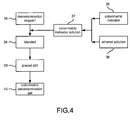
- FIG.4 is a flow view showing a colorimetric decontamination gel.
- a colorimetric indicator [35] such as alizarin
- ethanol solution [36] is added into an ethanol solution [36] to obtain a colorimetric indicator solution [37] with a ratio of alizarin to the ethanol solution between 0.01 and 0.03.
- 50 volumes of the colorimetric indicator solution [37] are mixed with 4800 volumes of a decontamination reagent [34] to obtain a proper ratio.
- the solution is blended [38] and then is placed still [39] to obtain a colorimetric decontamination gel [40].
- the decontamination gel is sprayed on a surface of a material.
- a film is formed and radioactive substances like cobalum (Co), cesium (Cs) and strontium (Sr) are soaked in the film and are shown by the colorimetric indicator with different colors. In this way, positions of the contaminations are observed and are cleaned by removing the film. In addition, densities of the contamination are recognized by the colors.
- FIG.5 is a view showing colors of a first state of use.
- different colorimetric indicators have different color reactions.
- decontamination gels separately having colorimetric indicators are obtained.
- materials of stainless steel are used to be sunk in a cleanser.
- the materials are cleansed with ultrasound before being hot-dried in an oven.
- solutions separately having contaminations of Co, Cs and Sr are obtained and dropped on glasses to be hot-dried.
- the decontamination gels separately having colorimetric indicators are sprayed on the glasses having contaminations of Co, Cs and Sr to show different colors.
- the glasses having the contaminations of Co show obvious colors by the decontamination gels having alizarin and BrPADAP; and the glasses having the contaminations of Cs and Sr show obvious colors by the decontamination gels having alizarin and arsenazo III.
- different decontamination gels separately having different colorimetric indicators detect materials separately having contaminations of Co, Cs and Sr for preventing pollution dispersion and protecting environment.
- FIG.6 is a view showing colors of a second state of use.
- a decontamination gel having more than two colorimetric indicators is used to show colors of materials having contaminations of Co, Cs and Sr.
- two different colorimetric indicators are solved in an ethanol solution.
- the mixed colorimetric indicators are added to a decontamination gel.
- solutions separately having contaminations of Co, Cs and Sr are obtained and the mixed colorimetric indicators are dropped on glasses to be hot-dried to show different colors.
- the colorimetric indicators are BrPADAP and arsenazo III; PR and alizarin; PR and arsenazo III; or alizarin and arsenazo III.
- the glasses having the contaminations of Co, Cs and Sr show obvious colors by the decontamination gel having the colorimetric indicators.
- the decontamination gel having the colorimetric indicators detects materials having contaminations of Co, Cs and Sr for preventing pollution dispersion and protecting environment.
- a decontamination gel according to the present invention is obtained. Solutions having contaminations of Co, Cs and Sr are obtained and dropped on a glass to be hot-dried. After the temperature is cooled down to room temperature, the decontamination gel is sprayed on a glass having contaminations of Co, Cs and Sr to form a film after being dried up naturally. Thus, the contaminations of Co, Cs and Sr are cleaned by removing the film. By sinking the glass in an acid solution and analyze the acid solution afterward, a decontamination effect of the decontamination gel to materials having contaminations of Co, Cs and Sr is shown. As a result, it is shown that the decontamination gel has decontamination effects of 99%, 96% and 97% to Co, Cs and Sr separately.
- the present invention is a decontamination method of a metal surface contaminated by radioactive element, where a blend of polymers, characteristic additives and a decontamination reagent are mixed to obtain a decontamination gel for indicating contaminations of Co, Cs and Sr and to obtain good decontamination effect by cleaning the contaminations by removing a film of the decontamination gel dried-up.
Landscapes
- Engineering & Computer Science (AREA)
- High Energy & Nuclear Physics (AREA)
- General Engineering & Computer Science (AREA)
- Physics & Mathematics (AREA)
- General Chemical & Material Sciences (AREA)
- Life Sciences & Earth Sciences (AREA)
- Food Science & Technology (AREA)
- Chemical & Material Sciences (AREA)
- Electrochemistry (AREA)
- Chemical Kinetics & Catalysis (AREA)
- Detergent Compositions (AREA)
- Physical Or Chemical Processes And Apparatus (AREA)
- Solid-Sorbent Or Filter-Aiding Compositions (AREA)
Claims (15)
- Dekontaminationsverfahren zur Dekontamination einer mit radioaktiven Elementen kontaminierten Metalloberfläche, das folgende Schritte umfasst:(a) Mischen von einem organischen Lösungsmittel, mehr als einem Polymer und Wasser, um ein Gelfluid zu erhalten;(b) Hinzufügen eines Dekontaminations-Reagens und eines Weichmachers in das Gelfluid bis zur vollständigen Vermischung und anschließendes Hinzufügen einer Lösung aus mindestens einem kolorimetrischen Indikator, um ein kolorimetrisches Dekontaminationsgel zu erhalten; und(c) Aufbringen des Dekontaminationsgels auf eine kontaminierte Oberfläche eines Materials, damit ein Film entsteht, und Entfernen des Films, so dass die Oberfläche dekontaminiert wird;wobei
das organische Lösungsmittel aus einer Gruppe gewählt wird, die aus Acetylaceton, Acetonitril und Ethanol besteht;
der Weichmacher aus einer Gruppe gewählt wird, die aus Tetrahydrofuran, N-Methylformamid, N,N-Dimethylformamid, Glycerin und Phthalatsäureester besteht; und der kolorimetrische Indikator eine Mischung aus einer Ethanollösung und mindestens einem Stoff ist, der aus einer Gruppe gewählt wird, die aus Alizarin, Phenolrot, Arsenazo III und 2-(5-Bromo-2-Pyridylazo)-5-Dimethylaminophenol besteht. - Verfahren nach Anspruch 1, wobei das Gelfluid eine Temperatur zwischen 80°C und 95°C aufweist.
- Verfahren nach Anspruch 1 oder 2,
wobei das Wasser und das organische Lösungsmittel ein physikalisches Verhältnis zwischen 1 und 5 haben. - Verfahren nach einem der Ansprüche 1 bis 3,
wobei das Polymer aus einer Gruppe gewählt wird, die aus Polyäthylenoxid, Polyacrylnitirl, Polyvinylalkohol, Polyvinylpyrrolidon, Polyvinylacetat, Carboxymethylcellulose, Polyäthylenoxid, Polyäthylenglycol, Gelatine, Apfelpektin und Gummi arabicum besteht. - Verfahren nach einem der Ansprüche 1 bis 4,
wobei der Weichmacher bei einer Temperatur von 80°C bis 95°C mit dem Polymer gemischt wird. - Verfahren nach einem der Ansprüche 1 bis 5,
wobei das Dekontaminationsreagens eine Mischung aus mindestens einer ersten Verbindung, einer anorganischen Säure und Wasser ist; und
wobei die erste Verbindung aus einer Gruppe gewählt wird, die aus Diäthylentriaminpentanessigsäure, Äthylendiamintetraessigsäure, Apfelpektin, Preußisch-Blau, Ammoniumphosphomolybdat, Ce4+/Ce3+, Wasserstoffperoxid und Ferrocyanid besteht. - Verfahren nach einem der Ansprüche 1 bis 6,
wobei die anorganische Säure aus einer Gruppe gewählt wird, die aus Phosphorsäure, Chlorwasserstoffsäure, Ameisensäure und Schwefelsäure besteht. - Verfahren nach Anspruch 6,
wobei ein Molverhältnis des Dekontaminationsreagens zu der anorganischen Säure zu Wasser 1 zu 8 zu 175 beträgt. - Verfahren nach einem der Ansprüche 1 bis 8,
wobei der kolorimetrische Indikator und die Ethanollösung zu einem Verhältnis zwischen 0,01 und 0,03 gemischt werden. - Verfahren nach einem der Ansprüche 1 bis 9,
wobei das Dekontaminationsgel 24 Stunden lang bei einer Temperatur zwischen 10°C und 40°C der Luft ausgesetzt wird, damit der Film gebildet wird. - Verfahren nach einem der Ansprüche 1 bis 10,
wobei der Film eine Dekontaminationseffizienz größer 96% bei einer Kontamination aufweist, die ein Element aus der Gruppe Kobalt, Cäsium und Strontium enthält. - Verfahren nach einem der Ansprüche 1 bis 11,
wobei das Material aus einer Gruppe gewählt wird, die aus Edelstahl, Kohlenstoffstahl, Aluminium, Kupfer, Kunststoff und Glas besteht. - Verfahren nach einem der Ansprüche 1 bis 12,
wobei der kolorimetrische Indikator Kontaminationen an der Oberfläche des Materials färbt und so die kontaminierten Stellen anzeigt. - Verfahren nach einem der Ansprüche 1 bis 13,
wobei ein physikalisches Verhältnis des Dekontaminationsreagens zu dem Gelfluid in einer Lösungsmischung 1 bis 33 beträgt. - Dekontaminationsgel zur Dekontamination einer mit radioaktiven Elementen kontaminierten Metalloberfläche, das aus Folgendem besteht:(a) einem organischen Lösungsmittel, mehr als einem Polymer und Wasser, die zu einem Gelfluid gemischt werden; und(b) einem Dekontaminationsreagens, einem Weichmacher und mindestens einem kolorimetrischen Indikator in dem Gel, damit ein kolorimetrisches Dekontaminationsgel entsteht; und(c) das dazu geeignet ist, auf eine kontaminierte Oberfläche eines Materials aufgebracht zu werden, damit ein Film gebildet wird, der zum Zwecke der Dekontamination von der Oberfläche entfernt wird, wobeidas organische Lösungsmittel aus einer Gruppe gewählt wird, die aus Acetylaceton, Acetonitril und Ethanol besteht;
der Weichmacher aus einer Gruppe gewählt wird, die aus Tetrahydrofuran, N-Methylformamid, N,N-Dimethylformamid, Glycerin und Phthalatsäureester besteht; und der kolorimetrische Indikator eine Mischung aus einer Ethanollösung und mindestens einem Stoff ist, der aus einer Gruppe gewählt wird, die aus Alizarin, Phenolrot, Arsenazo III und 2-(5-Bromo-2-Pyridylazo)-5-Dimethylaminophenol besteht.
Priority Applications (2)
| Application Number | Priority Date | Filing Date | Title |
|---|---|---|---|
| EP07119543A EP2056302B1 (de) | 2007-10-29 | 2007-10-29 | Dekontaminierungsverfahren für eine durch radioaktive Elemente kontaminierte Metalloberfläche |
| AT07119543T ATE538478T1 (de) | 2007-10-29 | 2007-10-29 | Dekontaminierungsverfahren für eine durch radioaktive elemente kontaminierte metalloberfläche |
Applications Claiming Priority (1)
| Application Number | Priority Date | Filing Date | Title |
|---|---|---|---|
| EP07119543A EP2056302B1 (de) | 2007-10-29 | 2007-10-29 | Dekontaminierungsverfahren für eine durch radioaktive Elemente kontaminierte Metalloberfläche |
Publications (2)
| Publication Number | Publication Date |
|---|---|
| EP2056302A1 EP2056302A1 (de) | 2009-05-06 |
| EP2056302B1 true EP2056302B1 (de) | 2011-12-21 |
Family
ID=39111513
Family Applications (1)
| Application Number | Title | Priority Date | Filing Date |
|---|---|---|---|
| EP07119543A Not-in-force EP2056302B1 (de) | 2007-10-29 | 2007-10-29 | Dekontaminierungsverfahren für eine durch radioaktive Elemente kontaminierte Metalloberfläche |
Country Status (2)
| Country | Link |
|---|---|
| EP (1) | EP2056302B1 (de) |
| AT (1) | ATE538478T1 (de) |
Families Citing this family (5)
| Publication number | Priority date | Publication date | Assignee | Title |
|---|---|---|---|---|
| TWI457948B (zh) * | 2011-09-29 | 2014-10-21 | Atomic Energy Council | 化學及電化學除污裝置及其方法 |
| KR20140095266A (ko) | 2013-01-24 | 2014-08-01 | 한국원자력연구원 | 금속 표면 고착성 방사능 오염 산화막 제거를 위한 무착화성 화학 제염제 및 이를 이용한 화학 제염방법 |
| KR101601201B1 (ko) * | 2015-04-15 | 2016-03-09 | 한국원자력연구원 | 금속 표면 고착성 방사능 오염 산화막 제거를 위한 무착화성 화학 제염제 및 이를 이용한 화학 제염방법 |
| IT201800004473A1 (it) * | 2018-04-13 | 2019-10-13 | Composizione detergente per la decontaminazione di superfici, in particolare di superfici radioattive, e relativo metodo di decontaminazione | |
| CN116504432B (zh) * | 2023-03-29 | 2026-04-21 | 中国原子能科学研究院 | 一种去污复合溶液及其凝胶膜的制备方法、应用 |
Family Cites Families (6)
| Publication number | Priority date | Publication date | Assignee | Title |
|---|---|---|---|---|
| US4511488A (en) | 1983-12-05 | 1985-04-16 | Penetone Corporation | D-Limonene based aqueous cleaning compositions |
| US5494611A (en) | 1993-11-24 | 1996-02-27 | Armor All Products Corporation | Dual-purpose cleaning composition for painted and waxed surfaces |
| US5763734A (en) | 1995-10-19 | 1998-06-09 | Nachtman; Thomas J. | Method for containing or removing contaminants from a substrate |
| JPH105684A (ja) | 1996-04-23 | 1998-01-13 | Fuji Heavy Ind Ltd | ストリッパブル塗膜の剥離方法 |
| FR2798603B1 (fr) | 1999-09-20 | 2002-03-01 | Tech En Milieu Ionisant Stmi S | Gel organique de decontamination et son utilisation pour la decontamination de surfaces |
| US6652661B2 (en) | 2001-10-12 | 2003-11-25 | Bobolink, Inc. | Radioactive decontamination and translocation method |
-
2007
- 2007-10-29 EP EP07119543A patent/EP2056302B1/de not_active Not-in-force
- 2007-10-29 AT AT07119543T patent/ATE538478T1/de active
Also Published As
| Publication number | Publication date |
|---|---|
| ATE538478T1 (de) | 2012-01-15 |
| EP2056302A1 (de) | 2009-05-06 |
Similar Documents
| Publication | Publication Date | Title |
|---|---|---|
| US20090112042A1 (en) | Decontamination method of metal surface contaminated by radioactive element | |
| EP2056302A1 (de) | Dekontaminierungsverfahren für eine durch radioaktive Elemente kontaminierte Metalloberfläche | |
| KR101282748B1 (ko) | 표면의 오염제거를 위한 진공흡입가능한 겔과 그 용도 | |
| CN108342738B (zh) | 一种核电设备用水基清洗剂及其制备方法 | |
| CN112176145B (zh) | 一种放射性废金属的回收方法 | |
| CN111363635B (zh) | 用于放射性污染去污的防冻泡沫去污剂的制备及使用方法 | |
| CN113563980A (zh) | 一种铀放射性去污剂、一种含铀器件的除铀方法 | |
| CN107033986A (zh) | 导热油用除积碳剂及清除方法 | |
| CN102296001A (zh) | 一种平板显示用清洗液及其制备方法 | |
| CA2054234A1 (en) | Reagent for dissolving radioactively contaminated surfaces from metal articles | |
| CN107740121A (zh) | 一种高效环保安全多功能清洗剂的制备方法 | |
| CN106497213A (zh) | 一种碱性脱漆剂 | |
| CN108114608A (zh) | 一种处理含油废水管式陶瓷膜的清洗剂及清洗方法 | |
| CN115926515A (zh) | 一种可剥离膜去污剂及其应用方法 | |
| CN113881513A (zh) | 一种用于核电站反应堆部件去污的去污剂及其使用方法 | |
| Kinnunen | ANTIOXI–Decontamination techniques for activity removal in nuclear environments | |
| CN113025445A (zh) | 一种用于清洗高温烧结金属过滤器的清洗剂 | |
| CN105274544B (zh) | 一种快速处理轧制态钼制品表面氧化层的方法 | |
| RU2017244C1 (ru) | Способ дезактивации поверхностей из нержавеющей стали | |
| US5205864A (en) | Inorganic based strippable coatings for isolating hazardous materials and method for making and using the same | |
| KR101657529B1 (ko) | 고제염능 및 저부식성을 갖는 화학제염제, 이의 제조방법 및 이를 이용한 제염방법 | |
| CN206321130U (zh) | 列管换热器高压水枪清洗防水飞溅装置 | |
| CN115458198A (zh) | 一种采用无气喷涂方式进行可剥离膜去污的方法 | |
| CN101260528B (zh) | 从酸洗的锆-铌合金除去铌二次相颗粒沉积物 | |
| Wu et al. | Research Progress of Radioactive Decontamination Methods |
Legal Events
| Date | Code | Title | Description |
|---|---|---|---|
| PUAI | Public reference made under article 153(3) epc to a published international application that has entered the european phase |
Free format text: ORIGINAL CODE: 0009012 |
|
| 17P | Request for examination filed |
Effective date: 20071129 |
|
| AK | Designated contracting states |
Kind code of ref document: A1 Designated state(s): AT BE BG CH CY CZ DE DK EE ES FI FR GB GR HU IE IS IT LI LT LU LV MC MT NL PL PT RO SE SI SK TR |
|
| AX | Request for extension of the european patent |
Extension state: AL BA HR MK RS |
|
| 17Q | First examination report despatched |
Effective date: 20091201 |
|
| AKX | Designation fees paid |
Designated state(s): AT BE BG CH CY CZ DE DK EE ES FI FR GB GR HU IE IS IT LI LT LU LV MC MT NL PL PT RO SE SI SK TR |
|
| GRAP | Despatch of communication of intention to grant a patent |
Free format text: ORIGINAL CODE: EPIDOSNIGR1 |
|
| RIN1 | Information on inventor provided before grant (corrected) |
Inventor name: LIN, KOU-MIN Inventor name: CHUNG, JEN-CHIEH Inventor name: WEI, TSONG-YANG Inventor name: CHEN, CHE-NAN |
|
| GRAS | Grant fee paid |
Free format text: ORIGINAL CODE: EPIDOSNIGR3 |
|
| GRAA | (expected) grant |
Free format text: ORIGINAL CODE: 0009210 |
|
| AK | Designated contracting states |
Kind code of ref document: B1 Designated state(s): AT BE BG CH CY CZ DE DK EE ES FI FR GB GR HU IE IS IT LI LT LU LV MC MT NL PL PT RO SE SI SK TR |
|
| REG | Reference to a national code |
Ref country code: GB Ref legal event code: FG4D |
|
| REG | Reference to a national code |
Ref country code: CH Ref legal event code: EP |
|
| REG | Reference to a national code |
Ref country code: AT Ref legal event code: REF Ref document number: 538478 Country of ref document: AT Kind code of ref document: T Effective date: 20120115 |
|
| REG | Reference to a national code |
Ref country code: IE Ref legal event code: FG4D |
|
| REG | Reference to a national code |
Ref country code: DE Ref legal event code: R096 Ref document number: 602007019472 Country of ref document: DE Effective date: 20120308 |
|
| REG | Reference to a national code |
Ref country code: NL Ref legal event code: VDEP Effective date: 20111221 |
|
| PG25 | Lapsed in a contracting state [announced via postgrant information from national office to epo] |
Ref country code: LT Free format text: LAPSE BECAUSE OF FAILURE TO SUBMIT A TRANSLATION OF THE DESCRIPTION OR TO PAY THE FEE WITHIN THE PRESCRIBED TIME-LIMIT Effective date: 20111221 |
|
| LTIE | Lt: invalidation of european patent or patent extension |
Effective date: 20111221 |
|
| PG25 | Lapsed in a contracting state [announced via postgrant information from national office to epo] |
Ref country code: LV Free format text: LAPSE BECAUSE OF FAILURE TO SUBMIT A TRANSLATION OF THE DESCRIPTION OR TO PAY THE FEE WITHIN THE PRESCRIBED TIME-LIMIT Effective date: 20111221 Ref country code: SI Free format text: LAPSE BECAUSE OF FAILURE TO SUBMIT A TRANSLATION OF THE DESCRIPTION OR TO PAY THE FEE WITHIN THE PRESCRIBED TIME-LIMIT Effective date: 20111221 Ref country code: NL Free format text: LAPSE BECAUSE OF FAILURE TO SUBMIT A TRANSLATION OF THE DESCRIPTION OR TO PAY THE FEE WITHIN THE PRESCRIBED TIME-LIMIT Effective date: 20111221 Ref country code: SE Free format text: LAPSE BECAUSE OF FAILURE TO SUBMIT A TRANSLATION OF THE DESCRIPTION OR TO PAY THE FEE WITHIN THE PRESCRIBED TIME-LIMIT Effective date: 20111221 Ref country code: GR Free format text: LAPSE BECAUSE OF FAILURE TO SUBMIT A TRANSLATION OF THE DESCRIPTION OR TO PAY THE FEE WITHIN THE PRESCRIBED TIME-LIMIT Effective date: 20120322 |
|
| PG25 | Lapsed in a contracting state [announced via postgrant information from national office to epo] |
Ref country code: CY Free format text: LAPSE BECAUSE OF FAILURE TO SUBMIT A TRANSLATION OF THE DESCRIPTION OR TO PAY THE FEE WITHIN THE PRESCRIBED TIME-LIMIT Effective date: 20111221 Ref country code: BE Free format text: LAPSE BECAUSE OF FAILURE TO SUBMIT A TRANSLATION OF THE DESCRIPTION OR TO PAY THE FEE WITHIN THE PRESCRIBED TIME-LIMIT Effective date: 20111221 |
|
| PG25 | Lapsed in a contracting state [announced via postgrant information from national office to epo] |
Ref country code: IS Free format text: LAPSE BECAUSE OF FAILURE TO SUBMIT A TRANSLATION OF THE DESCRIPTION OR TO PAY THE FEE WITHIN THE PRESCRIBED TIME-LIMIT Effective date: 20120421 Ref country code: EE Free format text: LAPSE BECAUSE OF FAILURE TO SUBMIT A TRANSLATION OF THE DESCRIPTION OR TO PAY THE FEE WITHIN THE PRESCRIBED TIME-LIMIT Effective date: 20111221 Ref country code: BG Free format text: LAPSE BECAUSE OF FAILURE TO SUBMIT A TRANSLATION OF THE DESCRIPTION OR TO PAY THE FEE WITHIN THE PRESCRIBED TIME-LIMIT Effective date: 20120321 Ref country code: SK Free format text: LAPSE BECAUSE OF FAILURE TO SUBMIT A TRANSLATION OF THE DESCRIPTION OR TO PAY THE FEE WITHIN THE PRESCRIBED TIME-LIMIT Effective date: 20111221 Ref country code: CZ Free format text: LAPSE BECAUSE OF FAILURE TO SUBMIT A TRANSLATION OF THE DESCRIPTION OR TO PAY THE FEE WITHIN THE PRESCRIBED TIME-LIMIT Effective date: 20111221 |
|
| PG25 | Lapsed in a contracting state [announced via postgrant information from national office to epo] |
Ref country code: RO Free format text: LAPSE BECAUSE OF FAILURE TO SUBMIT A TRANSLATION OF THE DESCRIPTION OR TO PAY THE FEE WITHIN THE PRESCRIBED TIME-LIMIT Effective date: 20111221 Ref country code: PL Free format text: LAPSE BECAUSE OF FAILURE TO SUBMIT A TRANSLATION OF THE DESCRIPTION OR TO PAY THE FEE WITHIN THE PRESCRIBED TIME-LIMIT Effective date: 20111221 Ref country code: PT Free format text: LAPSE BECAUSE OF FAILURE TO SUBMIT A TRANSLATION OF THE DESCRIPTION OR TO PAY THE FEE WITHIN THE PRESCRIBED TIME-LIMIT Effective date: 20120423 |
|
| REG | Reference to a national code |
Ref country code: AT Ref legal event code: MK05 Ref document number: 538478 Country of ref document: AT Kind code of ref document: T Effective date: 20111221 |
|
| PLBE | No opposition filed within time limit |
Free format text: ORIGINAL CODE: 0009261 |
|
| STAA | Information on the status of an ep patent application or granted ep patent |
Free format text: STATUS: NO OPPOSITION FILED WITHIN TIME LIMIT |
|
| PG25 | Lapsed in a contracting state [announced via postgrant information from national office to epo] |
Ref country code: DK Free format text: LAPSE BECAUSE OF FAILURE TO SUBMIT A TRANSLATION OF THE DESCRIPTION OR TO PAY THE FEE WITHIN THE PRESCRIBED TIME-LIMIT Effective date: 20111221 |
|
| 26N | No opposition filed |
Effective date: 20120924 |
|
| PG25 | Lapsed in a contracting state [announced via postgrant information from national office to epo] |
Ref country code: IT Free format text: LAPSE BECAUSE OF FAILURE TO SUBMIT A TRANSLATION OF THE DESCRIPTION OR TO PAY THE FEE WITHIN THE PRESCRIBED TIME-LIMIT Effective date: 20111221 |
|
| REG | Reference to a national code |
Ref country code: DE Ref legal event code: R097 Ref document number: 602007019472 Country of ref document: DE Effective date: 20120924 |
|
| PG25 | Lapsed in a contracting state [announced via postgrant information from national office to epo] |
Ref country code: AT Free format text: LAPSE BECAUSE OF FAILURE TO SUBMIT A TRANSLATION OF THE DESCRIPTION OR TO PAY THE FEE WITHIN THE PRESCRIBED TIME-LIMIT Effective date: 20111221 |
|
| PG25 | Lapsed in a contracting state [announced via postgrant information from national office to epo] |
Ref country code: ES Free format text: LAPSE BECAUSE OF FAILURE TO SUBMIT A TRANSLATION OF THE DESCRIPTION OR TO PAY THE FEE WITHIN THE PRESCRIBED TIME-LIMIT Effective date: 20120401 |
|
| PG25 | Lapsed in a contracting state [announced via postgrant information from national office to epo] |
Ref country code: MC Free format text: LAPSE BECAUSE OF NON-PAYMENT OF DUE FEES Effective date: 20121031 |
|
| REG | Reference to a national code |
Ref country code: CH Ref legal event code: PL |
|
| PG25 | Lapsed in a contracting state [announced via postgrant information from national office to epo] |
Ref country code: FI Free format text: LAPSE BECAUSE OF FAILURE TO SUBMIT A TRANSLATION OF THE DESCRIPTION OR TO PAY THE FEE WITHIN THE PRESCRIBED TIME-LIMIT Effective date: 20111221 |
|
| PG25 | Lapsed in a contracting state [announced via postgrant information from national office to epo] |
Ref country code: CH Free format text: LAPSE BECAUSE OF NON-PAYMENT OF DUE FEES Effective date: 20121031 Ref country code: LI Free format text: LAPSE BECAUSE OF NON-PAYMENT OF DUE FEES Effective date: 20121031 |
|
| REG | Reference to a national code |
Ref country code: IE Ref legal event code: MM4A |
|
| PG25 | Lapsed in a contracting state [announced via postgrant information from national office to epo] |
Ref country code: IE Free format text: LAPSE BECAUSE OF NON-PAYMENT OF DUE FEES Effective date: 20121029 |
|
| PG25 | Lapsed in a contracting state [announced via postgrant information from national office to epo] |
Ref country code: MT Free format text: LAPSE BECAUSE OF FAILURE TO SUBMIT A TRANSLATION OF THE DESCRIPTION OR TO PAY THE FEE WITHIN THE PRESCRIBED TIME-LIMIT Effective date: 20111221 |
|
| PG25 | Lapsed in a contracting state [announced via postgrant information from national office to epo] |
Ref country code: TR Free format text: LAPSE BECAUSE OF FAILURE TO SUBMIT A TRANSLATION OF THE DESCRIPTION OR TO PAY THE FEE WITHIN THE PRESCRIBED TIME-LIMIT Effective date: 20111221 |
|
| PG25 | Lapsed in a contracting state [announced via postgrant information from national office to epo] |
Ref country code: LU Free format text: LAPSE BECAUSE OF NON-PAYMENT OF DUE FEES Effective date: 20121029 |
|
| PG25 | Lapsed in a contracting state [announced via postgrant information from national office to epo] |
Ref country code: HU Free format text: LAPSE BECAUSE OF FAILURE TO SUBMIT A TRANSLATION OF THE DESCRIPTION OR TO PAY THE FEE WITHIN THE PRESCRIBED TIME-LIMIT Effective date: 20071029 |
|
| PGFP | Annual fee paid to national office [announced via postgrant information from national office to epo] |
Ref country code: FR Payment date: 20141021 Year of fee payment: 8 Ref country code: DE Payment date: 20141031 Year of fee payment: 8 Ref country code: GB Payment date: 20141024 Year of fee payment: 8 |
|
| REG | Reference to a national code |
Ref country code: DE Ref legal event code: R119 Ref document number: 602007019472 Country of ref document: DE |
|
| GBPC | Gb: european patent ceased through non-payment of renewal fee |
Effective date: 20151029 |
|
| PG25 | Lapsed in a contracting state [announced via postgrant information from national office to epo] |
Ref country code: DE Free format text: LAPSE BECAUSE OF NON-PAYMENT OF DUE FEES Effective date: 20160503 Ref country code: GB Free format text: LAPSE BECAUSE OF NON-PAYMENT OF DUE FEES Effective date: 20151029 |
|
| REG | Reference to a national code |
Ref country code: FR Ref legal event code: ST Effective date: 20160630 |
|
| PG25 | Lapsed in a contracting state [announced via postgrant information from national office to epo] |
Ref country code: FR Free format text: LAPSE BECAUSE OF NON-PAYMENT OF DUE FEES Effective date: 20151102 |