EP2058802A1 - Vorrichtung und Verfahren zur Kontexterfassung von Nutzern von Kommunikationsendgeräten mit Hilfe von in ihrer Umgebung aufgefangenen Audiosignalen - Google Patents
Vorrichtung und Verfahren zur Kontexterfassung von Nutzern von Kommunikationsendgeräten mit Hilfe von in ihrer Umgebung aufgefangenen Audiosignalen Download PDFInfo
- Publication number
- EP2058802A1 EP2058802A1 EP08167545A EP08167545A EP2058802A1 EP 2058802 A1 EP2058802 A1 EP 2058802A1 EP 08167545 A EP08167545 A EP 08167545A EP 08167545 A EP08167545 A EP 08167545A EP 2058802 A1 EP2058802 A1 EP 2058802A1
- Authority
- EP
- European Patent Office
- Prior art keywords
- contexts
- context
- elementary
- audio signals
- user
- Prior art date
- Legal status (The legal status is an assumption and is not a legal conclusion. Google has not performed a legal analysis and makes no representation as to the accuracy of the status listed.)
- Granted
Links
Images
Classifications
-
- G—PHYSICS
- G10—MUSICAL INSTRUMENTS; ACOUSTICS
- G10L—SPEECH ANALYSIS TECHNIQUES OR SPEECH SYNTHESIS; SPEECH RECOGNITION; SPEECH OR VOICE PROCESSING TECHNIQUES; SPEECH OR AUDIO CODING OR DECODING
- G10L17/00—Speaker identification or verification techniques
- G10L17/26—Recognition of special voice characteristics, e.g. for use in lie detectors; Recognition of animal voices
-
- G—PHYSICS
- G10—MUSICAL INSTRUMENTS; ACOUSTICS
- G10L—SPEECH ANALYSIS TECHNIQUES OR SPEECH SYNTHESIS; SPEECH RECOGNITION; SPEECH OR VOICE PROCESSING TECHNIQUES; SPEECH OR AUDIO CODING OR DECODING
- G10L15/00—Speech recognition
- G10L15/22—Procedures used during a speech recognition process, e.g. man-machine dialogue
- G10L2015/226—Procedures used during a speech recognition process, e.g. man-machine dialogue using non-speech characteristics
Definitions
- the invention relates to communication networks and more specifically to the determination of the contexts of the users of communication terminals that are connected to such communication networks.
- user context is meant here a set of information data that describes the environment and / or the situation of a user at a given moment.
- Any type of environment is concerned here, including the social environment (also called relational), such as being alone, in a group, with family, with a spouse, with children, or in the middle of a family. crowd.
- any type of situation is concerned here, and in particular the location (for example in a metro, an airplane, a bus or a car, or at the seaside or a lake or a watercourse , or in the countryside or in a forest), emotional state (eg quiet, laughing, silent, talking or screaming or crying) and activity (eg sitting, doing sports or walk).
- the term "communication network” here refers to any type of communication infrastructure, wired or wireless, to which communication terminals can connect. Consequently, it may be a wired network, for example of the xDSL or fiber or cable type, or of a wireless network, possibly satellite and / or possibly of diffusion, for example of cellular type ( or mobile) (such as for example a GSM, GPRS / EDGE, UMTS, CDMA (2000) or HSDPA type network), or of the WLAN ("Wireless Local Area Network" type - for example a WiMAX network or Wireless).
- the term "communication terminal” refers to any fixed or mobile communication equipment (or mobile or cellular) capable of connecting to a communication network, at least to transmit data to it. Therefore, it may for example be a fixed or mobile phone (or cellular phone), possibly business phone type connected to a private telephone switch (or PBX), a fixed or portable computer, a personal digital assistant (or PDA) or receiver multimedia contents (for example a decoder or an STB ("Set-Top Box”)), as long as it is equipped with communication means, possibly radio or satellite.
- a fixed or mobile phone or cellular phone
- PDA personal digital assistant
- STB Set-Top Box
- a user profile is usually composed of demographic data related to that user (ie gender, age and place of residence or work), and / or preferences and / or interests of that user (preferred content type, preferred content type, interests in general, hobbies), and / or that user's usage habits.
- the invention therefore aims to improve the situation, and in particular to obtain the context of a user, given its environment and / or its situation at a given time.
- the invention also proposes a communication terminal comprising a device for obtaining context (s) of the type of that presented above.
- the invention also proposes a service server, for a communication network, comprising a device for obtaining context (s) of the type presented above, and adapted to receive, communication terminals that are connected to the network. , audio signals picked up in their own environment by a microphone they understand.
- This server may optionally include profiling means for defining user profiles based on basic contexts and / or refined contexts relating to users, delivered by its context obtaining device (s).
- the object of the invention is to obtain the contexts of users having communication terminals adapted to connect to at least one communication network, given their environments and / or their situations at a given moment.
- the communication network is a mobile network (or cellular), for example GSM, GPRS / EDGE, UMTS, CDMA (2000) or HSDPA.
- the invention is not limited to this type of communication network. It concerns indeed any type of communication infrastructure, wired or wireless, to which can connect communication terminals. Therefore, it may also be a wired network, for example xDSL type or fiber or cable, or a WLAN type wireless network.
- the communication terminals (T, T ') are mobile phones (or cellular). But, the invention is not limited to this type of communication terminal. It concerns any fixed or mobile communication equipment (or mobile or cellular) capable of connecting to a communication network (RC) of a type defined above, at least to transmit data. Therefore, it may also be a landline or wireless telephone, possibly of the corporate telephone type connected to a private telephone switch (or PBX), a fixed or portable computer, a digital personal assistant (or PDA) or a multimedia content receiver (for example a decoder or a STB ("Set-Top Box”)), provided it is equipped with communication means, possibly radio or satellite.
- a private telephone switch or PBX
- PDA digital personal assistant
- STB Set-Top Box
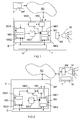
- the invention proposes a device D of the type of one that is illustrated on the Figures 1 and 2 .
- a device D can be either implanted in (or coupled to) a (communication) terminal T, as shown in FIG. figure 1 , either implanted in (or coupled to) a service server S ', as illustrated on the figure 2 .
- device D is responsible for obtaining the current context of the user of its only terminal T (so-called distributed solution), while in the case of the figure 2 , the device D is responsible for obtaining the current contexts of the users of many terminals T '(so-called centralized solution).
- a device D (whatever its location) comprises at least one analysis module MA responsible for intervening whenever it receives from a terminal T or T 'audio signals that have been received in its environment by an MI microphone that it understands (or to which it is coupled), then recorded, generally numerically, by a recording module ME which it also includes (or to which it is coupled).
- analysis module MA responsible for intervening whenever it receives from a terminal T or T 'audio signals that have been received in its environment by an MI microphone that it understands (or to which it is coupled), then recorded, generally numerically, by a recording module ME which it also includes (or to which it is coupled).
- the analysis module MA When the analysis module MA has captured audio signals, it compares them with audio signal sequences that have been previously recorded and associated with predefined basic contexts.
- the device D comprises first storage means MS1 in which it stores sequences of audio signals recorded in correspondence of sequence identifiers.
- first storage means MS1 can be of any type known to those skilled in the art. Therefore, it may for example be a memory (especially in the distributed case) or a database (especially in the centralized case).
- At least some of the recorded audio signal sequences may for example be provided by the operator of the communication network RC. But, as will be seen later, at least some of the recorded audio signal sequences can for example be defined from audio signals picked up by the microphone MI of a terminal T or T '.
- the recorded audio signal sequences that are used by the analysis module MA to perform a comparison are downloaded by the device D at the request of said analysis module MA as a function of the zoned identified RC communication network in which the terminal T or T 'is located (possibly momentarily).
- the identified area may be a cell or sector of the radio coverage area.
- the analysis module MA thus has predefined recorded sequences that accurately describe the typical sound environment of the area in which a terminal T or T 'is located.
- a recorded audio signal sequence is in a sense the audio signature that characterizes a basic context that describes at least part of a user's environment and / or situation.
- any type of environment is concerned here, and in particular the social environment (or relational environment) and the sound environment (that is to say relating to the intensity of the ambient noise), such as for example being alone, in a group, with your family, with your spouse, with your children or in the middle of a crowd, or the fact that there is noise or a lot of noise, or that there is not at all (or hardly any) noise.
- any type of situation is concerned here, and in particular the location (for example in a metro, an airplane, a bus or a car, or at the seaside or a lake or a watercourse , or in the countryside or in a forest), emotional state (eg quiet, laughing, silent, talking or screaming or crying) and activity (eg sitting, doing sports or walk).
- the device D may comprise second storage means MS2 in which it stores at least predefined elementary context definitions in correspondence of recorded audio signal sequence identifiers.
- the analysis module MA When the analysis module MA has finished a comparison by spectral analysis, it has information that represents the level of correspondence (or "matching") between the audio signals captured (objects of the comparison) and each of the audio signal sequences that he used. He can then retain the identifier of each sequence that he considers to correspond to audio signals captured given its level of correspondence.
- the analysis module MA determines the identifier of this sequence (for example in the first storage means MS1) and then the identifier of the elementary context which is associated with this sequence (for example in the second storage means MS2). It then delivers an elementary message which designates each elementary context associated with each determined sequence (which corresponds to the audio signals captured) as well as the user of the terminal T or T 'whose microphone MI has captured these audio signals.
- designate represents a basic context and a user for example by means of a basic context identifier and a user identifier (or terminal T or T ').
- Each basic message delivered by the analysis module MA can be used by a local or remote application (controlled by a remote server S), and in this case it is communicated to said application, possibly via the communication network RC, either used locally by the device D, for example at the request of a local or remote application (controlled by a remote server S).
- the device D comprises an identification module MD which is loaded, when it receives a basic message, delivered by the analysis module MA and designating at least two elementary contexts relating to the same user, to determine (For example, to deduce) a refined context that represents these elementary contexts designated from at least one predefined refined context model.
- defined context refers to a context that generally describes the environment and / or the situation of a user.
- model Any type of model known to those skilled in the art can be used by the identification module MD to determine a refined context, and in particular a type of model called "Bayesian network” or “decision tree” or “Ontology with rules of inference”.
- the identification module MD deduces from these two elementary contexts and from a model of refined contexts that the concerned user is in family. This context "in family” then constitutes a refined context.
- Each refined contexts model definition, useful for the identification module MD, can for example be stored in the second storage means MS2.
- the identification module MD Once the identification module MD has determined a context refined from the content of a basic message, it generates (and delivers on an output) a refined message that designates this refined context and the user concerned.
- designate is meant here the representation of a refined context and a user for example by means of a refined context identifier and a user identifier (or terminal T or T ')
- Each refined message delivered by the analysis module MA can be used by a local or remote application (controlled by a remote server S), and in this case it is communicated to said application, possibly via the communication network RC.
- Profiling consists of defining or supplementing or further refining a user profile based on traces of consumption (or use) of content or services. Contexts refined or elementary obtained at different times for the same user constitute such traces. Some profile data can be contextualized, for example to define a user's interest in a given context. This profiling can for example be performed by a profiling module MP which is part of a remote service server S or (in the example of the figure 2 ) of the service server S 'which contains the device D.
- a profiling module MP which is part of a remote service server S or (in the example of the figure 2 ) of the service server S 'which contains the device D.
- the analysis module MA of the device D may optionally be arranged to transform captured audio signals (which it receives from its terminal T or from a remote terminal T ') into a new recorded sequence of audio signals.
- the analysis module MA may comprise two submodules MA1 and MA2, one MA1 being dedicated to the determination of the elementary contexts described above, and the other MA2 being dedicated to the generation of new audio signal sequences. recorded.
- the second analysis sub-module MA2 can, for example, interact with a user via a GUI (Graphical User Interface) type GUI, in particular to record a new sequence at its request and then to initiate its backup in the first means. MS1, or to request the user to resume capturing audio signals using the microphone MI (and the recording module ME) of his terminal T or T ', when he considers that the quality of the audio signals previously captured is not enough.
- GUI Graphic User Interface
- this GUI GUI type GUI is preferably part of the terminal T or T 'used by a user to interact with the device D, and in particular to send him his instructions and commands.
- a user can define his own sequences, for example to define some of his usual environments and some of his usual personal situations. Thus, it may for example record sequences relating to his spouse, his children, his friends, his dog, his place of work, his place of vacation, and the like.
- the device D may optionally comprise a management module MG ensuring the interface with its first MS1 and second MS2 storage means, at least as regards the storage of sequences, sequence identifiers, context definitions elementary and sequence identifiers and associated context identifiers, and definitions of refined context models.
- a management module MG ensuring the interface with its first MS1 and second MS2 storage means, at least as regards the storage of sequences, sequence identifiers, context definitions elementary and sequence identifiers and associated context identifiers, and definitions of refined context models.
- the MG management module may for example comprise two submodules MG1 and MG2, one MG1 being dedicated to the interface with the operator of the communication network RC, and the other MG2 being dedicated to the interface with the user (s).
- the first management sub-module MG1 may for example be responsible for storing in the first storage means MS1 each new recorded sequence of audio signals, which is transmitted to its device D, via the communication network RC by the operator of this network RC, corresponding to a new sequence identifier. It may also be responsible for storing in the second storage means MS2 each new elementary context definition in correspondence of a new sequence identifier which has been associated with a new recorded audio signal sequence which is coming (or which is about to ) to be stored in the first storage means MS1. It may also be responsible for performing updates in the first MS1 and / or second MS2 storage means.
- the second management sub-module MG2 may, for example, be in charge of dialoguing with one or more users via the GUI IU GUI of its (their) terminal T (or T '), as well as with the second analysis sub-module MA2 of his device D.
- the invention can also be considered from the angle of a method for obtaining context (s) of user (s), which can be implemented in particular by means of a device. obtaining context (s) of user (s) D presented above.
- the functionalities offered by the implementation of the method according to the invention being identical to those offered by the device D as well as possibly the profiling module MP presented above, only the combination of main functionalities offered by the method is presented here. -after.
- the device for obtaining user context (s) D according to the invention can be realized in the form electronic circuits, software (or computer) modules, or a combination of circuits and software.
- many local or remote applications can have accurate information on the current global context of a user, which allows them to operate in an optimized manner.
- This allows, for example, to personalize a ringing tone, to direct a call to an electronic mail, to select content or services and then to transmit or offer them automatically, or to transmit advertisements (eg example related to the family when the user is family), depending on the current context of the user, or to transmit notifications during context changes (for example when silence is detected on can transmit information in text-to-speech (or text-to-speech) mode.
- the detected context is used to adapt the sending of information (for example, if we detect noise we prohibit the use of the ring and force the vibration mode).
- the invention is not limited to device (s) obtaining user context (s), communication terminal, service server and context obtaining method (s) embodiments.
- user (s) described above only by way of example, but it encompasses all the variants that may be considered by those skilled in the art within the scope of the claims below.
Landscapes
- Engineering & Computer Science (AREA)
- Health & Medical Sciences (AREA)
- Audiology, Speech & Language Pathology (AREA)
- Human Computer Interaction (AREA)
- Physics & Mathematics (AREA)
- Acoustics & Sound (AREA)
- Multimedia (AREA)
- Telephonic Communication Services (AREA)
- Stereophonic System (AREA)
- Telephone Function (AREA)
Applications Claiming Priority (1)
| Application Number | Priority Date | Filing Date | Title |
|---|---|---|---|
| FR0758821A FR2923319B1 (fr) | 2007-11-06 | 2007-11-06 | Dispositif et procede d'obtention de contextes d'utilisateurs de terminaux de communication, a partir de signaux audio captes dans leur environnement |
Publications (2)
| Publication Number | Publication Date |
|---|---|
| EP2058802A1 true EP2058802A1 (de) | 2009-05-13 |
| EP2058802B1 EP2058802B1 (de) | 2010-12-22 |
Family
ID=39381966
Family Applications (1)
| Application Number | Title | Priority Date | Filing Date |
|---|---|---|---|
| EP08167545A Active EP2058802B1 (de) | 2007-11-06 | 2008-10-24 | Vorrichtung und Verfahren zur Kontexterfassung von Nutzern von Kommunikationsendgeräten mit Hilfe von in ihrer Umgebung aufgefangenen Audiosignalen |
Country Status (4)
| Country | Link |
|---|---|
| EP (1) | EP2058802B1 (de) |
| AT (1) | ATE492877T1 (de) |
| DE (1) | DE602008004057D1 (de) |
| FR (1) | FR2923319B1 (de) |
Citations (4)
| Publication number | Priority date | Publication date | Assignee | Title |
|---|---|---|---|---|
| EP1076329A2 (de) * | 1999-08-10 | 2001-02-14 | International Business Machines Corporation | Verfahren zur Ermittlung von Persönlichkeitsmerkmalen unter Verwendung eines sprachbasierten Dialogs |
| EP1267590A2 (de) * | 2001-06-11 | 2002-12-18 | Pioneer Corporation | System und Verfahren zur Inhaltsdarstellung |
| US6721706B1 (en) * | 2000-10-30 | 2004-04-13 | Koninklijke Philips Electronics N.V. | Environment-responsive user interface/entertainment device that simulates personal interaction |
| EP1646037A2 (de) * | 2004-09-29 | 2006-04-12 | France Telecom | Verfahren und Vorrichtung für erhöhte Spracherkennungspräzision unter Verwendung geografischer Daten zur Filterung einer Wortgruppe |
-
2007
- 2007-11-06 FR FR0758821A patent/FR2923319B1/fr not_active Expired - Fee Related
-
2008
- 2008-10-24 DE DE602008004057T patent/DE602008004057D1/de active Active
- 2008-10-24 AT AT08167545T patent/ATE492877T1/de not_active IP Right Cessation
- 2008-10-24 EP EP08167545A patent/EP2058802B1/de active Active
Patent Citations (4)
| Publication number | Priority date | Publication date | Assignee | Title |
|---|---|---|---|---|
| EP1076329A2 (de) * | 1999-08-10 | 2001-02-14 | International Business Machines Corporation | Verfahren zur Ermittlung von Persönlichkeitsmerkmalen unter Verwendung eines sprachbasierten Dialogs |
| US6721706B1 (en) * | 2000-10-30 | 2004-04-13 | Koninklijke Philips Electronics N.V. | Environment-responsive user interface/entertainment device that simulates personal interaction |
| EP1267590A2 (de) * | 2001-06-11 | 2002-12-18 | Pioneer Corporation | System und Verfahren zur Inhaltsdarstellung |
| EP1646037A2 (de) * | 2004-09-29 | 2006-04-12 | France Telecom | Verfahren und Vorrichtung für erhöhte Spracherkennungspräzision unter Verwendung geografischer Daten zur Filterung einer Wortgruppe |
Also Published As
| Publication number | Publication date |
|---|---|
| FR2923319A1 (fr) | 2009-05-08 |
| FR2923319B1 (fr) | 2012-11-16 |
| DE602008004057D1 (de) | 2011-02-03 |
| ATE492877T1 (de) | 2011-01-15 |
| EP2058802B1 (de) | 2010-12-22 |
Similar Documents
| Publication | Publication Date | Title |
|---|---|---|
| EP1299874B1 (de) | Aktivierung eines interaktiven multimediasendgerätes | |
| EP2498520A1 (de) | Verfahren zum Erhalten von Videoinhalten aus Kameras und bezüglich eines Benutzers eines Kommunikationsgeräts, und entsprechende Vorrichtung | |
| US20050188399A1 (en) | Methods, systems, and storage mediums for providing multi-viewpoint media sharing of proximity-centric content | |
| US20110047237A1 (en) | Proximity based matchmaking using communications devices | |
| EP3395086B1 (de) | System zum vorschlagen, starten und automatischen oder halbautomatischen herunterladen von anwendungen für ein intelligentes mobiles objekt | |
| WO2015193422A1 (fr) | Procede et systeme de filtrage d'appels telephoniques entrants indesirables | |
| FR2729037A1 (fr) | Procede et appareil de selection d'attributs personnels comportant une gestion du retard | |
| FR2945176A1 (fr) | Methode de positionnement par signaux wi-fi | |
| EP2120411A1 (de) | Adaptation des Präsenzstatus von Instant-Messaging | |
| EP2168402B1 (de) | Dynamische verwendung mindestens eines multimedia-gerätes während eines kommunikationsaufbaus | |
| EP2058802B1 (de) | Vorrichtung und Verfahren zur Kontexterfassung von Nutzern von Kommunikationsendgeräten mit Hilfe von in ihrer Umgebung aufgefangenen Audiosignalen | |
| EP2039209A1 (de) | Verfahren, vorrichtung und system zur auswahl eines funkzugangsnetzwerks auf basis von umgebungsdaten sowie computerprogramm und entsprechendes datenmedium dafür | |
| FR3069991A1 (fr) | Procede de creation et de participation a une conference audio ou video | |
| FR3079951A1 (fr) | Procede d'expertise a distance | |
| WO2007134811A1 (fr) | Procede de determination d'associations entre des informations de priorite et des categories d'appel de groupe d'un service d'appel de groupe deploye sur un reseau de telephonie mobile | |
| WO2023099318A1 (fr) | Procede d'obtention d'une valeur d'une variable representative d'un deplacement d'un terminal mobile, dispositif et programme d'ordinateur correspondant | |
| WO2011124810A1 (fr) | Gestion de service personnalisee dans un reseau ip | |
| WO2017212124A1 (fr) | Système et procédé de communication vocale de type push-to-talk entre plusieurs utilisateurs d'un réseau de télécommunications | |
| FR3055764A1 (fr) | Procede de controle de la detection en temps reel d'une scene par un appareil de communication sans fil, par exemple un telephone mobile cellulaire, et appareil correspondant. | |
| WO2020212255A1 (fr) | Aide au positionnement d'un terminal mobile | |
| EP4375899A1 (de) | Verfahren und vorrichtung zur empfehlung von aktivitäten an mindestens einen benutzer | |
| EP2645311A1 (de) | Verfahren und System zur Benachrichtung eines Endgerätbenutzers von Kontextdaten, die im Zusammenhang mit identifizierten Elementen einer Anwendung vom Typ Adressbuch/Verzeichnis stehen | |
| EP2434726B1 (de) | Endgerät und verfahren zum sammeln von nicht deklarative informationen durch ein telekommunikations-endgerät implementiert | |
| WO2014154976A1 (fr) | Acces a un sous-ensemble d'informations relatives a un utilisateur | |
| FR3135156A1 (fr) | Procédé et dispositif de détection d’un type de localisation d’un dispositif. |
Legal Events
| Date | Code | Title | Description |
|---|---|---|---|
| PUAI | Public reference made under article 153(3) epc to a published international application that has entered the european phase |
Free format text: ORIGINAL CODE: 0009012 |
|
| AK | Designated contracting states |
Kind code of ref document: A1 Designated state(s): AT BE BG CH CY CZ DE DK EE ES FI FR GB GR HR HU IE IS IT LI LT LU LV MC MT NL NO PL PT RO SE SI SK TR |
|
| AX | Request for extension of the european patent |
Extension state: AL BA MK RS |
|
| 17P | Request for examination filed |
Effective date: 20091113 |
|
| 17Q | First examination report despatched |
Effective date: 20091208 |
|
| AKX | Designation fees paid |
Designated state(s): AT BE BG CH CY CZ DE DK EE ES FI FR GB GR HR HU IE IS IT LI LT LU LV MC MT NL NO PL PT RO SE SI SK TR |
|
| GRAP | Despatch of communication of intention to grant a patent |
Free format text: ORIGINAL CODE: EPIDOSNIGR1 |
|
| GRAS | Grant fee paid |
Free format text: ORIGINAL CODE: EPIDOSNIGR3 |
|
| GRAA | (expected) grant |
Free format text: ORIGINAL CODE: 0009210 |
|
| AK | Designated contracting states |
Kind code of ref document: B1 Designated state(s): AT BE BG CH CY CZ DE DK EE ES FI FR GB GR HR HU IE IS IT LI LT LU LV MC MT NL NO PL PT RO SE SI SK TR |
|
| REG | Reference to a national code |
Ref country code: GB Ref legal event code: FG4D Free format text: NOT ENGLISH |
|
| REG | Reference to a national code |
Ref country code: CH Ref legal event code: EP |
|
| REG | Reference to a national code |
Ref country code: IE Ref legal event code: FG4D |
|
| REF | Corresponds to: |
Ref document number: 602008004057 Country of ref document: DE Date of ref document: 20110203 Kind code of ref document: P |
|
| REG | Reference to a national code |
Ref country code: DE Ref legal event code: R096 Ref document number: 602008004057 Country of ref document: DE Effective date: 20110203 |
|
| REG | Reference to a national code |
Ref country code: NL Ref legal event code: VDEP Effective date: 20101222 |
|
| PG25 | Lapsed in a contracting state [announced via postgrant information from national office to epo] |
Ref country code: LT Free format text: LAPSE BECAUSE OF FAILURE TO SUBMIT A TRANSLATION OF THE DESCRIPTION OR TO PAY THE FEE WITHIN THE PRESCRIBED TIME-LIMIT Effective date: 20101222 |
|
| LTIE | Lt: invalidation of european patent or patent extension |
Effective date: 20101222 |
|
| PG25 | Lapsed in a contracting state [announced via postgrant information from national office to epo] |
Ref country code: LV Free format text: LAPSE BECAUSE OF FAILURE TO SUBMIT A TRANSLATION OF THE DESCRIPTION OR TO PAY THE FEE WITHIN THE PRESCRIBED TIME-LIMIT Effective date: 20101222 Ref country code: AT Free format text: LAPSE BECAUSE OF FAILURE TO SUBMIT A TRANSLATION OF THE DESCRIPTION OR TO PAY THE FEE WITHIN THE PRESCRIBED TIME-LIMIT Effective date: 20101222 Ref country code: FI Free format text: LAPSE BECAUSE OF FAILURE TO SUBMIT A TRANSLATION OF THE DESCRIPTION OR TO PAY THE FEE WITHIN THE PRESCRIBED TIME-LIMIT Effective date: 20101222 Ref country code: SE Free format text: LAPSE BECAUSE OF FAILURE TO SUBMIT A TRANSLATION OF THE DESCRIPTION OR TO PAY THE FEE WITHIN THE PRESCRIBED TIME-LIMIT Effective date: 20101222 Ref country code: CY Free format text: LAPSE BECAUSE OF FAILURE TO SUBMIT A TRANSLATION OF THE DESCRIPTION OR TO PAY THE FEE WITHIN THE PRESCRIBED TIME-LIMIT Effective date: 20101222 Ref country code: HR Free format text: LAPSE BECAUSE OF FAILURE TO SUBMIT A TRANSLATION OF THE DESCRIPTION OR TO PAY THE FEE WITHIN THE PRESCRIBED TIME-LIMIT Effective date: 20101222 Ref country code: BG Free format text: LAPSE BECAUSE OF FAILURE TO SUBMIT A TRANSLATION OF THE DESCRIPTION OR TO PAY THE FEE WITHIN THE PRESCRIBED TIME-LIMIT Effective date: 20110322 Ref country code: SI Free format text: LAPSE BECAUSE OF FAILURE TO SUBMIT A TRANSLATION OF THE DESCRIPTION OR TO PAY THE FEE WITHIN THE PRESCRIBED TIME-LIMIT Effective date: 20101222 |
|
| REG | Reference to a national code |
Ref country code: IE Ref legal event code: FD4D |
|
| PG25 | Lapsed in a contracting state [announced via postgrant information from national office to epo] |
Ref country code: GR Free format text: LAPSE BECAUSE OF FAILURE TO SUBMIT A TRANSLATION OF THE DESCRIPTION OR TO PAY THE FEE WITHIN THE PRESCRIBED TIME-LIMIT Effective date: 20110323 Ref country code: PT Free format text: LAPSE BECAUSE OF FAILURE TO SUBMIT A TRANSLATION OF THE DESCRIPTION OR TO PAY THE FEE WITHIN THE PRESCRIBED TIME-LIMIT Effective date: 20110422 Ref country code: CZ Free format text: LAPSE BECAUSE OF FAILURE TO SUBMIT A TRANSLATION OF THE DESCRIPTION OR TO PAY THE FEE WITHIN THE PRESCRIBED TIME-LIMIT Effective date: 20101222 Ref country code: EE Free format text: LAPSE BECAUSE OF FAILURE TO SUBMIT A TRANSLATION OF THE DESCRIPTION OR TO PAY THE FEE WITHIN THE PRESCRIBED TIME-LIMIT Effective date: 20101222 Ref country code: NO Free format text: LAPSE BECAUSE OF FAILURE TO SUBMIT A TRANSLATION OF THE DESCRIPTION OR TO PAY THE FEE WITHIN THE PRESCRIBED TIME-LIMIT Effective date: 20110322 Ref country code: IS Free format text: LAPSE BECAUSE OF FAILURE TO SUBMIT A TRANSLATION OF THE DESCRIPTION OR TO PAY THE FEE WITHIN THE PRESCRIBED TIME-LIMIT Effective date: 20110422 Ref country code: ES Free format text: LAPSE BECAUSE OF FAILURE TO SUBMIT A TRANSLATION OF THE DESCRIPTION OR TO PAY THE FEE WITHIN THE PRESCRIBED TIME-LIMIT Effective date: 20110402 |
|
| PG25 | Lapsed in a contracting state [announced via postgrant information from national office to epo] |
Ref country code: PL Free format text: LAPSE BECAUSE OF FAILURE TO SUBMIT A TRANSLATION OF THE DESCRIPTION OR TO PAY THE FEE WITHIN THE PRESCRIBED TIME-LIMIT Effective date: 20101222 Ref country code: SK Free format text: LAPSE BECAUSE OF FAILURE TO SUBMIT A TRANSLATION OF THE DESCRIPTION OR TO PAY THE FEE WITHIN THE PRESCRIBED TIME-LIMIT Effective date: 20101222 Ref country code: NL Free format text: LAPSE BECAUSE OF FAILURE TO SUBMIT A TRANSLATION OF THE DESCRIPTION OR TO PAY THE FEE WITHIN THE PRESCRIBED TIME-LIMIT Effective date: 20101222 Ref country code: RO Free format text: LAPSE BECAUSE OF FAILURE TO SUBMIT A TRANSLATION OF THE DESCRIPTION OR TO PAY THE FEE WITHIN THE PRESCRIBED TIME-LIMIT Effective date: 20101222 |
|
| PLBE | No opposition filed within time limit |
Free format text: ORIGINAL CODE: 0009261 |
|
| STAA | Information on the status of an ep patent application or granted ep patent |
Free format text: STATUS: NO OPPOSITION FILED WITHIN TIME LIMIT |
|
| PG25 | Lapsed in a contracting state [announced via postgrant information from national office to epo] |
Ref country code: IE Free format text: LAPSE BECAUSE OF FAILURE TO SUBMIT A TRANSLATION OF THE DESCRIPTION OR TO PAY THE FEE WITHIN THE PRESCRIBED TIME-LIMIT Effective date: 20101222 Ref country code: DK Free format text: LAPSE BECAUSE OF FAILURE TO SUBMIT A TRANSLATION OF THE DESCRIPTION OR TO PAY THE FEE WITHIN THE PRESCRIBED TIME-LIMIT Effective date: 20101222 |
|
| 26N | No opposition filed |
Effective date: 20110923 |
|
| PG25 | Lapsed in a contracting state [announced via postgrant information from national office to epo] |
Ref country code: IT Free format text: LAPSE BECAUSE OF FAILURE TO SUBMIT A TRANSLATION OF THE DESCRIPTION OR TO PAY THE FEE WITHIN THE PRESCRIBED TIME-LIMIT Effective date: 20101222 |
|
| REG | Reference to a national code |
Ref country code: DE Ref legal event code: R097 Ref document number: 602008004057 Country of ref document: DE Effective date: 20110923 |
|
| REG | Reference to a national code |
Ref country code: CH Ref legal event code: PCOW Free format text: ALCATEL LUCENT;3, AVENUE OCTAVE GREARD;75007 PARIS (FR) |
|
| BERE | Be: lapsed |
Owner name: ALCATEL LUCENT Effective date: 20111031 |
|
| PG25 | Lapsed in a contracting state [announced via postgrant information from national office to epo] |
Ref country code: MC Free format text: LAPSE BECAUSE OF NON-PAYMENT OF DUE FEES Effective date: 20111031 |
|
| PG25 | Lapsed in a contracting state [announced via postgrant information from national office to epo] |
Ref country code: BE Free format text: LAPSE BECAUSE OF NON-PAYMENT OF DUE FEES Effective date: 20111031 |
|
| PG25 | Lapsed in a contracting state [announced via postgrant information from national office to epo] |
Ref country code: MT Free format text: LAPSE BECAUSE OF FAILURE TO SUBMIT A TRANSLATION OF THE DESCRIPTION OR TO PAY THE FEE WITHIN THE PRESCRIBED TIME-LIMIT Effective date: 20101222 |
|
| PG25 | Lapsed in a contracting state [announced via postgrant information from national office to epo] |
Ref country code: LU Free format text: LAPSE BECAUSE OF NON-PAYMENT OF DUE FEES Effective date: 20111024 |
|
| REG | Reference to a national code |
Ref country code: CH Ref legal event code: PL |
|
| PG25 | Lapsed in a contracting state [announced via postgrant information from national office to epo] |
Ref country code: CH Free format text: LAPSE BECAUSE OF NON-PAYMENT OF DUE FEES Effective date: 20121031 Ref country code: LI Free format text: LAPSE BECAUSE OF NON-PAYMENT OF DUE FEES Effective date: 20121031 |
|
| PG25 | Lapsed in a contracting state [announced via postgrant information from national office to epo] |
Ref country code: TR Free format text: LAPSE BECAUSE OF FAILURE TO SUBMIT A TRANSLATION OF THE DESCRIPTION OR TO PAY THE FEE WITHIN THE PRESCRIBED TIME-LIMIT Effective date: 20101222 |
|
| PG25 | Lapsed in a contracting state [announced via postgrant information from national office to epo] |
Ref country code: HU Free format text: LAPSE BECAUSE OF FAILURE TO SUBMIT A TRANSLATION OF THE DESCRIPTION OR TO PAY THE FEE WITHIN THE PRESCRIBED TIME-LIMIT Effective date: 20101222 |
|
| REG | Reference to a national code |
Ref country code: FR Ref legal event code: GC Effective date: 20131018 |
|
| REG | Reference to a national code |
Ref country code: FR Ref legal event code: RG Effective date: 20141016 |
|
| REG | Reference to a national code |
Ref country code: FR Ref legal event code: CA Effective date: 20150521 |
|
| REG | Reference to a national code |
Ref country code: FR Ref legal event code: CA Effective date: 20150521 |
|
| REG | Reference to a national code |
Ref country code: FR Ref legal event code: PLFP Year of fee payment: 8 |
|
| REG | Reference to a national code |
Ref country code: FR Ref legal event code: PLFP Year of fee payment: 9 |
|
| REG | Reference to a national code |
Ref country code: FR Ref legal event code: PLFP Year of fee payment: 10 |
|
| REG | Reference to a national code |
Ref country code: FR Ref legal event code: PLFP Year of fee payment: 11 |
|
| PGFP | Annual fee paid to national office [announced via postgrant information from national office to epo] |
Ref country code: GB Payment date: 20250904 Year of fee payment: 18 |
|
| PGFP | Annual fee paid to national office [announced via postgrant information from national office to epo] |
Ref country code: FR Payment date: 20250908 Year of fee payment: 18 |
|
| PGFP | Annual fee paid to national office [announced via postgrant information from national office to epo] |
Ref country code: DE Payment date: 20250902 Year of fee payment: 18 |