EP2058828A1 - Elektrischer doppelschichtkondensator - Google Patents
Elektrischer doppelschichtkondensator Download PDFInfo
- Publication number
- EP2058828A1 EP2058828A1 EP07806797A EP07806797A EP2058828A1 EP 2058828 A1 EP2058828 A1 EP 2058828A1 EP 07806797 A EP07806797 A EP 07806797A EP 07806797 A EP07806797 A EP 07806797A EP 2058828 A1 EP2058828 A1 EP 2058828A1
- Authority
- EP
- European Patent Office
- Prior art keywords
- activated carbon
- discharge
- electric double
- double layer
- layer capacitor
- Prior art date
- Legal status (The legal status is an assumption and is not a legal conclusion. Google has not performed a legal analysis and makes no representation as to the accuracy of the status listed.)
- Granted
Links
Images

Classifications
-
- H—ELECTRICITY
- H01—ELECTRIC ELEMENTS
- H01G—CAPACITORS; CAPACITORS, RECTIFIERS, DETECTORS, SWITCHING DEVICES, LIGHT-SENSITIVE OR TEMPERATURE-SENSITIVE DEVICES OF THE ELECTROLYTIC TYPE
- H01G11/00—Hybrid capacitors, i.e. capacitors having different positive and negative electrodes; Electric double-layer [EDL] capacitors; Processes for the manufacture thereof or of parts thereof
- H01G11/22—Electrodes
- H01G11/24—Electrodes characterised by structural features of the materials making up or comprised in the electrodes, e.g. form, surface area or porosity; characterised by the structural features of powders or particles used therefor
-
- H—ELECTRICITY
- H01—ELECTRIC ELEMENTS
- H01G—CAPACITORS; CAPACITORS, RECTIFIERS, DETECTORS, SWITCHING DEVICES, LIGHT-SENSITIVE OR TEMPERATURE-SENSITIVE DEVICES OF THE ELECTROLYTIC TYPE
- H01G11/00—Hybrid capacitors, i.e. capacitors having different positive and negative electrodes; Electric double-layer [EDL] capacitors; Processes for the manufacture thereof or of parts thereof
- H01G11/22—Electrodes
- H01G11/30—Electrodes characterised by their material
- H01G11/32—Carbon-based
-
- H—ELECTRICITY
- H01—ELECTRIC ELEMENTS
- H01G—CAPACITORS; CAPACITORS, RECTIFIERS, DETECTORS, SWITCHING DEVICES, LIGHT-SENSITIVE OR TEMPERATURE-SENSITIVE DEVICES OF THE ELECTROLYTIC TYPE
- H01G11/00—Hybrid capacitors, i.e. capacitors having different positive and negative electrodes; Electric double-layer [EDL] capacitors; Processes for the manufacture thereof or of parts thereof
- H01G11/22—Electrodes
- H01G11/30—Electrodes characterised by their material
- H01G11/32—Carbon-based
- H01G11/42—Powders or particles, e.g. composition thereof
-
- H—ELECTRICITY
- H01—ELECTRIC ELEMENTS
- H01G—CAPACITORS; CAPACITORS, RECTIFIERS, DETECTORS, SWITCHING DEVICES, LIGHT-SENSITIVE OR TEMPERATURE-SENSITIVE DEVICES OF THE ELECTROLYTIC TYPE
- H01G11/00—Hybrid capacitors, i.e. capacitors having different positive and negative electrodes; Electric double-layer [EDL] capacitors; Processes for the manufacture thereof or of parts thereof
- H01G11/54—Electrolytes
- H01G11/58—Liquid electrolytes
- H01G11/60—Liquid electrolytes characterised by the solvent
-
- Y—GENERAL TAGGING OF NEW TECHNOLOGICAL DEVELOPMENTS; GENERAL TAGGING OF CROSS-SECTIONAL TECHNOLOGIES SPANNING OVER SEVERAL SECTIONS OF THE IPC; TECHNICAL SUBJECTS COVERED BY FORMER USPC CROSS-REFERENCE ART COLLECTIONS [XRACs] AND DIGESTS
- Y02—TECHNOLOGIES OR APPLICATIONS FOR MITIGATION OR ADAPTATION AGAINST CLIMATE CHANGE
- Y02E—REDUCTION OF GREENHOUSE GAS [GHG] EMISSIONS, RELATED TO ENERGY GENERATION, TRANSMISSION OR DISTRIBUTION
- Y02E60/00—Enabling technologies; Technologies with a potential or indirect contribution to GHG emissions mitigation
- Y02E60/13—Energy storage using capacitors
-
- Y—GENERAL TAGGING OF NEW TECHNOLOGICAL DEVELOPMENTS; GENERAL TAGGING OF CROSS-SECTIONAL TECHNOLOGIES SPANNING OVER SEVERAL SECTIONS OF THE IPC; TECHNICAL SUBJECTS COVERED BY FORMER USPC CROSS-REFERENCE ART COLLECTIONS [XRACs] AND DIGESTS
- Y02—TECHNOLOGIES OR APPLICATIONS FOR MITIGATION OR ADAPTATION AGAINST CLIMATE CHANGE
- Y02T—CLIMATE CHANGE MITIGATION TECHNOLOGIES RELATED TO TRANSPORTATION
- Y02T10/00—Road transport of goods or passengers
- Y02T10/60—Other road transportation technologies with climate change mitigation effect
- Y02T10/70—Energy storage systems for electromobility, e.g. batteries
Definitions
- the present invention relates to an electric double layer capacitor.
- An electric double layer capacitor comprises a pair of polarizable electrode layers as an anode and cathode disposed opposite each other with a separator interposed therebetween.
- Each polarizable electrode layer is impregnated with an aqueous or non-aqueous electrolytic solution, and is united with a current collector.
- the aqueous type electrolytic solution capacitance density can be increased to reduce resistance, but the operating voltage must be set lower than the voltage at which the electrolysis of water takes place; therefore, from the standpoint of increasing the energy density, the non-aqueous type is preferred for use.
- electric double layer capacitors have been used primarily for such applications as memory backup and energy storage, but in recent years, electric double layer capacitors have been gaining attention for applications that require large current discharge, such as uninterruptible power supplies, and applications that require discharging under low temperature conditions, such as engine starters for hybrid electric vehicles, etc.
- the capacitance density of the capacitor is an important factor, and to increase the capacitance density, activated carbon containing predominantly micropores of pore diameter smaller than 20 angstroms and thus providing a large specific surface area is used for polarizable electrode layers.
- the capacitor In memory backup and energy storage applications, the capacitor is discharged at a relatively small current over time, but if polarizable electrode layers formed from predominantly microporous activated carbon, such as described above, are used in applications where the capacitor is discharged at a large current in a short time, the discharge efficiency decreases. This is because the time constant RC given by the product of internal resistance R and capacitance C is large, reducing the discharge efficiency which is given by the equation: (1-2RC) [time constant) / t [discharge time].
- a method is known that aims to improve the performance by reducing the ratio of the specific surface area of the micropores in the activated carbon used for the polarizable electrode layers or by increasing the specific surface area or pore volume of mesopores so that the capacitor can be used in large current, quick discharge applications (Japanese Unexamined Patent Publications Nos. 2000-340470 , H08-119614 , 2001-316103 , and 2001-89119 ). According to this method, the mobility of electrolyte ions within the pores of the activated carbon increases, serving to suppress the performance drop and the discharge efficiency drop that occur when the capacitor is used at a current of 10 mA/cm 2 or larger.
- Japanese Unexamined Patent Publication No. H01-227417 Japanese Unexamined Patent Publication No. H01-227417
- the mixing ratio of the activated carbon is adjusted, and the electrodes are produced by drawing, but with this method, since the porosity is increased by increasing the interstices between the particles, the capacitance density significantly drops.
- Japanese Unexamined Patent Publication No. H01-227417 there is no mention of the capacitance density, and attention is focused only on the amount of volume change after a high-temperature load test.
- Various kinds of materials are used as materials for activated carbon for capacitors; among others, natural (plant-derived) materials (such as coconut shells, wood, etc.) are used, because such materials are inexpensive and already contain numerous fine pores inherent in the materials before activation, and it is therefore easy to reduce the resistance.
- natural (plant-derived) materials such as coconut shells, wood, etc.
- the fabrication of the polarizable electrode layers using such natural activated carbon has involved the problem that the material is difficult to mold because of such problems as the crushing of particles during molding and the sliding characteristics of the particles. That is, cracks can easily occur in the polarizable electrode layers, the reduction in film thickness by rolling is small, and so forth.
- an increased amount of solvent has had to be added when kneading the material. The solvent is removed by drying after molding the polarizable electrode layers, but it is difficult to completely remove the solvent, and if the solvent remains in the pores of the activated carbon, the durability of the capacitor decreases.
- nitrile-based organic solvent such as an acetonitrile solvent
- An electric double layer capacitor comprises a polarizable electrode layer containing an activated carbon, a conductive agent, and a binder, wherein the external specific surface area of the activated carbon, per unit volume of the polarizable electrode layer, lies within a range of 450 to 800 m 2 /cm 3 , and the volume based on the inter-particle interstices per unit volume of the polarizable electrode layer lies within a range of 0.05 to 0.12 cm 3 /cm 3 .
- the external specific surface area of the activated carbon is defined as the "specific surface area calculated from a nitrogen absorption isotherm by a t-plot method by excluding micropores of pore diameter smaller than 20 angstroms.”
- the polarizable electrode layer is defined in this specification as the "layer containing an activated carbon, a conductive agent, and a binder (which may include an additive such as a sliding agent).” That is, the polarizable electrode layer does not include a current collector nor an adhesive layer used for bonding the current collector to the polarizable electrode layer.
- the pores of the activated carbon are classified, in accordance with the IUPAC classification, as micropores whose pore diameter is smaller than 20 angstroms, mesopores whose pore diameter lies in the range of 20 to 500 angstroms, and macropores whose pore diameter is larger than 500 angstroms.
- Figure 1 is a conceptual diagram showing these pores.
- the external specific surface area according to the present invention refers to the internal surface area of the mesopores and macropores plus the external surface area of the activated carbon.
- the present invention aims to provide an electric double layer capacitor suited to large current applications and/or low temperature applications by focusing attention not only on the surface area characteristics of the activated carbon itself but also on the inter-particle interstices of the polarizable electrode layer.
- electric double layer capacitors for large current applications have been known in which the specific surface area of the mesopores is increased by focusing attention on the mobility of electrolyte ions within the pores of the activated carbon (Japanese Unexamined Patent Publications Nos. 2000-340470 , H08-119614 , 2001-316103 , and 2001-89119 ).
- Figure 2 is a diagram schematically showing how the capacitance of an electric double layer capacitor changes as the discharge current increases or the discharge temperature decreases.
- the capacitance is the highest when discharging at a small current or at normal temperature, but the capacitance rapidly decreases as the discharge current increases or the discharge temperature decreases.
- a capacitor that uses activated carbon prepared by increasing the specific surface area of the mesopores with a pore diameter of 20 to 500 angstroms, as disclosed in Japanese Unexamined Patent Publications Nos.
- the capacitance when discharging at a small current or at normal temperature is lower than that of the predominantly microporous activated carbon, but the decrease of the capacitance with increasing discharge current or decreasing discharge temperature is relatively mild.
- the capacitance when discharging at a small current or at normal temperature is lower than the above two capacitors, but the decrease of the capacitance with increasing discharge current or decreasing discharge temperature is much milder; in particular, in applications requiring a large current discharge at 100 mA/cm 2 or larger or in a low-temperature environment such as -20°C or lower, the electric double layer capacitor of the invention achieves a higher capacitance than the above two capacitors.
- Activated carbon having an external specific surface area of 1000 to 2000 m 2 /g, preferably 1200 to 1800 m 2 /g, and more preferably 1400 to 1550 m 2 /g, is used in the present invention. If the external specific surface area is smaller than 1000 m 2 /g, the resistance of the polarizable electrode layer and the time constant cannot be reduced sufficiently, and the performance tends to drop when discharging at a large current or in a low-temperature environment.
- the external specific surface area is usually measured by nitrogen absorption, the same method as used for the measurement of the specific surface area and pore distribution of the activated carbon, and is calculated from a nitrogen absorption isotherm by a t-plot method by excluding the micropores of pore diameter smaller than 20 angstroms.
- t-plot method For details of the analysis by the t-plot method, refer to a relevant document (for example, Shimadzu Review, Vol. 48, No. 1, p.
- a t-plot is a plot of the total quantity of adsorbed gas (g/cm 3 : standard condition) versus the thickness t (nm) of the adsorbed gas layer.
- the t-plot will show a linear region that has a positive intercept on the vertical axis; therefore, the external specific surface area (S ext ) was calculated from the slope ⁇ of the linear region between 0.35 to 0.5 nm.
- S ext ⁇ ⁇ 1000 ⁇ 0.001547 density conversion coefficient when nitrogen is used
- the external specific surface area per unit volume of the polarizable electrode layer is obtained by multiplying the above external specific surface area by the electrode density, then by the mass ratio of the activated carbon in the polarizable electrode layer.
- External specific surface area per unit volume of polarizable electrode layer m 2 / cm 3 External specific surface area of activated carbon m 2 / g ⁇ Electrode density g / cm 3 ⁇ Mass ratio of activated carbon in polarizable electrode layer no unit : unity when the material is all activated carbon
- the external specific surface area per unit volume of the polarizable electrode layer is preferably 450 to 800 m 2 /cm 3 , and more preferably 560 to 680 m 2 /cm 3 .
- the external specific surface area per unit volume of the polarizable electrode layer is within the above range, the decrease of the capacitance when discharging at a large current or in a low-temperature environment can be suppressed.
- the external specific surface area per unit volume of the polarizable electrode layer is smaller than 450 m 2 /cm 3 , the performance tends to drop in quick charging/discharging or in low-temperature regions. Conversely, if it is larger than 800 m 2 /cm 3 , the capacitance density greatly decreases as the electrode density decreases.
- the electrode density is a value that includes neither the current collector nor the adhesive layer, and the measurement can be made directly on the polarizable electrode layer sheet (hereinafter called the "electrode sheet") fabricated by a sheet forming method. After the electrode sheet cut to a prescribed size is dried for approximately one hour at 150°C, the electrode density is calculated by measuring the mass and the area and thickness of the electrode sheet. In the case of a polarizable electrode layer formed integrally with the current collector by a coating method or the like, the electrode density is calculated by first measuring the total density including the current collector and then subtracting the density of the current collector from the total density.
- the present invention is characterized in that the surface area characteristics of the activated carbon itself and the volume based on the inter-particle interstices of the polarizable electrode layer are balanced relative to each other in order to further optimize the mobility of electrolyte ions throughout the polarizable electrode layer for large current applications and/or low temperature applications, that is, the external specific surface area per unit volume of the polarizable electrode layer lies within the above-defined range while, at the same time, the volume based on the inter-particle interstices per unit volume of the polarizable electrode layer lies within a range of 0.05 to 0.12 cm 3 /cm 3 , and preferably within a range of 0.07 to 0.11 cm 3 /cm 3 .
- the volume based on the inter-particle interstices per unit volume of the polarizable electrode layer is smaller than 0.05 cm 3 /cm 3 , the performance tends to drop in quick charging/discharging or in low-temperature regions. Conversely, if it is larger than 0.12 cm 3 /cm 3 , the capacitance density greatly decreases as the electrode density decreases.
- the volume based on the inter-particle interstices per unit volume of the polarizable electrode layer can be calculated from the following data in the manner described below.
- the value of (3) is obtained from the nitrogen absorption isotherm at 77K by the BJH method.
- the value of (4) is measured by mercury porosimetry. Prior to the measurement, the sample is vacuum-dried at 150°C for 24 hours, and the distribution of pores in the range of 0.0018 to 100 ⁇ m is measured using a Micromeritics Autopore III 9420, to obtain the cumulative pore volume.
- activated carbon whose relative particle quantity by volume in the mode diameter of the particle size distribution lies within a range of 10 to 30%.
- the inter-particle interstices increase compared with the prior art activated carbon in which the electrode density is increased by broadening the particle size distribution of the activated carbon and filling the interstices of the large size activated carbon particles with smaller size activated carbon particles (Japanese Unexamined Patent Publication Nos. 2005-317642 , 2003-347172 , and 2000-344507 ).
- the relative particle quantity by volume in the mode diameter of the particle size distribution of the activated carbon is preferably within a range of 13 to 25%, and more preferably within a range of 15 to 20%.
- the particles contained in the range of ⁇ 30% of the mode diameter are 30 to 60% in terms of the relative particle quantity by volume.
- the uniformity of the inter-particle interstices further increases. If the relative particle quantity lying in the range of ⁇ 30% of the mode diameter is smaller than 30%, the inter-particle interstices decrease, and the performance tends to drop when discharging at a large current as well as in a low-temperature environment; besides, when fabricating the polarizable electrode layer using a natural activated carbon material, the moldability worsens, and the required amount of molding agent increases.
- the relative particle quantity lying in the range of ⁇ 30% of the mode diameter exceeds 60%, the inter-particle interstices increase excessively, and the capacitance density decreases markedly; in the first place, such a particle size distribution is, in itself, difficult to achieve, and it can also lead to an increase in manufacturing cost.
- the relative particle quantity lying in the range of ⁇ 30% of the mode diameter is preferably 40 to 55%.
- the activated carbon (in an amount equivalent to one small dispensing spoon) is dispersed in 5 mL of a 0.4% solution of Triton, and the solution is charged into a sampler filled with ion exchanged water; then, the measurement is made by a Shimadzu SALD-2000 under the following conditions, that is, refractive index: 1.70 to 0.20i, dispersion time: 1 minute, cell: flowcell, and medium: ion exchanged water.
- the frequency and the cumulative data of the relative particle quantity (q3) can be used as data, and the measured data can be loaded using a Windows (registered trademark) personal computer software "EXCEL" (registered trademark) to construct a graph by joining the measured points with smoothed lines. After enlarging the graph, the mode diameter is visually read from the frequency graph. Further, the particle quantity at the particle sizes corresponding to the range of ⁇ 30% of the mode diameter is read from the cumulative graph, and the difference is calculated to obtain the particle quantity lying in the range of ⁇ 30% of the mode diameter.
- Windows registered trademark
- EXCEL registered trademark
- the activated carbon various materials can be used, including plant-derived wood, coconut shells, pulp spent liquor, fossil fuels such as coal or petroleum heavy oil, coal or petroleum-based pitch or coke obtained by thermally cracking such fossil fuels, synthetic resins such as phenol resin, furan resin, polyvinyl chloride resin, polyvinylvinylidene chloride resin, etc.
- plant-derived materials such as wood and coconut shells
- these materials already contain numerous capillaries or fine pores before activation. Since such natural materials contain open-ended pores in the form of capillaries before activation, it is believed that the electrolyte ions can move smoother than in closed-end pores that would be formed by activation.
- activated carbon made of natural material is generally intractable and has problems such as cracking of polarizable electrode layers, poor rollability, etc.
- the sliding characteristics of the particles improve, which serves to improve the moldability of the polarizable electrode layers. It also becomes possible to reduce the amount of the molding agent used for improving the moldability, and as a result, the amount of the solvent remaining after drying can be reduced, alleviating the degradation of durability.
- Activated carbon can be produced using various activation methods such as gas activation and chemical activation.
- gases that can be used for gas activation include water vapor, carbon dioxide, oxygen, chlorine, sulfur dioxide, sulfur stream, etc.
- chemicals that can be used for chemical activation include zinc chloride, potassium hydroxide, sodium hydroxide, potassium carbonate, sodium carbonate, phosphoric acid, calcium chloride, potassium sulfide, etc.
- Activated carbon can be milled by either a dry or wet method, and various milling methods can be used, such as ball milling, turbo milling, jet milling, impact milling, and hammer milling. If the desired particle size distribution cannot be achieved by milling alone, the particle size may be adjusted by sieving and classifying the particles. Classification can be performed by either a dry or wet method, and various methods can be used, such as a vibration method, an ultrasonic method, a centrifugal method, and a sedimentation method.
- the polarizable electrode layer according to the present invention generally contains a conductive agent for conferring electrical conductivity to the activated carbon.
- a conductive agent for conferring electrical conductivity to the activated carbon.
- Carbon black such as Ketjen black or acetylene black, vapor growth carbon fiber, nanocarbon such as fullerene, carbon nanotube, or carbon nanohorn, or powdered or granular graphite or the like can be used as the conductive agent.
- the conductive agent is carbon black and is added in an amount not greater than 5% by mass, with respect to the total mass of the polarizable electrode layer including the conductive agent, activated carbon, binder, and other constituent materials.
- the total mass of the polarizable electrode layer is the dry mass measured after removing the molding agent used when molding the polarizable electrode layer.
- the conductive agent is used to reduce the contact resistance between the activated carbon particles; in the prior art polarizable electrode layer, the conductive agent was usually added in an amount greater than 5% by mass. However, when the amount of the conductive agent is thus increased, the moldability of the polarizable electrode layer worsens, causing problems such as cracking, poor rollability, etc.
- the conductive agent since its particle size is smaller than that of the activated carbon, if the conductive agent is not dispersed uniformly, there arises the problem that its particles fill the inter-particle interstices of the polarizable electrode layer and thus impede the diffusion of the electrolytic solution.
- the effect of reducing the diffusion resistance is great, which serves to mitigate the effect of the contact resistance between the particles, so that the amount of the conductive agent can be reduced compared with the prior art. This alleviates the problems that the moldability of the polarizable electrode layer worsens, and that the inter-particle interstices of the polarizable electrode layer are filled with the conductive agent.
- the polarizable electrode layer according to the present invention generally contains a binder for binding together the activated carbon and the conductive agent.
- a known material such as polytetrafluoroethylene (PTFE), polyvinylidene fluoride (PVDF), polyethylene (PE), polypropylene (PP), styrene-butadiene rubber (SBR), acrylonitrile-butadiene rubber (NBR), etc. can be used as the binder.
- PTFE polytetrafluoroethylene
- PVDF polyvinylidene fluoride
- PE polyethylene
- PP polypropylene
- SBR styrene-butadiene rubber
- NBR acrylonitrile-butadiene rubber
- the binder should be added preferably in an amount of 1% to 30% by mass, and more preferably in an amount of 3% to 20% by mass, with respect to the total mass of the polarizable electrode layer including the binder, activated carbon, conductive agent, and other constituent materials (the dry mass after removing the molding agent). If the amount of the binder added is smaller than 1% by mass, it becomes difficult to hold the activated carbon within the polarizable electrode layer. Conversely, if the amount added exceeds 30% by mass, the energy density of the electric double layer capacitor decreases, and the internal resistance increases.
- the polarizable electrode layer according to the present invention can be fabricated by a sheet forming method or a coating method or the like.
- the conductive agent and binder are added to the activated carbon, and the mixture is kneaded and rolled-down into a sheet-like form.
- liquid agents such as water, ethanol, acetonitrile, etc. may be added singly or mixed in a suitable combination.
- the thickness of the polarizable electrode layer is preferably 50 to 1000 ⁇ m, and more preferably 60 to 500 ⁇ m. If the thickness is smaller than 50 ⁇ m, the volume that the current collector occupies in the electric double layer capacitor increases, and the energy density decreases. Conversely, if the thickness exceeds 1000 ⁇ m, the internal resistance of the electric double layer capacitor increases.
- the values of the polarizable electrode layer thickness given here were obtained by measuring it using a dial thickness gauge "SM-528" manufactured by Teclock Co., Ltd., without applying any load other than the instrument's spring load.
- the electric double layer capacitor has a structure in which the pair of electrodes as the anode and cathode, each comprising a polarizable electrode layer and a sheet-like current collector in an integral fashion, are disposed opposite each other with a separator interposed therebetween.
- An insulating material such as microporous paper or glass or a porous plastic film of polyethylene, polypropylene, polyimide, polytetrafluoroethylene, or the like, can be used for the separator.
- the separator thickness is generally in the range of about 10 to 100 ⁇ m.
- quaternary ammonium salt quaternary imidazolium salt, quaternary pyridinium salt, quaternary pyrollidinium salt, quaternary phosphonium salt, etc.
- counter-anions in the electrolyte BF 4 - , PF 6 - , AsF 6 - , ClO 4 - , CF 3 SO 3 - , (CF 3 SO 2 ) 2 N - , AlCl 4 - , SbF 6 - , etc. are preferable from the viewpoint of electrochemical stability and molecular ion diameter; among others, BF 4 - is particularly preferable.
- the electrolyte may be used without dilution if it is a liquid at room temperature, but generally it is preferable to use it in the form of an electrolytic solution by dissolving it in an organic solvent. By using an organic solvent, the viscosity of the electrolytic solution can be reduced to suppress an increase in the internal resistance of the electrode.
- organic solvent used here examples include carbonates such as ethylene carbonate, propylene carbonate, diethyl carbonate, butylene carbonate, dimethyl carbonate, and vinylene carbonate, lactones such as ⁇ - butyrolactone, ethers such as 1,2-dimethoxyethane, diethylene glycol dimethyl ether, ethylene oxide, propylene oxide, tetrahydrofuran, and 1,3-dioxolane, sulfur-containing compounds such as dimethyl sulfoxide and sulfolane, amides such as formamide, N-methylformamide, N,N-dimethylformamide, N,N-diethylformamide, and N-methyl acetamide, dialkyl ketones such as methylethyl ketone and methyl isobutyl ketone, and other organic solvents such as N-methyl pyrrolidone and nitromethane, from which a suitable one may be selected by considering such factors as the solubility of the electrolyte
- the above organic solvents may be used singly, or two or more kinds of solvents may be mixed together in a suitable combination.
- the electrolyte concentration in the electrolytic solution is preferably 0.5 mol/L or higher, and more preferably 1.0 mol/L or higher.
- the upper limit of the electrolyte concentration depends on the solubility determined by each specific combination of the electrolyte and organic solvent.
- propylene carbonate is contained in an amount not less than 50% by mass with respect to the mass of the electrolytic solution.
- the present invention can also be applied to a hybrid capacitor (asymmetric capacitor) in which a polarizable electrode layer made of activated carbon and an electrode layer made of a material other than activated carbon are used in combination as the anode and cathode, respectively, and the electric double layer capacitor as defined in the present invention includes such a hybrid capacitor. More specifically, when only one of the pair of polarizable electrode layers in the electric double layer capacitor is constructed from the polarizable electrode layer made of activated carbon in accordance with the present invention, and the other is constructed from an electrode layer made of a material other than activated carbon, the effect of the present invention so far described can also be achieved.
- the polarizable electrode layer according to the present invention is employed for the anode of the electric double layer capacitor disclosed in Japanese Unexamined Patent Publication No. 2004-134658 , the capacitor performance (capacitance, durability, safety, etc.) for large current applications and/or low temperature applications improves.
- a coconut shell as a material for activated carbon was heated at 800°C in an inert atmosphere to obtain a carbonized material, which was then steam-activated for 120 minutes at 900°C. After that, the material was cooled to room temperature, rinsed with water, and dried.
- the thus produced activated carbon was milled by a jet mill, and the particles were classified to obtain activated carbon having a particle size distribution with a mode diameter of 20 ⁇ m (relative particle quantity: 15%) in which 50% of the particles were contained within the range of ⁇ 30% of the mode diameter (the range of 14 to 26 ⁇ m).
- the pore volume of the resulting activated carbon was 1.07 cm 3 /g, the specific surface area was 2000 m 2 /g, and the external specific surface area was 1500 m 2 /g.
- the sheet was dried for one hour at 150°C to remove the ethanol, to obtain an electrode sheet (polarizable electrode layer) of width 100 mm and thickness 150 ⁇ m.
- the electrode density of the obtained electrode sheet was 0.48 g/cm 3
- the external specific surface area per unit volume of the electrode sheet was 612 m 2 /cm 3
- the pore volume of the entire electrode sheet was 1.09 cm 3 /g
- the volume based on the inter-particle interstices per unit volume of the electrode sheet was 0.09 cm 3 /cm 3 .
- a high-purity etched aluminum foil of width 150 mm and thickness 50 ⁇ m (“C512" manufactured by KDK Corporation) was used as a current collector, and a conductive adhesive liquid ("GA-37” manufactured by Hitachi Powdered Metals Co., Ltd.) was applied over one surface of the current collector; then, the electrode sheet was placed over the current collector, and the electrode sheet and the current collector were laminated together by passing them through compression rolls, to obtain a laminated sheet with their contacting faces bonded together. The laminated sheet was then placed in an oven whose temperature was controlled to 150°C, and the sheet was held therein for 10 minutes to remove the dispersion medium by evaporation from the conductive adhesive liquid layer.
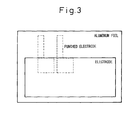
- the laminated sheet was diecut to form a rectangular-shaped electrode with its carbon electrode portion measuring 3 cm square and its lead portion (the portion where the current collector was not covered with the polarizable electrode) measuring 1 ⁇ 5 cm, as shown in Figure 3 .
- Two such electrodes were set up as an anode and a cathode, respectively, and an 80- ⁇ m thick, 3.5-cm square hydrophilized ePTFE sheet ("BSP0708070-2" manufactured by Japan Gore-Tex Inc.) was inserted as a separator between them; then, the electrodes and the separator were placed between two aluminum-laminated sheets ("PET12/A120/PET12/CPP30 dry laminated sheets measuring 5 ⁇ 10 cm manufactured by Showa Denko Packaging Co., Ltd.), and three sides including the lead portion side were heat-sealed to produce an aluminum pack cell.
- an end of the lead portion was brought outside the aluminum pack cell so that the lead portion and the aluminum pack cell were sealed together when the lead portion and the aluminum laminated sheets were heat-sealed.
- the aluminum pack cell was vacuum dried at 150°C for 24 hours, after which the cell was introduced into a glove box where a dew point of -60°C or lower was maintained in an argon atmosphere; then, with the open side (the side not sealed) facing up, 4mL of a propylene carbonate solution containing 1.5 mol/L of triethylmethylammonium tetrafluoroborate was injected as the electrolytic solution into the aluminum pack cell, and the aluminum pack cell was left stationary at a reduced pressure of -0.05 MPa for 10 minutes, allowing the gasses contained in the electrodes to be replaced with the electrolytic solution.
- the open side of the aluminum pack cell was sealed by heating, to produce a single laminated type electric double layer capacitor.
- This electric double layer capacitor was stored at 40°C for 24 hours, thus aging the electrolytic solution including the solution impregnated into the electrodes.
- the capacitor was sandwiched between 5-mm thick SUS plates each measuring 5 ⁇ 5 cm, and a compression pressure of 1 MPa was applied from the surface side; this capacitor is designated as the capacitor of Working example 1.
- Working example 1 was repeated except that the activation time was 90 minutes, the pore volume was 0.93 cm 3 /g, the specific surface area was 1600 m 2 /g, and the external specific surface area was 1100 m 2 /g.
- the number of rolling passes required to form the 150- ⁇ m thick electrode sheet was two, which was the same as Working example 1.
- the electrode density of the obtained electrode sheet was 0.52 g/cm 3
- the external specific surface area per unit volume of the electrode sheet was 486 m 2 /cm 3
- the pore volume of the entire electrode sheet was 0.98 cm 3 /g
- the volume based on the inter-particle interstices per unit volume of the electrode sheet was 0.10 cm 3 /cm 3 .
- Working example 1 was repeated except that the activation time was 160 minutes, the pore volume was 1.15 cm 3 /g, the specific surface area was 2400 m 2 /g, and the external specific surface area was 1900 m 2 /g.
- the number of rolling passes required to form the 150- ⁇ m thick electrode sheet was two, which was the same as Working example 1.
- the electrode density of the obtained electrode sheet was 0.45 g/cm 3
- the external specific surface area per unit volume of the electrode sheet was 727 m 2 /cm 3
- the pore volume of the entire electrode sheet was 1.17 cm 3 /g
- the volume based on the inter-particle interstices per unit volume of the electrode sheet was 0.09 cm 3 /cm 3 .
- Working example 1 was repeated except that activated carbon was used that had a particle size distribution with a mode diameter of 20 ⁇ m (relative particle quantity: 25%) in which 60% of the particles were contained within the range of ⁇ 30% of the mode diameter.
- the number of rolling passes required to form the 150- ⁇ m thick electrode sheet was two, which was the same as Working example 1.
- the electrode density of the obtained electrode sheet was 0.46 g/cm 3
- the external specific surface area per unit volume of the electrode sheet was 587 m 2 /cm 3
- the pore volume of the entire electrode sheet was 1.12 cm 3 /g
- the volume based on the inter-particle interstices per unit volume of the electrode sheet was 0.10 cm 3 /cm 3 .
- Working example 1 was repeated except that the proportions of the materials were changed to 80% by mass of the activated carbon, 10% by mass of the conductive agent, and 10% by mass of the binder.
- the number of rolling passes required to form the 150- ⁇ m thick electrode sheet was four.
- the electrode density of the obtained electrode sheet was 0.52 g/cm 3
- the external specific surface area per unit volume of the electrode sheet was 624 m 2 /cm 3
- the pore volume of the entire electrode sheet was 1.01 cm 3 /g
- the volume based on the inter-particle interstices per unit volume of the electrode sheet was 0.08 cm 3 /cm 3 .
- Working example 1 was repeated except that a phenol resin was used as the material for the activated carbon, the pore volume was 1.00 cm 3 /g, the specific surface area was 2000 m 2 /g, and the external specific surface area was 1400 m 2 /g.
- the number of rolling passes required to form the 150- ⁇ m thick electrode sheet was two, which was the same as Working example 1.
- the electrode density of the obtained electrode sheet was 0.50 g/cm 3
- the external specific surface area per unit volume of the electrode sheet was 595 m 2 /cm 3
- the pore volume of the entire electrode sheet was 1.00 cm 3 /g
- the volume based on the inter-particle interstices per unit volume of the electrode sheet was 0.08 cm 3 /cm 3 .
- the electrode density of the obtained electrode sheet was 0.58 g/cm 3
- the external specific surface area per unit volume of the electrode sheet was 222 m 2 /cm 3
- the pore volume of the entire electrode sheet was 0.75 cm 3 /g
- the volume based on the inter-particle interstices per unit volume of the electrode sheet was 0.06 cm 3 /cm 3 .
- Working example 1 was repeated except that the activation time was 80 minutes, the pore volume was 0.89 cm 3 /g, the specific surface area was 1400 m 2 /g, and the external specific surface area was 900 m 2 /g.
- the number of rolling passes required to form the 150- ⁇ m thick electrode sheet was two, which was the same as Working example 1.
- the electrode density of the obtained electrode sheet was 0.55 g/cm 3
- the external specific surface area per unit volume of the electrode sheet was 421 m 2 /cm 3
- the pore volume of the entire electrode sheet was 0.90 cm 3 /g
- the volume based on the inter-particle interstices per unit volume of the electrode sheet was 0.08 cm 3 /cm 3 .
- Working example 1 was repeated except that the activation time was 180 minutes, the pore volume was 1.25 cm 3 /g, the specific surface area was 2900 m 2 /g, and the external specific surface area was 2200 m 2 /g.
- the number of rolling passes required to form the 150- ⁇ m thick electrode sheet was two, which was the same as Working example 1.
- the electrode density of the obtained electrode sheet was 0.43 g/cm 3
- the external specific surface area per unit volume of the electrode sheet was 804 m 2 /cm 3
- the pore volume of the entire electrode sheet was 1.23 cm 3 /g
- the volume based on the inter-particle interstices per unit volume of the electrode sheet was 0.07 cm 3 /cm 3 .
- the external specific surface area of the activated carbon, the particle quantity in the range of ⁇ 30% of the mode diameter, the external specific surface area of the activated carbon per unit volume of the electrode sheet, and the volume based on the inter-particle interstices per unit volume of the electrode sheet are shown in Table 1 below for Working example 1 to 7 and Comparative example 1 to 4.
- the cell was stored for one hour in a thermostatic chamber maintained at -30°C.
- the internal resistance and hence the time constant is smaller in the capacitors of the working examples. As the time constant becomes smaller, the charge/discharge efficiency when discharging in a short time can be increased.
- the capacitance at the 5-mA discharge is larger in Comparative example 1, but at the 200-mA discharge, the situation is reversed.
- the capacitance at 25°C is larger in Comparative example 1, but at -30°C, the situation is reversed.
- an electric double layer capacitor can be achieved that is suited to large current, quick discharge applications requiring a large current such as 100 mA/cm 2 or larger, and/or applications in a low-temperature environment such as -20°C or lower. Further, according to the present invention, the durability and/or safety of the electric double layer capacitor suited to such applications are enhanced. Furthermore, according to the present invention, the moldability of the polarizable electrode layers for the electric double layer capacitor suited to such applications improves.
Landscapes
- Engineering & Computer Science (AREA)
- Power Engineering (AREA)
- Chemical & Material Sciences (AREA)
- Materials Engineering (AREA)
- Microelectronics & Electronic Packaging (AREA)
- Electric Double-Layer Capacitors Or The Like (AREA)
Applications Claiming Priority (2)
| Application Number | Priority Date | Filing Date | Title |
|---|---|---|---|
| JP2006237562A JP4959259B2 (ja) | 2006-09-01 | 2006-09-01 | 電気二重層キャパシタ |
| PCT/JP2007/067355 WO2008029865A1 (fr) | 2006-09-01 | 2007-08-30 | Condensateur électrique à double couche |
Publications (3)
| Publication Number | Publication Date |
|---|---|
| EP2058828A1 true EP2058828A1 (de) | 2009-05-13 |
| EP2058828A4 EP2058828A4 (de) | 2010-09-22 |
| EP2058828B1 EP2058828B1 (de) | 2015-08-19 |
Family
ID=39157290
Family Applications (1)
| Application Number | Title | Priority Date | Filing Date |
|---|---|---|---|
| EP07806797.2A Not-in-force EP2058828B1 (de) | 2006-09-01 | 2007-08-30 | Elektrischer doppelschichtkondensator |
Country Status (5)
| Country | Link |
|---|---|
| US (1) | US8848338B2 (de) |
| EP (1) | EP2058828B1 (de) |
| JP (1) | JP4959259B2 (de) |
| CA (1) | CA2661672A1 (de) |
| WO (1) | WO2008029865A1 (de) |
Cited By (1)
| Publication number | Priority date | Publication date | Assignee | Title |
|---|---|---|---|---|
| US20120301388A1 (en) * | 2010-06-17 | 2012-11-29 | Samsung Sdi Co., Ltd. | Crystalline carbonaceous material with controlled interlayer spacing and method of preparing same |
Families Citing this family (21)
| Publication number | Priority date | Publication date | Assignee | Title |
|---|---|---|---|---|
| JP2010219323A (ja) * | 2009-03-17 | 2010-09-30 | National Univ Corp Shizuoka Univ | 電気二重層キャパシタ用電極 |
| US20120148896A1 (en) * | 2010-12-09 | 2012-06-14 | E.I. Du Pont De Nemours And Company | Multi-layer article of polyimide nanoweb with amidized surface |
| US9312077B2 (en) | 2011-12-16 | 2016-04-12 | Calgon Carbon Corporation | Double layer capacitors |
| US20130194721A1 (en) * | 2012-01-26 | 2013-08-01 | Samsung Electro-Mechanics Co., Ltd. | Activated carbon for lithium ion capacitor, electrode including the activated carbon as active material, and lithium ion capacitor using the electrode |
| KR102031398B1 (ko) * | 2012-05-11 | 2019-10-11 | 주식회사 발카 | 전기 이중층 커패시터용 전극막 및 그 제조방법 |
| JP2014022425A (ja) * | 2012-07-13 | 2014-02-03 | Panasonic Corp | キャパシタ |
| US9093675B2 (en) * | 2013-01-21 | 2015-07-28 | E I Du Pont De Nemours And Company | Method of manufacturing non-firing type electrode |
| US9099215B2 (en) * | 2013-01-21 | 2015-08-04 | E I Du Pont De Nemours And Company | Method of manufacturing non-firing type electrode |
| US9640332B2 (en) * | 2013-12-20 | 2017-05-02 | Intel Corporation | Hybrid electrochemical capacitor |
| US10312028B2 (en) | 2014-06-30 | 2019-06-04 | Avx Corporation | Electrochemical energy storage devices and manufacturing methods |
| US9799459B2 (en) | 2014-08-08 | 2017-10-24 | Corning Incorporated | High pore volume utilization carbon and electric double layer capacitor |
| WO2017201167A1 (en) | 2016-05-20 | 2017-11-23 | Avx Corporation | Electrode configuration for an ultracapacitor |
| WO2017201173A1 (en) | 2016-05-20 | 2017-11-23 | Avx Corporation | Nonaqueous electrolyte for an ultracapacitor |
| KR102635455B1 (ko) | 2016-05-20 | 2024-02-13 | 교세라 에이브이엑스 컴포넌츠 코포레이션 | 고온용 울트라커패시터 |
| MY195773A (en) | 2016-05-20 | 2023-02-11 | Kyocera Avx Components Corp | Multi-Cell Ultracapacitor |
| WO2020027111A1 (ja) | 2018-08-03 | 2020-02-06 | 積水化学工業株式会社 | 炭素材料及びその製造方法、蓄電デバイス用電極材料、並びに蓄電デバイス |
| EP3979370A4 (de) | 2019-05-30 | 2023-10-04 | Sekisui Chemical Co., Ltd. | Stromspeichervorrichtung |
| JP7521244B2 (ja) * | 2020-04-14 | 2024-07-24 | 株式会社村田製作所 | 炭素質材料および電気二重層コンデンサ |
| EP4075117B1 (de) * | 2021-04-14 | 2024-05-01 | MTU Aero Engines AG | Verfahren und vorrichtung zur charakterisierung einer beschichtung |
| US20240266553A1 (en) * | 2021-06-30 | 2024-08-08 | The Carbon Studio Inc. | Porous carbon support, method for manufacturing porous carbon support, and fuel cell catalyst using same |
| WO2025216133A1 (ja) * | 2024-04-10 | 2025-10-16 | パナソニックIpマネジメント株式会社 | 電気化学キャパシタ |
Family Cites Families (20)
| Publication number | Priority date | Publication date | Assignee | Title |
|---|---|---|---|---|
| JP2993965B2 (ja) | 1988-03-08 | 1999-12-27 | 旭硝子株式会社 | 電気二重層コンデンサ |
| JP2778425B2 (ja) | 1993-04-20 | 1998-07-23 | 日本電気株式会社 | 分極性電極とその製造方法及びそれを用いた電気二重層コンデンサ |
| US5862035A (en) * | 1994-10-07 | 1999-01-19 | Maxwell Energy Products, Inc. | Multi-electrode double layer capacitor having single electrolyte seal and aluminum-impregnated carbon cloth electrodes |
| JP3446339B2 (ja) * | 1994-10-18 | 2003-09-16 | 三菱化学株式会社 | 活性炭の製造方法 |
| JP3689948B2 (ja) * | 1994-12-27 | 2005-08-31 | 旭硝子株式会社 | 電気二重層キャパシタ |
| US5953204A (en) | 1994-12-27 | 1999-09-14 | Asahi Glass Company Ltd. | Electric double layer capacitor |
| JPH10208958A (ja) | 1997-01-16 | 1998-08-07 | Nitsuko Corp | 箱型ノイズフィルタ |
| JPH11121295A (ja) * | 1997-10-14 | 1999-04-30 | Isuzu Advanced Engineering Center Ltd | 電気二重層コンデンサ、電極及びその製造方法 |
| JP3540629B2 (ja) | 1998-10-02 | 2004-07-07 | Tdk株式会社 | 電気化学デバイス用電極の製造方法ならびに電気化学デバイス |
| JP3724960B2 (ja) * | 1998-10-19 | 2005-12-07 | Tdk株式会社 | 固体電解質およびこれを用いた電気化学デバイス |
| US6865068B1 (en) | 1999-04-30 | 2005-03-08 | Asahi Glass Company, Limited | Carbonaceous material, its production process and electric double layer capacitor employing it |
| JP2000340470A (ja) | 1999-05-28 | 2000-12-08 | Asahi Glass Co Ltd | 電気二重層キャパシタおよびその電極材料 |
| JP2000344507A (ja) | 1999-06-07 | 2000-12-12 | Kuraray Chem Corp | 粉末活性炭、活性炭シート及び電気二重層キャパシタ |
| JP2001146410A (ja) * | 1999-11-17 | 2001-05-29 | Showa Denko Kk | 活性炭及びその製法 |
| JP2001316103A (ja) | 2000-05-08 | 2001-11-13 | Kawasaki Steel Corp | 多孔質炭素材料、その製造方法および電気二重層キャパシタ |
| JP2003272961A (ja) * | 2002-03-18 | 2003-09-26 | Nec Tokin Corp | 電気二重層キャパシタ |
| JP2003347172A (ja) | 2002-05-22 | 2003-12-05 | Nippon Valqua Ind Ltd | 電気二重層キャパシタ用活性炭及び電気二重層キャパシタ用電極 |
| JP2005317642A (ja) | 2004-04-27 | 2005-11-10 | Nec Tokin Corp | 電気二重層コンデンサ |
| EP1768141B1 (de) * | 2005-09-26 | 2009-09-02 | Nisshinbo Industries, Inc. | Polarisierbare Elektrode für Doppelschichtkondensator |
| BRPI0707932A2 (pt) * | 2006-02-15 | 2011-05-31 | Rudyard Lyle Istvan | carbonos ativados mesoporosos |
-
2006
- 2006-09-01 JP JP2006237562A patent/JP4959259B2/ja not_active Expired - Fee Related
-
2007
- 2007-08-30 WO PCT/JP2007/067355 patent/WO2008029865A1/ja not_active Ceased
- 2007-08-30 US US12/438,235 patent/US8848338B2/en not_active Expired - Fee Related
- 2007-08-30 CA CA002661672A patent/CA2661672A1/en not_active Abandoned
- 2007-08-30 EP EP07806797.2A patent/EP2058828B1/de not_active Not-in-force
Cited By (2)
| Publication number | Priority date | Publication date | Assignee | Title |
|---|---|---|---|---|
| US20120301388A1 (en) * | 2010-06-17 | 2012-11-29 | Samsung Sdi Co., Ltd. | Crystalline carbonaceous material with controlled interlayer spacing and method of preparing same |
| US8894964B2 (en) * | 2010-06-17 | 2014-11-25 | Samsung Sdi Co., Ltd. | Crystalline carbonaceous material with controlled interlayer spacing and method of preparing same |
Also Published As
| Publication number | Publication date |
|---|---|
| US20100220429A1 (en) | 2010-09-02 |
| CA2661672A1 (en) | 2008-03-13 |
| JP4959259B2 (ja) | 2012-06-20 |
| JP2008060457A (ja) | 2008-03-13 |
| US8848338B2 (en) | 2014-09-30 |
| EP2058828B1 (de) | 2015-08-19 |
| WO2008029865A1 (fr) | 2008-03-13 |
| EP2058828A4 (de) | 2010-09-22 |
Similar Documents
| Publication | Publication Date | Title |
|---|---|---|
| EP2058828B1 (de) | Elektrischer doppelschichtkondensator | |
| JP5276001B2 (ja) | エネルギー保存装置用電極 | |
| US9053871B2 (en) | High surface area and low structure carbon blacks for energy storage applications | |
| US9997301B2 (en) | Electrode, electric double-layer capacitor using the same, and manufacturing method of the electrode | |
| EP1998346A1 (de) | Elektrode für elektrischen doppelschichtkondensator und elektrischer doppelschichtkondensator | |
| US9478364B2 (en) | Carbon-based electrodes containing molecular sieve | |
| US20110013344A1 (en) | Polarizable electrode for capacitor and electric double layer capacitor having the same | |
| US8194394B2 (en) | Polarized electrode and electric double-layer capacitor | |
| EP2665074B1 (de) | Elektrochemische Zelle | |
| KR20080012952A (ko) | 전기 이중층 캐패시터용 전극 및 전기 이중층 캐패시터 | |
| US20160104584A1 (en) | Electrical double-layer capacitor for high-voltage operation at high-temperatures | |
| JP2002231585A (ja) | 電気二重層コンデンサ | |
| EP2879143B1 (de) | Polarisierbares elektrodenmaterial und doppelschichtkondensator damit | |
| KR102429092B1 (ko) | 전기화학 전지의 전극용 첨가제 재료, 이중층 커패시터 및 이러한 전극의 제조방법 | |
| JP4733707B2 (ja) | 電気二重層キャパシタ用炭素材料,電気二重層キャパシタ及び電気二重層キャパシタ用炭素材料の製造方法 | |
| JP2002260970A (ja) | 活性炭質構造体およびそれを用いた電気二重層コンデンサ | |
| JP2009065074A (ja) | シュードキャパシタ用電解液及びシュードキャパシタ | |
| JP2004273942A (ja) | 電気二重キャパシタ | |
| JP2007214174A (ja) | 積層型電極及びそれを用いた電気二重層キャパシタ | |
| JP2007019491A (ja) | 電気二重層キャパシタ用電極および電気二重層キャパシタ |
Legal Events
| Date | Code | Title | Description |
|---|---|---|---|
| PUAI | Public reference made under article 153(3) epc to a published international application that has entered the european phase |
Free format text: ORIGINAL CODE: 0009012 |
|
| 17P | Request for examination filed |
Effective date: 20090223 |
|
| AK | Designated contracting states |
Kind code of ref document: A1 Designated state(s): AT BE BG CH CY CZ DE DK EE ES FI FR GB GR HU IE IS IT LI LT LU LV MC MT NL PL PT RO SE SI SK TR |
|
| AX | Request for extension of the european patent |
Extension state: AL BA HR MK RS |
|
| A4 | Supplementary search report drawn up and despatched |
Effective date: 20100823 |
|
| RIC1 | Information provided on ipc code assigned before grant |
Ipc: H01G 9/058 20060101AFI20080410BHEP |
|
| 17Q | First examination report despatched |
Effective date: 20110621 |
|
| DAX | Request for extension of the european patent (deleted) | ||
| REG | Reference to a national code |
Ref country code: DE Ref legal event code: R079 Ref document number: 602007042690 Country of ref document: DE Free format text: PREVIOUS MAIN CLASS: H01G0009058000 Ipc: H01G0011240000 |
|
| GRAP | Despatch of communication of intention to grant a patent |
Free format text: ORIGINAL CODE: EPIDOSNIGR1 |
|
| RIC1 | Information provided on ipc code assigned before grant |
Ipc: H01G 11/32 20130101ALI20150217BHEP Ipc: H01G 11/24 20130101AFI20150217BHEP Ipc: H01G 11/42 20130101ALI20150217BHEP |
|
| INTG | Intention to grant announced |
Effective date: 20150318 |
|
| GRAS | Grant fee paid |
Free format text: ORIGINAL CODE: EPIDOSNIGR3 |
|
| GRAA | (expected) grant |
Free format text: ORIGINAL CODE: 0009210 |
|
| RAP1 | Party data changed (applicant data changed or rights of an application transferred) |
Owner name: W.L. GORE & ASSOCIATES, CO., LTD. |
|
| AK | Designated contracting states |
Kind code of ref document: B1 Designated state(s): AT BE BG CH CY CZ DE DK EE ES FI FR GB GR HU IE IS IT LI LT LU LV MC MT NL PL PT RO SE SI SK TR |
|
| REG | Reference to a national code |
Ref country code: GB Ref legal event code: FG4D |
|
| REG | Reference to a national code |
Ref country code: CH Ref legal event code: EP |
|
| REG | Reference to a national code |
Ref country code: IE Ref legal event code: FG4D |
|
| REG | Reference to a national code |
Ref country code: AT Ref legal event code: REF Ref document number: 744312 Country of ref document: AT Kind code of ref document: T Effective date: 20150915 |
|
| REG | Reference to a national code |
Ref country code: DE Ref legal event code: R096 Ref document number: 602007042690 Country of ref document: DE |
|
| REG | Reference to a national code |
Ref country code: AT Ref legal event code: MK05 Ref document number: 744312 Country of ref document: AT Kind code of ref document: T Effective date: 20150819 |
|
| REG | Reference to a national code |
Ref country code: LT Ref legal event code: MG4D |
|
| REG | Reference to a national code |
Ref country code: NL Ref legal event code: MP Effective date: 20150819 |
|
| PG25 | Lapsed in a contracting state [announced via postgrant information from national office to epo] |
Ref country code: FI Free format text: LAPSE BECAUSE OF FAILURE TO SUBMIT A TRANSLATION OF THE DESCRIPTION OR TO PAY THE FEE WITHIN THE PRESCRIBED TIME-LIMIT Effective date: 20150819 Ref country code: LT Free format text: LAPSE BECAUSE OF FAILURE TO SUBMIT A TRANSLATION OF THE DESCRIPTION OR TO PAY THE FEE WITHIN THE PRESCRIBED TIME-LIMIT Effective date: 20150819 Ref country code: LV Free format text: LAPSE BECAUSE OF FAILURE TO SUBMIT A TRANSLATION OF THE DESCRIPTION OR TO PAY THE FEE WITHIN THE PRESCRIBED TIME-LIMIT Effective date: 20150819 Ref country code: GR Free format text: LAPSE BECAUSE OF FAILURE TO SUBMIT A TRANSLATION OF THE DESCRIPTION OR TO PAY THE FEE WITHIN THE PRESCRIBED TIME-LIMIT Effective date: 20151120 |
|
| PG25 | Lapsed in a contracting state [announced via postgrant information from national office to epo] |
Ref country code: PL Free format text: LAPSE BECAUSE OF FAILURE TO SUBMIT A TRANSLATION OF THE DESCRIPTION OR TO PAY THE FEE WITHIN THE PRESCRIBED TIME-LIMIT Effective date: 20150819 Ref country code: ES Free format text: LAPSE BECAUSE OF FAILURE TO SUBMIT A TRANSLATION OF THE DESCRIPTION OR TO PAY THE FEE WITHIN THE PRESCRIBED TIME-LIMIT Effective date: 20150819 Ref country code: SE Free format text: LAPSE BECAUSE OF FAILURE TO SUBMIT A TRANSLATION OF THE DESCRIPTION OR TO PAY THE FEE WITHIN THE PRESCRIBED TIME-LIMIT Effective date: 20150819 Ref country code: PT Free format text: LAPSE BECAUSE OF FAILURE TO SUBMIT A TRANSLATION OF THE DESCRIPTION OR TO PAY THE FEE WITHIN THE PRESCRIBED TIME-LIMIT Effective date: 20151221 Ref country code: IS Free format text: LAPSE BECAUSE OF FAILURE TO SUBMIT A TRANSLATION OF THE DESCRIPTION OR TO PAY THE FEE WITHIN THE PRESCRIBED TIME-LIMIT Effective date: 20151219 Ref country code: AT Free format text: LAPSE BECAUSE OF FAILURE TO SUBMIT A TRANSLATION OF THE DESCRIPTION OR TO PAY THE FEE WITHIN THE PRESCRIBED TIME-LIMIT Effective date: 20150819 |
|
| PG25 | Lapsed in a contracting state [announced via postgrant information from national office to epo] |
Ref country code: NL Free format text: LAPSE BECAUSE OF FAILURE TO SUBMIT A TRANSLATION OF THE DESCRIPTION OR TO PAY THE FEE WITHIN THE PRESCRIBED TIME-LIMIT Effective date: 20150819 |
|
| REG | Reference to a national code |
Ref country code: CH Ref legal event code: PL |
|
| PG25 | Lapsed in a contracting state [announced via postgrant information from national office to epo] |
Ref country code: CZ Free format text: LAPSE BECAUSE OF FAILURE TO SUBMIT A TRANSLATION OF THE DESCRIPTION OR TO PAY THE FEE WITHIN THE PRESCRIBED TIME-LIMIT Effective date: 20150819 Ref country code: LI Free format text: LAPSE BECAUSE OF NON-PAYMENT OF DUE FEES Effective date: 20150831 Ref country code: EE Free format text: LAPSE BECAUSE OF FAILURE TO SUBMIT A TRANSLATION OF THE DESCRIPTION OR TO PAY THE FEE WITHIN THE PRESCRIBED TIME-LIMIT Effective date: 20150819 Ref country code: SK Free format text: LAPSE BECAUSE OF FAILURE TO SUBMIT A TRANSLATION OF THE DESCRIPTION OR TO PAY THE FEE WITHIN THE PRESCRIBED TIME-LIMIT Effective date: 20150819 Ref country code: IT Free format text: LAPSE BECAUSE OF FAILURE TO SUBMIT A TRANSLATION OF THE DESCRIPTION OR TO PAY THE FEE WITHIN THE PRESCRIBED TIME-LIMIT Effective date: 20150819 Ref country code: DK Free format text: LAPSE BECAUSE OF FAILURE TO SUBMIT A TRANSLATION OF THE DESCRIPTION OR TO PAY THE FEE WITHIN THE PRESCRIBED TIME-LIMIT Effective date: 20150819 Ref country code: CH Free format text: LAPSE BECAUSE OF NON-PAYMENT OF DUE FEES Effective date: 20150831 |
|
| REG | Reference to a national code |
Ref country code: DE Ref legal event code: R097 Ref document number: 602007042690 Country of ref document: DE |
|
| PG25 | Lapsed in a contracting state [announced via postgrant information from national office to epo] |
Ref country code: MC Free format text: LAPSE BECAUSE OF FAILURE TO SUBMIT A TRANSLATION OF THE DESCRIPTION OR TO PAY THE FEE WITHIN THE PRESCRIBED TIME-LIMIT Effective date: 20150819 Ref country code: RO Free format text: LAPSE BECAUSE OF FAILURE TO SUBMIT A TRANSLATION OF THE DESCRIPTION OR TO PAY THE FEE WITHIN THE PRESCRIBED TIME-LIMIT Effective date: 20150819 |
|
| REG | Reference to a national code |
Ref country code: IE Ref legal event code: MM4A |
|
| PLBE | No opposition filed within time limit |
Free format text: ORIGINAL CODE: 0009261 |
|
| STAA | Information on the status of an ep patent application or granted ep patent |
Free format text: STATUS: NO OPPOSITION FILED WITHIN TIME LIMIT |
|
| REG | Reference to a national code |
Ref country code: FR Ref legal event code: PLFP Year of fee payment: 10 |
|
| 26N | No opposition filed |
Effective date: 20160520 |
|
| PG25 | Lapsed in a contracting state [announced via postgrant information from national office to epo] |
Ref country code: IE Free format text: LAPSE BECAUSE OF NON-PAYMENT OF DUE FEES Effective date: 20150830 |
|
| PG25 | Lapsed in a contracting state [announced via postgrant information from national office to epo] |
Ref country code: SI Free format text: LAPSE BECAUSE OF FAILURE TO SUBMIT A TRANSLATION OF THE DESCRIPTION OR TO PAY THE FEE WITHIN THE PRESCRIBED TIME-LIMIT Effective date: 20150819 |
|
| PGFP | Annual fee paid to national office [announced via postgrant information from national office to epo] |
Ref country code: GB Payment date: 20160726 Year of fee payment: 10 Ref country code: DE Payment date: 20160721 Year of fee payment: 10 |
|
| PGFP | Annual fee paid to national office [announced via postgrant information from national office to epo] |
Ref country code: FR Payment date: 20160720 Year of fee payment: 10 |
|
| PG25 | Lapsed in a contracting state [announced via postgrant information from national office to epo] |
Ref country code: MT Free format text: LAPSE BECAUSE OF FAILURE TO SUBMIT A TRANSLATION OF THE DESCRIPTION OR TO PAY THE FEE WITHIN THE PRESCRIBED TIME-LIMIT Effective date: 20150819 |
|
| PG25 | Lapsed in a contracting state [announced via postgrant information from national office to epo] |
Ref country code: BG Free format text: LAPSE BECAUSE OF FAILURE TO SUBMIT A TRANSLATION OF THE DESCRIPTION OR TO PAY THE FEE WITHIN THE PRESCRIBED TIME-LIMIT Effective date: 20150819 Ref country code: HU Free format text: LAPSE BECAUSE OF FAILURE TO SUBMIT A TRANSLATION OF THE DESCRIPTION OR TO PAY THE FEE WITHIN THE PRESCRIBED TIME-LIMIT; INVALID AB INITIO Effective date: 20070830 |
|
| PG25 | Lapsed in a contracting state [announced via postgrant information from national office to epo] |
Ref country code: CY Free format text: LAPSE BECAUSE OF FAILURE TO SUBMIT A TRANSLATION OF THE DESCRIPTION OR TO PAY THE FEE WITHIN THE PRESCRIBED TIME-LIMIT Effective date: 20150819 |
|
| PG25 | Lapsed in a contracting state [announced via postgrant information from national office to epo] |
Ref country code: BE Free format text: LAPSE BECAUSE OF NON-PAYMENT OF DUE FEES Effective date: 20150831 |
|
| PG25 | Lapsed in a contracting state [announced via postgrant information from national office to epo] |
Ref country code: TR Free format text: LAPSE BECAUSE OF FAILURE TO SUBMIT A TRANSLATION OF THE DESCRIPTION OR TO PAY THE FEE WITHIN THE PRESCRIBED TIME-LIMIT Effective date: 20150819 |
|
| PG25 | Lapsed in a contracting state [announced via postgrant information from national office to epo] |
Ref country code: LU Free format text: LAPSE BECAUSE OF NON-PAYMENT OF DUE FEES Effective date: 20150830 |
|
| REG | Reference to a national code |
Ref country code: DE Ref legal event code: R119 Ref document number: 602007042690 Country of ref document: DE |
|
| GBPC | Gb: european patent ceased through non-payment of renewal fee |
Effective date: 20170830 |
|
| REG | Reference to a national code |
Ref country code: FR Ref legal event code: ST Effective date: 20180430 |
|
| PG25 | Lapsed in a contracting state [announced via postgrant information from national office to epo] |
Ref country code: GB Free format text: LAPSE BECAUSE OF NON-PAYMENT OF DUE FEES Effective date: 20170830 Ref country code: DE Free format text: LAPSE BECAUSE OF NON-PAYMENT OF DUE FEES Effective date: 20180301 |
|
| PG25 | Lapsed in a contracting state [announced via postgrant information from national office to epo] |
Ref country code: FR Free format text: LAPSE BECAUSE OF NON-PAYMENT OF DUE FEES Effective date: 20170831 |