EP2059053A2 - Procédé et dispositif pour générer une profondeur d'image en utilisant une image de référence, procédé de codage/décodage de profondeur d'image, et codeur ou décodeur associé - Google Patents
Procédé et dispositif pour générer une profondeur d'image en utilisant une image de référence, procédé de codage/décodage de profondeur d'image, et codeur ou décodeur associé Download PDFInfo
- Publication number
- EP2059053A2 EP2059053A2 EP20080105614 EP08105614A EP2059053A2 EP 2059053 A2 EP2059053 A2 EP 2059053A2 EP 20080105614 EP20080105614 EP 20080105614 EP 08105614 A EP08105614 A EP 08105614A EP 2059053 A2 EP2059053 A2 EP 2059053A2
- Authority
- EP
- European Patent Office
- Prior art keywords
- image
- depth image
- hole
- reference image
- depth
- Prior art date
- Legal status (The legal status is an assumption and is not a legal conclusion. Google has not performed a legal analysis and makes no representation as to the accuracy of the status listed.)
- Withdrawn
Links
Images



Classifications
-
- H—ELECTRICITY
- H04—ELECTRIC COMMUNICATION TECHNIQUE
- H04N—PICTORIAL COMMUNICATION, e.g. TELEVISION
- H04N13/00—Stereoscopic video systems; Multi-view video systems; Details thereof
-
- H—ELECTRICITY
- H04—ELECTRIC COMMUNICATION TECHNIQUE
- H04N—PICTORIAL COMMUNICATION, e.g. TELEVISION
- H04N19/00—Methods or arrangements for coding, decoding, compressing or decompressing digital video signals
-
- G—PHYSICS
- G06—COMPUTING OR CALCULATING; COUNTING
- G06T—IMAGE DATA PROCESSING OR GENERATION, IN GENERAL
- G06T1/00—General purpose image data processing
-
- H—ELECTRICITY
- H04—ELECTRIC COMMUNICATION TECHNIQUE
- H04N—PICTORIAL COMMUNICATION, e.g. TELEVISION
- H04N19/00—Methods or arrangements for coding, decoding, compressing or decompressing digital video signals
- H04N19/50—Methods or arrangements for coding, decoding, compressing or decompressing digital video signals using predictive coding
- H04N19/59—Methods or arrangements for coding, decoding, compressing or decompressing digital video signals using predictive coding involving spatial sub-sampling or interpolation, e.g. alteration of picture size or resolution
-
- H—ELECTRICITY
- H04—ELECTRIC COMMUNICATION TECHNIQUE
- H04N—PICTORIAL COMMUNICATION, e.g. TELEVISION
- H04N19/00—Methods or arrangements for coding, decoding, compressing or decompressing digital video signals
- H04N19/50—Methods or arrangements for coding, decoding, compressing or decompressing digital video signals using predictive coding
- H04N19/597—Methods or arrangements for coding, decoding, compressing or decompressing digital video signals using predictive coding specially adapted for multi-view video sequence encoding
-
- H—ELECTRICITY
- H04—ELECTRIC COMMUNICATION TECHNIQUE
- H04N—PICTORIAL COMMUNICATION, e.g. TELEVISION
- H04N19/00—Methods or arrangements for coding, decoding, compressing or decompressing digital video signals
- H04N19/60—Methods or arrangements for coding, decoding, compressing or decompressing digital video signals using transform coding
- H04N19/61—Methods or arrangements for coding, decoding, compressing or decompressing digital video signals using transform coding in combination with predictive coding
Definitions
- the present invention relates to a method and device for generating a depth image using a reference image, a method for encoding/decoding the depth image, and an encoder/decoder for the same. More particularly, the present invention relates to a method and device for generating a depth image, a method for encoding/decoding the depth image, an encoder/decoder for the same, and a recording medium recording an image generated by the method, which are related to a depth image encoding method that can effectively reduce a bit generation rate using a reference image obtained by at least one camera and improve encoding efficiency.
- a three-dimensional video processing technology as a core technology of the next-generation information communication service field is a state-of-the-art technology for which technology development competition is keen with the development to an information industry society.
- the three-dimensional video processing technology is an essential element to provide a high-quality image service in a multimedia application.
- the application field of the three-dimensional video processing technology is diversified into various application fields such as broadcasting, medical care, education (or discipline), military affairs, games, animation, or virtual reality as well as the field of information and communication.
- the three-dimensional video processing technology is considered as the next-generation of realistic three-dimensional multimedia information communication core technology, which is commonly required in a variety of fields, and has been studied by advanced countries.
- the three-dimensional video may be defined from two standpoints as follows. First, the three-dimensional video may be defined as video that is configured such that depth information is applied to an image and a user feels that a portion of the image protrudes from a screen. Second, the three-dimensional video may be defined as video that is configured such that various viewpoints are provided and a user feels reality (that is, three-dimensional impression) from an image. This three-dimensional video may be classified into stereoscopic type, a multi-view type, an integral photography (IP) type, a multi-view (omni) type, a panorama type, and a hologram type in accordance with an acquisition method, depth impression, and a display method. In addition, examples of a method that represents three-dimensional video include an image-based reconstruction method and a mesh-based representation method.
- depth image-based rendering has attracted attention as the method that represents the three-dimensional video.
- the depth image-based rendering generates scenes at different viewpoints using reference images that have information such as a depth or a different angle for each pixel.
- a three-dimensional model having a complicated shape, which is not easy to represent, can be easily rendered, a signal processing method such as general image filtering can be applied, and high-quality three-dimensional video can be generated.
- the depth image-based rendering uses a depth image (or depth map) and a texture image (or color image) that are acquired through a depth camera and a multi-view camera.
- the depth image is used to represent a three-dimensional model to be realistic (that is, to generate three-dimensional video).
- the depth image may be defined as an image that represents a distance between an object on a three-dimensional space and a camera used to photograph the object in a black-and-white unit.
- the depth image is widely used in a three-dimensional restoration technology or a three-dimensional warphing technology based on depth information and camera parameters.
- the depth image is applied in a variety of fields, and a representative example thereof is a free viewpoint TV.
- the free viewpoint TV is a TV where a user does not view an image at only a predetermined viewpoint but views an image at any viewpoint according to the selection from the user. Since the free viewpoint TV has the above-described characteristics, images can be generated at any viewpoint in consideration of multi-view images photographed by a plurality of cameras and multi-view depth images corresponding to the multi-view images.
- the depth image may include depth information at a single viewpoint.
- the depth image needs to include depth information at multi-viewpoints to achieve the above-described characteristics. Even if the multi-view depth image is configured more constantly than the texture image, the multi-view depth image has a large amount of data according to encoding. Accordingly, an effective video compression technology is essentially required in the depth image.
- an encoding method of a multi-view depth image has been studied by the MPEG Standardization Organization. For example, there is a method that uses texture images that are obtained by photographing one scene using a plurality of cameras in consideration of a relationship between adjacent images. This method can improve encoding efficiency, because there remains a large amount of information obtained from the texture images. If the correlation between the temporal direction and the spatial direction is considered, it is possible to further improve encoding efficiency. However, there is a problem in that this method is inefficient in terms of time or costs.
- the multi-view depth image encoding method that is suggested in the document follows the existing multi-view image encoding method, because multi-view depth image encoding method considers a relationship between the view-point directions having characteristics similar to those of the adjacent multi-view images instead of the multi-view images.
- the invention has been made to solve the above-described problems, and it is an object of the invention to provide a method and device for generating a depth image using a reference image, a method for encoding/decoding the depth image, an encoder/decoder for the same, and a recording medium recording an image generated by the method, which can use a down-sampling method that reduces a size of a depth image having a simpler pixel value than a texture image.
- a depth image generating method includes: a step (a) of obtaining a depth image at a viewpoint and setting the obtained depth image to a reference image; a step (b) of applying a 3D warphing method to the reference image and predicting and generating a depth image at a specific viewpoint; and a step (c) of removing a hole that exists in the predicted and generated depth image.
- the reference image may be down-sampled.
- the step (b) may include: a step (b1) of projecting positions of pixel values existing in the reference image onto a three-dimensional space; a step (b2) of reprojecting the projected position values on the three-dimensional space at predetermined positions of a target image; and a step (b3) of transmitting the pixel values of the reference image to pixel positions of the target image corresponding to pixel positions of the reference image.
- step (c) when one reference image exists, an intermediate value of available pixel values among the pixel values around the hole may be applied to the hole so as to remove the hole.
- step (c) when a plurality of reference images exist, a pixel value of a corresponding portion of another reference image may be applied to a hole of a depth image that is predicted and generated from a specific reference image so as to remove the hole.
- a depth image generating device includes a depth image storage unit that obtains a depth image at a viewpoint and stores the obtained depth image as a reference image; a depth image prediction unit that applies a 3D warphing method to the reference image and predicts and generates a depth image at a specific viewpoint; and a hole removing unit that removes a hole that exists in the depth image predicted and generated by the depth image prediction unit.
- the depth image generating device may further include: a down-sampling unit that down-samples the reference image stored in the depth image storage unit.
- the depth image prediction unit may project positions of pixel values existing in the reference image onto a three-dimensional space, reproject the projected position values on the three-dimensional space at predetermined positions of a target image, and transmit the pixel values of the reference image to pixel positions of the target image corresponding to pixel positions of the reference image, such that the depth image at the specific viewpoint is predicted and generated.
- the hole removing unit may apply an intermediate value of available pixel values among pixel values around the hole to the hole so as to remove the hole.
- the hole removing unit may apply a pixel value of a corresponding portion of another reference image to a hole of a depth image that is predicted and generated from a specific reference image so as to remove the hole.
- an encoding method using a depth image at a specific viewpoint is generated using the following steps: a step (a) of obtaining a depth image at a viewpoint and setting the obtained depth image to a reference image; a step (b) of applying a 3D warphing method to the reference image and predicting and generating the depth image at a specific viewpoint; and a step (c) of removing a hole that exists in the predicted and generated depth image.
- an encoder includes: an image prediction unit that performs inter-prediction and intra-prediction; an image T/Q unit that transforms and quantizes a prediction sample that is obtained by the image prediction unit; an entropy coding unit that encodes image data quantized by the image T/Q unit; and a depth image generating unit that generates a depth image at a specific viewpoint by the image prediction unit.
- the depth image generating unit includes: a depth image prediction unit that applies a 3D warphing method to a reference image using a depth image at a viewpoint as the reference image and predicts and generates a depth image at a specific viewpoint; and a hole removing unit that removes a hole that exists in the depth image predicted and generated by the depth image prediction unit.
- a decoding method and a decoder that decode the image encoded by the encoding method and the encoder.
- the invention in accordance with the above-described objects and the embodiments, can achieve the following effects.
- a depth image at a specific viewpoint can be generated without needing additional information other than camera parameters.
- a depth image at a specific viewpoint is generated from at least one reference image.
- this invention sequentially executes a down-sampling step of reducing a size of a reference image as a depth image that has a simpler pixel value than a texture image, a step of predicting a depth image at a specific viewpoint from the reference image using a 3D warphing method, and a step of removing, when a hole is generated in the predicted depth image, the hole using the reference image and values of pixels around the hole, thereby generating a depth image that can be viewed at a desired viewpoint.
- FIG. 1 is a flowchart illustrating a depth image generating method according to the preferred embodiment of the invention.
- the depth image generating method using the reference image will be described with reference to FIG. 1 .
- a depth camera is used to photograph a depth image at any viewpoint (S100).
- the depth image is hereinafter used as a reference image in the preferred embodiments of the invention.
- information that is related to a texture image may be obtained using a multi-view camera, and information that is obtained on the basis of a stereo matching method may be applied to the photographed depth image.
- This stereo matching method enables the depth image to have an accurate depth value.
- the stereo matching method is a method in which a three-dimensional image is generated using two-dimensional images that are obtained from spatially different planes.
- Step S100 that has been described above may be omitted.
- the reference image is down-sampled (S105).
- the reference image has a simpler pixel value than a texture image.
- down-sampling is preferably applied to the reference image in consideration of encoding, transmission, and decoding processes, which will be performed hereinafter.
- a sampling ratio is preferably 1/2 or 1/4, because the corresponding sampling ratio is suitable for keeping an optimal depth value.
- the reference image that is transmitted after encoding is up-sampled to have an original size, immediately or during a decoding process.
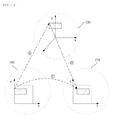
- the 3D warphing method is used to estimate and generate a depth image in a specific viewing direction from the reference image (S110).
- this method is defined as a depth image synthesis predicting method using the 3D warphing method.
- the depth image has depth image needed to perform 3D warphing, it is possible to generate a depth image in a specific viewing direction that corresponds to a target without additional information other than camera parameters.
- the following Equations 1 and 2 are used.
- P wc , P reference , and P target denote coordinate information, a reference image, and a target image in a three-dimensional space, respectively.
- R, A, D, and t denote a rotational variable, a unique variable of a camera, depth information, and a movement variable, respectively.
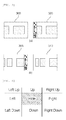
- the depth image generating method further includes a process of removing a hole, after the processes of (a) to (c). The process of removing a hole will be described below with reference to FIGS. 3 to 5 .
- an intermediate value of pixel values that are determined as available pixel values among eight pixel values around a hole is adopted, as shown in FIG. 4 .
- a median filter may be used.
- the intermediate value is preferably calculated using only pixel values belonging to a specific area among the pixel values around the hole by determining whether the hole belongs to the foreground or the background on the basis of all round values of the hole.
- any viewpoint image is used as the reference image
- holes are generated in a portion that is related to any viewpoint image as described in the case of (1).
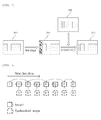
- the left viewpoint image 300 is used as the reference image
- the right viewpoint image 310 is used as another reference image
- the method of removing holes is performed as shown in FIG. 5 .
- a first step holes are generated at one side of a depth image 325 that is generated using a reference image 320 at the specific viewpoint. Then, in a second step, the holes of the depth image 325 are removed using a reference image 330 at another viewpoint.
- a reference image 330 at another viewpoint.
- Step S115 it is possible to generate the depth image in the specific viewing direction according to the embodiment of the invention (S120).
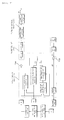
- the depth image may be used as an additional reference image when images at a viewpoint P and a viewpoint B are encoded, as shown in FIG. 6 . Accordingly, the depth image ultimately improves encoding efficiency.
- an encoder for encoding a generated depth image an encoding method using the encoder, a decoder for decoding the depth image, and a decoding method using the decoder will be sequentially described with reference to FIGS. 1 to 6 .
- the encoder will be described.
- FIG. 7 is a block diagram illustrating an internal structure of an encoder according to the preferred embodiment of the invention.
- an encoder 700 according to the preferred embodiment of the invention includes a down-sampling unit 702, a depth image predicting unit 704, a hole removing unit 706, an image prediction block 710, an image T/Q unit 730, and an entropy coding block 740.
- the encoder 700 may be implemented by a two-dimensional video encoder in consideration of a simple embodiment structure. However, the invention is not limited thereto, and the encoder 700 may be implemented by a three-dimensional video encoder. In particular, it is preferable that the encoder 700 be implemented by an H.264 encoder in consideration of high data compression efficiency.
- the down-sampling unit 702 performs down-sampling on a reference image in the preferred embodiment of the invention.
- the depth image predicting unit 704 predicts and generates a depth image in a specific viewing direction using a 3D warphing method on the basis of the down-sampled reference image. The detailed description thereof has been given above with reference to Equations 1 and 2 and FIG. 2 and thus is omitted herein.
- the hole removing unit 706 removes holes that exist in the predicted and generated depth image in the preferred embodiment of the invention. The detailed description thereof has been given above with reference to FIGS. 3 to 5 and thus is omitted herein. Meanwhile, in the preferred embodiment of the invention, the hole removing unit 706 may convert the depth image into a frame of a form that is supported by an H.264 encoder.
- the image prediction block 710 performs inter-prediction and intra-prediction in the preferred embodiment of the invention.
- block prediction of a depth image frame F n is performed using a reference image frame F n-1 that is stored in a buffer after decoding and deblocking filtering.
- block prediction is performed using pixel data of a block that is adjacent to a block that is desired to predict in the decoded depth image frame F n .
- the image prediction block 710 includes a subtracter 712a, an adder 712b, a motion estimation section 714, a motion compensation unit 716, an intra-frame estimation selection unit 718, an intra-prediction execution unit 720, a filter 722, an inverse transform unit 724, and an inverse quantization unit 726.
- the motion estimation section 714 and the motion compensation unit 716 provide blocks having different shapes and sizes, and may be designed to support 1/4 pixel motion estimation, multiple reference frame selection, and multiple bidirectional mode selection.
- the motion estimation section 714 and the motion compensation unit 716 may provide blocks having the same shape and size. Since the image prediction block 710 and individual units 712a to 726 that constitute the image prediction block 710 can be easily embodied by those skilled in the art, the detailed description thereof will be omitted.
- the image T/Q unit 730 transforms and quantizes an estimation sample that is predicted and obtained by the image prediction block 710.
- the image T/Q unit 730 includes a transform block 732 and a quantization block 734.
- the transform block 732 may be designed to use a separable integer transform (SIT) instead of a discrete cosine transform (DCT) that is mainly used in respects to the video compression standards according to the related art.
- SIT separable integer transform
- DCT discrete cosine transform
- a high-speed operation work of the transform block 732 is enabled and distortion can be prevented from occurring due to a mismatch in an inverse transform, which can be easily embodied by those skilled in the art as described above. Therefore, the detailed description thereof will be omitted herein.
- the entropy coding block 740 encodes quantized video data according to a predetermined method to generate a bit stream.
- the entropy coding block 740 includes a rearranging unit 742 and an entropy coding unit 744.
- the entropy coding unit 744 may be designed to perform efficient compression using an entropy coding scheme, such as universal variable length coding (UVLC), context adaptive variable length coding (CAVLC), and context adaptive binary arithmetic coding (CABAC).
- an entropy coding scheme such as universal variable length coding (UVLC), context adaptive variable length coding (CAVLC), and context adaptive binary arithmetic coding (CABAC).
- the entropy coding unit 744 is a component that is included in the H.264 encoder according to the related art, the entropy coding unit 744 may be easily embodied by those skilled in the art, and thus the detailed description thereof will be omitted herein.
- FIG. 8 is a flowchart sequentially illustrating an encoding method of an encoder according to the preferred embodiment of the invention. Hereinafter, the description is given with reference to FIG. 8 .
- the down-sampling unit 702 performs down-sampling on the reference image (S800). Then, the depth image predicting unit 704 predicts and generates a depth image in a specific viewing direction using a 3D warphing method on the basis of the down-sampled reference image (S805) Then, the hole removing unit 706 removes the holes that exist in the predicted and generated depth image (S810).
- the image prediction block 710 and the image T/Q unit 730 encode a transmitted macro block using one of an intra-frame mode and an inter-frame mode (S815).
- An estimation macro block P is generated even when the inter-frame mode or the intra-frame mode is used (S820).
- the intra-frame estimation selection unit 718 determines which of the inter-fame mode or the intra-frame mode is used. First, when the intra-frame mode is used, the depth image frame F n is processed by the transform block 732 and the quantization block 734 of the image T/Q unit 730.
- the processed frame F n is reconfigured by the inverse quantization unit 726 and the inverse transform unit 724 of the image prediction block 710.
- the macro block P is generated.
- the motion estimation section 714 of the image prediction block 710 predicts a motion of the depth image frame F n on the basis of the depth image frame F n and at least one reference image frame F n-1 .
- the motion compensation unit 716 compensates for the motion of the depth image frame F n and generates the macro block P.
- the estimation macro block P is generated, the estimation macro block P and the macro block of the depth image frame F n are input to the subtracter 712a to obtain a difference value macro block D n (S825). Then, the difference value macro block is IBT-transformed by the transform block 732, and is quantized in a constant quantization step Qstep in the quantization block 734 (S830).
- transform coefficients that are scanned and quantized in a predetermined form are sequentially arranged by the rearranging unit 742 of the entropy coding block 740. Then, a series of arranged transform coefficients are encoded by the entropy coding unit 744 and output in a form of a bit stream (S835). Meanwhile, at this time or hereinafter, the entropy coding unit 744 also transmits a sampling ratio.
- a reconfigured frame uF' n passes through the filter 722 and is then stored in a specific buffer 750 so as to be used when another frame is encoded in the future.
- the filter 722 is a deblocking filter that is used to suppress distortion from occurring between macro blocks of the reconfigured frame uF' n .
- the filter 722 is preferably implemented by an adaptive in-loop filter so as to simultaneously achieve subjective quality improvement of video and an increase in compression efficiency.
- FIG. 9 is a block diagram illustrating an internal structure of a decoder according to the preferred embodiment of the invention.
- a decoder 900 according to the preferred embodiment of the invention includes an up-sampling unit 905, an entropy decoding unit 910, a rearranging unit 742, an inverse quantization unit 726, an inverse transform unit 724, an adder 712b, a motion compensation unit 716, an intra-prediction execution unit 720, a filter 722, and a buffer 750.
- the decoder 900 further includes an up-sampling unit 905 that up-samples a down-sampled image, because the down-sampled image is transmitted.
- the up-sampling unit 905 performs up-sampling on an image that passes through the filter 722 in the preferred embodiment of the invention. However, in order to perform the above function, the up-sampling unit 905 needs to know a sampling ratio.
- the sampling ratio is generally transmitted together with the bit stream or transmitted from the encoder 700 hereinafter. However, the invention is not limited thereto, and the sampling ratio may be determined in advance and stored in each of the encoder 700 and the decoder 900.
- the entropy decoding unit 910 reconfigures transform coefficients of the macro blocks on the basis of the bit stream.
- FIG. 10 is a flowchart sequentially illustrating a decoding method of a decoder according to the preferred embodiment of the invention. Hereinafter, the decoding method will be described with reference to FIG. 10 .
- the entropy decoding unit 910 reconfigures transform coefficients of macro blocks on the basis of the bit stream (S1005).
- the reconfigured transform coefficients are configured in a form of macro blocks in the rearranging unit 742 (S1010).
- the macro block that is configured in Step S1005 is generated as a difference value macro block Dn by the inverse quantization unit 726 and the inverse transform unit 724 (S1015).
- the estimation macro block P is generated by the motion compensation unit 716 in accordance with the inter-frame mode or the intra-prediction execution unit 720 in accordance with the intra-frame mode, in consideration of the reference image frame F n-1 (S1020).
- the generated estimation macro block P and the difference value macro block D n generated in Step S1015 are summed by the adder 712b.
- the reconfigured frame uF' n is generated (S1025).
- the reconfigured frame uF' n is filtered by the deblocking filter 722 and up-sampled by the up-sampling unit 905.
- the depth image according to the embodiment of the invention is generated and stored in the buffer 750 (S1030).
- the depth image that is generated by the depth image generating method, the encoder, the encoding method, the decoder, and the decoding method according to the embodiment of the invention is stored in a computer readable recording medium (for example, a CD or a DVD).
- the three-dimensional video that is generated on the basis of the depth image may be stored the recording medium.
- the device may include a down-sampling unit that down-samples the reference image, a depth image prediction unit that predicts and generates a depth image in a specific viewing direction using the 3D warphing method on the basis of the down-sampled reference image, and a hole removing unit that removes holes in the predicted and generated depth image.
- the generated depth image can be applied to a three-dimensional restoration technology or a three-dimensional warphing technology.
- Encoding of the depth image according to the embodiment of the invention may be used in an image medium (or an image theater), such as a three-dimensional TV or a free viewpoint TV.
- the depth image or the encoding method of the depth image according to the embodiment of the invention can be used in various broadcasting technologies and thus industrial applicability is high.
Landscapes
- Engineering & Computer Science (AREA)
- Multimedia (AREA)
- Signal Processing (AREA)
- Physics & Mathematics (AREA)
- General Physics & Mathematics (AREA)
- Theoretical Computer Science (AREA)
- Compression Or Coding Systems Of Tv Signals (AREA)
- Testing, Inspecting, Measuring Of Stereoscopic Televisions And Televisions (AREA)
Applications Claiming Priority (1)
| Application Number | Priority Date | Filing Date | Title |
|---|---|---|---|
| KR1020070105592A KR100918862B1 (ko) | 2007-10-19 | 2007-10-19 | 참조영상을 이용한 깊이영상 생성방법 및 그 장치, 생성된깊이영상을 부호화/복호화하는 방법 및 이를 위한인코더/디코더, 그리고 상기 방법에 따라 생성되는 영상을기록하는 기록매체 |
Publications (2)
| Publication Number | Publication Date |
|---|---|
| EP2059053A2 true EP2059053A2 (fr) | 2009-05-13 |
| EP2059053A3 EP2059053A3 (fr) | 2011-09-07 |
Family
ID=40386246
Family Applications (1)
| Application Number | Title | Priority Date | Filing Date |
|---|---|---|---|
| EP20080105614 Withdrawn EP2059053A3 (fr) | 2007-10-19 | 2008-10-20 | Procédé et dispositif pour générer une profondeur d'image en utilisant une image de référence, procédé de codage/décodage de profondeur d'image, et codeur ou décodeur associé |
Country Status (4)
| Country | Link |
|---|---|
| US (1) | US20090103616A1 (fr) |
| EP (1) | EP2059053A3 (fr) |
| JP (1) | JP2009105894A (fr) |
| KR (1) | KR100918862B1 (fr) |
Cited By (7)
| Publication number | Priority date | Publication date | Assignee | Title |
|---|---|---|---|---|
| WO2012090181A1 (fr) * | 2010-12-29 | 2012-07-05 | Nokia Corporation | Codage de carte de disparité |
| CN103081480A (zh) * | 2010-09-03 | 2013-05-01 | 索尼公司 | 图像处理装置和方法 |
| CN103081479A (zh) * | 2010-09-03 | 2013-05-01 | 索尼公司 | 编码装置、编码方法、解码装置和解码方法 |
| CN103124361A (zh) * | 2011-11-21 | 2013-05-29 | 浙江大学 | 一种视频处理方法、视频码流及视频处理装置 |
| EP2592839A4 (fr) * | 2010-09-03 | 2014-08-06 | Sony Corp | Dispositif ainsi que procédé de codage, et dispositif ainsi que procédé de décodage |
| CN105979240A (zh) * | 2010-09-03 | 2016-09-28 | 索尼公司 | 编码装置和编码方法以及解码装置和解码方法 |
| CN103124361B (zh) * | 2011-11-21 | 2016-12-14 | 浙江大学 | 一种视频处理方法、视频码流及视频处理装置 |
Families Citing this family (54)
| Publication number | Priority date | Publication date | Assignee | Title |
|---|---|---|---|---|
| BR122018004903B1 (pt) | 2007-04-12 | 2019-10-29 | Dolby Int Ab | ladrilhamento em codificação e decodificação de vídeo |
| US8774512B2 (en) * | 2009-02-11 | 2014-07-08 | Thomson Licensing | Filling holes in depth maps |
| BRPI1013339B1 (pt) * | 2009-02-19 | 2021-09-21 | Interdigital Madison Patent Holdings | Método e aparelho para codificar vídeo, método e aparelho para decodificar vídeo, sinal de vídeo formatado para incluir informações e mídia legível por processador |
| KR101054875B1 (ko) * | 2009-08-20 | 2011-08-05 | 광주과학기술원 | 깊이 영상의 부호화를 위한 양방향 예측 방법 및 장치 |
| KR101113526B1 (ko) * | 2009-11-26 | 2012-02-29 | 이근상 | 봉의 회전이송장치 및 이를 이용한 봉의 열처리장치 |
| KR101407818B1 (ko) * | 2009-12-08 | 2014-06-17 | 한국전자통신연구원 | 텍스쳐 영상과 깊이 영상을 추출하는 장치 및 방법 |
| KR101377325B1 (ko) * | 2009-12-21 | 2014-03-25 | 한국전자통신연구원 | 스테레오 영상, 다시점 영상 및 깊이 영상 획득 카메라 장치 및 그 제어 방법 |
| KR101828096B1 (ko) | 2010-01-29 | 2018-02-09 | 톰슨 라이센싱 | 블록 기반 인터리빙 |
| KR101647408B1 (ko) | 2010-02-03 | 2016-08-10 | 삼성전자주식회사 | 영상 처리 장치 및 방법 |
| KR101289269B1 (ko) * | 2010-03-23 | 2013-07-24 | 한국전자통신연구원 | 영상 시스템에서 영상 디스플레이 장치 및 방법 |
| KR101598855B1 (ko) | 2010-05-11 | 2016-03-14 | 삼성전자주식회사 | 입체영상 부호화 장치 및 방법 |
| KR20110135786A (ko) * | 2010-06-11 | 2011-12-19 | 삼성전자주식회사 | 깊이 전이 데이터를 이용한 3d 비디오 인코딩/디코딩 장치 및 방법 |
| EP2400768A3 (fr) * | 2010-06-25 | 2014-12-31 | Samsung Electronics Co., Ltd. | Procédé, appareil et support lisible sur ordinateur codant et décodant une image de profondeur au moyen d'une image couleur |
| KR101702948B1 (ko) * | 2010-07-20 | 2017-02-06 | 삼성전자주식회사 | 깊이영상 부호화를 위한 율-왜곡 최적화 장치 및 방법 |
| KR20120016980A (ko) | 2010-08-17 | 2012-02-27 | 한국전자통신연구원 | 영상 부호화 방법 및 장치, 그리고 복호화 방법 및 장치 |
| JP4964355B2 (ja) * | 2010-09-30 | 2012-06-27 | パナソニック株式会社 | 立体映像符号化装置、立体映像撮影装置、および立体映像符号化方法 |
| US9865083B2 (en) | 2010-11-03 | 2018-01-09 | Industrial Technology Research Institute | Apparatus and method for inpainting three-dimensional stereoscopic image |
| TWI492186B (zh) * | 2010-11-03 | 2015-07-11 | Ind Tech Res Inst | 修補三維立體影像之裝置及方法 |
| KR101764424B1 (ko) * | 2010-11-08 | 2017-08-14 | 삼성전자주식회사 | 영상 데이터 검색 방법 및 장치 |
| JP5468526B2 (ja) | 2010-11-25 | 2014-04-09 | 株式会社東芝 | 画像処理装置及び画像処理方法 |
| US20120176536A1 (en) * | 2011-01-12 | 2012-07-12 | Avi Levy | Adaptive Frame Rate Conversion |
| US9661301B2 (en) * | 2011-02-18 | 2017-05-23 | Sony Corporation | Image processing device and image processing method |
| WO2012147621A1 (fr) * | 2011-04-28 | 2012-11-01 | ソニー株式会社 | Dispositif de codage et procédé de codage, et dispositif de décodage et procédé de décodage |
| JP5749595B2 (ja) * | 2011-07-27 | 2015-07-15 | 日本電信電話株式会社 | 画像伝送方法、画像伝送装置、画像受信装置及び画像受信プログラム |
| KR101276346B1 (ko) * | 2011-10-31 | 2013-06-18 | 전자부품연구원 | 선택적 깊이 지도 회전 방법 및 장치 |
| KR101332021B1 (ko) * | 2011-10-31 | 2013-11-25 | 전자부품연구원 | 깊이 지도 회전 방법 및 장치 |
| WO2013068491A1 (fr) | 2011-11-11 | 2013-05-16 | Fraunhofer-Gesellschaft zur Förderung der angewandten Forschung e.V. | Codage multivue avec exploitation de sections pouvant être rendues |
| BR112014011425B1 (pt) | 2011-11-11 | 2022-08-23 | GE Video Compression, LLC. | Codificação de multi-visualização eficiente utilizando estimativa e atualização de mapa por profundidade |
| EP3657796A1 (fr) | 2011-11-11 | 2020-05-27 | GE Video Compression, LLC | Codage multi-vues efficace utilisant une estimée de carte de profondeur pour und vue dépendante |
| EP2777256B1 (fr) | 2011-11-11 | 2017-03-29 | GE Video Compression, LLC | Codage multivue avec gestion effective de sections pouvant être rendues |
| WO2013072484A1 (fr) | 2011-11-18 | 2013-05-23 | Fraunhofer-Gesellschaft zur Förderung der angewandten Forschung e.V. | Codage multivue avec traitement résiduel efficace |
| KR20130073459A (ko) * | 2011-12-23 | 2013-07-03 | 삼성전자주식회사 | 멀티-뷰 생성 방법 및 장치 |
| KR101319260B1 (ko) * | 2012-02-01 | 2013-10-18 | (주)리얼디스퀘어 | 영상 복원 장치 및 방법과 이를 이용한 영상 변환 장치 및 방법 |
| WO2013115463A1 (fr) * | 2012-02-01 | 2013-08-08 | 에스케이플래닛 주식회사 | Dispositif et procédé pour traiter des images |
| CN103247027B (zh) * | 2012-02-13 | 2016-03-30 | 联想(北京)有限公司 | 图像处理方法和电子终端 |
| KR20140133770A (ko) * | 2012-02-23 | 2014-11-20 | 가부시키가이샤 스퀘어.에닉스.홀딩스 | 동화상 배신 서버, 동화상 재생 장치, 제어 방법, 및 컴퓨터 판독 가능한 기록 매체 |
| KR20150003406A (ko) | 2012-04-12 | 2015-01-08 | 가부시키가이샤 스퀘어.에닉스.홀딩스 | 동화상 배포 서버, 동화상 재생 장치, 제어 방법, 기록 매체, 및 동화상 배포 시스템 |
| US20150117514A1 (en) * | 2012-04-23 | 2015-04-30 | Samsung Electronics Co., Ltd. | Three-dimensional video encoding method using slice header and method therefor, and three-dimensional video decoding method and device therefor |
| KR101648094B1 (ko) * | 2012-09-25 | 2016-08-12 | 니폰 덴신 덴와 가부시끼가이샤 | 화상 부호화 방법, 화상 복호 방법, 화상 부호화 장치, 화상 복호 장치, 화상 부호화 프로그램, 화상 복호 프로그램 및 기록매체 |
| CN103716641B (zh) | 2012-09-29 | 2018-11-09 | 浙江大学 | 预测图像生成方法和装置 |
| EP4593395A3 (fr) | 2012-10-01 | 2025-10-01 | GE Video Compression, LLC | Codage vidéo échelonnable utilisant la contribution de la prédiction inter-couche à la prédiction de couche d'amélioration |
| JP6150277B2 (ja) * | 2013-01-07 | 2017-06-21 | 国立研究開発法人情報通信研究機構 | 立体映像符号化装置、立体映像復号化装置、立体映像符号化方法、立体映像復号化方法、立体映像符号化プログラム及び立体映像復号化プログラム |
| CN103067716B (zh) * | 2013-01-10 | 2016-06-29 | 华为技术有限公司 | 深度图像的编解码方法和编解码装置 |
| CN103067715B (zh) | 2013-01-10 | 2016-12-28 | 华为技术有限公司 | 深度图像的编解码方法和编解码装置 |
| CN104301700B (zh) * | 2013-07-20 | 2017-12-01 | 浙江大学 | 图像块边界位置确定方法和装置 |
| KR102158390B1 (ko) * | 2013-10-22 | 2020-09-22 | 삼성전자주식회사 | 영상 처리 방법 및 장치 |
| KR101561525B1 (ko) * | 2013-12-30 | 2015-10-20 | 재단법인대구경북과학기술원 | 스테레오 깊이 영상 생성 장치 및 방법 |
| KR101565488B1 (ko) | 2014-03-04 | 2015-11-04 | 서울과학기술대학교 산학협력단 | 자유 시점 영상용 스마트 송수신 프로토콜모듈을 통한 맞춤형 서비스 시나리오 제공장치 및 방법 |
| KR102156410B1 (ko) | 2014-04-14 | 2020-09-15 | 삼성전자주식회사 | 오브젝트 움직임을 고려한 영상 처리 장치 및 방법 |
| US10659750B2 (en) * | 2014-07-23 | 2020-05-19 | Apple Inc. | Method and system for presenting at least part of an image of a real object in a view of a real environment, and method and system for selecting a subset of a plurality of images |
| KR20160147448A (ko) | 2015-06-15 | 2016-12-23 | 한국전자통신연구원 | 컬러 영상정보를 이용한 깊이영상 부호화 방법 및 컬러 영상정보를 이용한 깊이정보 복원 방법 |
| KR102252298B1 (ko) * | 2016-10-21 | 2021-05-14 | 삼성전자주식회사 | 표정 인식 방법 및 장치 |
| CN109600600B (zh) * | 2018-10-31 | 2020-11-03 | 万维科研有限公司 | 涉及深度图转换的编码器、编码方法以及三层表达式的存储方法和格式 |
| EP3748395B1 (fr) * | 2019-06-06 | 2023-01-04 | Infineon Technologies AG | Procédé et appareil de compensation de lumière parasite provoquée par un objet dans une scène détectée par une caméra de temps de vol |
Family Cites Families (26)
| Publication number | Priority date | Publication date | Assignee | Title |
|---|---|---|---|---|
| JP3231618B2 (ja) * | 1996-04-23 | 2001-11-26 | 日本電気株式会社 | 3次元画像符号化復号方式 |
| US7102633B2 (en) * | 1998-05-27 | 2006-09-05 | In-Three, Inc. | Method for conforming objects to a common depth perspective for converting two-dimensional images into three-dimensional images |
| JP3776595B2 (ja) * | 1998-07-03 | 2006-05-17 | 日本放送協会 | 多視点画像の圧縮符号化装置および伸長復号化装置 |
| US7583270B2 (en) * | 1999-03-02 | 2009-09-01 | Sony Corporation | Image processing apparatus |
| US7236622B2 (en) * | 1999-08-25 | 2007-06-26 | Eastman Kodak Company | Method for forming a depth image |
| US20020015103A1 (en) * | 2000-07-25 | 2002-02-07 | Zhimin Shi | System and method of capturing and processing digital images with depth channel |
| US20020138264A1 (en) * | 2001-03-21 | 2002-09-26 | International Business Machines Corporation | Apparatus to convey depth information in graphical images and method therefor |
| WO2003005727A1 (fr) * | 2001-07-06 | 2003-01-16 | Koninklijke Philips Electronics N.V. | Procedes et unites pour l'estimation du mouvement ou de la profondeur, et dispositif de traitement d'image equipe de ce type d'unite |
| KR100433625B1 (ko) * | 2001-11-17 | 2004-06-02 | 학교법인 포항공과대학교 | 스테레오 카메라의 두영상과 양안차도를 이용한 다시점영상 합성 장치 |
| KR100446635B1 (ko) * | 2001-11-27 | 2004-09-04 | 삼성전자주식회사 | 깊이 이미지 기반 3차원 객체 표현 장치 및 방법 |
| US6956566B2 (en) * | 2002-05-23 | 2005-10-18 | Hewlett-Packard Development Company, L.P. | Streaming of images with depth for three-dimensional graphics |
| US7224355B2 (en) * | 2002-10-23 | 2007-05-29 | Koninklijke Philips Electronics N.V. | Method for post-processing a 3D digital video signal |
| AU2002952874A0 (en) * | 2002-11-25 | 2002-12-12 | Dynamic Digital Depth Research Pty Ltd | 3D image synthesis from depth encoded source view |
| DE60234040D1 (de) * | 2002-12-13 | 2009-11-26 | Schlumberger Holdings | Verfahren und Vorrichtung zur verbesserten Tiefenanpassung von Bohrlochbildern oder Probenbildern |
| CN1723476A (zh) * | 2003-01-06 | 2006-01-18 | 皇家飞利浦电子股份有限公司 | 用于数字图像的深度排序的方法和设备 |
| US7321669B2 (en) * | 2003-07-10 | 2008-01-22 | Sarnoff Corporation | Method and apparatus for refining target position and size estimates using image and depth data |
| ITRM20030345A1 (it) * | 2003-07-15 | 2005-01-16 | St Microelectronics Srl | Metodo per ricavare una mappa di profondita' |
| US20050036702A1 (en) * | 2003-08-12 | 2005-02-17 | Xiaoli Yang | System and method to enhance depth of field of digital image from consecutive image taken at different focus |
| KR100519779B1 (ko) * | 2004-02-10 | 2005-10-07 | 삼성전자주식회사 | 깊이영상기반 3차원 그래픽 데이터의 고속 시각화 방법 및장치 |
| JP2006074474A (ja) * | 2004-09-02 | 2006-03-16 | Toshiba Corp | 動画像符号化装置、動画像符号化方法および動画像符号化プログラム |
| KR100624457B1 (ko) * | 2005-01-08 | 2006-09-19 | 삼성전자주식회사 | 깊이-영상 기반의 모델링 방법 및 장치 |
| US8009871B2 (en) * | 2005-02-08 | 2011-08-30 | Microsoft Corporation | Method and system to segment depth images and to detect shapes in three-dimensionally acquired data |
| KR100707206B1 (ko) * | 2005-04-11 | 2007-04-13 | 삼성전자주식회사 | 3차원 객체의 깊이영상 기반 표현 방법 및 이를 이용한모델링 및 렌더링 방법 및 장치 |
| KR100748719B1 (ko) * | 2005-07-14 | 2007-08-13 | 연세대학교 산학협력단 | 다중 스테레오 카메라를 이용한 3차원 모델링 장치 및 그방법 |
| JP4414379B2 (ja) * | 2005-07-28 | 2010-02-10 | 日本電信電話株式会社 | 映像符号化方法、映像復号方法、映像符号化プログラム、映像復号プログラム及びそれらのプログラムを記録したコンピュータ読み取り可能な記録媒体 |
| BRPI0716814A2 (pt) * | 2006-09-20 | 2013-11-05 | Nippon Telegraph & Telephone | Método de codificação de imagem, e método de decodificação, aparelhos para isso, aparelho de decodificação de imagem, programas para isso, e mídias de armazenamento para armazenar os programas |
-
2007
- 2007-10-19 KR KR1020070105592A patent/KR100918862B1/ko not_active Expired - Fee Related
-
2008
- 2008-10-18 US US12/253,959 patent/US20090103616A1/en not_active Abandoned
- 2008-10-20 EP EP20080105614 patent/EP2059053A3/fr not_active Withdrawn
- 2008-10-20 JP JP2008269484A patent/JP2009105894A/ja active Pending
Non-Patent Citations (6)
| Title |
|---|
| CHEON LEE ET AL: "View Synthesis Tools for 3D Video", 86. MPEG MEETING; 13-10-2008 - 17-10-2008; BUSAN; (MOTION PICTURE EXPERT GROUP OR ISO/IEC JTC1/SC29/WG11),, 9 October 2008 (2008-10-09), XP030044448, * |
| FEHN C: "Depth-image-based rendering (DIBR), compression, and transmission for a new approach on 3D-TV", PROCEEDINGS OF SPIE, THE INTERNATIONAL SOCIETY FOR OPTICAL ENGINEERING SPIE, USA, vol. 5291, 31 May 2004 (2004-05-31), pages 93-104, XP002444222, ISSN: 0277-786X, DOI: 10.1117/12.524762 * |
| HAI TAO ET AL: "A global matching framework for stereo computation", PROCEEDINGS OF THE EIGHT IEEE INTERNATIONAL CONFERENCE ON COMPUTER VISION. (ICCV). VANCOUVER, BRITISH COLUMBIA, CANADA, JULY 7 - 14, 2001; [INTERNATIONAL CONFERENCE ON COMPUTER VISION], LOS ALAMITOS, CA : IEEE COMP. SOC, US, vol. 1, 7 July 2001 (2001-07-07), pages 532-539, XP010554026, ISBN: 978-0-7695-1143-6 * |
| MARK W R ET AL: "Efficient Reconstruction Techniques for Post-Rendering 3D Image Warping", INSIDE THE FFT BLACK BOX. SERIAL AND PARALLEL FAST FOURIERTRANSFORM ALGORITHMS, no. TR98-011, 21 March 1998 (1998-03-21), pages 1-14, XP002312619, ISBN: 978-0-8493-0270-6 * |
| MARK W R ET AL: "POST-RENDERING 3D WARPING", PROCEEDINGS OF 1997 SYMPOSIUM ON INTERACTIVE 3 D GRAPHICS 27-30 APRIL 1997 PROVIDENCE, RI, USA; [PROCEEDINGS OF THE SYMPOSIUM ON INTERACTIVE 3D GRAPHICS], PROCEEDINGS 1997 SYMPOSIUM ON INTERACTIVE 3D GRAPHICS ACM NEW YORK, NY, USA, 27 April 1997 (1997-04-27), pages 7-16, XP000725355, DOI: 10.1145/253284.253292 ISBN: 978-0-89791-884-8 * |
| POOJA VERLANI ET AL: "Depth Images: Representations and Real-Time Rendering", 3D DATA PROCESSING, VISUALIZATION, AND TRANSMISSION, THIRD INTERNATION AL SYMPOSIUM ON, IEEE, PI, 1 June 2006 (2006-06-01), pages 962-969, XP031079040, ISBN: 978-0-7695-2825-0 * |
Cited By (13)
| Publication number | Priority date | Publication date | Assignee | Title |
|---|---|---|---|---|
| CN105979240A (zh) * | 2010-09-03 | 2016-09-28 | 索尼公司 | 编码装置和编码方法以及解码装置和解码方法 |
| CN103081480A (zh) * | 2010-09-03 | 2013-05-01 | 索尼公司 | 图像处理装置和方法 |
| CN103081479A (zh) * | 2010-09-03 | 2013-05-01 | 索尼公司 | 编码装置、编码方法、解码装置和解码方法 |
| EP2613537A4 (fr) * | 2010-09-03 | 2014-08-06 | Sony Corp | Dispositif ainsi que procédé de codage, et dispositif ainsi que procédé de décodage |
| EP2592839A4 (fr) * | 2010-09-03 | 2014-08-06 | Sony Corp | Dispositif ainsi que procédé de codage, et dispositif ainsi que procédé de décodage |
| EP2613538A4 (fr) * | 2010-09-03 | 2014-08-13 | Sony Corp | Dispositif et procédé de traitement d'image |
| US9338430B2 (en) | 2010-09-03 | 2016-05-10 | Sony Corporation | Encoding device, encoding method, decoding device, and decoding method |
| US9762884B2 (en) | 2010-09-03 | 2017-09-12 | Sony Corporation | Encoding device, encoding method, decoding device, and decoding method for encoding multiple viewpoints for compatibility with existing mode allowing fewer viewpoints |
| CN105979240B (zh) * | 2010-09-03 | 2018-06-05 | 索尼公司 | 编码装置和编码方法以及解码装置和解码方法 |
| US9398313B2 (en) | 2010-12-29 | 2016-07-19 | Nokia Technologies Oy | Depth map coding |
| WO2012090181A1 (fr) * | 2010-12-29 | 2012-07-05 | Nokia Corporation | Codage de carte de disparité |
| CN103124361A (zh) * | 2011-11-21 | 2013-05-29 | 浙江大学 | 一种视频处理方法、视频码流及视频处理装置 |
| CN103124361B (zh) * | 2011-11-21 | 2016-12-14 | 浙江大学 | 一种视频处理方法、视频码流及视频处理装置 |
Also Published As
| Publication number | Publication date |
|---|---|
| EP2059053A3 (fr) | 2011-09-07 |
| KR20090040032A (ko) | 2009-04-23 |
| US20090103616A1 (en) | 2009-04-23 |
| JP2009105894A (ja) | 2009-05-14 |
| KR100918862B1 (ko) | 2009-09-28 |
Similar Documents
| Publication | Publication Date | Title |
|---|---|---|
| EP2059053A2 (fr) | Procédé et dispositif pour générer une profondeur d'image en utilisant une image de référence, procédé de codage/décodage de profondeur d'image, et codeur ou décodeur associé | |
| Sikora | Trends and perspectives in image and video coding | |
| EP3669333B1 (fr) | Codage et décodage séquentiels de vidéo volumétrique | |
| CN109691110B (zh) | 利用空间布局信息的同步多视点影像的编码/解码方法以及其装置 | |
| CN101822068B (zh) | 用于处理深度图的方法和设备 | |
| JP6356286B2 (ja) | 多視点信号コーデック | |
| TWI685679B (zh) | 用於全視差壓縮光場三維成像系統之方法 | |
| US20160357147A1 (en) | Methods and Apparatus for Full Parallax Light Field Display Systems | |
| KR20100008649A (ko) | 참조영상을 이용한 깊이영상 생성방법 및 그 장치, 생성된깊이영상을 부호화/복호화하는 방법 및 이를 위한인코더/디코더, 그리고 상기 방법에 따라 생성되는 영상을기록하는 기록매체 | |
| CN101990103B (zh) | 用于多视点视频编码的方法和装置 | |
| HUE026534T2 (en) | Hybrid video coding supporting intermediate view synthesis | |
| WO2006080739A1 (fr) | Procede et dispositif de codage et de decodage de videos multi-vues par assemblage d'images | |
| KR20100008677A (ko) | 깊이맵 추정장치와 방법, 이를 이용한 중간 영상 생성 방법및 다시점 비디오의 인코딩 방법 | |
| JP2024012332A (ja) | マルチビュービデオのデコードの方法及び装置、並びに画像処理の方法及び装置 | |
| JP4616564B2 (ja) | デジタルウォーターマーキングを利用した動画像符号化/復号化装置及びその方法 | |
| Dricot et al. | Integral images compression scheme based on view extraction | |
| CN113545060B (zh) | 视频编码中的空瓦片编码 | |
| CN101243692B (zh) | 对多视角视频进行编码的方法和设备 | |
| KR101348276B1 (ko) | 다시점 동영상을 부호화 하는 방법 및 장치 | |
| KR100775871B1 (ko) | 영상합성기반 다시점 동영상 부호화 및 복호화를 수행하기위한 방법 및 장치 | |
| KR100656783B1 (ko) | 양안식 입체 영상 전송 장치 및 그 방법과 그를 이용한양안식 입체 영상 렌더링 장치 및 그 방법 | |
| Kim et al. | Edge-preserving directional regularization technique for disparity estimation of stereoscopic images | |
| TWI507020B (zh) | 基於深度的三維影像處理方法 | |
| CN111357292B (zh) | 用于对表示全向视频的数据流进行编码和解码的方法 | |
| KR20260025049A (ko) | 영상 부호화 장치, 이를 포함하는 3차원 방송 송신 장치 및 방법 |
Legal Events
| Date | Code | Title | Description |
|---|---|---|---|
| PUAI | Public reference made under article 153(3) epc to a published international application that has entered the european phase |
Free format text: ORIGINAL CODE: 0009012 |
|
| AK | Designated contracting states |
Kind code of ref document: A2 Designated state(s): AT BE BG CH CY CZ DE DK EE ES FI FR GB GR HR HU IE IS IT LI LT LU LV MC MT NL NO PL PT RO SE SI SK TR |
|
| AX | Request for extension of the european patent |
Extension state: AL BA MK RS |
|
| PUAL | Search report despatched |
Free format text: ORIGINAL CODE: 0009013 |
|
| AK | Designated contracting states |
Kind code of ref document: A3 Designated state(s): AT BE BG CH CY CZ DE DK EE ES FI FR GB GR HR HU IE IS IT LI LT LU LV MC MT NL NO PL PT RO SE SI SK TR |
|
| AX | Request for extension of the european patent |
Extension state: AL BA MK RS |
|
| RIC1 | Information provided on ipc code assigned before grant |
Ipc: G06T 3/00 20060101ALI20110804BHEP Ipc: H04N 7/46 20060101ALI20110804BHEP Ipc: H04N 7/50 20060101ALI20110804BHEP Ipc: H04N 7/26 20060101AFI20110804BHEP |
|
| 17P | Request for examination filed |
Effective date: 20120301 |
|
| AKX | Designation fees paid |
Designated state(s): DE FR GB |
|
| STAA | Information on the status of an ep patent application or granted ep patent |
Free format text: STATUS: THE APPLICATION IS DEEMED TO BE WITHDRAWN |
|
| 18D | Application deemed to be withdrawn |
Effective date: 20140501 |