EP2060780B1 - Elektrische Entladungsstruktur eines Verbrennungsmotors - Google Patents
Elektrische Entladungsstruktur eines Verbrennungsmotors Download PDFInfo
- Publication number
- EP2060780B1 EP2060780B1 EP08168914.3A EP08168914A EP2060780B1 EP 2060780 B1 EP2060780 B1 EP 2060780B1 EP 08168914 A EP08168914 A EP 08168914A EP 2060780 B1 EP2060780 B1 EP 2060780B1
- Authority
- EP
- European Patent Office
- Prior art keywords
- discharge
- electrode
- internal combustion
- combustion engine
- equilibrium plasma
- Prior art date
- Legal status (The legal status is an assumption and is not a legal conclusion. Google has not performed a legal analysis and makes no representation as to the accuracy of the status listed.)
- Not-in-force
Links
- 238000002485 combustion reaction Methods 0.000 title claims description 122
- 230000004888 barrier function Effects 0.000 claims description 125
- 239000000446 fuel Substances 0.000 claims description 95
- 230000006835 compression Effects 0.000 claims description 84
- 238000007906 compression Methods 0.000 claims description 84
- 230000007246 mechanism Effects 0.000 claims description 56
- 239000000203 mixture Substances 0.000 claims description 35
- 239000003989 dielectric material Substances 0.000 claims description 25
- 230000001965 increasing effect Effects 0.000 claims description 20
- 238000000034 method Methods 0.000 claims description 17
- 238000002347 injection Methods 0.000 claims description 14
- 239000007924 injection Substances 0.000 claims description 14
- 239000004020 conductor Substances 0.000 claims description 7
- 230000008859 change Effects 0.000 claims description 4
- 230000003111 delayed effect Effects 0.000 claims description 2
- 230000020169 heat generation Effects 0.000 description 20
- 238000010586 diagram Methods 0.000 description 16
- 230000006870 function Effects 0.000 description 10
- 230000007423 decrease Effects 0.000 description 8
- 230000002829 reductive effect Effects 0.000 description 8
- 210000001331 nose Anatomy 0.000 description 7
- 230000000052 comparative effect Effects 0.000 description 6
- 230000000694 effects Effects 0.000 description 6
- 230000036961 partial effect Effects 0.000 description 6
- 238000013459 approach Methods 0.000 description 5
- 150000002500 ions Chemical class 0.000 description 5
- 238000010891 electric arc Methods 0.000 description 4
- 230000000977 initiatory effect Effects 0.000 description 4
- 239000011810 insulating material Substances 0.000 description 4
- 230000010355 oscillation Effects 0.000 description 4
- 238000007254 oxidation reaction Methods 0.000 description 4
- 230000009286 beneficial effect Effects 0.000 description 3
- 238000010494 dissociation reaction Methods 0.000 description 3
- 230000005593 dissociations Effects 0.000 description 3
- 230000009471 action Effects 0.000 description 2
- 239000003990 capacitor Substances 0.000 description 2
- 238000006243 chemical reaction Methods 0.000 description 2
- 230000003247 decreasing effect Effects 0.000 description 2
- 238000003780 insertion Methods 0.000 description 2
- 230000037431 insertion Effects 0.000 description 2
- 230000007935 neutral effect Effects 0.000 description 2
- 239000002245 particle Substances 0.000 description 2
- 238000011160 research Methods 0.000 description 2
- 230000007704 transition Effects 0.000 description 2
- 102100027617 DNA/RNA-binding protein KIN17 Human genes 0.000 description 1
- 101100398255 Homo sapiens KIN gene Proteins 0.000 description 1
- 230000005540 biological transmission Effects 0.000 description 1
- 230000000903 blocking effect Effects 0.000 description 1
- 230000015556 catabolic process Effects 0.000 description 1
- 230000001010 compromised effect Effects 0.000 description 1
- 238000007796 conventional method Methods 0.000 description 1
- 238000005516 engineering process Methods 0.000 description 1
- 230000006872 improvement Effects 0.000 description 1
- 230000001939 inductive effect Effects 0.000 description 1
- 238000009413 insulation Methods 0.000 description 1
- 230000000670 limiting effect Effects 0.000 description 1
- 238000012545 processing Methods 0.000 description 1
- 239000011435 rock Substances 0.000 description 1
Images








Classifications
-
- H—ELECTRICITY
- H01—ELECTRIC ELEMENTS
- H01T—SPARK GAPS; OVERVOLTAGE ARRESTERS USING SPARK GAPS; SPARKING PLUGS; CORONA DEVICES; GENERATING IONS TO BE INTRODUCED INTO NON-ENCLOSED GASES
- H01T13/00—Sparking plugs
- H01T13/50—Sparking plugs having means for ionisation of gap
-
- F—MECHANICAL ENGINEERING; LIGHTING; HEATING; WEAPONS; BLASTING
- F02—COMBUSTION ENGINES; HOT-GAS OR COMBUSTION-PRODUCT ENGINE PLANTS
- F02P—IGNITION, OTHER THAN COMPRESSION IGNITION, FOR INTERNAL-COMBUSTION ENGINES; TESTING OF IGNITION TIMING IN COMPRESSION-IGNITION ENGINES
- F02P3/00—Other installations
- F02P3/01—Electric spark ignition installations without subsequent energy storage, i.e. energy supplied by an electrical oscillator
Definitions
- the present invention generally relates to an internal combustion engine electric discharge apparatus and particularly, but not exclusively, to an electric discharge structure which discharges non-equilibrium plasma in order to increase a number of radicals and thereby improve auto-ignition properties of the internal combustion engine.
- aspects of the invention relate to an apparatus, to a structure, to an engine, to a method and to a vehicle.
- An electric discharge device has been proposed for an internal combustion engine in which the air-fuel mixture is ignited in an assisted manner by a sparkplug.
- radicals are generated in a cylinder and the auto-ignition properties of the air-fuel mixture are improved (see, Japanese Laid-Open Patent Application No. 2001-20842 ).
- the radicals tend to induce oxidation reactions (i.e.
- Embodiments of the invention may provide an electric discharge structure which is used in an internal combustion engine and which can improve the auto-ignition properties of an air-fuel mixture beyond that of conventional practice, and to provide a method for controlling the operation of the internal combustion engine.
- an internal combustion engine electric discharge structure comprising a first electrode including a first voltage receiving end and a second engine attachment end with a conductive material that discharges non-equilibrium plasma by a barrier discharge and a dielectric material covering the first electrode.
- the conductive material may be long and/or thin.
- the structure may comprise a second electrode facing the first electrode on a periphery of the dielectric material.
- the second electrode includes a tubular electrode surrounding at least a portion of the first electrode.
- the structure may comprise a cylinder head having the second electrode attached thereto, with the first electrode including a linear central electrode.
- the first electrode includes a linear central electrode and the second electrode is disposed as at least part of one of a wall surface of a combustion chamber and a top surface of a piston.
- the structure may comprise a fuel injection valve for supplying fuel into a combustion chamber of an internal combustion engine and a voltage application device operatively coupled to the first voltage receiving end of the first electrode for applying a voltage between the first electrode and the second electrode, such that the non-equilibrium plasma generates radicals within the combustion chamber before an air-fuel mixture in the combustion chamber undergoes auto-ignition.
- the structure may comprise a control unit operatively coupled to the voltage application device to vary a discharge start timing of the non-equilibrium plasma discharge in accordance with a mechanical load of the internal combustion engine.
- control unit sets the discharge start timing of the non-equilibrium plasma discharge to occur during an intake stroke when the mechanical load of the internal combustion engine is comparatively low.
- control unit sets the discharge start timing of the non-equilibrium plasma discharge to be increasingly advanced as the mechanical load of the internal combustion engine becomes lower.
- control unit sets the discharge start timing of the non-equilibrium plasma discharge to occur during a compression stroke when the mechanical load of the internal combustion engine is comparatively high.
- control unit sets the discharge start timing of the non-equilibrium plasma discharge to be increasingly delayed as the mechanical load of the internal combustion engine increases.
- the structure may comprise a control unit operatively coupled to the voltage application device to set a discharge start timing of the non-equilibrium plasma discharge to occur after an intake valve has opened.
- the structure may comprise a control unit operatively coupled to the voltage application device to set a discharge ending timing of the non-equilibrium plasma discharge to occur before an intake valve has closed.
- the structure may comprise a control unit operatively coupled to the voltage application device to set a discharge energy of the non-equilibrium plasma discharge such that the discharge energy increases as the mechanical load of the internal combustion engine becomes lower when the mechanical load of the internal combustion engine is in a low load range.
- control unit increases the discharge energy of non-equilibrium plasma discharge by at least one method selected from increasing a voltage value of an AC voltage applied between the first and second electrodes, increasing a frequency of the AC voltage applied between the first and second electrodes, and increasing an application duration of the AC voltage applied between the first and second electrodes.
- the structure may comprise a variable compression ratio mechanism arranged to change a mechanical compression ratio of the internal combustion engine and a control unit operatively coupled to the variable compression ratio mechanism to reduce the mechanical compression ratio so that an air-fuel mixture does not undergo compression ignition when a mechanical load of the internal combustion engine is in a high load range, and volumetric ignition is performed.
- the structure may comprise a fuel injection control unit operatively coupled to the fuel injection valve to control injection of fuel directly into a cylinder of the internal combustion engine such that a stratified air-fuel mixture is formed in the cylinder when a mechanical load of the internal combustion engine is in a low load range.
- an internal combustion engine control method for controlling an operating state of an internal combustion engine comprising determining a mechanical load of the internal combustion engine, injecting fuel into a combustion chamber of the internal combustion engine, applying a voltage to an electric discharge device having a first electrode and a second electrode to produce a non-equilibrium plasma discharge generating radicals within the combustion chamber before an air-fuel mixture of the fuel undergoes auto-ignition and setting a discharge start timing of the non-equilibrium plasma discharge such that the discharge start timing varies in accordance with the mechanical load.
- an internal combustion engine electric discharge structure which comprises a first electrode and a dielectric material.
- the first electrode includes a first voltage receiving end and a second engine attachment end with a long thin conductive material that discharges non-equilibrium plasma.
- the dielectric material covers the first electrode.
- spark ignition generates radicals (chemically active species which are in a state wherein molecular dissociation is induced by the collision of high-energy electrons with fuel or air molecules, and which promote ignition of an air-fuel mixture) in a cylinder and in which the auto-ignition properties (compression ignition properties) of the air-fuel mixture are improved.
- radicals chemically active species which are in a state wherein molecular dissociation is induced by the collision of high-energy electrons with fuel or air molecules, and which promote ignition of an air-fuel mixture
- auto-ignition properties compression ignition properties
- spark ignition involves a thermal plasma discharge.
- a thermal plasma discharge kinetic energy is adequately exchanged among electrons, ions, and molecules. The result is an establishment of a state of thermal equilibrium in which the electron energy, the ion energy, and the neutral particle energy are in equilibrium with each other.
- Radicals are chemically active species which are in a state wherein molecular dissociation is induced by collisions of high-energy electrons with fuel or air molecules, and which promote ignition of the air-fuel mixture.
- spark ignition energy is also imparted to ions and molecules which do not contribute to the generation of radicals, and the efficiency of conversion of input energy to electron energy is low. When the input energy is increased in order to increase the amount of radicals, there is a possibility that the electrodes will melt. Therefore, it is difficult to increase the amount of radicals.
- a non-equilibrium plasma discharge is beneficial.
- a thermally non-equilibrium state is achieved in which the electron temperature (electron energy) alone is extremely high (specifically, electron energy is much higher than ion energy and ion energy is equal to neutral particle energy), and the efficiency of converting input energy to electron energy is high.
- Heat loss is small in a non-equilibrium plasma discharge because the gas temperature is not increased. The danger that the electrodes will melt is also small.
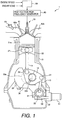
- FIG. 1 a simplified schematic cross-sectional view of a portion of a multi-link engine 1 is illustrated that forms a part of an electric discharge structure in accordance with a first embodiment.
- the multi-link engine 1 utilizes a non-equilibrium plasma discharge function, advantageously barrier discharge, to improve the auto-ignition properties of the multi-link engine 1.
- the engine 1 is provided with a barrier discharge device 70.
- the barrier discharge device 70 is provided between an intake port 60a and an exhaust port 60b, substantially in the center of a combustion chamber of a cylinder head.
- the barrier discharge device 70 generates radicals through barrier discharge, which is a non-equilibrium plasma discharge.
- the barrier discharge device 70 is also capable of igniting an air-fuel mixture through barrier discharge at a comparatively high load (when the air-to-fuel ratio of the air-fuel mixture is comparatively rich).
- the detailed structure of the barrier discharge device 70 will be described hereinafter with reference to an enlarged view ( Figure 2 ).
- the engine 1 having a barrier discharge function has a variable compression ratio mechanism (hereinafter referred to as a "multi-link variable compression ratio mechanism"), which uses a multi-link mechanism for connecting a piston 32 to a crankshaft 33 by two links.
- the multi-link variable compression ratio mechanism connects the piston 32 to the crankshaft 33 by an upper (first) link 11 and a lower (second) link 12.
- the multi-link variable compression ratio mechanism also controls the lower link 12 by using a control (third) link 13 to vary the mechanical compression ratio.
- the upper link 11 is connected at the top end to the piston 32 via a piston pin 21.
- the upper link 11 is connected at the bottom end to one end of the lower link 12 via a connecting pin 22.
- the piston 32 receives combustion pressure that moves the piston 32 within a cylinder 31a of a cylinder block 31 back and forth.
- the lower link 12 is connected at one end to the upper link 11 via the connecting pin 22.
- the lower link 12 is connected at the other end to the control link 13 via a connecting pin 23.
- the lower link 12 also has a substantially central connecting hole in which crank pins 33b of the crankshaft 33 are disposed.
- crank pins 33b of the crankshaft 33 are disposed.
- the crankshaft 33 comprises a plurality of crank journals 33a and a plurality of crank pins 33b for each cylinder.
- the journals 33a are rotatably supported by the cylinder block 31 and a ladder frame 34.
- the crank pins 33b are eccentric relative to the crank journals 33a by a predetermined amount, and the lower link 12 is oscillatably connected thereto.
- the control link 13 is connected to the lower link 12 via the connecting pin 23.
- the control link 13 is also connected at the other end to a control shaft 25 via a connecting pin 24.
- the control link 13 oscillates or rocks around the connecting pin 24.
- a gear is formed on the control shaft 25, and this gear meshes with a pinion 53 provided to a rotating axle 52 of an actuator 51.
- the control shaft 25 is rotated by the actuator 51 to move the connecting pin 24.
- Various sensors are provided for sensing the operating state of the engine, including the engine rotation speed and the engine load.
- the signals of various sensors are inputted to a controller 90.
- the controller 90 controls the actuator 51 to rotate the control shaft 25 and vary the compression ratio.
- the controller 90 also controls a high-voltage high-frequency generator 80 so that the AC voltage value, the application duration, the AC frequency, the application timing, and other parameters corresponding to the operating state of the engine are applied.
- the controller 90 may be considered to constitute a non-equilibrium plasma discharge control unit.
- the high-voltage high-frequency generator 80 constitutes a voltage application device.
- the controller 90 controls the fuel injection of a fuel injection valve 65 provided to the intake port 60a.
- An intake valve 61 is capable of varying the opening and closing timings thereof, as is described hereinafter.
- the controller 90 determines the engine load and performs control according to the load.
- the controller 90 is configured from a microcomputer comprising a central processing unit (CPU), a read-only memory (ROM), a random access memory (RAM), and an input/output interface (I/O interface).
- the controller 90 can also be configured from a plurality of microcomputers.
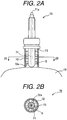
- FIGS. 2A and 2B contain enlarged cross-sectional views of the barrier discharge device 70.
- the barrier discharge device 70 of the illustrated embodiment discharges non-equilibrium plasma by using a barrier discharge.
- Non-equilibrium plasma can also be formed by applying a short pulse instead of forming a barrier discharge, but barrier discharge is beneficial in the illustrated embodiment. The reasons for this are described hereinafter.
- the barrier discharge device 70 comprises a central electrode 71 and a tubular electrode 72.
- the central electrode 71 is a rod-shaped electrical conductor. The entire periphery of the central electrode 71 is covered by a dielectric material (insulating material) 73.
- the central electrode 71 is connected to the high-voltage high-frequency generator 80 via a terminal 71a.
- An AC voltage is applied to the central electrode 71 upon being generated by the high-voltage high-frequency generator 80.
- the value, application duration, AC frequency, application timing, and other characteristics of the AC voltage are controlled (set) according to the operating state of the engine 1,
- the tubular electrode 72 is a tubular electrical conductor.
- the tubular electrode 72 is attached to the cylinder head.
- the inner periphery side of the tubular electrode 72 is a discharge chamber 72a.
- the central electrode 71 protrudes into the discharge chamber 72a.
- the central electrode 71 is provided on the top side of the substantial center of the fuel chamber.
- the center of the central electrode is substantially parallel to a line extending through the center of the fuel chamber.
- the distance from the central electrode 71 to the dielectric material and the distance from the dielectric material to the tubular electrode 72 are set to be substantially the same.
- streamers S are generated between the tubular electrode 72 and the dielectric material 73 as shown in Figure 2A .
- a plurality of streamers S is generated in the vertical direction as shown in Figure 2A .
- the streamers are branched into thin streaks, and Figure 2A shows a state in which six streamers are generated on both the right and left sides of the dielectric material 73.
- the streamers are also formed in a radial pattern about the dielectric material 73, as shown in Figure 2B.
- Figure 2B shows a state in which twelve streamers are formed in a radial pattern about the dielectric material 73.
- the barrier discharge device 70 can generate a large amount of radicals in the discharge chamber 72a by forming a plurality of streamers S. It is also possible for multipoint simultaneous ignition, i.e., a volumetric ignition (hereinafter referred to as "volume ignition”), to occur within the discharge chamber.
- volume ignition a volumetric ignition
- the barrier discharge device 70 can perform multiple electric discharges within a predetermined time, whereby a large amount of radicals can be generated in the discharge chamber 72a. This will be described with reference to Figures 3A and 3B.
- Figures 3A and 3B contain views showing the electric discharge obtained when an AC voltage (electric potential) is applied.
- Figure 3A is a diagram showing the electric discharges obtained when an AC voltage (electric potential) is applied by a spark ignition discharge mechanism in accordance with a comparative example of a conventional discharge mechanism.
- Figure 3B is a view showing the electric discharges obtained when an AC voltage (electric potential) is applied by the electric discharge structure in accordance with the illustrated embodiment.
- the dielectric material (insulating material) 73 covers the central electrode 71.
- the dielectric material 73 acts as a capacitor.
- a barrier discharge non-equilibrium plasma discharge
- an electric charge is accumulated on the surface of the dielectric material 73.
- the barrier discharge occurs between the dielectric material 73 and the tubular electrode 72 when the absolute value of the difference between the electric potential V 0 created by the applied voltage and the electric potential Vw created by the surface electric charge of the dielectric material 73 reaches a discharge voltage Vd, as shown in Figure 3B . Therefore, streamers S are formed at a plurality of locations in the discharge chamber 72a in the barrier discharge device 70, and eight barrier discharges (non-equilibrium plasma discharges) occur within the discharge time t, as shown in Figure 3B .
- the barrier discharge device 70 can increase the number of discharges in the same time (discharge time t) to a greater level than that obtained with a sparkplug in a conventional method.
- increasing the voltage value of the AC voltage in the barrier discharge device 70 also makes more likely that the absolute value of the difference between the electric potential V 0 created by the applied voltage and the electric potential Vw created by the surface electric charge of the dielectric material 73 will reach the discharge voltage Vd, and makes it possible to increase the number of discharges.
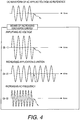
- Figure 4 is a diagram showing various methods for increasing the discharge energy of the electric discharge structure.
- the discharge energy of the barrier discharge device 70 is controlled by the voltage value, application duration, and AC frequency of the AC voltage from the high-voltage high-frequency generator 80.
- One possibility for increasing the discharge energy of the barrier discharge device 70 is a method for increasing the voltage value of the AC voltage in the manner shown in plot (B-1) of Figure 4 relative to the waveform of a reference AC applied voltage (plot (A) of Figure 4 ).
- the discharge energy of the barrier discharge part can also be increased by increasing the frequency of the AC voltage, the applied duration as in plot (B-2) of Figure 4 , or the AC frequency as in plot (B-3) of Figure 4 .
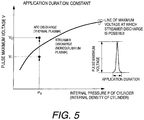
- FIG. 5 is a graph showing the problems with forming non-equilibrium plasma by the application of short pulses in accordance with a comparative example of a conventional discharge mechanism.
- Non-equilibrium plasma is generated if the voltage V1 is applied at a pressure P0, but when the voltage V2 is applied, thermal plasma is generated, as shown in Figure 5 .
- non-equilibrium plasma or thermal plasma is generated merely by slight variations in the applied voltage, and the discharge lacks robustness with short pulse application.
- the electrodes are originally covered on one side with a dielectric material, and the voltage is kept substantially within a range that extends from the discharge start voltage (lower limit of voltage) to a voltage at which the withstand-voltage properties of the dielectric material can be ensured (upper limit of voltage), whereby non-equilibrium plasma can always be maintained regardless of the voltage.
- An arc transition does not take place because the electrodes are covered by a dielectric material.
- discharge robustness is high.
- the potential required for a discharge varies extensively, and it is difficult to form non-equilibrium plasma by the application of short pulses. Therefore, non-equilibrium plasma based on a barrier discharge is advantageous for application in an internal combustion engine.
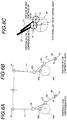
- FIGS 6A-6C are simple link diagrams showing the arrangement of a multi-link variable compression ratio mechanism.
- the mechanical compression ratio can be varied by rotating the control shaft 25 and varying the position of the connecting pin 24.
- the connecting pin 24 is at position A as shown in Figure 6C
- the top dead center (TDC) is at a high level, resulting in a high compression ratio.
- the connecting pin 24 is at position B as shown in Figures 6B and 6C
- the control link 13 is pushed upward, and the position of the connecting pin 23 rises.
- the lower link 12 is thereby rotated counterclockwise around the crank pins 33b, the connecting pin 22 moves down, and the piston 32 in the piston top dead center (TDC) moves to a lower position. Therefore, the compression ratio is low.
- FIG. 7 is a perspective view showing a variable valve timing mechanism for adjusting the opening and closing timing of a valve.
- the engine 1 having a barrier discharge function comprises a variable valve timing mechanism 200.
- the mechanism disclosed, for example, in Japanese Laid-Open Patent Application No. 11-107725 can be used as the variable valve timing mechanism 200. This is described with reference to the drawings.
- the variable valve timing mechanism 200 comprises a camshaft 210, a link arm 220, a valve lift control shaft 230, a rocker arm 240, a link member 250, and oscillating cams 260.
- Cam followers 63 are pushed by the oscillation of the oscillating cams 260, thus opening and closing valves (intake valves) 61.
- the camshaft 210 is rotatably supported at the top part of the cylinder head along the longitudinal direction of the engine. One end of the camshaft 210 is inserted through a cam sprocket 270. The cam sprocket 270 is rotated by the transmission of torque from a crank axle of the engine. The camshaft 210 rotates together with the cam sprocket 270. The camshaft 210 can rotate relative to the cam sprocket 270 by hydraulic pressure, and the phase of the camshaft 210 relative to the cam sprocket 270 can be varied. This type of structure makes it possible to vary the rotational phase of the camshaft 210 relative to the crank axle. A cam 211 is fixed to the camshaft 210.
- the cam 211 rotates integrally with the camshaft 210.
- the pair of oscillating cams 260 connected by pipes is inserted through the camshaft 210.
- the oscillating cams 260 oscillate around the camshaft 210 as a rotational center, and the cam followers 63 perform a stroke.
- the link arm 220 is supported by the insertion of the cam 211.
- the valve lift control shaft 230 is disposed parallel to the camshaft 210.
- a cam 231 is formed integrally on the valve lift control shaft 230.
- the valve lift control shaft 230 is controlled by an actuator 280 so as to rotate within a predetermined range of rotational angles.
- the rocker arm 240 is supported by the insertion of the cam 231 and is connected to the link arm 220.
- the link member 250 is connected to the rocker arm 240.
- the camshaft 210 is inserted through the oscillating cams 260, which can oscillate around the camshaft 210.
- the oscillating cams 260 are connected to the link member 250.
- the oscillating cams 260 move up and down, pushing down on the cam followers 63 and opening and closing the valves 61.
- variable valve timing mechanism 200 Next, the action of the variable valve timing mechanism 200 will be described with reference to Figures 8A-8D .
- Figures 8A and 8B are views showing the manner in which the stroke amount of the cam followers 63 is maximized to maximize the lift amount of the valves 61.
- Figure 8A shows the manner in which cam noses 262 are at their highest positions, and the oscillation direction of the oscillating cams 260 is inverted. At this time, the cam followers 63 are at top end positions, and the valves 61 are in a closed state.
- Figure 8B shows the manner in which the cam noses 262 are at their lowest positions, and the oscillation direction of the oscillating cams 260 is inverted. At this time, the cam followers 63 are at bottom end positions, and the valves 61 are in a state of maximum lift.
- Figures 8C and 8D are views showing the manner in which the stroke amount of the cam followers 63 is minimized.
- Figure 8C shows the manner in which the cam noses 262 are at their highest positions and the oscillating direction of the oscillating cams 260 is inverted.
- Figure 8D shows the manner in which the cam noses 262 are at their lowest positions and the oscillation direction of the oscillating cams 260 is inverted.
- the stroke amount of the cam followers 63 is zero
- the lift amount of the valves 61 is also zero. Therefore, in Figures 8C and 8D , the valves 61 are always in a closed state regardless of the action of the oscillating cams 260.
- valve lift control shaft 230 is rotated to lower the position of the cam 231 and to set the axial center P1 below the axial center P2, as shown in Figures 8A and 8B .
- the entire rocker arm 240 is thereby moved downward.
- valve lift control shaft 230 is rotated to raise the position of the cam 231, and the axial center P1 is set above and to the right of the axial center P2, as shown in Figures 8C and 8D .
- the entire rocker arm 240 is thereby moved upward.
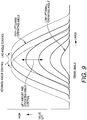
- Figure 9 is a graph showing the valve lift amount and the opening and closing timings in the variable valve timing mechanism 200.
- the solid lines indicate the lift amount and the opening and closing timings of the valves 61 when the valve lift control shaft 230 is rotated.
- the dashed lines indicate the opening and closing timings of the valves 61 when the phase of the camshaft 210 is varied relative to the cam sprocket 270.
- the lift amount and operating angle of the valves 61 can be continually varied.
- the lift amount and operating angle of the valves 61 can be continually and freely varied by varying the angle of the valve lift control shaft 230 and the phase of the camshaft 210 relative to the cam sprocket 270.
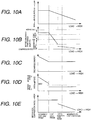
- Figures10A-10E are graphs showing an example of an operation map of the engine having a barrier discharge function.
- the range of extremely low load for example, engine is in an idle state
- the air-fuel ratio A/F is set to a constant value ( Figure 10A ).
- the barrier discharge start timing is set to a constant timing of the intake stroke ( Figure 10B ).
- the constant timing is a timing in which the setting is made near the most advanced angle within the low load range described hereinafter.
- the discharge energy is set to a level that increases the lower the load is ( Figure 10C ).
- the intake valve close timing (IVC) is set to be nearer to the advance angle than the bottom dead center (BDC), and the operation proceeds according to the Miller cycle. This timing is set to an angle that is more advanced the lower the load is ( Figure 10D ).
- the mechanical compression ratio is set to a high level ( Figure 10E ).
- the air-fuel ratio A/F is set to decrease (i.e., become richer) as the load increases ( Figure 10A ).
- the barrier discharge start timing is set to the intake stroke when the load is low, is set to approach the retard angle as the load increases, and is set to the compression stroke when the load is high ( Figure 10B ). The reasons for these settings are described hereinafter.
- the discharge energy is set to a constant value ( Figure 10C ).
- the intake valve close timing (IVC) is set to a constant value nearer the retard angle than the bottom dead center (BDC) ( Figure 10D ).
- the mechanical compression ratio is set to a high level ( Figure 10E ).
- the air-fuel ratio A/F is set to decrease (i.e., become richer) as the load increases ( Figure 10A ).
- the barrier discharge start timing is set to lag much more than in the low load range, and is also set to approach the retard angle as the load increases ( Figure 10B ).
- the discharge energy is set to a constant value ( Figure 10C ).
- the intake valve close timing (IVC) is set to a constant value nearer to the lag angle than the bottom dead center (BDC) ( Figure 10D ).
- the mechanical compression ratio is set to be much less than in the extremely low load range or the low load range, and is also set to decrease as the load increases ( Figure 10E ).
- the air-fuel ratio A/F is set to decrease (i.e., become richer) as the load increases ( Figure 10A ).
- the barrier discharge start timing is set to approach the retard angle as the load increases ( Figure 10B ).
- the discharge energy is set to a constant value ( Figure 10C ).
- the intake valve close timing (IVC) is set to a constant value nearer to the retard angle than the bottom dead center (BDC) ( Figure 10D ).
- the mechanical compression ratio is set to be even less than in the low-to-moderate load range, and is also set to decrease as the load increases ( Figure 10E ).
- the barrier discharge start timing is set to the intake stroke when the load is low, is set to approach the retard angle as the load increases, and is set to the compression stroke when the load is high ( Figure 10B ).
- Figure 10B The reasons for these settings will be explained with reference to Figure 11 .
- Figure 11 is a graph showing the variation in the heat generation rate outside of the barrier discharge start timing.
- Line A in the diagram is shown as a comparative example, and is a line indicating variation in the heat generation rate when a barrier discharge is not performed (i.e., radicals are not generated). It can be seen from line A that the peak of the heat generation rate is suppressed at the crank angle ⁇ a.
- the heat generation rate is substantially symmetrical before and after this peak, and the crank angle MB ⁇ 50% (discussed below) at which the mass combustion ratio is 50% substantially coincides with ⁇ a.
- Line B in the diagram is a line indicating variation in the heat generation rate when a barrier discharge is initiated during the compression stroke (for example, 135 deg BTDC). It can be seen from line B that the peak of the heat generation rate is suppressed at the crank angle ⁇ b nearer to the advance angle than when the barrier discharge was not performed (line A), and the heat generation rate rises more rapidly than when the barrier discharge was not performed (line A).
- the heat generation rate is substantially symmetrical before and after this peak, and the crank angle MB ⁇ 50%, at which the mass combustion ratio is 50%, substantially coincides with ⁇ b.
- Line C in the diagram is a line indicating variation in the heat generation rate when a barrier discharge is initiated during the intake stroke (for example, 270 deg BTCD). It can be seen from line C that the peak of the heat generation rate is suppressed at the crank angle ⁇ c even nearer to the advance angle than when the barrier discharge was initiated during the compression stroke (line B), and the variation is steep.
- the heat generation rate is substantially symmetrical before and after this peak, and the crank angle MB ⁇ 50%, at which the mass combustion ratio is 50%, substantially coincides with ⁇ c.
- Figures 12A-C contain drawings schematically depicting the state in which radicals are distributed within the cylinder, which is the result of analyzing the reasons that bring about a state such as in Figure 11 .
- the radicals are schematically depicted by the dots in the drawings. Research has shown that differences in the variation in the heat generation rate brought about by the barrier discharge start timing are caused by the state in which radicals are distributed within the cylinder, as shown in Figure 11 .
- radicals are distributed throughout substantially the entire cylinder 31a immediately before ignition, as shown in Figure 12C . This is because there is a long timing from the time when the barrier discharge device 70 performs a barrier discharge to generate radicals until the time of ignition, and the radicals are therefore carried by the intake flow to be widely dispersed throughout the cylinder 31a.
- compression ignition takes place in the state in which the radicals are widely distributed, the air-fuel mixture combusts substantially all at once throughout the entire cylinder 31a.
- the radicals are in a state in which molecular dissociation is induced by collisions of high-energy electrons with fuel or air molecules.
- radicals have the characteristic of readily inducing oxidation reactions (i.e., combustion) and creating chain oxidation reactions.
- the radicals undergo combustion substantially all at once throughout the entire cylinder 31a when the pressure in the cylinder increases while radicals having such characteristics are dispersed throughout the entire cylinder 31a.
- Research has shown that the heat generation rate also rises suddenly because a combustion reaction takes place in this manner throughout the entire cylinder 31a.
- Initiating a barrier discharge during the compression stroke brings about an intermediate state in the cylinder 31a immediately before ignition, that is, a state between the case of no barrier discharge ( Figure 12A ) and the case in which a barrier discharge is initiated during the intake stroke ( Figure 12C ).
- the intermediate state fewer radicals are distributed in the vicinity of the barrier discharge device 70 ( Figure 12B ). This is because there is a short timing from the time when the barrier discharge device 70 performs a barrier discharge to generate radicals until the time of ignition, and the radicals are therefore unable to widely disperse.
- the combustion process first involves the radicals and then spreads to the surrounding radical-free air-fuel mixture. It is because of this type of mechanism that line B is an intermediate line between line A and line C.
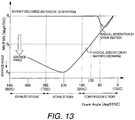
- Figure 13 is a graph showing the relationship between the barrier discharge start timing and the crank angle at which the mass combustion ratio is 50%.
- varying the barrier discharge start timing causes a change in the crank angle MB ⁇ 50% at which the mass combustion ratio is 50%.
- the auto-ignition properties change.
- This relationship is plotted in Figure 13 .
- the crank angle MB ⁇ 50% at which the mass combustion ratio is 50% advances as the barrier discharge start timing is advanced.
- auto-ignition properties are improved.
- the crank angle MB ⁇ 50% at which the mass combustion ratio is 50% lags behind as the barrier discharge start timing is advanced.
- crank angle MB ⁇ 50% at which the mass combustion ratio is 50% advances the farthest (i.e., auto-ignition properties are best) when the barrier discharge start timing is approximately 270 deg BTDC.
- the intake valve and exhaust valve of the engine are normally opened and closed. It is believed that initiating a barrier discharge after the exhaust valve has closed causes the air-fuel mixture drawn in through the intake valve to scatter more readily and auto-ignition properties to improve in comparison with a case in which a barrier discharge is initiated during the timing in which the exhaust valve has not yet closed.
- the barrier discharge part continuously performs a barrier discharge for a predetermined time (predetermined crank angle timing) following discharge initiation.
- the air flow rate decreases after the intake valve is closed.
- the heat generation timing (the crank angle MB ⁇ 50% at which the mass combustion ratio is 50%) can be controlled by adjusting the barrier discharge start timing.
- the auto-ignition properties of the air-fuel mixture can be controlled by adjusting the barrier discharge start timing.
- the barrier discharge start timing is adjusted according to the air-fuel ratio (load).
- Figure 13 also shows a case in which radicals are generated by a sparkplug. It is clear from the diagram that even if radicals are generated by a sparkplug, there is little difference from cases in which radicals are not generated.
- an electric discharge structure which causes a barrier discharge to be initiated during the intake stroke so that radicals are widely distributed within the cylinder when the air-fuel ratio corresponds to an extremely diluted (lean) condition.
- the auto-ignition properties are adjusted by delaying the barrier discharge start timing as the load increases (as the amount of fuel increases and the air-fuel ratio corresponds to a richer mixture).
- the above factors are the reasons that the barrier discharge start timing is set to occur during the intake stroke when the load is low, is set to approach a retard angle as the load increases, and is set to occur during the compression stroke when the load is high ( Figure 10B ).
- the mechanical compression ratio is set to a high level in a load range at or below a low load ( Figure 10E ). The reasons for these settings will now be described.
- An engine having a multi-link variable compression ratio mechanism has the characteristic of having a longer timing in which the piston stays in proximity to the top dead center in comparison with a common engine in which the compression ratio is constant (hereinafter referred to as a "normal engine"). Due to this characteristic, an engine having a multi-link variable compression ratio mechanism, even at a high compression ratio, is less susceptible to knocking than a common engine is, comparatively high combustion energy can be obtained even with ultra-lean combustion, and stable combustion can be maintained.
- Figure 14 contains a graph showing the piston behavior in a multi-link variable compression ratio mechanism, wherein the upper portion of Figure 14 is an enlarged view of the dotted line portion of the lower portion of the figure.
- the thin solid lines indicate the piston behavior in the multi-link variable compression ratio mechanism engine having the same compression ratio as a normal engine.
- the multi-link variable compression ratio mechanism engine has a longer timing in which the piston is in proximity to the top dead center than does a normal engine having the same compression ratio.
- the timing L1 in which the piston is in proximity to the top dead center at a high compression ratio is longer than the timing L2 in which the piston is in proximity to the top dead center at a low compression ratio.
- the inequality L1 > L2 is true in Figure 14 .
- the multi-link variable compression ratio mechanism engine has a longer timing in which the piston is in proximity to the top dead center than does a normal engine. Furthermore, the timing in which the piston is in proximity to the top dead center is longer than that observed at a high compression ratio.
- the fact that the piston is in proximity to the top dead center for a long time means that a high compression state is maintained for a long time during combustion. When a high compression state is maintained for a long time, knocking does not readily occur, and combustion is stable because comparatively high combustion energy can be obtained even during ultra-lean combustion.
- Figure 15 is a graph showing the relationship between the air-fuel ratio and combustion stability.
- the thin line in the diagram denotes a normal engine, and the thick line denotes a multi-link variable compression ratio mechanism engine.
- the combustion stability limit is not compromised because the piston remains in proximity to the top dead center for a long time.
- Increasing the compression ratio e.g., to about 18
- A/F air-fuel ratio
- the above are the reasons the mechanical compression ratio is set to a high level in a load range at or below a low load ( Figure 10E ).
- the map load range in Figure 10 was set based on this knowledge.
- the intake valve close timing (IVC) is set nearer to the advance angle than in the bottom dead center (BDC), and the operation proceeds according to the Miller cycle.
- the timing is set nearer to the advance angle at lower loads ( Figure 10D ).
- the filling efficiency of intake air is thereby reduced, the effective compression ratio is lowered, and pump loss is reduced. Since the combustion amount decreases with decreased load (the air-fuel ratio is substantially constant because the air intake amount also decreases), the air-fuel mixture loses auto-ignition properties. In view of this, the discharge energy is greatly increased at lower loads ( Figure 10C ).
- the map of the extremely low load range in Figure 10 was set based on the above knowledge. As shown, operation is possible even at extremely low load ranges.
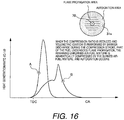
- the compression ratio is reduced so that the air-fuel mixture does not undergo compression ignition. It is designed so that volumetric ignition is performed by the barrier discharge part during the compression stroke. The fuel in the vicinity of the barrier discharge part thereby undergoes flame propagation. The remaining unburned air-fuel mixture is adiabatically compressed by the burned air-fuel mixture and is made to undergo auto-ignition. As a result, the heat generation rate varies as shown by line B in Figure 16 and does not suddenly increase to an excessive degree, and knocking does not occur.
- the map of the low-to-moderate load range in Figure 10 is set based on the above. Operation is thereby made possible even in a low-to-moderate load range.
- Spark ignition is performed by the barrier discharge part at a moderate-to-high load or greater, whereby operation is possible even in a moderate-to-high load range.
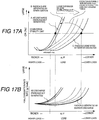
- Figures 17A and 17B contain graphs showing various effects of the present embodiment.
- the present embodiment it is possible to greatly expand the lean combustion limit because the barrier discharge start timing is appropriately controlled according to the operating state as described above.
- Line B depicts cases in which radicals are generated by a sparkplug, and combustion occurs by compression ignition.
- the lean combustion limit is the air-fuel ratio of AFb, and is somewhat leaner than the air-fuel ratio AFa of the lean combustion limit in normal cases.
- Line C depicts cases in which radicals are generated by the barrier discharge part, and combustion occurs by compression ignition.
- the lean combustion limit is the air-fuel ratio of AFc.
- the lean combustion limit can be greatly expanded in comparison with the air-fuel ratio AFa of the lean combustion limit in normal cases and in comparison with the air-fuel ratio AFb of the lean combustion limit in generation of radicals by a sparkplug and combustion by compression ignition.
- the operation shown by the dashed lines can be arbitrarily selected because it is possible to control the crank angle MB ⁇ 50% at which the mass combustion ratio is 50% by adjusting the barrier discharge start timing.
- the fuel consumption rate ISFC can be reduced as shown in Figure 17B .
- the present embodiment makes it possible to reduce the fuel consumption rate regardless of the load, and to improve fuel consumption.
- the first electrode composed of a long thin conductive material and the dielectric material for covering the first electrode allow a barrier discharge to be performed in which non-equilibrium plasma is discharged and radicals can be generated within a cylinder. Therefore, the auto-ignition properties of an air-fuel mixture during the compression stroke can be improved, the fuel consumption rate can consequently be reduced regardless of the load, and fuel consumption can also be improved.
- FIG. 18 an internal combustion engine electric discharge structure in accordance with a second embodiment will now be explained.
- the internal combustion engine electric discharge structure of the first embodiment is replaced in Figure 1 with a modified structure as discussed below.
- the parts of the second embodiment that are identical to the parts of the first embodiment will be given the same reference numerals as the parts of the first embodiment.
- the descriptions of the parts of the second embodiment that are identical to the parts of the first embodiment can be omitted for the sake of brevity.
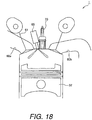
- Figure 18 is a simplified schematic cross-sectional view showing the operational configuration of the engine having an electric discharge structure in accordance with a second embodiment.
- the engine 1 having a barrier discharge function of the first embodiment was a so-called port-injection engine in which the fuel injection valve 65 was provided to the intake port, but the electric discharge structure can also be applied to a direct fuel-injection engine such as the one shown in Figure 18 , in which fuel is directly injected into the cylinder.
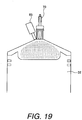
- the air-fuel mixture is stratified only in the vicinity of the barrier discharge device 70 as shown in Figure 19 to make operation possible even with a lean air-fuel ratio.
- Generating radicals in this type of lean air-fuel mixture allows the lean combustion limit to be expanded, the fuel consumption rate to be reduced, and fuel consumption to be improved.
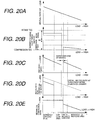
- FIG. 20A-20E An example of an operation map for the engine having such a barrier discharge function is shown in Figures 20A-20E .
- An interval in which a barrier discharge is not performed is provided in the vicinity of a comparatively high load within the low load range ( Figures 20A and 20B ).
- a high compression ratio is set by the variable compression ratio mechanism, and knocking does not readily occur. Therefore, there is an operation range in which lean combustion is possible even though a barrier discharge is not performed.
- a barrier discharge is performed in such an operating range, there is a danger that auto-ignition properties will improve excessively and that knocking will occur. In view of this, a barrier discharge is not performed in the vicinity of comparatively high loads within the low load range.
- a stratified operation is performed ( Figure 20D ) and the air-fuel ratio A/F is made leaner (sparser) according to the load ( Figure 20A ).
- a barrier discharge is performed because the auto-ignition properties must be improved along with the increase in sparseness.
- the barrier discharge start timing is set to occur during the intake stroke, wherein the effects of auto-ignition properties improvement are high ( Figure 20B ).
- the auto-ignition properties are improved by increasing the discharge energy along with the increase in sparseness ( Figure 20C ).
- the invention can be carried out even with a direct fuel-injection engine, the fuel consumption rate can be reduced regardless of the load, and fuel consumption can be improved.
- FIG. 21 an internal combustion engine electric discharge structure in accordance with a third embodiment will now be explained.
- the internal combustion engine electric discharge structure of the first embodiment is replaced in Figure 1 with a modified structure as discussed below.
- the parts of the third embodiment that are identical to the parts of the first embodiment will be given the same reference numerals as the parts of the first embodiment.
- the descriptions of the parts of the third embodiment that are identical to the parts of the first embodiment can be omitted for the sake of brevity.
- FIG. 21 is a simplified schematic cross-sectional view showing the third embodiment of an engine having a barrier discharge function.
- a dielectric layer (insulating layer) 73 is formed on the inner periphery of the tubular electrode 72, and the central electrode 71 is exposed.
- the distal end of the dielectric layer (insulating layer) 73 protrudes farther toward the combustion chamber than does the distal end of the tubular electrode 72 or the distal end of the central electrode 71. This is because such a configuration makes it possible to suppress the occurrence of a thermal plasma discharge between the distal end of the tubular electrode 72 and the distal end of the central electrode 71, even in cases in which the discharge energy of a non-equilibrium plasma discharge has been increased.
- the dielectric layer 73 acts as a capacitor in the configuration of the present embodiment as well, and the same effects as in the first embodiment are obtained.
- FIG. 22A and 22B an internal combustion engine electric discharge structure in accordance with a fourth embodiment will now be explained.
- the internal combustion engine electric discharge structure of the first embodiment is replaced in Figure 1 with a modified structure as discussed below.
- the parts of the fourth embodiment that are identical to the parts of the first embodiment will be given the same reference numerals as the parts of the first embodiment.
- the descriptions of the parts of the fourth embodiment that are identical to the parts of the first embodiment can be omitted for the sake of brevity.
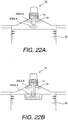
- Figures 22A and 22B contain simplified schematic cross-sectional views showing the fourth embodiment of the engine having a barrier discharge function.
- the central electrode 71 protrudes into the combustion chamber.
- the barrier discharge device 70 forms a barrier discharge within the combustion chamber as shown in Figure 22A .
- the top surface of the piston 32 or the inside wall surface of the cylinder head functions as an electrode.
- a barrier discharge is performed and radicals are generated in the area A between the top surface of the piston 32 and the dielectric layer (insulating layer) 73 of the central electrode 71, or in the area B between the inside wall surface of the cylinder head and the dielectric layer (insulating layer) 73.
- the discharge area of barrier discharge can be selected by controlling the application timing of the AC voltage applied to the barrier discharge device 70.
- a concave part can be formed in the top surface of the piston 32 as shown in Figure 22B , and the configuration can be designed so that barrier discharge is performed between the concave part and the distal end of the dielectric material (insulating material) 73 of the central electrode 71.
- FIG. 23A and 23B an internal combustion engine electric discharge structure in accordance with a fifth embodiment will now be explained.
- the internal combustion engine electric discharge structure of the first embodiment is replaced in Figure 1 with a modified structure as discussed below.
- the parts of the fifth embodiment that are identical to the parts of the first embodiment will be given the same reference numerals as the parts of the first embodiment.
- the descriptions of the parts of the fifth embodiment that are identical to the parts of the first embodiment can be omitted for the sake of brevity.
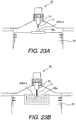
- Figures 23A and 23B contain simplified schematic cross-sectional views showing the fifth embodiment of the engine having a barrier discharge function.
- the dielectric material (insulating material) 73 is shorter in comparison with the fourth embodiment, and the central electrode 71 is exposed within the combustion chamber.
- a dielectric layer (insulating layer) 32a is also formed on the top surface of the piston 32.
- the barrier discharge device 70 performs a barrier discharge within the combustion chamber as shown in Figure 23A . Specifically, a barrier discharge is performed and radicals are generated in the area A between the distal end of the central electrode 71 and the dielectric layer (insulating layer) 32a on the top surface of the piston 32.
- a barrier discharge is performed between the dielectric layer (insulating layer) 32a and the distal end of the central electrode 71.
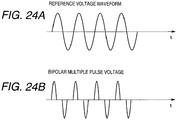
- alternating current corresponding to the operating state of the engine is applied to the barrier discharge device 70, but the alternating current is not limited to a sine curve ( Figure 24A ).
- a bipolar multiple pulse power source can also be used, such as is shown in Figure 24B .
- variable compression ratio mechanism a multi-link mechanism was shown as the variable compression ratio mechanism, but other possible examples include, e.g., a mechanism in which a hydraulic device is incorporated into the piston as such to adjust the height of the top surface of the piston, a mechanism in which the distance between the cylinder head and the cylinder block can be adjusted, and a mechanism in which the piston height can be adjusted by offsetting the center of the crankshaft.
- the mechanism for adjusting the valve timing of the intake valve can also be, e.g., an oscillating cam which uses a link (Japanese Laid-Open Patent Application No.
Landscapes
- Engineering & Computer Science (AREA)
- Chemical & Material Sciences (AREA)
- Combustion & Propulsion (AREA)
- Mechanical Engineering (AREA)
- General Engineering & Computer Science (AREA)
- Ignition Installations For Internal Combustion Engines (AREA)
- Electrical Control Of Air Or Fuel Supplied To Internal-Combustion Engine (AREA)
- Output Control And Ontrol Of Special Type Engine (AREA)
- Combustion Methods Of Internal-Combustion Engines (AREA)
- Spark Plugs (AREA)
- Elimination Of Static Electricity (AREA)
- Processes For Solid Components From Exhaust (AREA)
Claims (14)
- Vorrichtung für einen Verbrennungsmotor (1), mit:einer ersten Elektrode (71) mit einem mit Spannung beaufschlagten ersten Ende (71a) und einem zweiten Ende aus leitfähigem Material, das durch Barrieren-Entladung ein Nichtgleichgewichts-Plasma entlädt;ein die erste Elektrode (71) bedeckendes dielektrisches Material (73);eine der ersten Elektrode (71) an einem Umfang des dielektrischen Materials (73) gegenüberliegende zweite Elektrode (72);eine Spannungs-Beaufschlagungs-Vorrichtung (80), die mit dem ersten, mit Spannung beaufschlagten ersten Ende (71a) der ersten Elektrode wirkmäßig verbunden ist, um zwischen der ersten Elektrode (71) und der zweiten Elektrode (72) eine Spannung derart anzulegen, dass das Nichtgleichgewichts-Plasma Radikale innerhalb des Brennraums erzeugt, bevor die Luft-Kraftstoff-Mischung im Brennraum der Selbstzündung unterfällt; undeine mit der Spannungs-Beaufschlagungs-Vorrichtung (80) wirkmäßig verbundene Steuereinheit (90);dadurch gekennzeichnet, dass die Steuereinheit (90) dazu ausgebildet ist, den Zeitpunkt des Beginns der Nichtgleichgewichts-Entladung so einzustellen, dass er nach dem Öffnen des Einlassventils beim Ansaugtakt liegt.
- Vorrichtung wie in Anspruch 1 angegeben, wobei die zweite Elektrode (72) eine röhrenförmige Elektrode aufweist, die wenigstens einen Bereich der ersten Elektrode (71) umgreift.
- Vorrichtung wie in Anspruch 1 oder Anspruch 2 angegeben, ferner aufweisend einen Zylinderkopf (13) mit der daran angebrachten zweiten Elektrode (72), wobei die erste Elektrode (71) eine gerade Mittenelektrode aufweist.
- Vorrichtung wie in einem der Ansprüche 1 bis 3 angegeben, wobei:die erste Elektrode (71) eine gerade Mittenelektrode aufweist; unddie zweite Elektrode (72) als wenigstens ein Teil der Brennraumwandung oder der Oberfläche des Kolbens (32) ausgebildet ist.
- Vorrichtung wie in einem der Ansprüche 1 bis 4 angegeben, ferner aufweisend:ein Kraftstoffeinspritzventil (65) zum Zuführen von Kraftstoff in den Brennraum des Verbrennungsmotors (1).
- Vorrichtung wie in Anspruch 5 angegeben, wobei die Steuereinheit (90) ferner dazu ausgebildet ist:den Zeitpunkt des Beginns der Nichtgleichgewichts-Plasma-Entladung je nach der mechanischen Last des Verbrennungsmotors (1) zu variieren;den Zeitpunkt des Beendens der Nichtgleichgewichts-Plasma-Entladung so einzustellen, dass er vor dem Schließen des Einlassventils liegt; und/oderdie Entladungsenergie der Nichtgleichgewichts-Plasma-Entladung so einzustellen, dass die Entladungsenergie umso größer ist, je niedriger die mechanische Last des Verbrennungsmotors (1) wird, wenn die mechanische Last des Verbrennungsmotors (1) in einem niedrigem Bereich liegt.
- Vorrichtung wie in Anspruch 6 angegeben, wobei die Steuereinheit (90) dazu ausgebildet ist, den Zeitpunkt des Beginns der Nichtgleichgewichts-Plasma-Entladung so zu legen, dass er im Ansaugtakt liegt, wenn die mechanische Last des Verbrennungsmotors (1) vergleichsweise niedrig ist, oder den Zeitpunkt des Beginns der Nichtgleichgewichts-Plasma-Entladung so zu legen, dass er Verdichtungstakt liegt, wenn die mechanische Last des Verbrennungsmotors (1) vergleichsweise hoch ist.
- Vorrichtung wie in Anspruch 6 oder Anspruch 7 angegeben, wobei die Steuereinheit (90) ferner dazu ausgebildet ist, den Zeitpunkt des Beginns der Nichtgleichgewichts-Plasma-Entladung wie folgt zu legen:umso früher, je niedriger die mechanische Last des Verbrennungsmotors (1) wird; und/oderumso später, je höher die mechanische Last des Verbrennungsmotors (1) wird.
- Vorrichtung wie in einem der Ansprüche 6 bis 8 angegeben, wobei die Steuereinheit (90) ferner dazu ausgebildet ist, die Entladungsenergie der Nichtgleichgewichts-Plasma-Entladung nach einem aus den folgenden ausgewählten Verfahren zu erhöhen:Erhöhen des Spannungswertes der zwischen der ersten und der zweiten Elektrode (71, 72) angelegten Wechselspannung;Erhöhen der Frequenz der zwischen der ersten und der zweiten Elektrode (71, 72) angelegten Wechselspannung;Erhöhen der Anlegungsdauer der zwischen der ersten und der zweiten Elektrode (71, 72) angelegten Wechselspannung.
- Vorrichtung wie in einem der Ansprüche 5 bis 9 angegeben, ferner aufweisend:einen Mechanismus zur Verdichtungsvariation, der dazu ausgebildet ist, die Verdichtung des Verbrennungsmotors (1) zu verändern;wobei die Steuereinheit (90) wirkmäßig mit dem Mechanismus zur Verdichtungsvariation verbunden ist, um das mechanische Verdichtungsverhältnis zu verringern, so dass das Luft-Kraftstoff-Gemisch keiner Selbstzündung unterfällt, wenn sich die mechanische Last des Verbrennungsmotors (1) in einem Hoch-Last-Bereich befindet, und volumetrische Zündung durchgeführt wird.
- Vorrichtung wie in einem der Ansprüche 5 bis 10 angegeben, wobei die Steuereinheit (90) wirkmäßig mit dem Kraftstoff-Einspritz-Ventil (65) verbunden ist, um die Kraftstoffeinspritzung in einen Zylinder (31) des Verbrennungsmotors (1) derart zu steuern, dass in dem Zylinder (31) eine geschichtete Luft-Kraftstoff-Mischung gebildet wird, wenn sich die mechanische Last des Verbrennungsmotors (1) in einem Nieder-Last-Bereich befindet.
- Verfahren zum Steuern des Betriebszustands eines Verbrennungsmotors (1), mit:Bestimmen einer mechanischen Last des Verbrennungsmotors (1);Einspritzen von Kraftstoff in einen Brennraum des Verbrennungsmotors (1); undAnlegen einer Spannung an eine elektrische Entladungsvorrichtung mit einer ersten Elektrode (71) und einer zweiten Elektrode (72), um ein Nichtgleichgewichts-Plasma herzustellen, das im Brennraum Radikale erzeugt, bevor die Luft-Kraftstoff-Mischung des Kraftstoffs Selbstzündung unterfällt;dadurch gekennzeichnet, dass das Verfahren ferner aufweist:Setzen eines Zeitpunkts des Beginns der Nichtgleichgewichts-Plasma-Entladung so, dass er nach dem Öffnen des Einlassventils beim Ansaugtakt liegt.
- Verbrennungsmotor (1) mit der in einem der Ansprüche 1 bis 11 angegebenen Vorrichtung.
- Fahrzeug mit der in einem der Ansprüche 1 bis 11 angegebenen Vorrichtung oder dem in Anspruch 13 angegebenen Motor.
Applications Claiming Priority (1)
| Application Number | Priority Date | Filing Date | Title |
|---|---|---|---|
| JP2007298294A JP5228450B2 (ja) | 2007-11-16 | 2007-11-16 | 内燃機関の運転制御装置及び運転制御方法 |
Publications (3)
| Publication Number | Publication Date |
|---|---|
| EP2060780A2 EP2060780A2 (de) | 2009-05-20 |
| EP2060780A3 EP2060780A3 (de) | 2012-10-24 |
| EP2060780B1 true EP2060780B1 (de) | 2018-02-28 |
Family
ID=40350117
Family Applications (1)
| Application Number | Title | Priority Date | Filing Date |
|---|---|---|---|
| EP08168914.3A Not-in-force EP2060780B1 (de) | 2007-11-16 | 2008-11-12 | Elektrische Entladungsstruktur eines Verbrennungsmotors |
Country Status (3)
| Country | Link |
|---|---|
| US (1) | US20090126668A1 (de) |
| EP (1) | EP2060780B1 (de) |
| JP (1) | JP5228450B2 (de) |
Families Citing this family (26)
| Publication number | Priority date | Publication date | Assignee | Title |
|---|---|---|---|---|
| US7008487B1 (en) | 2002-03-04 | 2006-03-07 | Micron Technology, Inc. | Method and system for removal of contaminates from phaseshift photomasks |
| FR2932229B1 (fr) * | 2008-06-05 | 2011-06-24 | Renault Sas | Pilotage de l'alimentation electrique d'une bougie d'allumage d'un moteur a combustion interne |
| JP5182377B2 (ja) * | 2008-12-25 | 2013-04-17 | トヨタ自動車株式会社 | 内燃機関の制御装置 |
| JP2011034953A (ja) | 2009-02-26 | 2011-02-17 | Ngk Insulators Ltd | プラズマイグナイター及び内燃機関の点火装置 |
| MX349492B (es) | 2009-06-04 | 2017-08-01 | Excel Thermic Llc | Motor de combustión interna. |
| JP5934851B2 (ja) | 2009-10-06 | 2016-06-15 | イマジニアリング株式会社 | 内燃機関 |
| US8616177B2 (en) * | 2010-02-11 | 2013-12-31 | Wisconsin Alumni Research Foundation | Engine combustion control via fuel reactivity stratification |
| EP2673497B1 (de) * | 2011-02-11 | 2019-01-23 | Sphenic Technologies Inc. | System, schaltung und verfahren zur steuerung einer verbrennung |
| DE102012100841B3 (de) * | 2012-02-01 | 2013-05-29 | Borgwarner Beru Systems Gmbh | Verfahren zum Steuern des Zündzeitpunktes in einem Verbrennungsmotor mittels einer Korona-Entladung |
| US20150053178A1 (en) * | 2012-03-29 | 2015-02-26 | Wayne State University | Combustion modification and emissions reduction utilizing an electrically insulated engine member in internal combustion engines |
| JP5901459B2 (ja) | 2012-07-25 | 2016-04-13 | 株式会社デンソー | 点火装置 |
| US9617965B2 (en) | 2013-12-16 | 2017-04-11 | Transient Plasma Systems, Inc. | Repetitive ignition system for enhanced combustion |
| US9970407B2 (en) * | 2014-09-08 | 2018-05-15 | GM Global Technology Operations LLC | Method and apparatus for controlling operation of an internal combustion engine |
| WO2016075361A1 (en) * | 2014-11-12 | 2016-05-19 | Wärtsilä Finland Oy | Lean-burn internal combustion gas engine provided with a dielectric barrier discharge plasma ignition device within a combustion prechamber |
| JP6445928B2 (ja) * | 2015-05-19 | 2018-12-26 | 本田技研工業株式会社 | 内燃機関の点火装置 |
| JP7058084B2 (ja) * | 2017-06-14 | 2022-04-21 | 株式会社Soken | 点火装置 |
| DE112018005453T5 (de) * | 2017-11-09 | 2020-07-30 | Mitsubishi Electric Corporation | Zündvorrichtung |
| WO2019144037A1 (en) | 2018-01-22 | 2019-07-25 | Transient Plasma Systems, Inc. | Resonant pulsed voltage multiplier and capacitor charger |
| EP3732703B1 (de) | 2018-01-22 | 2022-08-31 | Transient Plasma Systems, Inc. | Induktiv gekoppelter gepulster hochfrequenzspannungsvervielfacher |
| JP7010141B2 (ja) * | 2018-05-21 | 2022-01-26 | マツダ株式会社 | エンジンの燃焼制御方法及び燃焼制御装置 |
| US11629860B2 (en) | 2018-07-17 | 2023-04-18 | Transient Plasma Systems, Inc. | Method and system for treating emissions using a transient pulsed plasma |
| EP3824223B1 (de) | 2018-07-17 | 2024-03-06 | Transient Plasma Systems, Inc. | Verfahren und system zur behandlung von kochrauchemissionen mithilfe eines transienten gepulsten plasmas |
| DE112019004778T5 (de) * | 2018-10-24 | 2021-09-09 | Hitachi Astemo, Ltd. | Steuervorrichtung für brennkraftmaschine |
| US20200182217A1 (en) * | 2018-12-10 | 2020-06-11 | GM Global Technology Operations LLC | Combustion ignition devices for an internal combustion engine |
| WO2020226977A1 (en) | 2019-05-07 | 2020-11-12 | Transient Plasma Systems, Inc. | Pulsed non-thermal atmospheric pressure plasma processing system |
| WO2022187226A1 (en) | 2021-03-03 | 2022-09-09 | Transient Plasma Systems, Inc. | Apparatus and methods of detecting transient discharge modes and/or closed loop control of pulsed systems employing same |
Family Cites Families (29)
| Publication number | Priority date | Publication date | Assignee | Title |
|---|---|---|---|---|
| US1991369A (en) * | 1931-01-30 | 1935-02-19 | Berger Bror | Electric spark ignition |
| DE2456163C2 (de) * | 1974-11-28 | 1986-03-13 | Daimler-Benz Ag, 7000 Stuttgart | Brennkammer, insbesondere Kolbenarbeitsraum eines Motors |
| JPH0417706A (ja) | 1990-05-07 | 1992-01-22 | Nissan Motor Co Ltd | エンジンの弁作動装置 |
| US5469013A (en) * | 1993-03-31 | 1995-11-21 | The United States Of America As Represented By The United States Department Of Energy | Large discharge-volume, silent discharge spark plug |
| CZ282875B6 (cs) * | 1994-12-23 | 1997-11-12 | BRISK Tábor a. s. | Zapalovací svíčka |
| JP3146956B2 (ja) | 1995-06-14 | 2001-03-19 | 株式会社デンソー | 内燃機関用バルブタイミング調整装置 |
| US5731655A (en) * | 1996-03-12 | 1998-03-24 | Corrado; Paul A. | Spark plug with 360 degree firing tip |
| JPH10309308A (ja) * | 1997-05-13 | 1998-11-24 | Nissin Electric Co Ltd | 粒状または粉状の被処理物の殺菌装置 |
| JP3881783B2 (ja) | 1997-08-07 | 2007-02-14 | 株式会社日立製作所 | 内燃機関の可変動弁装置 |
| DE19847096A1 (de) * | 1998-10-13 | 2000-04-20 | Massholder Karl F | Verfahren und Vorrichtung zur plasmachemischen Reduzierung von gasförmigen und/oder festen Schadstoffen in Abgasen von Verbrennungsmotoren |
| JP2001012337A (ja) * | 1998-10-23 | 2001-01-16 | Nippon Soken Inc | 火花点火装置 |
| JP3953668B2 (ja) | 1999-01-20 | 2007-08-08 | 株式会社日立製作所 | 内燃機関の可変動弁装置 |
| JP2001020842A (ja) * | 1999-07-09 | 2001-01-23 | Nissan Motor Co Ltd | 内燃機関の燃焼制御装置 |
| JP4259717B2 (ja) * | 1999-08-02 | 2009-04-30 | 株式会社日本自動車部品総合研究所 | 火花点火装置 |
| GB2352772A (en) * | 1999-08-05 | 2001-02-07 | Ford Global Tech Inc | Method of operating a spark-ignition i.c. engine using a series of sparks to promote auto-ignition |
| US6883507B2 (en) * | 2003-01-06 | 2005-04-26 | Etatech, Inc. | System and method for generating and sustaining a corona electric discharge for igniting a combustible gaseous mixture |
| JP4326386B2 (ja) * | 2004-03-26 | 2009-09-02 | 本田技研工業株式会社 | 制御装置 |
| JP2006257896A (ja) * | 2005-03-15 | 2006-09-28 | Toyota Motor Corp | 燃料噴射装置 |
| US7625531B1 (en) * | 2005-09-01 | 2009-12-01 | Los Alamos National Security, Llc | Fuel injector utilizing non-thermal plasma activation |
| JP4876217B2 (ja) * | 2005-09-20 | 2012-02-15 | イマジニアリング株式会社 | 点火装置、内燃機関 |
| RU2333381C2 (ru) * | 2005-11-03 | 2008-09-10 | Нек Лаб Холдинг Инк. | Способ инициирования воспламенения, интенсификации горения или реформинга топливовоздушных и топливокислородных смесей |
| JP4860325B2 (ja) * | 2006-03-31 | 2012-01-25 | シャープ株式会社 | 金属および/または金属化合物が加工されたディスプレイ基材の再資源化方法、ならびに再資源化装置 |
| JP3122373U (ja) * | 2006-03-31 | 2006-06-08 | レシップ株式会社 | 放電管 |
| JP4981351B2 (ja) | 2006-04-27 | 2012-07-18 | 彌榮精機株式会社 | サイドスリップテスター |
| JP4946173B2 (ja) * | 2006-05-17 | 2012-06-06 | 日産自動車株式会社 | 内燃機関 |
| CN101351638B (zh) * | 2006-09-20 | 2012-09-26 | 创想科学技术工程株式会社 | 点火装置、内燃机、点火塞、等离子设备、废气降解装置、臭氧发生/消毒/杀菌装置,以及除臭装置 |
| JP4924275B2 (ja) * | 2007-08-02 | 2012-04-25 | 日産自動車株式会社 | 非平衡プラズマ放電式の点火装置 |
| JP2009036123A (ja) * | 2007-08-02 | 2009-02-19 | Nissan Motor Co Ltd | 非平衡プラズマ放電式エンジン |
| JP5119879B2 (ja) * | 2007-11-16 | 2013-01-16 | 日産自動車株式会社 | 内燃機関の非平衡プラズマ放電制御装置及び非平衡プラズマ放電制御方法 |
-
2007
- 2007-11-16 JP JP2007298294A patent/JP5228450B2/ja active Active
-
2008
- 2008-11-12 EP EP08168914.3A patent/EP2060780B1/de not_active Not-in-force
- 2008-11-13 US US12/269,948 patent/US20090126668A1/en not_active Abandoned
Non-Patent Citations (1)
| Title |
|---|
| None * |
Also Published As
| Publication number | Publication date |
|---|---|
| JP5228450B2 (ja) | 2013-07-03 |
| JP2009121406A (ja) | 2009-06-04 |
| EP2060780A2 (de) | 2009-05-20 |
| EP2060780A3 (de) | 2012-10-24 |
| US20090126668A1 (en) | 2009-05-21 |
Similar Documents
| Publication | Publication Date | Title |
|---|---|---|
| EP2060780B1 (de) | Elektrische Entladungsstruktur eines Verbrennungsmotors | |
| EP2060781B1 (de) | Vorrichtung und Verfahren zur Motorsteuerung | |
| JP4924275B2 (ja) | 非平衡プラズマ放電式の点火装置 | |
| EP2020503A2 (de) | Nicht-Äquilibrium-Plasmaentladungs-Zündvorrichtung | |
| US7392795B2 (en) | Internal combustion engine and combustion control method | |
| US20100258097A1 (en) | Internal combustion engine | |
| US9638146B2 (en) | Gasoline direct-injection engine | |
| JP2009036068A (ja) | 内燃機関の燃焼制御装置 | |
| JP2010037949A (ja) | 内燃機関用バリア放電装置 | |
| JP5082530B2 (ja) | エンジン点火制御装置 | |
| JP2008240547A (ja) | エンジン点火制御装置 | |
| WO2016075358A1 (en) | A prechamber assembly adaptable in a cylinder head of an internal combustion engine and a cylinder head | |
| JP2012140970A (ja) | エンジン点火制御装置 | |
| JP2010209868A (ja) | エンジンの着火制御装置 | |
| JP2013148098A (ja) | エンジンの着火制御装置 | |
| JP2010037947A (ja) | 内燃機関 | |
| JP6281368B2 (ja) | 直噴エンジンの制御装置 | |
| JP2009036157A (ja) | 点火装置及び点火制御装置 | |
| JP6149765B2 (ja) | 直噴ガソリンエンジンの制御装置 | |
| JP7003731B2 (ja) | 低温プラズマの生成方法及び圧縮着火式エンジン | |
| JP7056229B2 (ja) | 予混合圧縮着火式エンジンの制御装置 | |
| JP6217493B2 (ja) | 直噴ガソリンエンジンの制御装置 | |
| JP2010001865A (ja) | エンジン |
Legal Events
| Date | Code | Title | Description |
|---|---|---|---|
| PUAI | Public reference made under article 153(3) epc to a published international application that has entered the european phase |
Free format text: ORIGINAL CODE: 0009012 |
|
| AK | Designated contracting states |
Kind code of ref document: A2 Designated state(s): AT BE BG CH CY CZ DE DK EE ES FI FR GB GR HR HU IE IS IT LI LT LU LV MC MT NL NO PL PT RO SE SI SK TR |
|
| AX | Request for extension of the european patent |
Extension state: AL BA MK RS |
|
| PUAL | Search report despatched |
Free format text: ORIGINAL CODE: 0009013 |
|
| AK | Designated contracting states |
Kind code of ref document: A3 Designated state(s): AT BE BG CH CY CZ DE DK EE ES FI FR GB GR HR HU IE IS IT LI LT LU LV MC MT NL NO PL PT RO SE SI SK TR |
|
| AX | Request for extension of the european patent |
Extension state: AL BA MK RS |
|
| RIC1 | Information provided on ipc code assigned before grant |
Ipc: F02P 23/04 20060101AFI20120914BHEP Ipc: H01T 13/52 20060101ALI20120914BHEP |
|
| 17P | Request for examination filed |
Effective date: 20130121 |
|
| AKX | Designation fees paid |
Designated state(s): DE FR GB |
|
| REG | Reference to a national code |
Ref country code: DE Ref legal event code: R079 Ref document number: 602008054192 Country of ref document: DE Free format text: PREVIOUS MAIN CLASS: F02P0023040000 Ipc: H01T0013500000 |
|
| GRAP | Despatch of communication of intention to grant a patent |
Free format text: ORIGINAL CODE: EPIDOSNIGR1 |
|
| STAA | Information on the status of an ep patent application or granted ep patent |
Free format text: STATUS: GRANT OF PATENT IS INTENDED |
|
| RIC1 | Information provided on ipc code assigned before grant |
Ipc: H01T 13/52 20060101ALI20171130BHEP Ipc: H01T 13/50 20060101AFI20171130BHEP Ipc: F02P 23/04 20060101ALI20171130BHEP |
|
| INTG | Intention to grant announced |
Effective date: 20171215 |
|
| GRAS | Grant fee paid |
Free format text: ORIGINAL CODE: EPIDOSNIGR3 |
|
| GRAA | (expected) grant |
Free format text: ORIGINAL CODE: 0009210 |
|
| STAA | Information on the status of an ep patent application or granted ep patent |
Free format text: STATUS: THE PATENT HAS BEEN GRANTED |
|
| AK | Designated contracting states |
Kind code of ref document: B1 Designated state(s): DE FR GB |
|
| REG | Reference to a national code |
Ref country code: GB Ref legal event code: FG4D |
|
| REG | Reference to a national code |
Ref country code: DE Ref legal event code: R096 Ref document number: 602008054192 Country of ref document: DE |
|
| REG | Reference to a national code |
Ref country code: FR Ref legal event code: PLFP Year of fee payment: 11 |
|
| REG | Reference to a national code |
Ref country code: DE Ref legal event code: R097 Ref document number: 602008054192 Country of ref document: DE |
|
| PLBE | No opposition filed within time limit |
Free format text: ORIGINAL CODE: 0009261 |
|
| STAA | Information on the status of an ep patent application or granted ep patent |
Free format text: STATUS: NO OPPOSITION FILED WITHIN TIME LIMIT |
|
| 26N | No opposition filed |
Effective date: 20181129 |
|
| PGFP | Annual fee paid to national office [announced via postgrant information from national office to epo] |
Ref country code: DE Payment date: 20191029 Year of fee payment: 12 |
|
| PGFP | Annual fee paid to national office [announced via postgrant information from national office to epo] |
Ref country code: FR Payment date: 20191014 Year of fee payment: 12 |
|
| PGFP | Annual fee paid to national office [announced via postgrant information from national office to epo] |
Ref country code: GB Payment date: 20191108 Year of fee payment: 12 |
|
| REG | Reference to a national code |
Ref country code: DE Ref legal event code: R119 Ref document number: 602008054192 Country of ref document: DE |
|
| GBPC | Gb: european patent ceased through non-payment of renewal fee |
Effective date: 20201112 |
|
| PG25 | Lapsed in a contracting state [announced via postgrant information from national office to epo] |
Ref country code: FR Free format text: LAPSE BECAUSE OF NON-PAYMENT OF DUE FEES Effective date: 20201130 |
|
| PG25 | Lapsed in a contracting state [announced via postgrant information from national office to epo] |
Ref country code: DE Free format text: LAPSE BECAUSE OF NON-PAYMENT OF DUE FEES Effective date: 20210601 Ref country code: GB Free format text: LAPSE BECAUSE OF NON-PAYMENT OF DUE FEES Effective date: 20201112 |