EP2061274A1 - Instrument d'aide auditive utilisant des récepteurs dotés de propriétés de performance différents - Google Patents
Instrument d'aide auditive utilisant des récepteurs dotés de propriétés de performance différents Download PDFInfo
- Publication number
- EP2061274A1 EP2061274A1 EP07121029A EP07121029A EP2061274A1 EP 2061274 A1 EP2061274 A1 EP 2061274A1 EP 07121029 A EP07121029 A EP 07121029A EP 07121029 A EP07121029 A EP 07121029A EP 2061274 A1 EP2061274 A1 EP 2061274A1
- Authority
- EP
- European Patent Office
- Prior art keywords
- signal processing
- processing device
- receiver
- hearing aid
- hearing
- Prior art date
- Legal status (The legal status is an assumption and is not a legal conclusion. Google has not performed a legal analysis and makes no representation as to the accuracy of the status listed.)
- Ceased
Links
Images

Classifications
-
- H—ELECTRICITY
- H04—ELECTRIC COMMUNICATION TECHNIQUE
- H04R—LOUDSPEAKERS, MICROPHONES, GRAMOPHONE PICK-UPS OR LIKE ACOUSTIC ELECTROMECHANICAL TRANSDUCERS; ELECTRIC HEARING AIDS; PUBLIC ADDRESS SYSTEMS
- H04R25/00—Electric hearing aids
- H04R25/65—Housing parts, e.g. shells, tips or moulds, or their manufacture
- H04R25/658—Manufacture of housing parts
-
- H—ELECTRICITY
- H04—ELECTRIC COMMUNICATION TECHNIQUE
- H04R—LOUDSPEAKERS, MICROPHONES, GRAMOPHONE PICK-UPS OR LIKE ACOUSTIC ELECTROMECHANICAL TRANSDUCERS; ELECTRIC HEARING AIDS; PUBLIC ADDRESS SYSTEMS
- H04R25/00—Electric hearing aids
- H04R25/30—Monitoring or testing of hearing aids, e.g. functioning, settings, battery power
- H04R25/305—Self-monitoring or self-testing
-
- H—ELECTRICITY
- H04—ELECTRIC COMMUNICATION TECHNIQUE
- H04R—LOUDSPEAKERS, MICROPHONES, GRAMOPHONE PICK-UPS OR LIKE ACOUSTIC ELECTROMECHANICAL TRANSDUCERS; ELECTRIC HEARING AIDS; PUBLIC ADDRESS SYSTEMS
- H04R2420/00—Details of connection covered by H04R, not provided for in its groups
- H04R2420/05—Detection of connection of loudspeakers or headphones to amplifiers
-
- H—ELECTRICITY
- H04—ELECTRIC COMMUNICATION TECHNIQUE
- H04R—LOUDSPEAKERS, MICROPHONES, GRAMOPHONE PICK-UPS OR LIKE ACOUSTIC ELECTROMECHANICAL TRANSDUCERS; ELECTRIC HEARING AIDS; PUBLIC ADDRESS SYSTEMS
- H04R25/00—Electric hearing aids
- H04R25/60—Mounting or interconnection of hearing aid parts, e.g. inside tips, housings or to ossicles
- H04R25/604—Mounting or interconnection of hearing aid parts, e.g. inside tips, housings or to ossicles of acoustic or vibrational transducers
-
- H—ELECTRICITY
- H04—ELECTRIC COMMUNICATION TECHNIQUE
- H04R—LOUDSPEAKERS, MICROPHONES, GRAMOPHONE PICK-UPS OR LIKE ACOUSTIC ELECTROMECHANICAL TRANSDUCERS; ELECTRIC HEARING AIDS; PUBLIC ADDRESS SYSTEMS
- H04R25/00—Electric hearing aids
- H04R25/70—Adaptation of deaf aid to hearing loss, e.g. initial electronic fitting
Definitions
- the invention relates to a hearing aid, to a signal processing device for the use in such hearing aid and to the adaptation of such hearing aid to the needs of a hearing impaired person using such hearing aid.
- the common hearing aid of today is a digitally programmable hearing aid comprising a microphone, a signal processing device and a receiver.
- the hearing aids are sold with only one predetermined type of receiver.
- Adaptation of the hearing aid to the needs of the hearing impaired is performed by programming the signal processing device of the hearing aid.
- the hearing loss can be categorized in different levels of severity. Different levels of severity require different degrees of the output sound pressure level of the receiver.
- the degree of amplification in the signal processing device is set to provide a certain degree of output sound pressure level of the receiver.
- the maximum output sound pressure level is a property of the receiver that is built into the hearing aid.
- a receiver with a very high maximum output sound pressure level has to be used.
- the use of a receiver with a lower maximum output sound pressure level would be less expensive.
- different dynamic ranges are preferable for different degrees of severity of the hearing loss, also with regards to the quality of adaptation of the hearing aid to the needs of the hearing impaired user. Accordingly, the use of only one predetermined receiver has the drawback that the hearing aid can not be adapted to a wide variety of severity of the hearing loss with a maintained level of quality.
- implantable hearing systems comprising a transducer for communicating vibrations to the ossicular chain.
- the described hearing aids comprise impedance measuring means for measuring the mechanical impedance of a biological load structure which, upon implantation of the output transducer, is coupled to the output transducer. The measured impedance is not a characteristic parameter of the transducer itself.
- the type of hearing aids have become increasingly popular, namely where the receiver part of the hearing aid is placed in the ear canal and the remaining hearing aid parts are placed in a housing behind the ear lobe of the hearing aid user.
- the receiver may easily be exchanged, and here it is important that the receiver which is used is in line with the settings or contents of the behind the ear part of the hearing aid.
- This adaptation includes choosing the right receiver, and/or adapting the hearing aid to the possible variation in receiver properties which might exist between receivers of the same type.
- a signal processing device for the use in a hearing aid which is electrically coupled to a connection socket operable to detachably connect a receiver to the socket and further comprise a detector operable to detect a characteristics of the receiver connected to the signal processing device through the connection socket.
- a receiver with the optimum dynamic range of the output pressure level for a certain level of severity of hearing loss can be provided without the need of a complicated mechanism within the receiver to adjust the dynamic range and/ or maximum output sound pressure.
- means for detecting the type or the size of the receiver by detecting a characteristic parameter of the receiver provide the possibility to avoid the situation that an output sound pressure level which is too high for the level of severity of the hearing loss is provided after exchange of the receiver. It should be noted that a too high output sound pressure level might damage the hearing of the user, and the means for detecting the type of the receiver provide the possibility to adapt the dynamic range and/ or the maximum output sound pressure level of the receiver by controlling the signal processing device such that it is ensured that the users hearing is not damaged.
- the signal processing device for use in a hearing aid usually comprises one, two or more input channels adapted to receive microphone or telecoil audio input signals and further has a signal processing scheme, which is programmable such that the particular hearing impairment of the user may be reflected in an amplification scheme which is applied to the input signal.
- the amplified input signal is then served at the receiver connection socket, and thereby transferred by wire to the receiver.
- the signal processing device is powered by a battery in the well known manner.
- the detector is operable to detect an impedance of the receiver.
- the impedance of the receiver is thus the characteristic parameter which may be detected by the signal processing device. This has the advantage that the output sound pressure level of the receiver can be detected because the output sound pressure level is related to the impedance of the receiver.
- a high impedance of the receiver corresponds to a low output sound pressure level, whereas a low impedance of the receiver corresponds to a high output sound pressure level of the receiver at a predetermined driving signal.
- the signal processing device comprise circuitry operable to provide a wireless or wired call signal to an electronic ID tag, and circuitry operable to receive a wired or wireless reply signal from an electronic ID tag provided in the receiver and a de-coding circuitry operable to decode the signal received from the ID tag
- an electronic ID tag of the receiver as a characteristic parameter has the advantage that the determination of different types of receivers may relate to any property of the receiver, such as the maximum output pressure level, the dynamic range or the version of a certain type of receiver.
- the read out of the electronic ID tag does not interfere with the normal operation of the hearing aid.
- An ID tag comprises a very small IC with an antenna or electrical connectors, which may be contacted and provide a signal wherein a unique identification coder or other information is embedded.
- the signal processing device is digitally programmable.
- the use of a digitally programmable signal processing device has the advantage that the signal processing is variable. Accordingly, the flexibility of a digitally programmable signal processing device is extremely high.
- the signal processing device comprises memory space for accommodation of information gathered on the characteristic parameter of a receiver and where this information is transferable to a programming device coupled to the signal processing device, avoids mistakes which can happen if properties of the receiver would have to be input into the programming device manually. In this way the error proneness can be minimized.
- the programming of the hearing aid becomes more easy as the programming device already has access to the properties of the receiver provided in connection with the signal processing device when the signal processing device is coupled to the programming device.
- a controller for controlling the detecting means in a way which ensures periodical detection of the characteristic parameter is provided.
- the possibility to detect an incorrect receiver before the receiver is put into the ear of the hearing impaired user is provided hereby.
- the signal processing device comprises a controller operable to control the detecting means in order to perform a detection of the characteristic parameter during the start-up of the signal processing device.
- a controller operable to control the detecting means in order to perform a detection of the characteristic parameter during the start-up of the signal processing device.
- the signal processing device further comprises a controller for controlling the detecting means in order to perform a detection of the characteristic parameter whenever the signal processing device is connected to a programming device and a programming software of that programming device accesses the signal processing device. This facilitates the detection of incorrect receivers if the receiver is changed at the dispenser who carries out the programming of the signal processing device and/or carries out further adaptations of the hearing aid to the needs of the user.
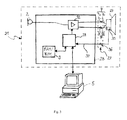
- Fig. 1 shows a hearing aid 1 comprising a microphone 2, a signal processing device 3 and a receiver 4.
- Programming device 5 is connected to the signal processing device 3 of the hearing aid 1 via a wireless or wired connection 6.
- the receiver 4 is connected to the signal processing device 3 by a detachable connector 7, 7'.
- Receivers of different type in particular receivers having a different maximum output sound pressure level, are connectable to the signal processing device 3.
- the signal processing device 3 comprises a controller 8, a memory 9, a signal generator 10, a switch 11, an amplifier 12, an ammeter 13 and a voltmeter 14 arranged either as discrete devices on a circuit board or integrated in the signal processing device 3.
- a controller 8 a memory 9
- a signal generator 10 a switch 11
- an amplifier 12 an ammeter 13
- a voltmeter 14 arranged either as discrete devices on a circuit board or integrated in the signal processing device 3.
- Such connector pairs are also known as plug/socket connectors, and naturally the plug- and socket parts as well as the male- female parts are interchangeable and may then be provided on either part of the hearing aid.
- a switch 11 connects either microphone 2 or the signal generator 10 to the input of the amplifier 12.
- a first output of the amplifier 12 is connected to the input terminal of the ammeter 13, the output of which is connected to the first output terminal 7a of the signal processing device 3.
- a second output terminal of the amplifier is connected to a second output terminal 7a' of the signal processing device 3.
- Either the first or the second output terminal of the amplifier 12 may be connected to a reference potential such as the ground potential.
- the voltmeter 14 is connected between the two output terminals 7a and 7a' of the signal processing device 3.
- the controller 8 receives the measurement results of the ammeter 13 and of the voltmeter 14.
- the signal processing device 3 is provided with one or more analog/digital converters (not shown). Furthermore, the controller is connected to a memory 9 and is connectable to the programming device 5.
- the controller 8 controls the operation of the signal generator 10, of the switch 11 and of the amplifier 12. In particular, the controller 8 controls the degree of amplification, i.e. the amplification factor of the amplifier 12, which can be frequency dependent. Control parameters which determine the control function of the controller 8 are stored in the memory 9. New control parameters can be input into the signal processing device 3 by the programming device 5 through the wireless or wired link 6.
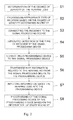
- a first step S1 the level of severity of the hearing loss, which is usually dependent on the frequency, is determined. Based on this level of severity of the hearing loss, a receiver having an appropriate dynamic range or maximum output sound pressure level is determined in a next step S2. This corresponds to choosing one appropriate type of receiver. Then the receiver of the appropriate type is connected to the signal processing device through the connector 7, 7' in a next step S3. When the receiver 4 is connected to the signal processing device 3, then the signal processing device automatically detects the type of the receiver 4 by detecting the impedance as a characteristic parameter of the receiver 4 in a next step S4. The impedance of the receiver 4 is determined according to the following detection scheme. First, the controller controls the switch 11 to connect the signal generator 10 to the input of the amplifier 12.
- the signal generator generates an electric signal of a predetermined waveform such as a sine signal. Then the controller calculates the impedance of the receiver 4 from the measurement results of the ammeter 13 and of the voltmeter 14. Based on the calculated impedance of the receiver 4, the controller determines the type of receiver.
- a programming device 5 is connected to the signal processing device via a wireless or wired link 6.
- the signal processing device 3 transmits information about the hearing aid device 1 to the programming device 5 in a next step S6.
- the information about the hearing aid device 1 contains information about the type of receiver 4 connected to the signal processing device 3, information about the type of the signal processing device 3 and information about the microphone 2 of the hearing aid 1.
- the programming device calculates control parameters which are then transmitted via the wireless or wired link 6 to the signal processing device 3 to program the signal processing device in step S8. As described above, these control parameters are stored in the memory 9 of the signal processing device 3. Thereby, the adaptation of the hearing aid to the means of the hearing impaired person, i.e. the user of the hearing aid, is completed.
- the receiver 4 is exchanged with another receiver of a different type, performing S4 of the above detection scheme enables the signal processing device 3 to automatically detect the type and impedance of the new receiver and to adapt the control parameters for the control of the amplifier 12 in such way that the output characteristics of the hearing aid is maintained as far as possible.
- the output characteristics with the new receiver 4 is, as far as possible, similar to the output characteristics of the hearing aid with the receiver 4 connected to the signal processing device 3 before the receiver exchange.
- the controller 8 of the signal processing device 3 prevents the hearing aid from outputting a higher sound pressure level after exchange of the receiver with a receiver having a higher maximum output sound pressure level. In this way, the automatic detection of the type of the receiver connected to the signal processing device 3 guarantees that the hearing sense of the user is not damaged after exchange of the receiver 4 with a different type of receiver 4.
- the automatic detection of the type of the receiver 4 connected to the signal processing device 3 may be performed periodically or during start-up of the signal processing device 3 when the hearing aid 1 is normally muted or at the dispenser each time the programming software of the programming device 5 accesses the signal processing device 3 of the hearing aid 1. It is also possible to combine the above-mentioned activations of the detection scheme.
- FIG. 3 A second embodiment of the invention is described with Fig. 3 .
- the elements which are the same as in the first embodiment are indicated with the same reference numerals. A repetition of the description of these elements is omitted.
- the hearing aid 21 according to the second embodiment of the invention comprises a microphone 2, a signal processing device 23 and a receiver 24.
- the receiver 24 includes an electronic ID tag 35, wherein the electronic ID tag corresponds to the type of the receiver 24.
- the signal processing device 23 comprises an amplifier 12, which is similar to the amplifier 12 of the first embodiment, wherein the input of the amplifier 12 is connected to the microphone 2 and the two output terminals of the amplifier 12 are connected to the output terminals 7a and 7a' of the signal processing device.
- the output terminals 7a and 7a' of the signal processing device 23 are formed as male connectors detachably connectable to a first and a second female connector 7b and 7b' of the receiver 24, respectively.
- the signal processing device 23 includes a controller 28 and a memory 9 (including a RAM memory and a ROM memory).
- the controller 28 is connected to the amplifier 12 and to the memory 9 to control the operation of the amplifier 12 in a similar manner as in the first embodiment.
- the controller 28 receives, as an input, a signal from the electronic ID tag 35 via a connector 36.
- the connectors 7, 7' and 36 form a detachable connector 27.
- the type of the receiver is not detected by detecting the impedance of the receiver but rather by detecting the electronic ID tag via the wired link 37.
- the operation of the hearing aid according to the second embodiment differs from that of the first embodiment in that the type of the receiver connected to the signal processing device 23 can be detected during normal operation of the hearing aid device 21.
- the second embodiment was described with a wired link 37 of the controller 28 to the electronic ID tag 35 with the connector 36.
- the detection of the type of signal processing device was described with the detection of the impedance or an electronic ID tag as a characteristic parameter of the receiver.
- any characteristic parameter of an additional element included in the receiver could be measured.
- Such element could be a capacitor or a resistor or any other electronic element.
- the hearing aid may be any kind of hearing aid comprising at least a microphone, a signal processing device for processing the electronic output signals form the microphone and a receiver for transforming the electrical output signals form the signal processing device back to sound signals.
- the hearing aid may be a receiver-in-the-ear (RITE) hearing aid.
- the embodiments were described with male and female connectors for connecting the receiver to the signal processing device.
- the receiver could be connected to the signal processing device with any connector providing a detachable connection. It is also possible to use a wireless link to connect the receiver to the signal processing device.
Landscapes
- Engineering & Computer Science (AREA)
- Health & Medical Sciences (AREA)
- General Health & Medical Sciences (AREA)
- Otolaryngology (AREA)
- Neurosurgery (AREA)
- Physics & Mathematics (AREA)
- Acoustics & Sound (AREA)
- Signal Processing (AREA)
- Manufacturing & Machinery (AREA)
- Circuit For Audible Band Transducer (AREA)
- Telephone Function (AREA)
- Arrangements For Transmission Of Measured Signals (AREA)
Priority Applications (8)
| Application Number | Priority Date | Filing Date | Title |
|---|---|---|---|
| EP07121029A EP2061274A1 (fr) | 2007-11-19 | 2007-11-19 | Instrument d'aide auditive utilisant des récepteurs dotés de propriétés de performance différents |
| EP08851614A EP2215859A1 (fr) | 2007-11-19 | 2008-11-07 | Instrument auditif utilisant des récepteurs à caractéristiques de performance différentes |
| AU2008328003A AU2008328003B2 (en) | 2007-11-19 | 2008-11-07 | Hearing instrument using receivers with different performance characteristics |
| EP18177208.8A EP3416409A1 (fr) | 2007-11-19 | 2008-11-07 | Instrument d'aide auditive au moyen de récepteurs dotés de propriétés de performance différentes |
| PCT/EP2008/065139 WO2009065742A1 (fr) | 2007-11-19 | 2008-11-07 | Instrument auditif utilisant des récepteurs à caractéristiques de performance différentes |
| CN2008801168017A CN101897201B (zh) | 2007-11-19 | 2008-11-07 | 使用具有不同性能特性的接收器的听力仪器 |
| CN201310277078.3A CN103402165B (zh) | 2007-11-19 | 2008-11-07 | 使用具有不同性能特性的接收器的听力仪器 |
| US12/743,211 US8433072B2 (en) | 2007-11-19 | 2008-11-07 | Hearing instrument using receivers with different performance characteristics |
Applications Claiming Priority (1)
| Application Number | Priority Date | Filing Date | Title |
|---|---|---|---|
| EP07121029A EP2061274A1 (fr) | 2007-11-19 | 2007-11-19 | Instrument d'aide auditive utilisant des récepteurs dotés de propriétés de performance différents |
Publications (1)
| Publication Number | Publication Date |
|---|---|
| EP2061274A1 true EP2061274A1 (fr) | 2009-05-20 |
Family
ID=39522269
Family Applications (3)
| Application Number | Title | Priority Date | Filing Date |
|---|---|---|---|
| EP07121029A Ceased EP2061274A1 (fr) | 2007-11-19 | 2007-11-19 | Instrument d'aide auditive utilisant des récepteurs dotés de propriétés de performance différents |
| EP18177208.8A Withdrawn EP3416409A1 (fr) | 2007-11-19 | 2008-11-07 | Instrument d'aide auditive au moyen de récepteurs dotés de propriétés de performance différentes |
| EP08851614A Withdrawn EP2215859A1 (fr) | 2007-11-19 | 2008-11-07 | Instrument auditif utilisant des récepteurs à caractéristiques de performance différentes |
Family Applications After (2)
| Application Number | Title | Priority Date | Filing Date |
|---|---|---|---|
| EP18177208.8A Withdrawn EP3416409A1 (fr) | 2007-11-19 | 2008-11-07 | Instrument d'aide auditive au moyen de récepteurs dotés de propriétés de performance différentes |
| EP08851614A Withdrawn EP2215859A1 (fr) | 2007-11-19 | 2008-11-07 | Instrument auditif utilisant des récepteurs à caractéristiques de performance différentes |
Country Status (5)
| Country | Link |
|---|---|
| US (1) | US8433072B2 (fr) |
| EP (3) | EP2061274A1 (fr) |
| CN (2) | CN101897201B (fr) |
| AU (1) | AU2008328003B2 (fr) |
| WO (1) | WO2009065742A1 (fr) |
Cited By (3)
| Publication number | Priority date | Publication date | Assignee | Title |
|---|---|---|---|---|
| EP3116240A1 (fr) * | 2015-07-09 | 2017-01-11 | Oticon A/s | Dispositif d'aide auditive avec unité de haut-parleur amovible |
| WO2018103899A1 (fr) * | 2016-12-09 | 2018-06-14 | Sivantos Pte. Ltd. | Procédé de surveillance de la performance électro-acoustique d'un dispositif auditif et dispositif auditif |
| EP3343952A1 (fr) * | 2016-12-30 | 2018-07-04 | GN Hearing A/S | Instrument auditif modulaire comprenant des paramètres d'étalonnage électroacoustique |
Families Citing this family (23)
| Publication number | Priority date | Publication date | Assignee | Title |
|---|---|---|---|---|
| EP2392085B1 (fr) * | 2009-01-28 | 2021-06-23 | Samsung Electronics Co., Ltd. | Terminal portatif et détecteur de son, tous deux étant en communication via un réseau corporel, et procédé de commande de données correspondant |
| WO2010092566A1 (fr) * | 2009-02-02 | 2010-08-19 | Carmel - Haifa University Economic Corp Ltd. | Procédé, appareil et système d'entraînement et de diagnostic auditif |
| EP2280560B1 (fr) * | 2009-07-03 | 2015-09-09 | Bernafon AG | Système d'assistance auditive comportant un récepteur dans l'oreille et système d'identification du type de récepteur |
| WO2011079875A1 (fr) | 2009-12-31 | 2011-07-07 | Nokia Corporation | Appareil de contrôle et de correction pour des transducteurs montés et procédé associé |
| CN102611980B (zh) * | 2012-01-13 | 2014-11-19 | 瑞声声学科技(深圳)有限公司 | 一种硅麦克风的灵敏度调整系统及调整方法 |
| EP2637423A1 (fr) * | 2012-03-06 | 2013-09-11 | Oticon A/S | Dispositif de test pour module de haut-parleur d'un dispositif d'écoute |
| CN102611974B (zh) * | 2012-03-09 | 2014-05-07 | 无锡纳讯微电子有限公司 | Mems麦克风电路 |
| US9426583B2 (en) * | 2012-03-27 | 2016-08-23 | Gn Otometrics A/S | Member with an adhesive surface |
| ITRE20120039A1 (it) * | 2012-05-17 | 2013-11-18 | Bluegan S R L | Cuffie a sicurezza aumentata e triplice funzionalita' con equalizzazione adattiva |
| US9069896B2 (en) * | 2012-08-29 | 2015-06-30 | Freescale Semiconductor, Inc. | Data processor device for handling a watchpoint and method thereof |
| DK2744225T3 (en) | 2012-12-17 | 2015-11-09 | Bernafon Ag | Hearing device and method for identifying an output transducer for a hearing aid |
| EP2908557B1 (fr) | 2014-02-17 | 2018-08-15 | GN Hearing A/S | Détection de configuration d'appareil d'aide auditive |
| DK201470077A1 (en) * | 2014-02-17 | 2015-08-31 | Gn Resound As | Hearing aid configuration detection |
| US10051392B2 (en) * | 2014-02-17 | 2018-08-14 | Gn Hearing A/S | Hearing aid configuration detection |
| JP6343397B2 (ja) * | 2014-10-15 | 2018-06-13 | ヴェーデクス・アクティーセルスカプ | 補聴器システムの動作方法および補聴器システム |
| DK3207719T3 (en) * | 2014-10-15 | 2019-03-11 | Widex As | PROCEDURE TO OPERATE A HEARING SYSTEM AND HEARING SYSTEM |
| DK3101917T3 (en) | 2015-06-03 | 2018-01-02 | Gn Resound As | Detection of hearing aid configuration |
| DK3139634T3 (da) * | 2015-08-24 | 2019-12-16 | Oticon As | Høreanordningsgrænseflade |
| US10409545B1 (en) | 2018-04-17 | 2019-09-10 | Starkey Laboratories, Inc. | Digital identification of devices attached to serial communication cables |
| DE102018209720B3 (de) * | 2018-06-15 | 2019-07-04 | Sivantos Pte. Ltd. | Verfahren zur Identifikation eines Hörers, Hörsystem und Hörerset |
| EP3706441B1 (fr) | 2019-03-07 | 2025-01-22 | Oticon A/s | Dispositif auditif comprenant un détecteur de configuration de capteur |
| US11627403B2 (en) | 2020-06-30 | 2023-04-11 | Gn Hearing A/S | Hearing device assembly |
| US20250203298A1 (en) * | 2023-12-13 | 2025-06-19 | Bose Corporation | Acoustic Assembly Detection in Hearing Aid |
Citations (6)
| Publication number | Priority date | Publication date | Assignee | Title |
|---|---|---|---|---|
| WO1999009799A2 (fr) * | 1998-11-24 | 1999-03-04 | Phonak Ag | Prothese auditive |
| US6269318B1 (en) * | 1997-04-30 | 2001-07-31 | Earl R. Geddes | Method for determining transducer linear operational parameters |
| US20020015506A1 (en) * | 2000-03-13 | 2002-02-07 | Songbird Hearing, Inc. | Remote programming and control means for a hearing aid |
| US20030086582A1 (en) * | 2001-11-08 | 2003-05-08 | Andy Vonlanthen | Hearing device and set of such devices |
| US20070019817A1 (en) * | 2005-07-22 | 2007-01-25 | Siemens Audiologische Technik Gmbh | Hearing device with automatic determination of its fit in the ear and corresponding method |
| WO2007045254A1 (fr) * | 2005-10-17 | 2007-04-26 | Widex A/S | Systeme acoustique interchangeable pour une prothese auditive et prothese auditive |
Family Cites Families (19)
| Publication number | Priority date | Publication date | Assignee | Title |
|---|---|---|---|---|
| JPS62151100A (ja) * | 1985-12-25 | 1987-07-06 | Matsushita Electric Ind Co Ltd | 補聴器 |
| DE8804743U1 (de) * | 1988-04-11 | 1989-08-10 | Siemens AG, 1000 Berlin und 8000 München | Hörhilfegerät, insbesondere Hörgerät mit einem hinter dem Ohr zu tragenden Gehäuse |
| US5659621A (en) * | 1994-08-31 | 1997-08-19 | Argosy Electronics, Inc. | Magnetically controllable hearing aid |
| US6859538B1 (en) * | 1999-03-17 | 2005-02-22 | Hewlett-Packard Development Company, L.P. | Plug and play compatible speakers |
| DE10041726C1 (de) * | 2000-08-25 | 2002-05-23 | Implex Ag Hearing Technology I | Implantierbares Hörsystem mit Mitteln zur Messung der Ankopplungsqualität |
| US6934400B1 (en) * | 2000-11-03 | 2005-08-23 | Phonak Ag | Method for controlling the dynamic range of a hearing aid, and method to manufacture different hearing aids, and a hearing aid |
| US6712754B2 (en) * | 2002-02-26 | 2004-03-30 | Otologics Llc | Method and system for positioning implanted hearing aid actuators |
| US7890284B2 (en) * | 2002-06-24 | 2011-02-15 | Analog Devices, Inc. | Identification system and method for recognizing any one of a number of different types of devices |
| US7064957B1 (en) * | 2003-07-08 | 2006-06-20 | Cisco Technology, Inc. | Methods and apparatus for securing a heat sink to a circuit board component |
| US7660633B2 (en) | 2003-12-24 | 2010-02-09 | Cochlear Limited | Transformable speech processor module for a hearing prosthesis |
| US7844065B2 (en) * | 2005-01-14 | 2010-11-30 | Phonak Ag | Hearing instrument |
| US7296421B2 (en) * | 2005-08-05 | 2007-11-20 | Eminent Supply Corporation | Protecting method of article |
| CN2896766Y (zh) * | 2005-09-12 | 2007-05-02 | 美商楼氏电子有限公司 | 用于助听器的接收器及可在其制造中使用的子组件 |
| EP1701585B1 (fr) | 2006-03-31 | 2012-06-13 | Phonak AG | Procédé et système pour l'adaptation d'un dispositif auditif |
| US7949144B2 (en) | 2006-06-12 | 2011-05-24 | Phonak Ag | Method for monitoring a hearing device and hearing device with self-monitoring function |
| JP5292396B2 (ja) | 2007-07-10 | 2013-09-18 | ヴェーデクス・アクティーセルスカプ | 補聴器中のレシーバを識別する方法 |
| US8189829B2 (en) * | 2007-07-26 | 2012-05-29 | Phonak Ag | Resistance-based identification |
| DE102007039452B3 (de) * | 2007-08-21 | 2009-06-04 | Siemens Audiologische Technik Gmbh | Automatische Hörer-Typ-Erkennung bei Hörhilfegeräten |
| EP2053876B1 (fr) * | 2007-10-18 | 2010-05-26 | Siemens Medical Instruments Pte. Ltd. | Dispositif auditif doté d'un raccordement commun pour le blindage et l'identification d'un récepteur |
-
2007
- 2007-11-19 EP EP07121029A patent/EP2061274A1/fr not_active Ceased
-
2008
- 2008-11-07 CN CN2008801168017A patent/CN101897201B/zh not_active Expired - Fee Related
- 2008-11-07 US US12/743,211 patent/US8433072B2/en not_active Expired - Fee Related
- 2008-11-07 EP EP18177208.8A patent/EP3416409A1/fr not_active Withdrawn
- 2008-11-07 CN CN201310277078.3A patent/CN103402165B/zh not_active Expired - Fee Related
- 2008-11-07 WO PCT/EP2008/065139 patent/WO2009065742A1/fr not_active Ceased
- 2008-11-07 EP EP08851614A patent/EP2215859A1/fr not_active Withdrawn
- 2008-11-07 AU AU2008328003A patent/AU2008328003B2/en not_active Ceased
Patent Citations (6)
| Publication number | Priority date | Publication date | Assignee | Title |
|---|---|---|---|---|
| US6269318B1 (en) * | 1997-04-30 | 2001-07-31 | Earl R. Geddes | Method for determining transducer linear operational parameters |
| WO1999009799A2 (fr) * | 1998-11-24 | 1999-03-04 | Phonak Ag | Prothese auditive |
| US20020015506A1 (en) * | 2000-03-13 | 2002-02-07 | Songbird Hearing, Inc. | Remote programming and control means for a hearing aid |
| US20030086582A1 (en) * | 2001-11-08 | 2003-05-08 | Andy Vonlanthen | Hearing device and set of such devices |
| US20070019817A1 (en) * | 2005-07-22 | 2007-01-25 | Siemens Audiologische Technik Gmbh | Hearing device with automatic determination of its fit in the ear and corresponding method |
| WO2007045254A1 (fr) * | 2005-10-17 | 2007-04-26 | Widex A/S | Systeme acoustique interchangeable pour une prothese auditive et prothese auditive |
Cited By (9)
| Publication number | Priority date | Publication date | Assignee | Title |
|---|---|---|---|---|
| EP3116240A1 (fr) * | 2015-07-09 | 2017-01-11 | Oticon A/s | Dispositif d'aide auditive avec unité de haut-parleur amovible |
| US10306384B2 (en) | 2015-07-09 | 2019-05-28 | Oticon A/S | Hearing device with detachable speaker unit |
| EP3709676A1 (fr) * | 2015-07-09 | 2020-09-16 | Oticon A/s | Dispositif d'aide auditive comprenant une unité de haut-parleur amovible |
| EP4576449A3 (fr) * | 2015-07-09 | 2025-08-27 | Oticon A/s | Dispositif auditif avec unité de haut-parleur détachable |
| WO2018103899A1 (fr) * | 2016-12-09 | 2018-06-14 | Sivantos Pte. Ltd. | Procédé de surveillance de la performance électro-acoustique d'un dispositif auditif et dispositif auditif |
| EP3343952A1 (fr) * | 2016-12-30 | 2018-07-04 | GN Hearing A/S | Instrument auditif modulaire comprenant des paramètres d'étalonnage électroacoustique |
| US10863285B2 (en) | 2016-12-30 | 2020-12-08 | Gn Hearing A/S | Modular hearing instrument comprising electro-acoustic calibration parameters |
| US11689865B2 (en) | 2016-12-30 | 2023-06-27 | Gn Hearing A/S | Modular hearing instrument comprising electro-acoustic calibration parameters |
| US12047745B2 (en) | 2016-12-30 | 2024-07-23 | Gn Hearing A/S | Modular hearing instrument comprising electro-acoustic calibration parameters |
Also Published As
| Publication number | Publication date |
|---|---|
| US20100272272A1 (en) | 2010-10-28 |
| CN103402165A (zh) | 2013-11-20 |
| CN101897201B (zh) | 2013-07-24 |
| WO2009065742A1 (fr) | 2009-05-28 |
| EP2215859A1 (fr) | 2010-08-11 |
| CN103402165B (zh) | 2016-12-28 |
| AU2008328003A1 (en) | 2009-05-28 |
| AU2008328003B2 (en) | 2012-05-10 |
| EP3416409A1 (fr) | 2018-12-19 |
| CN101897201A (zh) | 2010-11-24 |
| US8433072B2 (en) | 2013-04-30 |
Similar Documents
| Publication | Publication Date | Title |
|---|---|---|
| EP2061274A1 (fr) | Instrument d'aide auditive utilisant des récepteurs dotés de propriétés de performance différents | |
| EP1854333B1 (fr) | Systeme acoustique interchangeable pour une prothese auditive et prothese auditive | |
| EP2280560B1 (fr) | Système d'assistance auditive comportant un récepteur dans l'oreille et système d'identification du type de récepteur | |
| US9319801B2 (en) | Automatic identification of receiver type in hearing aid devices | |
| CN108271109B (zh) | 包括电声校准参数的模块化听力设备 | |
| US9258658B2 (en) | Test device for a speaker module for a listening device | |
| US11917374B2 (en) | Head-wearable hearing instrument with improved co-existence of multiple communication interfaces | |
| US10924871B2 (en) | Method for the identification of an earpiece, hearing aid system and earpiece set | |
| US11689866B2 (en) | Hearing device adapted to perform a self-test and a method for testing a hearing device |
Legal Events
| Date | Code | Title | Description |
|---|---|---|---|
| PUAI | Public reference made under article 153(3) epc to a published international application that has entered the european phase |
Free format text: ORIGINAL CODE: 0009012 |
|
| AK | Designated contracting states |
Kind code of ref document: A1 Designated state(s): AT BE BG CH CY CZ DE DK EE ES FI FR GB GR HU IE IS IT LI LT LU LV MC MT NL PL PT RO SE SI SK TR |
|
| AX | Request for extension of the european patent |
Extension state: AL BA HR MK RS |
|
| 17P | Request for examination filed |
Effective date: 20091120 |
|
| 17Q | First examination report despatched |
Effective date: 20091215 |
|
| AKX | Designation fees paid |
Designated state(s): AT BE BG CH CY CZ DE DK EE ES FI FR GB GR HU IE IS IT LI LT LU LV MC MT NL PL PT RO SE SI SK TR |
|
| STAA | Information on the status of an ep patent application or granted ep patent |
Free format text: STATUS: THE APPLICATION HAS BEEN REFUSED |
|
| 18R | Application refused |
Effective date: 20190208 |