EP2062006B1 - Mécanisme et procédé de déploiement d'empennage retardé vertical - Google Patents
Mécanisme et procédé de déploiement d'empennage retardé vertical Download PDFInfo
- Publication number
- EP2062006B1 EP2062006B1 EP07875055.1A EP07875055A EP2062006B1 EP 2062006 B1 EP2062006 B1 EP 2062006B1 EP 07875055 A EP07875055 A EP 07875055A EP 2062006 B1 EP2062006 B1 EP 2062006B1
- Authority
- EP
- European Patent Office
- Prior art keywords
- projectile
- fin
- fins
- down device
- hold down
- Prior art date
- Legal status (The legal status is an assumption and is not a legal conclusion. Google has not performed a legal analysis and makes no representation as to the accuracy of the status listed.)
- Active
Links
Images





Classifications
-
- F—MECHANICAL ENGINEERING; LIGHTING; HEATING; WEAPONS; BLASTING
- F42—AMMUNITION; BLASTING
- F42B—EXPLOSIVE CHARGES, e.g. FOR BLASTING, FIREWORKS, AMMUNITION
- F42B10/00—Means for influencing, e.g. improving, the aerodynamic properties of projectiles or missiles; Arrangements on projectiles or missiles for stabilising, steering, range-reducing, range-increasing or fall-retarding
- F42B10/02—Stabilising arrangements
- F42B10/14—Stabilising arrangements using fins spread or deployed after launch, e.g. after leaving the barrel
- F42B10/16—Wrap-around fins
-
- F—MECHANICAL ENGINEERING; LIGHTING; HEATING; WEAPONS; BLASTING
- F42—AMMUNITION; BLASTING
- F42B—EXPLOSIVE CHARGES, e.g. FOR BLASTING, FIREWORKS, AMMUNITION
- F42B10/00—Means for influencing, e.g. improving, the aerodynamic properties of projectiles or missiles; Arrangements on projectiles or missiles for stabilising, steering, range-reducing, range-increasing or fall-retarding
- F42B10/02—Stabilising arrangements
- F42B10/14—Stabilising arrangements using fins spread or deployed after launch, e.g. after leaving the barrel
Definitions
- This invention relates to fin-stabilized projectiles and more particularly to a mechanism for delayed tail fin deployment.
- High spin rate projectiles such as bullets, artillery shells or ballistic missiles are self-stabilizing ("spin-stabilized"); the projectile acts like a gyro which prevents the projectile from tumbling.
- Low spin rate projectiles such as rockets (guided or unguided) deploy tail fins to shift the center of pressure aft of the center of gravity to ensure stability (“fin-stabilized').
- Roll-stabilized projectiles such as guided missiles use active control of tail fins and other aerodynamic surfaces to provide stabilization.
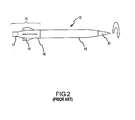
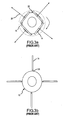
- FIG. 1 , 2 and 3a-3b An exemplary weapon system 10 is illustrated in Figures 1 , 2 and 3a-3b.
- the weapon system is a multi-tube rocket launcher 11 mounted on a helicopter 12 that fires rockets 13 .
- Tail fins 14 are stowed in a spring-loaded overlapping ( Fig. 3a ) or wrap-around design around the circumference of rocket tail section 15 while inside the tube 16 .
- the tail section also includes a nozzle 17 and rocket motor (not shown) to provide boost.
- the rocket nozzles are scarfed at an angle to impart a slight spin to the rocket during flight, e.g. 20-60 cycles/second typically.
- vanes could be positioned aft of the nozzle to impart the spin.
- the tail section 15 is coupled to the main body 18 of the projectile on which a warhead 19 and fuze 20 are attached.
- rockets 13 are unguided, simply point and shoot.
- a guidance package could be inserted between the warhead and main body in which case additional canards would be controlled to guide the rocket based on, for example, GPS or sensor data.
- individual rockets may be launched from a pylon instead of a tube.
- centrifugal force 24 is generated that produces a rotational moment on the fins about their respective rotation pins 26. Once clear of the tube, absent some additional restraint, centrifugal force 24 will immediately rotate the fins to their deployed positions as shown in Figure 3b .
- Spring loading adds to the centrifugal force to deploy the fins more quickly and with less variation.
- This "passive-passive" system e.g. passive deployment and passive control, is inexpensive, lightweight, low volume and reliable.
- the fins, once deployed, are typically held in position by a locking mechanism. Deployment is immediate upon clearing the launch tube. There is no capability to delay or control fin deployment to, for example, avoid interference with adjacent rockets or to mitigate the effects of boost-phase winds associated with, for example, the flow field of the helicopter.
- D.J. Wilson Delayed Fin Deployment Mechanism
- a timing circuit fires a bridge wire activated cable cutter squib after a precise time delay initiated by the rocket ignition pulse.
- the squib clips and thus releases a stainless steel cable which had previously maintained the spring-loaded fins in a folded position.
- Each (of two) timer circuit/squib units with batteries is contained in a package approximately the size of a pack of cigarettes.
- tail fins Some systems use the tail fins to provide both stability and guidance control instead of using additional canards. These "active-active" systems are quite expensive and large as they must provide both the actuator mechanism to physically adjust the fins and the intelligence to proportionally control the actuator mechanism in real-time to guide the rocket.
- the actuator mechanism may be mechanical, electromagnetic or possibly electrostatic. This guidance capability is more than sufficient to delay deployment of the tail fins but at a high cost.
- US 4,520,972 which forms a starting point for the present invention, discloses a training missile having a stabilizer comprising at least two surfaces that are retained by, respectively, one torsion spring initially within the outer contour of the missile. With rotation, the stabilizer surfaces are unfolded by centrifugal force.
- the invention provides a deployment mechanism and method as claimed hereinafter.
- the present invention provides an inexpensive, light weight, low volume and reliable delayed fin deployment mechanism for boosted fin-stabilized spinning projectiles.
- the hold down device provides a very simple and reliable solution to allow a boosted spinning projectile to, for example, clear an aircraft's flow field and/or other projectiles in a multi-tube launcher.
- a typical projectile will include a plurality of fins positioned around the circumference of the projectile's tail section.
- each fin will be provided with a hold down device.
- each device will exhibit the same spring force so that all of the fins deploy at the same time.
- a plurality of cams are positioned between adjacent fins so that when the hold down device having the weakest spring force releases, the deployment of its fin pushes the cam against the adjacent fin causing its hold down device to release and so forth in a daisy chain until all of the hold down devices have been released and the fins deployed.
- the cams should reduce dispersion at the target.
- only a primary fin is held in place with a hold down device.
- the remaining secondary fins are captured by a lanyard that is held between a pair of attachment lugs.
- the deployment of the primary fin releases the lanyard from at least one of the attachment lugs thereby allowing the secondary fins to deploy almost simultaneously.
- the present invention provides an inexpensive, light weight and reliable delayed fin deployment mechanism for boosted fin-stabilized spinning projectiles.
- a hold down device is positioned on the projectile to exert a known spring force in opposition to the centrifugal force.
- the centrifugal force increases with the square of the spin rate.
- the hold down device will release the primary in allowing it to swing into its deployed position.
- the spin rate can be correlated to a time or travel distance of the projectile from launch.
- the hold down device provides a simple yet effective means for delayed fin deployment in a boosted fin-stabilized spinning projectile.
- the incorporation of the hold down device requires minimal design changes to existing rockets and may, in some cases, be retrofit to the existing base of rockets if desired.
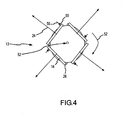
- a hold down device or devices 50 are positioned around the circumference of projectile 13 to restrain fins 14 in their stowed position as the projectile spins 52 around its axis 54 .
- the hold down device exerts a constant spring force 56 on the fin that opposes centrifugal force 24 .
- Spring force 56 is determined by the design of a particular hold-down device 50 .
- the opposing moment M S d S * F S where d S is he distance from fin rotation pin 26 to hold-down device 50 and F S is the spring force.
- the forcing moment M C is dictated by projectile and fin design and by the boost.
- the opposing moment M S is set through a combination of the spring force and the placement of the hold-down device.
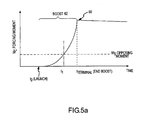
- the spin rate in a "boosted" projectile the spin rate, hence centrifugal force and moment M C spins up from zero to a terminal or maximum value 60 during the boost phase 62 .
- the projectile as shown in Figure 2 , includes a rocket motor and nozzle that propels the projectile towards the target and induces spin such as found in surface-to-air or air-to-air rockets and missiles.
- the boost phase of a typical rocket is, for example, 1 to 0 seconds in duration during which time the spin rate, hence centrifugal force is increasing.
- the boost phase 62 defines a time window from to at launch to t terminal at the end offhe boost phase in which to delay the deployment of the tail fins.
- the tail fins will deploy at a time t 1 when moment M C exceeds the opposing moment M S .
- the travel 70 of the projectile can be accurately plotted against time for a given projectile design and boost.
- Tail fin deployment can be delayed to correspond to a desired travel distance of the projectile up to a maximum travel delay d max corresponding to the end of the boost phase.
- d max a maximum travel delay
- the spin rate, hence moment M C will not get any larger and will actually reduce slightly due to aerodynamic drag effects.
- abattlefield scenario requires the projectile to travel at least a distance d min before the fins are deployed, a designer might select a distance d min ⁇ d 1 ⁇ d max .
- How close the designer sets d 1 to d min may depend on a number of considerations including the manufacturing tolerance of the actual spring force to the design value, the accuracy with which travel is known as a function of time for a particular projectile and boost, the criticality of not deploying the fins early and conversely the criticality of not deploying the fins too late.
- the selection of d 1 determines the time of deployment t 1 , which in turn determines the opposing moment M S .
- the design can than select the spring force of the hold-down device and the position of the hold-down device to achieve the required moment.
- the hold down device provides a very simple and reliable solution to allow a spinning projectile to, for example, clear an aircraft's flow field and/or other projectiles in a multi-tube launcher.
- the travel delay can be established a priori based on knowledge of the aircraft or the multi-tube launcher. For example, a designer can estimate that for a certain type of helicopter when hovering to fire its rockets the flow field produced by the rotors could cause the rocket to turn into the flow field and away from the intended target if the tail fins were deployed within 10 meters of the helicopter. Assuming that the boost phase extends beyond 10 meters, the designer can select and position a simple hold-down device to delay tail fin deployment.
- the tail fins deploy immediately upon clearing the tube they can interfere with adjacent rockets extending from their tubes. In this case, the travel delay need only be sufficient for the rocket to clear the other rockets. Note, if a longer travel delay is required, it may be possible to extend the boost phase.
- a typical projectile will include a plurality of fins positioned around the circumference of the projectile's tail section.
- the fins may be flat or curved to wrap-around the projectile. Alternately, the fins may be jack-knifed inside the tail section.
- each fin will be provided with a hold down device ( Figures 6-8 ). Ideally each device will exhibit the same spring force so that all of the fins deploy at the same time. However, inevitably there is some variation in the spring forces that causes a degree of dispersion at the target.
- a plurality of cams are positioned between adjacent fins so that when the hold down device having the weakest spring force releases, the deployment of its fin pushes the cam against the adjacent fin causing its hold down device to release and so forth in a daisy chain until all of the hold down devices have been released and the fins deployed (also Figures 6-8 ).
- the cams should reduce dispersion at the target.
- only a primary fin is held in place with a hold down device.
- the remaining secondary fins are captured by a lanyard that is held between a pair of attachment lugs.
- the deployment of the primary fin releases the lanyard from at least one of the attachment lugs thereby allowing the secondary fins to deploy almost simultaneously ( Figures 9-10 ).
- the single lanyard mechanism can also be adapted for use with the jack-knife fin configuration ( Figures 11-12 ).
- a plurality of fins 80 are positioned around the circumference of the nozzle (not shown) and pivotally mounted along an interior longitudinal edge 82 on respective fin rotation pins 84 extending through fin hubs 85 along a main axis 86 of the projectile to swing from a stowed position against the nozzle to a deployed position.
- a like plurality of hold down devices 88 are positioned to hold the fins in their stowed positions.
- each hold down device 88 (best shown in Figure 7 ) is positioned on the fin rotation pin 84 of the adjacent fin to hold the lateral edge 90 of the fin near its exterior longitudinal edge 92 .
- the hold down device is configured to provide a predetermined spring force opposing the deployment of the fin until the forcing moment is sufficiently large to overcome the spring force and push the hold down device out of the way.
- the spring force is determined by length, width, thickness, shape and material composition of walls 94 and can be defined and manufactured to a reasonable tolerance. Friction between the fin and hold down device has considerably more variation as it depends upon such unknowns as dirt, humidity etc. Consequently, it is generally desirable to design the hold down device (shape) to minimize friction.
- the edge 96 of the hold down device that actually contacts the fin is rounded to minimize any friction between the fin and device as the fin pushes edge 96 outward from the projectile spin axis 86 during deployment. The rounded edge also reduces the likelihood that the edge will tear or otherwise damage the fin during deployment.
- each hold down device 88 will exhibit the same spring force so that all of the fins deploy at the same time.
- a like plurality of cams 98 are positioned between adjacent fins 82 so that when the hold down device 88 having the weakest spring force releases, the deployment of its fin 80 pushes the cam 98 against the adjacent fin causing its hold down device to release and so forth in a daisy chain until all of the hold down devices have been released and the fins deployed.
- the cams 98 are positioned axially between the interior longitudinal edge 82 of one fin and the exterior longitudinal edge 92 of the adjacent fin so that when the hold down device having the weakest spring force releases the deployment of its fin pushes the cam against the exterior longitudinal edge of the adjacent fin causing its hold down device to release and so forth in the daisy chain.
- the force exerted by the cams should be larger than any variance in the spring forces of the hold down devices.
- any one of the hold down devices may be the weakest and start the daisy chain.
- a fin could be designated as the primary fin and its hold down device designed specifically to have the weakest spring force. The remaining secondary fins would have a higher designed spring force. When the primary hold down device releases, it starts the daisy chain and the cams provide sufficient additional force to deploy the secondary fins.
- a typical deployment mechanism may also include a spring underneath each fin to more rapidly deploy the fin once released. If the spring assist is included the spring force of the hold down device is increased to offset the spring assist so that the tail fins deploy at the same delay. The only effect is that once the fins are released, the forcing moment includes both the centrifugal force and the spring assist so that the fin will deploy faster.
- a typical deployment mechanism may also include a fin locking mechanism on the fin hub that holds the fin its deployed position. The centrifugal force of the spinning projectile will tend to hold the fin in the deployed position but the locking mechanism provides an additional measure of stability and reliability.
- the locking mechanism can be a simple detent.
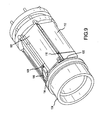
- a single hold down device 100 is positioned to hold a primary fin 102 against the nozzle 104 in the tail section of the projectile.
- a lanyard 106 is secured between primary and secondary attachment lugs 108 and 110, respectively, around the projectile to restrain one or more secondary fins 112 in their stowed positions.
- the deployment of primary fin 102 releases the lanyard 106 from first attachment lug 108 thereby allowing the secondary fins 112 to deploy.
- Primary attachment lug 108 is suitably positioned on the primary fin 102 and preferably on the fin rotation hub 114 so that as the fin pushes (deploys) past the hold down device 100 to rotate into its deployed position, the primary lug 108 also rotates allowing the lanyard to slip off.
- the secondary attachment lug 110 is positioned elsewhere on the projectile, suitably on the rotation hub 114 of the last secondary fin 112. When the lanyard slips off, the centrifugal force pops open all of the secondary fins almost simultaneously.
- the spring assist and locking mechanism may also be used in this configuration.
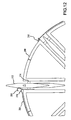
- a single hold down device 200 and lanyard 202 are used to hold a plurality of fins in a jack-knifed configuration.
- US 6,764,042 and 6,588,700 describe a tactical base for a guided projectile in which the fins are stored in a jack-knife configuration.
- the projectile's tail section 204 can be similarly reconfigured by forming a plurality of conical sections 208 spaced around the nozzle 206 to define fin slots 210.
- Fins 212 are pivotably mounted on fin pins 214 within the fin slots in a stowed position.
- the hold down device 200 is positioned over one of the fin slots at a determined distance from the fin pin (measured along the longitudinal axis of the projectile),
- the primary lug 216 is positioned on the hold down device so that when the forcing moment of the centrifugal force exceeds the opposing moment of the hold down device the fin pushes past the hold down device causing primary lug 216 to rotate and release lanyard 202.
- the secondary lug 218 is suitably position on the conical section 208 past the last fin.
Landscapes
- Physics & Mathematics (AREA)
- Fluid Mechanics (AREA)
- Engineering & Computer Science (AREA)
- General Engineering & Computer Science (AREA)
- Toys (AREA)
- Emergency Lowering Means (AREA)
- Aiming, Guidance, Guns With A Light Source, Armor, Camouflage, And Targets (AREA)
Claims (5)
- Mécanisme de déploiement retardé d'ailerons d'empennage, comprenant :un projectile (13) possédant un moteur et une tuyère (17) conçus pour mettre en rotation le projectile au cours d'une phase d'accélération suivant son lancement ;un aileron principal (102 ; 212) monté pivotant sur le projectile, ledit aileron principal étant replié au moment du lancement de sorte que la force centrifuge (24) du projectile en rotation produise un moment qui fasse pivoter l'aileron principal jusque dans une position déployée ;un dispositif de maintien (100 ; 200) qui maintient l'aileron principal dans sa position repliée jusqu'à ce que le moment de la force centrifuge devienne supérieur à un moment opposé produit par une force de rappel (56) du dispositif de maintien, ladite force de rappel étant préétablie pour correspondre à une vitesse de rotation particulière du projectile ; etun ou plusieurs ailerons secondaires (112 ; 212) positionnés autour du projectile ;
caractérisé parune première patte de fixation (108 ; 216) ;une deuxième patte de fixation (110 ; 218) ; etun cordon (106 ; 202) entre les première et deuxième pattes de fixation autour dudit projectile qui retient le ou les ailerons secondaires dans leur position repliée, le déploiement de l'aileron principal libérant le cordon de ladite première patte de fixation en permettant le déploiement du ou des ailerons secondaires. - Mécanisme de déploiement d'ailerons selon la revendication 1, dans lequel la première patte de fixation (108) est positionnée sur l'aileron principal (102) et la deuxième patte de fixation (110) est positionnée ailleurs sur le projectile (13).
- Mécanisme de déploiement d'ailerons selon la revendication 1, dans lequel la première patte de fixation (216) est positionnée sur le dispositif de maintien (200).
- Procédé de déploiement retardé d'ailerons d'empennage sur un projectile en rotation accéléré stabilisé par des ailerons, comprenant les étapes consistant à :appliquer passivement une force de rappel (56) pour maintenir un aileron principal (102 ; 212) dans sa position repliée, ladite force de rappel correspondant à une vitesse de rotation particulière du projectile (13) ;accélérer le projectile pendant une phase d'accélération (62) pour le propulser en direction d'une cible et le mettre en rotation ;libérer passivement l'aileron principal jusque dans une position déployée lorsque la force centrifuge (24) du projectile en rotation produit un moment de force devenant supérieur à un moment opposé produit par la force de rappel (56) ;caractérisé en ce qu'il comprend l'étape consistant enrouler un cordon (106 ; 202) entre des première et deuxième pattes de fixation (108, 110 ; 216, 218) autour dudit projectile pour retenir un ou plusieurs ailerons secondaires (112 ; 212) dans leur position repliée, le déploiement de l'aileron principal (102 ; 212) libérant le cordon de ladite première patte de fixation en permettant le déploiement du ou des ailerons secondaires.
- Procédé selon la revendication 4, comprenant en outre l'étape consistant à :corréler la vitesse de rotation particulière à laquelle les ailerons se déploient à une distance de parcours souhaitée.
Applications Claiming Priority (2)
| Application Number | Priority Date | Filing Date | Title |
|---|---|---|---|
| US11/559,465 US7628353B2 (en) | 2006-11-14 | 2006-11-14 | Delayed tail fin deployment mechanism and method |
| PCT/US2007/084501 WO2008147453A2 (fr) | 2006-11-14 | 2007-11-13 | Mécanisme et procédé de déploiement d'empennage retardé vertical |
Publications (3)
| Publication Number | Publication Date |
|---|---|
| EP2062006A2 EP2062006A2 (fr) | 2009-05-27 |
| EP2062006A4 EP2062006A4 (fr) | 2012-10-24 |
| EP2062006B1 true EP2062006B1 (fr) | 2013-08-14 |
Family
ID=39368294
Family Applications (1)
| Application Number | Title | Priority Date | Filing Date |
|---|---|---|---|
| EP07875055.1A Active EP2062006B1 (fr) | 2006-11-14 | 2007-11-13 | Mécanisme et procédé de déploiement d'empennage retardé vertical |
Country Status (3)
| Country | Link |
|---|---|
| US (1) | US7628353B2 (fr) |
| EP (1) | EP2062006B1 (fr) |
| WO (1) | WO2008147453A2 (fr) |
Families Citing this family (17)
| Publication number | Priority date | Publication date | Assignee | Title |
|---|---|---|---|---|
| US7952055B2 (en) * | 2007-11-21 | 2011-05-31 | Raytheon Company | Methods and apparatus for deploying control surfaces sequentially |
| US8058597B2 (en) * | 2009-05-06 | 2011-11-15 | Raytheon Company | Low cost deployment system and method for airborne object |
| US8350201B2 (en) | 2010-10-14 | 2013-01-08 | Raytheon Company | Systems, apparatus and methods to compensate for roll orientation variations in missile components |
| US8952304B2 (en) | 2011-03-03 | 2015-02-10 | Alliant Techsystems, Inc. | Rocket nozzle assembly |
| SE535837C2 (sv) | 2011-04-14 | 2013-01-08 | Bae Systems Bofors Ab | Fenutfällningsmekanism |
| US8816261B1 (en) * | 2011-06-29 | 2014-08-26 | Raytheon Company | Bang-bang control using tangentially mounted surfaces |
| RU2498192C2 (ru) * | 2011-12-29 | 2013-11-10 | Открытое акционерное общество "Конструкторское бюро приборостроения" | Способ наведения по оптическому лучу ракеты, стартующей с подвижного носителя |
| US9212877B2 (en) * | 2012-07-05 | 2015-12-15 | The United States Of America As Represented By The Secretary Of The Army | Retention system for a deployable projectile fin |
| RU2529256C1 (ru) * | 2013-04-09 | 2014-09-27 | Открытое акционерное общество "Конструкторское бюро приборостроения им. академика А.Г. Шипунова" | Комплекс вооружения |
| EP3118124B1 (fr) * | 2015-07-15 | 2021-05-12 | Airbus Defence and Space GmbH | Dispositif d'atterrissage pour un atterrisseur à faible gravité |
| FR3041744B1 (fr) * | 2015-09-29 | 2018-08-17 | Nexter Munitions | Projectile d'artillerie ayant une phase pilotee. |
| DE102017009671A1 (de) * | 2016-11-03 | 2018-05-03 | Diehl Defence Gmbh & Co. Kg | Verfahren zum Abwerfen eines Flugkörpers |
| US11307009B2 (en) * | 2019-11-05 | 2022-04-19 | Raytheon Company | Method and apparatus for determining projectile fin deployment timeline |
| US11287232B2 (en) | 2019-12-12 | 2022-03-29 | Bae Systems Information And Electronic Systems Integration Inc. | Additively manufactured self-destructive delay device |
| DE102020105188B4 (de) | 2020-02-27 | 2023-08-31 | Deutsches Zentrum für Luft- und Raumfahrt e.V. | Flugkörper-Finnenausklappeinrichtung, Flugkörper und Verfahren zum Betrieb eines Flugkörpers |
| CN113883971B (zh) * | 2021-09-23 | 2023-03-24 | 西安近代化学研究所 | 根据运动速度由双滑块四杆机构驱动尾翼迎风面积自动调节装置 |
| DE102021005973A1 (de) | 2021-12-03 | 2023-06-07 | Diehl Defence Gmbh & Co. Kg | Geschoss mit federlos ausschwenkbaren Finnen |
Family Cites Families (14)
| Publication number | Priority date | Publication date | Assignee | Title |
|---|---|---|---|---|
| US3125956A (en) * | 1964-03-24 | Fold able fin | ||
| BE533456A (fr) * | 1953-12-21 | Brandt Soc Nouv Ets | ||
| US3047259A (en) * | 1959-11-25 | 1962-07-31 | George J Tatnall | Speed brake retarding mechanism for an air-dropped store |
| US3114287A (en) * | 1961-09-22 | 1963-12-17 | Frank H Swaim | Elastic fin erector |
| US3260205A (en) * | 1964-09-28 | 1966-07-12 | Aerojet General Co | Fin actuated spin vane control device and method |
| US3697019A (en) * | 1970-05-13 | 1972-10-10 | Us Navy | Stabilizing fin assembly |
| US4296895A (en) * | 1979-01-15 | 1981-10-27 | General Dynamics Corporation | Fin erection mechanism |
| SE433882B (sv) * | 1979-10-09 | 1984-06-18 | Bofors Ab | Utfellbar fena for en fenstabiliserad ammunitionsenhet i form av en granat |
| DE3122320A1 (de) * | 1981-06-05 | 1983-01-27 | Dynamit Nobel Ag, 5210 Troisdorf | Drallstabilisierter uebungsflugkoerper |
| DE3403573A1 (de) * | 1983-11-09 | 1985-08-08 | Diehl GmbH & Co, 8500 Nürnberg | Geschoss mit herausklappbaren fluegeln |
| GB8609166D0 (en) * | 1986-04-15 | 1986-09-17 | British Aerospace | Deployment arrangement for spinning body |
| US5368255A (en) * | 1992-06-04 | 1994-11-29 | Hughes Aircraft Company | Aerotumbling missile |
| US6168111B1 (en) * | 1997-03-03 | 2001-01-02 | The United States Of America As Represented By The Secretary Of The Army | Fold-out fin |
| US6588700B2 (en) | 2001-10-16 | 2003-07-08 | Raytheon Company | Precision guided extended range artillery projectile tactical base |
-
2006
- 2006-11-14 US US11/559,465 patent/US7628353B2/en active Active
-
2007
- 2007-11-13 EP EP07875055.1A patent/EP2062006B1/fr active Active
- 2007-11-13 WO PCT/US2007/084501 patent/WO2008147453A2/fr not_active Ceased
Also Published As
| Publication number | Publication date |
|---|---|
| WO2008147453A3 (fr) | 2009-01-15 |
| US7628353B2 (en) | 2009-12-08 |
| US20080111020A1 (en) | 2008-05-15 |
| EP2062006A2 (fr) | 2009-05-27 |
| WO2008147453A2 (fr) | 2008-12-04 |
| EP2062006A4 (fr) | 2012-10-24 |
Similar Documents
| Publication | Publication Date | Title |
|---|---|---|
| EP2062006A2 (fr) | Mécanisme et procédé de déploiement d'empennage retardé vertical | |
| US6666145B1 (en) | Self extracting submunition | |
| US4175720A (en) | Retainer/release mechanism for use on fin stabilized gun fired projectiles | |
| US8552351B2 (en) | Projectile with deployable control surfaces | |
| EP2165152B1 (fr) | Projectile hybride à stabilisation à ailette/gyroscopique | |
| US5762291A (en) | Drag control module for stabilized projectiles | |
| AU2020261387B2 (en) | Maneuvering aeromechanically stable sabot system | |
| EP2470856B1 (fr) | Procédé de contrôle de vol de missile à l'aide de propulseurs de contrôle d'attitude | |
| JP2003534525A (ja) | ミサイルの方向制御 | |
| KR20070001924A (ko) | 2-d 발사체 궤적 교정 시스템 및 방법 | |
| WO2017035126A1 (fr) | Système de guidage de projectile au sol | |
| US20040200375A1 (en) | Artillery projectile comprising an interchangeable payload | |
| US8222583B2 (en) | Drag-stabilized water-entry projectile and cartridge assembly | |
| EP2276998B1 (fr) | Appareil pour retenue et déploiement d'un aérofrein | |
| RU2115882C1 (ru) | Неуправляемый реактивный снаряд, запускаемый из трубчатой направляющей | |
| US5368255A (en) | Aerotumbling missile | |
| US6682014B1 (en) | Device for exerting drag | |
| GB2142418A (en) | Cluster bombs | |
| JPH0443197B2 (fr) | ||
| US5153371A (en) | Ribbon stabilizer for a weapon | |
| US12270632B1 (en) | Deployable flap for high-G maneuvers | |
| US3088376A (en) | Ring for imparting spin | |
| KR101924970B1 (ko) | 유도무기 및 유도무기의 보호덮개 방출방법 | |
| SE2000241A1 (sv) | Kanister | |
| JPH0711356Y2 (ja) | 訓練弾 |
Legal Events
| Date | Code | Title | Description |
|---|---|---|---|
| PUAI | Public reference made under article 153(3) epc to a published international application that has entered the european phase |
Free format text: ORIGINAL CODE: 0009012 |
|
| 17P | Request for examination filed |
Effective date: 20090318 |
|
| AK | Designated contracting states |
Kind code of ref document: A2 Designated state(s): DE FR GB IT |
|
| AX | Request for extension of the european patent |
Extension state: AL BA HR MK RS |
|
| DAX | Request for extension of the european patent (deleted) | ||
| REG | Reference to a national code |
Ref country code: DE Ref legal event code: R079 Ref document number: 602007032319 Country of ref document: DE Free format text: PREVIOUS MAIN CLASS: F42B0010000000 Ipc: F42B0010140000 |
|
| A4 | Supplementary search report drawn up and despatched |
Effective date: 20120924 |
|
| RIC1 | Information provided on ipc code assigned before grant |
Ipc: F42B 10/16 20060101ALI20120918BHEP Ipc: F42B 10/14 20060101AFI20120918BHEP |
|
| GRAP | Despatch of communication of intention to grant a patent |
Free format text: ORIGINAL CODE: EPIDOSNIGR1 |
|
| INTG | Intention to grant announced |
Effective date: 20130402 |
|
| GRAS | Grant fee paid |
Free format text: ORIGINAL CODE: EPIDOSNIGR3 |
|
| GRAA | (expected) grant |
Free format text: ORIGINAL CODE: 0009210 |
|
| AK | Designated contracting states |
Kind code of ref document: B1 Designated state(s): DE FR GB IT |
|
| REG | Reference to a national code |
Ref country code: GB Ref legal event code: FG4D |
|
| REG | Reference to a national code |
Ref country code: DE Ref legal event code: R096 Ref document number: 602007032319 Country of ref document: DE Effective date: 20131010 |
|
| PG25 | Lapsed in a contracting state [announced via postgrant information from national office to epo] |
Ref country code: IT Free format text: LAPSE BECAUSE OF FAILURE TO SUBMIT A TRANSLATION OF THE DESCRIPTION OR TO PAY THE FEE WITHIN THE PRESCRIBED TIME-LIMIT Effective date: 20130814 |
|
| PLBE | No opposition filed within time limit |
Free format text: ORIGINAL CODE: 0009261 |
|
| STAA | Information on the status of an ep patent application or granted ep patent |
Free format text: STATUS: NO OPPOSITION FILED WITHIN TIME LIMIT |
|
| 26N | No opposition filed |
Effective date: 20140515 |
|
| REG | Reference to a national code |
Ref country code: DE Ref legal event code: R097 Ref document number: 602007032319 Country of ref document: DE Effective date: 20140515 |
|
| REG | Reference to a national code |
Ref country code: FR Ref legal event code: PLFP Year of fee payment: 9 |
|
| REG | Reference to a national code |
Ref country code: FR Ref legal event code: PLFP Year of fee payment: 10 |
|
| REG | Reference to a national code |
Ref country code: FR Ref legal event code: PLFP Year of fee payment: 11 |
|
| REG | Reference to a national code |
Ref country code: FR Ref legal event code: PLFP Year of fee payment: 12 |
|
| P01 | Opt-out of the competence of the unified patent court (upc) registered |
Effective date: 20230530 |
|
| PGFP | Annual fee paid to national office [announced via postgrant information from national office to epo] |
Ref country code: DE Payment date: 20241022 Year of fee payment: 18 |
|
| PGFP | Annual fee paid to national office [announced via postgrant information from national office to epo] |
Ref country code: GB Payment date: 20241023 Year of fee payment: 18 |
|
| PGFP | Annual fee paid to national office [announced via postgrant information from national office to epo] |
Ref country code: FR Payment date: 20241022 Year of fee payment: 18 |
|
| REG | Reference to a national code |
Ref country code: DE Ref legal event code: R119 Ref document number: 602007032319 Country of ref document: DE |