EP2062905A2 - Mischungen von phosphorhaltigen Verbindungen, ein Verfahren zu deren Herstellung und deren Verwendung als Flammschutzmittel - Google Patents
Mischungen von phosphorhaltigen Verbindungen, ein Verfahren zu deren Herstellung und deren Verwendung als Flammschutzmittel Download PDFInfo
- Publication number
- EP2062905A2 EP2062905A2 EP08020052A EP08020052A EP2062905A2 EP 2062905 A2 EP2062905 A2 EP 2062905A2 EP 08020052 A EP08020052 A EP 08020052A EP 08020052 A EP08020052 A EP 08020052A EP 2062905 A2 EP2062905 A2 EP 2062905A2
- Authority
- EP
- European Patent Office
- Prior art keywords
- compounds
- formula
- weight
- iii
- och
- Prior art date
- Legal status (The legal status is an assumption and is not a legal conclusion. Google has not performed a legal analysis and makes no representation as to the accuracy of the status listed.)
- Granted
Links
- 239000003063 flame retardant Substances 0.000 title claims abstract description 101
- 150000001875 compounds Chemical class 0.000 title claims abstract description 69
- RNFJDJUURJAICM-UHFFFAOYSA-N 2,2,4,4,6,6-hexaphenoxy-1,3,5-triaza-2$l^{5},4$l^{5},6$l^{5}-triphosphacyclohexa-1,3,5-triene Chemical compound N=1P(OC=2C=CC=CC=2)(OC=2C=CC=CC=2)=NP(OC=2C=CC=CC=2)(OC=2C=CC=CC=2)=NP=1(OC=1C=CC=CC=1)OC1=CC=CC=C1 RNFJDJUURJAICM-UHFFFAOYSA-N 0.000 title claims abstract description 60
- 239000000203 mixture Substances 0.000 title claims abstract description 55
- 238000004519 manufacturing process Methods 0.000 title claims description 12
- 239000000463 material Substances 0.000 title claims description 5
- OAICVXFJPJFONN-UHFFFAOYSA-N Phosphorus Chemical compound [P] OAICVXFJPJFONN-UHFFFAOYSA-N 0.000 title description 22
- 238000000034 method Methods 0.000 claims abstract description 17
- 230000008569 process Effects 0.000 claims abstract description 16
- 239000003054 catalyst Substances 0.000 claims abstract description 15
- -1 phosphonic acid ester compounds Chemical class 0.000 claims abstract description 13
- 239000003153 chemical reaction reagent Substances 0.000 claims abstract description 12
- 238000002360 preparation method Methods 0.000 claims abstract description 10
- 230000000855 fungicidal effect Effects 0.000 claims abstract description 3
- 239000000417 fungicide Substances 0.000 claims abstract description 3
- 230000002363 herbicidal effect Effects 0.000 claims abstract description 3
- 239000004009 herbicide Substances 0.000 claims abstract description 3
- 239000000575 pesticide Substances 0.000 claims abstract description 3
- JUJWROOIHBZHMG-UHFFFAOYSA-N Pyridine Chemical group C1=CC=NC=C1 JUJWROOIHBZHMG-UHFFFAOYSA-N 0.000 claims description 22
- 229920000728 polyester Polymers 0.000 claims description 20
- 239000004814 polyurethane Substances 0.000 claims description 20
- 229920002635 polyurethane Polymers 0.000 claims description 20
- 239000006260 foam Substances 0.000 claims description 17
- 150000003014 phosphoric acid esters Chemical class 0.000 claims description 17
- 150000003008 phosphonic acid esters Chemical class 0.000 claims description 16
- 229920003023 plastic Polymers 0.000 claims description 15
- 239000004033 plastic Substances 0.000 claims description 15
- GQHTUMJGOHRCHB-UHFFFAOYSA-N 2,3,4,6,7,8,9,10-octahydropyrimido[1,2-a]azepine Chemical compound C1CCCCN2CCCN=C21 GQHTUMJGOHRCHB-UHFFFAOYSA-N 0.000 claims description 12
- UMJSCPRVCHMLSP-UHFFFAOYSA-N pyridine Natural products COC1=CC=CN=C1 UMJSCPRVCHMLSP-UHFFFAOYSA-N 0.000 claims description 11
- ZMANZCXQSJIPKH-UHFFFAOYSA-N Triethylamine Chemical compound CCN(CC)CC ZMANZCXQSJIPKH-UHFFFAOYSA-N 0.000 claims description 9
- 239000012948 isocyanate Substances 0.000 claims description 9
- 150000002513 isocyanates Chemical class 0.000 claims description 9
- 239000000654 additive Substances 0.000 claims description 7
- 229920000570 polyether Polymers 0.000 claims description 7
- AXFVIWBTKYFOCY-UHFFFAOYSA-N 1-n,1-n,3-n,3-n-tetramethylbutane-1,3-diamine Chemical compound CN(C)C(C)CCN(C)C AXFVIWBTKYFOCY-UHFFFAOYSA-N 0.000 claims description 6
- WSFSSNUMVMOOMR-UHFFFAOYSA-N Formaldehyde Chemical compound O=C WSFSSNUMVMOOMR-UHFFFAOYSA-N 0.000 claims description 6
- 239000002516 radical scavenger Substances 0.000 claims description 6
- 239000004721 Polyphenylene oxide Substances 0.000 claims description 5
- 238000010276 construction Methods 0.000 claims description 5
- KSBAEPSJVUENNK-UHFFFAOYSA-L tin(ii) 2-ethylhexanoate Chemical compound [Sn+2].CCCCC(CC)C([O-])=O.CCCCC(CC)C([O-])=O KSBAEPSJVUENNK-UHFFFAOYSA-L 0.000 claims description 5
- IMNIMPAHZVJRPE-UHFFFAOYSA-N triethylenediamine Chemical compound C1CN2CCN1CC2 IMNIMPAHZVJRPE-UHFFFAOYSA-N 0.000 claims description 5
- 230000000996 additive effect Effects 0.000 claims description 4
- 238000005266 casting Methods 0.000 claims description 4
- 239000004744 fabric Substances 0.000 claims description 4
- 239000002480 mineral oil Substances 0.000 claims description 4
- 235000010446 mineral oil Nutrition 0.000 claims description 4
- 229920000642 polymer Polymers 0.000 claims description 4
- 239000003381 stabilizer Substances 0.000 claims description 4
- 150000003512 tertiary amines Chemical group 0.000 claims description 4
- KYVBNYUBXIEUFW-UHFFFAOYSA-N 1,1,3,3-tetramethylguanidine Chemical compound CN(C)C(=N)N(C)C KYVBNYUBXIEUFW-UHFFFAOYSA-N 0.000 claims description 3
- SGUVLZREKBPKCE-UHFFFAOYSA-N 1,5-diazabicyclo[4.3.0]-non-5-ene Chemical compound C1CCN=C2CCCN21 SGUVLZREKBPKCE-UHFFFAOYSA-N 0.000 claims description 3
- 239000004971 Cross linker Substances 0.000 claims description 3
- ATJFFYVFTNAWJD-UHFFFAOYSA-N Tin Chemical compound [Sn] ATJFFYVFTNAWJD-UHFFFAOYSA-N 0.000 claims description 3
- UKLDJPRMSDWDSL-UHFFFAOYSA-L [dibutyl(dodecanoyloxy)stannyl] dodecanoate Chemical compound CCCCCCCCCCCC(=O)O[Sn](CCCC)(CCCC)OC(=O)CCCCCCCCCCC UKLDJPRMSDWDSL-UHFFFAOYSA-L 0.000 claims description 3
- 150000001350 alkyl halides Chemical class 0.000 claims description 3
- 150000001244 carboxylic acid anhydrides Chemical class 0.000 claims description 3
- 239000003795 chemical substances by application Substances 0.000 claims description 3
- 230000007797 corrosion Effects 0.000 claims description 3
- 238000005260 corrosion Methods 0.000 claims description 3
- NLUNLVTVUDIHFE-UHFFFAOYSA-N cyclooctylcyclooctane Chemical compound C1CCCCCCC1C1CCCCCCC1 NLUNLVTVUDIHFE-UHFFFAOYSA-N 0.000 claims description 3
- 239000012973 diazabicyclooctane Substances 0.000 claims description 3
- 239000012975 dibutyltin dilaurate Substances 0.000 claims description 3
- 229920001971 elastomer Polymers 0.000 claims description 3
- 239000000806 elastomer Substances 0.000 claims description 3
- 238000000465 moulding Methods 0.000 claims description 3
- 239000007787 solid Substances 0.000 claims description 3
- 229920000742 Cotton Polymers 0.000 claims description 2
- YXHKONLOYHBTNS-UHFFFAOYSA-N Diazomethane Chemical compound C=[N+]=[N-] YXHKONLOYHBTNS-UHFFFAOYSA-N 0.000 claims description 2
- 241001465754 Metazoa Species 0.000 claims description 2
- 239000000853 adhesive Substances 0.000 claims description 2
- 230000001070 adhesive effect Effects 0.000 claims description 2
- 239000003963 antioxidant agent Substances 0.000 claims description 2
- 230000003078 antioxidant effect Effects 0.000 claims description 2
- 239000011230 binding agent Substances 0.000 claims description 2
- 239000003990 capacitor Substances 0.000 claims description 2
- 239000001913 cellulose Substances 0.000 claims description 2
- 229920002678 cellulose Polymers 0.000 claims description 2
- 238000000576 coating method Methods 0.000 claims description 2
- 239000003712 decolorant Substances 0.000 claims description 2
- 239000003599 detergent Substances 0.000 claims description 2
- 239000003814 drug Substances 0.000 claims description 2
- 238000004870 electrical engineering Methods 0.000 claims description 2
- 102000006966 enzyme regulator activity proteins Human genes 0.000 claims description 2
- 108040000578 enzyme regulator activity proteins Proteins 0.000 claims description 2
- 239000003822 epoxy resin Substances 0.000 claims description 2
- 125000002485 formyl group Chemical class [H]C(*)=O 0.000 claims description 2
- LNEPOXFFQSENCJ-UHFFFAOYSA-N haloperidol Chemical compound C1CC(O)(C=2C=CC(Cl)=CC=2)CCN1CCCC(=O)C1=CC=C(F)C=C1 LNEPOXFFQSENCJ-UHFFFAOYSA-N 0.000 claims description 2
- 239000012760 heat stabilizer Substances 0.000 claims description 2
- 238000005470 impregnation Methods 0.000 claims description 2
- 239000003112 inhibitor Substances 0.000 claims description 2
- 239000004611 light stabiliser Substances 0.000 claims description 2
- 229910052751 metal Inorganic materials 0.000 claims description 2
- 239000002184 metal Substances 0.000 claims description 2
- 239000003110 molding sand Substances 0.000 claims description 2
- TVMXDCGIABBOFY-UHFFFAOYSA-N octane Chemical compound CCCCCCCC TVMXDCGIABBOFY-UHFFFAOYSA-N 0.000 claims description 2
- 239000005648 plant growth regulator Substances 0.000 claims description 2
- 229920000867 polyelectrolyte Polymers 0.000 claims description 2
- 229920000647 polyepoxide Polymers 0.000 claims description 2
- 229920005594 polymer fiber Polymers 0.000 claims description 2
- 239000002243 precursor Substances 0.000 claims description 2
- 239000011814 protection agent Substances 0.000 claims description 2
- 239000003352 sequestering agent Substances 0.000 claims description 2
- 230000004936 stimulating effect Effects 0.000 claims description 2
- 230000001225 therapeutic effect Effects 0.000 claims description 2
- 230000008467 tissue growth Effects 0.000 claims description 2
- 229920006337 unsaturated polyester resin Polymers 0.000 claims description 2
- 239000002023 wood Substances 0.000 claims description 2
- 150000003752 zinc compounds Chemical class 0.000 claims description 2
- 230000000694 effects Effects 0.000 abstract description 2
- 101100516554 Caenorhabditis elegans nhr-5 gene Proteins 0.000 abstract 1
- 230000010534 mechanism of action Effects 0.000 abstract 1
- 230000008635 plant growth Effects 0.000 abstract 1
- 125000002887 hydroxy group Chemical group [H]O* 0.000 description 32
- 229910052698 phosphorus Inorganic materials 0.000 description 21
- 239000011574 phosphorus Substances 0.000 description 21
- 229920005830 Polyurethane Foam Polymers 0.000 description 20
- 239000002253 acid Substances 0.000 description 17
- 238000003756 stirring Methods 0.000 description 17
- WFDIJRYMOXRFFG-UHFFFAOYSA-N Acetic anhydride Chemical compound CC(=O)OC(C)=O WFDIJRYMOXRFFG-UHFFFAOYSA-N 0.000 description 15
- 239000007788 liquid Substances 0.000 description 13
- 239000011496 polyurethane foam Substances 0.000 description 12
- 238000010992 reflux Methods 0.000 description 11
- 125000001495 ethyl group Chemical group [H]C([H])([H])C([H])([H])* 0.000 description 9
- FZQMJOOSLXFQSU-UHFFFAOYSA-N 3-[3,5-bis[3-(dimethylamino)propyl]-1,3,5-triazinan-1-yl]-n,n-dimethylpropan-1-amine Chemical compound CN(C)CCCN1CN(CCCN(C)C)CN(CCCN(C)C)C1 FZQMJOOSLXFQSU-UHFFFAOYSA-N 0.000 description 8
- 125000004123 n-propyl group Chemical group [H]C([H])([H])C([H])([H])C([H])([H])* 0.000 description 7
- 125000001997 phenyl group Chemical group [H]C1=C([H])C([H])=C(*)C([H])=C1[H] 0.000 description 7
- 229920005862 polyol Polymers 0.000 description 7
- 150000003077 polyols Chemical class 0.000 description 7
- 230000007062 hydrolysis Effects 0.000 description 6
- 238000006460 hydrolysis reaction Methods 0.000 description 6
- 125000001449 isopropyl group Chemical group [H]C([H])([H])C([H])(*)C([H])([H])[H] 0.000 description 6
- XLYOFNOQVPJJNP-UHFFFAOYSA-N water Substances O XLYOFNOQVPJJNP-UHFFFAOYSA-N 0.000 description 6
- 238000006243 chemical reaction Methods 0.000 description 5
- 125000000959 isobutyl group Chemical group [H]C([H])([H])C([H])(C([H])([H])[H])C([H])([H])* 0.000 description 5
- 125000002496 methyl group Chemical group [H]C([H])([H])* 0.000 description 5
- DGTNSSLYPYDJGL-UHFFFAOYSA-N phenyl isocyanate Chemical compound O=C=NC1=CC=CC=C1 DGTNSSLYPYDJGL-UHFFFAOYSA-N 0.000 description 5
- 125000000999 tert-butyl group Chemical group [H]C([H])([H])C(*)(C([H])([H])[H])C([H])([H])[H] 0.000 description 5
- OKTJSMMVPCPJKN-UHFFFAOYSA-N Carbon Chemical compound [C] OKTJSMMVPCPJKN-UHFFFAOYSA-N 0.000 description 4
- 238000009472 formulation Methods 0.000 description 4
- 125000004435 hydrogen atom Chemical group [H]* 0.000 description 4
- 238000009413 insulation Methods 0.000 description 4
- 230000035699 permeability Effects 0.000 description 4
- 239000007858 starting material Substances 0.000 description 4
- NOGFHTGYPKWWRX-UHFFFAOYSA-N 2,2,6,6-tetramethyloxan-4-one Chemical compound CC1(C)CC(=O)CC(C)(C)O1 NOGFHTGYPKWWRX-UHFFFAOYSA-N 0.000 description 3
- YMWUJEATGCHHMB-UHFFFAOYSA-N Dichloromethane Chemical compound ClCCl YMWUJEATGCHHMB-UHFFFAOYSA-N 0.000 description 3
- 125000003277 amino group Chemical group 0.000 description 3
- 125000000956 methoxy group Chemical group [H]C([H])([H])O* 0.000 description 3
- 125000000325 methylidene group Chemical group [H]C([H])=* 0.000 description 3
- 229920001296 polysiloxane Polymers 0.000 description 3
- 150000003839 salts Chemical class 0.000 description 3
- 230000035945 sensitivity Effects 0.000 description 3
- 239000000126 substance Substances 0.000 description 3
- 239000004753 textile Substances 0.000 description 3
- PCHXZXKMYCGVFA-UHFFFAOYSA-N 1,3-diazetidine-2,4-dione Chemical compound O=C1NC(=O)N1 PCHXZXKMYCGVFA-UHFFFAOYSA-N 0.000 description 2
- 239000004604 Blowing Agent Substances 0.000 description 2
- 0 CCC(C)(CC)ON* Chemical compound CCC(C)(CC)ON* 0.000 description 2
- RGSFGYAAUTVSQA-UHFFFAOYSA-N Cyclopentane Chemical compound C1CCCC1 RGSFGYAAUTVSQA-UHFFFAOYSA-N 0.000 description 2
- JOYRKODLDBILNP-UHFFFAOYSA-N Ethyl urethane Chemical compound CCOC(N)=O JOYRKODLDBILNP-UHFFFAOYSA-N 0.000 description 2
- VEXZGXHMUGYJMC-UHFFFAOYSA-N Hydrochloric acid Chemical compound Cl VEXZGXHMUGYJMC-UHFFFAOYSA-N 0.000 description 2
- 229920001730 Moisture cure polyurethane Polymers 0.000 description 2
- OFBQJSOFQDEBGM-UHFFFAOYSA-N Pentane Chemical compound CCCCC OFBQJSOFQDEBGM-UHFFFAOYSA-N 0.000 description 2
- XSQUKJJJFZCRTK-UHFFFAOYSA-N Urea Chemical compound NC(N)=O XSQUKJJJFZCRTK-UHFFFAOYSA-N 0.000 description 2
- WETWJCDKMRHUPV-UHFFFAOYSA-N acetyl chloride Chemical compound CC(Cl)=O WETWJCDKMRHUPV-UHFFFAOYSA-N 0.000 description 2
- TZCXTZWJZNENPQ-UHFFFAOYSA-L barium sulfate Chemical compound [Ba+2].[O-]S([O-])(=O)=O TZCXTZWJZNENPQ-UHFFFAOYSA-L 0.000 description 2
- PASDCCFISLVPSO-UHFFFAOYSA-N benzoyl chloride Chemical compound ClC(=O)C1=CC=CC=C1 PASDCCFISLVPSO-UHFFFAOYSA-N 0.000 description 2
- 239000004202 carbamide Substances 0.000 description 2
- VPKDCDLSJZCGKE-UHFFFAOYSA-N carbodiimide group Chemical group N=C=N VPKDCDLSJZCGKE-UHFFFAOYSA-N 0.000 description 2
- 125000003178 carboxy group Chemical group [H]OC(*)=O 0.000 description 2
- JQZRVMZHTADUSY-UHFFFAOYSA-L di(octanoyloxy)tin Chemical compound [Sn+2].CCCCCCCC([O-])=O.CCCCCCCC([O-])=O JQZRVMZHTADUSY-UHFFFAOYSA-L 0.000 description 2
- SZXQTJUDPRGNJN-UHFFFAOYSA-N dipropylene glycol Chemical compound OCCCOCCCO SZXQTJUDPRGNJN-UHFFFAOYSA-N 0.000 description 2
- WUDNUHPRLBTKOJ-UHFFFAOYSA-N ethyl isocyanate Chemical compound CCN=C=O WUDNUHPRLBTKOJ-UHFFFAOYSA-N 0.000 description 2
- LYCAIKOWRPUZTN-UHFFFAOYSA-N ethylene glycol Substances OCCO LYCAIKOWRPUZTN-UHFFFAOYSA-N 0.000 description 2
- 238000005187 foaming Methods 0.000 description 2
- ZFSLODLOARCGLH-UHFFFAOYSA-N isocyanuric acid Chemical compound OC1=NC(O)=NC(O)=N1 ZFSLODLOARCGLH-UHFFFAOYSA-N 0.000 description 2
- 238000003475 lamination Methods 0.000 description 2
- 230000005012 migration Effects 0.000 description 2
- 238000013508 migration Methods 0.000 description 2
- 229920001228 polyisocyanate Polymers 0.000 description 2
- 239000005056 polyisocyanate Substances 0.000 description 2
- 239000000779 smoke Substances 0.000 description 2
- 238000012360 testing method Methods 0.000 description 2
- 125000004149 thio group Chemical group *S* 0.000 description 2
- AVWRKZWQTYIKIY-UHFFFAOYSA-N urea-1-carboxylic acid Chemical compound NC(=O)NC(O)=O AVWRKZWQTYIKIY-UHFFFAOYSA-N 0.000 description 2
- 239000012855 volatile organic compound Substances 0.000 description 2
- DXZMANYCMVCPIM-UHFFFAOYSA-L zinc;diethylphosphinate Chemical compound [Zn+2].CCP([O-])(=O)CC.CCP([O-])(=O)CC DXZMANYCMVCPIM-UHFFFAOYSA-L 0.000 description 2
- VFWCMGCRMGJXDK-UHFFFAOYSA-N 1-chlorobutane Chemical compound CCCCCl VFWCMGCRMGJXDK-UHFFFAOYSA-N 0.000 description 1
- GTEXIOINCJRBIO-UHFFFAOYSA-N 2-[2-(dimethylamino)ethoxy]-n,n-dimethylethanamine Chemical compound CN(C)CCOCCN(C)C GTEXIOINCJRBIO-UHFFFAOYSA-N 0.000 description 1
- NCUPDIHWMQEDPR-UHFFFAOYSA-N 2-[2-[2-(dimethylamino)ethoxy]ethyl-methylamino]ethanol Chemical compound CN(C)CCOCCN(C)CCO NCUPDIHWMQEDPR-UHFFFAOYSA-N 0.000 description 1
- CJWBPEYRTPGWPF-UHFFFAOYSA-N 2-[bis(2-chloroethoxy)phosphoryloxy]ethyl bis(2-chloroethyl) phosphate Chemical compound ClCCOP(=O)(OCCCl)OCCOP(=O)(OCCCl)OCCCl CJWBPEYRTPGWPF-UHFFFAOYSA-N 0.000 description 1
- LPLLVINFLBSFRP-UHFFFAOYSA-N 2-methylamino-1-phenylpropan-1-one Chemical compound CNC(C)C(=O)C1=CC=CC=C1 LPLLVINFLBSFRP-UHFFFAOYSA-N 0.000 description 1
- HOSGXJWQVBHGLT-UHFFFAOYSA-N 6-hydroxy-3,4-dihydro-1h-quinolin-2-one Chemical group N1C(=O)CCC2=CC(O)=CC=C21 HOSGXJWQVBHGLT-UHFFFAOYSA-N 0.000 description 1
- 239000004114 Ammonium polyphosphate Substances 0.000 description 1
- BKXYXLRPFIHGIP-UHFFFAOYSA-N C(C(C)O)O.C(C)P(O)(O)=O Chemical compound C(C(C)O)O.C(C)P(O)(O)=O BKXYXLRPFIHGIP-UHFFFAOYSA-N 0.000 description 1
- BCALCHXSCPWXMC-UHFFFAOYSA-N C(C(C)O)O.C(CC)P(O)(O)=O Chemical compound C(C(C)O)O.C(CC)P(O)(O)=O BCALCHXSCPWXMC-UHFFFAOYSA-N 0.000 description 1
- JUIRGISQJAEKOJ-UHFFFAOYSA-N C(C(C)O)O.C(CCC)P(O)(O)=O Chemical compound C(C(C)O)O.C(CCC)P(O)(O)=O JUIRGISQJAEKOJ-UHFFFAOYSA-N 0.000 description 1
- DHHZAJWUISIDFE-UHFFFAOYSA-N C(C(C)O)O.CP(O)(O)=O Chemical compound C(C(C)O)O.CP(O)(O)=O DHHZAJWUISIDFE-UHFFFAOYSA-N 0.000 description 1
- URCRHZURCCNDLC-UHFFFAOYSA-N C(CO)O.C(CC)P(O)(O)=O Chemical compound C(CO)O.C(CC)P(O)(O)=O URCRHZURCCNDLC-UHFFFAOYSA-N 0.000 description 1
- BTRUJEZERAFFDE-UHFFFAOYSA-N C(CO)O.C(CCC)P(O)(O)=O Chemical compound C(CO)O.C(CCC)P(O)(O)=O BTRUJEZERAFFDE-UHFFFAOYSA-N 0.000 description 1
- UJZUXMMRQVRKMT-UHFFFAOYSA-N C=CC.C(C)P(O)(O)=O Chemical group C=CC.C(C)P(O)(O)=O UJZUXMMRQVRKMT-UHFFFAOYSA-N 0.000 description 1
- QAGJLIVHFIYSKV-UHFFFAOYSA-N CP(O)(O)=O.C=C Chemical group CP(O)(O)=O.C=C QAGJLIVHFIYSKV-UHFFFAOYSA-N 0.000 description 1
- 239000004970 Chain extender Substances 0.000 description 1
- HEDRZPFGACZZDS-UHFFFAOYSA-N Chloroform Chemical compound ClC(Cl)Cl HEDRZPFGACZZDS-UHFFFAOYSA-N 0.000 description 1
- 240000003023 Cosmos bipinnatus Species 0.000 description 1
- 235000005956 Cosmos caudatus Nutrition 0.000 description 1
- 241000196324 Embryophyta Species 0.000 description 1
- 239000005909 Kieselgur Substances 0.000 description 1
- 229920000877 Melamine resin Polymers 0.000 description 1
- 241000276489 Merlangius merlangus Species 0.000 description 1
- VYPSYNLAJGMNEJ-UHFFFAOYSA-N Silicium dioxide Chemical compound O=[Si]=O VYPSYNLAJGMNEJ-UHFFFAOYSA-N 0.000 description 1
- 239000012346 acetyl chloride Substances 0.000 description 1
- 230000002378 acidificating effect Effects 0.000 description 1
- 239000012190 activator Substances 0.000 description 1
- 230000032683 aging Effects 0.000 description 1
- 150000001335 aliphatic alkanes Chemical class 0.000 description 1
- 235000019826 ammonium polyphosphate Nutrition 0.000 description 1
- 229920001276 ammonium polyphosphate Polymers 0.000 description 1
- BFNBIHQBYMNNAN-UHFFFAOYSA-N ammonium sulfate Chemical compound N.N.OS(O)(=O)=O BFNBIHQBYMNNAN-UHFFFAOYSA-N 0.000 description 1
- 229910052921 ammonium sulfate Inorganic materials 0.000 description 1
- 235000011130 ammonium sulphate Nutrition 0.000 description 1
- 230000003385 bacteriostatic effect Effects 0.000 description 1
- 239000002585 base Substances 0.000 description 1
- KCXMKQUNVWSEMD-UHFFFAOYSA-N benzyl chloride Chemical compound ClCC1=CC=CC=C1 KCXMKQUNVWSEMD-UHFFFAOYSA-N 0.000 description 1
- 229940073608 benzyl chloride Drugs 0.000 description 1
- 230000001413 cellular effect Effects 0.000 description 1
- NEHMKBQYUWJMIP-NJFSPNSNSA-N chloro(114C)methane Chemical compound [14CH3]Cl NEHMKBQYUWJMIP-NJFSPNSNSA-N 0.000 description 1
- HRYZWHHZPQKTII-UHFFFAOYSA-N chloroethane Chemical compound CCCl HRYZWHHZPQKTII-UHFFFAOYSA-N 0.000 description 1
- 229960001701 chloroform Drugs 0.000 description 1
- 238000009833 condensation Methods 0.000 description 1
- 230000005494 condensation Effects 0.000 description 1
- 239000000470 constituent Substances 0.000 description 1
- KQWGXHWJMSMDJJ-UHFFFAOYSA-N cyclohexyl isocyanate Chemical compound O=C=NC1CCCCC1 KQWGXHWJMSMDJJ-UHFFFAOYSA-N 0.000 description 1
- 230000006866 deterioration Effects 0.000 description 1
- 235000013870 dimethyl polysiloxane Nutrition 0.000 description 1
- 239000000975 dye Substances 0.000 description 1
- 231100000463 ecotoxicology Toxicity 0.000 description 1
- 239000003995 emulsifying agent Substances 0.000 description 1
- 150000002148 esters Chemical class 0.000 description 1
- KEXXDMPEUZTTIS-UHFFFAOYSA-N ethane-1,2-diol;phosphoric acid Chemical compound OCCO.OP(O)(O)=O KEXXDMPEUZTTIS-UHFFFAOYSA-N 0.000 description 1
- 229960003750 ethyl chloride Drugs 0.000 description 1
- 150000002191 fatty alcohols Chemical class 0.000 description 1
- 239000000945 filler Substances 0.000 description 1
- 238000010304 firing Methods 0.000 description 1
- 239000012757 flame retardant agent Substances 0.000 description 1
- 239000004872 foam stabilizing agent Substances 0.000 description 1
- 230000001408 fungistatic effect Effects 0.000 description 1
- 239000011521 glass Substances 0.000 description 1
- DMEGYFMYUHOHGS-UHFFFAOYSA-N heptamethylene Natural products C1CCCCCC1 DMEGYFMYUHOHGS-UHFFFAOYSA-N 0.000 description 1
- 229910052739 hydrogen Inorganic materials 0.000 description 1
- QWTDNUCVQCZILF-UHFFFAOYSA-N iso-pentane Natural products CCC(C)C QWTDNUCVQCZILF-UHFFFAOYSA-N 0.000 description 1
- QTBFPMKWQKYFLR-UHFFFAOYSA-N isobutyl chloride Chemical compound CC(C)CCl QTBFPMKWQKYFLR-UHFFFAOYSA-N 0.000 description 1
- IQPQWNKOIGAROB-UHFFFAOYSA-N isocyanate group Chemical group [N-]=C=O IQPQWNKOIGAROB-UHFFFAOYSA-N 0.000 description 1
- YDNLNVZZTACNJX-UHFFFAOYSA-N isocyanatomethylbenzene Chemical compound O=C=NCC1=CC=CC=C1 YDNLNVZZTACNJX-UHFFFAOYSA-N 0.000 description 1
- ULYZAYCEDJDHCC-UHFFFAOYSA-N isopropyl chloride Chemical compound CC(C)Cl ULYZAYCEDJDHCC-UHFFFAOYSA-N 0.000 description 1
- JDSHMPZPIAZGSV-UHFFFAOYSA-N melamine Chemical compound NC1=NC(N)=NC(N)=N1 JDSHMPZPIAZGSV-UHFFFAOYSA-N 0.000 description 1
- HAMGRBXTJNITHG-UHFFFAOYSA-N methyl isocyanate Chemical compound CN=C=O HAMGRBXTJNITHG-UHFFFAOYSA-N 0.000 description 1
- 238000012986 modification Methods 0.000 description 1
- 230000004048 modification Effects 0.000 description 1
- SNMVRZFUUCLYTO-UHFFFAOYSA-N n-propyl chloride Chemical compound CCCCl SNMVRZFUUCLYTO-UHFFFAOYSA-N 0.000 description 1
- 125000005474 octanoate group Chemical group 0.000 description 1
- CEYGNZMCCVVXQW-UHFFFAOYSA-N phosphoric acid;propane-1,2-diol Chemical compound CC(O)CO.OP(O)(O)=O CEYGNZMCCVVXQW-UHFFFAOYSA-N 0.000 description 1
- 239000000049 pigment Substances 0.000 description 1
- 239000004014 plasticizer Substances 0.000 description 1
- 229920000435 poly(dimethylsiloxane) Polymers 0.000 description 1
- 229920000515 polycarbonate Polymers 0.000 description 1
- 239000004417 polycarbonate Substances 0.000 description 1
- 229920006149 polyester-amide block copolymer Polymers 0.000 description 1
- 230000009257 reactivity Effects 0.000 description 1
- 230000009467 reduction Effects 0.000 description 1
- 238000005057 refrigeration Methods 0.000 description 1
- 230000001105 regulatory effect Effects 0.000 description 1
- 229920005989 resin Polymers 0.000 description 1
- 239000011347 resin Substances 0.000 description 1
- 239000000243 solution Substances 0.000 description 1
- 239000004071 soot Substances 0.000 description 1
- NBRKLOOSMBRFMH-UHFFFAOYSA-N tert-butyl chloride Chemical compound CC(C)(C)Cl NBRKLOOSMBRFMH-UHFFFAOYSA-N 0.000 description 1
- IUTCEZPPWBHGIX-UHFFFAOYSA-N tin(2+) Chemical compound [Sn+2] IUTCEZPPWBHGIX-UHFFFAOYSA-N 0.000 description 1
- 230000001988 toxicity Effects 0.000 description 1
- 231100000419 toxicity Toxicity 0.000 description 1
- 230000002110 toxicologic effect Effects 0.000 description 1
- 231100000027 toxicology Toxicity 0.000 description 1
- KVMPUXDNESXNOH-UHFFFAOYSA-N tris(1-chloropropan-2-yl) phosphate Chemical compound ClCC(C)OP(=O)(OC(C)CCl)OC(C)CCl KVMPUXDNESXNOH-UHFFFAOYSA-N 0.000 description 1
- HQUQLFOMPYWACS-UHFFFAOYSA-N tris(2-chloroethyl) phosphate Chemical compound ClCCOP(=O)(OCCCl)OCCCl HQUQLFOMPYWACS-UHFFFAOYSA-N 0.000 description 1
Classifications
-
- C—CHEMISTRY; METALLURGY
- C08—ORGANIC MACROMOLECULAR COMPOUNDS; THEIR PREPARATION OR CHEMICAL WORKING-UP; COMPOSITIONS BASED THEREON
- C08K—Use of inorganic or non-macromolecular organic substances as compounding ingredients
- C08K5/00—Use of organic ingredients
- C08K5/49—Phosphorus-containing compounds
- C08K5/51—Phosphorus bound to oxygen
- C08K5/53—Phosphorus bound to oxygen bound to oxygen and to carbon only
- C08K5/5317—Phosphonic compounds, e.g. R—P(:O)(OR')2
-
- C—CHEMISTRY; METALLURGY
- C08—ORGANIC MACROMOLECULAR COMPOUNDS; THEIR PREPARATION OR CHEMICAL WORKING-UP; COMPOSITIONS BASED THEREON
- C08K—Use of inorganic or non-macromolecular organic substances as compounding ingredients
- C08K2201/00—Specific properties of additives
- C08K2201/014—Additives containing two or more different additives of the same subgroup in C08K
Definitions
- the invention relates to mixtures of phosphorus-containing compounds, a process for their preparation and their use as flame retardants.
- Phosphorus-containing compounds are widely used as flame retardants in various plastics, for example in polyurethanes.
- Polyurethane plastics can be processed into foams, films and casting resins and are used in many areas, such as furniture, mattresses, transport, construction and technical insulation.
- polyurethane plastics must be equipped with very efficient flame retardants.
- a number of different flame retardants are known and commercially available. The use of these flame retardants are, however, often contrary to significant application problems or toxicological concerns.
- liquid flame retardants such as, for example, tris (2-chloroethyl) phosphate, tris (2-chloroisopropyl) phosphate and tetrakis (2-chloroethyl) ethylenediphosphate, are characterized by a marked tendency to migrate, which makes them useful in open-cell polyurethane flexible foam systems for the automotive industry. Interior fittings largely limited due to the requirements of condensable emissions (fogging).
- Fogging is understood to mean the condensation of vaporized volatile constituents from the automotive interior on glass panes, in particular on the windshield. This phenomenon can be assessed quantitatively according to DIN 75201.
- halogen-free flame retardant systems are preferred for reasons of ecotoxicology and due to improved fire side effects with regard to smoke density and smoke toxicity. Also for performance reasons, halogen-free flame retardants may be of particular interest.
- z. B. in the use of halogenated flame retardants strong corrosion on the parts used for flame lamination of polyurethane foams plant parts. This can be attributed to the occurring in the Flammenkaschtechnik halogen restroomr polyurethane foams hydrohalic acid emissions.
- Flame lamination is a process for the connection of textiles and foams, in which one side of a foam film is melted by means of a flame and pressed in direct connection thereto with a textile web.
- VOC Volatile Organic Compounds
- Solutions in the sense of high migration stability offer, for example, hydroxyl-bearing oligomeric phosphoric acid esters ( DE-A-43 42 973 ) and hydroxyalkylphosphonates ( DE-A-199 27 548 ). These phosphoric acid esters and hydroxyalkyl phosphonates show only low fogging values, but high sensitivity to hydrolysis and a tendency for closed-celledness in the polyurethane foam, which leads to deterioration of the mechanical properties of the foam. Another disadvantage is the high hydroxyl number, by which the flame retardant has a high reactivity towards the isocyanate component and thus complicates the control of foam production.
- the flame retardant according to the invention for polyurethane flexible foams, only low fogging values result and an adequate open-celledness of the foam is achieved.
- the flame retardant itself should have a low sensitivity to hydrolysis and a low hydroxyl number, so that the dosage of the flame retardant and the control of foam production is facilitated.
- the invention also relates to a process for the preparation of the aforementioned mixtures according to one or more of claims 1 to 3, characterized in that a polymeric phosphoric or phosphonic acid ester of the general formula (V) is reacted with a capping reagent in the presence of a basic catalyst to the mixture becomes.
- the capping agent is preferably monoalkyl isocyanates, monoaryl isocyanates, carboxylic anhydrides, carboxylic acid chlorides, alkyl halides, aralkyl halides and / or diazomethane.
- the basic catalyst is preferably tertiary amines and / or organic zinc compounds.
- the basic catalyst is pyridine, triethylamine, tetramethylbutanediamine (TMBDA), 1,4-diaza (2,2,2) bicyclooctane (DABCO), tetramethylguanidine, 1,5-diazabicyclo [4.3.0] non-5 -EN (DBN), 1,8-diazabicyclo [5.4.0] undec-7-ene (DBU), dibutyltin dilaurate, stannous octoate and / or tin ricinolate.
- TMBDA tetramethylbutanediamine
- DABCO 1,4-diaza (2,2,2) bicyclooctane
- tetramethylguanidine 1,5-diazabicyclo [4.3.0] non-5 -EN (DBN)
- DBU 1,8-diazabicyclo [5.4.0] undec-7-ene
- dibutyltin dilaurate stannous octoate and
- the basic catalyst is particularly preferably tin (II) octoate and / or pyridine.
- the invention also relates to the use of the aforementioned mixtures according to one or more of claims 1 to 3 as flame retardants, in admixture with other flame retardants, alone or in admixture with other flame retardants for the preparation of other flame retardants or precursors thereof.
- the invention relates to the use of the aforementioned mixtures according to one or more of claims 1 to 3 as a flame retardant for the production of flame-retardant polyurethane plastics, as elastomers by casting, as hard or soft foams in a continuous or batchwise production, as foamed or massive molded article or produced as a film.
- the abovementioned mixtures according to one or more of claims 1 to 3 are also preferred as flame retardant boosters, as flame retardants for clearcoats and intumescent coatings, flame retardants for wood and other cellulosic products, as reactive and / or non-reactive flame retardants for polymers and / or for flame retardant finishing Polyester and cellulose pure and mixed fabrics used by impregnation.
- the invention also relates to the use of the aforementioned mixtures according to one or more of claims 1 to 3 as a binder for Giesereimassen, molding sand; as a crosslinker or accelerator in the curing of epoxy resins, polyurethanes and unsaturated polyester resins; as polymer stabilizers, such as light stabilizer, radical scavengers and / or heat stabilizers for cotton fabrics, polymer fibers, plastics; as a crop protection agent, such as a plant growth regulator, as a herbicide, pesticide or fungicide; as a therapeutic or additive in human and animal therapeutics, as an enzyme modulator, for stimulating tissue growth; as sequestering agent, in mineral oil production and in metal treatment agents; as a mineral oil additive, as an antioxidant and to increase the octane number; as a corrosion inhibitor; in detergents and cleaners, as a decolorant; in electronic applications, in polyelectrolytes for capacitors, in batteries and accumulators, as well as radical sca
- How much of the compounds of the formulas (I), (III), (IV) and / or (V) is contained in the mixtures according to the invention can, in principle, be determined by the quantity supply or the use ratio of capping reagent to compound (V) - which represents one of the educts - be regulated. Accordingly, the proportions of compounds of formulas (I), (III), (IV) and / or (V) in the mixture according to the invention vary within wide limits, as it corresponds to claims 2 and 3 and as it was on the preceding pages at the preferred mixtures.
- mixtures which contain 0.1-20% of polymeric phosphoric or phosphonic acid esters of the general formula (V), in total 50-99.9% by weight of the phosphorus components of Formulas (III) and (IV) and 0.1 to 20 wt .-% of the phosphorus components of the formula (I).
- the phosphorus components of the formulas (III) and (IV) are preferably present in a ratio of 1.5: 1 to 1: 1.5.
- mixtures which contain from 30 to 75% by weight of polymeric phosphorus or Phosphonic acid esters of the general formula (V), in total 25- 60 wt .-% of the phosphorus components of the formulas (III) and (IV) and 0.1 to 10 wt .-% of the phosphorus components of the formula (I).
- the phosphorus components of the formulas (III) and (IV) are preferably present in a ratio of 1.5: 1 to 1: 1.5.
- the phosphorus components of the formulas (III) and (IV) are preferably present in a ratio of 1.5: 1 to 1: 1.5.
- the flame retardant according to the invention preferably has an acid number of 0.05-5 mg KOH / g, particularly preferably 0.1-2 mg KOH / g.
- the flame retardant according to the invention preferably has a viscosity of 0.01-50 Pa.s at 25 ° C., in particular 5-15 Pa.s at 25 ° C.
- the flame retardant according to the invention preferably has a phosphorus content of 1 to 25%, in particular 5 to 20%.
- the flame retardant according to the invention preferably has a hydroxyl number of 0-300 mg KOH / g, in particular of 5-200 mg KOH / g.
- the flame retardant according to the invention preferably has a water content of 0.001-2 mg / g, in particular 0.01-0.9 mg / g.
- the flame retardant according to the invention is characterized in that it represents a clear to slightly turbid liquid having a Hazen color number of 1 to 1,000, particularly preferably having a Hazen color number of 1 to 400.
- the flame retardant according to the invention in contrast to the corresponding uncapped polymeric phosphoric or phosphonic acid ester of the general formula (V) by a lower hydrolysis sensitivity and when used in PU foam, which is characterized by an improved open-celledness.
- polymeric phosphoric or phosphonic acid esters of the general formula (V) such as methylphosphonic acid-ethylene glycol-polyester, ethylphosphonic acid-propylene glycol-polyester, propylphosphonic acid-ethylene glycol polyester, butylphosphonic acid ethylene glycol polyester, methylphosphonic acid-propylene glycol polyester, ethylphosphonic acid-propylene glycol polyester, propylphosphonic acid-propylene glycol polyester and Butylphosphonic acid propylene glycol polyester used.
- the commercial products Exolit ® OP 550, Exolit ® OP 560 and Exolit ® OP 570 are particularly preferred as starting materials (polymeric phosphoric or phosphonic esters of the general formula (V)) are used.
- the monoalkyl isocyanate used is preferably methyl isocyanate, ethyl isocyanate and cyclohexyl isocyanate. Benzoisocyanate and phenyl isocyanate are preferably used as the monoarylisocyanate.
- carboxylic acid anhydride preference is given to using acetic anhydride and benzoic anhydride.
- carboxylic acid chlorides used are acetic acid chloride and benzoic acid chloride.
- alkyl halides used are preferably methyl chloride, ethyl chloride, n-propyl chloride, isopropyl chloride, n-butyl chloride, isobutyl chloride and tert-butyl chloride.
- Benzyl chloride is preferably used as aralkyl halide.
- the polymeric phosphoric or phosphonic acid esters of the formula (V) are preferably reacted with the capping reagent in a molar ratio of 1: 2 to 5: 1, particularly preferably in a molar ratio of 1: 1 to 1: 2.
- the molecular weight of the polymeric phosphoric or phosphonic acid esters is calculated from their hydroxyl number.
- 0.001-50% of the basic catalyst is employed with respect to the polymeric phosphoric or phosphonic acid esters of the formula (V), particularly preferably 0.05-35%.
- the process can be carried out in such a way that the polymeric phosphoric or phosphonic acid esters of the formula (V) are initially charged with the basic catalyst and the capping reagent is added dropwise.
- the process can also be carried out by initially introducing the capping reagent with the basic catalyst and adding dropwise the polymeric phosphoric or phosphonic acid esters of the formula (V).
- Preferred basic catalysts are tertiary amines and salts of weak bases.
- tertiary amines are pyridine, triethylamine, tetramethylbutanediamine (TMBDA), 1,4-diaza (2,2,2) bicyclooctane (DABCO), tetramethylguanidine, 1,5-diazabicyclo [4.3.0] non-5-ene (DBN ) 1,8-diazabicyclo [5.4.0] undec-7-ene (DBU), dibutyltin dilaurate, stannous octoate, tin ricinolate.
- pyridine and stannous octoate are particularly preferred.
- tin (II) in particular the commercial products Desmorapid SO ® (Rhein Chemie) and the cosmos ® are octoate 29 (Degussa) are preferred.
- the metering time is preferably 0.1-10 h, more preferably 1-5 h.
- the post-reaction time is preferably 0.1-48 h, more preferably 1-10 h.
- the reaction between polymeric phosphoric or phosphonic acid esters of the formula (V) and capping reagent is preferably carried out at 0-200 ° C., more preferably at 10-150 ° C.
- the invention also relates to the use of the mixtures according to the invention or of the flame retardant according to the invention as an intermediate for the preparation of flame retardants.
- the invention relates to flame retardants which contain 0.01-99.99% of the flame retardant according to the invention and 0.01-99.99% of other flame retardants.
- the invention relates to semiprepolymers and / or prepolymers containing 0.01-99.99% of the flame retardant according to the invention.
- the invention also relates to a process for the preparation of polyurethane prepolymers or semiprepolymers, characterized in that 0.01-50% of the flame retardant according to the invention and 0.01-99.99% polyol are mixed together.
- the invention relates to polyurethane plastics containing 0.01 to 99.99% of the flame retardant according to the invention.
- Polyurethane plastics are primarily foams having urethane and / or isocyanurate and / or allophanate and / or uretdione and / or urea and / or carbodiimide groups.
- the use according to the invention is preferably carried out in the production of polyurethane plastics.
- Starting components are also compounds having at least two isocyanate-reactive hydrogen atoms having a molecular weight of 400 to 10,000 (“polyol").
- polyol isocyanate-reactive hydrogen atoms having a molecular weight of 400 to 10,000
- Thio groups or compounds containing carboxyl groups preferably compounds containing hydroxyl groups, in particular 2 to 8 hydroxyl-containing compounds, especially those of molecular weight from 1,000 to 6,000, preferably 200 to 6,000, usually 2 to 8, but preferably 2 to 6 hydroxyl-containing polyethers and polyesters
- Polycarbonates and polyester amides as they are known per se for the preparation of homogeneous and cellular polyurethanes.
- the polyethers and polyesters containing at least two hydroxyl groups are preferred according to the invention.
- Further starting components are compounds having at least two isocyanate-reactive hydrogen atoms and a molecular weight of from 32 to 399.
- These compounds generally have from 2 to 8, preferably from 2 to 4, hydrogen atoms reactive toward isocyanates.
- Suitable blowing agents are water and / or volatile organic substances, eg.
- auxiliaries and additives are also used, such as catalysts of the type known per se, surface-active additives, such as emulsifiers and foam stabilizers, reaction retarders, for.
- acidic substances such as hydrochloric acid or organic acid halides, cell regulators of the known type such as paraffins or fatty alcohols and dimethylpolysiloxanes and pigments or dyes and other flame retardants known per se, also stabilizers against aging and weathering, plasticizers and fungistatic and bacteriostatic acting substances and fillers, such as barium sulfate, diatomaceous earth, soot or whiting.
- the invention also relates to the use of the mixtures according to the invention or the flame retardant according to the invention as flame retardants for the Production of flame-retardant polyurethane plastics, which are produced as elastomers by casting, as hard or soft foams in continuous or discontinuous production, as foamed or solid molded articles or as a film.
- the invention also relates to the use of the mixtures or of the flame retardant according to the invention as flame retardants for polyurethane plastics, which are used in the following applications: construction industry, refrigeration equipment industry, technical insulation, insulation boards, furniture upholstery, textile inserts, mattresses, automobile seats, armrests and components and seating and faucets.
- the invention also relates to a process for the preparation of flame-retardant flexible polyurethane foams characterized by low fogging contributions and adequate open-celledness.
- the process for producing these flexible polyurethane foams is characterized in that organic polyisocyanates containing compounds having at least two isocyanate-reactive hydrogen atoms with conventional blowing agents, stabilizers, activators and / or other customary auxiliaries and additives in the presence of the flame retardant according to the invention in the one-step process, prepolymer or semi-prepolymer implements.
- the resulting product according to the invention is a clear, slightly yellowish liquid, which is characterized by an acid number of 0.9 mg KOH / g, a hydroxyl number of 13 mg KOH / g and a viscosity of 9,800 mPa ⁇ s at 25 ° C.
- Exolit ® OP 550 (hydroxyl value: 139 mg KOH / g) were mixed with 0.06 g Desmorapid SO ® charged to a flask fitted with dropping funnel, thermometer and reflux condenser (0.06% related to Exolit OP 550.). While stirring, 16 g (0.134 mol) of phenyl isocyanate were added dropwise at a temperature of 60-70 ° C within 2 h and stirring was continued for a while.
- the resulting product is a clear, colorless liquid characterized by an acid number of 1.8 mg KOH / g, a hydroxyl number of 71 mg KOH / g and a viscosity of 9,600 mPa ⁇ s at 25 ° C.
- Exolit ® OP 570 (TP) (hydroxyl value: 438 mg KOH / g) were mixed with 0.21 g Desmorapid SO ® (with respect to 0.03% Exolit ® OP 570.) Were charged in a flask equipped with dropping funnel, thermometer and reflux condenser. While stirring, 321 g (2.7 mol) of phenyl isocyanate were added dropwise at a temperature of 75-80 ° C within 2.5 h and stirring was continued for a while.
- the resulting product according to the invention is a clear, colorless liquid which has an acid number of 0.8 mg KOH / g, a hydroxyl number of 155 mg KOH / g and a viscosity of 10.3 Pa ⁇ s at 25 ° C.
- Exolit ® OP 560 (hydroxyl value: 417 mg KOH / g) was treated with 0.12 g Desmorapid SO ® (with respect to 0.05% Exolit ® OP 560.)
- 0.12 g Desmorapid SO ® (with respect to 0.05% Exolit ® OP 560.)
- 64 g (0.9 mol) of ethyl isocyanate were added dropwise at a temperature of 40-50 ° C within 3 h and stirring was continued for a while.
- the resulting product according to the invention is a clear, colorless liquid which has an acid number of 0.5 mg KOH / g, a hydroxyl number of 130 mg KOH / g and a viscosity of 5,500 mPa ⁇ s at 25 ° C.
- Exolit ® OP 560 100 g Exolit ® OP 560 (hydroxyl value: 429 mg KOH / gm) were mixed with 0.01 g Desmorapid SO ® (with respect to 0.01% Exolit ® OP 560.) Were charged in a flask equipped with dropping funnel, thermometer and reflux condenser. While stirring, 52 g (0.4 mol) of benzyl isocyanate were added dropwise at a temperature of 85-90 ° C within 1 h and stirring was continued for a while.
- the resulting product according to the invention is a clear, colorless liquid which has an acid number of 0.8 mg KOH / g, a hydroxyl number of 137 mg KOH / g and a viscosity of 10.1 Pa.s at 25 ° C.
- Exolit ® OP 550 (hydroxyl value: 139 mg KOH / g) were charged to a flask fitted with dropping funnel, thermometer and reflux condenser. With stirring, first 13.7 g (0.134 mol) of acetic anhydride was added dropwise at a temperature of 20-30 ° C within 10 minutes. Then, 0.106 g (1.3 mmol) of dry pyridine (1 mol.% With respect to acetic anhydride) was added dropwise and heated to 100 - 105 ° C with stirring for 3 h.
- the resulting product according to the invention is a clear, pale yellow liquid which is characterized by an acid number of 0.6 mg KOH / g, a hydroxyl number of 63 mg KOH / g and a viscosity of 4,900 mPa ⁇ s at 25 ° C.
- the resulting product according to the invention is a clear, colorless liquid which has an acid number of 0.7 mg KOH / g, a hydroxyl number of 141 mg KOH / g and a viscosity of 8,200 mPa ⁇ s at 25 ° C.
- Exolit ® OP 560 (hydroxyl value: 429 mg KOH / g) were charged to a flask fitted with dropping funnel, thermometer and reflux condenser. With stirring, 40.8 g (0.4 mol) of acetic anhydride was added dropwise first at a temperature of 20-30 ° C within 10 minutes. Then, 0.63 g (8 mmol) of dry pyridine (2 mol.% With respect to acetic anhydride) was added dropwise and heated to 90-95 ° C with stirring for 4 h.
- the resulting product according to the invention is a clear, colorless liquid which has an acid number of 0.9 mg KOH / g, a hydroxyl number of 132 mg KOH / g and a viscosity of 5,000 mPa ⁇ s at 25 ° C.
- Exolit ® OP 560 (hydroxyl value: 429 mg KOH / g) were placed in a flask equipped with two dropping funnels, thermometer and reflux condenser. Then was at 10 - 15 ° C was added dropwise 31.4 g (0.4 mol) of acetyl chloride and 31.6 g (0.4 mol) of pyridine and stirred at 25 ° C for 10 h. The resulting salt was filtered off.
- the resulting product according to the invention is a clear, colorless liquid which has an acid number of 1.2 mg KOH / g, a hydroxyl number of 137 mg KOH / g and a viscosity of 5,100 mPa ⁇ s at 25 ° C.
- Exolit ® OP 550 (hydroxyl value: 139 mg KOH / g) were placed in a flask equipped with two dropping funnels, thermometer and reflux condenser. Then, at 15.degree.-20.degree. C., 18.8 g (0.134 mol) of benzoyl chloride and 10.6 g (0.134 mol) of pyridine were added dropwise and the mixture was stirred at 30.degree. C. for 5 h. The resulting salt was filtered off.
- the resulting product according to the invention is a clear, pale yellow liquid which has an acid number of 1.5 mg KOH / g, a hydroxyl number of 76 mg KOH / g and a viscosity of 7,900 mPa ⁇ s at 25 ° C.
- the acid number of the flame retardant according to the invention from Example 4 rises after addition of water significantly slower than the corresponding non-capped product Exolit ® OP 570.
- the flame retardant according to the invention from Example 4 is thus significantly less susceptible to hydrolysis than Exolit ® OP 570th
- the flame retardant described above Exolit ® OP 570, as well as flame retardants according to the invention from Example 4 were incorporated into flexible polyurethane foams having an NCO index of 105 of the formulation of Table 2 below.
- the NCO index is a characteristic number which describes the percentage ratio of the amount of isocyanate used to the stoichiometric, ie calculated, amount of isocyanate in the reaction of one isocyanate-active group with one isocyanate group.
- the PU-foam A with the inventive flame retardant of Example 4 shows significantly improved air permeability compared with the PU foam of the uncapped product Exolit ® OP 570th
- the open celledness of the flexible PU foam with the flame retardant of Example 4 is even as good as the standard without flame retardant (this is quite unusual and very surprising because the use of the previously known flame retardants from the prior art otherwise has led to a reduction of the open cell ).
- the flexible polyurethane foam A with the flame retardant of Example 4 achieved with SE same fire class as the soft polyurethane foam with A Exolit ® OP 570 (TP).
- the flexible PU foam B with the inventive flame retardant of Example 4 shows an improved air permeability to the PU foam of the uncapped product Exolit ® OP 570 (TP).
- the open-celledness of the flexible PU foam with the flame retardant of Example 4 is even as good as the standard without flame retardant.
- the flexible PU foam B with the flame retardant of Example 4 achieved with SE same class as the fire with foam Exolit ® OP 570 (TP).
Landscapes
- Chemical & Material Sciences (AREA)
- Health & Medical Sciences (AREA)
- Chemical Kinetics & Catalysis (AREA)
- Medicinal Chemistry (AREA)
- Polymers & Plastics (AREA)
- Organic Chemistry (AREA)
- Compositions Of Macromolecular Compounds (AREA)
- Fireproofing Substances (AREA)
- Polyurethanes Or Polyureas (AREA)
Abstract
Description
- Die Erfindung betrifft Mischungen von phosphorhaltigen Verbindungen, ein Verfahren zu deren Herstellung und deren Verwendung als Flammschutzmittel.
- Phosphorhaltige Verbindungen werden vielseitig als Flammschutzmittel in verschiedenen Kunststoffen eingesetzt, bspw. in Polyurethanen. Polyurethan-Kunststoffe können zu Schäumen, Folien und Gießharzen verarbeitet werden und finden in vielen Bereichen, wie in Möbeln, Matratzen, Transport, Bau und technischer Dämmung Verwendung. Zum Erreichen hoher Flammschutzanforderungen, wie sie für Materialien u. a. für den Automobil-, Bahn- und Flugzeuginnenausstattungsbereich sowie die Bauisolierung gefordert sind, müssen Polyurethan-Kunststoffe mit sehr effizienten Flammschutzmitteln ausgerüstet werden. Hierzu ist eine Reihe unterschiedlicher Flammschutzmittel bekannt und kommerziell erhältlich. Dem Einsatz dieser Flammschutzmittel stehen allerdings vielfach erhebliche anwendungstechnische Probleme bzw. toxikologische Bedenken entgegen.
- So treten bei Verwendung fester Flammschutzmittel wie z. B. Melamin, Ammoniumpolyphosphat und Ammoniumsulfat dosiertechnische Probleme auf, die vielfach Modifikationen der Verschäumanlagen, d. h. aufwendige Umbauten und Anpassungen derselben notwendig machen. Ein Großteil der eingesetzten flüssigen Flammschutzmittel, wie beispielsweise Tris(2-chlorethyl)-phosphat, Tris(2-chlorisopropyl)phosphat und Tetrakis(2-chlorethyl)ethylendiphosphat sind durch eine deutliche Migrationsneigung gekennzeichnet, die die Verwendbarkeit in offenzelligen Polyurethanweichschaumsystemen für die Automobil-Innenausstattung aufgrund der Anforderungen an die kondensierbaren Emissionen (Fogging) weitgehend einschränken.
- Unter Fogging versteht man die Kondensation von verdampften flüchtigen Bestandteilen aus der Kraftfahrzeug-Innenausstattung an Glasscheiben, insbesondere an der Windschutzscheibe. Diese Erscheinung kann nach DIN 75201 quantitativ beurteilt werden.
- Weiterhin werden aus ökotoxikologischen Gesichtspunkten sowie aufgrund verbesserter Brandnebenerscheinungen bezüglich Rauchgasdichte und Rauchgastoxizität halogenfreie Flammschutzmittelsysteme bevorzugt. Auch aus anwendungstechnischen Gründen können halogenfreie Flammschutzmittel von besonderem Interesse sein. So beobachtet man z. B. bei der Verwendung von halogenierten Flammschutzmitteln starke Korrosionserscheinungen an den zur Flammkaschierung von Polyurethanschäumen verwendeten Anlagenteilen. Dies kann auf die bei der Flammkaschierung halogenhaltiger Polyurethanschäume auftretenden Halogenwasserstoffsäure-Emissionen zurückgeführt werden.
- Als Flammkaschierung bezeichnet man ein Verfahren zur Verbindung von Textilien und Schaumstoffen, bei der eine Seite einer Schaumstofffolie mit Hilfe einer Flamme angeschmolzen und in unmittelbarem Anschluss daran mit einer Textilbahn verpresst wird.
- Vor dem Hintergrund des Trends zur Berücksichtigung von gasförmigen Emissionen (Volatile Organic Compounds = VOC) ergeben sich zudem wachsende Anforderungen an die Migrationsstabilität von Flammschutzmitteln.
- Lösungen im Sinne hoher Migrationsstabilität bieten beispielsweise hydroxylgruppentragende oligomere Phosphorsäureester (
DE-A-43 42 973 ) und Hydroxyalkylphosphonate (DE-A-199 27 548 ). Diese Phosphorsäureester und Hydroxyalkylphosphonate zeigen nur geringe Fogging-Werte, jedoch eine hohe Hydrolyseempfindlichkeit und eine Tendenz zur Geschlossenzelligkeit im Polyurethanschaum, was zur Verschlechterung der mechanischen Eigenschaften des Schaums führt. Ein weiterer Nachteil besteht in der hohen Hydroxylzahl, durch die das Flammschutzmittel eine hohe Reaktivität gegenüber der Isocyanatkomponente aufweist und somit die Steuerung der Schaumherstellung erschwert. - Es ist Aufgabe der vorliegenden Erfindung, solche phosphorhaltige Verbindungen zur Verfügung zu stellen, die beim Einsatz als Flammschutzmittel die vorgenannten Nachteile aufheben bzw. vermeiden.
- Es ist ebenfalls Aufgabe der vorliegenden Erfindung, ein Flammschutzmittel zur Verfügung zu stellen, das die vorgenannten Nachteile nicht aufweist. Insbesondere sollen bei der Verwendung des erfindungsgemäßen Flammschutzmittels für Polyurethanweichschäume nur geringe Fogging-Werte resultieren und eine angemessene Offenzelligkeit des Schaumes erreicht werden. Das Flammschutzmittel selbst soll eine geringe Hydrolyseempfindlichkeit und eine niedrige Hydroxylzahl aufweisen, damit die Dosierung des Flammschutzmittels und die Steuerung der Schaumherstellung erleichtert wird.
- Die Erfindung betrifft daher Mischungen von Verbindungen der Formeln (I), (III), (IV) und/oder (V),


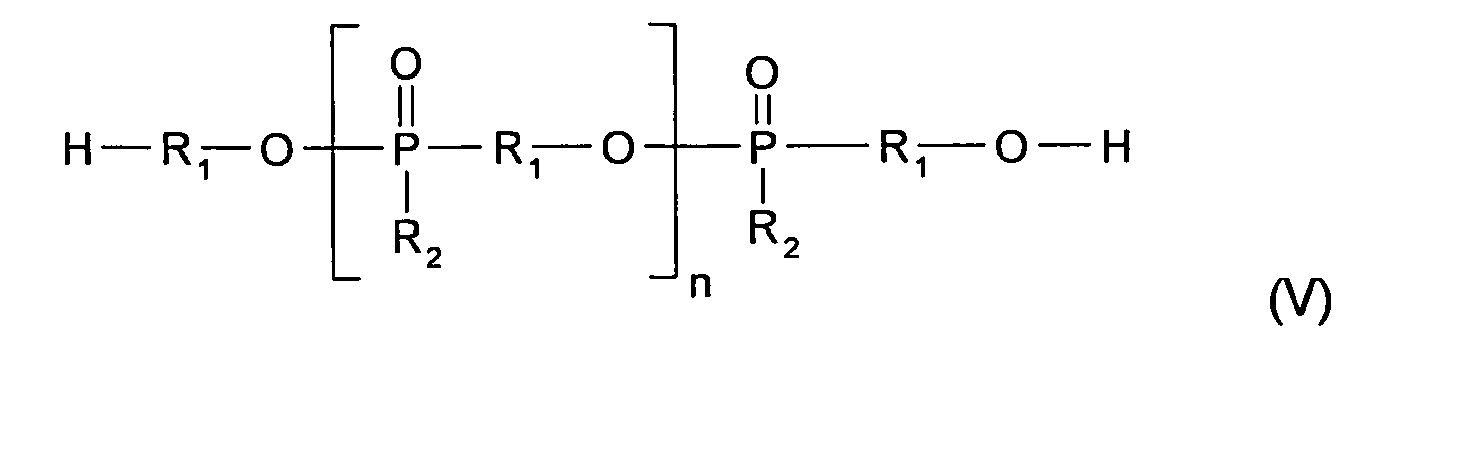
- worin n eine durchschnittliche Kettenlänge von 0 bis 10,
- A1 und A2 gleich oder verschieden sind und unabhängig voneinander C(=O)NHR5, C(=O)R5, CH3, CH2CH3, CH2CH2CH3, CH(CH3)2, CH2(CH2)2CH3, CH2CH(CH3)2, C(CH3)3, C6H5 und/oder CH2-C6H5,
- R1 ein Rest der allgemeinen Formel (II),

- worin k eine durchschnittliche Kettenlänge von 0 - 5 bedeutet;
- R2 CH3, CH2CH3, CH2CH2CH3, CH2(CH3)2, CH2(CH2)2CH3, CH2CH(CH3)2, C(CH3)3, C6H5 oder CH2-C6H5; OCH3, OCH2CH3, O(CH2)2CH3, OCH(CH3)2, O(CH2)3CH3, OCH2CH(CH3)2, OC(CH3)3, O-C6H5 oder O-CH2-C6H5,
- R3, R4, R5 gleich oder verschieden sind und unabhängig voneinander CH3, CH2CH3, CH2CH2CH3, CH(CH3)2, CH2(CH2)2CH3, CH2CH(CH3)2, C(CH3)3, C6H5 und/oder CH2-C6H5 bedeuten und wobei mindestens 2 Verbindungen der Formeln (I), (III), (IV) oder (V) gleichzeitig in der Mischung anwesend sind.
- Bevorzugt enthalten die Mischungen
- 0,1 bis 99,7 Gew.-% Verbindungen der Formel (I),
- 0,1 bis 99,7 Gew.-% Verbindungen der Formel (II) und
- 0,1 bis 99,7 Gew.-% Verbindungen der Formel (IV)
- Bevorzugt enthalten die Mischungen auch
- 0,1 bis 99,6 Gew.-% Verbindungen der Formel (I),
- 0,1 bis 99,6 Gew.-% Verbindungen der Formel (II),
- 0,1 bis 99,6 Gew.-% Verbindungen der Formel (IV) und
- 0,1 bis 99,6 Gew.-% Verbindungen der Formel (V).
- Bevorzugt bedeutet
- R2 CH3, CH2CH3, CH2CH2CH3, CH(CH3)2, C6H5, OCH3, OCH2CH3, O(CH2)2CH3 oder O-C6H5,
- R3, R4, R5 sind gleich oder verschieden und bedeuten, unabhängig voneinander CH3, CH2CH3 und/oder CH2CH2CH3 und
- A1, A2 sind gleich oder verschieden und bedeuten, unabhängig voneinander C(=O)NHR5, C(=O)R5, CH3, CH2CH3, (CH2)2CH3, CH(CH3)2, CH2(CH2)2CH3, CH2CH(CH3)2, C(CH3)3, C6H5 und/oder CH2-C6H5,
- k eine durchschnittliche Kettenlänge von 1 - 3 und
- n eine durchschnittliche Kettenlänge von 0 - 5.
- Die Erfindung betrifft auch ein Verfahren zur Herstellung von den vorgenannten Mischungen nach einem oder mehreren der Ansprüche 1 bis 3, dadurch gekennzeichnet, dass ein polymerer Phosphor- oder Phosphonsäureester der allgemeinen Formel (V) mit einem Verkappungsreagenz in Gegenwart eines basischen Katalysators zu der Mischung umgesetzt wird.
- Bevorzugt handelt es sich bei dem Verkappungsreagenz um Monoalkylisocyanate, Monoarylisocyanate, Carbonsäureanhydride, Carbonsäurechloride, Alkylhalogenide, Aralkylhalogenide und/oder Diazomethan.
Bevorzugt handelt es sich bei dem basischen Katalysator um tertäre Amine und/oder organische Zinkverbindungen. - Bevorzugt handelt es sich bei dem basischen Katalysator um Pyridin, Triethylamin, Tetramethylbutandiamin (TMBDA), 1,4-Diaza(2,2,2)bicyclooctan (DABCO), Tetramethylguanidin, 1,5-Diazabicyclo[4.3.0]non-5-en (DBN), 1,8-Diazabicyclo-[5.4.0]undec-7-en (DBU), Dibutylzinndilaurat, Zinn(II)octoat und/oder Zinnricinolat.
- Besonders bevorzugt handelt es sich bei dem basischen Katalysator um Zinn(II)octoat und/oder Pyridin.
- Die Erfindung betrifft auch die Verwendung der vorgenannten Mischungen nach einem oder mehreren der Ansprüche 1 bis 3 als Flammschutzmittel, in Mischung mit anderen Flammschutzmitteln, alleine oder in Mischung mit anderen Flammschutzmitteln zur Herstellung von weiteren Flammschutzmitteln oder Vorprodukten davon.
- Bevorzugt werden die vorgenannten Mischungen nach einem oder mehreren der Ansprüche 1 bis 3 als Flammschutzmittel für Polyurethan-Kunststoffe, die auf Polyether- oder Polyester-Systemen basieren, verwendet.
- Insbesondere betrifft die Erfindung die Verwendung von den vorgenannten Mischungen nach einem oder mehreren der Ansprüche 1 bis 3 als Flammschutzmittel für die Herstellung von flammgeschützten Polyurethan-Kunststoffen, die als Elastomere durch Gießen, als Hart- oder Weichschäume in kontinuierlicher oder diskontinuierlicher Herstellungsweise, als geschäumte oder massive Formartikel oder als Folie hergestellt werden.
- Bevorzugt werden die vorgenannten Mischungen nach einem oder mehreren der Ansprüche 1 bis 3 auch als Flammschutzmittelbooster, als Flammschutzmittel für Klarlacke und Intumeszenzbeschichtungen, Flammschutzmittel für Holz und andere cellulosehaltige Produkte, als reaktives und/oder nicht reaktives Flammschutzmittel für Polymere und/oder zum flammhemmend Ausrüsten von Polyester und Cellulose-Rein- und Mischgeweben durch Imprägnierung verwendet.
- Die Erfindung betrifft aber auch die Verwendung von den vorgenannten Mischungen nach einem oder mehreren der Ansprüche 1 bis 3 als Binder für Giesereimassen, Formsande;
als Vernetzer bzw. Beschleuniger beim Aushärten von Epoxyharzen, Polyurethanen und ungesättigten Polyesterharzen;
als Polymerstabilisatoren, wie als Lichtschutzstabilisator, Radikalfänger und/oder Thermostabilisatoren für Baumwollgewebe, Polymerfasern, Kunststoffe;
als Pflanzenschutzmittel, wie als Pflanzenwachstumsregulator, als Herbizid, Pestizid oder Fungizid;
als Therapeutikum oder Additiv in Therapeutika für Menschen und Tiere, als Enzymmodulator, zur Stimulierung von Gewebewachstum;
als Sequestrierungsmittel, bei der Mineralölgewinnung und in Metallbehandlungsmitteln;
als Mineralöl-Additiv, als Antioxidans und zur Erhöhung der Oktanzahl;
als Korrosionsschutzmittel;
in Wasch- und Reinigungsmittelanwendungen, als Entfärbungsmittel;
in Elektronikanwendungen, in Polyelektrolyten für Kondensatoren, in Batterien und Akkumulatoren, sowie als Radikalfänger in photosensitiven Schichten;
als Aldehydfänger;
Formaldehydfänger in Klebemassen und Formkörpern, in Bauanwendungen, Automobil-, Schiff-, Luft und Raumfahrtindustrie und für die Elektrotechnik. - Die eingangs genannte Aufgabe wird auch gelöst durch ein Flammschutzmittel, enthaltend eine Mischung von Verbindungen der Formeln (I), (III), (IV) und/oder (V), dadurch gekennzeichnet, dass es
- 0,1 - 10 Gew.-% Verbindungen der Formel (V) ,
- 0 - 30 Gew.-% Verbindungen der Formel (III) und (IV) und
- 70 - 99,9 Gew.-% Verbindungen der Formel (I) enthalten.
- Geeignet ist ebenfalls ein Flammschutzmittel, enthaltend eine Mischung von Verbindungen der Formeln (I), (III), (IV) und/oder (V), dadurch gekennzeichnet, dass
- es 0,1 - 20 Gew.-% Verbindungen der Formel (V)
- 50 - 99,8 Gew.-% Verbindungen der Formel (III) und (IV) und
- 0,1 - 20 Gew.-% Verbindungen der Formel (I) enthalten.
- In einer anderen Ausführungsweise enthält das Flammschutzmittel eine Mischung von Verbindungen der Formeln (I), (III), (IV) und/oder (V) in folgenden Mengen:
- 0,1 - 10 Gew.-% Verbindungen der Formel (I),
- 25 - 60 Gew.-% Verbindungen der Formeln (III) und (IV) und
- 30 - 74,9 Gew.-% Verbindungen der Formel (V).
- In einer weiteren Ausführungsweise enthält das Flammschutzmittel eine Mischung von Verbindungen der Formeln (I), (III), (IV) und/oder (V) in folgenden Mengen:
- 0,1 - 5 Gew.-% Verbindungen der Formel (I),
- 10 - 40 Gew.-% Verbindungen der Formeln (III) und (IV) und
- 50 - 89,9 Gew.-% Verbindungen der Formel (V).
- Bevorzugt bedeuten dabei in den Formeln (I), (III), (IV) und/oder (V)
- R2 CH3, CH2CH3, CH2CH2CH3, CH(CH3)2, C6H5, OCH3, OCH2CH3, O(CH2)2CH3 oder O-C6H5,
- R3, R4, R5 sind gleich oder verschieden und bedeuten, unabhängig voneinander CH3, CH2CH3 und/oder CH2CH2CH3 und
- A1, A2 sind gleich oder verschieden und bedeuten, unabhängig voneinander C(=O)NHR5, C(=O)R5, CH3, CH2CH3, (CH2)2CH3, CH(CH3)2, CH2(CH2)2CH3, CH2CH(CH3)2, C(CH3)3, C6H5 und/oder CH2-C6H5,
- k bedeutet eine durchschnittliche Kettenlänge von 1 - 3 und
- n bedeutet eine durchschnittliche Kettenlänge von 0 - 5.
- Wieviel an Verbindungen der Formeln (I), (III), (IV) und/oder (V) in den erfindungsgemäßen Mischungen enthalten ist, kann grundsätzlich über die Mengenzufuhr bzw. das Einsatzverhältnis Verkappungsreagenz zu Verbindung (V) - welche eines der Edukte darstellt - reguliert werden. Entsprechend können die Mengenverhältnisse an Verbindungen der Formeln (I), (III), (IV) und/oder (V) in der erfindungsgemäßen Mischung in weiten Grenzen variieren, wie es den Ansprüchen 2 und 3 entspricht und wie es auf den vorangangenen Seiten bei den bevorzugten Mischungen wiedergegeben ist.
- So werden etwa bei einem Einsatzverhätnis von Phosphor-Komponente zu Verkappungsreagenz von 1 zu 2 Mischungen erhalten, die 0,1 - 10 % polymere Phosphor- oder Phosphonsäureester der allgemeinen Formel (V), in Summe
- 0 - 30 Gew.-% der Phosphorkomponenten der Formeln (III) und (IV) und
- 70 - 99,9 Gew.-% der Phosphorkomponenten der Formel (I) enthalten. Die Phosphorkomponenten der Formeln (III) und (IV) liegen dabei bevorzugt in einem Verhältnis von 1,5 : 1 bis 1 : 1,5 vor.
- Bei einem Einsatzverhätnis von Phosphor-Komponente zu Verkappungsreagenz von 1 zu 1 werden Mischungen erhalten, die 0,1 - 20 % polymere Phosphor- oder Phosphonsäureester der allgemeinen Formel (V), in Summe 50 - 99,9 Gew.- % der Phosphorkomponenten der Formeln (III) und (IV) und 0,1 - 20 Gew.-% der Phosphorkomponenten der Formel (I) enthalten. Die Phosphorkomponenten der Formeln (III) und (IV) liegen bevorzugt in einem Verhältnis von 1,5 : 1 bis 1 : 1,5 vor.
- Bei einem Einsatzverhätnis von Phosphor-Komponente zu Verkappungsreagenz von 2 zu 1 werden Mischungen erhalten, die 30 - 75 Gew.-% polymere Phosphor- oder Phosphonsäureester der allgemeinen Formel (V), in Summe 25 - 60 Gew.-% der Phosphorkomponenten der Formeln (III) und (IV) und 0,1 - 10 Gew.-% der Phosphorkomponenten der Formel (I) enthalten. Die Phosphorkomponenten der Formeln (III) und (IV) liegen bevorzugt in einem Verhältnis von 1,5 : 1 bis 1 : 1,5 vor.
- Bei einem Einsatzverhätnis von Phosphor-Komponente zu Verkappungsreagenz von 4 zu 1 werden Mischungen erhalten, die 50 - 90 % polymere Phosphor- oder Phosphonsäureester der allgemeinen Formel (V), in Summe 10 - 40 % der Phosphorkomponenten der Formeln (III) und (IV) und 0,1 - 5 % der Phosphorkomponenten der Formel (I) enthalten. Die Phosphorkomponenten der Formeln (III) und (IV) liegen bevorzugt in einem Verhältnis von 1,5 : 1 bis 1 : 1,5 vor.
- Bevorzugt weist das erfindungsgemäße Flammschutzmittel eine Säurezahl von 0,05 - 5 mg KOH/ g, besonders bevorzugt von 0,1 - 2 mg KOH/g auf.
- Bevorzugt weist das erfindungsgemäße Flammschutzmittel eine Viskosität von 0,01 - 50 Pa.s bei 25 °C, insbesondere von 5 - 15 Pa.s bei 25 °C auf.
Bevorzugt weist das erfindungsgemäße Flammschutzmitteleinen Phosphorgehalt von 1 - 25 %, insbesondere von 5 - 20 % auf. - Bevorzugt weist das erfindungsgemäße Flammschutzmittel eine Hydroxylzahl von 0 - 300 mg KOH/ g, insbesondere von 5 - 200 mg KOH/g auf.
- Bevorzugt weist das erfindungsgemäße Flammschutzmittel einen Wassergehalt von 0,001 - 2 mg/g, insbesondere von 0,01 - 0,9 mg/g auf.
- Besonders ist das erfindungsgemäße Flammschutzmittel dadurch gekennzeichnet, dass es eine klare bis leicht trübe Flüssigkeit mit einer Hazenfarbzahl von 1 - 1.000, besonders bevorzugt mit einer Hazenfarbzahl von 1 - 400 darstellt.
- Überraschenderweise wurde gefunden, dass sich das erfindungsgemäße Flammschutzmittel im Unterschied zu den entsprechenden unverkappten polymeren Phosphor- oder Phosphonsäureester der allgemeinen Formel (V) durch eine niedrigere Hydrolyseempfindlichkeit und bei Anwendung im PU-Schaum, dieser sich durch eine verbesserte Offenzelligkeit auszeichnet.
- Beim erfindungsgemäßen Verfahren werden bevorzugt als Edukt polymere Phosphor- oder Phosphonsäureester der allgemeinen Formel (V), wie Phosphorsäure-ethylenglykol-polyester, Phosphorsäure-propylenglykol-polyester, Alkylphosphonsäure-ethylenglykol-polyester, Alkylphosphonsäurepropylenglykolpolyester, Arylphosphonsäure-ethylenglykol-polyester und Arylphosphonsäurepropylenglykol-polyester eingesetzt.
- Bevorzugt werden als Edukt auch die polymeren Phosphor- oder Phosphonsäureester der allgemeinen Formel (V) wie Methylphosphonsäureethylenglykol-polyester, Ethylphosphonsäurepropylenglykol-polyester, Propylphosphonsäure-ethylenglykol-polyester, Butylphosphonsäureethylenglykolpolyester, Methylphosphonsäure-propylenglykol-polyester, Ethylphosphonsäurepropylenglykol-polyester, Propylphosphonsäure-propylenglykol-polyester und Butylphosphonsäurepropylenglykol-polyester eingesetzt.
Besonders bevorzugt werden als Edukte (polymere Phosphor- oder Phosphonsäureester der allgemeinen Formel (V)) die Handelsprodukte Exolit® OP 550, Exolit® OP 560 und Exolit® OP 570 eingesetzt. - Bevorzugt werden als Monoalkylisocyanat Methylisocyanat, Ethylisocyanat und Cyclohexylisocyanat eingesetzt. Bevorzugt werden als Monoarylisocyanat Benzylisocyanat und Phenylisocyanat eingesetzt.
- Bevorzugt werden als Carbonsäureanhydrid Acetanhydrid und Benzoesäureanhydrid eingesetzt. Bevorzugt werden als Carbonsäurechloride Essigsäurechlorid und Benzoesäurechlorid eingesetzt.
- Bevorzugt werden als Alkylhalogenide Methylchlorid, Ethylchlorid, n-Propylchlorid, iso-Propylchlorid, n-Butylchlorid, iso-Butylchlorid und tert.-Butylchlorid eingesetzt. Bevorzugt wird als Aralkylhalogenid Benzylchlorid eingesetzt.
- Bevorzugt werden die polymeren Phosphor- oder Phosphonsäureester der Formel (V) mit dem Verkappungsreagenz in Molverhältnis 1 : 2 bis 5 : 1, besonders bevorzugt im Molverhältnis 1 : 1 bis 1: 2 umgesetzt.
- Das Molgewicht der polymeren Phosphor- oder Phosphonsäureester wird dabei aus deren Hydroxylzahl berechnet.
- Bevorzugt wird 0,001 - 50 % des basischen Katalysators bzgl. der polymeren Phosphor- oder Phosphonsäureester der Formel (V) eingesetzt, besonders bevorzugt 0,05 - 35 %.
- Das Verfahren kann so durchgeführt werden, dass die polymeren Phosphor- oder Phosphonsäureester der Formel (V) mit dem basischen Katalysator vorgelegt und das Verkappungsreagenz zugetropft wird.
- Das Verfahren kann auch so durchgeführt werden, dass das Verkappungsreagenz mit dem basischen Katalysator vorgelegt und die polymeren Phosphor- oder Phosphonsäureester der Formel (V) zugetropft werden.
Bevorzugt als basische Katalysatoren sind tertiäre Amine und Salze schwacher Basen. Besonders bevorzugte tertiäre Amine sind Pyridin, Triethylamin, Tetramethylbutandiamin (TMBDA), 1,4-Diaza(2,2,2)bicyclooctan (DABCO), Tetramethylguanidin, 1,5-Diazabicyclo[4.3.0]non-5-en (DBN),
1,8-Diazabicyclo[5.4.0]undec-7-en (DBU), Dibutylzinndilaurat, Zinn(II)octoat, Zinnricinolat. Besonders bevorzugt sind Pyridin und Zinn(II)octoat. Als Zinn(II)octoat sind besonders die Handelsprodukte Desmorapid® SO (Rhein Chemie) und Kosmos® 29 (Degussa) bevorzugt. - Bevorzugt beträgt die Dosierzeit 0,1 - 10 h, besonders bevorzugt 1 - 5 h.
Bevorzugt beträgt die Nachreaktionszeit 0,1 - 48 h, besonders bevorzugt 1 - 10 h. - Bevorzugt wird die Reaktion zwischen polymeren Phosphor- oder Phosphonsäureester der Formel (V) und Verkappungsreagenz bei 0 - 200 °C, besonders bevorzugt bei 10 - 150 °C durchgeführt.
- Die Erfindung betrifft auch die Verwendung der erfindungsgemäßen Mischungen bzw. des erfindungsgemäßen Flammschutzmittels als Zwischenstufe zur Herstellung von Flammschutzmitteln.
- Die Erfindung betrifft Flammschutzmittel, die 0,01 - 99,99 % des erfindungsgemäßen Flammschutzmittels und 0,01 - 99,99 % an anderen Flammschutzmitteln enthalten.
- Die Erfindung betrifft Semiprepolymere und/oder Prepolymere, die 0,01 - 99,99 % des erfindungsgemäßen Flammschutzmittels enthalten.
- Die Erfindung betrifft auch ein Verfahren zur Herstellung von Polyurethan-Prepolymere bzw. Semiprepolymere, dadurch gekennzeichnet, dass 0,01 - 50 % des erfindungsgemäßen Flammschutzmittels und 0,01 - 99,99 % Polyol miteinander vermischt werden.
- Die Erfindung betrifft Polyurethan-Kunststoffe, die 0,01 - 99,99 % des erfindungsgemäßen Flammschutzmittels enthalten.
- Bevorzugt handelt sich dabei um Urethan- und/oder Isocyanurat- und/oder Allophanat- und/oder Uretdion- und/oder Harnstoff- und/oder Carbodiimidgruppen aufweisende Schaumstoffe.
- Es handelt sich bei Polyurethankunststoffen vorwiegend um Urethan- und/oder Isocyanurat- und/oder Allophanat- und/oder Uretdion- und/oder Harnstoff- und/oder Carbodiimidgruppen aufweisende Schaumstoffe. Die erfindungsgemäße Verwendung erfolgt vorzugsweise bei der Herstellung von Polyurethankunststoffen.
- Ausgangskomponenten sind ferner Verbindungen mit mindestens zwei gegenüber Isocyanaten reaktionsfähigen Wasserstoffatomen mit einem Molekulargewicht von 400 bis 10.000 ("Polyolkomponente"). Hierunter versteht man neben Aminogruppen, Thiogruppen oder Carboxylgruppen aufweisende Verbindungen, vorzugsweise Hydroxylgruppen aufweisende Verbindungen, insbesondere 2 bis 8 Hydroxylgruppen aufweisende Verbindungen, speziell solche vom Molekulargewicht 1.000 bis 6.000, vorzugsweise 200 bis 6.000, in der Regel 2 bis 8, vorzugsweise aber 2 bis 6 Hydroxylgruppen aufweisende Polyether und Polyester sowie Polycarbonate und Polyesteramide, wie sie für die Herstellung von homogenen und von zellförmigen Polyurethanen an sich bekannt sind. Die mindestens zwei Hydroxylgruppen aufweisenden Polyether und Polyester sind erfindungsgemäß bevorzugt.
- Weitere Ausgangskomponenten sind Verbindungen mit mindestens zwei gegenüber Isocyanaten reaktionsfähigen Wasserstoffatomen und einem Molekulargewicht von 32 bis 399. Auch in diesem Fall versteht man hierunter Hydroxylgruppen und/oder Aminogruppen und/oder Thiogruppen und/oder Carboxylgruppen aufweisende Verbindungen, vorzugsweise Hydroxylgruppen und/oder Aminogruppen aufweisende Verbindungen, die als Kettenverlängerungsmittel oder Vernetzungsmittel dienen. Diese Verbindungen weisen in der Regel 2 bis 8, vorzugsweise 2 bis 4 gegenüber Isocyanaten reaktionsfähige Wasserstoffatome auf.
- Als Treibmittel geeignet sind Wasser und/oder leicht flüchtige organische Substanzen, z. B. n-Pentan, i-Pentan, Cyclopentan, halogenhaltige Alkane, wie Trichlormethan, Methylenchlorid oder Chlorfluoralkane, CO2 und andere.
- Gegebenenfalls werden Hilfs- und Zusatzmittel mitverwendet wie Katalysatoren der an sich bekannten Art, oberflächenaktive Zusatzstoffe, wie Emulgatoren und Schaumstabilisatoren, Reaktionsverzögerer, z. B. sauer reagierende Stoffe wie Salzsäure oder organische Säurehalogenide, ferner Zellregler der an sich bekannten Art wie Paraffine oder Fettalkohole und Dimethylpolysiloxane sowie Pigmente oder Farbstoffe und weitere Flammschutzmittel der an sich bekannten Art, ferner Stabilisatoren gegen Alterungs- und Witterungseinflüsse, Weichmacher und fungistatisch und bakteriostatisch wirkende Substanzen sowie Füllstoffe, wie Bariumsulfat, Kieselgur, Ruß- oder Schlämmkreide.
- Die Erfindung betrifft auch die Verwendung der erfindungsgemäßen Mischungen bzw. der erfindungsgemäßen Flammschutzmittels als Flammschutzmittel für die Herstellung von flammgeschützten Polyurethan-Kunststoffen, die als Elastomere durch Gießen, als Hart- oder Weichschäume in kontinuierlicher oder diskontinuierlicher Herstellungsweise, als geschäumte oder massive Formartikel oder als Folie hergestellt werden.
- Die Erfindung betrifft auch die Verwendung der erfindungsgemäßen Mischungen bzw. des erfindungsgemäßen Flammschutzmittels als Flammschutzmittel für Polyurethan-Kunststoffe, die in den folgenden Anwendungen: Bauindustrie, Kühlgeräteindustrie, technischen Isolierungen, Dämmplatten, Möbelpolsterungen, Textileinlagen, Matratzen, Automobilsitze, Armlehnen und Bauelemente sowie Sitz- und Armaturverkleidungen.
- Besonders bevorzugt ist die Verwendung der erfindungsgemäßen Mischungen bzw. des erfindungsgemäßen Flammschutzmittels als Flammschutzmittel für Polyurethan-Kunststoffe, die auf Polyether- oder Polyester-Systemen basieren.
- Die Erfindung betrifft auch ein Verfahren zur Herstellung von flammwidrigen Polyurethanweichschäumen, die durch geringe Fogging-Beiträge und angemessene Offenzelligkeit gekennzeichnet sind. Das Verfahren zur Herstellung dieser Polyurethanweichschäume ist dadurch gekennzeichnet, dass man organische Polyisocyanate mit Verbindungen mit mindestens zwei gegenüber Isocyanaten reaktionsfähigen Wasserstoffatomen mit üblichen Treibmitteln, Stabilisatoren, Aktivatoren und/oder weiteren üblichen Hilfs- und Zusatzstoffen in Gegenwart des erfindungsgemäßen Flammschutzmittels im Einstufenverfahren, Prepolymerverfahren oder Semiprepolymerverfahren umsetzt.
- Bevorzugt ist die Verwendung der erfindungsgemäßen Mischungen bzw. des erfindungsgemäßen Flammschutzmittels als Flammschutzmittel für Polyurethanweichschaumstoffe, die durch ein Blockverschäumungsverfahren hergestellt werden.
- Besonders bevorzugt ist die Verwendung der erfindungsgemäßen Mischungen bzw. des erfindungsgemäßen Flammschutzmittels als Flammschutzmittel für Polyurethanweichschäumen, die dann durch geringe Fogging-Beiträge und angemessene Offenzelligkeit gekennzeichnet sind.
- 16 g (0,134 mol) Phenylisocyanat wurden mit 0,03 g Desmorapid® SO (0,03 % bzgl. Exolit OP550) in einem Kolben mit Tropftrichter, Thermometer und Rückflusskühler vorgelegt. Unter Rühren wurden bei einer Temperatur von 70 - 80 °C 100 g Exolit® OP 550 (Hydroxylzahl: 131 mg KOH/g) zugetropft und noch eine Zeitlang weitergerührt. Das resultierende erfindungsgemäße Produkt ist eine klare, farblose Flüssigkeit, die sich durch eine Säurezahl von 1,6 mg KOH/g, eine Hydroxylzahl von 66 mg KOH/g und einer Viskosität von 8.700 mPa·s bei 25 °C auszeichnet.
- 32 g (0,268 mol) Phenylisocyanat wurden mit 0,01 g Desmorapid® SO (0,01 % bzgl. Exolit® OP 550) in einem Kolben mit Tropftrichter, Thermometer und Rückflusskühler vorgelegt. Unter Rühren wurden bei einer Temperatur von 80 - 85 °C 100 g Exolit® OP 550 (Hydroxylzahl: 145 mg KOH/g) zugetropft noch eine Zeitlang weitergerührt. Das resultierende erfindungsgemäße Produkt ist eine klare, schwach gelbliche Flüssigkeit, die sich durch eine Säurezahl von 0,9 mg KOH/g, eine Hydroxylzahl von 13 mg KOH/g und einer Viskosität von 9.800 mPa·s bei 25 °C auszeichnet.
- 100 g Exolit® OP 550 (Hydroxylzahl: 139 mg KOH/g) wurden mit 0,06 g Desmorapid® SO (0,06 % bzgl. Exolit OP 550) in einem Kolben mit Tropftrichter, Thermometer und Rückflusskühler vorgelegt. Unter Rühren wurden bei einer Temperatur von 60-70 °C innerhalb von 2 h 16 g (0,134 mol) Phenylisocyanat zugetropft und noch eine Zeitlang weitergerührt. Das resultierende Produkt ist eine klare, farblose Flüssigkeit, die sich durch eine Säurezahl von 1,8 mg KOH/g, eine Hydroxylzahl von 71 mg KOH/g und einer Viskosität von 9.600 mPa·s bei 25 °C auszeichnet.
- 691 g Exolit® OP 570 (TP) (Hydroxylzahl: 438 mg KOH/g) wurden mit 0,21 g Desmorapid® SO (0,03 % bzgl. Exolit® OP 570) in einem Kolben mit Tropftrichter, Thermometer und Rückflusskühler vorgelegt. Unter Rühren wurden bei einer Temperatur von 75 - 80 °C innerhalb von 2,5 h 321 g (2,7 mol) Phenylisocyanat zugetropft und noch eine Zeitlang weitergerührt. Das resultierende erfindungsgemäße Produkt ist eine klare, farblose Flüssigkeit, die sich durch eine Säurezahl von 0,8 mg KOH/g, einer Hydroxylzahl von 155 mg KOH/g und einer Viskosität von 10,3 Pa·s bei 25 °C auszeichnet.
- 230 g Exolit® OP 560 (Hydroxylzahl: 417 mg KOH/g) wurden mit 0,12 g Desmorapid® SO (0,05 % bzgl. Exolit® OP 560) in einem Kolben mit Tropftrichter, Thermometer und Rückflusskühler vorgelegt. Unter Rühren wurden bei einer Temperatur von 40 - 50 °C innerhalb von 3 h 64 g (0,9 mol) Ethylisocyanat zugetropft und noch eine Zeitlang weitergerührt. Das resultierende erfindungsgemäße Produkt ist eine klare, farblose Flüssigkeit, die sich durch eine Säurezahl von 0,5 mg KOH/g, einer Hydroxylzahl von 130 mg KOH/g und einer Viskosität von 5.500 mPa·s bei 25 °C auszeichnet.
- 100 g Exolit® OP 560 (Hydroxylzahl: 429 mg KOH/g) wurden mit 0,01 g Desmorapid® SO (0,01 % bzgl. Exolit® OP 560) in einem Kolben mit Tropftrichter, Thermometer und Rückflusskühler vorgelegt. Unter Rühren wurden bei einer Temperatur von 85 - 90°C innerhalb von 1 h 52 g (0,4 mol) Benzylisocyanat zugetropft und noch eine Zeitlang weitergerührt. Das resultierende erfindungsgemäße Produkt ist eine klare, farblose Flüssigkeit, die sich durch eine Säurezahl von 0,8 mg KOH/g, einer Hydroxylzahl von 137 mg KOH/g und einer Viskosität von 10,1 Pa.s bei 25 °C auszeichnet.
- 100 g Exolit® OP 550 (Hydroxylzahl: 139 mg KOH/g) wurden in einem Kolben mit Tropftrichter, Thermometer und Rückflusskühler vorgelegt. Unter Rühren wurde zuerst bei einer Temperatur von 20 - 30 °C innerhalb von 10 min 13,7 g (0,134 mol) Acetanhydrid zugetropft. Dann wurde 0,106 g (1,3 mmol) trockenes Pyridin (1 mol.% bzgl. Acetanhydrid) zugetropft und auf 100 - 105 °C unter Rühren 3 h erhitzt. Das resultierende erfindungsgemäße Produkt ist eine klare, hellgelbe Flüssigkeit, die sich durch eine Säurezahl von 0,6 mg KOH/g, einer Hydroxylzahl von 63 mg KOH/g und einer Viskosität von 4.900 mPa·s bei 25 °C auszeichnet.
- 54,5 g (0,4 mol) Benzoesäureanhydrid wurden in einem Kolben mit Tropftrichter, Thermometer und Rückflusskühler aufgeschmolzen und bei 60 °C mit 100 g Exolit® OP 560 (Hydroxylzahl: 429 mg KOH/g) versetzt. Dann wurde 1,58 g (0,02 mol) trockenes Pyridin (5 mol.% bzgl. Benzoesäureanhydrid) zugesetzt und bei 85 - 90 °C unter Rühren 5 h erhitzt. Das resultierende erfindungsgemäße Produkt ist eine klare, farblose Flüssigkeit, die sich durch eine Säurezahl von 0,7 mg KOH/g, einer Hydroxylzahl von 141 mg KOH/g und einer Viskosität von 8.200 mPa·s bei 25 °C auszeichnet.
- 100 g Exolit® OP 560 (Hydroxylzahl: 429 mg KOH/g) wurden in einem Kolben mit Tropftrichter, Thermometer und Rückflusskühler vorgelegt. Unter Rühren wurde zuerst bei einer Temperatur von 20 - 30 °C innerhalb von 10 min 40,8 g (0,4 mol) Acetanhydrid zugetropft. Dann wurde 0,63 g (8 mmol) trockenes Pyridin (2 mol.% bzgl. Acetanhydrid) zugetropft und auf 90 - 95 °C unter Rühren 4 h erhitzt. Das resultierende erfindungsgemäße Produkt ist eine klare, farblose Flüssigkeit, die sich durch eine Säurezahl von 0,9 mg KOH/g, einer Hydroxylzahl von 132 mg KOH/g und einer Viskosität von 5.000 mPa·s bei 25 °C auszeichnet.
- 100 g Exolit® OP 560 (Hydroxylzahl: 429 mg KOH/g) wurden in einem Kolben mit zwei Tropftrichtern, Thermometer und Rückflusskühler vorgelegt. Dann wurde bei 10 - 15 °C 31,4 g (0,4 mol) Acetylchlorid und 31,6 g (0,4 mol) Pyridin zugetropft und 10 h bei 25 °C gerührt. Das entstehende Salz wurde abfiltriert. Das resultierende erfindungsgemäße Produkt ist eine klare, farblose Flüssigkeit, die sich durch eine Säurezahl von 1,2 mg KOH/g, einer Hydroxylzahl von 137 mg KOH/g und einer Viskosität von 5.100 mPa·s bei 25 °C auszeichnet.
- 100 g Exolit® OP 550 (Hydroxylzahl: 139 mg KOH/g) wurden in einem Kolben mit zwei Tropftrichtern, Thermometer und Rückflusskühler vorgelegt. Dann wurden bei 15 - 20 °C 18,8 g (0,134 mol) Benzoylchlorid und 10,6 g (0,134 mol) Pyridin zugetropft und 5 h bei 30 °C gerührt. Das entstehende Salz wurde abfiltriert. Das resultierende erfindungsgemäße Produkt ist eine klare, hellgelbe Flüssigkeit, die sich durch eine Säurezahl von 1,5 mg KOH/g, einer Hydroxylzahl von 76 mg KOH/g und einer Viskosität von 7.900 mPa·s bei 25 °C auszeichnet.
- Hydrolysebeständigkeit des erfindungsgemäßen Flammschutzmittels gegenüber Exolit® OP 570
- Zum Vergleich der Hydrolysebeständigkeit von Exolit® OP 570 (nicht verkappter Phosphor- oder Phosphonsäureester mit dem resultierenden Produkt aus Beispiel 4 wurde von beiden Produkten die Säurezahl vor und nach Zugabe von 1 % Wasser bestimmt. Die Verfolgung der Säurezahl beider Produkte ist in Tabelle 1 wiedergegeben.
Tabelle 1: Verfolgung der Säurezahl in Beispiel 12 Zeit Säurezahl [mg KOH/g] Flammschutzmittel aus Beispiel 4 Exolit® OP 570 (TP) Ausgangsmaterial ohne H2O-Zusatz 0,8 1,4 mit 1% H2O (frisch angesetzt) 1,3 1,4 nach 1 Tag 2,5 5,3 nach 2 Tagen 2,7 6,7 nach 3 Tagen 3,1 8,6 - Die Säurezahl des erfindungsgemäßen Flammschutzmittels aus Beispiel 4 steigt nach Wasserzugabe deutlich langsamer an als das entsprechende nicht verkappte Produkt Exolit® OP 570. Das erfindungsgemäße Flammschutzmittel aus Beispiel 4 ist somit auch deutlich weniger hydrolyseempfindlich als Exolit® OP 570.
- Polyurethanweichschaumformulierungen mit Ausprüfung Das oben beschriebenen Flammschutzmittel Exolit® OP 570 sowie das erfindungsgemäße Flammschutzmittel aus Beispiel 4 wurden in Polyurethanweichschäumen mit einem NCO-Index von 105 der Formulierung nach Tabelle 2 eingearbeitet. Der NCO-Index ist eine Kennzahl, die das prozentuale Verhältnis der eingesetzten Isocyanatmenge zur stöchiometrischen, d. h. berechneten Isocyanatmenge, bei der Umsetzung je einer isocyanataktiven Gruppe mit einer Isocyanatgruppe beschreibt.
Tabelle 2: Polyurethanweichschaumformulierung A Standard ohne FSM* Standard mit FSM Polyetherpolyol (Arcol® Polyol 1108, Bayer MateriaiScience) 100 Teile 100 Teile Zinnricinoleat (Kosmos® EF, Goldschmidt) 0,3 Teile 0,3 Teile 0,3 Teile 0,3 Teile 2-((2-(2-(Dimethylamino)ethoxy)-ethyl)methylamino)ethanol (Tegoamin® ZE3, Degussa) 0,2 Teile 0,2 Teile Polyethermodifiziertes Polysiloxan (Tegostab® B 8232, Goldschmidt) 0,7 Teile 0,7 Teile Wasser 3,5 Teile 3,5 Teile 2,4- und 2,6-Toluylendiisocyanat (Desmodur® T80, Bayer MaterialScience) 47,8 Teile 47,8 Teile Flammschutzmittel 0 Teile 1-10 Teile *FSM: Flammschutzmittel Tabelle 3: Eigenschaften der Polyurethan-Weichschäume A mit erfindungsgemäßem Flammschutzmittel aus Beispiel 4 im Vergleich Standard ohne FSM Flammschutzmittel aus Beispiel 4 (Exolit® OP 570, verkappt) Exolit® OP 570 FSM-Gehalt (Teile) 0 7 4 Steigzeit (s) 112 115 114 Raumgewicht (kg/m3) 30,5 29,8 31,0 Luftdurchlässigkeit 15 16 >250 Brandklasse nach FMVSS 302 B = 82 mm/min SE SE - Die Flammfestigkeit der Polyurethanweichschäume wurde mittels des FMVSS 302 - Tests (Federal Motor Vehicle Safety Standard) geprüft. Terminologie zur Beurteilung des Brandverhaltens:
- SE
- Selbsterlöschend
- SE/NBR
- Selbsterlöschend/keine Brennrate
- SE/B
- Selbsterlöschend/mit Brennrate
- B
- Brennrate
- Der PU-Weichschaum A mit dem erfindungsgemäßen Flammschutzmittel aus Beispiel 4 zeigt gegenüber dem PU-Weichschaum des nicht verkappten Produktes Exolit® OP 570 eine wesentlich verbesserte Luftdurchlässigkeit. Die Offenzelligkeit des PU-Weichschaums mit dem Flammschutzmittel aus Beispiel 4 ist sogar ebenso gut wie der Standard ohne Flammschutzmittel (dies ist völlig ungewöhnlich und sehr überraschend, weil der Einsatz der bisher bekannten Flammschutzmittel aus dem Stand der Technik ansonsten zu einer Reduzierung der Offenzelligkeit geführt hat). Der Polyurethan-Weichschaum A mit dem Flammschutzmittel aus Beispiel 4 erreicht mit SE dieselbe Brandklasse wie der Polyurethan-Weichschaum A mit Exolit® OP 570 (TP).
Tabelle 4: Polyurethanweichschaumformulierung B Standard ohne FSM* Standard mit FSM Polyetherpolyol (Arcol® Polyol 1108, Bayer MaterialScience) 100 Teile 100 Teile Triethylendiamin in Dipropylenglykol (Tegoamin® 33, Degussa) 0,2 Teile 0,2 Teile Bis (2-Dimethylaminoethyl)ether in Dipropylenglykol (Niax® catalyst A-1, GE Silicones) 0,1 Teile 0,1 Teile Zinn(II)octoat (Desmorapid® SO; Rhein Chemie) 0,15 Teile 0,15 Teile Polyethermodifiziertes Polysiloxan (Tegostab® B 8232, Goldschmidt) 1,3 Teile 1,3 Teile Wasser 3,5 Teile 3,5 Teile 2,4- und 2,6-Toluylendiisocyanat (Desmodur® T80, Bayer MaterialScience) 23,9 Teile 23,9 Teile 2,4- und 2,6-Toluylendiisocyanat (Desmodur® T65, Bayer MateriaiScience) 23,9 Teile 23,9 Teile Flammschutzmittel 0 Teile 1-10 Teile *FSM: Flammschutzmittel Tabelle 5: Eigenschaften der PUR-Weichschäume B mit Flammschutzmittel aus Beispiel 4 im Vergleich Standard ohne FSM Flammschutzmittel aus Beispiel 4 (Exolit® OP 570, verkappt) Exolit® OP 570 FSM-Gehalt (Teile) 0 7 4 Steigzeit (s) 120 122 115 Raumgewicht (kg/m3) 30,1 32,0 31,3 Luftdurchlässigkeit 4 5 >250 Brandklasse nach FMVSS 302 B = 114 mm/min SE SE - Der PU-Weichschaum B mit der erfindungsgemäßen Flammschutzmittel aus Beispiel 4 zeigt gegenüber dem PU-Weichschaum des nicht verkappten Produktes Exolit® OP 570 (TP) eine verbesserte Luftdurchlässigkeit. Die Offenzelligkeit des PU-Weichschaums mit dem Flammschutzmittel aus Beispiel 4 ist sogar ebenso gut wie der Standard ohne Flammschutzmittel. Der PU-Weichschaum B mit dem Flammschutzmittel aus Beispiel 4 erreicht mit SE dieselbe Brandklasse wie der Schaum mit Exolit® OP 570 (TP).
Claims (18)
- Mischungen von Verbindungen der Formeln (I), (III), (IV) und/oder (V),


 worin n eine durchschnittliche Kettenlänge von 0 bis 10,A1 und A2 gleich oder verschieden sind und unabhängig voneinander C(=O)NHR5, C(=O)R5, CH3, CH2CH3, CH2CH2CH3, CH(CH3)2, CH2(CH2)2CH3, CH2CH(CH3)2, C(CH3)3, C6H5 und/oder CH2-C6H5,R1 ein Rest der allgemeinen Formel (II),
 worin k eine durchschnittliche Kettenlänge von 0 - 5 bedeutet;R2 CH3, CH2CH3, CH2CH2CH3, CH2(CH3)2, CH2(CH2)2CH3, CH2CH(CH3)2, C(CH3)3, C6H5 oder CH2-C6H5; OCH3, OCH2CH3, O(CH2)2CH3, OCH(CH3)2, O(CH2)3CH3, OCH2CH(CH3)2, OC(CH3)3, O-C6H5 oder O-CH2-C6H5,R3, R4, R5 gleich oder verschieden sind und unabhängig voneinander CH3, CH2CH3, CH2CH2CH3, CH(CH3)2, CH2(CH2)2CH3, CH2CH(CH3)2, C(CH3)3, C6H5 und/oder CH2-C6H5 bedeuten und wobei mindestens 2 Verbindungen der Formeln (I), (III), (IV) oder (V) gleichzeitig in der Mischung anwesend sind.
 - Mischungen nach Anspruch 1, enthaltend0,1 bis 99,7 Gew.-% Verbindungen der Formel (I)0,1 bis 99,7 Gew.-% Verbindungen der Formel (II)0,1 bis 99,7 Gew.-% Verbindungen der Formel (IV)
- Mischungen nach Anspruch 1, enthaltend0,1 bis 99,6 Gew.-% Verbindungen der Formel (I)0,1 bis 99,6 Gew.-% Verbindungen der Formel (II)0,1 bis 99,6 Gew.-% Verbindungen der Formel (IV)0,1 bis 99,6 Gew.-% Verbindungen der Formel (V).
- Verfahren zur Herstellung von Mischungen nach einem oder mehreren der Ansprüche 1 bis 3, dadurch gekennzeichnet, dass ein polymerer Phosphor- oder Phosphonsäureester der allgemeinen Formel (V) mit einem Verkappungsreagenz in Gegenwart eines basischen Katalysators zu der Mischung umgesetzt wird.
- Verfahren nach Anspruch 4, dadurch gekennzeichnet, dass es sich bei dem Verkappungsreagenz um Monoalkylisocyanate, Monoarylisocyanate, Carbonsäureanhydride, Carbonsäurechloride, Alkylhalogenide, Aralkylhalogenide und/oder Diazomethan handelt.
- Verfahren nach Anspruch 4 oder 5, dadurch gekennzeichnet, dass es sich bei dem basischen Katalysator um tertäre Amine und/oder organische Zinkverbindungen handelt.
- Verfahren nach einem oder mehreren der Ansprüche 4 bis 5, dadurch gekennzeichnet, dass es sich bei dem basischen Katalysator um Pyridin, Triethylamin, Tetramethylbutandiamin (TMBDA), 1,4-Diaza(2,2,2)bicyclooctan (DABCO), Tetramethylguanidin, 1,5-Diazabicyclo[4.3.0]non-5-en (DBN), 1,8-Diazabicyclo-[5.4.0]undec-7-en (DBU), Dibutylzinndilaurat, Zinn(II)octoat und/oder Zinnricinolat handelt.
- Verfahren nach einem oder mehreren der Ansprüche 4 bis 7, dadurch gekennzeichnet, dass es sich bei dem basischen Katalysator um Zinn(II)octoat und/oder Pyridin handelt.
- Verwendung von Mischungen nach einem oder mehreren der Ansprüche 1 bis 3 als Flammschutzmittel, in Mischung mit anderen Flammschutzmitteln, alleine oder in Mischung mit anderen Flammschutzmitteln zur Herstellung von weiteren Flammschutzmitteln oder Vorprodukten davon.
- Verwendung von Mischungen nach einem oder mehreren der Ansprüche 1 bis 3 als Flammschutzmittel für Polyurethan-Kunststoffe, die auf Polyether- oder Polyester-Systemen basieren.
- Verwendung von Mischungen nach einem oder mehreren der Ansprüche 1 bis 3 als Flammschutzmittel für die Herstellung von flammgeschützten Polyurethan-Kunststoffen, die als Elastomere durch Gießen, als Hart- oder Weichschäume in kontinuierlicher oder diskontinuierlicher Herstellungsweise, als geschäumte oder massive Formartikel oder als Folie hergestellt werden.
- Verwendung von Mischungen nach einem oder mehreren der Ansprüche 1 bis 3 als Flammschutzmittelbooster, als Flammschutzmittel für Klarlacke und Intumeszenzbeschichtungen, Flammschutzmittel für Holz und andere cellulosehaltige Produkte, als reaktives und/oder nicht reaktives Flammschutzmittel für Polymere und/oder zum flammhemmend Ausrüsten von Polyester und Cellulose-Rein- und Mischgeweben durch Imprägnierung.
- Verwendung von Mischungen nach einem oder mehreren der Ansprüche 1 bis 3 als Binder für Giesereimassen, Formsande;
als Vernetzer bzw. Beschleuniger beim Aushärten von Epoxyharzen, Polyurethanen und ungesättigten Polyesterharzen;
als Polymerstabilisatoren, wie als Lichtschutzstabilisator, Radikalfänger und/oder Thermostabilisatoren für Baumwollgewebe, Polymerfasern, Kunststoffe;
als Pflanzenschutzmittel, wie als Pflanzenwachstumsregulator, als Herbizid, Pestizid oder Fungizid;
als Therapeutikum oder Additiv in Therapeutika für Menschen und Tiere, als Enzymmodulator, zur Stimulierung von Gewebewachstum;
als Sequestrierungsmittel, bei der Mineralölgewinnung und in Metallbehandlungsmitteln;
als Mineralöl-Additiv, als Antioxidans und zur Erhöhung der Oktanzahl;
als Korrosionsschutzmittel;
in Wasch- und Reinigungsmittelanwendungen, als Entfärbungsmittel;
in Elektronikanwendungen, in Polyelektrolyten für Kondensatoren, in Batterien und Akkumulatoren, sowie als Radikalfänger in photosensitiven Schichten;
als Aldehydfänger;
Formaldehydfänger in Klebemassen und Formkörpern, in Bauanwendungen, Automobil-, Schiff-, Luft und Raumfahrtindustrie und für die Elektrotechnik. - Flammschutzmittel, enthaltend eine Mischung von Verbindungen der Formeln (I), (III), (IV) und/oder (V), dadurch gekennzeichnet, dass es0,1 - 10 Gew.-% Verbindungen der Formel (V),0 - 30 Gew.-% Verbindungen der Formel (III) und (IV) und70 - 99,9 Gew.-% Verbindungen der Formel (I) enthält.
- Flammschutzmittel, enthaltend eine Mischung von Verbindungen der Formeln (I), (III), (IV) und/oder (V), dadurch gekennzeichnet, dass es0,1 - 20 Gew.-% Verbindungen der Formel (V)50 - 99,8 Gew.-% Verbindungen der Formel (III) und (IV) und0,1 - 20 Gew.-% Verbindungen der Formel (I) enthält.
- Flammschutzmittel, enthaltend eine Mischung von Verbindungen der Formeln (I), (III), (IV) und/oder (V), dadurch gekennzeichnet, dass es0,1 - 10 Gew.-% Verbindungen der Formel (I),25 - 60 Gew.-% Verbindungen der Formeln (III) und (IV) und30 - 74,9 Gew.-% Verbindungen der Formel (V) enthält.
- Flammschutzmittel, enthaltend eine Mischung von Verbindungen der Formeln (I), (III), (IV) und/oder (V), dadurch gekennzeichnet, dass es0,1 - 5 Gew.-% Verbindungen der Formel (I),10 - 40 Gew.-% Verbindungen der Formeln (III) und (IV) und50 - 89,9 Gew.-% Verbindungen der Formel (V) enthält.
- Flammschutzmittel nach einem oder mehreren der Ansprüche 14 bis 17,
dadurch gekennzeichnet, dassR2 CH3, CH2CH3, CH2CH2CH3, CH(CH3)2, C6H5, OCH3, OCH2CH3, O(CH2)2CH3 oder O-C6H5,R3, R4, R5 gleich oder verschieden sind und unabhängig voneinander CH3, CH2CH3 und/oder CH2CH2CH3 undA1, A2 gleich oder verschieden sind und unabhängig voneinander C(=O)NHR5, C(=O)R5, CH3, CH2CH3, (CH2)2CH3, CH(CH3)2, CH2(CH2)2CH3, CH2CH(CH3)2, C(CH3)3, C6H5 und/oder CH2-C6H5,k eine durchschnittliche Kettenlänge von 1 - 3 undn eine durchschnittliche Kettenlänge von 0 - 5 bedeutet.
Applications Claiming Priority (1)
| Application Number | Priority Date | Filing Date | Title |
|---|---|---|---|
| DE102007056532A DE102007056532A1 (de) | 2007-11-23 | 2007-11-23 | Mischungen von phosphorhaltigen Verbindungen, ein Verfahren zu deren Herstellung und deren Verwendung als Flammschutzmittel |
Publications (3)
| Publication Number | Publication Date |
|---|---|
| EP2062905A2 true EP2062905A2 (de) | 2009-05-27 |
| EP2062905A3 EP2062905A3 (de) | 2009-12-16 |
| EP2062905B1 EP2062905B1 (de) | 2012-01-11 |
Family
ID=40363105
Family Applications (1)
| Application Number | Title | Priority Date | Filing Date |
|---|---|---|---|
| EP08020052A Not-in-force EP2062905B1 (de) | 2007-11-23 | 2008-11-18 | Mischungen von phosphorhaltigen Verbindungen, ein Verfahren zu deren Herstellung und deren Verwendung als Flammschutzmittel |
Country Status (4)
| Country | Link |
|---|---|
| US (1) | US20090136440A1 (de) |
| EP (1) | EP2062905B1 (de) |
| JP (1) | JP5641633B2 (de) |
| DE (1) | DE102007056532A1 (de) |
Cited By (2)
| Publication number | Priority date | Publication date | Assignee | Title |
|---|---|---|---|---|
| CN110600667A (zh) * | 2019-09-02 | 2019-12-20 | 厦门纬达科技有限公司 | 一种动力锂电池极耳热复合成型工艺 |
| EP4219575A1 (de) | 2022-02-01 | 2023-08-02 | Covestro Deutschland AG | Selbstverlöschende und intumeszierende flammhemmende polyurethanelastomerzusammensetzungen |
Families Citing this family (14)
| Publication number | Priority date | Publication date | Assignee | Title |
|---|---|---|---|---|
| PL2797976T3 (pl) | 2011-12-27 | 2020-08-24 | Dow Global Technologies Llc | Poliaddycyjny/poliuretano-mocznikowy poliol na bazie związku zawierającego fosfor |
| EP2687534A1 (de) * | 2012-07-20 | 2014-01-22 | LANXESS Deutschland GmbH | Halogenfreie Poly(alkylenphosphate) |
| CN103887559B (zh) * | 2012-12-20 | 2016-10-05 | 华为技术有限公司 | 高压电解液、高电压非水电解液及其锂离子电池 |
| CN103887558B (zh) * | 2012-12-21 | 2016-08-03 | 华为技术有限公司 | 高压电解液、高电压非水电解液及其锂离子电池 |
| CN103972586B (zh) * | 2013-01-28 | 2018-03-27 | 华为技术有限公司 | 一种非水有机电解液及其制备方法和锂离子二次电池 |
| EP2848640A1 (de) * | 2013-09-13 | 2015-03-18 | LANXESS Deutschland GmbH | Phosphorsäureester-Zubereitungen mit verringerter Hygroskopie |
| KR101756184B1 (ko) * | 2015-04-03 | 2017-07-11 | 주식회사 지엠이노텍 | 비용출부 도입 난연제 제조방법, 이에 의하여 제조된 비용출부 도입 난연제, 및 이를 포함하는 난연 수지 조성물 |
| WO2020041397A1 (en) * | 2018-08-23 | 2020-02-27 | Saint-Gobain Performance Plastics Corporation | Polyurethane foam and methods of forming the same |
| CN110857328A (zh) * | 2018-08-23 | 2020-03-03 | 美国圣戈班性能塑料公司 | 聚氨酯泡沫和其形成方法 |
| KR102510295B1 (ko) | 2018-08-31 | 2023-03-15 | 주식회사 엘지에너지솔루션 | 고체 전해질, 이의 제조방법, 및 이를 포함하는 전고체 전지 |
| CN112436186A (zh) * | 2020-10-30 | 2021-03-02 | 曹元成 | 一种以无纺布为基材的聚合物固态电解质及其制备方法和应用 |
| DE102021107028B4 (de) | 2021-03-22 | 2024-11-14 | Synthopol Chemie Dr. Rer. Pol. Koch Gmbh & Co. Kg | Flammhemmende, nicht-ionisch stabilisierte, wässrige pu-dispersion |
| KR102778785B1 (ko) * | 2021-11-19 | 2025-03-07 | 주식회사 엘지화학 | 난연성이 우수한 폴리에스터 수지, 상기 폴리에스터 수지를 포함하는 열가소성 수지 조성물 및 성형품 |
| CN115960330A (zh) * | 2022-12-28 | 2023-04-14 | 湖南美莱珀科技发展有限公司 | 一种聚合型大分子阻燃剂及其制备方法 |
Citations (2)
| Publication number | Priority date | Publication date | Assignee | Title |
|---|---|---|---|---|
| DE4342973A1 (de) | 1993-12-16 | 1995-06-22 | Hoechst Ag | Flammwidrige Polyurethane |
| DE19927548A1 (de) | 1999-06-16 | 2000-12-21 | Clariant Gmbh | Verfahren zur Herstellung von flammwidrigen Polyurethanweichschäumen |
Family Cites Families (10)
| Publication number | Priority date | Publication date | Assignee | Title |
|---|---|---|---|---|
| US3257337A (en) * | 1962-12-31 | 1966-06-21 | Hooker Chemical Corp | Phosphorus containing polyurethane compositions |
| GB1439741A (en) * | 1974-01-31 | 1976-06-16 | Air Prod & Chem | Copolyers of polyfunctional polyether polyols and cyclic nitrogen ous and ester monomers |
| DE3007714A1 (de) * | 1980-02-29 | 1981-10-08 | Hoechst Ag, 6000 Frankfurt | Oligomere phophonsaeureester und deren verwendung als flammhemmitelle |
| DE3531915A1 (de) * | 1985-09-07 | 1987-03-19 | Bayer Ag | Verdickungssysteme fuer hoch wasserhaltige funktionelle fluessigkeiten und die diese verdickungssysteme enthaltenden hoch wasserhaltigen funktionellen fluessigkeiten |
| DE4018548A1 (de) * | 1990-06-09 | 1991-12-12 | Huels Chemische Werke Ag | Verkappte polyphenylenether |
| DE19540861A1 (de) * | 1995-11-03 | 1997-05-07 | Hoechst Ag | Verfahren zur Herstellung von Mischungen von oligomeren Phosphorsäureestern und deren Verwendung als Flammschutzmittel für Polyurethanschäume |
| DE19744426A1 (de) * | 1997-10-08 | 1999-07-08 | Basf Ag | Verfahren zur Herstellung von Hydroxyphosphonaten und deren Verwendung als Flammschutz in Kunststoffen |
| US7288577B1 (en) * | 1999-09-09 | 2007-10-30 | Supresta U.S. Llc | Polyurethane foam containing flame retardant blend of non-oligomeric and oligomeric flame retardants |
| DE10014593C2 (de) * | 2000-03-27 | 2002-06-27 | Clariant Gmbh | Halogenfreier, flammwidriger Polyurethanhartschaum und ein Verfahren zu seiner Herstellung |
| DE10247973B4 (de) * | 2002-10-15 | 2005-05-04 | Clariant Gmbh | Halogenreduzierte Flammschutzmittelmischungen zur Herstellung von emissionsstabilen Polyurethanweichschäumen |
-
2007
- 2007-11-23 DE DE102007056532A patent/DE102007056532A1/de not_active Withdrawn
-
2008
- 2008-11-18 EP EP08020052A patent/EP2062905B1/de not_active Not-in-force
- 2008-11-21 JP JP2008297622A patent/JP5641633B2/ja not_active Expired - Fee Related
- 2008-11-21 US US12/313,542 patent/US20090136440A1/en not_active Abandoned
Patent Citations (2)
| Publication number | Priority date | Publication date | Assignee | Title |
|---|---|---|---|---|
| DE4342973A1 (de) | 1993-12-16 | 1995-06-22 | Hoechst Ag | Flammwidrige Polyurethane |
| DE19927548A1 (de) | 1999-06-16 | 2000-12-21 | Clariant Gmbh | Verfahren zur Herstellung von flammwidrigen Polyurethanweichschäumen |
Cited By (4)
| Publication number | Priority date | Publication date | Assignee | Title |
|---|---|---|---|---|
| CN110600667A (zh) * | 2019-09-02 | 2019-12-20 | 厦门纬达科技有限公司 | 一种动力锂电池极耳热复合成型工艺 |
| CN110600667B (zh) * | 2019-09-02 | 2022-01-28 | 厦门纬达科技有限公司 | 一种动力锂电池极耳热复合成型工艺 |
| EP4219575A1 (de) | 2022-02-01 | 2023-08-02 | Covestro Deutschland AG | Selbstverlöschende und intumeszierende flammhemmende polyurethanelastomerzusammensetzungen |
| WO2023148089A1 (en) | 2022-02-01 | 2023-08-10 | Covestro Deutschland Ag | Self-extinguishing and intumescent flame retardant polyurethane elastomer compositions |
Also Published As
| Publication number | Publication date |
|---|---|
| EP2062905A3 (de) | 2009-12-16 |
| JP5641633B2 (ja) | 2014-12-17 |
| US20090136440A1 (en) | 2009-05-28 |
| EP2062905B1 (de) | 2012-01-11 |
| DE102007056532A1 (de) | 2009-05-28 |
| JP2009149860A (ja) | 2009-07-09 |
Similar Documents
| Publication | Publication Date | Title |
|---|---|---|
| EP2062905B1 (de) | Mischungen von phosphorhaltigen Verbindungen, ein Verfahren zu deren Herstellung und deren Verwendung als Flammschutzmittel | |
| EP2687535B1 (de) | Halogenfreie Poly(alkylenphosphate) | |
| EP1785439B1 (de) | Halogenfreie, flammgeschützte Polyurethanschaumstoffe | |
| EP2860211B1 (de) | Phosphorsäureester-zubereitungen mit verringerter hygroskopie | |
| EP0482507B2 (de) | Verfahren zur Herstellung von flammwidrigen Polyurethan-Weichschaumstoffen mit verminderter Rauchgasdichte und Melamin-Blähgraphit-Polyether-polyol-dispersionen hierfür | |
| EP1061095B1 (de) | Verfahren zur Herstellung von flammwidrigen Polyurethanweichschäumen | |
| EP2556099B1 (de) | Herstellung und verwendung von metallsalzen von alkyloxid- und/oder arylalkyloxid-oligomeren und -polymeren mit säureendgruppen bei der herstellung von polyurethansystemen | |
| EP1142941B1 (de) | Halogenfreier, flammwidriger Polyurethanhartschaum und ein Verfahren zu seiner Herstellung | |
| EP2154185B1 (de) | Halogenfreie, flammgeschützte Polyurethanschaumstoffe mit geringem Scorch | |
| EP3660065B1 (de) | Zubereitungen mit verbesserter wirksamkeit als flammschutzmittel | |
| EP1746129B1 (de) | Halogenfreie, flammwidrige Polyurethanschaumstoffe | |
| EP3388480B1 (de) | Poly(alkylenphosphate) mit verringerter hygroskopie | |
| EP3050891B1 (de) | Hydroxylgruppen-haltige poly(alkylenphosphate) | |
| EP1142939B1 (de) | Halogenfreier, wassergetriebener flammwidriger Polyurethanhartschaum und ein Verfahren zu seiner Herstellung | |
| EP2985336B1 (de) | Flammwidrige polyurethanschaumstoffe mit geringer kernverfärbung | |
| DE102007010160A1 (de) | Halogenfreie, flammgeschützte Polyurethanschaumstoffe | |
| EP3221375B1 (de) | Verfahren zur herstellung von flammgeschützten polyurethanschaumstoffen unter verwendung von halogenfreien flammschutzmitteln | |
| EP1142940B1 (de) | Halogenfreier, pentangetriebener flammwidriger Polyurethanhartschaum und ein Verfahren zu seiner Herstellung | |
| DE10247974A1 (de) | Flammwidrige Polyurethanweichschäume mit hoher Alterungsbeständigkeit | |
| DE10247973A1 (de) | Halogenreduzierte Flammschutzmittelmischungen zur Herstellung von emissionsstabilen Polyurethanweichschäumen |
Legal Events
| Date | Code | Title | Description |
|---|---|---|---|
| PUAI | Public reference made under article 153(3) epc to a published international application that has entered the european phase |
Free format text: ORIGINAL CODE: 0009012 |
|
| AK | Designated contracting states |
Kind code of ref document: A2 Designated state(s): AT BE BG CH CY CZ DE DK EE ES FI FR GB GR HR HU IE IS IT LI LT LU LV MC MT NL NO PL PT RO SE SI SK TR |
|
| AX | Request for extension of the european patent |
Extension state: AL BA MK RS |
|
| RAP1 | Party data changed (applicant data changed or rights of an application transferred) |
Owner name: CLARIANT FINANCE (BVI) LIMITED |
|
| PUAL | Search report despatched |
Free format text: ORIGINAL CODE: 0009013 |
|
| AK | Designated contracting states |
Kind code of ref document: A3 Designated state(s): AT BE BG CH CY CZ DE DK EE ES FI FR GB GR HR HU IE IS IT LI LT LU LV MC MT NL NO PL PT RO SE SI SK TR |
|
| AX | Request for extension of the european patent |
Extension state: AL BA MK RS |
|
| RIC1 | Information provided on ipc code assigned before grant |
Ipc: C08K 5/51 20060101ALI20091111BHEP Ipc: C07F 9/40 20060101AFI20090226BHEP Ipc: C07F 9/09 20060101ALI20091111BHEP |
|
| 17P | Request for examination filed |
Effective date: 20100616 |
|
| AKX | Designation fees paid |
Designated state(s): AT BE BG CH CY CZ DE DK EE ES FI FR GB GR HR HU IE IS IT LI LT LU LV MC MT NL NO PL PT RO SE SI SK TR |
|
| 17Q | First examination report despatched |
Effective date: 20100802 |
|
| GRAP | Despatch of communication of intention to grant a patent |
Free format text: ORIGINAL CODE: EPIDOSNIGR1 |
|
| RTI1 | Title (correction) |
Free format text: MIXTURES OF PHOSPHORUS-CONTAINING COMPOUNDS, METHOD FOR PRODUCTION OF THE SAME AND USE OF THE SAME AS FLAME-RETARDANT MATERIAL |
|
| RBV | Designated contracting states (corrected) |
Designated state(s): BE DE FR GB IT NL |
|
| GRAS | Grant fee paid |
Free format text: ORIGINAL CODE: EPIDOSNIGR3 |
|
| GRAA | (expected) grant |
Free format text: ORIGINAL CODE: 0009210 |
|
| AK | Designated contracting states |
Kind code of ref document: B1 Designated state(s): BE DE FR GB IT NL |
|
| REG | Reference to a national code |
Ref country code: GB Ref legal event code: FG4D Free format text: NOT ENGLISH |
|
| REG | Reference to a national code |
Ref country code: DE Ref legal event code: R096 Ref document number: 502008006087 Country of ref document: DE Effective date: 20120315 |
|
| REG | Reference to a national code |
Ref country code: NL Ref legal event code: T3 |
|
| PLBE | No opposition filed within time limit |
Free format text: ORIGINAL CODE: 0009261 |
|
| STAA | Information on the status of an ep patent application or granted ep patent |
Free format text: STATUS: NO OPPOSITION FILED WITHIN TIME LIMIT |
|
| 26N | No opposition filed |
Effective date: 20121012 |
|
| REG | Reference to a national code |
Ref country code: DE Ref legal event code: R097 Ref document number: 502008006087 Country of ref document: DE Effective date: 20121012 |
|
| REG | Reference to a national code |
Ref country code: DE Ref legal event code: R081 Ref document number: 502008006087 Country of ref document: DE Owner name: CLARIANT INTERNATIONAL LTD, CH Free format text: FORMER OWNER: CLARIANT FINANCE (BVI) LTD., TORTOLA, VG |
|
| REG | Reference to a national code |
Ref country code: FR Ref legal event code: PLFP Year of fee payment: 8 |
|
| REG | Reference to a national code |
Ref country code: FR Ref legal event code: PLFP Year of fee payment: 9 |
|
| REG | Reference to a national code |
Ref country code: FR Ref legal event code: PLFP Year of fee payment: 10 |
|
| PGFP | Annual fee paid to national office [announced via postgrant information from national office to epo] |
Ref country code: NL Payment date: 20191127 Year of fee payment: 12 |
|
| PGFP | Annual fee paid to national office [announced via postgrant information from national office to epo] |
Ref country code: FR Payment date: 20191127 Year of fee payment: 12 |
|
| PGFP | Annual fee paid to national office [announced via postgrant information from national office to epo] |
Ref country code: IT Payment date: 20201120 Year of fee payment: 13 Ref country code: GB Payment date: 20201126 Year of fee payment: 13 |
|
| PGFP | Annual fee paid to national office [announced via postgrant information from national office to epo] |
Ref country code: BE Payment date: 20201126 Year of fee payment: 13 |
|
| REG | Reference to a national code |
Ref country code: BE Ref legal event code: PD Owner name: CLARIANT INTERNATIONAL LTD.; CH Free format text: DETAILS ASSIGNMENT: CHANGE OF OWNER(S), ASSIGNMENT; FORMER OWNER NAME: CLARIANT FINANCE (BVI) LIMITED Effective date: 20210202 |
|
| REG | Reference to a national code |
Ref country code: NL Ref legal event code: MM Effective date: 20201201 |
|
| PG25 | Lapsed in a contracting state [announced via postgrant information from national office to epo] |
Ref country code: NL Free format text: LAPSE BECAUSE OF NON-PAYMENT OF DUE FEES Effective date: 20201201 |
|
| REG | Reference to a national code |
Ref country code: GB Ref legal event code: 732E Free format text: REGISTERED BETWEEN 20210805 AND 20210811 |
|
| PG25 | Lapsed in a contracting state [announced via postgrant information from national office to epo] |
Ref country code: FR Free format text: LAPSE BECAUSE OF NON-PAYMENT OF DUE FEES Effective date: 20201130 |
|
| PGFP | Annual fee paid to national office [announced via postgrant information from national office to epo] |
Ref country code: DE Payment date: 20220127 Year of fee payment: 14 |
|
| GBPC | Gb: european patent ceased through non-payment of renewal fee |
Effective date: 20211118 |
|
| PG25 | Lapsed in a contracting state [announced via postgrant information from national office to epo] |
Ref country code: BE Free format text: LAPSE BECAUSE OF NON-PAYMENT OF DUE FEES Effective date: 20211130 |
|
| REG | Reference to a national code |
Ref country code: BE Ref legal event code: MM Effective date: 20211130 |
|
| PG25 | Lapsed in a contracting state [announced via postgrant information from national office to epo] |
Ref country code: GB Free format text: LAPSE BECAUSE OF NON-PAYMENT OF DUE FEES Effective date: 20211118 |
|
| PG25 | Lapsed in a contracting state [announced via postgrant information from national office to epo] |
Ref country code: IT Free format text: LAPSE BECAUSE OF NON-PAYMENT OF DUE FEES Effective date: 20211118 |
|
| REG | Reference to a national code |
Ref country code: DE Ref legal event code: R119 Ref document number: 502008006087 Country of ref document: DE |
|
| PG25 | Lapsed in a contracting state [announced via postgrant information from national office to epo] |
Ref country code: DE Free format text: LAPSE BECAUSE OF NON-PAYMENT OF DUE FEES Effective date: 20230601 |