EP2062948A2 - Modificateur de surface pour particules d'oxyde métallique et procédé de modification de surface de particules d'oxyde métallique l'utilisant - Google Patents
Modificateur de surface pour particules d'oxyde métallique et procédé de modification de surface de particules d'oxyde métallique l'utilisant Download PDFInfo
- Publication number
- EP2062948A2 EP2062948A2 EP20080075230 EP08075230A EP2062948A2 EP 2062948 A2 EP2062948 A2 EP 2062948A2 EP 20080075230 EP20080075230 EP 20080075230 EP 08075230 A EP08075230 A EP 08075230A EP 2062948 A2 EP2062948 A2 EP 2062948A2
- Authority
- EP
- European Patent Office
- Prior art keywords
- metal oxide
- cyclohexen
- oxide particles
- bis
- ylsilanetriol
- Prior art date
- Legal status (The legal status is an assumption and is not a legal conclusion. Google has not performed a legal analysis and makes no representation as to the accuracy of the status listed.)
- Granted
Links
Images


Classifications
-
- C—CHEMISTRY; METALLURGY
- C07—ORGANIC CHEMISTRY
- C07F—ACYCLIC, CARBOCYCLIC OR HETEROCYCLIC COMPOUNDS CONTAINING ELEMENTS OTHER THAN CARBON, HYDROGEN, HALOGEN, OXYGEN, NITROGEN, SULFUR, SELENIUM OR TELLURIUM
- C07F7/00—Compounds containing elements of Groups 4 or 14 of the Periodic Table
- C07F7/02—Silicon compounds
- C07F7/08—Compounds having one or more C—Si linkages
- C07F7/18—Compounds having one or more C—Si linkages as well as one or more C—O—Si linkages
-
- C—CHEMISTRY; METALLURGY
- C09—DYES; PAINTS; POLISHES; NATURAL RESINS; ADHESIVES; COMPOSITIONS NOT OTHERWISE PROVIDED FOR; APPLICATIONS OF MATERIALS NOT OTHERWISE PROVIDED FOR
- C09C—TREATMENT OF INORGANIC MATERIALS, OTHER THAN FIBROUS FILLERS, TO ENHANCE THEIR PIGMENTING OR FILLING PROPERTIES ; PREPARATION OF CARBON BLACK ; PREPARATION OF INORGANIC MATERIALS WHICH ARE NO SINGLE CHEMICAL COMPOUNDS AND WHICH ARE MAINLY USED AS PIGMENTS OR FILLERS
- C09C3/00—Treatment in general of inorganic materials, other than fibrous fillers, to enhance their pigmenting or filling properties
- C09C3/12—Treatment with organosilicon compounds
-
- C—CHEMISTRY; METALLURGY
- C07—ORGANIC CHEMISTRY
- C07F—ACYCLIC, CARBOCYCLIC OR HETEROCYCLIC COMPOUNDS CONTAINING ELEMENTS OTHER THAN CARBON, HYDROGEN, HALOGEN, OXYGEN, NITROGEN, SULFUR, SELENIUM OR TELLURIUM
- C07F7/00—Compounds containing elements of Groups 4 or 14 of the Periodic Table
- C07F7/02—Silicon compounds
- C07F7/08—Compounds having one or more C—Si linkages
-
- C—CHEMISTRY; METALLURGY
- C09—DYES; PAINTS; POLISHES; NATURAL RESINS; ADHESIVES; COMPOSITIONS NOT OTHERWISE PROVIDED FOR; APPLICATIONS OF MATERIALS NOT OTHERWISE PROVIDED FOR
- C09C—TREATMENT OF INORGANIC MATERIALS, OTHER THAN FIBROUS FILLERS, TO ENHANCE THEIR PIGMENTING OR FILLING PROPERTIES ; PREPARATION OF CARBON BLACK ; PREPARATION OF INORGANIC MATERIALS WHICH ARE NO SINGLE CHEMICAL COMPOUNDS AND WHICH ARE MAINLY USED AS PIGMENTS OR FILLERS
- C09C1/00—Treatment of specific inorganic materials other than fibrous fillers; Preparation of carbon black
- C09C1/28—Compounds of silicon
- C09C1/30—Silicic acid
- C09C1/3081—Treatment with organo-silicon compounds
-
- C—CHEMISTRY; METALLURGY
- C09—DYES; PAINTS; POLISHES; NATURAL RESINS; ADHESIVES; COMPOSITIONS NOT OTHERWISE PROVIDED FOR; APPLICATIONS OF MATERIALS NOT OTHERWISE PROVIDED FOR
- C09C—TREATMENT OF INORGANIC MATERIALS, OTHER THAN FIBROUS FILLERS, TO ENHANCE THEIR PIGMENTING OR FILLING PROPERTIES ; PREPARATION OF CARBON BLACK ; PREPARATION OF INORGANIC MATERIALS WHICH ARE NO SINGLE CHEMICAL COMPOUNDS AND WHICH ARE MAINLY USED AS PIGMENTS OR FILLERS
- C09C1/00—Treatment of specific inorganic materials other than fibrous fillers; Preparation of carbon black
- C09C1/36—Compounds of titanium
- C09C1/3607—Titanium dioxide
- C09C1/3684—Treatment with organo-silicon compounds
-
- C—CHEMISTRY; METALLURGY
- C01—INORGANIC CHEMISTRY
- C01P—INDEXING SCHEME RELATING TO STRUCTURAL AND PHYSICAL ASPECTS OF SOLID INORGANIC COMPOUNDS
- C01P2004/00—Particle morphology
- C01P2004/60—Particles characterised by their size
- C01P2004/64—Nanometer sized, i.e. from 1-100 nanometer
-
- C—CHEMISTRY; METALLURGY
- C01—INORGANIC CHEMISTRY
- C01P—INDEXING SCHEME RELATING TO STRUCTURAL AND PHYSICAL ASPECTS OF SOLID INORGANIC COMPOUNDS
- C01P2004/00—Particle morphology
- C01P2004/80—Particles consisting of a mixture of two or more inorganic phases
- C01P2004/82—Particles consisting of a mixture of two or more inorganic phases two phases having the same anion, e.g. both oxidic phases
- C01P2004/84—Particles consisting of a mixture of two or more inorganic phases two phases having the same anion, e.g. both oxidic phases one phase coated with the other
Definitions
- the present invention relates to a surface modifier for metal oxide particles and a method for modifying the surface of metal oxide particles using the same, and more particularly to a surface modifier comprising an alkylsilanepolyol containing a cyclic alkyl group capable of imparting steric hindrance or a mixture of said alkylsilanepolyol with alkylalkoxysilane, and to a method of modifying the surface of metal oxide particles by coating the surface modifier on the hydrophilic surface of the metal oxide particles through chemical bonding so as to impart hydrophobicity or amphiphilicity (hydrophilicity and hydrophobicity) and reactivity to the surface of the metal oxide particles.
- inorganic materials receive increasing attention and are used in a wide range of applications, because they have heat resistance, cold resistance, electrical resistance, optical properties, mechanical properties and the like over a wide temperature range compared to other materials and, at the same time, are price competitive. Particularly, because they are porous, and thus have a large internal surface area, they are widely used as adsorbers, packing materials for separation columns, or catalyst carriers.
- inorganic materials such as titanium dioxide (TiO 2 ) or zinc oxide are used as cosmetic materials or electronic materials because they have the ability to block UV light.
- these powders have a shortcoming in that, when they are used in oily cosmetic products or hydrophobic cosmetic products, which do not easily smear due to sweat or water, they will not be effectively dispersed, and thus their properties will not be sufficiently exhibited.
- inorganic particle silica has a hydroxyl group on the surface thereof, and thus is not easily dispersed in non-polar rubbery composite materials due to the cohesive force thereof.
- a silicone binder, a silica dispersing agent and the like have been separately added to tire tread rubber compositions.
- inorganic oxides are widely used in various applications, it is difficult to use them in combination with other materials due to a problem in which they are not uniformly dispersed in other materials that require hydrophobicity, because the surface thereof consists of a hydroxyl group (-OH), and is thus hydrophilic. Accordingly, there is the need to develop an effective and easy method of modifying the surface of inorganic particles into a hydrophobic surface to allow the particles to be dispersed uniformly, and then inducing chemical bonding.
- -OH hydroxyl group
- Methods for rendering the surface of inorganic particles hydrophobic can be diverse depending on the kind of inorganic materials, and methods for the surface modification of inorganic materials that are known to date will now be explained briefly.
- Korean Patent Laid-Open Publication No. 2004-830 discloses a method of preparing silica directly from a silane-based compound having no silica-hydrogen bond
- Korean Patent Laid-Open Publication No. 2006-128358 discloses a method of modifying a silica surface by heating acrylic silane, and an alkylsilane, having a relatively low boiling point, to a temperature of about 200 °C, and spraying the heated materials on the silica surface under pressure. The latter method solves the risk problem, because the silica surface is treated at a relatively low temperature, lower than 200 °C, without using a low-boiling-point silane having a silicon-hydrogen bond.
- US Patent Publication No. 2005-0203238 discloses a wet method of modifying a silica surface to create a hydrophobic surface by dehydrating the silica surface at high temperature, introducing an alkaline earth metal into the end of a hydrophobic polymer, and allowing the polymer to react with the silica.
- This method is not a method of simply coating the surface of silica, but is a grafting method of inducing covalent bonding, and has an advantage in that the bonds are significantly stable in subsequent processes.
- an alkaline earth metal such as lithium or sodium is used, impurities remaining after the reaction are likely to reduce bond stability.
- silane compounds used as surface modifiers have been limited mainly to silanes containing a primary alkyl group and tetraalkoxysilanes, and thus there were problems in that unstable silanol groups (Si-OH) are condensed with each other in hydrolysis conditions, or the surface modifier agglomerates before dispersion due to polarity.
- Si-OH unstable silanol groups
- the present inventors have developed a method of modifying the hydrophilic surface of metal oxide into a hydrophobic surface using an alkylsilanepolyol having a specific chemical structure substituted with a cyclic alkyl group as a functional group capable of inhibiting agglomeration or condensation under hydrolysis conditions, thereby completing the present invention.
- an object of the present invention to provide the use of an alkylsilanepolyol, having a specific chemical structure substituted with cyclic saturated or unsaturated alkyl groups, as a surface modifier for metal oxide particles.
- Another object of the present invention is to provide a surface modifier for metal oxide particles, which comprises an alkylalkoxysilane compound together with an alkylsilanepolyol, having a specific chemical structure substituted with cyclic saturated or unsaturated alkyl groups and which imparts functionalities such as hydrophobicity or amphiphilicity (hydrophilicity and hydrophobicity) and reactivity.
- Still another object of the present invention is to provide a method of imparting hydrophobicity or amphiphilicity (hydrophilicity and hydrophobicity) and reactivity to the hydrophilic surface of metal oxide particles by coating the hydrophilic surface with a surface modifier composed either of an alkylsilanepolyol having a specific chemical structure substituted with cyclic saturated or unsaturated alkyl groups or of a mixture of said alkylsilanepolyol and an alkylalkoxysilane compound, through chemical bonding.
- a surface modifier composed either of an alkylsilanepolyol having a specific chemical structure substituted with cyclic saturated or unsaturated alkyl groups or of a mixture of said alkylsilanepolyol and an alkylalkoxysilane compound, through chemical bonding.
- the present invention provides a surface modifier for metal oxide particles, which comprises an alkylsilanepolyol represented by the following formula 1: [Formula 1] RR 1 Si(OH) 2 wherein R is a cyclic saturated or unsaturated C 3-8 alkyl group which can be substituted with a hydrogen atom or a C 1-6 alkyl group, and R 1 is an OH or SiR(OH) 2 group.
- the present invention provides a method for modifying the surface of metal oxide particles, the method comprising: dispersing metal oxide powder and said alkylsilanepolyol of the formula 1 in a solvent selected from among water and alcohols having 1 to 6 carbon atoms; evaporating the solvent from the dispersion to obtain metal oxide particles coated with alkylsilanepolyol; and thermally treating the coated metal oxide particles at a temperature of 100-130 °C to obtain metal oxide particles having alkylsilanepolyol chemically bonded to the surface thereof.
- the present invention is technically characterized in that an organosilane polyol having a specific structure is used instead of an alkoxysilane, which was used as a surface modifier for metal oxide in the prior art. That is, the alkylsilanepolyol represented by formula 1, which is used as a surface modifier for metal oxide in the present invention, is characterized in that it is substituted with a secondary cyclic alkyl group capable of imparting steric hindrance, and thus the secondary alkyl group interferes with the chemical bonding of the alkylsilanepolyol itself to inhibit the agglomeration of the alkylsilanepolyol.
- the secondary alkyl group promotes the stabilization of silicon-hydroxyl (Si-OH) bonds to form a surface thin film through hydrogen bonds with the hydrophilic surface of metal oxide particles, and these hydrogen bonds are condensed in a high-temperature condensation process to form Si-O-M covalent bonds.
- the alkylsilanepolyol represented by the formula 1 has high solubility in polar solvents such as water or alcohol, no separate additive for dispersing the alkylsilanepolyol uniformly is used, and the alkylsilanepolyol can form a uniform coating layer by forming covalent bonds via a condensation reaction with metal oxide even through a simple heating process.
- the inventive method can become a very environmentally-friendly surface treatment method.
- a condensation reaction can be performed in a low-boiling-point solvent without using a vapor phase method.
- R is preferably cyclopentyl, cyclohexanyl, cyclopenten-1-yl, cyclopenten-2-yl, cyclopenten-3-yl, cyclohexen-1-yl, cyclohexen-2-yl, cyclohexen-3-yl, 3-methyl-cyclohexen-3-yl, 4-methyl-cyclohexen-3-yl, or 3,4-dimethyl-cyclohexen-3-yl.
- alkylsilanepolyol represented by the formula 1, which is used in the present invention may include cyclopentylsilanetriol, cyclohexanylsilanetriol, cyclopenten-1-ylsilanetriol, cyclopenten-2-ylsilanetriol, cyclopenten-3-ylsilanetriol, cyclohexen-1-ylsilanetriol, cyclohexen-2-ylsilanetriol, cyclohexen-3-ylsilanetriol, 3-methyl-cyclohexen-3-ylsilanetriol, 4-methyl-cyclohexen-3-ylsilanetriol, 3,4-dimethyl-cyclohexen-3-ylsilanetriol, 1,2-dicyclohexyl-1,1,2,2-tetrahydroxydisilane, 1,2-bis(cyclohexen-3-yl)-1,1,2,2-tetrahydroxydisilane, 1,
- the alkylsilanepolyol represented by formula 1 is used in an amount of 0.01-20 wt%, and preferably 0.1-10 wt%, based on the weight of the metal oxide.
- an alkylalkoxysilane represented by the following formula 2 is used as a surface modifier for metal oxide particles to impart hydrophobicity and reactivity to the surface of the metal oxide particles:
- R 3 Si(OR 2 ) 3 wherein R 2 is a C 1-6 alkyl group; and R 3 is 3-(glycidoxy)propyl, 2-(3,4-epoxycyclohexyl)ethyl, 3,3,3-trifluoropropyl, 3-[3-(triethoxysilyl)propyltetrathio]propyl, 3-[3-(trimethoxysilyl)propyltetrathio]propyl, 3-[3-(triethoxysilyl)propyldithio]propyl, 3-[3-(trimethoxysilyl)propyldithio]propyl, 3-[3-(trimethoxysilyl)propyldithio]propyl, 3-[3-(trimeth
- the alkylalkoxysilane represented by formula 2 may be included as a surface modifier to impart functionalities, such as hydrophobicity, amphiphilicity (hydrophilicity and hydrophobicity) and reactivity, to the surface of the metal oxide particles.
- alkylalkoxysilane represented by the formula 2 may include 3-glycidoxypropyltriethoxysilane, 3-glycidoxypropyltrimethoxysilane, 2-(3,4-epoxycyclohexyl)ethyltriethoxysilane, 2-(3,4-epoxycyclohexyl)ethyltrimethoxysilane, 3,3,3-trifluoropropyltriethoxysilane, 3,3,3-trifluoropropyltrimethoxysilane, bis(3-triethoxysilylpopryl)tetrasulfide, bis(3-trimethoxysilylpopryl)tetrasulfide, bis(3-triethoxysilylpopryl)disulfide, bis(3-trimethoxysilylpopryl)disulfide, 3-aminopropyltriethoxysilane, 3-aminopropyltrimethoxysilane,
- the alkylalkoxysilane represented by the formula 2 is used in an amount of less than 20 wt%, and preferably 0.1-10 wt%, based on the weight of metal oxide.
- the surface modifier of the present invention may additionally contain an aqueous acetic acid solution as a catalyst.
- an aqueous acetic acid solution has an acetic acid concentration of 1 wt%, it is preferably used in an amount of 1-5 wt% based on the weight of the metal oxide.
- the scope of the present invention encompasses a method of modifying the surface of the metal oxide particles using the above-described surface modifier.
- the surface modification method according to the present invention comprises the steps of:
- the alkylalkoxysilane represented by the formula 2 in addition to the alkylsilanepolyol represented by the formula 1, may be included in the solvent to impart various functionalities to the surface of metal oxide particles.
- Metal oxides, to which the surface modifier according to the present invention is applied, are in a powder state in which a mean particle size ranges from 5 nm to 100 ⁇ m. These metal oxides are inorganic materials which are frequently used as fillers in the art, and examples thereof may include wet or dry silica, mica, talc, titanium oxide, zirconium oxide, tin oxide, iron oxide, zinc oxide and the like. This surface modifier of the present invention can also be applied using a method for modifying the surface of a substrate such as a silicon wafer.
- the step i) is a process of uniformly dispersing metal oxide powder and the surface modifier.
- the metal oxide powder is used after it is dried and dehydrated using, for example, a dryer.
- the surface modifier the alkylsilanepolyol represented by the formula 1 is used alone or in combination with the alkylalkoxysilane represented by the formula 2.
- a solvent selected from among water and alcohol having 1 to 6 carbon atoms is used in the present invention. In this case, uniform dispersion can be achieved, because the silane compound represented by the formula 1 or 2, which is used as the surface modifier in the present invention, has high solubility in water and alcohol solvents.
- an aqueous acetic acid solution may also be added as a catalyst.
- the aqueous acetic acid solution has an acetic acid concentration of 1 wt%, it is preferably added in an amount of 1-5 wt% based on the weight of the metal oxide powder.
- the step ii) is a process of obtaining metal oxide particles coated with alkylsilanepolyol. That is, the solvent is removed from the above-prepared dispersion using a rotary evaporator to obtain metal oxide particles coated with alkylsilanepolyol.
- the organosilane polyol forms hydrogen bonds with the hydroxyl groups on the surface of the metal oxide particles, or is adsorbed on the surface thereof depending to the polarity thereof.
- the step iii) is a process of thermally treating the coated metal oxide particles obtained in the above step such that the alkylsilanepolyol coated on the surface of the particles forms a thin film on the metal oxide particles through, for example, chemical covalent bonds.
- the thermal treatment is carried out at a temperature of 100-130 °C.
- Example 1 Treatment of silica (SiO 2 ) surface with cyclopentenylsilanetriol
- wet silica selected from among 150 m 2 /g Aerosil® (Degussa, 15 nm, 140-80 m 2 /g, Aldrich, 99.5%), 175 m 2 /g ZEOSIL® 175GR and 115 m 2 /g ZEOSIL® 115GR (Rodia) was stirred and dispersed in 50 ml of water. To the dispersion, a solution of 1.0 g of cyclopentenylsilanetriol dissolved in water was added dropwise over 10 minutes and stirred.
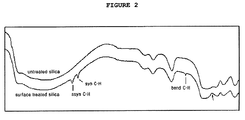
- the surface-treated silica was analyzed by infrared spectrometry using DRIFT (diffuse reflectance FR-IR) as an infrared spectrometer and MCT (mercury-cadmium-telluride) as a detector.
- DRIFT diffuse reflectance FR-IR
- MCT mercury-cadmium-telluride
- FIG. 2 characteristic absorption peaks were observed at 2929 cm -1 (asym, C-H stretching), 2857 cm -1 (sym, C-H stretching) and 1457 cm -1 (C-H bend).
- negative broad bands appearing between 1150 cm -1 and 1050 cm -1 were considered to be attributable to Si-O-Si [ Hair, M. L., Tripp, C.P., Langmuir, 1991, 7, 923 ].
- silica particles before surface treatment and the silica particles after surface treatment were compared with each other after they were shaken in water and then left to stand for 1 hour. As can be seen from the photographs in FIG. 3 , the silica particles before surface treatment settled down within a few minutes, and the silica particles after surface treatment floated in the water, because they were modified into hydrophobic particles.
- Example 2 Treatment of silica (SiO 2 ) surface with cyclopentenylsilanetriol
- Example 2 In a flask, 10 g of the same wet silica (dried at 120 °C for 8 hours) as used in Example 1 was stirred and dispersed in 50 ml of methanol. Then, a solution of 1.0 g of cyclopentenylsilanetriol dissolved in methanol at 0 °C was added dropwise to the flask at 0 °C and stirred for 10 minutes. The solvent was removed to the greatest possible extent using a rotary evaporator, and the remaining material was dried in a vacuum oven at 130 °C for 6 hours.
- Example 3 Treatment of silica (SiO 2 ) surface with cyclopentenylsilanetriol and bis(3-triethoxysilylpropyl)tetrasulfide
- Example 2 In a flask, 10 g of the same wet silica (dried at 120 °C for 8 hours) as used in Example 1 was dispersed in 50 ml of methanol. Then, 0.5 g of cyclopentenylsilanetriol and 0.5 g of bis(3-triethoxysilylpropyl)tetrasulfide (Degussa Germany, Si69) were added dropwise to the flask and stirred for 10 minutes. The solvent was removed to the greatest possible extent using a rotary evaporator, and the remaining material was dried in a vacuum oven at 130 °C for 6 hours. In this Example, 1 ml of 1 wt% acetic acid aqueous solution as a catalyst was added dropwise to the dispersion and, as a result, the surface modification of the metal oxide was more effectively conducted.
- Example 4 Treatment of silica (SiO 2 ) surface with cyclopentenylsilanetriol and 3-mercaptopropyltriethoxysilane
- Example 2 In a flask, 10 g of the same wet silica (dried at 120 °C for 8 hours) as used in Example 1 was dispersed in 50 ml of methanol. Then, 0.5 g of cyclopentenylsilanetriol and 0.5 g of 3-mercaptopropyltriethoxysilane (Gelest, Inc.) were added dropwise to the flask and stirred for 10 minutes. The solvent was removed to the greatest possible extent using a rotary evaporator, and the remaining material was dried in a vacuum oven at 130 °C for 6 hours.
- Example 5 Treatment of silica (SiO 2 ) surface with cyclopentenylsilanetriol and 3-(glycidoxy)propyltriethoxysilane
- Example 6 Treatment of silica (SiO 2 ) surface with cyclopentenylsilanetriol and 2-(3,4-epoxycyclohexyl)ethyltriethoxysilane
- Example 7 Treatment of silica (SiO 2 ) surface with cyclopentenylsilanetriol and 3-(methacryloxy)propyltriethoxysilane
- Example 8 Treatment of silica (SiO 2 ) surface with cyclopentenylsilanetriol and 3-isocyanatopropyltrimethoxysilane
- Example 9 Treatment of silica (SiO 2 ) surface with cyclopentenylsilanetriol and 3-isocyanatopropyltriethoxysilane
- Example 10 Treatment of silica (SiO 2 ) surface with cyclopentenylsilanetriol and 3-aminopropyltriethoxysilane
- Example 12 Treatment of silica (SiO 2 ) surface with cyclopentenylsilanetriol and 2-(3-hexenyl)ethyltriethoxysilane
- Example 13 Treatment of titanium dioxide (TiO 2 ) surface with cyclopentenylsilanetriol
- Example 14 Treatment of zirconium dioxide (ZrO 2 ) surface with cyclopentenylsilanetriol
- Example 15 Treatment of zirconia (ZrO 2 ) surface with cyclopentylsilanetriol
- Example 16 Treatment of silica (SiO 2 ) surface with cyclopentylsilanetriol
- Example 2 The same silica as used in Example 1 was treated cyclopentylsilanetriol instead of cyclopentenylsilanetriol in the same manner as described in Example 1. The results obtained in this Example were similar to those in Example 1.
- Example 17 Treatment of silica (SiO 2 ) surface with cyclopentylsilanetriol
- Example 1 10 g of the same silica used in Example 1 was added to an aqueous solution of 1.0 g of cyclopentylsilanetriol, prepared by hydrolyzing cyclopentyl trimethoxysilane according to the method of Korean Patent Application No. 2007-106843 , filed in the name of the present applicant.
- the mixture was stirred, while water and methanol (hydrolysis product) were evaporated therefrom.
- the remaining material was dried in a vacuum oven at 130 °C for one day. All of the treated silica particles were observed to float in water, because they had been modified into hydrophobic particles.
- Example 18 Treatment of silica (SiO 2 ) surface with cyclohexanylsilanetriol
- Example 2 The same wet silica used in Example 1 was treated with a solution of cyclohexanylsilanetriol dispersed in methanol, according to the same method described in Example 2. All of the treated silica particles were observed to float in water, because they had been modified into hydrophobic particles.
- Example 19 Treatment of silica (SiO 2 ) surface with 3-methyl-3-cyclohexenylsilanetriol
- Example 2 The same wet silica used in Example 1 was treated with a solution of 3-methyl-3-cyclohexenylsilanetriol dispersed in methanol, according to the same method as described in Example 2. All of the treated silica particles were observed to float in water, because they had been modified into hydrophobic particles.
- Example 20 Treatment of silica (SiO 2 ) surface with 4-methyl-3-cyclohexenylsilanetriol
- Example 2 The same wet silica used in Example 1 was treated with a solution of 4-methyl-3-cyclohexenylsilanetriol dispersed in methanol, according to the same method as described in Example 2. All of the treated silica particles were observed to float in water, because they had been modified into hydrophobic particles.
- Example 21 Treatment of silica (SiO 2 ) surface with 3,4-dimethyl-3-cyclohexenylsilanetriol
- Example 2 The same wet silica used in Example 1 was treated with a solution of 3,4-dimethyl-3-cyclohexenylsilanetriol dispersed in methanol, according to the same method as described in Example 2. All of the treated silica particles were observed to float in water, because they had been modified into hydrophobic particles.
- Example 22 Treatment of silica (SiO 2 ) surface with 1,2-dicyclohexyl-1,1,2,2-tetrahydroxydisilane
- Example 2 The same wet silica used in Example 1 was treated with a solution of 1,2-dicyclohexyl-1,1,2,2-tetrahydroxydisilane dispersed in methanol, according to the same method as described in Example 2. All of the treated silica particles were observed to float in water, because they had been modified into hydrophobic particles.
- Example 23 Treatment of silica (SiO 2 ) surface with 1,2-bis(cyclohexen-3-yl)-1,1,2,2-tetrahydroxydisilane
- Example 2 The same wet silica used in Example 1 was treated with a solution of 1,2-bis(cyclohexen-3-yl)-1,1,2,2-tetrahydroxydisilane dispersed in methanol, according to the same method as described in Example 2. All of the treated silica particles were observed to float in water, because they had been modified into hydrophobic particles.
- Example 24 Treatment of silica (SiO 2 ) surface with mixture of cyclopentylsilanetriol and 1,2-dicyclopentyl-1,1,2,2-tetrahydroxydisilane
- Cyclopentylsilanetriol obtained by hydrolyzing cyclopentyl trimethoxysilane, was mixed with 1,2-dicyclopentyl-1,1,2,2-tetrahydroxydisilane at a molar ratio of 1:4. 10 g of the same silica used in Example 1 was added to 1.0 g of the mixture and stirred, while water and methanol (hydrolysis product) were evaporated therefrom. The remaining material was dried in a vacuum oven at 130 °C for one day. All of treated silica particles were observed to float in water, because they had been modified into hydrophobic particles.
- Example 25 Treatment of silica (SiO 2 ) surface with aqueous solution of cyclopentenylsilanetriol
- Example 2 In a flask, 10 g of the same wet silica (11 nm, 225 m 2 /g, Aldrich) used in Example 2 was stirred and dispersed in 50 ml of methanol. Then, 3.0 g of cyclopentenylsilanetriol dispersed in methanol at 0 °C was added dropwise to the flask at 0 °C and stirred for 10 minutes. The solvent was removed to the greatest possible extent using a rotary evaporator, and the remaining material was dried in a vacuum oven at 130 °C for 6 hours. All of the treated silica particles were observed to float in water, because they had been modified into hydrophobic particles.
- Example 25 Treatment of silica (SiO 2 ) surface with hydrolysate of (2-cyclopentenyl)trimethoxysilane
- Example 2 At atmospheric pressure and room temperature, 0.65 ml of 1 wt% acetic acid aqueous solution was placed in a 50-ml glass flask, and 0.65 ml of (2-cyclopentenyl)trimethoxysilane was added thereto with stirring. After hydrolysis at 25 °C for 1 hour, the solution became completely clear (complete conversion to silanetriol). Then, the solution and 10 g of the same silica used in Example 1 were stirred and dispersed in 50 ml of methanol. Then, the solvent was removed to the greatest possible extent using a rotary evaporator, and the remaining material was dried in a vacuum oven at 130 °C for 6 hours. The results obtained in this Example were similar to those in Example 2.
- the surface of nanometer-sized, functional metal oxide can be modified using, as a modifier, an organosilane polyol substituted with a specific functional group imparting steric hindrance.
- the surface-modified functional metal oxide particles can be widely used to, for example, impart functionality to various organic composites and improve the performance of the composites.
Landscapes
- Chemical & Material Sciences (AREA)
- Organic Chemistry (AREA)
- Pigments, Carbon Blacks, Or Wood Stains (AREA)
- Oxygen, Ozone, And Oxides In General (AREA)
Applications Claiming Priority (1)
| Application Number | Priority Date | Filing Date | Title |
|---|---|---|---|
| KR20070116574A KR100947891B1 (ko) | 2007-11-15 | 2007-11-15 | 금속산화물 입자의 표면개질제 및 이를 이용한 금속산화물입자의 표면 개질방법 |
Publications (4)
| Publication Number | Publication Date |
|---|---|
| EP2062948A2 true EP2062948A2 (fr) | 2009-05-27 |
| EP2062948A3 EP2062948A3 (fr) | 2011-11-30 |
| EP2062948B1 EP2062948B1 (fr) | 2013-10-02 |
| EP2062948B8 EP2062948B8 (fr) | 2013-11-27 |
Family
ID=40231967
Family Applications (1)
| Application Number | Title | Priority Date | Filing Date |
|---|---|---|---|
| EP20080075230 Not-in-force EP2062948B8 (fr) | 2007-11-15 | 2008-03-31 | Modificateur de surface pour particules d'oxyde métallique et procédé de modification de surface de particules d'oxyde métallique l'utilisant |
Country Status (4)
| Country | Link |
|---|---|
| US (1) | US8815339B2 (fr) |
| EP (1) | EP2062948B8 (fr) |
| JP (1) | JP4982427B2 (fr) |
| KR (1) | KR100947891B1 (fr) |
Cited By (3)
| Publication number | Priority date | Publication date | Assignee | Title |
|---|---|---|---|---|
| CN107722792A (zh) * | 2017-11-13 | 2018-02-23 | 吉林大学 | 一种具有高防腐蚀性能环氧树脂涂层的制备方法 |
| CN109233423A (zh) * | 2018-09-26 | 2019-01-18 | 广州市嵩达新材料科技有限公司 | 一种改性纳米粒子及其制备方法和由其制备的超疏水自修复光固化涂料 |
| EP3252008B1 (fr) * | 2016-05-31 | 2020-03-25 | Fraunhofer-Gesellschaft zur Förderung der angewandten Forschung e.V. | Microparticule nano-structurée constituée de particules primaires silanisées présentant une redispersion régulable et son procédé de fabrication |
Families Citing this family (12)
| Publication number | Priority date | Publication date | Assignee | Title |
|---|---|---|---|---|
| JP5643623B2 (ja) * | 2010-12-02 | 2014-12-17 | デクセリアルズ株式会社 | 異方性導電材料及びその製造方法 |
| WO2012177088A1 (fr) * | 2011-06-23 | 2012-12-27 | 주식회사 나노브릭 | Procédé de traitement de surface pour particules magnétiques, composite magnétique ainsi préparé, et composite magnétique pour le marquage de matériaux cibles |
| EP3055362B1 (fr) * | 2013-10-07 | 2021-04-21 | PPG Industries Ohio, Inc. | Charges traitées compositions les contenant et articles préparés à partir de ces dernières |
| KR101745676B1 (ko) * | 2014-05-30 | 2017-06-09 | 주식회사 엘지화학 | 시아네이트계 수지에 대한 분산성이 우수한 실리카졸 조성물 및 이의 제조 방법 |
| WO2015183031A1 (fr) * | 2014-05-30 | 2015-12-03 | 주식회사 엘지화학 | Composition de sol de silice ayant une excellente dispersibilité vis-à-vis de la résine de cyanate, et son procédé de préparation |
| KR101606127B1 (ko) * | 2015-05-21 | 2016-03-24 | 이영재 | 기능성 나노기공 실리카 분말의 제조 방법 |
| KR101753606B1 (ko) | 2015-09-17 | 2017-07-05 | 한국세라믹기술원 | 표면개질된 결정성 금속산화물 및 그의 제조방법 |
| WO2017111098A1 (fr) * | 2015-12-25 | 2017-06-29 | 旭硝子株式会社 | Particules d'oxyde métallique à surface modifiée, procédé de production, dispersion, composition durcissable, et produit durci |
| KR102561545B1 (ko) * | 2020-12-11 | 2023-08-02 | 주식회사 케이씨텍 | 항균 필름 제조용 무기 입자 분산액 및 이를 사용하여 제조된 항균 필름 |
| KR102596635B1 (ko) * | 2021-11-09 | 2023-11-02 | 한국전자기술연구원 | 나노입자를 소수성으로 표면 개질하는 방법 |
| KR102556160B1 (ko) * | 2023-04-20 | 2023-07-19 | 한국종합철관 (주) | 강관말뚝용 탄성 에폭시 복합수지 조성물 및 이를 이용한 강관말뚝 도장 방법 |
| CN118440533B (zh) * | 2024-05-31 | 2026-04-17 | 陕西科技大学 | 一种Janus粒子交联剂和两步制备方法及其应用 |
Citations (6)
| Publication number | Priority date | Publication date | Assignee | Title |
|---|---|---|---|---|
| KR20010019581A (ko) | 1999-08-28 | 2001-03-15 | 서경배 | 화장료용 안료의 표면개질방법 및 이 방법에 의해 개질된 안료를 함유하는 고형분말 화장료 |
| KR20040000830A (ko) | 2002-06-25 | 2004-01-07 | 한국지질자원연구원 | 실란계 화합물로부터 기상 산화 반응에 의한 실리카초미분체 제조방법 |
| KR20040059977A (ko) | 2002-12-30 | 2004-07-06 | 주식회사 포스코 | 강판에 우수한 내식성과 도장성을 부여하는화성처리조성물 및 이를 이용한 아연도금강판의표면처리방법 |
| US20050203238A1 (en) | 2004-03-01 | 2005-09-15 | Haiying Zhou | Tire compositions comprising surface-modified silica |
| KR20060128358A (ko) | 2005-06-10 | 2006-12-14 | 홍성돈 | 유량조절밸브 |
| KR20070106843A (ko) | 2006-05-01 | 2007-11-06 | 주식회사 프론 | 배터리팩을 수용하는 외부 케이스 |
Family Cites Families (10)
| Publication number | Priority date | Publication date | Assignee | Title |
|---|---|---|---|---|
| NL174953C (nl) * | 1970-11-24 | 1984-09-03 | Degussa | Werkwijze voor het hydrofoberen van metaal- of siliciumoxiden. |
| JPS61129186A (ja) * | 1984-11-28 | 1986-06-17 | Lion Corp | ケイ素化合物含有化粧品組成物 |
| US5017694A (en) * | 1987-12-03 | 1991-05-21 | Rhone-Poulenc, Inc. | Process for the preparation of ceric hydrocarbyl silyloxides by transetherification of ceric alkoxides |
| JPH0699136B2 (ja) * | 1989-08-02 | 1994-12-07 | 株式会社トクヤマ | 疎水化無機粒子 |
| JP2001240769A (ja) * | 2000-02-25 | 2001-09-04 | Nippon Shokubai Co Ltd | 表面改質された無機系微粒子およびその用途と無機系微粒子の表面改質方法 |
| US6706398B1 (en) * | 2002-09-13 | 2004-03-16 | Dow Corning Corporation | Organosilicon compounds and blends for treating silica |
| US7338995B2 (en) * | 2004-03-06 | 2008-03-04 | E.I. Du Pont De Nemours And Company | Titanium dioxide—containing polymers and films with reduced melt fracture |
| US10041176B2 (en) * | 2005-04-07 | 2018-08-07 | Momentive Performance Materials Inc. | No-rinse pretreatment methods and compositions |
| US7622514B2 (en) * | 2005-05-09 | 2009-11-24 | Sabic Innovative Plastics Ip B.V. | Curable composition and article possessing protective layer obtained therefrom |
| EP1922369A1 (fr) | 2005-08-18 | 2008-05-21 | Clariant International Ltd. | Nanoparticules a surface modifiee, constituees par un oxyde d'aluminium et des oxydes d'elements du i. ou ii. groupe principal de la classification periodique des elements et realisation associee |
-
2007
- 2007-11-15 KR KR20070116574A patent/KR100947891B1/ko not_active Expired - Fee Related
- 2007-12-28 US US11/966,521 patent/US8815339B2/en not_active Expired - Fee Related
-
2008
- 2008-03-31 EP EP20080075230 patent/EP2062948B8/fr not_active Not-in-force
- 2008-05-16 JP JP2008129248A patent/JP4982427B2/ja not_active Expired - Fee Related
Patent Citations (6)
| Publication number | Priority date | Publication date | Assignee | Title |
|---|---|---|---|---|
| KR20010019581A (ko) | 1999-08-28 | 2001-03-15 | 서경배 | 화장료용 안료의 표면개질방법 및 이 방법에 의해 개질된 안료를 함유하는 고형분말 화장료 |
| KR20040000830A (ko) | 2002-06-25 | 2004-01-07 | 한국지질자원연구원 | 실란계 화합물로부터 기상 산화 반응에 의한 실리카초미분체 제조방법 |
| KR20040059977A (ko) | 2002-12-30 | 2004-07-06 | 주식회사 포스코 | 강판에 우수한 내식성과 도장성을 부여하는화성처리조성물 및 이를 이용한 아연도금강판의표면처리방법 |
| US20050203238A1 (en) | 2004-03-01 | 2005-09-15 | Haiying Zhou | Tire compositions comprising surface-modified silica |
| KR20060128358A (ko) | 2005-06-10 | 2006-12-14 | 홍성돈 | 유량조절밸브 |
| KR20070106843A (ko) | 2006-05-01 | 2007-11-06 | 주식회사 프론 | 배터리팩을 수용하는 외부 케이스 |
Non-Patent Citations (4)
| Title |
|---|
| DANIELS, M. W.; FRANCIS, L. F., J. COL. INT. SCI., 1998, pages 205 |
| HAIR, M. L.; TRIPP, C.P., LANGMUIR, vol. 7, 1991, pages 923 |
| TILMAN, N.; ULMAN, A.; PENNER, T. L., LANGMUIR, vol. 5, 1989, pages 101 |
| TRIPP, C. P.; HAIR, M. L., LANGMUIR, vol. 8, 1992, pages 1961 |
Cited By (4)
| Publication number | Priority date | Publication date | Assignee | Title |
|---|---|---|---|---|
| EP3252008B1 (fr) * | 2016-05-31 | 2020-03-25 | Fraunhofer-Gesellschaft zur Förderung der angewandten Forschung e.V. | Microparticule nano-structurée constituée de particules primaires silanisées présentant une redispersion régulable et son procédé de fabrication |
| CN107722792A (zh) * | 2017-11-13 | 2018-02-23 | 吉林大学 | 一种具有高防腐蚀性能环氧树脂涂层的制备方法 |
| CN109233423A (zh) * | 2018-09-26 | 2019-01-18 | 广州市嵩达新材料科技有限公司 | 一种改性纳米粒子及其制备方法和由其制备的超疏水自修复光固化涂料 |
| CN109233423B (zh) * | 2018-09-26 | 2022-03-25 | 广州市嵩达新材料科技有限公司 | 一种改性纳米粒子及其制备方法和由其制备的超疏水自修复光固化涂料 |
Also Published As
| Publication number | Publication date |
|---|---|
| US8815339B2 (en) | 2014-08-26 |
| US20090130306A1 (en) | 2009-05-21 |
| EP2062948B1 (fr) | 2013-10-02 |
| KR20090050237A (ko) | 2009-05-20 |
| JP4982427B2 (ja) | 2012-07-25 |
| EP2062948B8 (fr) | 2013-11-27 |
| KR100947891B1 (ko) | 2010-03-17 |
| EP2062948A3 (fr) | 2011-11-30 |
| JP2009120804A (ja) | 2009-06-04 |
Similar Documents
| Publication | Publication Date | Title |
|---|---|---|
| EP2062948B1 (fr) | Modificateur de surface pour particules d'oxyde métallique et procédé de modification de surface de particules d'oxyde métallique l'utilisant | |
| Ramezani et al. | Preparation of silane-functionalized silica films via two-step dip coating sol–gel and evaluation of their superhydrophobic properties | |
| CN102027074B (zh) | 表面改性的二氧化硅颗粒 | |
| Grasset et al. | Surface modification of zinc oxide nanoparticles by aminopropyltriethoxysilane | |
| US9856361B2 (en) | Surface-modified metal oxide particle dispersion liquid, method for producing same, surface-modified metal oxide particle-silicone resin composite composition, surface-modified metal oxide particle-silicone resin composite body, optical member and light emitting device | |
| JP2009513741A (ja) | 高い充填剤含量を有するシラン製剤 | |
| US20110245392A1 (en) | Silane-modified nanoparticles made of metal oxides | |
| CN102827496A (zh) | 一种对物质的表面进行包裹改性的方法 | |
| JP5627662B2 (ja) | 表面処理シリカ系粒子の製造方法 | |
| JP2010143806A (ja) | 表面処理シリカ系粒子及びその製造方法 | |
| WO2010006837A2 (fr) | Procédé de préparation de particules de dioxyde de silicium à surface modifiée dispersibles | |
| KR102541874B1 (ko) | 보호 캡슐화를 가진 판상 pvd 알루미늄 안료 및 보호 캡슐화를 가진 판상 pvd 알루미늄 안료를 제조하는 방법 | |
| US20240116764A1 (en) | Fumed silica powder with reduced silanol group density | |
| Jerman et al. | Polyhedral oligomeric silsesquioxane trisilanols as pigment surface modifiers for fluoropolymer based Thickness Sensitive Spectrally Selective (TSSS) paint coatings | |
| CN113198395A (zh) | 基于非水体系脱醇反应的无机颗粒表面改性高效可控方法 | |
| JPH10316406A (ja) | 無機微粒子およびその製造方法 | |
| JP2007536416A (ja) | 官能基で均質にコーティングされた粉末粒子、及び同粉末粒子の製造方法及び使用 | |
| CN111867974B (zh) | 一种沉淀白炭黑及其制备方法 | |
| KR20070015726A (ko) | 실란 화합물을 이용하는 금속 나노입자의 형성 및/또는고정 방법 | |
| JP6238683B2 (ja) | 導電性粒子 | |
| JP2000095517A (ja) | 無機微粒子の製造方法 | |
| CN118717541A (zh) | 一种聚硅氧烷包覆二氧化钛有机微球的制备方法 | |
| Kickelbick et al. | Organically functionalized silica nanoparticles | |
| Gottlieb | Functionalization of Silica Surface with UV-Active Molecules by Multivalent Organosilicon Spacer | |
| Asia et al. | Gelest, Inc. |
Legal Events
| Date | Code | Title | Description |
|---|---|---|---|
| PUAI | Public reference made under article 153(3) epc to a published international application that has entered the european phase |
Free format text: ORIGINAL CODE: 0009012 |
|
| AK | Designated contracting states |
Kind code of ref document: A2 Designated state(s): AT BE BG CH CY CZ DE DK EE ES FI FR GB GR HR HU IE IS IT LI LT LU LV MC MT NL NO PL PT RO SE SI SK TR |
|
| AX | Request for extension of the european patent |
Extension state: AL BA MK RS |
|
| PUAL | Search report despatched |
Free format text: ORIGINAL CODE: 0009013 |
|
| AK | Designated contracting states |
Kind code of ref document: A3 Designated state(s): AT BE BG CH CY CZ DE DK EE ES FI FR GB GR HR HU IE IS IT LI LT LU LV MC MT NL NO PL PT RO SE SI SK TR |
|
| AX | Request for extension of the european patent |
Extension state: AL BA MK RS |
|
| RIC1 | Information provided on ipc code assigned before grant |
Ipc: C09C 3/12 20060101ALI20111025BHEP Ipc: C09C 1/36 20060101ALI20111025BHEP Ipc: C09C 1/30 20060101AFI20111025BHEP |
|
| 17P | Request for examination filed |
Effective date: 20120530 |
|
| AKX | Designation fees paid |
Designated state(s): AT BE BG CH CY CZ DE DK EE ES FI FR GB GR HR HU IE IS IT LI LT LU LV MC MT NL NO PL PT RO SE SI SK TR |
|
| 17Q | First examination report despatched |
Effective date: 20121105 |
|
| GRAP | Despatch of communication of intention to grant a patent |
Free format text: ORIGINAL CODE: EPIDOSNIGR1 |
|
| INTG | Intention to grant announced |
Effective date: 20130418 |
|
| GRAS | Grant fee paid |
Free format text: ORIGINAL CODE: EPIDOSNIGR3 |
|
| GRAA | (expected) grant |
Free format text: ORIGINAL CODE: 0009210 |
|
| AK | Designated contracting states |
Kind code of ref document: B1 Designated state(s): AT BE BG CH CY CZ DE DK EE ES FI FR GB GR HR HU IE IS IT LI LT LU LV MC MT NL NO PL PT RO SE SI SK TR |
|
| REG | Reference to a national code |
Ref country code: GB Ref legal event code: FG4D |
|
| REG | Reference to a national code |
Ref country code: AT Ref legal event code: REF Ref document number: 634621 Country of ref document: AT Kind code of ref document: T Effective date: 20131015 Ref country code: CH Ref legal event code: EP |
|
| REG | Reference to a national code |
Ref country code: IE Ref legal event code: FG4D |
|
| REG | Reference to a national code |
Ref country code: DE Ref legal event code: R096 Ref document number: 602008027861 Country of ref document: DE Effective date: 20131205 |
|
| REG | Reference to a national code |
Ref country code: AT Ref legal event code: MK05 Ref document number: 634621 Country of ref document: AT Kind code of ref document: T Effective date: 20131002 |
|
| REG | Reference to a national code |
Ref country code: NL Ref legal event code: VDEP Effective date: 20131002 |
|
| PG25 | Lapsed in a contracting state [announced via postgrant information from national office to epo] |
Ref country code: SI Free format text: LAPSE BECAUSE OF FAILURE TO SUBMIT A TRANSLATION OF THE DESCRIPTION OR TO PAY THE FEE WITHIN THE PRESCRIBED TIME-LIMIT Effective date: 20131002 |
|
| REG | Reference to a national code |
Ref country code: LT Ref legal event code: MG4D |
|
| PG25 | Lapsed in a contracting state [announced via postgrant information from national office to epo] |
Ref country code: NL Free format text: LAPSE BECAUSE OF FAILURE TO SUBMIT A TRANSLATION OF THE DESCRIPTION OR TO PAY THE FEE WITHIN THE PRESCRIBED TIME-LIMIT Effective date: 20131002 Ref country code: FI Free format text: LAPSE BECAUSE OF FAILURE TO SUBMIT A TRANSLATION OF THE DESCRIPTION OR TO PAY THE FEE WITHIN THE PRESCRIBED TIME-LIMIT Effective date: 20131002 Ref country code: LT Free format text: LAPSE BECAUSE OF FAILURE TO SUBMIT A TRANSLATION OF THE DESCRIPTION OR TO PAY THE FEE WITHIN THE PRESCRIBED TIME-LIMIT Effective date: 20131002 Ref country code: NO Free format text: LAPSE BECAUSE OF FAILURE TO SUBMIT A TRANSLATION OF THE DESCRIPTION OR TO PAY THE FEE WITHIN THE PRESCRIBED TIME-LIMIT Effective date: 20140102 Ref country code: BE Free format text: LAPSE BECAUSE OF FAILURE TO SUBMIT A TRANSLATION OF THE DESCRIPTION OR TO PAY THE FEE WITHIN THE PRESCRIBED TIME-LIMIT Effective date: 20131002 Ref country code: IS Free format text: LAPSE BECAUSE OF FAILURE TO SUBMIT A TRANSLATION OF THE DESCRIPTION OR TO PAY THE FEE WITHIN THE PRESCRIBED TIME-LIMIT Effective date: 20140202 Ref country code: SE Free format text: LAPSE BECAUSE OF FAILURE TO SUBMIT A TRANSLATION OF THE DESCRIPTION OR TO PAY THE FEE WITHIN THE PRESCRIBED TIME-LIMIT Effective date: 20131002 Ref country code: HR Free format text: LAPSE BECAUSE OF FAILURE TO SUBMIT A TRANSLATION OF THE DESCRIPTION OR TO PAY THE FEE WITHIN THE PRESCRIBED TIME-LIMIT Effective date: 20131002 Ref country code: CZ Free format text: LAPSE BECAUSE OF FAILURE TO SUBMIT A TRANSLATION OF THE DESCRIPTION OR TO PAY THE FEE WITHIN THE PRESCRIBED TIME-LIMIT Effective date: 20131002 |
|
| PGFP | Annual fee paid to national office [announced via postgrant information from national office to epo] |
Ref country code: DE Payment date: 20140227 Year of fee payment: 7 |
|
| PG25 | Lapsed in a contracting state [announced via postgrant information from national office to epo] |
Ref country code: CY Free format text: LAPSE BECAUSE OF FAILURE TO SUBMIT A TRANSLATION OF THE DESCRIPTION OR TO PAY THE FEE WITHIN THE PRESCRIBED TIME-LIMIT Effective date: 20131002 Ref country code: PL Free format text: LAPSE BECAUSE OF FAILURE TO SUBMIT A TRANSLATION OF THE DESCRIPTION OR TO PAY THE FEE WITHIN THE PRESCRIBED TIME-LIMIT Effective date: 20131002 Ref country code: ES Free format text: LAPSE BECAUSE OF FAILURE TO SUBMIT A TRANSLATION OF THE DESCRIPTION OR TO PAY THE FEE WITHIN THE PRESCRIBED TIME-LIMIT Effective date: 20131002 Ref country code: LV Free format text: LAPSE BECAUSE OF FAILURE TO SUBMIT A TRANSLATION OF THE DESCRIPTION OR TO PAY THE FEE WITHIN THE PRESCRIBED TIME-LIMIT Effective date: 20131002 Ref country code: AT Free format text: LAPSE BECAUSE OF FAILURE TO SUBMIT A TRANSLATION OF THE DESCRIPTION OR TO PAY THE FEE WITHIN THE PRESCRIBED TIME-LIMIT Effective date: 20131002 |
|
| PGFP | Annual fee paid to national office [announced via postgrant information from national office to epo] |
Ref country code: FR Payment date: 20140228 Year of fee payment: 7 |
|
| PG25 | Lapsed in a contracting state [announced via postgrant information from national office to epo] |
Ref country code: PT Free format text: LAPSE BECAUSE OF FAILURE TO SUBMIT A TRANSLATION OF THE DESCRIPTION OR TO PAY THE FEE WITHIN THE PRESCRIBED TIME-LIMIT Effective date: 20140203 |
|
| PGFP | Annual fee paid to national office [announced via postgrant information from national office to epo] |
Ref country code: GB Payment date: 20140228 Year of fee payment: 7 |
|
| REG | Reference to a national code |
Ref country code: DE Ref legal event code: R097 Ref document number: 602008027861 Country of ref document: DE |
|
| PG25 | Lapsed in a contracting state [announced via postgrant information from national office to epo] |
Ref country code: EE Free format text: LAPSE BECAUSE OF FAILURE TO SUBMIT A TRANSLATION OF THE DESCRIPTION OR TO PAY THE FEE WITHIN THE PRESCRIBED TIME-LIMIT Effective date: 20131002 |
|
| PLBE | No opposition filed within time limit |
Free format text: ORIGINAL CODE: 0009261 |
|
| STAA | Information on the status of an ep patent application or granted ep patent |
Free format text: STATUS: NO OPPOSITION FILED WITHIN TIME LIMIT |
|
| PG25 | Lapsed in a contracting state [announced via postgrant information from national office to epo] |
Ref country code: IT Free format text: LAPSE BECAUSE OF FAILURE TO SUBMIT A TRANSLATION OF THE DESCRIPTION OR TO PAY THE FEE WITHIN THE PRESCRIBED TIME-LIMIT Effective date: 20131002 Ref country code: SK Free format text: LAPSE BECAUSE OF FAILURE TO SUBMIT A TRANSLATION OF THE DESCRIPTION OR TO PAY THE FEE WITHIN THE PRESCRIBED TIME-LIMIT Effective date: 20131002 Ref country code: RO Free format text: LAPSE BECAUSE OF FAILURE TO SUBMIT A TRANSLATION OF THE DESCRIPTION OR TO PAY THE FEE WITHIN THE PRESCRIBED TIME-LIMIT Effective date: 20131002 |
|
| 26N | No opposition filed |
Effective date: 20140703 |
|
| PG25 | Lapsed in a contracting state [announced via postgrant information from national office to epo] |
Ref country code: DK Free format text: LAPSE BECAUSE OF FAILURE TO SUBMIT A TRANSLATION OF THE DESCRIPTION OR TO PAY THE FEE WITHIN THE PRESCRIBED TIME-LIMIT Effective date: 20131002 |
|
| REG | Reference to a national code |
Ref country code: DE Ref legal event code: R097 Ref document number: 602008027861 Country of ref document: DE Effective date: 20140703 |
|
| PG25 | Lapsed in a contracting state [announced via postgrant information from national office to epo] |
Ref country code: LU Free format text: LAPSE BECAUSE OF FAILURE TO SUBMIT A TRANSLATION OF THE DESCRIPTION OR TO PAY THE FEE WITHIN THE PRESCRIBED TIME-LIMIT Effective date: 20140331 |
|
| REG | Reference to a national code |
Ref country code: CH Ref legal event code: PL |
|
| REG | Reference to a national code |
Ref country code: IE Ref legal event code: MM4A |
|
| PG25 | Lapsed in a contracting state [announced via postgrant information from national office to epo] |
Ref country code: LI Free format text: LAPSE BECAUSE OF NON-PAYMENT OF DUE FEES Effective date: 20140331 Ref country code: CH Free format text: LAPSE BECAUSE OF NON-PAYMENT OF DUE FEES Effective date: 20140331 Ref country code: IE Free format text: LAPSE BECAUSE OF NON-PAYMENT OF DUE FEES Effective date: 20140331 |
|
| REG | Reference to a national code |
Ref country code: DE Ref legal event code: R119 Ref document number: 602008027861 Country of ref document: DE |
|
| GBPC | Gb: european patent ceased through non-payment of renewal fee |
Effective date: 20150331 |
|
| REG | Reference to a national code |
Ref country code: FR Ref legal event code: ST Effective date: 20151130 |
|
| PG25 | Lapsed in a contracting state [announced via postgrant information from national office to epo] |
Ref country code: DE Free format text: LAPSE BECAUSE OF NON-PAYMENT OF DUE FEES Effective date: 20151001 Ref country code: GB Free format text: LAPSE BECAUSE OF NON-PAYMENT OF DUE FEES Effective date: 20150331 |
|
| PG25 | Lapsed in a contracting state [announced via postgrant information from national office to epo] |
Ref country code: FR Free format text: LAPSE BECAUSE OF NON-PAYMENT OF DUE FEES Effective date: 20150331 Ref country code: MT Free format text: LAPSE BECAUSE OF FAILURE TO SUBMIT A TRANSLATION OF THE DESCRIPTION OR TO PAY THE FEE WITHIN THE PRESCRIBED TIME-LIMIT Effective date: 20131002 |
|
| PG25 | Lapsed in a contracting state [announced via postgrant information from national office to epo] |
Ref country code: NO Free format text: LAPSE BECAUSE OF FAILURE TO SUBMIT A TRANSLATION OF THE DESCRIPTION OR TO PAY THE FEE WITHIN THE PRESCRIBED TIME-LIMIT Effective date: 20140101 |
|
| PG25 | Lapsed in a contracting state [announced via postgrant information from national office to epo] |
Ref country code: BG Free format text: LAPSE BECAUSE OF FAILURE TO SUBMIT A TRANSLATION OF THE DESCRIPTION OR TO PAY THE FEE WITHIN THE PRESCRIBED TIME-LIMIT Effective date: 20131002 Ref country code: MC Free format text: LAPSE BECAUSE OF FAILURE TO SUBMIT A TRANSLATION OF THE DESCRIPTION OR TO PAY THE FEE WITHIN THE PRESCRIBED TIME-LIMIT Effective date: 20131002 |
|
| PG25 | Lapsed in a contracting state [announced via postgrant information from national office to epo] |
Ref country code: GR Free format text: LAPSE BECAUSE OF FAILURE TO SUBMIT A TRANSLATION OF THE DESCRIPTION OR TO PAY THE FEE WITHIN THE PRESCRIBED TIME-LIMIT Effective date: 20140103 |
|
| PG25 | Lapsed in a contracting state [announced via postgrant information from national office to epo] |
Ref country code: TR Free format text: LAPSE BECAUSE OF FAILURE TO SUBMIT A TRANSLATION OF THE DESCRIPTION OR TO PAY THE FEE WITHIN THE PRESCRIBED TIME-LIMIT Effective date: 20131002 Ref country code: HU Free format text: LAPSE BECAUSE OF FAILURE TO SUBMIT A TRANSLATION OF THE DESCRIPTION OR TO PAY THE FEE WITHIN THE PRESCRIBED TIME-LIMIT; INVALID AB INITIO Effective date: 20080331 |