EP2063100A2 - Pompe à carburant pour moteur à combustion interne à injection directe - Google Patents
Pompe à carburant pour moteur à combustion interne à injection directe Download PDFInfo
- Publication number
- EP2063100A2 EP2063100A2 EP08019839A EP08019839A EP2063100A2 EP 2063100 A2 EP2063100 A2 EP 2063100A2 EP 08019839 A EP08019839 A EP 08019839A EP 08019839 A EP08019839 A EP 08019839A EP 2063100 A2 EP2063100 A2 EP 2063100A2
- Authority
- EP
- European Patent Office
- Prior art keywords
- valve
- pump
- coil
- control circuit
- fuel
- Prior art date
- Legal status (The legal status is an assumption and is not a legal conclusion. Google has not performed a legal analysis and makes no representation as to the accuracy of the status listed.)
- Withdrawn
Links
Images


Classifications
-
- F—MECHANICAL ENGINEERING; LIGHTING; HEATING; WEAPONS; BLASTING
- F02—COMBUSTION ENGINES; HOT-GAS OR COMBUSTION-PRODUCT ENGINE PLANTS
- F02M—SUPPLYING COMBUSTION ENGINES IN GENERAL WITH COMBUSTIBLE MIXTURES OR CONSTITUENTS THEREOF
- F02M59/00—Pumps specially adapted for fuel-injection and not provided for in groups F02M39/00 -F02M57/00, e.g. rotary cylinder-block type of pumps
- F02M59/20—Varying fuel delivery in quantity or timing
- F02M59/36—Varying fuel delivery in quantity or timing by variably-timed valves controlling fuel passages to pumping elements or overflow passages
- F02M59/366—Valves being actuated electrically
-
- F—MECHANICAL ENGINEERING; LIGHTING; HEATING; WEAPONS; BLASTING
- F04—POSITIVE - DISPLACEMENT MACHINES FOR LIQUIDS; PUMPS FOR LIQUIDS OR ELASTIC FLUIDS
- F04B—POSITIVE-DISPLACEMENT MACHINES FOR LIQUIDS; PUMPS
- F04B49/00—Control, e.g. of pump delivery, or pump pressure of, or safety measures for, machines, pumps, or pumping installations, not otherwise provided for, or of interest apart from, groups F04B1/00 - F04B47/00
- F04B49/22—Control, e.g. of pump delivery, or pump pressure of, or safety measures for, machines, pumps, or pumping installations, not otherwise provided for, or of interest apart from, groups F04B1/00 - F04B47/00 by means of valves
- F04B49/24—Bypassing
- F04B49/243—Bypassing by keeping open the inlet valve
-
- F—MECHANICAL ENGINEERING; LIGHTING; HEATING; WEAPONS; BLASTING
- F02—COMBUSTION ENGINES; HOT-GAS OR COMBUSTION-PRODUCT ENGINE PLANTS
- F02M—SUPPLYING COMBUSTION ENGINES IN GENERAL WITH COMBUSTIBLE MIXTURES OR CONSTITUENTS THEREOF
- F02M2200/00—Details of fuel-injection apparatus, not otherwise provided for
- F02M2200/09—Fuel-injection apparatus having means for reducing noise
Definitions
- the present invention relates to the control of a fuel pump for a direct injection gasoline internal combustion engine.
- Direct injection internal combustion engines i.e. engines in which the fuel injector injects the fuel directly into the combustion chamber, exhibit several advantages over the more conventional port-fuel injected internal combustion chambers. Most notably, direct injection engines enjoy increased fuel economy over other types of internal combustion engines. Direct injection internal combustion engines, however, do exhibit some inherent disadvantages.
- a primary source of noise, especially at low speeds, for a direct injection engine arises from the fuel pump for the engine.
- a pump piston in a fuel pump is reciprocally driven by a cam having two or more typically three or four lobes. These lobes are all symmetrical and all contact the piston pump, usually through a roller. Upon rotation of the cam, the lobes cause the piston to move reciprocally within the pump housing.
- the fuel pump also includes an inlet valve which is movable between an open position and a closed position by an electric coil or solenoid. In its open position, fuel flows to or from a pump chamber within the pump housing through the valve port. Conversely, when the valve is moved to its closed position, the piston during a pump cycle pumps pressurized fuel through a check valve and into the fuel rail for the engine.
- valve when the valve is moved to its open position by the electric coil or solenoid, the valve contacts a valve stop and produces an audible tick. Conversely, whenever the valve slams to a closed position during a pumping or pressurization portion of the pumping cycle, the contact between the valve head and the valve seat also causes audible noise. This noise is particularly prevalent at low speeds.
- the rapid closure of the fuel valve is required for proper engine operation at high speed operation of the engine since the fuel pump operates at or near 100% of its capacity. However, such rapid closure of the fuel valve is not required at lower speeds, such as idle, due to the lower fuel requirements of the engine.
- the present invention provides a number of strategies for the fuel pump in a direct injection internal combustion engine which overcomes the above-mentioned disadvantages of the previously known fuel pumps.
- the fuel pump of the present invention includes a piston which is reciprocally mounted within a pump chamber formed in a pump housing.
- a valve is mounted within the pump housing and includes a fuel port that is open to the pump chamber as well as the fuel tank. This fuel valve is movable between an open and a closed position by an electric coil or solenoid.
- valve With the valve in either a fully or partially open position, i.e. with the valve head spaced from the valve seat, reciprocation of the pump piston within the pump chamber during the suction portion of the pumping cycle inducts fuel from the fuel tank through the fuel port and into the fuel chamber. If the fuel valve is opened during a portion of the pressurization cycle for the pump, the pump piston pumps fuel from the pump chamber through the valve port and back to the fuel tank.
- the pump chamber is fluidly connected by a check valve to the fuel rails for the engine. Consequently, in this condition, the pump piston pressurizes the fuel rail in the desired fashion.
- a control circuit controls the energization of the coil or solenoid to reduce the pump noise during the operation of the invention.
- the control circuit deenergizes the coil in a ramp function during valve closure whenever the engine speed is less than a predetermined threshold. This, in turn, minimizes the speed of impact of the valve head against the valve seat during closure, or impact of the valve against a mechanical stop during valve opening, and thereby reduces the pump noise.
- control circuit maintains the energization of the coil, and thus maintains the valve in an open position, during a plurality of pressurization cycles of the pump during a low speed engine condition. Since the valve head does not impact the valve seat nor the valve impact the mechanical stop while the valve is held in an open position, noise from the fuel pump is reduced.
- control circuit actuates the valve to move the valve to an open position at the time that the valve is open a maximum amount by hydraulic pressure during the suction intake portion of the pump cycle. This also minimizes the speed of impact of the valve against the mechanical stop and thus reduces pump noise.
- the actuation of the coil or solenoid is controlled by a pulse width modulated current signal.
- the width of the first pulse to the coil is reduced as contrasted to subsequent current pulses to minimize the rate of opening of the valve at low engine speeds, and thus the rate of impact of the valve against the mechanical stop.
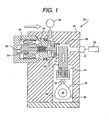
- the pump 20 includes a pump housing 24 which defines a pump chamber 26.
- the pump chamber 26 is fluidly connected through a valve port 28 to a fuel tank 30.
- the pump chamber 26 is also fluidly connected to the fuel rail for the engine 22 through a check valve 32.
- a pump piston 34 is reciprocally mounted within the pump chamber 26.
- This pump piston 34 is reciprocally driven by a cam 36 typically having three or more lobes 38.
- the cam 36 is mechanically coupled to the piston 34 by a roller 40 which follows an outer surface of the cam 36.
- This roller 40 is maintained in contact with the cam 36 by a spring 42 so that as the engine 22 rotatably drives the cam 36, the cam 36 reciprocally displaces the piston 34 in the pump chamber 26.
- the fuel pump 20 further includes a valve 50 having a valve head 52 which cooperates with a valve seat 54 which forms the valve port 28.
- An electric coil 56 upon energization, moves the valve 50 to an open position in which the valve head 52 is spaced from the valve seat 54 thus opening the port 28.
- the valve 50 contacts a mechanical stop 58 which limits the extension of the valve 50 in its open position as shown in FIG. 1 .
- a spring 60 and hydraulic force returns the valve 50 to its closed position, illustrated in FIG. 3 , in which the valve head 52 contacts the valve seat 54 and closes the fluid port 28.
- a control circuit 62 controls the energization of the coil 56 to move the coil between its open position, illustrated in FIGS. 1 and 2 , and its closed position, illustrated in FIG. 3 .
- the operation of the control circuit 62 will be subsequently described in greater detail.
- the pump piston 34 In operation, during the suction portion of the pumping cycle, i.e. when the cam 36 moves the pump piston 34 away from the pump chamber 26, the pump piston 34 inducts fuel from the fuel tank 30 through the fuel port 28 and into the pump chamber 26. During this suction portion of the pumping cycle, the hydraulic pressure caused by the fuel flow from the fuel tank 30 into the pump chamber 26 maintains the valve 50 in a partially open position.
- the control circuit 62 energizes the coils 56 and moves the valve 50 to an open position.
- the control circuit 62 maintains the valve 50 in an open position during the initial portion of the pressurization cycle.
- the reciprocation of the pump piston 34 into the pump chamber 26 thus pumps fuel from the pump chamber 26, through the fuel port 28 and back to the fuel tank 30.
- the control circuit 62 deenergizes the coils 56 thus causing the valve 50 to move to its closed position illustrated in FIG. 3 .
- the increasing pressure within the pump chamber 26 forces the check valve 32 to an open position and pumps the fuel from the pump chamber 26 to the fuel rail of the direct injection engine 22.
- the engine control circuit 62 energizes the coil 56 and holds the valve 50 open over multiple pumping cycles 72, i.e. wherein each pumping cycle represents one complete reciprocation of the pump piston 34 in the pump housing 24.
- a graph 70 of the pump current is illustrated through numerous pump cycles 72. Since the valve is moved to its open position only once over multiple pump cycles and thus causes contact between the valve 50 and its mechanical stop 58 only once over multiple cycles, the audible noise from such valve opening and closing (and pressurization) is reduced. Furthermore, even though the pump 20 provides less fuel pressure to the engine 22 since the valve 50 is held in its open position, such reduced fuel pumping capacity from the fuel pump 20 is acceptable due to the reduced fuel demands of the engine 22 at low speeds.
- FIG. 5 illustrates a graph 74 of the current to the coils 56 and in which the current is reduced during the suction portion of each pumping cycle as shown at 76.
- the valve 50 remains fully opened during the suction portion of the pumping cycle due to the co-operating hydraulic pressure caused by the fuel inflow into the pumping chamber 26 during the suction portion of each pumping cycle.
- control circuit 62 deenergizes the coil 56 after a certain maximum amount of time as shown at 80 in graph 78.
- Such deenergization of the coils is illustrated at 80 in FIG. 6 and such deenergization protects the coils 56 from overheating.
- FIG. 7 a still further modification is shown of the current control by the control circuit 62 for the coils 56.
- a graph 82 of the current flow for the coil 56 is shown in which the current flow is reduced during each suction portion of the pumping cycle in a fashion similar to FIG. 5 .
- the control circuit 62 also deenergizes the coils 56 after a certain maximum time period in a fashion similar to that illustrated in FIG. 6 . Consequently, although the graph 82 of current flow in FIG. 7 shows a reduction in the current flow during each suction portion of the pumping cycle, a larger reduction of the current flow, i.e. a current to zero, also occurs after each maximum time period as shown at 84.
- the overall number of impacts between the valve 50 and its mechanical stop 58 or between the valve head 52 and the valve seat 54 is reduced thus reducing the overall noise from the fuel pump during low speed engine operating conditions.
- FIG. 8 a still further strategy is illustrated for the control of the energization of the coil 56 by the control circuit 62.
- the movement of the valve is shown by graph 90 in which the valve 50 moves from a closed position, illustrated at position 92, to a partially open position, illustrated at 94, during the intake portion of the pump cycle.
- This partial opening of the valve 50 is caused by the hydraulic pressure of the incoming fuel flow to the pump chamber 26 during the suction cycle.
- the control circuit 62 energizes the coils 56 at time 96 thus causing the valve 50 to move to its fully open position illustrated at 98.
- the speed of impact of the valve 70 against its mechanical stop 58 is reduced.
- FIG. 9 a still further strategy to reduce fuel pump noise at low engine speed is illustrated as a graph 100 of the coil current as a function of time.
- the control circuit 62 utilizes a ramp function 102 to energize the coil and move the valve 50 to its open position.
- the ramp 102 thus effectively reduces the speed of impact of the valve 50 against its mechanical stop 58 at low engine speeds and thus reduces the pump noise.
- control circuit 62 also optionally deenergizes the coil 56 from its fully energized position, illustrated at 104, into a deenergized condition illustrated at 106 through a ramp function 108.
- the control circuit 62 also optionally deenergizes the coil 56 from its fully energized position, illustrated at 104, into a deenergized condition illustrated at 106 through a ramp function 108.
- the control circuit preferably energizes the coil 56 through pulse width modulation of the current.
- the speed of opening of the valve 50 at low engine speeds may be controlled by the control circuit 62 by reducing the pulse width of the current signal to the coil 56 during the initiation of the valve opening as shown in graph 110.
- the control circuit 62 reduces the speed of impact, and thus the noise, of the valve 50 against its mechanical stop 58.
- the pulse width can be progressively stepped down curing solenoid valve closing to reduce impact of valve head 52 against valve seat 54.
- the fuel noise from the fuel pump may be reduced by varying the lobe design for the pump. More specifically, as illustrated in FIGS. 12 and 13, the cam 36 of the fuel pump 20 includes three lobes 136, 138 and 140 which are angularly equidistantly spaced around the cam 134 and each of the lobes 136-140 are of the same angular length. Each lobe 136-140 reciprocates the pumping piston 34 through one complete pumping cycle.
- the lobe 140 is not symmetrical with the lobes 136 and 138.
- the asymmetry of the lobe 140 reduces pump noise caused by the pump suction.
- the lobe 140 provides a slower pressurization rate and hence lower pressurization noise.
- the present invention provides a novel pump control for a direct injection internal combustion engine which reduces fuel noise of the type that is evident at low engine speeds.
Landscapes
- Engineering & Computer Science (AREA)
- Mechanical Engineering (AREA)
- General Engineering & Computer Science (AREA)
- Chemical & Material Sciences (AREA)
- Combustion & Propulsion (AREA)
- Electrical Control Of Air Or Fuel Supplied To Internal-Combustion Engine (AREA)
- Fuel-Injection Apparatus (AREA)
- Magnetically Actuated Valves (AREA)
Applications Claiming Priority (1)
| Application Number | Priority Date | Filing Date | Title |
|---|---|---|---|
| US11/943,087 US7552720B2 (en) | 2007-11-20 | 2007-11-20 | Fuel pump control for a direct injection internal combustion engine |
Publications (2)
| Publication Number | Publication Date |
|---|---|
| EP2063100A2 true EP2063100A2 (fr) | 2009-05-27 |
| EP2063100A3 EP2063100A3 (fr) | 2009-07-15 |
Family
ID=40427880
Family Applications (1)
| Application Number | Title | Priority Date | Filing Date |
|---|---|---|---|
| EP08019839A Withdrawn EP2063100A3 (fr) | 2007-11-20 | 2008-11-13 | Pompe à carburant pour moteur à combustion interne à injection directe |
Country Status (3)
| Country | Link |
|---|---|
| US (1) | US7552720B2 (fr) |
| EP (1) | EP2063100A3 (fr) |
| JP (1) | JP2009127623A (fr) |
Cited By (7)
| Publication number | Priority date | Publication date | Assignee | Title |
|---|---|---|---|---|
| EP2363594A2 (fr) * | 2010-03-05 | 2011-09-07 | Hitachi Ltd. | Pompe à carburant |
| ITBO20110183A1 (it) * | 2011-04-07 | 2012-10-08 | Magneti Marelli Spa | Pompa carburante silenziata per un sistema di iniezione diretta |
| WO2015039960A1 (fr) * | 2013-09-19 | 2015-03-26 | Robert Bosch Gmbh | Soupape d'aspiration pouvant être commandée électromagnétiquement |
| FR3042230A1 (fr) * | 2015-10-13 | 2017-04-14 | Continental Automotive France | Reduction du bruit d'une vanne d'isolation d'un reservoir de carburant d'un vehicule automotive. |
| CN110700969A (zh) * | 2018-07-10 | 2020-01-17 | 罗伯特·博世有限公司 | 低温燃料的燃料输送装置及其运行方法 |
| CN111868370A (zh) * | 2018-01-17 | 2020-10-30 | 罗伯特·博世有限公司 | 用于低温燃料的燃料输送装置 |
| DE102022102073A1 (de) | 2022-01-28 | 2023-08-03 | Faurecia Autositze Gmbh | Verfahren zum Betrieb eines Fahrzeugsitzkomfortsystems |
Families Citing this family (31)
| Publication number | Priority date | Publication date | Assignee | Title |
|---|---|---|---|---|
| US8015964B2 (en) * | 2006-10-26 | 2011-09-13 | David Norman Eddy | Selective displacement control of multi-plunger fuel pump |
| WO2008094623A1 (fr) * | 2007-01-30 | 2008-08-07 | Cummins Inc. | Synchronisation de pompe à carburant pour réduire le bruit |
| US8001942B2 (en) * | 2007-10-31 | 2011-08-23 | GM Global Technology Operations LLC | High pressure piston pump actuating system using automotive starter system |
| US8091530B2 (en) | 2008-12-08 | 2012-01-10 | Ford Global Technologies, Llc | High pressure fuel pump control for idle tick reduction |
| US8342151B2 (en) * | 2008-12-18 | 2013-01-01 | GM Global Technology Operations LLC | Deactivation of high pressure pump for noise control |
| DE102010027745A1 (de) * | 2010-04-14 | 2011-10-20 | Robert Bosch Gmbh | Hochdruckpumpe |
| US8677977B2 (en) * | 2010-04-30 | 2014-03-25 | Denso International America, Inc. | Direct injection pump control strategy for noise reduction |
| US8662056B2 (en) * | 2010-12-30 | 2014-03-04 | Delphi Technologies, Inc. | Fuel pressure control system and method having a variable pull-in time interval based pressure |
| US9309849B2 (en) * | 2011-03-23 | 2016-04-12 | Hitachi, Ltd | Method and apparatus for reducing the number of separately distinguishable noise peaks in a direct injection engine |
| US9879662B2 (en) | 2011-05-17 | 2018-01-30 | Holley Performance Products, Inc. | Inline pump assembly and method |
| US9303607B2 (en) | 2012-02-17 | 2016-04-05 | Ford Global Technologies, Llc | Fuel pump with quiet cam operated suction valve |
| US9989026B2 (en) | 2012-02-17 | 2018-06-05 | Ford Global Technologies, Llc | Fuel pump with quiet rotating suction valve |
| DE102012211798B4 (de) * | 2012-07-06 | 2019-12-05 | Robert Bosch Gmbh | Verfahren zur Betätigung eines Schaltelements einer Ventileinrichtung |
| KR101905553B1 (ko) * | 2012-10-31 | 2018-11-21 | 현대자동차 주식회사 | 가솔린 직분사 엔진의 제어 시스템 및 제어 방법 |
| US9169817B2 (en) | 2012-12-05 | 2015-10-27 | Ford Global Technologies, Llc | Fuel pump with metering valve |
| US9671033B2 (en) | 2012-12-11 | 2017-06-06 | Hitachi, Ltd. | Method and apparatus for controlling a solenoid actuated inlet valve |
| US8985077B2 (en) | 2013-03-08 | 2015-03-24 | Ford Global Technologies, Llc | Valvetrain impact absorber |
| US9284931B2 (en) * | 2013-07-24 | 2016-03-15 | Ford Global Technologies, Llc | Engine fuel pump and method for operation thereof |
| US9303583B2 (en) | 2014-01-14 | 2016-04-05 | Ford Global Technologies, Llc | Robust direct injection fuel pump system |
| US9464590B2 (en) | 2014-04-16 | 2016-10-11 | Fca Us Llc | Variable stroke direct injection fuel pump system |
| US9753443B2 (en) | 2014-04-21 | 2017-09-05 | Synerject Llc | Solenoid systems and methods for detecting length of travel |
| US9997287B2 (en) | 2014-06-06 | 2018-06-12 | Synerject Llc | Electromagnetic solenoids having controlled reluctance |
| CN107076127B (zh) | 2014-06-09 | 2019-11-12 | 新尼杰特公司 | 用于冷却螺线管泵的螺线管线圈的方法和设备 |
| US10273945B2 (en) | 2014-07-31 | 2019-04-30 | Cummins Inc. | Mechanical fuel pump deactivation |
| JP6265091B2 (ja) * | 2014-09-19 | 2018-01-24 | 株式会社デンソー | 高圧ポンプの制御装置 |
| DE102015217955A1 (de) * | 2014-10-21 | 2016-04-21 | Robert Bosch Gmbh | Vorrichtung zur Steuerung von wenigstens einem schaltbaren Ventil |
| DE102014225982A1 (de) * | 2014-12-16 | 2016-06-16 | Robert Bosch Gmbh | Pumpe, insbesondere Kraftstoffhochdruckpumpe |
| JP6197822B2 (ja) * | 2015-04-13 | 2017-09-20 | トヨタ自動車株式会社 | 内燃機関の燃料供給装置 |
| JP6569542B2 (ja) * | 2016-01-21 | 2019-09-04 | 株式会社デンソー | 高圧ポンプ制御装置 |
| US10851738B2 (en) * | 2018-06-15 | 2020-12-01 | Southwest Research Institute | Internal combustion engine having dedicated EGR cylinder(s) and improved fuel pump system |
| US11401883B2 (en) | 2020-04-03 | 2022-08-02 | Ford Global Technologies, Llc | System and method for direct injection fuel pump control |
Family Cites Families (21)
| Publication number | Priority date | Publication date | Assignee | Title |
|---|---|---|---|---|
| US4643155A (en) * | 1984-10-05 | 1987-02-17 | Olin Corporation | Variable stroke, electronically controlled fuel injection control system |
| JP2861429B2 (ja) * | 1991-02-27 | 1999-02-24 | 株式会社デンソー | ディーゼル機関の蓄圧式燃料噴射装置 |
| US5558066A (en) | 1995-02-02 | 1996-09-24 | Cummins Engine Company, Inc. | Fuel system vibration damper |
| FR2765635B1 (fr) | 1997-07-07 | 1999-09-03 | Sagem | Pompe d'injection directe de combustible pour moteur a allumage commande et systeme d'injection comportant une telle pompe |
| JP3562351B2 (ja) * | 1998-11-24 | 2004-09-08 | トヨタ自動車株式会社 | 内燃機関の燃料ポンプ制御装置 |
| JP2001041128A (ja) * | 1999-07-28 | 2001-02-13 | Toyota Motor Corp | 高圧燃料ポンプ |
| JP3539302B2 (ja) * | 1999-09-09 | 2004-07-07 | トヨタ自動車株式会社 | 内燃機関の燃料供給装置 |
| JP2001182597A (ja) | 1999-12-24 | 2001-07-06 | Hitachi Ltd | 高圧燃料ポンプ制御装置及び筒内噴射エンジン制御装置 |
| JP2001263198A (ja) | 2000-03-14 | 2001-09-26 | Bosch Automotive Systems Corp | 燃料ポンプ及びこれを用いた燃料供給装置 |
| US6460510B1 (en) | 2000-05-30 | 2002-10-08 | Robert H. Breeden | Pump assembly and method |
| JP2002115623A (ja) * | 2000-10-05 | 2002-04-19 | Mitsubishi Electric Corp | 可変吐出量燃料供給装置 |
| ITTO20001228A1 (it) * | 2000-12-29 | 2002-06-29 | Fiat Ricerche | Impianto di iniezione del combustibile per un motore a combustione interna. |
| JP4123729B2 (ja) * | 2001-03-15 | 2008-07-23 | 株式会社日立製作所 | 燃料供給装置の制御方法 |
| JP3884252B2 (ja) * | 2001-09-27 | 2007-02-21 | 三菱電機株式会社 | 高圧燃料供給装置用電磁弁 |
| DE10215021A1 (de) * | 2002-04-05 | 2003-10-23 | Bosch Gmbh Robert | Kraftstoffeinspritzeinrichtung für eine Brennkraftmaschine |
| GB0229487D0 (en) * | 2002-12-18 | 2003-01-22 | Delphi Tech Inc | Cam arrangement and fuel pump arrangement incorporating a cam arrangement |
| JP4106663B2 (ja) * | 2004-03-26 | 2008-06-25 | 株式会社デンソー | 内燃機関の燃料供給装置 |
| WO2006060545A1 (fr) * | 2004-12-03 | 2006-06-08 | Stanadyne Corporation | Pompe à carburant commandée par un solénoïde à bruit réduit |
| JP4603867B2 (ja) * | 2004-12-07 | 2010-12-22 | 日立オートモティブシステムズ株式会社 | 可変容量式燃料ポンプの制御装置及び燃料供給システム |
| JP4415884B2 (ja) * | 2005-03-11 | 2010-02-17 | 株式会社日立製作所 | 電磁駆動機構,電磁弁機構及び電磁駆動機構によって操作される吸入弁を備えた高圧燃料供給ポンプ,電磁弁機構を備えた高圧燃料供給ポンプ |
| EP1717434A1 (fr) * | 2005-04-28 | 2006-11-02 | Delphi Technologies, Inc. | Amélioration d'un système d'injection de carburant |
-
2007
- 2007-11-20 US US11/943,087 patent/US7552720B2/en not_active Expired - Fee Related
-
2008
- 2008-04-17 JP JP2008107805A patent/JP2009127623A/ja not_active Withdrawn
- 2008-11-13 EP EP08019839A patent/EP2063100A3/fr not_active Withdrawn
Cited By (12)
| Publication number | Priority date | Publication date | Assignee | Title |
|---|---|---|---|---|
| EP2363594A2 (fr) * | 2010-03-05 | 2011-09-07 | Hitachi Ltd. | Pompe à carburant |
| ITBO20110183A1 (it) * | 2011-04-07 | 2012-10-08 | Magneti Marelli Spa | Pompa carburante silenziata per un sistema di iniezione diretta |
| EP2508744A1 (fr) * | 2011-04-07 | 2012-10-10 | Magneti Marelli S.p.A. | Pompe à combustible silencieuse pour système à injection directe |
| CN102734019A (zh) * | 2011-04-07 | 2012-10-17 | 马涅蒂-马瑞利公司 | 用于直接喷射系统的低噪声燃料泵 |
| US8474436B2 (en) | 2011-04-07 | 2013-07-02 | MAGNETI MARELLI S.p.A. | Silenced fuel pump for a direct injection system |
| CN102734019B (zh) * | 2011-04-07 | 2015-07-15 | 马涅蒂-马瑞利公司 | 用于直接喷射系统的低噪声燃料泵 |
| WO2015039960A1 (fr) * | 2013-09-19 | 2015-03-26 | Robert Bosch Gmbh | Soupape d'aspiration pouvant être commandée électromagnétiquement |
| FR3042230A1 (fr) * | 2015-10-13 | 2017-04-14 | Continental Automotive France | Reduction du bruit d'une vanne d'isolation d'un reservoir de carburant d'un vehicule automotive. |
| CN111868370A (zh) * | 2018-01-17 | 2020-10-30 | 罗伯特·博世有限公司 | 用于低温燃料的燃料输送装置 |
| CN110700969A (zh) * | 2018-07-10 | 2020-01-17 | 罗伯特·博世有限公司 | 低温燃料的燃料输送装置及其运行方法 |
| CN110700969B (zh) * | 2018-07-10 | 2022-06-28 | 罗伯特·博世有限公司 | 低温燃料的燃料输送装置及其运行方法 |
| DE102022102073A1 (de) | 2022-01-28 | 2023-08-03 | Faurecia Autositze Gmbh | Verfahren zum Betrieb eines Fahrzeugsitzkomfortsystems |
Also Published As
| Publication number | Publication date |
|---|---|
| US20090126688A1 (en) | 2009-05-21 |
| US7552720B2 (en) | 2009-06-30 |
| EP2063100A3 (fr) | 2009-07-15 |
| JP2009127623A (ja) | 2009-06-11 |
Similar Documents
| Publication | Publication Date | Title |
|---|---|---|
| US7552720B2 (en) | Fuel pump control for a direct injection internal combustion engine | |
| EP2453122B1 (fr) | Procédé et appareil de contrôle pour commander une pompe à carburant à haute pression configurée pour fournir de l'alimentation pressurisée à un moteur à combustion interne | |
| US8678779B2 (en) | Fuel pump | |
| KR100373616B1 (ko) | 고압 연료 펌프 및 고압 연료 펌프용 캠 | |
| JP4701227B2 (ja) | プランジャ式高圧燃料ポンプ | |
| JP3842002B2 (ja) | 可変吐出量燃料供給装置 | |
| US7198034B2 (en) | Method and system for the direct injection of fuel into an internal combustion engine | |
| JP2690734B2 (ja) | 可変吐出量高圧ポンプ | |
| JP2001248517A (ja) | 可変吐出量燃料供給装置 | |
| JP2007113462A (ja) | 可変容量式燃料ポンプを用いた高圧燃料供給システム | |
| EP2647824A1 (fr) | Systèmes de pompe à injection et procédés de fonctionnement | |
| US7063073B2 (en) | Method for the direct injection of fuel into an internal combustion engine | |
| JP2639017B2 (ja) | 可変吐出量高圧ポンプ及びその制御方法 | |
| US11401883B2 (en) | System and method for direct injection fuel pump control | |
| JP3800932B2 (ja) | 高圧燃料ポンプ | |
| JP5648620B2 (ja) | 高圧燃料ポンプ | |
| JPH09222056A (ja) | 燃料噴射装置 | |
| JP2754541B2 (ja) | 可変吐出量高圧ポンプ | |
| JPWO2005111406A1 (ja) | 高圧燃料ポンプ | |
| US20040099246A1 (en) | Fuel injector with multiple control valves | |
| JP3794221B2 (ja) | 高圧燃料ポンプ | |
| JP6160514B2 (ja) | 燃料ポンプ | |
| JP2015090169A (ja) | 電磁弁 | |
| JPH11336635A (ja) | 可変吐出量高圧ポンプ | |
| JP2690734C (fr) |
Legal Events
| Date | Code | Title | Description |
|---|---|---|---|
| PUAI | Public reference made under article 153(3) epc to a published international application that has entered the european phase |
Free format text: ORIGINAL CODE: 0009012 |
|
| AK | Designated contracting states |
Kind code of ref document: A2 Designated state(s): AT BE BG CH CY CZ DE DK EE ES FI FR GB GR HR HU IE IS IT LI LT LU LV MC MT NL NO PL PT RO SE SI SK TR |
|
| AX | Request for extension of the european patent |
Extension state: AL BA MK RS |
|
| PUAL | Search report despatched |
Free format text: ORIGINAL CODE: 0009013 |
|
| RIN1 | Information on inventor provided before grant (corrected) |
Inventor name: SAIKALIS, GEORGE Inventor name: SHIRAISHI, TAKUYA Inventor name: WATANABE, ATSUSHI Inventor name: MCCUNE, DONALD J. Inventor name: BADARINARAYAN, HARSHA Inventor name: BORG, JONATHAN |
|
| AK | Designated contracting states |
Kind code of ref document: A3 Designated state(s): AT BE BG CH CY CZ DE DK EE ES FI FR GB GR HR HU IE IS IT LI LT LU LV MC MT NL NO PL PT RO SE SI SK TR |
|
| AX | Request for extension of the european patent |
Extension state: AL BA MK RS |
|
| RIN1 | Information on inventor provided before grant (corrected) |
Inventor name: SAIKALIS, GEORGE Inventor name: SHIRAISHI, TAKUYA Inventor name: WATANABE, ATSUSHI Inventor name: MCCURE, DONALD J. Inventor name: BADARINARAYAN, HARSHA Inventor name: BORG, JONATHAN |
|
| 17P | Request for examination filed |
Effective date: 20090806 |
|
| STAA | Information on the status of an ep patent application or granted ep patent |
Free format text: STATUS: THE APPLICATION HAS BEEN WITHDRAWN |
|
| AKX | Designation fees paid |
Designated state(s): AT BE BG CH CY CZ DE DK EE ES FI FR GB GR HR HU IE IS IT LI LT LU LV MC MT NL NO PL PT RO SE SI SK TR |
|
| 18W | Application withdrawn |
Effective date: 20100204 |