EP2063123A2 - Procédé et appareil pour le transport de fluides dans une conduite - Google Patents
Procédé et appareil pour le transport de fluides dans une conduite Download PDFInfo
- Publication number
- EP2063123A2 EP2063123A2 EP08171827A EP08171827A EP2063123A2 EP 2063123 A2 EP2063123 A2 EP 2063123A2 EP 08171827 A EP08171827 A EP 08171827A EP 08171827 A EP08171827 A EP 08171827A EP 2063123 A2 EP2063123 A2 EP 2063123A2
- Authority
- EP
- European Patent Office
- Prior art keywords
- fluid
- dividing means
- downstream side
- fluid dividing
- wave
- Prior art date
- Legal status (The legal status is an assumption and is not a legal conclusion. Google has not performed a legal analysis and makes no representation as to the accuracy of the status listed.)
- Withdrawn
Links
- 239000012530 fluid Substances 0.000 title claims abstract description 124
- 238000000034 method Methods 0.000 title description 15
- 238000011144 upstream manufacturing Methods 0.000 claims abstract description 23
- 239000012528 membrane Substances 0.000 claims abstract description 10
- 238000004891 communication Methods 0.000 claims abstract description 8
- 239000007788 liquid Substances 0.000 description 9
- 238000012360 testing method Methods 0.000 description 9
- 238000005086 pumping Methods 0.000 description 5
- 238000009530 blood pressure measurement Methods 0.000 description 4
- 238000012423 maintenance Methods 0.000 description 3
- 230000010355 oscillation Effects 0.000 description 3
- 230000008859 change Effects 0.000 description 2
- 238000010586 diagram Methods 0.000 description 2
- 230000000694 effects Effects 0.000 description 2
- 238000005265 energy consumption Methods 0.000 description 2
- 238000005516 engineering process Methods 0.000 description 2
- 239000007789 gas Substances 0.000 description 2
- 238000009434 installation Methods 0.000 description 2
- 238000005381 potential energy Methods 0.000 description 2
- 230000009467 reduction Effects 0.000 description 2
- 230000004044 response Effects 0.000 description 2
- 230000003068 static effect Effects 0.000 description 2
- XLYOFNOQVPJJNP-UHFFFAOYSA-N water Substances O XLYOFNOQVPJJNP-UHFFFAOYSA-N 0.000 description 2
- 230000001133 acceleration Effects 0.000 description 1
- 230000004913 activation Effects 0.000 description 1
- 230000003466 anti-cipated effect Effects 0.000 description 1
- 230000006835 compression Effects 0.000 description 1
- 238000007906 compression Methods 0.000 description 1
- 230000001419 dependent effect Effects 0.000 description 1
- 238000006073 displacement reaction Methods 0.000 description 1
- 238000002474 experimental method Methods 0.000 description 1
- 238000000605 extraction Methods 0.000 description 1
- 230000002706 hydrostatic effect Effects 0.000 description 1
- 238000004519 manufacturing process Methods 0.000 description 1
- 239000000463 material Substances 0.000 description 1
- 230000009347 mechanical transmission Effects 0.000 description 1
- 230000007935 neutral effect Effects 0.000 description 1
- 239000003129 oil well Substances 0.000 description 1
- 230000003534 oscillatory effect Effects 0.000 description 1
- 230000008439 repair process Effects 0.000 description 1
- 239000012858 resilient material Substances 0.000 description 1
- 238000007789 sealing Methods 0.000 description 1
- 239000007787 solid Substances 0.000 description 1
- 239000003381 stabilizer Substances 0.000 description 1
Images



Classifications
-
- F—MECHANICAL ENGINEERING; LIGHTING; HEATING; WEAPONS; BLASTING
- F04—POSITIVE - DISPLACEMENT MACHINES FOR LIQUIDS; PUMPS FOR LIQUIDS OR ELASTIC FLUIDS
- F04B—POSITIVE-DISPLACEMENT MACHINES FOR LIQUIDS; PUMPS
- F04B53/00—Component parts, details or accessories not provided for in, or of interest apart from, groups F04B1/00 - F04B23/00 or F04B39/00 - F04B47/00
- F04B53/10—Valves; Arrangement of valves
- F04B53/12—Valves; Arrangement of valves arranged in or on pistons
-
- E—FIXED CONSTRUCTIONS
- E21—EARTH OR ROCK DRILLING; MINING
- E21B—EARTH OR ROCK DRILLING; OBTAINING OIL, GAS, WATER, SOLUBLE OR MELTABLE MATERIALS OR A SLURRY OF MINERALS FROM WELLS
- E21B43/00—Methods or apparatus for obtaining oil, gas, water, soluble or meltable materials or a slurry of minerals from wells
- E21B43/12—Methods or apparatus for controlling the flow of the obtained fluid to or in wells
- E21B43/121—Lifting well fluids
- E21B43/126—Adaptations of down-hole pump systems powered by drives outside the borehole, e.g. by a rotary or oscillating drive
-
- F—MECHANICAL ENGINEERING; LIGHTING; HEATING; WEAPONS; BLASTING
- F04—POSITIVE - DISPLACEMENT MACHINES FOR LIQUIDS; PUMPS FOR LIQUIDS OR ELASTIC FLUIDS
- F04B—POSITIVE-DISPLACEMENT MACHINES FOR LIQUIDS; PUMPS
- F04B43/00—Machines, pumps, or pumping installations having flexible working members
- F04B43/02—Machines, pumps, or pumping installations having flexible working members having plate-like flexible members, e.g. diaphragms
- F04B43/06—Pumps having fluid drive
- F04B43/073—Pumps having fluid drive the actuating fluid being controlled by at least one valve
-
- F—MECHANICAL ENGINEERING; LIGHTING; HEATING; WEAPONS; BLASTING
- F04—POSITIVE - DISPLACEMENT MACHINES FOR LIQUIDS; PUMPS FOR LIQUIDS OR ELASTIC FLUIDS
- F04B—POSITIVE-DISPLACEMENT MACHINES FOR LIQUIDS; PUMPS
- F04B47/00—Pumps or pumping installations specially adapted for raising fluids from great depths, e.g. well pumps
-
- F—MECHANICAL ENGINEERING; LIGHTING; HEATING; WEAPONS; BLASTING
- F04—POSITIVE - DISPLACEMENT MACHINES FOR LIQUIDS; PUMPS FOR LIQUIDS OR ELASTIC FLUIDS
- F04B—POSITIVE-DISPLACEMENT MACHINES FOR LIQUIDS; PUMPS
- F04B47/00—Pumps or pumping installations specially adapted for raising fluids from great depths, e.g. well pumps
- F04B47/02—Pumps or pumping installations specially adapted for raising fluids from great depths, e.g. well pumps the driving mechanisms being situated at ground level
-
- F—MECHANICAL ENGINEERING; LIGHTING; HEATING; WEAPONS; BLASTING
- F04—POSITIVE - DISPLACEMENT MACHINES FOR LIQUIDS; PUMPS FOR LIQUIDS OR ELASTIC FLUIDS
- F04F—PUMPING OF FLUID BY DIRECT CONTACT OF ANOTHER FLUID OR BY USING INERTIA OF FLUID TO BE PUMPED; SIPHONS
- F04F7/00—Pumps displacing fluids by using inertia thereof, e.g. by generating vibrations therein
Definitions
- the present application relates to a method and an apparatus for transporting fluid in a conduit, for example a pipe, as disclosed respectively in the preamble of independent claims 1 and 6.
- Galileo Galilei invented a pump which basically can be termed a syringe. In this connection, he noticed that it was impossible to draw water up from a depth of more than about 10 metres. Galileo could not explain the reason for this limitation, but this phenomenon has since been explained and in hydraulic engineering today it is acknowledged that the theoretical 10-metre boundary line cannot be crossed. In practice, due to various effects (for example, friction), the suction lift limit is less than about seven metres.
- the previously known pumps therefore have clear limitations.
- the suction lift limit means that in the case of vertical transport of a fluid over large distances towards the surface, for example, in the offshore industry, a pump must be installed on the bottom and additional pumps must be installed in series in the direction of transport. This makes installation and maintenance difficult, and since the entire weight of the fluid column is lifted during pumping, an enormous amount of energy is required to pump the fluid when the transport distances involved are long.
- the drawbacks of the previously known pumps are therefore the aforementioned suction lift limit, low efficiency and high energy consumption.
- the fluid is not pushed or sucked in the conventional manner when using the apparatus or method according to the invention.
- mechanical impulses or pressure waves are introduced into the fluid in a pipe.
- the apparatus, or the pump acts as a hammer, generating acoustic waves (or pressure waves) in the system. The waves travel through the fluid in the pipe at the speed of sound and with very little dissipation.
- Acoustic waves are large pressure oscillations, and when a wave encounters a valve, the valve remains closed while the pressure difference across the valve is positive (i.e. pressure above atmospheric), and opens when the pressure difference becomes negative (i.e., pressure below atmospheric) in response to the wave being reflected by the valve, thus creating a flow through the valve in the direction of the negative pressure in order to equalise the pressure across the valve.
- the valve generates the suction effect, and energy is supplied to the valve through the fluid.
- the fluid carries potential energy in the form of acoustic waves, and a main function of the valve is to transform this energy into kinetic energy, after which the fluid volume that has flowed through the valve in response to the wave's activation thereof is transported in the form of a compression wave which travels through the fluid.
- the fluid transport, or pumping, thus takes place according to the invention in that each small or incremental fluid volume that flows through the valve is transported downstream through the rest of the fluid in the form of a pressure wave of increased volume density.
- the parts of the apparatus, or the pump, according to the invention which constitute the wave generator may advantageously be positioned on top of a fluid source, for example, an oil well, and thus positioned will contribute to a dramatic reduction in installation and maintenance costs in addition to a substantial reduction in energy consumption.
- the wave generator will thus be the part of the apparatus that requires external energy supply via power cables, hydraulic lines, mechanical transmissions or the like.
- the wave generator can be temporarily replaced by a new one, thereby allowing continuous operation.
- the apparatus and the method according to the invention will thus result in reduced total costs, which will always be a major objective in oil production.
- the apparatus, or the pump, according to the invention is highly efficient, and its efficiency has been measured to be up to 95%.
- the transport material may be liquids, gases, multiphase fluids or highly viscous fluids. Successful tests have also been conducted with a non-Newtonian fluid.
- upstream and downstream are related to the direction of fluid transport or pumping direction, as should be implicitly apparent.
- Figure 1 shows a first embodiment of the apparatus according to the invention, where fluid is transported from a lower 1 to an upper 2 fluid reservoir through a pipe 3, and comprising a wave generator 4 and a fluid dividing means in the form of a check valve 5 located at a lower end of the pipe 3 submerged in the reservoir 1.
- Another check valve 6 is shown located downstream of the wave generator 4.
- This check valve 6 may have a stabiliser function, serve as a regulator of several parameters depending on the structure of the fluid transport system, or alternatively be omitted.
- the direction of fluid transport is indicated by solid arrows, whilst the direction of travel of a wave generated by the wave generator 4 is indicated by a stippled arrow.
- the wave generator 4 does not initially need to generate a wave directly in liquid in order to cause liquid to be transported from the lower 1 to the upper 2 fluid reservoir, as the wave can be transmitted between different fluids in gas and liquid state.
- the wave generator 4 consists of the following main components: a membrane 7, an oscillator 8 and a vibrator or power source 9.
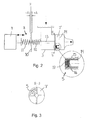
- the basic mode of operation of the wave generator 4 will be explained in more detail below with reference to Figures 2 and 3 , which show a second embodiment of the invention in which the wave generator and fluid dividing means - unlike in the first embodiment shown in Figure 1 - constitute an integral unit in that a plurality of check valves 5 are arranged in a piston 7'.
- the oscillator 8 includes an oscillating weight 10 disposed between a first end of two coil springs I 1 and 12, and connected to the piston 7' via a shaft 13.
- a second end of the coil spring 12 is rigidly supported, and a second end of the coil spring 11 is connected to the vibrator or power source 9 which via the coil spring 11 and at a given frequency imparts to the oscillating weight 10 a translational oscillating motion of an amplitude of A about a neutral point N.
- the oscillating weight 10 will, together with the coil springs 11 and 12, form a part of an oscillating system having a given resonant frequency, and the motion of the oscillating weight 10 will be transmitted to the piston 7' via the shaft 13.
- the oscillating weight 10 and the piston 7' will thus oscillate at an amplitude A at a given frequency, and it will be apparent to those skilled in the art that a small amplitude, for example in the range of 5 mm, and high frequency, for example in the range of 100 Hz, will cause a high acceleration which in turn will cause the fluid on the downstream side of the piston 7' to be supplied with a high power impulse from the piston 7'. Furthermore, the potential energy and kinetic energy of the oscillating system, minus the energy losses in the system, will always be constant, the losses here consisting mainly of the power impulse supplied to the fluid via the piston 7'.
- FIG. 2 shows the structure of the check valves 5 more clearly.
- Each valve is arranged as a through opening in the piston 7' perpendicular to the piston 7' surface 14.
- a membrane 15 with a central orifice 16 is provided in the through opening.
- a central abutment element 17 for the membrane 15 is also provided, so that a part of the membrane 15 will be moved into sealing contact with the abutment element by the positive pressure formed on the downstream side of the valve 5 when the piston moves in the downstream direction. Fluid flow through the valve 5 will thus be prevented.
- the piston 7' moves in the upstream direction, it will be apparent to those skilled in the art that fluid flow through the valve 5 can take place unimpeded.
- valves 5 are open when the piston 7' moves counter-flow, the motion resistance of the piston in this direction will be small, and it may therefore be more descriptive to say that the incremental fluid volume ⁇ V is "captured" on the downstream side of the piston during the counter-flow motion of the piston 7' than that the incremental fluid volume ⁇ V flows through the valve, as the pressure difference across the piston 7' will be small during the counter-flow motion of the piston 7'.
- Figure 5 shows a graph of pressure measurements as a function of time made at two different points in a pipe during a suction lift test of one embodiment of the apparatus according to the invention which is essentially identical to the embodiment shown in Fig. 1 , and where, as previously mentioned, a suction lift height of 24 metres was obtained. From the figure it can be seen that, as expected, there is a phase displacement between the pressure waves (represented by the peaks in the figure) by the apparatus (i.e., at a reference height equal to zero metres) and the pressure waves 16 metres upstream in the pipe from the said reference height (i.e., lower than the apparatus), as the pressure waves moves through the fluid at a given wave velocity.
- the pressure waves are in fact also intensified as the pressure 16 metres upstream in the pipe is considerably higher than at the said reference height.
- wave physics it is generally known that waves travel more easily in a denser or more compressed medium, and the explanation of the aforementioned phenomenon is believed to reside in the fact that the static pressure, and thus also the density, of a fluid generally increases with increasing depth in the fluid, and that the wave is intensified because it travels though a medium having steadily increasing pressure and density.
- Figure 6 is a graph of pressure measurements made during a test of another, small-scale embodiment of an apparatus according to the invention, essentially like the embodiment shown in Figures 2 and 3 , and where the pressure was measured at three different points.
- the different points were immediately upstream of the apparatus (indicated by a circular symbol), immediately downstream of the apparatus (indicated by a cruciform symbol) and at a greater downstream distance from the apparatus (indicated by square symbol).
- the figure shows respectively the mean pressure, the maximum pressure and the RMS pressure as a function of frequency, and as can be seen from the figure, the mean pressure, the maximum pressure and the RMS pressure all increase in the downstream direction.
- the test readings indicate that in particular the maximum pressure and the RMS pressure difference between the measuring points increases with increasing frequency, which is believed to be due to wave superposition.
- a semi-permeable membrane may alternatively be provided, where fluid can simply flow through the membrane in the downstream direction, and instead of springs 11, 12, other types of energy storing elements may alternatively be provided, for example, closed devices filled with a compressible medium, magnets of the same polarity, resilient materials such a rubber or the like, which have small losses due to inner frictional resistance.
- the power source 9 need not be an electric vibrator as shown in Figure 1 , but may be any form of motor or power-generating device which either directly or indirectly produces a translational oscillating motion of a desired frequency and amplitude.
Landscapes
- Engineering & Computer Science (AREA)
- Mechanical Engineering (AREA)
- General Engineering & Computer Science (AREA)
- Life Sciences & Earth Sciences (AREA)
- Geology (AREA)
- Mining & Mineral Resources (AREA)
- Physics & Mathematics (AREA)
- Environmental & Geological Engineering (AREA)
- Fluid Mechanics (AREA)
- General Life Sciences & Earth Sciences (AREA)
- Geochemistry & Mineralogy (AREA)
- Reciprocating Pumps (AREA)
Applications Claiming Priority (2)
| Application Number | Priority Date | Filing Date | Title |
|---|---|---|---|
| NO20045382A NO20045382D0 (no) | 2004-12-09 | 2004-12-09 | Fremgangsmate og anordning for transport av fluid i en kanal |
| EP05814040A EP1859167A1 (fr) | 2004-12-09 | 2005-12-05 | Procede et appareil de transport de fluide dans une conduite |
Related Parent Applications (1)
| Application Number | Title | Priority Date | Filing Date |
|---|---|---|---|
| EP05814040A Division EP1859167A1 (fr) | 2004-12-09 | 2005-12-05 | Procede et appareil de transport de fluide dans une conduite |
Publications (2)
| Publication Number | Publication Date |
|---|---|
| EP2063123A2 true EP2063123A2 (fr) | 2009-05-27 |
| EP2063123A3 EP2063123A3 (fr) | 2009-06-03 |
Family
ID=35198133
Family Applications (2)
| Application Number | Title | Priority Date | Filing Date |
|---|---|---|---|
| EP05814040A Withdrawn EP1859167A1 (fr) | 2004-12-09 | 2005-12-05 | Procede et appareil de transport de fluide dans une conduite |
| EP08171827A Withdrawn EP2063123A3 (fr) | 2004-12-09 | 2005-12-05 | Procédé et appareil pour le transport de fluides dans une conduite |
Family Applications Before (1)
| Application Number | Title | Priority Date | Filing Date |
|---|---|---|---|
| EP05814040A Withdrawn EP1859167A1 (fr) | 2004-12-09 | 2005-12-05 | Procede et appareil de transport de fluide dans une conduite |
Country Status (3)
| Country | Link |
|---|---|
| EP (2) | EP1859167A1 (fr) |
| NO (1) | NO20045382D0 (fr) |
| WO (1) | WO2006062413A1 (fr) |
Cited By (3)
| Publication number | Priority date | Publication date | Assignee | Title |
|---|---|---|---|---|
| US20130081818A1 (en) * | 2010-06-17 | 2013-04-04 | Impact Technology Systems As | Method employing pressure transients in hydrocarbon recovery operations |
| US9599106B2 (en) | 2009-05-27 | 2017-03-21 | Impact Technology Systems As | Apparatus employing pressure transients for transporting fluids |
| US9863225B2 (en) | 2011-12-19 | 2018-01-09 | Impact Technology Systems As | Method and system for impact pressure generation |
Families Citing this family (3)
| Publication number | Priority date | Publication date | Assignee | Title |
|---|---|---|---|---|
| NO20045382D0 (no) | 2004-12-09 | 2004-12-09 | Clavis Impuls Technlogy As | Fremgangsmate og anordning for transport av fluid i en kanal |
| EP2647844A1 (fr) * | 2012-04-05 | 2013-10-09 | AT Enterprise AS | Procédé de pompage de fluide |
| CN116292217B (zh) * | 2023-05-19 | 2023-07-21 | 胜利油田胜机石油装备有限公司 | 一种具有除砂功能柱塞的可打捞式抽油泵 |
Citations (1)
| Publication number | Priority date | Publication date | Assignee | Title |
|---|---|---|---|---|
| EP1859167A1 (fr) | 2004-12-09 | 2007-11-28 | Clavis Impulse Technology AS | Procede et appareil de transport de fluide dans une conduite |
Family Cites Families (10)
| Publication number | Priority date | Publication date | Assignee | Title |
|---|---|---|---|---|
| BE500911A (fr) * | ||||
| FR558911A (fr) * | 1921-12-08 | 1923-09-06 | Pompe à pistons différentiels, à action régularisée | |
| US2527184A (en) * | 1946-03-30 | 1950-10-24 | Gerhold Jose Aderito | Pump for raising petroleum and other liquids from deep wells |
| US2555613A (en) * | 1946-09-11 | 1951-06-05 | Sochris Dev Company | Pump |
| US3075468A (en) * | 1960-04-06 | 1963-01-29 | Hills Mccanna Co | Hydraulically actuated diaphragm pump |
| US3640344A (en) * | 1968-12-02 | 1972-02-08 | Orpha Brandon | Fracturing and scavenging formations with fluids containing liquefiable gases and acidizing agents |
| EP0541945B1 (fr) * | 1991-09-30 | 1997-03-12 | Ebara Corporation | Pompe à tube vibrante |
| CA2118772A1 (fr) * | 1993-03-15 | 1994-09-16 | Shinei Isa | Dispositif de pompage et generateur equipe du dispositif |
| BR9805280A (pt) * | 1998-11-24 | 2000-06-06 | Brasil Compressores Sa | Compressor alternativo com motor linear |
| DE10143978B4 (de) * | 2001-09-07 | 2005-03-03 | Lewa Herbert Ott Gmbh + Co. | Hydraulisch angetriebene Membranpumpe mit vorgespannter Membran |
-
2004
- 2004-12-09 NO NO20045382A patent/NO20045382D0/no unknown
-
2005
- 2005-12-05 WO PCT/NO2005/000449 patent/WO2006062413A1/fr not_active Ceased
- 2005-12-05 EP EP05814040A patent/EP1859167A1/fr not_active Withdrawn
- 2005-12-05 EP EP08171827A patent/EP2063123A3/fr not_active Withdrawn
Patent Citations (1)
| Publication number | Priority date | Publication date | Assignee | Title |
|---|---|---|---|---|
| EP1859167A1 (fr) | 2004-12-09 | 2007-11-28 | Clavis Impulse Technology AS | Procede et appareil de transport de fluide dans une conduite |
Cited By (7)
| Publication number | Priority date | Publication date | Assignee | Title |
|---|---|---|---|---|
| US9599106B2 (en) | 2009-05-27 | 2017-03-21 | Impact Technology Systems As | Apparatus employing pressure transients for transporting fluids |
| US10100823B2 (en) | 2009-05-27 | 2018-10-16 | Impact Technology Systems As | Apparatus employing pressure transients for transporting fluids |
| US20130081818A1 (en) * | 2010-06-17 | 2013-04-04 | Impact Technology Systems As | Method employing pressure transients in hydrocarbon recovery operations |
| US9803442B2 (en) | 2010-06-17 | 2017-10-31 | Impact Technology Systems As | Method employing pressure transients in hydrocarbon recovery operations |
| US9903170B2 (en) | 2010-06-17 | 2018-02-27 | Impact Technology Systems As | Method employing pressure transients in hydrocarbon recovery operations |
| US9863225B2 (en) | 2011-12-19 | 2018-01-09 | Impact Technology Systems As | Method and system for impact pressure generation |
| US10107081B2 (en) | 2011-12-19 | 2018-10-23 | Impact Technology Systems As | Method for recovery of hydrocarbon fluid |
Also Published As
| Publication number | Publication date |
|---|---|
| EP1859167A1 (fr) | 2007-11-28 |
| WO2006062413A1 (fr) | 2006-06-15 |
| NO20045382D0 (no) | 2004-12-09 |
| EP2063123A3 (fr) | 2009-06-03 |
Similar Documents
| Publication | Publication Date | Title |
|---|---|---|
| US4342364A (en) | Apparatus and method for coupling sonic energy to the bore hole wall of an oil well to facilitate oil production | |
| US2444912A (en) | Method and apparatus for pumping | |
| JP4704752B2 (ja) | 海面波エネルギー変換器 | |
| JP2006502343A5 (fr) | ||
| Ye et al. | Suppressing the generation of cavitation by increasing the number of inlet check valves in piezoelectric pumps | |
| EP2063123A2 (fr) | Procédé et appareil pour le transport de fluides dans une conduite | |
| CN101639029A (zh) | 共振式水面波动能量回收装置 | |
| US4487554A (en) | Sonic pump for pumping wells and the like employing a rod vibration system | |
| US6736209B2 (en) | Method for vibrational impact on a pipe string in a borehole and devices for carrying out said method | |
| CN108088651A (zh) | 波浪作用下海床动力响应实验设备及模拟实验方法 | |
| US2702559A (en) | Sonically actuated valve | |
| US20150053273A1 (en) | Method of pumping fluid, pulse generator for use in the method, and pump system comprising the pulse generator | |
| US3303782A (en) | Deep well sonic pumping process and apparatus | |
| US10006448B2 (en) | Hydraulic ram liquid suction pump apparatus and methods | |
| US2953095A (en) | Acoustic deep well pump with free compression column | |
| US11971006B2 (en) | Kinetic pumping system | |
| US2918127A (en) | Method of cleaning out well pump tubing and the like | |
| Wen et al. | Design and characterization of valveless impedance pumps | |
| JP2008508467A (ja) | エネルギー転換のための方法およびデバイス | |
| US20150361969A1 (en) | Chemical Injector | |
| WO2020071915A1 (fr) | Procédé et pompe de fond de trou pour pomper un liquide à travers un puits de forage | |
| CN1936266A (zh) | 油井低频声波振动解堵、增产设备及方法 | |
| CA2854382A1 (fr) | Injecteur de produit chimique | |
| CN108105050B (zh) | 一种变刚度压电振子驱动的微滴泵 | |
| Czitrom | Wave energy-driven resonant sea-water pump |
Legal Events
| Date | Code | Title | Description |
|---|---|---|---|
| PUAI | Public reference made under article 153(3) epc to a published international application that has entered the european phase |
Free format text: ORIGINAL CODE: 0009012 |
|
| PUAL | Search report despatched |
Free format text: ORIGINAL CODE: 0009013 |
|
| AC | Divisional application: reference to earlier application |
Ref document number: 1859167 Country of ref document: EP Kind code of ref document: P |
|
| AK | Designated contracting states |
Kind code of ref document: A2 Designated state(s): AT BE BG CH CY CZ DE DK EE ES FI FR GB GR HU IE IS IT LI LT LU LV MC NL PL PT RO SE SI SK TR |
|
| AK | Designated contracting states |
Kind code of ref document: A3 Designated state(s): AT BE BG CH CY CZ DE DK EE ES FI FR GB GR HU IE IS IT LI LT LU LV MC NL PL PT RO SE SI SK TR |
|
| 17P | Request for examination filed |
Effective date: 20091202 |
|
| AKX | Designation fees paid |
Designated state(s): AT BE BG CH CY CZ DE DK EE ES FI FR GB GR HU IE IS IT LI LT LU LV MC NL PL PT RO SE SI SK TR |
|
| 17Q | First examination report despatched |
Effective date: 20100121 |
|
| STAA | Information on the status of an ep patent application or granted ep patent |
Free format text: STATUS: THE APPLICATION IS DEEMED TO BE WITHDRAWN |
|
| 18D | Application deemed to be withdrawn |
Effective date: 20100601 |