EP2063285A1 - Verfahren zur Durchführung von Taubenrennen im Taubensport und ein Ortungssystem zur Ausführung des Verfahrens - Google Patents
Verfahren zur Durchführung von Taubenrennen im Taubensport und ein Ortungssystem zur Ausführung des Verfahrens Download PDFInfo
- Publication number
- EP2063285A1 EP2063285A1 EP08019665A EP08019665A EP2063285A1 EP 2063285 A1 EP2063285 A1 EP 2063285A1 EP 08019665 A EP08019665 A EP 08019665A EP 08019665 A EP08019665 A EP 08019665A EP 2063285 A1 EP2063285 A1 EP 2063285A1
- Authority
- EP
- European Patent Office
- Prior art keywords
- pigeon
- module
- location information
- radio
- user
- Prior art date
- Legal status (The legal status is an assumption and is not a legal conclusion. Google has not performed a legal analysis and makes no representation as to the accuracy of the status listed.)
- Granted
Links
Images

Classifications
-
- G—PHYSICS
- G07—CHECKING-DEVICES
- G07C—TIME OR ATTENDANCE REGISTERS; REGISTERING OR INDICATING THE WORKING OF MACHINES; GENERATING RANDOM NUMBERS; VOTING OR LOTTERY APPARATUS; ARRANGEMENTS, SYSTEMS OR APPARATUS FOR CHECKING NOT PROVIDED FOR ELSEWHERE
- G07C1/00—Registering, indicating or recording the time of events or elapsed time, e.g. time-recorders for work people
- G07C1/22—Registering, indicating or recording the time of events or elapsed time, e.g. time-recorders for work people in connection with sports or games
- G07C1/26—Pigeon-timing or like equipment
-
- G—PHYSICS
- G01—MEASURING; TESTING
- G01S—RADIO DIRECTION-FINDING; RADIO NAVIGATION; DETERMINING DISTANCE OR VELOCITY BY USE OF RADIO WAVES; LOCATING OR PRESENCE-DETECTING BY USE OF THE REFLECTION OR RERADIATION OF RADIO WAVES; ANALOGOUS ARRANGEMENTS USING OTHER WAVES
- G01S5/00—Position-fixing by co-ordinating two or more direction or position line determinations; Position-fixing by co-ordinating two or more distance determinations
- G01S5/0009—Transmission of position information to remote stations
- G01S5/0018—Transmission from mobile station to base station
- G01S5/0027—Transmission from mobile station to base station of actual mobile position, i.e. position determined on mobile
-
- G—PHYSICS
- G01—MEASURING; TESTING
- G01S—RADIO DIRECTION-FINDING; RADIO NAVIGATION; DETERMINING DISTANCE OR VELOCITY BY USE OF RADIO WAVES; LOCATING OR PRESENCE-DETECTING BY USE OF THE REFLECTION OR RERADIATION OF RADIO WAVES; ANALOGOUS ARRANGEMENTS USING OTHER WAVES
- G01S19/00—Satellite radio beacon positioning systems; Determining position, velocity or attitude using signals transmitted by such systems
- G01S19/01—Satellite radio beacon positioning systems transmitting time-stamped messages, e.g. GPS [Global Positioning System], GLONASS [Global Orbiting Navigation Satellite System] or GALILEO
- G01S19/13—Receivers
- G01S19/14—Receivers specially adapted for specific applications
- G01S19/19—Sporting applications
Definitions
- the invention relates to a method for performing pigeon racing in pigeon racing and a positioning system for carrying out the method.
- Each pigeon fancier's dream is to track the flight of the pigeon (or other animals) in "real time".
- the current systems used capture only the arrival time with which you can then calculate the flight duration and thus the average speed back. This is sufficient for timing in pigeon sport.
- the deciding factor is the transmission of the position in real time.
- the invention therefore has the object of developing a method for performing pigeon racing in pigeon racing and a positioning system for carrying out this method so that the current flight path of the pigeon can be transmitted in real time to a user.
- a location system for carrying out the method is the subject of the device claim 6.
- the GSM module is programmed to send the collected data to an Internet-capable bottom-side receiver, which in turn sends the data over the Internet to a database server, on whose data the organizer or the owner of the pigeon or another person Have access.
- the GSM module is programmed to have a number of dial-in numbers suitable for connecting this GSM module to the user module of a pigeon race participant or organizer via the usual mobile radio system.
- the transmission methods used for this purpose are arbitrary. It can be transmitted according to the usual GSM standard or according to the GSPR standard or UMTS standard.
- the main challenges are the minimal weight, compact design and maximum operating time.
- This GSM modem would get in during the flight enter the different cells. This booking information could be obtained from the provider and thus perform a localization.
- GPS Globalstar, Galileo etc.
- the pigeon module either constantly or on request by the user or at certain intervals radio contact with the respective radio cell receives, which flies over the animal.
- the network operator By logging into the specific radio cell, the network operator recognizes the current location of the pigeon. The network operator can now send this location information back to the pigeon, which installs it in an SMS message and transmits this SMS to the user.
- the network operator can also transmit this location information directly as an SMS or as a main message on a radio communication channel in the usual way to the user on his mobile device or an Internet-enabled database server.
- Such data include, for example, environmental data, time, altitude, temperature, humidity, and other pigeon sport relevant data.
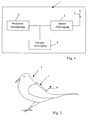
- a pigeon module 1 which consists essentially of a position module 2 and an associated data transmission in the form of a radio module 3.
- the mentioned modules 2, 3 are supplied by a power supply 4.
- the position module 2 may also be a multi-axis acceleration sensor, which has recently replaced so-called gyro compasses. It is thus possible to use a multi-axis acceleration sensor to collect position data in a position module which is evaluated and transmitted via the radio module 3 Data transmission of the antenna 6 are fed. This sends the correspondingly collected data into the radio network according to FIG. 3 ,
- FIG. 2 shows that such a pigeon module 1 is relatively small and lightweight and can be piggybacked on top of a pigeon 5 attached to the top.
- the pigeon module 1 can also be attached to the foot of the pigeon with a sufficiently small and lightweight construction.
- the antenna 6 may be formed here as a rod or as a loose hanging wire or as an internal, built-in module chip antenna.
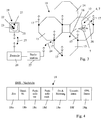
- FIG. 3 is a common radio network 11, consisting of a number of radio cells 12-15, shown, each radio cell is operated as the smallest geographic radio coverage area of a base station and where via a radio channel, the coupling of the GSM module 7 on the pigeon 5 to a BTS ( Base transceiver station) takes place.
- the GSM module distinguishes the radio cells via a Base Transceiver Station Identity Code (BSIC).
- BSIC Base Transceiver Station Identity Code
- CGI Cell Identity
- the radio cells can vary in size depending on the location and destination.
- the nominal cell size in the GSM 900 system is up to 35 km.
- the cell reduction is achieved, inter alia, by microcell technology and directional antennas.
- the radio cell radius for GSM-900 can theoretically be varied between 300 m and 35 km. In urban areas, a radio cell is still very small and can be in the range of several 10 m.
- the GSM module 7 on the flying dove 5 now books a BTS of a specific radio cell 12 via the air interface.
- Each BTS 17 is connected via a further air interface 24 to the base station 25 and from there the signals of the radio network 11 are fed to a control center 26, which feeds these signals via a further air interface 27 to a mobile device of a user.
- the user may have a user module 19 which has a graphical display 20.
- This graphic display 20 may, for example, have a constantly updated map in which the current position 21, 22, 23 of the pigeon 5 is displayed in relation to the radio cell 12, 13, 15 being flown over.
- the pigeon 5 flies through the radio cell 12 and then flies over in the direction of arrow 16, the radio cell 13, from which, in turn, for example, they get into the radio cell 15.
- the wireless network operator from the central office 26 directly communicates the location information (cell information) of the pigeon 5 via the air interface 27 to the bottom-side user module 19.
- the network operator transmits the determined location information in the center 26 and sends it back via the air interfaces 24 and 28 to the GSM module 7, which generates an SMS message, which in turn via the air interfaces 28, 24, 27 the User module 19 is communicated.
- the GSM module 7 which generates an SMS message, which in turn via the air interfaces 28, 24, 27 the User module 19 is communicated.
- SMS message a direct connection to a database server can be made.
- the position determination takes place directly on the GSM module 7 itself, in which, for example, this in FIG. 5 illustrated GSM module 7 still according to FIG. 6 is coupled to a GPS module 9.
- the GPS module 9 receives the corresponding satellite data via the receiving antenna 10 and calculates therefrom its current position, which is processed in the form of an SMS message or a direct connection message in the GSM module 7 and fed via the antenna 6 into the radio network 11 via the air interface 28 becomes.
- FIG. 5 shows that 4 solar cells 8 are used as a power supply. Likewise, batteries can be used.
- the GPS module 9 is omitted and instead a gyro module is used, which consists of a multi-axis electronic acceleration sensor that detects the location coordinates and feeds into the GSP module and from this an SMS message generated, which are transmitted to the user via the air interfaces 28, 24, 27.
- a gyro module which consists of a multi-axis electronic acceleration sensor that detects the location coordinates and feeds into the GSP module and from this an SMS message generated, which are transmitted to the user via the air interfaces 28, 24, 27.
Landscapes
- Physics & Mathematics (AREA)
- General Physics & Mathematics (AREA)
- Engineering & Computer Science (AREA)
- Radar, Positioning & Navigation (AREA)
- Remote Sensing (AREA)
- Position Fixing By Use Of Radio Waves (AREA)
- Mobile Radio Communication Systems (AREA)
- Transition And Organic Metals Composition Catalysts For Addition Polymerization (AREA)
- Steroid Compounds (AREA)
Abstract
Description
- Die Erfindung betrifft ein Verfahren zur Durchführung von Taubenrennen im Taubensport und ein Ortungssystem zur Ausführung des Verfahrens.
- Mit dem Gegenstand der
DE 100 24 805 A1 ist es lediglich bekannt geworden, Standorte eines Taubenschlages an die Zentraleinheit mit einem GPS-System zu ermitteln und diese Standortdaten an die Zentraleinheit zu übermitteln. Damit kann der Standort des Taubenschlages im Taubenrennen festgestellt werden. Ferner ist es bekannt, Tauben mit sogenannten Datenloggern zu versehen, wobei die während des Fluges ermittelten Daten (z. B. Flugzeit, Tageshelligkeit, Temperatur, Luftdruck und Luftfeuchtigkeit) aufgezeichnet und nach der Ankunft der Taube im Taubenschlag ausgelesen werden. Eine solche Technik lässt die Flugroute der Taube nur im nach hinein nachvollziehen. - Traum jedes Taubenzüchters ist die Verfolgung des Fluges der Taube (oder auch anderen Tiere) in "Echtzeit". Die jetzigen Systeme die eingesetzt werden erfassen lediglich die Ankunftszeit mit der man dann auf die Flugdauer und somit auf die Durchschnittsgeschwindigkeit zurückrechnen kann. Dies reicht aus für die Zeitmessung im Taubensport. Jedoch hat man keinerlei Information, wo sich die Taube während ihres Fluges gerade befindet. Diese zusätzliche Information könnte eine neue Ära im Taubensport einleiten. Es gibt zwar schon Systeme, die auf Basis eines kleinen GPS Empfängers die Flugroute der Taube aufzeichnen. Diese kann erst nach der Ankunft ausgewertet werden und hat daher nur eine sehr begrenzte Anwendung. Das Ausschlaggebende ist die Übermittlung der Position in Echtzeit.
- Die Erfindung legt deshalb die Aufgabe zugrund ein Verfahren zur Durchführung von Taubenrennen im Taubensport und ein Ortungssystem zur Ausführung dieses Verfahrens so weiterzubilden, dass die aktuelle Flugroute der Taube in Echtzeit an einen Nutzer übertragen werden kann.
- Zur Lösung der gestellten Aufgabe dient die im Anspruch 1 wiedergegebene technische Lehre.
- Ein Ortungssystem zur Ausführung des Verfahrens ist Gegenstand des Vorrichtungsanspruches 6.
- Wesentliches Merkmal der Erfindung ist, die Taube mit einem GSM oder UMTS-oder einem anderen geeigneten zellorientierten Funksystem Modul zu verbinden, welches diese trägt, wobei das GSM-Modul während der Flugzeit der Taube eine (ständige oder zeitweilig unterbrochene) Funkverbindung mit dem Funknetz eines Funknetzbetreibers herstellt. Für die Ermittlung und Übertragung der an der Taube erzeugten Ortsinformation und deren funkgestützte Übertragung werden hierbei nach den Ansprüchen 2 und 3 verschiedene Verfahren beansprucht::
- 1. als aktuelle Ortsinformation wird die gegenwärtig aktive Funkzelle dem Nutzer mitgeteilt. Hierbei kann dann auf einen GPS-Empfänger und die Weiterleitung seiner Daten von der Taube über das Funknetz verzichtet werden. Damit ergibt sich ein besonders kleiner, leichter und stromsparender Aufbau der Anordnung, die von der Taube mitgeführt wird.
- 2. als aktuelle Ortsinformation werden an der Taube die GPS-Daten erhoben und über das Funknetz von der Taube an den Nutzer übertragen. Zusätzlich zum zellfähigen Modul wird hierbei ein GPS-Empfänger mitgeführt, dessen Daten über die Funkschnittstelle an die bodenseitige Basisstation übertragen wird. Die Ortung mit einem GPS-Empäner ist genauer als die Ermittlung der Funkzelle.
- Das GSM-Modul ist nach einer ersten Ausführung so programmiert, dass es die erhobenen Daten an einen internetfähigen bodenseitigen Empfänger schickt, der seinerseits die Daten über das Internet an einen Datenbankserver sendet, auf dessen Daten der Veranstalter oder der Eigentümer der Taube oder eine andere Person Zugriff haben.
- In einer zweiten Ausführung ist das GSM-Modul ist so programmiert, dass es eine Reihe von Einwählnummern aufweist, die geeignet sind, dieses GSM-Modul mit dem Nutzermodul eines Teilnehmers oder Veranstalters eines Taubenrennens über das übliche Mobilfunksystem zu verbinden.
- Die hierfür verwendeten Übertragungsverfahren sind beliebig. Es kann nach dem üblichen GSM-Standard übertragen werden oder auch nach dem GSPR-Standard oder nach UMTS-Standard.
- Das System besteht im Wesentlichen aus 3 Teilen:
- 1. Die Positionsbestimmung:
- Dieser Teil des Systems ermittelt die aktuelle Position des Tieres. Diese Information kann von einem GPS Empfänger kommen oder von der Zelleninformation der Datenübertragung (z. B. GSM Funkzelle). Zusätzlich kann diese Information angereichert werden durch z. B. einer Höhenmessung oder Temperatur/Luftdruck/Geschwindigkeit.
- 2. Datenübertragung:
- Zur Datenübertragung werden die Mobilfunknetze verwendet. Hier kann z. B. ein GSM oder UMTS Sender die Informationen periodisch oder kontinuierlich an eine Datenbank schicken. Diese Datenbank kann diese Informationen dann weiterverarbeiten und visualisieren.
- 3. Energieversorgung:
- Als Energieversorgung kann eine Batterie oder auch eine alternative Energiequelle dienen (z. B. Solarzellen, Muskel- oder Windkraft)
- Die Herausforderungen liegen vor allem im minimalen Gewicht, kompakter Bauform und maximaler Betriebsdauer.
- Man könnte ein Minimalsystem mit einer aufladbaren Lithium Batterie und einem GSM Modem aufbauen. Dieses GSM Modem würde sich während des Fluges in die verschiedenen Zellen einbuchen. Diese Buchungsinformation könnte man vom Provider beziehen und damit eine Lokalisierung durchführen.
- Um diese Lokalisierung zu präzisieren könnte man das System zusätzlich mit einem GPS (GPS, Galileo etc.) Empfänger ausstatten und die Positionsdaten direkt zu einer Auswertung versenden.
- Wichtig bei der Erfindung ist, dass das Taubenmodul entweder ständig oder auf Anforderung durch den Nutzer oder in bestimmten Zeitabständen Funkkontakt mit der jeweiligen Funkzelle aufnimmt, die das Tier überfliegt. Durch die Einbuchung in die bestimmte Funkzelle wird vom Netzbetreiber der aktuelle Aufenthaltsort der Taube erkannt. Der Netzbetreiber kann nun diese Ortungsinformationen an die Taube zurücksenden, welche diese in eine SMS-Nachricht einbaut und diese SMS an den Nutzer übermittelt.
- In einer anderen Ausführungsform kann der Netzbetreiber auch diese Ortungsinformation unmittelbar als SMS oder als Hauptnachricht auf einem Funkverbindungskanal in üblicher Weise dem Nutzer auf sein Mobilfunkgerät oder einen internetfähigen Datenbankserver übertragen.
- Damit ergibt sich die Möglichkeit, dass der Nutzer auf einer grafischen Anzeige eine Landkarte vorhält, in der die aktuelle Position der Taube als wandernder Punkt sichtbar ist. Auf diese Weise kann zu jeder Zeit die aktuelle Position der Taube in einer geografischen Umgebung Online festgestellt werden.
- Durch Anklicken der aktuellen Position können dem Benutzer dann noch weitere Daten zugänglich gemacht werden, die in der SMS-Nachricht enthalten sind. Solche Daten sind beispielsweise die Umgebungsdaten, die Zeit, die Flughöhe, die Temperatur, die Feuchtigkeit und andere für den Taubensport relevante Daten.
- Der Erfindungsgegenstand der vorliegenden Erfindung ergibt sich nicht nur aus dem Gegenstand der einzelnen Patentansprüche, sondern auch aus der Kombination der einzelnen Patentansprüche untereinander.
- Alle in den Unterlagen, einschließlich der Zusammenfassung offenbarten Angaben und Merkmale, insbesondere die in den Zeichnungen dargestellte räumliche Ausbildung, werden als erfindungswesentlich beansprucht, soweit sie einzeln oder in Kombination gegenüber dem Stand der Technik neu sind.
- Im Folgenden wird die Erfindung anhand von lediglich einen Ausführungsweg darstellenden Zeichnungen näher erläutert. Hierbei gehen aus den Zeichnungen und ihrer Beschreibung weitere erfindungswesentliche Merkmale und Vorteile der Erfindung hervor.
- Es zeigen:
- Figur 1:
- schematisierte Darstellung eines Taubenmoduls nach der Erfindung;
- Figur 2:
- eine Taube mit darauf befestigtem Taubenmodul;
- Figur 3:
- schematisiert die Darstellung eines GSM-Funknetzes;
- Figur 4:
- schematisiert die Zusammensetzung einer SMS-Nachricht;
- Figur 5:
- ein Blockschaltbild eines GSM-Moduls;
- Figur 6:
- Blockschaltbild eines GSM-Moduls in Kombination mit einem GPS- Modul.
- In
Figur 1 ist allgemein ein Taubenmodul 1 dargestellt, welches im wesentlichen aus einem Positionsmodul 2 und einer dazugehörenden Datenübertragung in Form eines Funkmoduls 3 besteht. Die genannten Module 2, 3 sind von einer Energieversorgung 4 versorgt. - Das Positionsmodul 2 kann auch ein Mehrachsen-Beschleunigungssensor sein, der neuerdings sogenannte Kreiselkompasse ersetzt. Es ist also möglich, mit Hilfe eines Mehrachsen-Beschleunigungssensors Positionsdaten in einem Positionsmodul zu erheben, die ausgewertet und über das Funkmodul 3 als Datenübertragung der Antenne 6 zugeleitet werden. Diese sendet die entsprechend erhobenen Daten in das Funknetz gemäß
Figur 3 . - Die
Figur 2 zeigt, dass ein solches Taubenmodul 1 relativ klein und leichtgewichtig ist und auf einer Taube 5 huckepack an der Oberseite befestigt werden kann.Das Taubenmodul 1 kann auch bei genügend kleiner und leichter Konstruktion am Fuß der Taube befestigt sein. Die Antenne 6 kann hierbei als Stab oder als lose hängender Draht oder als interne, im Modul eingebaute Chipantenne ausgebildet sein. - In
Figur 3 ist ein übliches Funknetz 11, bestehend aus einer Anzahl von Funkzellen 12-15, dargestellt, wobei jede Funkzelle als kleinster geografischer Funkversorgungsbereich von einer Basisstation bedient wird und wo über einen Funkkanal die Ankopplung des GSM-Moduls 7 an der Taube 5 an eine BTS (Base Transceiver Station) stattfindet. Das GSM-Modul unterscheidet die Funkzellen über einen BSIC (Base Tranceiver Station Identity Code). Im Netz wird anhand der Cell Identity (CGI) zwischen den Zellen unterschieden. Die Funkzellen können je nach Einsatzort und Bestimmung unterschiedlich groß sein. Die nominale Zellengröße im GSM-900-System beträgt bis zu 35 km. Die Zellenverkleinerung wird unter anderem durch Mikrozellentechnik und Richtantennen erreicht. Demzufolge kann der Funkzellenradius für GSM-900 theoretisch zwischen 300 m und 35 km variiert werden. In städtischen Gebieten ist eine Funkzelle noch wesentlich kleine und kann im Bereich von mehreren 10 m liegen. - Das GSM-Modul 7 an der fliegenden Taube 5 bucht sich nun über die Luftschnittstelle an einer BTS einer bestimmten Funkzelle 12 ein. Jede BTS 17 ist über eine weitere Luftschnittstelle 24 mit der Basisstation 25 verbunden und von dort aus werden die Signale des Funknetzes 11 einer Zentrale 26 zugeleitet, welche diese Signale über eine weitere Luftschnittstelle 27 einem Mobilfunkgerät eines Nutzers zuleitet. Der Nutzer kann über ein Nutzer-Modul 19 verfügen, welches eine grafische Anzeige 20 aufweist. Diese grafische Anzeige 20 kann beispielsweise eine ständig aktualisierte Landkarte aufweisen, in welcher die aktuelle Position 21, 22, 23 der Taube 5 im Bezug zu der jeweils überflogenen Funkzelle 12, 13, 15 angezeigt wird.
- Im gezeigten Ausführungsbeispiel durchfliegt die Taube 5 die Funkzelle 12 und überfliegt danach in Pfeilrichtung 16 die Funkzelle 13, von der sie wiederum beispielsweise in die Funkzelle 15 hineingelangt.
- In der allgemeinen Beschreibung wurde bereits schon angegeben, dass es mehrere Möglichkeiten zur Erzeugung der Positionsdaten gibt.
- In einem Anwendungsfall teilt der Funknetzbetreiber aus der Zentrale 26 unmittelbar die Ortsinformation (Zellinformation) der Taube 5 über die Luftschnittstelle 27 dem bodenseitigen Nutzermodul 19 mit.
- In einem anderen Anwendungsfall übermittelt der Netzbetreiber in der Zentrale 26 die ermittelten Ortsinformation und funkt diese über die Luftschnittstellen 24 und 28 an das GSM-Modul 7 zurück, welches daraus eine SMS-Nachricht erzeugt, die wiederum über die Luftschnittstellen 28, 24, 27 dem Benutzermodul 19 mitgeteilt wird. Statt einer SMS-Nachricht kann auch eine Direktverbindung mit einem Datenbank-Server hergestellt werden.
- In einer dritten Variante erfolgt die Positionsermittlung unmittelbar am GSM-Modul 7 selbst, in dem beispielsweise dieses in
Figur 5 dargestellte GSM-Modul 7 noch gemäßFigur 6 mit einem GPS-Modul 9 gekoppelt ist. Das GPS-Modul 9 empfängt über die Empfangsantenne 10 die entsprechenden Satellitendaten und errechnet daraus seine aktuelle Position, die in Form einer SMS-Nachricht oder einer Direktverbindungsnachricht im GSM-Modul 7 verarbeitet und über die Antenne 6 in das Funknetz 11 über die Luftschnittstelle 28 eingespeist wird. - Die
Figur 5 zeigt, dass als Energieversorgung 4 Solarzellen 8 verwendet werden. Ebenso können Akkus verwendet werden. - In einer Weiterbildung der vorliegenden Erfindung ist es vorgesehen, dass das GPS-Modul 9 entfällt und stattdessen ein Kreiselmodul verwendet wird, welches aus einem mehrachsigen elektronischen Beschleunigungssensor besteht, der die Ortskoordinaten erfasst und in das GSP-Modul einspeist und hieraus eine SMS-Nachricht erzeugt, die an den Nutzer über die Luftschnittstellen 28, 24, 27 übermittelt werden.
- Mit der gegebenen technischen Lehre ergibt sich nun erstmals der Vorteil, dass ein Flug einer Taube in Echtzeit verfolgt werden kann, wobei die
Figur 4 zeigt, dass mit der SMS-Nachricht und der Übermittlung der Ortsinformationen noch eine Reihe weiterer Daten übermittelt werden kann wie - 18a:
- Zeit
- 18b:
- Ident-Nummer
- 18c:
- Funkzelle vorher
- 18d:
- Funkzelle nachher
- 18e:
- Ort und Richtung
- 18f:
- Umweltdaten
- 18g:
- ggf. in Verbindung mit GPS-Daten oder Kreiseldaten
-
- 1
- Taubenmodul
- 2
- Positionsmodul
- 3
- Funkmodul
- 4
- Energieversorgung
- 5
- Taube
- 6
- Antenne
- 7
- GSM-Modul
- 8
- Solarzelle
- 9
- GPS-Modul
- 10
- Empfangsantenne
- 11
- Funknetz
- 12
- Funkzelle
- 13
- Funkzelle
- 14
- Funkzelle
- 15
- Funkzelle
- 16
- Pfeilrichtung
- 17
- BTS
- 18
- Nachrichtenblock
- 19
- Nutzer-Modul
- 20
- Grafische Anzeige
- 21
- Position
- 22
- Position
- 23
- Position
- 24
- Luftschnittstelle
- 25
- Basisstation
- 26
- Zentrale
- 27
- Luftschnittstelle
- 28
- Luftschnittstelle
Claims (11)
- Verfahren zur Durchführung von Taubenrennen im Taubensport, dadurch gekennzeichnet, dass die Taube (5) mindestens ein GSM-oder UMTS- oder ein anderes zellfähiges Modul (1, 7) trägt, welches sich während des Fluges in unterschiedliche Funkzellen (12-15) eines Funknetzes (11) einbucht und dass die aktuelle Ortsinformation übertragen wird.
- Verfahren nach Anspruch 1, dadurch gekennzeichnet, dass als aktuelle Ortsinformation die gegenwärtig aktive Funkzelle dem Nutzer mitgeteilt wird.
- Verfahren nach Anspruch 1 oder 2, dadurch gekennzeichnet, dass als aktuelle Ortsinformation die GPS-Daten dem Nutzer mitgeteilt werden.
- Verfahren nach einem der Ansprüche 1 bis 3, dadurch gekennzeichnet, dass die Ortsinformation der gegenwärtig aktiven Funkzelle vom Betreiber des Funknetzes (11) dem Nutzer mitgeteilt wird.
- Verfahren nach einem der Ansprüche 1 bis 4, dadurch gekennzeichnet, dass die Ortsinformation der gegenwärtig aktiven Funkzelle vom GSM-Modul (1, 7) der Taube (5) als SMS-Nachricht über das Funknetz dem Nutzer mitgeteilt wird.
- Verfahren nach einem der Ansprüche 1 bis 5, dadurch gekennzeichnet, dass die Ortsinformation der gegenwärtig aktiven Funkzelle mit den Positionsdaten eines GPS-Moduls (9) verknüpft wird, das mit dem GSM-Modul (1, 7) von der Taube (5) getragen wird.
- Verfahren nach einem der Ansprüche 1 bis 6, dadurch gekennzeichnet, dass mit der Ortsinformation noch weitere Daten als Datenblöcke einer SMS-Nachricht dem Nutzer mitgeteilt werden.
- Ortungssystem zur Ausübung des Verfahrens nach einem oder mehreren der Ansprüche 1 bis 7, dadurch gekennzeichnet, dass es mindestens aus einem mit der Taube (5) befestigten GSM-Modul (7) besteht.
- Ortungssystem nach Anspruch 8, dadurch gekennzeichnet, dass das GSM-Modul (7) in vorbestimmten Zeitabständen die Ortsinformation übermittelt.
- Ortungssystem nach Anspruch 8, dadurch gekennzeichnet, dass das GSM-Modul (7) auf Funkaufforderung durch den Nutzer die Ortsinformation übermittelt.
- Ortungssystem nach einem - der Ansprüche 8 bis 10, dadurch gekennzeichnet, dass das GSM-Modul (7) mit einem GPS-Modul (9) kombiniert ist.
Priority Applications (1)
| Application Number | Priority Date | Filing Date | Title |
|---|---|---|---|
| PL08019665T PL2063285T3 (pl) | 2007-11-13 | 2008-11-11 | Sposób przeprowadzania wyścigów gołębi w sportowych zawodach gołębi |
Applications Claiming Priority (1)
| Application Number | Priority Date | Filing Date | Title |
|---|---|---|---|
| DE102007054425A DE102007054425B4 (de) | 2007-11-13 | 2007-11-13 | Verfahren zur Durchführung von Taubenrennen im Taubensport |
Publications (2)
| Publication Number | Publication Date |
|---|---|
| EP2063285A1 true EP2063285A1 (de) | 2009-05-27 |
| EP2063285B1 EP2063285B1 (de) | 2012-02-22 |
Family
ID=40361462
Family Applications (1)
| Application Number | Title | Priority Date | Filing Date |
|---|---|---|---|
| EP08019665A Active EP2063285B1 (de) | 2007-11-13 | 2008-11-11 | Verfahren zur Durchführung von Taubenrennen im Taubensport |
Country Status (4)
| Country | Link |
|---|---|
| EP (1) | EP2063285B1 (de) |
| AT (1) | ATE546743T1 (de) |
| DE (1) | DE102007054425B4 (de) |
| PL (1) | PL2063285T3 (de) |
Cited By (3)
| Publication number | Priority date | Publication date | Assignee | Title |
|---|---|---|---|---|
| EP2562724A1 (de) * | 2011-08-26 | 2013-02-27 | Skiline Movie GmbH | Verfahren zur Erfassung der Benutzungs- und Anwesenheitsdaten eines Sportlers an einer Sportanlage |
| EP2784545A1 (de) * | 2013-03-30 | 2014-10-01 | Alfons Alexander Weidinger | Vorrichtung zur Verfolgung eines lebendigen Wesens, insbesondere eines Vogels, und Bedienung einer solchen Vorrichtung |
| CN112675425A (zh) * | 2020-12-10 | 2021-04-20 | 黄淮学院 | 一种适于鸟类的分体式手持远程神经刺激系统 |
Families Citing this family (1)
| Publication number | Priority date | Publication date | Assignee | Title |
|---|---|---|---|---|
| DE102018103421A1 (de) * | 2018-02-15 | 2019-08-22 | Testo SE & Co. KGaA | Datenlogger |
Citations (5)
| Publication number | Priority date | Publication date | Assignee | Title |
|---|---|---|---|---|
| DE29701049U1 (de) | 1997-01-22 | 1997-03-13 | Göcke, Wilhelm, Dipl.-Ing., 48341 Altenberge | Einrichtung als virtuelle Brieftaubenrennbahn zur Beobachtung von Preisflügen von Brieftauben |
| DE29915592U1 (de) * | 1999-09-05 | 2001-02-01 | Fidelak, Michael, 59174 Kamen | Reitcomputer |
| WO2001041468A2 (en) | 1999-12-01 | 2001-06-07 | Nokia Corporation | Location services in a telecommunications system |
| DE10024805A1 (de) | 2000-05-19 | 2001-11-22 | Gantner Electronic Gmbh Schrun | Verfahren zum Betrieb eines Konstatiersystems für die Durchführung von Brieftaubenrennen im Taubensport und Konstatiersystem |
| BG109480A (en) * | 2006-03-16 | 2006-08-31 | Петър ГЕЦОВ | SYSTEM FOR MOBILIZATION OF MOVABLE OBJECTS |
Family Cites Families (2)
| Publication number | Priority date | Publication date | Assignee | Title |
|---|---|---|---|---|
| AU2003900863A0 (en) * | 2003-02-26 | 2003-03-20 | Commonwealth Scientific & Industrial Research Organisation | Inertial and radiolocation method |
| DE202006003146U1 (de) * | 2006-03-01 | 2006-12-07 | Heinrichs, André | GPS-Tierortungs-System |
-
2007
- 2007-11-13 DE DE102007054425A patent/DE102007054425B4/de not_active Revoked
-
2008
- 2008-11-11 EP EP08019665A patent/EP2063285B1/de active Active
- 2008-11-11 AT AT08019665T patent/ATE546743T1/de active
- 2008-11-11 PL PL08019665T patent/PL2063285T3/pl unknown
Patent Citations (5)
| Publication number | Priority date | Publication date | Assignee | Title |
|---|---|---|---|---|
| DE29701049U1 (de) | 1997-01-22 | 1997-03-13 | Göcke, Wilhelm, Dipl.-Ing., 48341 Altenberge | Einrichtung als virtuelle Brieftaubenrennbahn zur Beobachtung von Preisflügen von Brieftauben |
| DE29915592U1 (de) * | 1999-09-05 | 2001-02-01 | Fidelak, Michael, 59174 Kamen | Reitcomputer |
| WO2001041468A2 (en) | 1999-12-01 | 2001-06-07 | Nokia Corporation | Location services in a telecommunications system |
| DE10024805A1 (de) | 2000-05-19 | 2001-11-22 | Gantner Electronic Gmbh Schrun | Verfahren zum Betrieb eines Konstatiersystems für die Durchführung von Brieftaubenrennen im Taubensport und Konstatiersystem |
| BG109480A (en) * | 2006-03-16 | 2006-08-31 | Петър ГЕЦОВ | SYSTEM FOR MOBILIZATION OF MOVABLE OBJECTS |
Non-Patent Citations (3)
| Title |
|---|
| "Pigeons to set up a smog block", NEW SCIENTIST, REED BUSINESS INFORMATION, SURREY, vol. 2537, 4 February 2006 (2006-02-04) |
| "Pigeons to set up a smog blog", NEW SCIENTIST, REED BUSINESS INFORMATION, SURREY, GB, vol. 2537, 4 February 2006 (2006-02-04), pages 29, XP009112688, ISSN: 0262-4079, [retrieved on 20060202] * |
| DATABASE EPODOC EUROPEAN PATENT OFFICE, THE HAGUE, NL; XP002518933 * |
Cited By (4)
| Publication number | Priority date | Publication date | Assignee | Title |
|---|---|---|---|---|
| EP2562724A1 (de) * | 2011-08-26 | 2013-02-27 | Skiline Movie GmbH | Verfahren zur Erfassung der Benutzungs- und Anwesenheitsdaten eines Sportlers an einer Sportanlage |
| EP2784545A1 (de) * | 2013-03-30 | 2014-10-01 | Alfons Alexander Weidinger | Vorrichtung zur Verfolgung eines lebendigen Wesens, insbesondere eines Vogels, und Bedienung einer solchen Vorrichtung |
| CN112675425A (zh) * | 2020-12-10 | 2021-04-20 | 黄淮学院 | 一种适于鸟类的分体式手持远程神经刺激系统 |
| CN112675425B (zh) * | 2020-12-10 | 2023-11-17 | 黄淮学院 | 一种适于鸟类的分体式手持远程神经刺激系统 |
Also Published As
| Publication number | Publication date |
|---|---|
| PL2063285T3 (pl) | 2012-07-31 |
| ATE546743T1 (de) | 2012-03-15 |
| EP2063285B1 (de) | 2012-02-22 |
| DE102007054425A1 (de) | 2009-05-14 |
| DE102007054425B4 (de) | 2012-07-05 |
Similar Documents
| Publication | Publication Date | Title |
|---|---|---|
| DE69630020T2 (de) | Lokalisierungssystem | |
| DE4216828C2 (de) | Verfahren zur Erdbeobachtung | |
| EP3380203B1 (de) | Positionsverfolgung bei sportveranstaltungen | |
| DE212011100188U1 (de) | Ortungssystem bzw. Informationssystem zum Anzeigen einer einem Tier zugeordneten Information | |
| EP2063285B1 (de) | Verfahren zur Durchführung von Taubenrennen im Taubensport | |
| WO2020094683A1 (de) | Verfahren zur bodenabtastung mit hilfe einer (drehflügel)-flugdrohne | |
| DE102015116523A1 (de) | Taubensport-Abfragesystem mit der Möglichkeit zur genauen Positionsanalyse | |
| DE202006005089U1 (de) | Gerät zur Übermittlung und Genehmigung eines Flugplans | |
| DE112018007180T5 (de) | Ort-schätzung-vorrichtung, bewegendes objekt, ort-schätzung-verfahren und programm | |
| EP2195568B1 (de) | Vorrichtung und verfahren zur überwachung eines wartungsgeräts | |
| DE102015122619B4 (de) | Navigationsverfahren und Navigationsvorrichtung für Segelflugzeuge sowie Segelflugzeug | |
| DE102014007452A1 (de) | Verfahren zur Ermittlung von aktuellen Verkehrsdaten an einer zentralen Datensammelstelle und Kraftfahrzeug | |
| DE102017222810A1 (de) | Verfahren zum Erstellen einer merkmalbasierten Lokalisierungskarte für ein Fahrzeug unter Berücksichtigung charakteristischer Strukturen von Objekten | |
| EP1732349B1 (de) | Verfahren und Einrichtung zur Fernauslesung von Daten | |
| DE102020125566A1 (de) | Verfahren zur bedarfsgerechten Bestimmung eines Wasser- und/oder Nährstoffbedarfs einzelner Bäume sowie Wasserspeicher | |
| DE102022106942A1 (de) | Verfahren zum Koordinieren von einer Mehrzahl von Fahrzeugen | |
| EP1916644B1 (de) | Verfahren und Vorrichtung zur Erzeugung und Übermittlung georeferenzierter Nachrichten | |
| DE102023121479A1 (de) | Vorrichtung zur elektronischen Tierüberwachung | |
| AT13867U1 (de) | System zur Erstellung eines Fahrstreckenvideos | |
| DE10204202B4 (de) | Segelflieger, Motorsegler oder Drachen mit einer Vorrichtung zur Datenübertragung sowie Verfahren und System zur Datenübertragung zwischen Segelflieger, Motorsegler oder Drachen | |
| DE102024105874B3 (de) | Vorrichtung und System zur automatischen Verhaltenserkennung besendeter Tiere | |
| EP1801610B1 (de) | System zur Ermittlung des Standortes von Teilnehmern eines satellitengestützten Mobilfunksystems | |
| Boulet et al. | Giraffes (Giraffa camelopardalis peralta) of Niger | |
| Polakoff | Dancing bees and the language controversy | |
| WO2023098937A1 (de) | Automatisierte erfassung des einsatztaktischen wertsvon einsatzfahrzeugen von behörden und organisationen mit sicherheitsaufgaben (bos) |
Legal Events
| Date | Code | Title | Description |
|---|---|---|---|
| PUAI | Public reference made under article 153(3) epc to a published international application that has entered the european phase |
Free format text: ORIGINAL CODE: 0009012 |
|
| AK | Designated contracting states |
Kind code of ref document: A1 Designated state(s): AT BE BG CH CY CZ DE DK EE ES FI FR GB GR HR HU IE IS IT LI LT LU LV MC MT NL NO PL PT RO SE SI SK TR |
|
| AX | Request for extension of the european patent |
Extension state: AL BA MK RS |
|
| 17P | Request for examination filed |
Effective date: 20091126 |
|
| AKX | Designation fees paid |
Designated state(s): AT BE BG CH CY CZ DE DK EE ES FI FR GB GR HR HU IE IS IT LI LT LU LV MC MT NL NO PL PT RO SE SI SK TR |
|
| 17Q | First examination report despatched |
Effective date: 20110408 |
|
| GRAP | Despatch of communication of intention to grant a patent |
Free format text: ORIGINAL CODE: EPIDOSNIGR1 |
|
| RTI1 | Title (correction) |
Free format text: METHOD FOR THE IMPLEMENTATION OF PIGEON RACES IN PIGEON SPORT |
|
| GRAS | Grant fee paid |
Free format text: ORIGINAL CODE: EPIDOSNIGR3 |
|
| GRAA | (expected) grant |
Free format text: ORIGINAL CODE: 0009210 |
|
| AK | Designated contracting states |
Kind code of ref document: B1 Designated state(s): AT BE BG CH CY CZ DE DK EE ES FI FR GB GR HR HU IE IS IT LI LT LU LV MC MT NL NO PL PT RO SE SI SK TR |
|
| REG | Reference to a national code |
Ref country code: GB Ref legal event code: FG4D Free format text: NOT ENGLISH |
|
| REG | Reference to a national code |
Ref country code: CH Ref legal event code: EP |
|
| REG | Reference to a national code |
Ref country code: AT Ref legal event code: REF Ref document number: 546743 Country of ref document: AT Kind code of ref document: T Effective date: 20120315 |
|
| REG | Reference to a national code |
Ref country code: IE Ref legal event code: FG4D Free format text: LANGUAGE OF EP DOCUMENT: GERMAN |
|
| REG | Reference to a national code |
Ref country code: DE Ref legal event code: R096 Ref document number: 502008006456 Country of ref document: DE Effective date: 20120419 |
|
| REG | Reference to a national code |
Ref country code: NL Ref legal event code: T3 |
|
| LTIE | Lt: invalidation of european patent or patent extension |
Effective date: 20120222 |
|
| PG25 | Lapsed in a contracting state [announced via postgrant information from national office to epo] |
Ref country code: HR Free format text: LAPSE BECAUSE OF FAILURE TO SUBMIT A TRANSLATION OF THE DESCRIPTION OR TO PAY THE FEE WITHIN THE PRESCRIBED TIME-LIMIT Effective date: 20120222 Ref country code: IS Free format text: LAPSE BECAUSE OF FAILURE TO SUBMIT A TRANSLATION OF THE DESCRIPTION OR TO PAY THE FEE WITHIN THE PRESCRIBED TIME-LIMIT Effective date: 20120622 Ref country code: NO Free format text: LAPSE BECAUSE OF FAILURE TO SUBMIT A TRANSLATION OF THE DESCRIPTION OR TO PAY THE FEE WITHIN THE PRESCRIBED TIME-LIMIT Effective date: 20120522 Ref country code: LT Free format text: LAPSE BECAUSE OF FAILURE TO SUBMIT A TRANSLATION OF THE DESCRIPTION OR TO PAY THE FEE WITHIN THE PRESCRIBED TIME-LIMIT Effective date: 20120222 |
|
| REG | Reference to a national code |
Ref country code: PL Ref legal event code: T3 |
|
| PG25 | Lapsed in a contracting state [announced via postgrant information from national office to epo] |
Ref country code: PT Free format text: LAPSE BECAUSE OF FAILURE TO SUBMIT A TRANSLATION OF THE DESCRIPTION OR TO PAY THE FEE WITHIN THE PRESCRIBED TIME-LIMIT Effective date: 20120622 Ref country code: LV Free format text: LAPSE BECAUSE OF FAILURE TO SUBMIT A TRANSLATION OF THE DESCRIPTION OR TO PAY THE FEE WITHIN THE PRESCRIBED TIME-LIMIT Effective date: 20120222 Ref country code: GR Free format text: LAPSE BECAUSE OF FAILURE TO SUBMIT A TRANSLATION OF THE DESCRIPTION OR TO PAY THE FEE WITHIN THE PRESCRIBED TIME-LIMIT Effective date: 20120523 Ref country code: FI Free format text: LAPSE BECAUSE OF FAILURE TO SUBMIT A TRANSLATION OF THE DESCRIPTION OR TO PAY THE FEE WITHIN THE PRESCRIBED TIME-LIMIT Effective date: 20120222 |
|
| REG | Reference to a national code |
Ref country code: IE Ref legal event code: FD4D |
|
| PG25 | Lapsed in a contracting state [announced via postgrant information from national office to epo] |
Ref country code: CY Free format text: LAPSE BECAUSE OF FAILURE TO SUBMIT A TRANSLATION OF THE DESCRIPTION OR TO PAY THE FEE WITHIN THE PRESCRIBED TIME-LIMIT Effective date: 20120222 |
|
| PG25 | Lapsed in a contracting state [announced via postgrant information from national office to epo] |
Ref country code: EE Free format text: LAPSE BECAUSE OF FAILURE TO SUBMIT A TRANSLATION OF THE DESCRIPTION OR TO PAY THE FEE WITHIN THE PRESCRIBED TIME-LIMIT Effective date: 20120222 Ref country code: DK Free format text: LAPSE BECAUSE OF FAILURE TO SUBMIT A TRANSLATION OF THE DESCRIPTION OR TO PAY THE FEE WITHIN THE PRESCRIBED TIME-LIMIT Effective date: 20120222 Ref country code: IE Free format text: LAPSE BECAUSE OF FAILURE TO SUBMIT A TRANSLATION OF THE DESCRIPTION OR TO PAY THE FEE WITHIN THE PRESCRIBED TIME-LIMIT Effective date: 20120222 Ref country code: SI Free format text: LAPSE BECAUSE OF FAILURE TO SUBMIT A TRANSLATION OF THE DESCRIPTION OR TO PAY THE FEE WITHIN THE PRESCRIBED TIME-LIMIT Effective date: 20120222 Ref country code: CZ Free format text: LAPSE BECAUSE OF FAILURE TO SUBMIT A TRANSLATION OF THE DESCRIPTION OR TO PAY THE FEE WITHIN THE PRESCRIBED TIME-LIMIT Effective date: 20120222 Ref country code: RO Free format text: LAPSE BECAUSE OF FAILURE TO SUBMIT A TRANSLATION OF THE DESCRIPTION OR TO PAY THE FEE WITHIN THE PRESCRIBED TIME-LIMIT Effective date: 20120222 Ref country code: SE Free format text: LAPSE BECAUSE OF FAILURE TO SUBMIT A TRANSLATION OF THE DESCRIPTION OR TO PAY THE FEE WITHIN THE PRESCRIBED TIME-LIMIT Effective date: 20120222 |
|
| PLBI | Opposition filed |
Free format text: ORIGINAL CODE: 0009260 |
|
| PG25 | Lapsed in a contracting state [announced via postgrant information from national office to epo] |
Ref country code: IT Free format text: LAPSE BECAUSE OF FAILURE TO SUBMIT A TRANSLATION OF THE DESCRIPTION OR TO PAY THE FEE WITHIN THE PRESCRIBED TIME-LIMIT Effective date: 20120222 Ref country code: SK Free format text: LAPSE BECAUSE OF FAILURE TO SUBMIT A TRANSLATION OF THE DESCRIPTION OR TO PAY THE FEE WITHIN THE PRESCRIBED TIME-LIMIT Effective date: 20120222 |
|
| 26 | Opposition filed |
Opponent name: RUETER EPV-SYSTEME GMBH Effective date: 20121119 |
|
| PLAX | Notice of opposition and request to file observation + time limit sent |
Free format text: ORIGINAL CODE: EPIDOSNOBS2 |
|
| REG | Reference to a national code |
Ref country code: DE Ref legal event code: R026 Ref document number: 502008006456 Country of ref document: DE Effective date: 20121119 |
|
| PG25 | Lapsed in a contracting state [announced via postgrant information from national office to epo] |
Ref country code: ES Free format text: LAPSE BECAUSE OF FAILURE TO SUBMIT A TRANSLATION OF THE DESCRIPTION OR TO PAY THE FEE WITHIN THE PRESCRIBED TIME-LIMIT Effective date: 20120602 |
|
| PLBB | Reply of patent proprietor to notice(s) of opposition received |
Free format text: ORIGINAL CODE: EPIDOSNOBS3 |
|
| REG | Reference to a national code |
Ref country code: CH Ref legal event code: PL |
|
| GBPC | Gb: european patent ceased through non-payment of renewal fee |
Effective date: 20121111 |
|
| PG25 | Lapsed in a contracting state [announced via postgrant information from national office to epo] |
Ref country code: CH Free format text: LAPSE BECAUSE OF NON-PAYMENT OF DUE FEES Effective date: 20121130 Ref country code: BG Free format text: LAPSE BECAUSE OF FAILURE TO SUBMIT A TRANSLATION OF THE DESCRIPTION OR TO PAY THE FEE WITHIN THE PRESCRIBED TIME-LIMIT Effective date: 20120522 Ref country code: LI Free format text: LAPSE BECAUSE OF NON-PAYMENT OF DUE FEES Effective date: 20121130 |
|
| REG | Reference to a national code |
Ref country code: FR Ref legal event code: ST Effective date: 20130731 |
|
| PG25 | Lapsed in a contracting state [announced via postgrant information from national office to epo] |
Ref country code: MT Free format text: LAPSE BECAUSE OF FAILURE TO SUBMIT A TRANSLATION OF THE DESCRIPTION OR TO PAY THE FEE WITHIN THE PRESCRIBED TIME-LIMIT Effective date: 20120222 Ref country code: FR Free format text: LAPSE BECAUSE OF NON-PAYMENT OF DUE FEES Effective date: 20121130 Ref country code: GB Free format text: LAPSE BECAUSE OF NON-PAYMENT OF DUE FEES Effective date: 20121111 |
|
| PLAY | Examination report in opposition despatched + time limit |
Free format text: ORIGINAL CODE: EPIDOSNORE2 |
|
| PG25 | Lapsed in a contracting state [announced via postgrant information from national office to epo] |
Ref country code: MC Free format text: LAPSE BECAUSE OF NON-PAYMENT OF DUE FEES Effective date: 20121130 Ref country code: TR Free format text: LAPSE BECAUSE OF FAILURE TO SUBMIT A TRANSLATION OF THE DESCRIPTION OR TO PAY THE FEE WITHIN THE PRESCRIBED TIME-LIMIT Effective date: 20120222 |
|
| PG25 | Lapsed in a contracting state [announced via postgrant information from national office to epo] |
Ref country code: LU Free format text: LAPSE BECAUSE OF NON-PAYMENT OF DUE FEES Effective date: 20121111 |
|
| PLBC | Reply to examination report in opposition received |
Free format text: ORIGINAL CODE: EPIDOSNORE3 |
|
| PG25 | Lapsed in a contracting state [announced via postgrant information from national office to epo] |
Ref country code: HU Free format text: LAPSE BECAUSE OF FAILURE TO SUBMIT A TRANSLATION OF THE DESCRIPTION OR TO PAY THE FEE WITHIN THE PRESCRIBED TIME-LIMIT Effective date: 20081111 |
|
| REG | Reference to a national code |
Ref country code: AT Ref legal event code: MM01 Ref document number: 546743 Country of ref document: AT Kind code of ref document: T Effective date: 20131111 |
|
| PG25 | Lapsed in a contracting state [announced via postgrant information from national office to epo] |
Ref country code: AT Free format text: LAPSE BECAUSE OF NON-PAYMENT OF DUE FEES Effective date: 20131111 |
|
| PLAB | Opposition data, opponent's data or that of the opponent's representative modified |
Free format text: ORIGINAL CODE: 0009299OPPO |
|
| PLAB | Opposition data, opponent's data or that of the opponent's representative modified |
Free format text: ORIGINAL CODE: 0009299OPPO |
|
| R26 | Opposition filed (corrected) |
Opponent name: RUETER EPV-SYSTEME GMBH Effective date: 20121119 |
|
| R26 | Opposition filed (corrected) |
Opponent name: RUETER EPV-SYSTEME GMBH Effective date: 20121119 |
|
| PLAB | Opposition data, opponent's data or that of the opponent's representative modified |
Free format text: ORIGINAL CODE: 0009299OPPO |
|
| R26 | Opposition filed (corrected) |
Opponent name: RUETER EPV-SYSTEME GMBH Effective date: 20121119 |
|
| PLBP | Opposition withdrawn |
Free format text: ORIGINAL CODE: 0009264 |
|
| REG | Reference to a national code |
Ref country code: DE Ref legal event code: R100 Ref document number: 502008006456 Country of ref document: DE |
|
| PLCK | Communication despatched that opposition was rejected |
Free format text: ORIGINAL CODE: EPIDOSNREJ1 |
|
| RAP2 | Party data changed (patent owner data changed or rights of a patent transferred) |
Owner name: RUETER EPV-SYSTEME GMBH Owner name: GANTNER PIGEON SYSTEMS GMBH |
|
| PLBN | Opposition rejected |
Free format text: ORIGINAL CODE: 0009273 |
|
| STAA | Information on the status of an ep patent application or granted ep patent |
Free format text: STATUS: OPPOSITION REJECTED |
|
| 27O | Opposition rejected |
Effective date: 20150922 |
|
| PGFP | Annual fee paid to national office [announced via postgrant information from national office to epo] |
Ref country code: NL Payment date: 20251119 Year of fee payment: 18 |
|
| PGFP | Annual fee paid to national office [announced via postgrant information from national office to epo] |
Ref country code: DE Payment date: 20251118 Year of fee payment: 18 |
|
| PGFP | Annual fee paid to national office [announced via postgrant information from national office to epo] |
Ref country code: BE Payment date: 20251118 Year of fee payment: 18 |
|
| PGFP | Annual fee paid to national office [announced via postgrant information from national office to epo] |
Ref country code: PL Payment date: 20251031 Year of fee payment: 18 |
|
| REG | Reference to a national code |
Ref country code: DE Ref legal event code: R082 Ref document number: 502008006456 Country of ref document: DE Representative=s name: DR. RIEBLING & PARTNER PATENTANWAELTE MBB, DE |