EP2063584A1 - Verfahren zum Routing und Lastausgleich in Mesh-Netzen - Google Patents
Verfahren zum Routing und Lastausgleich in Mesh-Netzen Download PDFInfo
- Publication number
- EP2063584A1 EP2063584A1 EP07301565A EP07301565A EP2063584A1 EP 2063584 A1 EP2063584 A1 EP 2063584A1 EP 07301565 A EP07301565 A EP 07301565A EP 07301565 A EP07301565 A EP 07301565A EP 2063584 A1 EP2063584 A1 EP 2063584A1
- Authority
- EP
- European Patent Office
- Prior art keywords
- node
- communication network
- nodes
- topology
- routing
- Prior art date
- Legal status (The legal status is an assumption and is not a legal conclusion. Google has not performed a legal analysis and makes no representation as to the accuracy of the status listed.)
- Withdrawn
Links
Images


Classifications
-
- H—ELECTRICITY
- H04—ELECTRIC COMMUNICATION TECHNIQUE
- H04L—TRANSMISSION OF DIGITAL INFORMATION, e.g. TELEGRAPHIC COMMUNICATION
- H04L12/00—Data switching networks
- H04L12/28—Data switching networks characterised by path configuration, e.g. LAN [Local Area Networks] or WAN [Wide Area Networks]
-
- H—ELECTRICITY
- H04—ELECTRIC COMMUNICATION TECHNIQUE
- H04L—TRANSMISSION OF DIGITAL INFORMATION, e.g. TELEGRAPHIC COMMUNICATION
- H04L45/00—Routing or path finding of packets in data switching networks
- H04L45/02—Topology update or discovery
-
- H—ELECTRICITY
- H04—ELECTRIC COMMUNICATION TECHNIQUE
- H04L—TRANSMISSION OF DIGITAL INFORMATION, e.g. TELEGRAPHIC COMMUNICATION
- H04L45/00—Routing or path finding of packets in data switching networks
- H04L45/12—Shortest path evaluation
- H04L45/124—Shortest path evaluation using a combination of metrics
-
- H—ELECTRICITY
- H04—ELECTRIC COMMUNICATION TECHNIQUE
- H04L—TRANSMISSION OF DIGITAL INFORMATION, e.g. TELEGRAPHIC COMMUNICATION
- H04L45/00—Routing or path finding of packets in data switching networks
- H04L45/48—Routing tree calculation
-
- H—ELECTRICITY
- H04—ELECTRIC COMMUNICATION TECHNIQUE
- H04L—TRANSMISSION OF DIGITAL INFORMATION, e.g. TELEGRAPHIC COMMUNICATION
- H04L45/00—Routing or path finding of packets in data switching networks
- H04L45/48—Routing tree calculation
- H04L45/488—Routing tree calculation using root node determination
-
- H—ELECTRICITY
- H04—ELECTRIC COMMUNICATION TECHNIQUE
- H04W—WIRELESS COMMUNICATION NETWORKS
- H04W40/00—Communication routing or communication path finding
- H04W40/24—Connectivity information management, e.g. connectivity discovery or connectivity update
- H04W40/246—Connectivity information discovery
-
- H—ELECTRICITY
- H04—ELECTRIC COMMUNICATION TECHNIQUE
- H04W—WIRELESS COMMUNICATION NETWORKS
- H04W40/00—Communication routing or communication path finding
- H04W40/02—Communication route or path selection, e.g. power-based or shortest path routing
- H04W40/04—Communication route or path selection, e.g. power-based or shortest path routing based on wireless node resources
-
- H—ELECTRICITY
- H04—ELECTRIC COMMUNICATION TECHNIQUE
- H04W—WIRELESS COMMUNICATION NETWORKS
- H04W40/00—Communication routing or communication path finding
- H04W40/24—Connectivity information management, e.g. connectivity discovery or connectivity update
- H04W40/248—Connectivity information update
-
- H—ELECTRICITY
- H04—ELECTRIC COMMUNICATION TECHNIQUE
- H04W—WIRELESS COMMUNICATION NETWORKS
- H04W40/00—Communication routing or communication path finding
- H04W40/34—Modification of an existing route
Definitions
- the present invention pertains to the field of communication networks.
- the present invention more particularly relates to mesh networks.
- Mesh networking is a way to route data, voice and instructions between nodes. It allows for continuous connections and reconfiguration around broken or blocked paths by "hopping" from node to node until the destination is reached.
- a mesh network whose nodes are all connected to each other is a fully connected network.
- Mesh networks differ from other networks in that the component parts can all connect to each other via multiple hops, and they generally are not mobile.
- Mesh networks can be seen as one type of ad hoc network.
- a node is a critical element of any computer network. It can be defined as a point in a network at which lines intersect or branch, a device attached to a network, or a terminal or other point in a computer network where messages can be created, received, or transmitted.
- a node can be any device connected to a computer network. Nodes can be computers, personal digital assistants (PDAs), cell phones, or various other networked devices.
- PDAs personal digital assistants
- a node On a TCP/IP network, a node is any device with an IP address. If the node is a computer, it is more often called a "host".
- a node is a connection point, either a redistribution point or an end point, for data transmission.
- a node In general, a node has programmed or engineered capability to recognize and process or forward transmissions to other nodes. If the network in question is the Internet, every node must have a MAC address or Data Link Control address if it is at least a data link layer device, as defined in the OSI model. [Source of these definitions of "mesh networking- and "node”: Wikipedia online encyclopedia - http://www.wikipedia.org]. Routing algorithms for mesh network have to be robust to node failures, and link quality variations due to packet loss, and shadow-fading. It has been shown in the scientific publication "Performance Anomaly of 802.11b," (M. Heusse, F. Rousseau, G. Berger-Sabbatel, A.
- the MAC-layer is the Media Access Control layer that arbitrates access of nodes to the wireless medium.
- the goodput of a link can be substantially lower than its bit rate due to sharing of the wireless medium by multiple nodes.
- Past work has primarily focused on defining routing metrics to determine high throughput routes. Examples of such routing metrics are MAC-agnostic routing metrics, such as ETX [ D. S. J. De Couto, D. Aguayo, J. Bicket, and R.
- the routing should ensure that the traffic load is optimally distributed across all the gateways. Furthermore, in a wireless network, the links have complex interdependence due to their MAC-layer interaction through the CSMA-CA (Carrier Sense Multiple Access with Collision Avoidance) protocol. The routing decisions should ensure that links that experience heavy contention should not be used for carrying the majority of the routing traffic. Thus, the routing problem must address the above two constraints.
- CSMA-CA Carrier Sense Multiple Access with Collision Avoidance
- Past approaches to routing in mesh networks either (i) do not account for the MAC-layer interactions between the links in a tractable manner, or (ii) are agnostic to load-balancing across gateways.
- the method according to the invention is different from the solutions of the prior art, at least for the following reasons:
- the present invention can be defined as a tractable, distributed, and greedy mesh routing method that jointly addresses the MAC interactions between the links as well as load balancing across the gateways.
- the solution according to the present invention works around the tractability problem arising from the interaction between MAC and routing, and jointly solves the problem of MAC-aware routing and load balancing. Instead of using shortest path routing, the solution according to the present invention determines a delay optimal routing forest (union of disjoint trees rooted at the gateways).
- the invention allows to optimize resources for mesh routing and load balancing.
- the method according to the invention is beneficial to the mesh network scenarios which have topology imbalance. Such imbalance often arises when one or more gateway nodes fail. Simulation results show that in scenarios of gateway failures, the solution according to the invention results in 30-60% throughput improvement over other load balancing techniques, as well as over other proposed routing solutions (see Figure 4 ). For scenarios in which there is no load imbalance, the solution according to the invention performs as well as, or marginally better than other proposed solutions.
- a mesh network comprises a plurality of nodes.
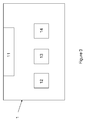
- the node 1 shown on Figure 3 comprises a communication interface 11, a processor 12, a volatile memory 13 and a non-volatile memory 14.
- Each mesh node i ⁇ M connects to a single gateway, G(i) ⁇ G, using other mesh nodes.
- mesh node i is considered to be associated with gateway G(i).
- Nodes are organized in disjoint trees Tg i , each tree rooted at a gateway node g i ⁇ G. Let T be the union of all these trees. Thus, T corresponds to one possible choice of routing.
- the subtree rooted at mesh node i ⁇ M is denoted by Ti. Note that Ti includes node i. All the nodes have a single radio for mesh communication, and operate over a common channel. The latter assumption is used because if a single radio is available for mesh communication, monitoring of link qualities over multiple channels is difficult. We assume that another radio is available at each mesh node for communication with its clients over an orthogonal channel.
- the indicator function 1 ⁇ l i ⁇ l j ⁇ is one if links l i and l j contend with each other, and zero otherwise. In other words only one of the two contending links can be active at a time.
- ETP Expected Throughput
- each mesh node j has a unique link l j for attaching itself to its parent.
- l j For attaching itself to its parent.
- ⁇ j ⁇ M ⁇ we include only these active links in the bandwidth computation.
- Shortest path routing algorithms which rely on routing metrics, such as ETX (Expected Transmission Count) and ETT (Expected Transmission Time) do not include support for load balancing across multiple gateways.
- ETX Exected Transmission Count
- ETT Extended Transmission Time
- a mesh node i is connected to its parent node through link l i . If link l i belongs to path P j , i.e., j ⁇ Ti, then a fraction of the bandwidth of link l i is used for the traffic of node j . For simplicity, we assume that all the nodes in a subtree are treated equally, i.e., we assume fair bandwidth sharing within a subtree. Since the expected throughput of link l j is ETP l j , the throughput received by traffic of node j over link li is ETP l i T i , where
- the proposed algorithm progressively reconfigures the network topology.
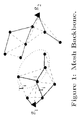
- Each node maintains a periodic timer. When the timer at node i expires, it finds the best point of attachment to the routing forest, or equivalently, the best parent node, and then migrates to the new parent node along with its entire subtree. For example, in Fig. 2 , node i migrates along with its subtree from parent j to parent k.
- a potential migration has an impact on two types of terms in the cost function Eq. (3); the tree size
- Fig. 2 shows the nodes of the links whose ETPs are affected by this migration.
- F i the current parent of node i.
- Set A k denotes the set of ancestors of node k including itself.
- the set of candidate parent nodes of node i is denoted by Si. This set includes those neighbors of node i that are not in its subtree (to avoid routing loops).
- the set of nodes that belong to the contention domain of link l j is denoted by CD l j .
- a node belongs to the contention domain of a link if it is in the carrier sensing range of either endpoints of the link. The choice of new parent node is made as follows.
- Each node maintains a periodic timer. When the timer of node i expires, it executes the following steps:
- This second algorithm forms the middle ground, since it is an intermediate low complexity solution between load-agnostic routing algorithms, such as shortest path with ETX, ETT, and a MAC-aware load balancing routing algorithm such as the first algorithm.
- Figure 2 represents the migrations performed by a node when it executes the method according to the present invention.
- a migration results in reorganization of the routing tree structure.
- the routing tree structure converges to the optimum routing configuration. It is shown that this process converges within a finite number of migrations. In fact, for a mesh network consisting of 100 nodes, the simulation results show that the method according to the present invention converges after less than 60 migrations.
Landscapes
- Engineering & Computer Science (AREA)
- Computer Networks & Wireless Communication (AREA)
- Signal Processing (AREA)
- Data Exchanges In Wide-Area Networks (AREA)
- Mobile Radio Communication Systems (AREA)
- Telephonic Communication Services (AREA)
Priority Applications (7)
| Application Number | Priority Date | Filing Date | Title |
|---|---|---|---|
| EP07301565A EP2063584A1 (de) | 2007-11-22 | 2007-11-22 | Verfahren zum Routing und Lastausgleich in Mesh-Netzen |
| DE602008003178T DE602008003178D1 (de) | 2007-11-22 | 2008-11-07 | Verfahren zum Routing und Lastausgleich in Kommunikationsnetzwerken |
| EP08168640A EP2063586B1 (de) | 2007-11-22 | 2008-11-07 | Verfahren zum Routing und Lastausgleich in Kommunikationsnetzwerken |
| KR1020080112265A KR101506586B1 (ko) | 2007-11-22 | 2008-11-12 | 통신 네트워크에서 부하 균형과 라우팅을 위한 방법 |
| JP2008294508A JP5235622B2 (ja) | 2007-11-22 | 2008-11-18 | 通信ネットワークにおける経路付け及び負荷バランシングのための方法 |
| US12/313,764 US7936704B2 (en) | 2007-11-22 | 2008-11-21 | Method for routing and load balancing in communication networks |
| CN2008101821715A CN101471881B (zh) | 2007-11-22 | 2008-11-24 | 通信网络中用于路由选择和负载平衡的方法 |
Applications Claiming Priority (1)
| Application Number | Priority Date | Filing Date | Title |
|---|---|---|---|
| EP07301565A EP2063584A1 (de) | 2007-11-22 | 2007-11-22 | Verfahren zum Routing und Lastausgleich in Mesh-Netzen |
Publications (1)
| Publication Number | Publication Date |
|---|---|
| EP2063584A1 true EP2063584A1 (de) | 2009-05-27 |
Family
ID=39156315
Family Applications (2)
| Application Number | Title | Priority Date | Filing Date |
|---|---|---|---|
| EP07301565A Withdrawn EP2063584A1 (de) | 2007-11-22 | 2007-11-22 | Verfahren zum Routing und Lastausgleich in Mesh-Netzen |
| EP08168640A Not-in-force EP2063586B1 (de) | 2007-11-22 | 2008-11-07 | Verfahren zum Routing und Lastausgleich in Kommunikationsnetzwerken |
Family Applications After (1)
| Application Number | Title | Priority Date | Filing Date |
|---|---|---|---|
| EP08168640A Not-in-force EP2063586B1 (de) | 2007-11-22 | 2008-11-07 | Verfahren zum Routing und Lastausgleich in Kommunikationsnetzwerken |
Country Status (6)
| Country | Link |
|---|---|
| US (1) | US7936704B2 (de) |
| EP (2) | EP2063584A1 (de) |
| JP (1) | JP5235622B2 (de) |
| KR (1) | KR101506586B1 (de) |
| CN (1) | CN101471881B (de) |
| DE (1) | DE602008003178D1 (de) |
Families Citing this family (11)
| Publication number | Priority date | Publication date | Assignee | Title |
|---|---|---|---|---|
| GB2495910B (en) * | 2011-10-19 | 2014-04-02 | Toshiba Res Europ Ltd | Methods of establishing communication in a sensor network, and apparatus thereof |
| MX2014006020A (es) | 2011-11-18 | 2015-01-12 | Cooper Technologies Co | Cálculo de costos de enlace en banda no instrusivo en redes de multisalto. |
| US20140204759A1 (en) | 2013-01-21 | 2014-07-24 | Mitsubishi Electric Research Laboratories, Inc. | Load Balanced Routing for Low Power and Lossy Networks |
| US10148537B2 (en) * | 2015-09-16 | 2018-12-04 | Cisco Technology, Inc. | Detecting oscillation anomalies in a mesh network using machine learning |
| US9967884B2 (en) | 2015-11-10 | 2018-05-08 | Netgear, Inc. | Dedicated backhaul for whole home coverage |
| US10356681B2 (en) | 2016-09-21 | 2019-07-16 | Netgear, Inc. | Client roaming in a distributed multi-band wireless networking system |
| EP4014474A4 (de) | 2019-08-16 | 2023-08-16 | Nokia Technologies Oy | Vorrichtung, verfahren und computerprogramm |
| US12047264B2 (en) | 2021-08-13 | 2024-07-23 | Itron, Inc. | Determining network reliability using message success rates |
| US11924077B2 (en) | 2021-08-13 | 2024-03-05 | Itron, Inc. | Determining network reliability using message success rates |
| US11483224B1 (en) | 2021-08-13 | 2022-10-25 | Itron, Inc. | Determining network reliability using message success rates |
| US12068931B2 (en) | 2021-08-13 | 2024-08-20 | Itron, Inc. | Determining network reliability using message success rates |
Family Cites Families (5)
| Publication number | Priority date | Publication date | Assignee | Title |
|---|---|---|---|---|
| CN1145311C (zh) * | 2001-07-26 | 2004-04-07 | 华为技术有限公司 | 网络节点拓扑结构图示方法 |
| AU2003290491A1 (en) * | 2003-12-23 | 2005-07-14 | Telefonaktiebolaget Lm Ericsson (Publ) | Method and system for routing traffic in ad hoc networks |
| US8599822B2 (en) * | 2005-03-23 | 2013-12-03 | Cisco Technology, Inc. | Slot-based transmission synchronization mechanism in wireless mesh networks |
| US9521584B2 (en) | 2005-10-17 | 2016-12-13 | Qualcomm Incorporated | Method and apparatus for managing data flow through a mesh network |
| PT1952588E (pt) * | 2005-11-09 | 2011-08-25 | Thomson Licensing | Selecção de percurso em redes sem-fios |
-
2007
- 2007-11-22 EP EP07301565A patent/EP2063584A1/de not_active Withdrawn
-
2008
- 2008-11-07 DE DE602008003178T patent/DE602008003178D1/de active Active
- 2008-11-07 EP EP08168640A patent/EP2063586B1/de not_active Not-in-force
- 2008-11-12 KR KR1020080112265A patent/KR101506586B1/ko not_active Expired - Fee Related
- 2008-11-18 JP JP2008294508A patent/JP5235622B2/ja not_active Expired - Fee Related
- 2008-11-21 US US12/313,764 patent/US7936704B2/en not_active Expired - Fee Related
- 2008-11-24 CN CN2008101821715A patent/CN101471881B/zh not_active Expired - Fee Related
Non-Patent Citations (10)
| Title |
|---|
| "The Fourth International Wireless on Demand Network Systems and Services", IEEE/IFIP WONS 2007, January 2007 (2007-01-01) |
| AWERBUCH ET AL: "The Medium Time Metric: High Throughput Route Selection in Multi-rate Ad Hoc Wireless Networks", MOBILE NETWORKS AND APPLICATIONS 11,, 31 March 2006 (2006-03-31), The Netherlands, pages 253 - 266, XP002472847, Retrieved from the Internet <URL:http://www.springerlink.com/content/w751217153007n71/fulltext.pdf> [retrieved on 20080313] * |
| D. S. J. DE COUTO ET AL.: "A High-Throughput Path Metric for Multi-Hop Wireless Routing", PROC. OF ACM MOBICOM 2003, September 2003 (2003-09-01) |
| J. C. PARK; S. KASERA: "Expected Data Rate: An Accurate High-Throughput Path Metric For Multi-Hop Wireless Routing", PROC. OF IEEE COMMUNICATIONS SOCIETY CONFERENCE ON SENSOR AND AD HOC COMMUNICATIONS AND NETWORKS, SECON 2005, September 2005 (2005-09-01) |
| J. PADHYE; R. DRAVES; B. ZILL: "Routing in Multi-radio, Multi-hop Wireless Mesh Networks", PROC. OF ACM MOBICOM 2004, September 2004 (2004-09-01) |
| M. HEUSSE ET AL.: "Performance Anomaly of 802.11b", PROC. OF IEEE INFOCOM 2003, March 2003 (2003-03-01) |
| OHATA N ET AL: "Fairness Improvement and Efficient Rerouting in Mobile Ad Hoc Networks", COMMUNICATIONS, 2007. ICC '07. IEEE INTERNATIONAL CONFERENCE ON, IEEE, PI, June 2007 (2007-06-01), pages 3333 - 3338, XP031126185, ISBN: 1-4244-0353-7 * |
| Y. BEJERANO, S. HAN; A. KUMAR: "Computer Networks", vol. 51, 2007, ELSEVIER SCIENCE, article "Efficient load-balancing routing for wireless mesh networks", pages: 2450 - 2466 |
| Y. YANG; J. WANG; R. KRAVETS: "Designing Routing Metrics for Mesh Networks", PROC. OF IEEE WORKSHOP ON WIRELESS MESH NETWORKS WIMESH 2005, September 2005 (2005-09-01) |
| YANG LI ET AL: "Three load metrics for routing in ad hoc networks", VEHICULAR TECHNOLOGY CONFERENCE, 2004. VTC2004-FALL. 2004 IEEE 60TH LOS ANGELES, CA, USA 26-29 SEPT. 2004, PISCATAWAY, NJ, USA,IEEE, 26 September 2004 (2004-09-26), pages 2764 - 2768, XP010787157, ISBN: 0-7803-8521-7 * |
Also Published As
| Publication number | Publication date |
|---|---|
| EP2063586B1 (de) | 2010-10-27 |
| JP2009130934A (ja) | 2009-06-11 |
| DE602008003178D1 (de) | 2010-12-09 |
| US7936704B2 (en) | 2011-05-03 |
| US20090135738A1 (en) | 2009-05-28 |
| CN101471881A (zh) | 2009-07-01 |
| KR20090053695A (ko) | 2009-05-27 |
| CN101471881B (zh) | 2012-10-31 |
| KR101506586B1 (ko) | 2015-03-27 |
| EP2063586A1 (de) | 2009-05-27 |
| JP5235622B2 (ja) | 2013-07-10 |
Similar Documents
| Publication | Publication Date | Title |
|---|---|---|
| EP2063586B1 (de) | Verfahren zum Routing und Lastausgleich in Kommunikationsnetzwerken | |
| CN101218794B (zh) | 采用链路交互的路由成本确定和选择的方法及装置 | |
| US10097469B2 (en) | Network traffic shaping for low power and lossy networks | |
| US9356858B2 (en) | Redirecting traffic via tunnels to discovered data aggregators | |
| JP5021769B2 (ja) | マルチラジオ・マルチチャネル・マルチホップ無線ネットワークのための無線・帯域幅認識型ルーティング・メトリック | |
| US20120030150A1 (en) | Hybrid Learning Component for Link State Routing Protocols | |
| US8447849B2 (en) | Negotiated parent joining in directed acyclic graphs (DAGS) | |
| US20130028140A1 (en) | Using service discovery to build routing topologies | |
| US20200296001A1 (en) | Concurrent network reformation for low-power and lossy networks | |
| JP2013513987A (ja) | マルチホップ通信ネットワークにおける質的ルーティングのための方法、およびネットワークノード管理設備 | |
| EP3425861A1 (de) | Verbessertes routing in einem heterogenen iot-netzwerk | |
| Kunavut et al. | Generalized Multi-Constrained Path (G_MCP) QoS Routing Algorithm for Mobile Ad hoc Networks. | |
| Wadhwani et al. | Link stability based approach for route discovery in MANET using DSR | |
| Sasikala et al. | A Neuro Fuzzy based conditional shortest path routing protocol for wireless mesh network | |
| Chambon et al. | ConSerN: QoS-Aware programmable multitier architecture for dynamic IoT networks | |
| Acharya et al. | Gateway-aware routing for wireless mesh networks | |
| Rossi et al. | Cost efficient routing strategies over virtual coordinates for wireless sensor networks | |
| JP5773550B2 (ja) | 無線マルチホップ・メッシュ・ネットワークにおけるアソシエーション、ルーティング、およびレート割当ての統合 | |
| Quach et al. | Dynamic Network Provisioning with Reinforcement Learning based on Link Stability | |
| Wijesekara et al. | MCOMR: Mobility-and Congestion-Aware Optimization-Driven Multipath Flow Routing for Software-Defined Mobile Networks. | |
| Kaur et al. | Game theoretic approach to routing in 802.11 based wireless mesh networks | |
| Thomas et al. | A survey on bandwidth guaranteed routing techniques in wireless mesh networks | |
| JP5773551B2 (ja) | 無線マルチホップ・メッシュ・ネットワークにおけるアソシエーション、ルーティング、およびレート割当ての統合 | |
| Kareem et al. | A dynamic channel assignment scheme for multi-radio wireless mesh networks | |
| Starlin et al. | Routing Analysis in Wireless Mesh Network with Bandwidth Allocation |
Legal Events
| Date | Code | Title | Description |
|---|---|---|---|
| PUAI | Public reference made under article 153(3) epc to a published international application that has entered the european phase |
Free format text: ORIGINAL CODE: 0009012 |
|
| AK | Designated contracting states |
Kind code of ref document: A1 Designated state(s): AT BE BG CH CY CZ DE DK EE ES FI FR GB GR HU IE IS IT LI LT LU LV MC MT NL PL PT RO SE SI SK TR |
|
| AX | Request for extension of the european patent |
Extension state: AL BA HR MK RS |
|
| AKX | Designation fees paid | ||
| RAP1 | Party data changed (applicant data changed or rights of an application transferred) |
Owner name: THOMSON LICENSING |
|
| REG | Reference to a national code |
Ref country code: DE Ref legal event code: 8566 |
|
| STAA | Information on the status of an ep patent application or granted ep patent |
Free format text: STATUS: THE APPLICATION IS DEEMED TO BE WITHDRAWN |
|
| 18D | Application deemed to be withdrawn |
Effective date: 20091128 |