EP2063644A2 - Bildverschlüsselungsvorrichtung und Verschlüsselungsverfahren und Bildentschlüsselungsvorrichtung und Bildentschlüsselungsverfahren - Google Patents
Bildverschlüsselungsvorrichtung und Verschlüsselungsverfahren und Bildentschlüsselungsvorrichtung und Bildentschlüsselungsverfahren Download PDFInfo
- Publication number
- EP2063644A2 EP2063644A2 EP20080253486 EP08253486A EP2063644A2 EP 2063644 A2 EP2063644 A2 EP 2063644A2 EP 20080253486 EP20080253486 EP 20080253486 EP 08253486 A EP08253486 A EP 08253486A EP 2063644 A2 EP2063644 A2 EP 2063644A2
- Authority
- EP
- European Patent Office
- Prior art keywords
- prediction
- image
- encoding
- variable
- unit
- Prior art date
- Legal status (The legal status is an assumption and is not a legal conclusion. Google has not performed a legal analysis and makes no representation as to the accuracy of the status listed.)
- Withdrawn
Links
Images






Classifications
-
- H—ELECTRICITY
- H04—ELECTRIC COMMUNICATION TECHNIQUE
- H04N—PICTORIAL COMMUNICATION, e.g. TELEVISION
- H04N19/00—Methods or arrangements for coding, decoding, compressing or decompressing digital video signals
- H04N19/10—Methods or arrangements for coding, decoding, compressing or decompressing digital video signals using adaptive coding
- H04N19/134—Methods or arrangements for coding, decoding, compressing or decompressing digital video signals using adaptive coding characterised by the element, parameter or criterion affecting or controlling the adaptive coding
- H04N19/136—Incoming video signal characteristics or properties
- H04N19/14—Coding unit complexity, e.g. amount of activity or edge presence estimation
-
- G—PHYSICS
- G06—COMPUTING OR CALCULATING; COUNTING
- G06N—COMPUTING ARRANGEMENTS BASED ON SPECIFIC COMPUTATIONAL MODELS
- G06N3/00—Computing arrangements based on biological models
- G06N3/02—Neural networks
- G06N3/08—Learning methods
- G06N3/084—Backpropagation, e.g. using gradient descent
-
- H—ELECTRICITY
- H04—ELECTRIC COMMUNICATION TECHNIQUE
- H04N—PICTORIAL COMMUNICATION, e.g. TELEVISION
- H04N19/00—Methods or arrangements for coding, decoding, compressing or decompressing digital video signals
- H04N19/10—Methods or arrangements for coding, decoding, compressing or decompressing digital video signals using adaptive coding
- H04N19/102—Methods or arrangements for coding, decoding, compressing or decompressing digital video signals using adaptive coding characterised by the element, parameter or selection affected or controlled by the adaptive coding
- H04N19/103—Selection of coding mode or of prediction mode
- H04N19/11—Selection of coding mode or of prediction mode among a plurality of spatial predictive coding modes
-
- H—ELECTRICITY
- H04—ELECTRIC COMMUNICATION TECHNIQUE
- H04N—PICTORIAL COMMUNICATION, e.g. TELEVISION
- H04N19/00—Methods or arrangements for coding, decoding, compressing or decompressing digital video signals
- H04N19/10—Methods or arrangements for coding, decoding, compressing or decompressing digital video signals using adaptive coding
- H04N19/102—Methods or arrangements for coding, decoding, compressing or decompressing digital video signals using adaptive coding characterised by the element, parameter or selection affected or controlled by the adaptive coding
- H04N19/13—Adaptive entropy coding, e.g. adaptive variable length coding [AVLC] or context adaptive binary arithmetic coding [CABAC]
-
- H—ELECTRICITY
- H04—ELECTRIC COMMUNICATION TECHNIQUE
- H04N—PICTORIAL COMMUNICATION, e.g. TELEVISION
- H04N19/00—Methods or arrangements for coding, decoding, compressing or decompressing digital video signals
- H04N19/10—Methods or arrangements for coding, decoding, compressing or decompressing digital video signals using adaptive coding
- H04N19/169—Methods or arrangements for coding, decoding, compressing or decompressing digital video signals using adaptive coding characterised by the coding unit, i.e. the structural portion or semantic portion of the video signal being the object or the subject of the adaptive coding
- H04N19/17—Methods or arrangements for coding, decoding, compressing or decompressing digital video signals using adaptive coding characterised by the coding unit, i.e. the structural portion or semantic portion of the video signal being the object or the subject of the adaptive coding the unit being an image region, e.g. an object
- H04N19/176—Methods or arrangements for coding, decoding, compressing or decompressing digital video signals using adaptive coding characterised by the coding unit, i.e. the structural portion or semantic portion of the video signal being the object or the subject of the adaptive coding the unit being an image region, e.g. an object the region being a block, e.g. a macroblock
-
- H—ELECTRICITY
- H04—ELECTRIC COMMUNICATION TECHNIQUE
- H04N—PICTORIAL COMMUNICATION, e.g. TELEVISION
- H04N19/00—Methods or arrangements for coding, decoding, compressing or decompressing digital video signals
- H04N19/50—Methods or arrangements for coding, decoding, compressing or decompressing digital video signals using predictive coding
- H04N19/593—Methods or arrangements for coding, decoding, compressing or decompressing digital video signals using predictive coding involving spatial prediction techniques
-
- H—ELECTRICITY
- H04—ELECTRIC COMMUNICATION TECHNIQUE
- H04N—PICTORIAL COMMUNICATION, e.g. TELEVISION
- H04N19/00—Methods or arrangements for coding, decoding, compressing or decompressing digital video signals
- H04N19/60—Methods or arrangements for coding, decoding, compressing or decompressing digital video signals using transform coding
-
- H—ELECTRICITY
- H04—ELECTRIC COMMUNICATION TECHNIQUE
- H04N—PICTORIAL COMMUNICATION, e.g. TELEVISION
- H04N19/00—Methods or arrangements for coding, decoding, compressing or decompressing digital video signals
- H04N19/60—Methods or arrangements for coding, decoding, compressing or decompressing digital video signals using transform coding
- H04N19/61—Methods or arrangements for coding, decoding, compressing or decompressing digital video signals using transform coding in combination with predictive coding
Definitions
- the present invention relates to an image encoding technology for encoding an image such as a moving picture or still-frame picture, and an image decoding technology for decoding the image encoded.
- the encoding schemes such as MPEG (: Moving Picture Experts Group) schemes had been formulated, and have become internationally-standardized encoding schemes as MPEG-1 standard, MPEG-2 standard, MPEG-4 standard, and H.264/AVC (: Advanced Video Coding) standard.
- MPEG-1 standard MPEG-1 standard
- MPEG-2 standard MPEG-2 standard
- MPEG-4 standard MPEG-4 standard
- H.264/AVC Advanced Video Coding
- an encoding target image is predicted in a block unit by taking advantage of image information whose encoding processing is completed. Then, a prediction difference between the original image and the encoding target image predicted in this way is encoded. By doing this prediction-difference encoding, redundancy which the moving picture possesses is eliminated thereby to reduce the resultant code amount.
- the intra-frame prediction encoding scheme is employed which takes advantage of peripheral pixels on the periphery of the encoding target block. The employment of this intra-frame prediction encoding scheme has allowed the implementation of a dramatic enhancement in the compression ratio.
- one reference pixel is selected from among pixels included in a pre-encoded block. Then, all of the pixels existing along a certain specific prediction direction are predicted using the pixel value of this reference pixel. At this time, the prediction accuracy is enhanced by making the specific prediction direction, which is suitable for the image, selectable from among a plurality of prediction directions defined in advance. In this case, however, a code for representing the prediction direction is required to be added for each block which becomes the prediction unit. Accordingly, there has existed a problem that the code amount increases by the amount equivalent to this addition of the code.
- JP-A-2007-116351 (paragraphs 0009, 0020, 0027), the proposal has been made concerning an image prediction decoding method which is designed to implement an efficient decoding processing by reducing mode information about prediction methods.
- this image prediction decoding method the following prediction method is further derived: Namely, based on pre-processed data corresponding to an adjacent region adjacent to an encoding target region and including pre-reproduced pixel signals, this prediction method generates an intra-frame prediction signal having a high pixel-signal correlation with the adjacent region from among a plurality of predetermined prediction methods.
- the mode information about the prediction method i.e., direction
- JP-A-2004-129260 (paragraph 0026) the disclosure has been made concerning a method for performing space prediction encoding and decoding of the color-phase component of an intra image. Namely, if the prediction mode is not included in the bit stream, variation amounts in vertical and horizontal directions of the pixel values with respect to the present block are calculated by taking advantage of reconstructed reference blocks on the upper side and side-surface sides of the present block. Then, the prediction method is determined based on these variation amounts.
- the compression efficiency may be enhanced by decreasing the prediction-direction representing code amount.
- the prediction direction in an encoding target block i.e., a block which becomes the target of the intra-frame prediction encoding processing
- the prediction direction in an encoding target block is estimated by taking advantage of pre-encoded blocks which are adjacent to the encoding target block. For example, a Sobel filter is applied to each of decoded images in four pre-encoded blocks which are adjacent to the left side, upper-left side, upper side, and upper-right side of the encoding target block, thereby calculating edge information which includes intensities and angles of the edges.
- the degree of likelihood of each prediction direction is calculated, using parameters of these eight intensities and angles obtained by this calculation.
- the prediction direction whose degree of likelihood is the highest is employed as the prediction direction in the encoding target block.
- the employment of the prediction direction like this makes it unnecessary to add the prediction-direction representing code to the bit stream.
- the present invention is also effective to direction-independent intra-frame prediction schemes such as, e.g., the DC prediction in H.264/AVC. Accordingly, its application to these schemes makes it possible to expect a significant reduction in the code amount.
- a variable-length code table is dynamically created based on the above-described estimated result. The creation of this table also allows implementation of a significant reduction in the prediction-direction representing code amount. As a result, it becomes possible to expect an enhancement in the compression efficiency.
- taking advantage of, e.g., a neural network is effective to the above-described likelihood-degree calculation in each prediction direction.
- Fig. 3 is a conceptual diagram for explaining the intra-frame prediction encoding processing according to H.264/AVC.
- the encoding is executed with respect to an encoding target image in accordance with the sequence of the raster scanning (301). Then, the prediction is performed using decoded images in four pre-encoded blocks which are adjacent to the left side, upper-left side, upper side, and upper-right side of the encoding target block.
- thirteen decoded pixels included in these four blocks are taken advantage of (302).
- the thirteen pixels are the pixels which, of the pixels included in the four blocks, are arranged in a manner of being adjacent to the encoding target block.
- these thirteen pixels are as follows: In the left side block, the four pixels on the right-most longitudinal line; in the upper-left side block, the one pixel at the lower-right corner; and in the upper side and upper-right side blocks, the four pixels arranged transversely on the lower-most side each.
- the direction of the prediction-direction vector is a downward direction
- all of the longitudinally-arranged four pixels B, C, D, and E in the encoding target block are subjected to the prediction encoding by making reference to one and the same reference pixel (i.e., the value A' obtained by decoding the pixel positioned directly above the pixel B) which exists on the prediction-direction vector in the upper side block (here, the prediction for the pixels B, C, D, and E is made by being assumed to be the same value as the value A', namely, each of the predicted pixel values for B, C, D, and E is equal to the value A').
- differences i.e., prediction differences
- b, c, d, and e between the pixels B, C, D, and E and the predicted pixel value A' are calculated.
- an optimum prediction-direction vector can be selected in the block unit from among eight types of prediction-direction candidates such as longitudinal, transverse, and oblique prediction directions (i.e., the directions indicated by the arrows of 0, 1, and 3 to 8 in Fig. 3 ).
- "DC prediction” can also be taken advantage of (304) in addition to the above-described prediction made along the specific prediction direction.
- the DC prediction all of the pixels included in the encoding target block are predicted using an average value of the reference pixels.
- the prediction direction 2 is allocated to the DC prediction.
- prediction modes that are represented in a manner of being distinguished by the above-described nine types of numbers (i.e., the eight directions + the DC prediction)
- information for indicating which of the prediction modes has been selected is encoded along with the prediction differences b, c, d, and e.
- Fig. 4 is a conceptual diagram for explaining the intra-frame prediction decoding processing according to H.264/AVC.
- the decoding is executed in accordance with the sequence of the raster scanning (401). Then, processing steps which are inverse to the encoding processing are executed, using a pre-decoded reference pixel and prediction differences. Namely, in a decoding target block, in accordance with the prediction mode selected at the time of the encoding processing and along the prediction direction corresponding thereto, the prediction differences (decoded values) are added to the reference pixel, thereby acquiring the decoded image.
- a summation is calculated between prediction differences b', c', d', and e' in the decoding target block (each of which results from decoding each of the prediction differences b, c, d, and e illustrated in Fig. 3 , and each of which contains a quantization error) and the reference pixels A'all of which have been pre-decoded, thereby acquiring decoded pixels B', C', D', and E' (each of which is the decoded pixel corresponding to each of B, C, D, and E in Fig. 3 ).
- the single-direction-based prediction encoding method is employed where one reference pixel is specified, and where all of the pixels existing along a specific prediction direction are predicted using the pixel value of this reference pixel.
- the information for indicating in which direction the prediction will be made has been required to be added for each encoding target block which becomes the unit of the prediction processing.
- Figs. 5A and 5B illustrate the encoding method for the prediction mode in the intra-frame prediction scheme according to H.264/AVC.
- H.264/AVC attention is focused on the fact that the prediction mode in the encoding target block is highly correlated with the prediction modes in the pre-encoded blocks adjacent thereto. Accordingly, the prediction mode in the encoding target block is predicted from the prediction modes in the pre-encoded adjacent blocks. Namely, as is indicated by (501), reference is made to the prediction mode M A in the adjacent block A which is adjacent to the left side of the encoding target block, and the prediction mode M B in the adjacent block B which is adjacent to the upper side of the encoding target block.
- the prediction mode whose number (i.e., one of the nine types of numbers illustrated in Fig. 3 (Fig. 4 )) is smaller of these two prediction modes M A and M B is employed as the prediction value (most probable mode) of the prediction mode in the encoding target block (502).
- the reference numeral (503) in Fig. 5B illustrates details of the bit configuration which represents the prediction method.
- the use of a flag (1 bit) for indicating whether or not the prediction mode is the same as the most probable mode encodes information for indicating that the prediction mode is the same as the most probable mode (i.e., code of "1" as the flag).
- the use of the flag encodes information for indicating that the prediction mode is different from the most probable mode (i.e., code of "0" as the flag).
- the actual prediction mode (of the nine-way prediction modes, one of the eight-way prediction modes excluding the most probable mode) is encoded with 3 bits.
- the representation of the prediction mode requires the use of a large amount of code. For example, when the intra-frame prediction is made in the 4-pixel x 4-pixel-size block unit, a 64-bit code occurs at the maximum per macro block.
- Figs. 6A and 6B are conceptual diagrams for illustrating an embodiment of the encoding processing for the prediction mode according to the present invention.
- the prediction mode in the encoding (decoding) target block is estimated by taking advantage of decoded images in the pre-encoded adjacent blocks A, B, C, and D which are adjacent to the left side, upper-left side, upper side, and upper-right side of the encoding (decoding) target block.
- the prediction mode in the target block is identified by taking advantage of a function f for inputting edge information on the adjacent blocks A to D, and outputting the prediction mode in the target block (602). Taking advantage of this function f makes it unnecessary to encode the prediction mode. As a result, the bit amount needed for representing the prediction mode becomes equal to zero (603).
- a detection method for detecting the above-described edge information is not particularly specified, taking advantage of, e.g., a Sobel filter illustrated in Fig. 14A is quite effective.
- two types of Sobel filters i.e., a vertical-direction-use Sobel filter (1401) and a horizontal-direction-use Sobel filter (1402), are used, thereby detecting the edges in the respective directions.
- the use of a Prewitt filter is allowable.
- oblique-direction-use filters 1405) and (1406) are prepared.
- MIN-MAX filter a rectangular filter in a specific size is prepared at first, then calculating a difference between the maximum value and the minimum value of the concentration value therein.
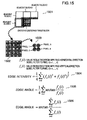
- Fig. 15 illustrates an example of the calculation method for calculating the edge information including edge intensities and edge angles in the case of taking advantage of the Sobel filters (1401) and (1402).
- the decoded images in the pre-encoded adjacent blocks A, B, C, and D which are adjacent to the left side, upper-left side, upper side, and upper-right side of the encoding (decoding) target block (1501)
- four pixels i.e., pixel 1 to pixel 4
- the vertical-direction-use filter (1401) and the horizontal-direction-use filter (1402) are applied to these four pixels.
- edges intensity can be calculated as is given by, e.g., (1504), and the edge angles can be calculated as are given by, e.g., (1505) and (1506).
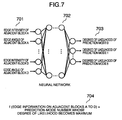
- Fig. 7 illustrates an example of the case where the function f is implemented taking advantage of the neural network.
- the neural network refers to a network where a plurality of threshold-value logic units are hierarchically deployed from an input layer to an output layer.
- a connection between the units exists only between layers adjacent to each other, and the connection is a one-direction connection directed from the input layer to the output layer.
- a weight of the connection is allocated to between the connected units.
- an input into a unit deployed in a higher-order hierarchy becomes equal to a summation of the products of values outputted by a group of units deployed in a lower-order hierarchy and the weights of the connections between the units.
- these weights are adjusted so that a desirable result will be obtained in the output layer.
- a function which will return the prediction-mode number in which the highest degree of likelihood is outputted is set as the above-described function f (704).
- This setting allows implementation of the encoding and decoding processings based on the method illustrated in Figs. 6A and 6B .
- the learning method to be used for the above-described learning is not particularly specified, taking advantage of, e.g., the BP (: Back Propagation) method permits accomplishment of an outstanding effect. Concerning the BP method, the detailed explanation has been given in, e.g., Chapter 3 of the following document:
- the candidates for the above-described function f are widely conceivable, ranging from a simple polynomial where the edge intensities and angles are employed as the variable to a function where the mechanical learning techniques are used such as kernel method, SVM (: Support Vector Machine), k-nearest neighbor algorithm, linear determinant analysis, Baysian network, Hidden Markov Model, and decision-tree learning. Also, a plurality of identification devices may be combined by a method of using boosting or the like. With which of the models the function f is to be implemented, or what type of input/output the function f is to perform may be determined by a standard in advance, or it is all right to permit the information on the function f to be stored into the stream.
- the mechanical learning techniques such as kernel method, SVM (: Support Vector Machine), k-nearest neighbor algorithm, linear determinant analysis, Baysian network, Hidden Markov Model, and decision-tree learning.
- a plurality of identification devices may be combined by a method of using boosting or the like. With which
- the edge intensities and angles of the central four pixels in the adjacent blocks are used as the variables.
- information on the peripheral blocks such as pixel-value average, variance, standard deviation, encoding method, and prediction mode of the peripheral blocks. Otherwise, it is all right to add image parameters on the encoding condition such as QP (: Quantization Parameter) and frame resolution.
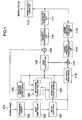
- Fig. 1 is a block diagram for illustrating an embodiment of the moving-picture encoding device according to the present invention.
- the moving-picture encoding device includes an original-image memory (102) for storing original images (101) inputted, a block partition unit (103) for partitioning each of the inputted original images (101) into small regions, a motion search unit (104) for detecting a motion in the block unit, a prediction-mode estimation unit (105) for estimating a prediction direction in the intra-frame prediction, an intra-frame prediction unit (106) for making the intra-frame prediction in the block unit, an inter-frame prediction unit (107) for making an inter-frame prediction in the block unit and based on the motion amount detected by the motion search unit (104), a mode selection unit (108) for determining a prediction encoding scheme (i.e., prediction method and block size) which matches property of the image, a subtraction unit (109) for generating prediction differences, a frequency transformation unit (110) and a quantization processing unit (111) for performing an encoding with respect to the
- the original-image memory (102) stores a piece of image from among the original images (101) as an encoding target image.
- the block partition unit (103) partitions this encoding target image into small blocks, then transferring these small blocks to the motion search unit (104), the intra-frame prediction unit (106), and the inter-frame prediction unit (107).
- the motion search unit (104) calculates a motion amount in the blocks by using the pre-decoded image stored in the reference-image memory (116), then transferring the corresponding motion vector to the inter-frame prediction unit (107).
- the prediction-mode estimation unit (105) extracts, from the reference-image memory (116), decoded images in the pre-encoded blocks positioned on the periphery of the target block, then performing the edge detection to identify the prediction direction in the target block, and transferring the identified prediction direction to the intra-frame prediction unit (106).
- the intra-frame prediction unit (106) and the inter-frame prediction unit (107) execute the intra-frame prediction processing and the inter-frame prediction processing in the block units in several sizes.
- the mode selection unit (108) selects an optimum prediction method which is either the intra-frame prediction method or the inter-frame prediction method.
- the subtraction unit (109) generates the prediction differences based on the optimum prediction encoding scheme, then transferring the generated prediction differences to the frequency transformation unit (110).
- the frequency transformation unit (110) and the quantization processing unit (111) apply a frequency transformation such as the DCT (: Discrete Cosine Transformation) and a quantization processing respectively to the transferred prediction differences in the block unit in a specified size, then transferring the resultant after-quantized frequency transformation coefficients to the variable length coding unit (112) and the inverse quantization processing unit (113).
- variable length coding unit (112) performs the variable length coding with respect to the prediction-difference information represented by the after-quantized frequency transformation coefficients, thereby generating an encoded stream.
- this variable length coding is performed along with the variable length coding of the information needed for the prediction decoding, such as the prediction direction in the intra-frame prediction encoding and the motion vector in the inter-frame prediction encoding.
- the inverse quantization processing unit (113) and the inverse frequency transformation unit (114) apply an inverse quantization processing and an inverse frequency transformation such as the IDCT (: Inverse DCT) respectively to the after-quantized frequency transformation coefficients, thereby acquiring the prediction differences, and then transferring the acquired prediction differences to the addition unit (115). Subsequently, the addition unit (115) generates the decoded image, which is then stored into the reference-image memory (116).
- direction-independent intra-frame prediction schemes such as, e.g., the DC prediction in H.264/AVC may also be employed as the target of the estimation.
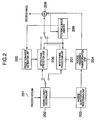
- Fig. 2 is a block diagram for illustrating an embodiment of the moving-picture decoding device according to the present invention.
- the moving-picture decoding device includes, e.g., a variable-length decoding unit (202) for performing an inverse processing step to the variable length coding with respect to the encoded stream (201) which is generated by the moving-picture encoding device illustrated in Fig.
- an inverse quantization processing unit (203) and an inverse frequency transformation unit (204) for decoding the prediction differences for decoding the prediction differences
- a prediction-mode estimation unit (205) for estimating a prediction direction in the intra-frame prediction
- an intra-frame prediction unit (206) for making the intra-frame prediction
- an inter-frame prediction unit (207) for making an inter-frame prediction
- an addition unit (208) for acquiring a decoded image
- a reference-image memory (209) for storing the decoded image temporarily.
- the variable-length decoding unit (202) performs the variable-length decoding with respect to the encoded stream (201), thereby acquiring the frequency transformation coefficient components of the prediction differences, and the information needed for the prediction processing such as the block size and the motion vector.
- the former information i.e., the prediction-difference information is transferred to the inverse quantization processing unit (203).
- the latter information i.e., the information needed for the prediction processing is transferred to either the intra-frame prediction unit (206) or the inter-frame prediction unit (207), depending on the prediction scheme.
- the inverse quantization processing unit (203) and the inverse frequency transformation unit (204) apply the inverse quantization processing and the inverse frequency transformation respectively to the prediction-difference information, thereby performing the decoding.
- the prediction-mode estimation unit (205) extracts, from the reference-image memory (209), the decoded images in the pre-encoded blocks positioned on the periphery of the target block, then performing the edge detection to identify the prediction direction in the target block, and transferring the identified prediction direction to the intra-frame prediction unit (206). Subsequently, the intra-frame prediction unit (206) or the inter-frame prediction unit (207) executes the prediction processing by making reference to the reference-image memory (209) on the basis of the information transferred from the variable-length decoding unit (202). Moreover, the addition unit (208) generates the decoded image, which is then stored into the reference-image memory (209).
- the moving-picture decoding device itself includes the prediction-mode estimation unit (205) and the prediction units (206) and (207) subsequent thereto.
- the prediction processing by which the prediction direction in the target block is identified is executed from the signal decoded from the encoded stream. Consequently, there exists no necessity for adding a prediction-mode representing code to the encoded stream. This feature allows implementation of a reduction in the code amount at the time of encoding and decoding the image.
- Fig. 8 is a flowchart for illustrating 1-frame encoding processing steps in the embodiment of the moving-picture encoding device illustrated in Fig. 1 .
- the processing in a loop 1 where each processing up to a processing (814) described hereinafter is repeated, is performed.
- the processing in a loop 2 where each processing from a processing (803) to a processing (806 or 807) is repeated with respect to all the coding modes, is further performed.
- the prediction differences are calculated with respect to the encoding target block by performing the prediction encoding processing with respect to all the coding modes (i.e., combinations of the prediction methods and the block sizes) once temporarily.
- the coding mode which results in the highest encoding efficiency is selected.
- the intra-frame prediction encoding processing (806) and the inter-frame prediction encoding processing (807) are executed, then selecting an optimum prediction processing method from these processings. This selection allows implementation of a high-efficiency encoding in correspondence with the property of the image.
- the intra-frame prediction mode (803) when performing the intra-frame prediction encoding processing (806), the edge included in the pre-encoded blocks positioned on the periphery of the target block is detected using the Sobel filter or the like (804).
- the prediction direction in the target block is identified by taking advantage of, e.g., the function F illustrated in (704) (805).
- the coding mode which results in the highest encoding efficiency is selected from among the large number of coding modes (808), taking advantage of, e.g., the RD-Optimization scheme allows implementation of the high-efficiency encoding.
- the optimum coding mode is determined from the relationship between image-quality distortion and the code amount. Concerning the details of the RD-Optimization scheme, the description has been given in the following document:
- the prediction differences generated in the selected optimum coding mode are subjected to the frequency transformation (809) and the quantization processing (810), then being further subjected to the variable length coding thereby to generate the encoded stream (811).
- the inverse quantization processing (812) and the inverse frequency transformation (813) are applied to the pre-quantized frequency transformation coefficients, thereby decoding the prediction differences.
- the decoded image is generated, then being stored into the reference-image memory (814).
- Fig. 9 is a flowchart for illustrating 1-frame decoding processing steps in the embodiment of the moving-picture decoding device illustrated in Fig. 2 .
- the processing in a loop 1 where each processing from a processing (902) to a processing (908 or 909) described hereinafter is repeated, is performed.
- the inputted stream is subjected to the variable-length decoding processing (902), then being further subjected to the inverse quantization processing (903) and the inverse frequency transformation (904) thereby to decode the prediction differences.
- the intra-frame prediction decoding processing (908) or the inter-frame prediction decoding processing (909) is performed depending on by which prediction method the target block has been prediction-encoded.
- the decoded image is acquired, then being stored into the reference-image memory.
- the edge included in the pre-decoded blocks positioned on the periphery of the target block is detected using the Sobel filter or the like (906).
- the prediction direction in the target block is identified by taking advantage of, e.g., the function F illustrated in (704) (907).
- the DCT has been mentioned as an example of the frequency transformation. Whatever transformation method, however, is all right as long as it is an orthogonal transformation used for eliminating the inter-pixel correlation, such as DST (: Discrete Sine Transformation), WT (: Wavelet Transformation), DFT (: Discrete Fourier Transformation), or KLT (: Karhunen-Loeve Transformation). Also, it is allowable to perform the encoding with respect to the prediction differences itself without applying the frequency transformation thereto in particular. Moreover, it is also all right not to perform the variable length coding in particular. In the embodiments, the description has been given regarding the case where the prediction of the luminance component is performed in the 4-pixel x 4-pixel-size block unit in particular.
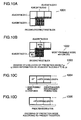
- Figs. 10A to 10D are conceptual diagrams for illustrating another embodiment of the encoding processing for the prediction mode according to the present invention.
- the prediction direction in the target block is estimated by taking advantage of the decoded images in the pre-encoded adjacent blocks A, B, C, and D which are adjacent to the left side, upper-left side, upper side, and upper-right side of the target block (1001).
- the prediction mode whose number is smaller of the prediction modes of the adjacent blocks which are adjacent to the left side and the upper side of the target block respectively is employed as the most probable mode (1002).
- a function g for inputting the edge information on the adjacent blocks A to D and the prediction-mode number p, and calculating the degree of likelihood of the prediction mode p (1003) is taken advantage of, then dynamically creating a variable-length code table based on the degree of likelihood of each prediction mode p. Namely, a shorter code is allocated to the prediction mode whose degree of likelihood is higher, and a longer code is allocated to the prediction mode whose degree of likelihood is lower, thereby making the average code length shorter.
- (1004) the following embodiment is explained: Whether or not the prediction mode in the target block is the same as the most probable mode is represented with 1 bit. Then, if the prediction mode is different from the most probable mode, a variable-length code table with respect to the eight-type prediction modes excluding the most probable mode is created, then performing the encoding based on this variable-length code table. Also, in (1005), the following embodiment is explained: Not depending on whether or not the prediction mode in the target block is the same as the most probable mode, a variable-length code table with respect to all of the nine-type prediction modes is created, then performing the encoding based on this variable-length code table.
- Fig. 11 illustrates an example of the case where the function g is implemented taking advantage of the neural network.
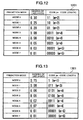
- Fig. 12 and Fig. 13 illustrate examples of the codes (i.e., the variable-length code tables) which will be allocated to each prediction mode when each prediction mode is encoded based on the method indicted in (1005) and taking advantage of the Huffman encoding.
- the most probable mode is the mode 8 is illustrated.
- the 4-bit code is necessary for encoding each prediction mode.
- the present invention is also effective in encoding still-frame pictures. Namely, the portion which remains after excluding the motion search unit (104) and the inter-frame prediction unit (107) from the block diagram illustrated in Fig. 1 is equivalent to the block diagram of an encoding device which is designed specifically for the still-frame pictures.
- the present invention can also be implemented as an image processing (encoding/decoding) system acquired by combining the image encoding device with the image decoding device, or an image processing (encoding/decoding) method acquired by combining the image encoding method with the image decoding method.
Landscapes
- Engineering & Computer Science (AREA)
- Multimedia (AREA)
- Signal Processing (AREA)
- Physics & Mathematics (AREA)
- Theoretical Computer Science (AREA)
- Data Mining & Analysis (AREA)
- General Health & Medical Sciences (AREA)
- Biomedical Technology (AREA)
- Biophysics (AREA)
- Computational Linguistics (AREA)
- Life Sciences & Earth Sciences (AREA)
- Evolutionary Computation (AREA)
- Artificial Intelligence (AREA)
- Molecular Biology (AREA)
- Computing Systems (AREA)
- General Engineering & Computer Science (AREA)
- General Physics & Mathematics (AREA)
- Mathematical Physics (AREA)
- Software Systems (AREA)
- Health & Medical Sciences (AREA)
- Compression Or Coding Systems Of Tv Signals (AREA)
Applications Claiming Priority (1)
| Application Number | Priority Date | Filing Date | Title |
|---|---|---|---|
| JP2007281605A JP2009111691A (ja) | 2007-10-30 | 2007-10-30 | 画像符号化装置及び符号化方法、画像復号化装置及び復号化方法 |
Publications (2)
| Publication Number | Publication Date |
|---|---|
| EP2063644A2 true EP2063644A2 (de) | 2009-05-27 |
| EP2063644A3 EP2063644A3 (de) | 2009-09-30 |
Family
ID=40512581
Family Applications (1)
| Application Number | Title | Priority Date | Filing Date |
|---|---|---|---|
| EP20080253486 Withdrawn EP2063644A3 (de) | 2007-10-30 | 2008-10-27 | Bildverschlüsselungsvorrichtung und Verschlüsselungsverfahren und Bildentschlüsselungsvorrichtung und Bildentschlüsselungsverfahren |
Country Status (4)
| Country | Link |
|---|---|
| US (1) | US20090110070A1 (de) |
| EP (1) | EP2063644A3 (de) |
| JP (1) | JP2009111691A (de) |
| CN (1) | CN101426141A (de) |
Cited By (7)
| Publication number | Priority date | Publication date | Assignee | Title |
|---|---|---|---|---|
| EP2391130A3 (de) * | 2010-05-30 | 2012-02-15 | LG Electronics Inc. | Verbesserte Signalisierung von Intra Prädiktion Modi |
| US9270992B2 (en) | 2011-01-13 | 2016-02-23 | Canon Kabushiki Kaisha | Image coding apparatus, image coding method and program, image decoding apparatus, and image decoding method and program |
| EP3032830A1 (de) * | 2014-12-08 | 2016-06-15 | Thomson Licensing | Differenzielle Kodierung einer Intra-Prädiktionsrichtung |
| WO2018002474A1 (fr) * | 2016-06-29 | 2018-01-04 | B<>Com | Procédé de codage intra d'une image numérique et procédé de décodage correspondant |
| WO2018099579A1 (en) * | 2016-12-02 | 2018-06-07 | Huawei Technologies Co., Ltd. | Apparatus and method for encoding an image |
| WO2019072921A1 (en) * | 2017-10-13 | 2019-04-18 | Fraunhofer-Gesellschaft zur Förderung der angewandten Forschung e.V. | INTRA-PREDICTION MODE CONCEPT FOR BLOCK IMAGE CODING |
| US11694125B2 (en) | 2017-10-19 | 2023-07-04 | Samsung Electronics Co., Ltd. | Image encoder using machine learning and data processing method of the image encoder |
Families Citing this family (71)
| Publication number | Priority date | Publication date | Assignee | Title |
|---|---|---|---|---|
| US20090180701A1 (en) * | 2008-01-10 | 2009-07-16 | Seungyeob Choi | Video Data Encoding System |
| JP5166339B2 (ja) * | 2008-03-28 | 2013-03-21 | 三星電子株式会社 | 画像のイントラ予測モード情報の符号化及び/又は復号化方法及び装置 |
| TWI386068B (zh) * | 2008-10-22 | 2013-02-11 | Nippon Telegraph & Telephone | 解塊處理方法、解塊處理裝置、解塊處理程式及記錄該程式之可由電腦讀取之記錄媒體 |
| US20120020580A1 (en) * | 2009-01-29 | 2012-01-26 | Hisao Sasai | Image coding method and image decoding method |
| DK3567853T3 (da) | 2009-03-23 | 2024-01-02 | Ntt Docomo Inc | Billedsforudsigelsesafkodningsindretning og billedsforudsigelsesafkodingsfremgangsmåde |
| KR101527085B1 (ko) * | 2009-06-30 | 2015-06-10 | 한국전자통신연구원 | 인트라 부호화/복호화 방법 및 장치 |
| KR101686958B1 (ko) * | 2009-07-10 | 2016-12-16 | 삼성전자주식회사 | 계층적 영상 부호화에서의 공간 예측 방법 및 장치 |
| KR101474756B1 (ko) * | 2009-08-13 | 2014-12-19 | 삼성전자주식회사 | 큰 크기의 변환 단위를 이용한 영상 부호화, 복호화 방법 및 장치 |
| CN102598667B (zh) | 2009-09-14 | 2015-03-18 | 汤姆森特许公司 | 帧内预测模式的高效视频编码和解码的方法和装置 |
| US9819952B2 (en) * | 2009-10-05 | 2017-11-14 | Thomson Licensing Dtv | Methods and apparatus for embedded quantization parameter adjustment in video encoding and decoding |
| JP2011151682A (ja) * | 2010-01-22 | 2011-08-04 | Sony Corp | 画像処理装置および方法 |
| BR112012021050A8 (pt) * | 2010-02-24 | 2017-10-10 | Sharp Kk | dispositivo de codificação de imagem e dispositivo de decodificação de imagem |
| JP5222878B2 (ja) * | 2010-03-24 | 2013-06-26 | 日本放送協会 | イントラ予測装置、符号化器、復号器及びプログラム |
| US20110274169A1 (en) * | 2010-05-05 | 2011-11-10 | Paz Adar | Device, system, and method for spatially encoding video data |
| US8559512B2 (en) | 2010-05-05 | 2013-10-15 | Ceva D.S.P. Ltd. | Device, system, and method for predicting residual data for intra and inter frame encoding of image or video data |
| ES2627431T3 (es) | 2010-05-12 | 2017-07-28 | Nippon Telegraph And Telephone Corporation | Método y aparato de control de cantidad de código |
| CN107277527B (zh) * | 2010-07-15 | 2020-02-18 | 威勒斯媒体国际有限公司 | 解码装置、解码方法、编码装置以及编码方法 |
| JP5656998B2 (ja) * | 2010-07-15 | 2015-01-21 | 三菱電機株式会社 | 動画像復号装置及び動画像復号方法 |
| CA3102661C (en) | 2010-07-20 | 2022-05-17 | Ntt Docomo, Inc. | Video prediction encoding and decoding for partitioned regions while determining whether or not to use motion information from neighboring regions |
| WO2012043766A1 (ja) * | 2010-09-29 | 2012-04-05 | シャープ株式会社 | 画像復号装置、画像符号化装置、および、符号化データのデータ構造 |
| WO2012043676A1 (ja) * | 2010-09-29 | 2012-04-05 | シャープ株式会社 | 復号装置、符号化装置、および、データ構造 |
| WO2012043678A1 (ja) * | 2010-09-30 | 2012-04-05 | シャープ株式会社 | 画像復号装置、画像符号化装置、および、データ構造 |
| US8885704B2 (en) | 2010-10-01 | 2014-11-11 | Qualcomm Incorporated | Coding prediction modes in video coding |
| EP2670141A4 (de) | 2010-12-27 | 2016-03-30 | Nec Corp | Videokodierungsvorrichtung, videodekodierungsvorrichtung, videokodierungsverfahren, videodekodierungsverfahren und programm dafür |
| US9490839B2 (en) | 2011-01-03 | 2016-11-08 | Qualcomm Incorporated | Variable length coding of video block coefficients |
| HUE071305T2 (hu) * | 2011-01-07 | 2025-08-28 | Lg Electronics Inc | Eljárás képinformáció kódolására és dekódolására, és az eljárást alkalmazó eszköz |
| WO2012134046A2 (ko) * | 2011-04-01 | 2012-10-04 | 주식회사 아이벡스피티홀딩스 | 동영상의 부호화 방법 |
| ES2459890B2 (es) * | 2011-04-25 | 2015-06-05 | Lg Electronics Inc. | Método de predicción intra, y codificador y descodificador que lo usan |
| CN107071411B (zh) | 2011-04-25 | 2020-08-28 | Lg电子株式会社 | 一种由解码设备和编码设备执行的帧内预测方法 |
| GB2491391B (en) * | 2011-06-02 | 2014-09-03 | Canon Kk | Encoding mode values representing prediction modes |
| US9654785B2 (en) | 2011-06-09 | 2017-05-16 | Qualcomm Incorporated | Enhanced intra-prediction mode signaling for video coding using neighboring mode |
| PT3136729T (pt) * | 2011-06-28 | 2018-01-25 | Samsung Electronics Co Ltd | Aparelho para descodificar vídeo com intra previsão |
| US9516316B2 (en) | 2011-06-29 | 2016-12-06 | Qualcomm Incorporated | VLC coefficient coding for large chroma block |
| US9338456B2 (en) | 2011-07-11 | 2016-05-10 | Qualcomm Incorporated | Coding syntax elements using VLC codewords |
| US20140169465A1 (en) * | 2011-07-22 | 2014-06-19 | Hitachi, Ltd. | Video decoding method and image encoding method |
| WO2013042912A2 (ko) * | 2011-09-21 | 2013-03-28 | 엘지전자 주식회사 | 영상 부호화/복호화 방법 및 그 장치 |
| MX369192B (es) * | 2011-10-18 | 2019-10-31 | Kt Corp | Método para codificar imagen, método para decodificar imagen, codificador de imagen y decodificador de imagen. |
| CN103918265B (zh) * | 2011-11-07 | 2018-09-18 | 英特尔公司 | 跨通道残余预测 |
| CN103096060B (zh) * | 2011-11-08 | 2017-03-29 | 乐金电子(中国)研究开发中心有限公司 | 帧内图像预测编解码的自适应环路滤波方法及装置 |
| US20160132754A1 (en) * | 2012-05-25 | 2016-05-12 | The Johns Hopkins University | Integrated real-time tracking system for normal and anomaly tracking and the methods therefor |
| US9532080B2 (en) | 2012-05-31 | 2016-12-27 | Sonic Ip, Inc. | Systems and methods for the reuse of encoding information in encoding alternative streams of video data |
| US9374592B2 (en) * | 2012-09-08 | 2016-06-21 | Texas Instruments Incorporated | Mode estimation in pipelined architectures |
| US9357210B2 (en) | 2013-02-28 | 2016-05-31 | Sonic Ip, Inc. | Systems and methods of encoding multiple video streams for adaptive bitrate streaming |
| WO2015133320A1 (ja) * | 2014-03-05 | 2015-09-11 | ソニー株式会社 | 画像符号化装置および方法 |
| JP6381996B2 (ja) | 2014-06-30 | 2018-08-29 | キヤノンメディカルシステムズ株式会社 | 医用画像処理装置およびx線ct装置 |
| JP6052319B2 (ja) | 2015-03-25 | 2016-12-27 | Nttエレクトロニクス株式会社 | 動画像符号化装置 |
| WO2016197317A1 (zh) * | 2015-06-09 | 2016-12-15 | 富士通株式会社 | 拷贝信息的编解码方法、装置以及图像处理设备 |
| EP3310058B1 (de) * | 2015-06-12 | 2023-02-22 | Panasonic Intellectual Property Management Co., Ltd. | Bildverschlüsselungsverfahren, bildentschlüsselungsverfahren, bildverschlüsselungsvorrichtung und bildentschlüsselungsvorrichtung |
| JP2017099616A (ja) * | 2015-12-01 | 2017-06-08 | ソニー株式会社 | 手術用制御装置、手術用制御方法、およびプログラム、並びに手術システム |
| KR101974261B1 (ko) * | 2016-06-24 | 2019-04-30 | 한국과학기술원 | Cnn 기반 인루프 필터를 포함하는 부호화 방법과 장치 및 복호화 방법과 장치 |
| US10623775B1 (en) * | 2016-11-04 | 2020-04-14 | Twitter, Inc. | End-to-end video and image compression |
| GB2574733B (en) | 2016-12-28 | 2020-05-06 | Arris Entpr Llc | Improved video bitstream coding |
| JP2018125718A (ja) * | 2017-02-01 | 2018-08-09 | 日本放送協会 | モード予測情報生成装置およびプログラム |
| WO2018199051A1 (ja) | 2017-04-25 | 2018-11-01 | パナソニック インテレクチュアル プロパティ コーポレーション オブ アメリカ | 符号化装置、復号装置、符号化方法および復号方法 |
| CN110892723B (zh) * | 2017-07-06 | 2024-04-12 | 三星电子株式会社 | 用于编码或解码图像的方法和装置 |
| JP2019041165A (ja) * | 2017-08-23 | 2019-03-14 | 富士通株式会社 | 画像符号化装置、画像復号装置、画像処理方法、及び画像処理プログラム |
| EP3451670A1 (de) * | 2017-08-28 | 2019-03-06 | Thomson Licensing | Verfahren und vorrichtung zum filtern mit modusbewusstem tiefenlernen |
| CN108289224B (zh) * | 2017-12-12 | 2019-10-29 | 北京大学 | 一种视频帧预测方法、装置及自动补偿神经网络 |
| US10687054B2 (en) * | 2017-12-20 | 2020-06-16 | Intel Corporation | Decoupled prediction and coding structure for video encoding |
| WO2019150435A1 (ja) * | 2018-01-30 | 2019-08-08 | 富士通株式会社 | 映像符号化装置、映像符号化方法、映像復号装置、映像復号方法、及び映像符号化システム |
| EP3562162A1 (de) | 2018-04-27 | 2019-10-30 | InterDigital VC Holdings, Inc. | Verfahren und vorrichtung zur videocodierung und -decodierung auf basis der implementierung von cabac in neuronale netzwerke |
| US10499081B1 (en) * | 2018-06-19 | 2019-12-03 | Sony Interactive Entertainment Inc. | Neural network powered codec |
| US11474978B2 (en) | 2018-07-06 | 2022-10-18 | Capital One Services, Llc | Systems and methods for a data search engine based on data profiles |
| US12455778B2 (en) | 2018-07-06 | 2025-10-28 | Capital One Services, Llc | Systems and methods for data stream simulation |
| CN112514388B (zh) * | 2018-08-08 | 2022-10-25 | 富士通株式会社 | 编码装置、编码方法、解码装置 |
| CN111131829B (zh) * | 2018-10-31 | 2021-12-24 | 联发科技股份有限公司 | 视频编码装置及方法 |
| US11601644B2 (en) * | 2018-12-11 | 2023-03-07 | Google Llc | Image and video coding using machine learning prediction coding models |
| CN111641831B (zh) * | 2019-03-01 | 2023-09-01 | 杭州海康威视数字技术股份有限公司 | 帧内预测方法、装置、设备及存储介质 |
| US11068665B2 (en) * | 2019-09-18 | 2021-07-20 | International Business Machines Corporation | Hypernym detection using strict partial order networks |
| US11876988B2 (en) * | 2021-01-19 | 2024-01-16 | Tencent America LLC | Method and apparatus for task-adaptive pre-processing for neural image compression |
| FR3120173A1 (fr) * | 2021-02-19 | 2022-08-26 | Orange | Détermination d’au moins un mode de codage d’image ou d’au moins un mode de décodage d’image, codage et décodage d’image utilisant une telle détermination |
Citations (2)
| Publication number | Priority date | Publication date | Assignee | Title |
|---|---|---|---|---|
| JP2004129260A (ja) | 2002-09-30 | 2004-04-22 | Samsung Electronics Co Ltd | 色相の空間予測符号化を利用した映像の符号化及び復号化方法及び装置 |
| JP2007116351A (ja) | 2005-10-19 | 2007-05-10 | Ntt Docomo Inc | 画像予測符号化装置、画像予測復号装置、画像予測符号化方法、画像予測復号方法、画像予測符号化プログラム、及び画像予測復号プログラム |
Family Cites Families (5)
| Publication number | Priority date | Publication date | Assignee | Title |
|---|---|---|---|---|
| FR2681750A1 (fr) * | 1991-09-20 | 1993-03-26 | Thomson Csf | Procede de compression d'images. |
| JP4542447B2 (ja) * | 2005-02-18 | 2010-09-15 | 株式会社日立製作所 | 画像の符号化/復号化装置、符号化/復号化プログラム及び符号化/復号化方法 |
| KR101037855B1 (ko) * | 2005-07-22 | 2011-05-31 | 미쓰비시덴키 가부시키가이샤 | 화상 부호화 장치, 화상 복호 장치, 화상 부호화 방법 및 화상 복호 방법 |
| US20080123947A1 (en) * | 2005-07-22 | 2008-05-29 | Mitsubishi Electric Corporation | Image encoding device, image decoding device, image encoding method, image decoding method, image encoding program, image decoding program, computer readable recording medium having image encoding program recorded therein |
| JP4769605B2 (ja) * | 2006-03-17 | 2011-09-07 | 富士通株式会社 | 動画像符号装置及び方法 |
-
2007
- 2007-10-30 JP JP2007281605A patent/JP2009111691A/ja active Pending
-
2008
- 2008-10-27 EP EP20080253486 patent/EP2063644A3/de not_active Withdrawn
- 2008-10-29 US US12/260,332 patent/US20090110070A1/en not_active Abandoned
- 2008-10-29 CN CNA2008101730561A patent/CN101426141A/zh active Pending
Patent Citations (2)
| Publication number | Priority date | Publication date | Assignee | Title |
|---|---|---|---|---|
| JP2004129260A (ja) | 2002-09-30 | 2004-04-22 | Samsung Electronics Co Ltd | 色相の空間予測符号化を利用した映像の符号化及び復号化方法及び装置 |
| JP2007116351A (ja) | 2005-10-19 | 2007-05-10 | Ntt Docomo Inc | 画像予測符号化装置、画像予測復号装置、画像予測符号化方法、画像予測復号方法、画像予測符号化プログラム、及び画像予測復号プログラム |
Non-Patent Citations (4)
| Title |
|---|
| G. SULLIVAN; T. WIEGAND: "Rate-Distortion Optimization for Video Compression", IEEE SIGNAL PROCESSING MAGAZINE, vol. 15, no. 6, 1998, pages 74 - 90, XP011089821, DOI: doi:10.1109/79.733497 |
| SYUKOU UEDA; EISAKU MAEDA; HIROSHI MURASE: "Easy-To-Understand Pattern Recognition", 1998, OHM CORP. |
| ZHANG YE: "Efficient Techniques for Sign alling Intra Prediction Modes of H.264/Mpeg-4 Part 10", PROC. ICICIC2006, August 2006 (2006-08-01) |
| ZHONG XUE ET AL: "An Automatic Mode Decision Method for Intra Frame Coding and Decoding", ITU STUDY GROUP 16 - VIDEO CODING EXPERTS GROUP -ISO/IEC MPEG & ITU-T VCEG(ISO/IEC JTC1/SC29/WG11 AND ITU-T SG16 Q6), XX, XX, no. M7719, 26 November 2001 (2001-11-26), XP030036810 * |
Cited By (21)
| Publication number | Priority date | Publication date | Assignee | Title |
|---|---|---|---|---|
| US11297331B2 (en) | 2010-05-30 | 2022-04-05 | Lg Electronics Inc. | Enhanced intra prediction mode signaling |
| US10390023B2 (en) | 2010-05-30 | 2019-08-20 | Lg Electronics Inc. | Enhanced intra prediction mode signaling |
| US9398303B2 (en) | 2010-05-30 | 2016-07-19 | Lg Electronics Inc. | Enhanced intra prediction mode signaling |
| US10742997B2 (en) | 2010-05-30 | 2020-08-11 | Lg Electronics Inc. | Enhanced intra prediction mode signaling |
| US11800117B2 (en) | 2010-05-30 | 2023-10-24 | Lg Electronics Inc. | Enhanced intra prediction mode signaling |
| EP2391130A3 (de) * | 2010-05-30 | 2012-02-15 | LG Electronics Inc. | Verbesserte Signalisierung von Intra Prädiktion Modi |
| US10034003B2 (en) | 2010-05-30 | 2018-07-24 | Lg Electronics Inc. | Enhanced intra prediction mode signaling |
| US8902978B2 (en) | 2010-05-30 | 2014-12-02 | Lg Electronics Inc. | Enhanced intra prediction mode signaling |
| US9270992B2 (en) | 2011-01-13 | 2016-02-23 | Canon Kabushiki Kaisha | Image coding apparatus, image coding method and program, image decoding apparatus, and image decoding method and program |
| EP3032830A1 (de) * | 2014-12-08 | 2016-06-15 | Thomson Licensing | Differenzielle Kodierung einer Intra-Prädiktionsrichtung |
| WO2016091727A1 (en) * | 2014-12-08 | 2016-06-16 | Thomson Licensing | Coding of intra modes |
| WO2018002474A1 (fr) * | 2016-06-29 | 2018-01-04 | B<>Com | Procédé de codage intra d'une image numérique et procédé de décodage correspondant |
| US10812814B2 (en) | 2016-06-29 | 2020-10-20 | B<>Com | Method for intra-coding of a digital image and corresponding decoding method |
| FR3053555A1 (fr) * | 2016-06-29 | 2018-01-05 | B<>Com | Procede de codage d'une image numerique, procede de decodage, dispositifs, terminal et programmes d'ordinateurs associes |
| WO2018099579A1 (en) * | 2016-12-02 | 2018-06-07 | Huawei Technologies Co., Ltd. | Apparatus and method for encoding an image |
| WO2019072921A1 (en) * | 2017-10-13 | 2019-04-18 | Fraunhofer-Gesellschaft zur Förderung der angewandten Forschung e.V. | INTRA-PREDICTION MODE CONCEPT FOR BLOCK IMAGE CODING |
| TWI702824B (zh) * | 2017-10-13 | 2020-08-21 | 弗勞恩霍夫爾協會 | 用於逐塊圖片編碼的幀內預測模式概念 |
| US11363259B2 (en) | 2017-10-13 | 2022-06-14 | Fraunhofer-Gesellschaft Zur Förderung Der Angewandten Forschung E.V., München | Intra-prediction mode concept for block-wise picture coding |
| TWI794623B (zh) * | 2017-10-13 | 2023-03-01 | 弗勞恩霍夫爾協會 | 用於逐塊圖片編碼的幀內預測模式概念 |
| US11889066B2 (en) | 2017-10-13 | 2024-01-30 | Fraunhofer-Gesellschaft zur Förderung der angewandten Forschung e.V. | Intra-prediction mode concept for block-wise picture coding |
| US11694125B2 (en) | 2017-10-19 | 2023-07-04 | Samsung Electronics Co., Ltd. | Image encoder using machine learning and data processing method of the image encoder |
Also Published As
| Publication number | Publication date |
|---|---|
| JP2009111691A (ja) | 2009-05-21 |
| US20090110070A1 (en) | 2009-04-30 |
| CN101426141A (zh) | 2009-05-06 |
| EP2063644A3 (de) | 2009-09-30 |
Similar Documents
| Publication | Publication Date | Title |
|---|---|---|
| EP2063644A2 (de) | Bildverschlüsselungsvorrichtung und Verschlüsselungsverfahren und Bildentschlüsselungsvorrichtung und Bildentschlüsselungsverfahren | |
| US11838509B2 (en) | Video coding method and apparatus | |
| US9058659B2 (en) | Methods and apparatuses for encoding/decoding high resolution images | |
| RU2509436C1 (ru) | Способ и устройство для кодирования и декодирования блока кодирования границы картинки | |
| KR101228020B1 (ko) | 사이드 매칭을 이용한 영상의 부호화 방법 및 장치, 그복호화 방법 및 장치 | |
| CN107241605B (zh) | 视频编码器以及视频编码方法 | |
| US10645410B2 (en) | Video decoding apparatus | |
| US8285064B2 (en) | Method for processing images and the corresponding electronic device | |
| CN109429071B (zh) | 图像编码装置、图像解码装置及图像处理方法 | |
| KR20080110171A (ko) | 영상 복구를 이용한 인트라 예측 부호화, 복호화 방법 및장치 | |
| JP7507913B2 (ja) | 画像をエンコーディング及びデコーディングする方法、エンコーディング及びデコーディング装置、並びに、対応するコンピュータプログラム | |
| US20090028241A1 (en) | Device and method of coding moving image and device and method of decoding moving image | |
| JP2025520260A (ja) | テンソルを符号化および復号する方法、装置およびシステム | |
| JP2025532752A (ja) | テンソルを符号化および復号する方法、装置およびシステム | |
| WO2025227394A1 (en) | System and method for unified reference picture synthesis | |
| JP7664750B2 (ja) | 符号化装置、プログラム、及びモデル生成方法 | |
| WO2025148775A1 (en) | Method and apparatus for intra prediction area in video coding | |
| KR101603412B1 (ko) | 깊이 정보를 이용한 비디오 부호화 방법 및 장치 |
Legal Events
| Date | Code | Title | Description |
|---|---|---|---|
| PUAI | Public reference made under article 153(3) epc to a published international application that has entered the european phase |
Free format text: ORIGINAL CODE: 0009012 |
|
| 17P | Request for examination filed |
Effective date: 20081114 |
|
| AK | Designated contracting states |
Kind code of ref document: A2 Designated state(s): AT BE BG CH CY CZ DE DK EE ES FI FR GB GR HR HU IE IS IT LI LT LU LV MC MT NL NO PL PT RO SE SI SK TR |
|
| AX | Request for extension of the european patent |
Extension state: AL BA MK RS |
|
| PUAL | Search report despatched |
Free format text: ORIGINAL CODE: 0009013 |
|
| AK | Designated contracting states |
Kind code of ref document: A3 Designated state(s): AT BE BG CH CY CZ DE DK EE ES FI FR GB GR HR HU IE IS IT LI LT LU LV MC MT NL NO PL PT RO SE SI SK TR |
|
| AX | Request for extension of the european patent |
Extension state: AL BA MK RS |
|
| 17Q | First examination report despatched |
Effective date: 20091202 |
|
| AKX | Designation fees paid |
Designated state(s): AT BE BG CH CY CZ DE DK EE ES FI FR GB GR HR HU IE IS IT LI LT LU LV MC MT NL NO PL PT RO SE SI SK TR |
|
| STAA | Information on the status of an ep patent application or granted ep patent |
Free format text: STATUS: THE APPLICATION IS DEEMED TO BE WITHDRAWN |
|
| 18D | Application deemed to be withdrawn |
Effective date: 20110114 |