EP2065073A2 - Composition de teinture d'oxydation des fibres kératiniques comprenant une cellulose à substituants hydrophobes, un colorant d'oxydation et un alcool gras à chaine longue - Google Patents
Composition de teinture d'oxydation des fibres kératiniques comprenant une cellulose à substituants hydrophobes, un colorant d'oxydation et un alcool gras à chaine longue Download PDFInfo
- Publication number
- EP2065073A2 EP2065073A2 EP08168645A EP08168645A EP2065073A2 EP 2065073 A2 EP2065073 A2 EP 2065073A2 EP 08168645 A EP08168645 A EP 08168645A EP 08168645 A EP08168645 A EP 08168645A EP 2065073 A2 EP2065073 A2 EP 2065073A2
- Authority
- EP
- European Patent Office
- Prior art keywords
- amino
- oxidation
- composition according
- dye composition
- dye
- Prior art date
- Legal status (The legal status is an assumption and is not a legal conclusion. Google has not performed a legal analysis and makes no representation as to the accuracy of the status listed.)
- Granted
Links
Classifications
-
- A—HUMAN NECESSITIES
- A61—MEDICAL OR VETERINARY SCIENCE; HYGIENE
- A61K—PREPARATIONS FOR MEDICAL, DENTAL OR TOILETRY PURPOSES
- A61K8/00—Cosmetics or similar toiletry preparations
- A61K8/18—Cosmetics or similar toiletry preparations characterised by the composition
- A61K8/30—Cosmetics or similar toiletry preparations characterised by the composition containing organic compounds
- A61K8/33—Cosmetics or similar toiletry preparations characterised by the composition containing organic compounds containing oxygen
- A61K8/34—Alcohols
- A61K8/342—Alcohols having more than seven atoms in an unbroken chain
-
- A—HUMAN NECESSITIES
- A61—MEDICAL OR VETERINARY SCIENCE; HYGIENE
- A61K—PREPARATIONS FOR MEDICAL, DENTAL OR TOILETRY PURPOSES
- A61K8/00—Cosmetics or similar toiletry preparations
- A61K8/18—Cosmetics or similar toiletry preparations characterised by the composition
- A61K8/72—Cosmetics or similar toiletry preparations characterised by the composition containing organic macromolecular compounds
- A61K8/73—Polysaccharides
- A61K8/731—Cellulose; Quaternized cellulose derivatives
-
- A—HUMAN NECESSITIES
- A61—MEDICAL OR VETERINARY SCIENCE; HYGIENE
- A61Q—SPECIFIC USE OF COSMETICS OR SIMILAR TOILETRY PREPARATIONS
- A61Q5/00—Preparations for care of the hair
- A61Q5/10—Preparations for permanently dyeing the hair
Definitions
- the present application relates to a composition for dyeing oxidation of keratinous fibers.
- oxidation bases such as ortho- or para-phenylenediamines, ortho- or para-phenylenediamines, aminophenols and heterocyclic compounds.
- oxidation bases are colorless or weakly colored compounds which, when combined with oxidizing products, can give rise to colored compounds by a process of oxidative condensation.
- couplers or color modifiers the latter being chosen in particular from aromatic meta-diamines, meta-aminophenols, meta-aminophenols and meta-aminophenols. diphenols and certain heterocyclic compounds such as indole compounds.
- the dyes must also make it possible to cover the white hairs, and finally be the least selective possible, that is to say to make it possible to obtain the lowest possible color differences throughout a single keratinous fiber, which comprises in general, areas that are differently sensitized (ie damaged) from its tip to its root.
- compositions obtained must, in addition, have good rheological properties, while retaining good coloring properties.
- these compositions must not flow on the face or outside the areas that are proposed to dye, during their application, especially after mixing with an oxidizing agent.
- compositions do not fully satisfy the aforementioned requirements and can be improved, especially in terms of dyeing properties, in particular with regard to the selectivity and the coloring power.
- the object of the present invention is to obtain stable hair coloring compositions, especially in the form of creams, easy to prepare and to apply, which may contain high concentrations of colorants in the form of salts, having good rheological qualities and leading to intense coloring, not very selective and resistant to the various attacks that may suffer keratin fibers.
- compositions according to the invention make it possible to obtain compositions capable of leading to colorations with varied, chromatic, powerful, aesthetic, low-selective, uniform shades across all keratin fibers and in particular human keratin fibers such as that hair, and resistant well to the various aggressions that can undergo the fibers.
- Another subject of the present invention consists of a process for dyeing keratin fibers in which the cosmetic composition according to the invention is used.
- a third object of the invention relates to the use of this cosmetic composition for dyeing keratinous fibers, and in particular human keratinous fibers, such as the hair.
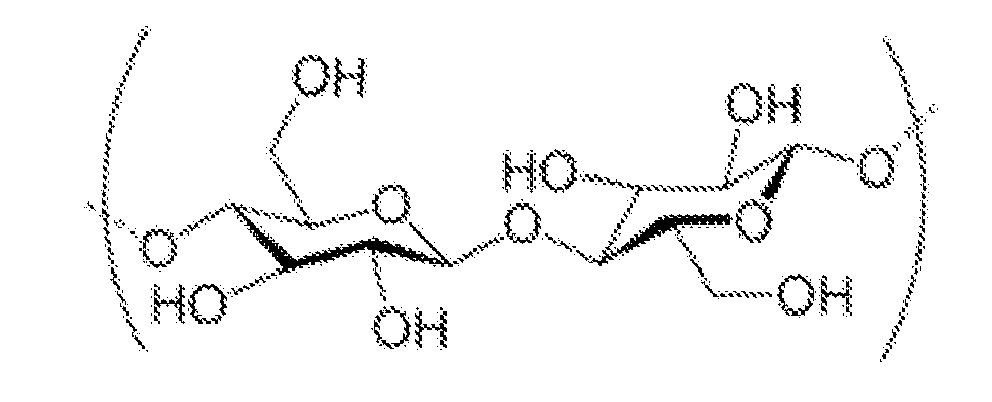
- derivative (s) of cellulose is meant a compound (or compounds) comprising at least one cellobiose unit of following structure: wherein one or more hydroxyl group (s) may (or may) be substituted.
- nonionic derivative (s) of hydrophobic substituted cellulose (s) (A) are amphiphilic polymers having an associative character. Indeed, they comprise hydrophilic units and hydrophobic units and are capable of interacting and associating with each other or with other molecules, reversibly, in particular, thanks to the presence of their hydrophobic chains.
- the cellulose derivative of the invention is a cellulose ether comprising one or more hydrophobic substituent (s) comprising from 8 to 30 carbon atoms.
- the nonionic derivative (s) of hydrophobic-substituted cellulose (s) according to the present invention are generally prepared from water-soluble nonionic cellulose ethers, all or part of which is substituted with reactive hydroxyl functions by a or more hydrophobic chain (s) comprising from 8 to 30 carbon atoms, preferably from 10 to 22 carbon atoms, and more preferably 16 carbon atoms.
- the reaction steps involved in the preparation of the cellulose derivatives of the invention are known to those skilled in the art.
- the nonionic cellulose ethers chosen for preparing the nonionic derivatives of hydrophobic-substituted cellulose (s) according to the invention preferably have a degree of nonionic substitution, for example in methyl group (s). , hydroxyethyl or hydroxypropyl, sufficient to be water soluble, i.e. form a substantially clear solution when dissolved in water at 25 ° C at a concentration of 1% by weight.
- the nonionic cellulose ethers chosen to prepare the nonionic derivatives of hydrophobic-substituted cellulose (s) according to the invention preferably have a relatively low number average molecular weight, less than 800,000 g / mol, preferably ranging from 50,000 to 700,000 g / mol and more preferably from 200,000 to 600,000 g / mol.
- the cellulose derivative of the invention is a hydroxyethylcellulose comprising one or more hydrophobic substituent (s) comprising from 8 to 30 carbon atoms.
- Nonionic cellulose derivatives used according to the invention are substituted by one or more chain (s) hydrocarbon (s) C 8 -C 30 linear, branched or cyclic, saturated or unsaturated, aliphatic or aromatic, which may be attached to the cellulose ether substrate by an ether, ester or urethane linkage, preferably ether.
- chain (s) hydrocarbon (s) C 8 -C 30 linear, branched or cyclic, saturated or unsaturated, aliphatic or aromatic which may be attached to the cellulose ether substrate by an ether, ester or urethane linkage, preferably ether.
- the hydrophobic substituent (s) used as substituents of the nonionic cellulose derivatives according to the present invention are C 8 -C 30 , preferably C 10 -C 22 , alkyl, arylalkyl or alkylaryl groups.
- hydrophobic substituent (s) according to the present invention are saturated alkyl chains.
- the hydrophobic substituent (s) according to the present invention are cetyl groups.
- the nonionic derivatives of hydrophobic substituted cellulose (s) according to the invention have a viscosity of preferably between 100 and 100 000 mPa.s, and preferably between 200 and 20 000 mPa.s, measured at 25 ° C. in a solution containing 1% by weight of polymer in water, this viscosity being determined conventionally using a Brookfield LVT type viscometer at 6 rpm with the mobile No. 3.
- the degree of hydrophobic substitution of the nonionic hydrophilic cellulose derivatives used according to the invention is preferably from 0.1 to 10% by weight, more preferably from 0.1 to 1% by weight and particularly preferably from 0, 4 to 0.8% by weight, of the total weight of the polymer.
- the oxidation dye (s) useful in the present invention may be selected from oxidation bases and couplers.
- the oxidation dye (s) (C) that may be used according to the invention is (or are) preferably chosen from oxidation bases, oxidation couplers, and their salts. addition.
- the oxidation bases that can be used are chosen from para-phenylenediamines, bis-phenylalkylenediamines, para-aminophenols, bis-para-aminophenols, ortho-aminophenols, heterocyclic bases and their salts. addition.
- para-phenylenediamines there may be mentioned, for example, para-phenylenediamine, para-tolylenediamine, 2-chloro-para-phenylenediamine, 2,3-dimethyl-para-phenylenediamine, 2,6-dimethyl-para-phenylenediamine 2,6-diethyl-para-phenylenediamine, 2,5-dimethyl-para-phenylenediamine, N, N-dimethyl-para-phenylenediamine, N, N-diethyl-para-phenylenediamine, N, N-dipropyl para-phenylenediamine, 4-amino N, N-diethyl-3-methylaniline, N, N-bis- ( ⁇ -hydroxyethyl) para-phenylenediamine, 4-N, N-bis- ( ⁇ -hydroxyethyl) amino-2-methylaniline, 4 N, N bis ( ⁇ -hydroxyethyl) amino-2-chloro
- para-phenylenediamine para-tolylenediamine, 2-isopropyl para-phenylenediamine, 2- ⁇ -hydroxyethyl para-phenylenediamine, 2- ⁇ -hydroxyethyloxy para-phenylenediamine, 2,6-dimethyl-para-phenylenediamine, 2,6-diethyl-para-phenylenediamine, 2,3-dimethyl-para-phenylenediamine, N, N-bis ( ⁇ -hydroxyethyl) para-phenylenediamine, 2-chloro-para-phenylenediamine, 2- ⁇ -acetylaminoethyloxy para-phenylenediamine, and their addition salts with an acid are particularly preferred.
- bis-phenylalkylenediamines mention may be made, by way of example, of N, N'-bis- ( ⁇ -hydroxyethyl) N, N'-bis- (4'-aminophenyl) 1,3-diamino propanol, N, N'-bis- ( ⁇ -hydroxyethyl) N, N'-bis- (4'-aminophenyl) ethylenediamine, N, N 'bis (4-aminophenyl) tetramethylenediamine, N, N' bis ( ⁇ -hydroxyethyl) N, N'-bis- (4-aminophenyl) tetramethylenediamine, N, N'-bis- (4-methylaminophenyl) tetramethylenediamine, N, N'-bis (ethyl) N, N 'bis (4'-amino, 3'-methylphenyl) ethylenediamine, 1.8 bis (2,5-diamino phenoxy
- para-aminophenol para-aminophenol, 4-amino-3-methyl phenol, 4-amino-3-fluoro phenol, 4-amino-3-hydroxymethyl phenol, 4- is exemplified. amino-2-methylphenol, 4-amino-2-hydroxymethylphenol, 4-amino-2-methoxymethylphenol, 4-amino-2-aminomethylphenol, 4-amino-2- ( ⁇ -hydroxyethylaminomethyl) phenol, 4 amino 2-fluoro phenol, and their addition salts with an acid.
- ortho-aminophenols there may be mentioned, by way of example, 2-aminophenol, 2-amino-5-methylphenol, 2-amino-6-methylphenol, 5-acetamido-2-aminophenol, and their salts. addition with an acid.
- heterocyclic bases that may be mentioned by way of example, pyridine derivatives, pyrimidine derivatives, pyrazole derivatives, pyrazolone derivatives, and their addition salts.
- pyridine derivatives mention may be made of the compounds described, for example, in the patents GB 1,026,978 and GB 1 153 196 such as 2,5 diamino pyridine, 2- (4-methoxyphenyl) amino 3 amino pyridine, 2,3 diamino 6-methoxy pyridine, 2- ( ⁇ -methoxyethyl) amino 3-amino 6-methoxy pyridine, 3,4-diamino pyridine, and their addition salts with an acid.
- pyridinic oxidation bases useful in the present invention are the 3-amino pyrazolo [1,5-a] -pyridines oxidation bases or their addition salts described, for example, in the patent application. FR 2801308 .
- pyrazolo [1,5-a] pyridin-3-ylamine 2-acetylamino pyrazolo [1,5-a] pyridin-3-ylamine; 2-morpholin-4-yl-pyrazolo [1,5-a] pyridin-3-ylamine; 3-amino-pyrazolo [1,5-a] pyridin-2-carboxylic acid; 2-methoxy-pyrazolo [1,5-a] pyridin-3-ylamino; (3-amino-pyrazolo [1,5-a] pyridin-7-yl) -methanol; 2- (3-Amino-pyrazolo [1,5-a] pyridin-5-yl) -ethanol; 2- (3-Amino-pyrazolo [1,5-a] pyridin-7-yl) -ethanol; (3-Amino-pyrazolo [1,5-a] pyridin-2-yl)
- pyrimidine derivatives mention may be made of the compounds described, for example, in the patents DE 2359399 ; JP 88 169571 ; JP 05 63124 ; EP 0770375 or patent application WO 96/15765 such as 2,4,5,6-tetraaminopyrimidine, 4-hydroxy-2,5,6-triaminopyrimidine, 2-hydroxy-4,5,6-triaminopyrimidine, 2,4-dihydroxy-5,6-diaminopyrimidine, 2,5,6-triaminopyrimidine, and pyrazolopyrimidine derivatives such as those mentioned in the patent application FR A 2750048 and among which mention may be made of pyrazolo [1,5-a] pyrimidine-3,7-diamine; 2,5-dimethyl pyrazolo [1,5a] -pyrimidine-3,7-diamine; pyrazolo [1,5-a] pyrimidine-3,5-diamine; 2,7-di
- pyrazole derivatives which may be used, mention may be made, for example, of the compounds described in the patents DE A 38 43 892 , DE A 41 33 957 and patent applications WO 94/08969 , WO 94/08970 , FR A-2,733,749 and DE A 195 43 988 such as 4,5-diamino-1-methylpyrazole, 4,5-diamino-1- ( ⁇ -hydroxyethyl) ppyrazole, 3,4 diaminopyrazole, 4,5-diamino-1 (4 'chlorobenzyl) pyrazole, 4,5-diamino-1,3-dimethylpyrazole, 4,5-diamino-3-methyl-1-phenylpyrazole, 4,5-diamino-1-methyl-3-phenylpyrazole, 4-amino-1, 3-dimethyl-5-hydrazinopyrazole, 1-benzyl-4,5-diamino-3-methylpyrazole
- the concentration of oxidation base (s) is generally from 0.001 to 20% by weight, preferably from 0.005 to 10% by weight, and even more preferably from 0.01 to 5% by weight, relative to the total weight of the composition.
- the oxidation coupler (s) present in the compositions of the invention may (or may be) chosen from benzene couplers, heterocyclic couplers, naphthalenic couplers, and their salts. addition.
- benzene couplers that may be used in the compositions according to the invention, mention may be made of meta-aminophenols, meta-phenylenediamines and meta-diphenols, as well as their addition salts.
- the concentration of oxidation coupler (s) generally ranges from 0.001% to 20% by weight, preferably from 0.005% to 10% by weight, and still more preferably from 0.01% to 5% by weight, relative to the total weight. of the composition.
- addition salts of the oxidation bases and couplers that can be used in the context of the invention are chosen especially from the addition salts with an acid such as hydrochlorides, hydrobromides, sulphates, the citrates, succinates, tartrates, lactates, tosylates, benzenesulfonates, phosphates and acetates and addition salts with a base such as sodium hydroxide, potassium hydroxide, ammonia, amines or alkanolamines.
- an acid such as hydrochlorides, hydrobromides, sulphates, the citrates, succinates, tartrates, lactates, tosylates, benzenesulfonates, phosphates and acetates
- a base such as sodium hydroxide, potassium hydroxide, ammonia, amines or alkanolamines.
- the fatty alcohol or alcohols useful in the composition of the present invention are long-chain fatty alcohols comprising at least 20 carbon atoms, preferably between 20 and 30 carbon atoms.
- the fatty alcohols useful in the present invention comprise a hydrocarbon chain comprising at least 20 carbon atoms which may be linear or branched, saturated or unsaturated. Preferably, these are primary fatty alcohols which have a linear and saturated chain. Examples that may be mentioned include, for example, behenyl alcohol, arachidyl alcohol, lignocyclic alcohol, ceryl alcohol and montanyl alcohol and their long-chain mixtures comprising at least 20 carbon atoms.
- fatty alcohols in the composition according to the invention it is possible to use, for example, the mixture of fatty alcohols consisting of 76% by weight of behenyl alcohol, 17% by weight of arachidyl alcohol, 1.5% by weight of lignoceryl alcohol, 5% by weight of stearyl alcohol and 0.5% by weight of cetyl alcohol.
- This mixture is sold under the name NAFOL ® 1822 C by the company Condea.
- NAFOL ® 2298 by the company Condea, which comprises 98% by weight of behenyl alcohol
- the mixture sold under the name ® NAFOL 20-22 by the company Condea which comprises 30% by weight of behenyl alcohol, 58% by weight of arachidyl alcohol and 6% by weight of lignoceryl alcohol
- the mixture sold under the name Nafol 20+ ® by the company Condea which comprises 50% by weight of arachidyl alcohol, 29% by weight of behenyl alcohol, 14% by weight of lignoceryl alcohol and 6% by weight of stearyl alcohol.
- the amount of the mixture of long-chain fatty alcohols comprising at least 20 carbon atoms in the composition according to the invention is in particular between 0.1 and 20% by weight, preferably between 0.2 and 10%, better between 0.5 and 6% by weight relative to the total weight of the composition.
- the dyeing composition in accordance with the invention may, in addition, contain one or more direct dyes which may be chosen in particular from nitrobenzene dyes, azo direct dyes, methine direct dyes and dyes. anthraquinones, xanthene dyes, triarylmethane dyes and their addition salts. These direct dyes may be nonionic, anionic or cationic in nature.
- the medium used in the compositions according to the present invention is an aqueous medium or a medium containing water and at least one organic solvent.
- the organic solvent (s) used in the compositions according to the present invention may be chosen from among monohydric alcohols and polyols different from those used in the composition of the present invention. 'invention.
- C 1 -C 4 lower alcohols such as ethanol, isopropanol, tert-butanol and n-butanol, and mixtures thereof.
- the alcohol used is ethanol.
- polyols there may be mentioned propylene glycol, polyethylene glycols, glycerine.
- organic solvents mention may also be made of polyol ethers such as 2-butoxyethanol, propylene glycol monomethyl ether, diethylene glycol monoethyl ether and monomethyl ether, as well as aromatic alcohols such as benzyl alcohol or phenoxyethanol, and mixtures thereof.
- the concentration of organic solvent (s) in the compositions according to the present invention is preferably between 0 and 30%, and more preferably between 0 and 20% by weight relative to the total weight of the composition.
- compositions according to the present application may also contain one or more thickening agent (s) also called “agent (s) for adjusting the rheology" different from the nonionic derivatives of hydrophobic-substituted cellulose (s) ( s) of the invention.
- thickening agent also called "agent (s) for adjusting the rheology” different from the nonionic derivatives of hydrophobic-substituted cellulose (s) ( s) of the invention.
- the rheology adjusting agent may (or may) be chosen from inorganic or organic thickeners, and in particular polymeric associative thickeners, fatty alcohols different from those of the present invention.
- fatty alcohols different from those of the present invention.
- oleic alcohol such as oleic alcohol, cellulose derivatives other than nonionic cellulose derivatives with hydrophobic substituents (A) according to the invention (hydroxyethylcellulose, hydroxypropylcellulose, carboxymethylcellulose) and gums of microbial origin ( xanthan gum, scleroglucan gum).
- the concentration of thickening agent (s) is preferably between 0.01 and 20% by weight, and more preferably between 1 and 10% by weight, relative to the total weight of the composition.
- the dye composition in accordance with the invention may also contain one or more adjuvants conventionally used in compositions for dyeing the hair.
- adjuvant (s) is meant an additive (or additives), different from the abovementioned compounds, such as anionic, cationic, nonionic, amphoteric or zwitterionic surfactants or mixtures thereof; nonionic, amphoteric, zwitterionic, anionic and cationic polymers other than the nonionic cellulose derivatives with hydrophobic substituent (s) (A) according to the invention, or their mixtures; penetrating agents; sequestering agents; the perfumes ; tampons; dispersants; conditioning agents such as, for example, volatile or non-volatile silicones, modified or unmodified; film-forming agents; ceramides; preservatives; opacifying agents; vitamins; amino acids; oligopeptides; peptides; hydrolysed or unmodified proteins, modified or not; enzymes; branched and unbranched fatty acids and alcohols; animal, vegetable or mineral waxes; hydroxylated organic acids; fatty alcohols other
- the adjuvant (s) above is (or is) generally present in an amount of, for each of them, preferably between 0.01 and 40% by weight, and preferably more preferably between 0.1 and 25% by weight relative to the weight of the composition.
- the pH of the dyeing composition according to the invention is generally from 3 to 12 approximately, and preferably from 5 to 11 approximately. It can be adjusted to the desired value by means of acidifying or basifying agent (s), usually used for dyeing keratinous fibers or else using conventional buffer system (s). (s).
- acidifying agents mention may be made, for example, of mineral or organic acids such as hydrochloric acid, orthophosphoric acid, sulfuric acid, sulphonic acids and carboxylic acids such as acetic acid. tartaric acid, citric acid and lactic acid.
- mineral or organic acids such as hydrochloric acid, orthophosphoric acid, sulfuric acid, sulphonic acids and carboxylic acids such as acetic acid. tartaric acid, citric acid and lactic acid.
- the dye composition according to the invention may be in various forms, such as in the form of creams, gels, or in any other form suitable for dyeing keratin fibers, and especially human hair.
- the process for dyeing keratinous fibers of the present invention is a process in which the composition according to the present invention as defined above is applied to the fibers, preferably in the presence of at least one oxidizing agent, for a time sufficient to develop the desired color.
- the color may be revealed at acidic, neutral or alkaline pH and the oxidizing agent (s) may (or may) be added to the composition of the invention just at the time of use or it (s) can (or can) be implemented from an oxidizing composition containing (s), applied simultaneously or sequentially to the composition of the invention.
- the composition according to the present invention is a ready-to-use composition, mixed, preferably at the time of use, with a composition containing, in a medium suitable for dyeing, at least one agent. oxidizing agent, wherein the oxidizing agent (s) is present in an amount sufficient to develop a color.
- the mixture obtained is then applied to the keratinous fibers. After a pause of about 3 to 50 minutes, preferably about 5 to 30 minutes, the keratinous fibers are rinsed, washed with shampoo, rinsed again and then dried.
- the oxidizing agents conventionally used for the oxidation dyeing of keratinous fibers are, for example, hydrogen peroxide, urea peroxide, alkali metal bromates, persalts such as perborates and persulfates, peracids, and the like.
- oxidase enzymes among which include peroxidases, 2-electron oxidoreductases such as uricases and 4-electron oxygenases such as laccases, these oxidoreductases being optionally associated with their usual cofactors such as uric acid for uricases.
- the preferred oxidizing agent is hydrogen peroxide.
- the oxidizing composition may also contain various adjuvants conventionally used in compositions for dyeing hair, as defined above.
- the pH of the oxidizing composition containing the oxidizing agent is such that, after mixing with the dyeing composition, the pH of the resulting composition applied on the keratinous fibers varies, preferably from 3 to 12 approximately, and preferably from 5 to 10. It can be adjusted to the desired value by means of acidifying agent (s) or alkalinizing (s) usually used (s) dyeing keratinous fibers, as defined previously.
- the ready-to-use composition which is finally applied to the keratinous fibers may be in various forms, such as in the form of creams, gels or in any other form suitable for dyeing keratinous fibers, and especially human keratin fibers such as hair.
- the invention also relates to a multi-compartment device or "kit" of dyeing comprising at least a first compartment containing the dye composition defined above and at least a second compartment containing an oxidizing composition.
- This device may be equipped with means for delivering the desired mixture onto the hair, such as the devices described in the patent application.
- FR A 2,586,913 .
- compositions have been prepared, the amounts indicated are in grams unless otherwise indicated.
- RESORCINOL 0.685 Monoethalonamide of stearic acid 4.8 Oleic acid 3
- CETYL HYDROXYETHYLCELLULOSE (Natrosol plus grade 330CS marketed by Hercules 0.4 Ammonia at 20% 5 Titanium DIOXIDE 0.3 ETHANOLAMINE 0.8 Oleth-10 1.8
- Each composition is mixed extemporaneously, with one and a half times its weight with an oxidizing composition of pH close to 3 (hydrogen peroxide at 20 volumes) (6% by weight of H 2 O 2 ).
- the mixing is easy and has a good viscosity; it is easily applied to gray hair, with 90% of white hair, at the rate of 10 g per 1 g of hair, for 30 minutes.
- the hair is then rinsed, washed with standard shampoo and dried.
- Capillary staining is evaluated visually. This results in hair coloring in a chestnut shade with mahogany red reflection.
- compositions obtained are stable over time.
- the application to the hair is carried out according to the protocol of Example 1.
- a hair color is thus obtained in a blond shade with coppery mahogany reflection.
- compositions were prepared (quantity expressed in g%):
- Composition A Composition B Composition C AMMONIUM HYDROXIDE 10 10 10 ERYTHORBIC ACID 0.50 0.50 0.50 ETHANOLAMINE 0.70 0.70 0.70 EDTA 0.20 0.20 0.20 SODIUM SULFITE 0.50 0.50 0.50 TITANIUM DIOXIDE 0.30 0.30 0.30 4-AMINO-2-hydroxytoluene .2460 .2460 .2460 p-phenylenediamine .2160 .2160 .2160 Stearyl alcohol 2.64 (*) Mixture of linear alcohols C18 / C20 / C22 / C24 7/58/30/6 (Trade name Nafol 2022) 3 (*) three CETYL HYDROXYETHYLCELLULOSE 0.40 0.40 1.40 Oleic acid three three three Steareth-2 5.50 5.50 5.50 5.50 STEARAMIDE MEA (96) (and) ETHANOLAMINE (2) (and) STEARIC ACID (2) ( 5 5 5 Ole
- the Nafol mixture contains 0.0090 moles of C20, C22, C24 alcohol.
- C18 alcohol stearyl alcohol
- each composition is mixed with 1 1 ⁇ 2 times its weight of oxidant at 20 volumes (6% H2O2).
- Each mixture is then applied to strands of hair with 90% natural white hair (BN) and permed (BP), at a rate of 15g of mixture per g of hair.
- the color of the locks is evaluated by colorimetric measurements in the CIE Lab system using the Konica Minolta CM-2600d Spectrocolorimeter
- L represents the intensity
- the lower the value of L * the more intense the coloration obtained.
- the chromaticity is measured by the values a * and b *, a * representing the ruge / green axis and b * the yellow / blue axis
- the selectivity of the coloring is the variation of the color between natural hair and permed hair Natural hair is representative of the nature of the hair at the root while the permed hair is representative of the nature of the hair at the tip.
- composition of the invention makes it possible to obtain a greater power of coloration on natural hair. Moreover, these results show an improvement in the selectivity with the composition of the invention which is representative of a better homogeneity of the coloration of the root to the tip of the hair.
Landscapes
- Health & Medical Sciences (AREA)
- Life Sciences & Earth Sciences (AREA)
- Animal Behavior & Ethology (AREA)
- General Health & Medical Sciences (AREA)
- Public Health (AREA)
- Veterinary Medicine (AREA)
- Birds (AREA)
- Epidemiology (AREA)
- Emergency Medicine (AREA)
- Cosmetics (AREA)
Abstract
Description
- La présente demande a pour objet une composition de teinture d'oxydation des fibres kératiniques.
- Il est connu de teindre les fibres kératiniques et en particulier les cheveux humains avec des compositions tinctoriales contenant des précurseurs de colorant d'oxydation, appelés généralement bases d'oxydation, tels que des ortho- ou para-phénylènediamines, des ortho- ou para-aminophénols et des composés hétérocycliques. Ces bases d'oxydation sont des composés incolores ou faiblement colorés qui, associés à des produits oxydants, peuvent donner naissance par un processus de condensation oxydative à des composés colorés.
- On sait également que l'on peut faire varier les nuances obtenues avec ces bases d'oxydation en les associant à des coupleurs ou modificateurs de coloration, ces derniers étant choisis notamment parmi les méta-diamines aromatiques, les méta-aminophénols, les méta-diphénols et certains composés hétérocycliques tels que des composés indoliques.
- La variété des molécules mises en jeu au niveau des bases d'oxydation et des coupleurs, permet l'obtention d'une riche palette de couleurs.
- La coloration dite "permanente" obtenue grâce à ces colorants d'oxydation, doit par ailleurs satisfaire un certain nombre d'exigences.
- Ainsi, elle doit être sans inconvénient sur le plan toxicologique, elle doit permettre d'obtenir des nuances dans l'intensité souhaitée et présenter une bonne tenue face aux agents extérieurs tels que la lumière, les intempéries, le lavage, les ondulations permanentes, la transpiration et les frottements.
- Les colorants doivent également permettre de couvrir les cheveux blancs, et être enfin les moins sélectifs possibles, c'est-à-dire permettre d'obtenir des écarts de coloration les plus faibles possibles tout au long d'une même fibre kératinique, qui comporte en général des zones différemment sensibilisées (i.e. abîmées) de sa pointe à sa racine.
- Par ailleurs, les compositions obtenues doivent, en outre, présenter de bonnes propriétés rhéologiques, tout en conservant de bonnes propriétés de coloration. En particulier, ces compositions ne doivent pas couler sur le visage ou en dehors des zones que l'on se propose de teindre, lors de leur application, notamment après mélange avec un agent oxydant.
- Il est déjà connu de la demande
WO 98/03150 - Cependant, ces compositions ne satisfont pas pleinement les exigences précitées et peuvent être améliorées, notamment en termes de propriétés tinctoriales, en particulier au niveau de la sélectivité et de la puissance de coloration. Le but de la présente invention est l'obtention de compositions de coloration capillaire stables, notamment sous forme de crèmes, faciles à préparer et à appliquer, pouvant contenir des concentrations élevées de colorants sous forme de sels, ayant de bonnes qualités rhéologiques et conduisant à des colorations intenses, peu sélectives et résistantes aux diverses agressions que peuvent subir les fibres kératiniques.
- Ce but est atteint par la présente invention qui a pour objet une composition tinctoriale pour fibres kératiniques, et en particulier pour fibres kératiniques humaines telles que les cheveux, comprenant, dans un milieu approprié pour la teinture :
- (A) un ou plusieurs dérivé(s) non ionique(s) de cellulose comprenant un ou plusieurs substituant(s) hydrophobe(s) comprenant de 8 à 30 atomes de carbone en quantité comprise entre 0,1 et 1 % en poids par rapport au poids total de la composition ,
- (B) un ou plusieurs colorants d'oxydation, et
- (C) un ou plusieurs alcools gras comprenant au moins 20 atomes de carbone.
- Les compositions tinctoriales selon l'invention présentent notamment les propriétés suivantes :
- elles permettent d'obtenir des compositions de viscosité correspondant à une crème qui sont stables dans le temps,
- elles se distinguent par une facilité de mélange avec la composition oxydante,
- elles se distinguent par les qualités rhéologiques des crèmes obtenues (bonne viscosité de crème en mélange),
- elles sont faciles à appliquer après mélange avec la composition oxydante au moment de la mise en oeuvre de la coloration (qualités d'usage sur tête).
- En outre, les compositions selon l'invention permettent l'obtention de compositions capables de conduire à des colorations aux nuances variées, chromatiques, puissantes, esthétiques, peu sélectives, uniformes sur l'ensemble des fibres kératiniques et en particulier des fibres kératiniques humaines telles que les cheveux, et résistant bien aux diverses agressions que peuvent subir les fibres.
- Un autre objet de la présente invention consiste en un procédé de teinture des fibres kératiniques dans lequel la composition cosmétique selon l'invention est mise en oeuvre.
- Un troisième objet de l'invention concerne l'utilisation de cette composition cosmétique pour la teinture des fibres kératiniques, et en particulier des fibres kératiniques humaines, telles que les cheveux.
- D'autres caractéristiques, aspects, objets et avantages de la présente invention apparaîtront encore plus clairement à la lecture de la description et des exemples qui suivent.
- A moins d'une indication différente, les bornes des gammes de valeurs qui sont données dans le cadre de la présente invention sont incluses dans ces gammes.
- Par « dérivé(s) de cellulose », on entend un (ou des) composé(s) comportant au moins un motif cellobiose de structure suivante :
- Le ou les dérivés non ioniques de cellulose à substituant(s) hydrophobe(s) (A) conformes à la présente invention, sont des polymères amphiphiles présentant un caractère associatif. En effet, ils comprennent des motifs hydrophiles et des motifs hydrophobes et sont capables d'interagir et de s'associer entre eux ou à d'autres molécules, de manière réversible, en particulier, grâce à la présence de leurs chaînes hydrophobes.
- De préférence, le dérivé de cellulose de l'invention est un éther de cellulose comprenant un ou plusieurs substituant(s) hydrophobe(s) comprenant de 8 à 30 atomes de carbone.
- Le ou les dérivés non ioniques de cellulose à substituant(s) hydrophobe(s) conformes à la présente invention, sont préparés généralement à partir d'éthers non-ioniques de cellulose hydrosolubles, dont on substitue tout ou partie des fonctions hydroxyle réactives par une ou plusieurs chaîne(s) hydrophobe(s) comprenant de 8 à 30 atomes de carbone, de préférence de 10 à 22 atomes de carbone, et mieux encore 16 atomes de carbone. Les étapes de réactions en jeu dans la préparation des dérivés de cellulose de l'invention sont connues de l'homme du métier.
- Les éthers non-ioniques de cellulose choisis pour préparer les dérivés non-ioniques de cellulose à substituant(s) hydrophobe(s) selon l'invention, ont de préférence un degré de substitution non-ionique, par exemple en groupement(s) méthyle, hydroxyéthyle ou hydroxypropyle, suffisant pour être hydrosolubles, c'est-à-dire former une solution sensiblement limpide lorsqu'ils sont dissous dans l'eau à 25 °C à la concentration de 1 % en poids.
- Les éthers non ioniques de cellulose choisis pour préparer les dérivés non ioniques de cellulose à substituant(s) hydrophobe(s) selon l'invention, possèdent préférentiellement une masse molaire moyenne en nombre relativement faible, inférieure à 800 000 g/mole, de préférence allant de 50 000 et 700 000 g/mole et de manière plus préférée allant de 200 000 à 600 000 g/mole.
- De préférence, le dérivé de cellulose de l'invention est une hydroxyéthylcellulose comprenant un ou plusieurs substituant(s) hydrophobe(s) comprenant de 8 à 30 atomes de carbone.
- Les dérivés non-ioniques de cellulose utilisés selon l'invention sont substitués, par une ou plusieurs chaîne(s) hydrocarbonée(s) en C8-C30 linéaires, ramifiées ou cycliques, saturées ou insaturées, aliphatiques ou aromatiques, pouvant être rattachées au substrat éther de cellulose par une liaison éther, ester, ou uréthane, de préférence éther.
- Selon un mode de réalisation, le ou les substituants hydrophobes utilisés comme substituants des dérivés non-ioniques de cellulose selon la présente invention sont des groupes alkyle, arylalkyle ou alkylaryle en C8-C30, de préférence en C10-C22.
- De préférence, le ou les substituants hydrophobes selon la présente invention sont des chaînes alkyles saturées.
- Selon un mode de réalisation préféré, le ou les substituants hydrophobes selon la présente invention sont des groupements cétyle.
- Les dérivés non-ioniques de cellulose à substituant(s) hydrophobe(s) selon l'invention, présentent une viscosité de préférence comprise entre 100 et 100 000 mPa.s, et de préférence entre 200 et 20 000 mPa.s, mesurée à 25°C dans une solution à 1 % en poids de polymère dans l'eau, cette viscosité étant déterminée de manière conventionnelle à l'aide d'un viscosimètre de type Brookfield LVT à 6 tours par minute avec le mobile n° 3.
- Le degré de substitution hydrophobe des dérivés non-ioniques de cellulose hydrophiles utilisés selon l'invention, va préférentiellement de 0,1 à 10% en poids, plus préférentiellement de 0,1 à 1% en poids et de manière particulièrement préférée de 0,4 à 0,8% en poids, du poids total du polymère.
- Parmi les dérivés non-ioniques de cellulose à substituant(s) hydrophobe(s) utilisables dans les compositions de l'invention, on peut citer, de préférence, les cétyl hydroxyéthylcelluloses commercialisées sous les dénominations Natrosol Plus Grade 330 CS et Polysurf 67 CS (INCI : Cetyl Hydroxyethylcellulose) par la société Aqualon/Hercules.
- La ou les colorants d'oxydation utiles dans la présente invention peuvent être choisis parmi les bases d'oxydation et les coupleurs.
- Le (ou les) colorant(s) d'oxydation (C) utilisable(s) selon l'invention est (ou sont) de préférence choisi(s) parmi les bases d'oxydation, les coupleurs d'oxydation, et leurs sels d'addition.
- A titre d'exemple, les bases d'oxydation utilisables sont choisies parmi les para-phénylènediamines, les bis-phénylalkylènediamines, les para-aminophénols, les bis-para-aminophénols, les ortho-aminophénols, les bases hétérocycliques et leurs sels d'addition.
- Parmi les para-phénylènediamines, on peut citer à titre d'exemple, la para-phénylènediamine, la para-toluylènediamine, la 2 chloro para-phénylènediamine, la 2,3-diméthyl para-phénylènediamine, la 2,6 diméthyl para-phénylènediamine, la 2,6-diéthyl para-phénylènediamine, la 2,5 diméthyl para-phénylènediamine, la N,N-diméthyl para-phénylènediamine, la N,N-diéthyl para-phénylènediamine, la N,N-dipropyl para-phénylènediamine, la 4 amino N,N diéthyl 3-méthyl aniline, la N,N-bis-(β-hydroxyéthyl) para-phénylènediamine, la 4-N,N-bis-(β-hydroxyéthyl)amino-2-méthyl aniline, la 4 N,N bis (β hydroxyéthyl)amino-2-chloro aniline, la 2 β hydroxyéthyl para-phénylènediamine, la 2 fluoro para-phénylènediamine, la 2 isopropyl para-phénylènediamine, la N (β hydroxypropyl) para-phénylènediamine, la 2 hydroxyméthyl para-phénylènediamine, la N,N diméthyl 3-méthyl para-phénylènediamine, la N,N (éthyl, βhydroxyéthyl) para-phénylènediamine, la N-(β,β-dihydroxypropyl) para-phénylènediamine, la N (4' aminophényl) para-phénylènediamine, la N phényl para-phénylènediamine, la 2-β-hydroxyéthyloxy para-phénylènediamine, la 2-β-acétylaminoéthyloxy para-phénylènediamine, la N (β-méthoxyéthyl) para-phénylènediamine, la 4-aminophénylpyrrolidine, la 2-thiényl para-phénylènediamine, le 2-β-hydroxyéthylamino-5-aminotoluène, la 3-hydroxy-1-(4'-aminophényl)pyrrolidine et leurs sels d'addition avec un acide.
- Parmi les para-phénylènediamines citées ci-dessus, la para-phénylènediamine, la para-toluylènediamine, la 2 isopropyl para-phénylènediamine, la 2-β-hydroxyéthyl para-phénylènediamine, la 2-β-hydroxyéthyloxy para-phénylène-diamine, la 2,6-diméthyl para-phénylènediamine, la 2,6-diéthyl para-phénylènediamine, la 2,3 diméthyl para-phénylènediamine, la N,N bis-(β-hydroxyéthyl) para-phénylènediamine, la 2 chloro para-phénylènediamine, la 2-βacétylaminoéthyloxy para-phénylènediamine, et leurs sels d'addition avec un acide sont particulièrement préférées.
- Parmi les bis-phénylalkylènediamines, on peut citer à titre d'exemple, le N,N'-bis-(β-hydroxyéthyl) N,N'-bis-(4'-aminophényl) 1,3 diamino propanol, la N,N'-bis-(β-hydroxyéthyl) N,N'-bis-(4'-aminophényl) éthylènediamine, la N,N' bis-(4-aminophényl) tétraméthylènediamine, la N,N' bis (β-hydroxyéthyl) N,N'-bis-(4-aminophényl) tétraméthylènediamine, la N,N' bis-(4-méthyl-aminophényl) tétraméthylènediamine, la N,N'-bis-(éthyl) N,N' bis (4'-amino, 3' méthylphényl) éthylènediamine, le 1,8-bis-(2,5-diamino phénoxy)-3,6-dioxaoctane, et leurs sels d'addition avec un acide.
- Parmi les para-aminophénols, on peut citer à titre d'exemple, le para-aminophénol, le 4-amino-3-méthyl phénol, le 4 amino-3 fluoro phénol, le 4 amino-3-hydroxyméthyl phénol, le 4-amino-2-méthyl phénol, le 4-amino-2 hydroxyméthyl phénol, le 4-amino-2-méthoxyméthyl phénol, le 4 amino-2 aminométhyl phénol, le 4-amino-2-(□-hydroxyéthyl aminométhyl)phénol, le 4 amino 2-fluoro phénol, et leurs sels d'addition avec un acide.
- Parmi les ortho-aminophénols, on peut citer à titre d'exemple, le 2-aminophénol, le 2-amino-5-méthylphénol, le 2-amino-6 méthylphénol, le 5-acétamido-2 aminophénol, et leurs sels d'addition avec un acide.
- Parmi les bases hétérocycliques, on peut citer à titre d'exemple, les dérivés pyridiniques, les dérivés pyrimidiniques, les dérivés pyrazoliques, les dérivés de pyrazolone, et leurs sels d'addition.
- Parmi les dérivés pyridiniques, on peut citer les composés décrits par exemple dans les brevets
GB 1 026 978 GB 1 153 196 - D'autres bases d'oxydation pyridiniques utiles dans la présente invention sont les bases d'oxydation 3-amino pyrazolo-[1,5 a]-pyridines ou leurs sels d'addition décrits par exemple dans la demande de brevet
FR 2801308 - Parmi les dérivés pyrimidiniques, on peut citer les composés décrits par exemple dans les brevets
DE 2359399 ;JP 88 169571 JP 05 63124 EP 0770375 ou demande de brevetWO 96/15765 FR A 2750048 - Parmi les dérivés pyrazoliques utilisables, on peut citer par exemple les composés décrits dans les brevets
DE A 38 43 892 ,DE A 41 33 957 et demandes de brevetWO 94/08969 WO 94/08970 FR A-2 733 749 DE A 195 43 988 comme le 4,5 diamino-1-méthylpyrazole, le 4,5-diamino-1-(β-hydroxyéthyl)¬pyrazole, le 3,4 diaminopyrazole, le 4,5-diamino-1 (4' chlorobenzyl)pyrazole, le 4,5-diamino-1,3-diméthyl¬pyrazole, le 4,5 diamino-3-méthyl-1-phénylpyrazole, le 4,5-diamino-1-méthyl-3-phénylpyrazole, le 4-amino-1,3-diméthyl-5-hydrazinopyrazole, le 1 benzyl-4,5-diamino-3-méthylpyrazole, le 4,5-diamino-3-tert-butyl-1-méthylpyrazole, le 4,5-diamino-1-tert-butyl-3-méthylpyrazole, le 4,5-diamino-1 (β-hydroxyéthyl)-3-méthylpyrazole, le 4,5 diamino-1 éthyl-3-méthylpyrazole, le 4,5-diamino-1-éthyl-3 (4' méthoxyphényl)-pyrazole, le 4,5-diamino-1-éthyl-3 hydroxyméthylpyrazole, le 4,5-diamino-3-hydroxyméthyl-1 méthylpyrazole, le 4,5-diamino-3 hydroxyméthyl-1-isopropylpyrazole, le 4,5 diamino-3-méthyl-1 isopropylpyrazole, le 4-amino-5-(2'-aminoéthyl)amino-1,3 diméthylpyrazole, le 3,4,5 triaminopyrazole, le 1-méthyl-3,4,5-triaminopyrazole, le 3,5-diamino-1 méthyl-4-méthylaminopyrazole, le 3,5-diamino-4 (β-hydroxyéthyl)amino-1 méthylpyrazole, et leurs sels d'addition. - Parmi les dérivés de pyrazolone utilisables, on peut citer par exemple les composés suivants et leurs sels d'addition :
- 2,3-diaminodihydropyrazolone ;
- 4,5-diamino-1,2-diméthyl-1,2-dihydropyrazol-3-one ;
- 4-amino-5-méthylamino-1,2-diméthyl-1,2-dihydropyrazol-3-one ;
- 4-amino-5-diméthylamino-1 ,2-diméthyl-1 ,2-dihydropyrazol-3-one ;
- 4-amino-5-(2-hydroxyéthyl)amino-1 ,2-diméthyl-1 ,2-dihydropyrazol-3-one ;
- 4-amino-5-(pyrrolidin-1-yl)-1,2-diméthyl-1,2-dihydropyrazol-3-one ;
- 4-amino-5-(pipéridin-1-yl)-1,2-diméthyl-1,2-dihydropyrazol-3-one ;
- 4,5-diamino-1,2-di-(2-hydroxyéthyl)-1,2-dihydropyrazol-3-one ;
- 4-amino-5-méthylamino-1,2-di-(2-hydroxyéthyl)-1,2-dihydropyrazol-3-one ;
- 4-amino-5-diméthylamino-1 ,2-di-(2-hydroxyéthyl)-1 ,2-dihydropyrazol-3-one ;
- 4-amino-5-(2-hydroxyéthyl)amino-1,2-di-(2-hydroxyéthyl)-1,2-dihydropyrazol-3-one ;
- 4-amino-5-(pyrrolidin-1-yl)-1,2-di-(2-hydroxyéthyl)-1,2-dihydropyrazol-3-one ;
- 4-amino-5-(pipéridin-1-yl)-1,2-di-(2-hydroxyéthyl)-1,2-dihydropyrazol-3-one ;
- 4,5-diamino-1,2-diéthyl-1,2-dihydropyrazol-3-one ;
- 4,5-diamino-1,2-diphényl-1,2-dihydropyrazol-3-one ;
- 4,5-diamino-1-éthyl-2-méthyl-1,2-dihydropyrazol-3-one ;
- 4,5-diamino-2-éthyl-1-méthyl-1,2-dihydropyrazol-3-one ;
- 4,5-diamino-1-phényl-2-méthyl-1,2-dihydropyrazol-3-one ;
- 4,5-diamino-2-phényl-1-méthyl-1,2-dihydropyrazol-3-one ;
- 4,5-diamino-1-(2-hydroxyéthyl)-2-méthyl-1,2-dihydropyrazol-3-one ;
- 4,5-diamino-2-(2-hydroxyéthyl)-1-méthyl-1,2-dihydropyrazol-3-one ;
- 2,3-diamino-6,7-dihydro-1H,5H-pyrazolo[1,2-a]pyrazol-1-one ;
- 2-amino-3-méthylamino-6,7-dihydro-1H,5H-pyrazolo[1,2-a]pyrazol-1-one ;
- 2-amino-3-diméthylamino-6,7-dihydro-1H,5H-pyrazolo[1,2-a]pyrazol-1-one ;
- 2-amino-3-éthylamino-6,7-dihydro-1H,5H-pyrazolo[1,2-a]pyrazol-1-one ;
- 2-amino-3-isopropylamino-6,7-dihydro-1H,5H-pyrazolo[1,2-a]pyrazol-1-one ;
- 2-amino-3-(2-hydroxyéthyl)amino-6,7-dihydro-1H,5H-pyrazolo[1,2 a]pyrazol-1-one;
- 2-amino-3-(2-hydroxypropyl)amino-6,7-dihydro-1H,5H-pyrazolo[1,2-a]pyrazol-1-one;
- 2-amino-3-bis(2-hydroxyéthyl)amino-6,7-dihydro-1H,5H-pyrazolo[1,2-a]pyrazol-1-one;
- 2-amino-3-(pyrrolidin-1-yl)-6,7-dihydro-1H,5H-pyrazolo[1,2-a]pyrazol-1-one ;
- 2-amino-3-(3-hydroxy-pyrrolidin-1-yl)-6,7-dihydro-1H,5H-pyrazolo[1,2-a]pyrazol-1-one ;
- 2-amino-3-(pipéridin-1-yl)-6,7-dihydro-1H,5H-pyrazolo[1,2-a]pyrazol-1-one ;
- 2,3-diamino-6-hydroxy-6,7-dihydro-1H,5H-pyrazolo[1,2-a]pyrazol-1-one ;
- 2,3-diamino-6-méthyl-6,7-dihydro-1H,5H-pyrazolo[1,2-a]pyrazol-1-one ;
- 2,3-diamino-6,6-diméthyl-6,7-dihydro-1H,5H-pyrazolo[1,2-a]pyrazol-1-one ;
- 2,3-diamino-5,6,7,8-tétrahydro-1H,6H-pyridazino[1,2-a]pyrazol-1-one ;
- 2,3-diamino-5,8-dihydro-1H,6H-pyridazino[1,2-a]pyrazol-1-one ;
- 4-amino-5-diméthylamino-1 ,2-diéthyl-1 ,2-dihydropyrazol-3-one ;
- 4-amino-1,2-diéthyl-5-éthylamino-1,2-dihydropyrazol-3-one ;
- 4- amino -1 ,2-diéthyl-5-isopropylamino-1 ,2-dihydropyrazol-3-one ;
- 4- amino -1 ,2-diéthyl-5-(2-hydroxyéthylamino)-1 ,2-dihydropyrazol-3-one ;
- 4-amino-5-(2-diméthylaminoéthylamino)-1,2-diéthyl-1,2-dihydropyrazol-3-one ;
- 4-amino-5-[bis(2-hydroxyéthyl)amino]-1 ,2-diéthyl-1 ,2-dihydropyrazol-3-one ;
- 4-amino-1,2-diéthyl-5-(3-imidazol-1-yl-propylamino)-1,2-dihydropyrazol-3-one ;
- 4-amino-1.2-diéthyl-5-(3-hydroxypyrrolidin-1-yl)-1,2-dihydropyrazol-3-one ;
- 4-amino-5-pyrrolidin-1-yl-1,2-diéthyl-1,2-dihydropyrazol-3-one ;
- 4-amino-5-(3-diméthylaminopyrrolidin-1-yl)-1,2-diéthyl-1,2-dihydropyrazol-3-one ;
- 4-amino-1,2-diéthyl-5-(4-méthylpipérazin-1-yl)pyrazolidin-3-one.
- La concentration en base(s) d'oxydation va en général de 0,001 à 20% en poids, de préférence de 0,005 à 10 % en poids, et encore plus préférentiellement de 0,01 à 5% en poids, par rapport au poids total de la composition.
- Le (ou les) coupleur(s) d'oxydation présent(s) dans les compositions de l'invention, peut (ou peuvent) être choisi(s) parmi les coupleurs benzéniques, les coupleurs hétérocycliques, les coupleurs naphtaléniques, et leurs sels d'addition.
- A titre de coupleurs benzéniques utilisables dans les compositions selon l'invention, on peut citer les méta-aminophénols, les méta-phénylènediamines, les méta-diphénols, ainsi que leurs sels d'addition.
- Parmi les coupleurs préférés, on peut citer le 2-méthyl-5-aminophénol, le 5-N-(β-hydroxyéthyl)amino-2-méthyl phénol, le 6-chloro-2-méthyl-5-aminophénol, le 3-aminophénol, le 1,3-dihydroxy benzène, le 1,3-dihydroxy-2-méthyl benzène, le 4-chloro-1,3-dihydroxy benzène, le 2,4-diamino-1-(β-hydroxyéthyloxy)benzène, le 2-amino-4-(β-hydroxyéthylamino)-1-méthoxybenzène, le 1,3-diamino benzène, le 1,3-bis-(2,4-diaminophénoxy)propane, la 3-uréido aniline, le 3-uréido 1-diméthylamino benzène, le sésamol, le 1-β-hydroxyéthylamino-3,4-méthylènedioxybenzène, l'β-naphtol, le 2 méthyl-1-naphtol, le 6-hydroxy indole, le 4-hydroxy indole, le 4-hydroxy N-méthyl indole, la 2-amino-3-hydroxy pyridine, la 6-hydroxy benzomorpholine la 3,5-diamino-2,6-diméthoxypyridine, le 1-N-(β-hydroxyéthyl)amino-3,4-méthylène dioxybenzène, le 2,6-bis-(β-hydroxyéthylamino)toluène et leurs sels d'addition avec un acide.
- La concentration en coupleur(s) d'oxydation va en général de 0,001 à 20 % en poids, de préférence de 0,005 à 10% en poids, et encore plus préférentiellement de 0,01 à 5 % en poids, par rapport au poids total de la composition.
- D'une manière générale, les sels d'addition des bases d'oxydation et des coupleurs utilisables dans le cadre de l'invention sont notamment choisis parmi les sels d'addition avec un acide tels que les chlorhydrates, les bromhydrates, les sulfates, les citrates, les succinates, les tartrates, les lactates, les tosylates, les benzènesulfonates, les phosphates et les acétates et les sels d'addition avec une base telles que la soude, la potasse, l'ammoniaque, les amines ou les alcanolamines.
- Le ou les alcools gras utiles dans la composition de la présente invention sont des alcools gras à chaine longue comprenant au moins 20 atomes de carbone, de préférence entre 20 et 30 atomes de carbone.
- Les alcools gras utiles dans la présente invention comportent une chaîne hydrocarbonée comprenant au moins 20 atomes de carbone qui peut être linéaire ou ramifiée, saturée ou insaturée. De préférence, ce sont des alcools gras primaires qui présentent une chaîne linéaire et saturée. On peut notamment citer à titre d'exemples l'alcool béhénylique, l'alcool arachidylique, l'alcool lignocérylique, l'alcool cérylique et l'alcool montanylique et leurs mélanges à chaîne longue comprenant au moins 20 atomes de carbone.
- Comme mélange d'alcools gras particulièrement préféré dans la composition selon l'invention, on peut utiliser, par exemple, le mélange d'alcools gras constitué de 76% en poids d'alcool béhénylique, de 17% en poids d'alcool arachidylique, de 1,5% en poids d'alcool lignocérylique, de 5% en poids d'alcool stéarylique et de 0,5% en poids d'alcool cétylique. Ce mélange est vendu sous la dénomination Nafol® 1822 C par la société CONDEA. Comme autres exemples, on peut également citer le mélange vendu sous la dénomination Nafol® 2298 par la société CONDEA, qui comprend 98% en poids d'alcool béhénylique ; le mélange vendu sous la dénomination Nafol® 20-22 par la société CONDEA, qui comprend 30 % en poids d'alcool béhénylique, 58% en poids d'alcool arachidylique et 6 % en poids d'alcool lignocérylique ; ou encore le mélange vendu sous la dénomination Nafol® 20+ par la société CONDEA, qui comprend 50% en poids d'alcool arachidylique, 29% en poids d'alcool béhénylique, 14% en poids d'alcool lignocérylique et 6% en poids d'alcool stéarylique.
- La quantité du mélange d'alcools gras à chaine longue comprenant au moins 20 atomes de carbone dans la composition selon l'invention est notamment comprise entre 0,1 et 20% en poids, de préférence entre 0,2 et 10%, mieux entre 0,5 et 6% en poids par rapport au poids total de la composition.
- La composition tinctoriale conforme à l'invention peut, en outre, contenir un ou plusieurs colorant(s) direct(s) pouvant notamment être choisi(s) parmi les colorants nitrés benzéniques, les colorants directs azoïques, les colorants directs méthiniques, les colorants anthraquinoniques, les colorants xanthéniques, les colorants triarylméthaniques et leurs sels d'addition. Ces colorants directs peuvent être de nature non ionique, anionique ou cationique.
- Le milieu utilisé dans les compositions selon la présente invention est un milieu aqueux ou un milieu contenant de l'eau et au moins un solvant organique.
- Le (ou les) solvant(s) organique(s) utilisé(s) dans les compositions selon la présente invention peut (ou peuvent) être choisi(s) parmi les alcools monohydroxylés et les polyols différents de ceux utiles dans la composition de l'invention.
- A titre d'alcools monohydroxylés utilisables, on peut citer les alcools inférieurs en C1-C4 comme l'éthanol, l'isopropanol, le tertiobutanol, le n-butanol, et leurs mélanges. De préférence, l'alcool utilisé est l'éthanol.
- À titre de polyols utilisables, on peut citer le propylèneglycol, les polyéthylèneglycols, la glycérine. A titre de solvants organiques, on peut aussi citer les éthers de polyols comme le 2-butoxyéthanol, le monométhyléther de propylèneglycol, le monoéthyléther et le monométhyléther du diéthylèneglycol, ainsi que les alcools aromatiques comme l'alcool benzylique ou le phénoxyéthanol, et leurs mélanges.
- La concentration en solvant(s) organique(s) dans les compositions selon la présente invention est comprise de préférence entre 0 et 30%, et de manière plus préférée entre 0 et 20% en poids par rapport au poids total de la composition.
- Les compositions selon la présente demande peuvent également contenir, un ou plusieurs agent(s) épaississant(s) encore appelé "agent(s) d'ajustement de la rhéologie" différents des dérivés non-ioniques de cellulose à substituant(s) hydrophobe(s) de l'invention.
- L'agent (ou les agents) d'ajustement de la rhéologie peut (ou peuvent) être choisi(s) parmi les agents épaississants minéraux ou organiques, et en particulier les épaississants associatifs polymériques, les alcools gras différents de ceux de la présente invention tels que l'alcool oléïque, les dérivés cellulosiques autres que les dérivés de cellulose non-ioniques à substituant(s) hydrophobe(s) (A) selon l'invention (hydroxyéthylcellulose, hydroxypropylcellulose, carboxyméthylcellulose) et les gommes d'origine microbienne (gomme de xanthane, gomme de scléroglucane).
- La concentration en agent(s) épaississant(s) est comprise de préférence entre 0,01 et 20% en poids, et de manière plus préférée entre 1 et 10% en poids, par rapport au poids total de la composition
- La composition tinctoriale conforme à l'invention peut également contenir un ou plusieurs adjuvant(s) utilisé(s) classiquement dans les compositions pour la teinture des cheveux.
- Par «adjuvant(s)», on entend un (ou des) additif(s), différent(s) des composés précités, tels que les agents tensioactifs anioniques, cationiques, non-ioniques, amphotères, zwittérioniques ou leurs mélanges ; les polymères non-ioniques, amphotères, zwittérioniques, anioniques, cationiques autres que les dérivés de cellulose non-ioniques à substituant(s) hydrophobe(s) (A) selon l'invention, ou leurs mélanges ; les agents de pénétration ; les agents séquestrants ; les parfums ; les tampons ; les agents dispersants ; les agents conditionneurs tels que par exemple des silicones volatiles ou non volatiles, modifiées ou non modifiées ; les agents filmogènes ; les céramides ; les agents conservateurs ; les agents opacifiants ; les vitamines ; les acides aminés ; les oligopeptides ; les peptides ; les protéines hydrolysées ou non, modifiées ou non ; les enzymes ; les acides et alcools gras ramifiés ou non ; les cires animales, végétales ou minérales ; les acides organiques hydroxylés ; les alcools gras autres que ceux de l'invention ; les filtres UV ; les agents anti-oxydants et les agents anti-radicaux libres ; les agents antipelliculaires ; les agents régulateurs de séborrhée ; les agents apaisants ; les huiles minérales, végétales ou animales ; les polyisobutènes et poly(α-oléfines) ; les pigments ; les acides, bases, plastifiants, charges minérales, nacres, paillettes ; les agents anti-statiques et les agents réducteurs.
- Le (ou les) adjuvant(s) ci-dessus est (ou sont), en général, présent(s) en quantité comprise, pour chacun d'eux, de préférence entre 0,01 et 40 % en poids, et de manière plus préférée entre 0,1 et 25 % en poids par rapport au poids de la composition.
- Bien entendu, l'homme de l'art veillera à choisir ce (ou ces) éventuel(s) composé(s) complémentaire(s) de manière telle que les propriétés avantageuses attachées intrinsèquement à la composition de teinture d'oxydation conforme à l'invention ne soient pas, ou substantiellement pas, altérées par la (ou les) adjonction(s) envisagée(s).
- Le pH de la composition tinctoriale conforme à l'invention va généralement de 3 à 12 environ, et de préférence de 5 à 11 environ. Il peut être ajusté à la valeur désirée au moyen d'agent(s) acidifiant(s) ou alcalinisant(s), habituellement utilisés en teinture des fibres kératiniques ou bien encore à l'aide de système(s) tampon(s) classique(s).
- Parmi les agents acidifiants, on peut citer, à titre d'exemple, les acides minéraux ou organiques comme l'acide chlorhydrique, l'acide orthophosphorique, l'acide sulfurique, les acides sulfoniques et les acides carboxyliques comme l'acide acétique, l'acide tartrique, l'acide citrique et l'acide lactique.
- Parmi les agents alcalinisants on peut citer, à titre d'exemple, l'ammoniaque, les carbonates alcalins, les alcanolamines telles que les mono-, di- et triéthanolamines ainsi que leurs dérivés, les hydroxydes de sodium ou de potassium et les composés de formule suivante :

- W est un reste propylène éventuellement substitué par un groupe hydroxyle ou un groupe alkyle en C1-C4 ;
- Ra, Rb, Rc et Rd, identiques ou différents, représentent un atome d'hydrogène, un groupe alkyle en C1-C4 ou hydroxyalkyle en C1-C4.
- La composition tinctoriale selon l'invention peut se présenter sous des formes diverses, telles que sous forme de crèmes, de gels, ou sous toute autre forme appropriée pour réaliser une teinture des fibres kératiniques, et notamment des cheveux humains.
- Le procédé de teinture des fibres kératiniques de la présente invention est un procédé dans lequel on applique sur les fibres la composition selon la présente invention telle que définie précédemment, de préférence en présence d'au moins un agent oxydant, pendant un temps suffisant pour développer la couleur désirée. La couleur peut être révélée à pH acide, neutre ou alcalin et l'agent (ou les agents) oxydant(s) peut (ou peuvent) être ajouté(s) à la composition de l'invention juste au moment de l'emploi ou il(s) peut (ou peuvent) être mis en oeuvre à partir d'une composition oxydante le(s) contenant, appliquée simultanément ou séquentiellement à la composition de l'invention.
- Selon un mode de réalisation particulier, la composition selon la présente invention est une composition prête à l'emploi, mélangée, de préférence au moment de l'emploi, à une composition contenant, dans un milieu approprié pour la teinture, au moins un agent oxydant, cet agent (ou ces agents) oxydant(s) étant présent(s) en une quantité suffisante pour développer une coloration. Le mélange obtenu est ensuite appliqué sur les fibres kératiniques. Après un temps de pause de 3 à 50 minutes environ, de préférence, 5 à 30 minutes environ, les fibres kératiniques sont rincées, lavées au shampooing, rincées à nouveau, puis séchées.
- Les agents oxydants classiquement utilisés pour la teinture d'oxydation des fibres kératiniques sont, par exemple, le peroxyde d'hydrogène, le peroxyde d'urée, les bromates de métaux alcalins, les persels tels que les perborates et persulfates, les peracides et les enzymes oxydases parmi lesquelles on peut citer les peroxydases, les oxydo-réductases à 2 électrons telles que les uricases et les oxygénases à 4 électrons comme les laccases, ces oxydoréductases étant éventuellement associées à leurs cofacteurs habituels tels que l'acide urique pour les uricases. L'agent oxydant préféré est le peroxyde d'hydrogène.
- La composition oxydante peut également renfermer divers adjuvants utilisés classiquement dans les compositions pour la teinture des cheveux, tels que définis précédemment.
- Le pH de la composition oxydante renfermant l'agent oxydant est tel qu'après mélange avec la composition tinctoriale, le pH de la composition résultante appliquée sur les fibres kératiniques varie, de préférence, de 3 à 12 environ, et préférentiellement, de 5 à 10. Il peut être ajusté à la valeur désirée au moyen d'agent(s) acidifiant(s) ou alcalinisant(s) habituellement utilisé(s) en teinture des fibres kératiniques, tel(s) que défini(s) précédemment.
- La composition prête à l'emploi qui est finalement appliquée sur les fibres kératiniques, peut se présenter sous des formes diverses, telles que sous forme de crèmes, de gels ou sous toute autre forme appropriée pour réaliser une teinture des fibres kératiniques, et notamment des fibres kératiniques humaines tels que les cheveux.
- L'invention a aussi pour objet un dispositif à plusieurs compartiments ou "kit" de teinture comprenant au moins un premier compartiment contenant la composition tinctoriale définie ci dessus et au moins un deuxième compartiment contenant une composition oxydante. Ce dispositif peut être équipé d'un moyen permettant de délivrer sur les cheveux le mélange souhaité, tel que les dispositifs décrits dans la demande de brevet
FR A 2 586 913 - Les exemples qui suivent servent à illustrer l'invention sans toutefois présenter un caractère limitatif.
- Les compositions suivantes ont été réalisées, les quantités indiquées sont en gramme sauf indication différente.
RESORCINOL 0,685 Monoéthalonamide d'acide stéarique 4,8 Acide oléique 3 CETYL HYDROXYETHYLCELLULOSE (Natrosol plus grade 330CS commercialisé par Hercules 0,4 Ammoniaque à 20% 5 DIOXIDE de Titane 0,3 ETHANOLAMINE 0,8 OLETH-10 1,8 Solution aqueuse à 40% en poids de Polyquaternium-6 (chlorure de polydiméthyldiallylammonium (MERQUAT 100, commercialisé par ONDEO/NALCO 1,6 m-AMINOPHENOL 0,14 EDTA 0,2 2,4-DIAMINOPHENOXYETHANOL HCl 0,02 Solution aqueuse à 60 % en poids de chlorure d'hexadiméthrine (Mexomère PO commercialisé par la société Chimex) 1,2 réducteur qs antioxydant qs HYDROXYPROPYL METHYLCELLULOSE 0,191 OLETH-30 1,5 STEARETH-2 5,5 Alcools en C20-C22 (Nafol 2022 EN commercialisé par la société Sasol) 3 TOLUENE-2,5-DIAMINE 0,7623 Eau Qs 100 - Chaque composition est mélangée extemporanément, avec une fois et demie son poids avec une composition oxydante de pH voisin de 3 (eau oxygénée à 20 volumes) (6 % en poids d'H2O2). Le mélange se fait facilement et présente une bonne viscosité ; il est appliqué facilement sur des cheveux gris, à 90 % de cheveux blancs, à raison de 10 g pour 1 g de cheveux, pendant 30 minutes. Les cheveux sont ensuite rincés, lavés avec un shampooing standard et séchés.
- La coloration capillaire est évaluée de manière visuelle. On obtient ainsi une coloration des cheveux dans une nuance châtain à reflet rouge acajou.
- Ces colorations possèdent de bonnes propriétés notamment en termes de sélectivité et d'intensité. Les compositions obtenues sont stables dans le temps.
- Les compositions suivantes ont été réalisées, les quantités indiquées sont en gramme sauf indication différente.
Monoéthalonamide d'acide stéarique 4,8 ACIDE OLEIQUE 3 CETYL HYDROXYETHYLCELLULOSE( polysurf 67 commercialisé par Hercules) 0.5 p-AMINOPHENOL 0,24 AMMONIAQUE à 20% 5 TITANIUM DIOXIDE 0,3 ETHANOLAMINE 0,8 2-AMINO-3-HYDROXYPYRIDINE 0,2 6-HYDROXYINDOLE 0,01 Solution aqueuse à 40% en poids de polyquaternium-6 (chlorure de polydiméthyldiallylammonium , MERQUAT 100, commercialisé par ONDEO/NALCO 1 ,6 4-AMINO-2-HYDROXYTOLUENE 0,24 2-METHYL-5-HYDROXYETHYLAMINOPHENOL 0,15 m-AMINOPHENOL 0,024 EDTA 0,2 2,4-DIAMINOPHENOXYETHANOL HCl 0,02 Solution aqueuse à 60 % en poids de chlorure d'hexadiméthrine (Mexomère PO commercialisé par la société Chimex) 1,2 réducteur qs antioxydant qs HYDROXYPROPYL METHYLCELLULOSE 0,191 OLETH-30 1,5 PEG-40 STEARATE 1,8 STEARETH-2 5,5 GLYCERYL LAURYL ETHER 0,5 Alcools en C20-C22 (Nafol 2022 EN commercialisé par la société Sasol) 3 TOLUENE-2,5-DIAMINE 0,2772 Eau Qs 100 - L'application sur les cheveux est effectuée selon le protocole de l'exemple 1. On obtient ainsi une coloration des cheveux dans une nuance blond à reflet acajou cuivré.
-
Composition A Composition B (Invention) Composition C AMMONIUM HYDROXIDE 10 10 10 ERYTHORBIC ACID 0,50 0,50 0,50 ETHANOLAMINE 0,70 0,70 0,70 EDTA 0,20 0,20 0,20 SODIUM SULFITE 0,50 0,50 0,50 TITANIUM DIOXIDE 0,30 0,30 0,30 4-AMINO-2-HYDROXYTOLUENE 0,2460 0,2460 0,2460 p-PHENYLENEDIAMINE 0,2160 0,2160 0,2160 Alcool stearylique 2,64 (*) Mélange d'alcools linéaires C18/C20/C22/C24 7/58/30/6 (Nom comercial Nafol 2022) 3 (*) 3 CETYL HYDROXYETHYLCELLULOSE 0,40 0,40 1,40 Acide oleique 3 3 3 STEARETH-2 5,50 5,50 5,50 STEARAMIDE MEA (96) (and) ETHANOLAMINE (2) (and) STEARIC ACID (2) ( 5 5 5 OLETH-30 1,50 1,50 1,50 eau Qs 100 Qs 100 Qs 100 - Préparation de la composition A comparative
- 3g% de Nafol 2022 ayant les proportions suivantes C18/C20/C22/C24 7/58/30/6 représentent
- 0,21 g% de C18
- 1,74 g% de C20 = 0,0058 mole de CH3(CH2)19OH
- 0,9 g% de C22 = 0,0027 mole de CH3(CH2)21OH
- 0,18 g% de C24= 0,0005 mole de CH3(CH2)23OH
- Donc le mélange de Nafol contient 0,0090 mole d'alcool en C20, C22, C24. Dans la composition A cette quantité d'alcool gras à chaine longue a été remplacé par 0,0090 mole d'alcool en C18 (alcool stearylique) soit 2,43 g.
- Pour être comparable en quantité d'alcool en C18, les 3g% de Nafol 2022 ont été remplavé dans la composition A par 2,64 g% d'alcool stéarylique ( 0,21 + 2,43 ).
- Au moment de l'emploi, chaque composition est mélangée avec 1 fois ½ son poids d'oxydant à 20 volumes (6% H2O2).
- Chaque mélange est ensuite appliqué sur des mèches de cheveux à 90% de cheveux blancs naturels (BN) et permanentés (BP), à raison de 15g de mélange par g de cheveux.
- Après 30 mn de pause à température ambiante, les mèches sont rincées, lavées avec un shampooing standard et séchées.
- La coloration des mèches est évaluée par des mesures colorimétriques dans le système CIE Lab à l'aide du spectrocolorimètre_Konica Minolta CM-2600d
- Dans ce système, L représente l'intensité, plus la valeur de L* est faible, plus la coloration obtenues es intense La chromaticité est mesurée par les valeurs a* et b*, a* représentant l'axe ruge/vert et b* l'axe jaune/bleu
- La sélectivité de la coloration est la variation de la couleur entre des cheveux naturels et des cheveux permanentés Les cheveux naturels sont représentatif de la nature des cheveux à la racine alors que les cheveux permanentés sont représentatifs de la nature des cheveux à la pointe.
- La sélectivité est mesurée par :
- ΔE, qui est la variation de la couleur entre les cheveux naturels et les cheveux permanents, est obtenu à partir de la formule :

- Les résultats sont reportés dans le tableau ci-dessous
Type cheveux L* A* B* ΔE A BN 26,97 15,26 -0,68 5,86 BP 21,29 15,06 0,76 B (inv) BN 23,99 16,38 1 1,72 BP 23,01 16,1 -0,39 C BN 26,50 16,48 0,33 5,70 BP 20,91 15,48 -0,16 - Ces résultats montrent que la composition de l'invention permet d'obtenir une puissance de la coloration plus importante sur cheveux naturels. Par ailleurs, ces résultats montrent une amélioration de la sélectivité avec la composition de l'invention ce qui est représentatif d'une meilleure homogénéité de la coloration de la racine à la pointe des cheveux.
Claims (15)
- Composition tinctoriale pour fibres kératiniques, comprenant, dans un milieu approprié pour la teinture :(A) un ou plusieurs dérivé(s) non ionique(s) de cellulose comprenant un ou plusieurs substituant(s) hydrophobe(s) comprenant de 8 à 30 atomes de carbone en quantité comprise entre 0,1 et 1 % en poids par rapport au poids total de la composition ,(B) un ou plusieurs colorants d'oxydation, et(C) un ou plusieurs alcools gras comprenant au moins 20 atomes de carbone.
- Composition tinctoriale selon la revendication 1, caractérisée en ce que le dérivé non ionique de cellulose (A) est une hydroxyéthylcellulose substituée par un ou plusieurs substituant(s) hydrophobe(s) comprenant de 8 à 30 atomes de carbone.
- Composition tinctoriale selon l'une quelconque des revendications précédentes, caractérisée en ce que le substituant hydrophobe est un groupe alkyle en C10-C22.
- Composition tinctoriale selon l'une quelconque des revendications précédentes, caractérisée en ce que le substituant hydrophobe est un groupement cétyle.
- Composition tinctoriale selon l'une quelconque des revendications précédentes, caractérisée en ce que le degré de substitution hydrophobe va de 0,1 à 10% en poids, de préférence de 0,1 à 1% en poids et de manière plus préférée de 0,4 à 0,8% en poids, du poids total du polymère.
- Composition tinctoriale selon l'une quelconque des revendications précédentes, caractérisée en ce que le colorant d'oxydation (C) est choisi parmi les bases d'oxydation, les coupleurs d'oxydation, et leurs sels d'addition.
- Composition tinctoriale selon la revendication précédente, caractérisée en ce que le colorant d'oxydation est une base d'oxydation choisie parmi les bases d'oxydation para-phénylènediamines, les bis-phénylalkylènediamines, les para-aminophénols, les bis-para-aminophénols, les ortho-aminophénols, les bases hétérocycliques et leurs sels d'addition.
- Composition tinctoriale selon l'une quelconque des revendications précédentes caractérisée en ce que le colorant d'oxydation est un coupleur d'oxydation choisi parmi les coupleurs benzéniques, les coupleurs hétérocycliques, les coupleurs naphtaléniques, et leurs sels d'addition.
- Composition tinctoriale selon la revendication précédente, caractérisée en ce que le coupleur benzénique est choisi parmi les méta-aminophénols, les méta-phénylènediamines, les méta-diphénols, et leurs sels d'addition.
- Composition selon l'une quelconque des revendications précédentes dans laquelle l'alcool gras comprend de 20 à 24 atomes de carbone.
- Composition selon l'une quelconque des revendications précédentes dans laquelle le ou les alcools gras comprenant au moins 20 atomes de carbone représentent de 0,1 à 20 et de préférence de 0,2 à 10% du poids total de la composition.
- Composition tinctoriale selon l'une quelconque des revendications précédentes, caractérisée en ce qu'elle comprend un ou plusieurs colorant(s) direct(s) choisi(s) parmi les colorants nitrés benzéniques, les colorants directs azoïques, les colorants directs méthiniques, les colorants anthraquinoniques, les colorants xanthéniques, les colorants triarylméthaniques et leurs sels d'addition.
- Composition tinctoriale selon l'une quelconque des revendications précédentes, caractérisée en ce qu'elle comprend au moins un agent oxydant, de préférence le peroxyde d'hydrogène.
- Procédé de teinture d'oxydation des fibres kératiniques, caractérisé en ce qu'on applique sur les fibres une composition tinctoriale telle que définie dans l'une quelconque des revendications 1 à 12 en présence d'au moins un agent oxydant, pendant un temps suffisant pour développer la couleur désirée.
- Dispositif à plusieurs compartiments, caractérisé en ce qu'il comprend au moins un premier compartiment contenant une composition tinctoriale telle que définie dans l'une quelconque des revendications 1 à 12 et au moins un deuxième compartiment contenant au moins un agent oxydant.
Applications Claiming Priority (1)
| Application Number | Priority Date | Filing Date | Title |
|---|---|---|---|
| FR0758930A FR2923388B1 (fr) | 2007-11-09 | 2007-11-09 | Composition de teinture d'oxydation des fibres keratiniques comprenant une cellulose a substituants hydrophobes, un colorant d'oxydation et un alcool gras a chaine longue |
Publications (3)
| Publication Number | Publication Date |
|---|---|
| EP2065073A2 true EP2065073A2 (fr) | 2009-06-03 |
| EP2065073A3 EP2065073A3 (fr) | 2011-05-11 |
| EP2065073B1 EP2065073B1 (fr) | 2015-08-19 |
Family
ID=39494958
Family Applications (1)
| Application Number | Title | Priority Date | Filing Date |
|---|---|---|---|
| EP08168645.3A Active EP2065073B1 (fr) | 2007-11-09 | 2008-11-07 | Composition de teinture d'oxydation des fibres kératiniques comprenant une cellulose à substituants hydrophobes, un colorant d'oxydation et un alcool gras à chaine longue |
Country Status (6)
| Country | Link |
|---|---|
| US (1) | US20090180979A1 (fr) |
| EP (1) | EP2065073B1 (fr) |
| BR (1) | BRPI0804841B1 (fr) |
| ES (1) | ES2551308T3 (fr) |
| FR (1) | FR2923388B1 (fr) |
| MX (1) | MX2008014276A (fr) |
Cited By (2)
| Publication number | Priority date | Publication date | Assignee | Title |
|---|---|---|---|---|
| FR2970174A1 (fr) * | 2011-01-10 | 2012-07-13 | Oreal | Procede de coloration ou d'eclaircissement mettant en œuvre une composition riche en corps gras comprenant un alcool a au moins 20 carbone, compositions et dispositif |
| EP2777688A1 (fr) * | 2013-03-11 | 2014-09-17 | The Procter and Gamble Company | Procédé de coloration capillaire |
Families Citing this family (1)
| Publication number | Priority date | Publication date | Assignee | Title |
|---|---|---|---|---|
| FR2966729B1 (fr) * | 2010-11-02 | 2014-03-21 | Oreal | Composition de coloration mousse comprenant un polymere associatif |
Citations (17)
| Publication number | Priority date | Publication date | Assignee | Title |
|---|---|---|---|---|
| GB1026978A (en) | 1962-03-30 | 1966-04-20 | Schwarzkopf Verwaltung G M B H | Method of dyeing hair |
| GB1153196A (en) | 1965-07-07 | 1969-05-29 | Schwarzkopf Verwaltung G M B H | Method of Dyeing Hair |
| DE2359399A1 (de) | 1973-11-29 | 1975-06-12 | Henkel & Cie Gmbh | Haarfaerbemittel |
| FR2586913A1 (fr) | 1985-09-10 | 1987-03-13 | Oreal | Procede pour former in situ une composition constituee de deux parties conditionnees separement et ensemble distributeur pour la mise en oeuvre de ce procede |
| JPS63169571A (ja) | 1987-01-06 | 1988-07-13 | Nec Corp | ト−ン検出装置 |
| DE3843892A1 (de) | 1988-12-24 | 1990-06-28 | Wella Ag | Oxidationshaarfaerbemittel mit einem gehalt an diaminopyrazolderivaten und neue diaminopyrazolderivate |
| JPH0563124A (ja) | 1991-09-03 | 1993-03-12 | Mitsubishi Electric Corp | 混成集積回路装置 |
| DE4133957A1 (de) | 1991-10-14 | 1993-04-15 | Wella Ag | Haarfaerbemittel mit einem gehalt an aminopyrazolderivaten sowie neue pyrazolderivate |
| WO1994008969A1 (fr) | 1992-10-16 | 1994-04-28 | Wella Aktiengesellschaft | Procede de production de derives de 4,5-diaminopyrazole, leur utilisation pour la teinture des cheveux, et nouveaux derives de pyrazole |
| WO1994008970A1 (fr) | 1992-10-16 | 1994-04-28 | Wella Aktiengesellschaft | Colorants d'oxydation pour cheveux, renfermant des derives du 4,5-diaminopyrazole, nouveaux derives du 4,5-diaminopyrazole et leur procede de fabrication |
| WO1996015765A1 (fr) | 1994-11-17 | 1996-05-30 | Henkel Kommanditgesellschaft Auf Aktien | Colorants d'oxydation |
| FR2733749A1 (fr) | 1995-05-05 | 1996-11-08 | Oreal | Compositions pour la teinture des fibres keratiniques contenant des diamino pyrazoles, procede de teinture, nouveaux diamino pyrazoles et leur procede de preparation |
| EP0770375A1 (fr) | 1995-10-21 | 1997-05-02 | GOLDWELL GmbH | Composition pour la teinture des cheveux |
| DE19543988A1 (de) | 1995-11-25 | 1997-05-28 | Wella Ag | Oxidationshaarfärbemittel mit einem Gehalt an 3,4,5-Triaminopyrazolderivaten sowie neue 3,4,5-Triaminopyrazolderivate |
| FR2750048A1 (fr) | 1996-06-21 | 1997-12-26 | Oreal | Compositions de teinture des fibres keratiniques contenant des derives pyrazolo-(1, 5-a)-pyrimidine, procede de teinture, nouveaux derives pyrazolo-(1, 5-a)-pyrimidine et leur procede de preparation |
| WO1998003150A2 (fr) | 1996-07-23 | 1998-01-29 | L'oreal | Composition de teinture d'oxydation pour fibres keratiniques comprenant un polymere amphiphile non-ionique |
| FR2801308A1 (fr) | 1999-11-19 | 2001-05-25 | Oreal | COMPOSITIONS DE TEINTURE DE FIBRES KERATINIQUES CONTENANT DE DES 3-AMINO PYRAZOLO-[1,(-a]-PYRIDINES, PROCEDE DE TEINTURE, NOUVELLES 3-AMINO PYRAZOLO-[1,5-a]-PYRIDINES |
Family Cites Families (6)
| Publication number | Priority date | Publication date | Assignee | Title |
|---|---|---|---|---|
| FR2803196B1 (fr) | 1999-12-30 | 2002-03-15 | Oreal | Composition pour la teinture d'oxydation des fibres keratiniques comprenant un alcool gras ayant plus de vingt atomes de carbone et un tensioactif non-ionique oxyalkylene de hlb superieure a 5 |
| FR2803197B1 (fr) * | 1999-12-30 | 2002-03-15 | Oreal | Composition pour la teinture d'oxydation des fibres keratiniques comprenant un polymere epaississant comportant au moins une chaine grasse et un alcool gras ayant plus de vingt atomes de carbone |
| FR2803195B1 (fr) | 1999-12-30 | 2002-03-15 | Oreal | Composition pour la teinture d'oxydation des fibres keratiniques comprenant un polymere epaississant comportant au moins une chaine grasse et un alcool gras mono-ou poly-glycerole |
| FR2883746B1 (fr) * | 2005-03-31 | 2007-05-25 | Oreal | Composition colorante comprenant une cellulose et procede de coloration de fibres keratiniques la mettant en oeuvre |
| US7569078B2 (en) * | 2005-03-31 | 2009-08-04 | L'oreal S.A. | Dye composition comprising at least one cellulose and process for dyeing keratin fibers using the dye composition |
| DE102006005450A1 (de) | 2006-02-07 | 2007-08-09 | Henkel Kgaa | Haar-Colorationscreme auf Polymerbasis |
-
2007
- 2007-11-09 FR FR0758930A patent/FR2923388B1/fr not_active Expired - Fee Related
-
2008
- 2008-11-06 BR BRPI0804841A patent/BRPI0804841B1/pt active IP Right Grant
- 2008-11-07 MX MX2008014276A patent/MX2008014276A/es active IP Right Grant
- 2008-11-07 EP EP08168645.3A patent/EP2065073B1/fr active Active
- 2008-11-07 ES ES08168645.3T patent/ES2551308T3/es active Active
- 2008-11-10 US US12/267,741 patent/US20090180979A1/en not_active Abandoned
Patent Citations (17)
| Publication number | Priority date | Publication date | Assignee | Title |
|---|---|---|---|---|
| GB1026978A (en) | 1962-03-30 | 1966-04-20 | Schwarzkopf Verwaltung G M B H | Method of dyeing hair |
| GB1153196A (en) | 1965-07-07 | 1969-05-29 | Schwarzkopf Verwaltung G M B H | Method of Dyeing Hair |
| DE2359399A1 (de) | 1973-11-29 | 1975-06-12 | Henkel & Cie Gmbh | Haarfaerbemittel |
| FR2586913A1 (fr) | 1985-09-10 | 1987-03-13 | Oreal | Procede pour former in situ une composition constituee de deux parties conditionnees separement et ensemble distributeur pour la mise en oeuvre de ce procede |
| JPS63169571A (ja) | 1987-01-06 | 1988-07-13 | Nec Corp | ト−ン検出装置 |
| DE3843892A1 (de) | 1988-12-24 | 1990-06-28 | Wella Ag | Oxidationshaarfaerbemittel mit einem gehalt an diaminopyrazolderivaten und neue diaminopyrazolderivate |
| JPH0563124A (ja) | 1991-09-03 | 1993-03-12 | Mitsubishi Electric Corp | 混成集積回路装置 |
| DE4133957A1 (de) | 1991-10-14 | 1993-04-15 | Wella Ag | Haarfaerbemittel mit einem gehalt an aminopyrazolderivaten sowie neue pyrazolderivate |
| WO1994008969A1 (fr) | 1992-10-16 | 1994-04-28 | Wella Aktiengesellschaft | Procede de production de derives de 4,5-diaminopyrazole, leur utilisation pour la teinture des cheveux, et nouveaux derives de pyrazole |
| WO1994008970A1 (fr) | 1992-10-16 | 1994-04-28 | Wella Aktiengesellschaft | Colorants d'oxydation pour cheveux, renfermant des derives du 4,5-diaminopyrazole, nouveaux derives du 4,5-diaminopyrazole et leur procede de fabrication |
| WO1996015765A1 (fr) | 1994-11-17 | 1996-05-30 | Henkel Kommanditgesellschaft Auf Aktien | Colorants d'oxydation |
| FR2733749A1 (fr) | 1995-05-05 | 1996-11-08 | Oreal | Compositions pour la teinture des fibres keratiniques contenant des diamino pyrazoles, procede de teinture, nouveaux diamino pyrazoles et leur procede de preparation |
| EP0770375A1 (fr) | 1995-10-21 | 1997-05-02 | GOLDWELL GmbH | Composition pour la teinture des cheveux |
| DE19543988A1 (de) | 1995-11-25 | 1997-05-28 | Wella Ag | Oxidationshaarfärbemittel mit einem Gehalt an 3,4,5-Triaminopyrazolderivaten sowie neue 3,4,5-Triaminopyrazolderivate |
| FR2750048A1 (fr) | 1996-06-21 | 1997-12-26 | Oreal | Compositions de teinture des fibres keratiniques contenant des derives pyrazolo-(1, 5-a)-pyrimidine, procede de teinture, nouveaux derives pyrazolo-(1, 5-a)-pyrimidine et leur procede de preparation |
| WO1998003150A2 (fr) | 1996-07-23 | 1998-01-29 | L'oreal | Composition de teinture d'oxydation pour fibres keratiniques comprenant un polymere amphiphile non-ionique |
| FR2801308A1 (fr) | 1999-11-19 | 2001-05-25 | Oreal | COMPOSITIONS DE TEINTURE DE FIBRES KERATINIQUES CONTENANT DE DES 3-AMINO PYRAZOLO-[1,(-a]-PYRIDINES, PROCEDE DE TEINTURE, NOUVELLES 3-AMINO PYRAZOLO-[1,5-a]-PYRIDINES |
Cited By (6)
| Publication number | Priority date | Publication date | Assignee | Title |
|---|---|---|---|---|
| FR2970174A1 (fr) * | 2011-01-10 | 2012-07-13 | Oreal | Procede de coloration ou d'eclaircissement mettant en œuvre une composition riche en corps gras comprenant un alcool a au moins 20 carbone, compositions et dispositif |
| WO2012095397A3 (fr) * | 2011-01-10 | 2013-02-07 | L'oreal | Procédé de coloration ou d'éclaircissement mettant en oeuvre une composition riche en corps gras comprenant un alcool ayant au moins 20 atomes de carbone, compositions et dispositif |
| US8808400B2 (en) | 2011-01-10 | 2014-08-19 | L'oreal | Dyeing or lightening process using a composition rich in fatty substances comprising an alcohol having at least 20 carbons, compositions and device |
| EP2663368B1 (fr) | 2011-01-10 | 2016-06-08 | L'Oréal | Procédé de coloration ou d'éclaircissement mettant en oeuvre une composition riche en corps gras comprenant un alcool ayant au moins 20 atomes de carbone, compositions et dispositif |
| EP2777688A1 (fr) * | 2013-03-11 | 2014-09-17 | The Procter and Gamble Company | Procédé de coloration capillaire |
| WO2014164213A1 (fr) * | 2013-03-11 | 2014-10-09 | The Procter & Gamble Company | Procédé pour colorer les cheveux |
Also Published As
| Publication number | Publication date |
|---|---|
| EP2065073A3 (fr) | 2011-05-11 |
| US20090180979A1 (en) | 2009-07-16 |
| FR2923388B1 (fr) | 2009-11-27 |
| BRPI0804841B1 (pt) | 2016-05-17 |
| MX2008014276A (es) | 2009-05-22 |
| BRPI0804841A2 (pt) | 2009-07-28 |
| EP2065073B1 (fr) | 2015-08-19 |
| ES2551308T3 (es) | 2015-11-18 |
| FR2923388A1 (fr) | 2009-05-15 |
Similar Documents
| Publication | Publication Date | Title |
|---|---|---|
| EP2062615B2 (fr) | Composition comprenant un dérivé de cellulose modifié, un ester d'acide gras et des colorants d'oxydation, procédé de teinture d'oxydation et utilisation | |
| EP2060301B1 (fr) | Composition comprenant un dérivé de cellulose modifié et des colorants d'oxydation, procédé de teinture d'oxydation et utilisation | |
| EP1762222B2 (fr) | Procédé de coloration des fibres kératiniques comprenant une étape de traitement du cuir chevelu a partir d'un ester de sorbitan particulier | |
| FR2856291A1 (fr) | Composition tinctoriale comprenant le 4,5-diamino-1-(b-hydroxyethyl)-1h-pyrazole ou le 4,5-diamino-1-(b-methoxyethyl)-1h-pyrazole a titre de base d'oxydation et le 6-hydroxy indole a titre de coupleur | |
| EP1870083A2 (fr) | Procédé pour la teinture prédictible des fibres kératiniques par application d'une composition contenant un dérivé diamino-N,N-dihydro-pyrazolone et d'une composition fondamentale ou a reflets dorés | |
| FR2945735A1 (fr) | Composition tinctoriale comprenant une base d'oxydation para-phenylene diamine secondaire et un tensioactif non ionique particulier | |
| FR2945728A1 (fr) | Composition tinctoriale comprenant une base d'oxydation para-phenylene diamine secondaire et un polymere anionique epaississant acrylique non associatif. | |
| WO2010133805A1 (fr) | Composition tinctoriale comprenant une base d'oxydation para-phenylene diamine secondaire et un agent nacrant | |
| EP1935456B1 (fr) | Composition de teinture d'oxydation comprenant un tensio-actif cationique, un biohétéropolysaccharide, un tensio-actif amphotère et un précurseur de colorant | |
| FR2926983A1 (fr) | Composition tinctoriale comprenant de la 3-amino 2-methylamino 6-methoxypyridine, un autre colorant d'oxydation et un polyol particulier, procede et utilisation | |
| EP2065074B1 (fr) | Composition de teinture d'oxydation des fibres kératiniques comprenant une cellulose à substituant(s) hydrophobe(s), un colorant d'oxydation et un polymère cationique | |
| EP1493426B1 (fr) | Composition tinctoriale comprenant au moins une base d'oxydation, le 2-chloro 6-méthyl 3-amino phénol et le 3-méthyl 1-phényl 5-pyrazolone | |
| EP2065073B1 (fr) | Composition de teinture d'oxydation des fibres kératiniques comprenant une cellulose à substituants hydrophobes, un colorant d'oxydation et un alcool gras à chaine longue | |
| EP2098266B1 (fr) | Composition comprenant un dérivé de cellulose modifié, un polymère non ionique et des colorants d'oxydation, procédé de teinture d'oxydation et d'utilisation | |
| FR2919500A1 (fr) | Composition de teinture d'oxydation des fibres keratiniques comprenant un ou plusieurs ether(s) de cellulose cationique (s), un ou plusieurs derive(s) de diaminopyrazolone, et un ou plusieurs autre(s) colorant(s) d'oxydation. | |
| EP1992329B1 (fr) | Composition tinctoriale comprenant une base d'oxydation aminopyrazolopyridine et un polymère associatif particulier | |
| EP1762223A1 (fr) | Composition de coloration des fibres kératiniques comprenant au moins une base d'oxydation et un ester de sorbitan polyoxyéthylène particulier | |
| FR2860151A1 (fr) | Composition tinctoriale comprenant au moins une base paraphenylenediamine secondaire hydroxyalkylee, au moins un coupleur et de l'octyldodecanol | |
| FR2860152A1 (fr) | Composition tinctoriale comprenant au moins une base paraphenylenediamine secondaire hydroxalkylee, au moins un coupleur et l'acide etidronique | |
| FR2860147A1 (fr) | Composition tinctoriale comprenant au moins une base paraphenylenediamine secondaire hydroxyalkylee, une seconde base et un coupleur meta-diphenol et/ou meta-aminophenol | |
| FR2919503A1 (fr) | Composition de teinture d'oxydation des fibres keratiniques comprenant un ethers de cellulose cationique, un tensioactif non ionique glycerole non oxyalkylene et des colorants d'oxydation | |
| FR2856292A1 (fr) | Composition tinctoriale comprenant le 4,5-diamino-1-(b-hydroxyethyl)-1h-pyrazole ou le 4,5-diamino-1-(b-methoxyethyl)-1h-pyrazole a titre de base d'oxydation et la 2,6-diamino pyridine a titre de coupleur | |
| FR2926982A1 (fr) | Composition tinctoriale comprenant de la 3-amino 2-methylamino 6 methoxypyrine, un autre colorant d'oxydation et un polymere associatif cationique ou non-ionique, procede et utilisation | |
| FR2860153A1 (fr) | Composition tinctoriale comprenant au moins une base paraphenylenediamine secondaire hydroxyalkylee, au moins un coupleur et au moins un agent alcalin choisi parmi la monoethanolamine et les silicates | |
| FR2860146A1 (fr) | Composition tinctoriale comprenant au moins une base paraphenylenediamine secondaire hydroxyalkylee, une deuxieme base et au moins deux coupleurs |
Legal Events
| Date | Code | Title | Description |
|---|---|---|---|
| PUAI | Public reference made under article 153(3) epc to a published international application that has entered the european phase |
Free format text: ORIGINAL CODE: 0009012 |
|
| AK | Designated contracting states |
Kind code of ref document: A2 Designated state(s): AT BE BG CH CY CZ DE DK EE ES FI FR GB GR HR HU IE IS IT LI LT LU LV MC MT NL NO PL PT RO SE SI SK TR |
|
| AX | Request for extension of the european patent |
Extension state: AL BA MK RS |
|
| PUAL | Search report despatched |
Free format text: ORIGINAL CODE: 0009013 |
|
| AK | Designated contracting states |
Kind code of ref document: A3 Designated state(s): AT BE BG CH CY CZ DE DK EE ES FI FR GB GR HR HU IE IS IT LI LT LU LV MC MT NL NO PL PT RO SE SI SK TR |
|
| AX | Request for extension of the european patent |
Extension state: AL BA MK RS |
|
| 17P | Request for examination filed |
Effective date: 20111111 |
|
| AKX | Designation fees paid |
Designated state(s): AT BE BG CH CY CZ DE DK EE ES FI FR GB GR HR HU IE IS IT LI LT LU LV MC MT NL NO PL PT RO SE SI SK TR |
|
| 17Q | First examination report despatched |
Effective date: 20120220 |
|
| GRAP | Despatch of communication of intention to grant a patent |
Free format text: ORIGINAL CODE: EPIDOSNIGR1 |
|
| INTG | Intention to grant announced |
Effective date: 20150506 |
|
| GRAS | Grant fee paid |
Free format text: ORIGINAL CODE: EPIDOSNIGR3 |
|
| GRAA | (expected) grant |
Free format text: ORIGINAL CODE: 0009210 |
|
| AK | Designated contracting states |
Kind code of ref document: B1 Designated state(s): AT BE BG CH CY CZ DE DK EE ES FI FR GB GR HR HU IE IS IT LI LT LU LV MC MT NL NO PL PT RO SE SI SK TR |
|
| REG | Reference to a national code |
Ref country code: GB Ref legal event code: FG4D Free format text: NOT ENGLISH |
|
| REG | Reference to a national code |
Ref country code: CH Ref legal event code: EP |
|
| REG | Reference to a national code |
Ref country code: IE Ref legal event code: FG4D Free format text: LANGUAGE OF EP DOCUMENT: FRENCH |
|
| REG | Reference to a national code |
Ref country code: AT Ref legal event code: REF Ref document number: 743383 Country of ref document: AT Kind code of ref document: T Effective date: 20150915 |
|
| REG | Reference to a national code |
Ref country code: DE Ref legal event code: R096 Ref document number: 602008039636 Country of ref document: DE |
|
| REG | Reference to a national code |
Ref country code: FR Ref legal event code: PLFP Year of fee payment: 8 |
|
| REG | Reference to a national code |
Ref country code: ES Ref legal event code: FG2A Ref document number: 2551308 Country of ref document: ES Kind code of ref document: T3 Effective date: 20151118 |
|
| REG | Reference to a national code |
Ref country code: AT Ref legal event code: MK05 Ref document number: 743383 Country of ref document: AT Kind code of ref document: T Effective date: 20150819 |
|
| REG | Reference to a national code |
Ref country code: LT Ref legal event code: MG4D |
|
| REG | Reference to a national code |
Ref country code: NL Ref legal event code: MP Effective date: 20150819 |
|
| PG25 | Lapsed in a contracting state [announced via postgrant information from national office to epo] |
Ref country code: LV Free format text: LAPSE BECAUSE OF FAILURE TO SUBMIT A TRANSLATION OF THE DESCRIPTION OR TO PAY THE FEE WITHIN THE PRESCRIBED TIME-LIMIT Effective date: 20150819 Ref country code: FI Free format text: LAPSE BECAUSE OF FAILURE TO SUBMIT A TRANSLATION OF THE DESCRIPTION OR TO PAY THE FEE WITHIN THE PRESCRIBED TIME-LIMIT Effective date: 20150819 Ref country code: NO Free format text: LAPSE BECAUSE OF FAILURE TO SUBMIT A TRANSLATION OF THE DESCRIPTION OR TO PAY THE FEE WITHIN THE PRESCRIBED TIME-LIMIT Effective date: 20151119 Ref country code: LT Free format text: LAPSE BECAUSE OF FAILURE TO SUBMIT A TRANSLATION OF THE DESCRIPTION OR TO PAY THE FEE WITHIN THE PRESCRIBED TIME-LIMIT Effective date: 20150819 Ref country code: GR Free format text: LAPSE BECAUSE OF FAILURE TO SUBMIT A TRANSLATION OF THE DESCRIPTION OR TO PAY THE FEE WITHIN THE PRESCRIBED TIME-LIMIT Effective date: 20151120 |
|
| PG25 | Lapsed in a contracting state [announced via postgrant information from national office to epo] |
Ref country code: IS Free format text: LAPSE BECAUSE OF FAILURE TO SUBMIT A TRANSLATION OF THE DESCRIPTION OR TO PAY THE FEE WITHIN THE PRESCRIBED TIME-LIMIT Effective date: 20151219 Ref country code: AT Free format text: LAPSE BECAUSE OF FAILURE TO SUBMIT A TRANSLATION OF THE DESCRIPTION OR TO PAY THE FEE WITHIN THE PRESCRIBED TIME-LIMIT Effective date: 20150819 Ref country code: PL Free format text: LAPSE BECAUSE OF FAILURE TO SUBMIT A TRANSLATION OF THE DESCRIPTION OR TO PAY THE FEE WITHIN THE PRESCRIBED TIME-LIMIT Effective date: 20150819 Ref country code: HR Free format text: LAPSE BECAUSE OF FAILURE TO SUBMIT A TRANSLATION OF THE DESCRIPTION OR TO PAY THE FEE WITHIN THE PRESCRIBED TIME-LIMIT Effective date: 20150819 Ref country code: SE Free format text: LAPSE BECAUSE OF FAILURE TO SUBMIT A TRANSLATION OF THE DESCRIPTION OR TO PAY THE FEE WITHIN THE PRESCRIBED TIME-LIMIT Effective date: 20150819 Ref country code: PT Free format text: LAPSE BECAUSE OF FAILURE TO SUBMIT A TRANSLATION OF THE DESCRIPTION OR TO PAY THE FEE WITHIN THE PRESCRIBED TIME-LIMIT Effective date: 20151221 |
|
| PG25 | Lapsed in a contracting state [announced via postgrant information from national office to epo] |
Ref country code: NL Free format text: LAPSE BECAUSE OF FAILURE TO SUBMIT A TRANSLATION OF THE DESCRIPTION OR TO PAY THE FEE WITHIN THE PRESCRIBED TIME-LIMIT Effective date: 20150819 |
|
| PG25 | Lapsed in a contracting state [announced via postgrant information from national office to epo] |
Ref country code: SK Free format text: LAPSE BECAUSE OF FAILURE TO SUBMIT A TRANSLATION OF THE DESCRIPTION OR TO PAY THE FEE WITHIN THE PRESCRIBED TIME-LIMIT Effective date: 20150819 Ref country code: EE Free format text: LAPSE BECAUSE OF FAILURE TO SUBMIT A TRANSLATION OF THE DESCRIPTION OR TO PAY THE FEE WITHIN THE PRESCRIBED TIME-LIMIT Effective date: 20150819 Ref country code: DK Free format text: LAPSE BECAUSE OF FAILURE TO SUBMIT A TRANSLATION OF THE DESCRIPTION OR TO PAY THE FEE WITHIN THE PRESCRIBED TIME-LIMIT Effective date: 20150819 Ref country code: CZ Free format text: LAPSE BECAUSE OF FAILURE TO SUBMIT A TRANSLATION OF THE DESCRIPTION OR TO PAY THE FEE WITHIN THE PRESCRIBED TIME-LIMIT Effective date: 20150819 |
|
| REG | Reference to a national code |
Ref country code: DE Ref legal event code: R026 Ref document number: 602008039636 Country of ref document: DE |
|
| PLBI | Opposition filed |
Free format text: ORIGINAL CODE: 0009260 |
|
| PG25 | Lapsed in a contracting state [announced via postgrant information from national office to epo] |
Ref country code: RO Free format text: LAPSE BECAUSE OF FAILURE TO SUBMIT A TRANSLATION OF THE DESCRIPTION OR TO PAY THE FEE WITHIN THE PRESCRIBED TIME-LIMIT Effective date: 20150819 |
|
| 26 | Opposition filed |
Opponent name: HENKEL AG & CO. KGAA Effective date: 20160511 |
|
| PLAX | Notice of opposition and request to file observation + time limit sent |
Free format text: ORIGINAL CODE: EPIDOSNOBS2 |
|
| PG25 | Lapsed in a contracting state [announced via postgrant information from national office to epo] |
Ref country code: MC Free format text: LAPSE BECAUSE OF FAILURE TO SUBMIT A TRANSLATION OF THE DESCRIPTION OR TO PAY THE FEE WITHIN THE PRESCRIBED TIME-LIMIT Effective date: 20150819 Ref country code: LU Free format text: LAPSE BECAUSE OF FAILURE TO SUBMIT A TRANSLATION OF THE DESCRIPTION OR TO PAY THE FEE WITHIN THE PRESCRIBED TIME-LIMIT Effective date: 20151107 |
|
| REG | Reference to a national code |
Ref country code: CH Ref legal event code: PL |
|
| PG25 | Lapsed in a contracting state [announced via postgrant information from national office to epo] |
Ref country code: CH Free format text: LAPSE BECAUSE OF NON-PAYMENT OF DUE FEES Effective date: 20151130 Ref country code: LI Free format text: LAPSE BECAUSE OF NON-PAYMENT OF DUE FEES Effective date: 20151130 |
|
| REG | Reference to a national code |
Ref country code: IE Ref legal event code: MM4A |
|
| PG25 | Lapsed in a contracting state [announced via postgrant information from national office to epo] |
Ref country code: SI Free format text: LAPSE BECAUSE OF FAILURE TO SUBMIT A TRANSLATION OF THE DESCRIPTION OR TO PAY THE FEE WITHIN THE PRESCRIBED TIME-LIMIT Effective date: 20150819 |
|
| REG | Reference to a national code |
Ref country code: FR Ref legal event code: PLFP Year of fee payment: 9 |
|
| PLAF | Information modified related to communication of a notice of opposition and request to file observations + time limit |
Free format text: ORIGINAL CODE: EPIDOSCOBS2 |
|
| PG25 | Lapsed in a contracting state [announced via postgrant information from national office to epo] |
Ref country code: IE Free format text: LAPSE BECAUSE OF NON-PAYMENT OF DUE FEES Effective date: 20151107 |
|
| PLBB | Reply of patent proprietor to notice(s) of opposition received |
Free format text: ORIGINAL CODE: EPIDOSNOBS3 |
|
| PG25 | Lapsed in a contracting state [announced via postgrant information from national office to epo] |
Ref country code: BG Free format text: LAPSE BECAUSE OF FAILURE TO SUBMIT A TRANSLATION OF THE DESCRIPTION OR TO PAY THE FEE WITHIN THE PRESCRIBED TIME-LIMIT Effective date: 20150819 Ref country code: HU Free format text: LAPSE BECAUSE OF FAILURE TO SUBMIT A TRANSLATION OF THE DESCRIPTION OR TO PAY THE FEE WITHIN THE PRESCRIBED TIME-LIMIT; INVALID AB INITIO Effective date: 20081107 |
|
| PG25 | Lapsed in a contracting state [announced via postgrant information from national office to epo] |
Ref country code: CY Free format text: LAPSE BECAUSE OF FAILURE TO SUBMIT A TRANSLATION OF THE DESCRIPTION OR TO PAY THE FEE WITHIN THE PRESCRIBED TIME-LIMIT Effective date: 20150819 |
|
| PG25 | Lapsed in a contracting state [announced via postgrant information from national office to epo] |
Ref country code: BE Free format text: LAPSE BECAUSE OF NON-PAYMENT OF DUE FEES Effective date: 20151130 |
|
| PG25 | Lapsed in a contracting state [announced via postgrant information from national office to epo] |
Ref country code: MT Free format text: LAPSE BECAUSE OF FAILURE TO SUBMIT A TRANSLATION OF THE DESCRIPTION OR TO PAY THE FEE WITHIN THE PRESCRIBED TIME-LIMIT Effective date: 20150819 Ref country code: TR Free format text: LAPSE BECAUSE OF FAILURE TO SUBMIT A TRANSLATION OF THE DESCRIPTION OR TO PAY THE FEE WITHIN THE PRESCRIBED TIME-LIMIT Effective date: 20150819 |
|
| REG | Reference to a national code |
Ref country code: FR Ref legal event code: PLFP Year of fee payment: 10 |
|
| REG | Reference to a national code |
Ref country code: DE Ref legal event code: R100 Ref document number: 602008039636 Country of ref document: DE |
|
| PLCK | Communication despatched that opposition was rejected |
Free format text: ORIGINAL CODE: EPIDOSNREJ1 |
|
| STAA | Information on the status of an ep patent application or granted ep patent |
Free format text: STATUS: THE PATENT HAS BEEN GRANTED |
|
| PLBN | Opposition rejected |
Free format text: ORIGINAL CODE: 0009273 |
|
| STAA | Information on the status of an ep patent application or granted ep patent |
Free format text: STATUS: OPPOSITION REJECTED |
|
| 27O | Opposition rejected |
Effective date: 20180320 |
|
| REG | Reference to a national code |
Ref country code: FR Ref legal event code: PLFP Year of fee payment: 11 |
|
| PGFP | Annual fee paid to national office [announced via postgrant information from national office to epo] |
Ref country code: GB Payment date: 20250918 Year of fee payment: 18 |
|
| PGFP | Annual fee paid to national office [announced via postgrant information from national office to epo] |
Ref country code: FR Payment date: 20250908 Year of fee payment: 18 |
|
| PGFP | Annual fee paid to national office [announced via postgrant information from national office to epo] |
Ref country code: DE Payment date: 20250910 Year of fee payment: 18 |
|
| PGFP | Annual fee paid to national office [announced via postgrant information from national office to epo] |
Ref country code: IT Payment date: 20251022 Year of fee payment: 18 |
|
| PGFP | Annual fee paid to national office [announced via postgrant information from national office to epo] |
Ref country code: ES Payment date: 20251211 Year of fee payment: 18 |