EP2065112B1 - Dispositif de coupe et de percussion doté d'un dispositif de rappel - Google Patents
Dispositif de coupe et de percussion doté d'un dispositif de rappel Download PDFInfo
- Publication number
- EP2065112B1 EP2065112B1 EP20080020667 EP08020667A EP2065112B1 EP 2065112 B1 EP2065112 B1 EP 2065112B1 EP 20080020667 EP20080020667 EP 20080020667 EP 08020667 A EP08020667 A EP 08020667A EP 2065112 B1 EP2065112 B1 EP 2065112B1
- Authority
- EP
- European Patent Office
- Prior art keywords
- drive
- catch
- impact
- driver
- damping
- Prior art date
- Legal status (The legal status is an assumption and is not a legal conclusion. Google has not performed a legal analysis and makes no representation as to the accuracy of the status listed.)
- Not-in-force
Links
Images




Classifications
-
- B—PERFORMING OPERATIONS; TRANSPORTING
- B23—MACHINE TOOLS; METAL-WORKING NOT OTHERWISE PROVIDED FOR
- B23D—PLANING; SLOTTING; SHEARING; BROACHING; SAWING; FILING; SCRAPING; LIKE OPERATIONS FOR WORKING METAL BY REMOVING MATERIAL, NOT OTHERWISE PROVIDED FOR
- B23D15/00—Shearing machines or shearing devices cutting by blades which move parallel to themselves
- B23D15/12—Shearing machines or shearing devices cutting by blades which move parallel to themselves characterised by drives or gearings therefor
Definitions
- the invention relates to a striking cutting device with a restoring device for advancing a striking element to a transfer position or a transfer area of an acceleration unit.
- a impact cutting device with an acceleration unit in which by means of the acceleration unit, a striking element against a cutting unit for adiabatic separation of bar material can be accelerated.
- the impact element is decoupled from the acceleration unit immediately before the impact on the cutting unit.
- the striking element rests on the cutting unit and is then lifted by means of a lifting unit into a region in which a driver of the acceleration unit can again be coupled to the striking element.
- the next impact for separating a new workpiece from the rod material against the cutting unit can be accelerated.
- the DE 2 322 770 A1 proposes a shearing device for transverse shearing of rod sections.
- a hammer is accelerated against a blade carriage by hydraulic fluid to shear a rod held in a bore of the blade carriage.
- a hydraulically actuated piston rod is slidably mounted within the striking slide.
- the piston rod or coupling rod is connected to the knife carriage and abuts the knife slide with reduced pressure even before the impact slide is hit in order to press the knife slide against the rod material with low pressure.
- the sledge strikes the knife carriage and performs the shearing action. After shearing the sledge is moved back, thereby retarding the piston rod and thus delayed the knife carriage back to the starting position, so that the rod material can be pushed to shearing.
- the hammer jumps after hitting the movable die in his leadership back up to the reversal point of the flight parabola and falls by gravity again down on the movable die of the cutting unit. If necessary, this bouncing process can be repeated several times. Thereby, it is not absolutely guaranteed that the lifting unit can take the striking element from the lower position, ie that the striking element does not rest on the cutting unit in every case when the lifting unit has already initiated the action for resetting the striking element. Hits here the lifting unit in full speed on the striking element, which may also be on the fall again, so the impact exerted by the impact element on the lifting unit blows in the long run can lead to an impairment of the lifting unit.
- the lifting unit In normal operation, when the striking member rests on the bottom of the cutting unit, the lifting unit must be slowly accelerated from this position after being coupled to the striking member to limit the load on the lifting unit when accelerating the heavy striking member. This costs time when delivering the impact element to the transfer position of the acceleration unit.
- a percussion cutting device is provided with an acceleration unit for accelerating a striking element against a cutting unit, with the cutting unit workpieces separated can be.
- short workpieces can be cut to length from a rod material fed into the cutting unit.
- the impact element is decoupled from the acceleration unit before the impact element impinges on a movable and displaceable by the striking element die of the cutting unit.
- the impact element is delivered to the cutting unit to a position or an area after the impact is carried out, in which the acceleration unit can take over the striking element again for the next acceleration process.
- coupling of an acceleration driver of the acceleration unit to the striking element or a receiver of the striking element is made possible in the transfer position or in the transfer region.
- the restoring device has a deceleration device with which the drive or propulsion of the drive device, which drives the carrier for returning the striking element, can be reduced at least temporarily.
- delayed by the delay device of the drive or propulsion immediately before the in-come-coming of the driver on the striker or before the engagement of the driver on the striker or when the driver on the striker or with the engagement of the driver on the striker This means that the driver is either already delayed before it comes directly to the impact element for installation or coupling, and / or after a connection or coupling between the driver and impact element has already been made.
- the connection or coupling between the striking element and the driver may be a unidirectional connection or coupling or a bidirectional connection or coupling (e.g., upward and downward movement).
- the drive device is an electric motor.
- a damping and / or spring device and / or a clutch device is a slip clutch and / or an elastic coupling is provided as a deceleration device.
- the deceleration device is arranged between the drive device and the guide device that guides the driver. In this case, the driver meets at full speed on the striker, which either rests or has a relative speed to the driver, so the deceleration or deceleration of the driver by the striking element and thus the moving parts of the guide device is not or not directly on the drive device transfer.
- the drive device has, for example, an NC-controlled motor and a gearbox in which the service life is significantly increased if the extremely frequent repetition of the deceleration by means of the deceleration device does not act directly on the drive device.
- the damping and / or spring device is arranged between the drive device and the guide device and / or between the guide device and the driver (90) and / or is part of the guide device.
- the restoring device is advantageous during the acceleration of the impact element by the acceleration unit and / or during the impact phase, in which the impact element impinges on the cutting unit or to this after the Decoupling from the acceleration unit flies, also decoupled from the impact element.
- the provision of the deceleration device makes it possible that the (return) driver is already moved in the moved state to the position in which it comes to rest on the impact element or with this.
- the driver can absorb the impact element at full speed or coupled to this.
- the deceleration device which at least temporarily makes it possible to brake or reverse the travel of the driver, prevents short-term, extreme acceleration of the striking element by the driver.
- the impact pulse between the driver and impact element is significantly reduced by the delay. Due to the reduced impact strength in the impact between the driver and impact element, the load or stress of the restoring device or the guide for the impact element is considerably reduced and thus the life of the impact cutting device is extended overall.
- the impact element is abruptly braked when hitting the movable die of the cutting unit by absorbing excess impact energy.
- the impact element after the acceleration by the acceleration unit usually more energy than the separation of the rod material is necessary.
- This surplus energy (or the excess impulse) is absorbed by damping by means of a damping device, so that the impact element comes to a standstill at the end of the impact phase.
- the approach and delivery of the driver for resting on the cutting unit impact element can be controlled so that fractions after the impact of the driver already on the impact element comes to rest (or that a coupling between the driver and impact element is made or the driver on the impact element Intervention comes).
- the acceleration of the impact element in the direction of transfer area or transfer position thus takes place immediately, whereby due to the deceleration device, the initial acceleration of the impact element is reduced by the driver.
- the guide means guides the driver, i. the driver is mounted on the guide device and is guided by this.
- the guide means connects the driver with the drive means, so that the movement of the drive means is transmitted by means of the guide means on the driver.
- the guide device extends at least over a partial area parallel to the guide of the striking element, so that the striking element can be carried along by the driver over a corresponding distance for delivery to the transfer position or to the transfer area.
- the guide device has a circumferential element, in particular a chain, a band or a rope.
- the rotating element is biased by means of a clamping device (82), in particular by means of a tensioning wheel.
- the drive device is an electric motor, preferably a NC-controlled electric motor, in which preferably by means of a control device, the timing of starting the driver of the starting position and the return of the driver to its starting position can be synchronized with the Timing of the acceleration unit and / or the impact time of the impact of the impact element on the cutting unit.
- the deceleration device is arranged in the drive train between drive device and driver, that is, e.g. Part of the guide device, part of the driver, formed as a coupling element between the drive device and guide means and / or formed as a connecting element between the guide device and driver.
- the mechanically acting delay unit 'connects' the drive unit with the driver so in the sense that in the drive connection, the driving force is at least in a sub-element not in full strength (only reduced or temporarily not at all) on.
- the drive energy can be stored temporarily in the drive connection (wholly or partly by means of elastic or spring elements, for example).
- at least some of the drive energy is dissipated in the drive connection (ie, not completely transferred from the drive unit to the driver), for example, derived in the form of thermal energy.
- the operation of the delay device may be based on purely electronic control, may be realized by a purely mechanical design of the delay device or be a combination of mechanical delay and electronically controlled delay.
- the damping and / or spring device has at least one damping element, in particular a damping piston with cylinder, and at least one spring element.
- the damping and / or spring device has at least one hydraulic damper or is a hydraulic damper.
- At least one damping and / or spring device is used, the delay of the driver being damped by the impact element being transmitted to the guide device and / or the drive device by means of the damping device. If the delay sufficiently damped (for example, the deflection of the damping device is sufficiently large) to compensate for the delay, it is advantageous to restore the damping device to the starting position by means of a spring device, which was stretched during the damping process. If, on the other hand, or in addition a coupling device is used, for example a slippage of the coupling between the driver and the guide device and / or between the guide device and the drive device is permitted for damping the relative speed between the driver and the striking element.
- the deceleration device advantageously has a cooling device which dissipates the damping or frictional heat, for example, from the damping device and / or the coupling device.
- a cooling device is for example a heat sink or a fluid device in which a cooling medium is fed to the damping device and / or the coupling device.
- the deflection path or deflection angle occurring during the deceleration between driver and drive device can be divided between the two damping and / or spring arrangements connected one behind the other . If, in particular, a damping piston is assigned to the drive wheel, the deflection travel or stroke can be divided between the two pistons by using two mutually connected damping pistons, so that even with a compact design the deflection stroke of the piston into a sufficiently large rotational stroke of the drive wheel with respect to a Drive shaft can be implemented.
- a detection device is provided, by means of which the contact of the driver to the striking element or the engagement of the driver on the striking element can be detected. Additionally or alternatively, by means of the detection device, the approach of the driver to the impact element can be detected. Additionally or alternatively, by means of the detection device, the already acting delay of the driver with respect to the drive device due to the effectiveness of the mechanical delay can be detected. For example, the contact between the driver and the striking element and / or an approach of the driver to the striking element can be detected by means of the detection device.
- the drive device can be controlled by means of the control device, the control device can be supplied with a signal of the detection device and the control device reduces or reverses the drive or propulsion of the driver (90) as a function of the signal from the detection device.
- the signal of the detection device of a control device for driving the drive means is supplied, so that upon detection of a predetermined signal, a predetermined signal range, when a signal value and / or the like, the control means controls the drive means such that exerted by the drive means on the driver Drive or propulsion is reduced or even reversed.
- the relative speed of the driver relative to the impact element can be reduced by slowing down or reversing the drive of the drive device.
- the relative speed of the driver is reduced so far that the pulse which is transmitted from the striking element on the driver to the guide means and the drive means, is greatly reduced.
- a delay between the drive device and the driver is detected, for example by means of a detection device when the driver is driven by a drive device.
- the driver engages the impact element or rests there or comes into engagement with it, preferably the driver is accelerated by increasing the propulsion of the drive device again, so that the impact element can be delivered with increased speed in the transfer position or the transfer area of the acceleration unit ,
- the mechanical delay supports reduction of the drive or propulsion of the driver by acting on the control device to the drive means, instead of detecting or in addition to detecting the approach of the driver to the striking element and the coming into contact of the driver with the striking element be recorded.
- the detection device has a contactor, which detects a contact between the driver and impact element electrically or by pressure detection.
- the already acting, mechanical delay between the driver and guide device and / or between the guide device and the drive device is detected by means of the detection device, so that, for example instead of a contactor implicitly on the engaged or the driver on the striking element or is closed to the concern of the driver on the striker.
- the driver and / or the guide device on a position sensor with which it can be determined whether the position of the driver and / or a moving part of the guide device coincides with the expected change in position, which are present due to the drive or propulsion through the drive means would. If the current position deviates from the expected position, it can be concluded that the mechanical deceleration takes effect.
- the detection device has a position transmitter, a rotary encoder, a contact sensor and / or a proximity sensor.
- the electronic deceleration already described above can also be used to support the mechanical deceleration, in which the propulsion or drive of the drive device is reduced by means of a control device. As a result, the mechanical load of the mechanical deceleration device is further reduced.
- a detection device for detecting the mechanical deceleration may, in an embodiment, additionally or alternatively be the mechanical deceleration device be assigned, for example, the damping and / or spring means and / or the coupling device.
- a percussion cutting device is operated such that, after a blow of the decoupled striking element on a cutting unit, an entrainment member already in motion is decelerated by the striking element during delivery and the relative speed between the striking element and the driver is reduced.
- the striking element can rest on the cutting unit or be deflected away from the cutting unit by bouncing off it or, in the event of a parabolic flight after bouncing, move back in the direction of the cutting unit.
- the delay of the driver in motion can already take place immediately before the contact between driver and impact element, with the coming into contact or immediately after coming into contact.
- the delay is caused either mechanically, for example, by a damping device between a drive device for driving the driver and the driver Spring device and / or a coupling device acts. Or the delay is caused by a corresponding operation of the drive device.
- the mechanical and electrical deceleration or controlled deceleration are combined with one another by the drive device.
- the delay is effected regardless of whether the striking element rests on the cutting unit, or, as described, is spaced after rebound of the cutting unit.
- the device can be operated or controlled such that the driver can return or return the striking element from a position to the transfer position or to the transfer region in which the striking element rests on the cutting unit.
- the driver or the driver carries the striker back from a position to the transfer position or to the transfer area, in which the striker is spaced from the cutting unit, in particular from a flight path position, wherein the striker after impact on the cutting unit of the cutting unit flies away.
- the time course of the process (the movement) of the driver to the transfer position or the transfer area is set so that the driver captures the impact element in the ascending branch of his parabola after the impact in the event of rebound of the striking element of the cutting unit, in particular Start position, start time, acceleration and / or speed of the driver is tuned to the timing of the impact of the impact element on the cutting unit is / are.
- the impact element is captured by the driver in the 'free' flight after a rebound, that the striking element still removed from the cutting unit when making contact between the driver and impact element.
- the relative speed between the driver and impact element from the outset is less than when the impact element falls back after bouncing back towards the cutting unit. (In this case, it is assumed that gravity acts on the striker and this falls back after rising after bouncing back towards the cutting unit or sinks back).
- the delay is brought about by the action of the deceleration device, wherein the deceleration device is arranged in particular between the drive device and the driver and / or wherein in particular the deceleration device connects the driver to the drive device (see embodiments above).
- Fig. 1 shows a front view of a percussion cutting machine 2.
- a vertical stand 6 is attached at an anvil or machine base 4 of the impact cutting machine 2.
- an acceleration unit 10 and a retractor 12 are mounted on the vertical stand 6, on the vertical stand 6, an acceleration unit 10 and a retractor 12 are mounted.
- the acceleration unit 10 a hammer 40 of a hammer unit 14 can be accelerated against a cutting unit 8 mounted on the anvil 4.
- the retractor 12 the hammer 40 is to a transfer area of the acceleration unit 10 or reset.
- the percussion cutting machine 2 is used for adiabatic cutting of bar material, wherein the bar material, for example a steel tube or a metal bar, is fed from the left side into a passage 24 of the cutting unit 8.
- the bar stock is again conveyed a predetermined length (to the right), so that the rod material recovers from the hammer 40 by striking it again on the movable die 22 and by moving the movable die 22 against a rigid die 20 of the cutting unit again a workpiece or a blank of the predetermined length is cut from the rod material.
- the cut piece of bar stock falls to the right out of the passageway 24 of the cutting unit 8, slides over a ramp on a conveyor belt 30, and is transported by the conveyor belt 30 to a shipping container or to a finishing device (not shown).
- the conveyor belt 30 is associated with a selector element 32.
- the selector element 32 cut pieces of the rod material are sorted out, ie led away from the conveyor belt 30 and redirected into a reject container.
- the Segorted pieces do not have the given length or not the desired shape. Normally, this is the gate of the bar material, in which the front side of the bar material is not evenly flat due to impact or transport damage. Further, a scrap of rod material occurs when the last severed piece does not have the predetermined length or the residual length of bar stock is no longer sufficient to properly separate the remaining bar stock with sufficient residual lengths in both the rigid and moveable dies 20 To ensure 22.
- the cutting unit 8 is shown enlarged.
- the rigid die 20 and the movable or downwardly displaceable die 22 are captured.
- the rod material is not shown here, but extends to the impact cutting through the passage 24 which extends through both the rigid and the movable die 20, 22.
- the Fig. 2 illustrated position shows the cutting unit 8 after the execution of the strike, the ejection of the cut rod material and the return of the movable die 22 in its basic position.
- the passages in the dies 20, 22 are aligned with each other, so that the bar material can be pushed from the left to the right to separate the new piece of the predetermined length from the bar stock.
- a damping / restoring device 28 is arranged, on the one hand absorbs excess impact energy by damping and is converted into heat.
- the movable die 22 displaced downward by the execution of the impact is inserted into the movable die 22 which is displaced downward in FIG Fig. 2 Reset shown basic position.
- the hammer has on the right side a recess 42 into which a driver 60 of the acceleration unit 10 engages during the acceleration phase.
- the hammer 40 is guided by a guide 46, wherein between the guide and the hammer damping elements and sliding elements are arranged, which allow a sliding of the hammer along the vertical guide 46 and during the shock, a vibration of the guide 46th largely attenuate by the hammer 40.
- a stop 44 is arranged with a projection.
- Fig. 2 shows Fig. 2 the impact cutting machine 2 in a snapshot, in which the hammer 40 rests on the movable die 22 after the blow is executed and the movable die 22 has been returned to its normal position.
- the acceleration unit 10 has in the phase between the decoupling of the hammer, the impact of the hammer on the movable die 22 and the return to the home position of the movable die 22 already from the Fig. 1 apparent position.
- the driver 60 is returned to the transfer position, in which then the transfer of the hammer 40 from the returner 12 to the acceleration unit 10 takes place.
- the dumpstellmit distractor 12 moves already at about 2 m / s upwards, so that the time is shown shortly before the striking of the remindstellmit legislatives 90 at stop 44 of the hammer 40.
- the driver 60 of the accelerator assembly 10 is fixed to a chain, wherein the driver 60 is a protruding chain link, which can engage in the recess 42 of the hammer 40.
- the chain 50 is deflected at the lower reversal point by a deflection wheel 52 and driven at the upper reversal point by a drive wheel 56.
- the drive wheel 56 is connected by a shaft to a drive motor 58 which builds forward seen from the drive wheel 56 ago.
- an optional chain tensioner 62 is arranged, on the one hand keeps the chain taut and on the other hand curbs chain rashes when accelerating or decelerating and thus limited.
- a chain guide 64 is arranged, which in the acceleration phase for accelerating the hammer 40 from the transfer position in the direction Cutting unit 8 is delivered close to the chain 50. Thereby, and due to the vertical length of the chain guide 64, it is prevented in the acceleration phase that the chain is deflected to the right. This in turn prevents the driver 60 from jumping out of the recess 40 of the hammer 40.
- the structure of the retractor 12 is as follows:
- the remindstellmit counseling described earlier 90, which comes into contact with the stopper 44 of the hammer 40 is disposed on a guide chain 80.
- the return cam 90 is a common chain link of the guide chain 80.
- the chain 80 is deflected at the lower turning point by a deflection wheel 84 and driven at the upper end by a drive wheel 88.
- the drive wheel 88 and its drive are off Fig. 3 further described in detail.
- the guide chain 80 is guided over a chain tensioner 82, which limits and dampens their deflections similar to the chain tensioner 62 during acceleration and deceleration and during the rapid movement of the guide chain 80.
- the chain tensioner 82 keeps the chain under tension.
- the lower guide wheel 84 is associated with a rotation sensor 86, with which the rotation or rotational speed of the guide wheel 84 and thus the guide chain 80 is detected.
- Fig. 1 can be removed, at least over a wide range of remindstellmit counseling 90 parallel to the driver 60 movable so that in this parallel area in principle a transfer is possible at any position.
- the transfer of the hammer 40 from the retriever 12 to the accelerator assembly 10 takes place at the level at which the snapshot of Fig. 1 the driver 60 is located.
- the retractor 12 raises the hammer 40 by means of the remindstellmit choirs 90 from its lower position until the recess 42 is on the hammer at the level of the driver 60.
- the chain guide 64 is reset to the right ( Fig. 1 shows this for the upper part of 64), so that by the lateral ramp, which is located on the hammer right and viewed from above in front of the recess 42, the driver 60 can slide over the ramp and thereby due to the reset chain guide 64, the chain can deflect to the right.
- the actuating element 66 or the chain guide 64 is assigned a position sensor 68 with which it is detected whether the chain guide 64 actually reaches the left end position on the chain by the adjustment by means of the actuating element 66. If it is determined with the position sensor 68 that the end position is reached, it is ensured that the driver 60 is sufficiently inserted into the recess 42. Report the position sensor 68 after the operation is not reaching the end position, so there is a mistake (for example, the driver 60 is not properly inserted into the recess 42) and the operation of the impact cutting machine 2 is interrupted for troubleshooting.
- the acceleration of the hammer 40 can be carried out from the transfer position by means of the acceleration unit 10. Or, if, for example, a higher or lower acceleration is required, the hammer 40 is first raised to a higher position by pulling up the chain 50 or brought down by moving the chain 50 down to a lower starting position. For reasons of time, however, it is advantageous if the beginning of the acceleration begins immediately in the position in which the transfer took place. Respectively. the transfer position is set so that the transfer position is the acceleration start position.
- the tillstellmitnitrostyrene foam 90 is moved by driving the guide chain 80 down so that the remindstellmitnitrostyrene foam 90 no longer abuts against the stop 44 during acceleration of the hammer by the accelerator assembly 10.
- the acceleration of the hammer 40 still begins while the return cam 90 is moved down to its lower reversing position. It therefore does not have to wait until the remindstellmit legislative 90 of the retractor 12 has reached its end position.
- Fig. 3 shows a cross-sectional view of the retractor 12 from the side, wherein the guide chain 80 is shown in a shortened form.
- the retractor 12 is driven by an NC motor 102, which is connected via a gear 104 to a drive shaft 106.
- the drive shaft 106 is connected to the drive wheel 88 via a deceleration unit 100.
- the delay unit comprises four shock absorbers 108 and two return springs 110, two dampers and a spring being provided in a first damping plane, and two dampers and a spring being provided in a second damping plane.
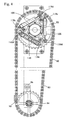
- Fig. 4 shows a front view of the retractor 12 also shown shortened chain 80, wherein in the front view in front of the drive wheel 88 shown the second level with the two dampers 108 and the spring 110 can be seen.
- the dampers 108 and the springs 110 are each pivotally mounted at both ends by means of pivot bearings 118.
- the designated with 118d pivot bearings of the damper 108 and the spring 110 are connected to the drive wheel 88.
- the bearings labeled 118c are connected to a third disk 116, which is best viewed in cross-sectional view of FIG Fig. 5 or the perspective view of Fig. 7 can be seen.
- the drive shaft 106 is rigidly connected to a first disc 112.
- the first disc 112 is with respect to the front view of Fig. 1 arranged behind the drive wheel 88.
- the dampers 108 and the first damping plane spring 110 are pivotally supported at one end to the bearings 118a.
- the bearings 118a are best in the perspective view of FIG Fig. 8 or the top view of Fig. 9 refer to.
- a second disc 114 is arranged, on which the two dampers 108 and the spring 110 of the first damping plane are pivotally mounted by means of bearings 118b.
- the second disc 114 is rigidly connected to the third disc 116 via bolts 138.
- the drive wheel 88 between the second and the third disc 114, 116 is arranged.
- the bolts 138 are guided through large recesses 134 in the drive wheel 88, so that the second and third pulley 114, 116 can be rotated relative to the drive wheel 88 over a predetermined range.
- the two dampers 108 and the spring 110 are also in the plane of the third disc 116 in the second damping plane. Via the pivot bearings 118c, 118d, two dampers and a spring connect the third disc 116 to the drive wheel 88.
- the drive wheel 88 is rigidly connected to a sleeve 119.
- the sleeve 119 is rotatably supported by means of a first ball bearing 120 and a second needle bearing 126 on the drive shaft 106 and its extension. Twistable relative to the sleeve 119, the second disc 114 is mounted by means of a first needle bearing 124.
- the third disc 116 is also rotatably mounted on the sleeve 119 by means of a second ball bearing 122.
- the first disc 112 is rigidly connected to the shaft 106
- the sleeve 119 with the drive wheel 88 is rotatably mounted relative to the shaft 106
- the rigidly connected second and third discs 114, 116 are rotatably mounted relative to the sleeve 119 (and thus also rotatable relative to the shaft 106).
- the deceleration unit 100 now acts so that, as soon as the return cam 90 of the retractor 12 abuts against the stop 44 of the hammer 40, the return cam 90 together with the guide chain 80 and the drive wheel 88 is braked due to the inertia (or intrinsic momentum) of the hammer 40.
- the deceleration is now not rigidly transmitted to the NC motor 102, but the delay unit 100 causes a delay. While this delay, the drive motor 102 rotates the drive shaft 106 unchanged in the direction in which the remindstellmit supportive 90 would be pulled up, but the drive wheel 88 no longer follows the rotational speed of the shaft 106.
- the first extended piston rods of the damper 108th pushed in both planes in the cylinder and at the same time the spring 110 is tensioned by compression. That is, in the first damping plane, the distance between the bearings 118a and 118b of the respective damper or on the spring is shortened, and in the second plane, the distance between the pairs of bearings 118c and 118d is shortened accordingly.
- the damping forces and the restoring forces are the same by the spring 110 in both damping planes, so that, for example, when the drive wheel 88 and rotation of the shaft 106 by 30 °, the strokes of the dampers and springs are divided among themselves, so that the interconnected second and third Disc 114, 116 experienced a rotation by 15 ° relative to the shaft 106.
- the 10A to 10C show the first and second damping level with fully retracted piston rod on the damper 108 and at maximum compressed spring 110th
- Fig. 10D shows the arrangement with fully extended piston of the damper 108 and fully restored spring 110th
- FIG. 5 The cross-sectional view of Fig. 5 shows that the bolts 138, which are attached to the third disc 116 and rigidly connect the second and third discs 114, 116, have a sleeve 136 over the pin 138 in the area between the two discs 114, 116.
- damping stops 130 are arranged, for example, damping stops made of polyurethane. Just before the maximum compression of the dampers 108 and the spring 110 in the second damping plane (in the plane of the third disc 116), the outer periphery of the damping stops 130 comes to the inner walls of the recess 134 of the drive wheel 88 to the plant.
- the rotation of the first disc 112 relative to the second disc 114 is limited by an elastic damping stop 130 and a metallic stop 128.
- the damping stop 130 and the metallic stop 128 for the first damping plane are connected to the ends of the bolts 138 which lie in the plane of the first disc 112.
- Fig. 11 Fig. 12 schematically illustrates the 'capture' of the rebounding hammer 40 by the return cam 90 in the course of the flight parabola at three different rebound heights of the hammer.
- the flight parabola H 1 shows the height / time diagram (h / t diagram) at a maximum rebound height of approximately 0.3 m, the parabola H2 at approximately 0.5 m and the parabola H3 at approximately 1 m rebound height h.
- 0 sec denotes the time of impact of the hammer on the movable die 22 and the time at which the hammer 40 has deflected the movable die 22 maximally downwards.
- the straight line R can be seen that the remindstellmit disturbing 90 already before the time 0 sec in motion and moves in the example shown with 2 m / sec upwards.
- the zero position 0 m passes the remindstellmit legislative 90 shortly after the hammer hit the movable die 22 and shortly after reaching the lower reversal point of the die 22.
- the speed that the remindstellmit legislative 90 already at 0 sec or at height h 0 m, ensures that the remindstellmit disruptive 90 is delivered very quickly to the stop 44, when in normal operating conditions, the hammer stops in the position 0 m and not rebounds. Should the rebound take place as in Fig. 11 illustrated, the hammer 40 is caught as a function of the maximum rebound height at the intersections of the straight line R with the flight parables H1, H2 or H3 by the driver 90 '. On the one hand, this prevents the hammer striking the movable die again and, on the other hand, that the delivery from the capture point to the transfer point of the acceleration assembly 10 is not delayed.
- the speed of the remindstellmit supportives 90 is adapted to that of the hammer 40 and gradually then takes place acceleration (when the hammer is at rest or has an upward movement) or a deceleration of the hammer (if this after reaching the maximum rebound height already back towards the cutting unit 8) and then gradually adjusting the speed of the hammer 40 to the speed given by the drive shaft 106. (A further adjustment of the relative speeds and thus an even gentler damping or deceleration is described below.)
- Fig. 12 schematically shows the control structure of the impact cutting machine 2.
- a control unit 150 controls the sequence of a separation cycle and outputs the corresponding drive signals to a power controller 152 for the drive motor 58 of the accelerator 10, to a power controller 152 for the NC motor 102 of the returner 12 and to a hydraulic unit 156, with which the pressurization and depressurizing switching or resetting of the actuating element 66 takes place.
- the control unit 150 receives the rotational position of the deflection wheel 84 reported by the rotation sensor 86 and the signal for the end position of the position sensor 68 with respect to the end position of the chain guide 64.
- the controller 150 By detecting the position of remindstellmit supplementss 90 via the corresponding relationship of the rotational position message by the rotation sensor 86, the controller 150 detects when the recess 42 has reached the height of the driver 60. At this moment the NC motor 102 is turned off and the actuator 66 is actuated, so that the driver 60 is inserted into the recess 42 of the hammer 40. If this is positively reported back by the end position sensor 68, the control unit 150 via power controller 154 to the NC motor 102 so that it runs backwards and leads the remindstellmit legislative down until the remindstellmit legislative 90 is in the deflection of the guide wheel 84.
- the acceleration of the hammer by the accelerator 10 starts, and the cam 60 is pulled down at a predetermined acceleration by driving the driving motor 58.
- the acceleration by the driver 60 takes place until shortly before reaching the deflection of the driver 60 at the lower guide wheel 52.
- the speed of the driver 60th set so that the hammer 40 and the driver 60 have the same speed, so no acceleration of hammer on driver or driver is applied to hammer. This can be pulled almost without force from the recess 42 with insertion of the deflection at the lower guide wheel 52 of the driver.
- the hammer flies force-free (apart from the gravitational pull) to the movable die 22 and executes the blow there.
- the motor 102 pulls the reminds before the blow was again controlled by the control device of the power controller 154, so that the motor 102 pulls the remindstellmit legislative 90 upwards.
- the hammer 40 rests on the movable die 22, the remindstellmit supportive 90 comes into contact with the stop 44 in the position in which the stop 44 in Fig. 2 is shown.
- the hydraulically operated restoring device 28 has already reset the movable die 22 to its basic position (see above) by corresponding activation of the hydraulic unit 156.
- the delay unit 100 is effective, which initially the speed of the remindstellmit counselings 90, the Guide chain 80 and the drive wheel 88 almost suddenly reduced. That is, the upward speed that the return cam 90 just before the stop 44 (as in Fig. 2 shown) is still braked almost to zero, since in the illustrated ideal case, the hammer 40 rests at the lower point.
- This deceleration is again detected by the control unit 150, as it detects, by means of the rotation sensor 86, that the deflection wheel 84 is not rotating at the speed it would need to rotate when the deflection wheel 84 is driven by the motor 102 without the deceleration unit 100 becoming effective ,
- the speed of the motor 102 is also reduced to a reduced drive until again a synchronization between the drive by the motor 102 and the remindstellmit supportive 90 is detected.
- the delay unit 100 is maximally deflected by the deceleration and the return cam 90 and hammer 40 have the speed they would have without the deceleration unit 100 operating by the drive of the motor 102.
- the deflecting wheel 84 or the upward speed of the return cam 90 of that of the engine 102 as soon as by relaxing the springs 110, the delay unit 100 is returned to its original, not deflected basic position.
- the drive wheel 88 rotates faster than the motor-driven shaft 106th
- the approach of the remindstellmit interventions 90 to the hammer 40 and at its stop 44 by means of the control unit 150 can be detected.
- the current position of remindstellmit medications 90 based on the signal of the rotation sensor 86 is closed - as described above.
- On the position of the hammer 40 for example by means of a hammer 40th associated position sensor or be closed by means of a distance sensor.
- the control unit 150 the power controller 154 so controls that the engine 102 braked and the relative speed between photostellmit diversity and hammer 40 is significantly reduced. Also, a gentle coupling of remindstellmit disorders 90 to the hammer 40 is possible and after the coupling can then be accelerated with gradually increasing acceleration of the hammer and returned to the transfer position.
- the position of the hammer 40 can be determined, for example, by means of a laser range finding device arranged at the upper point of the hammer guide 46.
Landscapes
- Engineering & Computer Science (AREA)
- Mechanical Engineering (AREA)
- Portable Nailing Machines And Staplers (AREA)
Claims (13)
- Dispositif (2) de coupe par percussion, comprenant
une unité de sectionnement (8) dévolue à la séparation de pièces à usiner,
une unité d'accélération (10),
un élément de percussion (40) pouvant subir une accélération vers ladite unité de sectionnement (8), sous l'action de ladite unité d'accélération,
un système de rappel (12), conçu pour présenter ledit élément de percussion (40) à un emplacement de transfert ou à une zone de transfert de ladite unité d'accélération (10),
ledit système de rappel (12) comportant un organe d'entraînement (90) disposé sur un système de guidage (80, 84, 88), et un système d'entraînement (102) conçu pour déplacer ledit organe d'entraînement au moyen dudit système de guidage,
caractérisé par
un système de décélération (100; 86, 150, 154) se présentant au moins comme un système (108, 110) à amortisseurs et/ou à ressorts et/ou un accouplement patinant et/ou un accouplement élastique, ou équipé de ce(s) dernier(s);
l'organe d'entraînement (90) étant relié au système d'entraînement (102) par l'intermédiaire dudit système de décélération (100), et
ledit système d'entraînement étant un moteur électrique. - Dispositif selon la revendication 1, dans lequel le système de guidage (80, 84, 88) présente une roue d'entraînement (88) reliée au système d'entraînement (102), sachant qu'au moins une partie du système (108, 110) à amortisseurs et/ou à ressorts couple ladite roue d'entraînement (88) audit système d'entraînement (102).
- Dispositif selon l'une des revendications précédentes, dans lequel le système de guidage (80, 84, 88), en particulier la roue d'entraînement (88), et/ou l'organe d'entraînement (90), est/sont relié(e)(s) au système d'entraînement par l'intermédiaire d'au moins deux systèmes (108, 110) à amortisseurs et/ou à ressorts, agencés en succession.
- Dispositif selon l'une des revendications précédentes, dans lequel le système de décélération (100) présente au moins un élément amortisseur hydraulique et/ou au moins un élément de rappel actionnable hydrauliquement.
- Dispositif selon l'une des revendications précédentes, dans lequel le système à amortisseurs (108) est interposé entre une roue d'entraînement (88) du système de guidage (80, 84, 88) et un arbre menant (106) du système d'entraînement (102).
- Dispositif selon l'une des revendications précédentes, dans lequel une décélération de l'organe d'entraînement (90) par rapport au système de guidage (80, 84, 88) et/ou par rapport au système d'entraînement (102), et/ou une décélération dudit système de guidage (80, 84, 88) par rapport audit système d'entraînement (102), peu(ven)t être détectée(s) au moyen d'un système de détection (86).
- Dispositif selon l'une des revendications précédentes, dans lequel un système de commande (150, 154) reçoit le signal de détection du système de détection (86) et active le système d'entraînement (102) en fonction dudit signal de détection, notamment en cas de dépassement d'une valeur de seuil dudit signal de détection.
- Dispositif selon l'une des revendications précédentes, dans lequel le système de commande (150, 154) active le système d'entraînement (102) en fonction du signal de détection, en particulier lors d'un accroissement dudit signal de détection, de manière à restreindre ou à ralentir la propulsion ou l'avance transmise à l'organe d'entraînement (90) par ledit système d'entraînement.
- Dispositif selon l'une des revendications précédentes, dans lequel le système de détection (86) est un capteur de positions et/ou de rotations, notamment un capteur de positions permettant de détecter la position ou l'excursion de l'organe d'entraînement (90) et/ou du système de guidage (80, 84, 88), ou un capteur de rotations permettant de détecter la vitesse angulaire d'un élément rotatif (84, 88) dudit système de guidage (80, 84, 88).
- Procédé de présentation à un emplacement de transfert ou à une zone de transfert, au moyen d'un système de rappel (12), d'un élément de percussion (40) dissocié d'avec une unité d'accélération (10) d'un dispositif (2) de coupe par percussion, en vue d'accoupler ledit élément de percussion (40) à ladite unité d'accélération (10),
caractérisé par le fait
qu'à l'issue d'une percussion exercée sur une unité de sectionnement (8) par l'élément de percussion (40) dissocié :un organe d'entraînement (90) en mouvement, déjà guidé au moyen d'un système de guidage (80, 84, 88), vient en applique contre l'élément de percussion (40) ou en prise avec ledit élément de percussion,une décélération dudit organe d'entraînement (90), en mouvement, s'opère avant et/ou pendant l'instauration de la venue en applique ou de la venue en prise, de telle sorte qu'une accélération initialement restreinte soit imprimée audit élément de percussion (40), par ledit organe d'entraînement, immédiatement après ou en concomitance avec la venue en applique dudit organe d'entraînement (90) contre ledit élément de percussion (40), ou la venue en prise dudit organe d'entraînement (90) avec ledit élément de percussion (40) ; sachant que ledit organe d'entraînement (90) est relié au système d'entraînement (102) par l'intermédiaire du système de décélération (100), etsachant que ledit système de décélération (100) comporte au moins un système (108, 110) à amortisseurs et/ou à ressorts et/ou un accouplement patinant et/ou un accouplement élastique. - Procédé selon la revendication 10, dans lequel la propulsion ou l'avance du système d'entraînement (102) est restreinte, au moins en partie, au stade de la détection de la décélération entre ledit système d'entraînement (102) et l'organe d'entraînement (90).
- Procédé selon la revendication 10 ou 11, dans lequel le contact entre l'organe d'entraînement (90) et l'élément de percussion (40), et/ou le rapprochement dudit organe d'entraînement vis-à-vis dudit élément de percussion, peu(ven)t être détecté(s) au moyen d'un système de détection, ledit organe d'entraînement étant freiné, par le système d'entraînement (102), lors du contact et/ou du rapprochement vis-à-vis dudit élément de percussion.
- Procédé selon la revendication 10, 11 ou 12, dans lequel l'organe d'entraînement (90) est entraîné par l'intermédiaire d'un système d'entraînement (102) et une décélération, entre ledit système d'entraînement (102) et ledit organe d'entraînement (90), est détectée au moyen d'un système de détection (86).
Applications Claiming Priority (1)
| Application Number | Priority Date | Filing Date | Title |
|---|---|---|---|
| DE200710057638 DE102007057638A1 (de) | 2007-11-30 | 2007-11-30 | Schlagschneidevorrichtung mit einer Rückstelleinrichtung |
Publications (2)
| Publication Number | Publication Date |
|---|---|
| EP2065112A1 EP2065112A1 (fr) | 2009-06-03 |
| EP2065112B1 true EP2065112B1 (fr) | 2012-05-16 |
Family
ID=40424420
Family Applications (1)
| Application Number | Title | Priority Date | Filing Date |
|---|---|---|---|
| EP20080020667 Not-in-force EP2065112B1 (fr) | 2007-11-30 | 2008-11-28 | Dispositif de coupe et de percussion doté d'un dispositif de rappel |
Country Status (2)
| Country | Link |
|---|---|
| EP (1) | EP2065112B1 (fr) |
| DE (1) | DE102007057638A1 (fr) |
Families Citing this family (4)
| Publication number | Priority date | Publication date | Assignee | Title |
|---|---|---|---|---|
| DE102009037396B4 (de) | 2009-08-13 | 2012-08-16 | Wafios Ag | Pyrotechnisch betätigte Schneidvorrichtung |
| CN102151888B (zh) * | 2011-03-23 | 2012-07-04 | 江苏金方圆数控机床有限公司 | 数控直角剪板机的主传动机构 |
| EP2559510A1 (fr) | 2011-08-19 | 2013-02-20 | Karl Klink GmbH | Dispositif de traitement, en particulier pour la séparation adiabatique d'une pièce à usiner |
| DE102011110663B4 (de) * | 2011-08-19 | 2015-05-28 | Karl Klink Gmbh Werkzeug- Und Maschinenfabrik | Vorrichtung zur Bearbeitung, insbesondere zum adiabatischen Trennen, eines Werkstücks |
Family Cites Families (2)
| Publication number | Priority date | Publication date | Assignee | Title |
|---|---|---|---|---|
| GB568752A (en) * | 1943-10-13 | 1945-04-18 | Frederick Emanuel | Improvements in or relating to drop hammers, stamps and the like |
| AU2003214090A1 (en) | 2003-03-04 | 2004-09-28 | Helmut Schuster | Impact cutting device and cutting unit therefor |
-
2007
- 2007-11-30 DE DE200710057638 patent/DE102007057638A1/de not_active Withdrawn
-
2008
- 2008-11-28 EP EP20080020667 patent/EP2065112B1/fr not_active Not-in-force
Also Published As
| Publication number | Publication date |
|---|---|
| EP2065112A1 (fr) | 2009-06-03 |
| DE102007057638A1 (de) | 2009-06-04 |
Similar Documents
| Publication | Publication Date | Title |
|---|---|---|
| DE69605635T2 (de) | Schlaggerät zum Setzen von Nieten und Verfahren zu seiner Anwendung | |
| EP2373446B1 (fr) | Procédé d'utilisation d'un marteau | |
| EP2065112B1 (fr) | Dispositif de coupe et de percussion doté d'un dispositif de rappel | |
| DE102015104762B4 (de) | Kraftfahrzeug mit Verbrennungsmotor welcher ein einstellbares Verdichtungsverhältnis aufweist | |
| EP3433193A1 (fr) | Module de butée pour maintenir un article dans une position exacte | |
| DE102013015525B4 (de) | Anschlagmodul | |
| EP0663270B1 (fr) | Marteau à percussion rotative et/ou rectiligne | |
| EP2562464B1 (fr) | Dispositif d'arrêt | |
| WO2014180774A1 (fr) | Mécanisme de déclenchement permettant de poser un élément de fixation | |
| DE102014005657B4 (de) | Anschlagmodul | |
| EP1935574B1 (fr) | Machine-outil manuelle dotée d'un mécanisme à percussion pneumatique | |
| EP1387739B1 (fr) | Marteau de demolition et/ou marteau perforateur comprenant un dispositif de percussion concu pour liberer par percussion des objets bloques | |
| EP2841219A1 (fr) | Presse de forgeage horizontale pour le formage de pièces massives | |
| DE102012003490B4 (de) | Vorrichtung zur Blechbearbeitung, umfassend eine Presse mit Stößelkisseneinrichtung, ein Werkzeug und wenigstens eine Stoßdämpfungseinrichtung zur Dämpfung von Stößen bei der Abwärtsbewegung des Pressenstößels | |
| DE4441020C1 (de) | Stoßdämpfervorrichtung für Laufwagen insbesondere für Folienreckanlagen | |
| EP0980733B1 (fr) | Cisaille de frappe pour des fils ou des barres | |
| DE102010050777A1 (de) | Spitzensicherung für einen Rangierbahnhof | |
| EP2394937B1 (fr) | Unité de manipulation destinée à déplacer des pièces et procédé associé | |
| DE3443480A1 (de) | Gleisbremsprellbock | |
| DE3828889A1 (de) | Vorrichtung zur schnellabsenkung von stromabnehmern elektrisch angetriebener fahrzeuge | |
| WO2014180771A1 (fr) | Mécanisme de rétroaction pour le retour d'un appareil de pose en une position de départ | |
| DE19848420C1 (de) | Kunststoff-Spritzgießanlage mit Handlinggerät | |
| DE19812621A1 (de) | Stoßdämpfungselement und damit ausgerüsteter Vorstoßwagen | |
| EP0260468A1 (fr) | Dispositif de cisaillage de barres | |
| WO2008040535A1 (fr) | Fendeur de bois |
Legal Events
| Date | Code | Title | Description |
|---|---|---|---|
| PUAI | Public reference made under article 153(3) epc to a published international application that has entered the european phase |
Free format text: ORIGINAL CODE: 0009012 |
|
| AK | Designated contracting states |
Kind code of ref document: A1 Designated state(s): AT BE BG CH CY CZ DE DK EE ES FI FR GB GR HR HU IE IS IT LI LT LU LV MC MT NL NO PL PT RO SE SI SK TR |
|
| AX | Request for extension of the european patent |
Extension state: AL BA MK RS |
|
| 17P | Request for examination filed |
Effective date: 20091127 |
|
| AKX | Designation fees paid |
Designated state(s): AT BE BG CH CY CZ DE DK EE ES FI FR GB GR HR HU IE IS IT LI LT LU LV MC MT NL NO PL PT RO SE SI SK TR |
|
| RAP1 | Party data changed (applicant data changed or rights of an application transferred) |
Owner name: SCHUSTER MASCHINENBAU GMBH |
|
| RIN1 | Information on inventor provided before grant (corrected) |
Inventor name: SCHUSTER, HELMUT |
|
| 17Q | First examination report despatched |
Effective date: 20100209 |
|
| GRAP | Despatch of communication of intention to grant a patent |
Free format text: ORIGINAL CODE: EPIDOSNIGR1 |
|
| GRAS | Grant fee paid |
Free format text: ORIGINAL CODE: EPIDOSNIGR3 |
|
| GRAA | (expected) grant |
Free format text: ORIGINAL CODE: 0009210 |
|
| AK | Designated contracting states |
Kind code of ref document: B1 Designated state(s): AT BE BG CH CY CZ DE DK EE ES FI FR GB GR HR HU IE IS IT LI LT LU LV MC MT NL NO PL PT RO SE SI SK TR |
|
| REG | Reference to a national code |
Ref country code: GB Ref legal event code: FG4D Free format text: NOT ENGLISH |
|
| REG | Reference to a national code |
Ref country code: CH Ref legal event code: EP |
|
| REG | Reference to a national code |
Ref country code: AT Ref legal event code: REF Ref document number: 557809 Country of ref document: AT Kind code of ref document: T Effective date: 20120615 |
|
| REG | Reference to a national code |
Ref country code: IE Ref legal event code: FG4D Free format text: LANGUAGE OF EP DOCUMENT: GERMAN |
|
| REG | Reference to a national code |
Ref country code: DE Ref legal event code: R096 Ref document number: 502008007193 Country of ref document: DE Effective date: 20120712 |
|
| REG | Reference to a national code |
Ref country code: NL Ref legal event code: VDEP Effective date: 20120516 |
|
| REG | Reference to a national code |
Ref country code: LT Ref legal event code: MG4D Effective date: 20120516 |
|
| PG25 | Lapsed in a contracting state [announced via postgrant information from national office to epo] |
Ref country code: FI Free format text: LAPSE BECAUSE OF FAILURE TO SUBMIT A TRANSLATION OF THE DESCRIPTION OR TO PAY THE FEE WITHIN THE PRESCRIBED TIME-LIMIT Effective date: 20120516 Ref country code: IS Free format text: LAPSE BECAUSE OF FAILURE TO SUBMIT A TRANSLATION OF THE DESCRIPTION OR TO PAY THE FEE WITHIN THE PRESCRIBED TIME-LIMIT Effective date: 20120916 Ref country code: PL Free format text: LAPSE BECAUSE OF FAILURE TO SUBMIT A TRANSLATION OF THE DESCRIPTION OR TO PAY THE FEE WITHIN THE PRESCRIBED TIME-LIMIT Effective date: 20120516 Ref country code: NO Free format text: LAPSE BECAUSE OF FAILURE TO SUBMIT A TRANSLATION OF THE DESCRIPTION OR TO PAY THE FEE WITHIN THE PRESCRIBED TIME-LIMIT Effective date: 20120816 Ref country code: SE Free format text: LAPSE BECAUSE OF FAILURE TO SUBMIT A TRANSLATION OF THE DESCRIPTION OR TO PAY THE FEE WITHIN THE PRESCRIBED TIME-LIMIT Effective date: 20120516 Ref country code: LT Free format text: LAPSE BECAUSE OF FAILURE TO SUBMIT A TRANSLATION OF THE DESCRIPTION OR TO PAY THE FEE WITHIN THE PRESCRIBED TIME-LIMIT Effective date: 20120516 Ref country code: CY Free format text: LAPSE BECAUSE OF FAILURE TO SUBMIT A TRANSLATION OF THE DESCRIPTION OR TO PAY THE FEE WITHIN THE PRESCRIBED TIME-LIMIT Effective date: 20120516 |
|
| PG25 | Lapsed in a contracting state [announced via postgrant information from national office to epo] |
Ref country code: GR Free format text: LAPSE BECAUSE OF FAILURE TO SUBMIT A TRANSLATION OF THE DESCRIPTION OR TO PAY THE FEE WITHIN THE PRESCRIBED TIME-LIMIT Effective date: 20120817 Ref country code: HR Free format text: LAPSE BECAUSE OF FAILURE TO SUBMIT A TRANSLATION OF THE DESCRIPTION OR TO PAY THE FEE WITHIN THE PRESCRIBED TIME-LIMIT Effective date: 20120516 Ref country code: PT Free format text: LAPSE BECAUSE OF FAILURE TO SUBMIT A TRANSLATION OF THE DESCRIPTION OR TO PAY THE FEE WITHIN THE PRESCRIBED TIME-LIMIT Effective date: 20120917 Ref country code: SI Free format text: LAPSE BECAUSE OF FAILURE TO SUBMIT A TRANSLATION OF THE DESCRIPTION OR TO PAY THE FEE WITHIN THE PRESCRIBED TIME-LIMIT Effective date: 20120516 Ref country code: LV Free format text: LAPSE BECAUSE OF FAILURE TO SUBMIT A TRANSLATION OF THE DESCRIPTION OR TO PAY THE FEE WITHIN THE PRESCRIBED TIME-LIMIT Effective date: 20120516 |
|
| PG25 | Lapsed in a contracting state [announced via postgrant information from national office to epo] |
Ref country code: SK Free format text: LAPSE BECAUSE OF FAILURE TO SUBMIT A TRANSLATION OF THE DESCRIPTION OR TO PAY THE FEE WITHIN THE PRESCRIBED TIME-LIMIT Effective date: 20120516 Ref country code: RO Free format text: LAPSE BECAUSE OF FAILURE TO SUBMIT A TRANSLATION OF THE DESCRIPTION OR TO PAY THE FEE WITHIN THE PRESCRIBED TIME-LIMIT Effective date: 20120516 Ref country code: DK Free format text: LAPSE BECAUSE OF FAILURE TO SUBMIT A TRANSLATION OF THE DESCRIPTION OR TO PAY THE FEE WITHIN THE PRESCRIBED TIME-LIMIT Effective date: 20120516 Ref country code: CZ Free format text: LAPSE BECAUSE OF FAILURE TO SUBMIT A TRANSLATION OF THE DESCRIPTION OR TO PAY THE FEE WITHIN THE PRESCRIBED TIME-LIMIT Effective date: 20120516 Ref country code: NL Free format text: LAPSE BECAUSE OF FAILURE TO SUBMIT A TRANSLATION OF THE DESCRIPTION OR TO PAY THE FEE WITHIN THE PRESCRIBED TIME-LIMIT Effective date: 20120516 Ref country code: EE Free format text: LAPSE BECAUSE OF FAILURE TO SUBMIT A TRANSLATION OF THE DESCRIPTION OR TO PAY THE FEE WITHIN THE PRESCRIBED TIME-LIMIT Effective date: 20120516 |
|
| PG25 | Lapsed in a contracting state [announced via postgrant information from national office to epo] |
Ref country code: IT Free format text: LAPSE BECAUSE OF FAILURE TO SUBMIT A TRANSLATION OF THE DESCRIPTION OR TO PAY THE FEE WITHIN THE PRESCRIBED TIME-LIMIT Effective date: 20120516 |
|
| PLBE | No opposition filed within time limit |
Free format text: ORIGINAL CODE: 0009261 |
|
| STAA | Information on the status of an ep patent application or granted ep patent |
Free format text: STATUS: NO OPPOSITION FILED WITHIN TIME LIMIT |
|
| 26N | No opposition filed |
Effective date: 20130219 |
|
| PG25 | Lapsed in a contracting state [announced via postgrant information from national office to epo] |
Ref country code: ES Free format text: LAPSE BECAUSE OF FAILURE TO SUBMIT A TRANSLATION OF THE DESCRIPTION OR TO PAY THE FEE WITHIN THE PRESCRIBED TIME-LIMIT Effective date: 20120827 |
|
| BERE | Be: lapsed |
Owner name: SCHUSTER MASCHINENBAU G.M.B.H. Effective date: 20121130 |
|
| REG | Reference to a national code |
Ref country code: DE Ref legal event code: R097 Ref document number: 502008007193 Country of ref document: DE Effective date: 20130219 |
|
| REG | Reference to a national code |
Ref country code: CH Ref legal event code: PL |
|
| GBPC | Gb: european patent ceased through non-payment of renewal fee |
Effective date: 20121128 |
|
| PG25 | Lapsed in a contracting state [announced via postgrant information from national office to epo] |
Ref country code: LI Free format text: LAPSE BECAUSE OF NON-PAYMENT OF DUE FEES Effective date: 20121130 Ref country code: CH Free format text: LAPSE BECAUSE OF NON-PAYMENT OF DUE FEES Effective date: 20121130 Ref country code: BG Free format text: LAPSE BECAUSE OF FAILURE TO SUBMIT A TRANSLATION OF THE DESCRIPTION OR TO PAY THE FEE WITHIN THE PRESCRIBED TIME-LIMIT Effective date: 20120816 |
|
| REG | Reference to a national code |
Ref country code: FR Ref legal event code: ST Effective date: 20130731 |
|
| REG | Reference to a national code |
Ref country code: IE Ref legal event code: MM4A |
|
| PG25 | Lapsed in a contracting state [announced via postgrant information from national office to epo] |
Ref country code: BE Free format text: LAPSE BECAUSE OF NON-PAYMENT OF DUE FEES Effective date: 20121130 |
|
| PG25 | Lapsed in a contracting state [announced via postgrant information from national office to epo] |
Ref country code: IE Free format text: LAPSE BECAUSE OF NON-PAYMENT OF DUE FEES Effective date: 20121128 |
|
| PG25 | Lapsed in a contracting state [announced via postgrant information from national office to epo] |
Ref country code: GB Free format text: LAPSE BECAUSE OF NON-PAYMENT OF DUE FEES Effective date: 20121128 Ref country code: FR Free format text: LAPSE BECAUSE OF NON-PAYMENT OF DUE FEES Effective date: 20121130 Ref country code: MT Free format text: LAPSE BECAUSE OF FAILURE TO SUBMIT A TRANSLATION OF THE DESCRIPTION OR TO PAY THE FEE WITHIN THE PRESCRIBED TIME-LIMIT Effective date: 20120516 |
|
| PG25 | Lapsed in a contracting state [announced via postgrant information from national office to epo] |
Ref country code: TR Free format text: LAPSE BECAUSE OF FAILURE TO SUBMIT A TRANSLATION OF THE DESCRIPTION OR TO PAY THE FEE WITHIN THE PRESCRIBED TIME-LIMIT Effective date: 20120516 Ref country code: MC Free format text: LAPSE BECAUSE OF NON-PAYMENT OF DUE FEES Effective date: 20121130 |
|
| PG25 | Lapsed in a contracting state [announced via postgrant information from national office to epo] |
Ref country code: LU Free format text: LAPSE BECAUSE OF NON-PAYMENT OF DUE FEES Effective date: 20121128 |
|
| PG25 | Lapsed in a contracting state [announced via postgrant information from national office to epo] |
Ref country code: HU Free format text: LAPSE BECAUSE OF FAILURE TO SUBMIT A TRANSLATION OF THE DESCRIPTION OR TO PAY THE FEE WITHIN THE PRESCRIBED TIME-LIMIT Effective date: 20081128 |
|
| REG | Reference to a national code |
Ref country code: AT Ref legal event code: MM01 Ref document number: 557809 Country of ref document: AT Kind code of ref document: T Effective date: 20131128 |
|
| PG25 | Lapsed in a contracting state [announced via postgrant information from national office to epo] |
Ref country code: AT Free format text: LAPSE BECAUSE OF NON-PAYMENT OF DUE FEES Effective date: 20131128 |
|
| PGFP | Annual fee paid to national office [announced via postgrant information from national office to epo] |
Ref country code: DE Payment date: 20151126 Year of fee payment: 8 |
|
| REG | Reference to a national code |
Ref country code: DE Ref legal event code: R119 Ref document number: 502008007193 Country of ref document: DE |
|
| PG25 | Lapsed in a contracting state [announced via postgrant information from national office to epo] |
Ref country code: DE Free format text: LAPSE BECAUSE OF NON-PAYMENT OF DUE FEES Effective date: 20170601 |