EP2065387A2 - Quarzglas-Mikrophotoreaktor und Synthese von 10-Hydroxycamptothecin und 7-Alkyl-10-hydroxycamptothecin - Google Patents
Quarzglas-Mikrophotoreaktor und Synthese von 10-Hydroxycamptothecin und 7-Alkyl-10-hydroxycamptothecin Download PDFInfo
- Publication number
- EP2065387A2 EP2065387A2 EP08019467A EP08019467A EP2065387A2 EP 2065387 A2 EP2065387 A2 EP 2065387A2 EP 08019467 A EP08019467 A EP 08019467A EP 08019467 A EP08019467 A EP 08019467A EP 2065387 A2 EP2065387 A2 EP 2065387A2
- Authority
- EP
- European Patent Office
- Prior art keywords
- camptothecin
- hydroxycamptothecin
- plates
- oxide
- alkyl
- Prior art date
- Legal status (The legal status is an assumption and is not a legal conclusion. Google has not performed a legal analysis and makes no representation as to the accuracy of the status listed.)
- Granted
Links
- VYPSYNLAJGMNEJ-UHFFFAOYSA-N Silicium dioxide Chemical compound O=[Si]=O VYPSYNLAJGMNEJ-UHFFFAOYSA-N 0.000 title claims abstract description 23
- VSJKWCGYPAHWDS-UHFFFAOYSA-N dl-camptothecin Natural products C1=CC=C2C=C(CN3C4=CC5=C(C3=O)COC(=O)C5(O)CC)C4=NC2=C1 VSJKWCGYPAHWDS-UHFFFAOYSA-N 0.000 title claims abstract description 16
- HAWSQZCWOQZXHI-FQEVSTJZSA-N 10-Hydroxycamptothecin Chemical compound C1=C(O)C=C2C=C(CN3C4=CC5=C(C3=O)COC(=O)[C@]5(O)CC)C4=NC2=C1 HAWSQZCWOQZXHI-FQEVSTJZSA-N 0.000 title claims abstract description 9
- HAWSQZCWOQZXHI-UHFFFAOYSA-N CPT-OH Natural products C1=C(O)C=C2C=C(CN3C4=CC5=C(C3=O)COC(=O)C5(O)CC)C4=NC2=C1 HAWSQZCWOQZXHI-UHFFFAOYSA-N 0.000 title claims abstract description 9
- 230000015572 biosynthetic process Effects 0.000 title description 3
- 238000003786 synthesis reaction Methods 0.000 title description 2
- 238000000034 method Methods 0.000 claims abstract description 22
- 230000005855 radiation Effects 0.000 claims abstract description 17
- QOJFTZYHCMXUHG-FQEVSTJZSA-N (4s)-4-ethyl-4-hydroxy-1h-pyrano[3',4':6,7]indolizino[1,2-b]quinoline-3,14(4h,12h)-dione 6-oxide Chemical compound C1=C2C=CC=CC2=[N+]([O-])C2=C1CN(C1=O)C2=CC2=C1COC(=O)[C@]2(O)CC QOJFTZYHCMXUHG-FQEVSTJZSA-N 0.000 claims abstract description 12
- 238000002360 preparation method Methods 0.000 claims abstract description 6
- ZMXDDKWLCZADIW-UHFFFAOYSA-N N,N-Dimethylformamide Chemical group CN(C)C=O ZMXDDKWLCZADIW-UHFFFAOYSA-N 0.000 claims description 27
- 239000012530 fluid Substances 0.000 claims description 19
- RYHBNJHYFVUHQT-UHFFFAOYSA-N 1,4-Dioxane Chemical compound C1COCCO1 RYHBNJHYFVUHQT-UHFFFAOYSA-N 0.000 claims description 9
- 239000000203 mixture Substances 0.000 claims description 9
- 239000002904 solvent Substances 0.000 claims description 4
- 238000001914 filtration Methods 0.000 claims 1
- 239000007788 liquid Substances 0.000 abstract description 2
- 239000000243 solution Substances 0.000 description 19
- XLYOFNOQVPJJNP-UHFFFAOYSA-N water Substances O XLYOFNOQVPJJNP-UHFFFAOYSA-N 0.000 description 13
- VSJKWCGYPAHWDS-FQEVSTJZSA-N camptothecin Chemical class C1=CC=C2C=C(CN3C4=CC5=C(C3=O)COC(=O)[C@]5(O)CC)C4=NC2=C1 VSJKWCGYPAHWDS-FQEVSTJZSA-N 0.000 description 9
- 239000011521 glass Substances 0.000 description 8
- KLWPJMFMVPTNCC-UHFFFAOYSA-N Camptothecin Natural products CCC1(O)C(=O)OCC2=C1C=C3C4Nc5ccccc5C=C4CN3C2=O KLWPJMFMVPTNCC-UHFFFAOYSA-N 0.000 description 7
- 229940127093 camptothecin Drugs 0.000 description 7
- 239000000047 product Substances 0.000 description 7
- 230000003595 spectral effect Effects 0.000 description 7
- IJGRMHOSHXDMSA-UHFFFAOYSA-N Atomic nitrogen Chemical compound N#N IJGRMHOSHXDMSA-UHFFFAOYSA-N 0.000 description 6
- QAOWNCQODCNURD-UHFFFAOYSA-N Sulfuric acid Chemical compound OS(O)(=O)=O QAOWNCQODCNURD-UHFFFAOYSA-N 0.000 description 6
- FJHBVJOVLFPMQE-QFIPXVFZSA-N 7-Ethyl-10-Hydroxy-Camptothecin Chemical compound C1=C(O)C=C2C(CC)=C(CN3C(C4=C([C@@](C(=O)OC4)(O)CC)C=C33)=O)C3=NC2=C1 FJHBVJOVLFPMQE-QFIPXVFZSA-N 0.000 description 5
- 239000011248 coating agent Substances 0.000 description 5
- 238000000576 coating method Methods 0.000 description 5
- 238000004519 manufacturing process Methods 0.000 description 5
- 238000003756 stirring Methods 0.000 description 5
- MYQKIWCVEPUPIL-QFIPXVFZSA-N 7-ethylcamptothecin Chemical compound C1=CC=C2C(CC)=C(CN3C(C4=C([C@@](C(=O)OC4)(O)CC)C=C33)=O)C3=NC2=C1 MYQKIWCVEPUPIL-QFIPXVFZSA-N 0.000 description 4
- WEVYAHXRMPXWCK-UHFFFAOYSA-N Acetonitrile Chemical compound CC#N WEVYAHXRMPXWCK-UHFFFAOYSA-N 0.000 description 4
- HEDRZPFGACZZDS-UHFFFAOYSA-N Chloroform Chemical compound ClC(Cl)Cl HEDRZPFGACZZDS-UHFFFAOYSA-N 0.000 description 4
- QSHDDOUJBYECFT-UHFFFAOYSA-N mercury Chemical compound [Hg] QSHDDOUJBYECFT-UHFFFAOYSA-N 0.000 description 4
- 229910052753 mercury Inorganic materials 0.000 description 4
- 229910001507 metal halide Inorganic materials 0.000 description 4
- 239000012429 reaction media Substances 0.000 description 4
- YMWUJEATGCHHMB-UHFFFAOYSA-N Dichloromethane Chemical compound ClCCl YMWUJEATGCHHMB-UHFFFAOYSA-N 0.000 description 3
- OKKJLVBELUTLKV-UHFFFAOYSA-N Methanol Chemical compound OC OKKJLVBELUTLKV-UHFFFAOYSA-N 0.000 description 3
- 239000002253 acid Substances 0.000 description 3
- 239000006227 byproduct Substances 0.000 description 3
- 229910052757 nitrogen Inorganic materials 0.000 description 3
- 230000035515 penetration Effects 0.000 description 3
- 125000006850 spacer group Chemical group 0.000 description 3
- 238000001228 spectrum Methods 0.000 description 3
- 239000007858 starting material Substances 0.000 description 3
- 150000007513 acids Chemical class 0.000 description 2
- 238000003491 array Methods 0.000 description 2
- 238000006243 chemical reaction Methods 0.000 description 2
- 239000007795 chemical reaction product Substances 0.000 description 2
- 239000011552 falling film Substances 0.000 description 2
- 238000007654 immersion Methods 0.000 description 2
- 239000000543 intermediate Substances 0.000 description 2
- -1 metal halide ions Chemical class 0.000 description 2
- 150000005309 metal halides Chemical class 0.000 description 2
- 229910001220 stainless steel Inorganic materials 0.000 description 2
- 239000010935 stainless steel Substances 0.000 description 2
- 238000003860 storage Methods 0.000 description 2
- 239000000126 substance Substances 0.000 description 2
- BQMLWEKOSHSOFT-UHFFFAOYSA-N 1-ethoxy-2,2-dimethylpropane Chemical compound CCOCC(C)(C)C BQMLWEKOSHSOFT-UHFFFAOYSA-N 0.000 description 1
- ZAFNJMIOTHYJRJ-UHFFFAOYSA-N Diisopropyl ether Chemical compound CC(C)OC(C)C ZAFNJMIOTHYJRJ-UHFFFAOYSA-N 0.000 description 1
- XTHFKEDIFFGKHM-UHFFFAOYSA-N Dimethoxyethane Chemical compound COCCOC XTHFKEDIFFGKHM-UHFFFAOYSA-N 0.000 description 1
- 239000002841 Lewis acid Substances 0.000 description 1
- BZLVMXJERCGZMT-UHFFFAOYSA-N Methyl tert-butyl ether Chemical compound COC(C)(C)C BZLVMXJERCGZMT-UHFFFAOYSA-N 0.000 description 1
- 150000001204 N-oxides Chemical class 0.000 description 1
- BQCADISMDOOEFD-UHFFFAOYSA-N Silver Chemical compound [Ag] BQCADISMDOOEFD-UHFFFAOYSA-N 0.000 description 1
- 239000000654 additive Substances 0.000 description 1
- 230000000712 assembly Effects 0.000 description 1
- 238000000429 assembly Methods 0.000 description 1
- 239000005388 borosilicate glass Substances 0.000 description 1
- 230000009172 bursting Effects 0.000 description 1
- 150000001735 carboxylic acids Chemical class 0.000 description 1
- 238000004440 column chromatography Methods 0.000 description 1
- 230000000052 comparative effect Effects 0.000 description 1
- 150000001875 compounds Chemical class 0.000 description 1
- 238000009833 condensation Methods 0.000 description 1
- 230000005494 condensation Effects 0.000 description 1
- 239000004035 construction material Substances 0.000 description 1
- 238000001816 cooling Methods 0.000 description 1
- 239000012043 crude product Substances 0.000 description 1
- SBZXBUIDTXKZTM-UHFFFAOYSA-N diglyme Chemical compound COCCOCCOC SBZXBUIDTXKZTM-UHFFFAOYSA-N 0.000 description 1
- 239000013013 elastic material Substances 0.000 description 1
- 239000007789 gas Substances 0.000 description 1
- 238000010438 heat treatment Methods 0.000 description 1
- AMGQUBHHOARCQH-UHFFFAOYSA-N indium;oxotin Chemical compound [In].[Sn]=O AMGQUBHHOARCQH-UHFFFAOYSA-N 0.000 description 1
- 238000009776 industrial production Methods 0.000 description 1
- 229910052500 inorganic mineral Inorganic materials 0.000 description 1
- 150000007517 lewis acids Chemical class 0.000 description 1
- 239000000463 material Substances 0.000 description 1
- 229910052751 metal Inorganic materials 0.000 description 1
- 239000002184 metal Substances 0.000 description 1
- 239000007769 metal material Substances 0.000 description 1
- 239000011707 mineral Substances 0.000 description 1
- 238000006552 photochemical reaction Methods 0.000 description 1
- 238000006303 photolysis reaction Methods 0.000 description 1
- 238000010672 photosynthesis Methods 0.000 description 1
- 230000015843 photosynthesis, light reaction Effects 0.000 description 1
- 239000002244 precipitate Substances 0.000 description 1
- 239000010453 quartz Substances 0.000 description 1
- 239000011541 reaction mixture Substances 0.000 description 1
- 230000035484 reaction time Effects 0.000 description 1
- 239000004065 semiconductor Substances 0.000 description 1
- 239000000741 silica gel Substances 0.000 description 1
- 229910002027 silica gel Inorganic materials 0.000 description 1
- 229910052709 silver Inorganic materials 0.000 description 1
- 239000004332 silver Substances 0.000 description 1
- 239000007787 solid Substances 0.000 description 1
- 150000003460 sulfonic acids Chemical class 0.000 description 1
- 238000005496 tempering Methods 0.000 description 1
Images


Classifications
-
- C—CHEMISTRY; METALLURGY
- C07—ORGANIC CHEMISTRY
- C07D—HETEROCYCLIC COMPOUNDS
- C07D491/00—Heterocyclic compounds containing in the condensed ring system both one or more rings having oxygen atoms as the only ring hetero atoms and one or more rings having nitrogen atoms as the only ring hetero atoms, not provided for by groups C07D451/00 - C07D459/00, C07D463/00, C07D477/00 or C07D489/00
- C07D491/22—Heterocyclic compounds containing in the condensed ring system both one or more rings having oxygen atoms as the only ring hetero atoms and one or more rings having nitrogen atoms as the only ring hetero atoms, not provided for by groups C07D451/00 - C07D459/00, C07D463/00, C07D477/00 or C07D489/00 in which the condensed system contains four or more hetero rings
-
- B—PERFORMING OPERATIONS; TRANSPORTING
- B01—PHYSICAL OR CHEMICAL PROCESSES OR APPARATUS IN GENERAL
- B01J—CHEMICAL OR PHYSICAL PROCESSES, e.g. CATALYSIS OR COLLOID CHEMISTRY; THEIR RELEVANT APPARATUS
- B01J19/00—Chemical, physical or physico-chemical processes in general; Their relevant apparatus
- B01J19/0093—Microreactors, e.g. miniaturised or microfabricated reactors
-
- B—PERFORMING OPERATIONS; TRANSPORTING
- B01—PHYSICAL OR CHEMICAL PROCESSES OR APPARATUS IN GENERAL
- B01J—CHEMICAL OR PHYSICAL PROCESSES, e.g. CATALYSIS OR COLLOID CHEMISTRY; THEIR RELEVANT APPARATUS
- B01J2219/00—Chemical, physical or physico-chemical processes in general; Their relevant apparatus
- B01J2219/00781—Aspects relating to microreactors
- B01J2219/00788—Three-dimensional assemblies, i.e. the reactor comprising a form other than a stack of plates
-
- B—PERFORMING OPERATIONS; TRANSPORTING
- B01—PHYSICAL OR CHEMICAL PROCESSES OR APPARATUS IN GENERAL
- B01J—CHEMICAL OR PHYSICAL PROCESSES, e.g. CATALYSIS OR COLLOID CHEMISTRY; THEIR RELEVANT APPARATUS
- B01J2219/00—Chemical, physical or physico-chemical processes in general; Their relevant apparatus
- B01J2219/00781—Aspects relating to microreactors
- B01J2219/00851—Additional features
- B01J2219/00858—Aspects relating to the size of the reactor
- B01J2219/00862—Dimensions of the reaction cavity itself
-
- B—PERFORMING OPERATIONS; TRANSPORTING
- B01—PHYSICAL OR CHEMICAL PROCESSES OR APPARATUS IN GENERAL
- B01J—CHEMICAL OR PHYSICAL PROCESSES, e.g. CATALYSIS OR COLLOID CHEMISTRY; THEIR RELEVANT APPARATUS
- B01J2219/00—Chemical, physical or physico-chemical processes in general; Their relevant apparatus
- B01J2219/00781—Aspects relating to microreactors
- B01J2219/00925—Irradiation
- B01J2219/00934—Electromagnetic waves
- B01J2219/00936—UV-radiations
Definitions
- the invention relates to processes for the preparation of 10-hydroxycamptothecin and of 7-alkyl-10-hydroxycamptothecin and to devices for carrying out the processes.
- EP 0 074 256 A1 (Camptothecin derivatives, process for preparing same, formulating with such derivatives and their use") and US 4,545,880 (“Photochemical process for preparing camptothecin derivatives", Example 7) describe the preparation of 10-hydroxycamptothecin and 7-alkyl-10-hydroxycamptothecin by irradiation of camptothecin-N-oxide or 7-alkyl-camptothecin-N-oxide in a solvent , preferably dioxane, acetonitrile, chloroform, dichloromethane, glyme, diglyme and mixtures thereof, with the addition of water in the presence of an acid, preferably mineral acids, organic sulfonic acids, Lewis acids and organic carboxylic acids.
- the irradiation of the reaction mixture with UV light is carried out according to the then known prior art using a mercury lamp.
- JP2006290765A (“Method for the production of 7-alkyl-10-hydroxycamptothecins") relates to the synthesis of 7-alkyl-10-hydroxycamptothecines from 7-alkylcamptothecin-N-oxides, wherein in the presence of acids with UV light is irradiated.
- the reaction time is given as 100 minutes and the yield as 79.2%.
- UV rays whose wavelength range is designed to emit wavelengths shorter than 370 nm is proposed ,
- light is irradiated in the range of 370 to 480 nm (low pressure mercury lamp 370-480 nm, metal halide lamp 400-430 nm, light emitting diode 405 nm, laser diode 405 nm).
- the content of 7-ethyl-camptothecin according to JP 2006290765 from about 12% to 3.8%.
- a yield increase from about 50% to 80% could be achieved by using a flow tube reactor instead of a batch reactor.
- d is 40 microns to 100 microns.
- the fluid flow is advantageously cuboid (length I, width b, thickness d). Preference is irradiated from both sides parallel to the thickness d. In a likewise preferred embodiment, light is irradiated in the range from 350 to 400 nm.
- Suitable light sources are z. Low-pressure mercury lamps with suitable spectral filters (350-400 nm), LEDs (light-emitting diodes (375 nm and 385 nm, respectively).
- the content of 7-alkyl camptothecin by-products can be greatly reduced ,
- the concentration of the solutions of 7-alkyl camptothecin- N- oxide to be irradiated can be increased from 0.1% previously described to up to 3% and beyond ,
- the by-product spectrum can be significantly improved.
- the temperature of the fluid stream is 40-80 ° C.
- Photochemical irradiation of a 0.1% solution of 7-ethyl-camptothecin-N-oxide to produce 7-ethyl-10-hydroxycamptothecin in a photoreactor (falling film photoreactor according to Dr. de Meijere, storage vessel 1000 ml) with Hg high-pressure radiator as a dive light (Heraeus Noblelight, type TQ 718 Z 2, emit about 10% of the total power in the range of 350 to 400 nm).
- 7-Ethyl camptothecin- N- oxide (150 g, 0.382 mol) is dissolved in a mixture of 1,4-dioxane (46 L), N, N-dimethylformamide (2.7 L), water (38 g) and concentrated sulfuric acid (38 g). and delivered via two serially arranged microphotoreactors type A at a flow rate of 600 ml / h and a fluid temperature of 70-75 ° C. The irradiated solution is then concentrated in vacuo to 200 ml. The resulting mixture is then added with stirring at 15 to 30 ° C in water (6.3 L) and stirred. The product is filtered, washed three times with water (1.5 L) and dried at 50 ° C in a stream of nitrogen. Content of 7-ethyl camptothecin 2.8%. Yield: 127 g (85%).
- 7-Ethyl camptothecin N-oxide (150 g, 0.382 mol) is dissolved in a mixture of 1,4-dioxane (23.1 L), N, N-dimethylformamide (1.4 L), water (38 g) and concentrated sulfuric acid (38 g). dissolved and conveyed through a quartz glass microphotoreactor type B at a flow rate of 900 ml / h at a fluid temperature of 70-75 ° C. The irradiated solution is then concentrated in vacuo to 200 ml. The resulting mixture is then added with stirring to water (6.3 L). The product is filtered, washed three times with water (1.3 L) and dried at 50 ° C in a stream of nitrogen. Yield: 143 g (95%).
- Camptothecin N-oxide (2.5 g, 0.004 mol) is dissolved in a mixture of 1,4-dioxane (833 ml), N, N- dimethylformamide (167 ml), water (2.5 ml) and concentrated sulfuric acid (1.5 ml ) at 550 ° C and conveyed through two serially arranged microphotoreactors type A at a flow rate of 480 ml / h at a fluid temperature of 70-75 ° C. The irradiated solution is then concentrated in vacuo and added with stirring to water (200 ml). The product is filtered, washed four times with water (25 ml each) and dried at 40 ° C in a vacuum. Camptothecin content 4.3% 1 . Yield: 1.75 g (70%).
- Camptothecin N-oxide (4.5 g, 0.012 mol) is dissolved in a mixture of 1,4-dioxane (833 ml), N, N- dimethylformamide (167 ml), water (4.5 ml) and concentrated sulfuric acid (2.7 ml). dissolved at 50 ° C and conveyed through a type B quartz glass microphotoreactor at a flow rate of 720 ml / h and a fluid temperature of 70-75 ° C. The irradiated solution is then concentrated in vacuo and added with stirring to water (500 ml). The product is filtered, washed with water and dried at 40 ° C in a vacuum. Yield: 4.2 g (93%). 1 The starting material contains 1% camptothecin.
- a suitable device is an improved performance of a microphotoreactor in the form of a glass flow cuvette (quartz glass micro-reactor type B) with minimized gap width, which is made so that it consists of two firmly interconnected, transparent, flat slices. These discs, which are interconnected at a defined distance, form a gap through which the solution to be irradiated can be transported via an inlet and outlet. From the outside, the glass cuvette can be irradiated with light sources that emit light of suitable wavelength. The light source can be integrated in an irradiation unit in such a way that filter discs are used which filter out unwanted wavelength ranges.
- the transparent plates of the quartz glass micro-photoreactor according to the invention are not connected to one another in a force-fitting or form-fitting manner, but are joined together in a material-locking manner. This has the significant advantage that it allows the setting of a defined gap width reproducible and precise.
- a cohesive connection allows pressure-free production of a gap by correspondingly connecting two flat plates and intermediate webs.
- Typical gap widths of the described here Quarzglasmikrophotoreaktors, made of a Quarzglas Strukturküvette be 20 microns to 1000 microns, preferred gap widths are 40 microns to 100 microns.
- An important component of a microphotoreactor is its light source and its constructive arrangement in the system.
- the arrangement of the light source in a spatially separated irradiation unit is advantageous.
- a type B quartz glass micro-photoreactor with Hg high-pressure lamps (Heraeus Noblelight) and spectral filters with a specified bandpass and two-sided coating has proven to be suitable; Emission wavelength range in the UV from 350 nm to 400 nm; Power 500 W:
- the Hg emitter can also be coated with metal halide ions.
- Microreactors as well as the quartz glass microphotoreactor described here, can become clogged if starting materials, intermediates or end products crystallize out of the reaction medium or precipitate in an amorphous manner. This leads to leaks or even bursting of the reactors. As a result, reaction medium or dissolved substances in contact with the light sources, which can take directly attached to the reactor light sources damage.
- the radiation sources are therefore preferably accommodated in a separate, closed irradiation unit, which can be installed at a defined distance and angle from the reactor surface to be irradiated.
- a preferred embodiment of such a spatially separated irradiation unit consists of an enclosure of suitable construction material, e.g. a metallic material, in suitable form, e.g. cuboid, cylindrical, conical or similar enclosing the radiation source in all directions except to the reactor. To the reactor side, this irradiation unit is completed by a transparent plate.
- suitable construction material e.g. a metallic material
- suitable form e.g. cuboid, cylindrical, conical or similar
- this transparent plate can be designed as a spectral filter, so that only light of the desired wavelength in the UV, visible and / or IR range is emitted onto the reactor.
- the spectral filter can be applied directly to the glass panes of the microphotoreactor to achieve the desired wavelength in the UV, visible and / or IR range.
- Light in the IR range can be useful in particular if heating of the photoreactor and of the medium flowing through is also to be achieved simultaneously with the light source.
- each irradiation unit at least one radiation source is installed.
- the number of radiation sources depends on the required irradiation power for the photoreaction to be performed and on whether different sources with different wavelength emissions are advantageous.
- gas discharge lamps or semiconductor light sources are used.
- the photoreactor (Falling-film photoreactor according to Dr. de Meijere) consists of an irradiation vessel (200 ml volume), with a silver-coated high-vacuum jacket with viewing strip and tempering jacket.
- the irradiation vessel In the irradiation vessel are the cooling tube made of quartz glass and the dip tube made of borosilicate glass.
- the circulation of the liquid is done with a forced circulation system Normag, which is controlled by a control unit.
- the storage vessel has a volume of 1000 ml.
- the radiation source used is a Hg high-pressure lamp TQ 718 Z2 (Heraeus Noblelight), designed as a dive light and coated with metal halide additives.
- This Hg emitter emits the characteristic Hg line spectrum, which ranges from the short-wave UV range of about the wavelength of 240 nm far into the visible area. Within this range are some intense and several weaker lines. The strongest line within the UV range is at the wavelength 366 nm. The subsequent lines in the visible range between 400 and 600 nm are often effective in photochemical reactions.
- the photoreactor consists of the assemblies reactor unit and radiator unit.
- the reactor unit consists essentially of a solid block of stainless steel (235 mm x 210 mm x 22 mm) and a glass plate (205 mm x 150 mm x 10 mm), held in a metal frame.
- the stainless steel block is used for process fluid guidance. Outside the fluid zone there is an additional 20 ⁇ Dartek® underlay. On this DartekR pad, the glass plate is pressed. The temperature control of the process fluid solution takes place via a separate flow circuit.
- the radiation source consists of an array block of 50 high power UV LED arrays with a typical emission wavelength of 385 nm and 150MW radiant power per high power UV LED array.
- the radiator unit is purged with nitrogen, on the one hand to avoid condensation of the partially cooled electrical components, on the other hand, to prevent the penetration of possibly flammable Gasgemsichen in the assembly from the outside.
- the radiation source is correctly positioned on the reactor part.
- the Quarzglasmikrophototreaktor consists of the reactor unit R and two separately completed irradiation units (radiation source).
- the reactor unit R consists essentially of two quartz glass plates P1 and P2.
- the gap depth S is defined by a spacer, which is also made of quartz glass.
- the quartz plates P1, P2 and spacers are connected flush with each other.
- the fluid stream flows through a bore at a flow rate v 2 and, before entering the irradiated zone, can pass through an inlet channel.
- Each irradiation unit (radiation source) consists of a high-pressure Hg lamp (Heraeus Noblelight) and a spectral filter with a specified bandpass and two-sided coating, so that the emission wavelength range in the UV of 350 nm to 400 nm is achieved.
- the power of the Hg high-pressure radiator is 500 W.
- the Hg radiator can also be coated with metal halide ions.
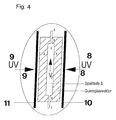
- Fig. 4 shows in cross section the reactor unit R consisting of two quartz glass panes (P1 and P2 Fig. 3 ) 1, 2, flush with a spacer 4, 5 for the gap depth S, as well as two spectral filters F.
- the incoming UV light 8, 9 is represented by the two arrows.
- a fluid flow runs at a flow rate v2 in the direction of the black arrow in the cavity indicated by 3 . It is understood that the fluid stream may pass through an entry zone before entering the irradiated zone.
Landscapes
- Chemical & Material Sciences (AREA)
- Organic Chemistry (AREA)
- Chemical Kinetics & Catalysis (AREA)
- Organic Low-Molecular-Weight Compounds And Preparation Thereof (AREA)
- Nitrogen Condensed Heterocyclic Rings (AREA)
- Physical Or Chemical Processes And Apparatus (AREA)
Abstract
Description
- Die Erfindung betrifft Verfahren zur Herstellung von 10-Hydroxycamptothecin und von 7-Alkyl-10-hydroxycamptothecin und Vorrichtungen zur Ausführung der Verfahren.
-
EP 0 074 256 A1 ("Camptothecin derivatives, process for preparing same, formulations containing such derivatives and their use") undUS 4,545,880 ("Photochemical process for preparing Camptothecin derivatives", Beispiel 7) beschreiben die Herstellung von 10-Hydroxycamptothecin und 7-Alkyl-10-hydroxycamptothecin durch Bestrahlung von Camptothecin-N-oxid bzw. 7-Alkyl-camptothecin-N-oxid in einem Lösemittel, bevorzugt Dioxan, Acetonitril, Chloroform, Dichlormethan, Glyme, Diglyme und Mischungen daraus, unter Zusatz von Wasser in Gegenwart einer Säure, bevorzugt Mineralsäuren, organischer Sulfonsäuren, Lewis-Säuren und organischer Carbonsäuren. Die Bestrahlung der Reaktionsmischung mit UV-Licht erfolgt entsprechend dem damals bekannten Stand der Technik unter Einsatz einer Quecksilberlampe. - In
EP 0 074 256 A1 wird beschrieben, dass die Reaktion der N-Oxide zu zwei verschiedenen Reaktionsprodukten führt, nämlich das an 1-Position deoxygenierte Startmaterial (Camptothecin oder 7-Alkylcamptothecin) und die gewünschten 10-Hydroxy-Derivate. 0-Hydroxycamptothecin wurde aus Camptothecin-N-oxid durch Photolyse in Dioxan/MeCN/H2O (5:4:1) in Gegenwart von H2SO4 mit 88.2% Ausbeute erhalten. - Lei et al., Chemical Research in Chinese Universities, 17 (1), 69-72 (2001), beschreiben ausgehend von Camptothecin (CAS 7689-03-4) ein dreistufiges Verfahren, das zu 7-Ethyl-10-hydroxycamptothecin (SN-38) führt, wobei in der letzten photochemischen Stufe mit einer Hg-Hochdrucklampe bestrahlt wird.
-
JP2006290765A - Durch Anwendung des Bestrahlungsspektrums 370 bis 480 nm konnte der Gehalt an 7-Ethyl-camptothecin gemäß
JP 2006290765 - Es stellt sich die Aufgabe, ein Verfahren bereitzustellen, das für die industrielle Herstellung von 10-Hydroxycamptothecin und 7-Alkyl-10-hydroxycamptothecinen geeignet ist. Darüber hinaus ist eine Aufgabe der vorliegenden Erfindung, für die photochemische Herstellung von Camptothecin-Derivaten einen geeigneten Reaktor zu entwickeln, der die Herstellung solcher Produkte und ähnlicher Verbindungen unter reproduzierbaren, ökonomischen und für den Anwender einfachen Bedingungen im industriellen Maßstab erlaubt.
- Die Erfindung betrifft Verfahren zur Herstellung von 10-Hydroxycamptothecin sowie von 7-Alkyl-10-hydroxycamptothecin, mit den Schritten
- A. Bereitstellung eines kontinuierlichen - bevorzugt quaderförmigen und/oder beidseitig bestrahlten - Fluidstroms mit Dicke d einer Lösung von Camptothecin-N-oxid bzw. 7-Alkyl-camptothecin-N-oxid;
- B. Vorbeiführen des Fluidstroms an Lichtquellen, die parallel zur Dicke d strahlen, wobei d bei 20 µm bis 1000 µm liegt.
- Bevorzugt liegt d bei 40 µm bis 100 µm. Der Fluidstrom ist mit Vorteil quaderförmig (Länge I, Breite b, Dicke d). Bevorzugt wird von beiden Seiten parallel zur Dicke d bestrahlt. In einer ebenfalls bevorzugten Ausführungsform wird mit Licht im Bereich von 350 bis 400 nm bestrahlt.
- Geeignete Lichtquellen dafür sind z. B. Niederdruck-Quecksilberlampen mit geeigneten Spektralfilter (350-400 nm), LEDs (lichtemittierende Dioden (375 nm bzw. 385 nm).
- Gemäß der vorliegenden Erfindung kann mit einer ebenen, von beiden Seiten bestrahlten Durchflussgeometrie und Nutzung von LED-Strahlungsquellen mit einer Wellenlänge von 385 nm oder Hg-Hochdruck-Strahlern mit Spektralfilter (350nm bis 400nm) der Gehalt an 7-Alkylcamptothecin-Nebenprodukten stark reduziert werden.
- Weiterhin kann gemäß der vorliegenden Erfindung durch Einsatz von Dimethylformamid (DMF) oder DMF/Dioxan als Lösemittel die Konzentration der zu bestrahlenden Lösungen von 7-Alkyl-camptothecin-N-Oxid von bisher beschriebenen 0.1 % auf bis zu 3 % und darüber hinaus gesteigert werden.
- Weiterhin konnte gefunden werden, dass bei Durchführung der Bestrahlung mit einem temperierten Fluidstrom von Camptothecin-N-oxid bzw. 7-Alkylcamptothecin-N-oxid das Nebenproduktspektrum deutlich verbessert werden kann. Im bevorzugten Fall liegt die Temperatur des Fluidstroms bei 40 - 80 °C.
- Weiterhin wurde gefunden, dass bei zweiseitiger Bestrahlung Lösungen von Camptothecin-N-Oxid und 7-Alkylcamptothecin-N-Oxid mit einer höheren Konzentration, bei einer größeren bestrahlten Schichtdicke d immer noch so vollständig durchstrahlt werden, dass eine Umsatzrate von größer 99 % bei einem hohen Fluss erzielt werden kann.
- Die folgenden Beispiele erläutern das Verfahren näher. Teile und Prozentangaben beziehen sich wie auch in der übrigen Beschreibung auf das Gewicht, sofern nicht anders angegeben.
- Photochemische Bestrahlung einer 0.1 %igen Lösung von 7-Ethyl-camptothecin-N-oxid zur Herstellung von 7-Ethyl-10-hydroxycamptothecin in einem Photoreaktor (Falling film-Photoreaktor nach Dr. de Meijere; Vorratsgefäß 1000 ml) mit Hg-Hochdruckstrahler ausgelegt als Tauchlampe (Heraeus Noblelight, Typ TQ 718 Z 2; ca. 10 % der Gesamtleistung emittieren im Bereich von 350 bis 400 nm).
- 7-Ethylcamptothecin-N-oxid (0.75 g,1.91 mmol) wird in einem Gemischaus 1,4-Dioxan (730 ml) und 1 N Schwefelsäure (1,75 ml) gelöst und in einem Photoreaktor mit Hg-Tauchlampe für 30 min bestrahlt. Die bestrahlte Lösung wird anschließend im Vakuum aufkonzentriert und unter Rühren mit t-Butylmethy-lethylether (10 ml) suspendiert, filtriert und mit Diisopropylether (10 ml) nachgewaschen. Das Produkt wird bei 50 °C im Vakuum getrocknet. Das Rohprodukt, verunreinigt mit 11 % 7-Ethylcamptothecin wird mittels Säulenchromatographie (Kieselgel; Chloroform: Methanol 90:10) gereinigt. Saubere Fraktionen werden aufkonzentriert, filtriert und mit t-Butylmethylether (10 ml) nachgewaschen. Das Produkt wird im Vakuum bei 50 °C getrocknet. Ausbeute: 0.37 g (49 %).
- Photochemische Bestrahlung einer 0.3 %igen Lösung von 7-Ethyl-camptothecin-N-oxid zur Herstellung von 7-Ethyl-10-hydroxycamptothecin in einem Mikrophotoreaktor Typ A mit Hochleistungs-LED Array (Fa. Epitex; Typ L 385-30 mit einer typischen Emmissionswellenlänge von 285 nm und 150 mW Strahlungsleistung).
- 7-Ethylcamptothecin-N-oxid (150 g, 0.382 mol) wird in einem Gemisch aus 1,4-Dioxan (46 l), N,N-Dimethylformamid (2.7 l) Wasser (38 g) und konzentrierter Schwefelsäure (38 g) gelöst und über zwei seriell angeordnete Mikrophotoreaktoren vom Typ A bei einer Flussrate von 600 ml/h und einer Fluidtemperatur von 70 -75°C gefördert. Die bestrahlte Lösung wird anschließend im Vakuum auf 200 ml eingeengt. Das erhaltene Gemisch wird dann unter Rühren bei 15 bis 30 °C in Wasser (6.3 l) gegeben und nachgerührt. Das Produkt wird filtriert, dreimal mit Wasser (1.5 l) gewaschen und bei 50 °C im Stickstoffstrom getrocknet. Gehalt an 7-Ethyl-camptothecin 2.8 %. Ausbeute: 127 g (85 %).
- Photochemische Bestrahlung einer 0.6 % igen Lösung von 7-Ethylcamptothecin-N-oxid zur Herstellung von 7-Ethyl-10-hydroxycamptothecin in einem Quarzglasmikrophotoreaktor Typ B mit Hg-Hochdruck-Strahlern (Heraeus Noblelight, medizinische UV-Einheit) und interferenz-Filtern mit spezifiziertem Bandpass sowie beidseitiger Beschichtung; Emissionswellenlängenbereich im UV von 350nm bis 400nm.
- 7-Ethylcamptothecin-N-oxid (150 g, 0.382 mol) wird in einem Gemisch aus 1,4-Dioxan (23.1 l), N,N-Dimethylformamid (1.4 l) Wasser (38 g) und konzentrierter Schwefelsäure (38 g) gelöst und über einen Quarzglas-Mikrophotoreaktor Typ B bei einer Flussrate von 900 ml/h bei einer Fluidtemperatur von 70 -75°C gefördert. Die bestrahlte Lösung wird anschließend im Vakuum auf 200 ml aufkonzentriert. Das erhaltene Gemisch wird dann unter Rühren in Wasser (6.3 l) gegeben. Das Produkt wird filtriert, dreimal mit Wasser (1.3 l) gewaschen und bei 50 °C im Stickstoffstrom getrocknet. Ausbeute: 143 g (95 %).
- Photochemische Bestrahlung einer 0.25 % igen Lösung von Camptothecin-N-oxid zur Herstellung von 10-Hydroxycamptothecin in einem Mikrophotoreaktor Typ A mit Hochleistungs-LED Arrays (Fa.Epitex, Typ L 385-30 , typische Emissionswellenlänge von 385nm und einer Strahlungsleistung von 150 mW).
- Camptothecin-N-oxid (2.5 g, 0.004 mol) wird in einem Gemisch aus 1,4-Dioxan (833 ml), N,N-Dimethyl-formamid (167 ml), Wasser (2.5 ml) und konzentrierter Schwefelsäure (1.5 ml) bei 550 °C gelöst und über zwei seriell angeordnete Mikrophotoreaktoren vom Typ A bei einer Flussrate von 480 ml/h bei einer Fluidtemperatur von 70 -75°C gefördert. Die bestrahlte Lösung wird anschließend im Vakuum aufkonzentriert und unter Rühren in Wasser (200 ml) gegeben. Das Produkt wird filtriert, viermal mit Wasser (je 25 ml) gewaschen und bei 40 °C im Vakuum getrocknet. Gehalt an Camptothecin 4.3 %1. Ausbeute: 1.75 g (70 %).
- Photochemische Bestrahlung einer 0.45 % igen Lösung von Camptothecin-N-oxid zur Herstellung von 10-Hydroxycamptothecin in einem Quarzglasmikrophotoreaktor Typ B Hg-Hochdruck-Strahlern (Heraeus Noblelight) und Interferenz-Filtern mit spezifiziertem Bandpass sowie beidseitiger Beschichtung; Emissinonswellenlängenbereich im UV von 350nm bis 400nm.
- Camptothecin-N-oxid (4.5 g, 0.012 mol) wird in einem Gemisch aus 1,4-Dioxan (833 ml), N,N-Dimethyl-formamid (167ml), Wasser (4.5 ml) und konzentrierter Schwefelsäure (2.7 ml) bei 50 °C gelöst und über einen Quarzglas-Mikrophotoreaktor Typ B bei einer Flussrate von 720 ml/h und einer Fluidtemperatur von 70 - 75°C gefördert. Die bestrahlte Lösung wird anschließend im Vakuum aufkonzentriert und unter Rühren in Wasser (500 ml) gegeben. Das Produkt wird filtriert, mit Wasser gewaschen und bei 40 °C im Vakuum getrocknet. Ausbeute: 4.2 g (93 %).
1 Das Startmaterial enthält etwas 1 % Camptothecin. - Überraschenderweise wurde gefunden, dass das Strömungsverhalten in einer in ihren Dimensionen stark vergrößerten quaderförmigen Quarzglasdurchflusszelle (siehe
Abb. 1 ) eine ausreichend homogene Durchströmung bei genau einstellbarem Verweilzeitverhalten der Lösung erlaubt. Daher eignet sich eine so konzipierte Durchflusszelle als einfach herzustellender Photoreaktor. - Eine erfindungsgemäß geeignete Vorrichtung ist eine in ihren Eigenschaften verbesserte Ausführung eines Mikrophotoreaktors in Form einer Glasdurchflussküvette (Quarzglasmikrophotoreaktor Typ B) mit minimierter Spaltbreite, die so gefertigt ist, dass sie aus zwei fest miteinander verbundenen, transparenten, ebenen Scheiben besteht. Diese in definiertem Abstand voneinander verbundenen Scheiben bilden einen Spalt, durch den die zu bestrahlende Lösung über einen Zulauf und Ablauf transportiert werden kann. Von außen lässt sich die Glasküvette mit Lichtquellen, die Licht geeigneter Wellenlänge emittieren, bestrahlen. Die Lichtquelle kann so in einer Bestrahlungseinheit integriert sein, dass Filterscheiben zum Einsatz kommen, die unerwünschte Wellenlängenbereiche herausfiltern.
- Im Unterschied zu bekannten Mikroreaktoren werden die transparenten Platten des erfindungsgemäßen Quarzglasmikrophotoreaktors nicht kraft- oder formschlüssig, sondern stoffschlüssig miteinander verbunden. Dies hat den wesentlichen Vorteil, dass es die Einstellung einer definierten Spaltbreite reproduzierbarer und präziser erlaubt.
- Werden zwei Platten kraft- oder formschlüssig miteinander verbunden, ist die Nutzung zweier transparenter, aus Glas bestehender Teile nicht bevorzugt oder ungünstig. Bei der Einstellung einer eng definierten Spaltbreite ist in jedem Fall eine Kraft senkrecht zu den Platten aufzubringen, die zur Erreichung des Spaltmasses ausreichend ist. Durch diese Krafteinwirkung kann es zu Schaden an den Glasteilen kommen. Zwischen den Glasteilen sind in diesem Fall dann elastische Materialien zu verwenden, die wiederum eine genaue Einstellung der Spaltbreite deutlich erschweren.
- Eine stoffschlüssige Verbindung erlaubt dagegen eine druckfreie Herstellung eines Spaltes durch entsprechende Verbindung zweier ebener Platten und dazwischen liegender Stege.
- In
DE 10341500 A1 wird die Eindringtiefe und damit die Spaltbreite eines Photoreaktors über das Lambert-Beersche Gesetz hergeleitet. Ein von zwei Seiten bestrahlter Quarzglasmikrophotoreaktor ergibt aus einsichtlichen Gründen eine doppelt so große Eindringtiefe des Lichts in das zu bestrahlende Medium, daher kann mit größeren und einfacher herzustellenden Spaltbreiten gearbeitet werden. Andererseits kann bei gleicher Spaltbreite auch mit Lösungen einer höheren Eduktkonzentration gearbeitet werden, was deutliche Einsparungen an Kosten für Lösemittel bewirkt. - Typische Spaltbreiten des hier beschriebenen Quarzglasmikrophotoreaktors, hergestellt aus einer Quarzglasdurchflussküvette, betragen 20 µm bis 1000 µm, bevorzugte Spaltbreiten liegen bei 40 µm bis 100 µm.
- Ein wichtiger Bestandteil eines Mikrophotoreaktors ist seine Lichtquelle und deren konstruktive Anordnung im System. Um eine gegenseitige negative Beeinflussung von Reaktionsmedium und Lichtversorgung möglichst auszuschließen, ist die Anordnung der Lichtquelle in einer räumlich getrennten Bestrahlungseinheit von Vorteil.
- Bewährt hat sich ein Quarzglasmikrophotoreaktor Typ B mit Hg-Hochdruck-Strahlern (Heraeus Noblelight) und Spektralfiltern mit spezifiziertem Bandpass sowie beidseitiger Beschichtung; Emissionswellenlängenbereich im UV von 350 nm bis 400 nm; Leistung 500 W: Der Hg-Strahler kann ebenso mit Metallhalogenidionen belegt sein.
- Mit einem einzigen solchen Reaktor bezogen können etwa 130 g pro Tag an 7-Ethyl-camptothecin-N-oxid umgesetzt werden. Durch Einsatz entsprechend parallel arbeitender Reaktorsysteme (Numbering up) lassen sich so Mengen im kg-Bereich pro Tag industriell produzieren. Es ist auch möglich, jeweils zwei Reaktoren seriell hintereinander zu schalten.
- Mikroreaktoren, wie auch der hier beschriebene Quarzglasmikrophotoreaktor, können verstopfen, wenn Edukte, Zwischen- oder Endprodukte aus dem Reaktionsmedium auskristallisieren oder sich amorph abscheiden. Dies führt zu Undichtigkeiten oder sogar zum Bersten der Reaktoren. Hierdurch tritt Reaktionsmedium oder darin gelöste Stoffe in Kontakt mit den Lichtquellen, wobei direkt auf dem Reaktor angebrachte Lichtquellen Schaden nehmen können.
- Erfindungsgemäß sind die Strahlungsquellen daher bevorzugt in einer separaten, abgeschlossenen Bestrahlungseinheit untergebracht, die in definiertem Abstand und Winkel von der zu bestrahlenden Reaktorfläche installiert werden kann.
- Eine bevorzugte Ausführungsform einer solchen räumlich getrennten Bestrahlungseinheit besteht aus einer Einhausung aus geeignetem Konstruktionsmaterial, z.B. einem metallischem Werkstoff, in geeigneter Form, z.B. quaderförmig, zylindrisch, kegelförmig oder ähnlich, die die Strahlungsquelle nach allen Seiten außer zum Reaktor hin umschließt. Zur Reaktorseite hin ist diese Bestrahlungseinheit durch eine transparente Platte abgeschlossen.
- Diese transparente Platte kann in einer weiteren bevorzugten Ausführungsform als Spektralfilter ausgeführt sein, so dass nur Licht der gewünschten Wellenlänge im UV-, sichtbaren und / oder IR-Bereich auf den Reaktor emittiert wird.
- In einer weiteren Ausführungsform kann der Spektralfilter zur Erreichung der gewünschten Wellenlänge im UV-, sichtbaren und/oder IR-Bereich direkt auf die Glasscheiben des Mikrophotoreaktors aufgebracht werden.
- Licht im IR-Bereich kann insbesondere dann nützlich sein, wenn mit der Lichtquelle auch gleichzeitig eine Beheizung des Photoreaktors und des durchströmenden Mediums erzielt werden soll.
- Eine andere Möglichkeit, das Reaktionsmedium zu erwärmen, besteht in dem Aufbringen einer dünnen Schicht von Indiumzinnoxid oder anderen Beschichtungsmaterialien mit transparentleitfähigen Eigenschaften auf die Außenfläche des Quarzglasmikrophotoreaktors. In jeder Bestrahlungseinheit ist mindestens eine Strahlenquelle installiert. Die Anzahl der Strahlungsquellen richtet sich nach der erforderlichen Bestrahlungsleistung für die durchzuführende Photoreaktion und danach, ob verschiedene Quellen mit unterschiedlichen Wellenlängenemissionen von Vorteil sind.
- In einer bevorzugten Ausführungsform werden Gasentladungslampen oder Halbleiterlichtquellen eingesetzt.
- Der Photoreaktor (Falling-film-Photoreaktor nach Dr. de Meijere) besteht aus einem Bestrahlungsgefäß (200 ml Volumen), mit einem silberverspiegelten Hochvakuummantel mit Sichtstreifen und Temperiermantel. Im Bestrahlungsgefäß befinden sich das Kühlrohr aus Quarglas sowie das Tauchrohr aus Bohrsilikatglas. Die Umwälzung der Flüssigkeit geschieht mit einer Zwangsumwälzpumpe System Normag, die über ein Regelgerät gesteuert wird. Das Vorratsgefäß hat ein Volumen von 1000 ml. Als Strahlungsquelle dient eine Hg-Hochdrucklampe TQ 718 Z2 (Heraeus Noblelight), ausgelegt als Tauchlampe, belegt mit Metallhalogenid-Zusätzen. Dieser Hg-Strahler emittiert das charakteristische Hg-Linienspektrum, welches vom kurzwelligen UV-Bereich von etwa der Wellenlänge 240 nm bis weit in das sichtbare Gebiet reicht. Innerhalb dieses Bereiches liegen einige intensive und mehrere schwächere Linien. Die stärkste Linie innerhalb des UV-Bereiches liegt bei der Wellenlänge 366 nm. Auch die anschließenden Linien im sichtbaren Bereich zwischen 400 und 600 nm sind vielfach bei photochemischen Reaktionen wirksam.
- Der Photoreaktor besteht aus den Baugruppen Reaktoreinheit und Strahlereinheit. Die Reaktoreinheit besteht im Wesentlichen aus einem massiven Edelstahlblock (235 mm x 210 mm x 22 mm) und einer Glasplatte (205 mm x 150 mm x 10 mm), gehaltert in einer Metallfassung. Der Edelstahlblock dient der Prozessfluidführung. Außerhalb der Fluidzone befindet sich zusätzlich eine 20 µ Dartek®-Unterlage. Auf diese DartekⓇ-Unterlage wird die Glasplatte aufgepresst. Die Temperierung der Prozessfluidlösung erfolgt über einen separaten Strömungskreislauf. Die Strahlungsquelle besteht aus einem Arrayblock von 50 Hochleistungs-UV-LED-Arrays mit einer typischen Emissionswellenlänge von 385 nm und 150 MW Strahlungsleistung pro Hochleistungs-UV-LED.Array. Die Strahlereinheit wird mit Stickstoff gespült, um einerseits Kondensation von an den teilweise gekühlten elektrischen Komponenten zu vermeiden, anderseits das Eindringen von ggf. entzündlichen Gasgemsichen in die Baugruppe von außen zu verhindern. Die Strahlungsquelle wird korrekt auf dem Reaktorteil positioniert.
- Der Quarzglasmikrophototreaktor besteht aus der Reaktoreinheit R und zwei separat abgeschlossene Bestrahlungseinheiten (Strahlungsquelle).
- Die Reaktoreinheit R besteht im Wesentlichen aus zwei Quarzglasplatten P1 und P2. Die Spalttiefe S ist definiert durch einen Abstandshalter, welcher ebenso aus Quarzglas gefertigt ist. Die Quarzplatten P1, P2 und Abstandshalter sind stoffbündig miteinander verbunden.
- Der Fluidstrom fließt mit einer Durchflussgeschwindigkeit v2 durch eine Bohrung und kann, bevor er in die bestrahlte Zone kommt, einen Eintrittskanal durchlaufen.
- Jede Bestrahlungseinheit (Strahlungsquelle) besteht aus einem Hg-Hochdruck-Strahler (Heraeus Noblelight) und einem Spektralfilter mit spezifiziertem Bandpass sowie beidseitiger Beschichtung, so dass der Emissinonswellenlängenbereich im UV von 350 nm bis 400 nm erreicht wird. Die Leistung des Hg-Hochdruck-Strahlers beträgt 500 W. Der Hg-Strahler kann ebenso mit Metallhalogenidionen belegt sein.
- Die IR-Strahlung des Hg-Hochdruck-Strahlers wird zur Heizung des Fluidstroms verwendet.
-
Fig. 1 zeigt einen erfindungsgemäßen zweiseitig bestrahlten Quarzglasmikrophotoreaktor Typ B mit Reaktoreneinheit und zwei Strahlungsquellen. Die Strahlungsquellen sind bei der inFig. 1 gezeigten Vorrichtung in je einer separaten, abgeschlossenen Bestrahlungseinheit untergebracht. -
Fig. 2 zeigt die Reaktoreneinheit R mit Ein- und Ausgang (Fig. 4 6,7) des Fluidstroms mit Durchflussgeschwindigkeit v2. -
Fig. 3 zeigt die schematische Anordnung eines zweiseitig bestrahlten Quarzglasmikrophotoreaktors. - Die schematische Darstellung der
Fig. 4 zeigt im Querschnitt die Reaktoreinheit R bestehend aus zwei Quarzglasscheiben (P1 und P2Fig. 3 ) 1, 2, stoffbündig verbunden mit einem Abstandshalter 4, 5 für die Spalttiefe S, sowie zwei Spektralfilter F. Das eintretende UV-Licht 8, 9 wird von den beiden Pfeilen dargestellt. Im Reaktor läuft ein Fluidstrom mit einer Durchflussgeschwindigkeit v2 in Richtung des schwarzen Pfeils im durch 3 bezeichneten Hohlraum. Es versteht sich, dass der Fluidstrom eine Eintrittszone durchlaufen kann, bevor er in die bestrahlte Zone kommt.
Claims (12)
- Verfahren zur Herstellung von 10-Hydroxycamptothecin sowie von 7-Alkyl-10-hydroxycamptothecin, mit den SchrittenA Bereitstellung eines kontinuierlichen Fluidstroms mit Dicke d einer Lösung von Camptothecin-N-oxid oder 7-Alkyl-camptothecin-N-oxid,B Vorbeiführen des Stroms an mindestens einer Lichtquelle, die parallel zur Dicke d Licht abstrahlt, wobei d bei 10 µm bis 1000 µm liegt.
- Verfahren nach Anspruch 1, wobei der Fluidstrom rohrförmig oder quaderförmig mit Länge l, Breite b und Dicke d bereitgestellt wird.
- Vorrichtung zum Ausführen von Verfahren nach Anspruch 1, aufweisend
zwei im Abstand d von 10 µm bis 1000 µm parallel angeordnete, transparente, ebenen Quarzglas-Platten (1, 2),
zwei den Raum (3) zwischen den Platten (1, 2) an zwei einander gegenüberliegenden Seiten begrenzende Wände (4, 5),
zwei nicht durch die Wände begrenzten, einander gegenüberliegenden Öffnungen (6, 7), zwei senkrecht zu den Platten derart angeordnete Lichtquellen (8, 9),
dass deren Strahlung (8', 9') durch die beiden Platten (1, 2) in den Raum (3) dringt, dadurch gekennzeichnet, dass die Platten stoffschlüssig miteinander verbunden sind. - Vorrichtung oder Verfahren nach einem der vorstehenden Ansprüche, wobei d bei 20 µm bis 500 µm liegt.
- Vorrichtung oder Verfahren nach Anspruch 4, wobei d bei 40 µm bis 100 µm liegt.
- Vorrichtung nach Anspruch 3, bei der zwischen den Lichtquellen (8, 9) und den Quarzglas-Platten (1, 2) Filter (10, 11) zum Herausfiltern unerwünschter Wellenlängenbereiche angeordnet sind.
- Verfahren nach Anspruch 1, wobei die Lichtquelle Licht im Bereich von 350 bis 400 nm abstrahlt.
- Verfahren nach Anspruch 1, wobei die Lichtquelle mindestens eine LED-Quelle mit Licht einer Wellenlänge von 375 oder 385 nm ist.
- Verfahren nach Anspruch 1, wobei das Lösemittel aus Dimethylformamid oder einer Mischung von 1,4-Dioxan und Dimethylformamid besteht.
- Verfahren nach Anspruch 9, wobei Camptothecin-N-oxid oder 7-Alkyl-camptothecin-N-oxid in einer Konzentration von 0.1 % bis 3 % in der Lösung vorliegen.
- Verfahren nach einem der vorstehenden Ansprüche, durchgeführt simultan mit mehreren parallel betriebenen Vorrichtungen ("Numbering up") nach einem der vorstehenden Ansprüche.
- Verfahren nach einem der vorstehenden Ansprüche, durchgeführt mit mindestens zwei seriell geschalteten Vorrichtungen nach einem der vorstehenden Ansprüche.
Applications Claiming Priority (1)
| Application Number | Priority Date | Filing Date | Title |
|---|---|---|---|
| DE102007057869A DE102007057869B3 (de) | 2007-11-29 | 2007-11-29 | Quarzglas-Mikrophotoreaktor und Synthese von 10-Hydroxycamptothecin und 7-Alkyl-10-hydroxycamptothecin |
Publications (3)
| Publication Number | Publication Date |
|---|---|
| EP2065387A2 true EP2065387A2 (de) | 2009-06-03 |
| EP2065387A3 EP2065387A3 (de) | 2009-07-22 |
| EP2065387B1 EP2065387B1 (de) | 2011-01-19 |
Family
ID=40384730
Family Applications (1)
| Application Number | Title | Priority Date | Filing Date |
|---|---|---|---|
| EP08019467A Not-in-force EP2065387B1 (de) | 2007-11-29 | 2008-11-07 | Quarzglas-Mikrophotoreaktor und Synthese von 10-Hydroxycamptothecin und 7-Alkyl-10-hydroxycamptothecin |
Country Status (7)
| Country | Link |
|---|---|
| US (1) | US20090143588A1 (de) |
| EP (1) | EP2065387B1 (de) |
| KR (1) | KR20090056834A (de) |
| AT (1) | ATE496053T1 (de) |
| AU (1) | AU2008243117A1 (de) |
| CA (1) | CA2644817A1 (de) |
| DE (2) | DE102007057869B3 (de) |
Families Citing this family (3)
| Publication number | Priority date | Publication date | Assignee | Title |
|---|---|---|---|---|
| DE102010025366A1 (de) | 2010-06-28 | 2011-12-29 | Umex Gmbh Dresden | Fotoreaktor |
| DE102011106498B4 (de) * | 2011-06-15 | 2016-08-04 | Heraeus Noblelight Gmbh | Bestrahlungsmodul für Mikrophotoreaktoren |
| TWI698277B (zh) | 2015-03-26 | 2020-07-11 | 美商康寧公司 | 用於化學反應的流體反應器 |
Citations (3)
| Publication number | Priority date | Publication date | Assignee | Title |
|---|---|---|---|---|
| EP0074256A1 (de) | 1981-09-04 | 1983-03-16 | Kabushiki Kaisha Yakult Honsha | Camptothecine Derivate, Verfahren zu ihrer Herstellung, Zusammensetzungen welche diese Derivate enthalten und ihre Anwendung |
| DE10341500A1 (de) | 2003-09-05 | 2005-03-31 | Ehrfeld Mikrotechnik Ag | Mikrophotoreaktor zur Durchführung photochemischer Reaktionen |
| JP2006290765A (ja) | 2005-04-07 | 2006-10-26 | Shiratori Pharmaceutical Co Ltd | 7−アルキル−10−ヒドロキシカンプトテシン類の製造法 |
Family Cites Families (4)
| Publication number | Priority date | Publication date | Assignee | Title |
|---|---|---|---|---|
| US4088553A (en) * | 1974-06-12 | 1978-05-09 | The United States Of America As Represented By The United States Department Of Energy | Method for separating boron isotopes |
| US5779912A (en) * | 1997-01-31 | 1998-07-14 | Lynntech, Inc. | Photocatalytic oxidation of organics using a porous titanium dioxide membrane and an efficient oxidant |
| DE10209898A1 (de) * | 2002-03-05 | 2003-09-25 | Univ Schiller Jena | Photoreaktor zur Durchführung von heterogen-photokatalysierten chemischen Reaktionen |
| EP1848528B1 (de) * | 2005-02-19 | 2011-06-22 | Deutsches Zentrum für Luft- und Raumfahrt e.V. | Fotoreaktor |
-
2007
- 2007-11-29 DE DE102007057869A patent/DE102007057869B3/de not_active Expired - Fee Related
-
2008
- 2008-11-05 AU AU2008243117A patent/AU2008243117A1/en not_active Abandoned
- 2008-11-07 DE DE502008002374T patent/DE502008002374D1/de active Active
- 2008-11-07 AT AT08019467T patent/ATE496053T1/de active
- 2008-11-07 EP EP08019467A patent/EP2065387B1/de not_active Not-in-force
- 2008-11-19 KR KR1020080115077A patent/KR20090056834A/ko not_active Ceased
- 2008-11-25 US US12/277,854 patent/US20090143588A1/en not_active Abandoned
- 2008-11-26 CA CA002644817A patent/CA2644817A1/en not_active Abandoned
Patent Citations (4)
| Publication number | Priority date | Publication date | Assignee | Title |
|---|---|---|---|---|
| EP0074256A1 (de) | 1981-09-04 | 1983-03-16 | Kabushiki Kaisha Yakult Honsha | Camptothecine Derivate, Verfahren zu ihrer Herstellung, Zusammensetzungen welche diese Derivate enthalten und ihre Anwendung |
| US4545880A (en) | 1981-09-04 | 1985-10-08 | Kabushiki Kaisha Yakult Honsha | Photochemical process for preparing camptothecin derivatives |
| DE10341500A1 (de) | 2003-09-05 | 2005-03-31 | Ehrfeld Mikrotechnik Ag | Mikrophotoreaktor zur Durchführung photochemischer Reaktionen |
| JP2006290765A (ja) | 2005-04-07 | 2006-10-26 | Shiratori Pharmaceutical Co Ltd | 7−アルキル−10−ヒドロキシカンプトテシン類の製造法 |
Non-Patent Citations (1)
| Title |
|---|
| LEI ET AL., CHEMICAL RESEARCH IN CHINESE UNIVERSITIES, vol. 17, no. 1, 2001, pages 69 - 72 |
Also Published As
| Publication number | Publication date |
|---|---|
| ATE496053T1 (de) | 2011-02-15 |
| US20090143588A1 (en) | 2009-06-04 |
| AU2008243117A1 (en) | 2009-06-18 |
| CA2644817A1 (en) | 2009-05-29 |
| EP2065387A3 (de) | 2009-07-22 |
| DE502008002374D1 (de) | 2011-03-03 |
| EP2065387B1 (de) | 2011-01-19 |
| DE102007057869B3 (de) | 2009-04-02 |
| KR20090056834A (ko) | 2009-06-03 |
Similar Documents
| Publication | Publication Date | Title |
|---|---|---|
| DE69830331T2 (de) | Verfahren zur durchfürung einer chemischen reaktion | |
| DE102008017218B4 (de) | Kontinuierliches Verfahren zur Herstellung von Amiden niederer aliphatischer Carbonsäuren | |
| DE102010000718B4 (de) | Mikrofluideinheit zum Entfernen von Kohlenhydraten von einem Glykoprotein, System zum Analysieren einer Probe, Verfahren zum Analysieren der Kohlenhydratanteile von Glykoproteinen und Ausrüstung zur Glykananalyse | |
| DE102005051637A1 (de) | Reaktorsystem mit einem mikrostrukturierten Reaktor sowie Verfahren zur Durchführung einer chemischen Reaktion in einem solchen Reaktor | |
| EP2065387B1 (de) | Quarzglas-Mikrophotoreaktor und Synthese von 10-Hydroxycamptothecin und 7-Alkyl-10-hydroxycamptothecin | |
| WO2011000459A1 (de) | Kontinuierliches verfahren zur herstellung von amiden aromatischer carbonsäuren | |
| DE69802453T2 (de) | Herstellung von bioaktiven Verbindungen durch Plasmasynthese | |
| EP1265699B1 (de) | Verfahren zur metathesereaktion ungesättigter organischer verbindungen | |
| EP1296915A1 (de) | Verfahren zur übertragung von alkyliden-gruppen auf organische verbindungen | |
| EP1291077B1 (de) | Mikrowellenreaktor und Verfahren zur Steuerung von Reaktionen von aktivierten Molekülen | |
| WO2003039736A1 (de) | Mikroreaktorsystem | |
| EP1855796B1 (de) | Vorrichtung und ihre verwendung zur kontinuierlichen durchführung photochemischer prozesse | |
| DE10148615B4 (de) | Verfahren und Vorrichtung zur Durchführung chemischer Prozesse | |
| DE10014298A1 (de) | Verfahren zur Reduktion aliphatischer, aromatischer oder heterocyclischer organischer Verbindungen mittels Hydriden und/oder deren Derivaten | |
| DE4336512A1 (de) | Verfahren zur Reaktionskontrolle und ein Apparat, wobei Kohlenstoff-Rußmoleküle und organometallische Komplexe in angeregtem Zustand verwendet werden | |
| DE102004038555B3 (de) | Modularer Mikroreaktor zur Nitrierung mit Mischsäure | |
| DE19935691A1 (de) | Friedel-Crafts-Acylierung im statischen Mikromischer | |
| EP1284965B1 (de) | Verfahren zur herstellung von indolen | |
| DE10026645A1 (de) | Verfahren zur Formylierung organischer Verbindungen | |
| DE3000714A1 (de) | Vorrichtung zum gleichmaessigen verteilen eines heiz- oder kuehlmittels in einem katalytischen reaktionsraum | |
| DE2850331C2 (de) | Verfahren zur Herstellung von ggf. substituierten 2-Amino-4,6-dichlors-triazinen | |
| EP1165769B1 (de) | Verfahren zur auftrennung von in lösung befindlichen doppelsträngigen nukleinsäuren in einzelsträngige nukleinsäuren | |
| DE10016106A1 (de) | Verfahren zur Beckmann-Umlagerung organischer Oxime | |
| DE10163313B4 (de) | Verfahren und Vorrichtung zur Beeinflussung einer Reaktion von in einem Medium angeordneten Reaktionspartnern | |
| DE19840553A1 (de) | Verfahren zur Herstellung von Alkyldihalogenphosphanen durch Photoinitiierung der Alkylierung von Phosphortrihalogeniden |
Legal Events
| Date | Code | Title | Description |
|---|---|---|---|
| PUAI | Public reference made under article 153(3) epc to a published international application that has entered the european phase |
Free format text: ORIGINAL CODE: 0009012 |
|
| 17P | Request for examination filed |
Effective date: 20081117 |
|
| AK | Designated contracting states |
Kind code of ref document: A2 Designated state(s): AT BE BG CH CY CZ DE DK EE ES FI FR GB GR HR HU IE IS IT LI LT LU LV MC MT NL NO PL PT RO SE SI SK TR |
|
| AX | Request for extension of the european patent |
Extension state: AL BA MK RS |
|
| PUAL | Search report despatched |
Free format text: ORIGINAL CODE: 0009013 |
|
| AK | Designated contracting states |
Kind code of ref document: A3 Designated state(s): AT BE BG CH CY CZ DE DK EE ES FI FR GB GR HR HU IE IS IT LI LT LU LV MC MT NL NO PL PT RO SE SI SK TR |
|
| AX | Request for extension of the european patent |
Extension state: AL BA MK RS |
|
| 17Q | First examination report despatched |
Effective date: 20091013 |
|
| AKX | Designation fees paid |
Designated state(s): AT BE BG CH CY CZ DE DK EE ES FI FR GB GR HR HU IE IS IT LI LT LU LV MC MT NL NO PL PT RO SE SI SK TR |
|
| RTI1 | Title (correction) |
Free format text: QUARTZ GLASS MICRO-PHOTOREACTORS AND SYNTHESIS OF 10-HYDROXYCAMPTOTHECIN AND 7-ALKYL-10-HYDROXYCAMPTOTHECIN |
|
| GRAP | Despatch of communication of intention to grant a patent |
Free format text: ORIGINAL CODE: EPIDOSNIGR1 |
|
| GRAS | Grant fee paid |
Free format text: ORIGINAL CODE: EPIDOSNIGR3 |
|
| GRAA | (expected) grant |
Free format text: ORIGINAL CODE: 0009210 |
|
| AK | Designated contracting states |
Kind code of ref document: B1 Designated state(s): AT BE BG CH CY CZ DE DK EE ES FI FR GB GR HR HU IE IS IT LI LT LU LV MC MT NL NO PL PT RO SE SI SK TR |
|
| REG | Reference to a national code |
Ref country code: GB Ref legal event code: FG4D Free format text: NOT ENGLISH |
|
| REG | Reference to a national code |
Ref country code: CH Ref legal event code: EP |
|
| REG | Reference to a national code |
Ref country code: IE Ref legal event code: FG4D Free format text: LANGUAGE OF EP DOCUMENT: GERMAN |
|
| REF | Corresponds to: |
Ref document number: 502008002374 Country of ref document: DE Date of ref document: 20110303 Kind code of ref document: P |
|
| REG | Reference to a national code |
Ref country code: DE Ref legal event code: R096 Ref document number: 502008002374 Country of ref document: DE Effective date: 20110303 |
|
| REG | Reference to a national code |
Ref country code: NL Ref legal event code: VDEP Effective date: 20110119 |
|
| LTIE | Lt: invalidation of european patent or patent extension |
Effective date: 20110119 |
|
| PG25 | Lapsed in a contracting state [announced via postgrant information from national office to epo] |
Ref country code: SE Free format text: LAPSE BECAUSE OF FAILURE TO SUBMIT A TRANSLATION OF THE DESCRIPTION OR TO PAY THE FEE WITHIN THE PRESCRIBED TIME-LIMIT Effective date: 20110119 Ref country code: PT Free format text: LAPSE BECAUSE OF FAILURE TO SUBMIT A TRANSLATION OF THE DESCRIPTION OR TO PAY THE FEE WITHIN THE PRESCRIBED TIME-LIMIT Effective date: 20110519 Ref country code: HR Free format text: LAPSE BECAUSE OF FAILURE TO SUBMIT A TRANSLATION OF THE DESCRIPTION OR TO PAY THE FEE WITHIN THE PRESCRIBED TIME-LIMIT Effective date: 20110119 Ref country code: ES Free format text: LAPSE BECAUSE OF FAILURE TO SUBMIT A TRANSLATION OF THE DESCRIPTION OR TO PAY THE FEE WITHIN THE PRESCRIBED TIME-LIMIT Effective date: 20110430 Ref country code: LT Free format text: LAPSE BECAUSE OF FAILURE TO SUBMIT A TRANSLATION OF THE DESCRIPTION OR TO PAY THE FEE WITHIN THE PRESCRIBED TIME-LIMIT Effective date: 20110119 Ref country code: IS Free format text: LAPSE BECAUSE OF FAILURE TO SUBMIT A TRANSLATION OF THE DESCRIPTION OR TO PAY THE FEE WITHIN THE PRESCRIBED TIME-LIMIT Effective date: 20110519 Ref country code: NO Free format text: LAPSE BECAUSE OF FAILURE TO SUBMIT A TRANSLATION OF THE DESCRIPTION OR TO PAY THE FEE WITHIN THE PRESCRIBED TIME-LIMIT Effective date: 20110419 Ref country code: LV Free format text: LAPSE BECAUSE OF FAILURE TO SUBMIT A TRANSLATION OF THE DESCRIPTION OR TO PAY THE FEE WITHIN THE PRESCRIBED TIME-LIMIT Effective date: 20110119 Ref country code: GR Free format text: LAPSE BECAUSE OF FAILURE TO SUBMIT A TRANSLATION OF THE DESCRIPTION OR TO PAY THE FEE WITHIN THE PRESCRIBED TIME-LIMIT Effective date: 20110420 |
|
| REG | Reference to a national code |
Ref country code: IE Ref legal event code: FD4D |
|
| PG25 | Lapsed in a contracting state [announced via postgrant information from national office to epo] |
Ref country code: NL Free format text: LAPSE BECAUSE OF FAILURE TO SUBMIT A TRANSLATION OF THE DESCRIPTION OR TO PAY THE FEE WITHIN THE PRESCRIBED TIME-LIMIT Effective date: 20110119 Ref country code: FI Free format text: LAPSE BECAUSE OF FAILURE TO SUBMIT A TRANSLATION OF THE DESCRIPTION OR TO PAY THE FEE WITHIN THE PRESCRIBED TIME-LIMIT Effective date: 20110119 Ref country code: PL Free format text: LAPSE BECAUSE OF FAILURE TO SUBMIT A TRANSLATION OF THE DESCRIPTION OR TO PAY THE FEE WITHIN THE PRESCRIBED TIME-LIMIT Effective date: 20110119 Ref country code: CY Free format text: LAPSE BECAUSE OF FAILURE TO SUBMIT A TRANSLATION OF THE DESCRIPTION OR TO PAY THE FEE WITHIN THE PRESCRIBED TIME-LIMIT Effective date: 20110119 Ref country code: SI Free format text: LAPSE BECAUSE OF FAILURE TO SUBMIT A TRANSLATION OF THE DESCRIPTION OR TO PAY THE FEE WITHIN THE PRESCRIBED TIME-LIMIT Effective date: 20110119 Ref country code: BG Free format text: LAPSE BECAUSE OF FAILURE TO SUBMIT A TRANSLATION OF THE DESCRIPTION OR TO PAY THE FEE WITHIN THE PRESCRIBED TIME-LIMIT Effective date: 20110419 |
|
| PG25 | Lapsed in a contracting state [announced via postgrant information from national office to epo] |
Ref country code: DK Free format text: LAPSE BECAUSE OF FAILURE TO SUBMIT A TRANSLATION OF THE DESCRIPTION OR TO PAY THE FEE WITHIN THE PRESCRIBED TIME-LIMIT Effective date: 20110119 Ref country code: IE Free format text: LAPSE BECAUSE OF FAILURE TO SUBMIT A TRANSLATION OF THE DESCRIPTION OR TO PAY THE FEE WITHIN THE PRESCRIBED TIME-LIMIT Effective date: 20110119 Ref country code: EE Free format text: LAPSE BECAUSE OF FAILURE TO SUBMIT A TRANSLATION OF THE DESCRIPTION OR TO PAY THE FEE WITHIN THE PRESCRIBED TIME-LIMIT Effective date: 20110119 |
|
| PLBE | No opposition filed within time limit |
Free format text: ORIGINAL CODE: 0009261 |
|
| STAA | Information on the status of an ep patent application or granted ep patent |
Free format text: STATUS: NO OPPOSITION FILED WITHIN TIME LIMIT |
|
| PG25 | Lapsed in a contracting state [announced via postgrant information from national office to epo] |
Ref country code: SK Free format text: LAPSE BECAUSE OF FAILURE TO SUBMIT A TRANSLATION OF THE DESCRIPTION OR TO PAY THE FEE WITHIN THE PRESCRIBED TIME-LIMIT Effective date: 20110119 Ref country code: CZ Free format text: LAPSE BECAUSE OF FAILURE TO SUBMIT A TRANSLATION OF THE DESCRIPTION OR TO PAY THE FEE WITHIN THE PRESCRIBED TIME-LIMIT Effective date: 20110119 Ref country code: RO Free format text: LAPSE BECAUSE OF FAILURE TO SUBMIT A TRANSLATION OF THE DESCRIPTION OR TO PAY THE FEE WITHIN THE PRESCRIBED TIME-LIMIT Effective date: 20110119 |
|
| 26N | No opposition filed |
Effective date: 20111020 |
|
| PG25 | Lapsed in a contracting state [announced via postgrant information from national office to epo] |
Ref country code: IT Free format text: LAPSE BECAUSE OF FAILURE TO SUBMIT A TRANSLATION OF THE DESCRIPTION OR TO PAY THE FEE WITHIN THE PRESCRIBED TIME-LIMIT Effective date: 20110119 |
|
| REG | Reference to a national code |
Ref country code: DE Ref legal event code: R097 Ref document number: 502008002374 Country of ref document: DE Effective date: 20111020 |
|
| BERE | Be: lapsed |
Owner name: W.C. HERAEUS G.M.B.H. Effective date: 20111130 |
|
| PG25 | Lapsed in a contracting state [announced via postgrant information from national office to epo] |
Ref country code: MC Free format text: LAPSE BECAUSE OF NON-PAYMENT OF DUE FEES Effective date: 20111130 |
|
| REG | Reference to a national code |
Ref country code: FR Ref legal event code: ST Effective date: 20120731 |
|
| PG25 | Lapsed in a contracting state [announced via postgrant information from national office to epo] |
Ref country code: BE Free format text: LAPSE BECAUSE OF NON-PAYMENT OF DUE FEES Effective date: 20111130 |
|
| REG | Reference to a national code |
Ref country code: DE Ref legal event code: R119 Ref document number: 502008002374 Country of ref document: DE Effective date: 20120601 |
|
| PG25 | Lapsed in a contracting state [announced via postgrant information from national office to epo] |
Ref country code: FR Free format text: LAPSE BECAUSE OF NON-PAYMENT OF DUE FEES Effective date: 20111130 |
|
| PG25 | Lapsed in a contracting state [announced via postgrant information from national office to epo] |
Ref country code: MT Free format text: LAPSE BECAUSE OF FAILURE TO SUBMIT A TRANSLATION OF THE DESCRIPTION OR TO PAY THE FEE WITHIN THE PRESCRIBED TIME-LIMIT Effective date: 20110119 |
|
| PG25 | Lapsed in a contracting state [announced via postgrant information from national office to epo] |
Ref country code: LU Free format text: LAPSE BECAUSE OF NON-PAYMENT OF DUE FEES Effective date: 20111107 |
|
| PG25 | Lapsed in a contracting state [announced via postgrant information from national office to epo] |
Ref country code: DE Free format text: LAPSE BECAUSE OF NON-PAYMENT OF DUE FEES Effective date: 20120601 |
|
| REG | Reference to a national code |
Ref country code: CH Ref legal event code: PL |
|
| GBPC | Gb: european patent ceased through non-payment of renewal fee |
Effective date: 20121107 |
|
| PG25 | Lapsed in a contracting state [announced via postgrant information from national office to epo] |
Ref country code: LI Free format text: LAPSE BECAUSE OF NON-PAYMENT OF DUE FEES Effective date: 20121130 Ref country code: CH Free format text: LAPSE BECAUSE OF NON-PAYMENT OF DUE FEES Effective date: 20121130 |
|
| PG25 | Lapsed in a contracting state [announced via postgrant information from national office to epo] |
Ref country code: TR Free format text: LAPSE BECAUSE OF FAILURE TO SUBMIT A TRANSLATION OF THE DESCRIPTION OR TO PAY THE FEE WITHIN THE PRESCRIBED TIME-LIMIT Effective date: 20110119 |
|
| PG25 | Lapsed in a contracting state [announced via postgrant information from national office to epo] |
Ref country code: HU Free format text: LAPSE BECAUSE OF FAILURE TO SUBMIT A TRANSLATION OF THE DESCRIPTION OR TO PAY THE FEE WITHIN THE PRESCRIBED TIME-LIMIT Effective date: 20110119 |
|
| PG25 | Lapsed in a contracting state [announced via postgrant information from national office to epo] |
Ref country code: GB Free format text: LAPSE BECAUSE OF NON-PAYMENT OF DUE FEES Effective date: 20121107 |
|
| REG | Reference to a national code |
Ref country code: AT Ref legal event code: MM01 Ref document number: 496053 Country of ref document: AT Kind code of ref document: T Effective date: 20131107 |
|
| PG25 | Lapsed in a contracting state [announced via postgrant information from national office to epo] |
Ref country code: AT Free format text: LAPSE BECAUSE OF NON-PAYMENT OF DUE FEES Effective date: 20131107 |